- Legendary fart battles in the Samurai Era Richard Farrell, Vintage News
- The other side of Weimar (Germany) art David Bennun, 1843
- India’s ingenuous approach to life Christian Koch, BBC
- Revisiting the American Century Ronald Radosh, Claremont Review of Books
Japan
Nightcap
- In Japan, ghost stories are not to be scoffed at Christopher Harding, Aeon
- Montesquieu was the ultimate revisionist Henry Clark, Law & Liberty
- Did British merchants cause the Opium War? Jeffrey Chen, Quillette
- The eclipse of Catholic fusionism Kevin Gallagher, American Affairs
RCH: America’s WWII internment camps
Folks, I forgot to link to last weekend’s piece at RealClearHistory. It was about World War II internment camps in the US. An excerpt:
As a quick historical reminder, the United States government, under the direct orders of Democratic president Franklin D. Roosevelt, imprisoned hundreds of thousands of Americans and recently immigrated foreigners for the crime of being Japanese or German (the Italians got some flack, too, but less so than the other two), or for having a Japanese or German surname.
The vast majority of these imprisoned people were Japanese or Japanese-American. In fact, the total amount of interred German or German-American prisoners was roughly 11,000, and the number of Italian or Italian-Americans much smaller than that.
Please, read the rest.
Animation Review #1: Burn the Witch
I am a big fan of animation, but I often have to ‘turn my brain off’ to enjoy a comic trying to make political commentary. With rare exceptions, like the Incredibles series, the industry has a strong statist bent. The industry is so statist that Superman: Red Son, a story line with the premise that Superman landed in the Soviet Union instead of the United States, ends with the message that communism would work if only it were a bit more democratic. Note that I say statist bent, as opposed to leftist bent. They are smaller in number, but there are several conservative comics (e.g. the Kingsman) that leave a statist aftertaste.
I can’t do much on the supply side of liberty-friendly comics, but I can at least highlight those comics that I think fellow libertarians might enjoy via blog posts.
First off is Burn the Witch, a new comic series published by Shonen Jump. I was pleasantly surprised when I read through Tite Kubo’s Burn the Witch. Tite Kubo is best known for authoring Bleach, a comic about Japanese school children fighting demons in fantasy Mexico.
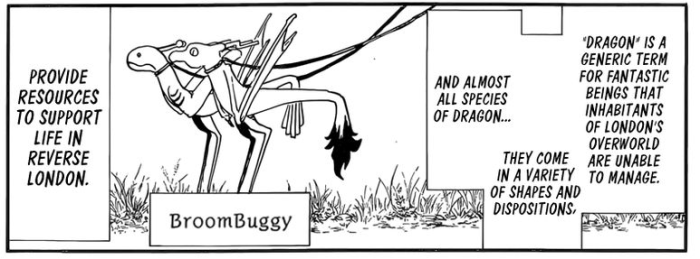
Burn the Witch is about Anglo-Japanese school children fighting demons in fantasy Britain. The twist? Unlike their counterparts in fantasy Mexico, the British demons (referred to as ‘Dragons’ in-series) aren’t killed outright. Instead they are raised for the resources they provide. Only ‘bad’ demons who are killing humans or otherwise causing destruction are killed. It is noteworthy that the protagonists refer to themselves as ‘conservationists’. They kill the occasional demon, providing the story with action scenes when doing so, but their primary purpose is to conserve them. In an off hand comment the protagonists note that their fantasy Mexican counterparts are barbaric and indiscriminately kill their demons.
Contrary to the protagonist’s comments, it isn’t that individual fantasy Mexicans are barbaric so much that fantasy Mexico doesn’t recognize property rights in demons. Since no one has a property right in demons, no one has an incentive to conserve, much less domesticate, them in fantasy Mexico. Fantasy Britain enjoys strong property rights and consequently has minimal problems associated with its demons. One of the protagonists is ethnically from fantasy Mexico, but seems to be thriving under fantasy Britain’s rules. The story’s lesson? Property rights matter.
Only one chapter of Burn the Witch has been published thus far, and it’s unclear if it’ll become a recurring series, but I like what I’ve seen so far.
Thoughts? Comments? As always, write in the comments below. If you’re a fan of animation and a fellow libertarian, consider joining the anime libertarian alliance facebook group.
Eye Candy: Japanese anti-Russian propaganda
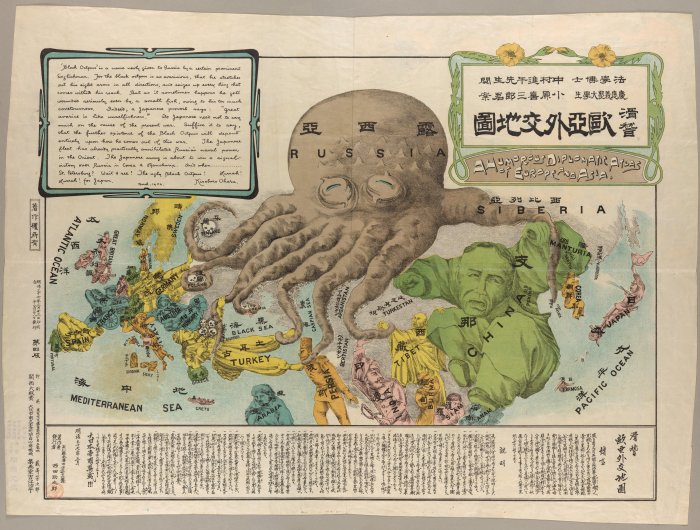
This dates from the late 19th or early 20th century. The Japanese won the Russo-Japanese War, but a quick glance at the casualties suggests it was more a pyrrhic victory for the Japanese.
The Indo-Pacific narrative, US insularity, and China’s increasing influence
Over the past year, there has been a growing interest with regard to the vision of a Free and Fair ‘Indo-Pacific’. While this term has been used in recent years by policy makers from the US and Australia and has been pushed forward by a number of strategic analysts, a number of developments since last year have resulted in this narrative gaining some sort of traction.
US President Donald Trump, during his visit to South East Asia and East Asia in November 2017, used this term on more than one occasion, much to the discomfort of China (which prefers ‘Asia-Pacific’). On the eve of his visit to India last year, Former Secretary of State Richard Tillerson, while speaking at the Centre for Strategic and International Studies (CSIS, Washington DC), explicitly mentioned a larger role for India in the Indo-Pacific, and the need for India and US to work jointly. Said Tillerson:
The world’s center of gravity is shifting to the heart of the Indo-Pacific. The U.S. and India, with our shared goals of peace, security, freedom of navigation, and a free and open architecture, must serve as the Eastern and Western beacons of the Indo-Pacific, as the port and starboard lights between which the region can reach its greatest and best potential.
In November 2017, the Quad grouping (Australia, US, India, and Japan) met on the sidelines of the ASEAN Summit pitching not just for a rules based order, but also in favour of enhancing connectivity. Commenting on the meeting, an official statement from the US Department of State had said that the discussions were important and members of the Quad were “committed to deepening cooperation, which rests on a foundation of shared democratic values and principles.”
Earlier, too, the four countries had coalesced together, but as a consequence of Chinese pressure, the grouping could not last.
There have also been discussions of coming up with connectivity projects. This was discussed during Australian Prime Minister Malcolm Turnbull’s meeting with Donald Trump in February 2018, and between representatives of Japan, the US, and India in April 2018 when the three sides met in New Delhi, committing themselves to furthering connectivity between the countries.
China Factor
While members of the Quad have continuously denied that the Indo-Pacific concept is specifically targeted at China, it would be naïve to believe this assertion. In fact, during a visit to Australia, French President Emmanuel Macron, who is trying to position himself as one of the frontline protagonists of liberalism in the Western world, spoke about the need for India, Australia, and France to work together in order to ensure a rules-based order. Commenting on the need for India, France and Australia to jointly work for a rules based order, and checking hegemony (alluding to China), the French President stated:
What’s important is to preserve rules-based development in the region… and to preserve necessary balances in the region….It’s important with this new context not to have any hegemony.
Evolving relationship between China-India and China-Japan
While it is good to talk about a rules-based order, and a Free and Fair Indo-Pacific, it is important for members to do a rational appraisal of ensuring that the Indo-Pacific narrative remains relevant, especially in the context of two important events. First, the reset taking place between India-China, and second, the thaw between Japan-China.
This has already resulted in some very interesting developments.
First, Australia was kept out of the Malabar exercises last June (Japan, US, and India participated). Australia is a member of the Quad alliance and has been one of the vocal protagonists of the Free and Fair Indo-Pacific narrative. Canberra has also expressed vocally the need for a greater role for India in the Indo-Pacific. Australia has on more than one occasion expressed its desire to participate in the Malabar Exercises.
Many argue that the decision to exclude Australia from the exercises is a consequence of the significant shift taking place in India-China relations, though India has been dismissive of this argument.
Second, Japan has expressed its openness to participate in China’s Belt and Road Initiative (BRI) as long as international norms are met. During meetings between the Chinese and Japanese Foreign Ministers in April 2018, the Chinese Foreign Minister, Wang Yi, said such a possibility was discussed. Japanese Prime Minister Shinzo Abe, who is seeking to improve ties with China, recently reiterated the potential of the Belt and Road Initiative in giving a boost to the regional economy.
It would be pertinent to point out that a number of Japanese companies are already participating in countries which are part of the Belt and Road Initiative.
Interestingly, the Japanese-led Asian Development Bank (ADB), which has been funding many projects (spearheaded by Japan) projected to be components of the Indo-Pacific strategy, has even gone to the extent of stating that it does not perceive the Chinese-led Asian Infrastructure Investment Bank (AIIB) as a threat. Commenting on the possibility of cooperation between ADB and AIIB, the President of ADB, Takehiko Nakao, stated that “AIIB, it’s not the kind of threat to us. We can cooperate with AIIB because we need larger investment in Asia and we can collaborate.”
Where does the Indo-Pacific move from here?
In terms of strategic issues, especially ensuring that China is not an unfettered influence in the region, the narrative is relevant. The Chinese approach towards Indo-Pacific and Quad as being mere froth is an exaggeration. Addressing a press conference on the sidelines of the National People’s Congress, China’s Foreign Minister, Mr. Wang, had stated that there was “no shortage of headline grabbing ideas” but they were “like the foam on the sea” that “gets attention but will soon dissipate.”
Similarly, in terms of promoting democratic values it certainly makes sense. The real problem is in terms of connectivity projects (beyond India-Japan, none of the members of the Quad have elaborated a coherent vision for connectivity). The US has spoken about an Indo-Pacific Economic Corridor, but given the Trump Administration’s approach, it remains to be seen to what extent this can be taken further. While Australia has been steadfast in its opposition to China’s growing economic clout, it has its limitations, especially in terms of funding any concrete connectivity projects. Possible regions where Australia could play a key role should be identified.
Conclusion
It is fine to speak in terms of certain common values, but to assume that China can be the only glue is a bit of a stretch, especially given the fact that it has strong economic ties with key countries pushing ahead the Indo-Pacific vision. It is also important for the Indo-Pacific to come up with a cohesive connectivity plan. Currently, the narrative seems to be driven excessively by strong bilateral relationships, and the individual vision of leaders.
Lunchtime Links
- 25 years after Waco | Freedom of Conscience and the Rule of Law
- The US-Japan Alliance and Soviet competition | Some thoughts on “Thinking About Libertarian Foreign Policy”
- Japan’s rent-a-family industry | In Search of Firmer Cosmopolitan Solidarity
- The story of the skull of a victim of the Indian Uprising of 1857 | Myths of Sovereignty and British Isolation, III
- Reviving India’s classical liberal party | Classical Liberalism and the Nation State
- The decline of regional American art | A History of Regional Governments
- Michelle Pfeiffer keeps getting better and better | On the paradox of poverty and good health in Cuba
- “It was the most devastating loss in the history of the Library.” | No, natural disasters are not good for the economy
“Horrors Didn’t End When Bataan Death March Did”
That’s the title of last week‘s Tuesday post over at RealClearHistory. I’ve been so busy I forgot to share it here. Check it out:
Camp O’Donnell was no relief from the Death March of Bataan. In it, disease spread like wildfire and starvation was rampant. The Japanese, who were fighting Americans elsewhere and Filipino guerrillas close by, had no empathy for their prisoners. The prisoners who survived the harsh march from Bataan had another 3 ½ years of hard manual labor in prison camps to look forward to, if they survived the horrific conditions of the camps.
As the Allies began slowly retaking the Philippines from Japanese forces, these prisoners of war were shipped from one of the 70 prisoner camps on the archipelago to China and Japan itself to continue their slave labor for the Empire. The Japanese shipped these prisoners to the mainland on unmarked vessels, a violation of the Geneva Conventions, and it’s possible that the American and British Navies may have inadvertently sunk a number of these vessels.
Please, read the rest.
Recent developments in the context of Indo-Pacific
At a time when a massive churn is taking place in the Donald Trump Administration (HR Mcmaster was replaced as head of the NSA by John Bolton, while Secretary of State Rex Tillerson was replaced with the more hawkish Mike Pompeo), Alex Wong, Deputy Assistant Secretary of State for East Asian and Pacific Affairs, gave a briefing with regard to the US vision for ‘Indo-Pacific’ strategy, on April 3, 2018 (a day before a trilateral dialogue took place between senior officials from India, Japan and US). Wong outlined the contours of the strategy, and spoke not just about the strategic vision, but also the economic vision of the US, with regard to the Indo-Pacific.
A backgrounder to the Indo-Pacific, Quad, and the China Factor
For a long time, the US referred to the region as ‘Asia-Pacific’ (which China prefers), but the current Trump Administration has been using the term ‘Indo-Pacific’. During his visit to East Asia and South East Asia, in November 2017, the US President had used the term more than once (much to the discomfort of China) giving a brief overview of what he meant by a ‘Free and Fair Indo-Pacific’. While speaking to a business delegation at Asia-Pacific Economic Cooperation, Trump spoke about ‘rule of law’ and playing by the rules. Former Secretary of State Rex Tillerson had referred to the Indo-Pacific and the Quad Alliance (consisting of US, India, Japan, and Australia) in an address at the Center for Strategic and International Studies (a Washington think tank) in October 2017, a week before his India visit.
In order to give a further thrust to the Quad, representatives of all four countries met on the eve of East Asia Summit in Manila. A statement of the Indian Foreign Ministry said: Continue reading
3 key problems with Trump’s style of functioning
The removal of Rex Tillerson as Secretary of State (who was replaced by Mike Pompeo, Director of the CIA) reiterates three key problems in US President Donald Trump’s style of functioning: First, his inability to get along with members of his team; second, impulsive decisions driven excessively by ‘optics’ and personal chemistry between leaders; and, finally, his inability to work in a system even where it is necessary.
Tillerson, who had differences with Trump on issues ranging from the Iran Nuclear Deal (which Trump has been wanting to scrap, though his stance was moderated by Tillerson) to the handling of North Korea, is not the first member (earlier senior individuals to be sacked are, amongst others, Michael Flynn, who was National Security Adviser, and Chief Strategist Steve Bannon) to exit hurriedly. Gary Cohn, Director of the National Economic Council, quit recently after opposing the US President’s tariffs on imports of steel and aluminium.
The US President tweeted this decision:
Mike Pompeo, Director of the CIA, will become our new Secretary of State. He will do a fantastic job! Thank you to Rex Tillerson for his service! Gina Haspel will become the new Director of the CIA, and the first woman so chosen. Congratulations to all!
The US President admitted that Tillerson’s style of functioning was very different from his own (alluding to the latter’s more nuanced approach on complex issues).
Interestingly, the US President did not even consult any of his staff members, including Tillerson, before agreeing to engage with North Korean Dictator Kim Jong Un. The South Korean National Security Advisor, Chung Eui Yong, had met with Trump and put forward the North Korean dictator’s proposal of a Summit.
The US President agreed to this proposal. Commenting on his decision to engage with Kim Jong Un, Trump tweeted:
Kim Jong Un talked about denuclearization with the South Korean Representatives, not just a freeze. Also, no missile testing by North Korea during this period of time. Great progress being made but sanctions will remain until an agreement is reached. Meeting being planned!
While Chung stated that the Summit would take place before May 2018, White House has not provided any specific dates.
There is absolutely no doubt that, at times, bold steps need to be taken to resolve complex issues like North Korea. Trump’s impulsive nature, however – refusing to go into the depth of things or seeking expert opinion – does not make for good diplomacy.
In fact, a number of politicians and journalist have expressed their skepticism with regard to where North Korean negotiations may ultimately lead. Ed Markey a Democratic Senator from Massachusetts, stated that Trump “must abandon his penchant for unscripted remarks and bombastic rhetoric to avoid derailing this significant opportunity for progress.”
In a column for the Washington Post, Jeffrey Lewis makes the point that there is a danger of Trump getting carried away by the attention he receives. Says Lewis in his column:
Some conservatives are worried that Trump will recognize North Korea as a nuclear-weapons state. They believe that an authoritarian North Korea will beguile Trump just as it did his erstwhile apprentice, American basketball player Dennis Rodman. They fear that Trump will be so overjoyed by the site of tens of thousands of North Koreans in a stadium holding placards that make up a picture of his face that he will, on the spot, simply recognize North Korea as a nuclear power with every right to its half of the Korean peninsula.
All Trump’s interlocutors have realized that while he is unpredictable, one thing which is consistent is the fact that he is prone to flattery. During his China visit, for instance, Trump was so taken aback by the welcome he received and the MOU’s signed with Chinese companies that he started criticizing his predecessors.
Finally, while Trump, like many global leaders, has risen as a consequence of being an outsider to the establishment, with people being disillusioned with the embedded establishment, the US President has still not realized that one of Washington’s biggest assets has been strategic alliances like NATO and multilateral trade agreements like NAFTA. The United States has also gained from globalization and strategic partnerships; it has not been one way traffic.
It remains to be seen how Tillerson’s removal will affect relations with key US allies. If Trump actually goes ahead with scrapping the Iran nuclear deal (2015), it will send a negative message not just to other members of the P5 grouping, but also India. In the last three years, India has sought to strengthen economic ties with Iran and has invested in the Chabahar Port Project. New Delhi is looking at Iran as a gateway to Afghanistan and Central Asia. If Tillerson’s successor just plays ball, and does not temper the US President’s style of conducting foreign policy, there is likely to be no stability and consistency and even allies would be skeptical.
Japan on its part would want its concerns regarding the abduction of Japanese citizens by Pyongyang’s agents, decades ago, to not get sidelined in negotiations with North Korea. (13 Japanese individuals were abducted in 2002, 5 have returned but the fate of the others remains unknown.) Prime Minister Shinzo Abe has made the return of the abductees a cornerstone of his foreign policy, and his low approval ratings due to a domestic scandal could use the boost that is usually associated with the plight of those abductees.
The removal of Tillerson underscores problems with Trump’s style of functioning as discussed earlier. The outside world has gotten used to the US President’s style of functioning and will closely be watching what Tillerson’s successor brings to the table.
Quad: The way ahead and the key challenges
The Quadrilateral Security Dialogue (QSD) consisting of India, Australia, Japan, and the US has been pitching in favor of a ‘Free and Fair Indo-Pacific’ ever since the first meeting between representatives of member states in November 2017.
Shinzo Abe, the current Prime Minister of Japan, actually proposed this arrangement about a decade ago. Diplomatic engagement began, and joint military exercises were even held, but a change in guard in Australia, as well as Chinese complaints to member states, resulted in the end of the arrangement. Given the increasing focus on the ‘Indo-Pacific’ region and the strengthening of strategic ties between all four countries, reticence was finally shed and representatives of the four countries met in November 2017, on the eve of the East Asia Summit in Manila. The main aim of the alliance, thus in other ways, has been to check China’s assertiveness, especially in the South China Sea, and democracy has been one of the key binding factors between the Quad. The U.S. State Department, after the meeting in November 2017, issued a statement that the United States is “committed to deepening cooperation, which rests on a foundation of shared democratic values and principles.”
More recently, the joint statement issued after the meeting between Trump and Australian Prime Minister Malcolm Turnbull in February 2018, reiterated the point about a Free and Open Indo-Pacific. Said the joint statement between both countries: Continue reading
Nightcap
- Victor Hugo’s surreal, forgotten art Andrew Hussey, 1843
- Was Roosevelt’s “Europe First” Policy A Mistake? Salvatore Babones, Asian Review of Books
- Your God is Our God Elliot Kaufman, Claremont Review of Books
- The Seduction of the Gun Matt Lewis, Los Angeles Review of Books
Japanese adoption
A recent article in the Economist describes the results from a study of an interesting Japanese custom. Traditionally (and according to the civil code until 1945), company ownership and leadership were passed on through primogeniture. This custom has continued to be practiced, and the study found solid evidence that family-managed companies outperform professionally managed companies. It could be argued that family unofficial training, continuity, and trust are at the root of this, but the authors find a different reason: adoption.
Japan and the US lead the world in adoption rate, but Japanese adoption is not necessarily what you would think. Over 90% of Japanese adoptions are of adults, who are usually men adopted into childless (or more specifically son-less) families for business purposes. This is also quite traditional, and since Japanese birth rates are extremely low, Japanese businessmen are likely to continue adopting talented, ambitious single men. This is often also accompanied by marriage to the daughter of the businessman (while women participate in business in Japan, they are more rarely the executives), which is referred to as mukoyoshi and combines familial with business ties.
This practice has the advantage of allowing for the trust, mutual investment, and long-term planning and teaching based on family relationship while avoiding the risk of having an unfit successor. In fact, in reading this, I am reminded of another culture’s custom of adoption: ancient Rome.
Ancient Rome also had a custom of adoption among its upper classes because of the prestige associated with old patrician family names and the incentives of inheritance laws (for a time it also served as a political means of a patrician gaining the tribuneship, as the Gracchi did). Similarly to the Japanese businessmen, adopted sons tended to excel (the earliest and best example is the Republican general Scipio Aemilianus), and it served as a method of political alliance and developing shared interest. It also became a typical method of succession for Roman emperors in the case that no son was available, a deal needed to be made between factions, or an emperor had a favored successor to whom he was not related. Adopted emperors included Trajan (adopted by Nerva as deal with the army, successful and beloved military leader), Hadrian (great builder and patron of the arts), and Marcus Aurelius (famed general and philosopher), and were generally well-reputed and effective leaders. In contrast, the sons of emperors (such as Domitian and Commodus, who were both infamously insane and harmful, or Maxentius, whose usurpation followed a blood-based claim) or blood-based successors (such as Caligula, who was blood-thirsty and childish, Nero, who was brutal and wasteful, and Elegabalus, who had was more interested in orgies than leadership).
It seems that the same potential reasons underlying Japanese business success through adoption were also at work in antiquity: emperors who were chosen and bred based on their abilities provided the continuity associated with heredity but with the advantage of meritocratic selection. This raises the question of whether this advantage has somehow been passed over by the Western world in those cases where we have avoided family-based succession in business (based on worries about nepotism and/or to gain the advantages of meritocratic selection). Even more interesting, does the adoption practice maintain the freedom of choice and opportunity found in Western careers while also conferring the ability to maintain trust and continuity that family-based succession offers?
Geopolitics and Asia’s Little Divergence: State Building in China and Japan After 1850
Crossposted at the Medium
Why did Japan successfully modernize in the 19th century while China failed to do so? Both China and Japan came under increasing threat from the Western powers after 1850. In response, Japan successfully undertook a program of state building and modernization; in China, however, attempts to modernize proved unsuccessful and the power of the central state was fatally weakened. The failure to build a modern state led to China’s so-called lost century while Japan’s success enabled it to become the first non-western country to industrialize. In a paper with Chiaki Moriguchi (Hitotsubashi University) and Tuan-Hwee Sng (NUS), we explore this question using a combination of historical evidence and formal modeling.
On the surface this East Asian “little divergence” is extremely puzzling. Qing China, as late as the end of the eighteenth century, was a powerful centralized empire. An impersonal bureaucracy selected by exams, and routinely rotated, governed the empire. In contrast, the institutions of Tokugawa Japan are usually described as feudal. The shogun directly ruled only 15% of the country. The remainder was divided into 260 domains ruled by lords known as daimyo who collected their own taxes, possessed their own armies, and issued their own currencies. To the outside observer China would have seemed much more likely to have been able to establish the institutions or a centralized state than Japan.
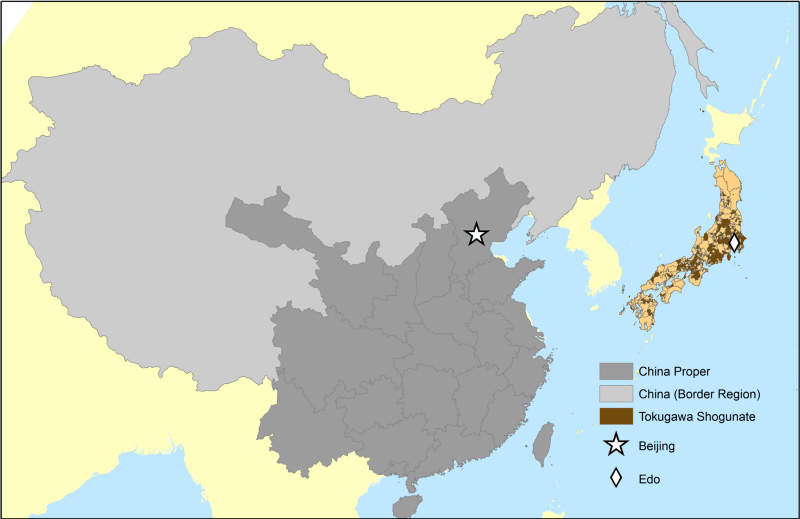
For much of the early modern period (1500–1700) China and Japan possessed military capabilities that made them more than a match for any western power. This changed dramatically after the Industrial Revolution and their vulnerability exposed by the Opium War (1839–1840) and the Black Ships Incident of 1853, respectively. During the First Opium a small number of British ships overpowered the entire Chinese navy, while Commodore Perry’s show of force in landing in Japan in 1853 convinced the Japanese of western naval superiority. Within a few years, political elites in both countries recognized the need to modernize if only to develop the military capacity required to fend off this new danger.
* * *

In China, after the suppression of the Taiping Rebellion, there were attempts at modernizing — notably the Self-Strengthening movement associated with Li Hongzhang and others. Recent scholarship has reevaluated this movement positively. At the purely military-technological level it was in fact quite successful. The Jiangnan Arsenal and the Fuzhou Shipyard saw the successful importation of western military technology into China and the Chinese were soon producing modern ships and weaponry. However, these developments were associated with a process of political decentralization as local governors took on more and more autonomy. The importation of military technology was not associated with more far-reaching societal or political reforms. There was no serious attempt to modernize the Qing state.
In contrast, Japan, following the Meiji Restoration, embarked on whole scale-societal transformation. The daimyo lost all power. Feudalism was abolished. Compulsory education was introduced as was a nationwide railway system. A new fiscal system was imposed in the teeth of opposition from farmers. The samurai were disarmed and transformed from a military caste into bureaucrats and businessmen.
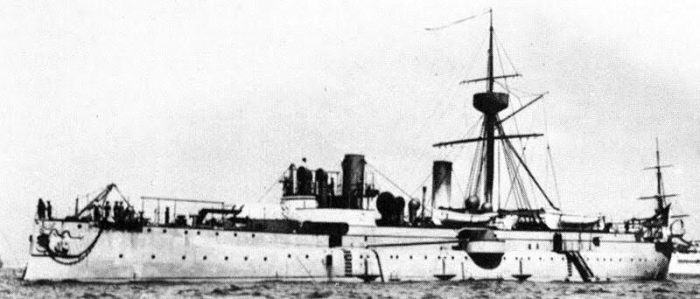
Qing China and the newly modernized Meiji Japan would collide in the first Sino-Japanese war (1894–1895). Before the war, western observers believed China would win in part because of their superior equipment. But the Chinese lacked a single national army. It was the Beiyang army and the Beiyang fleet that fought the entire Japanese military force. The fact that Japan had undergone a wholesale transformation of society enabled them to marshal the resources to win a rapid victory.
* * *
Why did the Japanese succeed in modernizing while Qing China failed to do so? Historians have proposed numerous explanations. In our paper, however, rather than focusing on cultural differences between Japan and China, we focus on how different geopolitical incentives shaped their decisions to invest in state capacity and state centralization.
Before the mid-19th century China only faced a threat from inner Asia from where historically nomadic invasions had routinely invaded and threatened the sedentary population of the Chinese plain. Due to this threat, historically China tended to be a centralized empire with its capital and the bulk of its professional army stationed close to the northern frontier (see Ko, Koyama, and Sng (2018)). In contrast, Japan faced no major geopolitical threats prior to 1850. This meant that it could retain a loose and decentralized political system.
After 1850 both countries faced major threats from several directions. China was threatened on its landward borders by Russian expansionism and from the coast by Britain and France (and later Germany and the United States). Japan was threatened from all directions by western encroachment.
We build a simple model which allows for multidirectional geopolitical threats. We represent each state as a line of variable length. States have to invest in state capacity to defend against external geopolitical threats. Each state can use centralized fiscal institutions or decentralized fiscal institutions.
If there is strong threat from one direction, as China faced prior to 1850, the dominant strategy is political centralization. In the absence of major geopolitical threats decentralization may be preferable as was the case in Tokugawa Japan.
The emergence of a multidirectional threat, however, changes things. A large country facing a multidirectional threat may have to decentralize in order to meet the different challenges it now faces. This is what happened in China after 1850. In contrast, for a small state with limited resources, an increase in the threat level makes centralization and resource pooling more attractive. For a small territory like Japan, the emergence of non-trivial foreign threats renders political decentralization untenable.
We then consider the incentives to modernize. Modernization is costly. It entails social dislocation and creates losers as well as winners, the losers will attempt to block any changes that hurt their interests. We show that for geographically compact polities, it is always a dominant strategy to modernize in the face of a multidirectional threat as the state is able to manage local opposition to reform. This helps to explain why all members of the Japanese political elite came around to favoring rapid modernization by the late 1860s.
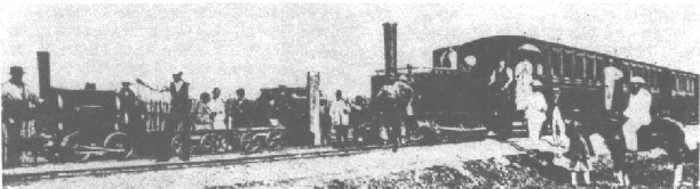
Consistent with our model, modernization was more difficult and controversial in China. The Qing government and particularly the Empress Dowager famously opposed the building of railroads. The most well-known example of this was the Wusong Road in Shanghai. Built using foreign investment it was dismantled in 1877 after locals complained about it. The Qing state remained reactive and prepared to kowtow to local powerholders and vested interests rather than confront them. Despite local initiatives, no effort was made at wholesale reforms until after China’s defeat at the hands of Japan in 1895.
* * *
By 1895 it was too late, however. The attempts of the Qing state to reform and modernize led to its collapse. Needless to state, East Asian’s little divergence would have lasting consequences.
Japan’s modernization program astonished foreign observers. Victory over Russia in 1904 propelled Japan to Great Power status but also set Japan on the path to disaster in the World War Two. Nevertheless, the institutional legacy of Japan’s successful late 19th century modernization played a crucial role in Japan’s post-1945 economic miracle.
Following the collapse of the Qing dynasty China fragmented further entering the so-called warlord era (1916–1926). Though the Nationalist regime reunified the country and began a program of modernization, the Japanese invasion and the Second Sino-Japanese War (1937–1945) devastated the country. The end result was that China came to be reunified by the Communist party and to experience more conflict and trauma until it began to embrace market reforms after 1979.
Trump’s Inauguration: Ageing Pains

Vincent has discussed the relative age of US presidents. There is something to be said about the age of electorates.
I was living in the United Kingdom when we voted for Brexit (I was a soft remainer). I was living in the United States when Trump won the election. So I can’t help but feel that Trump’s inauguration is part of a generalised nationalist turn that, ironically, transcends national borders. Why is this nationalist turn happening? And why has it wrong-footed pollsters and political scientists more than once now?
We are repeatedly, and correctly, warned not to over-interpret individual events as somehow determined by given factors. Both the Brexit vote and the presidential election were close, with Trump taking the electoral college without the popular vote. One domino that didn’t fall last year was the Austrian presidency that, after a close call, went to a Green rather than a Nationalist. So whatever explanation we are looking for has to be a tendency that’s slightly shifted the odds in favour of nationalist politicians without the experts being able to anticipate it in advance.
Some suggest that this resurgent economic nationalism is an inevitable outcome of the overreach of trade liberalisation that has undermined national self-determination and humiliated local cultures. Others argue that the real cause is growing income and wealth inequality. I think a potentially more straightforward factor is demography. The electorate is simply older than it used to be.
There are a few reasons why this explanation may work better than the more popular ones. The ageing electorate is almost unprecedented in history. This could make it harder for political scientists to predict its impact on elections. Surveys might be able to tell us how older people vote as individuals without being able to work out how older people surrounded, in addition, by lots of older peers will behave.
Countries like Italy and Japan were somewhat ahead of us on this demographic transition. And perhaps not entirely coincidentally, Italy repeatedly elected a mini-Trump, Silvio Berlusconi as Prime Minister, while continuing to support the elderly at the expense of opportunities for the young. Meanwhile, Japan has always been more ethno-nationalist than other developed economies and in some ways has grown more politically reactionary in recent decades.
This explanation chimes with the fact that Trump voters were not typically economically disadvantaged. They were older and less educated but typically economically secure. Age was also a big factor explaining support for Brexit. At the same time, an ageing population presents real economic challenges that translate into politically salient problems. Demography is probably responsible for a great deal of the sustained drop in real interest rates, precisely the sort of thing that worries ageing savers with slowly growing pension pots.
Trump wants to boost infrastructure, construction and manufacturing. But these sectors do best with young and growing populations, where families want new and bigger houses and offices, roads to connect them and cars to drive to and from them. What happens when everyone already has a great deal of material goods and a country hasn’t got as many young adults to demand new stuff? Inevitably, an economy’s trend growth declines and may even contract, leaving investors with fewer places to get a good return.
What could this mean about the future? On the one hand, this could be quite a pessimistic explanation. There is very little that can be done in the short or medium term about the demographics of an electorate. So we might just be in for a more reactionary period. The vote is not about strength of belief, just the sheer numbers nudged in that direction, and that is what age can do.
On the other, this could be an optimistic hypothesis. The situation we find ourselves in is a side-effect of two generally attractive outcomes: people living much longer, and lower fertility thanks to women becoming more educated. The balance between the young and the elderly might eventually improve once the demographic bulge of the baby boomers has passed into history (this depends critically on whether institutions permit new family formation). In addition, tomorrow’s elderly are not the same as today’s elderly. They will probably be more educated, less nationalist and possibly less subject to cognitive decline than the current generation. They are less likely to be impressed by a bad sales pitch.
 Notes On Liberty