The Nice Massacre

Following the massacre in Nice yesterday, I am hearing comments on radio that, together, would have one believe that it could not happen here, that it’s somehow the fault of the French themselves. I think that’s a dangerous dream.

Americans have to get past the Irma la Douce fantasy about France that many still shelter in their hearts. The French do not wile away their days at sidewalk cafes terraces brimming with insouciance. (That means a “devil-may care” attitude.) France is an industrial society pretty much like the US though without most of the inventiveness. Its economic policies for the past twenty years have been stinky. The causes of the French stagnation would sound familiar to any Bernie Sanders supporter. The current government of the Socialist Party differs from the Obama administration in matters of degree only. The same la-la-la Land dream occupies the minds of most of the French Left as of most American liberals. If anything, the French tend to be more realistic because they have had more experience of its failures.

It’s not the case that France has had an open borders policy as I have heard say on conservative radio today. Nevertheless, for historical reasons, France probably has many more Muslims proportionately than the US has. “Probably” because no one knows who is really a Muslim; no one really knows who is really a Catholic. The only thing that’s more or less known is the number of Muslims names. There are many. Most are French citizens by birth.

The current French Minister of Labor has a Muslim name. People with Muslim names are present throughout all levels of French society. They are in banking, in entertainment. The most popular French citizens probably have Muslims names; they are in sports. By and large, such people are well integrated within a mostly religiously indifferent French society. That is, as well as can be done within an economically stagnant society with a permanent unemployment rate of 10%, 20% for the young. How much discrimination there is against people with Muslim names is anyone’s guess. The fact is that immigrants with Muslim names keep trying hard to move to France. Not many try to move to Egypt or even to Saudi Arabia, for example, where the fate of immigrants may be even worse.

This large population with Muslim names is seen from the US as providing a bottomless pool of jihadist recruits. That’s true but it should also be an asset in combating violent jihadism. Thousands of French police personnel have Muslim names. (The police officer murdered outside Charlie Hebdo was one such.) Hundreds if not thousands of police and other security personnel are fluent in diverse dialects of Arabic. This is more, of course, than can be said of their American counterparts.

The French intelligence services have earned the respect of their allies. The country was not caught sleeping after the Bataclan slaughter. It had been under a state of emergency lightly suspending some personal rights. The state of emergency was slated to be removed in the coming days. Perhaps, someone did not want it to stop although it’s hard to believe given how light it was.

As I write on July 15th, there has been no claim by any Islamist organization. The only thing known is that the driver of the truck, the murder weapon, was a person of Tunisian origin who was probably a French citizen. That’s not enough to prove a link to Islamist terrorist organizations. The man was known to the police as a petty criminal (a familiar story). Note that a petty criminal is one who is not very successful, one at the bottom of the criminal pecking order. He was also undergoing a difficult divorce. I speculate that jihadist organizations provide people of Muslim origin undergoing personal difficulties a high-sounding excuse for venting their anger on the innocent many.

If there was indeed an involvement of ISIS or Al Qaida, no reason for the attack on civilians need to be found. They hate Westerners, irrespective of what Westerners actually do. The fact that France has been publicly involved in fighting Islamist terrorism in two theaters – in Iraq next to the US and in Mali may have made it a priority target for jihadists.

With this group assassination the lack of scruples of violent jihadists is confirmed again. Given the number of victims, the circumstance and the location of the crime, there is a 100% certainty that some of the victims have Muslim names. (By the way, the best video of the event was supplied by an Egyptian tourist.) I wonder if this is going to prompt Muslim organizations everywhere, including in the US, to do more than passively deplore the crime. I wonder if this is going to lead to request for energetic surveillance measures involving the breeding marshes of violent jhadists, which are not Lutheran seminaries or Buddhist monasteries. I ask because, under Obama, in this country, we are paralyzed by political correctness as if avoiding bruising the feelings of some was well worth a few hundred blown up civilians here and there.

Classical Liberalism, Cosmopolitanism and Nationalism

In another thought-provoking post on Facebook (does the guy ever write mediocre stuff, I wonder?) Barry raised the question of the relation between classical liberalism, nationalism and cosmopolitanism. He wrote the following:

“On the capture of classical liberal/libertarianism by anti-cosmopolitans. This is very influential at the heart of the ‘leave’ ‘elite’ in the UK, and can only be destructive of classical liberalism/libertarianism. The immediate political consequence of Leave is the elevation of Theresa May to Tory leadership/Prime Minister’s office on a much more ‘Red Tory’, communitarian, corporatist foundation than existed under Cameron. ’To the extent to which the current wave of populism maps into a conflict over national versus transnational identity (Dan Drezner is unconvinced), the problem is not an excess of cosmopolitanism but rather its absence, especially on the conservative, free-market right.”

He seems to take a positive relation between classical liberalism and cosmopolitanism as the default position. Of course Barry did not provide definitions in a FB post, but here I take cosmopolitanism to mean “the idea that all human beings, regardless of their political affiliations, belong to a common moral community. Cosmopolitans often believe that all individuals have the same basic moral status, and tend to downplay the importance or desirability of national political institutions. [They are] opposed to nationalism” (source: Matt Zwolinski (editor), Arguing About Political Philosophy, Routledge, 2009).

I argue that Barry overlooks that classical liberalism combines a cosmopolitan side, with a strong defense of national political institutions (e.g. the state). The cosmopolitan side is perhaps easiest to see, if one takes the idea of free trade as the guiding principle. Free trade is by nature morally neutral for the individuals involved, and has numerous positive economic effects; it fosters cultural exchange as well as innovation and knowledge sharing. In that sense classical liberalism is indeed related to cosmopolitanism.

Yet this stops where the national state comes into play. Classical liberals never predicted any positive political effects of trade (see my earlier notes on this topic) and, just as importantly, they actually favor a strong state, with a limited number of tasks. At the same time, from Hume and Smith onwards to Mises and Hayek, they strongly dislike the idea of transnational political institutions, because these lack any substantial emotional basis which nations do posses. Also, these large political institutions easily become a threat to individual liberty, even more so than national states with too many tasks. So, there is no really no relations between political cosmopolitanism and classical liberalism at all.

There is also no relation between nationalism and classical liberalism. A preference for the national state does not lead to nationalism, which is the vicious and poisonous belief in the superiority of one’s country, often accompanied with a dislike of allegedly inferior neighboring countries or peoples or groups. This is collectivism turned even worse, which is a double ‘no’ from a classical liberal perspective. This said, if patriotism is defined as national pride, then classical liberalism and patriotism can and will go together. There is a fine line between the two sometimes, but patriotism is not violent and dividing, but a binding force between individuals sharing a national state.

The last point is on the European Union. Hayek and Mises have been on record with strong support for a European Federation, primarily as a remedy to war-torn and nationalism-infected Europe. In these circumstances the default position of an international order as a society of states no longer functioned, so there was a need to seek an alternative. Needless to say their federation had little resemblance with the current super state we know as the European Union, which has become a classical liberal nightmare in terms of liberty and property rights violations it commits on a daily basis.

The current EU has some classical liberal traits (the imperfect common market is the single most important one), which is of tremendous use to all European individuals. It is, however, way too cosmopolitan in the bad political way. A likely consequence of Brexit is that this will become even worse, now that the French and their allies will get more room for their collectivist fallacies.

Dear Bernie Supporter: Keep an eye on foreign news

Widespread strikes in France, many turning violent. There are big-time shortages of gasoline so that many people can’t go to work if they want to. The strikes are not directed against “the corporations.” They are directed squarely at the government. What government? The government of the French Socialist Party. That’s an instance of “democratic socialism” if there was ever one.

What did the Hollande government do to attract such working class anger? It has tried to modify slightly the labor laws, to make it easier for example, for employers to offer more than 35 hours a week to their employees if the latter want them (IF they want them).

France is a country with around 10% unemployment for about twenty years. For the young it’s been around 25% . Also, there has not been real economic growth for about ten years (+1% GDP annual is a cause for celebration). Meanwhile, Germany and Switzerland next door are thriving. A great deal of French public opinion is simply in bad faith and refuses to see the obvious: If it’s too difficult to fire people, employers don’t hire and even suppress growth to avoid hiring.

The Minister of Labor in charge of making the French kiss and even swallow that frog is a woman with an Arab name, a Muslim name. Do I think the French Socialist Party is twisted? I am not sure.

Please, thing of sharing, especially with Sanderites.

Socialism(s) – Part One

Sanders and Me and not so Democratic Socialism

Sen. Sanders got a huge pass this primary season. Captivated by the deep dishonesty of one probable nominee and the crude ignorance of the other (not to mention his plain crudeness), the media, and informal commentators like myself, have not given the Democratic candidate and his program the attention they deserve. Also, in the current primary contest, it’s difficult not to like the guy. I have said several times that he inspires in me a kind of twisted affection. Plus, he has real pluck. But, let’s face it: He is probably done, or done for.

Sen. Sanders has gone very far into the primary while maintaining perfect dignity in his demeanor. He has seldom stooped to personal insults even when he was being severely tried by a Ms Clinton who seems to consider the man’s very candidacy a grave offense, an offense against the natural order of things, a crime of lèse-majesté, even a form of woman abuse. In the meantime Mr Sanders will have single-handedly rehabilitated the word “socialism.” This matters for the future of this nation. Time to look at it critically.

I, personally, especially like Sanders the man. I have reasons to. We are the same age; we went to college at about the same time, both in good universities. He took a fairly active part in the desegregation movement. I did not because it was too early in my American sojourn. (I wish I had taken part.) Nevertheless at age 25, Sanders and I were both leftists. The main difference between us is this: Fifty years later, he has remained impeccably faithful to the ideals of our youth while I walked away, faster and faster, really. I learned to understand the invisible hand of the market. I did some good readings. I was lucky enough to observe my leftists academic colleagues in action at close range early on. Cannily, I observed that the victorious Vietnamese Communist Party did not establish a workers’ paradise in its part of the world. I loathed authoritarianism in any guise. The Senator, meanwhile, spent his honeymoon in the Soviet Union.

When that latter country fell apart and its archives were open, the Senator had nothing to say about the eighty years of mass atrocities they revealed. I am guessing he did not think he had to because he believed in the democratic brand of socialism. It’s hard to tell how much history he knows. (I think that liberals in general are ignorant, including academic liberals. I could tell you stories about them that would raise the hair on the back of your neck.) It does not take much knowledge though to guess that Lenin and the 1916 Bolsheviks did not originally set out deliberately to create a tyranny. Too bad they had to come to power by overthrowing by force of arms a democratically elected government. (See “Kerensky.”) Still, they named the new country “The Union of Socialist Soviet Republics,” and the word “soviet” means “council,” and “republic” means what it means. But, building socialism wasn’t working out; too many people with bad attitudes. So Lenin had to nudge History a little bit with bayonets, with barbed wire, with organized famines and soon, with a bullet to the back of the head of those who stood in the way. The Bolsheviks were forced to choose between socialism and democracy. They chose the former and they got neither. There is no record of Sen. Sanders making any relevant comment. (As always, I am eager to correct my errors.)

It’s less clear whether the Communist Party of China ever had a democratic plan. The unauthorized biography of Mao by his personal doctor reads like a tissue of horrors right from the start. (Dr. Li Zhisui. The Private Life of Chairman Mao, 1994) The Communist Parties of Eastern Europe simply came to power in the wagon train of the Red Army occupying their countries. None of them ever got close to getting there through free elections. The most interesting is the case of East Germany, ruled by a fusion of a native communist party and of preexisting democratic socialist parties. Together, they achieved a fair degree of material success for the East German people yet, they never managed to make do without a police state. Today, Sanders’ backers may not remember or they may not know that the German Democratic Republic, as it was called with a straight face, disappeared overnight. Someone had left a back door open to this paragon of socialist success and the people immediately started voting with their feet by the tens of thousands.

This is all irrelevant, Senator Sanders’ supporters would claim. You are describing a grave perversion of socialism; again, we only want democratic socialism.

During much of my adult life, the ill-defined words “socialism” and “socialist” were used with all kinds of modifiers: “African socialism,” “Arab socialism.” In all cases, the regimes so named led their countries straight to poverty, usually accompanied by official kleptocracy. In India, a really democratic country, the mild Ghandian-Nehruan form of socialism produced deep poverty for two generations including in the large, educated Indian middle class . (Just compare and contrast with un-socialist South Korea which started in 1953, after a devastating war, much poorer than India had been in 1949 when it became independent.) Socialism – whatever that is – is normally the road sign that points toward generalized poverty. Perhaps, this is only the result of a fateful case of reverse magic naming: Call something good, reasonable “socialist” and it begins degrading and sinking! Go figure!

OK, this is all about ancient times, they say. So, let’s look at current examples.

In Venezuela, socialism started under unusually favorable conditions because the country had considerable oil income that minimized the need for high taxation, a major reason for discontent in most socialist experiments. Yet, the socialists in power there made such a mess of it that today, only a few years later, the country suffers about 400% inflation (in 2016). If you had a dollar’s worth of local money there 12 months ago, it now only buys about a quarter’s worth of milk or bread. The skilled middle-class is leaving or trying to. They may return later; or, they may not. If they don’t, it will take a couple of generations at best to rebuild the country’s human capital after the socialist experiment ends.

Note that the sharp drop in world oil prices has affected many countries. It’s only in “Bolivarian” socialist Venezuela that you will see mass exodus and severe shortages of necessities.

In Brazil, The Workers’ Party is in power. The sitting president is a woman whose bona fide, whose socialist credentials are not in question. When she was young, she was imprisoned and even tortured for her belief in socialism, or because she was a guerrilla. (That’s the name for a left-wing terrorist.) She would now be impeached for making up optimistic economic figures for her country, except for the fact that the man constitutionally designated to replace her is also under indictment for corruption. It was bound to happen. The federal government in Brazil eats up 40% of GDP. The huge national oil company, Petrobras is nationalized; it belongs to the government, a favorite socialist arrangement. So oil revenues belong to everyone which means they belong to no one. Why not help myself a little, generations of Brazilian politicians have figured? There are no shareholders to keep tabs and to complain, after all. Socialism and kleptocracy are like father and son.

But, but, you say, those are Third World countries that have not yet recovered from the corrupting influence of colonialism (200 years later). Point well taken. Here is another case I know well, of a socialist country that has not been colonized since about 50 (BC.) France has been under the guiding hand of the French Socialist Party for nearly five years this time around. By the way, France is a democratic country with fair elections and a free press. The Socialists won fair and square. They were in power for 23 of the 35 years since 1981. They largely implemented their program and there were few rollbacks – except by themselves, a few times when they understood the disastrous effects of the reforms they had implemented. I am thinking of a broad de-nationalization of banks in 1981-82. (This is directly relevant to Sen. Sanders’ thinking.)

The French Socialist Party in power never tried to restrict freedom of the press and it did not fill the prisons with its opponents. (Instead, it emptied them hastily of violent criminals, according to its security critics.) By and large, its rule has been quite civilized. There is just that pesky problem of chronic unemployment which never dips much below 10% (25% for the young; sky is the limit if you are young and your name is “Mohamed”). There is also the fact that economic stagnation is now seen as normal by the young. Has been for a couple of generations, now. And then, there is the unbelievable cultural sterility of French society (another story, obviously that I partially tell elsewhere on this blog. Ask me.)

True story: a few months ago, members of the socialist government celebrated loudly. That was because the government office of economic analysis had revised upward its estimate of annual economic growth from GDP: + 0.4% to +0.6% ! (Yes, that’s 6 tenth of one per cent. It’s true that today, in the spring of 2016, it’s at a respectable annual 2% plus.)

“No, no,” cries Sen. Sanders ( and I can almost hear him from here) “I don’t mean ‘socialist’ as in ‘Union of Socialist Soviet Republics,’ and I don’t mean Red China, and I don’t mean North Korea, certainly, and I don’t mean Cuba (although…), and I don’t mean Venezuela today, or Brazil. And, I don’t even mean France although I could not explain why exactly. (Bad call here, Senator. The French single-payer health care system works well; it’s cheaper than US health care, and French men live two years longer than American men.) I mean socialism as in Denmark and Sweden. Now, here we are at last. In part Two, we will look at what passes for Swedish “socialism.” (Denmark is too small to be an example, perhaps.)
Colonialism and Identity in Wasolon (and everywhere else, too)

The notion of the person is constantly renegotiated and is at stake between groups situated within the same political entity as well as between neighboring political entities. With advent of [France’s colonial] district register and the resulting written registration of identity, the notion of a person acquired a greater fixity. It became much more difficult to change identity or even to modify the spelling of one’s first or last name. Since it could no longer affect the components of the person, the negotiation of identity shifted, as in the case of the West, onto other sectors of social and individual life. (135)

This is from the French anthropologist (and high school friend of our own Jacques Delacroix) Jean-Loup Amselle, in his book Mestizo Logics: Anthropology of Identity in Africa and Elsewhere. The book is hard to read. The English translation (the one I’m reading) was published by Stanford University Press in 1998, but the original French language version came out in 1990. Between the translation and the fact that the book was written for specialists in the field of political anthropology and the region of French Sudan, strenuous effort was required on my part to stay focused and motivated to finish the book. The preface alone is worth the price of admission, though, especially if you’ve been following my blogging with any great interest over the years.

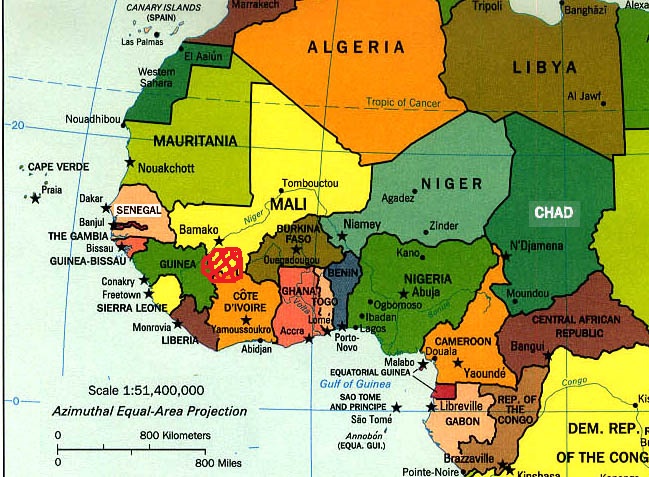
My intent is not to write a review, but rather to build off Amselle’s work and present some of my efforts in blog form here at NOL. But first, a map of the region, Wasolon, that Amselle specializes in:

Wasolon is that big red marking that I've drawn on the map. You can see that it's about as big as Sierra Leone.

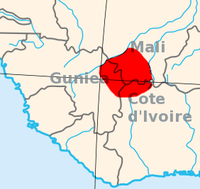
Wasolon is that big red marking that I’ve drawn on the map. You can see that it’s about as big as Sierra Leone. Just for clarity’s sake, here is a second map with a closer view of Wasolon:

blog wasolon 2
Notice the rivers? source: wikipedia

Amselle’s argument for why his approach to identity is superior to others’ is convincing. He performed all of his fieldwork (15 years’ worth as of 1990) in Wasolon, or briefly in neighboring areas, reasoning that “research within numerous regions of a well-circumscribed area […] has allowed me to observe systems of transformation [in] societies that have been in contact for centuries. This has protected me from being forced into large analytical leaps and from engaging in [the current anthropological trends of] abstract comparativism and the identification of structures (xii-xiii).” This defense of his methodology, coupled with his insights on French colonial administration in the late 19th and early 20th centuries, gives me reason to believe that Amselle’s work is an excellent blueprint for better understanding the complete and utter failure of post-colonial states and the violence these collective failures have produced.

I want to take a specific route using the introductory quote, even though I could take a number of different routes using that passage. I could, for example, focus on the invention of the individual and muse about its consequences in regards to the rise of the West. I could go on and on about how other societies had writing – but not the individual- and therefore did not have the institutions necessary for “capitalism” that the West did around the 16th century. Et cetera, et cetera. Instead, I’m going to take a geopolitical route (the West is still practicing colonialism) that has a decidedly philosophical direction to it (nationalism and ethno-nationalism are both bullhooey).

First, the geopolitical context. Wasolon was basically a war zone in the 18th and 19th centuries. It was an important producer of cotton, a minor producer of rubber and ivory, and a net exporter of slaves. Wasolon was unfortunate enough to be caught between Saharan empires backed by Arabic culture, money, and technology, and coastal empires recently enriched through cultural, economic, and technological exchange with rapidly-expanding European populations. Caught between these two geographic poles, polities in Wasolon oscillated between being decentralized chiefdoms, small independent states, empire builders themselves, and vassals of empires. In such an uncertain setting, the identity of people themselves necessarily oscillated as often as their political systems did.

When the French arrived militarily on the scene (there was already a long history of economic, political, and cultural exchange between the “French” and Wasolonians; I put French in quotation marks because, of course, many Europeans found it to be much easier to use “French” as an identity in French Sudan rather than their own), Wasolon was home to many decentralized chiefdoms, and they were all in the midst of a protracted and brutal war with the Samori Empire, a Saharan polity that rose quickly and ruthlessly to prominence in the late 19th century.

The Samori Empire – which the French military was in contact with due to its centralized political structure (it had a bureaucracy and an organized military, for example) – claimed Wasolon as a vassal state and the French, out of ignorance or expediency (to attribute it to malice gives French central planners too much credit), simply took Samori at its word (a policy that continues to play out to this day in international affairs, but more on this below).

The French military commanders and, later, colonial administrators eventually figured out that Wasolon was not a loyal vassal. From the French perspective, the resisting chiefdoms in Wasolon had formed an alliance against the Samori Empire, and this alliance was based on an ethnic solidarity shared by all Fulani. Amselle labors to make the point that this alliance  was based on a “mythical charter” long prominent in Fula oral traditions (and has some basis in the historical accounts of Arab and European travelers). This “mythical charter” served as the basis for the French colonial understanding of the Fula and eventually for the notion of a Fulani ethnic identity. The problem here is that the “mythical charter” was just that: a myth.

I’ll start by extracting an insight from the footnotes:

As we saw in Chap. 5, colonial ethnology merely reproduces this local political theory by taking it literally, thereby assimilating these “mythical charters” to a real historical process. Such a reproduction is what makes this ethnology truly colonial. (179)

In the Chapter 5 that Amselle alludes to in his footnotes, Mestizo Logics explains how the Fula people of Wasolon adopted fluid political identities over the centuries, depending on who was in power and who was about to be in power. This fluidity played, and continues to play, a much more important role in how people identified themselves politically (“local political theory”) than either culture or language.

Amselle illustrates this point best by pointing out that a number of chiefdoms in Wasolon claimed to be Fula at the time of the French conquests in the late 19th century, but that the populations spoke a different language than the Fula and were culturally distinct from the Fula (these Wasolon chiefdoms claiming Fulaniship were Banmana and Maninka in language and culture rather than Fula). Amselle then points out that Fula chiefdoms existed outside of Wasolon that don’t claim to be Fula – even though they are culturally and linguistically Fula – and instead identified as something more politically expedient (he doesn’t elaborate on what those non-Fula Fulani identify as, only that they did, and still do).

The French state’s act of writing down and categorizing this “mythical charter” as a distinct feature of Wasolon’s Fulani thus created the Fula ethnic group and, through imperial governance, ensconced this new group into its empire’s hierarchy based on traits that ethnographers, colonial administrators, historians, and managers of state-run corporations had recorded (accounts written by merchants not connected to the state in some way could not be trusted, of course).

Basically, when the French showed up to build their empire in west Africa they bought the narrative espoused by a couple of the factions in the region and based their empire (which was only feasible with the advent of peace in Europe after the Napoleonic Wars) on that narrative. The results of this policy are eye-opening. Aside from the fact that the present-day states of Mali, Cote d’Ivoire, and Guinea are failures, the old rules of fluid identity used by Wasolonians for political and economic reasons were erased and new rules, based on bureaucratic logic (“ethnicity”), were wrested into place by the French imperial apparatus. These new ethnic identities soon took on characteristics, ascribed to them by others, that quickly became stereotypes. The ethnic groups with good stereotypes (like being hard-working) ended up – you guessed it – in positions of power, first in France’s imperial apparatus and then for a short time after independence.

Sound familiar?

If it doesn’t, think about international governing institutions (IGOs) like the United Nations or the World Bank for a moment. Why don’t these institutions recognize the likes of Kurdistan, Baluchistan, or South Ossetia? Is it because these IGOs are evil and oppressive, or simply because these bureaucracies cannot adapt quickly enough to a world where identity and the necessities of political economies are always in flux?

This phenomenon is not limited to post-colonial Africa, either. Think about African-Americans here in the United States and the stereotypes attributed to them. Those stereotypes – good and bad – are a direct result of bureaucracy.

Individualism, to me, is the best way to tackle the long-standing problem created by colonial logic abroad, and racism at home. Government programs that seek to help groups by taking from one and giving to another are just an extension of the bureaucratic logic revealed by Amselle’s work in French West Africa. But what is a good way to go about implementing a more individualized world? Open borders? Federation?

From the Comments: A libertarian solution to Daesh (ISIS/ISIL) and the civil war in Syria

I have 3 scenarios in mind, and multilateralism is a must for all of them. 1) I’m still a proponent of recognizing the separatist aspirations of Mideast factions and introducing new, smaller states into the international order (haphazard though it may be). This was done after WWI but in the wrong manner. There was an international element to it then (UK, France, etc. working together), but there were also representatives of various Mideast factions at the table and they were ignored (the reasons why are many and I won’t delve into them here). This time, placing those Mideast factions on an equal footing with Western players (and Russia) is a must for things to work out.

2) North America has to perform a delicate balancing act now that Ankara screwed up. NATO has to stand strong against Putin’s public condemnations and tough talk and back Turkey in all public and behind-the-scenes forums. At the same time I would use Turkey’s mistake to initiate a new state in the Kurdish region, one that is not explicitly Kurdish of course but one that encompasses most of the Kurds in Syria and Iraq. Use the UN Security Council to do it; exploit Putin’s anger and get him to renege on his policy of not recognizing separatist aspirations because of the sovereignty argument. Then get him to recognize that a new state in the Kurdish region (that doesn’t change Turkey’s current borders) is more than enough revenge for shooting down a plane.

3) North America should get out of France’s and Russia’s way in Syria for the time being (this should be done in tandem with the diplomacy I advocate above). Let them work together and let off some steam. The two of them, with Assad’s help, might be able to destroy ISIS (neither Russia nor France is as careful as the US when it comes to civilians, and in this scenario their ruthlessness might be a plus for long-term peace; the fact that the US won’t get blamed for the violence is a big plus, too). Assad would then be able to stay in power, but this is a big MAYBE and he will have lost the the Kurdish part of the state (remember Russia helps with Kurdistan becoming a reality because it angers the Turks). With hundreds of thousands of dead people from all over the world and millions of displaced people, Assad’s record of incompetency will most likely force the French and Russians to find a way to push him out of office and usher in a new strong man (only a strong man can govern a state like Syria). While Paris and Moscow search for a strong man, the West should continue its policy of recognizing regions that want out of Damascus’s orbit; keep Russia in the loop on this. By the time Paris and Moscow find a new strong man, what’s left of Syria might actually be able to hold elections and have a government that is constrained by a constitution and the strong man won’t be needed.

3b) ISIS in Iraq: Recognize ISIS’s territorial claims in Iraq (the ones that don’t overlap with Kurdistan’s, of course). That’ll force it to actually govern and will bind it to international law. We’ll see ISIS quickly collapse, and in its place will be a small country that is war-torn but with manageable problems (unlike in a large state like Iraq). This new country would be free to join up with Baghdad again or it could choose to go its own way. There would be at least three states in what is now Iraq, a big step forward in a world that is more interconnected economically and thus less in need of a big bad military to fight massive, bloody wars over territory.

(I’d be happy to argue with others about how libertarian my argument is, too.)

This is from yours truly, in response to a question from Professor Amburgey about libertarian foreign policy. Is this feasible? Absolutely. Is it likely? No, but when has that ever stopped libertarians from using logic and history to debunk statist fantasies?

Libertarians try to build off of the individual when it comes to policy, which means their policies are going to be both internationalist and skeptical of the state’s ability to accomplish an aim. I think my short answer in the threads does this in a mostly competent manner. It’s a multilateral approach which eliminates any ‘central planning’ aspect, and it acknowledges both the process of the rule of law (however haphazard it may be) and the inability of large states to govern populations competently (thus my argument for decentralization – through the legal process).

Small Thought On The Terrorist Attack in Paris, France

What the attack in Paris has made clear to me is that there is a deep hatred amongst people against the west. I believe that much of this hatred stems from the same roots from which my discontents with the west had also grown – western interventionist policies with foreign nations. I also sense such discontents among the few people that I know from Pakistan, Nigeria, Afghanistan, Iraq, Morocco, and Serbia.

My displeasures with the west originate from the personal stories of my parents who, before they became victims of the Khmer Rouge, were also victims of American bombings of Cambodia – a fact that is not widely known. The bombardments that started in 1965 ended in 1973, and had killed hundreds of thousands of Cambodians. Indeed, before the Khmer Rouge took power over Cambodia in 1975 and before they sent all people to the rural areas to grow foodstuffs for ‘Angkar’ (the Organization/the State), there were already widespread famines and scores of displaced people due to the bombings. It had created a chaotic climate in which the anti-western, anti-capitalist, and anti-imperialist propaganda of the Khmer Rouge found their way into people’s minds – mostly into the minds of those poor rural Cambodian people that were suffering most from the secret bombings. Ben Kiernan writes in ‘Bombs over Cambodia’ (2004):

Years after the war ended, journalist Bruce Palling asked Chhit Do, a former Khmer Rouge officer, if his forces had used the bombing as antiAmerican propaganda. Chhit Do replied:

“Every time after there had been bombing, they would take the people to see the craters, to see how big and deep the craters were, to see how the earth had been gouged out and scorched . . . . The ordinary people sometimes literally shit in their pants when the big bombs and shells came. Their minds just froze up and they would wander around mute for three or four days. Terrified and half crazy, the people were ready to believe what they were told. It was because of their dissatisfaction with the bombing that they kept on co-operating with the Khmer Rouge, joining up with the Khmer Rouge, sending their children off to go with them. . . . Sometimes the bombs fell and hit little children, and their fathers would be all for the Khmer Rouge.”

Cambodia, together with Laos, still remains one of the heaviest bombed countries in the history of the world.[1] My parents were just 7-8 years old at the advent of the secret bombings. Imagine that a drone would bomb the school of your child or the hospital in which your loved ones are, would you not feel enraged? Would you not want to take revenge on those that are responsible?

A pre-moral person looks at the consequences of the actions. He sees the attacks, he acknowledges the dead, he becomes emotional and judges firmly. A moral person withholds his judgements and attempts to comprehend the causes of the attackers’ actions. I do not want to justify the killings of the French people, but I would like to emphasize that if we were really to honor the victims, we should reflect on the question why there are people that hate the west so fiercely. Maybe our society itself is part of a larger machine that is the origin of foreign hatred against the west. We must not only realize that religious fundamentalism is a danger to the world, but that there is a more contemptible false idol which is democratic fundamentalism – the uncritical acceptance that democracy is equal to liberty, that it is always superior and that, if necessary, it should be spread with violence.

As long as we, as a society, fail to reflect on ourselves and the political system we participate in, we will never find a fundamentally peaceful solution.

Footnote
[1] See Ben Kiernan’s ‘Bombs Over Cambodia: New Light On US Air War

BC’s weekend reads

  1. France has less and less influence in the EU, and fears to use what it still has (peep B-Stock here at NOL from awhile back, too)
  2. U of Missouri Student VP: “I think that it’s important for us to create that distinction and create a space where we can all learn from one another and start to create a place of healing rather than a place where we are experiencing a lot of hate like we have in the past.” Mmhm. And what better way to learn from one another than by restricting what can and cannot be said?
  3. Along the Divide: Israel’s Allies (long book review)
  4. Standing Up for Migrant Workers in the Arab Gulf (don’t forget Amit’s piece on migrant workers from Bangladesh here at NOL)
  5. Economic rationality versus full rationality
  6. Rand Paul strikes back
  7. The Case for Brexit (contra B-Stock here at NOL)

Myths of Sovereignty and British Isolation XIX, Charters and Constitutions

The last post discussed the historical role of law. This post finally delivers the promise to discuss constitutions and charters. The sovereigntist Eurosceptic position in Britain standardly includes an elevation of Magna Carta into the greatest document ever in human liberty or, in more moderate versions of this position, certainly the greatest since it was issued in 1215 and the fount of all worthwhile liberties ever since: blessing Britain and countries which might be considered off shoots, like the USA, Canada, Australia and New Zealand (the ‘Anglosphere’), with a unique appreciation of liberty and parliamentary democracy.

While Magna Carta is of course a remarkable document and the moment it was issued was a remarkable historical moment, these claims are a distortion. It was a Latin document issued under duress during civil war conditions, the duress applied to the king by barons, at a time when the the English aristocracy and monarchy was distinguished from the great body of English by use of the French language and holdings in France.

Magna Carta has nothing to do with parliamentary democracy, it refers to a council of 25 which barons might form if they found the king to be misbehaving, and does not refer to a standing representative body but rather something more like a right of insurrection against a ‘tyrannical’ monarch. This has no more to do with parliamentary democracy than a variety of councils and assemblies existing across Europe at this time, and rather less than some.

Though Magna Carta is dressed up in the language of reasserting traditional rights, this does not make it the expression of a distinctly English or British love of rights based in tradition rather than innovation as the sovereigntists standardly claim. All demands for rights across Europe were expressed in that way at that time, and for centuries before and centuries after. The French Revolution itself started as a demand for ‘restoration’ of rights. The language of restoration is of course frequently a cover for innovation, an attempt to justify innovation by denying what it is.

Magna Carta was the innovatory product of political struggle, not the writing down of the unchanging liberties of old England. The same goes for the struggles for parliamentary power in the seventeenth century which frequently took on the deceptive form of ‘restoration’ of a Magna Carta which was already supposedly a restoration. It is even more fantastical to see the US Constitution as the outcome of Magna Carta, which does not stop many Anglosphere sovereigntist Eurosceptics doing so.

The history, or histories of liberty, is the accumulation of many interacting events, charters and theories in many countries. The growth of British parliamentary power took place in that context as did the US constitution and the Declarations of the Rights of Man and Citizen, which took place during the French Revolution. Like the French Declarations, Magna Carta exists in different versions so there is no pure origin text of liberty in either place. Rival French and Anglosphere attempts to proclaim the priority of either are particularly absurd. These are documents separated by hundreds of years and many other factors.

We cannot imagine modern liberty without either source, though both sources are flawed and open to challenge. The last thing thought and politics based on liberty needs is some sacred unchallengeable text as foundation, inevitably distorting understanding of the varied contexts and sources of liberty, and inevitably distorting our understanding of how ‘sacred’ documents had a source in power politics and political economy. There is no immaculate liberty born outside of struggles over power and appropriation of wealth.

The writing down of liberties in a legal document itself, particularly one that has a special, difficult-to-overturn foundational status, places some constraint on liberty, on how some people now and even more in the future might have some different ideas about liberty and see the earlier document as constraining.

It is certainly the case that a strongly entrenched document like the US Constitution deprives later generations of the liberty to re-imagine liberty and it is certainly the case that such a Constitution conflicts with the common law tradition exalted by British sovereigntist-Eurosceptics, according to which law progresses through the way judges build gradually on earlier cases to interpret statutes and formulate principles of justice.

Clearly a strongly entrenched Constitution with a Bill of Rights added does not come from common law, though it may try to capture some of the principles supposed to be widespread in common law, and must heavily constrain common law judges. The idea of a Constitution standing above politics, constraining it according to pure justice, has at least in the United States made the membership of the Supreme Court and its decisions a matter of constant political contention.

No attempt at a system of liberty can avoid tensions between different sources and understanding of liberty. Unfortunately the Eurosceptic-sovereigntist position largely tends to overlook this, or like someone looking at the Sun, cannot have it directly in its gaze without serious damage. The elevation of common law tradition, Magna Carta, and parliamentary democracy is the elevation of different things which in some sense must always be part of liberty, thinking of the general principles of judicial independence, institutional harmony, and representative government. However, as they conflict there can be no perfect version and no reason to think English, British or Anglosphere solutions can be regarded as above all others and with nothing to learn from the law-governed democracies of mainland Europe.

Next week, the end, a final summary.

A Different Kind of Pork (in France)

There is a big government crisis in France following the arson of several trucks and blocking of traffic on several main national arteries for several days. The problem is that the French don’t eat enough pork. Pig farmers are angry at the government, of course. (You read this right.)

It’s worth learning French just to read about this, our future under Bernie Sanders.

Myths of Sovereignty and British Isolation XVII: Common and Civil Law

The last post referred to the need to investigate ideas about law and related ideas in discussing Britain’s relation both with the Anglosphere (USA, Canada, Australia, New Zealand) and with the rest of Europe. The big issue here is Anglosphere common law tradition versus Roman or civil law tradition in the European mainland and indeed most of the world outside the Anglosphere. Common law in this context refers to judge-made law based on precedent versus civil law referring to statute laws based on the will of the sovereign. Statute laws are laws instituted by the state, in writing, in public explicit acts of law making.

Judge-made laws based on precedent refers to the ways in which judges, using a general sense of justice, make judgements according to that sense of justice with the precedents of previous relevant judgements shaping the sense of justice along with the whole set of laws and their general principles. Civil law judges look at the text of statutes, as do common law judges, but apparently the latter category of judges are also concerned with the mixture of precedents and general spirit of the laws.

There are certainly some real differences between common law and civil law traditions, but how straight forward are these difference? The phrase ‘common law’ itself comes from the codification and national harmonisation of laws undertaken by French-speaking kings of England, after William, Duke of Normandy, conquered England. So the phrase ‘common law’ itself refers to the opposite of what common law has come to mean: the English legal tradition since the High Middle Ages has come out of conquest by an external power. We can argue about how far Anglo-Saxon laws and judicial formalities survived the Norman and Angevin re-codification, but there is no denying that the re-codification happened and that nothing now survives from the Anglo-Saxon era.

England started off in the earlier Middle Ages where all of post-Roman Europe stood, that is Roman law had collapsed and Germanic tribes introduced their own laws in conquered territories, where some elements of Roman law survived in the canon law of the church. The Roman law system itself reached a peak with the final codification undertaken under the Emperor Justinian in Constantinople during the sixth century. The transformation of the eastern part of the Roman Empire into a Greek empire included a decline in knowledge of Latin so understanding of the definitive law text was limited, but survived in the Empire including the last Roman-‘Byzantine’ holdings in Italy.

Knowledge of Roman law increased in the thirteenth century, in association with the growth of new universities where legal education played a very large role. England was not outside this process, but it is fair to say that it was less influenced by it than some continental powers, particularly France. The process of Revolution and Bonapartist rule, from 1789, produced a large scale deliberate construction of law as a unified system based on the will of the sovereign (whether elected assembly or absolute monarch) with regard to the laws, which was exported to other parts of Europe in the Revolutionary and Napoleonic wars.

The British commitment to common law was not entirely consistent since Scotland has always retained some differences from England in its legal system, which place it closer to the civil law tradition, at least compared with England. In the United States, there was a parallel to the French republican and Bonapartist experience of redesigned institutions in the process of adopting first the Articles of Confederation and then the Constitution of the United States, which unified the thirteen British colonies in a common structure.

The difference between French and American constitution making is often held to be that the French constitutions claimed that laws are the will of the people and the product of nature, while the American constitution is designed to disperse any idea of a single political law-making will between the different branches of federal government and the ‘several states’. However, the preamble to the US Constitution refers to ‘we the people’ and therefore asserts that it is the product of a single political will of the people in the union.

While the US Constitution does not refer directly to good laws as the work of nature, there were shared underlying assumptions in France and the US concerning the ‘natural’ status of good laws, good political institutions, and justice. It is at least true that the US constitution federalises rather than centralises, while the French process of about the same time ended in a very centralised state. This cannot be the difference between common and civil law systems though, since there are federal civil law states like Germany and Switzerland and unitary common law states like the UK and New Zealand, though the UK has been evolving in a more federal direction, if in a rather ad hoc and limited way, since the turn of the century.

Next, laws, charters and constitutions

Myths of Sovereignty and British Isolation XVI, Britain’s Significant Others: France and Germany (2)

Continuing from here.

The French, or at least the dominant part of its elites, together with a more ambiguous but largely assenting public opinion, sees the chance to maintain a large European role and an accompanying global role through the EU, using the EU to maintain the importance of French as an administrative language and the influence of France on European affairs without war, and ideally without aggressive winner-takes-all attitudes to diplomacy. It is a matter of reasonable debate whether this has worked well, it is not reasonable to think that France has given up on being France.

There is a strong steak of grandiose French ambition and memories of the more universal moments of the French state, under Bourbon monarchs who tried to dominate Europe, the French Revolution, and the Bonapartist Empire. Despite what some sovereigntist-Euroseptics claim, France is not obviously less global than Britain in its history or current attitudes. France had the second biggest overseas empire after Britain, there are many French speakers outside France, even though some parts of what was the empire have lost the Francophone legacy. France is just as much of a country of immigration as Britain.

The residual overseas territories from the empire are more integrated into the French state then the British equivalents are integrated into the British state. Of course Britain had the bigger empire, English is the more global language, and a global financial role lacking for France, but none of this makes France less of a country to some degree tied to its non-European legacies, or that France is less integrated and less nationally-oriented than Britain. In fact France looks a lot less likely to break up between component parts than Britain. The devolution of power to Scotland, Wales, and Northern Ireland is not matched in even the most distinct French regions and there seems little chance of any part of France matching Scotland in the success of a separatist party and near success of a separatist referendum.

The same applies to Germany. Germany has a briefer history as an important country of self-image construction for Britain than France, but the sense that Britain is more liberal than the Prussian-German state tradition and more patriotic than current federal Germany is a major factor in Britain. The sense that Germany has a less strong sense of national identity combines for British Eurosceptics, or alternates, with the sense that it is trying to dominate Europe.

There is no doubt that Germany has a more traumatic relation with its recent history than Britain, and that it is the leading country in the EU. Nevertheless, there is no sign at all of bits of Germany seceding, while there is every sign that German state rebirth through democracy and European identity has been a great success. The relations of Germany with the rest of the EU is a rather large question, but it is worth remarking here that most of the supposed German dominance and domineering attitudes in the EU is a mask for the hopes of other EU countries, on the French model, to improve themselves through:

  • institutional influence on Germany;
  • importing German fiscal discipline and associated economic successes through a common currency;
  • a willingness to put the burden of blame on Germany for tough policies resulting from the imbalances that emerged as a result of excessively low interest rates in the less robust Eurozone economies;
  • a preference for related ‘externally imposed’ German influenced reforms over exit from the EU and a reassertion of strong national sovereignty.

At the heart of these choices is the belief that Germany is too big to ignore and that where states have had difficulty in economic reform, institutional constraints designed in the hope of importing German economic success, within a system of pooled sovereignty, offer more hope of economic success than supposedly pure national sovereignty. This may or may not work for the best in the long term, but it is not an example of German aggression; and given that no one state has genuinely pure and absolute sovereignty, no one state can exist unrestrained by the attitudes of other nations and the international consequences of its own policies, so pooling of sovereignty with Germany should not be seen as unpatriotic countries surrendering an unvalued national existence.

Anyway, the sovereigntist-Eurosceptics who put forward, or rely on, the dangerous German domination claim, are themselves generally oriented towards an Anglosphere conception of an alliance between the UK, the USA, Canada, New Zealand, and Australia. This can draw on the enhanced levels of intelligence and security co-operation between these countries, along with the ‘Special Relationship’ between the UK and the USA that developed during the Second World War. The obvious issue here from a sovereigntist point of view is that the USA is very dominant in this relationship, whether that of the Anglosphere or of the ‘special relationship’. The language of the ‘special relationship’ has declined anyway in the UK, particularly since the invasion and occupation of Iraq. The reality has always been in any case that the USA has pursued close relationships with countries outside the Anglosphere with little if any common decision making in the ‘Anglosphere’. The Anglsophere idea also refers to ideas about law, which will be discussed in the next post.

Myths of Sovereignty and British Isolation XVI, Britain’s Significant Others: France and Germany (1)

Moving on from the narrative of British history concluded in the last post, some thoughts about the way that Britain has existed as a European nation in comparison with other nations, mostly Germany and France. Britain has been defining itself in comparison with these two, in more or less friendly ways since Germany emerged as a modern unified state in 1871. The comparisons with France go back further, as has been partly explored in the narrative posts from Æthelred II’s (the Unready) marriage to a French princess to the Tudor loss of Calais.

The attitude to Germany has been coloured by the pre-1870 Prussian monarchy which became the imperial family of Germany, while retaining the Prussian royal title, in 1871. Even the Prussian monarchy, though, is new compared with the French state. The Prussian kingdom only goes back to 1701, as an elevated form of the Margravate of Brandenburg in which the Hohenzollern family had been the Margraves since 1415, and even that is rather recent compared with the beginning of the history of France. Anyway, we cannot think of Brandenburg-Prussia as a pre-formation of the German state until the early nineteenth century when it took lands on the Rhineland and emerged as the joint leading power in Germany, along, with Austria, after the European  settlement at the end of the Napoleonic wars.

It is not entirely clear when we can date the beginning of the French state, since the earliest form, or preformation, of it was the Frankish kings who became rulers of some part of what is now France in the fifth century with the collapse of Roman rule in what had been Gaul. The Franks were German and the sense that the aristocracy of France had a different national origin from the common people lingered into the nineteenth century. It is only in the ninth century that Old French emerges as a written language of state business while the title of King of the Franks was separated from that of the dominant ruler of Germany, holding the title of Emperor of the Romans since the Frankish king Charlemagne was crowned by the Pope in 800.

The official title King of France only stated to replace King of the Franks in the late twelfth century, but it is safe to say that something like a swell defined the French state with a very broadly defined sense of shared culture between king and French speaking subjects goes back to the ninth century, after a preformation going back to the fifth century. Of course it should be remembered in relation to that it was only in the nineteenth century that a shared mass competence in the French of Paris prevailed across France including communities which were historically Basque, Flemish, Breton, German, Italian and Occitan (southern versions of French including Povençal), though a linguistic unity of the educated goes back much further.

One aspect of the sketches of French and German history above, is that the history of the dominant power in western Europe is often the history of France and Germany in various sometimes overlapping forms. This continues into the European Union which is at its heart a Franco-German union and that can be seen in the Euro which comes out of the French belief that it could import German economic success and discipline through a common currency, as well as the belief that it could mitigate German influence in Europe after post-Cold War unification though a shared monetary mechanism. One problem with British membership, maybe the most important, is a lack of interest in the French and German belief in a shared destiny best managed by some pooled sovereignty in a unified Europe, largely if not entirely consisting of countries strongly influenced in their history by contacts with France and Germany.

The most important issue in this post, though, is that France has a history as old and as grandiose as that of Britain, in fact preceding the unified British state history of England and Scotland only going back to 1603. The reason for emphasising this is the British sovereigntist-Eurosceptic tendency to regard France, like all European nations other than Britain in their view, as somehow less proud of their nationality, less patriotic, and less real as nations than Britain.

Really this is preposterous nonsense, and it should not be said that all British eurosceptics hold to this view, but it is hard to imagine the Eurosceptic current existing in Britain without this aspect of its culture, and hard to imagine even many of the more fastidious Eurosceptics do not believe this in their guts. The apparent willingness of France to share sovereignty with Germany in the EU even when Germany has become clearly the dominant EU country may to some degree explain this, but does not justify it.

More on this in the next post

Myths of Sovereignty and British Isolation XV, From Dutch Model to German Kings

Continuing from the last post, the story of the temporary Anglo-Dutch fusion and then moving onto the German kings of Britain.The invasion of late October was not strongly resisted, James fled London and then England, giving Parliament the pretext to declare that James had abdicated. His son was ignored with the falsehood pretext that he was not the son of James and his wife, but a baby smuggled into the royal chambers. All this evasion and pretence should not be allowed, in Burkean fashion, to conceal the reality that Parliament had asserted itself as the sovereign power in the country, and accordingly that the monarch reigned at its pleasure, which could be withdrawn. This was not a restoration but a very radical innovation.

On the conservative side, it was designed to maintain a religious settlement in which only members of the state church were full citizens, removing rights James had given to Catholics and also Protestant Dissenters. The immediate impact then was a major loss of religious freedom, though partly based on fear that ‘tolerance’ was a tactic only for James on the road to state enforcement of Catholicism. We will never know the truth of that.

William’s Dutch invasion did not inspire much of a war as James II’ authority collapsed quickly, but further violence was to come in Ireland until 1691 featuring sieges and major battles, with the French helping the Catholic Irish against the Dutch prince turned English monarch. There was war in Scotland until 1692, featuring one of the infamous events of Scottish history, the Glencoe Massacres of Scottish Jacobites (supporters of James). The massacre was partly the result of clan rivalry, but was certainly also the consequence of state policies.

The Dutch connection disappeared with William’s death, as he had no children and the throne passed to Mary’s sister Anne, ignoring of course the claims of ‘James III’, the exiled son of James II. However, the impact of the Dutch connection was not just in the person of William. His reign as William III (1688 to 1702) coincides with the foundation of the Bank of England in 1694, which took place in the context of Dutch investments in London and a strong Dutch influence as a model of Protestantism, science, crafts, public finances, naval and merchant fleets, trade and colonialism which preceded 1688, including the exile of the liberal political philosopher John Locke in the Netherlands from 1683 to 1688, and was intensified by the Dutch invasion/Glorious Revolution.

The Dutch Republic had shown how to fight wars through a reliable, credible form of public debt which Britain was able to use in eighteenth century wars. Generally, the temporary relationship between the two states, which was somewhere between mere alliance and full fusion, was important in enabling Britain to become the leading eighteenth century power in Europe for all the things associated with the Dutch Republic in the seventeenth century.

The temporary semi-fusion of course had a drastic impact on British foreign and defence policy, which was now heavily oriented towards Dutch aims in northwestern Europe, and even the whole of Europe. Britain was heavily engaged in European politics, including wars, particularly the War of Spanish Succession (1701 to 1714), which led to Britain’s still current acquisition of Gibraltar on the southern tip of Spain and included one of the most famous victories of British military history, Blenheim, under on the most famous British generals, John Churchill (ancestor of Winston Churchill), Duke of Marlborough on German territory. The main aim of British participation was to prevent French domination of Europe, which was threatened by a French claim to the Spanish throne, and the possibility of over generous compensation to France if it gave up Spain, with regard to Spanish colonies and the parts of Italy dominated by Spain.

Moving back briefly to the period before James II, his brother Charles II, had a secret treaty with Louis XIV of France which meant that state policy was covertly guided by the French who were subsiding Charles. So the temporary semi-fusion with the Dutch Republic was itself nothing new in terms of British state policy coming under the influence of a European power, it was simply a more open form of it. Looking forward, William was succeed by Mary’s sister Anne.

Parliament then legislated for a Protestant only succession, which went to the Elector Prince of Brunswick-Lüneburg, generally known as the Elector of Hanover. This family supplied British monarchs from 1714 to 1837. The legislation of Queen Anne’s time precluded military commitments to Hanover, but inevitably in practice the defence of Hanover and the protection of Hanover’s interests in Germany were a major consideration of state during that period. The first two Hanoverian monarchs were more German than English, though the third of the Hanoverian Georges, George III established himself as a largely popular archetype of supposed British character.

Next post: Britain in relation to some European nations

Myths of Sovereignty and British Isolation XIV, Revolution and the Dutch Model in the Late 17th Century

The last post in this series looked at the impact of Dutch republicanism on constitutional innovation and revolution in mid-seventeenth century Britain. Now on to Dutch influence on the Glorious Revolution of 1688.

Britain, or what was still three kingdoms (England, Scotland and Ireland) only unified in the person of the monarch did not have just one revolution connected with the Dutch model in the seventeenth century, but two. Furthermore the second of those revolutions required invasion by a Dutch prince to happen. The Glorious Revolution, as that second revolution is known, established something like the modern British political system in 1688 in establishing that the monarch could not legislate or even nullify legislation without parliament, could not govern without parliamentary consent and that parliament had the right to decide who could inherit the monarchy.

That this fundamental reorientation of the state system took place through violence and foreign intervention is not the sort of thing that sovereigntist believers in a British special path separate from mainland Europe, since Edmund Burke like to emphasise. Edmund Burke, a remarkable parliamentarian and writer on various topics including philosophical aesthetics, of the latter half of the eighteenth century, is introduced here, because his way of presenting British history is very connected with his assertions of British superiority in Reflections on the French Revolution, his most widely read book.

Of course there were things to condemn in the French Revolution, and Burke was a very acute observer of the violent polarising tendencies within it before they reached their extreme points, but his assumptions about British history are absurd. Given the importance of the Glorious Revolution for the British polity within which he played a distinguished role (though never in government), and his wish to condemn revolution, he reacts by denying a real revolution in 1688, presenting it as essentially restorative rather than innovative and as an essentially peaceful consensual event. It was of course presented in that way at the time, but then the French Revolution was influenced by ideas of restoration.

Evaluating Burke’s attitude will require going back to those events. Inevitably there are debates about the real causes of the Glorious Revolution, but it is anyway undeniable that it was a reaction against the rule of James II, who had only come to the throne three years previously suggesting remarkably poor powers of persuasion and conciliation.

The collapse of his reign was in some important part the result of religious issues going back to the simple fact that he was a Catholic monarch in a Protestant country. This would have been tolerable for Parliament and everyone else participating in political life if James had left the state religious settlement alone and if he was to die without a Catholic heir.

James was, however, very busy with changing the state religious settlement letting Catholics into powerful positions, and more seriously institutionalising the Catholic church in ways that suggested that at the very least he intended to give it equal status with the Protestant Church of England. This could be defended on grounds of religious tolerance at the time and still is.

Unfortunately for him James was not successful at persuading many Protestants, even those subject to discrimination themselves, that he had good intentions, and his methods of enforcing changes in the state religious settlement did not suggest someone willing to limit his general powers as Parliament expected. These methods included the assertion of a Dispensing Power, in which laws were suspended at will, and measures to manipulate parliamentary elections.

At the beginning of the reign he benefited from an extravagantly royalist Tory Parliament, but in a short period became mistrusted and feared. The birth of a son in June 1688 brought opposition to a new peak as it suggested that what James II had done would last beyond his own lifetime and it was not enough for those who disliked his policies to simply wait for his death, which would bring his Protestant daughter Mary to the throne, if he had no male heirs and she lived long enough. The outcome was that the Immortal Seven, seven prominent parliamentarians invited Princess Mary’s husband, Prince William of Orange to invade England.

The title ‘Orange’ refers to territory in France, but the Orange family was Dutch. They had a rather complicated and changing status as the first family of a country with no monarchy, tending to lead the army and to some degree provide a focus for central executive power in a  very decentralised system. The invitation to William enabled him to become King by will of parliament, but as he was the husband of the next in line to James, apart from his son, the hand over to William could be concealed as Mary taking her inheritance.

The next post will look at the steps from Dutch model to German kings linking Britain with Hanover.