Muslim Welcome

Here is a nice little story, I think.

I was once a pretend hippie. It was only “pretend” because my drug consumption was moderate and limited and I never dropped acid. Also, I never dropped out as recommended. I attended graduate school and I even worked quite a bit.

At the end of a work interlude in France from graduate school in the US, I thought I deserved a reward. (I often think I deserve a reward; it does not take much.) I was a big-time free-diver (no SCUBA) for most of my life, not so much for the beauty of it but always in search of something good to eat. I decided to leave gray Paris for a diving vacation in sunny Algeria.

It was only nine years after the end of the bloody war by which Algerians won their independence from France. Practically, the whole French population was gone. There were tensions between the French and the Algerian governments although hundreds of thousands of Algerians were working and living in France. I thought my good manners and my smiling face would get me through any difficulty. Also, I thought that with the French gone, there must have been precious little spear fishing in Algerian waters. I half-believed that big groupers would practically jump at me

I packed my VW bus I had outfitted for camping and I put a small borrowed plastic boat on its roof. My then-future ex-wife (“TFEW”) and I drove to Marseilles where we checked in bus and boat. We spent the night-long crossing of the Med on deck. There was a moving moment in the middle of the crossing when all the portable radios on board suddenly tuned them selves to Arab music from Radio Algiers. The dolphins accompanied our ship into the light blue waters of Algiers Bay.

One thing the Algerians had learned from the French and had not yet forgotten was running a non-corrupt bureaucracy. (I believe corrupt is good, that it expedites bureaucratic processes.) It took hours to clear us because the TFEW had an American passport, something unusual then and there. Clearing the bus and the boat through customs took even more time. By the time we were out of the harbor building, the sun was setting. We did not want to spend the night in some shabby overpriced hotel in the big city so, we drove on out of town in a general eastward direction.

After a couple of hours in deep-darkness, we were on a dirt road climbing some hills which made me admit that it was probably not the main coastal highway. I couldn’t see much with the weak VW headlights and there was a little mist. The torchlight I had packed was not much more useful. I ended up stopping the bus more or less at random. We stepped outside for a leak. There were not house lights, not street lights, and no sound except the song of the cicadas. We figured we might just bed down in the van till morning.

The sun was fairly high in the sky when we woke up. I saw some blue through a window of the bus. I opened the door to take out the equipment necessary for a cup of Nescafé. I discovered we were parked right in the middle of a low farmhouse courtyard. And old man in a djellaba was quietly sitting on a rock outside our door with an earthenware jar of cool water at his side and a basket of figs on his lap. “Bonjour, Salaam” he said pleasantly.

BC’s weekend reads

  1. ‘It’s true you have better hair than I do,’ Trump said matter-of-factly. ‘But I get more pussy than you do.’ Click.
  2. French elites have convinced themselves that their social supremacy rests not on their economic might but on their common decency.”
  3. Chelsea Clinton seems to have a more crippling want: fashionability—of the sort embraced by philanthropic high society.”
  4. Iran’s Guardian Council announces presidential candidate list

The GDP, real wages and working hours of France since the 13th century

Every few years, an economic historian in training spends thousands of hours in archives assembling a long quantitative essay. It’s the work of monks (in fact, when you go far back in history, you also end up working with monks and nuns – which was my case on Canadian economic history). It’s the kind of work that requires patience, attention to details and (did I say it already?) patience.

I did that for my own work on Canadian economic history. For two years, I locked myself in the archives of two religious congregations to collect and transcribe close to a million price and wages information. For these two years, I did not write one single paper. I just collected the data and constituted a list of the papers I could write. However, once its finished, you may party like a sailor fresh off the boat because you end up with a wealth of data to answer hundreds of questions. When I finished my own thing on Canada, I was thrilled as I thought it constituted a great advance in quantitative knowledge (which I could use to assess tougher historical questions).

However, compared to the work of Leonardo Ridolfi, my own work looks like a dwarf (I confess envy here).  Ridolfi spent hundreds of hours assembling a quantitative essay on France’s economy since 1250. This is monumental!  France has generally been a statistical abyss (except for demography and some price series) especially when compared to England. Yet, the country is highly relevant to western economic history. After all, the question of why did the Industrial Revolution take place in Britain is the mirror of asking why it did not happen in France. As a result, Ridolfi’s work fills one of the largest voids in the field of economic history and will end up being one of the most cited dissertations for the next ten years I expect.

He constructed estimates of real wages, prices, incomes and working hours. As such, he provided the widest possible statistical portrait possible which (I wont get into details here) circumvents tons of empirical complications that may limit the quality of each variable taken separately (see for example the manner in which GDP is calculated and the role that estimating working hours plays).

I invite anyone interested in economic history to read his work. But, I will give you the main conclusion I gathered: France was not as poor as many believed. I recently pointed this out in an article which I am trying to get published, but Ridolfi’s work proves my point beyond my wildest expectations. I assembled the most relevant figures below.

Ridolfi.png

French Africa

This is a meandering essay; although it’s about history, it’s a bit personalized, for effect. In other words, it’s far from straightforwardly scholarly history but I think it’s all or mostly true. Be patient, at one point it will become about the former French African colonial empire and socio-cultural strata it deposited in France, and there to this day.

Acting Uncool

Often, in my dotage, I sneak a look at TV5, the French language cable channel. Often too, I fall asleep on the couch while watching its usually – but not always – insipid programs. One day, a short documentary catches my attention. It’s about sexual harassment of French women on the public way. It catches my attention because it’s not obvious to me what would pass for sexual harassment in France, I mean, this side of grabbing and such. So, it turns out that the makers of the documentary had placed a man with a hidden camera near a cafe on a street with a bad reputation. The street is near to one of the main railroad stations in Paris, guaranteeing a two-way flow of commuters, including women, of course.

In the course of twenty minutes, the documentary displays about thirty episodes of “sexual harassment.” I am only a man, of course, and thus limited, and a skeptic, but the worst harassment I witness takes the form of annoying mouth noises that I am not talented enough to reproduce with words. Mostly, there are gauche invitations to have a cup of coffee. The documentary ends with the expected boring, trite lamentations, blah, blah. There is zero mention of a striking fact: All the harassers without exception sport a thick North African accent.

I say a “thick” accent to signify recent arrival in France. The accent normally erodes in a few years or months. I imagine the harassers were young immigrants from small villages in Algeria and Morocco trying artlessly to deal with the knowledge that they were now in a society where sex could theoretically be had outside of marriage and outside of prostitution. Some may have been merely lonely and naively hoping to make a French friend. Political correctness clashes with political correctness: Harassing women, even if only verbally, is terrible but mentioning that the harassers all proceed from Muslim countries is terrible too. So, make the documentary and shut up about the obvious!

This is not a very interesting story, of course; I know this. Would anyone expect probably poorly educated rural young men from sex-segregated societies to learn to be cool with women as they are stepping off the boat? It will take quite a while, at best. For some, it will never happen; they will remain uncool forever. Then, they will marry an immigrant woman from their area of origin. Again, it would be absurd to expect anything else. In the same vein, would it be reasonable to imagine that all those immigrants would quickly come to appreciate the importance of the separation of religion from governance (of “church and state”) when it’s anathema in Islam?

Is it possible that a few will never appreciate at all the beauty of such separation? Is it possible that their ignorance, or their hostility, will be passively transmitted to their offspring, together with pork avoidance, for example? Will (would) that transmission have a cumulative effect on French society? France contributed more than its share of apprentice terrorists to ISIS, even would-be war brides, even young women ready for the sexual jihad. The one thing may have little to do with the other. And, it’s true that a startling number of the above are converts from Christianity or, more likely, from atheism.

French people who are not racist, or even “Islamophobic” in any mechanistic sense, carry this sort of question on their minds all the time. Some French people who have been in France for a long time but have Muslim names become themselves attached to secularism (la laïcité). They also discreetly worry about the very same issue. Those who will actually talk about it appear more worried than their fellow citizens with names like mine, or like “Pierre Dupont.” This is all impressionistic, of course. There is no survey. For one thing, it’s illegal in France to gather data about ethnicity.

How did it come to this, you might wonder. Why are these guys in France at all, the ones acting uncool in every conceivable meaning of the word?

Quitting Algeria

In 1962, the French Republic and the Algerian nationalists of the Front de Libération Nationale (“FLN”) came to an agreement about Algerian independence. That was after 130 years of French colonization and eight years of brutal war, including war against civilians, from both sides. The colonization had been in depth, with hundreds of thousands of French settlers convincing themselves that Algeria was a kind of second France, resembling the original in every way. Except, that is, for the inconvenient prior presence of numerous exotically dressed people who were neither Christians nor free-thinkers. Except for the fact that many of the French settlers were newly minted poor immigrants from Spain and Italy.

At Independence, I participated in the evacuation of large number of French civilians from the country as a little sailor. I mean “French French.” By that time and belatedly, the presumably Muslim population had been granted citizenship. Too little, too late. Probably in an an effort to divide to conquer, the numerous (Arabic speaking) Algerian Jews had all been granted citizenship in the 1880s. In the days of evacuation, the number of (old) French who wanted to leave was much greater than French authorities had planned for. An aircraft carrier – emptied of its planes – had to be used. It was a pathetic show, complete with broken, uncomprehending old grandmothers who had probably never set foot in France. There were no deluxe suitcases in sight but there were used mattresses. Some factions within the FLN were threatening the French with death if they did not go immediately; others would have liked to keep them, or some of them. The death threats prevailed.

It was too bad that the French left in such large numbers. It made the transition to independence technically more difficult than it could have been. It gave the upper hand in Algeria to those who had the best guns rather than to those who could govern, or to the people. It was a pity for all concerned. The French refugees faced an uncertain and harsh future in France, for the most part. For the Algerians, many positions were left for a while without competent personnel, including a budding oil industry in the Sahara. There was a shortage of medical doctors for many years.

Make a mental note of this fact: The French French were not the only ones fleeing. They were accompanied by tens of thousands of families with Muslim names and whose native language was other than French. They were Algerians who had chosen the wrong side in the war of independence and who feared to be massacred in the new Algeria (correctly so, it turned out). Those joined the other hundreds of thousands who had been living in France for economic reasons beginning with WWI.

I think of those events as a double tragedy or a tragedy leading to a tragedy. The Algerian independence fighters who had prevailed by shedding quantities of their blood were definitely not (not) Islamists. In most respects, intellectually and otherwise, they were a lot like me at the time, moderate, democratic leftists. In fact, I once spent a moving three hours drinking coffee with a convalescing FLN soldier my age, in a third country. He and I had most things in common, including the French language. (More needs to be said about communities of language.)

The true Algerian revolutionaries were soon replaced in power in Algiers however by the professional soldiers of an army that had never really fought because it had been formed outside Algeria while partisan-style forces battled the French army. The military is still in power, fifty-five years later. I think of their regime as a classical but fairly moderate kind of fascism. It has bloodily fought Islamism to a standstill on Algerian soil so, everyone pretends to like them.

The Poor Politics of Colonialism

I went back to Algeria – as a tourist, a spear fisherman, believe it or not- six years after independence. I was warmly received and I liked the people there. They felt like cousins, the sort of cousins you played with in childhood but have not seen in adulthood. I think now, as I thought in 1962, that the nationalists were on the right side of the argument but I miss Algeria nevertheless. It’s like a divorce that should not have happened if someone had been more reasonable. Even such a short time after the events, events I had lived through as an adult, it was difficult to comprehend what had gone wrong. It was difficult to find any trace of hatred for the French. A young man I wanted to thank for a favor done asked me to take him to a restaurant where he could eat Brie, made expensive by a tariff. (Do I have the talent to make up this anecdote?)

I blame the astonishing incompetence of a French political class that failed in the course of 130 years to invent a form of citizenship that would have accommodated a large and fast growing Muslim population. At the time, it was widely argued that the Muslims insisted on being ruled by a mild form of Sharia insofar as their personal affairs, such as marriage and divorce, were concerned. Such an arrangement was incompatible with the strictly secular laws of the French Republic, of course, they were told. The Muslim numerical majority thus had to remain subjects, with only individual access to citizenship, more or less like any Finn or any Bulgarian. I don’t know if this was a genuine obstacle or an excuse for a simple case of yielding to the local French population who did not wish to live under Muslim rule, even if only for local affairs. In spite of their well publicized humanitarian and liberal values, French parties of the left played a prominent part in colonization and in the attendant repression of native populations. The late Socialist Pres. Mitterand, for example, was vigorously policing Algeria when he was a young politician (who had had one foot in the Resistance and one foot in Vichy, earlier, another story, of course).

A brief history of imperialism

After completing the military conquest of Algeria in 1847, which had been arduous, France soon developed a vague appetite for easy territorial gains overseas. The age-old British rival’s imperialism probably inspired the French. By WWI, France had placed under its control, Algeria’s neighbors Tunisia and Morocco (the latter, split with Spain), and the present countries of Mali, Niger, Mauritania, Senegal, Guinea, Cote d’Ivoire, Burkina Faso, Chad, Benin, the Central African Republic, Gabon, and the Congo (the small one, next to the Belgian Congo). During World War I, France also took Togo, and the southern half of Cameroon from Germany. We must add Djibouti on the Red Sea and the large island of Madagascar in the Indian Ocean.

Most – but not all – of the population in the colonies was Muslim. Possibly close to half were native speakers of Arabic dialects. However in North Africa, large minorities knew no Arabic but were speakers of several varieties of Tamazigh (“Berber”). French colonial power did not fail to utilize this linguistic dichotomy, as you might expect. Be it as it may, at the close of WWII, you could travel straight south from Algiers on the Mediterranean to Pointe Noire, (across the river Congo from Kinshasa in the larger and better known Belgian Congo) without ever leaving French control.

The possession of a colonial empire seems to have generated monopolistic profits for a few French people, the extraction of which were accompanied by routine atrocities in some parts. The horrors of French rule in the equatorial colonies where hevea -rubber trees – grew, was documented by the great writer André Gide in his travel narrative Un Voyage au Congo. National possession of the empire gave the average French person much psychic income, I think. At least, it facilitated fantasizing – under the gray French skies – about palm trees and warm seas. And adventurous but skill-less young Frenchmen could always find jobs easily in the southern colonies, overseeing native (black) labor just for being white, French, and knowing the common language (French) well.

All the sub-Saharan African countries achieved independence peacefully in the late fifties or early sixties. Morocco and Tunisia had preceded them in 1956. Before that, in Sétif, Algeria, a peaceful demonstration against the French government was put down in 1945 in a massacre where thousands perished. In 1947, an attempted insurrection against French colonial power in faraway Madagascar was ended with another bloodbath. One concrete objection to colonialism is that it regularly places mediocre men in charge of the destinies of many others, some of whom are not mediocre. Those who gave the order to shoot in both Sétif and Madagascar where low level public servants.

Compare

There is an intuitive tendency to view colonialism largely or completely in terms of the culture of the colonial power. This is probably wrong. What matters is the circumstances of the colonial acquisition and the use to which it was put. The contrasting cases of Algeria and Senegal are instructive in this respect.

Algeria was conquered militarily between 1830 and 1847 in a thoroughly ravaging war. Note that 1830 was only 18 years after the Waterloo defeat. The Napoleonic era’s stupendous French military victories (excepting Waterloo) were fresh in the collective consciousness. Plus, the political entity centered in Algiers had been far from a bucolic and peaceful place before the French conquest. Its economy relied heavily on piracy and various forms of slaving. It made a likely prey. No one or almost no one was going to miss it. (It’s a mystery why Thomas Jefferson ran out of breath before he got to that Barbary state.) Algeria always mattered because it seemed a likely colony of settlement. It became one, a good one, in spite of the existence of a large native population.

The balance of France’s African colonies – with the exception of Tunisia that was wrested from nominal Ottoman rule by a brief military invasion – was acquired without much purposefulness and with little fighting. A large swath of land near the Equator was taken without a fight by an Italian adventurer, a naturalized Navy officer, a contemporary of Stanley. Brazza was usually accompanied only by a handful of native troops. Wherever he went, he cheekily raised the French flag and abolished slavery. The capital of the Congo bears his name to this day (indicating that he left a pretty good memory).

The smallish country of Senegal in western Africa is a special case of French colonization. French political presence there dates back to the 17th century, first in the form of slave trading posts. Later, the four main cities of Senegal were re-formed as French political municipalities. This, in the absence of a significant local French population. The inhabitants of those cities obtained French citizenship in 1792, that is, earlier than many inhabitants of France. They were eligible to vote and to be elected. French power over the countryside extended slowly from those four towns meeting little resistance.

This special case matters because the assimilationist current in Senegal was strong before independence in 1960 and it continued after independence. Today, it’s difficult to find a Senegalese who does not speak good to excellent French. The unknown percentage who can write do it in French. Interestingly, the casual racism guiding the interaction with the natives of the few French administrators and military personnel, plus a handful of businessmen, was largely suspended when they dealt with the Senegalese. (Personally, I think labels matter, “citizen,” for example. Obviously, that’s another story.)

The narrative of the colonization of Senegal is fairly important because it shows one case where a Muslim country (95%) is explicitly friendly toward the West and well informed about it (via the French language). It is also politically stable and democratic although it is poor (GDP/capita of only about $2,600 around 2015). It’s a case of successful intellectual colonization. I have even personally heard English-speaking Africans accuse Senegalese intellectuals of the same sins of arrogance and obstinacy that usually stick to Paris Left Bank intellectuals. Something went right in Senegal.

By the time of WWII, much of public opinion – including the still-large officer class – was enamored with the notion of France as a great Muslim power.

Colonial strata within France

Every new acquisition of territory in Africa generated a new wave of emigrants to France: students, low-level civil servants climbing the bureaucratic ladder, and some laborers. Public school teachers of native extraction – a large number – would go to France for training through what was intended as a revolving door. There, some would find true love, marry and stay. Every loss of a colony did the same as every acquisition because – as I have mentioned – not everyone knows how to choose the right side in a conflict. Every war also brought Africans to France, as soldiers and as laborers both. Many won French citizenship and remained too. Over the twentieth century that African-originated population grew inside France because immigrants, mostly from rural areas, usually multiply faster than the more urban host population. All immigrants and all their children and all their grandchildren attended the Republic’s schools, or, more rarely, the few Catholic schools.

There was comparatively little true racism, racism by color. (Read the subtle observations of the black American writer Richard Wright, for example.) The existence on the soil of Metropolitan France of a long assimilated black West Indian population may have contributed to deny conventional racism much traction. Despised cultural traits and a condition of economic inferiority on the one hand, and skin color on the other, just did not coincide well enough.

The relative rarity of color sentiment and its shallowness, does not mean that the French were or are free of prejudice, of course. For more than one century, the worst jobs in the country were occupied by immigrants from North Africa, mostly Algeria. Those were people from deeply rural, primitive regions, literate in no language. For most of that period, they lived in ghettos, while their wives and children remained behind in a Maghreb that was always fairly near.

Those people were subject to systematically poor treatment. It was made much worse by the Algerian war of independence that was fought partly in France, with numerous acts of terrorism. French French people never knew enough about Islam until recently and they were too religiously indifferent to call that prejudice “Islamophobic,” I think. What is now the largest political party in France, the Front National, used to be overtly anti-Muslim. Under new leadership, it has cleaned up its act in this respect, avowedly because that stance was doing it more electoral harm than good. It’s now against all immigration. In the current (2017) presidential campaign, some people with Muslims names have said publicly that they would vote for the Front. (They remain a curiosity, I am guessing.)

I am trying to be fair and descriptive here. Two relevant stories. When I was a teenager, I worked part time in an expensive hotel in Paris. Luxury hotels are like theaters; they have a public stage and a backstage. There was a middle aged guy who was the fix-everything man. He was knowledgeable and he had all the tools of most trades. His name was “Ahmed” backstage but it became magically “Jean” when he was in the public area. The great and luminous French movie star Isabelle Adjani (b. 1955) kept her half Algerian origins in the closet for half of her career. To be fair, when she disclosed that she was the daughter of an Algerian Amazigh (a Muslim) a consensus quickly formed that her secrecy had been silly. It’s also possible that she feared the nude scenes in her movies would meet with dangerous disapproval from her father’s group of origin.

In the end, there is a large sub-population in France today that traces its ancestry to various parts of Africa, north, west, and central. By American standards, some are black, some are white. Many or most are citizens. Many are not but have a legal right to live in France by virtue of some international post-colonial agreement or other. Some almost have that right. Many – and still coming – don’t have any such right at all but their cousin lives there. Their children all attend school. They all arrive knowing some French from the schooling in their countries of origin. Given the comparatively effective (comparatively) French school system, and given the unsmiling, generalized French contempt for multilingualism, they all end up “French” in some sense, knowing the French language well, familiar with the fundamentals of civics, well versed in basic French history.

Muslim identity

The only trait that consistently differentiates some, or probably most people of African origin from the rest of the French population, is their presumed Muslim identity. (Notably, you almost never hear of people of African descent who are Christian, or even nothing at all.) Islam matters as a cultural fact, even irrespective of genuine religious sentiment, because it prevents mixing to a large extent, and especially, intermarriage. Previous immigrants, from Poland, Germany, Italy, Spain, and more recently, Portugal all tended to marry French. Even more so did their daughters. Muslims from Africa mostly don’t except that a few men marry non-Muslim women.

I say “presumed” Muslim identity because there is no rigorous way to estimate the current Muslim population in France. That too, is forbidden. Going by names – which is often done – is sure to give bad results. It’s likely that most French people with a Muslim name are like the bulk of other French people, religiously indifferent.  Hence name counting inflates the number of Muslims in any meaningful sense. Still, there are many mosques in France and many recriminations about their being in insufficient number. There is a large, monumental, highly visible mosque near central Paris. It shelters the headquarters of the official national organization that represents the interests of French Muslims with the government. I don’t know how representative that representative organization currently is, of course.

People with Muslim first names and last names are everywhere in France, over the latitude and longitude of the territory but also from the bottom – sweeping the streets of Paris – to the top of the socioeconomic pyramid. (A while ago, I was half in love with a French woman named Rachida Dati. She was a minister in Pres. Sarkozy’s cabinet. It did not work out!) The first French soldier to die in the NATO expedition in Bosnia was named El Hadji. The Paris cop terrorists killed outside of Charlie Hebdo also had a Muslim name.

There are many other markers of long-term African presence in France. Here are some, pell-mell: Best couscous in the world. The North African Arabic word for “fast” is commonly used in French, including by people with 32 ancestors born in France. One of the many vocables for the male appendage in French, also one of the most commonly used, is straight from Arabic. (Don’t count on me to satisfy you salacious curiosity; do your own research.) Paris is the world center for the promotion and recording of rich West African music. Same for most fiction and poetry in French, including a significant production from Africa. The strange, often baffling intellectual movement “la négritude“(“negroeness,” I think) developed in France. The largest or second largest collection (after that of the British Museum, maybe) of black African art in the world is in a Paris museum, etc.

Cultures

Those who know me, in person or through Notes On Liberty, or Liberty Unbound, those who spend even a little time on my blog (factsmatter.worldpress.com), or on my FB page will have heard me lamenting loudly the sterility of contemporary French culture. I cry torrents, especially over the impoverishment and the muddiness of the current French public French language, I mean, as spoken in France, specifically.* For the past fifty years, the French have had precious little to show by way of visual arts, or music and much of their contemporary literature projects the very cold of the grave. Aided by endless government subsidies, the French make many mediocre movies whose slowness and technical imperfection passes for intellectual depth, especially among a certain category of Americans.  (On this topic of government help to the French movie industry, you might read Delacroix and Bornon: Can Protectionism Ever Be Respectable? A Skeptic’s Case for the Cultural Exception, with Special Reference to French Movies.” [pdf])

French public figures talk like teenagers and they generally don’t know how to finish a sentence. If a member of the French intelligentsia speaks to you about Iraq, for example, say a journalist at prestigious Le Monde, you know no more about Iraq when he is finished than you did when he begun; you may know less. It was not always like this. (And, I will not insist that the decline of French culture and language are due to my emigration to the US at age 21 but the dates coincide pretty well.) Incidentally, the museums are still good; actually, the whole country of France is like an attractive museum that would have a superlative cafeteria attached. But I digress. This is all to let you know of a certain critical pessimistic state of mind of mine.

Still, there are French cultural phenomena that continue to interest me. One is a “culture” TV show with a strong political component that’s tougher on politicians than anything we do in the US. (It’s called, “On nest pas couchés.“) Another is a pure political show, also hard on the politicians interviewed there. (It’s called simply, “L’ Emission politique.“)

So, another time, I am watching French TV intently because there is a retrospective show on the anarchizing singer/composer George Brassens who died in 1981. Brassens is the closest thing France has – except for Edith Piaf –  to a secular modern saint. He wrote elegant poems addressed to ordinary people that the intellectual elite also admired. He also put to music Victor Hugo and even the medieval poet François Villon. He sang all with a distinctive stage presence.

That night several current stars of French popular song have been gathered in one setting to each sing one or more of Brassens’s songs. A man named “Slimane” takes one of the three or four most popular, most familiar of Brassens’ pieces and sings it in a deliberately Arabized manner. When he is finished, the eyes of several women singers sparkle. I am strongly moved myself. Slimane has given new life to a classic. No one will ever forget his hybrid rendition of the song.

This is yet another time, I am dozing on the couch (again) after a good French political show I mentioned elsewhere. The TV is still on, of course. Something stops me from falling right asleep; something drags me back to consciousness. This has never happened to me before. What’s waking me is the clarity of the language used by a youngish man being interviewed for one of those culture/literature shows that abound on French television.** The man to whom the voice belongs enunciates precisely; his words are well chosen without being precious; his grammar is impeccable; he finishes every one of the sentences he begins; he does not stutter. He speaks like a man who has thought of what he is speaking about.

Soon, I am alert enough to realize that the fine speaker of French is on the show to flog his newly published book. The book is about conversations he has had in his mind with the writer/philosopher Albert Camus. Now, Camus died in 1960, by the look of it, before the current writer on Camus was born. Camus has a special place in the minds and hearts of several generations of a certain category of French men that used to include me. He is one of the fathers of popular “existentialism.” (I have to use the qualifier and the quote marks to avoid the predictable correction by pedants who will push quotes in German into my email to prove that Camus is in no way a real existentialist. WTF!) Camus received the Nobel in literature in 1957 but that’s not why we care about him. I cannot describe here in detail the particular category of French men who revere him but here is a pointer: Early on in his fame Camus broke up very publicly with his good buddy, the better known Jean-Paul Sartre because Sartre would not denounce Stalinism.

The young writer on TV is black. I am told he is a well-known rapper in France. His name is Abd el Malik. Anecdotal evidence about nothing, some will say. Will it influence me in the future in spite of my good social science training? You bet. How can I avoid it? How can millions of French people ignore this kind of episode irrespective of their views on immigration? That man’s short presentation was like a ray of sunshine in a uniformly dark forest. Why should they not let it impress them?

The story does not end here, Camus himself was a Frenchman from Algeria, obviously not a Muslim. He was born to a widowed, half-deaf and illiterate Spanish immigrant woman who cleaned houses to support herself and Albert. The French are not so much confused about the legacies of their former colonial Empire as they are faced with a confounding reality.


* French is well spoken in various places, in Senegal, first, in much of urban Morocco and Tunisia, and among the Haitian elite, of all places. Romanians and Lebanese also tend to speak a very classical French as a second language.

**I say this with a little bitterness because, as someone who is still practicing being a commercially unsuccessful American writer, I regret strongly that we don’t have a plethora of such shows in the US of A.

The Latin American tropism

Below is an excerpt from my book I Used to Be French: an Immature Autobiography. You can buy it on amazon here.


The Paris in which I grew up (outside of the long summer vacations), was a gray, dank and dark place. It was an easy locale from which to fantasize about the sun-drenched tropics. Palm-trees were our favorite trees because we never saw any except at the movies. Of all the tropics, the Latin American tropics took pride of place. Perhaps that was because France had negligible colonial entanglement there and therefore, no colonial retirees to mug our fantasy with their recollections of reality. Or perhaps, it was because, well after the emergence of rock-and-roll in France, close dancing was still taking place to the sound of Latin music: Rumba, Samba, Tango. One sensuous experience easily becomes grafted onto another; the clinging softness of girls’ flesh became associated in our minds with that particular kind of music and thence, with a whole unknown continent. This cocktail of sensations biased me until now in favor of that continent.

At one of the stops where several foreign student buses met, I became smitten with a Bolivian girl and she with me. We were to each other the most exotic thing ever touched. She had luscious brown skin, thick, black, lustrous Indian hair, swinging hips, and a lovely round chest. Our buses met again several times and the passion was renewed each time. Although those encounters involved little more than many sloppy deep kisses and some furious mutual groping, indirectly, they were to shape an important part of my mental life, a favorable disposition toward the otherness of others, “xenophilia,” if you will.

A Common Conservative Fallacy

I believe folly serves liberals better than it serves conservatives. Our way is the rational way while liberals tend to rely on their gut-feelings and on their sensitive hearts which make them comparatively indifferent to hard facts. That’s why they voted for  Pres. Obama. That’s why they voted for Mrs Bill Clinton against all strong evidence (known evidence, verifiable, not just suppositions) of her moral and intellectual unsuitability. That’s why many of them still can’t face emotionally the possibility of buyer’s remorse with respect to Mr Obama. That’s why they can’t collectively face the results of the 2016 election. So, conservatives have a special duty to wash out their brains of fallacy often.

It’s the task of every conservative to correct important errors that have found their way into fellow conservatives’ mind. Here is one I hear several times a week, especially from Rush Limbaugh (whom I otherwise like and admire). What’s below is a paraphrase, a distillation of many different but similar statements, from Limbaugh and from others I listen to and read, and from Internet comments, including many on my own Facebook:

“Government does not create jobs,”

and

“Government does not create wealth (it just seizes the wealth created by business and transfers it to others).”

Both statements are important and both statements are just false. It’s not difficult to show why.

First, some government actions make jobs possible that would not exist, absent those actions. Bear with me.

Suppose I have a large field of good bottom land. From this land I can easily grow a crop of corn sufficient to feed my family, and our poultry, and our pig, Gaspard. I grow a little more to make pretty good whiskey. I have no reason to grow more corn than this. I forgot to tell you: This is 1820 in eastern Ohio. Now, the government uses taxes (money taken from me and from others under threat of violence, to be sure) to dig and build  a canal that links me and others to the growing urban centers of New York and Pennsylvania. I decide to plant more corn, for sale back East. This growth in my total production works so well that I expand again. Soon, I have to hire a field hand to help me out. After a while, I have two employees.

In the  historically realistic situation I describe, would it not be absurd to declare that the government gets no credit, zero credit for the two new jobs? Sure, absent government tax-supported initiative, canals may have been built as private endeavors and with private funds. In the meantime, denying that the government contributed to the creation of two new jobs in the story above is not true to fact.

Second, it should be obvious that government provides many services, beginning with mail delivery. Also, some of the services private companies supply in this country are provided elsewhere by a branch of government. They are comparable. This fact allows for an estimation of the economic value of the relevant government services. Emergency services, ambulance service, is a case in point. Most ambulances are privately owned and operated in the US while most ambulances are government-owned and operated in France. If you have a serious car accident in the US, you or someone calls a certain number and an ambulance arrives to administer first aid and to carry you to a hospital if needed. Exactly the same thing happens in France under similar circumstances. (The only difference is that, in France, the EM guy immediately hands you a shot of good cognac. OK, it’s not true; I am kidding.)

In both countries, the value of the service so rendered is entered into the national accounting and it does in fact appear in the American Gross Domestic Product for the year (GDP) and in the French GDP, respectively. The GDP of each country thus increases by something like $500 each time an ambulance is used. Incidentally, the much decried GDP is important because it’s the most common measure of the value of our collective production. One version of GDP (“PPP”) is roughly comparable between countries. When the GDP is up by 3,5 % for a year, it makes every American who knows it, happy; also some who don’t know it. When the GDP shrinks by 1%, we all worry and we all feel poorer. If the GDP change shrinks below zero for two consecutive quarters, you have the conventional definition of a recession and all hell breaks lose, including usually a rise in unemployment.

Exactly the same is true in France. The government-provided French ambulance service has exactly the same effect on the French GDP.

Now think of this: Is there anyone who believes that the equivalent service supplied in France by a government agency does not have more or less the same value as the American service provided by a private company? Would anyone argue that the ambulance service supplied in France, in most ways identical to the service in America, should not be counted in the French GDP? Clearly, both propositions are absurd.

Same thing for job creation. When the French government agency in charge of ambulances hires an additional ambulance driver, it creates a new job, same as when an American company hires an ambulance driver.

By the way, don’t think my story trivial. “Services” is a poorly defined category. It’s even sometimes too heterogeneous to be useful (not “erogenous,” please pay attention). It includes such disparate things as waitressing, fortune-telling, university teaching, and doing whatever Social Security employees do. Yet it’s good enough for gross purposes. Depending on what you include, last year “services” accounted for something between 45% and 70% of US GDP. So, if you think services, such as ambulance service, should not be counted, you should know that it means that we are earning collectively about half to three quarters less than we think we do. If memory serves, that means that our standard of living today is about the same as it was in 1950 or even in 1930.

Does this all imply that we should rejoice every time the government expands? The answer is “No,” for three reasons. These three reasons however should only show up after we have resolved the issue described above, after we have convinced ourselves that government does provide service and that it and does create real jobs, directly and indirectly. Below are the three questions that correspond to the three reasons why conservatives should still not rejoice when government enlarges its scope. Conservatives should ask these three questions over and over again:

1 Is this service a real service to regular people or is it created only, or largely, to serve the needs of those who provide it, or for frivolous reasons? Some government services fall into this area, not many, I think. Look in the direction of government control, inspection, verification functions. Don’t forget your local government.

Often, the answer to this question is not clear or it is changing. Public primary and secondary education looks more and more like a service provided largely or even primarily to give careers to teachers and administrators protected by powerful unions. It does not mean that the real, or the expected service, “education,” is not delivered, just that it’s often done badly by people who are not the best they could be to provide that particular service; also people who are difficult or impossible to replace.

2   Is this particular service better provided by government or by the private sector? Is it better provided by government although the provision of the service requires collecting taxes and then paying out the proceeds to the actual civil servants through a government bureaucracy? That’s a very indirect way to go about anything, it would seem. That’s enough reason to be skeptical. The indirectness of the route between collecting the necessary funds and their being paid out to providers should often be enough to make government service more expensive than private, market-driven equivalent services. Note that the statement is credible even if every government employee involved is a model of efficiency.

The US Post Office remains the best example of a  situation where one would say  the private sector can do it better.

Only conservatives dare pose this question with respect to services one level of government or other has been supplying for a long time or forever. The Post Office is inefficient; if it were abolished, the paper mail would be delivered, faster or cheaper, or both. Some paper mail would not be delivered anymore. Many more of us would count it a blessing than the reverse. While there is a broad consensus across the political spectrum that children should be educated at collective expense, there is growing certitude that governments should not be in the business of education. In many parts of the country, the public schools are both expensive and bad. Last time I looked, Washington DC was spending over $20,000 per pupil per year. Give me half that amount and half the students or better will come out knowing how to read, I say. (It’s not the case now.)

3   This is the most serious question and the most difficult to answer concretely: Does the fact that this service is provided by government (any level) have any negative effect on our liberties? This is a separate question altogether. It may be that the government’s supply of a particular service is both inefficient and dangerous to freedom. It may be however that government supply is the most efficient solution possible and yet, I don’t want it because it threatens my freedom. As a conservative, I believe that my money is my money. I am free to use it to buy inefficiently, in order to preserve liberty, for example. I am not intellectually obligated to be “pragmatic” and short sighted.

To take an example at random, if someone showed me, demonstrated beyond a reasonable doubt, that Obamacare would reduce the cost of health care without impairing its quality, if that happened, I would still be against it because of the answer I would give to the third and last question above.

I don’t want a any government bureaucracy to make decisions that are ultimately decisions of life and death on my behalf. The possibility of blackmail is too real. Even thinking about it is likely to make some citizens more docile than they otherwise would be. So much power about such real issues must have a chilling effect on the many.

The rule of thumb is this: Every expansion of government reduces individual freedom. That’s true even if this expansion creates and efficient and effective government agency, say, a real good Post Office we don’t even know how to dream of. And this is not an abstract view. The well-intentioned and in other ways laudable recognition of homosexual marriage was followed in short order by threats and fines against a hapless baker who declined to bake a cake for a gay wedding. We must keep in mind at all times that, of course, the power to fine, like the power to tax, is the power to destroy.

An efficient but ethically objectionable government service is not something I worry much about, in the case of Obamacare specifically, by the way. It is inefficient, ineffective and dangerous to individual liberty all at once.

Conservatives don’t do enough to proclaim that their opposition to big government has an ethical basis, that it’s a moral position independent of the quality of big government. This silence makes if easy for liberals to caricature conservatives as just selfish grouches who don’t want to pay taxes.

Most of the time, I don’t want to pay taxes because I don’t want to be forced. I would gladly give away twice the amount of my taxes if there were a way to do it voluntarily instead of paying taxes.

I am so opposed to this kind of force that I think even the undeserving and obscenely rich should not be despoiled by the government. It’s an ethical position, not a pragmatic one. And, it sure cannot be called “selfish.” (WTF!)

On How Poor France Was in the 18th Century?

I have recently completed a working paper which has now been submitted (thank you a great many scholars who provided comments notably Judy Stephenson and Mark Koyama). That paper basically went back modestly on one datapoint in the work of Robert Allen which was published in 2001 in Explorations in Economic History. 

Probably one of the greatest ten papers in the field of economic history for the last twenty-five years, Allen’s article has had a tremendous influence. It introduced a new method of comparing real wages at a time when very few goods were traded internationally and most prices were determined at the local level. In using what we now call “welfare ratios” (which are akin to poverty lines), Allen managed to compare many countries before the industrial revolution.

My entire research agenda has been to improve on this stupendous work and to increase the constellation of observations as part of an “uncoordinated” (many scholars are working on this separately) effort to map living standards prior to the mid 19th century. The main part of my agenda is to add Canada and devote more attention to the important issue of relative prices in comparing old world (high labor to land ratios) and new world (high land to labor ratios) economies. In the process of comparing parts of the world, I had to re-examine some data for some established countries. One of my reconsiderations was for Strasbourg in France where I found that Allen might have misclassified wages of skilled workers which included in-kind payments as unskilled workers receiving full compensation in money wages.

When I enacted corrections to the money wage rate, I found that the Alsace region where Strasbourg is located had living standards more or less in line with those observed in Paris (rather than living standards at less than half the level of Paris). If you’re interested, the note is available here.

Note: For those who are interested, I really recommend reading this short article in Cliometrica by Sharp and Weisdorf who also discuss comparisons between France and England (and how it may relate to topics like the French Revolution).

French Expatriates and Foreign Francophiles

First, a definition: an expatriate is someone who lives outside the country of his birth on a more or less permanent basis. I am dealing here with French expatriates specifically, a fairly rare breed in relation to the size of the French population, rarer than English and American expatriates, for example.

The French expatriates often land in a particular town of a particular country at a particular time for no particular reason. They may have been heading somewhere else and gotten stuck along the way. They always include wives and former wives of natives who may have divorced them, or died. Coming from different epochs (such as before and after the establishment of French social democracy in the 1980s), they form historical strata. Each stratum remembers a different France, and the strata may entertain disparate and often incompatible visions of the fatherland.

They have developed new habits in the country where they live and, without knowing it, they have drifted far from their culture of origin. Many disseminate patently false notions about the country where they were raised; they do it more or less innocently because myth-making and absence go well together. Their French self is forever a young person, or even a child. Their own children are simply natives of their land of residence with a smattering of the French language and no real curiosity, forever strangers to their parents.

The Francophiles are yet another story. They are people who don’t have the luck to have been born French but who love what they imagine is French culture with a degree of repressed hysteria. No part of the world is free of them. I have bumped into them everywhere I have been; they have victimized me everywhere with their undeserved love. Many but by no means all are also francophone to some extent. Some gain standing in their own mind via their real or imagined mastery of what they have decided is a superior national culture.

They are usually very parochial, doubly so because they are fixated on France and on their own country, to the exclusion of knowledge of any other part of the world. Others are teachers of French who feel professionally obligated to revere that which they teach and, by extension, everything French. Often, they don’t even know the language very well, limited as they are by the cramped discourse of textbooks, without awareness of the vigor, of the colorfulness, and, especially, of the frequent crudeness of the real French language of both literature and everyday life. (“Cul-de-sac,” for example, means “ass of a bag.”)

Once, a long time ago, in Bolivia of all places, I observed that the two groups mixed well. It was at a Bastille Day celebration at the French consulate. The French expats and the Francophiles shared the rudimentary popular imagery of the 1789 French revolution, that beheaded a king for the sake of “public salvation,” and his pretty, frivolous young queen, just in case. (That was after storming a prison-fortress, the Bastille, that was largely undefended.)

Think of reading my book: I Used to Be French: an Immature Autobiography. It’s available from Amazon, under my name. I need the bucks. Please!

A moral inquiry

Below is an excerpt from my book I Used to Be French: an Immature Autobiography. You can buy it on amazon here.


Note: I was born and reared mostly in Paris but I spent most summers in Brittany. Brittany summers left a deeper mark in me than the Paris school year.

In the Breton architectural fashion, my grandmother’s granite house shared a wall with the houses of two neighbors. On one side was the good looking old guy and his too virtuous old wife. On the other side of my grandmother’s house was a family of fishermen: old Pop, old Mom, grown daughter and grown son. They all lived in a single room that served as kitchen, dining room and bedroom. The parents shared a carved oak armoire-bed, accessible by climbing on a trunk and equipped with a sliding door to provide privacy. The adult children each had their small iron bed, placed at opposite corners of the room, I am pleased to report. There was no bathroom, of course, only an outhouse in the backyard. It was never scooped, never moved. It was surrounded by the most beautifully, healthy cabbage I have ever seen. The fisherman’s children never married. Perhaps they were too afraid of their parents; or, they liked each other too much. (But this is only hearsay.)

At the end of the dirt road, fifty yards away, lived the town ditch-digger and his large brood. The ditch digger’s boys were always hungry. They stole eggs, from wild birds’nests and from hen houses alike. They also picked wheat and toasted it in the fields, which was tolerated. In September, ripe hazelnuts were available for the picking. I don’t know what they did after September and I will never know because my family never stayed beyond that month. But school was back in session then, and there, they got at least one square a day.

Sometimes, we would climb over the priest’s orchard wall to steal his excellent pears. This happened less often than one might think because it presented moral problems: Everyone knew that the priest would not beat you hard if he caught you so, it was kind of unsporting to pick on him. And there was the issue of having to tell him in confession that you had stolen his pears. We discussed whether one would go to Hell for abstaining from confessing that single particular sin. There was no theological consensus.

The struggle for life

Below is an excerpt from my book I Used to Be French: an Immature Autobiography. You can buy it on amazon here.


In elementary school, grades were handed out in class in a terrifying monthly ceremony. The same deranged Principal would walk into each classroom in turn holding a thick pile of “livrets scolaires,” individual grade-booklets, rather than simple, one-shot report cards, under his arm. There was one livret per student per year with numerical scores and verbal comments for each subject matter, and a monthly overall ranking of students. The Principal would lay the grade-books upside down, in reverse order of students’ ranking for the month ending hence, lowest-ranking student first.

For several years, every month, without fail, the lowest-ranking pupil and the first on the mental scaffold was a runty, scrawny, rheumy-eyed boy who always sat in the last row, “Colinet.” The Principal would start ranting as he entered the room; his glasses would drop down his nose and he would deliver himself of the same furious tirade at the top of his voice against miserable, crouching Colinet. He was a large middle-aged man whose eyes became globulous when he was angry. He would foam at the mouth and spittle would dribble down his shirt as he promised Colinet the guillotine or worse. Colinet never got used to it. I sure did not. I almost crapped my pants several times although I was sitting near the front row and the Principal was staring over my head, straight at the back of the room, as he yelled and screamed. As he called out names from Colinet to the higher-ranking pupils, he would calm down, his voice would subside, and his comments became briefer. By the time he reached the livret of the tenth-ranker, his manner had become civilized as if there had been no raging storm minutes earlier.

In my family, there was a completely arbitrary rule that only the first six places were acceptable. I think my parents secretly thought only the first five were really acceptable but added the sixth because it made them feel magnanimous. Once the Principal had called out the ninth-ranked name, my body began to relax and I was breathing normally. If the Principal was down to the fifth livret and my name had not come up, the sweet song of victory began ringing in my heart. “Very good, my boy,” the Principal would say in a low, calm voice as he handed me my livret (to be signed by both parents).

Communism and reading

Below is an excerpt from my book I Used to Be French: an Immature Autobiography. You can buy it on amazon here.


My parents pro-Americanism must have been displayed often because faith in Communism was on the ascendancy during the miserable post-war years. That was when a significant fraction of French public opinion became mindlessly and reflexively anti-American, seemingly forever. Yet, rampant anti-Americanism hardly interfered with American cultural influence. The first movie I saw was a Charlie Chaplin, the first cartoon, Snow White. Every week, when I had been good, I had my copy of Mickey Mouse Magazine (“Mikay Mooze”), although there were excellent French and Belgian children’s periodicals. One of the best French-language children’s periodical had a Far-West serial, “Lucky Luke” that still amazes me for its historical and geographic accuracy. Somebody in the France of the fifties was an attentive student of Americana. Made-in-America action hero comics were forbidden fruits though. To this day, I don’t know why they were prohibited. Perhaps my mother thought them “vulgaires,” like many other things. Later, the first music I paid attention to was jazz.

Movies played a big role in shaping my world-view. I did not develop a sense for what was an American movie rather than a French movie until I was about fifteen. My real second language was thus the extremely bad, stilted French dubbing of American motion pictures. The dubbing is awful to this day. When the hero shoots the bad guy in the gut with a “Take this, you motherfucker!” it comes out in French like this: “This will teach you a lesson, mean man.” All dubbing is done in France by people who don’t know English well, I suspect. The same dozen voices are used over and over again. The dubbers are immortal, it seems. You might say that I was brought up in good part by a curiously distorted Hollywood.

Testing the High-Wage Economy (HWE) Hypothesis

Over the last week or so, I have been heavily involved in a twitterminar (yes, I am coining that portemanteau term to designate academic discussions on twitter – proof that some good can come out of social media) between myself, Judy Stephenson , Ben Schneider , Benjamin Guilbert, Mark Koyama, Pseudoerasmus,  Anton Howes (whose main flaw is that he is from King’s College London while I am from the LSE – nothing rational here), Alan Fernihough and  Lyman Stone. The topic? How suitable is the “high-wage economy” (HWE) explanation of the British industrial revolution (BIR).

Twitter debates are hard to follow and there is a need for summaries given the format of twitter. As a result, I am attempting such a summary here which is laced with my own comments regarding my skepticism and possible resolution venues.

An honest account of HWE

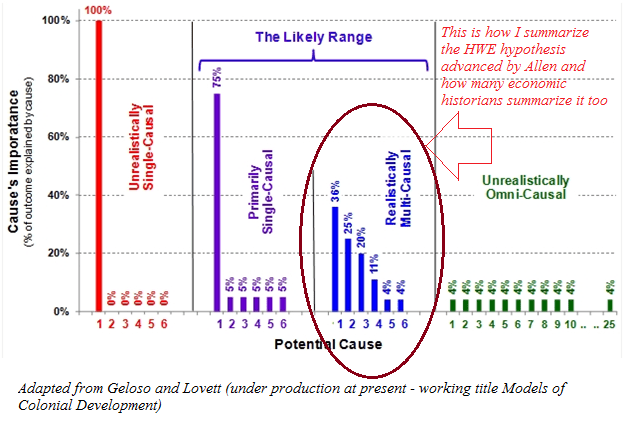
First of all, it is necessary to offer a proper enunciation of HWE’s role in explaining the industrial revolution as advanced by its main proponent, Robert Allen.  This is a necessary step because there is a literature attempting to use high-wages as an efficiency wage argument. A good example is Morris Altman’s Economic Growth and the High-Wage Economy  (see here too) Altman summarizes his “key message” as the idea that “improving the material well-being of workers, even prior to immediate increases in productivity can be expected to have positive effects on productivity through its impact on economic efficiency and technological change”. He also made the same argument with my native home province of Quebec relative to Ontario during the late 19th century. This is basically a multiple equilibria story. And its not exactly what Allen advances. Allen’s argument is that wages were high in England relative to energy. This factors price ratio stimulated the development of technologies and industries that spearheaded the BIR. This is basically a context-specific argument and not a “conventional” efficiency wage approach as that of Allen. There are similarities, but they are also considerable differences. Secondly, the HWE hypothesis is basically a meta-argument about the Industrial Revolution. It would be unfair to caricature it as an “overarching” explanation. Rather, the version of HWE advanced by Robert Allen (see his book here) is one where there are many factors at play but there is one – HWE – which had the strongest effects. Moreover, while it does not explain all, it was dependent on other factors that contributed independently.  The most common view is that this is mixed with Joel Mokyr’s supply of inventions story (which is what Nick Crafts has done). In the graph below, the “realistically multi-causal” explanation is how I see HWE. In Allen’s explanation, it holds the place that cause #1 does. According to other economists, HWE holds spot #2 or spot #3 and Mokyr’s explanations holds spot #1.

hwe

In pure theoretical terms (as an axiomatic statement), the Allen model is defensible. It is a logically consistent construct. It has some questionnable assumptions, but it has no self-contradictions. Basically, any criticism of HWE must question the validity of the theory based on empirical evidence (see my argument with Graham Brownlow here) regarding the necessary conditions. This is the hallmark of Allen’s work: logical consistency. His work cannot be simply brushed aside – it is well argued and there is supportive evidence. The logical construction of his argument requires a deep discussion and any criticism that will convince must encompass many factors.

Why not France? Or How to Test HWE

As a doubter of Allen’s theory (I am willing to be convinced, hence my categorization as doubter), the best way to phrase my criticism is to ask the mirror of his question. Rather than asking “Why was the Industrial Revolution British”, I ask “Why Wasn’t it French”. This is what Allen does in his work when he asks explicitly “Why not France?” (p.203 of his book). The answer proposed is that English wages were high enough to justify the adoption of labor-saving technologies. In France, they were not. This led to differing rates of technological adoptions, an example of which is the spinning jenny.

This argument hinges on some key conditions :

  1. Wages were higher in England than in France
  2. Unit labor costs were higher in England than in France (productivity-adjusted wages) (a point made by Kelly, Mokyr and Ó Gráda)
  3. Market size factors are not sufficiently important to overshadow the effects of lower wages in France (R&D costs over market size mean a low fixed cost relative to potential market size)
  4. The work year is equal in France as in England
  5. The cost of energy in France relative to labor is higher than in England
  6. Output remained constant while hours fell – a contention at odds with the Industrious Revolution which the same as saying that marginal productivity moves inversely with working hours

If most of these empirical statements hold, then the argument of Allen holds. I am pretty convinced by the evidence advanced by Allen (and E.A. Wrigley also) regarding the low relative of energy in England. Thus, I am pretty convinced that condition #5 holds. Moreover, given the increases in transport productivity within England (here and here), the limited barriers to internal trade (here), I would not be surprised that it was relatively easy to supply energy on the British market prior to 1800 (at least relative to France).

Condition #3 is harder to assess in terms of important. Market size, in a Smithian world, is not only about population (see scale effects literature). Market size is a function of transaction costs between individuals, a large share of which are determined by institutional arrangements. France has a much larger population than England so there could have been scale effects, but France also had more barriers to internal trade that could have limited market size. I will return to this below.

Condition #1,2,4 are basically empirical statements. They are also the main points of tactical assault on Allen’s theory.  I think condition #1 is the easiest to tackle. I am currently writing a piece derived from my dissertation showing that – at least with regards to Strasbourg – wages in France presented in Allen (his 2001 article) are heavily underestimated (by somewhere between 12% and 40% using winter workers in agriculture and as much as 70% using the average for laborers in agriculture). The work of Judy Stephenson, Jane Humphries and Jacob Weisdorf has also thrown the level and trend of British wages into doubts. Bringing French wages upwards and British wages downwards could damage the Allen story. However, this would not be a sufficient theory. Industrialization was generally concentrated geographically. If labor markets in one country are not sufficiently integrated and the industrializing area (lets say the “textile” area of Lancashire or the French Manchester of Mulhouse or the Caën region in Normandy) has uniquely different wages, then Allen’s theory can hold since what matters is the local wage rate relative to energy. Pseudoerasmus has made this point but I can’t find any mention of that very plausible defense in Allen’s work.

Condition #2 is the weakest point and given Robert Fogel’s work on net nutrition in France and England, I have no problem in assuming that French workers were less productive. However, the best evidence would be to extract piece rates in textile-producing regions of France and England. This would eliminate any issue with wages and measuring national productivity differences. Piece rates would perfectly capture productivity and thus the argument could be measured in a very straightforward manner.

Condition #4 is harder to assess and more research would be needed. However, it is the most crucial piece of evidence required to settle the issue once and for all. Pre-industrial labor markets are not exactly like those of modern days. Search costs were high which works in a manner described (with reservations) by Alan Manning in his work on monopsony but with much more frictions. In such a market, workers may be willing to trade in lower wage rates for longer work years. In fact, its like a job security argument. Would you prefer 313 days of work guaranteed at 1 shilling per day or a 10% chance of working 313 days for 1.5 shillings a day (I’ve skewed the hypothetical numbers to make my point)? Now, if there are differences in the structure of labor markets in France and England during the 18th and 19th centuries, there might be differences in the extent of that trade-off in both countries. Different average discount on wages would affect production methods. If French workers were prone to sacrifice more on wages for steady employment, it may render one production method more profitable than in England. Assessing the extent of the discount of annual to daily wages on both markets would identify this issue.

The remaining condition (condition #6) is, in my opinion, dead on arrival. Allen’s model, in the case of the spinning jenny, assumed that labor hours moved in an opposite direction as marginal productivity. This is in direct opposition to the well-established industrious revolution. This point has been made convincingly by Gragnolati, Moschella and Pugliese in the Journal of Economic History. 

In terms of research strategy, getting piece rates, proper wage estimates and proper labor supplied estimates for England and France would resolve most of the issue. Condition #3 could then be assessed as a plausibility residual.  Once we know about working hours, actual productivity and real wages differences, we can test how big the difference in market size has to be to deter adoption in France. If the difference seems implausible (given the empirical limitations of measuring effective market size in the 18th century in both markets), then we can assess the presence of this condition.

My counter-argument : social networks and diffusion

For the sake of argument, let’s imagine that all of the evidence favors the skeptics, then what? It is all well and good to tear down the edifice but we are left with a gaping hole and everything starts again. It would be great to propose a new edifice as the old one is being questioned. This is where I am very much enclined towards the rarely discussed work of Leonard Dudley (Mothers of Innovation). Simply put, Dudley’s argument is that social networks allowed the diffusion of technologies within England that fostered economic growth. He has an analogy from physics which gets the point across nicely. Matter has three states : solid, gas, liquid. Solids are stable but resist to change. Gas, matter are much more random and change frequently by interacting with other gas, but any relation is ephemeral. Liquids permit change through interaction, but they are stable enough to allow interactions to persist for some time. Technological innovation is like a liquid. It can “mix” things together in a somewhat stable form.

This is where one of my argument takes life. In a small article for Economic Affairs, I argued (expanding on Dudley) that social networks allowed this mixing (I am also expanding that argument in a working paper with Adam Martin of Texas Tech University). However, I added a twist to that argument which I imported from the work of Israel Kirzner (one of the most cited books in economics, but not by cliometricians – more than 7000 citations on google scholar). Economic growth, in Kirzner’s mind,  is the result of entrepreneurs discovering errors and arbitrage possibilities. In a way, growth is a process of discovering correcting errors. An analogy to make this point is that entrepreneurs look for profits where the light is while also trying to move the light to see where it is dark. What Kirzner dubs as “alertness” is in fact nothing else than repeated and frequent interactions. The more your interact with others, the easier it becomes for ideas to have sex. Thus, what matters is how easy it is for social networks to appear and generate cheap information and interactions for members without the problem of free riders. This is where the work of Anton Howes becomes very valuable. Howes, in his PhD thesis supervised by Adam Martin who is my co-author on the aforementioned project (summary here), showed that most innovators went in frequent with one another and they inspired themselves from each other. This is alertness ignited!

If properly harnessed, the combination of the works of Howes and Dudley (and also James Dowey who was a PhD student at the LSE with me and whose work is *Trump voice* Amazing) can stand as a substitute to Allen’s HWE if invalidated.

Conclusion

If I came across as bashing on Allen in this post, then you have misread me. I admire Allen for the clarity of his reasoning and his expositions (given that I am working on a funded project to recalculate tax-based measures in the US used by Piketty to account for tax avoidance, I can appreciate the clarity in which Allen expresses himself). I also admire him for wanting to “Go big or go home” (which you can see in all his other work, especially on enclosures). My point is that I am willing to be convinced of HWE, but I find that the evidence leans towards rejecting it. But that is very limited and flawed evidence and asserting this clearly is hard (as some of the flaws can go his way). Nitpicking Allen’s HWE is a necessary step for clearly determining the cause of BIR. It is not sufficient as a logically consistent substitute must be presented to the research community. In any case, there is my long summary of the twitteminar (officially trademarked now!)

P.S. Inspired by Peter Bent’s INET research webinar on institutional responses to financial crises, I am trying to organize a similar (low-cost) venue for presenting research papers on HWE assessment. More news on this later.

How I Helped Win World War Two

Below is an excerpt from my book I Used to Be French: an Immature Autobiography. You can buy it on amazon here.


All of a sudden, that road was flooded by a long column of trucks overflowing with big, loud, laughing men in distinctive uniforms. People were shouting greetings and waving flags. It seems that an American soldier jumped off his vehicle, swept me up into his arms and kissed me on both cheeks. That may have been because my mother, who had wanted her second child to be a daughter, processed my long blond hair into Goldilock-style ringlets. That I am straight today is a testimony to the resiliency of genetic programming. My mother always insisted the kissing soldier was black. On the one hand, she may have made up this detail for colorful effect. On the other hand, there were so many trucks the soldiers may have belonged to a transport unit and hence, probably to a black unit in the segregated Army of the day.

It was August 1944. I was two and my family lived in a (nice) city project right on the periphery of Paris, near one of its main access roads. One thing that bothers me about this visual and auditory recollection is that we lived on the east side of Paris. American soldiers should have been arriving from Normandy, in the west. Yet, the memory is clear.

Before the American forces reached Paris, my mother had sewn a makeshift tricolor French flag. The blue came from my father’s old military service flannel sash (a forgotten and now incomprehensible item of clothing). The red came from a Nazi flag my father had stolen from a German general’s car he was supposed to guard. (The Germans were packing up at the time and very nervous. He might have been shot on the spot if he had been caught.) At a loss for white, my mother made the center piece out of one of my diapers. That’s why I have always felt I played a part, although a small one, in the liberation of Paris, a symbolically important phase of WWII.

I was born and conceived during the Nazi Occupation of France when life was tough and entertainment scarce. My father was a Paris cop. His life was not so tough, however, that he did not have the energy to make my mother pregnant one more time before the Liberation, this time with twins. There was little to eat and milk was rationed so, my mother breastfed me for the longest time. I was precocious. At one point, I think I was able to ask for the breast in grammatically perfect French. It must have been embarrassing for her. Or perhaps I made this up on the basis of bits and pieces I picked up while I was growing up, like some of the other early recollections in these truncated memoirs. They stop at age 21 when I moved to the US for good. I made that choice because I think the second part of my life would be less  interesting to an American readership than the first, the preparatory phase, so to speak.

I  described above my first, full, cinematographic memory. From the days before the Liberation, I remember bit and pieces, like still photographs with some sound, glimpses of German uniforms and the vast, beautiful fire of the Paris general mills, a mile away, set by the US Army Air Corps. It’s a little known fact that the Allies bombed the hell out of France right before and during the Normandy landing. The French never complained much; they were different then, and too sick of the German presence to bitch about collateral damage. When the air raid siren sounded, my mother would wrap me up in a blanket and take me down to the basement of our seven-story apartment house. Some tenants were so jaded by then that they did not bother to take shelter. The basement was a crowded but not especially tragic place.

In spite of this dramatic, first, fully formed memory, nothing really important ever happened to me. I have escaped the Chinese curse, of “living in interesting times,” although I did live in fact in quite interesting times. I waltzed through the murderous second half of the twentieth century with hardly a scratch to show for it. All my life, I have been mostly fortunate. The undeserved lucky breaks more than made up for the few unjustified blows fate has dealt me. The luckiest break was my first coming to the US at eighteen, a prelude to immigration three years later. In this country, no one ever oppressed me successfully though a few tried.  Many gave me a push at just the right moment. Mine is a happy story. This makes it worth telling to the largely glum denizens of the twenty-first century.

I live in the sunny, warm climate I longed for as a child, near the sea I always loved, in a small town rich with the small pleasures I have always appreciated: a variety of movies, a good café in an interesting, animated downtown, several bookstores within easy reach, and young people everywhere. My wife is a talented painter whose work I enjoy so much I don’t ever like her to sell it. She has few obligations, and she has not had many for  quite a while. That’s what keeps her beautiful, I think. She is also an immigrant, from the other side of the world from me, yet we see eye-to-eye on most matters. Nevertheless, we each have our own house, feet apart, each gracious in its own way. Although, it’s in the center of town, our tiny plot contains an apple tree, a plum tree, two lemon trees, and a big fig tree. All bear fruits, especially the fig tree, a sort of miracle I never fully grasp, for reasons that will become clear below.

I am a retired university professor and scholar, fairly proud of my scholarship, happy to have been a professor and equally happy to not be one anymore. Most mornings, weather permitting (it permits often, here in California), after the gym and after coffee at Lulu’s, I am forced to decide whether I want to go sailing, or fishing, or just putter about my boat, or start one of my sometimes fairly good postcard paintings, or again, write a micro-story. Sometimes, I just simply spend the whole day reading, for no particular reason and to no particular purpose. I read much history but also almost anything anyone hands me. That would include a fair amount of trash. You guessed it: I am a satisfied lazy man.

The pages below tell the tale of the unlikely beginnings of the journey that brought me to my current state of beatific smugness.

From the Comments: Foucault’s purported nationalism, and neoliberalism

Dr Stocker‘s response to my recent musings on Foucault’s Biopolitics is worth highlighting:

Good to see you’re studying Foucault Brandon.

I agree that nationalism is an issue in Foucault and that his work is very Gallocentric. However, it is Gallocentric in ways that tend to be critical of various forms of nationalist and pre-nationalist thought, for example he takes a very critical line of the origins of the French left in ethnic-racial-national thought. Foucault does suggest in his work on Neoliberalism that Neoliberalism is German and American in origin (which rather undermines claims that Thatcherism should be seen as the major wave). He also refers to the way that Giscard d’Estaing (a centre-right President) incorporated something like the version of neoliberalism pursued by the German Federal Chancellor, Helmut Schmidt, from the right of the social democratic party.

Thoughts about the relations between France and Germany going back to the early Middle Ages are often present in Foucault, if never put forward explicitly as a major theme. I don’t see this as a version of French nationalism, but as interest in the interplay and overlaps between the state system in two key European countries.

His work on the evolution of centralised state judicial-penal power in the Middle Ages and the early modern period, concentrates on France, but takes some elements back to Charlemagne, the Frankish king of the 8th century (that is chief of the German Franks who conquered Roman Gaul), whose state policies and institutional changes are at the origin of the French, German and broader European developments in this are, stemming from Charlemagne’s power in both France and Germany, as well as other areas, leading to the title of Emperor of the Romans.

Getting back to his attitude to neoliberalism, this is of course immensely contentious, but as far as I can see he takes the claims of German ordoliberals to be constructing an alternative to National Socialism very seriously and sympathetically and also regards the criticisms of state power and moralised forms of power with American neoliberalism in that spirit. I think he would prefer an approach more thoroughly committed to eroding state power and associated hierarchies, but I don’t think there is a total rejection at all and I don’t think the discussion of ordoliberalism is negative about the phenomenon of Germany’s role in putting that approach into practice in the formative years of the Federal Republic.

Here is more Foucault at NOL, including many new insights from Barry.

A Muslim Woman and the Sea

Here is another short story. (I don’t have the talent to compose characters so, most of my stories are autobiographical by default.)

I am on the same free-diving and spear fishing expedition I mentioned in another story. We are driving and living in a VW bus I equipped myself for the purpose. This time, my then future ex-wife (“TFEW”) and I are stopped in a small town in coastal western Algeria. We just arrived and it’s a sunny quiet morning. We are enjoying a rare cup of real coffee at the also rare terrace of a small café. I will never forget that insignificant non-event, because, suddenly, out of nowhere, a baby camel came ambling down the street. The charming animal walked straight up to me and began browsing my hair. (Go ahead, don’t believe me; I have a picture!)

So, we are just lingering when a handsome teenage boy stops by to make conversation (in French, of course): Where are you from? What are you doing here? What kind of fishing, again? How do you like Algeria?

We invite him to sit down and have coffee with us but he insists he is in a hurry. He wishes us a good vacation and walks away. Then, suddenly, he wheels around to tell us he would like to invite us to his house for couscous. He is too young to be married and to have his own house. I ask him how his mother would respond to sudden unannounced guests. He replies that she would love it, that she misses her old French bosses; that she likes to speak French with real French people. I am beginning to feel peckish. Against my better judgment, we follow him around the corner.

We drive through a metal gate he closes behind us. The young man stops at the door to the house and calls out with several sentences in Arabic. A woman’s voice responds and the door opens immediately. A woman in her early forties stands smiling at us. Her dark shiny hair is partially covered. She has beautiful apricot skin and dancing black eyes. Under other circumstances, in spite of a fifteen-year age difference, I might have fallen in love with her on the spot. I must have been fairly obvious because the TFEW secretly yanked hard on the back of my shirt.

We sit down on cushions in the living room. There is an opening into the kitchen so we can communicate with the mother while she works. Actually, I am pretty much the only one doing the communicating because the TFEW is not a native French speaker and she is a little hesitant on that account. The thought crosses my mind that the mother is flirting with me verbally a little from the kitchen where I cannot see her face. The charming son soon serves us tea and two quiet teenage girls dart in and out on what I think is a mission to keep us company although they do not say anything. I am not sure whether they were shy or if they did not know French. There is no man in sight and no mention of any adult male.

After quite a long time bantering back and forth without the help of an adult beverage precisely, the steaming couscous garni appears on the rug in front of our knees. (Tech note: “couscous” is the grits-like grain; it’s “garni” when it is accompanied by a vegetable stew including chickpeas, and meat, usually boiled mutton, sometimes chicken.) Everyone is starving by that time and the family sits around and next to us each holding a bowl into which the mother dishes out couscous topped with veggies and mutton. One of the girls has thoughtfully placed a spoon in front of us, the visitors, which we make a point of honor to ignore, of course because we want to appear cool.

The mother tells us gaily how she had worked for fifteen years for a French family, as a servant with broad responsibilities, including the care of small children and the kitchen. She says she loved the lady of the house and the lady of the house loved her “like a niece.” I guess that’s how she has learned her grammatically perfect and lively French. After the French left, suddenly, feeling threatened (and probably with good reason) there was no work for a woman with her skills. Nothing is said, again in this story, about a husband. There is no explanation about how the family sustains itself.

It’s often difficult to say how poor people are following a revolution. Those don’t look poor. They are all well though simply dressed. The house in which they live is consequential and Western-style. (I mean that I would have moved into it in a minute.) As far as I know, it is her beloved lady boss’s house they are all occupying. Perhaps, the lady boss has slipped her the title before fleeing. I am told there was a lot of that that went on. I am also told the new Algerian government, its hands full of pressing matters, was happy to let sleeping dogs lie on this issue. I can’t judge what the family’s everyday food is like but none of them look skinny and the couscous was well garnished and ample. (But then again, the latter is not a good indicator of anything in North Africa where a feast is a feast however meagre the fare on ordinary days.)

If you eat enough food and it’s tasty enough, at the end of the meal, you will feel a little like drunk. Those who talk after dinner, including the Mom, talk louder. The pleasant son tells me of his wish to go work in France and of his modest ambitions in general. Even the young girls smile more broadly. Perhaps seeing their mother happy makes them feel happy. I am asked to explain for the tenth time in Algeria what I am doing there. I explain my quest for big fish and spiny lobster (and also for slipper lobster, a grotesque looking but delicious creature). I describe how I go under water holding my breath to shoot them in the face with a rubber spear gun. The family seems a little incredulous but they are visibly charmed by the concept. They have already made themselves believe that the TFEW and I really sleep in the VW bus as we travel from place to place. (The bus was parked out of view in their courtyard while we ate.)

Then, out of nowhere, the mother says something astounding: I envy you – she says to spend so much time looking at the sea. I love the sea and I haven’t seen it for so long. Say this again, I request. Isn’t this house, your house, about four or five blocks from the sea cliff? It is, she said but I can’t go there (“Je ne peux pas y aller.”) French does not not distinguish between physical impossibility and moral interdiction. So, I am a little confused but not for long. I guess quickly what’s on her mind.

I have an idea, I say. I tell you what: Tomorrow morning at five when the sun is up but everyone is still asleep, you will put on your hijab and wear a shawl around your shoulders that you can raise to hide your face if necessary. Your son will open the gate to let my bus out and then, he will sit next to me in front where everyone can see him. You will be in the back next to my wife with the curtains drawn. Your son will direct me to a suitable point on the cliff where I will park. There, you will raise the curtain as much as you want to and look at the sea as long as you wish. She agrees and her face is filled with anticipation.

Early the next morning, the son wake us up with cups of hot coffee. There is a defeated look on his face. He tells us that his mother has changed her mind and that she will not take up my proposal after all; that she says thank you and good-bye. He adds she is too embarrassed to get up and wish us a good trip face-to-face. We shake hands and leave with much sadness in our hearts.

Is this a story about religion? All Algerians were Muslims, if nothing else, by default; so was our pleasant hostess, no doubt Yet Muslim intellectuals will point out that there is no part of the Islamic sacred scriptures that enjoins women to hide at home. There is certainly nothing in the same scriptures that says they can’t enjoy contemplating the sea, one of God’s first creations, in Islamic as well as in Jewish and Christian tradition.

Personally, I disagree. I think this is a story about religion although indirectly. If the woman had been a Lutheran, a Catholic, a Buddhist, a Zoroastrian, or a Mormon, she would have had her fill of the sea before I met her. I can even imagine a Hindu woman being somewhat self-cloistered but not one fluent in a foreign language, not one with a long history of happy interaction with Westerners.

Two main points. First, every follower of a religion is not a scriptural expert. What people think is their religion often differs a great deal from what theologians say is true religion. I addressed this issue in an article in Liberty Unbound. (“Religious Bric-a-Brac and Tolerance of Violent Jihad.”) Second, religions are vehicles for all kinds of cultural practices that are not religious or only in a distorted manner. Thus, Catholicism, besides its rich history of burning people alive for their opinions, is largely responsible for the consumption of fish among inland Catholics. It probably even had a lot to do with the establishment of the long lasting Newfoundland cod fishery. (Ask me.) It’s fair to judge religions for the cultural baggage they carry and that they could put down if they really wanted to. Passive assent is a form of complicity.