North Korea at the North Sea?

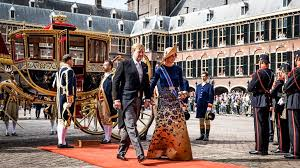
Yesterday, both Houses of Dutch Parliament jointly opened the parliamentary year, which is always held on the third Tuesday in September, and is known as “Budget Day.” Normally, there is not much pomp and glory in the Low Lands, but on “Little Princes Day” (as the day is literally called), we go all-out: the King and Queen are driven in a horse-pulled carriage to the Hall of Knights, the oldest part of the parliamentary buildings (built around 1250), surrounded by military troops in full ceremonial dress. The King reads his speech (actually written by and under full political responsibility of the Prime Minister and cabinet) from a huge throne, announcing the government’s plans for the next year. Male ministers in morning coats, ladies in dresses and hats, with the powerful elites also assembled.
king and queen
King Willem-Alexander and Queen Maxima entering the Hall of Knights (source)

After the reading, the Royal couple make their way back to one of their palaces in the centre of The Hague, returning once to greet the masses from the balcony.

Meanwhile, the Minister of Finance officially presents the 2018 budget to the Lower House. The separate budgets of all departments are laws, which will have to pass both Houses before 31 December. This process is normally preceded by a two day debate on “the general state of the country,” but this year it is skipped because there is only a caretaker government in office. It awaits the finalization of negotiations for a new government, which started right after the elections on 15 March. Still no government is formed, although it is widely expected that a four-party coalition will be presented within a few weeks, consisting of small Christian left wingers, centre Christian Democrats, and two social liberal parties, D66, and Prime Minister Mark Rutte’s VVD.

Although much improved since the low point of the Great Recession, around 2011-2012, the public finances are still shocking from a classical liberal perspective. The income of the national government is 285 billion Euro (around 338.5 billion USD), which is 43% of GDP.

It consists mainly of several mandatory insurance premiums for collective arrangements (112.2 billion Euro), income tax (55.4 billion; the highest bracket of 51.5% tax applies to all personal income over 68.507 Euro), and VAT (52.8 billion). The rest are mainly specific taxes, related to companies, the environment, excises, dividends, et cetera. In 2011, the public share of GDP was still 47%, while in the 1980s it reached peaks of around 60%. Not exactly anywhere near an ideal liberal situation, no matter what liberal persuasion you are. Personally, I would argue that 25% should be the max for a decent set of state tasks, but I am sure that makes me some weird Northern European commie in some American libertarian eyes!

The situation is even more dire if we see where that money is spent. Health care (80.4 billion euro) and social security (79 billion) are always in competition as the largest spending departments. So that is 56% of the budget already and both increase annually, no matter the economic circumstances. The third post is public education (35.4 billion), followed by funds for provinces and municipalities (24.4 billion), foreign affairs and foreign aid (12), police and judiciary (10.3), defense (8.4), and infrastructure and environment (also 8.4), with the other departments taking parts of the rest. Despite a very rare expected budgetary surplus of 7.8 billion in 2018, the national debt is still 53.7% of GDP. Perhaps not bad in international comparison, still not good for any liberal.

These numbers are only part of the story, because there are also numerous local taxes, and the number of liberty-inhibiting regulations, from European, national, provincial and local origin are staggering. There is not one really free market, and there are hardly parts of individual life not regulated or influenced by the state. A comparison with North Korea is of course still far-fetched, yet socialism is alive and kicking on the North Sea shores.

In my view it is evidence of the remarkable power of capitalism that The Netherlands is still one of the richest countries on earth, a global top 15 economy (GDP per capita), with only 17 million inhabitants. No matter how hard you curb it, the capitalist system still delivers amazing results. Of course, the opportunity costs of the Dutch regulatory state are very high. In terms of personal liberty there are not many better places on the planet. Yet in other fields it is a different story. Economic freedom is a mess, which means that the material aspects of personal freedom are seriously restricted. Yet the worst is the mentality. Sadly, most Dutch have traveled the whole Hayekian Road to Serfdom, making a shift to classical liberalism highly unlikely.
BC’s weekend reads

  1. From a nation of romantic philosophers, Russia is today a bastion of rationalism and pragmatism
  2. India’s merchant class aided the British instead of the Indian elite
  3. Why is Ethiopia building a space program?
  4. When Charlie Chaplin met Pablo Picasso

Libertarians on Climate Change

This post is part of the preliminary results of the NoL Foreign Policy Survey 2017 Pilot. I will be posting results throughout the week as I play around with the data. As always, I strongly emphasize that this is a pilot survey and these are just preliminary results

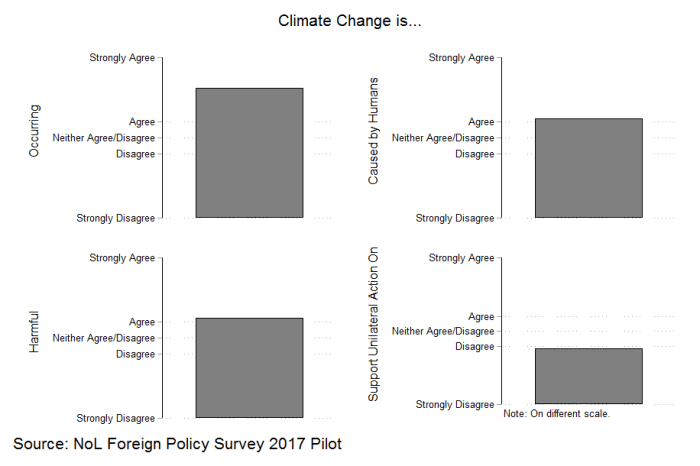
Are libertarians climate change deniers? No. The majority agree that it is occurring, caused by human activity, and that it is harmful. They do not however support unilateral action by the United States government. At least not the average libertarian respondent.

climatechange

Note that the last question, asking about supporting unilateral action, is on a different scale from the other three.


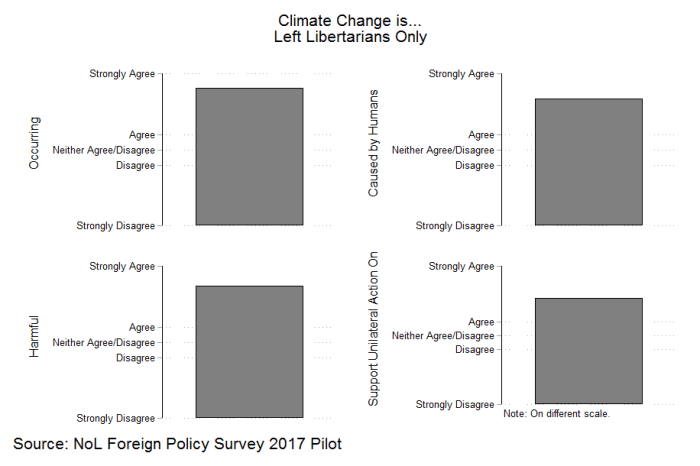
When you drill down by type of libertarian though you start to see stark differences. Left-libertarians agree much more strongly that climate change is occurring, caused by human activity, and harmful. They are also much more in support of unilateral action to prevent climate change.

climatechangell


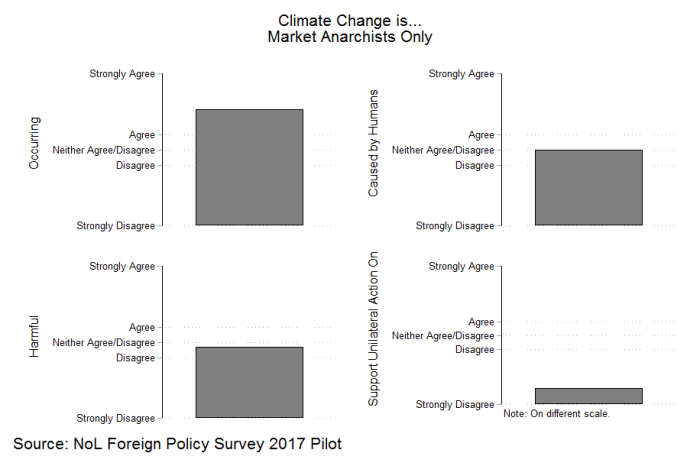
What is driving the differences between type of libertarian? Part of the story seems to be that those who think climate change is harmful are more willing to act to address it, but I suspect a large part of the story is also that some libertarians, particularly market anarchists, simply do not trust the government. Market anarchists are less likely to believe climate change is harmful or caused by humans compared to libertarians at large, but the big difference in opinion is whether the government should act on it.

Thoughts? Tomorrow I will be posting the demographics of those who took the survey.

climatechangema

Update: Updated graphs; minor coding error.

When Europe Rejected Morocco

Did you know that in 1987 the government of Morocco formally submitted an application to become a member of the European Union?

Brussels flatly rejected the application, arguing publicly that Morocco was not a European country and also that Morocco had a poor human rights record. This rejection marks one of the biggest mistakes that Brussels has ever made in its short-but-brilliant history (along with instituting a central bank).

Does anyone know of any scholarly literature showing that the admittance of authoritarian states to the EU or other federal-esque institutions will have the effect of liberalizing the political regimes of such states, as long as the republics admit these states one or two at a time? I did a blog post on it awhile back, but a blog post is not a peer-reviewed journal article.

The best counter-example of federalism-as-a-path-to-liberty that I can think of is the pre-Civil War US. The US federal system was made up, in part, of a number of authoritarian states that promoted and enforced chattel slavery. This example does not address the EU model, however, where Brussels admits neighboring poor states and a gradual liberalizing effect takes place.

In the US example, factions within the slave states benefited economically from the use of slaves, and this economic prosperity was tied up directly to the political institutions of the US. So, the US Senate had a number of pro-slavery representatives that not only made sure slavery could not be attacked politically, but also that the interests of slaveholders were advanced at the expense of the non-slaving states (and, of course, the slaves themselves). In other words, a powerful minority with interests very different from the general intent of the classical liberal framework of Madison’s constitution.

Once the number of free states became great enough to overcome the number of slave states in the Senate, a war became much more likely. It became more likely because the interests of the (illiberal) slaveholders were directly challenged by the numerical superiority of free state representatives in both houses.

In short, the pre-Civil War US was made up of two factions – one liberal and one illiberal – that were almost equal in power. The EU does not have to worry about this, though. It should be much bolder in admitting despotic, neighboring states into its apparatus. (The same goes for the US.) Imagine if Morocco had been admitted into the EU in 1987. There would likely be representatives in Brussels bitching about austerity instead of representatives of the King torturing and imprisoning Moroccan citizens for reasons unknown.

A Victory for the Big Center

“To my left, the wall,” Argentina’s President Cristina Fenández de Kichner (CFK) had expressed some months ago. Many of her detractors agreed with her on this opinion, while some others doubted where exactly to place the wall -and how far. The label of “Populist” might be subject to controversy as well, but everyone will at least agree on one single definition: her political strain could be everything but centrist.

Notwithstanding “Peronism vs anti Peronism,” “Populism vs Rule of Law,” “Left vs Right,” “Kirchnerism vs anti Kirchnerism” were some of the terms articulated along the presidential campaign whose run off has just had been won by Mauricio Macri, from the challenging front “Cambiemos” (Let’s Change), the decisive point of discussion of the past election was “Big Center vs Hegemony.”

The Big Center could be defined as the coalition of the Center-Left and the Center-Right in order to preserve a political system which allows the competition between both wings from the menace of a radical hegemonic force. That is why it would be a mistake to characterize the winning coalition as a Center-Right or a non-Populist political party. “Cambiemos” (Let´s Chance) has won the election with the support of both Centre-Right and Centre-Left voters and both Populist and non-Populist strains. Its political platform contains an orthodox monetary policy as well as the continuity of the policies on helping to alleviate poverty. Mauricio Macri won in the main cities with European ancestry population, such as Buenos Aires, Córdoba, Rosario, Mendoza, and also won in the Province of Jujuy, where he finished his campaign with a ancient ritual salutation to the Pachamama, one of the most important pre-Columbian deities.

By the width of “Cambiemos” coalition one could imagine how much was at stake. Which will be the final turn of the new government is something that generates no concern among its supporters. It is clear that it will remain circumscribed to the “Big Center.” Perhaps the definition will depend upon the ability of the Peronist Party -from now on in the opposition- to reassess its political strain: to turn into a Center-Right party, or into a Center-Left one or to insist on becoming a radical force. Given that “Cambiemos” has been delimiting its political discourse as a mirror of the “Kirchnerism,” we can expect the former to place itself in the political spectrum in reaction to its opposition. Nevertheless, all of us are convinced that Argentina’s political language will return to the categories of the Modern democracies.

From the Comments: Trying to Make Sense of Left and Right (Again)

This one is from yours truly, in a delightful back-and-forth with Dr Amburgey:

Ok. Clearly we need to be using terms that mean the same things to both of us. It’s your thread so tell me what constitutes ‘The American Right’ and what constitutes ‘The American Left’. Once we have a common understanding of terminology we can resume the discussion.

I have been working on a post about this very topic, and this conversation is helping me immensely. Thanks.

First, I think there is a distinction that has to be made between the ‘ideological’ and the ‘political’. The ideological rests atop a higher tier than does the political, like a pyramid. The ideological tier houses philosophical and moral insights, which are produced through the academy and in think tanks. The political tier houses organizations dedicated to parties (I think that factions and parties are two different components of a society, and that factions represent a tier below the ideological and above the political).

The American Right is ideological. The GOP is political. (Factions would consist of actors like bureaucracies, trade unions, industrialists, banks, medical doctors, etc., but can also be used to describe intra-party, or coalitional, differences) The American Right is currently home to three broad ideologies: neo-conservatism (elite and moderate), libertarianism (elite and radical), and traditionalism (populist and radical). I emphasize ‘currently’ because neoconservatives and libertarians were at one point Leftist factions in US history, and could easily end up there again in the near future. In many post-colonial and post-socialist societies, for example, both of these ideologies are considered to be on the Left.

The American Left is currently home to three broad ideologies: fascism, communism, and racism. Just kidding! The three ideologies are, I would argue: New Deal liberalism (elite and moderate), technocratic liberalism (elite and radical), and progressivism (populist and radical).

New Deal liberals and neo-conservatives are only moderate because they are dominated by Baby Boomers and Baby Boomers dominate the population at the moment. Libertarians and the technocrats are broadly younger and more cerebral (hence the radicalism). Traditionalism and progressivism are ideologies for the vulgar mob, of course.

Ideology, using the pyramid analogy, trickles down from the top tier into the factional and political tiers. This is just how it works in societies governed by laws rather than by men. Libertarians have been dominating the ideological discussion for the last 30 years or so, and the technocrats have been playing defense, largely because they are politically aligned – wrongly, of course – with socialism’s failure, but also because technocrats are just libertarians who don’t have the chutzpah to become non-conformists.

Successful politicians from the Democrat Party have been trying to balance their New Deal liberalism with the insights of their technocratic betters, but have been calling themselves ‘progressives’ because of the populist narrative and the fact that they need the votes of the vulgar mob to be successful.

I already don’t like this because I don’t think the Left deserves to be considered ‘liberal’ at all, and there is also the shortcoming of being strictly American in scope. We have got to think in internationalist terms when we discuss power and liberty. NOL has tried to hash this whole issue out before, by the way, and numerous times.

Trade: Is Obama Right This Time?

I was hoping to sit this one out. I mean the multiple discords about the new Pacific trade treaty proposed by President Obama. I feel I need to lend a hand because there are good reasons to be confused. Plus, I taught international business for twenty-five years. My voice just might be useful this time. Here is my brief but adequate road map to the problem. I am deliberately staying away from nouns and initials because they do more harm than good.

Pres. Obama has an early draft of an international trade agreement with a large number of Pacific countries. Such agreements eliminate or lower trade barriers. So, first, they make it easier for economic actors from one country to buy a and sell things to economic actors from another country. That’s because all trade barriers are hidden taxes on consumers. They all raise prices above where they should be. Get rid of them, have more real income.

Second, the lowering or the elimination of trade barriers ultimately result in something almost magical: Economic actors stop doing what they are doing badly and start focusing on what they do well. Most items become less expensive and of better quality. Everyone benefits from this. I mean everyone in the world.*

International trade agreements do cause some to lose their jobs. They create many more jobs than they cause to disappear, however. But the loss is certain: After all, as soon as central American bananas are allowed into Canada, Canadian banana growers must lose their jobs, by and large. Incidentally, there have not been Canadian banana growers, as far as I know but you see what I mean: Canadians ought to concentrate on producing lumber, or refrigerators, or iron ore, almost anything but bananas.

The current trade project presented by Obama contains a $500 million clause to retrain at public expense those Americans who might lose their job as a result of the new agreement. This is nothing new. Previous trade agreements contained similar arrangements.

President Obama wants what is known as “fast track authority.” That’s the privilege to have the Senate vote a simple “Yes” or “No” on the final draft of the agreement with those many other countries. This is pretty necessary because if each government of each signing country has to go home and gather amendments and often, amendments to amendments, in the end, no agreement sees the light of day. It’s a practical thing, not a sinister ploy.

On the one hand, practically all previous presidents who signed international trade agreements had fast track authority. On the other hand there is a sturdy reason to deny Mr Obama fast track authority: He is a proven, extremely bad negotiator. On the third hand, the negotiations of such agreements are almost completely done by technical personnel who know their business. And, how likely is Mr Obama actually to get involved?

As I write, elected Democrats are all against everything involved because the unions think that every international trade agreement makes them lose ground. I think their perception is correct. Republicans are torn between their understanding of the world (which is more or less like mine) and their wish to give the president a black eye.

This is a small digest of a complex and interesting issue. I deal with it at leisure and extensively in nine installments on this blog. Each had the words “protectionism” or “protectionist” in the title. Again, those are installments; you may want to look at them in order. No test!

* Paradoxically, one of the best, clearest scholarly explanations of this magic – called comparative advantage – is by Paul Krugman. It’s from the days when he was not yet crazy. Bret Stephens in the WSJ 6/16/15 jogged my memory on this strange fact. It’s worth looking up Krugman, for once.

Gay Parade: a Conservative Take

So, last Sunday was Gay Pride Parade downtown Santa Cruz. I am all for parades in general. It feels good for people to march, no matter the cause. In this case, I am a little perplexed at first. I don’t know what the marchers are addressing. This is Santa Cruz, after all, where no one is ever judgmental, except against those who are judgmental. Where is the potential gain in tolerance, I wonder?

The parade does not even succeed in browbeating me by making me feel “what it’s like to be a minority.” After all, most of the women in the parade are a lot like me. They like what I like. We may have been rivals once but I was not even aware of it until my wife brought home – in all innocence – an obviously lesbian admirer. My wife is from India. She was young then. There were many things she did not understand. Also, she was striking. Of course, I threatened the woman with beating her up with my big fists. No, I was not acting intolerant. I treated her the way I would have treated any sexual rival. I treated her equally, you might say. (Yes, she quickly vanished.)

The Santa Cruz parade is puzzling in other ways. One small tight group carries two signs. The first shows a Star of David in several colors. The second sign shows a small number of abstractly rendered fish in the same colors. I can’t bring myself to believe that this is a plea for support of Jewish homosexual fish. Yet, I have no other interpretation. The Santa Cruz parade also leaves me a little frustrated because it’s frankly scruffy, overall. I feel parade envy vis-à-vis the flamboyant and perfectly groomed San Francisco Gay Pride Parade. I am not sure but I think the difference is due to the fact that the Santa Cruz event is dominated by lesbians. Many (not all) lesbians make it a point of pride to wear sloppy t-shirts, like guys. Some aspire to be male rednecks and are fast getting there.

Toward the end, I enter into a conversation with two older woman, one costumed. It turns out they are leaders of the local Medical Marijuana Alliance. One is a retired nurse. They both like guys, one of the biddies reassures me unhelpfully. They are there because there is an alliance between the Alliance and lesbian and gay organizations. They support one another politically. This is good American politics at work. Mutual support is set up peacefully, without acrimony, to gain influence over rules and over how public funds are spent. I often complain about the policy results of such coalitions but I can’t think of a better way, in the short term, that is.

I still dislike taxation and I dislike even more large segments of law and order. I detest above all the so-called War on Drugs, a true catastrophe for this whole society. In the short term, though, I don’t see the path forward to doing away with these gross limitations on individual freedom. So, I rejoice in every item of evidence that we could do worse.

The Most Embarrassing Factions of the US-Cuba detente

I can only list, in order of magnitude, three: 1) Republican hawks, 2) condescending Leftists, and 3) anti-Americans abroad.

In some ways none of this is surprising. All three of these factions hate each other, mostly because they are the least libertarian factions in the world (familiarity breeds contempt, it is often said).

Republican hawks are first on my list because they are the most dangerous. This is a deeply reactionary faction that does not care one iota about the national interest. It is a vulgar mob that has no need for nuance or depth. One of the state of Florida’s Senators, Marco Rubio, exemplifies this isolationist faction. This is demagoguery at its finest. It also goes a long way toward explaining why I will never, ever be a Republican, despite the honest efforts of courageous statesmen like Ron and Rand Paul.

Condescending Leftists are second because of their reactions to the beginnings of the end of a vicious, self-defeating embargo: Decrying the fact that Starbucks and McDonald’s will soon be forcing poor, naive Cubans into becoming customers with actual choices in an actual marketplace. According to the worldview of these Leftists: the lives of Cubans have been better than those of Westerners because of its simplicity (this simplicity was brought about, of course, by the heavy-handed tactics of the Castro dictatorship, but somehow this always fails to make the final cut of the condescending Leftist’s narrative). Capitalism will put an end to the simple lives of the Cuban people, and this is a bad thing for both the world and the Cubans themselves.

Embarrassing and disgusting.

The last faction on my list, anti-Americans abroad, have taken the Obama administration’s decision to reach out to Cuba as an excuse to lie to domestic factions everywhere. They have seized upon the fact that the US sometimes pursues bad policies, and have turned it into a soapbox preaching session for all of the gullible schoolboys and girls in the world who instinctively hate the world’s liberal hegemon. What is lost (or, more likely, ignored) in these preachers’ message is the fact that the US is changing its bad policy. The same cannot be said for the tired tropes wielded by aging anti-Americans in the name of some variant of socialist (whether national or international) revolution.

Some notes in the margins:

  • Cuba will not become free or (or) democratic overnight.
  • It will not become wealthy overnight, either. In fact, there is bound to be a whole lot of cronyism in the near future, as Castro’s butchers and henchmen gobble up much of the wealth that will inevitably flood Cuba’s markets. Remittances will likely increase as well, which means that the cronysim of Castro’s henchmen will be offset by the influx of cash from the US. This, in turn, means that the Castro dictatorship is likely to be around for a lot longer than anticipated.

Peggy Noonan’s piece in the Wall Street Journal is well-worth reading. Observe:

A closing note: I always thought, life often being unfair, that Fidel Castro would die the death of a happy monster, old, in bed, a cigar jutting out from the pillows, a brandy on the bedside table. My dream the past few years was that this tranquil end would be disturbed by this scene: American tourists jumping up and down outside his window, snapping pictures on their smartphones. American tourists flooding the island, befriending his people, doing business with them, showing in their attitude and through a million conversations which system is, actually, preferable. Castro sees them through the window. He grits his teeth so hard the cigar snaps off. Money and sentiment defeat his life’s work. He leaves the world knowing that in history’s great game, he lost.

Open the doors, let America flood the zone and snap those pictures. “Fidel! Look this way!” Snap. Flash. Gone.

Buddhist Lobbyists Push for Legislation Targeting Muslims in Myanmar (UPDATED)

The story is here.

I’ll be straight with you: I hate arguments that try to pinpoint Islam and Muslims as more prone to violence or bigotry than other faiths. Aside from lacking any evidence whatsoever to support such a claim, they contribute to hostility and bad faith when this conversation – about religion and society – could easily be used to contribute to tolerance and a better understanding of why government sucks.

All religions are exactly the same when it comes down to it.

Politically and organizationally, lobbying efforts on behalf of religions are necessarily going to aim for shoving its particular beliefs down the throats of everybody else. This is why separation of church and state is so important (church and state, not church and society; I could care less how people organize themselves in the non-political arena).

So, for example, the censorship we have here in the United States, on television, is the direct result of Christian groups that were able to successfully lobby the government to stifle free speech (see this excellent essay in the Freeman by BK Marcus on how the television markets are now changing thanks to deregulation). Can’t buy beer in your county on Sunday or after 7:00 pm on weekdays? Thank your local Christian lobby (or, if you’re in parts of India, your local Hindu or Sikh lobby, or…).

The extremity of the lobbying groups depends not on religion per se, but on the institutions that a state has in place. Anybody who argues that the Middle East is a more violent place than sub-Saharan Africa – the other region of the world that largely adopted Leninist socialism after independence – is a charlatan or a fool. It is, unfortunately, not a well-known fact that heavily Muslim, predominately Arab states are anti-capitalist, and staunchly so. This anti-capitalistic mentality has led to poverty, of course, and isolation (“cultural stagnation”), but it has also had an adverse effect on these states’ political institutions. Instead of becoming more open, and more inclusive of various factions (“lobbying groups”), political institutions in the Muslim world have been built around the executive branch – the Strong Man –  and as a result the more populist a lobby’s message is, the more it is likely to receive support from the Strong Man (the oil states in the Gulf are considered wealthy, but they are still anti-capitalistic).

In a world that is dominated by a secular hegemon that often supports bad people in the name of savvy geopolitics, the popularity of Muslim populism is not hard to fathom.

Meanwhile, in Myanmar, the Muslims being targeted by legislation are mostly illegal immigrants fleeing Bangladesh. The most prominent lobby pushing for the bill, the Association for the Protection of Race and Religion, is headed by a Buddhist monk (of the Theravada sect if I’m not mistaken).

In other news I still come across Americans, my own age, that support the Castro regime in Cuba (“because free health care and equality”). What kind of sick world do we live in?

EDIT: I had to edit this thing for clarity. Jesus donkey smears.

UPDATE (11/2/2014): Wait a second Brandon, did you just write that the Buddhist zealots are lobbying the state of Myanmar for legislation aimed at Muslims? How can this be? Myanmar is a known authoritarian state. Doesn’t the junta do what it wants, when it wants?

The short answer is “No, it can’t.” Authoritarian regimes are constrained by choices and popular opinion as well. One of the main differences between authoritarian and democratic states is the number of factions involved in the lobbying process. In democratic states, any faction can lobby the government for any reason it wishes to. Everybody has equal access (if not equal influence). This equal access (which, again, does not translate to equal influence) is, in part, what classical liberals and libertarians mean by political and legal equality. In authoritarian states the number of lobbying groups tends to be a lot smaller than in democratic states. I’ll let you figure out why this is.

It’s worth noting that calls to limit lobbying efforts by repealing Citizens United is, in its barest form, an authoritarian urge. For what is this repeal movement, if not an attempt to shut some factions up using the power of the state? The excuses always vary (in this case it’s “money”), but the pattern of authoritarianism through limiting choices remains the same.

The difference in understanding of equality between libertarians and conservatives/liberals strikes at the heart of American politics (I can’t speak for other places). Yet it also illustrates why libertarianism’s conception of equality is superior to that of the conservative/liberal. If there is a successful attempt at leveling out influence so that it’s equal in some measure (though conservatives/liberals are ambiguous on what they mean by ‘influence’, not to mention ‘equality’), then equal access has to be denied or else some factions would tip the balance of influence. Attempting to guarantee equality of influence would also lead to cronyism. Instead of lobbying the government for favors, factions would end up lobbying the committee that picks lobbying groups it deems worthy of lobbying for government favors!

On the other hand, if equal access is protected then everybody has a shot and no influence is guaranteed.

UPDATE (11/03/2014): The more I think about it, the more the Muslims-are-more-prone-to-violence canard sounds an awful lot like the Jews-secretly-run-the-world canard. People point to outbreaks of collective or individual violence perpetrated by Muslims or a Muslim and say to themselves “Well, this isn’t surprising, as their 7th century founder was a war chief.”

Disgusting. And, I suppose, Jews really are running the world because Judas stabbed poor ole Jesus in the back for 30 pieces of silver in the first century. The logic is exactly the same.

The Jews-secretly-run-the-world canard hides a nasty prejudice against Jews by creating a half-baked, pseudo-scientific rationale that can be used in public (this canard does not hide such a prejudice very well, at least to others; it may hide well from himself the intolerance and ignorance a person has in the form of rationalizing his prejudice). The Muslims-are-more-prone-to-violence canard is most often used by proponents of overseas military intervention in Muslim regions of the world.* Like the anti-Jewish voices, the anti-Muslim voices are not interested in Truth but in forcing their own deeply hostile beliefs down the throats of others. Hence the libertarian’s task of delicately balancing religious skepticism with the protection of religious believers from vulgar conspiracy theorists.

* There is a small cadre of religious skeptics and secularists who also use the “violence” thesis, though this faction, which includes myself, is more easily swayed by evidence.

Columbus Day needs to go, but…

I deplore Columbus Day. It it a state-sponsored celebration of state-sponsored genocide. I argue that it needs to be abolished because Columbus was a bad man with bad motives.

However, there are a number of talking points, put forth by the Left, that are simply wrong and need to be debunked before we can have an honest discussion about why Columbus was such a bad guy.

The conquests of New Spain and Brazil undertaken by Spain and Portugal were state-sponsored, while the slow, eventual westward push by other European peoples were only indirectly sponsored by states (through corporate charters and the like) until the mid-nineteenth century (a time frame of over four centuries). This state sponsorship can largely explain why Latin America is the red-headed stepchild of the West today.

I don’t buy the argument, put forth by Politically Correct Leftists, that the genocide of Native Americans was perpetrated solely by white men and their cunning and guile. This counter-narrative is just as dishonest as the traditional narrative proclaiming Columbus to be a great discoverer. It takes away the agency and the complexity of Native societies with one fell, condescending swoop.

As an example, consider yesterday’s (American) football game between the Cardinals and the Redskins in Phoenix. The owner of the Redskins, under fire for keeping the name ‘Redskins’, invited the current, democratically-elected President of the Navajo nation to watch the game with him and his family. The President and his wife obliged, and wore Redskins gear to accentuate their support for the Redskins owner.

The couple did this while hundreds of anti-Redskins protesters stood outside the stadium with signs and slogans. Native fans brandished signs inside the stadium declaring their support for the Redskins name.

Many appointed Native leaders simply sold their people out to Europeans. Many more thought assimilation between their culture and the Europeans’ would be the better option going forward. Many Native factions actively slaughtered other factions for money, land, or other goods and services.

I often wonder if traditionalists don’t see what Leftists are doing when they deliberately display such a proud ignorance of historical facts. It’s as if traditionalists relish the role of bad guy in society when they play into the dishonest hands of Leftist so-called reformers.

At any rate, here is economist Bryan Caplan on Columbus Day, and here is philosopher Irfan Khawaja. Both are worth reading. Both are libertarian, to one degree or another, and both pieces move well beyond the usual garbage that passes for debate in this country.

On Conspiracies and Immigration Reform

Late last month I asked a simple question, what does the Obama administration hope to accomplish in regards to immigration? I answered that its goal was not to reform the United States immigration system unilaterally, but to use executive action to force Congress into acting.

My prediction turned out to be correct. The administration had initially planned to announce executive actions meant to provide relief from deportation for many of the country’s illegal alien population and to make legal migration easier after the Labor Day weekend. ‘Had’ is the key word here. In its latest series of press conferences the administration has pushed back the announcement till year’s end.

Why did the administration push back its announcement? Partly because the administration doesn’t really want to issue executive actions – it merely wants to use the threat of executive action. Some opponents of the current administration, including libertarians, envision the executive branch as having unlimited powers but the truth is that the administration has all too real limits to its powers. Members of the President’s own party lobbied for the postponement in fear that a radical change in immigration policy will cause them to lose their upcoming elections.

The state is not a monolithic beast with a single mind. Rather it is composed of several competing factions who are nonetheless united in their shared goal of maintaining a functioning order. The state is usually seen as the antithesis of the market, but I think this a wrong way to think. The state is itself a product of spontaneous order and better thought of as an example of how human cooperation can do great harm.

What this means is that the Obama administration must first secure its hold over its own party before it can duke it with other factions within the state apparatus.

It also means that conspiracy theories, of the like discussed in the comments section of my last post, are unlikely. It is true that ‘open borders’ could be used to rob the United States of its sovereignty in favor of creating a larger transnational state in its favor. However it is unclear why Obama and his allies, as individuals, should wish to see the creation of a new state unless they were assured they would be leaders in it. The creation of a new state is no small feat and usually requires a long time horizon.

Monarchs of the past could afford to undergo the long process because they were assured that even if they themselves did not live to see their creations their children would. Obama has no such assurance; in a few years he will vacate the White House and go into retirement. As a matter of tradition Obama, as most US Presidents have, will leave electoral politics. He may lend his support to some charitable cause, but he will never again be active in day to day politics. His incentives are as such to maintain the United States as strong as possible to preserve his legacy.

Who then does have the incentive to see the creation of a new state? Presumably it would have to be a faction in the current state apparatus that has some power but has been relegated to a position where they cannot expect to rise any further. In times of old this would be a Duke who, although strong, could not expect to see himself made King under the current regime because of one reason or another.

Which faction could fit the bill today? The Democrats? No. As noted above, current Democrats would not be assured of their involvement in a new state and would not risk their current power given their short time horizon. The Republicans? No. The Republican Party is believed by many to be destined to become a permanent minority party at the national level, but for the foreseeable future it still has enough sway to win a healthy amount of seats in Congress and could very well win the Presidency under a charismatic candidate. Even if the Republican Party is destined to become a minority party, why would it want a stronger state replace the US? It anything it should want the south and western mountain states to secede so that it could continue to influence national politics, albeit in a new nation. What about Hawaii? The far flung state owes its political union with the US to an overthrow of its indigenous monarchy. It may harbor some desire to regain its independence, but it is unclear why it would want to see the US by a larger state still. If anything the rebellious factions in the US should desire to break up, not increase, the current state.

By no means should I be seen as saying that conspiracies cannot be in play. I simply do not see the necessary incentives for a conspiracy to arise that would wish to see the United States replaced by a transnational state.

Let us compare this with the European Union, a new state in the process of being formed from the remnants of the previously separate European countries. As many observers have noted previously, it is hard not to notice that the European Union is effectively a new German Reich. Germany was unable to secure an empire on the continent using arms, but it has been immensely successful in winning its empire through commerce. German politicians and their bureaucrat allies have a clear incentive to see the continued rise of the EU, but even here there are rival factions who oppose them. One wonders if euroskepticism in the United Kingdom is truly because the British people oppose the EU or because Germany and its allies, and not the UK, will be the center of power in the new state?