- Contrary to popular myth, Democrats are just as ideological as Republicans, and Republicans are just as group-centric Democrats
- The Rule of Karlowitz: Fiscal Change and Institutional Persistence (pdf)
- The Privilege of Checking White Privilege
- The Wealth of Subnations: Geography, Institutions, and Within-Country Development (pdf) (h/t Adrián)
- Shakespeare in Tehran “I also noticed among the men a few who stood apart and did not seem to be either students or faculty. It was not difficult to imagine who these might be.”
- The new economic history of Africa (pdf)
economic development
Which MPOs are most efficient?
I have been working on a project to measure the efficiency of Metropolitan Planning Organizations (MPOs). MPOs are one of the levels of government often forgotten. When we think of government we usually think of federal, state and local government. MPOs lay between local and state government. My local MPO for example, the Southern California Association of Governments (SCAG) for example covers all of the southern Californian counties except for San Diego. Other MPOs, such as the Delaware Valley Region Planning Commission, cross over several states. Nominally MPOs are concerned with setting transportation policy, but in effect they have broad powers over many areas of regional economic development.
Most MPOs have no elected leadership and instead either appoint their own heads or draw from their constituent members. By no means am I a little ‘d’ democrat; I do not see much value in democracy to decide public policy. It is however concerning that these form of government have little oversight over them of any sort. My hope is that my work will provide much needed information on how well (or badly) these MPOs are doing their jobs.
I am attempt to rank MPOs on two basis: transportation services and air quality. Below is a ranking of the top 77 largest metro regions by their adjusted cost efficiency for providing transit services. I used metropolitan level data from 1991 to 2011 to construct these figures. By adjusted I mean that I attempted to take into account for factors that affect their cost efficiency, namely level of federal funding which is negatively associated with cost efficiency. I hope to be able to better calculate these figures in the future taking into account spatial factors that affect efficiency, but I have to start somewhere right?
1. Raleigh
2. Virginia Beach
3. Honolulu
4. El Paso
5. Orlando
6. Wichita
7. Memphis
8. Baton Rogue
9. Cincinnati
10. Indianapolis
….
70. Bridgeport
71. Akron
72. Seattle
73. Albuquerque
74. Knoxville
75. Worcester
75. Dallas
76. San Jose
77. McAllen
The full ranking can be found here: Efficiency Residual.
Thoughts?
Eye Candy: the GDP (PPP) per capita of OECD Administrative Units (UPDATED)
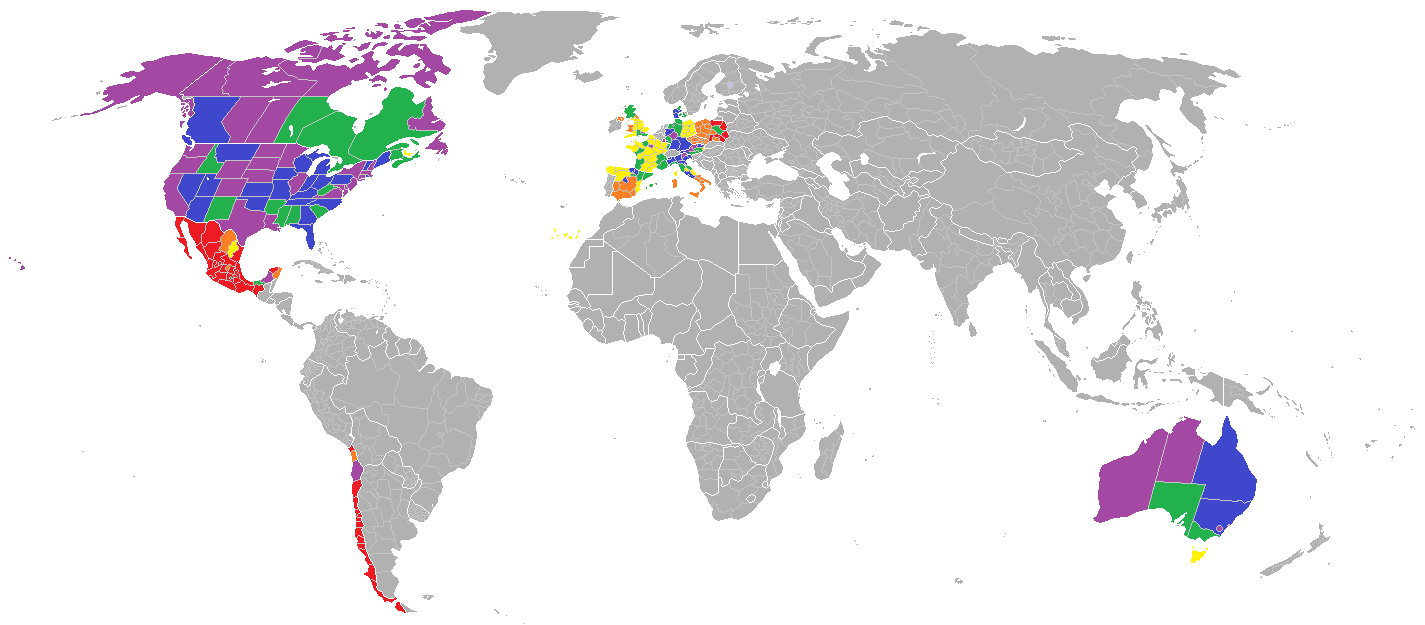
The countries I’ve filled in were about half of the OECD. The data is hard to get on administrative units elsewhere in the world (I got my data from the OECD website), but it was also hard to get for OECD states. The reason it was hard is because OECD data collectors divide up administrative units into two separate categories (TL2 and TL3) that sometimes correlate to traditional administrative units (such as California or New South Wales) and are sometimes arbitrary creations of EU or OECD bureaucrats designed specifically for data collection (rather than for understanding the historical trajectory of regions within a state).
Does this make sense?
To make matters worse, sometimes the TL2 category correlated with an actual administrative unit with political representation in a capital, and sometimes the TL3 category was the actual administrative unit with political representation. So I had to thumb through the nitty-gritty details of how OECD states send representatives to central parliaments and then match those real-life details to the data collectors TL2 and TL3 categories.
Does this make sense?
The map above highlights the US, Canada, Australia, Germany, France, the UK, Spain, Poland, Austria, Italy, Czech Republic, Chile, Denmark, and Mexico. These countries are all TL2 states.* I have no idea what that is supposed to mean for data collectors, but it means to dorks like me that their TL2 categories send political representatives to capital cities, whereas their TL3 categories likely send political representatives to regional capitals.
Does this make sense?
I have continued entering the data that the OECD has provided for the GDP (PPP) per capita of TL3 units (which send political representatives to capital cities), but the map I downloaded does not outline TL3 units (it only outlines TL2 units). So unless I want to spend time carving out TL3 units onto a TL2 map I am going to have to stop filling out the map. I’m all for collaboration on this, of course.
Here is the table I have (very slowly) been working on, but when I colored in the map above (the TL2 states), I divided them up into six groups based on highest GDP (PPP) per capita to lowest. The richest administrative units were purple, followed by blue, followed by green, followed by yellow, followed by orange, followed by red. So: purple is rich, red is poor. Got it? Because I started adding the TL3 states to the table, and because the map doesn’t allow for me to add the TL3 states to it, I forgot the range of the colored TL2 units. Dividing them up into six groups is a pretty easy task, though, so you should just trust my coloring scheme.
The map I created doesn’t have a very good zoom-in function, but what I found interesting is that Europe has a lot more economic inequality than the US, Canada, and Australia. Look at France. It’s mostly yellow, and the only purple (rich) administrative unit is Paris metro. This suggests, of course, that wealth in France is concentrated in the capital. The UK looks just like France (as does Spain). Germany is divided in half (as is Italy), and Austria and Denmark are cool, rich colors. Canada and Australia only have one yellow province each, and the US has none. Mexico looks just as Michelangelo described it, and Chile looks like Spain.
This is the OECD page I’ve been using. Here’s how I find regional GDP (PPP) per capita:
- select “Regions and Cities”
- select “Large (TL2) and Small (TL3) regions” – remember it’s either/or here: either TL2 or TL3 but not both
- select “regional GDP per capita”
- Then for measures (top of table) select “per head, current prices, current PPP”
I’ve been using 2011.
This pdf lists the “territorial grids” (TL2 and TL3 regions) of the OECD. The pdf didn’t help me figure out which regions send political representatives to capital cities and which are arbitrary, bureaucratic creations (I got to do that on my own!), but lists can definitely be helpful. In many cases I was able to figure out which units are politically viable and which are arbitrary for data collecting purposes just by looking at the list.
Finally, here is a map – courtesy of kelsocartography.com – of the world’s administrative units, at the TL2 level. Lots of work to do.

I like using the GDP (PPP) per capita of administrative units because I think it gives a much more stark picture of life around the world. I have pointed out before that the UK is now poorer than Mississippi, but breaking down the UK in the same manner as we do the US reveals that not only is the UK poorer than the poorest US state, the purchasing power parity of British citizens within the UK looks a lot more unequal than what we see in the United States. What is going on in the UK? The NHS can’t be that bad.
* – Oops, except for Denmark (it’s TL3)
UPDATED (3/11/2015): Continue reading
Mexican Underdevelopment: Pop-Sociology
It’s six a.m., I am sipping my first cup of coffee on the small balcony near the tall coconut tree. It’s still dark but I can see a short stocky woman sweeping the ground of the open space in front of the hotel next door. Right away, I detect that something is wrong in the picture although I am not fully awake. The broom the woman is using is too short, its straw end is frayed. She is bending over more than should be necessary; some of her energy is being misspent because she pushes harder than she would have to with a newer broom. No big deal! Except…
Mexico is the kind of country where the dentist kisses you when you leave. (This particular dentist is a pretty willowy blonde.) Perhaps, Mexico is the only country of its kind. I don’t know; I have not been everywhere. No American dentist has ever attempted this maneuver on me, or on my attractive wife either. I have avoided French dentists since 1960. A dentist in Morocco once gave me a root canal with no anesthesia whatsoever. I forgave him long ago but I wouldn’t let him kiss me if you paid me. The universal amiability of Mexicans might color everything I say below. You are warned.
I just spent three weeks in Mexico, in the pleasant resort city of Puerto Vallarta. With a population of 250,000, it does not feel much larger than Santa Cruz, California with its population 4/5 smaller. Still it’s large enough to be considered a real place, not a boutique resort. I was staying in a small hotel on the beach, of course, which limits observation. But my wife and I did most of our own cooking and therefore, we had to shop often in an ordinary supermarket located in an ordinary commercial center. This is important as a kind of regular and forced immersion into normal local life. We did not have a car so, we took taxis several times a day. This is important too because cab drivers everywhere are a rich fount of information if you manage to steer them from small talk. Yes, I know Spanish, and not only in my imagination as described in my masterful “Foreign Languages and Self-Delusion in America” (if I say so myself) but for real. I understand everything that is said to me in that language; I am able to eavesdrop on conversations between strangers; I can read the newspaper; I listen to television news without effort.* In brief, I was in a reasonable good position to observe, interpret and ask questions.
This stay in Mexico was like a refresher course on a topic that occupied me professionally for about twenty-five years: Why some countries are poorer than others. (When you begin thinking seriously about this simple question, you quickly discover that the plausible answers are numerous and complex.) I used to do it in a rigorous, quantitatively based manner, estimating statistical models and the like. This time, I am indulging myself frankly in pop-sociology. It does not imply any rejection of my past endeavors.
Comparisons between the way things are done in Mexico and in the US come naturally because the surface similarities between there and here are obvious. Mexicans want what we want and they work openly for it and, in time, they get it. Material progress usually takes a familiar American form, from shopping malls to cineplexes, to the Discovery Channel…, you name it.
Mexico’s GDP per capita is less than one third of the American equivalent (about USD 16,500 vs 52,000, Purchasing Power Parity, a formulation which makes the two figures comparable) Mexico is a poor country but not one of the poorest by a long shot. Why would it be poor?
Mexicans are not a short on entrepreneurial spirit. Every nook and cranny shelters a business of sorts. I enter a tiny corner shop in a non-touristy part of town selling I don’t know what. A toddler sleeps on a blanket on the cold floor. (It’s hot.) Against one wall, three cramped stalls offer Internet access. The owner, the toddler’s father, tells me he is opened from 7 am to 10 pm. He charges me forty cents to recharge my cellphone battery, not an especially low price considering his cost and the little labor involved. There are restaurants everywhere, also far from the tourist tracks. Some have only four tables. Most are still empty at 8 pm. Two social mechanisms seem at work. One is simple mimicry: The guy across the street has one. What does he know about birria that I don’t know? The other is a version of the Chinese eating place economic rationale: If people don’t come to dine here, my family can always eat the food; I have many children anyway. Nothing is going to go to waste. The economic risk is small. It can’t hurt. Perhaps, rents are low because there is not much alternative use for the relevant spaces.
Food is everywhere anyway. If someone goes hungry in Mexico, it’s somewhere else. Yet, food prices are low but not very low. Rice is cheap, avocados are cheap; apples are the same price as in California perhaps because they come from afar. This is an undeveloped capitalism, with poor infrastructures; moving foodstuff is still expensive. A cup of reasonable good coffee costs USD 1,40; that’s probably more than in an Arkansas diner. That’s what it means to be poor: Your money does not reach very far.
Three facts of possible economic relevance strike you quickly; two are concrete and easy to verify; the third is intangible, or kind of unsubstantial, but that does not make it irrelevant. First, nearly every shop is overstaffed by a significant factor. That’s easy to see when people perform identical jobs with identical technologies as in the US. There are twice or more salesladies in the clothing area of a department store as there would be in KMart, the perennially failing chain. In the butcher section of the supermarket, employees are waiting for you. That’s nice but it’s probably superfluous. I could wait two minutes instead, so could Mexican housewives. In the restaurants that actually have some business, the waitpersons (waiters and waitresses ) seem to be spending most of their time standing still.
The second observation concerns low individual productivity. It’s not that Mexicans don’t work hard. In Mexico as in the US, Mexicans are remarkable for working hard for long hours. They seem to know no coffee breaks and little even by way of lunch breaks. The problem is that you see everywhere people doing work for which they have received little or no training. I watched with increasing fascination, several times a day, a laborer failing to finish a simple brick path. He did not manage to complete in three days what I am ready to bet an American bricklayer would have done in less than a day. (Yes, I know something about bricklaying too.) That’s a big productivity differential. Even the pharmacists filling my prescriptions seemed hesitant. They did not exude the authority of American pharmacists with an advanced education. Since Mexicans in general rarely lack in personal authority and, by elimination, I am forced to hypothesize that my pharmacists where just sort of learning their job as they went along.
Incidentally, I have reasons to believe that this shortage of training does not extend to superior occupations: Mexican doctors and Mexican engineers are not inferior to their American counterparts, I am guessing. (The fast development of medical tourism into Mexico from both the US and Canada testifies to the quality of the former, I think.)
The third observation, which I called intangible is difficult to render, of course. It’s almost only an impression but one that is redundantly encountered. The information dispensed by the conventional Mexican media seems very thin. The nightly news program on major channel serves poor fare as compared to the Spanish language but American Univision. If there are new or substantive programs on radio, I have not discovered them. (I may very well have missed such.) I mean that I almost missed National Public Radio there ( a difficult admission for me, obviously). Whether you read the daily newspaper or not does not make much difference in your level of information. Here is a test case.
On a weekend day, there is a massive protest march in Mexico City. The demonstration is to protest the disappearance of 43 young people from the same teachers school. Everyone except their parents knows they have been murdered. The demonstration is both very large and quite orderly as compared to anything of the same kind in the US. The police uses tear gas but only sixty people are arrested. There is no mention of anyone seriously hurt.
I buy the Sunday version of what has been designated to me as the best national daily newspaper in the country (“El Excelsior“). A description of the demonstrations and photographs cover the front page, as you would expect. The two innermost pages are devoted to the same events. In addition to eyewitness accounts are included serious interviews of government officials, of protest march organizers and of several pundits. I make myself read every word. At the end, I have learned close to nothing and I have no new perspective on the crime, sociologically, politically or otherwise. I just get confirmation of the fact that the mayor of the town where the young men disappeared and his wife have been arrested. I turn to the “global” page and get a reading of events in Iraq and Syria that I would probably not understand absent my previous familiarity based on American media. In three weeks, I see and hear not a single reference to President Obama’s executive order concerning illegal immigrants about half of whom are of Mexican origin.
I think that Mexicans, including well-educated Mexicans, are not well informed unless the Internet makes up for the obvious deficiencies of the conventional press, which is hard to believe. I would be hard put to explain how this affects Mexican economic development except that it may result in a blindness to new economic opportunities. Mexican entrepreneurs dedicate themselves to old pursuits or they imitate the gringo model late and imperfectly, perhaps (perhaps). Even where a Mexican industry has experienced notable global success such as the brewery industry, it did not innovate much, if at all. No innovation, no temporary super-profits, no generous wages (as we see in Silicon Valley, for example). This is all speculation. Others may have written on the relationship between the general level of information of a population and its overall productivity and it may have escaped my attention or, I may have forgotten it. Maybe readers will come to my rescue on this.
So, here you have it: skimpy training of ordinary workers, inferior tools, a poor physical infrastructure, an under-informed populace, together make for much lower gross productivity than what we are used to in the US. But, overall, in a sort of rough way, wages follow productivity. Mexican workers produce little and they get paid accordingly little. Note that the same factors of poverty interact with one another: Low pay encourages the hiring of a surfeit of workers; modestly paid workers may not be perceived as deserving good tools; an underdeveloped infrastructure buffers business decision-makers from all kinds of competition, including competition for workers, thereby keeping wages lower than they need be. Workers may not be well informed enough to struggle for higher wages. And, of course, workers with low pay make poor consumers. Among other things, they fail to fill the restaurants their entrepreneurially inclined neighbors open for them.
By now, you may wonder why something is missing from this story. I mean corruption, small corruption and especially, big corruption. Two reasons for this absence. The first is that, naturally, corrupt behavior is not readily amenable to casual observation. The second reason is that I am not convinced that corruption of any kind goes much way toward explaining Mexican underdevelopment.
Low level corruption first. In Mexico, it’s common to deal with an ordinary traffic transgression by asking the policeman who stopped you to pay the fine on your behalf because “I am too busy, sorry.” I am told that any amount of cash close to half of the amount of the official fine will do the trick. This sort of practice pervades Mexican life, I am still told. (I have not had a personal experience of it for twenty years myself.) It’s not clear to me that it has any relation to underdevelopment. In the above example, what is basically a tax gets diverted from the government to private pockets. Likewise, when building permits are sold by building inspectors rather than earned and deserved, a relaxation of anti-growth regulations takes place, doesn’t it ?
I don’t know, incidentally, that there is much private corruption in Mexico. I must have taken more than sixty taxis while I was in Puerto Vallarta. They have no meters but rates are fixed by zone. Only one tried to take me, for about USD 3. That’s an extremely low hit rate as compared to say, New York City.
Now, on to big-time corruption. By its nature, it’s hard to observe except if you read the paper carefully and with great, diligent constancy. (See above.) Here is one possible case that came to my attention while I was in Mexico. A big house on a golf course comes up for sale for USD 1.5 million. The seller is a police official described to me as not very high on the totem pole. Someone I know makes an offer. The asking price shrinks to USD 750,000 if he will pay cash. How did a police official get his hands on that house? Did he inherit a pile of money from his father, from a rich aunt? By insisting on cash, is he simply trying to avoid taxes or does he have a more sinister reason? I don’t know and here again, I am not sure it matters. Perhaps, it does in relation to the accumulation of capital; I wouldn’t know which way though.
People of libertarian inclination have to choose: If government is inimical to happiness in general and to economic prosperity in particular then, the suspension of government efficacy, as with corrupt government practices, must be for the better. Or, another, more benign theory of government must be developed.
* If you wonder at my linguistic prowess, don’t. First, Spanish is a dialect of Latin, like French, my native language. Second, I have been studying Spanish for a straight sixty years. It stands to reason that I have made some progress.
Artunç paper on legal decentralization and the Ottoman Empire
Awhile back Tyler Cowen linked to this paper (pdf) by Cihan Artunç on legal pluralism in the Ottoman Empire, and I found it to be really interesting. Here is the abstract, followed by some comments from yours truly:
Throughout the eighteenth and nineteenth centuries, non-Muslim Ottomans paid large sums to acquire access to European law. These protégés came to dominate Ottoman trade and pushed Muslims and Europeans out of commerce. At the same time, the Ottoman firm remained primarily a small, family enterprise. The literature argues that Islamic law is the culprit. However, adopting European law failed to improve economic outcomes. This paper shows that the co-existence of multiple legal systems, “legal pluralism,” explains key questions in Ottoman economic history. I develop a bilateral trade model with multiple legal systems and first show that legal pluralism leads to underinvestment by creating enforcement uncertainty. Second, there is an option value of additional legal systems, explaining why non-Muslim Ottomans sought to acquire access to European law. Third, in a competitive market where a subpopulation has access to additional legal systems, agents who have access to fewer jurisdictions exit the market. Thus, forum shopping explains protégés’ dominance in trade. Finally, the paper explains why the introduction of the French commercial code in 1850 failed to reverse these outcomes.
Got that? If not, you know where the ‘comments’ section is. What stood out to me the most in this paper is that the Ottoman Empire limited choice of law to a specific population within the realm:
“Muslims were restricted to Islamic law but non-Muslims could use any of the available legal systems, including European jurisdictions upon paying an entry fee. This subsection extends the model by allowing variation in the legal options agents have in order to capture this asymmetric jurisdictional access.” (11)
This looks, to me, a lot more like the Jim Crow South in the United States, or the present-day Maori in New Zealand, than a good case study for understanding legal pluralism. I guess the Jim Crow-esque laws in the Ottoman Empire can be described as “legal pluralism,” but I think this is a bit of a stretch on the part of Artunç. Perhaps not. Maybe there needs to be a distinction between “good” and “bad” legal pluralism? I was under the impression that legal pluralism meant difference court systems operating under an assumed set of rules rather than a different set of laws for different classes of people within a society.
Another interesting tidbit is that Artunç attributes the empire’s economic stagnation (“Such an expansion in asymmetry increases the buyer’s payoff for moderate values of effective enforcement, but will always decrease investment, partnership size, seller’s payoff and total surplus.” [12]) to legal pluralism rather than the Jim Crow-esque legal system actually in place.
I’d say this paper does a good job explaining, in an off-hand way, how Ottoman Jim Crow created a path dependency of poverty for the states encompassing the territory of what used to be the Ottoman Empire. I’d say it does a much worse job explaining what legal pluralism is (Artunç defines legal pluralism as “a single economy where two or more legal systems coexist.” [1] That’s it! That’s his definition of legal pluralism!), and enhances that weakness with an analysis based upon a definition of legal pluralism that is, if I read the paper correctly, wrong, or at least sorely lacking in depth.
For the record I have my doubts about legal pluralism as it can sometimes be interpreted by anarcho-capitalists. Anarcho-capitalists argue that the “assumed set of rules” I identified above that are necessary for legal pluralism to work are largely, naturally understood by humanity and therefore provide Anarcho-Capitalistan with everything it needs for a fully functional legal system. I think that’s stretching it a bit. In fact, it’s close to ludicrous. I think legal pluralism does work in systems like the one found in the US (where circuit courts compete with each other, for example, or state and federal courts clash).
Regardless of my opinions on libertarian legal theory, I think it is clear that Artunç’s brilliant paper is brilliant because it tackles an important topic (Ottoman Empire and, more deftly, international trade) that can be used as a stepping stone for further research, but I cannot bring myself to buy his conclusion (legal pluralism is to blame for the path dependency of poverty in the post-Ottoman world rather than Timur Kuran’s “Islamic law” thesis) because he gets legal pluralism so wrong. (I don’t think Kuran’s thesis is right either, but that’s a story for another blog post and has nothing to do with the fact that he once taught at USC; briefly, Kuran argues that Islamic law was responsible for keeping the Ottoman and Persian empires poor while Europe grew rich, but this is as superficial – and important – as Artunç’s thesis; importantly, Kuran also confuses the Ottoman Jim Crow system with legal pluralism, which suggests Artunç’s critique of his work is less robust than initially thought.)
Holla back!
Anti-Sikh Riots, Eastern Europe’s Normalcy
Here is a pdf from economists Andrei Shleifer and Daniel Treisman on life in Eastern Europe 25 years after the fall of the Berlin Wall:
Twenty-five years after the Berlin Wall came down, a sense of missed possibilities hangs over the countries to its east. Amid the euphoria that greeted the sudden implosion of communism, hopes ran high. From Bratislava to Ulaan Bataar, democracy and prosperity seemed just around the corner.
Yet, a quarter century on, the mood has changed to disillusion. With a few exceptions, the postcommunist countries are seen as failures—their economies peopled by struggling pensioners and strutting oligarchs, their politics a realm of ballot stuffing and emerging dictators.
Wars—from Nagorno-Karabakh to Yugoslavia, Chechnya, and now Eastern Ukraine— have punctured the 40 years of cold peace on the European continent, leaving behind enclaves of smoldering violence. Russian President Vladimir Putin’s consolidation of autocracy and imperial aggression seem to many emblematic of a more general rot spreading from the East.
[…]
We find that objective evidence contradicts the conventional view. Media images aside, life has improved dramatically across the former Eastern Bloc. Since the start of transition, the post-communist countries have grown rapidly. Their citizens live richer, longer, and happier lives. In most regards they look today just like other countries at similar levels of economic development. They have become normal countries—and in some ways “better than normal.”
If only this picture would garner as much attention as wars, protests, and economic downturns.
This week marks the 30th anniversary of the vicious anti-Sikh riots that occurred after Indira Gandhi was assassinated. Akhilesh Pillalamarri has a thoughtful piece.
1953
In 1953 I was just old enough to have some sense of what was going on in the world. Have things gotten better since then or worse? On the whole, better, I’d say. Herewith, two lists to which many more items could be added.
Ten things that were better then:
- Clean entertainment, tuneful music
- Safe streets
- Good schools
- Low rate of illegitimate birth
- Predominance of two-parent families, most mothers staying at home
- Stable neighborhoods
- High standards of dress and deportment
- Less intrusive government
- Lower tax burden
- Korean war ending, cold war not yet ramped up
Amplifications:
- That great scourge of western civilization, rock-and-roll “music,” was still over the horizon.
- The best schools were not as good as today’s best schools: no AP programs, limited facilities. The worst schools were far better than today’s worst schools. On average, I would say schools were better.
- The top marginal income tax rate was very high but hardly anyone paid that rate. In Ohio, there was no state income tax and the state sales tax was 3%.
Ten things that weren’t so good
- Polio
- Crummy cars
- Three TV channels, primitive receivers
- Expensive monopoly telephone service
- De facto segregation, marginalization of women
- Air and water pollution
- Primitive medicine and dentistry
- The military draft
- Atmospheric nuclear weapons tests
- CIA overthrow of elected leaders in Guatemala and Iran
Amplifications:
- Polio was a crippling and and contagious disease. Our municipal swimming pool was closed during the summer of 1953 because of fears of polio. The Salk vaccine was just over the horizon.
- Car fenders would begin to rust through after a couple of years because of road salt. It was common to have to grind the valves at 35,000 miles or so. A 60,000-mile car was ready for the junk pile.
- Air quality had improved somewhat due to the post-war switch from coal-fired furnaces to natural gas. But if you painted your house white it would gradually take on a reddish tinge due to emissions from factories and foundries. Lake Erie was unsafe for swimming within 50 miles either side of Cleveland.
- If you were black, you couldn’t buy a house or rent an apartment in suburbs like Cleveland Heights where I lived. There were no legal barriers, just an understanding among sellers and landlords.
- The detrimental effects of ionizing radiation were not well recognized, not just with regard to weapons tests. Dental X-rays inflicted 50 times as much radiation as they do now. When my mother took me shopping for shoes, I stuck my feet into slots at the bottom of a machine called a fluoroscope with three viewing ports on top that showed X-ray images of my feet, to show whether a candidate pair of shoes fit well. One such exposure probably didn’t hurt me, but the cumulative effect of many such exposures might have.
- Opportunities for women were beginning to spread beyond the traditional fields of nursing, teaching, clerking and a few others. Professions weren’t closed to women, but there were hurdles.
Surowiecki on Intellectual Piracy
James Surowiecki had an excellent article in the June 9 issue of the New Yorker about countries committing intellectual piracy. It includes a nice summary of how “stealing” patented ideas played a major role in the early economic development of the United States. In the process, it surveys some of the considerable historical evidence debunking the widespread myth that intellectual property is necessary for, or even makes a contribution to, economic growth.
“The Economic Origins of Territorial States”
That’s the title for a paper by Scott Abramson in the Department of Politics at Princeton. Among the gems in this excellent paper:
[…[ before the French Revolution, before the era of the mass conscript army, wealth could not only purchase the technologies of violence, but also the manpower required to prosecute major wars. That is, rather than being an age when large states dominated militarily, this was a period where the population and natural resource advantages of territorial states provided little benefit in the production of violence. Leaders of states could, for a negotiated price, hire a Hessian colonel or an Italian condotierro and retain their men for a campaign season just as they could use these resources to purchase the most advanced technologies of coercion like siege artillery or rearms. It was by virtue of their economic capacity city-states like Genoa and Florence or groups of independent towns like the Swabian league could raise armies that matched or even exceeded those of territorial states like France or England
and
[…] the relationship between geographic scale and survival probability is the opposite of what war-making theories predict. Over this span small states were more likely to survive than their larger counterparts. In other words, rather than being an age of the territorial state” the period between 1500 and 1800 was one in which small political communities not only persisted but remained the typical form of political organization.
Read the rest of the paper here. So small territorial units dominated much of Europe during the initial phase of modernity and industrialization. What I’m trying to piece together is a way to incorporate the ability of small states to provide for themselves while at the same time maintaining ties with multiple neighbors in a way that binds them economically and politically, but without the coercive apparatus of a central government.
I think Madison was thinking about the same thing when he drafted the federal republic of the US, but it seems to me there is a right way to do federal republics (US) and a wrong way (Latin America). Does this make sense?
Keynesianism, the Global Economy, and Responsibility
Economist Joseph Stiglitz has an op-ed out in Project Syndicate lamenting bad policies for the current economic stagnation of the West. This response comes from economist Peter Boettke, and I think it is an important and woefully neglected one:
Since 2008, and before, [Stiglitz] has been constantly complaining about neo-liberal policy and how its lack of attention to the appropriate regulatory framework and disregard for fundamental policy priorities has produced the mess we are in. In fact, he made the argument very simply even while he was in positions of tremendous political power in the Clinton administration and at the World Bank — if only the world would listen to me, and engage in the appropriate interventions then the mess would be avoided. But who were the so-called neo-liberals that weren’t listening to him? What neo-liberal thinker had the same powerful positions that he held? Did F. A. Hayek or Milton Friedman actually come back from the grave to serve as head of the CEA or as Chief Economist at the World Bank? Or did all this disruptive inequality and global imbalance happen on the watch of other thinkers.
I think Boettke is right, but I also think both economists are wrong in a sense, too. First of all, global poverty over the past twenty years or so has been halved thanks to the very neoliberal policies that both economists are disagreeing about, and that both economists have more or less endorsed. With this important, praiseworthy accomplishment in mind, why would these guys want to spend so much time pointing fingers at each other?
I know why they are pointing fingers (because of the terrible shape that Western economies are in), but I am a little baffled at the audacity of Stiglitz and other Keynesians who have held the levers of power for sixty years to point the finger at something other than themselves.
Really quickly: Some of might ask why Boettke and Stiglitz agree on neoliberalism abroad and disagree on policy at home. My short answer would be because the West already has the institutions (property rights, other individual rights, etc.) that economists have identified as necessary for a market order, so their debates about policy occur within the same theoretical framework. Post-colonial states (“developing states”) have virtually none of the institutions that the West, and so it easy for economists with different theoretical paradigms to agree on generalities concerning these developing countries (“they need to open up to world trade and focus on property rights before they do much else”). Does this make sense?
What’s Up with New Zealand?
Economist Scott Sumner’s 2010 piece on the unacknowledged success of neoliberalism (which I linked to yesterday and you should definitely read or reread) poses an interesting question:
There are two obvious outliers [to aggressive neoliberal reforms]. Norway, the highest-income country, is much richer than other countries with similar levels of economic freedom, and New Zealand, at 80 on the economic freedom scale and only $27,260 in per capita income (US PPP dollars), is somewhat poorer than expected […] Perhaps New Zealand’s disappointing performance is due to its remote location and its comparative advantage in agriculture holding it back in an increasingly globalized economy in which many governments subsidize farming.
Rather than challenge Sumner’s thoughts as to why New Zealand is much poorer (I think his guess explains a lot), I think I can add to it: The Maori.
The Maori are the indigenous inhabitants of New Zealand, and can be compared – socially – to the Native Americans of the New World or the aborigines of Australia. Unfortunately I know next to nothing about the Maori (or other South Pacific cultures), but I do know how to draw rough inferences about things by using data!
The Maori comprise about 15% of New Zealand’s population, whereas in other states settled by Anglo colonies the population of the natives relative to the overall population of the country is minute (aborigines in Australia comprise 3% of the population, for example, and in Canada and the US the indigenous make up about 2%).
The relatively large percentage of indigenous citizens in New Zealand can better explain why New Zealand is an outlier among rich countries, but I also think it’s important to ask why the Maori (and other indigenous populations in Anglo-settled colonies) have failed to match the demographic trends of their European and Asian counterparts.
Institutions are, to me, the obvious answer, but I’m curious as to what the rest of you think. I’d also like to add that I don’t think enough of us think about the issue of land (as in ‘land, labor and capital’ when we discuss the huge demographic gaps found between – for lack of better terms – settlers and natives in Anglo-American countries).
Unequal Poverty: Tricks (Part Two of two)
I explained how the general standard of living in America, denoted by real income, grew a great deal between 1975 and a recent date, specifically, 2007. This, in spite of a widespread rumor to the contrary. The first installment touched only a little on the following problem: It’s possible for overall growth to be accompanied by some immobility and even by some regress. Here is a made-up example:
Between the first and the second semester, grades in my class have, on the average, moved up from C to B. Yet, little Mary Steady’s grade did not change at all. It remained stuck at C. And Johnny Bad’s grade slipped from C to D.
Flummoxed by the sturdiness, the blinding obviousness of the evidence regarding general progress in the standard of living, liberal advocates like to take refuge in more or less mysterious statements about how general progress does not cover everybody. Or not everybody equally, which is a completely different statement. They are right either way and it’s trivial that they are right. Let’s look at this issue of unequally distributed economic progress in a skeptical but fair manner.
It’s awfully hard to prevent the poor, women and minorities from benefiting
I begin by repeating myself. As I noted in Part One, it’s too easy to take the issue of distribution of income growth too seriously. Some forms of improvements in living standard simply cannot practically be withheld from a any subgroup, couldn’t be if you tried. Here is another example: Since 1950, mortality from myocardial infarctus fell from 30-40% to 5-8%. (from a book review by A. Verghese in Wall Street Journal 10/26 and 10/27 2013). When you begin looking at these sort of things, unexpected facts immediately jump at you.
Fishing expeditions
The US population of 260 millions to over 300 million during the period of interest 1975-2007 can be divided in an infinity of segment, like this: Mr 1 plus Mr 2; Mr 2 plus Mrs 3; Mr 2 and Mrs 3 plus Mr 332; Mr 226 plus Mrs 1,000,0001; and so forth.
Similarly, the period of interest 1975 to 2007 can be divided in an infinity of subperiods, like this: Year 1 plus year 2; year 1 plus year 3; years 1, 2, 3 plus year 27; and so forth. You get the idea.
So, to the question: Is there a subset of the US population which did not share in the general progress in the American standard of living during some subperiod between 1975 and 2007?
The prudent response is “No.” It’s even difficult to imagine a version of reality where you would be right to affirm:
“There is no subset of the US population that was left behind by general economic progress at any time during the period 1975- 2007.”
Let me say the same thing in a different way: Given time and good access to info, what’s the chance that I will not find some Americans whose lot failed to improve during the period 1975 to 2007? The answer is zero or close to it.
This is one fishing expedition you can join and never come back empty-handed, if you have a little time.
Thus, liberal dyspeptics, people who hate improvement, are always on solid ground when they affirm, “Yes, but some people are not better off than they were in 1975 (or in _____ -Fill in the blank.)” The possibilities for cherry-picking are endless (literally).
Everyone therefore has to decide for himself what exception to the general fact of improvement is meaningful, which trivial. This simple task is made more difficult by the liberals’ tendency to play games with numbers and sometimes even to confuse themselves in this matter. I will develop both issues below.
To illustrate the idea that you have to decide for yourself, here is a fictitious but realistic example of a category of Americans who were absolutely poorer in 2007 that they were in 1975. You have to decide whether this is something worth worrying about. You might wonder why liberals never, but never lament my subjects’ fate.
Consider any number of stock exchange crises since 1975. There were people who, that year, possessed inherited wealth of $200 million each, generating a modest income of $600,000 annually. Among those people there were a number of stubborn, risk-seeking and plain bad investors who lost half of their wealth during the period of observation. By 2007, they were only receiving an annual income of $300,000. (Forget the fact that this income was in inflation shrunk dollars.) Any way you look at it, this is a category of the population that became poorer in spite of the general (average) rise in in American incomes. Right?
Or, I could refer to the thousands of women who were making a living in 1975 by typing. (My doctoral dissertation was handwritten, believe it or not. Finding money to pay to get it typed was the hardest part of the whole doctoral project.) One of the many improvements brought about by computers is that they induced ordinary people to learn to do their own typing. Nevertheless, there was one older lady who insisted all along on making her living typing and she even brought her daughter into the trade. Both ladies starved to death in 2005. OK, I made them up and no one starved to death but you get my point: The imaginary typists fell behind, did not share in the general (average) improvement and their story is trivial.
So, I repeat, given some time resources, I could always come up with a category of the US population whose economic progress was below average. I could even find some segment of the population that is poorer, in an absolute sense, than it was at the beginning of the period of observation. Note that those are two different finds. Within both categories, I could even locate segments that would make the liberal heart twitch. It would be a little tougher to find people who both were poorer than before the period observation and that would be deserving of liberal sympathy. It would be a little tough but I am confident it could be done.
So, the implication here is that when it comes to the unequal distribution or real economic growth you have to do two things:
A You have to slow down and make sure you understand what’s being said; it’s not always easy. Examples below.
B You have to decide whether the inequality being described is a moral problem for you or, otherwise a political issue. (I, for one, would not lose sleep over the increased poverty of the stock exchange players in my fictitious example above. As for the lady typists, I am sorry but I can’t be held responsible for people who live under a rock on purpose.)
Naively blatant misrepresentations
A hostile liberal commenter on this blog once said the following:
“Extreme poverty in the United States, meaning households living on less than $2 per day before government benefits, doubled from 1996 to 1.5 million households in 2011, including 2.8 million children.”
That was a rebuttal of my assertion that there had been general (average) income growth.
Two problems: first, I doubt there are any American “households” of more than one person that lives on less than $2 /day. If there were then, they must all be dead now, from starvation. I think someone stretched the truth a little by choosing a misleading word. Of maybe here is an explanation. The commenter’s alleged fact will provide it, I hope.
Second, and more importantly, as far as real income is concerned, government benefits (“welfare”) matter a great deal. Including food stamps, they can easily triple the pitiful amount of $2 a day mentioned. That would mean that a person (not a multiple person- household ) would live on $1080 a month. I doubt free medical care, available through Medicaid, is included in the $2/day. I wonder what else is included in “government benefits.”
The author of the statement above is trying to mislead us in a crude way. I would be eager to discuss the drawbacks of income received as benefits in- instead of income earned. As a conservative, I also prefer the second to the first. Yet, income is income whatever its source, including government benefits.
The $2/day mention is intended for our guts, not for our brains. Again, this is crude deception.
Pay attention to what the other guy asserts sincerely about economic growth.
Often, it implies pretty much the reverse of what he intends. In an October 2013 discussion on this blog about alleged increasing poverty in the US, I asked the following rhetorical question:
“Or have Americans’ standard of living only improved as the gap [between other countries and the US] closed?“
I meant to smite the other guy because the American standard of living has only increased, in general, as we have seen (in Part One of this essay posted). A habitual liberal commenter on my blog had flung this in my face:
“….Since 1975, practically all the gains in household income have gone to the top 20% of households…” (posted 10/23/13)
(He means in the US. And that’s from a source I am not sure the commenter identified but I believe it exists.)
Now, suppose the statement is totally true. (It’s not; it ignores several things described in Part One.) The statement says that something like roughly 60 million Americans are richer than they, or their high income equivalents were in 1975. It also says that other households may have had almost stationary incomes (“practically”). The statement does not say in any way that anyone has a lower income in 1975. At best, the statement taken literally, should cause me to restate my position as follows:
“American standards of living have remained stationary or they have improved….”
You may not like the description of income gains in my translation of the liberal real statement above. It’s your choice. But the statement fails to invalidate my overall assertion: Americans’ standard of living improved between 1975 and 2007.
What the liberal commenter did is typical. Liberals always do it. They change the subject from economic improvement to something else they don’t name. I, for one, think they should be outed and forced to speak clearly about what they want to talk about.
Big fallacies in plain sight
Pay attention to seemingly straightforward, common liberal, statist assertions. They often conceal big fallacies, sometimes several fallacies at once.
Here is such an assertion that is double-wrong.
“In the past fifteen years the 20% of the population who receive the lowest income have seen their share of national income decrease by ten percentage points.” (Posted as a comment on my blog on 10/21/13)
Again, two – not merely one – strongly misleading things about this assertion. (The liberal commenter who sent it will assure us that he had no intention to mislead; that it’s the readers’ fault because, if…. Freaking reader!)
A The lowest 20% of the population of today are not the same as those of fifteen years ago, nor should you assume that they are their children. They may be but there is a great deal of vertical mobility in this country, up and down. (Just look at me!) The statement does not logically imply that any single, one recognizable group of social category became poorer in the interval. The statement in no way says that there are people in America who are poor and that those same people became poorer either relatively or in an absolute sense. Here is a example to think about: The month that I was finishing my doctoral program, I was easily among the 20% poorest in America. Hell, I probably qualified for the 5% poorest! Two months later, I had decisively left both groups behind; I probably immediately qualified for the top half of income earners. Yet, my progress would not have falsified the above statement. It’s misleading if you don’t think about it slowly, the way I just did.
I once tried to make the left-liberal vice-president of a Jesuit university understand this simple logical matter and I failed. He had a doctorate from a good university in other than theology. Bad mental habits are sticky.
B Percentages are routinely abused
There is yet another mislead in the single sentence above. Bear with me and ignore the first fallacy described above. The statement is intended to imply that the poorer became poorer. In reality, it implies nothing of the sort. Suppose that there are only two people: JD and my neighbor. I earn $40, neighbor earns $60. In total, we earn $100. Thus my share of our joint income is 40%, neighbor’s is 60%. Then neighbor goes into business for himself and his income shoots up to $140. Meanwhile, I get a raise and my income is now $60.
In the new situation, my share of our joint income has gone down to 30% (60/60+140), from 40%. (Is this correct? Yes, or No; decide now.) Yet, I have enjoyed a fifty percent raise in income. That’s a raise most unions would kill for. I am not poorer, I am much richer than I was before. Yet the statement we started with stands; it’s true. And it’s misleading unless you pay attention to percentages. Many people don’t. I think that perhaps few people do.
My liberal critic was perhaps under the impression that his statement could convince readers that some Americans had become poorer in spite of a general (average rise) in real American income. I just showed you that his statement logically implies no such thing at all. If he want to demonstrate that Americans, some Americans, have become poorer, he has to try something else. The question unavoidably arises: Why didn’t he do it?
Was he using his inadequate statement to change the subject without letting you know? If you find yourself fixating on the fact that my neighbor has become even richer than I did because he more than doubled his income, the critic succeeded in changing the subject. It means you are not concerned with income growth anymore but with something else, a separate issue. That other issue is income distribution. Keep in mind when you think of this new issue that, in my illustration of percentages above, I did become considerably richer.
Liberals love the topic of unequal progress for the following reason:
They fail to show that, contrary to their best wish, Americans have become poorer. They fail almost completely to show that some people have become absolutely poorer. They are left with their last-best. It’s not very risky because, as I have already stated, it’s almost always true: Some people have become not as richer as some other people who became richer!
Policy implications of mis-direction about income growth
The topic matter because, in the hands of modern liberals any level of income inequality can be used to call for government interventions in the economy that decrease individual liberty.
Here are a very few practical, policy consequences:
A Income re-distribution nearly always involves government action that is, force. (That’s what government does: It forces one to do what one wouldn’t do out of own inclination.) That’s true for democratic constitutional governments as well as it is for pure tyrannies. In most countries, to enact a program to distribute the fruits of economic growth more equally it to organize intimidation and, in the end, violence against a part of the population. (For a few exceptions, see my old but still current journal article: “The Distributive State in the World System.“ Google it.) This is a mild description pertaining to a world familiar to Americans. In the 1920s, in Russia, many people (“kulaks”) were murdered because they had two cows instead of one.
Conservatives tend to take seriously even moderate-seeming violations of individual liberty, including slow-moving ones.
B Conservatives generally believe that redistribution of income undermines future economic growth. With this belief, you have to decide between more equality or more income for all, or nearly all (see above) tomorrow?
It’s possible to favor one thing at the cost of bearing the travails the other brings. It’s possible to favor the first over the second. This choice is actually at the heart of the liberal/conservative split. It deserves to be discussed in its own right; “Do your prefer more prosperity or more equality?” The topic should not be swept under the rug or be made to masquerade as something else.
If you are going to die for a hill, make sure it’s the right hill.
PS: There is no “income gap.”
Growing Poverty, a Declining Standard of Living: Watch Out for…. Part 1.
It’s vital to the liberal narrative that pretty much everything has to go generally downhill (except global warming, of course, which is always going up even when it’s not, like right now). Life has to deteriorate, they think. That things are getting worse is an article of faith among liberals; it’s even a tenet of their faith. (If things are swimming along fine, what excuse is there for government intrusion?) You might even say that most liberals hate most good news. Prominent among the liberals’ permanent myths is the belief that Americans have become poorer except for a tiny minority of the very rich __________% (Fill in the blank.) In its most common version the idea is that Americans’ real standard of living has done nothing but decline since sometimes in the seventies. This, whatever the numbers say.
I, for one, know it’s not true. I was there, after all, from the beginning, even from before the beginning! I remember well how bad the good old days were in many respects. I am distressed that some people with apparently conservative or libertarian ideas have now also espoused this false belief. In this essay in two parts, I try to help readers find their way in the midst of often misleading or downright false statements that seem to support this erroneous belief. As usual, I do not address myself to specialists but rather to the intelligent but ignorant. Specialists are welcome to comment if they agree to do it in English or in some other official language.
Two forewords
1 I don’t contend that I understand what happened to American real incomes during the current crisis, say, between 2009 and 2013. I will say nothing about this recent period. (If I told you what I suspect happened, you might be astounded, though.) I refer in this essay only to the period 1975-2007.
2 I believe poverty and prosperity have to be measured in terms of real income, income as experienced by real human beings: It’s not how many dollar bills you have in your wallet, it’s what your paycheck actually buys that matters. This brings up several tough technical problems we will get into presently or in the next episode. If you think of poverty in different terms, I am not sure I have anything useful to say to you.
The superficial facts
General federal statistics, all OECD figures, all World Bank numbers show that on the average Americans have become considerably richer since 1975. Nevertheless, these statistics, contrary to a now common belief – significantly understate the economic progress of Americans. We, in general, have become vastly richer than were were then.
I will deal later explicitly with the issue of possible differences between what the average shows and the economic progress of sub-categories of the US population. In the meantime, I must point out that some common forms of enrichment cannot be confined to a particular group. Cleaner drinking water, for example, is usually cleaner for everyone. It would be impractical to reserve wells of dirty, polluted water for the poor or for racial minorities. (However, if you search a little you might actually find liberal allegations of such segregation or, at least, the intimations of such. National Public Radio is a good bet.)
Here is what I don’t intended to do, don’t do: I do not accuse government statistics of lying. I help others read them and complement them where they need to be complemented. There is not government conspiracy designed to mislead us about the living standards of Americans, I think.
Major (unintended) sources of bias.
There are three major sources of bias in expressing standard of living that understate, underestimate, understate economic betterment. I explain them below.
Ballooning health expenditures
Since the seventies, most employed Americans have taken most of their pay raises in the form of health benefits. This results from a historically accidental peculiarity of the American wage and benefit system going back to WWII. (It may be getting removed by the implementation of Obamacare as I write in 2013). The large increase in health expenditures provided by employers do not appear in wage statistics. Yet, they constitute consumption in a way similar to straight wages. In fact, wherever people are given a choice between more steak and more health care, they seem to chose more steak and more health care. Health care possesses an interesting characteristic all of its own: While there is a limit to how much steak an individual can ingest, there is no limit at all to how much health care -broadly defined – the same individual can absorb. It’s close to infinite. Why, I am considering right now some surgery to correct a nose I have not really liked for more than sixty years!
Whether it is a wise societal choice to spend apparently limitless resources on health care, much of it for the old and economically unproductive is an interesting issue in its own right. However, it’s not my issue here. Health services have been produced in vast quantities since 1975. They were eagerly consumed by Americans. Health expenditures constitute a part of the standard of living. If you don’t believe this, just ask yourself if the withdrawal of all health care would not be a lowering of the standard of living.
Better quality of common goods
Common objects on which comparisons of living standard across time are based have improved tremendously in quality. This is difficult, sometimes impossible to measure. Indices of comparison across time (1975 to 2007) don’t do a good job of it.
Nominal wages, the numbers printed on your paychecks, have to be corrected for inflation. We all know that a dollar does not buy as much as it did in 1975. (Around that time, my salary of $20,000/year was quite comfortable.) Federal international and private organizations in charge of these things do their very best to correct raw numbers in meaningful ways. However, they meet with several limitations because things of 1975 are often radically different from what bears the same name in 2007.
(Note: The agencies in charge do their best and mostly intelligently. Again, I am not faulting their efforts. Also, I think there is little intellectual fraud involved in this work because their results are among the most and best scrutinized in the history of the world.)
Here is an example: I suspect that the average television set of 1975 was like mine was then: It was small, offered only black and white images, often had scratchy sound, and gave access to little more than three national networks. Watching television then was like eating in a mediocre restaurant that offered only three dishes ( and there was maybe a hot dog stand outside).
When economists correct for inflation, they have little choice but to compare that television set with a modern ultra-flat etc… Hence, when they report that the cost of a television set has increased in face dollars by, say, 100%, they are not able to take into account that the actual service (the enjoyment) attached to a contemporary set with precise colors, faithful sound that is a gateway to 300 sources is ten times, or one hundred times, greater than what I derived from my 1975 B&W set.
This example can pretty much be turned into a general rule: Everything is better, works better, tastes better, gives more service than its equivalent back then. When you find a seeming exception, you soon discover that it’s not real. Two examples of exceptions that don’t resist examination:
A Cars are more expensive now than then by several measures. This means that it takes more days of mean (average) American wages to buy the cheapest car in American than it did then. But the cheapest car on American roads today are vastly better in every way than their supposed equivalent back then. They break down less often; they are safer (weight for weight); they require much less maintenance. (Older people will remember the days when every car required an oil change every 5,000 miles and when prudent car owners changed oil every 3,500 miles.)
In addition, much of the rise in real car prices is due to mandated safety and environmental buffers now built into them that did note exist in 1975. (It’s startling to see in not-so-old movies parents getting into the family car with their children and driving off with no one buckling safety belts because there aren’t any.) No matter how one feels about the current health and environmental restrictions pushing upward car prices, they are undeniably form of consumption. It’s useless to cry,” I don’t want it” when you imposed it on yourself through the political process you deem legitimate in every way.
B Many older people, and I am often tempted to join them, believe that any number of produce just tasted better back then, produce such as tomatoes and strawberries, for example. This is pure delusion. Here is how I know: Several times, I have steeled my resolve, put cash in my pocket and directed my steps to the local farmers’ market. There, against all my instincts, I purchase a pound of organic tomatoes or a tiny basket of grossly priced strawberries. Now organic produce is not better for you (See “organic food” on this blog.) but it’s often fresher, and often handpicked. Each time, I recovered in my mouth the taste of produce of my youth. Each time, I did the calculations only to rediscover anew that the outrageous cost of the farmer’s market produce was actually less, as a percentage of any income, or in inflation-corrected dollars, than the equivalents did when I was young.
We have become used to paying little for mediocre produce, the better produce of yesteryear are still available. They are not even especially expensive. They appear expensive because we are spoiled by general low food prices.
An then, of course, there is the coffee. It was so vile then, coast-to-coast, in 1975 that if anyone but a drunks’ bar served it today he would probably be indicted. And then, there is bread that would have qualified as light construction material. The list is endless: In the good old days, most things were mediocre to very bad and they were, in fact expensive. Current measures are seldom able to take improvement in quality into account. For this reason, they understate average economic progress in America between 1975 and 2007.
I repeat that this average economic progress is also mostly widespread, available to all parts of the population. There are, in fact, few corner bakeries operating especially in the ghetto and specializing in nutritionally unsound, bad-tasting bread for African-Americans.
There may be an exception to the general rule that things have become cheaper in thirty years with constant quality I am not able to deal with here. It may be a major exception: Housing in all its forms may be more expensive in real terms now than it was in 1975. Much housing is the same now as it was then, so prices matters a great deal. Thus, better quality would not explain superior cost. I am eager to see sources on this issue and to publish them here.
New goods, new services
When comparing the prices of things and services then and now, economists are not able, of course, to take into account objects and services that simply did not exist then. This inescapable fact also understates the real progress in living standards. I repeat: Some good things are not counted at all in comparisons of the standard of living then and now because they did not exist at all then. This fact in itself constitutes an overstatement of the standard of living of then. The Internet and its many manifestations, its many subordinate services, such as Google, are a case in point.
I hasten to add that this judgment does not depend on how much you, personally value the Internet and its multiple offerings. To demonstrate that it’s a form of consumption, it’s enough to observe that few of those who can have access to the Internet actually turn it down. I, for example, like most residents of developed societies probably know more than one thousand people. Of the people I know, only three refuse to gain Internet access (and they periodically cheat by catching a ride on a relative’s network tool!)
I can hear some older readers grumble ( as one did recently on this blog) that newfangled technical innovations, such as the Internet and hugely better television, actually made life worse. I smile sarcastically inside for the following reason: Very few Americans seem to be following the primitivist dream implicit in such judgment and make for the wilderness. This, although it would be easy because there is probably more and more undeveloped, empty space in America as the population become more concentrated in a few mega cities. This is too has improved since 1975: There is more and wilder wilderness.
Summary
Large health expenditures, better products, more products have increased the general standard of living of Americans considerably beyond what wage and income statistics show. This statement is implicitly based on averages. The demonstration above does not exclude the logical possibility that some sectors of American society were worse off in 2007 than they, or their equivalents were in 1975. This issue is dear to liberal sensitivity. I deal with it in Part 2, soon forthcoming.
Around the Web
I apologize for the dearth of posts lately. I have been reading a lot of books the old-fashioned way, chasing girls down so that I can smell their hair and generally just enjoying life post-graduation.
- Will Wilkinson blogs about the drug war’s inherent racism at Democracy in America.
- Rebecca Liao writes about Democracy in China for Dissent.
- Randy Barnett on the future of federalism after the “gay marriage” SCOTUS decision.
- Uganda versus South Korea. An interesting take on development by Andrew Mwenda.
- The Economist has a great piece on the violence in Turkey.
- Fascinating ‘comments’ thread on Hayek and Pinochet. I am going to dedicate a long piece to this thread shortly. American Leftists are just classical liberals who have come to think of themselves as superior to their neighbors. Leftists in Europe and Latin America are murderous.
Critical Junctures and Path Dependency in “Why Nations Fail”: Implications for U.S. Foreign Aid Policy
Greeted with wide acclaim, Why Nations Fail: The Origins of Power, Prosperity, and Poverty, should put to bed all debate on using foreign aid to promote economic development on a national level.
Authors Daron Acemoglu and James A. Robinson effectively deploy path dependency to explain the trajectories of the political institutions that form the core of their argument: Nations with “inclusive” political institutions succeed economically whereas those saddled with extractive” political institutions fail. Citing cases from myriad times and places, the authors demonstrate the relationship between political institutions and economic development. The authors tether their argument to Schumpeter’s idea of creative destruction in the marketplace: No creative destruction, no long-term development. Nations encumbered by extractive political institutions typically privilege monopoly. And so, over time, their economies atrophy.
So far, so good. In deploying path dependency to explain why institutions, once in place, tend to persist, authors add a solid piece of research to a literature that includes persuasive and important studies from Paul Krugman and Robert Higgs (and show that path dependency is an ideologically independent analytical tool). Notwithstanding their clear, concise, and compelling prose, however, the authors do less well in explaining the origins of divergent dependent paths. This is disappointing, because knowing and understanding the point of origin is crucial to understanding the dependent path. Because points of origin are often associated with cataclysmic events, however, one thing is clear: Development economics has no chance of establishing a new point of origin for nations encumbered by extractive political institutions.
Acemoglu and Robinson call their points of origin “critical junctures.” As they explain, critical junctures “are major events that disrupt the existing political and economic balance in one or many societies.” Critical junctures launch nations down their respective dependent paths. Because of small differences in initial conditions, the same critical juncture can send nations in radically different directions. But a lot is murky here in terms of understanding the historical foundation of a particular critical juncture. In many cases, I found myself accepting the facts that the authors present as the starting point and then going along for the narrative ride. Origins happen, and until another critical juncture occurs, a nation is pretty much locked in an institutional straightjacket.
What the authors do show is that we really have very little control over the initial conditions that propel nations down a particular path. And if paths are truly as dependent as the authors insist, it is extremely difficult—especially for outsiders—to get a nation to change course, that is, reform its political institutions. Whatever else they accomplish in elaborating the findings of their research, Acemoglu and Robinson bolster the argument, made by economists from P. T. Bauer to William Easterly, that foreign aid generally does nothing, and really can do nothing, to promote economic development.
Here’s my short list of the most important critical junctures in the book:
- The Black Death
- The French Revolution
- The Glorious Revolution—a relatively peaceful resolution to decades of bloody civil war
If pestilence, famine, and war are requisites for institutional change, what chance do USAID, the World Bank, and the various UN agencies have to affect reform, armed only with dollars and expertise?
Less apocalyptic critical junctures described by Acemoglu and Robinson give no cause for cheer among aid advocates, either:
- Of more than 50 African nations, only Botswana enjoys inclusive political institutions, and only because its leaders acted on their own initiative and in the face of conventional wisdom to break the institutional chains that have shackled all of the other nations on the continent.
- Notwithstanding the arguments of the authors, the weight of the evidence suggests that America enjoys inclusive political institutions and Latin America does not above all because of climate, geology, geography topography, and differences in the demography of indigenous populations. (Score a point here for Jared Diamond.) English and Spanish colonists set out from Europe with similar intentions. In contrast to their Spanish counterparts, English colonists unhappily found no gold or silver, and in any case, encountered no large concentrations of peoples to enslave. The indentured servants that they imported in their stead proved to be a poor substitute. Paths diverged.
There is little in these stories to guide contemporary aid missionaries.
Why Nations Fail provides no justification for Washington maintaining its foreign aid apparatus. The general reader might close the book relieved to know that China, America’s greatest adversary in the international political economy, will inevitably falter because of its extractive political institutions. Policymakers and practitioners operating in the aid arena have no similar cause for relief. The authors leave some wiggle room in their conclusion, but in my reading, Why Nations Fail closes the door on using aid to foreign governments to foster economic development.
 Notes On Liberty