One Cheer for NATO

The largest military NATO exercise since the end of the Cold War will start shortly in Norway. About 50.000 troops and 10.000 vehicles from all 29 NATO countries plus Sweden and Finland will commence ‘Trident Juncture 2018’ on October 25.

Before the actual exercise starts, there are already logistical tests. As the news release of NATO explains:

Over the next few days, 70 Foxhound, Husky and Landover vehicles will make the 2,000km journey from the Hook of Holland harbour through northern Europe to Norway. The UK convoy’s move through the Netherlands, Germany, Denmark and Sweden will test how efficiently soldiers and equipment can move between European countries. It will also test customs, border regulations and infrastructure’s ability to cope with rapid and heavy troop movements.

“Military mobility is vital, especially to reinforce in a crisis. That’s exactly why we exercise it,” said NATO spokesperson Oana Lungescu. “Over the past few years, NATO has made real progress in improving our ability to deploy troops quickly across Europe. We are overcoming legal hurdles and cutting red tape, including by working closely with the European Union. Looking ahead, we aim to further reduce border-crossing times (clearances within five days by the end of 2019), identify alternative supply routes, and exercise even more to practice military mobility.”

The exercise itself has an article 5 or collective defense scenario, training NATO’s crisis response ability. It will last about two weeks. “NATO is a defensive Alliance. We’re not looking for a fight, but we are committed to defense and deterrence. That’s what this exercise is all about: training to defend, and providing a deterrent effect, ready to respond to any threat from any direction at any time,” commanding officer Admiral Foggo underlined.

I think this exercise, with all NATO members, on this scale, in these uncertain times, deserves one cheer. It shows that the Alliance is still able and willing to get together, to show it is the most powerful military alliance on earth, and that it realizes it needs a lot of training to remain so.

There are still two cheers lacking. The second cheer is lacking because the partnership is still unbalanced. Despite increases in the defense budgets in some of the European NATO members (The Netherlands included), the main burden (also in relative numbers) still falls on the Americans. That is simply wrong. And it is also dangerous, because in current times, for example also with cyber warfare becoming ever more important, any shortage of budget is putting (future) lives at risk. The third cheer is lacking because anti-NATO rhetoric (on both sides of the Atlantic) will sow the seeds of doubt about the use and future of NATO. That is also simply wrong and dangerous. Whether it is Russia, or other powers, the West cannot afford to leave any current or future authoritarian ruler in any doubt about the military ties across the Atlantic, all the way to the Russian border. It is in the best interest of all NATO members, the US included.

Are Swedish University Tuitions Fees Really Free?

University tuition fees are always popular talking points in politics, media, and over family dinner tables: higher education is some kind of right; it’s life-changing for the individual and super-beneficial for society, thus governments ought to pay for them on economic as well as equity grounds (please read with sarcasm). In general, the arguments for entirely government-funded universities is popular way beyond the Bernie Sanders wing of American politics. It’s a heated debate in the UK and Australia, whose universities typically charge students tuition fees, and a no-brainer in most Scandinavian countries, whose universities have long had up-front tuition fees of zero.

Many people in the English-speaking world idolize Scandinavia, always selectively and always for the wrong reasons. One example is the university-aged cohort enviously drooling over Sweden’s generous support for students in higher education and, naturally, its tradition of not charging tuition fees even for top universities. These people are seldom as well informed about what it actually means – or that costs of attending university is probably lower in both England and Australia. Let me show you some vital differences between these three countries, and thereby shedding some much-needed light on the shallow debate over tution fees:

The entire idea with university education is that it pays off – not just socially, but economically – from the individual’s point of view: better jobs, higher lifetime earnings or lower risks of unemployment (there’s some dispute here, and insofar as it ever existed, the wage premium from a university degree has definitely shrunk over the last decades). The bottom line remains: if a university education increases your lifetime earnings and thus acts as an investment that yield individual benefits down the line, then individuals can appropriately and equitably finance that investment with debt. As an individual you have the financial means to pay back your loan with interest; as a lender, you have a market to earn money – neither of which is much different from, say, a small business borrowing money to invest and build-up his business. This is not controversial, and indeed naturally follows from the very common sense principle that those who enjoy the benefits ought to at least contribute towards its costs.

Another general reason for why we wouldn’t want to artificially price a service such as university education at zero is strictly economical; it bumps up demand above what is economically-warranted. University educations are scarce economic goods with all the properties we’re normally concerned about (has an opportunity cost in its use of rivalrous resources, with benefits accruing primarily to the individuals involved in the transaction), the use and distribution of which needs to be subject to the same market-test as every other good. Prices serve a socially-beneficial purpose, and that mechanism applies even in sectors people mistakenly believe to be public or social, access to which forms some kind of special “human right.”

From a political or social-justice point of view, such arguments tend to carry very little weight, which is why the funding-side matters so much. Because of debt-aversion or cultural reasons, lower socioeconomic stratas of societies tend not to go to university as much as progressives want them to – scrapping tuition fees thus seems like a benefit to those sectors of society. When the financing of those fees come out of general taxation however, they can easily turn regressive in their correct economic meaning, disproportionately benefiting those well off rather than the poor and under-privileged they intended to help:

The idea that graduates should make no contribution towards the tertiary education they will significantly benefit from it, while expecting the minimum wage hairdresser in Hull, or waiter in Wokingham to pick up the bill by paying higher taxes (or that their unborn children and grandchildren should have to pay them due to higher borrowing) is highly regressive.

Although not nearly enough people say it, university is not for everyone. The price tag confronts students, who perhaps would go to university to fulfill an expectation rather than for any wider economic or societal benefit, with a cost as well as a benefit of attending university.

Having said that, I suggest that attending university is probably more expensive in your utopian Sweden than in England or Australia. The two models these three countries have set up look very different at first: in Sweden the government pays the tuition and subsidies your studies; in England and Australia you have to take out debt in order to cover tuition fees. A cost is always bigger than no cost – how can I claim the reverse?

With the following provision: Australian and English students don’t have to pay back their debts until they earn above a certain income level (UK: £18,330; Australia: $55,874). That is, those students whose yearly earnings never reach these levels will have their university degree paid for by the government regardless. That means that the Scandinavian and Anglophone models are almost identical: no or low costs accrue for students today, in exchange for higher costs in the future provided you earn enough income. Clearly, paying additional income taxes when earning high incomes but not on low incomes (Sweden) or paying back my student debt to the government only if I earn high incomes rather than low (England, Australia) amounts to the same thing. Changing the label of a financial transfer from the individual to the government from “debt-repayment” to “tax” has very little meaning in reality.

In one way, the Aussie-English system is somewhat more efficient since it internalises costs to only those who benefited from the service rather than blanket taxing everyone above a certain income threshold: it allows high-income earners who did not reach such financial success from going to university to avoid paying the general penalty-tax on high-incomes that Swedish high-earners do.

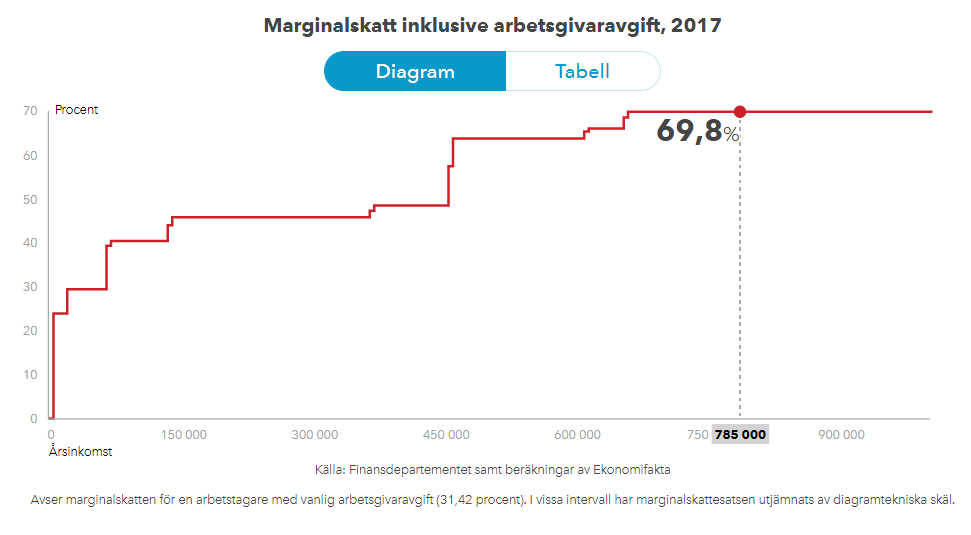
Let me show the more technical aspect: In England, earning above £18,330 places you at a position in the 54th percentile, higher than the majority of income-earners. Similarly, in Australia, $55,874 places you above 52% of Aussie income-earners. For Sweden, with the highest marginal income taxes in the world, a similar statistics is trickier to estimate since there is no official cut-off point above which you need to repay it. Instead, I have to estimate the line at which you “start paying” the relevant tax. What line is then the correct one? Sweden has something like 14 different steps in its effective marginal tax schedule, ranging from 0% for monthly incomes below 18,900 SEK (~$2,070) to 69.8% for incomes above 660,000 SEK (~$72,350) or even 75% in estimations that include sales taxes of top-marginal taxes:


If we would place the income levels at which Australian and English students start paying back the cost of their university education, they’d both find themselves in the middle range facing a 45.8% effective marginal tax – suggesting that they would have greatly exceeded the income level at which Swedish students pay back their tuition fees. Moreover, the Australian threshold would exchange into 367,092 SEK as of today, for a position in the 81st percentile – that is higher than 81% of Swedish income-earners. The U.K., having a somewhat lower threshold, converts to 217,577 SEK and would place them in the 48th percentile, earning more than 48% of Swedish income-earners – we’re clearly not talking about very poor people here.

The fact that income-earners in Sweden face a much-elevated marginal tax schedule as well as the simplified calculations above do indicate that despite its level of tuition fees at zero, it is more expensive to attend university in Sweden than it is in England or Australia. Since Australia’s pay-back threshold is so high relative to the income distribution of Sweden (81%), it’s conceivably much cheaper for Australian students to attend university than for it is for Swedish students, even though the tuition list prices may differ (the American debate is much exaggerated precisely because so few people pay the universities’ official list prices).

Letting governments via general taxation completely fund universities is a regressive measure that probably hurts the poor more than it helps the rich. The solution to this is not some quota-scholarships-encourage-certain-groups-version but rather to a) increase and reinstate tuition fees where applicable or b) cut government funding to universities, or ideally get government out of the sector entirely.

That’s a progressive policy in respect to universities. Accepting that, however, would be anathema for most people in politics, left and right.

A Millennial’s New Perspective on Home Ownership

The last few years I’ve loudly protested that home ownership is overrated; it’s a bad investment plus lots of responsibility. And yet, this summer my fiance and I bought a 100 year old house on the south shore of Long Island.

Yes, I have lost my mind.

I basically stand by my earlier position, but with greater nuance. Owning a home is a complicated undertaking. But it’s given me a greater appreciation for the nuance involved in managing real estate.

Home ownership is a great big Gordian knot of inter-dependencies. It’s massive set of knowledge problems wrapped in externality problems.There’s a massive role for local knowledge which means policy makers’ attention should be less focused on things like home ownership rates, and more on guiding the right people into the right places to take advantage of that local knowledge.

With local knowledge comes local politics. I don’t know anything about local politics, but expect more posts about what’s going on in my town hall over the next few decades.

So what have I learned in this first month of home ownership?

  • There’s something to be said about pride in ownership

It’s still a real trip to turn on my lights in my kitchen so I can do my laundry in my laundry machines. I didn’t think I’d enjoy it this much. The endowment effect is real. One effect has been to increase my interest in contributing to local public goods via civic engagement and other routes.

I haven’t been to a town hall meeting yet, but I plan on going to one tomorrow. I suspect it will be awful. But I’m walking distance, so I’ll be a little bit drunk.

  • The real estate market has some serious frictions

This might be obvious, but it’s interesting. There are artificial and natural obstacles to the efficient use of real estate. Transaction costs are significant and property rights issues are hairy.

Buying a house is a complicated transaction and going through the process has really made clear to me how difficult it is to commodify land. Each piece of land has a unique location and history. Information asymmetries are substantial. The neighborhood you’re buying into is utterly out of your control. Put simply: Amazon won’t be selling real estate any time soon.

Part of the reason I’m happy with buying a house is that our rent had been increasing about $100/month/year. Land lords absolutely take advantage of real estate frictions to charge as much as they can. The alternative (which I chose) is to lock-in to a specific property.

  • The required knowledge to operate a home is significant and difficult to evaluate.

It takes a lot of knowledge to manage a house. If I were to take a wild guess (at this non-quantifiable variable), I’d say that between 5% and 50% of a homeowner’s brain is necessary to operate a house. Even if you bring in experts to do everything, evaluating those experts is a lot of work.

There are repairs and upgrades to make, and my formal education prepared me for exactly none of those projects. On the other hand, I’ve got the Internet. Without YouTube and Reddit I’d be a half dozen unlucky mistakes away from homelessness.

On the other other hand, I’ve learned a ton of stuff I’ve got no use for. Like how to grow asparagus (which it turns out it isn’t worth doing except out of boredom).

You can’t evaluate knowledge until it’s too late. And there’s more to learn than you ever will, so you have to make mistakes. It’s true of home ownership and it’s true of life more generally.

  • Gardening is a real trip.

In History of Economic Thought professor Gonzalez shared a story about two economists meeting in Switzerland during WWII. On showing his vegetable garden to the visiting economist, the visitor said “that’s not a very efficient way to grow food,” to which the gardener said, “yes, but it’s a very efficient way to grow utility.”

I’ve wanted to garden for some time, but the market for gardens is thin. So now I’m starting with almost no useful experience. My public stance has been that lawns are boring and dumb. But figuring out how to manage a little ecosystem ain’t easy. I now get why someone would just put in a lawn and be done with it.

At my old apartment complex the entire ecosystem was made of: humans, trees, lawns, cockroaches. I suspect the cockroaches did so well because all their competition was poisoned away. As an emergent order guy, I’m not really into that. But I get it now. In the same way the king wants everyone living in neat little taxable rows my life would be easier if I could just slash and burn all the complexity out of my yard.

Tl;dr: My biggest surprise as a new home owner is just how big a cognitive load owning a house is. You hear homeowners talk about how much work it can be, but I think it’s rare to hear someone talk about how much know-how is required.

Given the capacity to generate externalities, I’m a bit surprised that there isn’t more public policy devoted to issues of home ownership* (beyond subsidizing finance and increasing barriers to entry). I supposed I’ll learn a lot more about these issues as I learn about local politics.

*That isn’t to say I think it’s a good idea to get the government involved in trying to tell people how to go about the business of daily life. I think homeowners are (basically) doing fine left to their own devices.

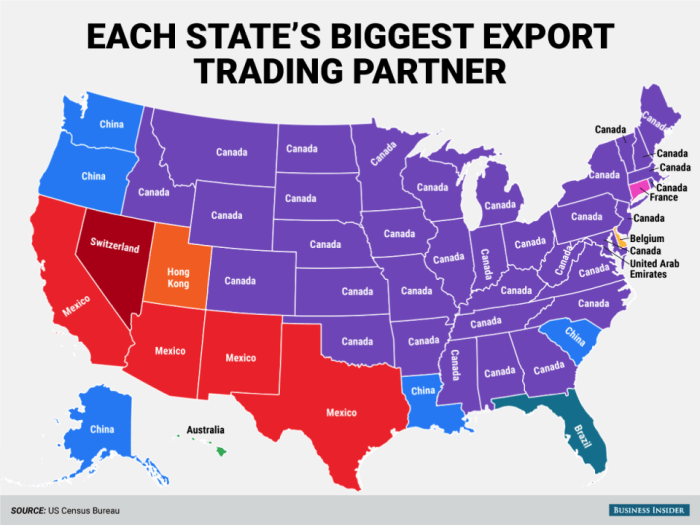
Eye Candy: Each (American) state’s biggest export trading partner

NOL map US state trading partners
Click here to zoom

Those tariffs will work wonders for the economy, I’m sure…

Nightcap

  1. The world’s first political risk consultants John Hulsman, Aeon
  2. Why We Should Say Yes to Drugs Andrew Sullivan, Daily Intelligencer
  3. A primer on fentanyl(s) Mark Kleiman, Reality-Based Community
  4. Moral responsibility Scott Sumner, EconLog

Nixon to Moscow, slavery’s toll on the economy

My latest is up over at RealClearHistory. An excerpt:

Nixon’s anti-Communist credentials were so sound that he could spend political capital making inroads with Communist enemies. His actions were viewed as safe by the American electorate because, for better or worse, the public saw Nixon as somebody who would not betray American values at the negotiating table with the Soviets. Nixon’s hawkishness provided moral cover for America’s withdrawal from Vietnam, and its peaceful overtures to the two most powerful and aggressively anti-capitalist regimes in the world (China and the USSR).

Please, read the whole thing.

Vincent has a great review up on Robert Wright’s new book about slavery, too. It’s at EH.net, a website dedicated to economic history, and here is an excerpt:

All of these amount to the same core point, those who reap the private benefits of slavery are content with their gains even though they come at a larger social cost and they will work to find ways to drive a wider wedge between the two by shifting costs onto other parties. Hence, slavery as pollution.

More here.

Nightcap

  1. What is the cost of “tractable” economic models? Beatrice Cherrier, Undercover Historian
  2. Facts vs. hand-waving in economics Chris Dillow, Stumbling and Mumbling
  3. How factories changed the world Donald Sassoon, New Statesman
  4. Defending the Mughals became a way to defend colonial rule Blake Smith, the Wire

2017: Year in Review

Well folks, another year has come and gone. 2017 was Notes On Liberty‘s busiest year yet. Traffic came from all over the place, with the most visits coming from the US, the UK, Canada, Australia, and India. (In the past, India and Germany have vied for that coveted 5th place spot, but this year India blew Germany out of the water.)

NOL is a voluntary cooperative, and as such this year saw the introduction of 6 new Notewriters: Kevin Kallmes, Nicolás Cachanosky, Ash Navabi, Tridivesh Maini, Matthew Bonick and Trent MacDonald.

Michelangelo invited Kevin to join, Nicolás is an old grad school buddy of Rick‘s, I reached out to Tridivesh, and Ash and Matthew were invited on Vincent‘s initiative.

Speaking of Vincent, 2017 was his year. He had Tyler Cowen (MarginalRevolution), Mark Thoma (Economist’s View), Anthony Mills (RealClearPolicy), Barry Ritholtz (Bloomberg), Don Boudreaux (Cafe Hayek), John Tamny (RealClearMarkets) and Pseudoerasmus (a well-regarded economic historian) all link to his thoughts multiple times over the course of the year. His Top 10 list for best papers/books in recent economic history (Part 1 and Part 2) were legitimate viral sensations, dominating the top 2 spots on NOL‘s most-read list. Other huge posts included “Did the 30 Glorious Years Actually Exist? (#5),” “The Pox of Liberty – dixit the Political Economy of Public Health (#9),” “James Buchanan on racism,” “The GDP, real wages and working hours of France since the 13th century,” “Did 89% of American Millionaires Disappear During the Great Depression?,” and “A hidden cost of the war on drugs.” My personal favorite was his “Star Trek Did More For the Cultural Advancement of Women Than Government Policies.” Dr Geloso’s thoughts made up 40% of NOL‘s 10 most-read 2017 posts.

My favorite posts from Edwin this year were his analyses of Dutch politics – “Dutch politics, after the elections” and “North Korea at the North Sea?” – but the reading public seemed to enjoy his posts on Ayn Rand, especially her thought on international relations, and his summary of Mont Pelerin Europe more than anything else. Van de Haar’s day job is in the private sector, so his blogging is understandably light (especially given his incredible publishing output in academic journals). I look forward to what looms ahead in 2018.

Federico’s most recent post on artificial intelligence and the law got love from some major outlets, including FT‘s Alphaville blog and 3 Quarks Daily. His question “Does business success make a good statesmen?” and his report on a Latin American Liberty summit are worth reading again, but my personal favorites were his comments on other Notewriters’ thoughts: first jumping in to add some historical clarity to Bruno’s post on Latin American conservatism and then to add layers onto the debate between Mark and Bruno on the Protestant Reformation. Federico has been invaluable to NOL‘s welcoming, skeptical culture and I cannot wait to see what he comes up with in 2018.

Barry was generous enough recount the situation in Turkey after the coup earlier in the year, and fruits of this endeavor – Coup and Counter Coup in Turkey – can be found in six parts:

  1. First of a series of posts on Turkey since 15th July 2016 and background topics
  2. Immediately after the coup and party politics
  3. Gülenists and Kemalists
  4. The Kurdish issue in Turkey
  5. Jacobins and Grey Wolves in Turkey
  6. Presidential Authoritarianism in Turkey

Dr Stocker also began writing an appendix to his six-part series, which resulted in a first post on authoritarianism and electoral fixes. Barry is hard at work on a new book, and of course the situation in Turkey is less than ideal, so I can only hope he has a bit more time in 2018 for NOL.

Michelangelo had a banner year at NOL. His #microblogging has been fun, as were his post analyzing relevant data from his surveys: What libertarians think of climate change, for example, or urban planning in Oregon. Michelangelo also utilized NOL to play around with concepts like race, marriage markets, data, Spanish language services, affirmative action, and freeware, to name a few. My absolute favorite Michelangelo post this year was his excellent “Should we tax churches? A Georgist proposal.” Michelangelo is a PhD candidate right now, too, so if he ever gets some time to himself, watch out world!

Rick also had a banner year at NOL. His post arguing against Net Neutrality was one of the most-read articles of the year here (#4), and many of his wonkier thoughts have been picked up by the sharp eye of Anthony Mills (RealClearPolicy) and the excellent Chris Dillow (Stumbling and Mumbling). Rick is my favorite blogger. Posts on cycling in Amsterdam, subsidies, management and measurement, linguisticsmore subsidies, and my personal favorite of his for the year, “Why do we teach girls that it’s cute to be scared,” always make me think and, more importantly, smile.

Bruno’s blogging was also amply rewarded this year. His thoughts on some of the problems with postmodernism brought in the most eyeballs, but thankfully he didn’t stop there: Articles introducing postmodernism and highlighting the origins of postmodernism also generated much interest. RealClearWorld picked up his post analyzing Brazil post-Rousseff (he had more analysis of Brazilian politics here and here), and his post delving into whether Nazism is of the left or the right provoked quite the dialogue. Dr Rosi was at his best, though, when prompted by Mark to further advance his argument that the Protestant Revolution played an integral role in the rise of the freedom of conscience. Times are tough in Brazil right now, so I can only hope that Bruno continues to play a vital role as a Notewriter in 2018.

Chhay Lin, now in the private sector, had his post about Bruce Lee’s application of Taoist philosophy head to the top of reddit’s philosophy sub, and his post on Catalonia and secession got love from RealClearWorld and Lew Rockwell (Political Theater). I hate to be *that* guy distracting a man from making his money, but I hope to see Chhay Lin pop in at NOL much more often in 2018!

Zak has been busy with a number of different projects, as well as attending Michigan-Ann Arbor full-time. He still managed to have one of his posts, on “libertarian” activist hypocrisy (#10), highlighted in the Guardian, the UK’s premier left-wing mouthpiece. His post on The Nancy MacLean Disgrace earned him plaudits from the online libertarian community and Don Boudreaux (Cafe Hayek), and his posts on open borders and income inequality show just how much of a bad ass he has become. I had a tough time trying to pick out my favorite Zak article of 2017, so I’m just gonna highlight all three of them:

  1. Immigration, Cultural Change, and Diversity as a Cultural Discovery Process
  2. Why I’m No Longer A Christian…
  3. Against Libertarian Populism

They’ve all got great self-explanatory titles, so do yourself a favor and read ’em again! Hopefully Zak can continue to work NOL in to his many successful ventures in 2018.

Jacques continues to amaze me. He’s been retired from academia for – as far as I can tell – at least a decade and he’s still producing great material that’s able to reach all sorts of people and places. His post on the Ottoman Empire and libertarianism (#6), which was featured at RealClearWorld and much-shared in Ottomanist corners of Twitter – took aim at popular American libertarian understandings of decentralization and seems to have landed pretty squarely on target. My favorite post of Dr Delacroix’ this year was about French Africa (also featured at RealClearWorld), but his late-year book review on Christopher De Bellaigue’s 2017 book about Islam might end up being a classic.

Bill’s 2017 here at NOL was productive and he continues to impress. His “Speech in academic philosophy: Rebecca Tuvel on Rachel Dolezal” brought in thousands of readers, but it was not his ability to draw crowds that I found impressive. His ability to tackle tough concepts and tough issues came to the forefront this year: drug use, “vulvæ,” more drug use, party culture (my personal fave), schooling (another personal fave), more schooling, and music (personal fave). Bill’s ability to weave these trends together through the lens of individual freedom is so much fun to read and important for fostering a culture of tolerance and respect in today’s world. I can’t wait to see what 2018 has in store for him!

Nicolás came out firing on all cylinders this year. With excellent dialogues between himself and Vincent, as well as between himself and guest blogger Derrill Watson (who I hope will be back for more in 2018), Dr Cachanosky’s passion for teaching has shown through clearly and brightly. I hope 2018 – his first full year with NOL – is filled with much more hard-hitting but insightful blogging from Nicolás.

Ash brought the heat, too. Check out the subject matter of his first few posts here at NOL: “A Right is Not an Obligation,” “Physical Goods, Immaterial Goods, and Public Goods,” “The Economics of Hard Choices,” “Markets for Secrets?,” “A Tax is Not a Price,” and “A Radical Take on Science and Religion.” Like Nicolás, Ash’s first full year at NOL is coming up, and if 2017 is any indication, readers can look forward to an interesting and engaging 2018.

Mark’s first full year here at NOL was a definite barnburner. His debate with Bruno on the Protestant Reformation (#8) brought in a bunch of eyeballs, including from RealClearHistory, while his “The Return of Cyclical Theories of History” also brought in thousands of readers, thanks in large part to Robert Cottrell’s excellent website, the Browser. Dr Koyama’s review of Aldo Schiavone’s The End of the Past also caught Mr Cottrell’s eye and the attention of his readers. Mark’s post on geopolitics and Asia’s “little divergence” is well worth reading again, too. Like Zak and Bill’s posts, I couldn’t choose just one favorite, so I give you two:

  1. Political Decentralization and Innovation in early modern Europe
  2. Some Thoughts on State Capacity” (an especially good criticism of American libertarian understandings of the “state capacity” literature)

We’re lucky to have Mark here at NOL.

Kevin, like Ash and Nicolás, brought the ruckus for his first few posts here at NOL. Kevin’s very first post at Notes On Liberty – “Rules of Warfare in Pre-Modern Societies” (#3) – ended up on the front page of RealClearHistory while his “Paradoxical geniuses…” earned a spot on the Browser‘s prestigious reading list. Not a bad start. Kevin will be finishing up the second half of his first year of law school (at Duke), so I doubt we’ll see much of him until June or July of 2018. My personal favorite, by the way, was Kevin’s “Auftragstaktik: Decentralization in military command.” His posts on taking over Syria – Roman style, the median voter theorem, and inventions that didn’t change the world also got lots of love from around the web.

Nick’s post on public choice and Nancy MacLean (#7) earned a nod from Arnold Kling (askblog), Don Boudreaux (Cafe Hayek), Chris Dillow (Stumbling and Mumbling), Mark Thoma (Economist’s View), and pretty much the entire online libertarian community, while his post analyzing the UK’s snap election earned a spot at RealClearWorld. Dr Cowen’s thoughts on school choice and robust political economy, as well as a sociological analysis of Trump/Brexit prompted by Vincent, all garnered love from libertarians and scholars around the world. My favorite Cowen post was his question “Is persecution the purpose?

Overall, it was a hell of a year here at Notes On Liberty. I’m really looking forward to 2018. Here’s to a happy, healthy you. Oh, and my proudest piece this year was “North Korea, the status quo, and a more liberal world.” HAPPY NEW YEAR!

The Cost of ‘Free’ – or why I don’t like freeware

This is a partial response to Fabio Rojas recent post on the fate of Stata, a statistics package, given the rise of a free alternative, R. Rojas and others have many reasons for why R is a good package, but for now I wish to deal with the argument that it being ‘free’ is a virtue.

R is free, but I see it as a fault because it reveals that it doesn’t have a devoted support system and because it isn’t free at all. It’s actually very costly!

If you’ve spent any time with an economist you should know that there is no such thing as a free lunch. If R is free we should not simply assume it is better. To the contrary we should ask why it is free. As I have tried to argue elsewhere, it is because when you purchase software you aren’t just purchasing a few lines of code. You’re purchasing the support system that comes with it. When a company purchases Stata, or any commercial software, they do so with the expectation that they can call a dedicated hotline for troubleshooting. As software has evolved you’ve seen companies experiment with pricing to acknowledge the fact that we don’t purchase a one time software but a continuous support system.

Consider Xbox or Playstation’s online services. Their use is charged on a per time basis because it costs money to run servers and provide customer support. Even ‘freemium’ games, which nominally don’t require any money to play, survive off micro transactions which enable companies to earn steady revenues in exchange for continuing support and new content. I would not be surprised if freemium statistical software is tried in the future – access to basic regressions is free but more advanced models cost money to run. I half joke.

But let’s assume you’re good at coding and don’t need much support outside of a few days reading an R book. Should you praise R for being ‘free’? No, because you still paid the time value of your time. Every hour spent learning how to code in R is an hour you could have spent doing any number of things.

Now to be clear, you may still want to learn R if it frees up your time in the future by automating X process. This post isn’t to argue against adopting R. My point is only to say that it isn’t free in a meaningful sense. Adopting R costs in the sense that you’re giving up a devoted support system and value of time equal to how long it takes you to become proficient in it.

It’s possible that once you account for those things R is still ‘cheaper’ than commercial software like Stata or SPSS. That is an empirical question beyond the scope of this post.

Immigration and Jobs – Reprise

A good op-ed in the March 24 issue of the Wall Street Journal by Mark Krikorian forces me to go back to one of my recent postings on immigration: “Immigration and Jobs.”

Krikorian is executive director of the Center for Immigration Studies in Washington D.C. Mr Krikorian accuses everyone in America of “not facing the facts” about current and recent immigration. He insists that some questions must be posed instead of skirted. I agree, of course, but I don’t know that it’s true that people are not facing the facts. I think instead that many busy and fair people are hearing contradictory statements and that they don’t have a good framework to think things through. Krikorian states that he rests his case on an authoritative study by the National Academies of Science, Engineering and Medicine. The academies are a respected source. I take it seriously if Krikorian reports accurately. (Be aware that I have not read the study in question.)

Krikorian’s most troubling assertion is as follows: All Americans benefit from immigrants being in the US. This benefit is entirely extracted from the higher wages Americans competing with immigrants would receive absent wage lowering immigrants’ competition. In other words: Americans who compete with immigrants receive lower wages than they should; everyone else benefits from these lower wages.

I think that’s obviously overstating the case. There must be at least one immigrant generating product (GDP) that would not otherwise exist in the American economy. Maybe, there are two. One is in Silicon Valley, inventing a product – like the personal computer forty years ago – that will eventually cause the employment of thousands, or millions. The second is in Kansas, saving from demolition a beat-down hotel that provides immediate employment for two-to–four minimum wage-earning maids. (Both entrepreneurs are Indians, obviously). In general, immigrants might benefit all by offering additional, or better, services than do the native born. I develop this thesis below.

Krikorian seems to be operating from a standpoint where the work pie to be shared by Americans and by immigrants is of a permanently fixed size. This erroneous perspective, in turn, may well come from a respectable desire to stick close to research findings. Research that also (also) takes into account immigrants’ contribution to increasing the size of the pie is doable but it’s more difficult to perform and to integrate with previous findings than research that relies on a static representation of reality.

Let me admit that I don’t have any numbers at my disposal and that any reasonably credible set of numbers could blow out of the water everything I am going to say below.

First, it’s obvious that there are currently many unfilled jobs in the US. Organized labor and anti-immigration spokespeople will argue that all those jobs would be filled if the wages offered were high enough. I am skeptical of this argument for two reasons. First, Silicon Valley employers affirm vigorously that they just don’t find enough would-be employees with the required skills, at any price. I tend to believe them to some extent because they evidently spend energy and resources raiding each other for expensive existing personnel. This kind of practice suggests true, absolute scarcity. I have mentioned in one of the companion essays the difficulty farmers encounter in recruiting pickers even when they offer wages significantly superior to both the minimum wage and to the going wage in my job-poor area. I would argue that their difficulties are rooted in the same problem facing Silicon Valley employers: a shortage of local competence. Picking strawberries, for example, is not easy at all. And it requires a certain attitude, or fortitude, that is not common anymore among Americans, as I have argued elsewhere.

Second, presented below, a forbidden argument. But I must make a disclosure before I move to it: I am one of the 43 million foreign-born people now living in the US. I studied in the US and I was permanently admitted on a variant of a B1 visa. I had a main career as a university professor. I don’t believe that an extra teaching position was ever added in any university to accommodate me. (It happens for some foreigners, a very few, of star quality, like Einstein; I wasn’t one of them, let’s face it.) Of course, to obtain any university position, I had to possess the same credentials as native-born Americans who also wanted the position. (That’s right, there is no affirmative action track for white Europeans!) Good university positions are surprisingly competitive to obtain; earning tenure is even more competitive. Every position I obtained, I got from winning against similarly situated native-born.

Each time, I won the gold, if you will. This simple fact would seem to suggest that I was at least slightly better in conventional terms than those native-born who did not get the position. This fact implies at minimum that had I not competed for the position my students would have been served at best by a silver medalist. (I choose the Olympics language on purpose, from a surfeit of honesty. It’s not absurd to argue that the quality difference between the gold and the silver winners is insignificant or even accidental: On a different day, with a different wind, perhaps, the silver winner would have won the gold. But there is more.)

Like many but not all immigrants, I grew up in a language different from English, French in my case. So. I had to achieve the same credentials as my competitors in what was for me a second language. Forgive me for seeming to brag but doesn’t this indicate an intellectual competence over and above what the formal credentials express? If you doubt this shameless assertion, ask yourself how many native-born Americans are able to teach anything – besides the English language – in any francophone university anywhere. And I am not an extreme case of talent among immigrants to the US. I know a man, a distinguished biological scientist, who grew up in the African language Wolof, went to secondary school in French, to college and graduate school in English. Would you guess he possesses a certain mental nimbleness uncommon among determined monolinguals?

I will reluctantly take another step. I do it reluctantly because it is sure to lose me some friends. I will use my own case as an immigrant for an example because it’s the case I know best. It’s about the cultural endowment we carry around over and above, or aside from mastery of a foreign language.

Let me say right away that I don’t contend that I enjoy a 100% understanding of American culture, even after fifty years. I don’t understand the rules of baseball, for example. I never bothered to learn because the game seems boring. Yet, I must be conversant with a lot of national culture, just for having acquired my professional credentials and, even more so, for navigating everyday life in my society of adoption. The point is that the acquisition of another culture does not entail a one-for-one exchange, like changing clothes, for example. Much, most of what the immigrant brings with him, he retains, as one might easily assume. When I was learning American culture, I was not leaving French culture behind with the hat-check girl.

The first thing that immigrants, those who immigrate as adults, keep is mastery of their native language. This may sound mysterious to a monolingual person. It’s true that one can become “rusty” in a language one does not use. The quality of self-expression, for example, may deteriorate over time spent abroad. Yet, it’s very unlikely that an immigrant will lose the ability to watch the news in his native language, or to read a newspaper. So, I follow the news in English, of course, but also in French, some of the time. The reporting of the same events do not overlap perfectly, far from it. So, I am learning things I probably would not learn if I knew no French. (That’s in addition to carrying in my head much disorderly information from my society of origin. More below.) In my job as a teacher and as a scholar, I was routinely able to draw on broader information than did my native-born colleagues. I wouldn’t say (although I am tempted) that I had twice as large a store of information at my fingertips as they did but that I had definitely more than they.

So, in fact, I am arguing – with little embarrassment – that I must have been a better teacher and scholar than most (not all) of my native-born colleagues with similar credentials by virtue of being an immigrant.* There may be no metrics allowing an assessment of this outrageous claim. That’s because what college professors actually do is so mysterious. (Another story.)

It’s also true that to measure accurately the added work value of immigrants you have to find a way to factor in laziness, which varies much among individuals. In my case, I suspect strongly that if I had been native born, I could not have had the normal academic career I enjoyed, given my above-average level of laziness. In other words, the informational advantage associated with being a bilingual immigrant may have paid the fare for my laziness. Had I been the same person, with the same formal credentials, except less lazy, however, my presence would have much benefited American society. This detour supports my main argument of course: It does not make much sense to deny that competent bilingualism adds to normally credentialed efficacy. This is true in an occupation such as university teaching. It’s true though possibly to a lesser extent, for a plumber who will, at least, be a better citizen than a comparably situated monolingual. This is all common sense. No hard data are needed to give this scenario credence although hard figures might destroy it.

It should be fairly clear that a second language is like another tool in one’s personal toolbox. Immigrants have yet more, other additional tools that may be more elusive, more difficult to describe. I am giving it a try. All of us approach new situations through a filter that is made up partly of our past experiences, through the colander of past experiences if you will. Many of the experiences that compose the sifting device are repetitive, partly superfluous: The tenth car accident you witness does not have the same power to influence your driving as the first. There is often an excess of material in the sifter. This means that whatever the sifting process accomplishes would be accomplished as well, or nearly as well, on the basis of fewer past experiences.

My experiences in my society of origin do not perfectly duplicate those of a similarly situated native-born American. For example, I lived through a school system that was much more authoritarian than he experienced. I take from this the strong impression that my experiences in my society of origin adds to my experiences in my society of choice to give me a better sifter than what exists among the native-born population. It does this in a non-repetitive way (unlike, say, the 9th car accident.) I don’t mean that I have twice as large a sifter as they do but perhaps that I have 125% of what they carry in their heads.

This second extra tool in my tool box is factually associated with the first, bilingualism, but it’s not the same thing. An Australian, with a perfect command of English and perfectly innocent of knowledge of another language would carry the same extra tool as I do. The advantage gained through this second tool is difficult to express. It’s tacit. (I have never read anything about the topic.) I believe that my experience of another society – again, independently of bilingualism – acts like a second pair of glasses. I think I am able to watch events and people from one perspective, and then, to some extent, from a second perspective. I suspect it does not give me extra-depth but an edge in exercising common criticality. Possibly, it acts like a few IQ points that would be added to my measured IQ. Again, this thesis is very exploratory, supported by no real numbers. I must add that this second tool associated with being an immigrant is free from the effects of education. I think I have observed the expected extra resourcefulness among Mexican immigrants I knew to be semi-literate (in Spanish) performing ordinary manual jobs, in construction and in repair work, for example.

In conclusion: I and hundreds of other immigrants I have observed contribute to the society in which we live over and above the contributions of the native-born. Thus, we add to the general well-being even if we are paid exactly the same as the native-born.

The above is a short string of arguments in favor of immigration. None of it is a call for open borders. I subscribe to the lifeboat view of immigration. Too numerous immigrants could easily sink the boat that made them swim to developed societies in the first place. (According to retired foreign service officer Dave Seminara’s review of relevant studies – that I have not read – 150 million people world wide would like to move to the US, including 34% of Mexicans.) In addition, there are non-economic arguments against large-scale immigration that I support although they may be even more difficult to describe than what I tried to explain above. My analysis supports instead an active stance to design immigration policies that make rigorously the conceptual distinction between immigrants we need and immigrants in need. This distinction is not inimical to any refugee policy whatsoever; perhaps, the reverse is true.


* Please, don’t try to factor in a putative superior European education brought to the job of being an American academic as an alternative explanation. I am a French high school dropout.
How dairy farmers unions in Canada are distorting the facts about supply management

Under heat recently as President Trump has criticized supply management in Canada and retaliated against it, the different provincial associations representing dairy farmers have moved on the offensive. To promote the virtues of this system meant to reduce production in order to prop up prices through the use of trade tariffs, production quotas and price controls (how can we call those virtues), these unions have produced numerous infographics to make their case. It is even part of what they dub their These-infographics-show-that-diary-prices-are-lower-in-Canada-than-elsewhere, that milk is still a cheap drink relative to other type of drinks and those prices, supposedly, increase more slowly than elsewhere. All of these graphics are dishonest and must be dismantled.

The most egregious of these infographics – present in the “lobby day kit” – shows the price of milk in Australia (1.55 CAD), Canada (1.45 CAD) and New Zealand (1.65 CAD). They are seemingly using 2014 prices. First of all, they use data that conflicts massively with the reports of Statistics Canada that suggest that milk prices hover between 2.33$ to 2.48$ per liter.  Their data is provided by AC Nielsen but no justification is presented as to why they are better than Statistics Canada. The truth is that it is not better. Participants in Nielsen surveys come from a self-selected pool of storeowners who wish to participate and are then selected by Nielsen to be part of the data collection. Then, they can record prices. It should be mentioned that not all regions of Canada are covered in the data. Although the Nielsen data does have some uses (especially with regards to market studies), it hardly measures up Statistics Canada when comes the time to evaluate price levels. This is because the government agency collects information from all regions and tries a broader sweep of retailers in order to create the consumer price index.

But an even larger problem is that, in their comparison of prices, they don’t mention that New Zealand taxes milk. In New Zealand, all food items are subjected to sales tax, which is not the case in Canada and Australia. Hence, when they compare retail prices, they are comparing prices that exclude taxes and prices that include taxes. One would like to find if they acknowledge this fact in the methodological mentions, but there are none!

Using prices available at Numbeo.com and Expatisan.com and the exchange rates made available by the Bank of Canada, we can correct for this problem of theirs. Simply changing prices source leads to a massively different result with regards to Australia whose milk prices are lower than in Canada. Secondly, once we adjust for the sales tax in New Zealand, we find that prices in New Zealand are lower than in Canada. In fact they are lower than in one of Canada’s cheapest market, Montreal (let alone Toronto or Vancouver).  So the infographic they show in order to lobby governments is a fabrication.

Table 1: The real price of milk

Using Numbeo.com (regular milk)
Unadjusted Adjusted for taxes
 Australia  $           1.59  $                 1.59
 New Zealand  $           2.26  $                 1.97
 Canada  $           1.99  $                 1.99
 Using Expatisan.com (whole milk)
 Unadjusted  Adjusted for taxes
 Sydney  $           1.82  $                 1.47
 Wellington  $           2.42  $                 2.10
 Montreal  $           2.87  $                 2.87

Source: Numbeo.com and Expatisan.com, consulted May 16th 2014 and the Bank of Canada’s currency converter. Note: using the Statistics Canada price would make Canada’s situation even worse by comparison.

This is part of a pattern of deceit since they also massage data for numerous other graphs that are presented to Canadians in efforts to convince them of the virtues of supply management. One other example is an infographic that presents a figure of nominal milk prices in Australia before and after the abolition of supply management. Given that prices seem more volatile after 2000 and that they increase more steeply, they try to make us believe that liberalization was a failure. This is not the case. Any sensible policy analyst would deflate nominal prices by the general price index to control for inflation. When one does just that using the data from the Australian Bureau of Statistics, one sees that real prices stabilized in the first ten years of deregulation after increasing roughly 15% in the decade prior. And since 2010, real prices have been falling constantly.

Other examples abound. In one instance, the Quebec union of dairy farmers circulated an infographic meant to show that nominal prices for dairy products increased faster in the United States than in Canada. Again, they omit inflation. Since 1990 (their own starting date), prices of dairy products have risen more slowly than inflation – indicating a decline in real prices. In Canada, the opposite occurred – inflation increased more slowly than dairy prices indicating an increase of the real price.

The debate around supply management is complicated. The policy course to adopt in order to improve agricultural productivity and lower prices for Canadians is hard to pinpoint. But whatever position one may hold, no one is well-served by statistical manipulations offered by the unions representing dairy farmers.

Pride and Subsidies

Freakonomics had an episode on the dramatic impact of subsidies on the visual effects (VFX) industry. Long story short: 1) VFX companies operate on razor thin margins, 2) the industry chases subsidies from competing local governments–Canada and London are  currently important locations, 3) Californian politicians want to bring these jobs back to LA, but doing so would probably be a net burden.

(Let’s put aside the issue of the state of California trying to play central planner by effectively creating different tax rates for different industries. That’s a bad idea for reasons we can explore later.)

Putting yourself in the head of a Californian, something about the policy feels right (maybe not for the typical NOL reader, but probably for the median voter). I’m sure you could convince the median voter that these subsidies are a bad idea, economically. But even so, I’d be willing to bet that you’d still get significant support.

I’m confident that if you were to talk this issue over with a representative sample of California voters–or X industry in Y region for similar industry upheavals–you could convince them of the probable negative impact of such policy and still see many voters at least weakly supporting the policy. Why? Because being able to point to a movie and say “that awesome explosion was made in my backyard,” is worth some degree of sacrifice for these people.

Perhaps people want our government to give us something to be proud of (God knows they give us enough things to be ashamed of!). Perhaps people have some latent willingness to pay to be able to say that some high status industry is in their community/city/state/country.

We like pride, but it costs us. This puts us squarely in the domain of economics. How do we figure out how to make the trade off between pride, and the price we must pay for it? Some cases seem easy, at least in hindsight–the sacrifice of the civil rights movement was a small price to pay for the pride generated–but cases like the VFX industry, aren’t so obvious, but still high stakes.

I don’t think we’re likely to be able to figure out the bill. We can be proud of NASA, movies, the post office, and whatever else. But how much of the cost can we attribute to engaging in activities that make us proud? We get the same issue in markets. I have more than brand loyalty for Honda (the maker of my motorcycle); I’m also proud to associate with Honda as an innovative company with a history of liberating the world’s poor.

A clever statistician or economist could estimate some important facts about how people tend to make these trade offs. Doing so could help us make better decisions, but can’t ultimately replace our own judgment.

Given the uncertainty we face we really have to make a decision about whether to err on the side of over- or under-provision of pride goods–and this is true in a variety of settings.

I suspect that the “let 1000 flowers bloom” approach is the appropriate one here. We don’t want to have one Secretary of Pride deciding to err on the side of over-provision and the result is that a bunch of children die from preventable causes so that we can all feel proud about how cool the latest domestically produced Fast and Furious movie is going to be. On the other hand, it would be a tragedy of slavery was never ended because it would interrupt business as usual.

Markets, civil society, and government face different sorts of pros and cons with respect to how they might make these trade offs. Arguing about them could create a new academic discipline at the intersection of ethics, economics, and sociology.

In all three spheres, there will be many very bad decisions made. But if you aren’t free to be wrong, you aren’t free. The question to ask is what sort of pride goods will tend to survive, and in which spheres?

What we can say for sure is that private, voluntary exchange and cooperation (free markets and civil society) at least allow us to choose our associations. And they require us to choose, and choose again on a regular basis. Our nation is mostly based on luck. Where we live tends not to change much. Voting with your feet is costly, so we should expect it to be that much harder to dismantle big mistakes. The political process routinely results in outcomes we’re ashamed of (about half of voters are ashamed of the results every presidential election!).

There aren’t markets in pride so it’s hard to know how the benefits compare to the costs. But we can (and do) exhibit pride in markets. We should probably do more of it. And perhaps we should also be more skeptical of government, even though we normally think of them as providing pride goods. On the margin, anyways, I think this is a good direction for most people to move. Be proud of your community because the people have whatever unique traits they do. Be proud of the brands you buy from for their contributions to the state of the art. Be proud of your local sports team.

Illegal Immigration: Pres. Trump’s New Measures

I can’t wait for the raging assaults by the pseudo-cultural elite and by the media against Pres. Trump to stop to begin criticizing some of his decisions, as I would with any other president.

I have heard and read reports that the president intends to launch a policy of accelerated repatriation of illegal aliens. It will single out criminals for priority deportation (as was the case under Mr Obama). At this point, almost everybody agrees about getting rid of illegal aliens who are real criminals, especially the violent ones. Again, the new policy sounds a lot like Mr Obama’s, with a few details different. The details often matter when it comes to human lives, also when it comes to traditions of government. Here are two such details.

First, I have heard that even traffic tickets qualify an illegal alien for quick deportation. Make a wrong u-turn and your life gets broken up.

Second, I have heard and read that even being merely charged with a crime places you at the head of the line for deportation. Someone who looks like you steals a car. You get charged by mistake. You are gone.

The first detail seems awfully rough to me. I would feel better if the word “recidivist” were included. A person who breaks driving rules repeatedly is a trouble-maker we can do without. A guy who is too distracted to interpret the U-turn sign (could be me – once) is not exactly a criminal in the real sense of the word.

It’s true that such extreme severity would improve the driving of all illegal aliens. The claim is probably also correct however that it would interfere with aliens’ (legal and not) willingness to cooperate with the local police. Aside from this, I would bet it would involve significant law enforcement costs just to process traffic tickets through to the Immigration Service. I am a conservative, I am against big government, even against big government at the local level. I don’t want tax money, federal, state, or local, to be wasted processing a U-turn violator. It seems irrational to me.

The second, detail concerns the treatment of people only charged with a crime. It’s simple. I just don’t want any of them to be included in the priority list. Having any branch of government treating the accused as guilty simply goes too strongly against everything I believe. It’s un-American.

Yes, I have not forgotten that the subjects have no right to be in the country in the first place. I don’t care. It’s not about illegal aliens’ rights. Immigrants, legal or not, have no rights as a category as far as I am concerned. They only possess the ordinary human rights of anyone under American jurisdiction.

It’s about a slippery slope for all. If we begin officially thinning out the traditional wall between “charged” and “guilty,” where are we going to stop?

I understand that a lawyer would argue that the person is technically not being deported for the imaginary crime of being charged but because he has no right to be in the country, period. Do you know the one about the lawyer….

We can’t engineer our way out of this

Folks on the left have been getting more interested in science lately (though history tells us that might be something to worry about). They’re right to celebrate the incredible results of scientific progress–but scientific victory isn’t uniform across disciplines.

In some areas (including just about all areas on the cutting edge), scientists disagree with one another.It’s a big, complex world we live in, and we don’t understand it fully. That disagreement doesn’t mean we should discount science entirely, but it does mean we should be careful with it.

Imagine a world where engineers disagreed about the capabilities of their techniques and the strength of the materials they use. Some might be beholden to special interests (which gives me an idea for a public choice version of the Three Little Pigs), others might be dogmatic/superstitious. But even without concerns of systemic issues, we should be hesitant to try to get to the moon. That disagreement should tell us that we aren’t certain enough in our knowledge to make anyone but volunteers put their lives in the hands of those engineers.

Social scientist in particular frequently disagree with each other. Most are trying earnestly to apply the scientific way of thinking to understanding the social world, and it’s worth considering their view points. But applying that knowledge should only be done in a decentralized way. Applying the incredible insights of behavioral economics from the top down is appealing, but it’s probably best to do it piecemeal.

Social engineering and social science are harder than physical engineering and the physical sciences. Part of the problem Western governments face is that they’re trying to engage in social engineering. And politicians are promising them greater degrees of social engineering to improve the well-being of their constituents.

The trouble is two-fold: 1) those social engineering techniques aren’t good enough, even if they’re sometimes appealing. 2) The cost to decision makers of buying snake oil is too low in voting booths.

To my friends who are looking to the government to make things better: whether your hope is for government to help people be better versions of themselves, or to stop bad guys, we should push as much of that policy to the local level as possible. It might be nice if the whole country were more like Berkeley or Salt Lake City, but trying to make it happen at the national level is a recipe for conflict, disorder, and doing more harm than good. Keep policy local.

The Great Blessings of Cash

Paper money offers the benefits of anonymity, immediate payment, no identity theft, and no transaction charges. Government also benefits by printing notes with much greater value than the cost of the paper. However, some economists argue that cash has social costs that outweigh these blessings, and advocate the reduction and eventual elimination of paper cash. Several countries are planning to discontinue their largest currency notes. The European Central Bank is phasing out its 500-euro note; it will stop issuing new ones in 2018. The Scandinavian countries are reducing their paper cash.

Kenneth Rogoff, professor at Harvard University, has written a book, The Curse of Cash, in which he argues that the elimination of large-denominations of paper money would be good for society. Cash is a curse, he says, because criminals use the large bills, and because it limits the ability of central banks to have negative interest rates.

The use of cash by the underground economy is a symptom of bad policy, and the elimination of cash treats the effects rather than the causes. The reason economic activity goes underground is that governments have prohibited economic transactions.

Although some U.S. states have decriminalized medical marijuana, the substance remains illegal in federal law, which prevents the sellers from using the normal banking system. Therefore they use paper money. The prohibition of drugs generally drives the industry towards the use of large denominations, especially “Benjamins,” the US $100 bill depicting Benjamin Franklin. The elimination of Benjamins would make it less convenient to sell illegal drugs. The higher cost would raise the price of illegal drugs, but since the quantity demanded by addicts is not very responsive to a change in price, the drug dealers would find ways to do their transactions.

The legalization of drugs would eliminate the cause of the high demand for paper cash. Just as with alcohol, producers would then use the normal banking system.

The underground economy uses cash also for activities that are legal if taxes are paid on the income and sales. Again, the elimination of cash would make tax evasion less convenient, but not eliminate the incentives to evade having substantial amounts of gains taxed away. Rogoff thinks that if the government prohibits the legal use of Benjamins, the remaining notes would lose value, as they would no longer be legally convertible into small denominations and not be legally payable for goods. But large notes could circulate as a medium of exchange within the underground economy as an alternative currency. Moreover, there are underground currency traders in all countries that impose artificial currency exchange rates.

The problem originates in evadable taxation. The remedy that eliminates the cause is to make taxation unevadable. The main resource that cannot hide is land. The taxation of land value, based on its best possible use regardless of current use, cannot be evaded. The elimination of all other taxes would bring production, trade, and consumption above ground and eliminate the current high demand for paper cash.

Another “curse of cash” argued by Rogoff is that paper money prevents central banks from lowering the transaction rate of “interest” much below zero. Suppose a bank has a negative 5 percent charge on deposits, so that the depositor has to pay $5 per year per $100 deposited. Many people would withdraw the money and hold it in paper cash. Companies would offer to securely store your cash in insured vaults. If all notes above $10 were made illegal, the storage and insurance costs would rise substantially, and the banking system would be better able to have the negative rates.

The alleged benefit of negative rates is that, because the banks also pay negative rates on their deposits with central banks, financial institutions would scramble to loan out the money to investors who would pay a positive rate, or become partners in ventures.

It is bad enough now that savers, especially retired folks, are getting close to a zero return on their retirement savings. Negative returns on, say, large certificates of deposit would further ruin those who depend on income from savings. Again, the artificial device of pushing the nominal rate of interest below zero is an attempt to treat the symptoms rather than cure the causes.

Some blame a glut of global savings for the low rates of interest. But technology is marching forward, to artificial intelligence, robots, medical advances, better batteries, and many other frontiers. There is no shortage of possible investment projects. But governments world-wide stifle investment with taxes and restrictions. The USA, for example, has choked investment since 2008 with tighter banking restrictions and higher costs such as medical mandates.

What is needed is the ultimate supply-side policy, cutting marginal tax rates on labor and investment yields to zero, with a prosperity tax shift, replacing all other taxes with a single tax on land value. The land-value tax would also push land to its most productive use, stimulating productive investment and employment.

As to money, attempts to skew markets almost always fail, so it would be best to eliminate central banks and their manipulations of nominal interest rates. Let markets set the money supply and restore the positive natural rate of interest based on the human-nature tendency to prefer to have goods sooner rather than later.

Controlled market manipulations are failing, and so statist advocates propose even more artificial controls such as eliminating paper money and pushing interest rates below zero. But the further we get from economic freedom, the worse the outcome. Interest rates and money evolved in markets; let them return to their natural base.

Note: this article is also in http://www.progress.org under the title The Blessings of Cash.