Nazism: left or right? (again)

A few days ago, Brazil’s Foreign Affair’s Minister declared that Nazism “derives from the left”. Asked about his minister’s remark, president Jair Bolsonaro confirmed that he understands Nazism as a left-wing movement.

The understanding that Nazism is a left-wing movement is growing among Brazilian conservatives, especially those who support Bolsonaro’s government. On the other side of the debate, Bolsonaro’s adversaries ridiculed his remark or manifested concern with his “historical revisionism”.

Seems to me that classifying Nazim as a left-wing movement is not a Brazilian exclusivity. Political commentators from other countries (such as Dinesh D’Souza) are saying the same thing. It is probably more accurate to say that Brazilians are following a trend.

This trend, however, is not new. One of Friedrich Hayek’s main points in Road to Serfdom was to tell social democrats (who were indeed democrats in the classical liberal sense of the word) that they were closer to Nazis than they would like to admit. Hayek’s remark was as polemic then as it is now, but mainly because he is saying the truth: as Milton Friedman said, “The society that puts equality before freedom will end up with neither. The society that puts freedom before equality will end up with a great measure of both.” If I remember correctly, it was also Friedman who said that in order to obtain perfect equality more government would be necessary, which would completely undermine the desire for equality, for those in government would most certainly not be equal to everyone else.

The standard in Political Science is, of course, to call Nazim a right-wing movement. However, we see in moments like this how political and how little scientific Political Science can be. What many people observe is that Nazism shares a lot with communism: both are violent, both emphasize the collective (and not the individual), both rely on popular leaders, and so on. Of course, there are also differences: Nazism has nothing of the class-struggle so central to communism and certainly doesn’t appeal to the cosmopolitanism present in “workers of the World, unite!”.

With all that said, I have a growing feeling that there are only two political tendencies: “live and let live” and all others. Some people can’t stand the possibility of having others living a different lifestyle from them. Some people can’t stand people who disagree. Some people like to blame others. Some people truly believe that those who think and do like they do are superior to everyone else. These people come together and ask the government to force everyone else to comply.

Proposal: Let’s stop calling them “Property Rights”

I think an alternative that is both clearer and more general is “Decision Rights”. When I teach Coase Theorem I use both terms, and (I think) students have an easier time grasping it when they realize that property rights are really just rights to make certain decisions. I can’t see a good reason to keep using the term property rights except that by historical accident it’s become entrenched jargon.

Property sounds like “stuff” to most people. And property rights sounds like “owning stuff”. This raises two points that need clarifying:

1. There is more to the world than just the physical, and there is more to property than just stuff.

I would argue that economic rights are human rights. (I would also argue that corporations are owned and staffed by humans but are not humans themselves.) And I would say that right to self-ownership is a particular type of economic/human right.

When we talk about environmental issues, the root problem is usually over some shared resource (e.g. we can’t neatly privatize the atmosphere and let now-private conflicts be resolved in court). It’s much easier to focus in on the relevant particulars when our language directs us to what’s really at stake (e.g. whether I can decide to put more than X amount of pollution into the atmosphere without legal consequences).

2. I own a bit of land and I can make many decisions about how to use it. But I can’t set up a nuclear reactor or burn a massive pile of debris. My ownership is not carte blanche, but a bundle of different rights. I have the right to use (for normal domestic purposes), to exclude, to sell, etc. By “I own” what I really mean is “I can make a particular set of decisions.

I hope my hard core libertarian friends will agree with me that the decisions I can make are not limited by what is explicitly legislated. I suspect my interventionist friends will disagree. But I also think interventionists can agree that it’s more reasonable for me to have a set of decision rights (how ever nebulous the extent of that set is) than some more magical sounding dominion/ownership over a particular fifth of an acre.

The notion of decision rights makes it clearer what political debates are over. If we want to pass a law saying you can’t put a pool in your yard because of spotted owls, “property rights” muddies the discussion. The law would take away a particular property right–which is to say, the right to make a particular decision. But the debate is going to devolve into “you’re taking our land” vs. “no we aren’t.” It’s close to the real issue, but not close enough.

tl;dr: When we talk about “property rights” or ownership what we really mean is a set of various decisions that one has a right to make. Those decisions might be over the use of what we traditionally call property (e.g. my yard), but it might also be over shared resources (e.g. the atmosphere), decisions with collective impacts (e.g. ecosystem management–or lack thereof), or socially constructed issues (e.g. intellectual property). The term “property rights” is not clear or obvious (particularly for people who aren’t already likely to read this blog). A better term would be “decision rights.”

Old Property

Property is the basis for every right and ounce of autonomy we have. James Madison called property “that dominion which one claims and exercises over the external things of the world, in exclusion of every other individual.” Madison went on to argue that basically every right we enjoy is reducible to a property right. We have property in our opinions, in the free use of our faculties, in the safety and liberty of our body, and so on. He believed that “Government is instituted to protect property of every sort” and a government can only be just if it “impartially secures to every man, whatever is his own.”

But government has not remained impartial in this endeavor. It has become a massive property owner in its own right.  It has also become a gatekeeper, setting the terms for individuals’ uses of their own property. It has also become a broker and redistributor of property. And finally, it has =become a creator of property in the form of entitlements–what Charles Reich famously called “new property.” It’s this last role that I’d like to discuss here.

Government’s role as a creator of property has muddled and watered down the strength of property rights. The problem began when U.S. courts started grappling with claims that individuals had been deprived of a constitutional right when government stripped them of a government-created entitlement, such as social security.

Courts confronted with this problem basically held that while constitutional rights do attach to entitlements, the government has an increased authority to limit the rights to those entitlements. Essentially, since the government created the entitlement, the government can define the scope and terms of that entitlement.

This “new property” doctrine then became entangled with a different idea altogether. The United States Constitution protects against deprivations of life, liberty, and property without due process of law. The Constitution, however, does not define property. Courts have held instead that state law defines property , and the Constitution then protects rights to that property.

That does not mean, however, that all property can be whisked away at a whim as if it is all “new property.” Rather, even though state law may establish what property is, states do not have the power to mutate and redefine all property rights on a whim. In essence, there is “new property” and then there is “old property.”

“Old property” is a bundle of long-recognized property rights rooted in common law. But just because those rights have arisen from common law courts over the centuries does not mean that these are property rights created by government in the same sense as less-protected “new property.” There is a fundamental difference, for constitutional purposes, between government recognizing a boundary line and creating a food stamp program. In some sense, this difference strikes a deeper philosophical chord, one that distinguishes between positive law and natural law–or fundamental rights that are acknowledged and respected by government, and entitlements that are created and controlled by government.

What are these fundamental property rights? Most are intuitive and understood by babies as soon as their hands are capable of grasping. They include the right to exclude others (the first property right understood by all children everywhere), the right to quiet enjoyment, the right dispose of the property by sale or lease, the right to develop and improve the property, etc. That right extends to chattel and land–things the government does not create but simply exist and are brought under human ownership through a first-in-time rule or a transfer.

The idea that “new property” deserves lesser protection because government dictates its bounds has bled over into the “old property” rights. This stems from confusion between government recognizing the existence of a fundamental right and government creating an entitlement. Extensive permitting regimes have only exacerbated this confusion. When local governments demand a permit before a property owner can do something with their land, the government looks upon that permit as an entitlement–a privilege and not a right. Thus, “new property” ideas come to overlay and suffocate “old property.” As permitting regimes expand, the world of “old property” retracts. But that permit is not a “new property” entitlement–it’s a condition placed upon a fundamental background right–an intruder upon natural law. When a permitting authority tries to strip away or deny a permit, that denial should be subjected to the full rigor of constitutional scrutiny offered to “old property,” not the weak sauce protections for entitlements.

If a government is only just if it limits itself to protecting what is ours, as Madison believed, then we don’t have many just governments left to us. Courts could help by establishing a clearer distinction between the old and the new forms of property so that governments can’t get away with redefining or stripping away fundamental property rights.

Nightcap

  1. A socialist wave in Chicago Will Bloom, Jacobin
  2. Chicago has clearly voted for change Aaron Renn, City Journal
  3. Teaching Machiavelli in Palestine Irfan Khawaja, Policy of Truth
  4. NATO in an age of populism David Reynolds, New Statesman

Nightcap

  1. Scientific self-abnegation Nick Nielsen, Grand Strategy Annex
  2. Logic and emotion: notes on Bach Anitra Pavlico, 3 Quarks Daily
  3. Max Weber, Islamism, and modernity Shahrukh Khan, JHIBlog
  4. The rise of moral simplicity Chris Dillow, Stumbling & Mumbling

Conservatives vs Liberals vs Libertarians

What I’m going to say here is far from original, but I believe it is worth reminding from time to time. Yes, there is a lot of over-simplification here, but bear with me! This is the difference between conservatives, liberals, and libertarians (or at least this libertarian who writes):

Gun control:

  • Liberal: Guns are dangerous! People should not have guns!
  • Conservative: From my cold dead hands!
  • Libertarians: I personally don’t like guns and I wouldn’t like to have one. But I believe that people who so desire should have the right to own guns.

Drugs:

  • Liberal: Marijuana is less dangerous than alcohol and should be legalized!
  • Conservative: Marijuana is a gateway into heavier drugs and should be prohibited!
  • Libertarian: Although I personally never did drugs and have no desire to do so, nor have deep knowledge of how particular drugs are heavier than legalized substances or not, I believe that people who want to do drugs should not be prohibited from doing so.

Foreign Policy:

  • Liberal: We have to send more foreign aid. It is our moral responsibility! And who are we to judge which nations are democratic or not?
  • Conservative: The world is a dangerous place and it is our responsibility to police it!
  • Libertarian: Although I can see that the World is a dangerous place and I feel personally obligated to do something to help those in need, I don’t believe it is the role of the government to interfere in other nations.

Labor laws:

  • Liberal: We have to protect the poor!
  • Conservative: Capitalism is God’s way of deciding who is poor and who is smart!
  • Libertarian: I feel for the poor, and I believe we should do something to help. I believe that some governmental policies predictably hurt the poor and therefore should be changed. However, I believe that helping the poor should be mainly done by individuals and independent organizations, not by the government.

Crime in general:

  • Liberal: He is a victim of society!
  • Conservative: The chair!!!
  • Libertarian: External circumstances can explain and even attenuate certain crimes, but never justify it. On the other hand, if we are cruel towards criminals, we are becoming just like them. Also, throwing people in jail is very clearly an awful and simplistic way of dealing with crime and should think of other ways of punishment, always having reconciliation as an ideal.

Economics:

  • Liberal: We need more government oversight!
  • Conservative: The market will solve everything!
  • Libertarian:

Immigration:

  • Liberal: Open the border!
  • Conservative: Build a wall!
  • Libertarian: Completely opening the borders is abandoning any notion of nation-state. Nevertheless, we should be welcoming, though thoughtful, about immigration.

Education:

  • Liberal: Your kids are mine!
  • Conservative: We need to bring prayer back to public schools!
  • Libertarian: Education is fundamentally religious and reflects the values we aim to have. Maybe the state can have a very limited role in it, but the main responsibility belongs to the parents, who likely will instill their values on the children.

Politics in general:

  • Liberal: My party will solve everything!
  • Conservative: My party will solve everything!
  • Libertarian: There are no perfect solutions, especially not through politics. Do you want to change the World? Start by cleaning your room.

Nightcap

  1. The battle for Rust Belt Catholicism Charles McElwee, City Journal
  2. The artwork of Joan Miró Tim Smith-Laing, 1843
  3. Interpreting Modern Monetary Theory Jeffrey Rogers Hummel, Econlib
  4. “the most productive in generating cognitive skill” Caetano, Kinsler & Tang, JAE

Brazil’s Military Coup, 55 years later

Fifty-five years ago, in 1964, Brazilian president João Goulart was overthrown and substituted by Castelo Branco, a military president. Until 1985 the country was governed by military presidents. To this day people are still debating the coup (some even denying that there was a coup), much because the victims and perpetrators are still commanding the debate. In light of that, I’d like to offer some thoughts about 1964 here.

In 1789, only thirteen years after the American Revolution, a small group of Brazilian discontents planned an independent attempt in the region of Minas Gerais. The movement failed miserably, leaving one infamous victim, Tiradentes, who would much later be considered the patron of Brazilian independence. In the following years Brazil saw many other revolts and independence attempts, but in 1808 a significant change of events took over the country: instead of fighting in Europe a war against Napoleon he believed he could not win, Dom João VI, the Portuguese prince-regent, decided to move his capital from Lisbon to Rio de Janeiro. However, some years later Dom João had to choose between staying in Brazil or losing his crown. He decided to go back to Portugal. His son, Dom Pedro I, remained in Brazil as a new prince-regent. Legend has it that, when embarking back to Europe, João turned to Pedro and said, “make the independence of this country before someone else does.”

And he did: on September 7, 1822, Dom Pedro I proclaimed Brazil’s independence and became the country’s first emperor. His son, Dom Pedro II, would succeed him in 1840 and rule until 1889 when the monarchy was overthrown, and the republic established. Now, just imagine if the king or prince of England or Spain proclaimed himself emperor of America. Well, that’s what happened in Brazil. It seems to me that people forget how absurd this scenario really was.

Fast-forward: Dom Pedro I followed his father’s steps in 1831. He had to choose between staying in Brazil or jeopardizing his family’s position in Europe. He went back to Portugal but left his son to become emperor in Brazil. Because Dom Pedro II was still only four years old, that wouldn’t happen until almost a decade later. And so, the 1830s were a very turmoiled time in Brazilian history. The country was ruled by several regents and was about to be torn apart. This favored speeding up Dom Pedro II’s coronation. Although he was only 14 years old, his rise to power helped to heal several wounds and bring a union to Brazil. The country’s subsequent history, at least until the proclamation of the republic in 1889, was lived under the shadow of the 1830s. To a high degree the Brazilian elites were afraid that without a strong central power, represented by the emperor, the country would fall apart, much like Hispanic America. On top of that, Brazilian economy was majorly dependent on African slaves, and the same elites were afraid that the Haitian Revolution of 1803 would be emulated in their country in the absence of a strong centralized government.

These are in my view the basics of Brazilian history in the 19th century. To prevent regional fragmentation (as in Hispanic America) or a slave revolution (as in Haiti) a very strong and centralized government was established. Liberal on the surface, but very far from that in reality. I don’t question that in the absence of this choice Brazilian history might have been quite different. However, I think that it is important to notice that Brazilian political history didn’t have a very democratic beginning.

As I already mentioned, the monarchy in Brazil ended in 1889. Dom Pedro II suffered a textbook coup d’état: some economic elites colluded with the military (mostly the army) and took over the power. The first forty years of Brazilian republic were notoriously oligarchic, ruled mostly by the coffee elites of the states of São Paulo and Minas Gerais. These elites, however, tasted their own medicine when, in 1930, Getúlio Vargas took over power by force. He would be the country’s dictator until 1945.

Vargas deserves special attention, both because of his long time in power and his enduring influence. On many occasions, he has been classified as a fascist, or something close to that. Populist is also a label that has been associated with him. I prefer to label him as “getulist”. To be sure, Vargas had some resemblance to fascists in Europe and populists in Latin America, but I understand that this is mainly so because all these governments share in their anti-liberalism, centralization of power and tendency to extreme violence.

Vargas peacefully stepped down from power in 1945, only to come back (democratically elected!) in 1951. He committed suicide in 1954. The whole period of 1945-1964 was lived under his shadow. Many tried to be his successor. Juscelino Kubitsheck, president from 1956 to 1961, began his political career as Vargas’ protégé and remained faithful to the mentor until Getúlio’s death. Leonel Brizola, governor of Rio Grande do Sul (1959-1963) – Vargas’ home state – also tried to continue Getúlio’s legacy. Even more so did Brizola’s brother in law, João Goulart, president from 1961 until the 1964 coup.

Even more than Juscelino Kubitsheck, João Goulart began his political career as a protégé of Getúlio Vargas, but never achieved the political brilliance of his mentor. Jango, as he was called, was not a communist by any means. Very much like Vargas, his ideology was a confused mix of positivism, laborism, populism and any other -isms. Very pragmatic. However, above all, Jango was a fool. He was unable to understand that the World had changed. What was successful for Vargas in the 1930s could not be reproduced in the 1960s. Because of that, amid the Cold War scenario he was mistaken for a communist by some. Others, more pointedly, realized that he was too oblivion to the communist threat Brazil was facing.

Communists had been trying to come to power in Brazil (rarely democratically) since the 1920s. The Cold War only intensified this threat. After the Cuban Revolution of 1959 many feared that Brazil would be the next domino to fall.

And this is in short, the scenario in which the military came to power in Brazil in 1964. As late Brazilian economist Roberto Campos very lucidly pointed, democracy was sadly not an option for Brazil in 1964. The country had to choose between a right-wing or a left-wing dictatorship. I believe they chose correctly. The communists took power in Cuba in 1959. They are still there. The military seized control in Brazil in 1964. They pacifically laid over power 21 years after and never tried to come back. I am not saying that a right-wing dictatorship is a good solution against leftism. Anyone who reads this here is reading his prejudices solely. What I am saying is that Brazil sadly has little democratic tradition and had even less 55 years ago. Therefore, we should not be surprised that the military took over power in 1964. Surprisingly would be if things happened in any other way. I don’t celebrate the military government of 1964-1985. Just the opposite: as with so many things in Brazilian history (or in life!) it is not something to celebrate. Just to accept and live with it.

Nightcap

  1. Is this the end of the American Century? Adam Tooze, London Review of Books
  2. The case for a Shi’a Century Fitzroy Morrissey, History Today
  3. The ‘Caliphate’ Is Gone. Where’s the ‘Caliph’? Kathy Gilsinan, the Atlantic
  4. Europe’s media has an actual bias problem Bill Wirtz, American Conservative

Free Immigration is not a Classical Liberal Right

My eye caught this article, which stands in a long tradition among libertarians.

It is the kind of fairy tale theory that gives liberal thought a bad name in general, and classical liberal thought in particular, as it is often confused with libertarianism in the US.

My problem with arguments like these is that they make logical sense, but are practically non-sensical at the same time. I am more than willing to admit that in the ideal libertarian world free immigration indeed is a right. Yet I do not think arguments like these help us to get that libertarian ideal one inch closer. On the contrary, I am afraid it only fosters disdain and outright disbelief, even among potential supporters.

The main problem of course is that there is no ideal libertarian world. Yet libertarians all too often do not seem to care about that. They rather continue to argue about what fairy tales makes the most logical sense, rather than using their sometimes brilliant minds to come up with ideas and theories to actually foster a more liberal world. Let alone a classical liberal or a libertarian world.

To make a case for free immigration on the basis of rights is to deny the property rights of current populations. Roughly, that argument goes like this: in this world most immigrants will make some claim to these existing property rights once they arrive in their host country. Higher taxation to pay for the immigration system is one thing, but also think of housing, claims to health and medical systems, social welfare programs, schools, roads, et cetera. The majority of the current population has put money into (these) public goods, certainly in Europe, and thus property rights were created. These  should be protected and can only consensually be changed.

Also, there are more intangible effects, think for example of the change in culture and social cohesion, certainly before the new arrivals are fully integrated. Hayek warned against precisely these destabilizing effects of large groups of immigrants entering a relatively homogenous territory, drawing on his own Viennese experience in the interwar years. He openly supported Margaret Thatcher to this end in a letter to The Times on February 11, 1978, which were followed by further explanations in the same newspaper in the weeks thereafter.

This is not to say we should all build (or rather attempt to build) walls, or close off borders completely. Some form of immigration is indeed called for, if only out of humanitarian perspective. That is something completely different than free immigration though.

Nightcap

  1. The Mick Mulvaney Presidency Ross Douthat, New York Times
  2. The Great Disappointment Nick Nielsen, Grand Strategy Annex
  3. An Addendum to Perpetual Peace Irfan Khawaja, Policy of Truth
  4. “The Other Americans” Michael Carroll, Los Angeles Review of Books

The French Have It Better?

As I keep saying, facts matter. Facts matter more than ideological consistency if you want to know. That’s why I keep comparing us with the other society I know well, France. I am up-to-date on it, a task facilitated by the fact that I read a major French newspaper online every day, by the fact that I watch the French-language Francophone television chain, TV5, nearly every day, and by occasional recourse to my brother who lives in France. My brother is especially useful as a source because he is well-informed by French standards, articulate, and an unreconstructed left-of-center statist. I suspect he has never in his life heard a clear exposition of how markets are supposed to work. He is a typical Frenchman in that respect.

I almost forgot: I must admit that I watch a French soap opera five days a week at lunchtime. And finally, I spy on my twenty-something French nieces and nephews through Facebook. I never say anything to them so they have forgotten I am their so-called “friend.” I almost forgot again: Until recently, I went to France often. Every time I was there, I made it my duty to read local newspapers and newsweeklies and to listen to the radio and to watch the news on television. I said “duty” because it was not always fun.

So, those are my credentials. I hope you find them as impressive as I do.

And, incidentally, for those who know me personally, mostly around Santa Cruz, the rumor that I am a guy from New Jersey who fakes a French accent to make himself interesting to the ladies, that rumor has no foundation. In fact, the accent is real. French is my first language; the accent never went away and it’s getting worse as my hearing deteriorate. I like to write in part because I don’t have much of an accent in writing. Got it?

I found out recently that the French national debt to GDP ratio is about 85. That is, French citizens, as citizens, owe 85 cents for every dollar they earn in a year. The debt is a cumulative total, of course, And “national debt” refers to what’s owed by the national government of a country. The private debt of the citizens of the same country is an unrelated matter. Another way to say the same thing is that, should you reduce the national debt of your country down to zero, it wouldn’t help you directly with your personal credit card balance. (It might help you indirectly to some extent because you wouldn’t be in a position anymore to compete with the federal government for credit. This competition raises interest rates.)

The national debt also does not include the debts of states and local governments. In this country, the aggregate of these non-federal government debts is also high because of our decentralized structure. Let me say it another way: The national debt, associated entirely with the federal government, is a relatively small fraction of the total debt US citizens owe by virtue of the cost of their overall system of government. It’s relatively small as compared to the same quantity for France, for example. The French national debt includes most sub-debts that would be counted as state debt and local debt in this country. Accordingly, the French national debt is overestimated as compared to ours. If French accounting were like ours the French national debt would be considerably less than 85% of GDP.

Well, you ask: What’s ours, our national debt as a percentage of GDP? Fair enough:

It’s about 100% of GDP, 15 points higher than the French percentage. We are closer to Greece than France is in that respect.

This pisses me off to no end. The divergence between the directions taken by French society and American society occurred during my adulthood. I witnessed that divergence in concrete terms through my French relatives and directly, through my visits to France, and the occasional longish sojourn there, and so forth. So, let me summarize what I saw in France during the past thirty years.

The French eat better than Americans. They always did but their food could have become worse under “socialism.” Even the children who stay at school over lunch eat good meals for a nominal sum. School lunches in the average French town taste better than the fare of a better-than-average American restaurant, in my book.

The French have longer vacations than Americans. That’s all of them, all Americans, including civil servants and bricklayers’ union members. Five weeks is the norm in France. You read that right: 5!

In many French municipalities – I am tempted to say “most” but I have not done the research – children go skiing at public expense one week each year or more. There are also many subsidized “initiation to the sea” summer camps.

It’s also true that Americans have bigger houses and bigger cars than do French people. Personally (and I am a kind of small expert on the topic) I think French universities are not nearly as good as their American counterparts. I mean that the best French universities don’t come close to the best American universities and that the worst American universities maintain standards absent in the worst French universities. Elementary and secondary French schools seem to me to be about equivalent to American schools. They also turn out large numbers of functional illiterates. But, there is more.

The French have universal health care that is mostly free. It hurts me a lot to say this but I saw it at work several times, including under trying circumstances, and the French national health care system performed fine every time. (There is an essay on this topic on this blog, I think.) I know this is only anecdotal evidence but the raw numbers don’t contradict my impression. In point of fact, French males live two years longer than American men. I realize this superior longevity could be due to any number of factors (except genetic factors, both populations are very mixed). However, it is not compatible with a truly horrendous “socialized medicine” system. And, yes, I too would like to credit Frenchmen’s longevity to regular drinking of red wine but it’s not reasonable. If it were, a health cult of red wine would have been launched by the wine industry in this country a long time ago.

The French collectively spend about half as much as we do on health care.

I can hear my virginal libertarian friends howling: The French can afford all those tax-based luxuries because they are less likely than Americans to become involved in military ventures. (And I would add, they cut out earlier, as they are now doing in Afghanistan.) But the numbers have to jibe: In the past thirty years, the US never spent more than 5% of GDP on the military. In most years, it was under 4% . Both figures include incompressibles such as veterans’ benefits that aren’t really spent to wage war, now or in the future. Those costs, about ¼ of the military budget in the average year, would be more or less made up elsewhere if they did not exist. So, it seems to me that higher military budgets cannot begin to account for the fifteen percentage points the French have over us in their national debt relative to GDP.

I am a small government conservative who would call himself a libertarian if I did not see the word as associated with pacifism. Yet, I cannot look away from these simple facts. I wish I had an answer to the quandary they pose but I don’t. Any ideas?
Nightcap

  1. The US constitution and populism, left and right Ilya Somin, Volokh Conspiracy
  2. Macron calls for the EU superstate Nathan Pinkoski, Law & Liberty
  3. Polybius as the father of Applied History Iskander Rehman, War on the Rocks
  4. Rome and Carthage in the Histories of Polybius Barry Stocker, NOL

Not all GDP measurement errors are greater than zero!

Bryan Caplan is an optimist. He thinks that economists do many errors in estimating GDP (overall well-being). He is right in the sense that we are missing many dimensions of welfare improvements in the last half-century (see here, here and here). These errors in measurements lead us to hold incorrectly pessimistic views (such as those of Robert Gordon). However, Prof. Caplan seems to argue (I may be wrong) that all measurements problems and errors are greater than zero. In other words, they all cut in favor of omitting things. There are no reasons to believe this. Many measurement problems with GDP  data cut the other way – in favor of adding too much (so that the true figures are lower than the reported ones).

Here are two errors of importance (which are in no way exhaustive): household output and adjustments for household size.

Household Output

From the 1910s to the 1940s, married women began to enter moderately the workforce. This trickle became a deluge thereafter. National GDP statistics are really good at capturing the extra output they were hired to produce. However, national GDP statistics cannot net out the production that was foregone: household output.

A married woman in 1940 did produce something: child-rearing, house chores, cooking, allowing the husband to specialize in his work. That output had a value. Once offered the chance to work, married women thought the utility generated from producing “home outputs” was inferior to the utility generated from “market work”. However, the output that is measured is only related to market work. Women entered the labor force and everything they produced was considered a net addition to GDP. In reality, any economist worth his salt is aware that the true improvement in well-being is equal to the increased market output minus the forsaken house output. Thus, in a transition from a “male-labor force” to a “mixed labor force”, you are bound to overestimate output increases.

How big of an issue is this? Well, consider this paper from 1996 in Feminist Economics. In that paper, Barnet Wagman and Nancy Folbre calculate output in both the “household” and “market” sectors. They find that even very small changes in the relative size of these sectors alter growth rates by substantial margins. Another example, which I discussed in this blog post based on articles in the Review of Income and Wealth, is that when you make the adjustment over four decades of available Canadian data, you can find that one quarter of the increase in living standards is eliminated by the proper netting out of the value of non-market output. These are sizable measurement errors that cut in the opposite direction as the one hypothesized by prof. Caplan (and in favor of people like prof. Gordon).

Household Size

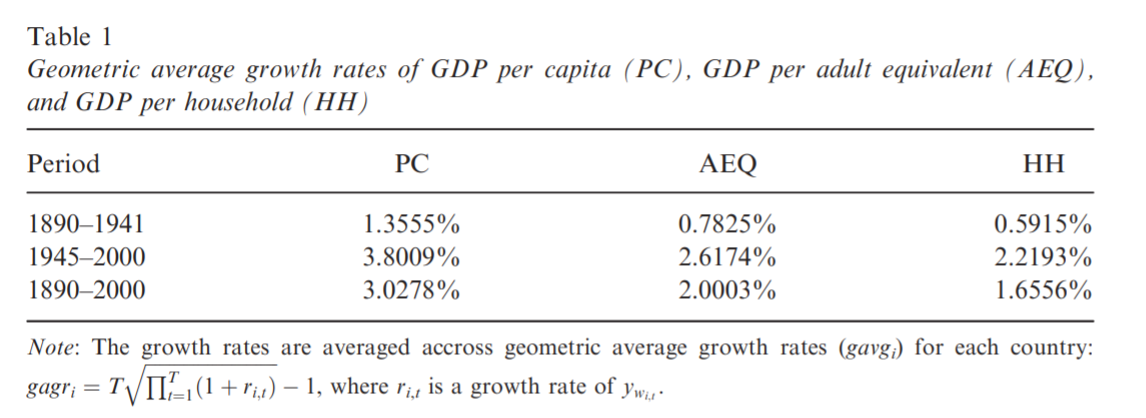
Changes in household sizes also create overestimation problems. Larger households have more economies of scale to exploit than smaller households so that an income of $10,000 per capita in a household of six members is superior in purchasing power than an income of $10,000 per capita in a single-person household. If, over time, you move from large households to small households, you will overestimate economic growth. In an article in the Scottish Journal of Political Economy, I showed that making adjustments for household sizes over time yields important changes in growth rates between 1890 and 2000. Notice, in the table below, that GDP per adult equivalent (i.e. GDP per capita adjusted for household size) is massively different than GDP per capita. Indeed, the adjusted growth rates are reduced by close to two-fifths of their original values over the 1945-2000 period and by a third over the 1890 to 2000 period. This is a massive overestimation of actual improvements in well-being.

HouseholdAdjust

A large overestimation

If you assemble these two factors together, I hazard a guess that growth rates would be roughly halved (there is some overlap between the two so that we cannot simply sum them up as errors to correct for – hence my “guess”). This is not negligible. True, there are things that we are not counting as Prof. Caplan notes. We ought to find a way to account for them. However, if they simply wash out the overestimation, the sum of errors may equal zero. If so, those who are pessimistic about the future (and recent past) of economic growth have a pretty sound case. Thus, I find myself unable to share Prof. Caplan’s optimism.

Three Lessons on Institutions and Incentives (Part 8): Conclusion

Far from the custom of assigning to cultural factors, or educational, or geographic or relative to the particular constitution of the ruling elites, the three works reviewed – Institutions, Institutional Change and Economic Performance, by Douglass C. North; The Elusive Quest for Growth, by William Easterly and Why Nations Fail, by Daron Acemoglu & James A. Robinson, state an explanation of the progress and decline of nations articulated on abstract incentives, which serve as a structure in which frame the rational agent makes his choices. The four authors have a common reference to methodological individualism, but such an individual agent does not make decisions in a vacuum, but inserted within a framework of incentives.

That such incentives, to act as points of reference for individual action, should materialize historically, does not mean that such conditions for action come from a particular circumstance of time and place, but that they depend on an abstract structure that relates to different terms and that is present in every phenomenon of human interaction.

To finish, it is worth referring to the conclusions reached by North in his referenced work: the case of the two successive Spanish Americas, the Habsburg and the Bourbons. The first extended from the discovery and colonization of America to the early eighteenth century. The viceroyalties of America enjoyed great political autonomy – Spanish immigration had been little and a “Creole” elite had developed – and they were closed to trade, which was limited to the “export” of gold to Spain. With the arrival of the Bourbons at the beginning of the 18th century and the implementation of their Reforms – which from the economic point of view were a resounding success both in Spain and in America – the relationship was reversed: political power passed into the hands of the “Peninsular Spaniards” and an opening of a more fluid trade between the metropolis and its colonies was launched. North explains that the independence movements could be successful due to a transitory alliance between the sectors that wanted to return to the Habsburg system and those who wanted to deepen the modernizing and free-market impulse of the Bourbons. Once achieved independence, these two currents came into conflict, which, according to the author, would extend until today.

According to North’s thesis on Spanish America, there would be two political patterns in tension: on the one hand, an elitist politician who is open to the economy and on the other a “popular” current that is traditionally protectionist. In the second half of the 19th century, success belonged to the “Bourbon pattern” and, in the 20th Century, the “Habsburg pattern” prevailed. In terms of Acemoglu & Robinson, it would be the dispute between a combination of extractive political institutions with inclusive economic institutions and another combination of inclusive political institutions with extractive economic institutions. Of course, in practice, moments of extractive political and economic institutions were also known, as well as short-lived experiences of inclusive institutions, both politically and economically.

The notion of polarized societies used by Easterly can serve as a way to deepen this analysis. It is much clearer to find problems of countries with societies divided into distant and dissimilar regions, in which the policy is expressly articulated as a function of tribes or ethnic groups and which the dispute over public policies expressly favors or harms a another ethnic group. However, as it has been stated, it is not ethnicity or nationality that determines the low economic and institutional performance of a country, but the polarization structure itself, whatever the functions in which such polarization is expressed (language, religion, ethnicity, ideology, etc.). Understanding these latter is fundamental to be able to provide a common thread for a principle of solution.

Just as on the political level an express agreement can be reached on the way to choose who exercises public power and under what conditions, Easterly states a series of conditions related to economic institutions whose agreement would allow for economic growth, regardless of the region, culture, or education of the ruling class of each country. Throughout The Elusive Quest for Growth you can find mentioned to free trade as a main factor of progress, monetary stability and exchange freedom as examples of clear and equitable rules, a state that participates in large infrastructure works but that refrain from arbitrating in the distribution of economic rents among various groups, a low level of public indebtedness, stability in property rights and an independent justice that allows individuals to innovate and save, as well as support programs and incentives to members of society who are immersed in poverty traps.

As mentioned, many times the policy -especially when, in the terms of Acemoglu & Robinson, it is inclusive- consists of the composition of interests of various kinds for the purpose of articulating a government program. From the work of the authors commented here, it can be inferred that, just as there is an agreement on the political plane regarding the rules of the democratic game, which include periodic elections, limited re-elections and division of powers, among others, there should also be a consensus in a body of economic institutions that should be left out of political negotiation, so that economic policy is as neutral as possible against the conflicting interests of which a country with a polarized society is composed.

[Editor’s note: Here is Part 7, and here is the entire, Longform Essay.]