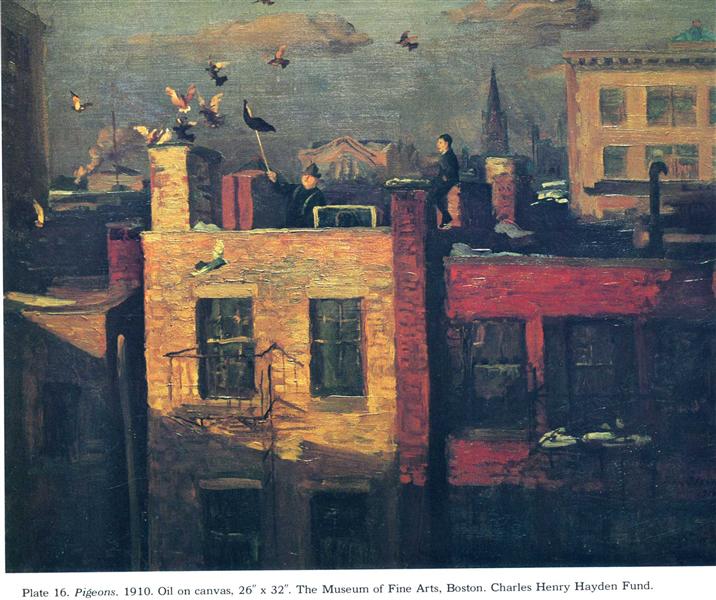
This is from John French Sloan, an American and a socialist. Check out his wiki. Click here to zoom in on this marvelous painting.
This is from John French Sloan, an American and a socialist. Check out his wiki. Click here to zoom in on this marvelous painting.
One of the bests books I’ve read this year was Serge Audier’s & Jurgen Reinhoudt’s relatively unknown (unfortunately!) translation of the protocols of the Walter-Lippmann-Colloquium. The NOUS-Network organized a wonderful seminar in which we thoroughly discussed the book and the emergence of Neoliberalism. For the preparation of this weekend’s Hayek-Kreis seminar, I reread the book and stood once again in awe of the magnificence of the discussion during the Colloquium.
By the way: If you are an undergraduate, graduate, or PhD scholar, please consider joining the NOUS-Network for Constitutional Economics and Social Philosophy as a Young Affiliate! NOUS is an information platform and a community for interdisciplinary research. The network links all academic fields relevant for thinking about social order and liberty. It spans philosophy, politics, economics and fosters scholarly research, contact and exchange.
In the following excerpt, it becomes clear, that the participant’s opinion on the psychological and sociological causes of the decline of Liberalism differed significantly. Mr Rüstow eloquently captures the standpoints of the two opposing groups (not without bias to be fair) and even cheekily disses Ludwig von Mises.
“Mr Rüstow: ‘All things considered, it is undeniable that here, in our circle, two different points of view are represented. One group does not find anything essential to criticize or to change in traditional liberalism, such as it was and such as it is, apart from, naturally, the adjustments and the current developments that are self-evident.
In their view, the responsibility for all the misfortune falls exclusively on the opposite side, on those who, out of stupidity or out of malice, or through a mixture of both, cannot or do not want to discern and observe the salutary truths of liberalism.
We, on the other hand, we seek the responsibility for the decline of liberalism in liberalism itself; and, therefore, we seek the solution in a fundamental renewal of liberalism. In order to justify in a positive manner this second point of view, I have to refer to what I have said and, especially, to the excellent arguments of Mr Lippmann.
Here, I would only like to draw attention to the fact that if the unwavering representatives of old liberalism were right, the practical prospects [for liberalism] would be almost hopeless. Because it does not really seem that old liberalism has gained in persuasive and in seductive force or that the arguments, no matter how shrewd they may be, of these representatives have the least possibility of bringing about a conversion movement within the realm of Bolshevism, Fascism, or of National Socialism. If they did not listen to Moses and the prophets—Adam Smith and Ricardo—how will they believe Mr. von Mises?'”
Introduction
Ever since taking over as President, Donald Trump’s approach towards Iran has been excessively rash and lacking in nuance. The US withdrawal from JCPOA (Joint Comprehension for Plan of Action), the imposition of sanctions, and brash statements by Trump have heightened tensions between both countries. Allies of the US, including EU member states (especially Germany and France), have expressed their disapproval of Trump’s Iran policy on numerous occasions.
In August 2019, during the G7 Summit at Biarritz (France), it seemed that Trump might have changed his approach towards Iran. The US President expressed his openness to engaging with Iran and dubbed it as a country of immense potential. After the attack on Saudi Oil facilities, there has been a visible shift in the approach of Germany, France, and the UK towards Iran. All three countries blamed Iran for the attacks. In a meeting on the sidelines of the United Nations General Assembly (UNGA) these three countries issued a statement condemning the attack. They also held Iran squarely responsible for the attack. Said the joint statement:
It is clear to us that Iran bears responsibility for this attack
Why China is giving importance to Iran Continue reading
I am flattered to be in the company Brandon places me in. When I was still growing up, I wanted to be Tyler Cowen then, I figured he moved way too fast for me. I have the utmost respect for Robert Higgs but I wouldn’t dream of mimicking his nearly super-human determination. I suspect Brandon put me on purpose in that flattering company and that he will soon ask me to stay after the meeting to sweep the room in return. Brandon also implicitly gave me permission to do what old dudes love to do (and often do well): reminisce.
I had a mostly but not exclusively academic career. It began so long ago that the hardest part of my doctoral dissertation was getting it typed from its long-hand last draft (yes, “typed,” with a typewriter; do you even know what this is?) Few graduates students knew how to type. Those who did were all females who had taken the trouble to learn in high school,. Below are two things that have changed for the better since those days, changed specifically in connection with blogging.
When I was a young scholar, I quickly discovered that having good co-authors was extraordinarily important. Myself, with one exception I won’t name, I always had co-authors, that is, co-investigators, I did not deserve. The difference in quality, in reach, in scope, between what I could produce by myself and what I did with others was so great that I seldom even tried to go it alone once I had discovered the force multiplier of well chosen others.* But finding potential research partners was costly, haphazard and often disappointing.
Apart from the necessarily limited local offering at your own university, you had to wait for your first high-powered publication, hoping it would draw admirers who would then take the trouble to contact you. Of course, you could do the same with others. To some extent, it involved the same sort of hesitancy one experiences trying to pick up a good-looking person in a public place. And, in some disciplines, publishing an admirable article in a well esteemed periodical may take years, of course. The poor traditional remedy was attending academic conferences, listening to others at formal presentations sessions and then, making advances. This worked to some extent but it was an inefficient system with a piteous yield.
The contemporary blog with a theme, such as Notes on Liberty, offers the young scholar the immense advantage of being able to present in a stress-free fashion samples of his work to many strangers of a similar cast of mind who are also hanging out around the blog in a relaxed frame of mind. Some of these will turn out to be potential coauthors. The blog will give them a social context for reaching out that is less intimidating than most.
Needless to say, the same features of the blog may facilitate being noticed by useful senior scholars. (I said “may” because I have no certainty about the extent to which such august persons go slumming on blogs. I have my suspicions though.)
Next: many people who become academics begin a with a general interest in ideas. Soon, they discover that the organizations that are willing to put bread on their table while they indulge their tastes are mostly universities. This is certainly true in the English speaking world. It seems to me that this is also largely the case in the French speaking world, and in the Spanish speaking world as well.
Once involved in a university career, the same people soon figure out that to progress in that career, or simply to remain in the career, they must publish in scholarly journals at a good clip. Unfortunately, in most disciplines, journals require a much narrower enterprise than the typical aspiring public intellectuals dreams of. This is intentional: Specialization encourages attention to detail in reasoning and it punishes sloppy logic. It also promotes respect for facts. (I mean outside of the post-modern English discipline, of course). Scholarly formats often leave authors unsatisfied in one particular respect, the formal limits they imposes on their discourse. I have often myself been in a situation, – and likewise observed others to be – with an eighteen page empirical paper that seemed to me honestly to authorize fifty pages of innovative narrative. The journal format usually allowed only one to three pages, four, if you played your cards right, or if the editor dated your sister.
Some will comment that a person can pursue a two-track career with scholarly publications on one side, and more general narratives in other media, on the other. That’s true enough but if you consider the large number of America academics in general compared to the two handfuls nationwide who have a public voice, you will guess that the dual career path must present formidable obstacles.
The one I encountered personally – which I think is quite common – is that the gates of outlets for general well-informed but non-technical narratives were as narrow of those of the most respected academic journals, and also vastly more capriciously opened. And in case, you are wondering no, I am not thinking only of the New York Review of Books. It will take me a long time to recover from the contemptuous rejection I received from the newspaper of my local community college. (That was twenty years ago. I was a well respected scholar by then.)
A good blog with an open editorial policy such as Notes on Liberty will give many a chance to circulate opinion pieces and other narratives not fitting a normal scholarly format. Those may spring, by the way, from the same source as their scholarly production narrowly defined. When I was churning out statistical empirical papers in the sociology of economic development, I felt I had lots of things to say to the general intelligent public, springing from the endeavor of producing those papers, things that never got said.
I am not sure how many of those who read these words are academics, or aspiring academics, or frustrated academics who long to be also public intellectuals. I hope I reached a few of you, all the same. What I can tell you is that my life would have been more satisfying (even more satisfying) if blogs such Notes on Liberty had been available when I was just sharpening my pencils.
* Nonetheless, I wrote alone and off the top of my head a little paper that keeps cropping up in the class syllabi of several military schools forty years later: “The distributive state in the world system.” Studies in Comparative International Economic Development, 15-3: 3-21. 1980. (A little harmless bragging!)

Well then. Discuss? This is from PornHub. Thanks to r/mapporn.
Consider the post-Hayek/Rothbard/Friedman era of libertarianism.
Who has stepped up to fill their shoes? It’s hard to say, but 4 academics who stand out are Tyler Cowen, Mike Munger, Robert Higgs, and Bryan Caplan. Their scholarly output is comparable to our own Jacques Delacroix, and their influence within the libertarian quadrant is – or was at some point in time – much greater than Jacques’.
All four of these scholars cut their teeth blogging. The blog is how they teach. The blog is how they vent. The blog is how they share news and knowledge. The blog is how they went from well-respected to essential. All four write opinion pieces for professional outlets, but that’s not how they became essential to libertarians across the globe. Sharing their day-to-day thoughts about the world, to the world (and not just their walled-off social media accounts), is how they were able to step up and usher libertarianism into the next generation.
As the new year approaches, I encourage you to think about what liberty means to you. (Is it best left in the hands of professional Libertarians? You know the incentives they face. You know the choices they’ve made.) I also encourage you to be bold in your goofiness. Be strange! Be strong. Be artsy. Be rude (but never cruel). The professional outlets will always be there, waiting patiently to edit out your voice from The Message. Make 2020 the year a new generation of libertarians stepped up and took on the burden of responsible citizen-scholarship.
I’ve been on a Taleb streak this year (here, here and here). Nassim Nicholas Taleb, that is, the options trader-turned-mathematician-turned public intellectual (and I even managed to get myself on his infamous blocklist after arguing back at him). Many years ago, I read Fooled by Randomness but for some reason it didn’t resonate with me and I wasn’t seeing the brilliance.
Last spring, upon reading former poker champion Annie Duke’s Thinking in Bets and physicist Leonard Mlodinow’s The Drunkard’s Walk, I plunged into Taleb land again, voraciously consuming Fooled, The Black Swan and Skin in the Game, followed by Antifragile just a few months ago.
Taleb is a strange creature; vastly productive and incredibly successful, everything he touches does not quite become gold, but surely stirs up controversy. What he’s managed to do in his popular writing (collected in the Incerto series) is to tie almost every aspect of human life into his One Big Idea (think Isaiah Berlin’s hedgehog): the role of randomness, risk and uncertainty in everyday life.
One theme that comes up again and again is the idea of redundancies: having several different and overlapping systems – back-ups to back-ups – that minimize the chance of fatally bad outcomes. The failures of one of those systems will not result in the extremely bad event you’re trying to avoid.
Focusing primarily on survivability – “absorbing barriers” – through the handed-down wisdom of the Ancients and the Classic, the take-away lesson for Taleb in almost all areas of life is overlapping redundancies. Reality is complicated, and the distribution from which events are drawn is not a well-behaved Gaussian normal distribution, but one of thick tails. How thick nobody knows, but wisdom in the presence of absorbing barriers suggest that taking extreme caution is a prudent long-term strategy.
Of course, in the short run, redundancy amounts to “wasted” resources. In chapter 4 of Fooled, Taleb relates a story from his option trading days where a client angrily calling him up about tail-risk insurance he had sold them. The catastrophic event from which the insurance protected had not taken place, and so the client felt cheated. This behavior, Taleb maintains quite correctly, is idiotic. After all, if an insurance company’s clients consist of only soon-to-be claimants, the company won’t exist for long (or it prices insurance at prohibitively high rates, undermining the business model).
Same thing applies for one of his verbose rants about airline “efficiency,” a rather absurd episode of illustrating “asymmetry” – the idea that downside risks are larger than upside gains. Consider a plane departing JFK for London, a trip scheduled to take 7h trip. Some things can happen to make the trip quicker (speedy departure, weather conditions, landing slot available etc), but only marginally; it would, for instance, not be possible to arrive in London after only an hour. In contrast, the asymmetry arises as there are many things that can delay the trip from mere minutes to infinity – again, weather events, mechanical failures, tech or communication problems.
So, when airlines striving to make their services more efficient by minimizing turnaround time – Southwest’s legendary claim to fame – they hit Taleb’s antifragile asymmetry; getting rid of redundant time on the ground, makes the process of on-loading and off-loading passengers fragile. Any little mistake can cause serious delays, delays that accumulate and domino their way through crowded airport networks.
Embracing redundancies would mean having more time in-between flights, with extra planes and extra mechanics and spare parts available at many airports. Clearly, airlines’ already brittle business model would crumble in a heartbeat.
The flipside efficiency is Taleb’s redundancy. Without optimization, we constantly use more than we need, effectively operating as a tax on all activity. Taleb would of course quibble with that, pointing out that the probability distribution of what “we need” must include Black Swan events that standard optimization arguments overlook.
That’s fine if one places as high a value on risks that Taleb does, and indeed they’re voluntarily paid for. If customers wanted to pay triple the money for airfares in order to avoid this or that delay, there is a market for that – it just seems few people value that price over the damage from (low-probability) delays.
Another example is earthquake-proving buildings that Nate Silver discussed in his The Signal and the Noise regarding the Gutenberg-Ritcher law (the reliably inverse relationship between frequency and magnitude of earthquakes). Constructing buildings that can withstand a high-magnitude earthquake, say a one-in-three-hundred-year event is something rich Californians or Japanese can afford – much-less so a poor country like the Philippines. Yes, Taleb correctly argues, the poor country pays its earthquake expenses in heightened risk of devastating damage.
Large redundancies, back-ups to back-ups, are great if you a) can afford them, and b) are risk-averse enough. Judging by his writing, Taleb is – ironically – far out along the right-tail of risk aversion; for most other people, we have more urgent needs to look after. That means occasionally “blowing up” and suffer hours and hours of airline delays or collapsing buildings after an earthquake.
Taleb rarely considers the trade-offs, and the different subjective value scales (or discount rates!) that differ between people. While Taleb may cherish his redundancies, most of us would rather eliminate them for asymmetrically small gains.
Insurance is a relative assessment of price and risks. Keeping a reserve of redundancies are subjective choices, not an objective necessities.
 Notes On Liberty