Department of Oops!

One of the most influential anthropologists to my own way of analyzing global society and how it interacts with each other is Edwin Wilmsen, whose book Land Filled with Flies: A Political Economy of the Kalahari has deeply influenced my thoughts about intercultural (“foreign”) relations (the other two most influential books on me so far have been Peace Pact… and 1491…). I am currently doing a research project and came across the following sentence, which deserves to be deeply pondered by anthropologist and layman alike:

[…] those who have been responsible for formulating and implementing policy towards [the San] have relied on a functionalist equilibrium model derived from ethnography grafted onto a residual colonial construction of a static San social condition […] A key element in this ideology [governing Botswana policy towards the San] is the mystification of [San] uniqueness, a condition that [has] been imposed on them by other, hegemonically dominant ethnic groups.  Among these hegemonically dominant groups – I urge that we not forget this point – are ethnographers, whose work serves as scientific sanction for this mystification.

Wilmsen is a Marxist, and Land Filled with Flies… was written before the collapse of the Berlin Wall, but I nevertheless find his work extremely satisfying. Can anybody see why this is such a powerful critique of collectivism? Admittedly, I have depraved this post of its rich context, but I think readers here at Notes On Liberty are smart and thoughtful enough to find some gems among this deceptive-looking rock pile.

An online profile of Edwin Wilmsen.

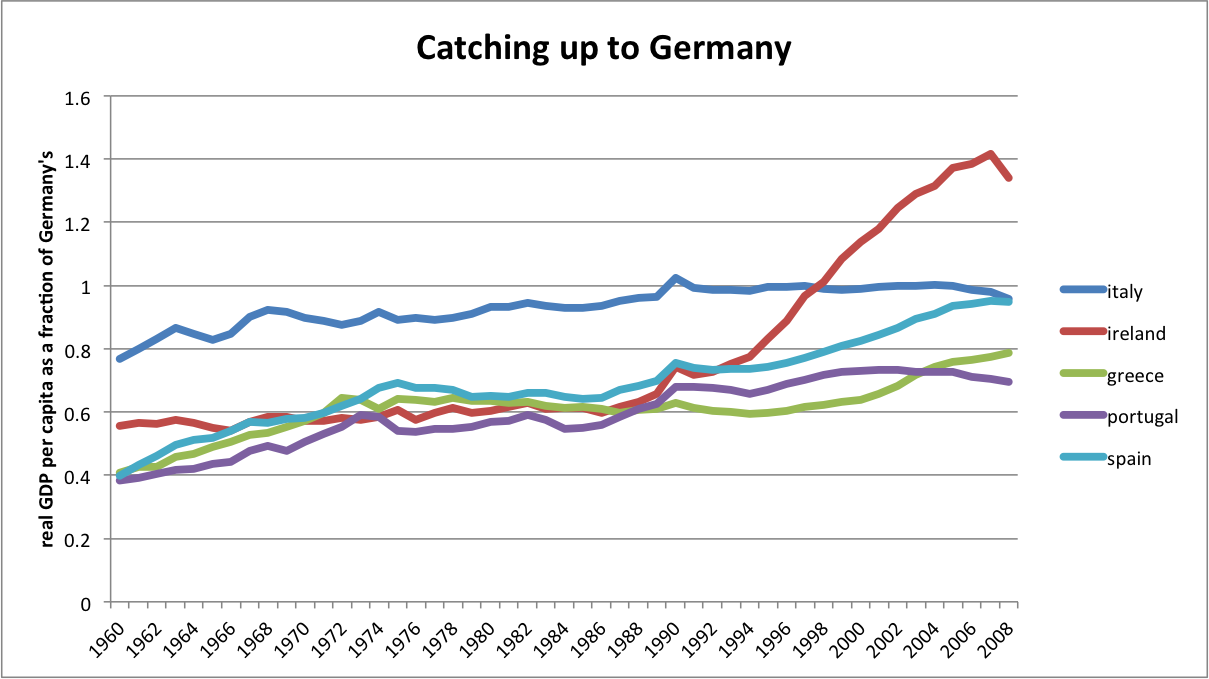
Economic Growth in Europe: the Longer View

Economist Tyler Cowen has a post up on who has gained most from the Euro (as measured by state), but the economist Angus puts things into perspective:

Ireland, Spain, Portugal and Greece were all growing fast relative to Germany (and France which is not on the graph) well before the introduction of the Euro. Ireland and Spain take off somewhere around 1990 and the intro of the Euro in 2000 does not speed up their trajectory. Portugal actually falls further behind Germany in the Euro era. Greece is the only country of these 5 whose catch-up to Germany accelerates with the intro of the Euro.

Two quick thoughts:

  1. Woah! Look at Ireland!
  2. I’ll bet the acceleration of growth in the 1960’s had to do with the end of World War 2 and its rebuilding efforts.

Taking a broader historical view really puts things into perspective. If the Euro was not the catalyst for the economic growth of the 1990’s, what was? My guess is that the elimination of tariffs and labor restrictions between European states led to the growth. If the Eurozone had not implemented a central bank I think we wouldn’t be looking at all of the political problems now associated with the region.

Angus (who works at Oklahoma University) got his statistics from here. I highly recommend using it in your own studies as well.

One Sure Thing About Globalization – The American Motion Pictures Industry World Hegemony Part 1

[Editor’s note: this lecture was delivered to the Leavey Institute of Santa Clara University in 2003. You can find it reproduced in whole here.]

The word “globalization” is often used as shorthand to suggest that the world as recently shrunk for many purposes (Friedman, 1999). At first blush, this would seem to be good news, facilitating the spread of literacy, the diffusion of useful technologies, and socioeconomic progress, in general. However, a large segment of public opinion, in this country and, apparently, a larger segment in Europe and certain other countries (such as India), takes a jaundiced view of this shrinkage. This view is propagated by numerous websites as well as by professional intellectuals such as Noam Chomsky (who is often heard on National Public Radio). It contains a large anti-American component (Menand, 2002). It is widespread – at various levels of sophistication – in American universities. (1) In recent years, it has been dramatically acted out by rioters in Seattle, Quebec and Genoa, among other places. For left-wing opinion, “globalization” seems to imply that there is something radically new under the sun that is also economically nefarious for the poor and for the weak. For the same left-wing opinion, the word often suggests a sinister plot implicating in turn, “big corporations”, the World Trade Organization, the International Monetary Fund, and other organizations little understood by the general public. (For a broad, business-oriented and mildly liberal classification of the many sins the word “globalization” covers, see Eden and Lenway, 2001.) That new something entails a clandestine hegemony, or hegemonies, of some sort, dedicated to the further “exploitation” of the already poor and weak by the already rich and powerful. In this presentation, I develop the idea that there is little that is both radically new and nefarious,
and that what is new is likely to have largely beneficial effects. I rest my argumentation on readily available, public evidence.

Note: If you don’t think such a perspective on globalization exists, or you believe it’s inconsequential, you may want to stop reading. It is very difficult to find anywhere assertions about globalization displaying at once the following features: Continue reading

Department of Huh?

The dialectic between pragmatics and metapragmatics is the way in which

explicit metapragmatic registers instantiated in metapragmatic discourse encapsulate ideologies of language use and play an obvious role in the institutionalization of discursive mechanisms of society.

This is from Michael Silverstein, a linguistic anthropologist and somebody who I have to read for a degree requirement. Life could be worse, I guess…

Obama’s Economic Policies: What’s Wrong, in a Nutshell

People are overwhelmed by the avalanche of bad news, and of news in general. It’s difficult to stop long enough to summarize objections to the new economic policies fostered by Presidents Obama and Pelosi.  Besides, if you tried, you might just strangle with horror and indignation. I made the effort. Here it is:

Pres Obama wants to re-distribute wealth when the amount of wealth available to re-distribute  is dwindling. It’s never happened, I think, in any democratic, market-oriented country before. Normally, you wait for a period when wealth is growing.

Pres Obama insists on an expensive stimulus package that will do, and has done little to stimulate the economy. Keynesian economics is largely wrong. This is Keynesian economics at its worst. It’s not even defensible by Keynesian standards.

Pres Obama choses a severe economic downturn to force us as a nation to try and do things we don’t know how to do. This includes switching from proven energy technologies such as coal and petroleum-based technologies to unproven ones such as air and wind technologies. It includes also constructing a satisfactory national health system, something no country has done. Normally, whenever you try something new, you make mistakes. You need a margin of error. You need to be reasonably rich. You don’t want to do it on a tight budget or when you are close to poverty.

Pres Obama is not evil. He has something I have seen hundreds of times in academia: He knows what he thinks he knows and he does not know anything else. He is narrow-minded and dogmatic. The more intelligent the person, the more stubborn in his narrow-mindedness and in his dogmatism. A less intelligent person would have the virtue of self-doubt, “Wait a minute, am I doing the right thing?”

Perplexing: There is an international media consensus  to the effect that the current global economic crisis was made in America. Yet, I detect no rise in anti–Americanism abroad. This would be a good time to be pissed off at us but, I don’t see it anywhere.

I wrote on this blog about “European Anti-Americanism.”  I suggested it was mainly based on envy. Perhaps, I was right: Others like us better when we are down and hurting. What do you think?

Recently, I mentioned the sentencing of a 75-year old woman to a whipping, in Saudi Arabia. I promised that I would check for indignant reactions on the part of Muslims. I have seen nothing on the website of the American Muslim Council and nothing of the website of the Islamic Society of North America.  I haven’t found anything either on French Muslim sites.

Of course, it’s disturbing. I would like it if someone told me that I am wrong and that I searched in the wrong places. I know I have Muslim readers. Get on your feet and do what’s right.

[Editor’s note: this essay first appeared on Dr. Delacroix’s blog, Bay Watch, on March 26th 2009]

North Dakota or Bust!

An excerpt from co-editor Fred Foldvary’s Progress Report:

In theory, productive public goods increase land rent because the supply of land is fixed. There can also be a rise in wages from more public goods, but that would be temporary. If labor becomes more productive in a location, that attracts labor from areas where wages are lower for the same skills. The increase in the labor supply will drive wages back down to normal. But the total supply of land in some region cannot expand, so the increase in rent sticks.

Just as territorial benefits raise land values, costs to landowners reduce the rent they keep, and so capitalize land value down. If the public goods are paid for by public revenue from land rent or site values, then the rise in land values would be limited. If governmental public goods are paid by labor and enterprise, then the rentalization and capitalization are implicit subsidies to landowners, at the expense of taxed labor and enterprise.

Economists have found evidence of the generation of higher land values from greater public goods. We now have an excellent case study: North Dakota.

Read the whole thing here. I’ve never been to North Dakota, but if it’s anything like South Dakota I might be tempted to settle there someday. Just kidding! California is the best state to live in, even with our terrible, fascistic-like government.

I am still having trouble wrapping my head around the concept of land value taxing, though. Someday I’m going to have to spend a couple of days with a copy of Henry George’s Progress and Poverty and see what I can figure out.

The Good Old Days

Here is a story that’s more than a story.

All our food was organic and no one was overweight. We wore only natural fibers, from sheep and from the cotton fields of Africa.

Children did not get fat spending their days and nights in front of a stupid screen of one kind or another. We read instead.

No one was over-caffeinated or on pills. We rarely went to the doctor.

Kids with Attention Deficit Disorder did not disrupt any school.

We used water sparingly and washed our hair and bodies in simple, non-polluting soaps. We did not waste water or energy with long showers.

My own personal carbon footprint was close to zero, I am sure.

There were few car accidents, unlike now.  Continue reading

Don’t Vote?

Philosopher Jason Brennan gives us a thought exercise concerning voting:

Imagine 12 people are serving on a jury in a murder case. The prosecution and defense present evidence and call witnesses. The court asks the jury to reach a verdict. They find the defendant guilty.

Suppose four of the jurors paid no attention during the trial. When asked to deliberate, they were ignorant of the details of the case. They decided more or less at random.

Suppose four of the jurors paid some attention to the evidence. However, they found the defendant guilty not on the basis of the evidence, but on wishful thinking and on bizarre conspiracy theories they happen to believe.

Suppose four of the jurors paid attention to the evidence. However, they found the defendant guilty because he is an atheist, while they are Christians. Like many Americans, the jurors trust atheists no more than they trust rapists.

Do read the whole thing to find out why voting in a mass democracy is not necessarily something that should be automatically assumed to be good (or to go to war over, for that matter).

Co-blogger Warren Gibson has a great take on voting as well.

Criticizing the Right

There has been lots of attention on this blog geared towards the hypocrisy of the Left, and I think that it is justified, but all too often we have been giving the Right a pass. I think this has to do with the fact that the Left holds the presidency, but I still think it’s appropriate to remind readers that libertarianism is of neither the Left nor the Right. Philosopher Jason Kuznicki does just this in a brilliant post:

Scrutinize your own side too. Take a hard look at cushy “privatization” deals that really just funnel power and money directly into private corporations’ hands. As a certain liberal recently observed, the way to privatize a prison isn’t to give imprisonment power to a corporation. It’s to stop imprisoning so many people, then sell off the property. About which more below […]

But other restrictions exist. Many of them bite even harder.

Consider immigrants. In particular, if our free market is so great, why do you work so hard to exclude immigrants from it? Is the immigrant laborer less a moral self-fashioner than the Wall Street banker? I wouldn’t say so. He’s clearly at least as motivated. If the immigrant wants to make a life in America — why not let him?

Mr. Ryan recently proclaimed that the United States is the only nation founded on an idea. It’s a common conservative theme, and even if it’s not 100% accurate, I’m certainly sympathetic to it. But we are founded on an idea if and only if our borders remain open to all who share that idea. The moment we start checking for purity of blood, we become a tribalist nation-state just like so many others. Not founded on an idea, but on accidents of birth—and in fact standing squarely against the idea that all people should be the authors of their own lives.

You can read the rest here.

Again, I suspect that much of the vitriol aimed at the Left on this blog (mostly by myself and Dr. Delacroix and something that probably has to do with our previous, sovereign associations with that side of the aisle) is due to the fact that it currently occupies the White House, but it’s nice to remind readers that the Right is very hypocritical as well.

For more on immigration, see Hermanos* and Immigrants: A Story Pregnant with Deep Meaning.

For more on “privatization”, see Who Stole Our Trillions? and An Ominous Expansion of Eminent Domain.

For more criticism of the Right, see Ugly Conservative Sacred Cows and Blissful Ignorance….

Blast from the Past

Dr. Delacroix writes, in 1980, in the academic journal Studies in Comparative International Development, the following:

The logical possibility of distributive states which are not class-based has profound implications for our understanding of the political functioning of the world system […] First, challengers will not be able to claim a monopoly of rationality. They will not be able to present themselves as representatives of the progressive forces of history, bent on freeing production from the shackles of a mode of production that has become mired in its own contradictions. Hence, it will be difficult for them credibly to draw their inspiration from scientific socialism. Instead, they will have to find their legitimizing ideology in strictly moral considerations. Such considerations tend to find their strongest support in Golden Age myths, usually of religious origin. Revolutionary movements in distributive states will thus have strong reactionary ideological components. In their purest forms, they will be completely reactionary.

Secondly, the organizational base of challengers in a distributive state cannot be class. Therefore, other structures of social solidarity will have to be activated. Alternative structures are, by default, traditional structures. The more recently incorporated into the world economy a society, the more available are its traditional social structures. Hence, a distributive state ruling a recently incorporated society will experience a maximum of tribal, ethnic, and religious challenges.

Note that these two departures from class-based challenges are additive: the activation of archaic social structures under the banner of a  reactionary ideology does not give birth to socialist regimes but to entirely new kinds of political formations. These are not accounted for by existing conceptualizations of the state.

You can read the whole thing here (possibly gated).

A View from Inside China

Below is what I think is an interesting document. It’s an email from a former MBA student. He is a Singapore Chinese who spends a lot of time doing business inside China, in Mandarin. He is an intelligent and well-educated man. I know him to have a conservative temperament overall but he is also a keen observer and an independent thinker. Some of his statements are disturbing to me. I post this document on my blog for its intrinsic interest, not as an endorsement. I note with interest that he has not asked me to delete his name in spite of his denunciations of Singapore’s treatment of its dissidents. I withhold it nevertheless. He can add it subsequently if he wishes.

I have been hearing lots about evil China and their evil products (mostly from Taiwan opposition party folks, Chen Sui Bian and his gang).

There have been lots of negative press about manufacturers in China and how bad they are. Thing is the blame needs to be shared. I sourced in China as well and I what I have seen appalled me. Not that the manufacturers are out to get the buyers, but more so, the buyers are working so hard to get the manufacturers. The incident about Mattel, for example, I feel it was an error on Mattel’s part not to confirm that lead-free paint was going to be used. They probably assumed it.

And they probably pushed the price down so hard that the manufacturers had to cut corners to make any sort of financial sense. And when excrement hits the fan, they sad the manufacturers were to blame. And what about Walmart? Most manufacturers I know, many of whom are my friends, are refusing to sell to Walmart. Walmart are so harsh on pricing that they would specifically ask for the lower (if not lowest) quality goods. They would put such a large order, so huge that they would take over the entire manufacturing capability of a factory. If the factory is dumb enough to let them be the biggest and majority customer, they will be in for a fix. Walmart to hit prices down low and threaten to move elsewhere. The factory would have no choice but to budge because, if Walmart left, they would go out of business. So corners are cut, and Walmart knows about these cuts. All they care about is price and in the end, the customer suffers. It is not just the savings are “rolling back” to the customers, but the poor quality of the products are going back to the customer as well. By the way, Walmart usually price their goods anywhere from five to twenty times that of the cost they procured it at.

My view on communism is very different from the average person in the “free world”. This is the “new” communism in China. My opinion is that things actually get done here and quick too. In the time that Oakland took to rebuild the Cypress Highway that connects 880 to the Bay Bridge after the earthquake, Shanghai has constructed more than 10 times of that distance in highways, most of them elevated, a complete subway system, 3 large bridges and 3 underwater tunnels, a full industrial park (cao he jing) a full financial center in Pudong, A new airport, and a new half of the city in Pudong literally done up. This is just within the limits of Shanghai city, excluding all the work done for the interstates. What can I say?

Comparing it to Singapore with a “democratically” elected government, China enjoys more freedom. Now, I say this as a person living in China, not as a politician. I see demonstrations from time to time in Shanghai and recently, the Shanghai government has been listening.

Talks happen, and situations get changed. It is true that China has seen more restricted times in the past but Hu and his current government is set to change that. The situation in Singapore is much more different where the law is often used to suppress opposition and dissidents.

See http://singaporedissident.blogspot.com/.

People in Singapore mostly just take it in and forget about it, choosing to think about car payments, house payments and if their favorite British soccer team is going to win.

Anyway, these are just some of my thoughts. Of course, there are things that gets to me in China and Singapore as well, and also many things I like about the USA. These are some ramblings I have. Feel free to put them on your blog if you want to. I really miss talks with you outside Kenna Hall while you are bumming cigarettes off me. ;)

P.S. I haven’t seen the Palin article on your blog. I will look it up. Every time I see her picture or video anywhere, I always get the impression of a deer in the headlights.

P.S.S. I have been out of touch with a lot of things. I really disapprove of Obama in 1) his work on 90% tax on the AIG bonuses (which I think is stupid and unconstitutional) and 2) him sending more troops into middle east.

A. L.
McCloskey Review = Leftist Rhetoric in Tatters

Deirdre McCloskey has an excellent review of a new book focusing on the immorality of capitalism. An excerpt:

The poor have benefited the most from capitalism. The sheer, first-act, unanalyzed equality that Sandel advocates would have killed the modern world and kept us in the appalling poverty of the human condition down to 1800. In fact in some countries it did, such as India after 1947, under Gandhi-plus-London-School-of-Economics egalitarianism, the “License Raj” and “the Hindu rate of growth,” as the Indians themselves bitterly described their communitarian economy. When I talk to friends who think like Sandel I worry that their dispositions will kill, quite unintentionally, the only chance for the world’s poor to achieve the scope for a full human life.

[…]

Sandel worries properly that the market can crowd out the sacred. A corporate market in, say, instruction in elementary classrooms can crowd out unbiased teaching about capitalism. Yet Sandel does not tell his own classroom that state schools can crowd out unbiased teaching about, say, the environment.

Do read the whole thing. McCloskey is an expert writer and a prestigious scholar, so be sure to grab a cup of coffee before you settle in. (h/t Jason Brennan)

From the Comments: The Climate Change Cult

I reread your paragraph, Travis:

“I can see Delacroix’s point that a few un-peer-reviewed sources make one question what other sources are also un-reviewed, but it seems absurd to me to throw out all the information in all of the chapters of the IPCC report because it contains one un-peer-reviewed source. The chapter-leads who ultimately allowed the un-reviewed source to enter the IPCC report are not in charge of other chapters, which are essentially independent manuscripts, so why arbitrarily distrust them as well?”

You seem to say that the process by which papers (peer-reviewed papers, another issue discussed above) are compiled within each chapter of the IPCC reports is like  Wikipedia’s process for each of its entries.

Would you say that IPCC is as open to revision as Wikipedia is? I mean only revision by means of serious peer-reviewed papers. Suppose someone produced a study using good methods and trustworthy data and had it peer-reviewed (say on Mars). Suppose further the study concluded that there has been no real appreciable global warming since 1780. Do you think that there is a likelihood that the new study would be incorporated into the next IPCC report? What likelihood: 100%, 75%, 50%, 5%?

This is a real question for Travis . I don’t know if Travis is listening so, anyone besides Travis should feel free to answer it.

[Editor’s note: you can find the context of this post in discussions found here and here]

Paul Ryan and Ayn Rand: What’s the Connection?

I will admit up front that the only Ayn Rand novel I’ve read (so far) has been Anthem. I liked it. It reminded me of Brave New World and 1984. A lot of books came out at around the same time as Anthem that had themes of the struggle between totalitarianism and the individual. Recent commentary has focused on Rep. Ryan’s connections with the late, great author, though, and Will Wilkinson does a great job of summing them all up in a post over the Economist. An excerpt:

In practice, arguments like Mr Black’s and Ms Walsh’s tend to come to the silly idea that one’s ideological opponents are duty-bound (by their own lights!) to either unilaterally disarm or shut up. Heads, I win; tails, you lose. It’s a cheap trick. The argument as usually deployed also depends on a combination of lazy partisan Manichaeism and the naive practice of taking politicians at their word. Paul Ryan is an elected official whose views therefore fall squarely within the ambit of conventional political wisdom. Despite his professed admiration for Ayn Rand, and the ardent wishes of his admirers and detractors alike, Mr Ryan is far from a laissez faire radical.

Indeed. Do read the rest of the post here.

What are your thoughts on Ryan as Romney’s VP? Longtime reader Hank has shared his thoughts here. Personally, I agree with Hank and I don’t think the nomination matters all that much, and I share libertarian sentiments that Rep. Ryan is hardly a fiscal conservative, but I am also curious as to what you think.

Apologies and Reaffirmations

My co-blogger Dr. Gibson alerted me to the rudeness of my tone regarding Dr. Delacroix in a previous post. Dr. Gibson rightly admonished me for three things:

  1. Using the term “Dr. J” instead of the formal Dr. Delacroix
  2. My insinuation that anybody who disagrees with my observations is insane or irrational
  3. My accusation of demagoguery on Dr. Delacroix’s part

I am guilty of all three of course. I referred to Dr. Delacroix as Dr. J because it is a self-administered nickname he gave himself on his other blog, Facts Matter (it’s on the right-hand side under “links”), and he has not objected to me using it before. I took Dr. Gibson’s critiques in stride and have made the corrections. I apologize again.

On point number two I shouldn’t have discounted the arguments in favor of imperialism or interventionism so brusquely. I again apologize and have altered the text accordingly.

On point number three, though, I feel like I hit the nail on the head. Check out the following three posts by Dr. Delacroix and tell me if I went too far by labeling his arguments demagogic:

In these three posts Dr. Delacroix insinuates that all who disagree with him are anti-Semitic (knowingly or otherwise), immoral, and cowardly. What do you guys think?