- The imperial sociology of “the tribe” in Afghanistan Nivi Manchanda, Millennium
- Life in the capital city of pre-modern Japan John Butler, Asian Review of Books
- The Irish free trade crisis of 1779 Joel Herman, Age of Revolutions
- Insiders and outsiders in 17th century philosophy Eric Schliesser, Philosophical Reviews
The Prose and Poetry of Creation
Every great civilization has simultaneously made breakthroughs in the natural sciences, mathematics, and in the investigation of that which penetrates beyond the mundane, beyond the external stimuli, beyond the world of solid, separate objects, names, and forms to peer into something changeless. When written down, these esoteric percepts have the natural tendency to decay over time because people tend to accept them too passively and literally. Consequently, people then value the conclusions of others over clarity and self-knowledge.
Talking about esoteric percepts decaying over time, I recently read about the 1981 Act the state of Arkansas passed, which required that public school teachers give “equal treatment” to “creation science” and “evolution science” in the biology classroom. Why? The Act held that teaching evolution alone could violate the separation between church and state, to the extent that this would be hostile to “theistic religions.” Therefore, the curriculum had to concentrate on the “scientific evidence” for creation science.
As far as I can see, industrialism, rather than Darwinism, has led to the decay of virtues historically protected by religions in the urban working class. Besides, every great tradition has its own equally fascinating religious cosmogony—for instance, the Indic tradition has an allegorical account of evolution apart from a creation story—but creationism is not defending all theistic religions, just one theistic cosmogony. This means there isn’t any “theological liberalism” in this assertion; it is a matter of one hegemon confronting what it regards as another hegemon—Darwinism.
So, why does creationism oppose Darwinism? Contrary to my earlier understanding from the scientific standpoint, I now think creationism looks at Darwin’s theory of evolution by natural selection not as a ‘scientific theory’ that infringes the domain of a religion but as an unusual ‘religion’ that oversteps an established religion’s doctrinal province. Creationism, therefore, looks to invade and challenge the doctrinal province of this “other religion.” In doing so, creation science, strangely, is a crude, proselytized version of what it seeks to oppose.
In its attempt to approximate a purely metaphysical proposition in practical terms or exoterically prove every esoteric percept, this kind of religious literalism takes away from the purity of esotericism and the virtues of scientific falsification. Therefore, literalism forgets that esoteric writings enable us to cross the mind’s tempestuous sea; it does not have to sink in this sea to prove anything.
In contrast to the virtues of science and popular belief, esotericism forces us to be self-reliant. We don’t necessarily have to stand on the shoulders of others and thus within a history of progress, but on our own two feet, we seek with the light of our inner experience. In this way, both science and the esoteric flourish in separate ecosystems but within one giant sphere of human experience — like prose and poetry.
In a delightful confluence of prose and poetry, Erasmus Darwin, the grandfather of Charles Darwin, wrote about the evolution of life in poetry in The Temple of Nature well before his grandson contemplated the same subject in elegant prose:
Organic life beneath the shoreless waves
Was born and nurs’d in Ocean’s pearly caves;
First forms minute, unseen by spheric glass,
Move on the mud, or pierce the watery mass;
These, as successive generations bloom,
New powers acquire, and larger limbs assume;
Whence countless groups of vegetation spring
And breathing realms of fin, and feet, and wing.
The prose and poetry of creation — science and the esoteric; empirical and the allegorical—make the familiar strange and the strange familiar.
Nightcap
- Great piece on Latin American history Laurence Blair, BBC History
- The political economy of deep integration (pdf) Maggi & Ossa, NBER
- Democracy in the polycentric city (pdf) Loren King, Journal of Politics
- Here’s what I don’t say Christopher Craig, Threepenny Review
The poverty of the middle-class: lack of savoir-faire
In 2009, the film An Education came out. It was a Bildungsroman of sorts but it was beyond a coming-of-age story. It showed the life of the aspiring, post-World War II nouveau riche middle-class. The protagonist is a schoolgirl whose aspirationally-minded parents send her to a private school. They have no notion of what a good school is, how to tell if one is good, or why a person should attend one; they only know that “all the best” send their children to fee-paying schools. In the process, they’re swindled. The film’s characters descend into wallowing self-pity as nothing works out quite right for the protagonist. The story showcases a reality that we’re dealing with today. A fiction created by and for the post-War nouveau riche is collapsing. Those caught in its net do not recognize that what is collapsing is a fantasy, believing instead that the social order is declining, that a social contract has been broken.
Adam Smith wrote in his Theory of Moral Sentiments (1759),
The rich man glories in his riches, because he feels that they naturally draw upon him the attention of the world, and that mankind are disposed to go along with him in all those agreeable emotions with which the advantages of his situation so readily inspire him. At the thought of this, his heart seems to swell and dilate itself within him, and he is fonder of his wealth, upon this account, than for all the advantages it procures him. The poor man, on the contrary is ashamed of his poverty.
In the twenty-first century, achievement replaces riches as a font of glory. And that is good. It means that we have reached a point where being monied by itself is no longer a distinction. Achievement is the currency of the realm now (if anyone wants to imagine me saying that in the voice of Cutler Beckett from Pirates of the Caribbean, please feel free). What we face today is a society of rich men whose hearts have dilated but who haven’t reinvested their wealth to procure advantage. And herein lies the rub: procuring advantage requires savoir-faire and those who built and benefitted from the society of post-War nouveau riche for the better part don’t have it.
The savoir-faire needed is a type of street-smarts, but for life and careers rather than the literal streets (though it’s good to have that as well). This knowledge is not particularly secret, yet when caught out, the nouveau riche middle-class squawks and cries foul. Take for example Abigail Fisher and her lawsuit against UT-Austin: the young woman required the Supreme Court to validate UT-Austin’s assertion that graduating above average from a public school, playing in a section of a youth orchestra, and being one of two million Habitat for Humanity volunteers did not make her remarkable. The Abigail Fisher story is not one of racism or affirmative action. It’s a story of lack of savoir-faire. A person who thinks that any of the extracurriculars entered into evidence at the trial were résumé enhancing is as deluded as the parents from An Education who thought that merely forking out money ensured social mobility, a better life, the prospect of great things.
Making unfounded assumptions is part of the nouveau riche middle-class’ lack of savoir-faire. A lawyer I know has made it well into adulthood without knowing that advanced degrees from Ivy League schools are fully funded, i.e. free. Believing that he could neither afford an academic advanced degree nor that it would pay off professionally, he pursued law at a school where he received in-state tuition. He suffers from a stagnant career and fears that he doesn’t have a vocation for law. In contrast, this lawyer has already been surpassed by another attorney I know who is still in her twenties. In addition to being fiercely intelligent overall, she is worldly-wise. When she decided on law school, she pursued only Ivy Plus schools exactly because they were the ones with the best funding and scholarships; name recognition was an aside. She received merit-based full tuition funding, a stipend, and major professional opportunities because she was a prize winner.
Nor is it an anomaly that the highest tiers of education are free, or less expensive than people assume. Those who have read George Elliot’s Daniel Deronda know that Daniel was on track to win a fellowship which would refunded his tuition at Cambridge to his father Sir Hugo Mallinger. This was a huge honor which had almost nothing to do with money. Sir Hugo was fabulously wealthy; he didn’t need the money refunded – though of course it would have been nice. The honor was the primary attraction for him. “Daddy paid all my tuition” can’t be put on a résumé; “___ Fellow” or “winner of ___ Scholarship” can be. To be clear, I fully support parents saving for their children’s college. But I have had genuine conversations with people who told me that even though their children qualified for merit scholarships or grants, they wouldn’t apply for them because “those are for poor people.” The middle-middle class’ false pride of refusing to apply for scholarships and grants, euphemistically call “paying their way,” has only disadvantaged middle-middle class children as they arrive at the ages of twenty-two, twenty-four, twenty-six without plums, without proof of their abilities, without signs that someone, some institution took a bet on them and that they held up their end of the bargain. Further as Daniel Deronda’s story shows, this false pride has never been the way of the upper-class.
A lack of savoir-faire affects in career shaping as well. I know two artists, one of whom is quite young, just over thirty, and highly successful; the other has had an unnecessarily disappointing career. Artistically, both are remarkable. The difference between the two is that since undergraduate the first has submitted her work to art journals, competitions, galleries, any opportunity where her art could be seen. Acceptance rates are less than one percent, and it is entirely standard for artists to apply multiple times to a single opportunity. The first artist has learned to take rejection on the chin, get up, and reapply. She said to me once, “all grant applications want to know what journals you’ve been published in, what shows you’ve had and where; all the journals and competitions want to know what grants you’ve won, where you’ve been published, and what shows you’ve had. The only thing to do is to keep having shows, keep applying, keep building.” Her persistence shows as she wins more and more prizes which in turn lead to bigger opportunities. She’s already developed a name and reputation within the professional community.
In contrast, the second artist submitted her work to a handful of opportunities when she graduated but gave up when the everything ended in rejections. Now, decades later, she understands how the “numbers game” works, and she’s submitting her work for consideration again. Just because she “didn’t know” she has lost decades she could have spent building her professional reputation and career. She lives in a kind of disappointed daze, wondering why things never quite worked out. She’s reached the point where she can afford to support herself by art alone, but she feels as though somehow some vague, inchoate rules of the game have been broken.
This is not about having money. The artist who has drifted and the first lawyer both come from and have enough money to do anything they might desire. This is about knowing how things work. In the age of the internet, such ignorance and lack of savoir-faire is inexcusable, and it is only right for it to be treated as a flaw. Back in 1905, my great-grandfather who had grown up in unfathomable, though genteel, poverty managed to figure out that Harvard doctorates were fully funded. He pursued one to the benefit of himself and his children, grandchildren, and great-grandchildren. If he could gather information and take action in 1905, in a part of the country without telephone, running water, electricity, or proper roads, what excuse is there for people today?
Gathering information and then taking action has another name: meritocracy. Both the left and the right have united against meritocracy, as predicted by Michael Dunlop Young, the man who coined the term “meritocracy.” Both sides agree that the meritocracy is bad because it is unfair, it breaks social bonds, however fictious. The rub with meritocracy is that it favors those who have savoir-faire over those who do not.And perhaps it is unfair. For example, the artists are equal in that each is technically strong and expresses interesting concepts with their art. Subjectively speaking, I would pay to go see the work of either of them in galleries. Yet one is ahead of the other in her career because she knew what was needed to cultivate her professional reputation and promote her work.
The second lawyer, the first artist, the UT-Austin students who had superb applications all earned their laurels because they took the extra steps of gathering information and learning how the world works. We owe nothing to people who won’t inform themselves, who create fictions about how the world around them works and then become angry when their ideas are shown to be fantasy. Saying that we are in a social contract with such people is coercive because such a contract compels those with savoir-faire to be the custodians of those without it. It would mean that Abigail Fisher would have to be admitted to the school of her choice because she “didn’t know” that all her extracurriculars were ordinary; it would mean that the first lawyer would have to be elevated to equality with the second one, even though the first one is literally less knowledgeable about the law, because he “didn’t know” that better quality legal training was in his grasp; it would mean that we would have to hold the artist who “didn’t know” to submit to journals and gallery competitions as equal to one who has a strong career and recognition because she submits her work regularly. How is this world, a society of excusing ignorance, pandering to an affluent but uninformed, uninquiring people, more fair than a meritocracy?
Nightcap
- The local touch of Soviet modernism Aliide Naylor, Jacobin
- The bad Muslim discount Kristin Yee, Asian Review of Books
- Ireland, America, and…national parks Melissa Buckheit, FIVES
- Can Japan bring the US back into the TPP? Daisuke Akimoto, Diplomat
In Pursuit Of The Human Aim Of Leisure
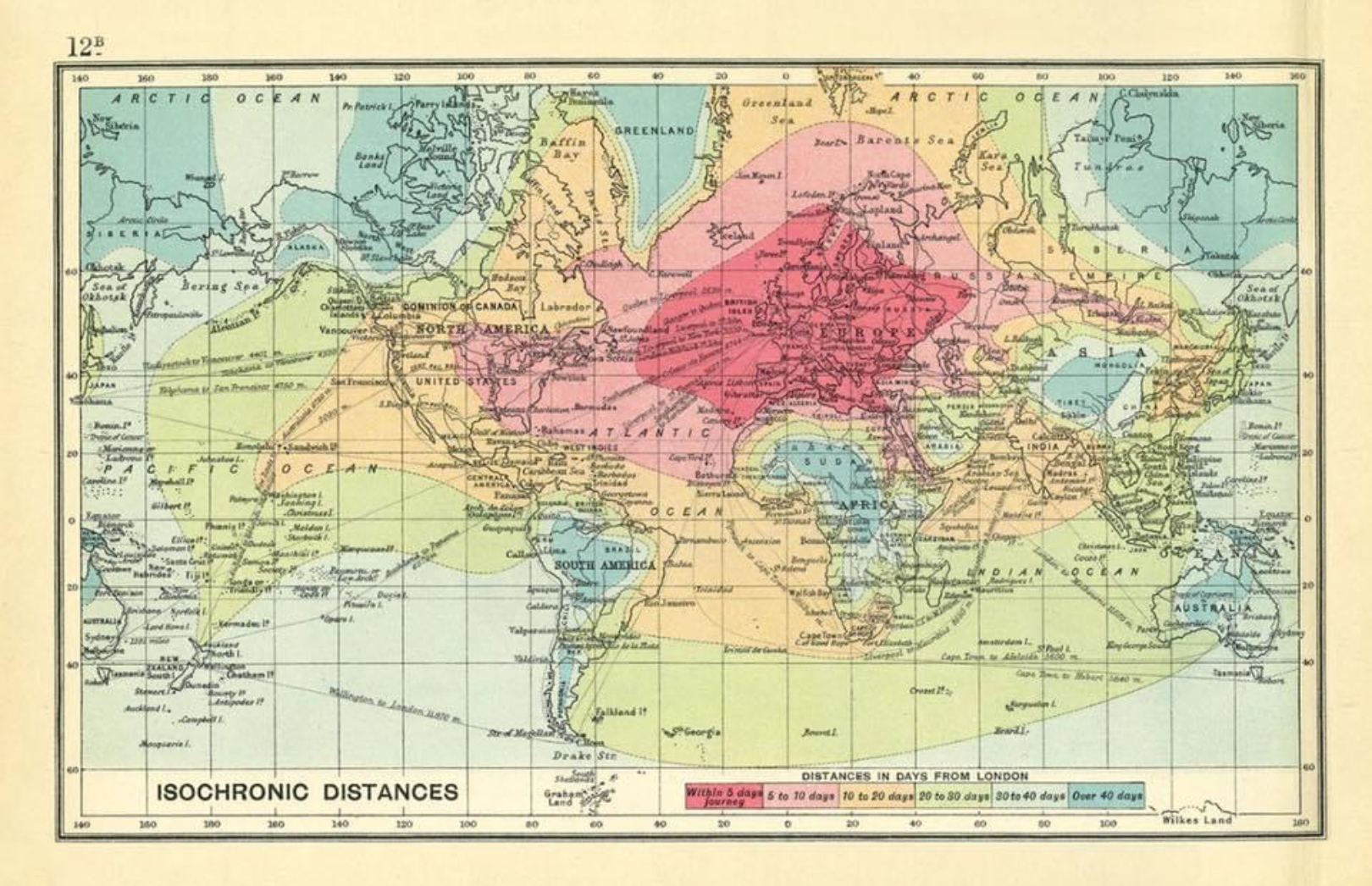
This fascinating isochrone map—how many days it took to get anywhere in the world from London in 1914—at first blush evokes the cliché that the world has now shrunk. Obviously it hasn’t shrunk. While the distance between London and New Delhi is still 4,168 miles, what has shrunk is time, and this has had profound aftermaths on our lives.
One of the great ironies in the remarkable proliferation of time-saving inventions is they haven’t made life simple enough to give us more time and leisure. By leisure, I don’t mean a virtue of some kind of inertia, but a deliberate organization based on a definite view of the meaning and purpose of life. In the urban world, the workweek hasn’t shortened. We still don’t have large swaths of time to really enjoy the good life with our families and friends.
In 1956, Sir Charles Darwin, grandson of the great Charles Darwin, wrote an interesting essay on the forthcoming Age of Leisure in the magazine New Scientist in which he argued: “The technologists, working for fifty hours a week, will be making inventions so the rest of the world need only work twenty-five hours a week. […] Is the majority of mankind really able to face the choice of leisure enjoyments, or will it not be necessary to provide adults with something like the compulsory games of the schoolboy?”
He is wrong in the first part. The world may have shrunk but cities have magnified. Travel technologies have incentivized us to live farther away and simply travel longer distances to work and attract anxiety attacks during peak hour traffic [Google Marchetti’s constant]. So, rather than being bored to death, our actual challenge is to avoid psychotic breakdowns, heart attacks, and strokes resulting from being accelerated to death.
Nonetheless, Sir Charles Darwin is accurate about “compulsory games” for adults. What else are social media platforms, compulsive eating, selfies, texts, Netflix bingeing, and 24/7 news media that dominate our lives? They are the real opiates of the masses. We have been so conditioned to search for happiness in these anodyne pastimes that defying these urges appears to be a denial of life itself. It is not surprising that we can no longer confidently tell the difference between passing pleasure and abiding joy. Lockdown or no lockdown, we are all unwittingly participating in these compulsory games with unwritten rules, believing that we are now that much closer to the good life of leisure. But are we?
‘Time is the wealth of change, but the clock in its parody makes it mere change and no wealth.’— Rabindranath Tagore
Nightcap
- The Mises-(Karl) Polanyi debate (on imperialism) reconsidered Eric Schliesser, Digressions & Impressions
- Racism, entrepreneurship, and love Conor Friedersdorf, Atlantic
- The new power brokers? Index funds and the public interest Sahand Moarefy, American Affairs
- The quiet collapse of Scottish unionism Scott Hames, New Statesman
Nightcap
- Should everything be decentralized? Arnold Kling, Pairagraph
- Is Russia’s future non-Slavic? Eugene Chausovsky, Newlines
- Is America’s future non-European? Samuel Gregg, Law & Liberty
- The myth of Westernization Jon Davidann, Aeon
Nightcap
- Libertarianism is bankrupt Thomas Wells, 3 Quarks Daily
- Neoracism in America today John McWhorter, Persuasion
- Racism, elites, and the have-nots Joanna Williams, spiked!
- Monday morning quarterbacking Jason Brennan, 200-Proof Liberals
Nightcap
- Middle class: questioning the definitions Mary Lucia Darst, NOL
- On Romney’s child allowance proposal Scott Sumner, EconLog
- On the American constitutionalism, and nationalism Dennis Coyle, Modern Age
- Ottomanism, nationalism, and republicanism (IV) Barry Stocker, NOL
Nightcap
- The anti-colonial revolution Adom Getachew (interview), Tribune
- Testing balance-of-power theory in world history (pdf) Deudney, et al, EJIR
- Hayekian balance-of-power theory (pdf) Edwin van de Haar, TIR
- Globalization and peace: A Hayekian perspective (pdf) Adrián Ravier, LP
Nightcap
- The Zulus, the British, and the military revolution of the 19th century Jacob Ivey, Age of Revolutions
- The British, the Holy Roman Empire, and diplomacy in the 17th century Philip Hitchings, British Interest
The unyielding middlemen: A timeline of 2020-2021 Indian farmers’ protest
What’s the first question in the field of public policy? According to the Indian Economist Ajay Shah, “What should the state do?” is the first question. He says, “A great deal of good policy reform can be obtained by putting an end to certain government activities and by initiating new areas of work that better fit into the tasks of government.”
This question is especially essential for a weak state like India. But what if people prefer government subsidies, assertive intermediaries and a weak state? I don’t know the answer to this question. The story of the Indian farm protest is an illustrative example; it is a rebellion to stay bound to the old status quo, fearful of free choice.
Protest Timeline
04 June 2020: Union Cabinet clears three ordinances meant for reforms in the Indian Agricultural sector. These reforms upgrade farmers from being just producers to free-market traders. Agriculture is a state subject in India, but state governments have had no political will to usher in these reforms. China reformed its agriculture sector first, followed by other industries. India is doing it the other way round and thirty years late. So, the union government followed constitutional means to usher in the reforms.
04-05 June 2020: Leader of Bharatiya Kisan Union (BKU), Rakesh Tikait, welcomes the ordinances.
09 August 2020: Two months after the cabinet’s ordinance, voices of dissent emerge in Punjab, Haryana, and U.P. because a minority of well-off farmers in these states are associated with APMC—the post-green revolution status-quo— that makes them comfortable middlemen.
14-20 September 2020: All the three bills cleared in the two houses of the parliament. But a party member from Punjab pulls out as a symbolic protest.
25 September 2020: Protest gets a ‘Bharat Bandh’ (India Shutdown) tag even though farmer unions in only three states oppose the reforms. The Union Govt opens a communication channel and holds several talks with these farmer associations over their concerns.
04 December 2020: The Union Govt offers a work-around the dilution of MSP. By the way, MSP sets an unnaturally high price and cuts out the competition, so the middlemen club in the farmer’s association of Punjab, Haryana, and U.P. want nothing less than the scraping of these reforms.
21 December 2020: Farmer associations boycott Jio and Reliance products unrelated to the farmer bills.
08 January 2021: Greta Thunberg’s online toolkit for a planned Twitter campaign against the Indian government is launched to invoke human rights violations; it confirms a hashtag.
10 January 2021: Online narrative set and future social media posts finalized.
12 January 2021: The supreme court of India makes a committee to examine the laws.
21 January 2021: The Union Govt offers to stay the laws for 18 months for a consultation, but it gets rejected.
26 January 2020: The farmers, during their Tractor Rally protests, breach the Red Fort, leads to a scuffle with the police. They hoist a religious flag at the Red Fort, thereby giving this arcane legal issue an unwanted sectarian color.
Bottom line: A) The Ordinances aim to liberalize Agri trade and increase the number of buyers for farmers. B) de-regulation alone may not be sufficient to attract more buyers.
Almost every economist worth his salt acknowledges the merit in point A) and welcomes these essential reforms that are thirty years late but better late than never. Ajay Shah says, “We [Indians] suffer from the cycle of boom and bust in Indian agriculture because the state has disrupted all these four forces of stabilization—warehousing, futures trading, domestic trade and international trade. The state makes things worse by having tools like MSP and applying these tools in the wrong way. Better intuition into the working of the price system would go a long way in shifting the stance of policy.”
However, the middlemen argue on point B), that acts as a broad cover for their real fears of squandering their upper-hand in the current APMC/MSP system. Although nobody denies that a sudden opening of the field for competition will threaten the income of these middlemen, such uncertainties should not justify violent protests, slandering campaigns, that look to derail the entire process of upgrading the lives of a great majority of poor farmers in the country.
Even worse, these events get branded in broad strokes as state violence and human rights abuses by pre-planned Twitter and street campaigns and unnecessary road blockades. Everybody questions internet outages during these protests but no one questions the ethics of protesters blocking essential roads in the city. A section of the Indian society and diaspora hates Prime Minister Modi for sure. I have no qualms with this, but the reckless hate shouldn’t negate all nuances in analyzing perfectly sane reforms. Social justice warriors legitimize the vicious cycle of dissent without nuance because they don’t take the trouble of even reading the farm bill but make it a virtue to reason from their “bleeding hearts.”
Talking about social justice warriors, the sane voice of Sadanand Dhume, a Resident Fellow at the American Enterprise Institute, one of the few left-leaning voices from India I respect writes, “What do Rihanna, Greta Thunberg, and Vice President Kamala Harris’s niece, Meena Harris, have in common? They’re all rallying support for India’s farmer protests, which are morphing from an arcane domestic dispute into an emotive international cause. And they’re all mostly wrong in their thinking.”
Ordinarily, the Indian state works inadequately, experiences confusion when faced with a crisis. It comes out with a communication of a policy package that attempts to address the problem in a short-term way and retreats into indifference. So, there are two aspects to its incompetence, one, there is a lack of political will because special interest groups persuade the government towards the wrong objectives. And two, the state capacity is so weak that it fails to achieve the goal. The farm protest is a hideous third kind of difficulty: a special interest group of assertive, influential middlemen want the strong-willed, long-term thinking Indian government policy—a rare entity— to sway towards short-termism under the pretext of human rights abuse. The hard left is actually supporting the Indian state to remain weak. They will also be the first to blame the state when it comes off as weak in the next debacle.
The story never ends.
Second to None in the Creation of Extraordinary Wealth
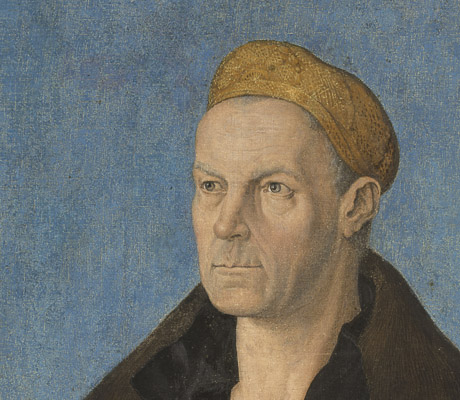
The most important historical question to help understand our rise from the muck to modern civilization is: how did we go from linear to exponential productivity growth? Let’s call that question “who started modernity?” People often look to the industrial revolution, which is certainly an acceleration of growth…but it is hard to say it caused the growth because it came centuries after the initial uptick. Historians also bring up the Renaissance, but this is also a mislead due to the ‘written bias’ of focusing on books, not actions; the Renaissance was more like the window dressing of the Venetian commercial revolution of the 11th and 12th centuries, which is in my opinion the answer to “who started modernity.” However, despite being the progenitors of modern capitalism (which is worth a blog in and of itself), Venice’s growth was localized and did not spread immediately across Europe; instead, Venice was the regional powerhouse who served as the example to copy. The Venetian model was also still proto-banking and proto-capitalism, with no centralized balance sheets, no widespread retail deposits, and a focus on Silk Road trade. Perhaps the next question is, “who spread modernity across Europe?” The answer to this question is far easier, and in fact can be centered to a huge degree around a single man, who was possibly the richest man of all time: Jakob Fugger.
Jakob Fugger was born to a family of textile traders in Augsburg in the 15th century, and after training in Venice, revolutionized banking and trading–the foundations on which investment, comparative advantage, and growth were built–as well as relationships between commoners and aristocrats, the church’s view of usury, and even funded the exploration of the New World. He was the only banker alive who could call in a debt on the powerful Holy Roman Emperor, Charles V, mostly because Charles owed his power entirely to Fugger. Strangely, he is perhaps best known for his philanthropic innovations (founding the Fuggerei, which were some of the earliest recorded philanthropic housing projects and which are still in operation today); this should be easily outcompeted by:
- His introduction of double entry bookkeeping to the continent
- His invention of the consolidated balance sheet (bringing together the accounts of all branches of a family business)
- His invention of the newspaper as an investment-information tool
- His key role in the pope allowing usury (mostly because he was the pope’s banker)
- His transformation of Maximilian from a paper emperor with no funding, little land, and no power to a competitor for European domination
- His funding of early expeditions to bring spices back from Indonesia around the Cape of Good Hope
- His trusted position as the only banker who the Electors of the Holy Roman Empire would trust to fund the election of Charles V
- His complicated, mostly adversarial relationship with Martin Luther that shaped the Reformation and culminated in the German Peasant’s War, when Luther dropped his anti-capitalist rhetoric and Fugger-hating to join Fugger’s side in crushing a modern-era messianic figure
- His involvement in one of the earliest recorded anti-trust lawsuits (where the central argument was around the etymology of the word “monopoly”)
- His dissemination, for the first time, of trustworthy bank deposit services to the upper middle class
- His funding of the military revolution that rendered knights unnecessary and bankers and engineers essential
- His invention of the international joint venture in his Hungarian copper-mining dual-family investment, where marriages served in the place of stockholder agreements
- His 12% annualized return on investment over his entire life (beating index funds for almost 5 decades without the benefit of a public stock market), dying the richest man in history.
The story of Fugger’s family–the story, perhaps, of the rise of modernity–begins with a tax record of his family moving to Augsburg, with an interesting spelling of his name: “Fucker advenit” (Fugger has arrived). His family established a local textile-trading family business, and even managed to get a coat of arms (despite their peasant origins) by making clothes for a nobleman and forgiving his debt.
As the 7th of 7 sons, Jakob Fugger was given the least important trading post in the area by his older brothers; Salzburg, a tiny mountain town that was about to have a change in fortune when miners hit the most productive vein of silver ever found by Europeans until the Spanish found Potosi (the Silver Mountain) in Peru. He then began his commercial empire by taking a risk that no one else would.
Sigismund, the lord of Salzburg, was sitting on top of a silver mine, but still could not run a profit because he was trying to compete with the decadence of his neighbors. He took out loans to fund huge parties, and then to expand his power, made the strategic error of attacking Venice–the most powerful trading power of the era. This was in the era when sovereigns could void debts, or any contracts, within their realm without major consequences, so lending to nobles was a risky endeavor, especially without backing of a powerful noble to force repayment or address contract breach.
Because of this concern, no other merchant or banker would lend to Sigismund for this venture because sovereigns could so easily default on debts, but where others saw only risk, Fugger saw opportunity. He saw that Sigismund was short-sighted and would constantly need funds; he also saw that Sigismund would sign any contract to get the funds to attack Venice. Fugger fronted the money, collateralized by near-total control of Sigismund’s mines–if only he could enforce the contract.
Thus, the Fugger empire’s first major investment was in securing (1) a long-term, iterated credit arrangement with a sovereign who (2) had access to a rapidly-growing industry and was willing to trade its profits for access to credit (to fund cannons and parties, in his case).
What is notable about Fugger’s supposedly crazy risk is that, while it depended on enforcing a contract against a sovereign who could nullify it with a word, he still set himself up for a consistent, long-term benefit that could be squeezed from Sigismund so long as he continued to offer credit. This way, Sigismund could not nullify earlier contracts but instead recognized them in return for ongoing loan services; thus, Fugger solved this urge toward betrayal by iterating the prisoner’s dilemma of defaulting. He did not demand immediate repayment, but rather set up a consistent revenue stream and establishing Fugger as Sigismund’s crucial creditor. Sigismund kept wanting finer things–and kept borrowing from Fugger to get them, meaning he could not default on the original loan that gave Fugger control of the mines’ income. Fugger countered asymmetrical social relationships with asymmetric terms of the contract, and countered the desire for default with becoming essential.
Eventually, Fugger met Maximilian, a disheveled, religion-and-crown-obsessed nobleman who had been elected Holy Roman Emperor specifically because of his lack of power. The Electors wanted a paper emperor to keep freedom for their principalities; Maximilian was so weak that a small town once arrested and beat him for trying to impose a modest tax. Fugger, unlike others, saw opportunity because he recognized when aligning paper trails (contracts or election outcomes) with power relationships could align interests and set him up as the banker to emperors. When Maximilian came into conflict with Sigismund, Fugger refused any further loans to Sigismund, and Maximilian forced Sigismund to step down. Part of Sigismund’s surrender and Maximilian’s new treaty included recognizing Fugger’s ongoing rights over the Salzburg mines, a sure sign that Fugger had found a better patron and solidified his rights over the mine through his political maneuvering–by denying a loan to Sigismund and offering money instead to Maximilian. Once he had secured this cash cow, Fugger was certainly put in risky scenarios, but didn’t seek out risk, and saw consistent yearly returns of 8% for several decades followed by 16% in the last 15 years of his life.
From this point forward, Fugger was effectively the creditor to the Emperor throughout Maximilian’s life, and built a similar relationship: Maximilian paid for parties, military campaigns, and bought off Electors with Fugger funds. As more of Maximilian’s assets were collateralized, Fugger’s commercial empire grew; he gained not only access to silver but also property ownership. He was granted a range of fiefs, including Arnoldstein, a critical trade juncture where Austria, Italy, and Slovenia border each other; his manufacturing and trade led the town to be renamed, for generations, Fuggerau, or Place of Fugger.
These activities that depended on lending to sovereigns brings up a major question: How did Fugger get the money he lent to the Emperor? Early in his career, he noted that bank deposit services where branches were present in different cities was a huge boon to the rising middle-upper class; property owners and merchants did not have access to reliable deposit services, so Fugger created a network of small branches all offering deposits with low interest rates, but where he could grow his services based on the dependability of moving money and holding money for those near, but not among, society’s elites. This gave him a deep well of dispersed depositors, providing him stable and dependable capital for his lending to sovereigns and funding his expanding mining empire.
Unlike modern financial engineers, who seem to focus on creative ways to go deeper in debt, Fugger’s creativity was mostly in ways that he could offer credit; he was most powerful when he was the only reliable source of credit to a political actor. So long as the relationship was ongoing, default risk was mitigated, and through this Fugger could control the purse strings on a wide range of endeavors. For instance, early in their relationship (after Maximilian deposed Sigismund and as part of the arrangement made Fugger’s interest in the Salzburg mines more permanent), Maximilian wanted to march on Rome as Charlemagne reborn and demand that the pope personally crown him; he was rebuffed dozens of times not by his advisors, but by Fugger’s denial of credit to hire the requisite soldiers.
Fugger also innovated in information exchange. Because he had a broad trading and banking business, he stood to lose a great deal if a region had a sudden shock (like a run on his banks) or gain if new opportunities arose (like a shift in silver prices). He took advantage of the printing press–less than 40 years after Gutenberg, and in a period when most writing was religious–to create the first proto-newspaper, which he used to gather and disseminate investment-relevant news. Thus, while he operated a network of small branches, he vastly improved information flow among these nodes and also standardized and centralized their accounting (including making the first centralized/combined balance sheet).
With this broad base of depositors and a network of informants, Fugger proceeded to change how war was fought and redraw the maps of Europe. Military historians have discussed when the “military revolution” that shifted the weapons, organization, and scale of war for decades, often centering in on Swedish armies in the 1550s as the beginning of the revolution. I would counter-argue that the Swedes simply continued a trend that the continent had begun in the late 1400’s, where:
- Knights’ training became irrelevant, gunpowder took over
- Logistics and resource planning were professionalized
- Early mechanization of ship building and arms manufacturing, as well as mining, shifted war from labor-centric to a mix of labor and capital
- Multi-year campaigns were possible due to better information flow, funding, professional organization
- Armies, especially mercenary groups, ballooned in size
- Continental diplomacy became more centralized and legalistic
- Wars were fought by access to creditors more than access to trained men, because credit could multiply the recruitment/production for war far beyond tax receipts
Money mattered in war long before Fugger: Roman usurpers always took over the mints first and army Alexander showed how logistics and supply were more important than pure numbers. However, the 15th century saw a change where armies were about guns, mercenaries, technological development, and investment, and above all credit, and Fugger was the single most influential creditor of European wars. After a trade dispute with the aging Hanseatic League over their monopoly of key trading ports, Fugger manipulated the cities into betraying each other–culminating in a war where those funded by Fugger broke the monopolistic power of the League. Later, because he had a joint venture with a Hungarian copper miner, he pushed Charles V into an invasion of Hungary that resulted in the creation of the Austro-Hungarian Empire. These are but two of the examples of Fugger destroying political entities; every Habsburg war fought from the rise of Maximilian through Fugger’s death in 1527 was funded in part by Fugger, giving him the power of the purse over such seminal conflicts as the Italian Wars, where Charles V fought on the side of the Pope and Henry VIII against Francis I of France and Venice, culminating in a Habsburg victory.
Like the Rothschilds after him, Fugger gained hugely through a reputation for being ‘good for the money’; while other bankers did their best to take advantage of clients, he provided consistency and dependability. Like the Iron Bank of Braavos in Game of Thrones, Fugger was the dependable source for ambitious rulers–but with the constant threat of denying credit or even war against any defaulter. His central role in manipulating political affairs via his banking is well testified during the election of Charles V in 1519. The powerful kings of Europe– Francis I of France, Henry VIII of England, and Frederick III of Saxony all offered huge bribes to the Electors. Because these sums crossed half a million florins, the competition rapidly became one not for the interest of the Electors–but for the access to capital. The Electors actually stipulated that they would not take payment based on a loan from anyone except Fugger; since Fugger chose Charles, so did they.
Fugger also inspired great hatred by populists and religious activists; Martin Luther was a contemporary who called Fugger out by name as part of the problem with the papacy. The reason? Fugger was the personal banker to the Pope, who was pressured into rescinding the church’s previously negative view of usury. He also helped arrange the scheme to fund the construction of the new St. Peter’s basilica; in fact, half of the indulgence money that was putatively for the basilica was in fact to pay off the Pope’s huge existing debts to Fugger. Thus, to Luther, Fugger was greed incarnate, and Fugger’s name became best known to the common man not for his innovations but his connection to papal extravagance and greed. This culminated in the 1525 German Peasant’s War, which saw an even more radical Reformer and modern-day messianic figure lead hordes of hundreds of thousands to Fuggerau and many other fortified towns. Luther himself inveighed against these mobs for their radical demands, and Fugger’s funding brought swift military action that put an end to the war–but not the Reformation or the hatred of bankers, which would explode violently throughout the next 100 years in Germany.
This brings me to my comparison: Fugger against all of the great wealth creators in history. What makes him stand head and shoulders above the rest, to me, is that his contributions cross so many major facets of society: Like Rockefeller, he used accounting and technological innovations to expand the distribution of a commodity (silver or oil), and he was also one of the OG philanthropists. Like the Rothschilds’ development of the government bond market and reputation-driven trust, Fugger’s balance-sheet inventions and trusted name provided infrastructural improvement to the flow of capital, trust in banks, and the literal tracking of transactions. However, no other capitalist had as central of a role in religious change–both as the driving force behind allowing usury and as an anti-Reformation leader. Similarly, few other people had as great a role in the Age of Discovery: Fugger funded Portuguese spice traders in Indonesia, possibly bankrolled Magellan, and funded the expedition that founded Venezuela (named in honor of Venice, where he trained). Lastly, no other banker had as influential of a role in political affairs; from dismantling the Hanseatic League to deciding the election of 1519 to building the Habsburgs from paper emperors to the most powerful monarchs in Europe in two generations, Fugger was the puppeteer of Europe–and such an effective one that you have barely heard of him. Hence, Fugger was not only the greatest wealth creator in history but among the most influential people in the rise of modernity.
Fugger’s legacy can be seen in his balance sheet of 1527; he basically developed the method of using it for central management, its only liabilities were widespread deposits from the upper-middle class (and his asset-to-debt ratio was in the range of 7-to-1, leaving an astonishingly large amount of equity for his family), and every important leader on the continent was literally in his debt. It also showed him to have over 1 million florins in personal wealth, making him one of the world’s first recorded millionaires. The title of this post was adapted from a self-description written by Jakob himself as his epitaph. As my title shows, I think it is fairer to credit his wealth creation than his wealth accumulation, since he revolutionized multiple industries and changed the history of capitalism, trade, European politics, and Christianity, mostly in his contribution to the credit revolution. However, the man himself worked until the day he died and took great pride in being the richest man in history.
All information from The Richest Man Who Ever Lived. I strongly recommend reading it yourself–this is just a taster!
Nightcap
- Immigration and voting for redistribution Derrill Watson, NOL
- What shouldn’t be surprising about democracy John Hasnas, RCL
- Wobbly: China’s post-Covid future Andrew Scobell, War on the Rocks
- Experts versus elites Robin Hanson, Overcoming Bias
 Notes On Liberty