Nixon to Moscow, slavery’s toll on the economy

My latest is up over at RealClearHistory. An excerpt:

Nixon’s anti-Communist credentials were so sound that he could spend political capital making inroads with Communist enemies. His actions were viewed as safe by the American electorate because, for better or worse, the public saw Nixon as somebody who would not betray American values at the negotiating table with the Soviets. Nixon’s hawkishness provided moral cover for America’s withdrawal from Vietnam, and its peaceful overtures to the two most powerful and aggressively anti-capitalist regimes in the world (China and the USSR).

Please, read the whole thing.

Vincent has a great review up on Robert Wright’s new book about slavery, too. It’s at EH.net, a website dedicated to economic history, and here is an excerpt:

All of these amount to the same core point, those who reap the private benefits of slavery are content with their gains even though they come at a larger social cost and they will work to find ways to drive a wider wedge between the two by shifting costs onto other parties. Hence, slavery as pollution.

More here.

Nightcap

  1. Delacroix and his followers? Joe Lloyd, 1843
  2. Cortés and his allies Álvaro Enrigue, NY Review of Books
  3. God and the mathematicians Josephine Livingstone, New Republic
  4. Comey and the libertarians Stephen Cox, Liberty Unbound

Nightcap

  1. The abolitionist hero ahead of his time Marcus Rediker, Aeon
  2. On guilt by association Chris Dillow, Stumbling and Mumbling
  3. The newest right-wing assault on federalism Ilya Somin, Volokh Conspiracy
  4. The Conquest of the World as Globe Soni Wadhwa, Asian Review of Books

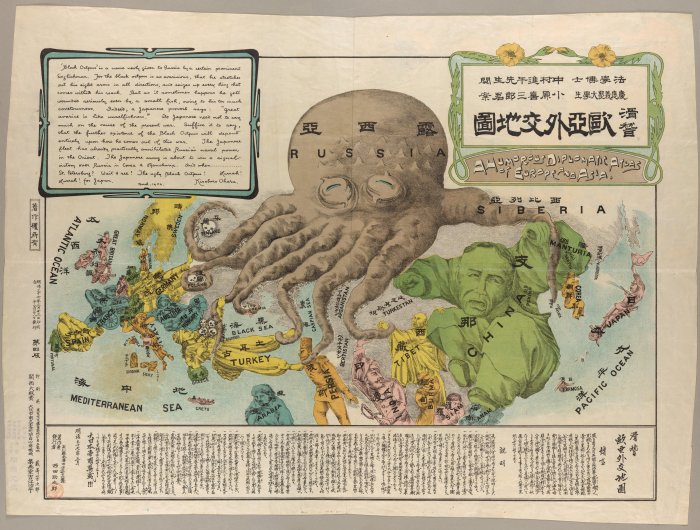
Eye Candy: Japanese anti-Russian propaganda

NOL map Japanese anti-Russia
Click here to zoom.

This dates from the late 19th or early 20th century. The Japanese won the Russo-Japanese War, but a quick glance at the casualties suggests it was more a pyrrhic victory for the Japanese.

Nightcap

  1. Responding to the challenge of modernization Branko Milanovic, globalinequality
  2. The Victorian Achievement Nick Nielsen, The View from Oregon
  3. The Warriors and Rockets win with defense Chris Herring, FiveThirtyEight
  4. An ignored, scary development in Israeli politics Michael Koplow, Ottomans and Zionists

Israelis Kill Unarmed Palestinians in Gaza

The Israeli Defense Force is killing unarmed demonstrators in Gaza. The Defense Force is on one side of the fence, the demonstrators on the other. What happened is that the ruling political party in Gaza, Hamas, sent the demonstrators to try and breach the fence separating Gaza from Israel. The declared purpose was to have Gaza Palestinians exercise their “right of return.” Hamas means the “right” of Palestinians to return where their forebears used to live, or maybe not, or nearby, etc, right inside present-day Israel. Of course, if Israel allowed this, Israelis might just as well start packing. It would be the end of the Jewish state that already has about 1.85 million Muslim and Christian Arab citizens. Both Palestinians and Israeli Arabs reproduce faster than Israeli Jews, by the way. (It’s the Jews’ fault, of course; they should get busy.) Hamas generously would allow Jews of Middle Eastern origin to remain as second-class, tribute-paying dhimmis. All the others, the majority, would have to leave quickly. Ethnic cleansing is the best scenario if Hamas wins, according to Hamas. The worst? Hamas does not say.

The mid-May 2018 demonstration was presented as a way to commemorate what Palestinians call “the disaster “– meaning the creation of Israel and the wholesale defeat the Arabs suffered in the war they had started against the new state. Initially, it had nothing to do with the inauguration of the new American Embassy in Jerusalem. It was mostly the Amerileft media that created a link with such devices as showing the inauguration in Jerusalem on a split screen with the rioting in Gaza. Many Americans, some of whom can’t place the US on a world map, would have believed that Palestinians were dying while the Americans and Israelis were gaily drinking champagne right next door.

The Israelis had warned early on that they would shoot demonstrators who tried to breach the fence separating Israel from Gaza. They did, killing about 70 Palestinians. That’s harsh but no one can call it unfair: They said it clearly: If you touch our fence, we will kill you. Don’t touch the fence, I would say. Little detour: the magazine Commentary pointed out that the Gaza authorities claim that 1600 Gazans were wounded by real bullets. What’s wrong here is the ratio of wounded to killed, 1600/70. It should be something like 1600/500 . It does not add up or else, the Israelis snipers are real bad at their job. Go figure!

Hamas thinks it’s winning because of the large number of unarmed demonstrators, its youths, wounded and killed. It’s been acting like this forever. Just a week ago, Gazans (who may have been Hamas agents or not) deliberately destroyed the valve to the main pipeline supplying Gaza with diesel fuel. The more misery ordinary residents of Gaza suffer, the happier the Hamas government is because Israeli atrocities give it standing among the ill-informed and mindless everywhere. I am tempted to feel sorry for Gazans myself because of the terrible government they live under. I can’t quite do this; below is why.

Hamas was elected in proper well observed elections. Although the Hamas government is well overdue for a new election, I would argue that the initial election makes Hamas one of the most legitimate governments in the Middle East. Hamas is explicitly an Islamist party. It does not think well of freedom of religion. It wants to impose sharia but does not feel strong enough yet. Hamas is in favor of polygamy. Young Gaza Palestinians are dying because of actions encouraged by their government, the Hamas government. Their parents properly elected that government. There has been no rebellion against it. The mass of the population seems loyal.

Hamas is insuring an aggravation of a situation in Gaza that is pretty much intolerable already. Israel left Gaza unilaterally 15 years ago but it maintains a partial blockade of the territory. It provides fuel and electricity and most of the water available, on its terms. It allows certain merchandise in but not others. Cement is limited, for example, I read in a source I can’t quote now but that I found credible at the time that Israeli Customs allow in milk and sugar but not instant coffee – which makes life more enjoyable. There is almost no work in Gaza, except working for the Hamas government. Nevertheless, no one there is starving because the territory is largely on welfare. Gaza has one of the highest educational achievement scores in the world although there is malnutrition there.

Gaza is a welfare non-state. It has no industry and very little else by way of earning its living. (That’s in part because of Israeli control over its borders, of course.) It’s an economic ward of the UN and secondarily of the European Union and of the USA. American Jews are thus among those supporting through their taxes riots where the main demand is “Death to the Jews!” The Leftmedia does not seem to be willing to mention, or it actually does not know, that the Israeli blockade of Gaza would be ineffective, almost useless, if Egypt did not join in. Yes, Egypt is also impeding the movement of goods, funds, and especially of people between itself and Gaza. And the PLO, which rules the West Bank, the other part of Palestine, has its own punitive measures against Gaza. Hamas is everyone’s favorite!

If you too feel revolted by the Israeli killings of Gaza demonstrators, and if you don’t think that righteous indignation is its own reward, I invite you to take two minutes to answer the following simple and sensible question:

Suppose you have a chance to advise the Israeli Prime Minister; suppose further that you have reason to believe that he will pay attention to you; what’s your advice to him regarding the present situation in Gaza (mid-May 2018)?

You can be sure that I have answered the question myself.

PS I am not Jewish, never have been, never will be. I am not a fundamentalist Christian either.
George Halm against Common Wisdom on Currency Boards

Motivated by the recent decision of Argentina’s government to ask for an stand-by loan to the I.M.F., after a run on the peso, the last The Economist’s Bello section gives an account of the history of the relationship between them and makes a remark about the Argentine currency board experience between 1991-2002 that today is almost common wisdom: Since convertibility meant forgoing exchange-rate flexibility and an independent monetary policy, fiscal discipline was all-important for its success.”

But by the time the I.M.F. was being created, that was not an unanimous opinion. We have the example of George N. Halm who, in his book Economics of Money and Banking, stated that every Currency Board must implement a countercyclical policy on reserve requirements to be held by the commercial banks. Thus, the Currency Board could neutralize or mitigate an expansion or contraction of the base money by alternatively increasing or lowering the reserve requirements of the banks. For George Halm, a Currency Board could be almost in full command of monetary policy -and even more with respect to any other system, since it retains its political independence.

It is hard to imagine a Halm’s Currency Board that promotes a rapid economic growth which, in turn, could bring any popularity to its implementation. But it is as hard to imagine as the probability that a monetary system as such could end up in a bank run.

Nightcap

  1. Gonzo philosophy Scott Bradfield, New Statesman
  2. Three contrarian opinions Scott Sumner, EconLog
  3. The dark, complicated reality of Tibetan Buddhism Mark Hay, Aeon
  4. AI and the limits of deep learning Robert Richbourg, War on the Rocks

Dictators who gave up power?

That’s the topic of my weekend column over at RealClearHistory, thanks to an extended email with Andrei. Here’s an excerpt:

10. King Juan Carlos I. Juan Carlos should be a household name in the West. The monarch of Spain upon dictator Francisco Franco’s death, Juan Carlos was expected to continue Franco’s legacy of authoritarian rule. After all, he received a military education in Spain under the Franco regime and had a clear claim to the throne (although the throne itself was a complicated legal matter). Furthermore, Juan Carlos was an active member of Franco’s staff, even stepping in to fill Franco’s void when the fascist began to fall ill due to old age. When Franco died, Juan Carlos began to dismantle the Franco regime and helped usher a smooth transition to democratic rule.

Please, read the rest.

What is the proper role of government?

Former Brazil’s president Dilma Rousseff publicly lied by saying that she had a M.A. and a Ph.D. in Economics. The lie was discovered in 2009, when she still wasn’t Brazil’s president. Maybe that’s the problem with Dilma: she would even lie to say she was highly competent in economics.

Nobody in the 19th century believed that the role of government was to control the economy. This notion only became strong in the 20th century and to a great degree thanks to Keynesianism. It was Keynes who popularized the notion that the free market is inherently unstable, and that government should exercise some oversight on it.

Jair Bolsonaro, the Brazilian presidential candidate ahead in the opinion polls, has no problem admitting he doesn’t know enough about economics. For me, this is one of his main strengths. In the past, Bolsonaro was more statist. Today he shows signs of becoming more inclined towards free markets. He is clearly willing to delegate the economic policy of his government to people who are strongly favorable to the free market. In other words, Bolsonaro doesn’t know a lot about economics and he is not ashamed of admitting it. But he knows that too much government control ruins a country’s economy.

Dilma is arrogant. Part of her arrogance is to believe that she would be able to control the economy politically. Bolsonaro seems to be humble enough to admit that’s impossible. Keynes believed that the economy is inherently unstable. Contradictorily he advised governments to try to control it. Hayek’s answer to Keynes was that economics is not a science you can master in college. There are simply way too many variables for any human to control.

Bolsonaro’s focus is on public security. Criminality is on the rise in Brazil. People are afraid of walking on the streets, especially in big cities like Rio de Janeiro and São Paulo. That should be the role of government: to guarantee we can go out for work, come back, and not get killed or robbed on the way. If the government is doing that, it is already doing a lot. People freely and willingly interacting with one another can do the rest. Guarantee that evildoers will be punished, and watch the economy fly. And before I forget: contrary to cultural Marxism (and Rousseau), criminals are not victims of the society. Society is the victim of criminals.

Nightcap

  1. Linking Eastern Christianity with capitalism Bruce Clark, Erasmus
  2. Why were (are) the Balkans underdeveloped? Branko Milanovic, globalinequality
  3. What Nikolai Kardashev really said JN Nielsen, Centauri Dreams
  4. Chernobyl was a disaster by design Tobie Mathew, Literary Review

Nightcap

  1. Down and out with Chaïm Soutine Joe Lloyd, 1843
  2. On Sodomy And Restoration Liam Heneghan, 3 Quarks Daily
  3. Human Rights and Neoliberalism Nils Gilman, LA Review of Books
  4. Under the Skin Gene Callahan, Modern Age

Nightcap

  1. Why the last two speakers of a dying language don’t talk to each other Avedis Hadjian, International Business Times
  2. Britain’s intellectual decline Chris Dillow, Stumbling and Mumbling
  3. Savagery, Barbarism, and Civilization JN Nielsen, The View from Oregon
  4. Venezuela’s mysterious tepuis James MacDonald, JSTOR Daily

Cities in capitalism are more beautiful

The other day I wrote about some of the reasons why I love capitalism. One of them is that cities in capitalism are more beautiful. I am convinced of this when I think about some cities I am more familiar with, including their geography and history.

Most foreigners I know have difficulty to answering correctly, when asked, “What is Brazil’s national capital?”. Most people answer Rio de Janeiro, but it is actually Brasilia. Many people say that beauty is in the eyes of the beholder, but I am very inclined to say that this is not so. I am still not 100% sure about this, but I believe that there is something objective about beauty. Maybe it is not something so strict, like a point. Maybe it is something broader, like an area. But still, I am inclined to say that there is something objective about it. At least for me, Brasilia is one of the ugliest cities conceivable. I am really glad to say that. Its architecture was designed by Oscar Niemeyer and Lucio Costa. Growing up in Brazil, questioning that Niemeyer was a genius is almost anathema, almost like saying that Maradona was better than Pelé or that Ayrton Senna was not the best Formula One pilot ever. Because of that, I was always happy to say that Niemeyer’s buildings are among the ugliest things on the surface of this planet. It was like shouting that the king is naked.

Brasilia is very beautiful from the sky. Its shape resembles an airplane or a cross. But that is the problem: the city is beautiful from heaven, but not for the people walking in it. It was made for God to see from up there. But, as Niemeyer was a convinced atheist, I am not sure who is watching his creation. My guess is that Niemeyer thought that he was a god. A very mean god, who didn’t care about people having to spend lots of time in cars driving long distances.

Niemeyer was also related, with Lucio Costa, to Barra da Tijuca, a neighborhood in Rio de Janeiro where I spent lots of time growing up. Lucio Costa, as far as I’m concerned, was not a communist. I believe he was closely connected to the Brazilian version of positivism. Because positivism and communism are basically the same, it doesn’t make much of a difference. Barra da Tijuca is very similar to Brasilia: very beautiful if looked at from the sky, but very unpleasant for the pedestrian. Very long distances to walk. Cars are mandatory.

The most pleasant neighborhoods in Rio de Janeiro are the result of spontaneous order. As Hayek noticed, spontaneous order is one of the central features of capitalism. People usually contrasted between planned economies (such as the USSR) and unplanned economies (such as the US in some moment of its history). But Hayek observed that all economies are planned. Some are centrally planned. Others are planned by several individuals who are not following a specific central plan.

I am convinced that cities that follow no plan, or a very simple plan, are more beautiful than cities that follow a very specific central plan. New York, as far as I know, followed a simple plan, a grid. But other than that, there was a lot of freedom in the use of the space for much of its history. It’s a city that I just love. I am more comfortable talking about Rio de Janeiro. It is a city that was at its best before modern architecture, positivism, socialism, Developmentalism, and other isms. It was better when Brazil had a little more classical liberalism.

The Mexican-American War, and another warm welcome

My topic over at RealClearHistory today is the Mexican-American War and slavery, so be sure to show me a little extra love and have a peek. An excerpt:

The British, for their part, played an ingeniously devious role. London convinced Mexico to finally recognize Texas independence in 1845, as long as Texas agreed to avoid annexation by another sovereign polity. This put enormous pressure on factions in Washington, Austin, and Mexico City, so much so that Tyler, by then a lame-duck, urged Congress to put aside its differences and offer statehood to the Republic of Texas (which it did). In Austin, the process was a little trickier. The Congress of the Texan Republic had to vote on whether to be independent or to be annexed, but so did a newly-formed convention of elected delegates, which was one of the requirements imposed on Texas by the United States. (Washington felt that a convention of elected delegates better fit the profile of an incoming state than a Congress that had been independent for 10 years.) Both the Congress and the convention of delegates voted in favor of annexation over independence. The convention of delegates then drew up a state constitution, turned it over to the people of Texas to be ratified, and then sent it to Washington for Congressional acceptance. On Dec. 29, 1845, the U.S. Congress finally ratified statehood for Texas.

Please, read the rest. Annexation is a topic I will continue to explore, albeit from NOL rather than RealClearHistory, so stay tuned. “Entrance” is just as important as “exit” in libertarian theory, even though the latter gets all of the fame and fortune these days.

Speaking of entrances, I’d like to officially, warmly welcome Shree Agnihotri to the consortium and highlight her first thoughts with NOL: “Role of a Citizen in Hegemonic Authoritarianism.” I’m not going to spoil it for you, but it’s about Hannah Arendt, so if you haven’t read it yet, now would be a good time (don’t forget to say ‘hi’ while you’re at it). Here is her bio. Here is more from NOL on Hannah Arendt. I’m stoked to see what she has to say over the years!