The Federation of Free States: Growing pains

We’re continuing our thought experiment on adding more states to the American republic.

Our initial experiment added 29 states to the union in 2025. After a few decades of relative success (the entire world grew economically from 2025 to 2045), the bicameral Congress of free states was willing to accept several new members, who in turn were willing to trade their sovereignty for two seats in the Senate. The polities that joined the federation of free states in the second peaceful geographic expansion of the Philadelphian federal order were varied, but only somewhat predictable. The Madisionian compound republic rearranged the map once again. Here is what it looks like in 2045:

The red places were “states” in 2025, the orange places are new “states” in 2045.

As you can see, most of the expansion came in North America, East Asia, and West Africa. The experience of Canaan, England, and Wales hasn’t been bad, but enough nationalist-secessionist sentiments remain in these three “states” that none of their neighbors thought that giving up their sovereignty for Senate seats was worth it. All three economies grew, and peace finally came to Canaan, but if peace, wealth, and security from predation were the only things that people wanted then we wouldn’t be people. We’d be something else entirely. People want freedom, and the compound republic – the federation of free states – did not yet show in 2045 it was capable of extirpating the menace of nationalism from human existence.

The success of the ranching states of Mexico – Coahuila, Tamaulipas, and Nuevo León – within the United States prompted several more Mexican states to apply for statehood, but the pushback against too many states joining the union was stern. Yucatán and Chihuahua were added as is, giving the Senate four more seats, but the states of Zacatecas, Durango, and San Luis Potosí had to combine into one state (they called it San Luis Potosí, and it’s about the size of Nevada) in order to join the Philadelphian world order.

The prairie provinces of Canada also did well for themselves since 2025. So well, in fact, that five more provinces applied to join. However, Congress did not want to add five more states with such sparse populations, so the Atlantic provinces of Nova Scotia, Prince Edward Island, New Brunswick, Newfoundland, and Labrador merged to become a state that they called Nova Scotia, a massive landmass with enough people for only one or maybe two representatives. By the way, from 2025 to 2045, several old American states — Washington, Oregon, and Vermont – all held referendums on whether to leave the Madisonian republic and join Canada (or go it alone), but the referendums have proved to be unsuccessful.

Liberia’s success in the American federation is perhaps the most encouraging progress of all. Crime rates skyrocketed once Liberia joined the union, but this only shows how the American legal system does such a wonderful job of protecting property rights. Violent crime dropped, but crimes involving property rights reached an all-time high, which means that property rights in Liberia are finally being protected by a state strong enough to do so. The GDP (PPP) per capita of Liberia quadrupled from 2025 to 2045. Several neighboring states took notice, but only one, Sierra Leone, joined the federation outright.

Several Nigerian and Ghanaian polities joined the republic. All of the polities started out as administrative units within Ghana and Nigeria, and there were too many that wanted to join. So, they borrowed from San Luis Potosí’s playbook and merged with each other before applying for statehood as larger polities. From Nigeria, the states of Oyo (made up of five Nigerian states), Biafra (made up of eight states), Benin (made up of four states), and Bayelsa (three states) all joined. The states are all from the south of Nigeria.

Ghana sent three states to the republic: Ashanti (made up of five Ghanaian provinces), Volta (made up of three provinces), and Cape Coast (three provinces). The 11 provinces that made up the three new states were all from Ghana’s south. It should be noted the the Ashanti region had a relatively strong sense of nationalism when it applied for membership to the federation, and that the extirpation of this nationalism in exchange for self-government in a compound republic was not a problem for its inhabitants.

Colombia and Panama. The Caribbean experience has had less of a “wow factor” than Liberia or Mexico. Economic growth in Antilles was a little bit better than the regional average, but not by much. The big change was demographics, as many seniors from the original 50 states moved to Antilles, and many young people from Antilles moved to the original 50 states. The crime rate was similar to that of Liberia, too, with violent crimes dropping but property crimes increasing a little bit. Most of the countries in Central America (sans Costa Rica) and all of the Pacific countries in South America applied for membership in one form or another. However, only four states were added in 2045: three from Colombia and the whole of Panama. The four states got together and pulled out a map of 19th century Gran Colombia to put together a plan for federation. Isthmo (Panama), Cundinamarca (made up of eight Colombian states), Magdalena (made up of six states), and Cauca (five states) all joined the federation of free states.

Things went so well in East Asia and the Pacific that the entire country of Vietnam applied lock, stock, and barrel. Like Japan, South Korea, and the Philippines in 2025, Vietnam had too many states for the federation so six regions joined instead: Bắc Trung Bộ, Bắc Bộ, Tây Nguyên, Đông Nam Bộ, Tây Nam Bộ, and Đồng Bằng Sông Hồng. The Vietnamese now enjoy the military and economic benefits that come with being federated with the compound republic of the United States.

Further thoughts

The Canadian and West African states are the only ones with English-language speakers. Nevertheless, English continues to be employed as the lingua franca of the federated polity. This has produced a class division between those who can speak English and those who cannot, and eventually English will be spoken by nearly everybody in the polity (now numbering just over one billion souls), but the native languages are unlikely to disappear. They’ll continue to evolve on their own lines, and most people in the federation will simply be able to speak more than one language. The English of the Constitution and Bill of Rights will no doubt become antiquated as English evolves, but it’s already pretty antiquated today (2022) and there’s been no real challenge in 250 years to English’s status as the lingua franca of the republic.

Reactions to the compound republic from other states

Perhaps the most interesting aspect of the United States’ decision to apply federation to its foreign policy is the reaction of other states. The Russians, who it could be argued had an alternative to the Westphalian order in the 19th century (and this is why it pursued its own foreign policy agenda throughout the Cold War, rather than for the exportation of the Revolution), are still doing what they’ve been doing since 2000: recognizing small states along their vast border and slowly chipping away at the losses of their empire. States such as Donetsk, South Ossetia, and Crimea are recognized as states by Russia, Belarus, and, say Kazakhstan, but in 2045 the compound republic decided to build upon its foreign policy of federation by recognizing these claims to independence. This means that post-Soviet states like Ukraine and Georgia lose territory, but it doesn’t necessarily make Russia stronger and it doesn’t mean freedom is in decline. Out of two states (in this example), five now exist, and there’s nothing to suggest that they won’t lean on the compound republic rather than the Russian Federation.

The CCP turned inward, especially once the compound republic called its bluff on Taiwan. Like Russia, it has been argued that an alternative state system to Westphalia existed prior to 19th century European imperialism. The Belt and Road Initiative was supposedly part of the Tianxia state system, but regardless of whether or not you buy this argument (I don’t), China’s expansion ceased once Japan, South Korea, and Taiwan joined the Philadelphian union. The CCP became even more repressive and paranoid. The non-Han grew more despondent, and the non-Mandarin speaking Chinese, especially those living along the wealthy seaboard of the South China Sea, grew angry.

The Europeans and their interstate system continued to try to keep the Westphalian European Union alive, but without the abrogation of state sovereignty, the EU continued to be ineffectual. The French, taking a page from the American playbook, revived an old effort to federate with its former colonies. The French continued to adhere to a Westphalian logic in this effort, and the French Union floundered as badly as the European Union. The key to Madisonian compound republic’s success has been its abrogation of state sovereignty (which is “traded” for seats in the Senate). Portugal reached out to Brazil and Angola to discuss a Lusophone federation, and ties became closer, but Westphalian sovereignty trumped all discussions of cooperation and the Portuguese found themselves in the same situation as the French: members of two ineffectual confederations that are built upon Westphalian nation-state sovereignty.

The remnants of the British and Spanish Empires (Peru, Argentina, Australia, India, Pakistan, Sri Lanka, New Zealand, Iraq, Egypt, Saudi Arabia, the British Caribbean, etc.) continued along the same path as the Europeans. Economic growth continued at its slow pace, but compared to the societies living within the compound republic, it was becoming clear that the Westphalian remnants were losing ground, especially in regards to liberty, equality under the law, and democratic governance.

In 2045, the American republic added 22 more states, making the federation a conglomerate of 101 “states” and the District of Columbia. Liberty is on the rise, and despotism is getting cornered.
Monday’s Link

The battle over the Tomb of the Unknown Soldier (eKathimerini)

About one of the many similar monuments around the world. If you ‘ve been in Athens, Greece, you have probably visited it. An excerpt:

Such controversies, however, underscore the importance of how public space is designed – in terms of both architecture and art – and not just with regard to how it helps form relationships and movements, or determine how a city is viewed, but also in how it contributes to the creation of collective memory and identity. To the manner, in short, that the central authority and society of any given era chooses to cast its relationship to the past and to address the future.

Some Monday Links: Mostly Econ, again

The worldly turn (Aeon)

The chocolate route (Aeon)

For the Woke warriors, culture and economics are two sides of the same coin – just ask Mollie-Mae (CapX)

Optional.: Knowing who Mollie-Mae actually is.

Measuring the Essence of the Good Life (Finance & Development)

Nightcap: Development with Dignity (NOL)

Great Stories and Weak Economics (Regulation)

Digital currencies and the soul of money (BIS)

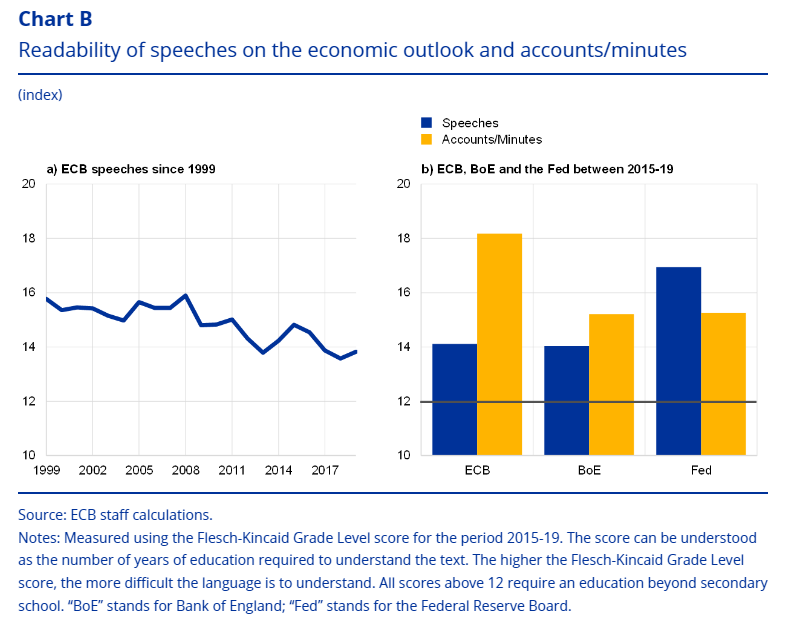
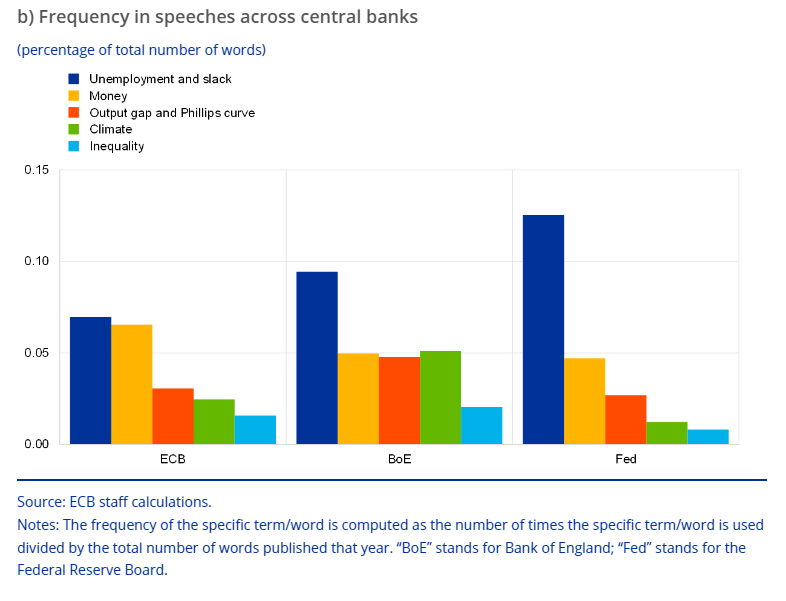
To close this, a couple of neat graphs from the European Central Bank. The first one shows a measure of central bank messages’ clarity , the lower the number, the better. The second graph demonstrates the frequency (a proxy for significance) of some buzzwords. As old Korean masters comment when comparing various strands of their art, the major central banks are “same, same, a little different“.

Source
Source

China’s new footprint in the Middle East starts with Iran

Introduction

Iranian Foreign Minister Hossein Amir Abdollahian met with Chinese Foreign Minister Wang Yi on Friday, January 14, 2022, in the city of Wuxi, in China’s Jiangsu province. Both of them discussed a gamut of issues pertaining to the Iran-China relationship, as well as the security situation in the Middle East.

A summary of the meeting, published by the Chinese Foreign Ministry, underscored the point that the Foreign Ministers of Iran and China agreed on the need for strengthening bilateral cooperation in a number of areas under the umbrella of a 25-year agreement known as “Comprehensive Cooperation between the Islamic Republic of Iran and the People’s Republic of China.” This agreement had been signed between both countries in March 2021 during the Presidency of Hassan Rouhani, but the Iranian Foreign Minister of the new Raisi government announced the launch of the agreement on January 14, 2022.

During the meeting there was a realization of the fact that cooperation between both countries needed to be enhanced not only in areas like energy and infrastructure (the focus of the 25-year “comprehensive cooperation agreement” was on infrastructure and energy), but also in other spheres like education, people-to-people contacts, medicine, and agriculture. Iran also praised the Belt and Road Initiative (BRI) and said that it firmly supported the One China policy.

China-US and the Iran nuclear deal

The timing of this visit is interesting, as Iran is in talks with other signatories to the JCPOA/Iran nuclear deal 2015 (which includes China) for the revival of the 2015 agreement. While Iran has asked for removal of economic sanctions which were imposed by the US after it withdrew from the JCPOA in 2018, the US has said that time is running out, and it is important for Iran to return to full compliance to the 2015 agreement. US Secretary of State Antony Blinken said in an interview: “Iran is getting closer and closer to the point where they could produce on very, very short order enough fissile material for a nuclear weapon.” The US Secretary of State also indicated that if the negotiations were not successful the US would explore other options along with other allies.

During the course of the January 14 meeting Wang Yi is supposed to have told his Iranian counterpart that while China supported negotiations for the revival of the Iran nuclear deal 2015, the onus for revival was on the US since it had withdrawn in 2018.

The visit of the Iranian Foreign Minister to China was also significant because Foreign Ministers of four Gulf Cooperation Council (GCC) countries – Saudi Arabia, Kuwait, Oman, and Bahrain — and the Secretary General of the GCC (Nayef Falah Mubarak Al-Hajraf) were in China from January 10-14, 2022, with the aim of expanding bilateral ties – especially with regard to energy cooperation and trade. According to many analysts, the visit of GCC officials to China was driven not just by economic factors, but also the growing proximity between Iran and Beijing.

In conclusion, China is important for Iran from an economic perspective. Iran has repeatedly stated that if the United States does not remove the economic sanctions it has imposed, it will focus on strengthening economic links with China (significantly, China has been purchasing oil from Iran over the past three years in spite of the sanctions imposed by the US). The Raisi administration has repeatedly referred to an ‘Asia-centric’ policy which prioritises ties with China.

Beijing is seeking to enhance its clout in the Middle East as US ties with certain members of the GCC, especially the UAE and Saudi Arabia, have witnessed a clear downward spiral in recent months (the US has been uncomfortable with the use of China’s 5G technology by the UAE and the growing security linkages between Beijing and Saudi Arabia). One of the major economic reasons for the GCC gravitating towards China is Washington’s thrust on reducing its dependence upon GCC for fulfilling its oil needs. Beijing can utilize its good ties with Iran and the GCC and play a role in improving links between both.

The geopolitical landscape of the Middle East is likely to become more complex, and while there is not an iota of doubt that American influence in the Middle East is likely to remain intact, China is fast catching up.

Some Monday Links

Burning the witch (New Humanist)

Not as funny as it may sound.

Will nudge theory survive the pandemic? (UnHerd)

From an ex-member of the UK Nudge Unit:

[I]t may be worth reflecting on where we need to draw the line between the choice-maximizing nudges of libertarian paternalism, and the creeping acceptance among policy makers that the state should use its heft to influence our lives without the accountability of legislative and parliamentary scrutiny.

Why Do We Return to the Greek Myths Again and Again? (LitHub)

Olympus, Texas?

French Socialism Embraced Neoliberalism and Signed Its Death Warrant (Jacobin)

The usual disclaimers on the use of term neoliberalism apply.

The Periodic Table of Commodity Returns (2012-2021) (Visual Capitalist)

Nightcap: Development with Dignity

There’s a new book coming out that y’all should read: Development with Dignity: Self-determination, Localization, and the End to Poverty. Here’s the link. Here’s the description:

At a time when the global development industry is under more pressure than ever before, this book argues that an end to poverty can only be achieved by prioritizing human dignity.

Unable to adequately account for the roles of culture, context, and local institutions, today’s outsider-led development interventions continue to leave a trail of unintended consequences, ranging from wasteful to even harmful. This book shows that increased prosperity can only be achieved when people are valued as self-governing agents. Social orders that recognize autonomy and human dignity unleash enormous productive energy. This in turn leads to the mobilization of knowledge-sharing that is critical to innovation and localized problem-solving. Offering a wide range of interdisciplinary perspectives and specific examples from the field showing these ideas in action, this book provides NGOs, multilateral institutions, and donor countries with practical guidelines for implementing “dignity-first” development.

Compelling and engaging, with a wide range of recommendations for reforming development practice and supporting liberal democracy, this book will be an essential read for students and practitioners of international development.

It’s by Tom Palmer (one of my favorite scholars) and Matt Warner. Again the link is here.

Podcast Institute of Economic Affairs

I had a chat on classical liberalism, liberal international relations theory the standoff with Russia. It is about 25 minutes or so.

New issue of The Independent Review is out

Two of the Notewriters are featured in this issue: myself and Nick. The Independent Review, by the way, is the leading libertarian academic journal in the world today. If you want to find good, intellectually stimulating arguments about liberty, then TIR is the place to go. Many of the Notewriters have been featured in TIR. Indeed, most of my recruitment of Notewriters has been based off of stuff they’ve written that’s been featured in the journal. Edwin (“Hayekian Spontaneous Order and the International Balance of Power“), Jacques (“If Mexicans and Americans Could Cross the Border Freely“), Vincent (“Social Justice, Public Goods, and Rent Seeking in Narratives“), and Andrei (“From ‘National Socialists’ to ‘Nazi’“) all have beautiful pieces of work in the journal.

Nick’s article is part of an elite mini-symposium on Rawls and his Theory of Justice, while mine slipped in near the end of the journal as a piece on libertarian foreign policy. Both pieces are paywalled, but here is an earlier draft of Nick’s piece (titled “Rescuing Rawls from Rawls”) that you can read, and here is an earlier, readable draft of my piece.

You can buy the entire issue here, and I recommend that you do!

China, Covid, and economic slowdowns

China’s economy faces a number of challenges — three in particular:

  1. the spread of the covid19 pandemic
  2. the country’s ambitious zero-covid approach (which has resulted in severe lockdowns)
  3. and a grave real estate crisis arising out of the crackdown on the property market

The slow down of China’s economy was acknowledged by Chinese Premier Li Keqiang. In a meeting he is reported to have said: “It is necessary … to further cut taxes and [administrative] fees to ensure a stable economic start in the first quarter and stabilize the macro economy.”

During a meeting in December 2021, Chinese leadership flagged ‘stability’ as its key aim for 2022. This was in stark contrast to targets for 2021, which was focused on ‘the disorderly expansion of capital’ driven by President Xi Jinping’s objective of reducing inequalities in Chinese society.

China’s zero-covid strategy is impacting its economic links with the rest of the world as international air travel is restricted, and even the stringent lockdowns applied in the country are likely to take their toll on global supply chains. A lockdown in Xian, for instance, has already prompted Samsung Electronics and Micron Technology, two of the world’s largest memory chip makers, to red flag the possibility of their chip manufacturing bases in the area being hit.

As a result of its zero-covid strategy, and its aim of controlling the spread of the pandemic in Xian, and also before the Beijing winter Olympics next month, China has further tightened regulations for the import of products from neighbouring countries in Southeast Asia. Trucks with agricultural products from Vietnam and Myanmar have been stranded for weeks (some for well over a month), and as a result products have been rotting (especially fruits like mangoes and jackfruit) and exporters in both countries have had to face losses (exports of non-agricultural products, such as rubber and minerals, from Laos to China, have also suffered). Apart from stringent checks, exporters of commodities are supposed to carry Chinese trucks across the border – the unloading of goods and transfer is a time consuming process and this leads to further delays.

It is not just mainland China but also the important financial hub of Hong Kong that has been following a zero-covid policy, which has impacted its economy – especially the tourist sector. The fact that Hong Kong will be opening to China before it opens to the rest of the world has also not sent out a positive message to international businesses.

China faces the onerous responsibility of not just keeping covid19 under check, but also preventing a further slow down in its economy. Economic challenges and the zero-covid approach will lead not only to domestic problems, but also impact its economic linkages with the rest of the world, especially neighbouring countries in Southeast Asia (China is an important market for agricultural products of Vietnam and Myanmar). The slow down in China’s economy and the remarks by Li Keqiang with regard to the same also highlight the limitations of Xi Jinping’s economic vision and the fact that there is a growing concern with regard to the country’s possible economic challenges over the next few months.

Reasonable decisions leading to lousy results

Early 20th century Greece

A novella fucked me up. Not now. That would be some 20 years ago, at the nationally held university admission exams. So, last week I went for a complete re-read of the thing, “Η Τιμή και το Χρήμα” (translates in either Price or Honor, and Money, a witty ambiguity in Greek) by Konstantinos Theotokis. It follows a family drama in Corfu island, circa 1910. It’s prose is something for its own sake, but more importantly, it is a relatively rare depiction of lower class people, not as proud, hard-working laborers, but as quite cold calculating individuals.

Rigid constraints are in place, from tradition and custom: Social hierarchy is alive and kicking, with old noble families and new-moneyed ones on top and the poorer, working ones beneath. Women are generally subordinate. There is a clear distinction in occupations, so that men of higher heritage are unavoidably expected to be masters, not employees, securing that their women do not (need to) work. The drama arises as the son (Andreas) of such a family, plighted by ill economic tidings, and the daughter (Rini) of a lower family, fall in love. It gets more complicated as the girl’s mother (Epistimi), the acting head of their house and a business partner of sorts to the prospective groom, refuses to offer the requested dowry.

It is a sad story, with just a bit of silver lining so no to come as downright depressing. Some take-aways:

  1. Smuggling was thriving. Andreas smuggles commodities and cattle.
  2. Epistimi, a factory seamstress, buys smuggled products from Andreas to resell them, and also lends him money for his endeavors. A homebrew little merchant – money lender she is.
  3. The interest rate is around 20%-25% for a term of weeks or so. In written pact.
  4. Smuggling operations have a nearly explicit political coverage. Andreas uses his family’s connections to remove the local constable at some point.
  5. This patronage is flimsy, as governments change. Smuggling shifts to the new minister’s electoral district. Hardly a good fit for trade theorizing.
  6. Per Andreas’ uncle, who is also his accomplice, smuggling is as decent as any dealing, and those “fat cats” at the capital could do with less taxes.
  7. Women’s’ social position plainly sucked. But at least they could take some initiatives.
  8. Hard labor is in fact praised throughout the novella.

Juveniles lack context to understand and appreciate the novella, I think. I agree it should be taught, but not in the hammer-it-in-your-head way it was presented back then.

Race versus class: Identifying the difference

If a person were to receive a letter with the salutation “Hey girl!” and the closing “Kindly,” one would naturally start to make conclusions about the author. One might conjecture from the salutation that the letter is between intimates, though it could equally signify that the author is unaware of appropriate salutations for written communications. The closing “Kindly” would probably trigger a second of cognitive dissonance. “Kindly” has passive aggressive undertones, which is one reason etiquette guides discourage using it. This type of analysis — what sort of person wrote this letter? — relates to social class.

In October 2021, The New York Times’s literary arm, New York Times Magazine, published a story on a multi-year tussle between writers Dawn Dorland and Sonya Larson. In the process of lawsuits, Dorland’s side subpoenaed Larson’s group chats with other writers in which those who also knew Dorland discussed in frank terms how irritating they found her. As part of a court order to indicate types of research Larson did for her work, her lawyers submitted a list of resources which included a handful of academic research on the subject of “White Savior” complexes. To be fair to Larson, it is important to her short story that one character is Asian-American and the other is Caucasian, so it is logical that Larson would read some sources on the subject, as well as the others submitted which were on topics such as alcoholism or psychological conditions. However, as Larson herself is a mixed-race Asian-American and Dorland is Caucasian, followers of the case latched on to the detail as representative of the underlying problem between the two writers. In my opinion, dragging race into the Dorland-Larson debacle represents a problem of vocabulary: modern society has taken to using political race-based terms to describe issues of social class.

The salutation and closing described in the first paragraph come from an email Dorland wrote to Larson. The author of the New York Times Magazine story on Dawn Dorland and Sonya Larson chose to interpret Dorland’s sign off, “kindly,” as a sign of her altruistic mindset.  

To summarize a situation that occurred over several years, Dorland donated a kidney and created a Facebook group as a platform where she talked about her experiences in real time; Larson wrote a short story in which she used elements of some of Dorland’s story; the story won literary accolades; Dorland accused Larson of plagiarism and contacted the Boston Book Festival for promoting the story along with some of Larson’s other work; Larson sued Dorland for tortious interference and the courts found in Larson’s favor; Dorland countersued Larson for copyright violation; the courts ruled for Larson, citing that Larson hadn’t used enough of Dorland’s writings on the topic to qualify remotely as copyright violation; Dorland maintained that Larson had violated her rights and mounted a campaign to discredit Larson within professional literary circles.

Larson is the daughter of educated professionals. Her Caucasian-American father and her Asian-American mother are university professors. That said, her maternal grandparents were working-class immigrants who worked hard for their children’s futures. Dorland had an unstable childhood as the child of itinerant agricultural workers; eventually she ended up in Los Angeles. She obtained two graduate degrees, one from Harvard Divinity School and an MFA from University of Maryland. Given that she took a degree at a top university, one can argue that she had a ticket into the American bourgeois, if not the grands bourgeois. In this way, the American system worked: she was not denied opportunity based on parental background; she was welcomed as an equal within a professional network. In a broad sense, the two women were on a level of some parity: Larson was an established writer, but Dorland was a Harvard graduate.

The decision to project a racial narrative onto the debate was not Larson’s as is evident in the legal documents her lawyers submitted and the story itself. Those who latched onto a racial interpretation of the debacle missed to a great extent that while the story contained a traditional dichotomy, working-class minority woman opposed to a wealthy, though uncultured Caucasian for narrative purposes, the dynamic between the real people was, if anything, reversed. Based on cultural norms from around the world, who would start life higher, the child of a university professor, or the child of an itinerant laborer? In real life, a dynamic that works for fiction can be, and often is, inverted.

In one of the ping pong lawsuits, Dorland sued Larson for Intentional Infliction of Emotional Distress, citing that “Larson abruptly ceased speaking with Ms. Dorland” and had moved to “ostracize Ms. Dorland from their mutual acquaintances in the writing community.” The judge dismissed the IIED suit out of hand. Dorland’s charges were based on an earlier claim that she and Larson had been close personal friends. And this is where class differences start to show up. As a citizen journalist has found, Dorland met Larson around 2007 by dint of attending writing workshops at the arts center where Larson worked, but they were not the close friends Dorland portrayed in her lawsuits. Larson categorically stated via her lawyers that they “were never alone in the same room,” which implies all of the social activities close friends do, e.g. going to restaurants, cafés, or movies together, never occurred. This does not ipso facto mean Dorland lied; rather, the difference can indicate that there was a misunderstanding of proximity. Dorland rubbed shoulders with Larson for around seven years before moving away from Boston; Dorland attended Larson’s partner’s mother’s funeral; according to Dorland’s testimony, Larson attended Dorland’s going away party and presented a “meaningful gift.” Finally, and of more immediate interest to the judiciary, Dorland told Larson about her familial history. Depending on who is asked, this last is interpreted as either a sign of a friendship or as a sign that Dorland was an over-sharer. Both women could be correct in terms of their assessment of their friendship. What could be glancing and low-commitment contact in Larson’s social strata — in the American upper-middle class, one does not attend a goodbye party without a gift and one makes an effort to put some thought into it (after seven years, one should know enough about the recipient to choose an item that won’t trigger allergies and is in a pleasing color; this is simply common courtesy) — might be signs of deep friendship in Dorland’s. The lack of clarity in this is one reason the court ruled that there was no Intentional Infliction of Emotional Distress.

At this point, any racial issues remained part of the fictional short story. However, once the case went public, the racial dynamic took over the narrative in certain quarters. The polemic therefore bore little resemblance to the original problems between Dorland, Larson, and Larson’s friends. The latter two had problems with behaviors which were low-class, though neither Larson nor her friends are people who are likely to use that term. Use of racial language obscures the class issue, which undeniably matches contemporary sensibilities. After all, discussing the case in terms of class — on one side, a woman reveals medical procedures and conducts herself in a manner others might perceive as overly familiar, overly ebullient, while on the other side, a group of more established professionals decry her lack of gravitas, dignitas, or sense of privacy, while possibly sending out a snobbish aura — opens up an uncomfortable recognition of the existence of class divides, something which American society would prefer to ignore.

Throughout all of human history, societies have had acceptable and unacceptable behaviors. These are often cast in terms of upper- or lower-class. This is normal for humans. Attempting to deflect the matter is to ignore a fundamental part of how humans negotiate with each other. Creating a red herring of race issues serves no one. To the contrary, doing so increases problems as questions of conduct take on a political tone. Which is even less helpful as politics are polarizing enough without conflating class differences with political differences. Anecdotally, I know many people from the right and the left who are upper-class in their manners, tastes, activities, and professions, but equally I also know many people from both sides of the aisle who are decidedly lower-class in their behaviors, dress, entertainments, and lifestyle. Confusing political leanings with social class, as some people I know have, is truly not helpful. Having good table manners, dressing correctly, or behaving appropriately with others is not a matter of conservative or liberal, Republican or Democrat, but if a person has tangled “Conservative” with “polished,” or “slovenly” with “Liberal,” then one will see political boogeymen in every corner of life. 

No nightcap tonight

I’m buried in a special issue for Cosmos + Taxis. It’s gonna be awesome. It’s on libertarian foreign policy. The list of authors contributing is astounding, but the list of peer reviewers might be the crowning achievement of the issue. I’m dealing with academic rock stars.

Some of the subjects being tackled in the issue:

  • human rights and the liberal world order
  • indigenous sovereignties
  • the populist world order
  • Somaliland
  • hawkish libertarian world orders
  • F.A. Hayek
  • the polycentric orders of pre-colonial Nigeria

Nightcap

  1. Remembering Christopher Hitchens John Rodden, Commonweal
  2. Is Vladimir Putin preparing for war? Bruno Maçães, New Statesman
  3. Russia does not want war in Ukraine Mary Dejevsky, spiked!
  4. What won the Cold War Daniel McCarthy, Modern Age

Monday’s Vintage Whines

  1. Brilliant metal puns shall not be forgotten
  2. I generally like Noah Smith’s economics made simple explanations and have read him since his old blog days (I still check his substack, and Bloomberg, pieces)
Skyclad rocked (never got interested in their pagan tendencies and gibberish fonts, though) – Source

So, NS reposted The liberty of local bullies, a decade-old critique of libertarianism (using, in perfect economist style, a completely libertarian world as the basic assumption). I am sure almost everything is already said and done (late to the party!), but here goes anyway (from “theoretical” to “real-world” order):

  1. Those cartels that will push anyone not to their liking aside would not necessarily be invincible. Cartels/ trusts/ consortia/ whatever (probably) use government regulations to dig-in even more solidly. Take away the government’s heavy hand, and they get more exposed to competition.
  2. The high transaction costs of moving/ working elsewhere also go the same way.
  3. Liberal thought is not blind to misuses of private power (the usual quote here being *the* Adam Smith). Αt least one European liberal strand requires active trust-busting policies as a prerequisite for protection against such consolidations (ordoliberalism of 1930s-50s). Also, the mother of legislative trust-busting, the US Sherman Act of 1890, was signed by a Republican President. Since NS hedges as he gears his offensive to American expressions of the liberty creed, I am at a loss if this law could claim a liberal (libertarian?) root.

Nightcap

  1. The global recession of classical liberalism John McGinnis, Law & Liberty
  2. Where are we making progress? Scott Sumner, EconLog
  3. Anthropology has turned its back on its legacy Peter Wood, Spectator
  4. The spiritual space of Rus Vs. NATO Nathan Gardels, Noema