Another Liberty Canon: Kierkegaard

Søren Kierkegaard (1813-1855) is well known for his contributions to philosophical and religious thought, and for the literary qualities of his work in these areas. He has not been so well known as a contributor to political thought, though there is now a growing amount of scholarly commentary in this area.

Generally his politics has been seen as directed by an extreme kind of conservative reaction against changes, and particularity movements of  democratic and constitutional change in Denmark in his own time. The sense that he was conformable with the most absolute and conservative kind of monarchism possible has been accompanied by the sense that he was anti-political, that he just did not like politics, which connected with the supposed conservatism, because if there is no need for change in political structures, there is no need for political discussion and thought.

These positions might have some appeal to some libertarian-conservative fusionists, and do have some basis in some aspects of Kierkegaard’s thought. However, his thought cannot be properly characterised overall in this way, which would connect Kierkegaard at a relatively popular level with the political thinking of J.R.R. Tolkein, or at the more historical scholarly level with Robert Filmer, the English ultra-monarchist criticised at length by John Locke, or the Savoyard (French-Italian) ultra-monarchist critic of the French Revolution, Joseph de Maistre.

More justified connections can be made with David Hume, for example. Hume was cautious about both political change and claims that the authority of existing political institutions rests on either reverence for the past, or very deliberate conscious popular consent. Hume thought that though societies with political and legal institutions probably did originate with a contract of sorts between government and governed, such contracts cannot bind future generations, and the ‘contract’, or set of relations, between individuals and the state, are open to reform and renegotiation.

Kierkegaard’s comments on the politic currents of his time, suggest that he had a strong understanding both of the belief in the absolute authority of existing institutions, and of the wish to create a new absolute, in a spirit of revolution. His own view is that negotiation and renewal are desirable, and are certainly inevitable, which he saw as the need to revise historical contractual agreements.

Kierkegaard certainly did not wish for individuals to make politics the highest aspect of their lives, as this would detract from the individual relation with God, which was the central interest of this passionately religious man. However, that is not to say that Kierkegaard thought Christianity gives the answer to everything in worldly life, or that Kierkegaard had nothing else driving him. A passion for writing, which has a strong element of self-exploration even if though the medium of fiction and the pseudonyms, which are used in his books, or as fictional authors for many of his widely read books.

The writing and self-exploration converge, for Kierkegaard, in the understanding and communication of the deepest relation of the self with itself as necessarily a relation with God. The recognition of something more than momentary about the existence of the self, leads to a recognition of an absolute aspect of the self, and a struggle with any dissolution of the self into a series of moments. This was Kierkegaard’s way of exploring the value of the individual, and the word ‘individual’ is frequently and frequently orientates his writing. In this, he provided a great way of thinking about the value of the individual for any political thought concerned about the liberty of the individual, and why that should be at the centre of politics.

Kierkegaard saw in the more absolute kinds of political thought a desire for a version of God, and in doing so provided the basis for distinguishing between a politics that recognises limits to what it hopes for from the state and collective action, and a politics that tries to impose itself on society by turning the state into a substitute for God.

Kierkegaard was very critical of the state church, even though his brother had made a career in it, and suggest that dependent on the state weakened religion, as other forms of dependence create other forms of weakness. He did not argue for a pure nightwatchman state, or individualist-anarchism, but he did argue for caution about how much the state does, and for taking individual responsibility for assisting those who have met with misfortune.

In his emphasis on the individual in his understanding of Christianity, Kierkegaard also understood that Christianity places an enormous burden on the individual compared with earlier forms of thinking, in which the individual is primarily thought of as part of a family or state. Kierkegaard was particularly concerned with the ancient Greek and Roman city states in this context, including the literature they produced. He placed value on his own small city of Copenhagen for preserving some of the value of ancient city-state, where the individual can draw strength from connection with others in a very concrete community, without wanting to see the individual subsumed into any kind of communal or collective identity.

For Kierkegaard, the more worldly part of our lives rests on more than living under a state defined  by law or a society defined  by universal rights, necessary though these are. We need engagement with our social world, including its political debates. Though Kierkegaard was a great loner in some respects, he did walk regularly though crowded parts of the city, live near the centre, accept that he would be recognised,  contributed to magazines, and existed as a public figure, which was sometimes uncomfortable for him, but was never a role he excluded.  He was attacked as an eccentric in the press and condemned as a diabolical figure by some of the church establishment, but like his hero Socrates reacted with humour, intelligence and the assumption that the independent, even self-contained, individual deals with difficult public controversies. In his ways of bringing together an antique commitment to public life and a more modern sense of strong individuality, Kierkegaard made a remarkable contribution to themes which preoccupied the major classical liberal thinkers, like David, Hume, Benjamin Constant, John Stuart Mill, and many others.

It is not possible to recommend specific political theory texts by Kierkegaard, and just about everything he wrote can be read with great reward in association with the issues discussed above. A good starting point for a focus on the more political Kierkegaard though is the literary reflections in Two Agesfollowed up by the three masterpieces of 1843 that established his importance. The most immediately readable is RepetitionFear and Trembling is also relatively short. Either/Or is long and complex, but very rewarding and can itself be followed up by reading its sequel Stages on Life’s Way.

Liberalism Unrelinquished: Some Tactical Thoughts

Today is #LiberalismDay. My friend Dan Klein of George Mason University along with his colleague Kevin Frei have launched a project called “Liberalism Unrelinquished.” An impressive list of economists and others have signed their petition which declares that they “affirm the original arc of liberalism, and the intention not to relinquish the term liberal to the trends, semantic and institutional, toward the governmentalization of social affairs.”

Other bloggers will presumably rehearse the tale of how that storied term lost its original meaning, at least in the U.S., as it has been appropriated, since at least the 1930’s, by statists.  (Example: George Leef’s fine piece). I just offer a few thoughts on some tactics that may be appropriate to this battle.

  • We must stop using the word liberal to denote present-day statists. This should be easy since they themselves have largely abandoned the term in favor of “progressives.” (Note that modern progressives hate progress of the material sort more than anything. That’s an issue for another time.) I have nothing better than “progressives” to denote these folks except perhaps a qualified “so-called progressives.” I hope “governmentalists” doesn’t get started. That would be too big a mouthful.
  • Speaking of which, there must be a better term than “governmentalization,” another mouthful. Perhaps just “government takeover” which is more forceful and easier to say.
  • “Liberalism unrelinquished” doesn’t exactly roll off the tongue either. How about “liberalism restored?”
  • Our task will often be easier if we say “classical liberal” rather than just liberal.
  • The term libertarian has entered the mainstream of U.S. politics. We should take advantage of this progress. We can use phrases like “the libertarian position, or as I like to call it, the classical liberal position …”
  • We must understand the price we pay when we call ourselves or our positions “liberal” or “classical liberal.” The price consists in the time and energy required to make clear to our audience what we mean when we use the term. Whether the price is worth paying depends on circumstances.
  • In academic writing, speaking, or debating there is usually sufficient time to preface our arguments by explanations. Attention spans are long enough that the price paid for explaining why we say “liberal” will not be significant.
  • The last place to take this fight would be political campaigns or debates. Attention spans are minute, audiences are unsophisticated, and we will just confuse people by using the term in its classical meaning prematurely. We can, however, try to disavow the tired old “liberal-conservative” spectrum that is currently entrenched in the media. “I’m aTime permitting, we could say classical liberal, and that means I agree with conservatives on some issues and with progressives on others. All my positions are grounded in the notion of liberty.”
  • In letters to the editor where every word counts we can say “libertarian (or classical liberal)” or the other way around.

I congratulate Dan and Kevin on the response they’ve gotten so far and I hope the momentum continues.

Another Liberty Canon

For my first post, I’ll pick up on the bio under ‘About the Notewriters’ and start to address the issue of what kind of texts I find most valuable with regard to thinking about liberty, though there are other reasons for selecting those texts, in particular I favour the kind of texts which are deeply embedded in literature, culture, and history. It is not an either/or situation with regard to whether one prefers the alternative canon here or more standard canons in introductions to liberty, and the like, but I think there are good reasons for paying more attention to the suggested texts, which apply to individual toms of  engagement, and more institutional ways in which groups promote liberty.

My own personal ‘canon’, apart from my favourites among the more obvious liberty oriented thinkers,  includes Niccolò Machiavelli (1469-1527), Michel de Montaigne (1533-1592), Søren Kierkegaard (1813-1855), Friedrich Nietzsche (1844-1900),  Hannah Arendt (1906-1975), and Michel Foucault (1926-1984).  If anyone is disturbed by the inclusion of any of these figures, I hope they will be less so by the end of the series of posts I am now starting on these figures.

I suppose that Montaigne is the least controversial inclusion, but nevertheless I have not seen a great deal of liberty oriented writing devoted to him. The word ‘canon’ is itself necessary when talking about what texts and writers count the most, but let us beware of any idea that there is a self-evident canon, rather than a variable canon, or canons, constructed from the shifting aggregations and interactions of the preferences of many individuals concerned with liberty.

Let us start at the beginning of the list in this post with Machiavelli, traditionally condemned to the extent of being identified with  the devil, and often seen as the arch-apologist for the cynical use and abuse of power, so as to promote state authority without regard to individual rights. A more favourable variation on this is to see the exposure of cynicism in politics as a justification for an anti-political streak of liberty oriented political thought.

On this last point, the anti-political position is really the opposite of the truth about Machiavelli, since he was very rooted in an antique republicanism for which human flourishing includes politically active citizenship, or at least living in a community where many are pursuing their rights through politics. Machiavelli was very attached in particular to the ancient Roman Republic, which he discusses in some detail in The Discourse on the First Ten Books of Livy, usually just known as The Discourses. 

Livy was the Roman historian Titus Livius Patavinus,  living at the beginning of the period in which one man rule by Emperors had taken over from shared republican government. His massive History of Rome only survives in part, including those books discussed by Machiavelli, which cover the foundation of Rome, the rule of the early kings, the overthrow on monarchy, and the early republic, including its struggles between aristocratic and democratic political forces.

In his commentary, Machiavelli certainly has ‘Machiavellian’  moments in which he welcomes ruthless use of force or manipulation of religious symbols for state purposes. However, these moments are very much concerned with state foundation, changes in political regime particularly to a more liberty based regime, and wars. The reading of ‘auspices’ (pagan interpretation of avian  behaviour and the innards of sacrificed birds) is manipulated only when necessary to rouse soldiers in battle.

War is a deeply unpleasant and destructive business and we should all hope we  are moving to a world without it, but we do not live in a world free of bad governments, or proto-governments, willing to use force to extinguish liberty in other states as well as within their own. Machiavelli certainly did not and nether did Livy.  The use of some psychological manipulation to raise military morale in the heat of battle is not the last word in tyranny.  The foundation of states, including those most inclined to liberty, law and peace, and the overthrow of tyrannical regimes has largely happened by force.  This certainly applies to the foundation of the United States.

Machiavelli’s view of republics is that they are strongest, and most resistant to the return of tyranny, where the citizen body are motivated to defend their rights in the public political sphere, and that an unruly rambunctious democracy is the antidote to feudal oligarchy as well as one person tyranny.  This is surely a powerful argument against anti-politics, which risks leaving liberty advocates unable to participate in the political process in order to resist tyranny.  We can certainly find that argument in the conventional heroes of thought about liberty like Alexis de Tocqueville and John Locke. Despite his willingness to excuse extremes of force and deception in certain situations of  necessity for survival, Machiavelli is overall and overwhelmingly an advocate of the rule of law, and recommends republican government, partly on the basis that it is more favourable to the universal enforcement of law than the more personalised and arbitrary attitude to law arising from monarchy.

Sometime Machiavelli’s Discourses are divided from his most famous work, The Prince on the grounds that the latter text just is a cynical manifesto to obtain favour from the Medici rulers of Florence. However, careful reading will show many ways in which Machiavelli argues for the limitation of the power of a prince, and of the state in general. Again law is regarded with the utmost favour and respect, so that, for example, France is praised at least a couple of times for the many laws and legal institutions built up during the late Middle Ages and Renaissance, in implicit contrast with Italian princely states.

Again force and deception are advocated where necessary, but only where necessary and in strictly limited terms. It is said that the prince should use  force like a lion and deception like a fox, and that to be feared is better to be loved. However, the force, deception,  and ‘fear’ is oriented towards the stabilisation of institutions of law, followed by the  regular  enforcement of laws, and Machiavelli places limits on how far the force, deception, and fear can go . The unloved prince is unloved, because he does not attempt to bribe the people with money raised through taxes on them, and does not bankrupt the state with unfunded ‘generosity’.  We can surely all agree that liberty would be better preserved if contemporary governments followed such maxims.

Machiavelli recommends that a prince should avoid contempt through showing respect for the property of subjects and the honour of women, that is the prince should not use state power to seize property, or sexually abuse women. In general the prince should be mostly concerned with the art of war, which is really a way of trying to nudge princes into accepting the de facto republics that  will arise if monarchs if they limit their powers and activities to defence of national sovereignty.

In his views on the proper limits of state power and the consequences of over extension, Machiavelli is a forerunner of public choice theory, one of the major aspects of recent liberty oriented social science, and like James Buchanan he had a strong belief in democracy, where it is concerned with laws that apply equally to all, and is to opposed the extension of state activity beyond strictly defined public goods.

I would say that Machiavelli is a great lover of liberty and though there is an increasing amount of good scholarship and commentary on his thought, the lingering associations around his name still create problems in the proper appreciation of his thought. There is a streak in the liberty community of suspicion of politics and of suspicion of  any state action even in emergency situations, outside the strictest legal supervision. There are some good impulses behind those suspicions, which I welcome, but taken to the extreme they would have prevented the formation of the United States or the Swiss Confederation, the Glorious Revolution in Britain, or any of the historical republics which explored the possibilities of liberty. Leaving aside such purism, I don’t see anything disturbing in Machiavelli beyond a taste for presenting brutal realities for what they are.  Even the most pure and fastidious of min-archists, and individualist anarchists, should at least find some value in Machiavelli’s analyses and his impulses towards liberty under law.
Update from Austin, and a Warm Welcome too

I’m currently in the City of Austin, the capital of the great state of Texas. I’ll be here for the quite some time, so if you can visualize me in a cowboy hat instead of on a beach in California, that’d be great. Geographer Joel Kotkin has a good piece on Austin here. Among the gems:

Most of the strongest local economies combine the positive characteristics associated with blue states — educated people, tech-oriented industries, racial diversity — with largely red, pro-business administrations. This is epitomized by our top-ranked metro area, Austin, Texas, which has enjoyed double-digit growth in GDP, jobs, population and birthrate since 2007. The Texas capital has a very strong hipster reputation, attracting many of the same people who might otherwise end up in Silicon Valley or San Francisco, but it also boasts the low taxes, light regulation and reasonable housing prices that keep migrants there well past their 30s.

If that ain’t libertarian then I don’t know what is. I take advice on where to go for food and girls, too.

We’ve got a new blogger joining the team, too. I’m pleased to introduce you to Dr Barry Stocker. From his bio page:

Barry Stocker (personal website) is a British philosopher based in Istanbul, working at Istanbul Technical University. His academic interests cover political philosophy. Publications in this field include the monograph Kierkegaard on Politics (2014) and the co-edited volume Nietzsche as Political Philosopher (2014).  He is currently working on Michel Foucault and liberty. As these projects indicate, he likes to work on issue of liberty, ethics, individualism, and subjectivity, in authors a bit outside the conventional canon of liberty oriented thinkers, but does also work on more familiar names in this field, such as Adam Smith and Friedrich Hayek.

Please be sure to welcome Dr Stocker to the blog with you usual cunning wit and boorish criticisms in the ‘comments’ threads. I think Dr Stocker’s current location, his origins, and his specialized body of knowledge is going to make this project tremendously more interesting. Thanks for taking the plunge Dr Stocker!

Karl Marx versus Thomas Piketty

Both [Marx and Piketty] protest economic disparities, but move in opposite directions. Piketty advances into the domain of salaries, income and wealth; he wants to temper these extremes and give usto alter the slogan of the ill-fated Prague Spring of 1968capitalism with a human face. Marx advances into the domain of commodities, work, and alienation; he wants to undo these relations and give us a transformed society.

This is from UCLA historian Russell Jacoby in the New Republic. The rest of the article is not that great, to be honest (I’ll bet you ten bucks that Jacoby – whom I never took during my time in Westwood – is an old man; I can safely assume this because of the praise he lavishes upon Karl Marx at the expense of Piketty and other economists), but I thought this excerpt was a good opportunity to enhance my argument that Murray Rothbard was a great Cold War scholar and a terrible role model for the world we live in today.

Rothbard’s argument – exemplified by this excerpt that Adam provided in the ‘comments’ threads a while back – devastated the Marxist notions of the world held in the 1960s and 1970s, but Rothbard’s argument simply does not grapple with Piketty’s. It’s a whole new ball game, and one that newer scholars who have built upon Rothbard’s foundations are now grappling with. It does us no good to continue parroting a line of reasoning that has long since outlived its usefulness.

Neoliberalism: When French philosophy thinks about American economics

From an economic perspective, the vision of man becomes very, very poor. Man is a being who responds to stimuli from the environment, and we can modify his behavior with a choice of stimuli. And what government is, what power is, is the use of different kinds of stimuli. The economic theory gives a set of tools, a “good manner” to use stimuli to obtain the right comportment. In this respect, the result of the theory, perhaps, is to produce a vision of man that is very impoverished.

This is French philosopher François Ewald taking a moment away from his task of explaining Foucault’s thoughts on Gary Becker’s work to elaborate his own thoughts on the discipline of economics. Read the whole thing (pdf). It’s a short paper on Michel Foucault’s thoughts about American liberalism (or neoliberalism) and particularly Gary Becker’s work.

Abstract Ideas Don’t Deserve Patents [NY Times]

In preparation for something special that I will finally complete this week (Rothbard willing) lets talk about this editorial from the New York Times.


The article starts accurately enough explaining the US government’s monopoly power of ideas saying:

The Constitution gives Congress the power to grant inventors a temporary monopoly over their creations to “promote the progress of science and useful arts.”


I am actually shocked at the strong language used here, the four letter word “monopoly” is rarely used in reference to any government service.  At least in polite company.  I would also like to point out the subjective language quoted from the constitution.  “Useful arts”.  Useful to whom?  To the inventor?  To consumers?  To the government?  To humanity?  Like most state activities the ability to decide what is “useful” is left to bureaucrats in service to the government rather than in the free market where useful services will generate profits and those that generate disuse (or disutility) are met with losses.  Back to the article though:

“But in recent years, the government has too often given patent protection to inventions that do not represent real scientific advances.”


No argument there.  The “copyright troll” phenomenon is more than enough to make this libertarian squeamish.  Where is this editorial going I wonder?

  “The issue in this case, Alice Corporation Pty. v. CLS Bank International, is whether using a computer to implement a well-established economic concept can be patented. The court should rule that such ideas are not eligible for patent protection.


Alice Corporation obtained four American patents that cover a method of settling trades between investors in currency and other financial markets. The approach depends on a neutral middleman to make sure traders complete the transactions they have agreed to. The corporation, which is based in Australia, has accused CLS Bank, a London-based company that settles foreign exchange trades for investors around the world, of infringing its patents.”  

To make a long story short the US patent office granted the Alice Corporation a copyright on a form of interaction between a buyer, a middleman and a seller.  An absurd concept to be sure.  Now the question is what does the editorial suggest?

“The Supreme Court should make clear that nobody should be allowed to claim a monopoly over an abstract idea simply by tying it to a computer.”

I agree; but why stop there?  Why the artificial endpoint of “abstract ideas tied to a computer”?  If we shouldn’t allow patents on abstract ideas what would the author suggest if we proved that all ideas are necessarily abstract and therefore not able to be owned, sold, or monopolized?  Would he follow his logic to the conclusion that perhaps all patents are invalid?

More regions contemplating independence?

The historically great city-state of Venice is contemplating independence from Italy. “Over two million residents,” nearly half of the total population, “of the Veneto region took part in the week-long survey, with 89 percent voting in favour of independence from Italy.” The  Indipendenza Veneta party believes that the centralized Italian government is unable “to stamp out corruption, protect its citizens from a damaging recession and plug waste in the poorer south.” Venice joins Catalonia and, for better or worse, Crimea this year in considering breaking away from it’s central government. Catalonia’s request for an independence referendum denied by the Spanish prime minister while we all know how long Crimean independence lasted.  All is not lost however.

These types of referendum must be celebrated by libertarians throughout the world. The further decentralization of governments is a goal that can directly lead to a freer, more libertarian society and will serve as a siphon weakening governments worldwide. To quote, as I do so often, the great Murray Rothbard:

“Once one concedes that a single world government is not necessary, then where does one logically stop at the permissibility of separate states? If Canada and the United States can be separate nations without being denounced as in a state of impermissible ‘anarchy’, why may not the South secede from the United States? New York State from the Union? New York City from the state? Why may not Manhattan secede? Each neighbourhood? Each block? Each house? Each person?”

Why not indeed.

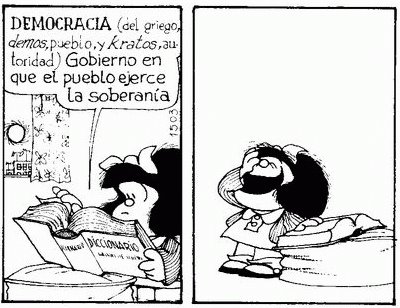
Demos sin cracia

democracia2

Las democracias modernas instituidas como “el gobierno de la mayoría” comenzaron a aparecer ya entrado el siglo XIX y se popularizaron velozmente.  Al lado de ella, la promoción de los ideales del sufragio universal, la igualdad de derechos y obligaciones entre hombre y mujer, la abolición de la esclavitud y del trabajo forzoso de curso legal, entre otros principios empezaron a dispersarse como un veloz germen en las sociedades occidentales y sus ex-colonias.  Han pasado ya 200 años desde que el germen democrático se dispersó por el mundo.  Sin embargo, los más recientes acontecimientos que han perturbado el flujo de las democracias de mayorías se ha visto afectado en Ucrania, Venezuela y desde hace dos días en El Salvador.

¿Por qué será que el ideal de la democracia ha “fallado” en estos países? 

Los argumentos a favor y en contra son muchos y muy complejos. Deben ser comprendidos desde distintas perspectivas y entender las posiciones tomadas por todos los actores que se han visto afectados de manera directa e indirecta por estos eventos.  Nosotros, el resto del mundo observador, podemos participar con ideas para ojalá descubrir más preguntas en nuestro camino. Hoy quiero compartirles una idea que cruzó por mi mente.

¿Acaso nuestro problema no ha sido que hemos tenído más “demos” que “cracia” en nuestro gobierno y en el desarrollo de nuestro rol ciudadano?

¿A qué me refiero con esto?

El término democracia es antiguo y complejo y se forma a partir de los vocablos “demos” traducido al castellano como -pueblo y/o poder- y “cracia” que indica un -gobierno o sistema-.  Así y actualizando el término desde la antigua Grecia a nuestros días, la democracia se refiere al gobierno del pueblo.

¿Pero acaso no ha sido el pueblo el que se ha volcado a la rebelión en Ucrania, Venezuela y El Salvador? Entonces, ¿la democracia reaccionó en estos países contra la democracia?

Quizás lo que ocurre en estos tres países (que son producto de la colonización y de la subyugación a los imperios durante la Guerra Fría) es que quizás no han pasado el suficiente tiempo en independencia institucional y maduración de sus gobiernos como para lanzarse desbocados a procesos democráticos que deben ir de la mano de una reforma educativa y cultural de la ciudadanía.  Pero, ¡alto! Que conste, que no me refiero a que estos países post-coloniales y post-guerra fría deban regresar bajo el control de un dictador o de una metrópoli.  Sino que, la participación del pueblo (demos) no debería avanzar cuando se ha descuidado o se ha impedido continuar el proceso de institucionalización de la democracia en la vida ciudadana.

Ucrania, Venezuela y El Salvador tienen como un común denominador la inmensa pobreza y la enorme desigualdad educativa y cultural entre la elite gobernante que heredó el poder de sus antiguos amos colonizadores y el grueso de la población. La mayoría de la población en estos países ha sido condicionada a servir como un “agente legitimador” al momento de ejercer su voto pero no se le ha permitido adquirir conciencia absoluta de su rol como “ciudadano legitimador empoderado”. Porque es su voto el que le permite exigir responsabilidad, honestidad y resultados en el equipo de gobierno que eligió en las urnas.

Titulo: 7 killed in post-election protests
Via: FoxNews

En Venezuela ha sido la población cansada y agotada de la corrupción la que ha tomado conciencia del poder de su voto al exigir la renuncia del gobierno revolucionario (aún a pesar de que recientemente había sido electo por el voto de las mayorías).  Es acá que el pueblo ha empezado a ilustrarse en su poder como votante y garante.

Titulo: Days of Protest in Ukraine
Via: The Atlantic

En Ucrania ha sido el pueblo el que también ha tomado conciencia del poder de su voto y de su derecho de autodeterminación pidiendo la anexión de Crimea y su mayoría étnica rusa a Rusia debido a sus distintos intereses económicos, políticos y culturales con el resto del país.

Titulo: El TSE pidió a los contendientes que respeten los resultados que el pueblo decida.
Via: http://www.lapagina.com.sv

Y en El Salvador desde el día lunes debido a que las elecciones presidenciales concluyeron con una cercana diferencia de votos entre los partidos ARENA y FMLN. ARENA rechazó el conteo de las elecciones luego del anuncio de su derrota. 6,000 votos marcaron la diferencia y el partido ARENA rechazó la legalidad del proceso democrático.

Espero que no sea aún tarde para extender una invitación a reflexionar a los ciudadanos salvadoreños sobre el funcionamiento del gobierno democrático y de la necesidad de estudiarlo a más profundidad y, quizás, comprender que el voto de la mayoría (aún si efectivamente ganará por 6mil votos de diferencia) no es garante suficiente de legitimidad.  Y que, es urgente que ambos partidos realicen un pacto serio, democrático y honesto antes de queso se derramé una sola gota de sangre.

En Venezuela, Ucrania y El Salvador es aún posible alcanzar acuerdo y pactos de concertación que partan del respeto al gobierno democrático y que busquen una inclusión de ideas, actores y modificaciones a los actuales procesos en los que el Pueblo (demos) colabore en la construcción y progreso del del Sistema de gobierno (cracia).

Esto evitará muertes y violaciones a los derechos individuales.  Pero más importante aún, permitirá la evolución y maduración de sistemas democráticos de gobierno en estos países que aún ahora se vieron afectados por la injerencia de los poderes imperiales en sus asuntos. Que envidia que en estos países quizás estén a las puertas de un desarrollo democrático del cual nuestros países vecinos podrían aprender mucho.

From the Comments: An embarrassment of riches, a stable full of straw

Below are some more thoughts on “total liberty” and bad faith.

My argument in the threads with Marvin has intended to be one that displays two points of view, rather than to be one of persuasion. Due to his responses to Dr Foldvary’s argument, I realized that he was uninterested in having an honest debate. I also realized that persuading him would be futile. So I instead have tried to illustrate – to readers and curious passersby – how Marvin’s arguments are fallacious (dishonest) and what to do about them by exploiting Marvin’s position. In order to do this I have kept it simple and tried to argue on Marvin’s terms (“speaking past one another”). Rick has an insightful, must-read summary of our arguments, and he also furthers our understanding of freedom in the process.

I am not quite done, though. I am still unsure if I have accomplished my task of exposing Marvin’s arguments as fallacious. I want to be sure that readers don’t take him seriously in the future should he decide to continue trolling the ‘comments’ section. Marvin states matter-of-factly that:

The problem is that I have a better handle on the truth than you do.

Now, in the interest of honest debate, I hope that everyone can see how Marvin’s assertion shows how he is being dishonest. I have pointed out his straw man fallacies for a while now, and I want to get the point across that Marvin’s characterizations of libertarian ethics are based upon the above-quoted viewpoint.

Given that Marvin believes he has a better handle on truth than I, how can I (or you as a reader) expect to get an even-handed argument from him? If you believe that I have mischaracterized Marvin’s arguments (as he has done to mine and Dr Foldvary’s and soon-to-be [?] Dr Weber’s), please point out where in the ‘comments’ thread.

Again, my task is much more simple than Rick’s. I wish to merely show how Marvin’s argument is based on falsehoods. I think his comments elsewhere suggest my hunch is right. (Rick, by the way, has been much more generous to Marvin than I, a position for which he has been rewarded by being called a homosexual with an unhealthy obsession for Marvin (“My name can’t stay off of Rick’s lips,” according to Marvin the Truthspeaker).)

Marvin’s main error in reasoning, in my judgement, is that he creates positions that nobody has made and then draws conclusions from those created positions. Sometimes he restates arguments that nobody has contested as if they were contested and then proceeds to explain why libertarians should not (or do) contest such an argument. This is sophistry at its most vulgar.

Does everybody follow? Dr Amburgey?

His last response to me in the ‘comments’ is a good example of what I mean. Marvin writes:

Brandon [quoting me]: “Society A (the one with no rules prohibiting murder) does not have total liberty because its members do not have freedom from unwarranted aggression.”

[Marvin:] If a society has a consensus that murder should be punished then it effectively has a rule prohibiting murder whether the rule is explicitly written down or not.

Yes, and what exactly does this have to do with my argument? With Fred’s? With Rick’s? With Hank’s? Marvin continues:

If a society has no agreement that murder is wrong then its sense of justice either presumes any murder is justified or is indifferent to it until it affects them personally.

Again, this may be true, but what exactly does this have to do with my argument that “Society A (the one with no rules prohibiting murder) does not have total liberty because its members do not have freedom from unwarranted aggression”? Where does it follow from this statement that rules prohibit total liberty? It’s almost as if Marvin is talking to himself rather than to a group of people. There is nothing wrong with thinking out loud, but it seems to me – based on this response and on past responses – that Marvin thinks he is replying to an argument somebody else has made rather than thinking out loud.

Marvin continues to pummel me:

(b) The meaning of “liberty” is “freedom to”, not “freedom from”. “Freedom to” means you can pursue your happiness with minimal restrictions (“total freedom” would imply no restrictions at all, a liberty to do what you please without fear of punishment).

Marvin goes on and on (and on) from there. However, this is simply wrong. The Stanford Encyclopedia of Philosophy has a good summary of the ‘freedom to’ versus ‘freedom from’ distinction. Basically, the ‘freedom from’ folks look at external factors (such as government) that inhibit liberty, whereas the ‘freedom to’ folks look at factors that are internal to individuals (such as class). I don’t want to get into the details here, but suffice it to say this is not Marvin’s understanding of the distinction. Normally I wouldn’t have a problem explaining this misunderstanding, but given Marvin’s track record I’m going to skip out on doing so (unless somebody wants me to).

I’ve got one more example I’d like to use to hammer home my point that Marvin is not interested in having an honest debate. He writes:

Brandon [quoting me]: “Your attempt at distinguishing “private punishments” within Society A from “punishments of society” is also fallacious. Is society composed of numerous factions – most of them private – or is it a monolithic, dissent-free, homogeneous unit.”

[Marvin:] A consensus is not monolithic. If everyone had to agree to everything then nothing would be possible. To make cooperation possible, we created a democratically elected government with many checks and balances. And we agreed to respect the authority of the laws it creates, even laws we may disagree with, because we would expect others to respect the laws that we do agree with that they don’t. And the democratic process may correct or remove an unsuccessful law in the future. I may win the case today and you may win the case tomorrow.

My argument is that Marvin’s assumption about society is monolithic, not society itself. If you read my argument with an eye for understanding it you can easily see that. If you read my argument from a position of Truthspeaker it may be harder to do so.

One last point I’d like to mention is that Marvin also has a habit of changing definitions to suit his argument. Often he simply provides his own. This, of course, helps him to have that “better handle on truth” that nobody else at NOL seems to have.

Has this cleared anything up? Muddled it further? Am I coming off as an ideologue or somebody who is trying to weed out falsehoods?

There are plenty of rules in a libertarian society. The fact that there are rules does not mean that ‘total liberty’ is lost because of it. Such a characterization is the epitome of a straw man. Rick takes the idea of total freedom to the next level (so read up!), so all I’m trying to do here is make sure that everybody understands Marvin’s sophistry. I think understanding sophistry is important because it tends to mellow people out: If you can understand the falsehoods in an argument you can craft up a cooler response.

My Thoughts on Marvin

Addendum: I’m sure Marvin is sick of Marvin the Martian references by this point in his life but I’m keeping the picture because Marvin the Martian my favorite WB character, and is apropos enough…

Other than that, please understand that this post is made with respect to Marvin, and made public in order to offer an organized presentation of some recent exchanges here on Notes On Liberty.

Man, things are really heating up on NoL!

The outsider…

It begins…

I suspect the totally free society is where all civilizations started. Then someone stole something from someone else, and the people got together to deal with the problem of theft. The consensus decided that there should be a right to property, and they reached an agreement with each other to respect that right for each other and to come to each other’s aid when necessary to defend that right.

… with Marvin contemplating Buchanan’s constitutional moment. He continues with an amusing story of a quasi-voluntary provision of police, and an ad hoc ideological opposition from the first hold-out. He continued with a near analogous argument by a would be thief.

But I’m not going to follow that argument. For me, the interesting thing here, the pivotal term that tells us something meaningful about Marvin is “totally free”.

For Marvin, freedom means a lack of punishment for a given action. Therefore total freedom means no socially sanctioned punishment for any action. That state of affairs is one lacking in governance. The only person who remotely approaches that is Kim Jong-Un, but even he is ultimately constrained by (the apparently unlikely) possibility of revolution, and his near-total freedom is only within his borders. This contrasts with Brandon’s idea of mutually consistent freedom which depends on individuals having the right to not be subject to coercion.

Following Marvin’s commentary has been confusion over the terms liberty, freedom, and rights. What we all think of when we hear the term “free society” would not have what Marvin calls total freedom. This in turn has lead to dispute over the term law. Let me offer my own clarifications, focusing on the issue of law and rules.

When Dr. Foldvary used the term “truly free” he had in mind a situation with governance, but without top-down intervention. Marvin, I suspect, has confused this for a situation entirely lacking governance, or at least effective governance. I think this has roots in his belief that competition for scarce resources, as directed through the profit and loss system, will lead to unchecked cheating (e.g. pollution) in the absence of some disinterested third-party to enforce rules that reasonable people, if they’re being honest, would agree to. There are two problems with this:

First, the unmentioned one, is that the government isn’t a disinterested third-party and rules aren’t set behind a veil of ignorance (ensuring honest agreement among reasonable people). Marvin starts with the Hobbesian Jungle and arrives at the position that there is something like a social contract whereby we all (implicitly) agree to rules (restrictions on our choice set) for our mutual betterment. I don’t disagree that rules restrict our choice set and can (can!) be for our mutual betterment. What’s missing is the appreciation for the distinction between constitutional and post-constitutional rules (but that a can of worms unto itself). Beyond issues of incompatible incentives, there are also significant information problems.

Second, the government isn’t the only source of governance. Brandon and Marvin both use the term “law” in an all-encompassing way. I prefer Hayek’s distinction between law and legislation. Law, is the set of informal institutions that underlie (we hope) formal legislation. Law is emergent, but legislation is static (although it does change, just in punctuated equilibria). When government is responsive legislation will simply codify law, but when the two diverge it sets the stage for upheaval.

With that in mind, let me briefly respond to Marvin’s question:

In response to the loss of lives in the mining and manufacturing industries, government regulation requires safety precautions and inspections, like under OSHA. Should this type of regulation be eliminated to make the market “truly free”?

First off, nobody here is advocating for an unbound choice set. “Truly free” should be understood to mean “free from external [i.e. government] coercion, rule-setting, and back-room politics that are enforced at gun point.” With that in mind, the basic regulatory framework will be based on property rights and voluntary choice. Mines that acquire a reputation for being unsafe will soon be unable to find workers, unless they increase their wages. If we see poor working conditions at low pay, it doesn’t mean an injustice is being done, it means that the people working there see it as their best available option.

Final thoughts:

I think Brandon and Marvin have been largely talking past each other, but despite that the conversation has been interesting. I would like to see them engage in a debate on some particular topic. I propose that we find a topic agreeable to both, they both respond to that topic, open comments ensue for a few days, then each writes their final thoughts in a second blog post. I will summarize their points here.

Around the Web

  1. Missing from President’s Day: The People They Enslaved
  2. The Left Still Harbors a Soft Spot For Communism from Cathy Young at Reason
  3. Tyler Cowen on practical gradualism vs. moral absolutism, for immigration and revolution; see also Dr Delacroix’s very relevant “If Mexicans and Americans Could Cross the Border Freely” article [pdf] in the Independent Review
  4. Writing in the Wall Street Journal, James Freeman reviews the results of Obama’s stimulus package five years on
  5. Theologian and philosopher Eric Hall on Confusing Confucianism with Collectivism

Italy overturns ‘absurd’ drug law equating marijuana and hard drugs

Italy overturns ‘absurd’ drug law equating marijuana and hard drugs

The title really gives all of the details. Libertarians are usually quick to celebrate these kinds of liberalizations of government authority but I always take these times to reiterate and oft forgotten fact.  Italy has not “given more rights to drug users”.  I hear this so often and strangely enough almost universally from more “left” policies such as gay marriage “Massachusetts has given the right to marry to homosexuals.”  This is a blatant misrepresentation of the truth.  The right of self-ownership is universal and each and every person already has the right to consume any drugs they please or to marry whomever they choose.  Government action has taken away those rights and them removing that restriction is not the same as giving away rights.  Rights cannot be granted, they are innate and inalienable.  Rights can only be removed by force.  Two forces in this world deny rights to others.  Criminals and the Government.  Most libertarians do not make a distinction between the two.

A Belated Warm Welcome

Readers,

Allow me to introduce notewriter Matthew Strebe to the team:

Matthew Strebe is a senior undergraduate student at the University of California in Santa Cruz, double majoring in Philosophy and Classical Studies. His areas of interest include political and ethical theory from antiquity to the present, particularly concerning the pre-Socratic philosopher Heraclitus and the classical philosopher Aristotle, along with the modern philosophers Kant, Schopenhauer, Nietzsche, and Heidegger. He considers political labels unnecessarily stifling, and contrary to a spirit of open exchange and inquiry, but nonetheless will provide a few: he is a member of Young Americans for Liberty, a registered libertarian, with viewpoints that are conservative to some and liberal to others. If you really want to know what he thinks, it is best to ask.

His debut post can be found here, and his most recent post is here. Please join me in giving him a warm welcome, and – as our small community is apt to do – be sure to keep him on his toes in the ‘comments’ section.

Kant och kapitalismen

Immanuel Kant (1724–1804) är en av de mest framstående filosoferna genom tiderna. Han skrev bland annat inom etiken och kunskapsteorin, men också inom den politiska filosofin. Jag tänker här inte redogöra fullständigt för hans tankar utan endast snudda vid några av de huvudsakliga dragen.

Anledningen till att jag skriver om Kant är att jag den senaste veckan har mötts av tre av varandra oberoende misstolkningar, ja, rena missbruk, av Kants filosofi. Man har mot bakgrund av ett av hans mest kända påståenden hävdat att Kant var antikapitalist. Så var inte fallet. I sin bok Groundwork of the Metaphysics of Morals skriver Kant såhär:

“All handel, alla hantverk och alla skickligheter har gynnats av arbetsfördelningen, alltså då en person inte gör allt utan att varje person begränsar sig till en specifik uppgift som skiljer sig markant från andra i sättet det utförs, så att hen erhåller förmågan att utföra det så perfekt som möjligt och med största lätthet. Där arbete inte är så avgränsat och fördelat, där alla är sin egen allt-i-allo, förblir handeln barbarisk.”

(Stycket är fritt översatt från engelska, avsnitt 4:388, Groundwork.)

Kant var samtida med moralfilosofen och ekonomiteoretikern Adam Smith, som bland annat är känd för sin redogörelse av arbetsfördelningen som Kant skriver om. Som stycket visar, tillsammans med Kants vurm för frihet (se nedan), påstod Kant att andra system än det som vi idag kallar för marknadsekonomi är barbariskt (”greatest barbarism”). Den som påstår att Kants filosofi är antikapitalistisk måste förklara sin ståndpunkt väldigt väl.

Antikapitalistiska tolkningar av Kant bygger ofta på det välkända ”agera så att du använder mänskligheten (inklusive dig själv) som ett mål i sig, och aldrig endast som ett medel” (förkortat och omformulerat från avsnitt 4:429). Den antikapitalistiska tolkningen brukar då heta att när folk byter varor och tjänster med varandra använder de sina medmänniskor som medel för sina egna ändamåls skull, vilket ska strida mot Kants filosofi. Vad denna tolkning förbiser är att i en marknadsekonomi använder båda parter frivilligt varandra för att tillsammans uppnå ett tillstånd som de båda anser är bättre än det föregående. Ett brott mot moralen uppstår endast om denna ömsesidiga överenskommelse förvandlas till exploatering genom att den ena parten tvingar den andre till ett byte.

I det efterföljande avsnittet skriver Kant att principen enklast förstås om man föreställer sig ett ”angrepp på andras frihet eller egendom” (”freedom and property of others”, 4:430). Det ska alltså bli tydligt och lätt att förstå, menar Kant, att det moraliska ligger i fullständig ömsesidig respekt om man tänker sig kapitalismens två grundpelare – frihet och privat egendom. När någon bryter mot dessa ska man omedelbart se att handlingen är omoralisk.

Det finns goda skäl att kalla Kant för kapitalist. Han skrev ju också om institutionen att låna och låna ut saker till varandra. Om man inte lämnar tillbaka det man är skyldig faller tilliten sönder. Kant förespråkade alltså kapitalismens motor – arbetsfördelningen; dess två grundpelare – frihet och privat egendom; och dess klister – tillit och ömsesidig respekt. Vill man göra ett case av Kant som antikapitalist får man bita hårt i böckerna. Det mesta tycks tala åt motsatsen: laissez faire, laissez faire.