The Skyscraper Curse

The Skyscraper Curse

This is Thornton at his best!

My Summer of ’63: Bureaucracy, Sex and Alternating Current

Brandon’s comment about just finishing The Fountainhead reminded me of the summer of 1963, a pivotal time in my life. I can’t imagine why anyone but me would care about such personal stuff, but here goes.

I had the good fortune to attend a fine private engineering school, Case Institute of Technology (now part of Case Western Reserve University). Tuition was modest by today’s standards, even if adjusted for inflation – something like $1,400 per year, but still substantial. There were no student loans and my parents were just a little too well off for scholarships. They and my grandparents provided more than half my tuition and I used my own savings and job earnings to cover the rest. I didn’t work during the school year because the engineering curriculum demanded all my time and energy.

Toward the end of my sophomore year as a civil engineering major, I began to look for a summer job. An opening advertised in the administration building seemed like it would offer good experience and good pay for the time: $295 per month. I applied and got the job, little knowing that three huge life lessons were coming my way. The value of those lessons, in the long run, overwhelmed the monetary reward.

The first benefit was to learn meticulous work. I was an assistant in the Bridge Department of the City of Cleveland. No technology of any kind, beyond dial telephones and possibly an electric typewriter (more likely manual) had penetrated the department. The engineers drew their plans in pencil on large sheets of paper mounted on drafting tables. It was my job to make archival copies of final plans.

Think about how we make copies these days. It’s pretty much a quick “save as” operation, or, in a throwback to past times, people still make photocopies. Although Xerox copiers were available by 1963 (Case had at least one), they were nowhere to be seen at City Hall. Typists made copies using carbon paper (look it up). I made copies of drawings by mounting the original on my board, placing a special sheet of linen over it, and tracing the drawing using india ink. Every line had to be duplicated at the proper width and every character of text carefully drawn by hand. Erasers? No such thing. A tiny slip could be scraped off with a knife but otherwise the only resort was to start over.

Astoundingly, a technological advance that had become universal more than seventy years previously – alternating current – was absent from City Hall. The whole building ran on direct current, a legacy of the Municipal Power authority that was launched early in the century to undercut the monopoly Cleveland Electric Illuminating Company. Fluorescent lights were out of the question as, I presume, were were any motor-driven devices like electric typewriters.

My second benefit was to learn some realities of bureaucratic life. There were six engineers on staff of whom three actually worked. Mr. Sevcik, who sat in front of me, had the same drawing on his table for the whole three months I was there. He appeared to put himself into a state of suspended animation. Somehow he could sit there motionless all day without falling off his stool. His wall calendar was blank except for every other Friday where he wrote “haircut.” Another fellow was constantly out of the office. Nobody seemed to know where he went or why.

One of the actual workers took me under his wing. He trained me in my job but also explained the facts of bureaucracy. All that could be done about the slackers was to keep them out of the way. They couldn’t be fired.

The third and most important benefit – actually two benefits – I got from Sam. Sam was a girl; I never did learn her real name. I say “girl” advisedly because in those days adult women in the workforce were typically, and without malice, called girls. She was a technician of some sort, not an engineer, and she was a worker. Her nickname may have reflected the fact that she was something of an intruder in this man’s world.

Slacks for women were gaining more acceptance by then but generally not in the workplace. I remember her wearing only skirts, and shorter skirts were coming into fashion then. So when Sam sat on her stool at her board, her skirt invariably rode up.  I mean, all the way up to there! Sometimes I would get to sit next to her to consult on some work issue. Needless to say I found it difficult to concentrate.

I made no attempt to hit on Sam. She was probably five years older than me and was clearly savvy about many things beyond her years. I was a nerd and unsavvy to say the least. It just wasn’t in the cards.

Sam was perfectly well aware of her effect on me and she charitably deflected my energy by taking it upon herself to educate me a bit in the ways of the world. After work we would usually walk together to the Terminal Tower to catch our trains. She would tell me about her boy friends – what attracted her to them and how she liked to be treated. She said nothing about her sex life and I didn’t ask. Open and frank talk about sex was still in the future.

One day Sam mentioned a novel she had just finished – The Fountainhead. “I think you’d like it,” she said. I don’t think I read it before leaving my summer job, but I soon did and I found it transformative. The character of Howard Roark was electrifying but it was many years before I understood Dominique. At that time I was trying to figure out who I was and what I stood for, and Rand got me started on my libertarian path. Later in the sixties I had read all her work and took tape-transcribed courses on objectivism from the Nathanial Branden Institute. Fortunately I never became groupie and in hindsight I see many shortcomings, as well as strengths, in Rand’s objectivism.

Not knowing Sam’s real name, I have no way to trace her. If she’s around, she’s well into her seventies. I hope her life has been good. She deserved it.

Heads up Pennsylvanians you just became less free!

Cops can now search your car without a warrant in Pa.

So much for due process?  Or unreasonable search and siezure…
That’s right, not only do police have the legal authority (thanks positivists!) to search a vehicle with absolutely no cause whatsoever but you can be arrested and charged for the simple act of having “secret compartments” in your vehicle.  I will leave it up to you to decide if this power will be abused or not.

Dragging the Poor Slobs Into War

Hermann Goering, speaking at the Nuremberg trials following World War II:

Why of course the people don’t want war. Why should some poor slob on a farm want to risk his life in a war when the best he can get out of it is to come back to his farm in one piece? Naturally, the common people don’t want war; neither in Russia, nor in England, nor for that matter in Germany. That is understood. But, after all, it is the leaders of the country who determine the policy and it is always a simple matter to drag the people along, whether it is a democracy, or a fascist dictatorship, or a parliament, or a communist dictatorship. Voice or no voice, the people can always be brought to the bidding of the leaders. All you have to do is tell them they are being attacked, and denounce the peacemakers for lack of patriotism and exposing the country to danger. It works the same in any country.

Quoted in Ron Paul’s A Foreign Policy of Freedom

Are libertarians more intelligent than conservatives and liberals?

The short answer is “yes.”

Jonathan Haidt, a moral psychologist at NYU’s Stern School of Business, published a paper in 2012 with three colleagues exploring libertarian morality. Dr Haidt is well-known for his work on studying morality among conservatives and liberals in the US, but has become increasingly interested in libertarians (or, at least, he can no longer ignore us).

Among the factors that Haidt and his colleagues explore and compare with liberals and conservatives is intelligence, or at least one common measure of it:

The Cognitive Reflection Task is a set of 3 logic questions that have correct and intuitive answers. Correct answers on these questions is said not just to measure intelligence, but also to measure a person’s ability to suppress an intuitive response in service of the cognitive reasoning required to solve these problems.

[…]

Results.

Table 3 shows that libertarians find the correct answers to these questions at a slightly higher rate than liberals and moderately higher rate compared to conservatives (also see Figure 4).

Interpretation.

The cognitive reflection task provides a behavioral validation of the hypothesis that libertarians have a more reasoned cognitive style. In our dataset, this measure inter-correlates with both Need for Cognition […] and Baron-Cohen Systemizer […] scores, with libertarians scoring higher than both liberals and conservatives on all three measures. Taken together, a convergent picture of the rational cognitive style of libertarians emerges.

Although the Cognitive Reflection Task is just one test among many that attempts to measure intelligence, and although I am not a big believer that intelligence tests are any good at detecting intelligence (they are, however, great for analyzing structural issues within a society or across different societies), it’s hard to argue with the results: Libertarians score higher on intelligence tests than either liberals or conservatives. Here is the paper. I’d be very interested in reading through more literature that deals with this, but libertarians are new to a lot of scholars (which is why Haidt’s “common-sense” approach is being considered groundbreaking for including libertarians).

You don’t really need to read the paper though. Dr Amburgey, the house liberal of this blog, explains well why liberals tend to score slightly lower on intelligence tests than libertarians. Here, for example, is Dr Amburgey trying to tell me that the CIA is not really arming rebels in Syria if it goes through proxies like Qatar and Saudi Arabia. It’s an intelligent response, to be sure, but a libertarian – slightly more superior in his cognitive abilities, according to science – knows better.

Notes  On Liberty‘s house conservative*, Dr Delacroix, amply demonstrates why conservatives are not in the same league as liberals or libertarians.

With the fact that libertarians are more intelligent than liberals and conservatives in mind, I’d like to take a moment to a) bask in the glory of it all, and b) go back to Rick’s question about the One Big Change that I’d like to make.

I think that there is a way to incorporate open borders into a One Big Change-style reform while also leaving room for other improvements such as financial competition in the markets (rather than between governments) and competing tax regimes. I’d dig deeper and go a little more structural. I’d federate the entire world, and I wouldn’t make the federation out of the current agglomeration of nation-states, either. I would destroy the states currently in place and federate the administrative units that currently operate underneath the nation-state.

This, I think, would do a great job of incorporating open borders (everyone is part of the same federal union now), financial competition (no more national banks), tax regimes (you can more easily vote with your feet), and a common legal system that protects individual rights such as private property and freedom of religion.

*Dr Delacroix is, of course, a libertarian. He just calls himself a conservative out of spite for liberals, and because he mistakenly thinks of himself as a paternalistic defender of the common man from Leftist condescension and aggression.

The Problem with Modern Monetary Theory

“Modern Monetary Theory,” a doctrine about fiat money, has captured the attention of some reformers and progressives. This doctrine – a set of propositions contrary to logic and evidence – purports to explain why the US and other economies are ailing, but is beset by contradictions with the historic facts and within the doctrine.

For example, The New Inquiry on 11 April 2014 featured an article by Rebecca Rojer on “The World According to Modern Monetary Theory.” The author regards it as a revelation of MMT that the “rules of money are not immutable laws of nature.” Since the science of economics explains the effects of incentives and decisions, evidently these money “rules” are the outcomes of private and governmental decisions, and since the effects are not immutable laws, people can arbitrarily create whatever outcomes they wish. That would indeed be wonderful, to just print money are thereby eliminate unemployment, depressions, and poverty, all without creating price inflation, because the rules of money creation are not immutable, so we can have whatever outcome we wish!

Science is based on logic and evidence rather than “revelations.” It is possible that there have been revelations, but these create religion rather than science, since if an experience or experiment cannot be duplicated, the revelations are not sufficient for scientific warrants. Various religions have had different revelations, and the members do not believe the revelations of the others.

The author provides an example of the MMT doctrine. Suppose there is an island that has minerals. The owner of the mines hires workers and pays them with fiat money, like the paper and bank-account money we have today, i.e. money created out of nothing. But the owner also imposes a tax on the wages of the miners. So evidently this mine owner is a government, and we are not dealing with private enterprise, but a coercive socialist state. The miners work enough to both pay the wage tax and be able to survive.

But a premise of this MMT island example is that prior to the mining, the people were able to hunt and farm without working too hard. So why would anyone work in the mines? The historical explanation is the “enclosures” movement, in which land that was held by small-scale farmers or by villages was forcibly taken by the aristocracy or by the state or by foreign invaders. This is not a money story, but a land-grab story. Another way to get forced labor, other than chattel slavery, is to require the payment of taxes in money, which forces subsistence farmers to work on plantations at least long enough to pay the taxes. That is more a tax story than a money story, since if the government insists on being paid in coconuts, and a farmer does not grow coconuts, he must work on the coconut plantation, get paid in coconuts, and then pay the tax. Therefore the forced labor is based on the government’s restrictions on alternative employment opportunities.

MMT is correct in stating that one way that the government gets people to accept its fiat money is what economists call the “fiscal theory of money,” that the government reinforces its money as a medium of exchange by requiring the use of that money for paying taxes. However, if the government currency is being hyper-inflated, taxpayers would keep their savings in, say, gold, or a stable foreign currency, and then convert it to the fiat money only when a tax payment is due. The fiscal effect only works if the government is not creating too much inflation.

Therefore MMT is incorrect as stating, as a “core building block,” that forcing people to pay taxes with fiat money “gives it its value.” That was not the case, for example, in Zimbabwe, which suffered hyperinflation. One “immutable” economic law of money is that the creation of money, beyond what is needed for transactions, results in price inflation, and the payment of taxes becomes tied to that inflation, via the nominal rise of prices and wages, rather than preventing inflation.

A related fallacy of MMT is that “sovereigns” in general create money by “spending it into existence.” That can indeed happen, as for example in the Zimbabwe hyperinflation, but in the US and most countries today, government spending comes from taxes and borrowing, not money creation. The central bank, such as the Federal Reserve, does not create money by spending it for goods, but rather by buying bonds and then increasing the banks’ reserves or funds to pay for the bonds.

Since the “core” proposition of MMT, that price inflation can be controlled by government’s taxing and spending, is incorrect, the whole superstructure of the MMT doctrine built on it collapses. Actually, MMT does accept the proposition that monetary inflation creates price inflation, but that true proposition contradicts the core MMT premise that tax-paying gives money its value.

A worse MMT fallacy is that the taxes paid to the government destroys money. MMT tells us that governments create money when they spend, and then the money disappears when taxes are paid. But a tax no more destroys money than the dollars used to buy bread. The seller of bread now has the money, and the government now has the dollars paid in taxes, and they then spend that money.

There have been various theories and doctrines on money and banking in the history of economic thought, and in my judgment, the explanations that best fit the facts are a combination of the monetarist and the Austrian schools of thought. The monetarist core is the equation MV=PT, which explains that the quantity of money (M) multiplied by its annual velocity or turnover (V) equals the price level (P) multiplied by the amount of transactions (T) measured in money. Thus high price inflation, a rise in P, is usually caused by monetary inflation, an on-going increase in M.

The Austrian school explains how excessive monetary inflation not only cause price inflation, but distorts relative prices, such as when house purchase prices rise faster than rentals. Austrian theory shows how governmental central planning fails because the knowledge to do so well is always lacking, and that applies to money as well. Hence the Austrians propose free-market money and banking, so that the market sets interest rates and the money supply.

Indeed the Fed failed to prevent the Great Depression of the 1930s and the Great Recession of 2008, and its policies generated high inflation during the 1970s and the cheap credit that has fueled land-value bubbles. MMT cannot do any better, because, as the Austrian theory explains, the optimal money supply is not only not known, but not knowable. The pure free market provides the optimal money supply just as it provides the optimal amount of bread and the optimal amount of shoes.

Useful neoconservative insights

It is not common for liberals to praise neoconservative thinkers. Regardless if this concerns domestic politics or international affairs.  While this normally makes a lot of sense, sometimes the liberals are clearly at fault. I recently re-read two of Robert Kagan’s most famous books: Paradise and Power: America and Europe in the New World Order (2003) and The Return of History and the End of Dreams (2008). The power of Kagan’s analysis struck me again in these two concise books, predominantly his balanced treatment of the enduring and dominant role of power in world politics. This is something not many liberals are keen to accept, the classical liberals excepted, most notably Hume, Smith and the certainly the hawkish Hayek.

In the light of the topical situation in Eastern Europe, let me quote a few lines from The Return of History.

  • ‘One of the geopolitical fault lines runs along the western frontier of Russia, [Ukraine included] with Russia on one side, and the European Union and the United States on the other. Instead of an anticipated zone of peace, western Eurasia has once again become a zone of competition.’
  • ‘If Russia was where history most dramatically ended two decades ago, today it is where history has most dramatically returned. Russia’s turn toward liberalism at home stalled and then reversed, and so has its foreign policy […….] Great power nationalism has returned to Russia and with it traditional great power calculations and ambitions.’
  • ‘Contrary to the dismissive views of many in the West, Russia is a great power, and it takes pride in being a force to be reckoned with on the world stage.’
  • ‘its oil and gas wealth has allowed Moscow to increase defense spending by more than 20 percent annually over the past three years’.
  • ‘This new sense of power today fuels Russian nationalism. It also stirs up deep resentment and feelings of humiliation […] such as acceptance of NATO enlargement, the withdrawal of troops from former Soviet republics and the ceding of independence to Ukraine, Georgia and the Baltic states.’

Recall this was in 2008 and it just a very brief selection. There was not much the liberals (of all persuasions) could have added to this. Liberals generally lack realistic let alone original views on world politics. That is simply not good enough, if they have intentions to widens the appeal of liberal thought. An embrace of neoconservative insights such as Kagan’s would be a good start.

Choques reais e choques monetários…juntos – observações aleatória sobre bitcoin, Lucas, Marschak e, claro, política monetária

One source of difficulty in formal empirical studies of monetary policy effects on real variables has been the common practice of focusing attention on real responses to policy innovations—i.e., unexpected components —in vector autoregression (VAR) studies. [McCallum, B.T., here]

O que dizer da distinção entre choques reais e monetários quando o governo norte-americano, de forma inteligente, aceita a inovação do bitcoin?

Pois é. A criação do bitcoin e similares é um choque tecnológico, mas é também um choque monetário. Digo, você injetou mais moeda de forma descentralizada e temporalmente aleatória na economia. A princípio, isto tornaria a oferta de moeda mais instável do que a demanda, penso.

Bem, como seria de se esperar, políticos, que são tão racionais quanto nós, facilitaram o fluxo de bitcoins…para eles.Seria legal agora que pudéssemos investigar uma galera da Papuda. Será que eles têm bitcoins também?

Old bottles…

Suspeitas à parte, a questão sobre como medir o choque monetário do bitcoin é algo a ser pensado, não? McCallum já chamava a atenção para a dificuldade, em termos do debate acerca da demanda de moeda (a equação (4) do texto, reproduzida a seguir) e dos choques tecnológicos já em 2002.

mt −pt = γ0 +γ1γt +γ2Rt +εt

Agora que você se lembrou da famosa equação, eis o trecho interessante:

Indeed, it would seem almost to suggest the opposite—for the theoretical rationale for (4) is built upon the transaction-facilitating function of money, but the technology for effecting transactions is constantly evolving. And since technical progress cannot be directly measured by available variables, the effects of technical change (not captured by a deterministic trend) show up in the disturbance term, εt. But the nature of technological progress is such that changes (shocks) are typically not reversed. Thus one would expect a priori there to be an important permanent component to the εt process, making it one of the integrated type— and thereby making mt −pt not cointegrated with yt and Rt.

Podemos ver que McCallum, ao discutir a questão do progresso tecnológico, deu-nos uma pista para como poderíamos começar a entender o problema. Temos que estudar mais séries de tempo, cointegração e pensar melhor no sistema de equações que usamos. Ok, não é um conselho fácil, mas nem inventar o bitcoin foi fácil, não é?

Fica esta dica para o debate sobre o choque que é (ou os choques que são) a introdução do bitcoin no modelo.

Mas vamos aproveitar que o autor é bom e citar outro trecho!

“Eu já sabia. Pelo menos o Lucas deve ter lido meu artigo…”

Ah sim, em um outro excelente momento do texto, ele mostra seu conhecimento da evolução histórica do pensamento econômico. Vejam que trecho ótimo:

Now clearly the switch from the fixed-lag to the rational expectations hypothesis was the consequence primarily of theoretical, rather than empirical, analysis. At the time it seemed a rather drastic step, but after the fact it has come to be recognized as an entirely natural extension of the usual approach of neoclassical economic analysis to an area of economic activity (expectation formation) that had previously been treated in a non-standard manner. Today, many economists trained after 1980 appear, empirically, to have difficulty in even contemplating any other expectational hypothesis. Also, it should be remembered that Lucas’s critique itself was not new, but merely a (brilliantly persuasive) application of Marschak’s (1953) fundamental insight that policy analysis requires a structural (as opposed to reduced-form) model.

Marschak é um autor bem mais antigo, nascido em Kiev (Ucrânia, Putin, Ucrânia…) e, como você pode ver, não era um sujeito qualquer. Não digo para sair por aí correndo para ler artigos dele, mas pense na questão que sempre destaco aqui: a importância do capital humano na formulação e condução da política monetária. De certa forma, o genial Bryan Caplan já pensou em algo assim quando publicou aquele artigo que sempre cito aqui sobre a idea trap (versão para iniciantes aqui, para alunos que já fizeram pelo menos um ano de curso e não temem as letras do alfabeto em combinações algébricas aqui).

Só para você ter um gostinho do que Caplan intuiu:

The current paper presents a simple political– economic model of the interaction of growth, policy, and ideas to explain this puzzle. Growth, policy, and ideas are mutually reinforcing, given a key assumption about the impact of growth on ideas. Countries tend to have either all ‘‘good’’, all ‘‘mediocre’’, or all ‘‘bad’’ values. An important implication is that social forces do notinexorably drive economically unsuccessful countries to reform. In my model, policy ‘‘turn-arounds’’ instead arise due to large random disturbances that shock economies into better equilibria. While this conclusion is somewhat counterintuitive, it is much more consistent with the empirical failure of the convergence hypothesis than the optimistic ‘‘learning’’ model (Williamson, 1994a).

Pense nisto um pouco. Não é o que ocorre no Brasil? Sai uma equipe econômica que coloca a economia no lugar, entra outra que parece não ter lido nem um livro-texto básico. Não há porque a política econômica ser sempre melhor do que a anterior porque ela é feita por seres humanos. Logo, diria o leitor de Buchanan, precisamos de amarras constitucionais para não dependermos de anjos, né?

Eu adoraria falar mais disto, mas notei que isto está se transformando em outro post. (a ser publicado em De Gustibus Non Est Disputandum)

Energy Primer for Libertarians (or anyone else)

One of these days Brandon’s going to kick me off this blog for posting notes that aren’t “on liberty.” But maybe he’s not looking. I’ll take a chance.

This piece is about energy and on second thought, it is relevant to libertarians. We need to know what we’re talking about when we enter into controversies on current topics like energy. Insights into how markets work are crucial, of course, but not sufficient. We should arm ourselves with a few facts and Lord knows, maybe even a little understanding of basic physics.

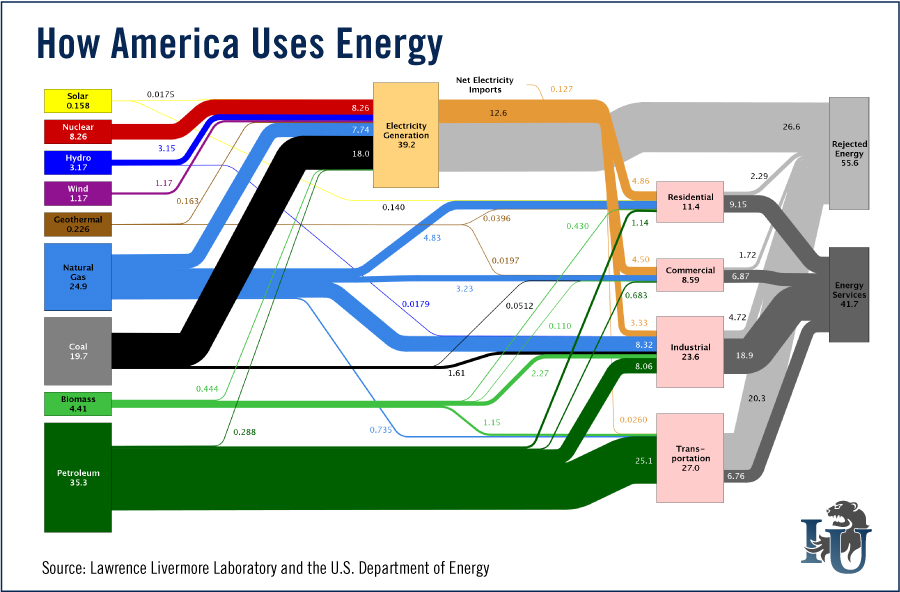
I base my remarks on an excellent chart produced by (gasp!) a government agency, Lawrence Livermore National Laboratory. It appears here but if it’s illegible please find a better copy here.  Blame Brandon for squeezing our posts into a narrow column!Image

We see energy sources on the left. A couple of facts stand out. At the top, notice that solar and wind are negligible. The yellow line representing solar may be thinner than a single pixel on your monitor and therefore invisible. Geothermal is on the radar, but barely; same for biomass (wood chips, organic leftovers, corn used for ethanol instead of feeding people) that can either be burned or processed into methane or ethanol. Our three main sources are, and will be for the foreseeable future, petroleum, coal and natural gas.

At the top center we see electricity generation. We don’t consume electricity directly except maybe for executing criminals. We use it to power devices in the four broad categories shown on the right: residential, commercial, industrial, transportation.

Notice the fat grey line coming out of the electricity generation box called “rejected energy.” It tells us that about two thirds of the energy coming into power plants goes up in smoke or steam or other waste heat rather than electricity. That sounds like a terrible loss and indeed, there is always room for efficiency improvements at the margin. But, boys and girls, there’s something called the Second Law of Thermodynamics which puts an iron limit on how much energy in a particular situation is available to do useful work. In other words, a certain amount of the “waste” represented by that fat gray line is inevitable. It would be great if the good people at LLL could supply that calculation, but I suspect that reliable estimates of the necessary data would be difficult to come by.

Look at the residential box on the right. It only represents 11% of energy consumption meaning that relative to the big picture, home energy efficiency measures like insulation, solar panels, etc. can never do much for the big picture. I say this too keep things in perspective, not to deny the possibilities for cost-effective marginal improvements in many homes.

If your monitor resolution allows it, you’ll see a tiny orange line running from electricity generation to transportation. That means electric vehicles are, and for some time will be, utterly insignificant, though again, marginally beneficial in very special situations.

Another fat gray line comes out of transportation. When you burn gasoline, most of the energy goes out the tailpipe or the radiator; only a little ends up as kinetic energy and even that ends up as waste heat when you apply the brakes. (In the long run, it all ends up as waste heat. Look up “heat death” on Wikipedia.)

The overall message of this chart is: if we want to maintain anything like our present industrial civilization with its abundant heat/cooling, light, transportation, etc., we’d better keep the present main sources going – petroleum, coal, natural gas, nuclear because renewable energy sources are advancing only slowly and in many cases (wind and ethanol, especially), uneconomically. The stakes couldn’t be higher – significant losses of energy, more than anything short of nuclear war, will make life nastier, more brutish, and shorter.

How to decide which energy R&D projects deserve scarce resources? Solyndra, anyone? No, central planning of energy is just as much a disaster as any other form of central planning or maybe more so. Energy is a highly specialized field. A biomass expert, for example, may be ignorant of nuclear fusion. A transformer guy may know nothing of transmission line losses. I suspect there are dozens or hundreds of subspecialties within the biomass field. Knowledge, as Hayek taught us, is dispersed and often tacit. We need to let all these specialists use their particular knowledge and facilities to experiment around the edges, comparing present or expected future marginal costs and benefits. Other than an occasional nice chart like you see here, the Energy Department just gets in the way. (To see a boondoggle that dwarfs Solydra, google “national ignition facility.”)

Speaking of costs and benefits, one of these days I’ll comment on the strange notion that energy accounting – a perfectly legitimate engineering practice – should be used to judge the economic value of energy projects. Tallies of income/expenses and assets/liabilities, should, say proponents, be carried out not in dollars but in energy units (joules or BTUs.) Why is this wrong? Because the economic value of a joule depends on time and place and most critically, people’s ability to make good use of it. In fact, natural resources aren’t resources at all until and unless someone figures out how to make good use of them.  More generally, value never inheres in physical objects and materials but only in the minds of people who believe those objects and materials can help satisfy wants, theirs or others’.

Postscript: The oceans store unimaginable amounts of thermal energy. You can calculate this yourself: using your favorite system of units, just multiply the volume of water by its mass density by its specific heat at constant pressure. You’ll discover that if we were willing to lower the ocean temperature by a thousandth of a degree per year, we would have abundant energy from now till Kingdom Come. Try this idea on a “progressive” friend sometime, keeping the answer momentarily in your back pocket: the Second Law forbids it. Stated differently, even with perfect technology, you would have to put more energy into the conversion process than the usable energy end product.

Abstract Ideas Don’t Deserve Patents [NY Times]

In preparation for something special that I will finally complete this week (Rothbard willing) lets talk about this editorial from the New York Times.


The article starts accurately enough explaining the US government’s monopoly power of ideas saying:

The Constitution gives Congress the power to grant inventors a temporary monopoly over their creations to “promote the progress of science and useful arts.”


I am actually shocked at the strong language used here, the four letter word “monopoly” is rarely used in reference to any government service.  At least in polite company.  I would also like to point out the subjective language quoted from the constitution.  “Useful arts”.  Useful to whom?  To the inventor?  To consumers?  To the government?  To humanity?  Like most state activities the ability to decide what is “useful” is left to bureaucrats in service to the government rather than in the free market where useful services will generate profits and those that generate disuse (or disutility) are met with losses.  Back to the article though:

“But in recent years, the government has too often given patent protection to inventions that do not represent real scientific advances.”


No argument there.  The “copyright troll” phenomenon is more than enough to make this libertarian squeamish.  Where is this editorial going I wonder?

  “The issue in this case, Alice Corporation Pty. v. CLS Bank International, is whether using a computer to implement a well-established economic concept can be patented. The court should rule that such ideas are not eligible for patent protection.


Alice Corporation obtained four American patents that cover a method of settling trades between investors in currency and other financial markets. The approach depends on a neutral middleman to make sure traders complete the transactions they have agreed to. The corporation, which is based in Australia, has accused CLS Bank, a London-based company that settles foreign exchange trades for investors around the world, of infringing its patents.”  

To make a long story short the US patent office granted the Alice Corporation a copyright on a form of interaction between a buyer, a middleman and a seller.  An absurd concept to be sure.  Now the question is what does the editorial suggest?

“The Supreme Court should make clear that nobody should be allowed to claim a monopoly over an abstract idea simply by tying it to a computer.”

I agree; but why stop there?  Why the artificial endpoint of “abstract ideas tied to a computer”?  If we shouldn’t allow patents on abstract ideas what would the author suggest if we proved that all ideas are necessarily abstract and therefore not able to be owned, sold, or monopolized?  Would he follow his logic to the conclusion that perhaps all patents are invalid?

Physics in Human Action

Some Austrian-school economists dislike analogies from physics in economics, because they don’t regard economics as mechanical. But since human action is physical, we can understand economics better if we understand the basics of physics.

We begin with space. For human action, space encompasses distance in three dimensions. For economics, space constitutes the sites in which activity takes place. The economics of space includes three-dimensional volume as well as a location. For human purposes, spacial land is fixed relative to the earth. Space is not altered by use, but it is consumed by using its value, as reflected by its rent, over time. There is also another type of economic space in the electromagnetic spectrum, made up of frequencies that travel through three-dimensional space.

The second rudiment of the universe is time, which has two meanings, a moment and a duration. Time is not an input into production, but a dimension of all activity. An analysis that examines a phenomenon over a duration is called “dynamic,” in contrast to the static analysis of a moment.

The third universal rudiment is mass, or its synonym, matter. Mass is what takes up space and has inertia. Economics categorizes mass as land (natural resources), human beings, capital goods, and trash.

A fundamental law of physics is that of conservation, that matter (and its sibling energy) cannot be created or destroyed, but only changed in form. But there is no conservation of value. In economics, production is the creation of economic value, processing inputs to make them more desirable. Consumption is the using up of economic value. Capital goods are items that have been produced but not yet consumed.

Linear velocity is the rate of the motion of a mass object in some direction. In economics, activity has a velocity as a mass of inputs gets processed into outputs, or objects get transported. There is also angular velocity in the speed of rotation, including the velocity of money as its turnover as measured during a year. Momentum equals mass times velocity, including a velocity of zero. Human action has momentum when activity proceeds at a constant speed and direction.

However, economic dynamics involves changes in speed or direction, which is acceleration (including negative acceleration or deceleration). A fundamental equation in physics is F=MA, force equals mass times its acceleration, Newton’s second law of motion. Newton’s first law of motion is that of inertia, that a body will retain its momentum unless an external force is applied. Force makes mass objects accelerate. On earth, mass has a weight due to the force applied by gravity

In human action, force can mean either a physical action, as inputs are moved and combined, or else a coercive action by either criminals or governments. The initiation of coercive force alters what people would otherwise voluntarily do. Such forceful intervention imposes a net loss of value on society by accelerating the mass of human action into directions or speeds that reduce its net utility. The economy and society maximize well being with rules that prevent coercive force.

Newton’s third law of motion is that for every action there is an equal and opposite reaction. When one body exerts force on another body, the other body exerts an opposite force on the first body. This law is what propels a rocket, as the force of the ejected fuel makes the rocket go in the opposite direction. Economic action encounters resistance to motion, or friction, which is good if we want to walk (as without friction we would slide around), but is bad if the friction consists of obstacles imposed by coercive force.

In economics, energy is the generation of heat, light, and movement. There are many forms of energy. In physics, potential energy is mass that can be accelerated into motion, such as an object that can fall down, or molecules that can be combined to create heat and light. There is kinetic energy of motion, with the equation: e = ½ mv2. Einstein’s equation reflecting the convertibility of mass and energy is e = mc2, but that has no relevance in the human scale of action.

In physics, work is force times displacement. Applied to human action, work is done when a person applies force (human exertion and tools) to a mass to change its location or composition, even if the change is only of bits in a computer memory. Work can also be a change in the kinetic energy of a system.

Another physics concept that has been applied to economics is equilibrium, a state of constant momentum, including zero velocity, where there is no incentive or force for acceleration. In economics, equilibrium is the exhaustion of gains from trade. At the moment you pay for goods at a store, you are in equilibrium, as you do not wish to trade any more money for goods. But a moment later, you are in disequilibrium, as some goods now have more value than the money you exchange for them. Market prices and quantities move towards equilibrium to remove a shortage or surplus or to gain from extra production, consumption, and trade.

We can see that the application of physics to human action is not mechanistic, as people act on their subjective values and beliefs and psychological inclinations, but their physical action is necessarily subject to the laws and concepts of physics. F=MA applies to human action as it does to physical particles.

Thoughts on the Tom Woods Show

Most of you are probably already aware of Tom Woods, so this may not apply to you, but I wanted to throw a quick plug for him.

Many of my friends are aware of my extreme distaste for talk radio. I heard about Tom Woods podcast from some friends in my local Young Americans for Liberty chapter and also heard him speak at the YAL Idaho convention and decided to give his show a try. It is amazing.

I strongly recommend subscribing to his show if youre interested. It is highly educational and likely fascinating to even the totally uninterested. I believe part of the merit of the show is its appeal to both the intellectual libertarian and the newcomer to political thought. The quality of guests he brings on daily is outstanding. I listen to it at work and learn so much every day. Check it out at his homepage.

Failure and learning

The last few months I’ve been thinking about the relationship between failure and entrepreneurship. Just now I’m listening to a podcast and that old point came up: going to prison teaches you how to be a better criminal. You’d think that failed criminals would be the last sort of people to learn from, but really it’s just about the perfect sort of school. The general assumption is that people in prison have high discount rates, so they probably came into prison with one thing on their mind: what the hell went wrong with that last scheme?! So you’ve got dozens of people who all screwed up and that’s all their thinking about. That’s a whole lot better than you would get at a university; nobody at a school is thinking about how they screwed up, they’re thinking about how stupid other people are!

So the question is: how could you set up a system where the incentives of K-grad school teachers are constantly thinking about mistakes they’ve made and are able to pass those lessons on to their students? Sounds like science fiction to me.

What’s the One Big Change?

I enjoy idle speculation, and like many libertarians I like to speculate on the following question: If you could make one big change, what would it be? In other words, what’s the real big issue.

I’m increasingly convinced that the one big issue is immigration. If we opened borders internationally, world GDP would increase by an estimated 50-150%. World income would double! That’s incredible. All those people living on $2 per day would suddenly by doing significantly better if they could only be allowed to work for you!

And the benefits don’t stop there! Gains from trade! By now we all should understand that if I work for you it’s because I value my wages more than my time and you value my time more than the wages (and payroll taxes, and administrative costs) that you pay in order to hire me. So by letting poor people into America they gain by making their employers better off. Their employers are made better off by making their customers better off. You and I are those customers.

So why isn’t this already happenings. There are three basic oppositions.

  1. They’ll use public services without paying taxes.
  2. They’ll depress wages and steal jobs
  3. They might be dangerous. Either because they’ll commit crimes, or they’ll vote for stupid things (like restricting immigration).

I’m not including a more traditional reason for opposing liberalized immigration: xenophobia and racism. Xenophobia makes sense from the perspective of evolutionary psychology, but it’s not a legitimate reason, and it’s one we can choose to be bigger than.

Okay, so point one, simple solution: give anyone who wants one a work visa. Problem solved. Anyone can come here, but nobody is automatically eligible for public services. They’re above board, on the grid, we can see them, and if they commit crimes they’re out. But they’re obliged to pay into a system that they can’t exploit.

Point two: empirical evidence is that the only group in America genuinely negatively affected are high school dropouts. Want to increase high school graduation rates? Increase the cost of dropping out by letting in immigrants. Everyone else is made more productive because immigrants have different skills than natives, creating opportunities for gains from trade. They are complementary to us, and so make us better off by working along side us. Imagine a lone man on an island. He’s a baker. If he meets another marooned baker, it’s nice, but not as nice as if he meets a marooned butcher.

Point three: first off, getting rid of illegal immigration will make it easier to keep people safe from the foreign menace. Second, immigrants currently have lower incarceration rates than natives. Besides, it’s cheaper to punish them: just deport criminals. No feeding, sheltering, and clothing them; just ship them off. For voting: again, just give them a worker’s visa that doesn’t let them vote.

So what’s the takeaway? A simple policy of letting people come into the U.S. to live and work will make nearly everyone better off, especially the world’s desperately poor. America’s poorest (high school drop outs) may suffer, but there are fairly simple ways to address that. Here’s one: use a slice of the tax revenue from the new immigrants to pay for GED’s, and a stipend to give these folks time to study and pass the test. If they aren’t willing to do that, then that’s on them. If they have some disability that prevents it (maybe they dropped out because of undiagnosed learning disorders), then address those problems, because with that increased tax revenue we can afford to. And anyone born after 1999 is responsible for graduating high school and will be told the costs of failing to do so.

What do we get out of it? International poverty reduction, local wealth increase, a more cosmopolitan society, and a better, more humane world.

Courting Campaign Money

The Supreme Court has overruled 5 to 4 the previous limit on total campaign contributions in the US. In the McCutcheon v. Federal Election Commission case, The Court eliminated the limits on the total campaign contributions an individual could make to candidates and committees per election. Previously, in the Citizens United case, the Court struck down the limits on campaign funding and electioneering by corporations, labor unions, and nonprofit organizations.

Critics of these rulings say that they transform our democracy into a plutocracy, the rule by the rich, but the United States has always been a plutocracy, and the voters have used democracy to keep the system plutocratic. Wealthy donors could already finance Super PACs – political action committees. The amount of money spent in US elections had been escalating each election for decades.

American political culture has had a mixture of two ideals. The first is democracy, the rule by the people as equals rather than by a king or an aristocracy. The second ideal is liberty, especially freedom of speech. When the rich can influence candidates and elections by spending huge amounts of money, the ideal of liberty clashes with the egalitarian ideal of democracy.

Political speech is the most important of all, and the speech that most needs to be free of restrictions. Just as the government should not limit how many times one may give a speech, or how many editorials one may write on a topic, the government should not limit how much one spends to propagate speech.

Proposals to have the government finance campaigns also clash with free speech, if private financing is again limited. Governmental funding entrenches the established parties, and it forces the taxpayers to finance political ads which they may well detest.

Unfortunately, along with democracy and liberty there has been a third political idea in the USA. Economists call it “rent seeking.” In classical political economy, “rent” meant the yield of land. The classical economists knew that landowners receive rent in exchange for nothing, since the title holders did not create the land. They broadened the term to “economic rent,” which means any gains beyond what is needed to put resources to their most productive use.

Then economists in the branch called “public choice,,” which applies economics to voting and politics, recognized that the subsidies and privileges that special interests receive from government are economic rent, since it is loot taken from the public in exchange for less than nothing. Hence, when special interests seek favors from government, they are rent seekers.

The modern use of “rent” has become so far removed from its landed origin, and the land factor so much subsumed under capital, that economists no longer appreciate that the biggest rent seekers are the landed interests who obtain the implicit subsidy as the land rent generated by public goods paid for by taxes on labor.

Because superficial appearances trump the understanding of implicit reality, the reflexive reaction to the corruption of rent seeking is to limit campaign money. That then clashes with free speech. But the reason there is a clash between free speech and democracy is that we have inherited an antiquated 19th-century model of voting that is no longer appropriate to the 21st century world of mass democracy combined with great state power.

Public-choice economists such as Mancur Olson have recognized that the way to limit the rent seeking disease of democracy is to vote in small groups rather than in large groups. In a large country, the small groups should federate rather than become a large single group.

The demand for campaign money dissolves when people vote in tiny local districts. The district councils send representatives to a higher-level (or broader-level) council. With such a bottom-up small-group voting system, we would have much fewer political ads in the mass media.

The mass-democracy model has been grafted world-wide, and it has not brought social peace, as we have witnessed in place such as Egypt and Ukraine. But one day, mass democracy will be regarded as a relic like we today regard the former power of monarchs and aristocrats.

(Note: this article is also at http://www.progress.org)