RCH: Religion in the USSR

That’s the topic of my weekend column at RealClearHistory. An excerpt:

4. Buddhism was also outlawed and persecuted to the fullest extent of the Soviet law. Buddhism was practiced by a few different non-Russian ethnic groups in central Asia, and these small ethnic groups were given more leniency than most, but Buddhism came to be viewed by the Soviet intelligentsia as extremely dangerous, due to the fact that many left-leaning scholars abandoned socialism for Buddhist principles. The work of Andrei Znamenski, a historian of religion and ideology at the University of Memphis, is particularly useful for finding out why this happened.

Please, read the rest. Dr Znamenski, of course, blogs here on occasion, but I do wish he’d do so more often…

Ottomanism, Nationalism, Republicanism IX

After a break dealing with proofs and indexes of two forthcoming books, a process that overlapped with getting a new university semester started, I can return to this series, which I last added to here. I set the scene of the late 1960s in Turkey, so I will turn to the next big upheaval, the Coup by Memorandum on March 12th 1971.

The Coup by Memorandum followed an attempted coup by far left/third worldist revolutionaries amongst the officer corps. Any unity created by the Kemalist project (secularist national-republican tradition of Turkey’s founder, Kemal Atatürk) was effectively ended, though this decomposition could be said about the whole period from the 1940s to 1971, especially after the adoption of multi-partyism by Atatürk’s successor, İsmet İnönü.

The 1971 coup forced the resignation of the conservative Prime Minister Süyleman Demirel and the implementation of a program to crush the far left, while also implementing some of the more left-wing ideas associated with the 1960 coup (particularly land reform and trade union rights). National View, the first Islamist party in Turkey, founded by Necmettin Erbakan, was closed down along with leftist groups so that an appearance of balance could be maintained in opposing the extremes on both sides. The reality, though, is that the level of state repression, including violence, and further including illegal violence (torture of the arbitrarily detained) directed against the far left, including Kurdish autonomists, drastically exceeded that directed against the far right.

The level of oppression that affected the mainstream right (in that the Justice Party was temporarily removed from government) and religious right was enough to create the idea that the right in Turkey was in some way the liberal part of Turkish politics. This not only influenced liberals, but even some people with very left wing views. It is part of how the AKP could come to power and hollow out state institutions, while subordinating civil society from 2002 onwards. The right continued with a militant anti-communist discourse, in all parts, while in part posing as the liberal friends of leftist rights, along with the rights of the Kurdish autonomists. This was pioneered by Turgut Özal in the 80s and taken further by the AKP. Presumably, Turkish liberals and leftists of the most anti-Kemalist sort have now learned a lesson, but possibly too late to benefit from it for at least a generation.

The military establishment’s implicit tolerance of the religious right, along with the ultranationalist grey wolves, in comparison to the secularist leftists tells an important story about the reality of ‘Kemalist domination’ of Turkey. It had evolved into a Turkish-Islamic synthesis, a compromise with the more conservative parts of the Kemalist establishment, in which the Turkish-Islamic synthesis became more prominent and the ‘Kemalism’ became more and more gestural, including a pointless obsession with preventing young women with covered hair from entering the university, at the same time as the rights of non-Muslim minorities.

The picture is more complicated in that the anti-leftist post-memorandum government in 1971 closed the Greek Orthodox seminary in the Princes Islands off the Marmara Sea coast of Istanbul, as part of a general closure or nationalisation of private (largely foreign) institutions of higher education. This was a policy in accordance with the demands of the far left, including campus radicals. So a measure to deny rights to a Christian minority coincided with the demands of the far left and was undertaken by a notionally secularist government, in reality more concerned with crushing the far left and extending a conservative form of statism.

The above, in any case, did not resolve the real problems of political violence to which the 1971 coup responded. The period between the end of the very temporary government appointed in 1971 and the coup of 12th September 1983 was one of increasing political violence and extremism, with a lack of stable governments as the Justice Party lost majority support (though it remained in government most of the time). Neither it nor the Republican People’s Party were able to form stable coalitions or parliamentary agreements, while the economy suffered and political violence increased between far left and far right groups. Unexplained massacres of demonstrators and political assassinations accompanied barricades that violent groups put up to signify control of urban areas.

The National Assembly failed to elect a President of the Republic in 1980, despite 115 rounds of voting during increasing political and economic disruptions. When the army seized power again on the 12th September, there was widespread public support, but this was the most brutal of the military governments. Its attempt to create a more ‘stable’, i.e. authoritarian, democracy gave Turkey a constitution and system which enabled the AKP to come to power with 35% of the vote in 2002 and then erode the weak restraints on executive powers when held in conjunction with a one party majority in the National Assembly.

More on this in the next post.
RCH: law schools and Thurgood Marshall

Yesterday’s RealClearHistory article was all about law schools, with a little bit of Thurgood Marshall thrown in for good measure (he took his seat on the US’ highest court Oct 2, 1967):

If the Supreme Court’s liberal and conservative justices all come from one of two law schools, the prevailing mode of thinking about the law is going to be not only out of touch with most of the legal profession (and general populace), but also with the idea of a judicial branch dedicated to overseeing the laws of a vast, continent-spanning republic. Marshall’s supreme courts were elitist and aristocratic, which is what they were supposed to be, but what do you call a court that is so insular and so self-selecting that only two law schools are represented?

This is not a plea to lower standards in order to broaden the field, but there are a lot of good law schools in America, which is, after all, a republic governed by laws, not men. If the Kavanaugh debacle proves too much of a problem for federal politicians (Kavanaugh went to Yale’s law school), perhaps President Trump should think of looking elsewhere for a nominee.

Please, read the rest. In it, I include 3 people who would be good SCOTUS Justices. Feel free to add your own…

RCH: 10 most divisive Supreme Court justices in American history

It turns out that SCOTUS appointments have had a long history of dividing American society. An excerpt:

9. Roger Taney (1836-64). Taney rose up the political ranks as Andrew Jackson’s right-hand man. Jackson tried to get him on the Supreme Court in 1835 but his nomination was rejected by anti-Jacksonian Whigs in the Senate. After the Whigs were swept away in the 1836 election campaign, Jackson renominated Taney, but this time for the position of Chief Justice, and he was confirmed 21-15 after a bitter debate in the Senate. The Taney court is responsible for the Dred Scott case that tore the fledgling republic apart, and for helping Jackson abolish the national bank. Taney and Lincoln clashed often, too, as Taney ruled that Lincoln’s suspension of habeas corpus was unconstitutional, but Taney never did go home during the Civil War and served out his term as Chief Justice until his death in 1864. He holds the second-longest tenure of any Chief Justice.

Please, read the rest, and try to remember: this divisiveness is a feature of the system, not a bug.

RCH: 10 corporations that gave capitalism a bad name

That’s the subject of my weekend column over at RealClearHistory. An excerpt:

5. Dutch East India (1602-1799). The VOC, as the Dutch East India Company was known, exemplified corporate plunder and colonial oppression in the 17th and 18th centuries. Its demise was only met after Napoleon’s revolutionary armies conquered the Netherlands, and for nearly 200 years the VOC brutally oppressed and exploited Asian lands in the name of monopoly and Dutch interests of state. The VOC was created to give the Netherlands a presence in the burgeoning world of global trade that had been started by Spain and Portugal after the former’s colonization efforts in the New World. The VOC wanted to cut off Spain and Portugal (and, later, the U.K., France, and U.S.) from world trade, and monopolize industries in order to benefit Dutch society. This logic led directly to not only the horrible things that happened in VOC-governed territory, but also to the corruption and unnecessary wars that happened in the Netherlands.

Please, read the rest.

INDIA: A case study in the demise of representative democracy

India of 1947 had battled decades of colonialism to embrace self-rule. Whatever divisions seeped through party ranks, coalesced – and how beautifully – to fight for the right the people to a democracy. Having a common enemy helped. Compounded by the ability of the political leaders of that time to weave magic through words, connecting the plights of the millions to the queen-ship of one propelled movements across the breadth of the Indian subcontinent. While much has been said of the academic prowess as well as the oratory skills of the Founders, it was their ability to connect across barriers of identity that ultimately pushed the wheel. How dearly they protected their freedom of speech, expression and press is perhaps telling of the importance they assigned to being connected with those they had chosen to represent. How is it then that a deeply flawed election system and disjointed lines of public communication yielded one of the biggest civil disobedience movements the world had ever seen?

In terms of representation and reach, India 2018 is better abled than India 1947. And yet, it fell upon the unelected shoulders of four men and one woman to correct a deeply violent, colonial and bigoted law. The right to sexual identity was granted by five cis heterosexual individuals; the ones in need of representation reduced to being mere petitioners. India celebrated breaking off one more shackle, the Judiciary reveled in being the harbinger of liberal values to the Indian legal system yet one more time and the Parliament, as always, stayed mum. It is not that either of the institutions have embraced staunch anti/pro liberal positions. The Indian judiciary has its share of misogynists much like the Parliament. Misogyny is not illegal. But what is illegal is the Parliament’s distance from her electorate. Even if one were to contend that a majority of India does not support homosexuality, the increasing momentum of the movement should have propelled an informed debate within and without the Parliament. Instead, the government chose to not object to the petitions filed in favor of decriminalizing homosexuality as if that is the extent of the responsibility they owe to the LGBTQ community of the country. The distance between a judicial decriminalization of homosexuality and one done through a legislative device is the distance between a populist democracy and a representative one. The counter-majoritarian difficulty seems almost trivial when democratic institutions lose their representative character.

The biggest reason behind the rising legitimacy of an essentially non-democratic institution as the Judiciary is not a power grab by the Supreme Court judges. Howsoever activist they might get, the requirement of giving a reasoned decision tempers their emotions. The Indian Parliament, on the other hand, has come to rely on this increasing politicization of the judiciary to avoid political battles that might require concessions from their mostly unreasoned manifestos. The result is a lack of deliberation that is disturbingly dismal for a democracy as huge as India. The requirements of representation have come to be restricted to a periodical holding of elections. Members of Parliament are neither Burkean agents nor Pateman’s representatives. They are a political class unto themselves working towards a steady demise of the largest democracy in the world.

RCH: 10 Dead Nazis You’ve Never Heard Of

Yup, dead Nazis. That’s the subject of my weekend column for RealClearHistory. An excerpt:

8. Karl Haushofer (died 1946). While it is perhaps unfair to include Haushofer in this list (he denied being a Nazi and his wife and son were, under Nazi law, considered to be “half-Jews”), his ideas about the world and how he went about promoting them are too important to leave out of the Nazi story. Haushofer became a geopolitical theorist after World War I and is credited with introducing to the German public (including the Nazis) the idea of “Lebensraum,” or “living space.” According to Haushofer, Germany could only compete with the Western powers if it had control over areas of Europe stretching from Norway to the Caspian Sea. Once the German military controlled this geographic space, the Nazis could begin exterminating the indigenous people there to make room for German colonists. Haushofer also viewed Japan as a natural ally of Germany and was instrumental in convincing the Nazis to partner up with Tokyo. One of Haushofer’s former students, Rudolf Hess, was one of Hitler’s closest confidants, and it’s unlikely that Haushofer, bitter about the terms of peace imposed on Germany by France and the U.K. after World War I, did not exploit his former student’s position as Deputy Führer. He and his wife committed suicide together in 1946. Their son had been murdered by the S.S. in April of 1945.

Please, read the rest (if you haven’t already!).

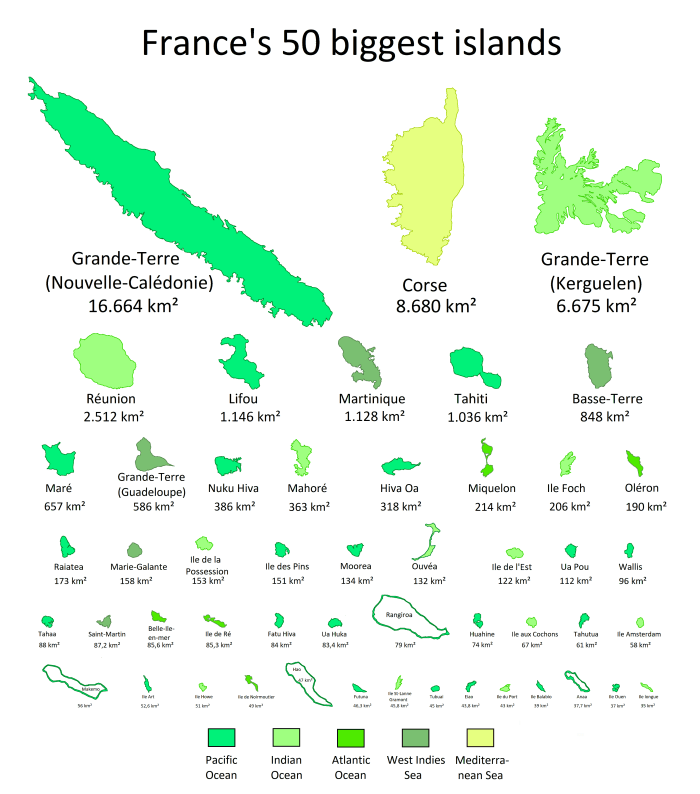
Eye Candy: France’s 50 largest islands

NOL French islands worldwide
Click here to zoom

This is pretty cool. France still has an overseas presence in the Pacific, the Caribbean, the Mediterranean, the Indian and Antarctic oceans, and the Atlantic (including St. Pierre and Miquelon, an archipelago just off the coast of Newfoundland, a province of Canada). Here’s a good Wikipedia list of France’s islands. It’s in French. Translate it to English, if you must. Browse and soak it all in. Here is Jacques at NOL on all things French. And here is Vincent at NOL on all things Quebec, which is a French-speaking province in Canada.

RCH: The United States and the Middle East

My latest for RealClearHistory is all about ‘Murica and the Mideast. An excerpt:

2. The Iranian Regime. During the Cold War, the U.S. government supported a number of regimes that were illiberal in the name of fighting communism. The necessity of such tactics are beyond the scope of this article, but the Pahlavi “dynasty” of Persia was one such illiberal regime. The Pahlavis were anti-Communist and pro-Western, which meant that women could dress how they pleased and go to university, and that religion was pushed to the sidelines of political life. This made the Pahlavi’s enemies of not only the socialist reformers of Persia, but also the majority of the conservative religious clergy. One Pahlavi was ousted by a joint British-Soviet invasion in 1925, and his son was deposed in the 1979 revolution that turned Persia into Iran. After the British-Soviet invasion, the United States became heavily involved in Persia and supported the secular autocrat almost blindly, which is why the anti-Shah revolution of 1979 was also anti-American.

Please, read the rest.

RCH: the Peace of Paris (1783)

My latest at RealClearHistory is up. An excerpt:

The Americans did not like this proposal one bit, and they went around the French and their Spanish allies and negotiated a separate treaty with the British, who were all too happy to give up some land in exchange for sticking a thumb in France’s eye. The French foreign minister at the time of the treaty negotiations, Charles Gravier, Count of Vergennes, bitterly complained that “the English buy peace rather than make it.” London also anticipated a rapprochement between itself and its now-former colonies, and a favorable treaty with the rebels would buy the British some much-needed diplomatic capital down the road. The American diplomats who negotiated such a generous truce were led by Benjamin Franklin, John Jay, and John Adams.

Please, read the rest.

RCH: 10 rivalries that shaped world history

My weekend column for RealClearHistory, in case you missed it, was fun to write. An excerpt:

4. The Mughals versus the Persians (1600s -1739). The Mughal Empire, an Indian polity that ruled over much of the subcontinent, fought three wars against two Persian dynasties (Safavids and Afsharids) and lost all of them. Much of the fighting was done around the city of Kandahar, in what is now Afghanistan. Kandahar was for a long time an important fortress for empires and dynasties that lorded over both Persia and India. While the Mughals had their pride stung by the losses, they could at least find solace in the fact their realm was the most economically successful on the planet at the time. India and Iran have long been weary regional rivals and sometime allies, but geographic distance and terrain have made outright wars between the two civilizations rare and limited. The rivalry between Iran and India has been a cultural one rather than a military one.

Read the rest (if you haven’t already!).

RCH: death and taxes

I’ve been so busy I forgot about my Tuesday column over at RealClearHistory (I have a Friday column, too). Last week’s column was about the trial and execution of two Italian-born anarchists in Massachusetts:

The anarchism of Nicola Sacco and Bartolomeo Vanzetti was left-wing and violent. Very violent. The two young men were admirers of Luigi Galleani, an Italian anarchist who advocated violence as the best way to achieve a more anarchist world. Sacco and Vanzetti, the executed, were part of an American syndicate dedicated to Galleani’s ideals. This syndicate was responsible for bombings, assassination attempts, printing and distributing bomb-making books, and even mass poisonings in the United States. The Galleanists were so violent that they sat atop a list of the federal government’s most dangerous enemies. On April 15, 1920, an armed robbery at the Slater and Morrill Shoe Company in Braintree, Mass., went awry and two men, a guard and an accountant (“paymaster”) were killed by the robbers. Sacco and Vanzetti were accused, convicted, and sentenced to death.

This week’s column focused on Shays’ Rebellion:

The Shaysites, as supporters of Daniel Shays came to be known, eventually grew to thousands of men, and the movement grew confident enough that it planned to seize a federal armory. However, the governor of Massachusetts, James Bowdoin, directed a local militia leader (William Shepard) to protect the armory. The armory, though, was federal property, and the militia was operating under state direction, so the seizure of the armory in the name of protecting it from rebels had the potential to ignite a powder keg of legal ramifications throughout the war-torn eastern seaboard.

Y’all stay sane out there!

The Catholic Church, Pedophilia, and Gay Rights

Note: I wrote this eight (8) years ago, in April, on my personal blog, Facts Matter.


The Catholic Church is, first of all, a criminal organization. It conspired for several generations to shield criminals from justice, just like the Mafia. Reading the press, I experience a sense of growing disbelief. Many commentators sound as if it the Catholic Church should be given a pass, somehow. The reverse is true. I am not religious but I know enough about the traditional Jesus to remember that he held hypocrites in special contempt. (Within the context of his day, he called them “Pharisees,” a sect known for showing off instead of acting righteously.) The Catholic Church’s own historical, philosophical, and moral claims demand that its crimes be treated with special severity. The Catholic Church deserves enhanced penal sentences and seizure of property.

If you are a grief-stricken Catholic and you hesitate to leave the Church, you should wonder whether even your simple passivity does not make you complicit in the large-scale, systemic, criminal cover-up becoming apparent right now. If you believe that the Catholic Church has the ability to cleanse itself somehow, you have not been listening to the shameful lies and self-deceptions expressed by prelates, during Holy Week of all times.

As always, I pay attention to what one should reasonably expect to happen and that is not happening. It’s striking how nearly none of the accusations of pedophilia against the Catholic church concerns girls. Catholic sexual crimes against children are almost exclusively homosexual. It looks like we are speaking about thousands of homosexual crimes. It makes me wonder why I don’t hear a word from so-called “gay” organizations. I mean militant gay organizations. I do not (not) refer here to the many homosexuals who lead irreproachable and constructive lives. They have no more to do with priestly pedophilia than I am responsible for heterosexuals who cut up their wives into little pieces. Nevertheless, anyone who thinks that mass molestation of children by homosexuals within the church has no bearing on the discussion of homosexuals’ right to marry is dreaming. The numbers are just too large and the criminals are homosexuals, anyway you look at it.

Eye Candy: the provinces of ancient Rome

NOL ancient Rome's adminstrative units.png
Click here to zoom

This is a beautiful map of Rome’s administrative units. There’s not much more to say, really.

Here is Barry on Roman law. Here is Mark on the Roman economy. Have a good week!

RCH: 10 libertarian thoughts on the (American) Civil War

I went there. I did it. I dropped a doo-doo right in the middle of August, for all the world to see. An excerpt:

5. Shout-outs to Alexis de Tocqueville and Joseph Smith. Alexis de Tocqueville wrote the best book on America, ever. Joseph Smith founded the “American religion” (to quote Leo Tolstoy). Both men also saw that the north-south divide in the United States was bound to lead to future calamity. It wouldn’t be accurate to call their thoughts on the American divide “predictions,” but both men were outsiders in one form or another, and both men have etched their names into history. The French, who had lost Tocqueville just two years prior to the beginning of the Civil War, approach to the American bloodbath was to remain neutral (after consulting with the United Kingdom), and instead invade Mexico. Napoleon III invaded Mexico, in the name of free trade, late in 1861 and established a puppet monarchy, which angered the United States as it violated the Monroe Doctrine. However, there was not much the U.S. could do and Napoleon III did not abandon his puppet until early 1866, when it became apparent which side was victorious in the American Civil War. The French preferred normalized relations with the American republic to a puppet monarch in the Mexican one. The Mormons, for their part, largely sat out the Civil War. Volunteers from Utah helped guard the mail routes from Indian attacks, but other than that, the Mormons, who had not yet been assimilated into American society (indeed, they had only fled from violence in Missouri to Utah a few decades prior to the Civil War), were content to let both sides bleed.

Please, read the rest.