Three Lessons on Institutions and Incentives (Part 4): Institutions and the Rule of Law

Daron Acemoglu & James Robinson call the set of regulations that obstruct innovation “extractive institutions.” Of course, here again, extractive institutions are less harmful than the total absence of institutions. Not every change in the status quo can be interpreted as “creative destruction” or “entrepreneurship.” As Friedrich Hayek pointed out in Law, Legislation and Freedom, so that the most mutually compatible plans can be carried out, it is necessary that a well-defined set of expectations be systematically frustrated: the usurpations, the frauds, collusions, the paramilitary bands, etc., etc. The main thing is to have institutions that guarantee a minimum of order. Now, many times the institutions manage to be put into effect as a result of having the consensus of a certain number of interests that see in the law an opportunity to extract benefits. It is the distinction between Acemoglu & Robinson between the already mentioned “extractive institutions” and “inclusive institutions.” The latter are constituted by that set of rules that formally are equal for all and that materially protect private property, the value of money, competition understood as freedom of entry to markets, among other values ​​of modern capitalism.

The distinction between extractive and inclusive institutions can find its parallelism in the expressions of “Rule by Law” and “Rule of Law.” The first consists on the accommodation of general and abstract normative statements with a second intention: to benefit a group at the expense of society as a whole. It is common to hear the criticism that the law has a false neutrality and that therefore any defense of the “Rule of Law” must be ideological (in the Marxist sense of the term). However, what distinguishes the concept of “Rule of Law” from “Rule by Law” is that, for the first of the terms, the consequences are unlikely to be predicted in terms of their particular and even more individual, while the second has an intentionality, declared or hidden.

To give an example, the procedural due process has such a degree of abstraction that it can hardly be predicted who will benefit from those proceedings. However, a law that prohibits the importation of a product of domestic manufacture clearly aims to redistribute resources from consumers to the local producers (although this type of regulation usually also generates consequences that are very difficult to foresee and often contrary to its original intentional).

Critics of the Rule of Law state that it is not neutral, because it protects exclusively the interests of the proprietors. However, such criticism loses sight of the fact that in the Modernity, any inhabitant, even those who are not citizens, can have access to the right to property, regardless of whether or not they belong to a certain caste, class, or social class. This, unlike the legal and political systems of the so-called Ancien Régime, which limited access to private property in perpetuity and irrevocably to a certain group of people, or even more, to a certain clan or group of families. It does not matter if, in Modernity, a person does not own any particular good, as long as he can count on the expectation of being able to become one at some time. In this sense, private property understood in the modern sense as that right that any inhabitant can enjoy from having stability in their possessions to the point of only being stripped of it by their own consent or by following the procedural due process.

This unlike laws protecting infant industries, professions or trades, or promotion of certain activities that are deemed as socially necessary or valuable, which establish a regime of transfers of resources from one sector of society to another. As the School of Public Choice indicates, such laws encourage “lobbying” and reduce the efficiency in the allocation of resources. In such institutional arrangements, individuals and businesses do not prosper through the discipline of serving the consumer, but through political agreements. Economic agents continue to maximize, but at the expense of regulations that deliberately establish certain winners (the owners of protected activities) and certain losers (consumers and potential producers who are denied access to protected activities). Under these circumstances, the citizenry begins to perceive an arbitrary sense in the norms and have no moral issues with challenging them (any contraband, without commercial purposes, is a clear example of this). Obviously, when non-compliance with standards becomes so extensive, regulations become ineffective. Moreover, as James M. Buchanan put it in his brief essay “A policy in the interests of producers,” the stagnation generated by protectionism means that the winners of such a system – the protected producers – turn out to be less rich than they would be in an open and competitive institutional framework.

Sometimes protectionism seeks its foundation in a mistaken theory of “original accumulation.” (Joseph Schumpeter ruled out the validity of such proposals by pointing out that, although those could have had some basis until the 19th century, the development of capital markets made this theory completely obsolete.)

However, neither Douglass North, nor William Easterly, nor Acemoglu & Robinson, deal with the problem of original accumulation. They prefer to encompass such phenomena within the set of erroneous theories that serve to justify policies arising from political agreements in polarized societies. This means that a certain institutional arrangement, an economic growth policy, a stabilization program, a constitutional reform, foreign policy and so on, in a polarized society is not inspired by abstract and formal principles but in concrete goals that benefit certain sectors of society above others.

The examples of polarized societies, to which Easterly and Acemoglu & Robinson turn, come mostly from African countries since these are mostly created in the process of decolonization and comprise different ethnic groups and languages ​​within themselves, so polarization is much more evident: certain policies benefit a certain ethnic group over another. Easterly specifically cites the case of an African nation in which an ethnic group that represents 10% of the population lives in the region where a certain commodity is produced and whose export generates large revenues and, in the meantime, the government is elected, with some exceptions, by 90% of the remaining population, which imposes export rights on the said commodity, whose collection is destined to industrialization plans that systematically fail.

It is often tempting to explain the failure of such industrialization plans for the corruption evidenced in their execution. In fact, corruption cases are verified, but public policy would also fail even if those involved were incorruptible. Many times bad policies destroy much more wealth than political corruption. Corruption implies a transfer of resources and, therefore, an inefficient allocation of resources, while bad public policies result in the destruction of wealth.

However, examples of polarized societies in African countries can generate confusion around the main message of The Elusive Quest for Growth and Why Nations Fail. The economic performance of nations has nothing to do with geography, culture, or lack of preparation of the ruling elites to draw the plans of government. Easterly holds the main responsibility for the rise and fall of nations in incentives, while Acemoglu & Robinson point to the institutions that establish such incentive schemes. Regarding the opinion of Douglass C. North, although his line of research can lend itself to a “culturalist” interpretation, he himself recognizes the disruptive change of formal institutions as a determining factor of economic performance.

In summary, the three works discussed here have as a common denominator the role of incentives as a determinant of the economic performance of countries, above culture (which North would call “informal institutions”), geography, or the level of education of its elites. However, the case of polarized societies is presented as a critical point of such approaches.

José Luis de Imaz in Los que mandan (The ones who command) had defined politics as the activity consisting of articulating diverse interests according to a coherent plan of government. The definition of Imaz deserves to be put back into use, since it addresses the problem of polarization and also because its double edge allows to tie the loose ends left by the visions that we can group, with greater or lesser precision, under the “neo- institutionalist” (clearly the case of North, although it would be pending to discuss the label for Easterly and Acemoglu & Robinson).

Notwithstanding, that polarization is manifest in tribal or caste societies does not mean that it is not present in other societal forms. In the United States, the north and south; in Europe, the separatist movements; in Argentina, the interior and Buenos Aires. With greater or lesser intensity, manifestly or latently, politics is always structured on a space of tension of interests in competition for resources. Those who frequent the work of Carl Schmitt often claim that trade and law are “civilized” means for the exchange and dispute of such resources, politics and war are on the other side of the same question in terms of intensity of the conflict.

However, the term institutions – which define incentives – does not refer only to deliberate political agreements in pursuit of a specific purpose, such as a given public policy. The concept of institution also concerns a series of abstract and general principles whose final result at a particular level no one can foresee, because their level of abstraction imposes an insurmountable limit for the knowledge of its concrete consequences.

[Editor’s note: Here is Part 3; Here is the entire, Longform Essay]

Three Lessons on Institutions and Incentives (Part 3): Innovation means creative destruction

The concept of creative destruction was popularised by Joseph Schumpeter and assumes that the economy is in a equilibrium. The “entrepreneur,” therefore, is an unbalancing factor that, through innovation, displaces the winners of the prevailing situation until then, generating a new equilibrium. This notion was criticized by other economists such as Friedrich Hayek and Israel Kirzner, who saw that the entrepreneur, far from being a disequilibrating factor, obtained its benefits by identifying the points of disequilibrium of a system and arbitrating between them.

The concept of “creative destruction,” on the other hand, focuses on businesses that go to waste from the irruption of the entrepreneur. This emphasis allows us to understand why there will be those who see with fear or disgust the very idea of ​​innovation. In contrast, Hayek and Kirzner emphasize the benefits of the new equilibrium: greater efficiency in the allocation of resources and, consequently, a greater generation of wealth. The notion of Schumpeter allows us to explain why many oppose innovation, that of Hayek and Kirzner gives us reasons to move forward with it. Strictly speaking, in order for innovation not to cause damage at the aggregate level, it must satisfy the Kaldor-Hicks criterion, that is, the gains from innovation must be so high as to allow a hypothetical compensation to the ones who lost the new distribution of resources.

In short, the notion of creative destruction that both William Easterly and Acemoglu & Robinson use, although it might differs from Schumpeter’s, meets the said Kaldor-Hicks criterion. In these cases, innovation does not represent a social disvalue, but on the contrary it generates a benefit for the whole. Therefore, it goes without saying that any brake on an innovation of this nature generates social loss. At this point, if innovation -also called “creative destruction”- is systematically curtailed, in order to seek to protect activities that would otherwise be displaced, society may encounter the following scenarios: a relative delay (regarding its potential) of its development, or a stagnation, or setback. In all three scenarios, inequality in wealth and income increases, or society sees its standard of living delayed or diminished in a homogenous way. In this last case, the protected sectors are also harmed by the brakes imposed on innovation.

[Editor’s note: Here is Part 2; Here is the entire Longform Essay.]

Three Lessons on Institutions and Incentives (Part 2); Institutions: definition and subtypes

Implicitly, Douglass C. North, William Easterly, and Daron Acemoglu & James A. Robinson share the same notion of “institution.” In this respect, what must be taken into account is not a real definition of the former but its operative concept, that is, what characteristic features relate it to the rest of the concepts of each theoretical body. In this sense, we can affirm that for these authors an institution is a limiting factor for human interaction. More precisely, in terms of D.C. North, institutions can be defined as abstract constraints imposed on human social decisions that structure political, economic, and social interaction. The rational agent finds limited its action and its spectrum of choices by institutions, which can be derived as much from the law as from custom, his habits, or his moral constraints.

However, the particular limitations that a particular person experiences are not relevant, but those that are incorporated into the behavior of a large number of human beings that interact with each other, which allows them to recognize a structural pattern of human social action. In this way, although an institution limits human action, because it is widespread throughout the social fabric, building it, it allows each individual inserted in such a set of interactions to represent expectations about the behavior of their fellow human beings that have a high probability of being true (something similar to what Friedrich A. Hayek had previously enunciated in his concept of “spontaneous order”). These expectations allow each individual to make plans with a high degree of probability of accomplishment, or at least to identify those actions that could be ruinous. In this sense, an institution is not only a limitation of human action, but, correlatively, a motivator for it, i. e. an incentive. The structure of human interactions that institutions project in the political, economic, and social fields helps the rational agent to make more efficient decisions, since they have a lower margin of risk. Of course, not all the incentives generate the same economic performance.

It is true that any pattern of human interactions that constrains the scope of choices of the agent (i.e., institutions), however inefficient they might be, represent an advantage over the total absence of it, since it works as a hedge against the arbitrary power and violence from third parties. Thus, the main distinction to be drawn is between anomie and institutionalization.

This latter opinion is expressly stated in Why Nations Fail: the extractive institutions -the ones that establish rules that favor a group at the expense of the whole-, both politically and economically, although they are harmful, are less so than civil war, polarization, factions, or anarchy. Acemoglu & Robinson argue that a country that does not have “inclusive” institutions, but at least have extractive institutions, might experience a rapid development obtained from the importation of discoveries from better organized countries – the phenomenon of “catch up.” However, after reaching a certain maturity, if the country in question does not advance towards political and economic opening, stagnation and subsequent implosion will be difficult to avoid.

Here is where the book of Acemoglu & Robinson finds its point of greatest affinity with the work of William Easterly: to continue on a path of growth and development, countries and their ruling classes must be willing to admit that progress only comes through innovation and that all innovation is accompanied by a process of “creative destruction.”

[Editor’s note: You can find Part 1 here. You can find the entire Longform Essay here.]

The Nonsensical Meaning of Sustainability

Along with ‘Inequality’ and ‘Democratic socialism’, ‘Sustainability‘ is one of the words that captures the essence of my generation. A sustainable project, event or business is met with “wow”s and “oooh!”s, an indicator of its owner’s moral righteousness and altogether praiseworthy character.

But its meaning is far from clear from all but its most fervent supporters. Dealing with the extraction of resources, the use of ecological reserves or harvesting of crops, a process is allegedly ‘sustainable’ if the naturally occurring regeneration exceeds the current levels of extraction. Simply put, don’t use more than what is (annually?) renewed. Moreover, a process branded as sustainable usually involve a mix of some other virtue signalling activities of our time: carbon emission neutrality or offsetting; at least a superficial concern for one’s environmental impact; energy produced in ‘renewable’ ways (read: nothing but solar, wind or hydro); or the use of recycled materials.

If this sounds unobjectionable and self-evident to you, this piece is for you. Despite the fancy branding, the SDGs, the fervor of self-proclaimed do-gooders, is the ‘sustainability’ of an activity really what we care about?

There are at least two major confusions with the assessment of activities as sustainable or its despised opposite: unsustainable. First, and most frequently occurring, is the belief that we aim to pursue our current endeavor in the same way for all eternity. If you think about it, the indignant objection of unsustainability is often quite meaningless, worthy of nothing but a ‘so what?’ response; everything we do at any given moment is in a sense “unsustainable”:

  • if I keep typing on my computer I will eventually starve;
  • if I keep lifting weights or endlessly running on that treadmill, I will collapse;
  • if I keep eating this chocolate cake of mine, I will be sick.

So? Everyone who has ever engaged in those activities understand that there are ends to them, that we’re only doing them for a particular purpose for a certain period of time, and that extrapolating snapshots of reality is quite silly; I do not intend to continue this activity until the brink of whatever physical boundary there might – or might not – be. Until I approach some “safe” distance to that brink, I’ll happily indulge in my chocolate cake, lift my weights or type away at my keyboard. In economic speak we are trading off one resource for another, until saturation or the fulfillment of some other aim becomes more important (prime example is Environmental Kuznets Curves).

The other confusion is to believe that economic systems cannot change and that humans cannot adapt. It is emphatically irrelevant that there is a physically limited amount of oil in the ground, since price systems and their incentives effectively ration oil use according to urgently-induced needs and encourage substitutes when those are needed. More importantly, the price system for raw materials incorporate and incentivize technological improvements that 1) through discovering new deposits literally expands “the” amount of resources,  2) shape cost-effective processes to hard-to-access deposits we couldn’t profitably exploit before, 3) improve the bang for our buck, i.e. how much output we can squeeze out of a given quantity of material. Thus, there might ultimately be a physical limit, but not an economic limit.

Let me give an iconic example: chopping down trees quicker than the forest grows. Such an activity seem pretty ‘unsustainable’ since the declining size of the forest implies that one day there will no longer be a forest. So what? There might be urgent present reasons for doing that (say, for instance, no other source of heat/fuel for cooking or no other source of income) that are very likely to change in a fairly short time frame (ie, before complete deforestation has occurred); the current prices of pulp or firewood may be meaningfully higher than their anticipated future prices (‘selling’ off some capital assets would therefore be fairly prudent); there might be future technological innovations that a) (re-)grows forests quicker, b) offers a better substitute to the current use of wood, c) allows us to cheaply make use of more from what we chop down.

Almost any practice taken as a snap-shot in time is literally ‘unsustainable’. Naively believing that they will mindlessly continue linearly into the future is quite silly; hailing processes that don’t as righteous and ‘sustainable’ is similarly silly. Human societies and their economic process are dynamic systems capable of (read: constantly) change.

By saying that something is unsustainable, my generation wants to convey the idea that these activities are immoral and that they shouldn’t continue. It’s a naive and erroneously nonsensical conviction.

Britain’s Pornographer and Puritan Coalition

D1dm1BuWkAAYreQ

Brexit isn’t the only ridiculous thing happening in the United Kingdom. In April, the British government is rolling out statutory adult verification for pornography websites and content platforms. This requires all adult content providers to have proof of age or identity for all their users, whether a passport or a credit card (or more ludicrously a ‘porn pass’ that Brits wishing to browse anonymously will have to buy from local newsagents). The government plans to require internet service providers to block pornography websites that are not in compliance with adult verification once the system is in place. For those with university institutional access, Pandora Blake has written a timely explanation and critique published in Porn Studies: ‘Age verification for online porn: more harm than good?’.

Technical challenges with rolling out the system have led the dominant pornography search platform owner, MindGeek, to develop proprietary solution, AgeID, in cooperation with regulators. This cooperation between the dominant commercial pornography platform supplier and a Conservative government publicly intent on restricting access to pornography might appear surprising. However, it can be explained by a particular pattern of regulatory capture identified in public choice theory as a Bootlegger and Baptist coalition. Bruce Yandle observed that throughout the 20th century, evangelical Christians in the United States agitated for local restrictions on the sale of alcohol with the avowed aim of reducing consumption but with the secondary effect of increasing demand for alcohol for illegal bootleggers. Hence both interest groups, apparently opposed in moral principle came to benefit in practice. We now have a classic British case study. In this case, MindGeek is not acting as a literal bootlegger. It intends to be fully legally compliant with the filtering regime. However, the law will block all non-compliant competitors without a comparable verification system. They can gain a competitive advantage with a proprietary technical solution to the barrier introduced by the government.

Introducing identity verification systems has high fixed costs and low marginal costs. It is costly to develop or implement but easy to scale once integrated. The larger the pornography enterprise, the more easily these costs can be absorbed without the risk that it will not be worthwhile to serve the British market. For many smaller international pornography websites, without in-house legal advice or technical expertise, it might prove uneconomical to serve British users directly. So MindGeek’s platforms could become the least-cost legal gatekeeper between small enterprises producing pornographic content and the British public. The government is raising transaction costs to accessing pornography in a way that impacts larger and smaller platforms asymmetrically and favors one dominant platform in particular.

Both the premise of this policy and its likely impact on the market for pornography is unpromising. At its most benign, this could be a characterized as a ‘nudge’ against the consumption of pornography and reducing access of inappropriate content to minors. But these limited benefits have costs for both producers and consumers. On the consumption side, it increases risks to data security and privacy because it will plausibly tie records of pornographic access to verified identities, with a clear likelihood of being to infer an individual’s sexuality from private browsing. This could represent a particular vulnerability for LGBTQ identifying individuals who live in communities where there is still stigma attached to minority sexual orientations.

On the supplier side, it takes what already appears to be a market with strong tendencies towards a winner-takes-all model, and then augments it so that a dominant platform has a legally enforceable competitive advantage over potential rivals in the market. Ultimately, it threatens to further strengthen the bargaining position of a single corporate pornography platform against the sex workers who supply their content.

Interwar US inequality data are deeply flawed

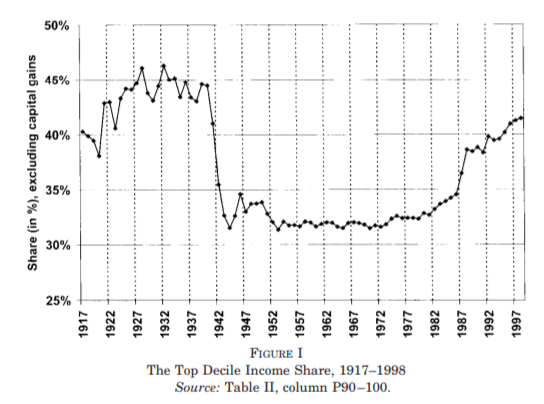
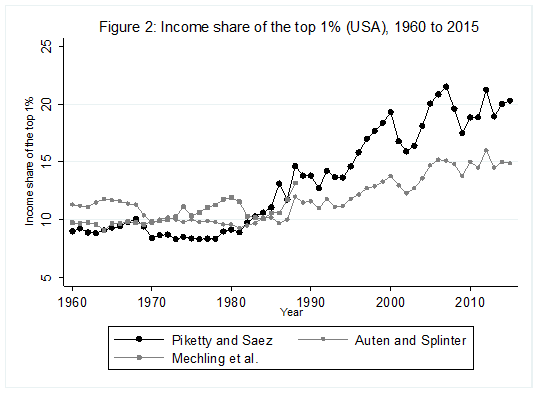
For some years now, Phil Magness and myself have been working on improving the existing income inequality for the United States prior to World War II. One of the most important point we make concerns why we, as economists, ought to take data assumptions seriously. One of the most tenacious stylized facts (that we do not exactly dispute) is that income inequality in the United States has followed a U-curve trajectory over the 20th century. Income inequality was high in the early 1920s and descended gradually until the 1960s and then started to pick up again. That stylized fact comes from the work of Thomas Piketty and Emmanuel Saez with their data work (first image illustrated below). However, from the work of Auten and Splinter and Mechling et al. , we know that the increase post-1960 as measured by Piketty is somewhat overstated (see second image illustrated below).  While the criticism suggest a milder post-1960 increase, me and Phil Magness believe that the real action is on the left side of the U-curve (pre-1960).

Inequality

NOL1

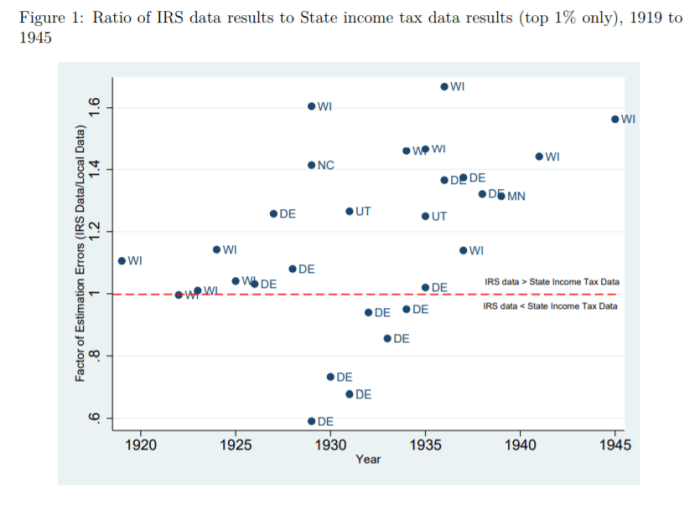
Why? Here is our case made simple: the IRS data used to measure inequality up to at least 1943 are deeply flawed. In another paper recently submitted, I made the argument that some of the assumptions made by Piketty and Saez had flaws. This did not question the validity of the data itself. We decided to use state-level income tax data from the IRS to compute the state-level inequality and compare them with state-income tax data (e.g. the IRS in Wisconsin versus Wisconsin’s own personal income tax data). What we found is that the IRS data overstates the level of inequality by appreciable proportions.

Why is that? There are two reasons. The first is that the federal tax system had wide fluctuations in tax rates between 1917 and 1943 which means wide fluctuations in tax compliance. Previous scholars such as Gene Smiley pointed out that when tax rates fell, compliance went up so that measured inequality went up. But measured inequality is not true inequality because “off-the-books” income (which was unmeasured) divorced true inequality from measured inequality.  This is bound to generate false fluctuations in measurement as long as tax compliance was voluntary (which is true until 1943). State income taxes do not face that problem as their tax systems tended to be more stable throughout the period. The same is true with personal exemptions.

The second reason speaks to the manner the federal data is presented. The IRS created wide categories with the numbers of taxpayers according to net taxable income (rather than gross income) in each categories. For example, the categories go from 0$ to 1,000$ per filler and then increase by slice of 1,000$ until 10,000$ and then by slices of 5,000$ etc. This makes it hard to pinpoint where to start each the calculations for each of the fractiles of top earners. This is not true of all state income tax systems. For example, Delaware sliced the data by categories of 100$ and 500$ instead. Thus, we can more easily pinpoint the two. More importantly, most state-income tax systems reported the breakdown both for net taxable and gross income. This is crucial because Piketty and Saez need to adjust the pre-1943 IRS data – which are in net income – to that they can tie properly with the post-1943 IRS data – which are in adjusted gross income. Absent this correction, they would get an artificial increase in inequality in 1943. The problem is that the data for this adjustment is scant and their proposed solution has not been subjected to validation.

What do our data say? We compared them to the work of Mark Frank et al. who used the same methodology and Piketty Saez but at the state-level using the same sources. The image below pretty much sums it up! If the points are above the red line, the IRS data overestimates inequality. If below, the IRS underestimates. Overall, the bias tends towards overestimation. In fact, when we investigated all of the points separately, we found that those below the red line result merely from the way that Delaware’s (DE) was adjusted to convert net income into gross income. When we compared only net income-based measures of inequality, none are below the red line except Delaware from 1929 to 1931 (and by much smaller margins than shown in the figure below).

IRS.png

In our paper, we highlight how the state-level data is conceptually superior to the federal-level data. The problem that we face is that we cannot convert those measures into adjustments for the national level of inequality. All that our data do is suggest which way the bias cuts. While we find this unfortunate, we highlight that this would unavoidably alter the left side of the curve in the first graph of this blog post. The initial level of inequality would be less than it is now. Thus, combining this with the criticisms made for the post-1960 era, we may be in presence of a U-curve that looks more like a shallow tea saucer than the pronounced U-curve generally highlighted.  The U-curve form is not invalidated (i.e. is it a quadratic-looking function of time or not), but the shape of the curve’s tails is dramatically changed.

It’s no longer the economy, but we are still stupid

Motivated Reasoning, Public Opinion, and Presidential Approval‘, an interesting new paper forthcoming in the journal Political Behavior (summarized here), by Kathleen M. Donovan, Paul M. Kellstedt, Ellen M. Key, Matthew J. Lebo finds that support for sitting presidents has become increasingly misaligned with national economic expectations. Rather than being a sign of voters realizing that presidents play little role determining economic performance, they attribute this to increased partisan polarization.

I think this is a compelling account. All I would add is a potential causal mechanism. My current favorite dimensions for analyzing democratic trends in the developed world is demography. Voters are ageing. When retired, they tend to have much less direct involvement with the productive economy than when they were working. On average, the elderly are quite rich and living off entitlements they have acquired during their working lives. So they are both less reliant on current economic opportunities and less knowledgeable of them. This means their personal costs of partisanship, relative to good policy, is lower than it used to be. And this is what lets all the culture-war nonsense creep into people’s decision functions.

Further thoughts on the carbon tax.

This post is in response to feedback from my previous post on this topic.


There are no panaceas.

But as abstract ideas go, pollution taxes are pretty appealing. Holding constant lots of things that we can’t really hold constant, it means replacing the inefficiency resulting from poorly defined/enforced property rights with a world where prices more accurately reflect the costs of one’s decisions.

Let me come back to the things we’re “holding” constant in a bit. Why do I want to throw my weight behind shifting public perceptions in favor of pollution taxes?

I think they’re underrated by the median voter. Climate change is just a subsidy paid in the form of worse conditions. But most people (including people who should know better) don’t have a good understanding of the problems caused by subsidies.

Which is not to say a carbon tax isn’t overrated by the median policy wonk. There are a ton of important caveats, but on balance, as a policy for use in the next 50 years, I think they’re a useful tool to enhance efficiency or replace worse tools.

Again, there are no panaceas. I’m also not a huge fan of the “Economists’ Statement on Carbon Dividends” as written (for reasons I’ve hopefully mostly addressed). I suspect the best case scenario for my preferred carbon tax policy would be a modest improvement. I think the bulk of the gain would be a cultural shift away from “let’s regulate our problems!” to “let’s leverage incentives to address our problems!” Not Earth shattering, but a step in the right direction.

So let me state my position, then we can dig into criticisms and caveats.

Let’s make marginal shifts away from taxing investment and towards taxing negative externalities. As we go, let’s spend a lot of effort trying to study the impacts and adjust accordingly. Let’s heavily agument that with abatement policies rather than trying to return to some pre-industrial climate target.

Okay, let’s dig into criticisms and caveats.

  1. Public choice considerations
  2. Geoengineering and other alternatives
  3. Cost
  4. Coordination
  5. Uncertainty

1-Public choice considerations

A Green New Deal will be a rent-seeking bonanza. Pollution taxes will face the same sorts of problems that plague the tax code in general. There will be intentional loop-holes and accidental screw ups.

We have to continue to push for reducing the complexity of tax codes in general. But I can’t deny that a carbon tax would be a step back on this margin.

Minus a hundred points for my position.

2-What about geoengineering?

Geoengineering sounds like a possible panacea. Maybe it is. But I’m not willing to flip a switch and find out the hard way all at once.

First off, geoengineering is scary. The climate is a complex system and complex systems are difficult-impossible to manage well. And that’s especially concerning if it means that anyone with a few million bucks can try to fiddle with Earth’s thermostat.

But it seems like a plausible tool that might be used to address climate change. Similar to my take on a carbon tax, I think the way to go is baby-steps plus research.

What about subsidizing “green _____”

Personally, I’m skeptical. Solar sounds appealing, and I (personally) think windmills are beautiful. But I don’t think the government will do a good job of picking winners and losers. Pollution taxes are appealing to me because they don’t require bureaucrats to choose. Again, I think the way to go is to use pollution taxes to offset other taxes–while continuing to advocate for reduced size/scope of government and a return to federalism.

Plus five points for my position.

3-Cost

We should also remember that GDP is an imperfect measure of well being. The current figures aren’t directly comparable to the figures we’d get in a post-carbon-tax world. A one-time fall in GDP doesn’t (necessarily) mean we’ve screwed things up.

A tax big enough to halt climate change would be incredibly costly. Too big a tax yields a negative net benefit.

Still, it’s worth remembering that a) we can go too far with a carbon tax, and b) we don’t have access to a silver-bullet solution. So let’s start small and gradually increase carbon taxes till we get close to (our best estimate of) the optimal level.

Plus epsilon points for my position.

4-Coordination

The basic idea of a carbon tax is that we’re dealing with a global-scale externality problem. But small scale taxes are unlikely to do much beyond shifting where pollution happens. A fully effective tax would require multi-lateral coordination. And, as a country, we aren’t very good at that.

Trying to create a tax on imported carbon-intensive goods that didn’t face a tax at home seems a) sensible at first blush, and b) a massive opportunity for public choice problems.

On the other hand, we could justify a tax commensurate with the local impacts (something like 10% of the global impact). This fits nicely with my idea of starting small and adjusting at the margin.

But even within the U.S. there are coordination issues. Long Island will likely face net costs from climate change, but other areas will benefit from a longer growing season.

Plus 10 points for my position, but also minus 10 points.

5-Uncertainty

Uncertainty cuts both ways: we’re currently accidentally manipulating the climate and that could turn out to be catastrophic. Trying to intentionally manipulate it in the other direction is also dangerous. Again, the appropriate focus is on marginal tinkering [much as it clashes with my non-interventionist priors] rather than ambitious global engineering [which grabs my priors by the lapels and knees them in the groin].

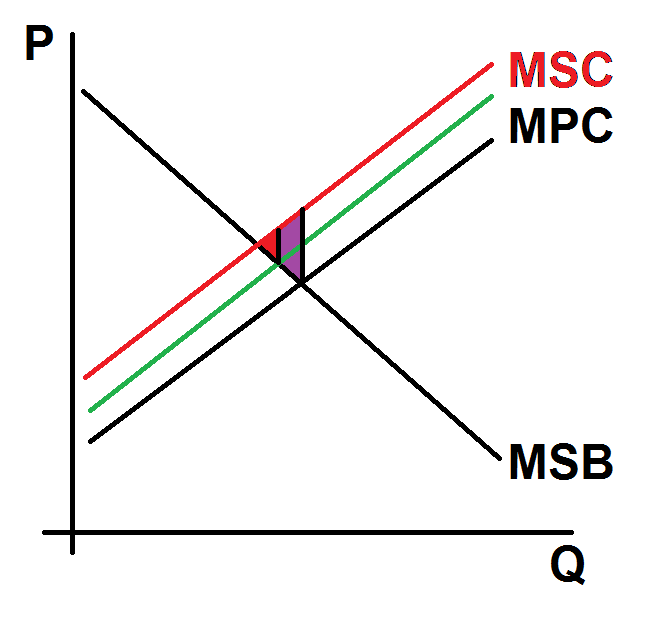
When I teach externalities, I draw a graph like this:

Negative externalities when we magically know their magnitude.

In this market, we end up with an equilibrium quantity defined by the point where Marginal Private Cost equals Marginal Social Benefit (MPC = MSB). But the Marginal Social Cost (MSC) is greater, so we get a deadweight loss equal to the triangle I’ve shaded in red and purple.

It’s important to note: we don’t actually know where the MSC curve is. It’s somewhere above MPC, but we’re basically in the position of trying to eliminate a subsidy we don’t know the size of.

The relevant models–climate models and economic models–are filled with uncertainty that we simply cannot resolve without real life experience.

What does the economic way of thinking tell us? Act on the margin. Setting a tax that pushes supply (MPC) up to the green line doesn’t fully address the problem (as I’ve assumed it to be in this graph), but it’s an improvement.

Even better, it’s an improvement where the biggest returns are experienced up front. This modest tax fails to get rid of the red deadweight loss (DWL) area, but it eliminated 3/4 of the total DWL.

Plus X points for my position where X is a random variable with an unknown distribution, positive first derivative, and negative second derivative.

tl;dr:

At my friend’s behest I’ve been looking at Bob Murphy’s critique of carbon taxes. I find it’s shifted the magnitude of my prior opinion, but not the direction. I still think carbon/pollution taxes are a good idea, but I no longer think they’re a great idea. My take away from Murphy’s work is that the optimal carbon tax is fairly modest. My response is to advocate for getting a very modest carbon tax on the books, then gradually shift tax policy in that direction.

For climate change (and any other problem) we ought to be pluralists. A mix of approaches is ideal. Part of the appeal of Pigouvian taxes is that they allow and encourage a wide range of responses. The best pollution abatement scheme isn’t something we can look up in a binder. We have to discover it, and crowdsourcing is the appropriate way to do that.

But carbon taxes are only one part. We should also advocate for changes that will ameliorate harm. I am more bullish on these policies than I am on a carbon tax:

  • Make it easier for the world’s poorest people to move to rich countries that will be better able to cope with climate change.
  • Quit subsidizing flood insurance.
  • Quit subsidizing polluting industries (and other industries).

Even though geoengineering scares me, we should try to learn more. Ditto for any other possible tools that come along.

The Paradox of Prediction

In one of famous investor Howard Marks’ memos to clients of Oaktree Capital, the eccentric and successful fund manager hits on an interesting aspect of prediction markets and probability alike. In 1993 Marks wrote:

Being ‘right’ doesn’t lead to superior performance if the consensus forecast is also right. […] Extreme predictions are rarely right, but they’re the ones that make you big money.

Let’s unpack this.

In economics, the recent past is often a good indicator for the present: if GDP growth was 3% last quarter, it is likely around 3% the next quarter as well. Similarly, since CPI growth was 2.4% last year and 2.1% the year before, a reasonable forecast for CPI growth for 2019 is north of 2%.

If you forecast extrapolation like this, you’d be right most of the time – but you won’t make any money, neither in betting markets nor financial markets. That is, Marks explains, because the consensus among forecasters are also hoovering around extrapolations from the recent past (give or take some), and so buyers and sellers in these markets price the assets accordingly. We don’t have to go as far as the semi-strong versions of the Efficient Market Hypothesis which claim that the best guesses of all publicly available information is already incorporated into the prices of securities, but the tendency is the same.

  • if you forecasted 5% GDP growth when most everyone else forecasted 3%, and the S&P500 increased by say 50% when everyone estimated +5%, you presumably made a lot more money than most through, say, higher S&P500 exposure or insane bullish leverage.
  • If you forecasted -5% GDP growth when most everyone else forecasted 3%, and the S&P500 fell 40% when everyone estimated +5%, you presumably made a lot more money than most through staying out out S&P500 entirely (holding cash, bonds or gold etc).

But if you look at all the forecasts over time by people who predicted radically divergent outcomes, you’ll find that they quite frequently predict radically divergent outcomes – and so they would be spectacularly wrong most of the time since extrapolation is usually correct. But occasionally they do get it right. In hammering the point home, Marks says:

the fact that he was right once doesn’t tell you anything. The views of that forecaster would not be of any value to you unless he was right consistently. And nobody is right consistently in making deviant forecasts.

The forecasts that do make you serious money are those that radically deviate from the extrapolated past and/or current consensus. Once in a while – call it shocks, bubble mania or creative destruction – something large happens, and the real world outcomes land pretty far from the consensus predictions. If your forecast led you to act accordingly, and you happened to be right, you stand the make a lot of money:

Predicting future development of markets thus put us in an interesting position: the high-probability forecasts of extrapolated recent past are fairly useless, since they cannot make an investor any money; the low-probability forecasts of radically deviant change can make you money, but there is no way to identify them among the quacks, charlatans, and permabears. Indeed, the kind of people who accurately call radically deviant outcomes are the ones who frequently make such radically deviant projections and whose track record of accurately forecasting the future are therefore close to zero.

Provocatively enough, Marks concludes that forecasting is not valuable, but I think the bigger lesson applies in a wider intellectual sense to everyone claiming to have predicted certain events (market collapses, financial crises etc).

No, you didn’t. You’re a consistently bullish over-optimist, a consistent doomsday sayer, or you got lucky; correctly calling 1 outcome out of 647 attempts is not indicative of your forecasting skills; correctly calling 1 outcome on 1 attempt is called ‘luck’, even if it seems like an impressive feat. Indeed, once we realize that there are literally thousands of people doing that all the time, ex post there will invariably be somebody who *predicted* it.

Stay skeptical.

Monetary Progression and the Bitcoiner’s History of Money

In the world of cryptocurrencies there’s a hype for a certain kind of monetary history that inevitably leads to bitcoin, thereby informing its users and zealots about the immense value of their endeavor. Don’t get me wrong – I laud most of what they do, and I’m much looking forward to see where it’s all going. But their (mis)use of monetary history is quite appalling for somebody who studies these things, especially since this particular story is so crucial and fundamental to what bitcoiners see themselves advancing.

Let me sketch out some problems. Their history of money (see also Nick Szabo’s lengthy piece for a more eloquent example) goes something like this:

  • In the beginning, there was self-sufficiency and the little trade that occurred place took place through barter.
  • In a Mengerian process of increased saleability (Menger’s word is generally translated as ‘saleableness’, rather than ‘saleability’), some objects became better and more convenient for trade than others, and those objects emerged as early primative money. Normally cherry-pick some of the most salient examples here, like hide, cowrie shells, wampum or Rai stones.
  • Throughout time, precious metals won out as the best objects to use as money, initially silver and gradually, as economies grew richer, large-scale payments using gold overtook silver.
  • In the early twentieth century, evil governments monopolized the production of money and through increasingly global schemes eventually cut the ties to hard money and put the world on a paper money fiat standard, ensuring steady (and sometimes not-so-steady) inflation.
  • Rising up against this modern Goliath are the technologically savvy bitcoiners, thwarting the evil money producing empires and launching their own revolutionary and unstoppable money; the only thing that stands in its way to worldwide success are crooked bankers backed by their evil governments and propaganda as to how useless and inapt bitcoin is.

This progressively upward story is pretty compelling: better money overtake worse money until one major player unfairly took over gold – the then-best money – replacing it with something inferior that the Davids of the crypto world now intents to reverse. I’m sure it’ll make a good movie one day. Too bad that it’s not true.

Virtually every step of this monetary account is mistaken.

First, governments have almost always defined – or at least seriously impacted – decisions over what money individuals have chosen to use. From the early Mesopotamian civilizations to the late-19th century Gold Standard that bitcoin is often compared to, various rulers were pretty much always involved. Angela Redish writes in her 1993 article ‘Anchors Aweigh’ that

under commodity standards – in practice – the [monetary] anchor was put in place not by fundamental natural forces but by decisions of human monetary authorities. (p. 778)

Governments ensured the push to gold in the 18th and 19th centuries, not a spontaneous order-decentralized Mengerian process: Newton’s infamous underpricing of silver in 1717, initiating what’s known as the silver shortage; Gold standard laws passed by states; large-scale network effects in play in trading with merchants in those countries.

Secondly, Bills of Exchange – ie privately issued debt – rather than precious metals were the dominant international money, say 1500-1900. Aha! says the bitcoiner, but they were denominated in gold or at least backed by gold and so the precious metal were in fact the real outside money. Nope. Most bills of exchange were denominated in the major unit of account of the dominant financial centre at the time (from the 15th to the 20th century progressively Bruges, Antwerp, Amsterdam and London), quite often using a ghost money, in reference to the purchasing power of a centuries-old coins or social convention.

Thirdly, monetary history is, contrary to what bitcoiners might believe, not a steady upward race towards harder and harder money. Monetary functions such as the medium of exchange and the unit of account were seldomly even united into one asset such as we tend to think about money today (one asset, serving 2, 3 or 4 functions). Rather, many different currencies and units of accounts co-emerged, evolved, overtook one another in response to shifting market prices or government interventions, declined, disappeared or re-appeared as ghost money. My favorite – albeit biased – example is early modern Sweden with its copper-based trimetallism (copper, silver, gold), varying units of account, seven strictly separated coins and notes (for instance, both Stockholms Banco and what would later develop into Sveriges Riksbank, had to keep accounts in all seven currencies, repaying deposits in the same currency as deposited), as well as governmental price controls for exports of copper, partly counteracting effects of Gresham’s Law.

The two major mistakes I believe bitcoiners make in their selective reading of monetary theory and history are:

1) they don’t seem to understand that money supply is not the only dimension that money users value. The hardness of money – ie, the difficulty to increase supply – as an anchoring of price levels or stability in purchasing power is one dimension of money’s quality – far from the only. Reliability, user experience (not you tech nerds, but normal people), storage and transaction costs, default-risk as well as network effects might be valued higher from the consumers’ point of view.

2) Network effects: paradoxically, bitcoiners in quibbling with proponents of other coins (Ethereum, ripple, dash etc) seem very well aware of the network effects operating in money (see ‘winner-takes-it-all’ arguments). Unfortunately, they seem to opportunistically ignore the switching costs involved for both individuals and the monetary system as a whole. Even if bitcoin were a better money that could service one or more of the function of money better than our current monetary system, that would not be enough in the presence of pretty large switching costs. Bitcoin as money has to be sufficiently superior to warrant a switch.

Bitcoiners love to invoke history of money and its progression from inferior to superior money – a story in which bitcoin seems like the natural next progression. Unfortunately, most of their accounts are lacking in theory, and definitely in history. The monetary economist and early Nobel Laureate John Hicks used to say that monetary theory “belongs to monetary history, in a way that economic theory does not always belong to economic history.”

Current disputes over bitcoin and central banking epitomize that completely.

What’s the biggest takeaway from my Blockchain classes?

We are nearing the end of my first semester as a Blockchain lecturer at a local university. We have discussed many topics, such as cryptography, consensus protocols, tokenization, smart contracts, how to build your own crypto-token…

During the final examination, I have asked what their biggest takeaways are from my classes. Do you know what the biggest takeaway is among most students?

It’s that they will never look at government and money the same way again. None of them had heard of the word Libertarian before, but now they leave the classes a little more sceptical of government and hopefully a little more libertarian.

Government isn’t the only problem

Working in a college, I’m at the front lines of a significant problem: wasteful bullshit jobs. In fact, I am writing this post to procrastinate editing a bureaucratic report (that nobody cares about) that has been slowly grinding the joy out of my life for the past several months. I have to write this report for the benefit of regulatory oversight which, ironically, is supposed to ensure that I use my privileged position for the benefit of society instead of wasting my efforts on pointless or destructive outlets.

In my case, this bullshit aspect of my job is a predictable outcome of working in a state sponsored bureaucracy. But the same disease afflicts private industry too.

If I’m the head of a Fortune 500 company, I have incentive to increase profitability of my company, but I have competing interests too. Most importantly I have to maintain my position of power within the company. Bruce Bueno de Mesquita and coauthors have laid out the logic of the situation in The Dictator’s Handbook, and The Logic of Political Survival–in a nutshell, I have to worry about competition for positions of power within any hierarchy. This requires engaging in cooperative rent-seeking to keep the right people happy. If I don’t, I risk losing my position to a sycophant who will.

We shouldn’t be surprised to see Niskanenian logic show up in these situations. Corporate flunkies are like a private army that can help me keep my position of power even if they don’t contribute to the profitability of the firm. Even if I want to maximize profits, if I have to worry about keeping my position, I have to engage in some of this costly, inefficient rent-seeking.

In other words, “firms maximize profit” is an approximation that brushes aside methodological individualism. Don’t get me wrong, there’s evolutionary pressure on firms that will push in that direction. But within a firm there’s evolutionary pressure preventing the firm from fully maximizing. (In other other words, if I survive this report I’ll have to start reading up on corporate governance.)

This logic is a natural source of bullshit jobs, even in a free market. Regulatory capture should make it worse, but we’ll never completely eliminate it.

On a more speculative note, I think we also have to worry about culture. For one, our current culture drives the demand for increased regulation. For another, we prize work for work’s sake to the point that most people would rather see someone fritter away their brief experience as a sentient being than see them fail to live up to social expectations. Such notions, I think, are behind the surprising lack of riots in the street you might expect in a world where most people know we face this problem of bullshit jobs. But I’ll leave any further speculation for the comments.

tl;dr: Our economy is beset with bullshit jobs that sap our creative capacity and crush our souls. And pretty much everyone knows it. Government is part of the problem, partly because regulation creates demand for paper-pushing, and partly because anti-competitive regulation converts lively, profit-seeking firms into private bureaucracies in their own right. But there are deeper problems: our willingness to abide, and the fundamental logic of hierarchical organizations.

Asking questions about women in the academy

Doing the economist’s job well, Nobel Laureate Paul Romer once quipped, “means disagreeing openly when someone makes an assertion that seems wrong.”

Following this inspirational guideline of mine in the constrained, hostile, and fairly anti-intellectual environment that is Twitter sometimes goes astray. That the modern intellectual left is vicious we all know, even if it’s only through observing them from afar. Accidentally engaging with them over the last twenty-four hours provided some hands-on experience for which I’m not sure I’m grateful. Admittedly, most interactions on twitter loses all nuance and (un)intentionally inflammatory tweets spin off even more anger from the opposite tribe. However, this episode was still pretty interesting.

It started with Noah Smith’s shout-out for economic history. Instead of taking the win for our often neglected and ignored field, some twitterstorians objected to the small number of women scholars highlighted in Noah’s piece. Fair enough, Noah did neglect a number of top economic historians (many of them women) which any brief and incomprehensive overview of a field would do.

His omission raised a question I’ve been hooked on for a while: why are the authors of the most important publications in my subfields (financial history, banking history, central banking) almost exclusively male?

Maybe, I offered tongue-in-cheek in the exaggerated language of Twitter, because the contribution of women aren’t good enough…?

Being the twenty-first century – and Twitter – this obviously meant “women are inferior – he’s a heretic! GET HIM!”. And so it began: diversity is important in its own right; there are scholarly entry gates guarded by men; your judgment of what’s important is subjective, duped, and oppressive; what I happen to care about “is socially conditioned” and so cannot be trusted; indeed, there is no objectivity and all scholarly contribution are equally valuable.

Now, most of this is just standard postmodern relativism stuff that I couldn’t care less about (though, I am curious as to how it is that the acolytes of this religion came to their supreme knowledge of the world, given that all information and judgments are socially conditioned – the attentive reader recognises the revival of Historical Materialism here). But the “unequal” outcome is worthy of attention, and principally the issue of where to place the blame and to suggest remedies that might prove effective.

On a first-pass analysis we would ask about the sample. Is it really a reflection of gender oppression and sexist bias when the (top) outcome in a field does not conform to 50:50 gender ratios? Of course not. There are countless, perfectly reasonable explanations, from hangover from decades past (when that indeed was the case), the Greater Male Variability hypothesis, or that women – for whatever reason – have been disproportionately interested in some fields rather than others, leaving those others to be annoyingly male.

  • If we believe that revolutionising and top academic contributions have a long production line – meaning that today’s composition of academics is determined by the composition of bright students, say, 30-40 years ago – we should not be surprised that the top-5% (or 10% or whatever) of current academic output is predominantly male. Indeed, there have been many more of them, for longer periods of time: chances are they would have managed to produce the best work.
  • If we believe the Greater Male Variability hypothesis we can model even a perfectly unbiased and equal opportunity setting between men and women and still end up with the top contribution belonging to men. If higher-value research requires smarter people working harder, and both of those characteristics are distributed unequally between the sexes (as the Greater Male Variability hypothesis suggests), then it follows naturally that most top contributions would be men.
  • In an extension of the insight above, it may be the case that women – for entirely non-malevolent reasons – have interests that diverge from men’s (establishing precise reasons would be a task for psychology and evolutionary biology, for which I’m highly unqualified). Indeed, this is the entire foundation on which the value of diversity is argued: women (or other identity groups) have different enriching experiences, approach problems differently and can thus uncover research nobody thought to look at. If this is true, then why would we expect that superpower to be applied equally across all fields simultaneously? No, indeed, we’d expect to see some fields or some regions or some parts of society dominated by women before others, leaving other fields to be overwhelmingly male. Indeed, any society that values individual choice will unavoidably see differences in participation rates, academic outcomes and performance for precisely such individual-choice reasons.

Note that none of this excludes the possibility of spiteful sexist oppression, but it means judging academic participation on the basis of surveys responses or that only 2 out of 11 economic historians cited in an op-ed were women, may be premature judgments indeed.

Where are our manners?

“Manners Makyth Man.” William of Wykeham said that back in a distant past when the letter “y” was at peak popularity. I thought of that quote today as I read about the shrill outrage over Karen Pence’s unremarkable job at a Christian school. There’s a great speech expounding on William of Wykeham’s quote, delivered about a century ago by Lord John Fletcher Moulton in London. He entitled his speech, “Law and Manners,” and its message could really use another go around.

Lord Moulton’s speech begins by dividing human action into three domains: the domain of positive law, the domain of absolute choice, and the domain of what he calls “manners.” This last domain is his essential topic, which he defines as “obedience to the unenforceable.”

Manners, by which he means something akin to duty or morality but encompassing more than both, are sandwiched between the worlds of positive law and absolute choice. This realm of manners is where we may act as we choose but we nonetheless face constraints that are outside the force of law. His basic premise is that the larger the middle domain, the healthier the society. He says, “The true test is the extent to which individuals composing the nation can be trusted to obey self-imposed law.” Encroachment from the realms of positive law and absolute choice pose a danger.

Lord Moulton does not suggest that the two outer domains are bad. They are vital. But if either expands too far into the middle, trouble awaits. If positive law expands too far, it stifles the freedom necessary for a flourishing society. On the other hand, if people feel completely unrestrained in their exercise of freedom, civil society begins to sag, and the danger that positive law will sweep in to pick up a perceived slack increases. As one religious leader put it, “We would not accept the yoke of Christ; so now we must tremble at the yoke of Caesar.”

Given these threats to the middle domain, Lord Moulton feared that “the worst tyranny will be found in democracies.” Minority interests will get chewed up by the voracious appetite of a positive law driven by a majority.  The representatives of the majority “think that the power and the will to legislate amount to a justification for that legislation. Such a principle would be death to liberty. No part of our life would be secure from interference from without. If I were asked to define tyranny, I would say it was yielding to the lust of governing.”

The maintenance of the middle domain depends on growth of a robust civil society sheltered from majority dominance. Religion, culture, tradition, diasporas—communities independent of the state must exist with some genuine autonomy for the middle domain to survive and thrive.

And this brings me back to Karen Pence working at a Christian school that (trigger outrage) requires students and teachers to abide by traditional Christian values. Whether or not those values are correct or not is not at all the point. Those eager to slap down a law at the first hint of a disagreement need to understand that tolerance for even genuinely illiberal viewpoints is essential to the success of liberal democracy. Organizations must have some power to define themselves apart from the prerogatives of the state to establish a framework for obedience to the unenforceable. As the Supreme Court put it, people must have space to organize communities separate from state interference that can serve as competing purveyors of norms. Such groups provide an essential “counterweight . . . to the State’s impulse to hegemony.” Thus, organizations that can establish their own norms apart form majority interference prevent the encroachment of positive law into the middle domain.

I worry that we are seeing simultaneous encroachment from both the realms of positive law and absolute choice. People outraged at Karen Pence’s new job feel convinced that the positive law should thrust its tentacles into group dynamics, thereby swallowing civil society into an all-pervading state orthodoxy. On the other hand, a sneering sense of moral relativity that frowns upon any attempt to speak up for solid norms encroaches from the other end—the perversion of tolerance that believes in no genuine moral structure outside what the law “makyth.” The letter “Y” may be a consonant and a vowel, but that doesn’t mean we can live without unenforced rules. Lord Moulton warned us about this. It’s time we mind our manners.

RE: Economists’ Statement on Carbon Dividends

I just got an email asking me to sign on to an open letter arguing for some carbon tax policies. I’m seeing some push back from (smart, economically literate) Facebook friends, but I think it’s a viable step in the right direction.

Here’s the statement paraphrased:

We think global warming is an important and urgent issue and we recommend these five things:

1. A carbon tax is the best, most cost-efficient way to do as much about carbon as needs to be done. [For a given level of carbon reduction, I agree. How much carbon reduction should happen (and how much at government behest) I am deeply agnostic about.]

2. We think this should be phased in over time and should be revenue neutral. [Yes on both points, but the rest of the statement makes it seem like they’re talking about a pretty short time horizon. I’m not sure how fast is too fast, but I’m sure there’s such thing.]

3. A carbon tax is more efficient than a set of specific regulations. [Certainly!] It’s also less likely to be subject to changing political winds. [Is it though?]

4. We should also apply a carbon tax to imported goods. This would reward energy-efficient American firms and prod other countries to follow suit. [Hmmmm… I can’t really disagree with the general principle, but this sounds like it will require bureaucratic oversight that will be subject to regulatory capture. On the other hand, we’ve already got that.]

5. We should give the revenue collected back to U.S. citizens, to offset increases in energy prices. [Okay, but if it’s going to be revenue neutral and come with a transfer scheme, that’s going to take some detangling!]

I buy into the notion that carbon emissions create large scale externalities that will probably be more bad than good on balance. Not universally bad, mind you. And not something that humanity won’t ultimately adapt to. But I think the people who will face the brunt of the bad outcomes will be the world’s poor (who we should help migrate to better climates!).

I don’t think we can just impose “the right” carbon tax and have everything come out just right. Even though I routinely draw out the case with a supply and demand graph in class, the truth is that nobody has access to those curves in real life. But a small tax can serve to reduce the inefficiency of pollution even if we don’t get it exactly right.

The revenue neutral part is important–we’re currently taxing lots of things we actually want more of (like investment). So if we can cut those taxes by taxing things we want less of (pollution), we’re reducing two sources of inefficiency in the current setup. Of course you and I have bolder views about what policy should look like in 100 years, but restricted to a 10 year window, a revenue neutral carbon tax looks pretty good to me.

The letter dramatically over-simplifies things. Climate change is probably a problem, but probably not as big a problem as proffered by proponents of proposals to prepare for apocalypse. It’s not clear to me that we have a good idea of a) all of the effects (good and bad), b) how people will adapt, and c) how people will adapt to a changing policy regimen.

Figuring out how to handle the tax on imports will be difficult and rife with rent seeking. Unmentioned is the impact on exports. If all our trading partners follow a similar policy, there’s no problem, but in the mean time there’s a tension that will probably be resolved with some unfortunate bit of rent seeking.

I’m sure most reasonable people would agree that instantaneous change would probably be unduly costly, but it’s not clear what the right speed of implementation is.

There are some miscellaneous rhetorical points I have issue with, but I suspect those are in there to throw a bone to people who aren’t me.

I hope that 10 years from now this open letter looks a bit silly. But I also hope that 10 years from now pollution taxes start to replace more inefficient taxes. On balance, I’m happy to see the letter prodding us in that direction.