Davies’ “Extreme Economies” – Part 2: Failure

In the previous part of this three-part review, I looked at Davies’ first subsection (“Survival”) where he ventured to some of the most secluded and extreme places of the world – a maximum security prison, a refugee camp, a tsunami disaster – and found thriving markets. Not in that pejorative and predatory way markets are usually denounced by their opponents, but in a cooperative, resilient and fascinating way.

In this second part, subtitled “The Economics of Lost Potential”, Davies brings us on a journey of extreme places where markets did not deliver this desirable escape from exceptionally restrictive circumstances.

There might be many reasons for why Extreme Economies has become a widely read and praised book. Beyond the vivid characters and fascinating environments described by Davies, this swinging between opposing perspectives is certainly one. Whether your priors are to oppose markets or to favour them, there is something here for you. Davies isn’t “judgy” or “preachy” and the story comes off as more balanced because of it.

If the previous section showed how markets flourish and solve problems even under the most strained conditions, this section shows how they don’t.

Darien, Panama

We first venture to the Darien Gap, the 160-kilometre dense rainforest that separates the northern and southern sections of the Pan-American Highway – an otherwise unbroken road from Alaska to the southern tip of Argentina.

To a student of financial history, “Darien” brings up William Paterson’s miserable Company of Scotland scheme in the 1690s; trying to make Scotland great (again?), the scheme raised a large share of scarce Scottish capital and spectacularly squandered it on trying to build a colony halfway around the world. In the first chapter of subsection ‘Failure’, Davies skilfully recounts the Darien Disaster, “Scotland’s greatest economic catastrophe” (p. 114).

Judging from Davies’ ventures into the jungle bordering Panama and Colombia, it wouldn’t be a far cry to call the present state of affairs a similar economic catastrophe. Rather than failed colonies, the failed potential of Darien lies elsewhere: its environmental challenges coupled with the trade and markets that failed to emerge despite readily available mutual gains for trade.

A stunning landscape of mile after mile filled with rainforests and rivers and the occasional lush farmland, the people of the Gap make a living through extracting what the land provides. If you’re deep into environmentalism, you might even say unsustainably so. Davies’ point is to illustrate a more well-known economic problem: when unowned or communally owned resources suffer from the tragedy of the commons – the tendency is for such resources to be overexploited and ultimately destroyed.

Whether through logging companies exceeding their quotas or locals chopping trees out of desperation to survive, the story in Darien is altogether conventional. At the edge of the Gap, “the people of Yaviza do what they can. [T]he environment is an asset, and for many people living in Yaviza getting by is only possible by chipping a bit off a selling it” (p. 120).

What’s striking here is that in times of need (as Davies himself showed in the chapter on Aceh) that’s exactly what we want assets to do! We can show this in down-to-earth, real-world examples like Acehnese women drawing on their jewellery as emergency savings, or in formal economic models such as the C-CAPM, the Consumption Capital Asset Pricing Model, familiar to every business and finance student.

On a much cruder level: if the mere survival of some of the poorest people on earth depend on chopping down precious trees – well, precious to far-away Westerners, anyway – accusing those people of destroying our shared environment is mind-blowingly daft. To rationalise that equation, you have to put a very large value on turtles and trees, and a very small value on human life.

Elinor Ostrom, whose Nobel Prize in economics was awarded to her work on common pool resources, emphasised three ways to solve tragedies of the commons: clear boundaries (i.e. individual property rights); regular communal meetings such that members can voice opinions and amicably resolve conflicts; a stable population so that reputation matters and we can socially police deviant behaviour (p. 125).

The Darien Gap has none of those. Property rights are routinely ignored; the forest includes many different populations (indigenous tribes, farmers, ex-FARC fugitives, illegal immigrants); and those populations fluctuate a lot, meaning that most interactions are one-shot games where reputation becomes useless. End result: extensive, illegal, unsustainable logging mixed with armed strangers.

What I can’t quite wrap my head around is that almost all (market and non-market) interactions that all of us have daily are with strangers: the barista, the people we walk past on the street, the new client you just met or the customer support agent you just talked to. All of them are strangers. A large share of interactions with other humans in the last few centuries of human societies have been one-offs, yet very few of them have spiral into the lawlessness that Davies describes in Darien. Be it the Leviathan, secure property rights, the doux commerce thesis or some wider institutional or cultural reason, but the failure of Darien to establish well-functioning formal and informal markets of the kind we saw in the book’s first part are intriguing.

While a fascinating chapter, it might also be Davies’ worst chapter, factually speaking. He claims, mistakenly, that “globally, deforestation continues apace with 2016 the worst year on record for tree loss”. On the contrary, we’re approaching global zero net deforestation. More specifically, Davies claims that Colombia and Panama are particularly at risk here, with rates deforestation “increased sharply”. A quick look through UN’s Global Forest Resource Assessment report (latest figures from 2015), these two countries are indeed chopping down their forests – but by less than any other time period on record.  Moreover, the Colombian net deforestation rate of 0.05% per year is easily exceeded by a number of countries; not even Panama’s dismal 0.3%/year (worse than the Brazilian Amazon) is particularly high in a global or historical perspective.

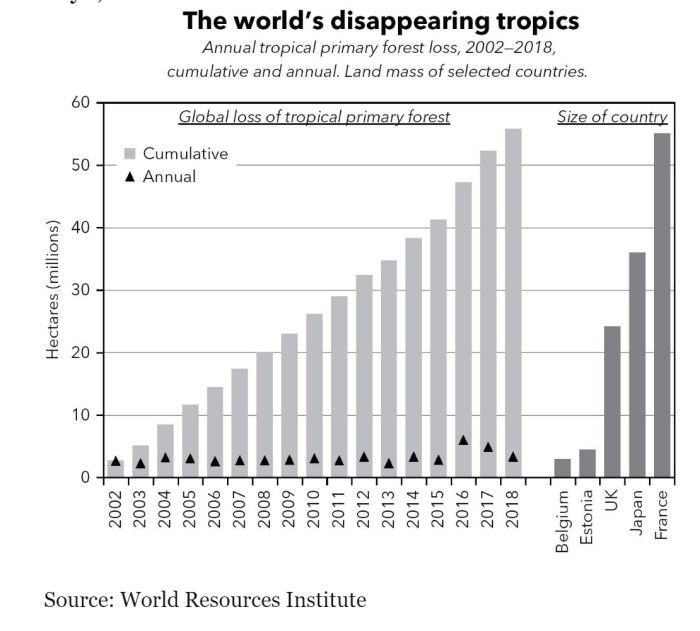
To make matters worse, the figure on p. 158 titled “The World’s Disappearing Tropics” might win an award for the most misleading graph of the year: by making the bars cumulative and downplaying the annual deforestation, it suggests that the forests are rapidly disappearing. The only comparison to relevant numbers (remember, Rosling teaches us to Always Be Comparing Our Numbers) is the tired “football pitches”. That’s hugely misleading. A vast amount of football pitches cleared in the Amazon this year still only amounted to 0.2% of the Brazilian Amazon; in other words, Brazilians could keep chopping down trees for a few good decades without making much of a dent to that vast rainforest.

davies

Moreover, the only reference point we’re given is that over a period of almost twenty years, an area the size of France has been deforested – but that’s equivalent to no more than one-tenth of only the Amazon forest, and the tropics have many more forested areas than that. The graph aims to intimidate us with ever-rising bars signalling the loss of forests; with some proper numbers and further examination it doesn’t seem very bad at all. On the contrary, locals (and yes, international logging companies) use the assets that nature has endowed them with – what’s so wrong with that?

Finally, the “missing market” that Davies observes in the Gap involves countless of illegal immigrants from around the world that trek through the jungles in search of a better life in the U.S. We have cash-rich Indians, willing to pay people to guide them through unknown and dangerous terrain, and local tribes and farmers and ex-FARC members with such knowledge looking for income; setting up a trade between them ought to be elementary.

Instead, it’s not: “in this place of flux,” writes Davies, “reputation does not matter, interactions are one-offs” (p. 137). Overturning the market quip that “trading is cheaper than raiding”, in the Darien Gap raiding is cheaper than trading. One might of course object that the failures of rich countries to offer more liberal immigration rules for people willing to go this far to get there illegally is hardly a market failure – but a failure of government regulation and incompetent bureaucracies.

Kinshasa, Democratic Republic of the Congo (DRC)

A 12-million people city sprawled on the banks of the Congo river, so unknown to Westerners that most of us couldn’t place it on a map. Democratic Republic of the Congo, the country with more people in extreme poverty than any other, is frequently described as “rich”. Or, with Davies’ euphemism “unrivalled potential” (p. 143).

Congo, the argument goes, has “diamonds, tin and other rare metals, the world’s second-largest rainforest and a river whose flow is second only to the Amazon. [it] shares a time zone with Paris [and the] population is young and growing”. It is one of the poorest countries but “should be one of the richest” (p. 143).

No, no and no. Before any other consideration of the remarkable day-to-day trading and corruption that Davies’ interview subjects describe, this mistaken idea about wealth must be straightened out. Wealth isn’t what could be if this or that major obstacle wasn’t in the way (Am I secretly a great singer, if I could only overcome the pesky fact that I have a voice unsuited for singing and lack practice?). This is almost tautological; what we mean by a country being poor is that it cannot overcome obstacles to wealth.

All wealth has to be created; humanity’s default position is extreme poverty.

And natural resources do not equate to wealth – there is even more support suggesting the opposite – in which case Japan and Singapore ought to be poor and Venezuela and DRC rich. My own sassy musings are still largely correct:

As Mises taught us half a century ago – and Julian Simon more recently – wealth (or even ‘goods’ or ‘commodities’ or ‘services’) are not the physical existence of those objects somewhere in the ground, but the satisfaction and valuation derived by the human mind. The object itself is only a means to whatever end the actor has in mind. Therefore, a “resource” is not the physical oil in the ground or the tons of iron ore in the Australian outback, but the ability of Human Imagination and Ingenuity to use those for his or her goals. After all, before humans learned to harnish the beautiful power of oil into heat, combustion engines and industrial production, it was nothing but a slimy, goe-y liquid in the ground, annoying our farmers. Nothing about its physical appearance changed over the centuries, but the mental abilities and industrial knowledge of human beings to use it for our purposes did.

Still, “modern Kinshasa is a disaster everyone should know about” (p. 172). No country has done worse in terms of GDP/capita since the 1960s. And we don’t have to go far to figure out at least part of the reason: the first rule of Kinshasa, says one of Davies’ interviewees, is corruption (p. 145). Everyone “steals a little for themselves as the funds pass through their hands, and if you pay in at the bottom of the pyramid there are hundreds of low-level tax officials competing to claim your cash.” (p. 185). Mobutu, the country’s long-time dictator, apparently said “if you want to steal, steal a little in a nice way” (p. 159).

Whether small stallholders at gigantic market or supermarket-owning tycoons, workers or university professors, pop-up sellers or police officers, everyone in Kinshasa uses every opportunity they can to extract a little rent for themselves – out of desperation more than malice. And everyone hates it: “The Kinoise”, writes Davies, “understand that these things should not happen, but recognize that their city’s economy demands a more flexible moral code.” (p. 168).

Interestingly enough, DMC is not a country whose state capacity is insufficient; it’s not a “failed state”, an “absent or passive” government whose cities are filled with “decaying official buildings and unfilled civil-service positions.” (p. 148). On the contrary:

The government thrives, with boulevards lined with the offices of countless ministries thronged by thousands of functionaries at knocking-off time. The Congolese state is active but parasitic, a corruption superstructure that often works directly against the interests of its people.

Poorly-paid police officers set up arbitrary roadblocks and extract bribes. Teachers demand a little something before allowing their pupils to pass. Restaurant owners serve their best food to their civil service regulators, free of charge, to even stay in business. Consequently, despite an incredibly resilient and innovative populace, “these innovative strategies are ultimately economic distortion reflecting time spent inventing ways to avoid tax collectors, rather than driving passengers or selling to customers” (p. 162).

But, like the ingenious monetary system of Louisiana prisons, the most fascinating aspect of Kinshasa’s economy is its use of money. Arbitrage traders head across the river to Brazaville in neighbouring Republic of the Congo equipped with dollars which they swap for CFAthe currency of six central African countries, successfully pegged to the euro. With ‘cefa’ they buy goods at Brazaville prices, goods they bring back over the river and undercut exorbitant Kinshasa prices. Selling in volatile and unstable Congolese francs carries risk, so Kinshasa’s streets are littered with currency traders offering dollars – at bid-ask spreads of less than 2%, comparing favourably with well-established Western currency markets. Before most transactions, Kinoise stop by an exchange trader sitting outside restaurants or malls, to acquire some Congolese francs with which to pay. Almost, almost dollarisation.

In Kinshasa, people rely on illegal trading as a safety net when personal disaster strikes or the state’s required bribes become too extortionary. Davies’ point is a convincing one, that “a town, city or country can get stuck in a rut and stay there” (p. 174).

Judging from his venture into Kinshasa, it’s difficult to blame markets for that. I don’t believe I’m invoking a No True Scotsman fallacies by saying that a market whose participants spent half their time avoiding public officials and the other half bribing them to avoid arbitrarily made-up rules, is pretty far from a free market.

Believing the opposite is also silly – that markets and mutual gains from trade can overcome any obstacles placed before them. Governments, culture or institutions have power to completely eradicate the beneficial outcomes of markets – Kinshasa’s extreme poverty attests to that.

Glasgow, the last part of ‘Failure’, is discussed in a separate post.

Rethinking the Yellowbelt: Report Release

After a full year of research, the largest, most comprehensive report on the economics, politics, history, and policies of zoning in Toronto is available for download.

The full report is available both on the Housing Matters website, and quickly downloadable here: Rethinking the Yellowbelt

The “Yellowbelt” refers to the portion of the city that’s zoned exclusively for detached homes. The report goes into detail explaining when and why such a zone came into existence, where it spreads in the city, who is hurt by the existence of this zone and how; and what it will take to change the system.

A summary of the report follows. Of course, the report itself goes into much more detail.

Continue reading

Romance Econometrics

I had a mentor at BYU, Prof. James McDonald, who tried to convince us that

  • Econometrics is Fun.
  • Econometrics is Easy.
  • Econometrics is Your Friend.

One of his classes made a bronze plaque out of it for him. He also tried to convince us that Economics is Romantic because this one guy took a girl to his class on a date and she married him anyway. Because he was one of the economists I’ve tried to model my life after, I’ve always been on the lookout for ways to convince people that econometrics is, in fact, fun, friendly, easy, and romantic.

A while back, Bill Easterly blogged about how marriage search is like development, and in the process talking about how unromantic economists can be:

I recently helped one of my single male graduate students in his search for a spouse.

First, I suggested he conduct a randomized controlled trial of potential mates to identify the one with the best benefit/cost ratio. Unfortunately, all the women randomly selected for the study refused assignment to either the treatment or control groups, using language that does not usually enter academic discourse.

With the “gold standard” methods unavailable, I next recommended an econometric regression approach. He looked for data on a large sample of married women on various inputs (intelligence, beauty, education, family background, did they take a bath every day), as well as on output: marital happiness. Then he ran an econometric regression of output on inputs. Finally, he gathered data on available single women on all the characteristics in the econometric study. He made an out-of-sample prediction of predicted marital happiness. He visited the lucky woman who had the best predicted value in the entire singles sample, explained to her how he calculated her nuptial fitness, and suggested they get married. She called the police.

He goes on from there to describe how he eventually did find a mate and makes a comparison with development and over-reliance on econometric methods. As popular as it is in Libertarian circles to bash on econometrics, I’d like to defend empirics by pointing out that his regression advice was not sound:

1 – The suitor’s regressions ignored the self-selection bias. Regressions only tell us what the ‘average’ effects are, that is the effect for the ‘average’ person. Making the average guy happy is only relevant if he is the average guy. Economists being the strange lot we are, it is likely that it takes a special kind of person to marry one of us. He ought to have found a bunch of guys very similar to himself and examine the qualities that made a difference from among (and this is key) the population of women willing to marry guys like him – the women who self-select themselves into our group. If he then approached a women who was not in that group, no wonder he was rejected! I knew I had my work cut out for me since I was in junior high: a Latter-day Saint economist-in-embryo who read Shakespeare “in the original Klingon”, and who carried a briefcase to school? Small sample sizes indeed!

2 – He ignored endogeneity. Instead of trying to convince her that research showed she would make him happy, he needed to present research that demonstrated he would make her happy, and that’s the other half of the regression: male qualities on marital happiness. No wonder she rejected him: his regressions didn’t answer her question!

Personally, I took more of a Bayesian approach. Bayesians believe that a lot of things in life (like regression coefficients) are random and over time we get better and better signals about where the truth is, but we only ever approach it by degrees. First, by trying to become a friend, I identified if a woman was in the group of people who might marry someone like me. Each interaction gave me more information about the error term and the regression coefficients about fostering a happy, loving friendship that could endure. After any failed relationship, I had a new variable or two to add to my equations and I understood the ‘relationships’ between relationship variables better. That might be about finding out different things I needed (hunh, so her political affiliation isn’t as important as I thought and her willingness to smile at me is vital) or about learning more and better policies over time that I could enact to make her happier (tips for being a better listener or learn to identify her love languages and feed them to her regularly).

One of the most important regression-related romance tips I learned was to control the variables I could control, and leave the residual in God’s hands. I recall a graduate labor economics research seminar where the presenter claimed that the marriage market always cleared. I complained that I was willing to supply a great deal more marriage than had ever been demanded at prevailing prices. I was reassured that the marriage market clears in equilibrium, and I might not have found my equilibrium yet. The presenter’s prediction was, thankfully, prescient: I found a buyer a year later, and last week we celebrated 5250 days of married bliss.

Wiener Moderne and Austrian Economics – A product of times of turmoil

There are some certain incredibly rare constellations of time and space which result in one of a kind decades. The peak of Greek civilization from 5th to 4th century BC, the Californian Gold Rush from 1848–1855 and the Fin de Siecle from 1890-1920. The latter one is of specific interest to me for a long time. Some of the most worlds most famous painters (Gustav Klimt, Oskar Kokoschka), philosophers (Ludwig Wittgenstein, Karl Popper, Edmund Husserl) or authors (Georg Trakl, Hugo von Hofmannsthal, Arthur Schnitzler) coined the decade. Even more intriguing for me is that the Viennese intellectual live happened in very close circles. All intellectuals being witnesses of the downfall of one of the greatest empires of the 19th century, each discipline coped with this fate in their very own way. Especially if one compares the movements of that time in literature and economics, it becomes clear that the self-imposed demands of the authors and scientists on their science differ considerably.

The Wiener Moderne:  Flight into the irrational

Driven by the predictable crumbling of the Austro-Hungarian empire, the anticipated increasing tensions in the multi-ethnic empire and the threating of financial recession, the civil society was teetering on an abyssal edge. Furthermore, the Halleyscher comet was predicted to “destroy” the world in 1910, the titanic sunk in 1912, a European war was lingering just around the corner. Concerning the breakdown of stable order, people sought a way out of ruins of what once has been a stable authoritarian order. When existential threats become more and more realistic, one would expect cultural life to totally drain or at least decrease sufficiently. However, the complete opposite was the case.

At first, art merely revolted against the prevailing naturalism. Why would anybody need a detailed, accurate depiction of reality if reality itself is flawed with incomprehension, irrationality and impenetrability? Missing a stable external framework, many writers turned the back against their environment and focused on the Ego. To express the inner tensions of most contemporary people, many authors sought to dive deep into the human consciousness. Inspired by the psychoanalytical insights provided by Sigmund Freund, who had vivid relationships with many important authors such as Arthur Schnitzler, human behaviour and especially human decision making became a topic of increasing interest. Therefore, news ways of narrating such as interior monologue were founded.

Many writers such as Albert Schnitzler, Hugo von Hofmannsthal and Georg Trakl found in transcendence a necessary counterbalance to supra-rational society. Reality and dream blurred into a foggy haze; rational preferences gave way to impulsive needs; time horizons shortened, emotions overcame facts. The individual was portrayed without any responsibility towards society, their family or other institutions. In the Dream Story (By far my favourite book) by Arthur Schnitzler, the successful doctor Ferdinand risks his marriage and his family to pursue subconscious, mysterious sexual needs. If you have the time, check out the movie based on the novel “Eyes Wide Shut” by Stanley Kubrick, truly a cinematic masterpiece.

Karl Kraus, on the other hand, founded the satirical newspaper “The Torch” in 1899 and offered often frequented point of contact for aspiring young talented writers. The content was mostly dominated by craggy, harsh satirical observations of the everyday life which sought to convince the public of the predictable mayhem caused by currents politics. Franz Wedekind, Adolf Loos and Else Lasker-Schüler could use the torch as a stepping stone for their further careers.

What they have in common is their understanding of their craftmanship: It is not of the concern of art to save civilization or to convince us to be better humans, but to describe, document and in a way aestheticize human behaviour. This does by no way means that the Viennese authors of the early 20th century were not politically or socially involved: Antisemitism (Karl Kraus & Arthur Schnitzler), Free Press (Karl Kraus), Sexuality (Franz Wedekind and Arthur Schnitzler) were, for example, reoccurring themes. However, in most works, the protagonist struggles with these problems on an individual level, without addressing the problem as a social problem. Also, the authors seemed to lack the entire puzzle picture: Although many individual pieces were criticized, the obvious final picture was rarely recognized (Especially Schnitzler).

Economics – Role of the scientist in society

Meanwhile in economics another exciting clash of ideas took place: The second wave of the Historical School economist, mainly Gustav Schmoller, Karl Büchner and Adolph Wagner, were waging a war against Austrian School of Economics, mainly Carl Menger. The Historical School sought to identify the patterns in history through which one could deduce certain principles of economics. Individual preferences are not the result of personal desires, but rather the sum of social forces acting on the individual depending on space and time, they asserted. Thus, instead of methodological individualism, methodological collectivism must be used to conduct economic research. To determine the historical-temporal circumstances, one must first collect an enormous amount of empirical material, based on which one could formulate a theory. Austrian Economists, in turn, claim that individual preferences stem from personal desires. Although the Austrian emphasize the constraints emerging from interpersonal interactions, they rejected the idea, that free individuals are confined in their will through culture and norms. Thus, economics is a science of aggregated individual preferences and must be studied through the lens of methodological individualism.

As Erwin Dekker (Dekker 2016) has argued, the works of Austrian Economists must be seen as an endeavour to understand society and civilization in the first place. One must carefully study human interaction and acknowledge the ridiculously small amount of knowledge we actually possess about the mechanism of a complex society before one can “cure” the many ills of humankind. With the socialist calculation debate, Austrian Economist tried to convince other academics of the impossibility of economic calculation in the absence of prices.

Apart from their academic debates, they were very much concerned with the development of common society: Authoritarian proposal, the constant erosion of norms as a foundation for civil society, the increasing overall hostility lead them to the decision to leave the ivory tower of economics and argue for their ideas in public discourse. “The road to serfdom” is THE peak of this development. Hayek impressively explains to the general public the fragility of liberal democratic order and how far-reaching even well-intended governmental interferences can eventually be. Joined by Karl Popper’s masterpiece “The open society and its enemies”, Austrian Economist were now defending the achievements of liberal democracy more vigorously than ever.

Conclusion

It would be exaggerated to claim that the literary-historical “flight into the irrational” had excessive influence on the economic debate between the historical school and the Austrian school. Nevertheless, it has already been proven that intellectual Viennese life took place in a few closely networked interdisciplinary circles. There is no direct connection between the Viennese literary circles and famous contemporary economic circles such as the Mises-Kreis. However, the intellectual breadth of contributions and the interwoven relationships of many contributors became an important point of study in recent years (See: Dekker 2014). Especially Sigmund Freud could have been a “middle man” between Austrians (especially Hayek) and the authors of the Wiener Moderne (especially Schnitzler).

What definitely is remarkable is how different the various scientists and artist reacted to the existential threats of the early 20th century.
Resignation? Internal Exile? Counterattack? There were many options on the table.

The “flight into the irrational” pursued by many, by far not all, authors of Wiener Moderne was a return to surreality, irrationality and individualism. Austrian Economist, however, went from individualism to social responsibility. According to them, scientists had an obligation to preserve that kind of liberal democratic system, which fosters peaceful human cooperation. To achieve this shared goal, many Austrian Economists left the ivory tower of academic debates, where they also fought for the same purpose, and temporarily became public intellectuals; starting a much more active defence of liberal democracy.

Davies’ “Extreme Economies” – Part 1: Survival

Late to the party, I relied on the quality-control of the masses before I plunged into Richard Davies’ much-hyped book Extreme Economies: Survival, Failure and Future – Lessons from the World’s Limits (see reviews by Diane Coyle and Philip Aldrick). I first heard about it on some Summer Reading List – or perhaps Financial Times’ shortlist for best books of 2019. What really prompted me to read it, however, was an unlikely source: The Guardian’s long-read in late-August. Davies adopted his Louisiana Prison chapter and described the intricate ways prisoners and guards in maximum-security prison Louisiana State Penitentiary (“Angola”) exchange value using the top-up debit card Green Dot and single-use MoneyPak cards. I was hooked.

Davies’ captivating and personal writing in that 4000-word piece made me want to read the full thing. Once I got around to it, I couldn’t put it down – which is the best compliment an author can get. At little over 400 pages of easy non-jargon prose, it doesn’t take too long to get through – and the nine case-study chapters can easily be read on their own. Further attesting to the brilliance of the book are the many questions it raised with me, insights to investigate further.

The book’s structure is simple to follow: three themes ‘Survival’ (“The Economics of Resilience”), ‘Failure’ (“The Economics of Lost Potential”) and ‘Future’ (“The Economics of Tomorrow”), each containing three fascinating places, wrapped between an introductory and a concluding chapter.

The motivation for the book is a mixture of John Maynard Keynes and a Scottish 19th century civil engineer named David Kirkaldy. The latter’s big idea was studying “why materials buckled and bent under pressure” (p. 31); to fully grasp the potential for something, we need to examine why they fall apart. From Keynes Davies took the idea that the future is already partly here:

“We can get a glimpse of the future today, if we know where to look. The trick was to identify a sustained trend – a path most people are following – and look at the lives of those experiencing the extremes of that trend. […] to zoom forward in time, he said, we need to find those whose lives are like this already.” (p. 31)

Davies ventures to nine places of the world, all extreme in some aspect, and investigates the everyday economic challenges that people face and the ingenious ways in which they do – or do not – solve them. By carefully looking at the present, he posits to gauge something about the future.

In this first part – ‘Survival’ – I look at Davies’ three selections (Aceh, Indonesia; Zaatari, Jordan; and Louisiana, U.S.). The next part contains the case studies of ‘Failure’ (Darien, Panama; Kinshasa, DRC; Glasgow, Scotland) and the concluding part looks at ‘Future’ (Akita, Japan; Tallinn, Estonia; and Santiago, Chile). As I have personal experience of living in two of these places while knowing virtually nothing about many of the others, I reserve some complementary reflections on Glasgow and Santiago when appropriate.

Aceh, Indonesia

On Dec 26, 2004, an Indian Ocean earthquake created a tsunami that devastated coastlines from Thailand to Madagascar. Two-thirds of the 230,000 human lives lost were in Indonesia, mostly in the Aceh province on the northern tip of Sumatra, closest to the earthquake’s epicentre. Pictures taken before and after show how complete the destruction was; except for a few sturdy mosques, nothing was left standing.

A few years later, the busy streets and crowded beaches were pretty much back to normal. How?

Davies’ story does not emphasise aid flows or new investment by outsiders, but “informal systems of trade, exchange and even currency” (p. 49), an aspect that generally “goes unmeasured an unassessed” (p. 65). Aceh’s catastrophe is a story of human resilience and of intangibles.

The people Davies interviewed told him how the ancient Aceh practice of keeping savings in wearable and portable gold – necklace, rings, bangles – provided survivors who had lost everything with a source of funds to draw on. Importantly, a gold dealer told him, as the market price of gold is set internationally, the massive sell orders coming in simultaneously did not affect prices very much. Additionally, the dealer’s knowledge of market prices and contacts in Jakarta allowed him to quickly set up his business again. Buying Acehnese’s gold during those crucial months, way before foreign aid or government could effectively respond, provided people with funds to rebuild their lives. Traditional practices “insulated Aceh and provided its entrepreneurs with rapid access to cash” (p. 49).

Another insightful observation is the role played by intangibles – the knowledge of how and where and when that most of our economies depend on. Sanusi, 52-year-old coffee trader, lost everything: his shop, his equipment, his family. Amid his devastation he realized that one thing that the tsunami had not destroyed was his knowledge of the coffee business – where to source the best beans, how to make it, where and when to sell the coffee. He patched together some spare planks, used his business contacts to provide him with trade credit and had his rudimentary coffee business set-up in time for the arrival of coffee-drinking construction and aid-agency workers.

Davies also gives us a very balanced GDP discussion here, as the years after the December 2004 disaster saw huge GDP growth. Most economists would reflexively object and invoke Bastiat’s Broken Window Fallacy. Yes, Davies is well aware, but he’s getting at something more subtle:

“GDP aims to capture what a country’s residents are doing now, rather than what they have done previously. [It is] all about current human activities – spending, wages, income, producing goods – rather than the value embodied in physical assets such as building and factories. Far from being a mean or cold measure, economists’ favourite yardstick is a fundamentally human one.” (p. 53, 65)

To GDP, what you produced in the past is of no consequence. Clearly, when the tsunami devastated the coastline of Aceh, killing hundreds of thousands of people in the process and wiping away houses, factories and equipment, that made everyone poorer – their assets and savings and capital were literally washed away. Considering the massive construction boom that followed, only partly financed by outside aid and government money, it is not incorrect to say that GDP boomed; it is only incorrect to believe that people were made better off because of the disaster. Bastiat teaches us that they were not.

I think of this as the difference between your total savings (in cash, stocks, bank accounts, houses, jewelry) and your monthly income, a difference between “stock” and “flow”. If, like many Acehnese that Davies interviewed, your earnings-potential depend on your knowledge of your industry, your most valuable assets remain untouched even after a complete disaster. Your savings – your capital, your stuff – are completely eradicated, but the basis for your future income remains intact. With some minor equipment – a trade credit, some furniture, a shop patched together with flotsam – you can quickly approach the production and income you had before. GDP attempts to measure that income – not the current value of total assets.

“The people here,” Davies concludes, “lost every physical asset but the tsunami survivors retained skills and knowledge from before the disaster, and rebuilt quickly as a result.” (p. 66).

Zaatari, Jordan

Following the Syrian civil war and its exodus of refugees, camps were set up in many neighbouring countries. Often run by the UN, these camps ensure minimum survivability and life-support for refugees and are rather centrally-planned; the UNHCR hands out blankets, assigns tents and provides in-kind goods and services (food, medicine etc).

In April 2013, the Zaatari camp in the northern Jordan desert had grown to over 200,000 inhabitants, with daily inflows of up to 4,000 refugees. It was too much – and the UNHCR “ran out of manpower” (p. 70). They rationalised operations, focused on their core tasks – and left individuals alone to trade, construct and flourish on their own. It became a lesson in anarchic cooperation and of the essentiality of markets – and, like the Louisiana prison economy below, an ingenious monetary system.  It “did not happen by design, but by accident”, Davies writes, and constitutes “an economic puzzle worth unpicking” (p. 72) only if you doubt the beneficial consequences of markets and free people. If you don’t, the result is predictable.

Every month, the Zaatari camp administrators load up payment cards for the refugees with 20 dinars (£23) per person, spendable only in the two camp supermarkets. Designed to be a cashless economy, the money flowed directly from donors to the supermarkets: “refugees cannot transfer cash between wallets, so aid money designated for food cannot be spent on clothes, and the winter clothing allowance cannot be spent on food” (p. 79).

This extreme and artificial economy teaches us something universal about markets; imposed orders, out of touch with market participants’ demands, malfunctions and create huge wastes. Complete monetary control by outsiders, Davies writes, “fails the basic test of any well-functioning market – to be a place where demand meets supply” (pp. 80-81). Supermarkets lacked the things refugees wanted, and they stocked up on things that reflected kickbacks to donor countries (Italian spaghetti or Brazilian coffee), entirely out of sync with Syrian cuisine and preferences. And the unorganic, artificially-set prices were entirely detached from the outside world.

Yet, the refugee city of Zaatari is a flourishing economy where people build, make and trade all kinds of things. How did this happen? Innovative Syrians found a way around their monetary restrictions: the economy of Zaatari “rests on the conversion of homes to business and flipping aid credit, via smuggling, into hard cash” (p. 88). Informal and free markets, at their best.

Along most of the camp’s boundaries, there are no fences, only roads – and the huge number of children playing ball games on the concrete roads or running in and out of the camp, makes identifying who’s a refugee and who’s a teenage smuggler next to impossible. What the refugees did was:

  • buy some item in the supermarket using the e-card credits provided by UNHCR
  • sell it to smugglers for less than their outside market value and obtain hard cash in return
  • smugglers slip out of the camp and sell the goods to Jordanians and other driving past, taking a cut for themselves.

Bottom line: refugees turned 20 dinars of illiquid and restricted e-credit into hard cash, spendable on anything anywhere in the camp. The productive powers of 200,000 refugees was unleashed. In Zaatari, the presence of smugglers allowed large-scale interactions with the outside world – and so the artificially-created closed-loop payment system did not remain closed. Instead, it was connected to the outside Jordanian economy through smuggling!

The take-away point is to cherish market activities, even informal ones, since they “matter to everyone and are fundamentally human” (p. 102). Governments plan and creates problems; markets solve them.

Louisiana State Prison

Analogous to the Zaatari refugees, prisoners in Louisiana’s maximum-security prison (“Angola”) find themselves in a similar economic squeeze: unsatisfied demand and large shortage of goods, artificial constraints on what prisoners can and cannot own. Prisons are places where official prices don’t work: paltry “incomes” through mandatory work stand in no relation to the officially-mandated prices of goods that prisoners can buy at commissary. Accusations of modern slavery comes to mind. The “official price system,” Davies writes, “has been intentionally broken” (p. 119).

To escape their formal and restricted economy, prisoners have long relied on smuggling. Radford’s famous article about cigarettes becoming money in a WWII Prisoners-of-War camp applied – until Angola officials decided to ban tobacco from the premises. Cash too risky to hold; age-old money banned. What now? Fintech to the rescue!

Louisiana prisons “have a remarkable new currency innovation, something far better than tobacco or cans of mackerel”. Physical dollar bills are not handled, bank accounts that leave digital traces are not linked to individuals: “people pay each other with dots”, says an ex-convict that Davies interviewed (p. 132).

Contrary to the belief that smuggling into prisons happen through corrupt prison guards only, prisoners have some power; they can stage riots or make guards’ everyday-life very hard by misbehaving in every imaginable way. That power gives prisoners and guards alike incentives to trade with another – but prisoners don’t have anything to offer, apart from occasional or indivisible services like car repairs or (like Andy Dufresne in the movie Shawshank Redemption) accounting services. And paying guards in commissary products is not gonna cut it.

Here’s how Angola prisoners solved their monetary constraints, obtaining means of payment to smuggle in items their economy’s participants demanded:

  • set up an account with Green Dot, providing a pre-paid debit card without requirements of ID or proof of address.
  • buy a second card, a single-use scratch card called MoneyPak, used to load the first card with anywhere between $20 and $500. These cards are usable anywhere that accepts VISA and Mastercards, and easily bought/cashed out at Walmarts or pharmacies.
  • Scratch away MoneyPak’s 14-digit number (“the dots”), and transfer those digits to somebody else, be it another prisoner or guard.
  • that person goes online, logs into their Green Dot account, enters the combination and credit is added to their debit card.

The dots, Davies describes, “are a currency close to cash: an instant, simple and safe transfer of value over long distance” (p. 134). Even prison economies, argues Davies, “show that the human urge to trade and exchange information is impossible to repress” (p. 136).

The Economics of Resilience

The power of informal economies are great – and essential to people cut off from regular economic processes. Through natural disasters, in refugee camps or in prisons, innovative people find ways around their imposed-upon constraints and “establish a trading system if theirs is damaged, destroyed or limited in some way”. (p. 135)

Aceh, Zaatari and the Angola prison show “three places where markets, currencies, trade and exchange exist despite all odds.” (p. 139).
Be Our Guest: “How to make Brexit Really Worthwhile – Example: Financial Regulation”

Be Our Guest is an open invitation to NOL‘s readers to participate with us. Pretty much anything is on the table. The latest article comes from the Freeconomist, who is following up on his earlier piece about making Brexit worthwhile via information asymmetries. His new piece is on financial regulation through the prism of Brexit. Check out this excerpt:

I do not want to write a lengthy discussion on the question of which alternative is the least costly in dealing with the incentive problems arising from the implicit subsidy by the taxpayer. There are good reasons to believe an incremental, decentralized and evolutionary system of market-based regulation to be superior to centrally designed government regulation. (4)

But even if this is the case, private regulation arising as a response to the incentive problems resulting from explicit and/or implicit government guarantees is still costly. Indeed, the evolved system of private regulation in the UK banking industry was giving the appearance of a restrictive cartel. If my analysis is correct, this “cartel” served a useful social function, namely to deal with the incentive problems created by the implicit government guarantee. Nevertheless, it also involved costs.

At the root of the problem are the taxpayer guarantees.

Please, read the rest. It’s another excellent piece of work.

And don’t be afraid to submit your thoughts to us.

Thoughts on Time from a College Library

Note: This was written by my brother Keith, and he did not originally post it online but sent it to our family members. For being a younger brother, he brings a hell of a lot of wisdom to the table, and I think this thought-provoking epistle deserves to be shared more widely. I am publishing it here, with permission:

From Keith:

I learn a great deal from my family.  The facts, figures, and articles that commonly result from discussing and arguing with each other are a reward in and of themselves.  As might be expected, many of these experiences and facts are soon forgotten, making way for new debates.  Once in a while, however, when discussing a topic, we–or I–stumble upon an insight which radically changes, clarifies, or re-enforces my understanding.

In recent months, I had two routine, incidental, and unrelated conversations, one with my brother, and the other with my sister.  The conversation with my sister did not start during some contentious economic debate, but when we were eating dinner together.  Offhand, my sister said to me:  “Keith, I have really come to appreciate the ideas from your econ classes you told me about, like opportunity cost, especially the opportunity cost of time spent on one task being a loss of all other possible actions.  When I applied those ideas to my everyday life, I saw a marked improvement, because I had become more efficient, simply from valuing my time appropriately.”  We often complain that few people these days recognize how econ is not a theory of how society works but of how math can represent human reality at any level. This is one case where there are real, personal benefits from understanding the math of limited lifespan.

My second recent conversation of note did not concern this day and age, in fact, it concerned the ideas of a wealthy 2000-year-old Roman by the name of Seneca.  My brother had recently been translating his Epistulae morales ad Lucilium (literally “Moral letters to Lucilius” in Latin, courtesy of Wikipedia), and had stumbled upon Roman intellectual gold.  Any attempt of mine to summarize the ideas in the letter would be less than adequate, so I shall copy it here.  I know that it is long, and rather Latin-ish, but I would encourage anyone to take the time to read it, if only because reading it will pay your time back, with interest:

Greetings from Seneca to his friend Lucilius.

Continue to act in the way you described, my dear Lucilius: set yourself free for your own sake; gather and save your time, which till lately has been forced from you, or stolen away, or has merely slipped from your hands. Make yourself believe the truth of my words, that certain moments are torn from us, that some are gently removed, and that others glide beyond our reach. The most disgraceful kind of loss, however, is that due to carelessness. Furthermore, if you will pay close heed to the problem of lost time, you will find that the largest portion of our life passes while we are doing ill, a goodly share while we are doing nothing, and the whole while we are doing that which is not to the purpose. What man can you show me who places any value on his time, who reckons the worth of each day, who understands that he is dying daily? For we are mistaken when we look forward to death; the major portion of death has already passed, Whatever years be behind us are in death’s hands.

Therefore, Lucilius, do as you write me that you are doing: hold every hour in your grasp. Lay hold of today’s task, and you will not need to depend so much upon to-morrow’s. While we are postponing, life speeds by. Nothing, Lucilius, is ours, except time. We were entrusted by nature with the ownership of this single thing, so fleeting and slippery that anyone who will can oust us from possession. What fools these mortals be! They allow the cheapest and most useless things, which can easily be replaced, to be charged in the reckoning, after they have acquired them; but they never regard themselves as in debt when they have received some of that precious commodity: time! And yet time is the one loan that even a grateful recipient cannot repay.

You may desire to know how I, who preach to you so freely, am practising. I confess frankly: my time account balances, as you would expect from one who is free-handed but careful. I cannot boast that I waste nothing, but I can at least tell you what I am wasting, and the cause and manner of the loss; I can give you the reasons why I am a poor man. My situation, however, is the same as that of many who are reduced to slender means through no fault of their own: everyone forgives them, but no one comes to their rescue.

What is the state of things, then? It is this: I do not regard a man as poor, if the little which remains is enough for him. I advise you, however, to keep what is really yours; and you cannot begin too early.  For, as our ancestors believed, it is too late to spare when you reach the dregs of the cask. Of that which remains at the bottom, the amount is slight, and the quality is vile.  

Farewell

After listening to my brother dictate the whole of this letter, I felt genuine chills.  The truth it contains is so blatant, a simple calculation could yield the same result:  life is made up of a limited number of hours, therefore life is time.  Whenever you work, you are giving up your time for money (hence the old adage that time is money).  This means that whenever you waste time, or money, you are wasting your life, and wasted life is death.  This single fact horrifies me every day, because like most every other human, I waste an obscene amount of time.  Time watching a movie I have already seen, trolling through Facebook without really reading any of the posts, or having the same argument all over again:  rarely, when I am doing these things do I think about what else I could be doing.

Therein lies the link, which most will have already seen, between my two conversations.  Our time is not free.  Every moment we spend sleeping, eating, studying, etc., has a cost–an opportunity cost–and once it has been spent, if it was not truly the best way to spend it, then some small part of your life has been lost without reward.

I see this nearly everywhere:  students doze off in class or idly check their email or texts, they, when “studying” in the library, will spend a majority of the time effectively idle.  Writing this, I am in a college library, and with sample size n=11, I may, without prying too much, say that ~7/11ths  of my fellow computer users are not doing what they came intending to do.  They are wasting time they will not get back.

And so I say to you, whoever you may be reading this (perhaps idly), much the same as what Seneca might say to you, only I will say it less eloquently, and more directly:  value your time.  Do not waste it.  Work on being efficient not for the sake of productivity, but for the sake of leisure, for we all have our jobs to do, and if we get them done faster then there is more time for enjoyment.  If you spent less time complaining, you might spend that time actively addressing your problems, solving them rationally and thus eliminating your cause for complaint.

Vale.

Musings on opinions: de gustibus non est disputandum

A well-known Latin adage reads “de gustibus non est disputandum”, roughly translated as “about tastes it should not be disputed”. In English, we usually refer to the maxim as “over tastes there is no argument”, indicating the economist’s fundamental creed that tastes and preferences may very well come from somewhere but are useless to argue over. We can’t prove them. We can’t disavow them. Ultimately, they just are and we have to live with that.

In November last year, ridiculing a prominent Swedish politician, I used the example of ice-cream flavours to illustrate the point:

“I like ice-cream” is an innocent and unobjectionable opinion to have. Innocent because hey, who doesn’t like ice-cream, and unobjectionable because there is no way we can verify whether you actually like ice-cream. We can’t effortlessly observe the reactions in your brain from eating ice-cream or even criticize such a position.

Over tastes there is no dispute. You like what you like. We can theorize all we want over sociological or cultural impacts, or perhaps attempt to trace biological reasons that may explain why some people like what they like – but ultimately we must act in the world (Proposition #1) and so we shrug our shoulders and get on with life. We accept that people believe, like, and prefer different things and that’s that.

Being strange rationalising creatures, you don’t have to scratch humans very deeply before you encounter convictions or beliefs that make no sense whatsoever. Most of the time we’re talking plainly irrational or internally inconsistent beliefs, but, like most tastes and political opinions, they are very cheap to hold – you are generally not taxed or suffer noticeable disadvantages from holding erroneous or contradictory beliefs. Sometimes, by giving the speaker social kudos for believing it, the cost of holding an erroneous belief might even be negative – openly portraying it gives us benefits with our in-group. (yes, we’re all Caplanites now).

Let’s continue the “what to eat” comparison since, apparently, the personal is political and what I eat seems recently to be everybody else’s business too.

When I make a decision in the world (as I must to stay alive, Proposition #1), I occasionally feel the urge to explain that choice to others – because they ask or because I submit to the internalised pressure. I might say “eating ice-cream is good for me” (Proposition #2a).

Now, most people would probably consider that statement obviously incorrect (ice-cream is a sweet, a dessert; desserts make you fat and unhealthy, i.e. not good for you). The trouble is, of course, that I didn’t specify what I meant by “good for me”.  It’s really unclear what that exactly means, since we don’t know what I have in mind and what I value as “good” (taste? Longevity? Complete vitamins? How it makes me feel? Social considerations?).

This version of Proposition 2a therefore essentially reverts back to a Proposition 1 claim; you can like whatever you want and you happen to like what ice-cream does to you in that dimension (taste, feeling, social consideration). Anything still goes.

I might also offer a slightly different version (Proposition #2b) where I say “eating ice-cream is good for me because it cures cancer”.

Aha! Now I’ve not only given you a clear metric of what I mean by ‘good’ (curing cancer), I’ve also established a causal mechanism about the world: ice-cream cures cancer.

By now, we’ve completely left the domain of “everything goes” and “over tastes there is no argument”. I’m making a statement about the world, and this statement is ludicrous. Admittedly, there might be some revolutionary science that shows the beneficial impacts of ice-cream on cancer, but I seriously doubt it – let’s say the causal claim here is as incorrect and refuted as a claim can possibly be.

Am I still justified in staying with my conviction and eating ice-cream? No, of course not! I gave a measure of what I meant by ‘good’ and clear causal criteria (“cure cancer”) for how ice-cream fits into that – and it’s completely wrong! I must change my beliefs, accordingly – I am no longer free to merely believe whatever I want.

If I don’t change my behaviour and maintain enjoying my delicious chocolate-flavoured ice-cream, two things happen: First, I can surrender my outrageous claim and revert back to Proposition 1. That’s fine. Or I can amend Proposition 2b into something more believable – like “eating ice-cream makes me happy, and I like being happy”.

What’s the story here?

If we substitute ice-cream for – I posit with zero evidence – the vast majority of people’s beliefs (about causality in the world, about health and nutrition, about politics, about economics and religion), we’re in essentially the same position. All those convictions, ranging from what food is good for you, to how that spiritual omnipotent power you revere helps your life, to what the government should do with taxes or regulations to reduce poverty, are most likely completely wrong.

Sharing my own experiences or telling stories about how I solved some problem is how we socially interact as humans – that’s fine and wonderful, and essentially amounts to Proposition 1-style statements. If you and I are sufficiently alike, you might benefit from those experiences.

Making statements about the world, however, particularly causal relations about the world, subjects me to a much higher level of proof. Now my experiences or beliefs or tastes are not enough. Indeed, it doesn’t even matter if I invoke the subjective and anecdotal stories of a few friends or this or that family member. I’m still doing sh*t science, making claims about the world on seriously fragile grounds. It’s not quite Frankfurt’s “Bullshit” yet, since we haven’t presumed that I don’t care about the truth, but as a statement of the world, what I’m saying is at least garbage.

I am entitled to my own beliefs and tastes and political “opinions“, whatever that means. I am not, however, entitled to my own facts and my own causal mechanisms of the world.

Keeping these spheres separate – or at least being clear about moving from one to the other – ought to rank among the highest virtues of peaceful human co-existence. We should be more humble and realise that on most topics, most of the time, we really don’t know. But that doesn’t mean anything goes.

There is no such thing as a sunk cost fallacy

The advocates of the sunk cost fallacy state that, since an agent ponders in his decisions marginal costs against marginal incomes, any consideration upon sunk costs would be irrational. Notwithstanding, as soon as we accept the arguments of the said sunk cost fallacy and try to put its recommendations into practice, we discover that we have just become an easy prey of a more severe kind of irrationality: the one that concerns with intransitive preferences.

Jon Elster exemplifies the sunk cost fallacy with the case of a huge snowfall that pours onto the city the very same day we were planning to attend a theatre play whose tickets we had bought the previous days and are not refundable. Elster points out that, since our attendance to the play will not bring the money we had paid for the tickets back, there is no reason to make the decision on whether or not to attend the play on the basis of the sunk costs of the tickets. The correct reasoning should take into account only the cost of enduring the heavy snowfall in order to reach to the theatre where the play would be performed. Nevertheless, the same Jon Elster makes the disclaimer that a zealous observance of avoiding the sunk cost fallacy could lead to make choices following non transitive preferences.

If we change our mind every day, discarding previous decisions and assuming a new direction just because a new opportunity has arisen, we risk to end up in the ruin. Transitive preferences tend to assure the agent of a certain profit and non transitive ones exposes him to losses. In evolutionary games simulations, agents who act according to transitive preferences outshine agents who do not. It seems, then, that the rational agents walks on the edge of the razor, between sunk cost fallacies and non transitive preferences.

That is why there is not such a thing as a sunk cost fallacy. The rational agent, to be such, must ponder a whole plan against an alternative plan in a whole as well, which in some cases, both of them last several periods of time. It is true that in the “very short term” all past costs are sunk and that it only matters the opportunity costs, but most decisions are made in the short term, which lasts more than just a moment. Otherwise, the very concept of transitive preferences would lack any meaning.

Of course certain costs are sunk: if the flux of earnings that a good of capital produces just covers the variable costs of putting it to work (for example, a truck whose earnings just pay for the gas and the salary of the driver), the more rational choice is to use it until it becomes full obsolete and do not replace it with a brand new unit.

But the sunk cost fallacy does not provide a criterion to distinguish sunk costs from just mere costs of a single plan. What a rational agent with transitive preferences discards in his considerations will be named sunk costs, and what he does not, will not. A pure tautology.

Even the snowfall case does not explain satisfactorily the said fallacy: when the agent bought the tickets, their cost were inferior to the income of watching the play, but a heavy snowfall adds not a marginal cost but increases the marginal cost of the plan composed by the cost of the tickets plus the cost of enduring the snowfall.

Notwithstanding, the sunk cost fallacy derives into a philosophical puzzle: what is the subject? How are relations between time and being and between being and becoming. It seems that our permanence as rational agents depends mostly upon not to put into practice the opportunistic approach of the sunk cost fallacy ad libidum.

Moreover, the matter has a political strand: constitutional constraints demand from the authorities to take into account the weight of certain principles in their decisions and those principles could be disregarded if the decisions are purely made on the basis of expediency. If it is the same authority the one who decides whether certain constitutional principle should be followed or not, then all the citizens would be left exposed to arbitrariness.

The considerations about the length of the period a plan should last, the responsibility upon the consequences of our past choices, and the weight of the constitutional principles on the legitimacy of political decisions, become rational if they are not pondered by an isolated agent but in the framework of the interplay among several agents.

This framework of human interaction upon which the agent’s choices take place had been characterised by Friedrich A.Hayek as a spontaneous, or abstract or extended order. He proposed to leave the term “economics” to the explanation of the choices made by an isolated agent and to establish the science of “catallaxy” as the study of the complex phenomena involved in the said structure of interactions. In the same line, James M.Buchanan labelled the interplay of individual agents as “symbiosis” and proposed to redefine the task of the political economy to its study.  More recently, in 2009, Douglass C. North, John Joseph Wallis and Barry R. Weingast, in Violence and Social Orders: A Conceptual Framework for Interpreting Recorded Human History, coined the term “open access orders” to analyse the same set of events. To this stream of thought, it also belongs Vernon L. Smith’s own account of the concept of ecological rationality.

Catallaxy, Symbiosis, Complex Phenomena, and Open Access Order or Ecological Rationality are some of the aspects of what Karl Popper once called “critical rationalism” and supersedes old problems such as those of the instrumental or subjective reason. An authentic “toolbox,” ready to be used.

Hyperinflation and trust in Ancient Rome

Since it hit 1,000,000% in 2018, Venezuelan hyperinflation has actually been not only continuing but accelerating. Recently, Venezuela’s annual inflation hit 10 million percent, as predicted by the IMF; the inflation jumped so quickly that the Venezuelan government actually struggled to print its constantly-inflated money fast enough. This may seem unbelievable, but peak rates of monthly inflation were actually higher than this in Zimbabwe (80 billion percent/month) in 2008, Yugoslavia (313 million percent/month) in 1994, and in Hungary, where inflation reached an astonishing 41.9 quadrillion percent per month in 1946.

The continued struggles to reverse hyperinflation in Venezuela are following a trend that has been played out dozens of times, mostly in the 20th century, including trying to “reset” the currency with fewer zeroes, return to barter, and turning to other countries’ currencies for transactions and storing value. Hyperinflation’s consistent characteristics, including its roots in discretionary/fiat money, large fiscal deficits, and imminent solvency crises are outlined in an excellent in-depth book covering 30 episodes of hyperinflation by Peter Bernholz. I recommend the book (and the Wikipedia page on hyperinflations) to anyone interested in this recurrent phenomenon.

However, I want to focus on one particular inflationary episode that I think receives too little attention as a case study in how value can be robbed from a currency: the 3rd Century AD Roman debasement and inflation. This involved an iterative experiment by Roman emperors in reducing the valuable metal content in their coins, largely driven by the financial needs of the army and countless usurpers, and has some very interesting lessons for leaders facing uncontrollable inflation.

The Ancient Roman Currency

The Romans encountered a system with many currencies, largely based on Greek precedents in weights and measures, and iteratively increased imperial power over hundreds of years by taking over municipal mints and having them create the gold (aureus) and silver (denarius) coins of the emperor (copper/bronze coins were also circulated but had negligible value and less centralization of minting). Minting was intimately related to army leadership, as mints tended to follow armies to the front and the major method of distributing new currency was through payment of the Roman army. Under Nero, the aureus was 99% gold and the denarius was 97% silver, matching the low debasement of eastern/Greek currencies and holding a commodity value roughly commensurate with its value as a currency.

The Crisis of the Third Century

However, a major plague in 160 AD followed by auctions of the imperial seat, major military setbacks, usurpations, loss of gold from mines in Dacia and silver from conquest, and high bread-dole costs drove emperors from 160-274 AD to iterative debase their coinage (by reducing the size and purity of gold coins and by reducing the silver content of coins from 97% to <2%). A major bullion shortage (of both gold and silver) and the demands of the army and imperial maintenance created a situation where a major government with fiscal deficits, huge costs of appeasing the army and urban populace, and diminishing faith in leaders’ abilities drove the governing body to vastly increase the monetary volume. This not only reflects Bernholz’ theories of the causes of hyperinflations but also parallels the high deficits and diminishing public credit of the Maduro regime.

Inflation and debasementFigure 1 for Fiat paper

Unlike modern economies, the Romans did not have paper money, and that meant that to “print” money they had to debase their coins. The question of whether the emperor or his subjects understood the way that coins represented value went beyond the commodity value of the coins has been hotly debated in academic circles, and the debasement of the 3rd century may be the best “test” of whether they understood value as commodity-based or as a representation of social trust in the issuing body and other users of the currency.

Figure 2 for Fiat paper

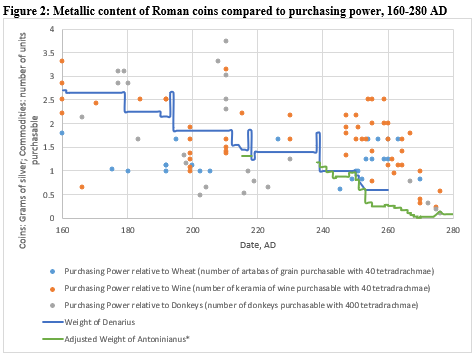
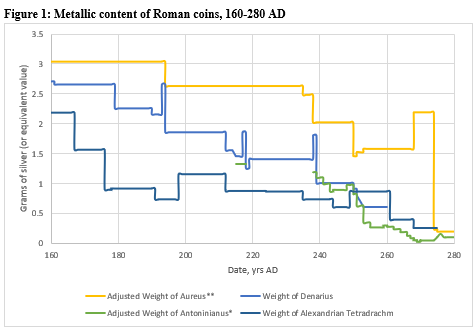
Given that the silver content of coins decreased by over 95% (gold content decreased slower, at an exchange-adjusted rate shown in Figure 1) from 160-274 AD but inflation over this period was only slightly over 100% (see Figure 2, which shows the prices of wine, wheat, and donkeys in Roman Egypt over that period as attested by papyri). If inflation had followed the commodity value of the coins, it would have been roughly 2,000%, as the coins in 274 had 1/20th of the commodity value of coins in 160 AD. This is a major gap that can only be filled in by some other method of maintaining currency value, namely fiat.

Effectively, a gradual debasement was not followed by insipid ignorance of the reduced silver content (Gresham’s Law continued to influence hoards into the early 3rd Century), but the inflation of prices also did not match the change in commodity value, and in fact lagged behind it for over a century. This shows the influence of market forces (as monetary volume increased, so did prices), but soundly punctures the idea that coins at the time were simply a convenient way to store silver–the value of the coins was in the trust of the emperor and of the community recognition of value in imperial currency. Especially as non-imperial silver and gold currencies disappeared, the emperor no longer had to maintain an equivalence with eastern currencies, and despite enormous military and prestige-related setbacks (including an emperor being captured by the Persians and a single year in which 6 emperors were recognized, sometimes for less than a month), trade within the empire continued without major price shocks following any specific event. This shows that trust in the solvency and currency management by emperors, and trust in merchants and other members of the market to recognize coin values during exchanges, was maintained throughout the Crisis of the Third Century.

Imperial communication through coinage

This idea that fiat and social trust maintained higher-than-commodity-values of coins is bolstered by the fact that coins were a major method of communicating imperial will, trust, and power to subjects. Even as Roman coins began to be rejected in trade with outsiders, legal records from Egypt show that the official values of coins was accepted within the army and bureaucracy (including a 1:25 ratio of aureus-to-denarius value) so long as they depicted an emperor who was not considered a usurper. Amazingly, even after two major portions of the empire split off–the Gallic Empire and the Palmyrene Empire–continued to represent their affiliation with the Roman emperor, including leaders minting coins with their face on one side and the Roman emperor (their foe but the trusted face behind Roman currency) on the other and imitating the symbols and imperial language of Roman coins, through their coins. Despite this, and despite the fact that the Roman coins were more debased (lower commodity value) compared to Gallic ones, the Roman coins tended to be accepted in Gaul but the reverse was not always true.

Interestingly, the aureus, which was used primarily by upper social strata and to pay soldiers, saw far less debasement than the more “common” silver coins (which were so heavily debased that the denarius was replaced with the antoninianus, a coin with barely more silver but that was supposed to be twice as valuable, to maintain the nominal 1:25 gold-to-silver rate). This may show that the army and upper social strata were either suspicious enough of emperors or powerful enough to appease with more “commodity backing.” This differential bimetallist debasing is possibly a singular event in history in the magnitude of difference in nominal vs. commodity value between two interchangeable coins, and it may show that trust in imperial fiat was incomplete and may even have been different across social hierarchies.

Collapse following Reform

In 274 AD, after reconquering both the Gallic and Palmyrene Empire, with an excellent reputation across the empire and in the fourth year of his reign (which was long by 3rd Century standards), the emperor Aurelian recognized that the debasement of his currency was against imperial interests. He decided to double the amount of silver in a new coin to replace the antoninianus, and bumped up the gold content of the aureus. Also, because of the demands of ever-larger bread doles to the urban poor and alongside this reform, Aurelian took far more taxes in kind and far fewer in money. Given that this represented an imperial reform to increase the value of the currency (at least concerning its silver/gold content), shouldn’t it logically lead to a deflation or at least cease the measured inflation over the previous century?

In fact, the opposite occurred. It appears that between 274 AD and 275 AD, under a stable emperor who had brought unity and peace and who had restored some commodity value to the imperial coinage, with a collapse in purchasing power of the currency of over 90% (equivalent to 1,000% inflation) in several months. After a century in which inflation was roughly 3% per year despite debasement (a rate that was unprecedentedly high at the time), the currency simply collapsed in value. How could a currency reform that restricted the monetary volume have such a paradoxical reaction?

Explanation: Social trust and feedback loops

In a paper I published earlier this summer, I argue that this paradoxical collapse is because Aurelian’s reform was a blaring signal from the emperor that he did not trust the fiat value of his own currency. Though he was promising to increase the commodity value of coins, he was also implicitly stating (and explicitly stating by not accepting taxes in coin) that the fiat value that had been maintained throughout the 3rd Century by his predecessors would not be recognized going forward by the imperial bureaucracy in its transactions, thus signalling that for all army payment and other transactions, the social trust in the emperor and in other market members that had undergirded the value of money would now be ignored by the issuing body itself. Once the issuer (and a major market actor) abandoned fiat currency and stated that newly minted coins would have better commodity value than previous coins, the market–rationally–answered by moving quickly toward commodity value of the coins and abandoned the idea of fiat.

Furthermore, not only were taxes taken in kind rather than coin, but there was widespread return to barter as those transacting tried to avoid holding coins as a store of value. This pushed up the velocity of money (as people abandoned it as a store of value and paid higher and higher amounts for commodities to get rid of their currency). The demonetization/return to barter reduced the market size that was transacted in currency, meaning that there were even more coins (mostly aureliani, the new coin, and antoniniani) chasing fewer goods. The high velocity of money, under Quantity Theory of Money, would also contribute to inflation, and the unholy feedback loop of decreasing value causing distrust, which caused demonetization and higher velocity, which led to decreasing value and more distrust in coins as stores of value kept this cycle going until all fiat value was driven out of Roman coinage.

Aftermath

This was followed by Aurelian’s assassination, and there were several monetary collapses from 275 AD forward as successive emperors attempted to recreate the debased/fiat system of their predecessors without success. This continued through the reign of Diocletian, whose major reforms got rid of the previous coinage and included the famous (and famously failed) Edict on Maximum Prices. Inflation continued to be a problem through 312 AD, when Constantine re-instituted commodity-based currencies, largely by seizing the assets of rich competitors and liquidating them to fund his army and public donations. The impact of that sort of private seizure is a topic for another time, but the major lesson of the aftermath is that fiat, once abandoned, is difficult to restore because the very trust on which it was based has been undermined. While later 4th Century emperors managed to again debase without major inflationary consequences, and Byzantine emperors did the same to some extent, the Roman currency was never again divorced from its commodity value and fiat currency would have to wait centuries before the next major experiment.

Lessons for Today?

While this all makes for interesting history, is it relevant to today’s monetary systems? The sophistication of modern markets and communication render some of the signalling discussed above rather archaic and quaint, but the core principles stand:

  1. Fiat currencies are based on social trust in other market actors, but also on the solvency and rule-based systems of the issuing body.
  2. Expansions in monetary volume can lead to inflation, but slow transitions away from commodity value are possible even for a distressed government.
  3. Undermining a currency can have different impacts across social strata and certainly across national borders.
  4. Central abandonment of past promises by an issuer can cause inflationary collapse of their currency through demonetization, increased velocity, and distrust, regardless of intention.
  5. Once rapid inflation begins, it has feedback loops that increase inflation that are hard to stop.

The situation in Venezuela continues to give more lessons to issuing bodies about how to manage hyperinflations, but the major lesson is that those sorts of cycles should be avoided at all costs because of the difficulty in reversing them. Modern governments and independent currency issuers (cryptocurrencies, stablecoins, etc.) should take lessons from the early stages of previous currency trends toward trust and recognition of value, and then how these can be destroyed in a single action against the promised and perceived value of a currency.

Be Our Guest: “Of Monies and Juries and Freedoms”

Be Our Guest is a new, experimental series at NOL. Basically, NOL is invite-only but you can, and should, submit your thoughts to us. The latest piece is by Michalis Trepas, a Greek national working in the financial sector. An excerpt:

The judicial system was reluctant to intervene, out of respect of the separation of powers (according the Weimar Constitution, currency matters were reserved for the parliament). So, at first, the courts upheld the nominalistic principle and refused to accept a revalorisation of debts. But then, something began to change in the courts’ reasoning. The currency’s slide prior to 1921 could be attributed to the conditions of the “war economy”, whose burden was to be shared by everyone in the country. The unrestrained fall thereafter, the courts said, was a monetary phenomenon, punishing “blindly and unpredictably” only the creditor class.

If you cannot guess by now what Michalis is writing about, read on! If you have figured out what the subject of his piece is about, read on, as it only gets more interesting.

There are cultural and geopolitical considerations to think about here, too, in regards to Greece and Germany and financial markets and constitutionalism.

Mexican Productivity and Poverty: a Superficial, Street-Level View

I just spent three and a half weeks in Puerto Vallarta, Mexico (summer 2019). Below are some impressions. First things first; I have to give you the severe limits of my field of vision while I was there.

My wife and I stayed in an old-fashioned, 1950s low-rise hotel on the ocean with a pleasant faded kind of glory. (My wife Krishna does not let me go to Mexico by myself, for obvious reasons!) It was very hot throughout so, we did not go out much except that we had to shop for food every day at the mall across a broad avenue. We took taxis to and from the dentist about fifteen times. I always chat with taxi drivers; they gave us the foundation of sociology, I am sure! We spent a little time in the old touristy market district (where we have friendly acquaintances from past visits). We also walked some on Puerto Vallarta’s beautiful and interesting seafront (the “malecon”). I speak Spanish well, I understand everything in the language; I read it with ease. I read the paper a few times; I watched the Spanish language news on television a few times. I read free brochures on this and that.

There is much to like in Mexico, and especially Mexicans. They are low-key, unexcitable, stoical cordial, affable, and eager to help, and not only vis-à-vis this pleasant, well-disposed gringo, myself. Living for a short time in pleasant, clean Puerto Vallarta, it’s difficult to remember that Mexico’s homicide rate is three times the US rate. It takes the occasional sighting of a truckful of the new, nattily dressed National Guard with automatic weapons to jog your memory. (See notes from a previous visit: “Mexicans in Mexico,” 2017, )

Low productivity

My main observation is a repeat from what I recounted the last time I was there (See my “Mexican Underdevelopment: Pop-Sociology.”) It’s about productivity. For most of our stay, there was work going on on a brick path right beneath my windows. It was mind boggling. At one point, there were seven people working on the same two steps, including a master craftsman. They continued by restoring and cleaning a flat brick path. The thought stuck me that,in California, two, or two-and-a-half of the same Mexican workers (the very same guys) would have done the same work in the same time easily. And, yes, I know something about brick laying, both personally (I used to be very poor; now I am moderately poor), and as a customer. I am talking about a more than fifty per cent rise in productivity obtained by simply moving workers into a different environment. Bosses and economic leaders would easily kill for a change of such magnitude!

Of all the guys on the bricklaying and brick cleaning site, only one had a proper power tool, and it was only operational part of the time. The others labored by hand, mostly on their knees. No one had thought of giving them knee-guards. They had not themselves.

Moderate Poverty

The workers told me they were making about US$23 a day, or $115 for a forty-hour week. That’s not bad given that beginning professional positions – that require a university education – in thriving, manufacturing Monterrey are advertised for US$600 a month. Yet, and although most food, housing, gasoline, and health care are all cheaper in Mexico than in the US, this is still not much money on which to rear a family. But, this is also not dire poverty of the kind we used to see, and sometimes still find in India or in Africa. In that part of Mexico, everyone looks healthy, especially the children. Many adults are obese, more or less like in the US. Everyone is well dressed, by the admittedly low standards of central California where I live.

Over-staffing

Here is striking fact: Wherever you go, you find overstaffed shops, restaurants, etc, often very overstaffed. I mean like three shop attendants doing nothing in the middle of the afternoon. There must be a reasonable number of exceptions because my dentist’s office makes good use of its human resources. The same young women who serve as assistants, also act as receptionists. (I know, know, comparative advantage; don’t get me started, this is not the time or place.)

Productivity and Income

Over-staffing and the failure to provide workers with the best tools matter a great deal if you think, as I do, that incomes roughly follow productivity though often with big time lags, and often not in a linear fashion. Although employers sometimes fail to share the product of productivity gains with workers, the fact is that they cannot share gains that have not occurred. Low productivity pretty much guarantees low wages.

Note what I am not saying. The Mexican work ethic is not the problem. The guys who worked in the hot sun of tropical Mexico for eight hours a day don’t need lessons from anyone on that count. Also, those of us who live in California remember well the recession years when the vegetable picking lines remained nearly all-Mexican (with a handful of Filipinos) while poor Anglos lamented the absence of jobs. Now that wages in the field have increased substantially because of a chronic farm labor shortage, still few college students are flooding in, California sky-high rents or not.

Going back to fairly prosperous Puerto Vallarta, where construction is thriving (because of Canadian refugees from the cold, I am told), there is also the mysterious fact of the invisible zealot pounding stakes close to my hotel at 5:30 AM. I am not complaining. I respect this instance of unreasonable industriousness!

Social Structure and Productivity

Mexicans remain poor, the Mexican economy keeps growing but only slowly. This is, at least in part, I think, because Mexicans have normative standards that do not feed high productivity. These standard maintain a permanent social structure that makes increasing productivity difficult. A vicious/virtuous circle is at work. Labor is cheap because of its low productivity. It’s so cheap that, why not hire an additional worker for the same job? The incentive to hire nonchalantly is probably high because of Mexicans’ high connectivity. Mexicans, even in a fairly new city like Puerto Vallarta appear much more interconnected than Californians. (I don’t know much about the East Coast of the US.) There are many more individuals in one’s life there to please by giving their relatives and liege a job than is the case where I live.

Take the lifelong relationship of “compadre” and “comadre” between adults who are usually not kin to each other. The titles denote the link between a man and a woman who are respectively godfather and godmother to the same child. It easily multiplies by two or three beyond actual relatives the circle of individuals to whom one is to some extent obligated. And, it does not end there. Why, there is even a word in Mexican Spanish to denote the relationship of two people who have the same first name! I forgot the word but I was charmed to discover that I was ##### to any number of “Diegos.” I can even imagine situations where someone would succeed in using that tenuous link to extract a small favor from me (with a probable intention to reciprocate).

High Connectivity not a Specific Feature of Mexico, and Over-Staffing

I don’t think this high connectivity is an idiosyncratic feature of Mexican society. I believe rather that something similar prevails in India (that I know a little). It seems to me that high connectivity was visible also, in rural Brittany when I was a child in the forties and fifties. It was largely absent in Paris by contrast where I lived most of the time (Order my book of socio-historical memoirs of that period: I Used to Be French: An Immature Autobiography; avoid the middle person, go through me.). Having obligations to few rather than to many is a salient feature of modernity (that includes also urbanization, small nuclear families, and a search for formal education).

I speculate that Mexicans, even in comparatively modern places like Puerto Vallarta, have a high tolerance for over-staffing because of the large social networks within which they exist. Over-staffing is thus a primary contributor to low productivity. Low productivity keeps many people poor. Poor people need a supportive network more than do the more prosperous. Long and short of it: to break the cycle would require a degree of de-humanization of Mexican society. It’s not inexorable. Mexicans may collectively choose a bearable level of poverty (see life expectancy below) over the destruction of the emotional comfort larger social networks promote.

Not Following in the Footsteps….

It seems to me that a high degree of familiarity with the negative example of American society next door with its low connectivity – in places – may guide them toward such a choice. In point of fact, I have met a strikingly large number of Mexican men who had worked in the US for several years and who had returned home under their own power, by choice, according to their narratives. (I also note with satisfaction that ten years ago, S. Nikiforov and I had evoked precisely that sort of preference in a big article on Mexican immigration: “If Mexicans and Americans could cross the border freely,” in The Independent Review, 14-1: 101-133 [Summer] 2009.)

There is no law of nature that requires the people of less developed countries to retrace all the steps of their predecessors in development. The cellphone shows us that often, they don’t have to: Several African countries have phone landlines only in the center of their major city but 80% of their population has access to a cellphone. Trying to skip stages is the rational thing to do, of course. I would guess it’s most successful when it depends largely on a myriad of individual decisions, as with cellphones. Nevertheless, it seems to work pretty well – for some reason – even with collective decisions regarding health care, specifically.

Perhaps, societies can pick and choose what features of modernity they actually want thanks to a density of available information and a richness in inter-communications that was unimaginable forty years ago. (That was when I was studying underdevelopment with rigorous methods.) I can picture a partial national consensus forming that says, “We don’t need everything the big guys have; a little bit more of this and of that, and we are OK.” If this scenario is realistic, food, schooling, and health care will probably be its dominant themes. The Mexican food situation appears fine (I will consider contradiction on this.). In my subjective judgment, based on its products, on the average, Mexican K-12 is superior to its American public counterpart.

Illness and Health care

One component of socio-economic underdevelopment and also an obstacle to development in its own right used to be widespread illness. The morbidity figures I saw in the seventies about the situation in the fifties were horrifying. Illness also obstructed development indirectly because it destroyed family units through the death of parents or older siblings, even of aunts and uncles who might have provided. This is largely in the past. The present in poor countries is very different, greatly improved from the narrow standpoint of health. And, it turns out, the Mexican health picture, in particular appears fairly bright.

Single Payer Health Care

Something to think about for my conservative friends: Mexico has single payer healthcare for those who want it. It has a pretty poor reputation, it’s true. A private health network subsists side-by-side with it for the prosperous. (I like that.) Yet, yet, the life expectancy of Mexicans is only 2.6 years lower than that of Americans, same as the difference between the US and the Netherlands (WHO 2015, in Wikipedia). Americans live longer than Mexicans in the same proportion as the Dutch live longer than Americans. So, either, it’s possible to get fairly similar results health-wise at much lower cost than do Americans, or health care does not matter all that much, as far as not dying is concerned. (Hate to twist the knife in the conservative wound but the Dutch also spend much less money than Americans on their health care.)

Incidentally, I am well aware that there are non-economic arguments against entrusting what is now 17% of the US GDP to the government, to any government. But, perhaps, conservatives should restrict themselves to combating govt. health care on political and principle grounds alone. (End of digression.)

Where To?

So, where am I going with this, you may fairly ask? I am expressing my doubts that Mexican society – and other less developed societies – will be forced to undergo the dislocating social change that would be required to improve much its (their) productivity, according to the old schemes. I have to stop here, more or less, but it seems to me that Mexico is more likely to improve first its societal-level productivity by having more women join the work force. The preservation of a high existing level of connectivity – with its baked-in child care and food services – would ease, and facilitate such mass social change, of course.

Be Our Guest: “How to make Brexit Really Worthwhile – Example: Regulation dealing with Information Asymmetries”

Here is the latest installment of NOL‘s new “Be Our Guest” series, this one by the pseudonymous Freeconomist. An excerpt:

Third-party certification provides assurance to consumers that a product or a supplier of professional services meets certain quality standards.

Private suppliers of third-party certification include organisations such as Consumer Reports, the American Automobile Association (AAA), which rates motels, or A.M. Best, rating insurance companies. Examples of third-party certification provided by the government are product safety regulation, food standards regulation or occupational licensure.

Private suppliers of third-party certification can only exist because the product they offer is valued enough by market participants to justify the cost of providing it. And their profits are determined by their credibility.

The same cannot be said for third-party certification provided by the government.

Please, read the rest and do keep submitting your thoughts to us.

Financial History to the Rescue: The Harder Money Wins Out

This article is part of a series on bitcoin (and bitcoiners’) arguments about money and particularly financial history. See also:

(1) ‘On Bitcoiners’ Many Troubles’, Joakim Book, NotesOnLiberty (2019-08-13)
(2): ‘Rothbard’s First Impressions on Free Banking in Scotland Were Correct’, Joakim Book,
AIER (2019-08-18)

(4): ‘Bitcoin’s Fixed Money Supply Is a Weakness’, Joakim Book, AIER (2019-08-28)

The great monetary economist and early Nobel Laureate John Hicks used to say that monetary theory “belongs to monetary history, in a way that economic theory does not always belong to economic history.”

Today I’m going to illustrate exactly that with respect to the Bitcoiner’s (mistaken) progressivism in another episode of Financial History to the Rescue.

In the game of monetary competition, the Bitcoin maximalists posit, the “harder” money always wins out. I’ve been uneasy with the statement as it (1) isn’t clear to me what “harder” money (or money’s “hardness”) really means, and (2) probably isn’t historically true. So we end up with something that’s false, or vague – or both! Clearly unsatisfactory. As I pointed out in my overview post to this series, financial and monetary history is almost always more nuanced than what such simple generalizations allow.

Luckily enough, Saifedean Ammous at the Soho Forum debate last week, did inadvertently provide me with a useable definition – and I intend to use it to debunk the idea that money’s history is one of increased hardness. Repeatedly Saif claimed that monetary history, before the advent of central banking, showed us that the harder money always won out: whenever two monetary networks clashed (shells and silver; wampum and gold) the “harder” money won. The obvious implication is that Bitcoin, being the “hardest” money, will similarly win out. Right off the bat, there’s some serious problems here.

First, it’s not altogether clear that such “This time is not different” arguments apply. Yes, economic history teaches us not to discount what seems to be long-standing or universally applicable phenomena – but also to take notice of the institutional setting in which they happen. Outcomes specific to, say, the Classical Gold Standard, rarely generalize into our hyper-modern financial markets with inflation targeting central banks.

Second, over the twentieth century we literally went from the hardest money (gold) to the “softest” money (central bank-created fiat paper money). Sure, you can argue that this was unfair or imposed upon us from above by wars and welfare states, but discounting it as irrelevant strikes me as overly cherry-picking. If the hardest money “lost” before, what makes you think that your new fancy money will win out this time around?

Then Saif returned to the topic of hardness and defined it as a money whose supply is “the hardest to increase.” The hardness of Cowrie shells or Wampum or gold or Whale’s teeth or Rai stones or the other early money that Jevons listed and discussed in 1875, all rely on a difficult, costly and inconvenient process of extraction and/or production. Getting Rai stones from far-away islands, stringing beads together into extended strips of Wampum, or digging up gold from inaccessible patches of the earth were all cumbersome and expensive processes. In Saif’s mind, this contributed to their hardness. Their money stock were simply difficult to expand – in jargon: their money supplies were inelastic.

The early 1600s Dutch Republic struggled with another problem. As the main financial centre of the time, countless hard money (coins) from all over the world were used in Amsterdam. Estimates say over a thousand legally recognized kinds of coins – and presumably even more unrecognized coins. A prime setting for monetary competition: they were all pretty hard (Saif’s definition: difficult and costly to expand) commodity moneys, of various quality, origin, and recognition in trade.

Another feature of 17th century Amsterdam was the international environment of Bills of Exchange (circulating private credit notes). Briefly summarized, merchants across the world traded debts on Amsterdam bankers or traders, and rather than holding and transporting bullion across the world, they transported the debt of the most trustworthy and reliable Dutch financiers. As all such bills required a settlement medium in Amsterdam, trade on thin margins was very sensitive to fluctuations in prices between the commodity moneys in which their bills were denominated – and very sensitive to debasements and re-defined values by various European proto-governments.

In 1609, the City of Amsterdam created the Wisselbank (initially a 100% reserve exchange bank) specifically tasked with standardizing the coinage and to insulate the bill market from currency fluctuations (through providing a ‘neutral’ unit of account for bills settlement). The Bank accepted deposit of whatever coin at the legally recognized rate (unrecognized at metal content) and delivered ”high-quality Dutch trade coins” upon withdrawal. To fund itself, it added a withdrawal fee of 1.5%, but no internal transfer fee, which made holding currency at the Bank very expensive in the short-term, but very cheap in the long-term. Merchants also avoided much of the withdrawal fee by simply trading balances with one another rather than depositing and withdrawing trade coins. In return for this cost-saving, sellers of bank balances would share a portion of the funds saved with the buyer in what’s known as the “Agio”: the price of Bank money in terms of current money outside the Bank’s accounts. This price would fluctuate like any other price on the market and would indicate the stance of liquidity demands.

In a classic example of Alchian’s monetary competition by transaction costs, Dutch merchants and financiers “outsourced” the screening and assaying of unfamiliar coins. They preferred settling their transactions through the (cheaper) medium that was deposits in the Bank.

And it gets worse for the bitcoiner’s story. In 1683, the Bank coupled its deposits with specific receipts for withdrawal; to gain access to coins, one was required both to hold balances and to purchase a receipt issued by the Bank (they also changed the pricing). Roughly speaking, the Bank became a fractional reserved bank (with capped withdrawals) overnight – and contrary to what the hardness argument would imply, the agio on Bank money rose to above par!

Two monetary historians, Stephen Quinn and William Roberds, summarize one of their many writings on the Wisselbank as follows:

“imaginary money on the Bank’s ledgers succeeded because it was more reliable than the real stuff. […] The most liquid asset in the economy was no longer coin, but a sort of ‘virtual banknote’ residing in Bank of Amsterdam accounts.”

Further,

“the evolution of the agio shows that the market valued irredeemable balances as if they were closely tied to backing trade coins” (my emphasis)

The story of the Amsterdam Wisselbank’s monetary experiments and innovations show us that monetary adaption relies on many more dimensions than “hardness.” Sometimes “hard” money is defeated by “soft” money, since the softer money brought other benefits to its users – in this case a cheap and reliable settling medium.

The lesson for bitcoin-vs-fiat-vs-FinTech is pretty clear: hard money doesn’t always “win”; and sometimes “soft” money can better serve the needs of consumers in a free market.

Financial History to the Rescue: On Bitcoiners’ Many Troubles

This article is part of a series on bitcoin (and bitcoiners’) arguments about money and particularly financial history. See also:

(2): ‘Rothbard’s First Impressions on Free Banking in Scotland Were Correct’, Joakim Book, AIER (2019-08-18)
(3): ‘The Harder Money Wins Out’, Joakim Book, NotesOnLiberty (2019-08-19)
(4): ‘Bitcoin’s Fixed Money Supply Is a Weakness’, Joakim Book, AIER (2019-08-28)

It is unfair to expect technologically savvy bitcoiners to also be apt and well-read monetary economists. By no means do the skills and experiences of either have to overlap. Through the rise of Bitcoin with its explicit central banking challenge and attempt to become a worldwide currency, the subject matter of the two groups has unexpectedly clashed. All arguments that support or attack bitcoin is a head-first dive into monetary economics – sometimes exhuming centuries-long disputes among monetary economists and often blatantly distorts and overlooks money and banking arrangements of the past.

We can’t have that, can we.

One of the most delightful events in the libertarian world is the monthly Soho Forum debate run by Gene Epstein. Yesterday’s splendid showdown between Profs. George Selgin and Saifedean Ammous on the suitability of Bitcoin as a Medium of Exchange is bound to get some serious traction once the recording is on available only – look out for that!

A great debate for anyone interesting in monetary system and monetary economics more generally, this was probably the best and most entertaining of many Soho Forum debates I’ve watched. It’s a good format that forces speakers to engage and respond to one another’s arguments, which makes a two-hour conversation on something as technical and intricate as Bitcoin’s monetary role an absolute delight; even those of us deep into this nerdy rabbit hole can learn a lot and walk away with a trove of inspiration.

Channeling that inspiration into long-form, multi-part reviews of the relevant financial and monetary history is exactly what I’m going to do!

One question I often get regarding my research interests (banks, money and financial markets in the past) is the mildly offensive but absolutely correct question to ask: who the f— cares?! Bitcoin and the question of monetary regimes are perfect examples that make financial history relevant: the rise of crypto questions the fundamentals of monetary systems, systems that very rarely change. Naturally, the financial historian has an edge here, having a lot more nuanced knowledge about past monetary and financial arrangements and their operations. History becomes our (only) laboratory, to which the financial historian typically has a lot to contribute.

Moreso than other topics, fundamental questions of monetary regimes are explicitly pitted against other possible regimes – by their nature comparative and always informed by historical experience. It takes about two-and-a-half sentences before debates over money invoke some reference to financial and monetary history – as they should, since they illustrate how some (aspect of) a different monetary regime worked. Frustratingly enough, there’s a good chance that the speaker has mindboggingly little idea of what s/he’s talking about!

That’s where I like to come in. To a roomful of aspiring monetary economists at Cato’s Alternative Money University in July this year, Randall Wright‘s response to why he does monetary economics at all (“to debunk all this B-S!”) generalizes pretty well.

I’m gonna use this post to review some of the mistakes Saifedean made yesterday – and use it going forward as an updated collection of future posts on the topic, especially as I go through Saif’s promising book, The Bitcoin Standard: The Decentralized Alternative to Central Banking. The aim here is to respectfully clarify the parts of the Bitcoin arguments where I’d like to think that I have a comparative advantage – financial and monetary history – and to better develop my understanding of the monetary theory involved.

Here are some points that came up yesterday:

  • The Monetary Progression of ‘Harder Money’: the brilliance of the past is that almost any account, no matter how persuasive and compelling, is bound to run into inconvenient historical facts. The world is more nuanced than can be reasonably captured by pithy generalization (yes, I realize the irony here). In a piece attacking this bitcoiner’s creation myth earlier this year, I wrote:

This progressively upward story is pretty compelling: better money overtake worse money until one major player unfairly took over gold – the then-best money – replacing it with something inferior that the Davids of the crypto world now intents to reverse. […] Too bad that it’s not true. Virtually every step of this monetary account is mistaken.

  • The Lender-of-Last-Resort role privately provided: Many Austrians and opponents to fractional reserve banking routinely believe that banks holding less-than-100% reserve against their deposits must have a government backing them, providing emergency liquidity when such banks are inevitably run upon. This is completely false. I can point to many different historical instances that privately accounted for such risks, from private clearinghouses to insurance, to the option-clause debate in Scottish Free Banking and contingent/unlimited liability institutions.
  • …which leads us to Scottish Free Banking. There’s a famous quip by Rothbard (“Rothbard’s Law“) that describes the tendency for economists to specialize in the fields they’re worst at: Henry George specialized in land, where his writing is appalling; Milton Friedman on Money, where he’s awful etc. I usually say that the same thing applies for Rothbard whenever he writes on Financial History. Very bad. And yes, I will go through his article ‘Myth of Free Banking in Scotland’
  • Saif made a distinction yesterday between the “Medium of Exchange” and the “Payment Mechanism” involved that struck me as misleading, and I didn’t get a chance to finish my reasoning with him in person – so I’ll flush it out in a piece later on. Happily for all you Free Banking fans, it involves note-issuing Scottish banks and the bigger questions of redeemability and outside/inside money.

Some additional housekeeping from yesterday:

  • Saif: “There was no real estate bubble on the Gold Standard”.
    • Yes, Selgin said, the Florida 1920s housing bubble leading up to the Great Depression. No, Saif correctly objected, that wasn’t a real gold standard, but a central bank-planned Gold Exchange Standard.
      Ok, fine – I’d agree with Saif here. How about the 1893 Australian banking crisis? Classical Gold Standard, no central bank, but a property boom and bubble-like collapse nonetheless.
    • A response might be “but fractional reserve banking!” but a) that’s a topic I’ll delve into much more, and b) this is started to sound like a No True Scotsman fallacy…
  • Saif: “Central banks hold gold – they don’t trust each other enough to hold currency”
    • Saif probably misspoke here, since he couldn’t possibly believe this; looking at any central bank’s balance sheet would instantly dispell such beliefs. Central banks generally hold no more than 5-8% of their assets in gold, and often a lot more than that in foreign currency-denominated asset. The ECB holds about equal parts (7-8% of assets) in gold and foreign currency. I routinely follow the weekly changes in the Riksbank’s balance sheet and even after a more extreme QE programe than the Fed’s (as % of GDP), it holds more FX than it does SEK-denominated assets (and no more than 5% in gold). The Bank of England technically doesn’t actually have any gold at all on its balance sheet, but holds gold in storage at its vaults (on behalf of other countries and the UK Treasury).

Bear with me over the next few months, as I make my way through Saif’s book and engage with these thrilling debates. Feel free to interrupt/comment on Twitter at any point if you think I’ve made a factual/empirical error, error in reasoning or in relevance to Bitcoin.

And yes, keep in mind that this is a respectful inquiry into fascinating topics with people who agree on like 92% of everything. Feel free to call me out for unnecessarily snarky and offensive thing as we go along – and welcome to the party!