Property Rights in Africa: More Decentralization Please

From the economist Camilla Toulmin:

While land registration is often proposed as a means of resolving disputes, the introduction of central registration systems may actually exacerbate them. Elite groups may seek to assert claims over land which was not theirs under customary law, leaving local people to find that the land they thought was theirs has been registered to someone else. The high costs of registration, in money, time, and transport, make smallholders particularly vulnerable to this.

You can read the rest of her article here [ungated version can be found here]. It goes on to elaborate upon how more decentralization is needed, as well as the need for more incorporation of indigenous legal practices. Highly recommended, but grab a cup of coffee first.

Arguments to ponder:

  1. James Buchanan’s work on public choice (elite groups seeking to capture the rent)
  2. Friedrich Hayek’s work on tacit knowledge and the inability to plan societies from the top
  3. Elinor Ostrom’s work on governing the commons and how states muddle the intricate “rules of the game”

Any thoughts? Suggestions for further reading?

Property Rights in the Post-Colonial World

Land grabs and crony capitalism at its finest. From Reason magazine:

Politicians in the affected countries are key partners in operations that resemble the late-19th-century scramble for control of Africa. The land grabs aim at enriching privileged companies and their political allies, usually at the expense of those already on the land. States, companies, and their frequent close friend, the World Bank, see no reason to respect sitting owners and resource users, whatever their rights under customary law and (sometimes) postcolonial statutes. Pastoral nomads get even less respect. In Tanzania, for example, governments and safari capitalists have reduced the traditional grazing lands of the Maasai herdsmen to a fraction of what they were. And in Ethiopia, the government’s “villagization” policy, Pearce writes, resettles peasant farmers “in the manner of Stalin, Mao, and Pol Pot,” clearing the way for deals with foreign capital.

You can read the rest here. I hope to have some more academic articles up as links soon.

Ron Paul’s Legacy

Ron Paul will not get to speak at the GOP convention, but his legacy will hard to miss over the next decade of American politics. His son is now a Senator in Kentucky, and his Audit the Fed bills have lots of bi-partisan support (in the House anyway; Senators, for some strange reason, seem to like the Federal Reserve an awful lot).

His foreign policy, which initially attracted me to libertarian ideas, is the most important legacy, however. I can tell because the GOP loathes it so much that they won’t give Congressman Paul the time of day they know they need for his support.

From Foreign Policy: Continue reading →

Life Under Fatwa

I did once visit Iran when I was 21 years old, during the time of the shah. It was wonderful. I had just graduated from university, and such was the world at that time, 1968, that I was able to drive with a friend from London to South Asia across the world. I mean, try driving across Iran and Afghanistan now! I remember it being a very cosmopolitan, very cultured society. And it always seemed to me that the arrival of Islamic radicalism in that country, of all countries, was particularly tragic because it was so sophisticated a culture — which is not to defend the shah’s regime, which was appalling. But it was one of the tragedies of history that an appalling regime was replaced by a worse one.

From Salman Rushdie.

At first I found his praise for the Obama administration to be typical of Left-wing establishment figures, but then I remembered that Rushdie is an Indian and had probably had to deal with racist legislation in one form or another while growing up. While the period of colonialism (roughly coinciding with the end of the Napoleonic Wars and the beginning of World War I) did indeed open up more places to markets, the Jim Crow-like legal barriers that European states erected no doubt helped to foster part of the suspicious climate that now pervades most globalization skeptics worldwide.

This is a shame for two reasons: Continue reading →

Around the Web

How savage has European austerity (spending cuts) been?

An Invisible Nation: the Gulf’s Stateless Communities

The Moral Limit of Markets Debunked

Keynesian Obstinate Ignorance


From the Comments: the Unemployment Rate

Dr. Gibson has won the much-cherished gold star I had offered in a previous comment. My question had to do with the green dot in this graph, and Dr. Gibson explained it to perfection. He writes:

The widely followed U3 unemployment rate, as shown in the figure, is the number of unemployed divided by the labor force. The labor force excludes discouraged workers. The labor force participation rate is the labor force size (employed & unemployed) divided by the population. The green dot shows what the U3 rate would be if that ratio had stayed the same since Jan. 2009.

The U6 statistic counts discouraged workers as unemployed. That rate is currently around 15%.

See also: Unemployment: What It Is

From the article Dr. Gibson directs us towards comes some other important information:

Government policies contribute to unemployment above and beyond natural unemployment. The most notorious of these policies are minimum wage laws. These laws make it illegal, effectively, for low-skilled workers to accept employment. Anyone who cannot generate $8 worth of production per hour cannot expect to be paid more than $8. Such unfortunate people might be productive at $6 per hour but are forbidden to accept employment at this rate and are instead condemned to joblessness and all its attendant miseries. This burden falls most heavily on black teenagers, whose unemployment rate (based on those seeking work and excluding those who are in school) is well over 40 percent. The benefits accrue mainly to slightly higher-skilled workers, who have climbed onto the metaphorical ladder leading to better jobs and who are shielded from competition from those excluded by minimum-wage laws […]

Labor unions, as voluntary associations bargaining freely with employers, are unobjectionable. They did a lot of good in the past when working conditions in many places were pretty bad. But now they are granted special privileges by law—basically the privilege to engage in violent or coercive activities. The result is often wage agreements that are above market-clearing levels. Those left out are of course unemployed.

While labor unions can boost their members’ compensation at the expense of non-union workers, higher wages generally and higher living standards are due mainly to increased productivity, which in turn depends on high levels of capital investment. People are more willing to save and invest when they have confidence in the future, and that confidence comes from respect for property rights.

For more on minimum wage laws, see Bad Idea of the Year.

From the Comments: Keynesian Economics and the Stimulus Bill

A recent brouhaha has erupted in the comments thread of Dr. Delacroix’s post on Obama’s bad economic policies. Now, to be sure, the bad economy cannot be put on Obama’s shoulders alone. All he did was sign the stimulus act into law, after all, and I doubt John McCain would have vetoed it.

Let us also not forget about the two foreign wars that George W. Bush charged to the republic’s credit card, either. With that being said, I thought another economic chart would do readers of this blog a favor. From AEI’s blog comes this:

Ta-dah! Utter economic failure.

(h/t Steve Horwitz)

Economic Growth in Europe: the Longer View

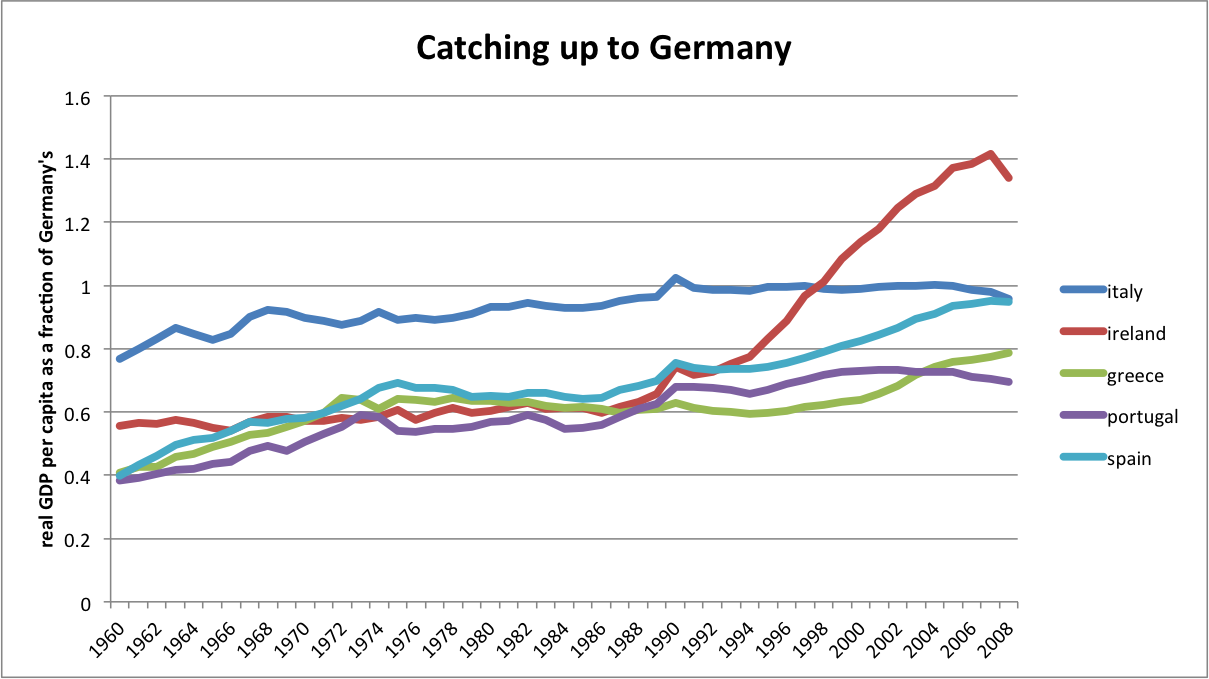
Economist Tyler Cowen has a post up on who has gained most from the Euro (as measured by state), but the economist Angus puts things into perspective:

Ireland, Spain, Portugal and Greece were all growing fast relative to Germany (and France which is not on the graph) well before the introduction of the Euro. Ireland and Spain take off somewhere around 1990 and the intro of the Euro in 2000 does not speed up their trajectory. Portugal actually falls further behind Germany in the Euro era. Greece is the only country of these 5 whose catch-up to Germany accelerates with the intro of the Euro.

Two quick thoughts:

  1. Woah! Look at Ireland!
  2. I’ll bet the acceleration of growth in the 1960’s had to do with the end of World War 2 and its rebuilding efforts.

Taking a broader historical view really puts things into perspective. If the Euro was not the catalyst for the economic growth of the 1990’s, what was? My guess is that the elimination of tariffs and labor restrictions between European states led to the growth. If the Eurozone had not implemented a central bank I think we wouldn’t be looking at all of the political problems now associated with the region.

Angus (who works at Oklahoma University) got his statistics from here. I highly recommend using it in your own studies as well.

Obama’s Economic Policies: What’s Wrong, in a Nutshell

People are overwhelmed by the avalanche of bad news, and of news in general. It’s difficult to stop long enough to summarize objections to the new economic policies fostered by Presidents Obama and Pelosi.  Besides, if you tried, you might just strangle with horror and indignation. I made the effort. Here it is:

Pres Obama wants to re-distribute wealth when the amount of wealth available to re-distribute  is dwindling. It’s never happened, I think, in any democratic, market-oriented country before. Normally, you wait for a period when wealth is growing.

Pres Obama insists on an expensive stimulus package that will do, and has done little to stimulate the economy. Keynesian economics is largely wrong. This is Keynesian economics at its worst. It’s not even defensible by Keynesian standards.
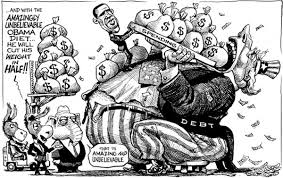
Pres Obama choses a severe economic downturn to force us as a nation to try and do things we don’t know how to do. This includes switching from proven energy technologies such as coal and petroleum-based technologies to unproven ones such as air and wind technologies. It includes also constructing a satisfactory national health system, something no country has done. Normally, whenever you try something new, you make mistakes. You need a margin of error. You need to be reasonably rich. You don’t want to do it on a tight budget or when you are close to poverty.

Pres Obama is not evil. He has something I have seen hundreds of times in academia: He knows what he thinks he knows and he does not know anything else. He is narrow-minded and dogmatic. The more intelligent the person, the more stubborn in his narrow-mindedness and in his dogmatism. A less intelligent person would have the virtue of self-doubt, “Wait a minute, am I doing the right thing?”

Perplexing: There is an international media consensus  to the effect that the current global economic crisis was made in America. Yet, I detect no rise in anti–Americanism abroad. This would be a good time to be pissed off at us but, I don’t see it anywhere.

I wrote on this blog about “European Anti-Americanism.”  I suggested it was mainly based on envy. Perhaps, I was right: Others like us better when we are down and hurting. What do you think?

Recently, I mentioned the sentencing of a 75-year old woman to a whipping, in Saudi Arabia. I promised that I would check for indignant reactions on the part of Muslims. I have seen nothing on the website of the American Muslim Council and nothing of the website of the Islamic Society of North America.  I haven’t found anything either on French Muslim sites.

Of course, it’s disturbing. I would like it if someone told me that I am wrong and that I searched in the wrong places. I know I have Muslim readers. Get on your feet and do what’s right.

[Editor’s note: this essay first appeared on Dr. Delacroix’s blog, Bay Watch, on March 26th 2009]

North Dakota or Bust!

An excerpt from co-editor Fred Foldvary’s Progress Report:

In theory, productive public goods increase land rent because the supply of land is fixed. There can also be a rise in wages from more public goods, but that would be temporary. If labor becomes more productive in a location, that attracts labor from areas where wages are lower for the same skills. The increase in the labor supply will drive wages back down to normal. But the total supply of land in some region cannot expand, so the increase in rent sticks.

Just as territorial benefits raise land values, costs to landowners reduce the rent they keep, and so capitalize land value down. If the public goods are paid for by public revenue from land rent or site values, then the rise in land values would be limited. If governmental public goods are paid by labor and enterprise, then the rentalization and capitalization are implicit subsidies to landowners, at the expense of taxed labor and enterprise.

Economists have found evidence of the generation of higher land values from greater public goods. We now have an excellent case study: North Dakota.

Read the whole thing here. I’ve never been to North Dakota, but if it’s anything like South Dakota I might be tempted to settle there someday. Just kidding! California is the best state to live in, even with our terrible, fascistic-like government.

I am still having trouble wrapping my head around the concept of land value taxing, though. Someday I’m going to have to spend a couple of days with a copy of Henry George’s Progress and Poverty and see what I can figure out.

Criticizing the Right

There has been lots of attention on this blog geared towards the hypocrisy of the Left, and I think that it is justified, but all too often we have been giving the Right a pass. I think this has to do with the fact that the Left holds the presidency, but I still think it’s appropriate to remind readers that libertarianism is of neither the Left nor the Right. Philosopher Jason Kuznicki does just this in a brilliant post:

Scrutinize your own side too. Take a hard look at cushy “privatization” deals that really just funnel power and money directly into private corporations’ hands. As a certain liberal recently observed, the way to privatize a prison isn’t to give imprisonment power to a corporation. It’s to stop imprisoning so many people, then sell off the property. About which more below […]

But other restrictions exist. Many of them bite even harder.

Consider immigrants. In particular, if our free market is so great, why do you work so hard to exclude immigrants from it? Is the immigrant laborer less a moral self-fashioner than the Wall Street banker? I wouldn’t say so. He’s clearly at least as motivated. If the immigrant wants to make a life in America — why not let him?

Mr. Ryan recently proclaimed that the United States is the only nation founded on an idea. It’s a common conservative theme, and even if it’s not 100% accurate, I’m certainly sympathetic to it. But we are founded on an idea if and only if our borders remain open to all who share that idea. The moment we start checking for purity of blood, we become a tribalist nation-state just like so many others. Not founded on an idea, but on accidents of birth—and in fact standing squarely against the idea that all people should be the authors of their own lives.

You can read the rest here.

Again, I suspect that much of the vitriol aimed at the Left on this blog (mostly by myself and Dr. Delacroix and something that probably has to do with our previous, sovereign associations with that side of the aisle) is due to the fact that it currently occupies the White House, but it’s nice to remind readers that the Right is very hypocritical as well.

For more on immigration, see Hermanos* and Immigrants: A Story Pregnant with Deep Meaning.

For more on “privatization”, see Who Stole Our Trillions? and An Ominous Expansion of Eminent Domain.

For more criticism of the Right, see Ugly Conservative Sacred Cows and Blissful Ignorance….

McCloskey Review = Leftist Rhetoric in Tatters

Deirdre McCloskey has an excellent review of a new book focusing on the immorality of capitalism. An excerpt:

The poor have benefited the most from capitalism. The sheer, first-act, unanalyzed equality that Sandel advocates would have killed the modern world and kept us in the appalling poverty of the human condition down to 1800. In fact in some countries it did, such as India after 1947, under Gandhi-plus-London-School-of-Economics egalitarianism, the “License Raj” and “the Hindu rate of growth,” as the Indians themselves bitterly described their communitarian economy. When I talk to friends who think like Sandel I worry that their dispositions will kill, quite unintentionally, the only chance for the world’s poor to achieve the scope for a full human life.

[…]

Sandel worries properly that the market can crowd out the sacred. A corporate market in, say, instruction in elementary classrooms can crowd out unbiased teaching about capitalism. Yet Sandel does not tell his own classroom that state schools can crowd out unbiased teaching about, say, the environment.

Do read the whole thing. McCloskey is an expert writer and a prestigious scholar, so be sure to grab a cup of coffee before you settle in. (h/t Jason Brennan)

From the Comments: The Climate Change Cult

I reread your paragraph, Travis:

“I can see Delacroix’s point that a few un-peer-reviewed sources make one question what other sources are also un-reviewed, but it seems absurd to me to throw out all the information in all of the chapters of the IPCC report because it contains one un-peer-reviewed source. The chapter-leads who ultimately allowed the un-reviewed source to enter the IPCC report are not in charge of other chapters, which are essentially independent manuscripts, so why arbitrarily distrust them as well?”

You seem to say that the process by which papers (peer-reviewed papers, another issue discussed above) are compiled within each chapter of the IPCC reports is like  Wikipedia’s process for each of its entries.

Would you say that IPCC is as open to revision as Wikipedia is? I mean only revision by means of serious peer-reviewed papers. Suppose someone produced a study using good methods and trustworthy data and had it peer-reviewed (say on Mars). Suppose further the study concluded that there has been no real appreciable global warming since 1780. Do you think that there is a likelihood that the new study would be incorporated into the next IPCC report? What likelihood: 100%, 75%, 50%, 5%?

This is a real question for Travis . I don’t know if Travis is listening so, anyone besides Travis should feel free to answer it.

[Editor’s note: you can find the context of this post in discussions found here and here]

Paul Ryan and Ayn Rand: What’s the Connection?

I will admit up front that the only Ayn Rand novel I’ve read (so far) has been Anthem. I liked it. It reminded me of Brave New World and 1984. A lot of books came out at around the same time as Anthem that had themes of the struggle between totalitarianism and the individual. Recent commentary has focused on Rep. Ryan’s connections with the late, great author, though, and Will Wilkinson does a great job of summing them all up in a post over the Economist. An excerpt:

In practice, arguments like Mr Black’s and Ms Walsh’s tend to come to the silly idea that one’s ideological opponents are duty-bound (by their own lights!) to either unilaterally disarm or shut up. Heads, I win; tails, you lose. It’s a cheap trick. The argument as usually deployed also depends on a combination of lazy partisan Manichaeism and the naive practice of taking politicians at their word. Paul Ryan is an elected official whose views therefore fall squarely within the ambit of conventional political wisdom. Despite his professed admiration for Ayn Rand, and the ardent wishes of his admirers and detractors alike, Mr Ryan is far from a laissez faire radical.

Indeed. Do read the rest of the post here.

What are your thoughts on Ryan as Romney’s VP? Longtime reader Hank has shared his thoughts here. Personally, I agree with Hank and I don’t think the nomination matters all that much, and I share libertarian sentiments that Rep. Ryan is hardly a fiscal conservative, but I am also curious as to what you think.

Apologies and Reaffirmations

My co-blogger Dr. Gibson alerted me to the rudeness of my tone regarding Dr. Delacroix in a previous post. Dr. Gibson rightly admonished me for three things:

  1. Using the term “Dr. J” instead of the formal Dr. Delacroix
  2. My insinuation that anybody who disagrees with my observations is insane or irrational
  3. My accusation of demagoguery on Dr. Delacroix’s part

I am guilty of all three of course. I referred to Dr. Delacroix as Dr. J because it is a self-administered nickname he gave himself on his other blog, Facts Matter (it’s on the right-hand side under “links”), and he has not objected to me using it before. I took Dr. Gibson’s critiques in stride and have made the corrections. I apologize again.

On point number two I shouldn’t have discounted the arguments in favor of imperialism or interventionism so brusquely. I again apologize and have altered the text accordingly.

On point number three, though, I feel like I hit the nail on the head. Check out the following three posts by Dr. Delacroix and tell me if I went too far by labeling his arguments demagogic:

In these three posts Dr. Delacroix insinuates that all who disagree with him are anti-Semitic (knowingly or otherwise), immoral, and cowardly. What do you guys think?