*The World’s Your Stage* New book by our own Warren Gibson!

The subtitle is How Performing Artists Can Make a Living While Still Doing What They Love.

Here is the link to amazon. You can also find it in the book pile to your right. Hopefully Dr Gibson will be able to blog a bit about the book in the next few weeks or so…

Book Review: Hans-Hermann Hoppe – Economic Science and the Austrian Method

I decided to read Hans-Hermann Hoppe’s Economic Science And The Austrian Method (1995) in order to grasp a deeper philosophical understanding of the Austrian School’s methodology of economic inquiry. I was especially interested in Immanuel Kant’s influence on Ludwig von Mises and how Mises had used Kant’s epistemological insights to construct praxeology, the study of human action (economics included) that is purely deductive in nature.

Those who are acquainted with scientific methodologies in the field of economics may have heard of the controversies surrounding praxeology. Living in an empirical age, many people may be inclined to question the validity of a science that claims to arrive at economic laws from pure deduction whose validity can be established independently from observations. Praxeological propositions are indeed much more “like those of logic and mathematics, a priori” (Mises, 1966, p. 32). Such a science may strike the skeptics as being disquietly dogmatic.

In this book review, I will firstly give a brief discussion why it is important at all to discuss the epistemological foundations of economic science. Thereafter, I will discuss Hoppe’s thesis. I will describe the philosophical aspects of praxeology that can be traced back to Kantian epistemology. I will moreover summarize Hoppe’s critique of empiricism and historicism, and why Mises believed that economics is essentially praxeology. Lastly, I will give my personal thoughts on the book.

Why should we discuss the epistemological foundations of economic science?
The most immediate answer to this question is that different epistemological foundations lead to different methodologies and different theories, which can lead to different interpretations of real-life phenomena. Take for example the interpretation of an historical economic event, the Great Depression. Murray Rothbard, because he is working within the context of praxeology makes use of the praxeological Austrian Business Cycle Theory. This theory focuses on the expansion of the money supply as an explanation of the onset of the ‘boom’ in the 1920’s which eventually resulted in the ‘bust’ in 1929. Milton Friedman and Anna Schwartz in A Monetary History Of The United States (1963), while not applying the ABCT, have focused only on the contraction of the money supply and the resulting higher interest rates in 1928 as the main cause of the Great Depression. Their application of different economic methods has led them to look for different possible historical causes of the Great Depression which has effectively resulted in different accounts of the same historical event. It therefore matters what economic methods are employed in economic research.

Now that we have established the importance of inquiring epistemological foundations and methodologies of economic science, I will turn to Hoppe’s thesis.

Kant and synthetic a priori propositions
Working within the rationalist tradition of Leibniz and Kant, Mises attempts to present the proper way through which economic science – a science that according to Mises falls within the broader science of human action, praxeology – should be conducted. He resorts to the Kantian conception of the nature of knowledge and explains praxeology in terms of Kantian terminology. Hence, Hoppe firstly directs the reader to Kantian epistemology.

Kant had developed the idea that all propositions are either analytic or synthetic and either a priori or a posteriori. The difference between analytic and synthetic propositions is that the former is true by virtue of their meaning or as Kant would have phrased it himself, “the predicate B belongs to the subject A as something that is (covertly) contained in this concept A” (Kant, 1781, A:6-7). Take for instance the following proposition: “Bachelors are unmarried.” This proposition is analytic, because the predicate, ‘unmarried’, is part of the concept of a bachelor. Analytic propositions are regarded as tautological propositions; they simply restate the definition or a concept incorporated within a word and therefore they do not tell us anything meaningful about the world. A synthetic proposition on the other hand is a proposition whose predicate concept is not contained in the subject’s concept. It could therefore express something meaningful about the world. An example of a synthetic proposition is: “All bachelors are unhappy.” The concept ‘unhappy’ is not contained within the definition of ‘bachelor’, and expresses something meaningful about ‘bachelors’.

The distinction between a priori and a posteriori is as follows: a priori propositions are propositions whose justification does not rely upon experience, but solely on logical reasoning. The justifications of a posteriori propositions on the other hand, do rely upon experience. Examples of a posteriori propositions are “Some bachelors I have met are unhappy” or “Siddharta Gautama left the palace.”

The big question is: do synthetic a priori propositions exist? Kant certainly believed that they do exist, “and it is because Mises subscribes to this claim that he can be called a Kantian” (Hoppe, 1995, p. 18). In Critique of Pure Reason (1781), Kant contended that synthetic a priori propositions do exist and as an example he took mathematics (Kant, 1781, p. 55). The statement “7 + 5 = 12” is not dependent on experimentation and the concept 12 is not contained in either the definitions of 7 or 5. According to Kant, a priori propositions are derived from self-evident axioms. We can find such axioms by reflecting upon ourselves and understanding ourselves as knowing subjects. However, how can truth claims derived from reflection in our mind have any basis in reality? Is Kant here running into the problem of idealism – a notion that it is the mind that constructs reality and superimposes itself upon reality in such a way that it fits within the mind’s necessary laws?

According to Hoppe, Kant had not given a satisfactory response to this issue and future thinkers would have to take on the challenge of solving this problem. Hoppe believes that Mises had done so successfully when he had averred that action provides the link between mind – body and between mind – external world: “[W]e must recognize that such necessary truths are not simply categories of our mind, but that our mind is one of acting persons. Our mental categories have to be understood as ultimately grounded in categories of action” (Hoppe, 1995, p. 20). It is through action that the mind and reality are related: “[A]cting is a cognitively guided adjustment of a physical body in physical reality” (Hoppe, 1995, p. 70).

Another issue that arises with regards to the possibility of synthetic a priori propositions, and which I have found quite confusing myself is the following: does Hoppe suggest that we can arrive at knowledge without any experience of ourselves or the external world at all? No, according to Hoppe “the truth of a priori synthetic propositions derives ultimately from inner, reflectively produced experience” (Hoppe, 1995, p. 19). This experience is phrased by Stolyarov II as “the mind’s identification of facts about actually existing entities, including the identifier himself” (Stolyarov II, 2007, p. 53). In this sense, the action axiom is experientially-derived, but it is not subjected to the empiricists’ narrow view that all knowledge must be testable, verifiable, or falsifiable.

Empiricism, Historicism, and Praxeology
When Mises systematically constructed the foundations of praxeology, he faced a double-challenge; (A) empiricism which was quickly becoming the main influence in the economics discipline, and (B) historicism which was then a prevailing ideology at German-speaking universities.

(A) Empiricism
Empiricism is the “philosophy which thinks of economics and the social sciences in general as following the same logic of research of that, for instance, of physics” (Hoppe, 1995, p. 28). Hoppe writes that empiricism is governed by the following two related basic propositions:

(1) that empirical knowledge, knowledge about reality, must be subjected to falsifiability and verifiability by observational experience;
(2) and that empiricist research formulates their explanations in terms of causality, i.e. “if A, then B”. (Hoppe, 1995, pp. 28-29)

Hoppe continues to write that the validity of empirical statements

can never be established with certainty… The statement will always be and always remain hypothetical… Should experience confirm a hypothetical causal explanation, this would not prove that the hypothesis was true. Should one observe an instance where B indeed followed A as predicted, it verifies nothing… Later experiences could still possibly falsify it. (Hoppe, 1995, p. 29)

Empirical knowledge is hence contingent on historical facts. Neither confirmation nor falsification by observational experience can prove that a relationship between phenomena does not or does exist. By emphasizing that our knowledge of reality must stem from observational experience, they directly deny a science that avers that a priori knowledge can give us any meaningful explanation of real phenomena. However, as Hoppe and Mises point out, the statement that meaningful synthetic a priori propositions cannot exist is itself a synthetic a priori proposition. Mises has put this empiricist contradiction the following way in The Ultimate Foundation of Economic Science (1962):

The essence of logical positivism [logical empiricism] is to deny the cognitive value of a priori knowledge by pointing out that all a priori propositions are merely analytic. They do not provide new information, but are merely verbal or tautological, asserting what has already been implied in the definitions and premises. Only experience can lead to synthetic propositions. There is an obvious objection against this doctrine, viz., that this proposition that there are no synthetic a priori propositions is in itself a … synthetic a priori proposition, for it can manifestly not be established by experience. (Mises, 1962, p. 5)

Hoppe mentions a second contradiction of empiricism which regards historical events. Empiricists believe that particular events may cause any particular human action. They attempt to find such causal relationships in order to explain historical events. However, in order to do so, empiricists must assume that causality within historical sequences exists through all times. This assumption itself is not based on experiential observations, and must presuppose a priori knowledge that “time-invariantly operating causes with respect to actions exist” (Hoppe, 1995, p. 36). In addition, Hoppe identifies a third contradiction with respect to social phenomena. The empiricists believe that in order to confirm and falsify hypotheses, one must be able to learn from historical and social experience. If one would deny this, then why should one engage in empirical research at all? This however presupposes that “one admittedly cannot know at any given time what one will know at a later time and, accordingly, how one will act on the basis of this knowledge” (Hoppe, 1995, p. 37). Admitting that humans learn from historical and social experience, one cannot deny that empirical causal constants in human action do not exist. “The empiricist-minded social scientists who formulate prediction equations regarding social phenomena are simply doing nonsense” (Hoppe, 1995, p. 38). Predicting human action is not a science according to Hoppe.[1]

The empiricists are mistaken in applying the methodology of the natural sciences into the fields of social science in order to predict human actions. Unlike natural elements, human beings can and do act differently under equal conditions. Thus, social history cannot yield any knowledge that can be employed for predictive purposes. Relating this to the quantity theory of money; if the money supply for instance increases, one can still not predict whether the demand of money will change as this is entirely dependent on human action. Nonetheless, one could assert that if the demand for money stays constant and the money supply increases, then the purchasing power of money will fall (Hoppe, 1995, pp. 44-45).

(B) Historicism
Historicism, the second challenge that Mises had to face, does not take nature as its model but literary texts. Historicists believe that there are no objective laws in economics, and that “historical and economic events are whatever someone expresses or interprets them to be” (Hoppe, 1995, p. 54). Historicism is therefore extremely relativist. However, according to Hoppe also historicism is fundamentally self-contradictory. If there are only interpretations and hence no constant time-invariant relations, then there is also no historicist constant truth about history and economics. If historicism does not give us any reason to believe in its doctrine, why should we adhere to its epistemological philosophy if its proposition implies that they themselves may not be true?

Next to his refutations of empiricism and historicism, Mises had hoped that he could demonstrate the existence of true synthetic a priori propositions. Such propositions would (1) not be derived from experience, and (2) they must yield self-evident axioms so that when one tries to deny it one is involved in self-contradiction. Mises believes that these two requirements are met by the axiom of action – the proposition that human beings act and display intentional behaviour (Hoppe, 1995, pp. 60-61). According to Mises, purposeful human behaviour exhibits a person’s pursuit of an end which he attempts to reach through the employment of particular means (at least time and body). The fact that a person pursues a particular goal with his action reveals that he places a relatively higher value (preference) on the goal than any other goals of action that he could have thought of at the beginning of his action. Human action also happens sequentially, implying that the actor can only pursue one goal at a time in which he has to forego other valuable goals temporally. Action therefore also implies choices and costs. An action furthermore implies loss (and profit), because every action accompanies a certain degree of uncertainty, whether the goal achieved has resulted in the value one has expected can only be known in retrospect. All these categories of action – values, ends, means, choices, preferences, costs, profit, loss, and time – are at the heart of economics (Hoppe, 1995, pp. 61-63). This insight establishes economics as a science of human action. Or as Hoppe asserts more precisely,

all true economic theorems consist of (a) an understanding of the meaning of action, (b) a situation or situational change – assumed to be given or identified as being given – and described in terms of action-categories, and (c) a logical deduction of the consequences – again in terms of such categories – which are to result for an actor from this situation or situational change (Hoppe, 1995, pp. 63-64).

The existence of the categories of action is derived a priori from the axiom of action, and not through observation. Any attempt to disprove it is futile, since “a situation in which the categories of action would cease to have a real existence could itself never be observed or spoken of, since to make an observation and to speak are themselves actions” (Hoppe, 1995, p. 63).

My thoughts on Hoppe’s book
The book serves as an excellent summary of praxeological philosophy and is a must-read for anyone who wants to start learning more about the subject. Reading the book, one feels that it is extremely concise (around 80 pages), but also dense. Hoppe directly discusses the essential philosophical aspects that one must know in order to understand praxeology as developed by Mises, and fortunately he leaves many footnotes for further reading.

I believe that Hoppe has skillfully shown that economics is part of praxeology, and that it indisputably deals with such categories of human action as values, ends, means, choices, preferences, profit, loss, time, and causality. He has furthermore provided a well-reasoned critique of the empiricist and historicist-hermeneutical interpretations of economics by showing that they are necessarily self-contradictory.

Understanding that economics should not be conducted within the methodological framework of the natural sciences has severe implications to the ways we should deal with data of real world phenomena. If, like praxeologists claim, we cannot predict human action then there is also little reason to believe that effective social engineering is possible. The fundamentals of the praxeological methodology are therefore also immediately relevant within discussions on the roles of the state in planning the economy.

Footnotes
[1] Hoppe calls it entrepreneurship.

Bibliography
Friedman, M. & Schwartz, A.J. (1963). A Monetary History of the United States 1867-1960. Princeton: Princeton University Press.
Hoppe, H.H. (1995). Economic Science and the Austrian Method. Auburn: Ludwig von Mises Institute.
Kant, I. (1781). Critique of Pure Reason. (W.S. Pluhar, Trans.) Indianapolis: Hackett Publishing Company, Inc.
Mises von, L. (1942). Social Science and Natural Science. In R.M. Ebeling (Ed.) Money, Methods, and the Market Process (pp. 3-15). Retrieved from http://mises.org
Mises von, L. (1966). The Ultimate Foundation of Economic Science. Retrieved fromhttp://mises.org
Stolyarov II, G. (2007). The Compatibility of Hoppe’s and Rothbard’s Views of the Action Axiom. The Quarterly Journal of Austrian Economics, 10, 2, pp. 45-62.
Theory versus Common Sense? The case of the Dutch

Since the fifteenth century, [the Netherlands] has had several features which later liberal thinkers, such as David Hume and Adam Smith, enviously referred to. Compared to other countries, economic freedom was an important issue, just as the larger degree of religious freedom. Trade, tolerance, and cultural developments turned the Dutch into an early manifestation of liberalism. However, with the possible exception of Erasmus, Spinoza, and perhaps the Rotterdam-born but London-based Bernard Mandeville, the Dutch lacked great thinkers who could provide this liberal practice with a theoretical base.

This is from the introduction (page 2) to Dr van de Haar‘s excellent new book, Degrees of Freedom: Liberal Political Philosophy and Ideology, and I think it makes a good argument in favor of the “common sense” approach to the political. This common sense approach, for those of you wondering, is often contrasted in American libertarian circles with the theoretical approach espoused by academics. Common sense libertarians tend to be more socially conservative and more parochial than theoretical libertarians who, in turn, are less socially conservative and more cosmopolitan in outlook. This difference in outlook between the two factions leads to the former camp appealing to “the people” in arguments, whereas the latter often appeal to the authority of a scholar or school of thought. Dudes like Ron Paul and Lew Rockwell are in the former camp; dudes like Steve Horwitz and Eugene Volokh are in the latter. This is not a tension limited to American libertarians, of course. You can find it just about anywhere, but libertarians have made it interesting, mostly because – once they have acquired facts like the one Edwin reports on above – they ask questions like this:

How is it possible for a society like the Netherlands to exist when it had no great thinkers to claim as its own?

The common sense faction will reply with something like this: “That’s easy: because the Dutch people were left alone they were able to prosper. With no busybody do-gooder class of intellectuals around to make rules for the peons, folks were able to thrive thanks largely to personal freedoms and self-interest.” This line of reasoning has a lot of merit to it. In fact I buy it, even though it’s not complete.

I think the Dutch had plenty of good theorists whose work contributed to the peculiar nature of the 15th century Dutch republic, but it is also true that the high theory of guys like Smith and Hume is largely absent from Dutch political thought (I don’t remember reading any Dutch philosophers in my introductory philosophy courses in college, for example). I can clarify this in my own mind by drawing parallels with American political theorists up until the end of World War 2, when the US suddenly became a superpower and has received a great influx of the Really Smart People from around the world. Like the good Dutch political thinkers, nobody outside of the US knows who James Madison or Alexander Hamilton are (specialists excepted, of course). A few quirky weirdos out there might know who Ben Franklin is, but they won’t know him for his political theory.

Maybe this also had to do with the fact that the Dutch (and American) theorists were more concerned with keeping Spain (or other scheming Great Powers) at bay, and this could only be accomplished with a heavy does of pragmatism to supplement ideals; pragmatism is, of course, something that high theory avoids.

The great thinkers, who we all know (even if we have not all read), in contrast, don’t seem to have a lot of experience in policy and diplomacy. Furthermore, these guys all seemed to be in well-integrated outposts of cosmopolitan empires that were largely populated by minorities. Scotland, for example, was part of the British Empire, or Kant’s Prussia, which was technically independent of the Austro-Hungarian Empire but still very much a cultural and economic junior partner to Vienna at the time.

Here is my big question, though: If the Dutch had no Great Thinkers, how were they able to create the richest, most extensive overseas empire the world had ever seen?

Common sense libertarians, 1

Theoretical libertarians, 0

By the way, my answer to that last question goes something like this: the Dutch, as former subjects of the Spanish Empire, had intimate access to Madrid’s trading networks (cultural access as well as economic and political) and this, coupled with the federal republic that Dutch statesmen were able to cobble together, gave lowlanders just enough breathing room to raise the bar of humanity. Again, you can find Dr van de Haar’s new book here.

Larry Siedentop’s Straw Dog

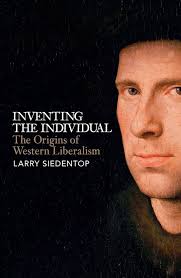
I finally had the chance to finish reading Larry Siedentop’s Inventing the Individual: The Origins of Western Liberalism.

download

It is a great book, and especially informative for those not well-versed in the intellectual history of political ideas within (mainly) Christian thought. The arguments starts with the Ancient traditions, to the early years of Christianity, all the way to the fifteenth century. According to Siedentop (p. 332) the main goal of the book is:

‘to show that in its basic assumptions, liberal thought is the offspring of Christianity. It emerged as the moral intuitions generated by the Christianity were turned against an authoritarian model of the church. The roots of liberalism were firmly established in the arguments of the philosophers and canon lawyers by the 14th and 15th centuries: belief in the fundamental equality of status as the proper basis for a legal system; belief in that enforcing moral conduct is a contradiction in terms; a defense of individual liberty, through the assertion of fundamental or ‘natural rights’ and, finally, the conclusion that only a representative form of government is appropriate for  a society resting on the assumption of moral equality’.

Siedentop clearly succeeds in making this point. As said, the book can be warmly recommended. The question is, however, why does he care about this issue? Siedentop (pp. 334-338) clarifies that he wants to fight the dominant idea that liberalism sprang from the Renaissance, and that liberalism almost equates secularism, or is even anti-religion, at least in the public sphere.

You do not need to be a scholar of the liberal history of ideas to raise more than a few eyebrows here. What liberalism is Siedentop taking up for argument? He is unclear about this, as he does not care to define this liberalism, nor does he provide references to liberal thinkers. That is where the trouble starts.

Undoubtedly there are some modern social-liberals who claim that liberalism is secular and that the state and lawmaking should be strictly neutral in religious terms. Arblaster in The Rise and Decline of Western Liberalism even explicitly refutes any liberal traces before the Renaissance. Unclear is how dominant these voices are, especially outside academia. One thing is certain, these do not comprise classical liberals.

In the Scottish Enlightenment, in many ways the birth grounds of classical liberalism, the place of religion in life, and religion as a source of morality, was discussed. In contrast to most other thinkers, -Smith included- Hume even criticized religion, albeit most openly  after his death in Dialogues concerning Natural Religion. Yet to my knowledge, no thinker actually denied the role of Christianity as a source of  important ideas, certainly not the  role of individuality.

Modern writers, who are more aware of classical liberalism as a tradition do not deny this either. Let me give a few examples.

Hayek in an essay on liberalism (in New Studies in Politics, Philosophy Economics and the History of Ideas) writes that it traces back to classical antiquity and certain medieval traditions. He actually attacks ‘some nineteenth century writers’ who denied ‘that the ancient knew individual liberty in the modern sense’. In his general overview entitled Liberalism, John Gray (then still in his liberal days), also neatly points to the pre-modern and early modern times for the development of liberal ideas as we now know them. David Schmidtz and Jason Brennan pay their due respect to these older sources in A Brief History Of Liberty and the same goes for George H. Smith in The System of Liberty, and David Boaz in The Libertarian Mind.

Of course, none of them made detailed studies of these influences because their books had different purposes than Siedentop’s. Yet all deal with it in a few paragraphs or even a separate chapter, making clear to their readers that (classical) liberalism has older roots then the Renaissance, that there are important Medieval and Ancient thinkers who all left their mark on the development of (classical) liberal thought.

Siedentop wrote a great book, that unfortunately is a straw dog as well: his portrayal of ‘liberalism’ is erroneous, either deliberately or not. It denies the views of the founding and one of the main liberal variants. That is sloppy, to say the least, for such a learned and experienced scholar. With the use of these general terms Siendentop’s attack is simply off target. He should have taken far more time to define the ‘liberalism’ and the liberal scholars subjected by his attack.

Look at what just arrived in my hands

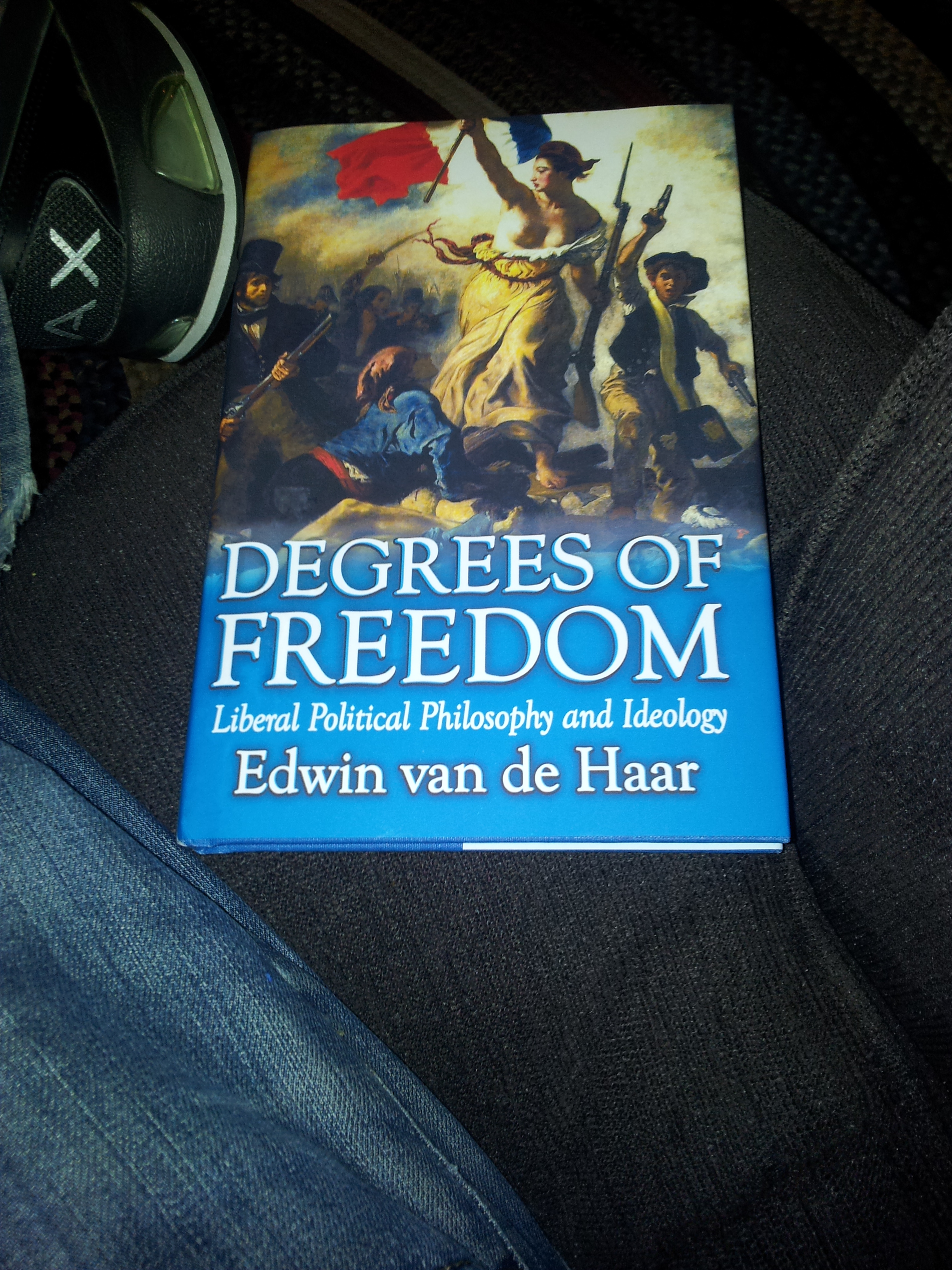
Van de Haar's "Degrees of Freedom: Liberal Political Philosophy and Ideology"
Van de Haar’s “Degrees of Freedom: Liberal Political Philosophy and Ideology”

It’s Dr van de Haar’s newest book, straight from the Netherlands. You can pick up your own copy here (mine was a gift from Dr V, one of the many perks of being an annoying blog editor!). He’s got more books that you can find either on his ‘About…’ page here at NOL or on the sidebar. Thanks Dr van de Haar!

I know Dr Khawaja (of Policy of Truth infamy) was thinking of getting this book reviewed for Reason Papers, too. I don’t have the training in political philosophy to do the job, but I can say, just by reading through the first couple of pages in his introduction, that I could have benefited immensely from this book if I had been introduced to it in Political Science 101.

Aside from the introduction, I also briefly read through Edwin’s section near the back of the book (pgs. 120-126) titled ‘The Neoliberal Phantom’, and believe that it would be very useful for liberals of all stripes when confronted with poorly constructed anti-liberal arguments (the geographer – NOT anthropologist – David Harvey, for example, gets the full Dutch treatment from Dr van de Haar). It should be noted that this section is probably (again, I don’t have any training in this area) a little less useful for academics confronting more sophisticated attacks against liberalism, but it’s a very good primer for intense undergraduates and graduate students who have to deal with the relentless, poorly reasoned attacks on liberalism in their studies and at seminars.

When I read the whole thing I’ll be sure to post a review here at the blog. If I get word of somebody who wants to review Dr van de Haar’s book for Reason Papers (check out what’s on tap right now, by the way), I’ll try to post the good news here, too.

How about war, Professor Wall?

The Cambridge Companion to Liberalism

There is a lot of truth, insight and wisdom in this Cambridge Companion to Liberalism. But how on earth is it possible that there is no substantial mentioning, let alone analysis, of the political philosophy of liberalism and international relations? At least a weird omission by the editor, Professor Steven Wall, I must say….

Slowly debunking the trade leads to peace fallacy

In 2010 I wrote that economic issues are just another factor in decisions on war or peace. There is nothing to suggest that free trade leads to peace per se (The Liberal Divide over Trade, Peace, and War, International Relations, vol 24, number 2, June 2010).

This is not a particular popular viewpoint, certainly not among classical liberals and libertarians, for reasons written about before at this blog.

So it is nice to read in Dale C. Copeland’s new book Economic Interdependence and War (Princeton University Press 2015), that indeed it all depends upon the situation. Economic factors can just as easily be cause for war, as a cause for refraining from violence. Copeland does not write from the liberal tradition, but if he had, he could have used Adam Smith, David Hume or Friedrich Hayek in support for his argument.

Anyway, the good thing is that the free-trade -leads-to-peace thesis is slowly but surely being debunked. It makes for a better and more mature discussion about international relations, inside and outside liberalism.

My latest book review: Rafia Zakaria’s “History of Pakistan”

The other pertinent issue raised by Rafia is about the patriarchal structure, which is a political institution now sanctioned by religious practices and with social acceptance. The plight of women is considered to be a private affair but it is a political programme through which one gender controls the activities of the other. It defines values and sets up norms to control and regulate the body of women. This control and regulation becomes strong in conflict-affected societies where the level of violence is high. The stronger group tries to abduct and carry out violence against women from other communities while the minority, in the name of protection of its ‘honour’, puts all forms of restrictions on their women and carries out violence against them within their own community.

Read the rest.

Review of “The Age of Abundance: How Prosperity Transformed America’s Politics and Culture”

I just finished one of the best books I’ve read in a long time, so even though it’s been out since 2007 I’m going to review it: “The Age of Abundance: How Prosperity Transformed America’s Politics and Culture” by Brink Lindsey.  A second subtitle reads, “Why the Culture Wars Made Us More Libertarian.” It would be a shame if that subtitle put off some potential readers because the book isn’t a libertarian tract, not by a long shot. It’s a fine piece of sociological analysis, rigorous yet readable.

I lived through the post-war transformation of America but that doesn’t mean I really understood what was going on. I understand a whole lot better now thanks to Lindsey’s book. My mother struggled through the Great Depression, by necessity developing a scarcity mentality, some of which rubbed off on me. But as postwar abundance spread, overcoming scarcity was the driving motivation for fewer and fewer people. Instead, mass affluence became the norm. My cousin in Ohio, for example, spent his entire working life as a diesel mechanic for Ford Motor Co. Over the years he and his wife acquired a nice house, a boat, three cars, and took cruises abroad. He worked very hard, but so did his forebears, and they never had what he had.

Mass affluence gave people free time and energy to explore the meaning of life. The New Age, or the Aquarian movement as Lindsey calls it, burst forth in the 1970’s. Having participated peripherally in some of the “personal growth” movements of the time, I can attest to two things. First, most of it was nonsense. I’m chagrined to look back on some of the groups I got into, and glad that I never went overboard with any of them. Second, I’m grateful for some of the genuine growth I experienced during those times. Crucially, I never questioned the work ethic that I inherited from my mother. I grew a beard, but otherwise dressed conventionally and held a steady job.

Almost nobody in the personal growth movements of the time understood that they owed their newfound freedom to mass affluence and that that affluence resulted from the capitalist system which many of them liked to deride. (An exception would be the tiny libertarian movement of the time which for some people was allied with the personal growth movement.) Most participants looked down their noses at hard workers like my cousin.

As it happens, the capitalist system not only survived the Aquarian onslaught but found ways to make a buck from it, adapting and softening its revolutionary fashions, music, and entertainment for a mass market. Capitalism, far from keeling over, co-opted the movement and moved on.

Then came the evangelical backlash, a movement I never had any truck with. The system survived the evangelicals’ attacks on personal liberties.  The upshot, says Lindsey, is that while these two forces pulled at the capitalist center (or the free-market center as I prefer to call it), the system survived and has actually thrived. Out of it all, we are learning to balance liberation and responsibility. Here’s how he puts it on p. 316 of the hardcover edition:

Out of the antitheses of the Aquarian awakening and the evangelical revival came the synthesis that is emerging today. At the heart of that synthesis is a new version of the middle-class morality—more sober, to be sure, than the wild and crazy days of “if it feels good, do it,” but far removed from old-style bourgeois starchiness or even the genial conformism of the early postwar years. Core commitments to family, work, and country remain strong, but the are tempered by broad-minded tolerance of the country’s diversity and a deep humility about telling others how they should live.

As you can tell, Lindsey is a masterful story teller. He adds statistics occasionally; more would have been welcome. I doubt that he will ever get his material published in a sociology journal. Not only is he “politically incorrect” but his writing is too clear and too compelling. By the way, do you see the dialectics in this passage? Lindsey never uses the word, but there it is: Aquarian thesis, evangelical antithesis, libertarian synthesis. Fascinating.

How to think like an individualist

Postmodernism is disposed of incisively. “Just as Western politicians and generals annex foreign lands, postcolonial theorists argue, so Western intellectuals impose their knowledge on the rest of the world,” Malik writes. But Western philosophy does not replicate the ways and methods of Western imperialism. Its criteria and methods, but also its values, are completely different. So is its relationship to the non-European world, which is not one of subjugation and annexation, but of interaction and accommodation. The key concepts of Western secular modernity that are hardest to contest – universalism, democracy and individual liberty – were not, in reality, products of Western imperialism, and are actually not compatible with it. Anti-colonialism in modern times is as much a product of Western philosophy as of non-European thought, or more so. There are also other key Western ideas, such as Marx’s critique of capitalism, that have demonstrated an impressively wide appeal in every part of the globe but remain as much contested today in the West as anywhere else.

Kenan Malik stole all my ideas. I guess I should start applying for insurance salesman positions, eh? Read the rest, by Jonathan Israel. But wait, there’s more.

Any nation that has an official religious establishment faces the problem of “standardizing” the religion to satisfy the demands of the establishment. Note that the law [passed by Austria’s parliament forcing Austrian Muslim organizations to use a German-language Qur’an] doesn’t outright ban competing translations of the Qur’an, but gives the official imprimatur of the Austrian government to an approved translation. It doesn’t seem to have occurred to Austrians to distinguish the rights-protecting and religious-establishment-establishing functions of the state, and to dump the latter over the side. But I suspect it hasn’t occurred to the Austrian Parliament because it hasn’t quite occurred to Austrian Muslims, either. There are perks to be had if you accept government sponsorship of your religion: once you’re enticed by them, it becomes hard not to do a deal with the Devil to keep them in place. I don’t know about the standardized German translation, but my translation of the Qur’an suggests that seduction is the Devil’s AOS.

This is from the infamous Irfan Khawaja over at Policy of Truth. Read it.

So you think war can be eliminated?

You might be one of those libertarians, or you belong to some other creed, who think war can be eliminated. For example through international trade, the better use of our ratio, or more influence for regular people on foreign policy decisions. In my own work I have tried to make clear all of these claims are false, and many related ones as well. This is all in the writings of Hume, Smith, Hayek or Rand. The base line is that in human nature reason cannot overcome the emotions, at least, not with all people, at all times. This means that conflict is one of the perpetual characteristics of human action, both in domestic and international settings.

In the unlikely case you do not want to take my word for it, read this book. Coker is a professor of International Relations at the London School of Economics and Political Science, specializing in the study of war. In this short but powerful book, he clearly sets out the different reasons why war will not be eliminated, providing evolutionary, cultural, technological, geopolitical and a number of other reasons. Buy it, and your world view and view of human nature will be even more aligned to the great classical liberals.

http://www.amazon.com/Can-War-Eliminated-Christopher-Coker/dp/0745679234/ref=sr_1_1?ie=UTF8&qid=1424447372&sr=8-1&keywords=can+war+be+eliminated

Strange Historical Facts

Not long thereafter, they erected the first sawmill in what was to become the state of Washington on a site by the lower falls of the Deschutes River. Much of the capital for erecting the mill apparently came from George W. Bush, Washington’s first black resident. The cut of this mill, it has been claimed, was marketed through the Hudson’s Bay Company at Fort Nisqually and found its way to Victoria and the Hawaiian Islands. The first shipment was supposedly made on the Hudson’s Bay Company steamer Beaver in 1848.

Um, wow. I don’t know where to begin. This excerpt comes from page 25 of a 1977 book by historian Thomas R Cox titled Mills and Markets: A History of the Pacific Coast Lumber Industry to 1900. Aside from the interesting anecdote quoted above, it’s not very good. I picked it up because of the possibilities associated with such a subject, but instead of a theoretical narrative on globalization, identity, state-building, and property rights, it is a book that reads a lot like the excerpt I quoted above (the local history aspect I have enjoyed, though; local history is one of my secret pleasures, the kind of stuff that never makes it into grand theoretical treatises but always lights up my brain because of the fact that places I know and places I have lived are the focus of the narrative).

I blame it on the year it was published, of course. 1977 was at the height of the Cold War, which means that scholarly inquiry was inevitably going to be policed by ideologues, and also that works appraising global or regional scales and scopes just weren’t doable. For instance, there was virtually no mention of Natives in the book. (See archaeologist Kent Lightfoot’s excellent, highly-recommended work – start here and here – for more on how this is changing.)

From the Footnotes: Ignorance of Islam and of the Decentralization of Power

There are widespread calls for an Islamic reformation such as Christianity experienced in the sixteenth century, but the Reformation cleaved Christianity into two major traditions and many splintered sects; each grew independently of the others, eroding any hope of a Christian center that could rein in extremes. After its early division into Sunni and Shi’a, Islam has come to suffer enough from this segmentation without a modern reformation. Indeed, Islam is a democratic religion, so thoroughly decentralized that even muftis are elected. Many Muslims are interested not in further schisms but rather in reconciliation among the competing doctrines and their extremist messengers, ultimately reducing the violence carried out against each other and other civilizations. As Gilles Kepel argues, though the rise of militant Islamism has been spectacular, its hyperviolence has proved to be a liability rather than an asset. (243)

This is from Parag Khanna’s 2008 book The Second World: Empires and Influence in the New Global Order. This footnote is in most respects a microcosm of the book as a whole: it’s on the cusp of providing theoretical insight into how the world works but just can’t seem to shake a certain type of dogma associated with the technocratic Left (I think he has done a better job of shaking this dogma post-2008).

This footnote is also in most respects why I’ll never be a Leftist again, even as a sleek, trade-friendly technocrat.

This footnote says to me that Khanna is arguing for a hands-off approach to Islam on the part of the West. Khanna is saying that Islam does not need a Christianity-style reformation. So far, so good. Khanna and I are in agreement. Then he goes off his rocker, though, by arguing that Christianity (and by implication European society) became a net loser because there was no Christian center to temper extremists.

What?

Correct me if I am wrong, but doesn’t Christian Europe have higher standards of living/tolerance/pluralist values today than anywhere else in the Old World? And isn’t Christian Europe the one place in the Old World where it is awfully hard to find Christian religious extremists? Wouldn’t you have a better argument if you stated that is was the lack of a Christian center which has been responsible for the dramatic increase in standards of living/tolerance/pluralist values in the West?

Maybe Khanna is thinking of medieval Europe, with its devastating series of religiously-inspired wars, but somehow I don’t think this is the case.

The Muslim world is decentralized culturally (like Europe) and is trying to decentralize politically (again, like Europe). The political decentralization is being hastened by trade liberalization and global economic integration. This same decentralization is being resisted by the international order (including, especially, Russia and China) due to nefarious but understandable interests of state but also to the severe lack of understanding that Western intellectuals like Khanna have of social organization. A center of cultural or political or economic power does not guarantee a waning of extremes. In fact, in some cases (in most?) such a center of power actually contributes to extremes.

Khanna was so blinded (and, again, I think he’s changed his tune post-2008) by technocratic Left-wing theory that he could not see what he was arguing: that a decentralized Christianity gave rise to Europe as we know it, therefore the West should step back so that the Muslim religion can build a monolithic consensus in order to combat “extremes.” Am I mischaracterizing Khanna’s footnote? Am I knocking down a straw man?

Khanna’s latest stuff has been much better than what I found in his 2008 book. He still doesn’t go far enough, though. He needs to undertake Brandon-style libertarianism in order to really be a bad ass: let the process of decentralization happen, but (but) recognize new states where it is smart and safe to do so (Kurdistan? The Islamic State? Baluchistan?) and then integrate them into the imperfect but important international order that the West has slowly been building for the last hundred years or so.

Khanna’s incoherence on geopolitical matters is not limited to interesting footnotes. Check out what he wrote in the introduction (again, this is from 2008):

Many believe that the emerging world order is polycentric: China will remain primarily a regional power, Japan will assert itself more nationalistically, the EU will lack influence beyond its immediate region, India will rise to rival China, Russia will resurge, and an Islamic Caliphate will congeal as a geopolitical force. (xviii)

This is basically what has happened so far, and it largely falls in line of where I would bet my money (but not place my dreams) on future events (the Muslim world excepted; see above). Khanna has none of it though:

All these views ignore a much deeper reality: The United States, the European Union, and China already possess most of the total power in the world. (xviii)

I think this argument, if anything, reveals Khanna’s (and, by implication, the technocratic Left’s) authoritarian impulses and desires. The United States is the world’s sole hegemon, and it will be for a long, long time. The EU is a basketcase and China’s GDP (PPP) per capita stands at Intl$ 11,907 in 2013, just below the Dominican Republic, Serbia, the world average, and Iraq. Khanna’s inclusion of the EU – with the social democratic values that technocratic Leftists mistakenly believe Europe harbors – and China – an ode to both the condescending identity politics of the same technocratic Left and its fixation with centrally-planned but privately-run enterprises (“corporatism”) – in the troika of world powers illustrates nicely the weaknesses of the Left.

Khanna’s dogma gets him in more trouble (still on the same introductory page):

Russia, Japan, and India cannot assert themselves globally, militarily or otherwise […] In fact, they are being gradually outmaneuvered by the United States, the EU, and China in their own regions. (xviii)

Don’t cry for Khanna. Last time I checked, he was on the board of several prominent think tanks.

Khanna’s best chapter is on the Middle East (it starts with a useful map on p. 168 and ends on p. 253). His treatment of post-Soviet Europe is laughable (“Ukraine: From Border to Bridge”) and his treatment of China (“Asia”) is overly laudable. India gets just three dismissive pages.

Would I recommend reading it?

Yeah, sure. I like the concept of “second world” that Khanna tries (but fails) to convey. I like the way he thinks and his post-2008 work is especially good. There are a lot of facts that aren’t really facts in the book though, and he applies those facts to theories that I think are weak at explaining how the world works. Then again, when has reading a book ever hurt you?

The Best Book I Have Read Recently

I make some notes about almost all the books I read. I am thinking my notes may be useful to others. Here is an instance; it’s about a good book I read recently:

Jared Diamond’s 2012 The World Until Yesterday: What Can We Learn from Traditional Societies?

A confession first: When I die, I want to come back as Jared Diamond. He had the exemplary academic career; he wasted no time; he took advantage of academia’s largess and low standards to change himself several times into a different kind of scholar. He addresses ordinary literate people with much success. He is a great teacher.

What Diamond means by “traditional societies”  (in the title) is an imaginary aggregate of what social scientists call “hunters-gatherers” and “horticulturalists.” The latter are largely hoe cultivators, people who don’t use the plow but who grow food. Horticulturalists live entirely in tropical and equatorial climates.

Diamond’s book makes very good reading and, in addition, he tries to make it practical, useful at every step. His guiding theme is that by observing traditional people more closely, we may be able to improve many of our civilized practices. He visits in turn how his traditional societies define strangers and how they deal with war, child rearing, the treatment of the aged, attitudes toward danger, religion, language and health.

Traditionals, in general (also called “primitives”) live in fairly small units because their technologies (plural) cannot support large concentrations of people. They have no cities; they are not “civilized.” Diamond makes the implicit assumption (implicit, I think) that small scale and the preservation of “traditional beliefs” go hand in hand. He makes the further assumption – a fairly common one – that today’s traditional societies are similar to the societies in our own past. Thus, the part of the title that says, “Until Yesterday.” According to this assumption, the observation of such societies has much to teach us about how we – civilized people – grew up, so to speak, and about what we lost while growing up.

I am skeptical about both assumptions, not rejecting, skeptical. First, I don’t really believe that tradition does not change. I think that traditional people live in environments that change to some extent, sometimes rapidly. They change, in particular, because the powerful civilized societies in which they are embedded tend to grow, thus threatening or reducing the traditionals’ physical space and their resources. The tragedy of the Plains Indians reduction to near nothing must have happened many times before. Thus the thing that defines traditional people, “tradition” itself must change to some extent to accommodate change in their environments. The mere fact that traditional societies are around to be observed at all tells us that they must have adjusted to some extent. Thus, when considering them we don’t know if we are looking at our own past, or at pathetic survivors next to extinction, or on the contrary, at extraordinarily skillful ones. That’ s a problem for the generalizing Diamond invites us to engage in. That’s my second main objection to Diamond’s overall approach.

In point of fact, the traditional societies to which Diamond alludes include none situated in the temperate zone. It’s not his fault, of course, Lapps in Northern Scandinavia and Finland may be the only ones left more or less intact. But this fact aggravates my skepticism about the exemplarity of the primitive groups Diamond describes. I cannot eliminate from my mind the fact that civilization arose only in temperate zones, in the Middle East, in Europe, and in China. And independently, in the temperate elevations of meso-America and of South America. Perhaps, possibly, probably this is not a coincidence. Diamond’s tropical, desert, and far north groups may be in no way similar to our ancestors.

Beyond these general remarks, I have two specific quarrels with Diamond. The first is about health and the second about language acquisition. Diamond contends that the maladies of old age that affect civilized people today, including arthritis, cardiac illness, and diabetes, are practically non-existent among primitive people. He also says that primitive people have low life expectancy, I think he means at all ages. So, I am wondering if the first statement is not simply the result of a major sampling error, of a major optical illusion: If people seldom live beyond age fifty-five there will be few of the illnesses associated with old age in their society. It would seem like a gross error for a man of Diamond’s intellectual distinction to make. He may have in fact taken care of this objection and I missed it. Or, he did not do it loudly enough and then, why?

My second specific objection concerns one of the many statement he makes on language acquisition. At one point, he declares himself in favor of “crib bilingualism.” That’s the practice of speaking to babies in more than one language from birth. Personally, I think it’s a dangerous gamble. I don’t have any systematic data. My judgment relies on anecdotal evidence spread over fifty years. So does his. I believe he has not done enough due diligence of tracking possible downsides of the practice. (I don’t need to track its upsides because they are obvious: Get two languages for the same price, same as heads of cabbage at the flea market.)

I may write Prof. Diamond soon at UCLA where he teaches to ask him to discuss these points. Don’t wait on me to act to read this wonderful book though. Do it, do it critically if you can.

Also, read my book : I Used to Be French: an Immature Autobiography

Happy Holidays

Merry Christmas, Happy Hanukkah, and Happy Kwanzaa.

I’ve just been chillin’ with family the past week or so. My brother got home from Paris recently and my sisters arrive in town, from Utah, sometime this weekend.

I’ve been browsing through the Bismark section of Kissinger’s Diplomacy, as well as the Bismark sections of Ozment’s A Mighty Fortress and Tipton’s A History of Modern Germany Since 1815. I’m trying to get a feel not so much for the man himself but for how he created a federal state out of many and called it Germany. I would welcome recommendations on this topic.

I’ve also been reading the Mistborn series by Brandon Sanderson. There is not enough gratuitous sex and violence for me to recommend the series (in fact there has been no sex at all in the series so far, and I’m about halfway through the second book), but the story line has hooked me enough that I’ll read through the entire trilogy. I think I’m done with fantasy though. I mentioned that I read the A Song of Ice and Fire series and really liked it, but apparently that series is considered an anomaly of sorts within the fantasy genre. A damn shame.