- The first God James Hoffmeier, Aeon
- Homelessness in America’s gilded cities Jacob Siegel, American Affairs
- Swedish exceptionalism Henrietta Horn, American Interest
- Is India a rising great power? Parag Khanna, Times of India
Author: Brandon Christensen
Afternoon Tea: The Women of Algiers in their Apartment (1834)
From Eugene Delacroix, as requested by Jacques Delacroix (no relation):
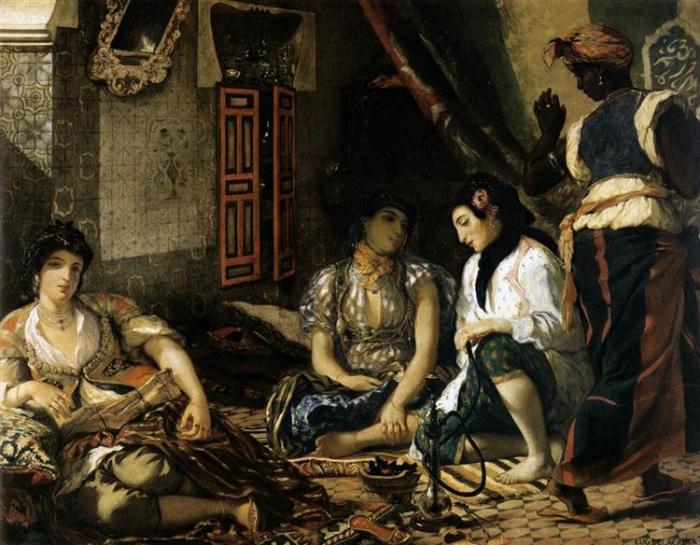
Nightcap
- Reflections on Zimbabwe and its white folks Diana Stone, London Review of Books
- Whose civilization? Which clash? Daniel McCarthy, Modern Age
- Should the government really make parenting ‘easy’? Rachel Lu, the Week
- What the… ?
Nightcap
- A closer look at US hostage recovery policy Danielle Gilbert, War on the Rocks
- How to restore democracy in Venezuela Ryan Berg, RealClearWorld
- How markets and the State leave the community behind Oren Kass, New York Times
- I won’t drive the roundabout Irfan Khawaja, Policy of Truth
Afternoon Tea: Diomedes Devoured by his Horses (1866)
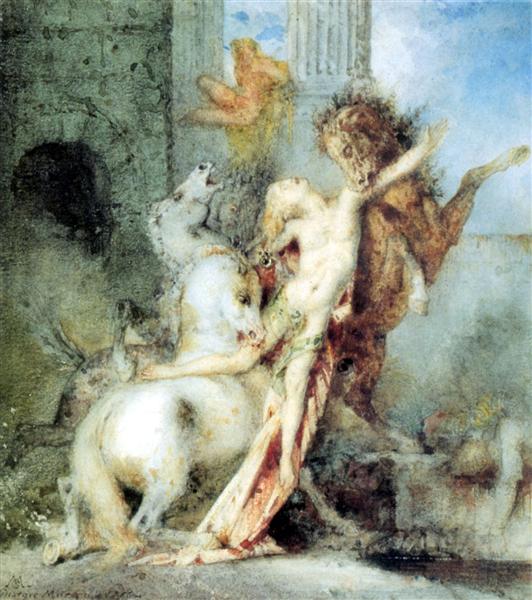
This one is just plain crazy, and it’s by the French painter Gustave Moreau. Here is a wiki on the story of Diomedes, by the way. And here is Barry Stocker on ancient Greek thought.
Nightcap
- Anti-Semitism from Trotsky to Soros James Sheehan, Commonweal
- How to combat parochialism in philosophy Peter Adamson, Times Literary Supplement
- The era of limited government is over Ross Douthat, New York Times
- The paradox of voting Arathy Puthillam, Pragati
Nightcap
- Why weakly enforced rules? Robin Hanson, Overcoming Bias
- What’s changed since Salman Rushdie’s notorious novel? Bruce Fudge, Aeon
- Spacefaring civilization Nick Nielsen, Grand Strategy Annex
- Is the universe pro-life? Bobby Azarian, Quartz
Afternoon Tea: Urvashi and Pururavas (unknown)
From the great Malayi (India) painter Raja Rami Varma:
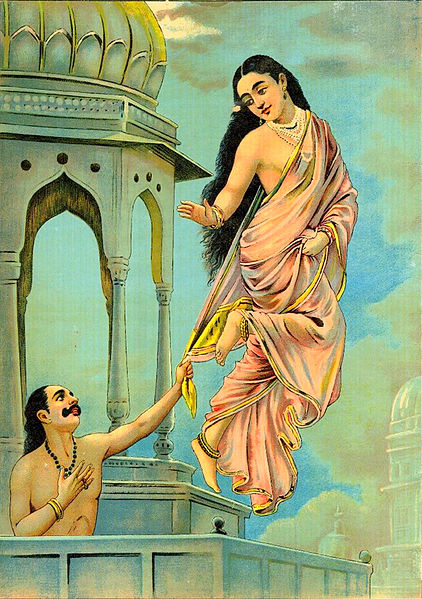
Varma was one of the first artists in colonial India to blend Western art with Indian traditions. Urvashi and Pururavas is an old Hindu love legend (wiki). And here is a wiki on Varma.
Here is yet another wiki, on the Malayali.
Nightcap
- A Mexican perspective on NAFTA Roberto Salinas-Leon, Law & Liberty
- Prosperity, the periphery, and the future of France Andrew Hussey, Literary Review
- The Indian Ocean slave trade Geoffrey Clarfield, Quillette
- The meaning of the exoplanet revolution Caleb Scharf, Aeon
Nightcap
- Have we ever been modern? Anthony Pagden, Cato Unbound
- Missing the elephant in the room Chris Dillow, Stumbling & Mumbling
- Why celibacy matters Ross Douthat, New York Times
- A reflection on Tito and Franco Branko Milanovic, globalinequality
Nightcap
- Can there be peace in Afghanistan? Shreyas Deshmukh, Pragati
- Competition among states wasn’t sufficient for religious liberty Johnson & Koyama, Cato Unbound
- Transnational queenship Michelle Beer, JHIBlog
- Russia the Terrible Timothy Crimmins, Modern Age
From the Comments: who is the conservative or libertarian equivalent of Nancy MacLean?
Rick posed a great question about Nancy MacLean awhile back. I haven’t been neglecting it. I’ve been thinking about it. Here it is:
Question for those more abreast than me: do conservatives or libertarians have an equivalent of Nancy MacLean? All sides have irresponsible pseudo-scholars, but how often do the various camps launch one of them to undue prominence instead of just ignoring them?
Michelangelo suggests Murray Rothbard as one example, and I had that thought as well, but that’s almost too obvious, and he’s been dead for a long time now.
Libertarians today are pretty firmly divided by the cosmos and paleos, so undue prominence is hard to get. When was the last time you saw Jason Brennan or Bryan Caplan praising the work of Justin Raimondo or Lew Rockwell?
With that being said, I think libertarians nowadays tend to launch intellectual fads into undue prominence, rather than scholars. Stuff like Open Borders or signaling or my personal favorite, non-intervention in foreign policy, tend to hold a prominence in libertarian circles that I find ridiculous. If you don’t believe me, find your nearest Cato Institute scholar on Twitter and ask him (yes, him) if his pet policy project has any potential flaws in it…
Afternoon Tea: Ahasver (1910)
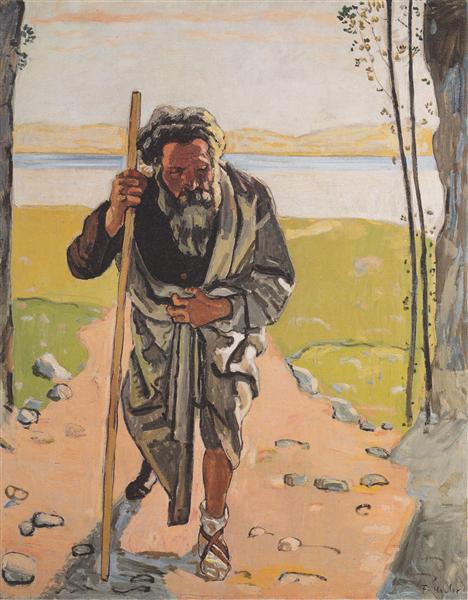
This beauty is by Ferdinand Hodler, a Swiss painter. Rest assured, there’ll be more from him.
Nightcap
- How to pay for the Green New Deal Simon Wren-Lewis, mainlymacro
- Racism in an elevator Alison Bowles, Policy of Truth
- The fitful march of religious liberty Johnson & Koyama, Cato Unbound
- The why of religious freedom Ethan Blevins, NOL
Nightcap
- Franklin D. Roosevelt Jackson Lears, London Review of Books
- Memoir of captivity in Iran John Tamny, RealClearMarkets
- Towards decentralization Andy Smarick, National Affairs
- Did humans tame themselves? Melvin Konnor, the Atlantic

