- Smuggling Nikita Khrushchev’s memoirs out of the USSR
- Are memes disrupting American politics? So asks a Leftist
- The 4th Amendment, policing, and pedagogy
- At least the end of the War on Drugs is nigh
- A new (old) strategy for a polycentric world (but why not federation?)
- A simple map of Brazil and its states
Author: Brandon Christensen
Taxes, Free-riding, and Federation
Check out Adam Smith complaining about the rent-seeking that the UK’s North American colonies were practicing back in 1776:
The expence of the ordinary peace establishment of the colonies amounted, before the commencement of the present disturbances, to the pay of twenty regiments of foot; to the expence of the artillery, stores, and extraordinary provisions with which it was necessary to supply them; and to the expence of a very considerable naval force which was constantly kept up, in order to guard, from the smuggling vessels of other nations, the immense coast of North America, and that of our West Indian islands. The whole expence of this peace establishment was a charge upon the revenue of Great Britain, and was, at the same time, the smallest part of what the dominion of the colonies has cost the mother country. If we would know the amount of the whole, we must add to the annual expence of this peace establishment the interest of the sums which, in consequence of her considering her colonies as provinces subject to her dominion, Great Britain has upon different occasions laid out upon their defence. We must add to it, in particular, the whole expence of the late war, and a great part of that of the war which preceded it. The late war was altogether a colony quarrel, and the whole expence of it, in whatever part of the world it may have been laid out, whether in Germany or the East Indies, ought justly to be stated to the account of the colonies. It amounted to more than ninety millions sterling, including not only the new debt which was contracted, but the two shillings in the pound additional land tax, and the sums which were every year borrowed from the sinking fund.
This comes from Book 4, the third (and last) part (“Part Third”) of Chapter 7 in Smith’s famous book The Wealth of Nations (TWON). (Here is a great link to the whole chapter, courtesy of the Library of Economics and Liberty. I read the Bantam Classics version for my Honors seminar on Liberty in Western Political Thought, led by Andrew Sabl, who is currently a Visiting Professor at Yale, though I don’t have it with me so I can’t cite, let alone remember, the page numbers.)
Let me throw a little bit of historical context for this excerpt at you. Smith wrote TWON before the onset of the first Anglo-American war (TWON was published in 1776, which means it did not influence the American colonists in any way, shape, or form; think about the way information spread back in those days), and the war was largely the result of a quarrel between the UK and its North American colonies over taxation. The taxation, though, was needed in order to pay for a war (the Seven Years’ War) that the colonies had initially lobbied the British government to fight for them. The British colonies in North America had much more leeway than their French, Spanish, Portuguese, and Dutch counterparts, and a number of these colonies wanted to expand westward, into the Ohio Valley, where the French state had made claims that were recognized under international treaties.
To make a long story short: Several colonial factions picked a fight with the French and their Native American allies, and this little schoolyard brawl turned into a global war (with fighting in North America, India, Africa, South America, and East Asia) that saw the United Kingdom become the world’s preeminent imperial power and France lose almost all of its North American colonial possessions.* When the war was over, the British parliament wanted to tax the colonies to pay for their fair share of the war, and the colonists said “No taxation without representation!” Smith summed up the situation as thus:
In order to put Great Britain upon a footing of equality with her own colonies […] it seems necessary, upon the scheme of taxing them by parliamentary requisition, that parliament should have some means of rendering its requisitions immediately effectual, in case the colony assemblies should attempt to evade or reject them […] The parliament of Great Britain insists upon taxing the colonies; and they refuse to be taxed by a Parliament in which they are not represented.
This is quite the conundrum, and Smith put forth a proposal that I found quite novel when I first read it as an undergraduate. But before I get to his proposal, I want to make sure that everyone understands the situation here. The UK fought an expensive war at the behest of its colonies, and the colonies, once the war was over, refused to pay for it. Sound familiar? It should. Today the United States finds itself in this situation often (just replace the word “colonies” with “allies”).
Smith proposed the following deal instead of war or civil oppression (such as economic sanctions):
If to each colony […] Great Britain should allow such a number of representatives as suited the proportion of what is contributed to the public revenue of the empire, in consequence of its being subjected to the same taxes, and in compensation admitted to the same freedom of trade with its fellow-subjects at home. [Were British America] to send fifty or sixty new representatives to parliament, […] there is not the least probability that the British constitution would be hurt by the union of Great Britain with her colonies. That constitution, on the contrary, would be completed by it, and seems to be imperfect without it. The assembly which deliberates and decides concerning the affairs of every part of the empire, in order to be properly informed, ought certainly to have representatives from every part of it. That this union, however, could be easily effectuated, or that difficulties and great difficulties might not occur in the execution, I do not pretend. I have yet heard of none, however, which appear insurmountable. The principal perhaps arise, not from the nature of things, but from the prejudices and opinions of the people both on this and on the other side of the Atlantic. […]
Why didn’t the UK just federate with its North American colonies? Smith cited British fears of an unbalanced political constitution that the North American colonies might bring to such a union, and North American fears of being completely dominated by a faraway parliament were they to join such a federation. He countered both fears well, but check out what he predicted would happen if such a federation were to actually take place:
The distance of America from the seat of government […] would not be of very long continuance. Such has hitherto been the rapid progress of that country in wealth, population, and improvement, that in the course of little more than a century, perhaps, the produce of American [taxation] might exceed that of British taxation. The seat of the empire would then naturally remove itself to that part of the empire which contributed most to the general defence and support of the whole.
Interesting, right? Smith argued that the American colonies would become so rich and so populous that the capital of his proposed British federation would “naturally” move from London to somewhere in North America.
Smith was wrong in a general way, but correct in an even more general way. Let me explain.
Smith was wrong because the United States – once separated from the United Kingdom – evolved into the wealthiest, most innovative society the world has ever known. The reason for this is the aristocratic upper house of a legislative institution (“Senate”) that the 13 states had to create in order for all of them to join a federation. If Smith had had his way, the world would have never known the American Senate, and I doubt very much that the 13 colonies would have grown to become as innovative and wealthy as they are today without this vital institution of governance.
Smith was also wrong to make his argument for such a federation to be based on tax revenue rather than principled representation (though see Warren’s infamous post arguing for just such a proposal). The tax revenue argument might be more economically efficient, but it would not give polities seeking federal bonds the guarantee of some sort of equality (two representatives in the aristocratic chamber of the legislative assembly) that they would need to join such a federation. On these two points Smith’s argument was wrong, but what did he and other republicans and federalists get right?
To answer that I think it’s best to ask another question: What would happen if the UK and the US were to federate today?
The UK would be the poorest state in the union (as measured by GDP PPP per capita), if it were admitted as one state.
The stark difference in living standards doesn’t stop there, though. Suppose the SNP finally gets its way and Scotland leaves the UK. Even if England (intl$ 32,669), Wales (intl$ 25,947), and Northern Ireland (intl$ 27,573) were admitted into the US as three separate states, they would all be at the bottom of the living standards barrel. Were Scotland to go along with the other polities in the UK and federate with the US as a separate state, she would rank second-to-last (intl$ 33,791), just in front of Mississippi but behind Idaho. The rankings would look like this:
49. Idaho
50. Scotland
51. Mississippi
52. England
53. Northern Ireland
54. Wales
Smith’s argument suddenly looks a whole lot better, right? At least if you think living standards as they are measured by economists are a good way to gauge the overall health and wealth of a given society.
A federation is basically a huge, actual free trade zone (both capital and labor can move freely) coupled with a binding military pact and some institutions that allow factions to openly argue and contest for spoils that end up in a state’s treasury, but that’s not what the US has with any of its military allies or trading partners. What I find interesting is that the objections to federation between the UK and its North American colonies that Smith listed are essentially the same ones that crop up when such a federation is proposed between the US and its various allies and partners. The difference between now and then, though, is the Senate. Sending representatives based purely on population or tax revenue would most likely contribute to an unbalanced political constitution, but having two guaranteed representatives in a political body that’s heavily aristocratic and lightly democratic would surely guarantee an equality that all sides could eventually agree upon.
There is also an interesting cultural development to think about as well. The states in Western Europe and East Asia sans China have helped to develop a political culture that is more closely aligned with the one found in the US, Canada, and Australia/New Zealand, one where citizenship trumps ethnic identity. Identity based on citizenship is not as strong as the one found in the Anglo-Saxon world, and ethnic differences do pop up from time to time (largely due to linguistic differences), but the states of Western Europe and East Asia have taken many steps in the right direction to help eradicate the parochial tribalism that has long plagued European and Asian societies and replace it with citizenship. Take a look at the political constituencies of the following three countries:


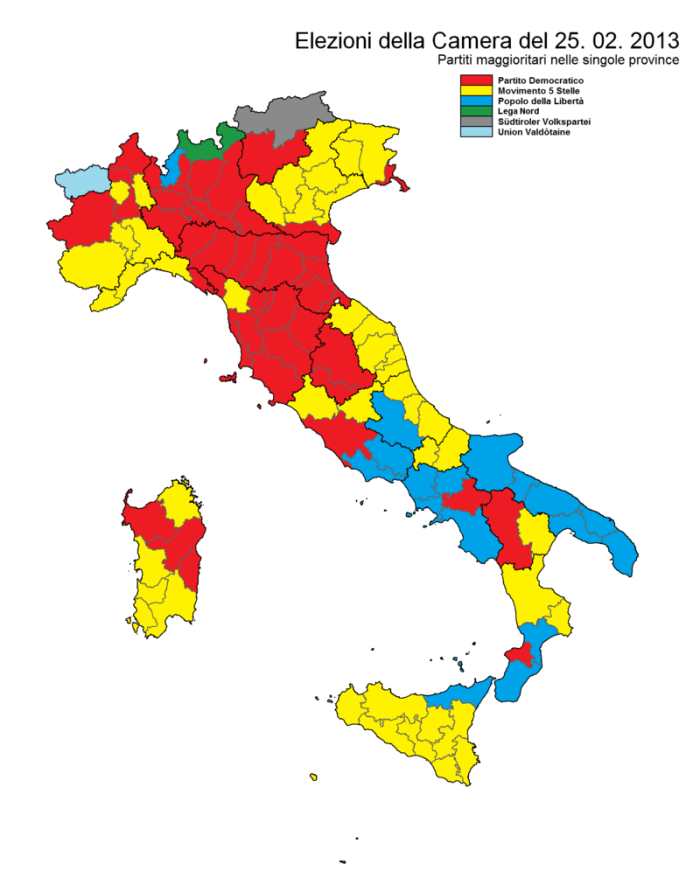
They are largely based on a Left-Right divide rather than the ethnic ones we find in less economically-developed, less politically-integrated, post-colonial states. This Left-Right divide would fit in perfectly with the Madisonian constitution, as administrative units (i.e. Northern Ireland, Gangwon, Bavaria, or Trentino instead of the UK, South Korea, Germany, or Italy) could be added in a manner so as not to upset the balance between Left and Right currently found in the US. Political coalitions would wax and wane with time, of course, but if we want a world where the East Asians and Western Europeans pay their fair share, and where they are protected from Moscow and Beijing, then federation is as moderately radical as you can get.
Just ask Adam Smith.
New issue of Econ Journal Watch is out!
For those of you who don’t already know, Warren is the math reader for EJW and one of NOL‘s co-founders, Fred Foldvary, is an editor for the journal, so this is very much a family affair. Here are some of the articles that caught my eye:
You get what you measure: Daniel Schwekendiek explains how South Korea followed a proven template of incentivizing exports to boost Web of Science publications and raise the rankings of its academic institutions.
Now entering a Republican-free zone: Mitchell Langbert, Anthony J. Quain, and Daniel Klein report on the voter registration of faculty at 40 leading U.S. universities in Economics, History, Journalism, Law, and Psychology.
Whither science in gender sociology? Charlotta Stern investigates whether gender sociologists blinker themselves from scientific findings about sex differences.
How to Do Well by Doing Good! In this 1984 essay, Gordon Tullock counsels young economists that doing well and doing good go together.
You can download and read the whole thing here (pdf).
A short note on minorities and the Left
Lately I have been thinking about how minorities affect the Democratic Party here in the US. Basically, all minorities vote for the Democrats in national elections, but minorities tend to be conservative culturally. This has the effect of pulling the Leftist party waaaaay to the center (a fact that makes it hard for me to complain about Democrats’ pandering tactics).
Sure, the GOP will always be the party of old white people, but if the Democrats’ left-wing is essentially neutered due to minority voting blocs within the Party, who cares?
The fact that the Democrats pine for minorities explains why the US has never had a very powerful socialist movement. Socialists will often blame “neoliberals,” “capitalists,” “reactionaries,” and other assorted boogeymen, but doesn’t the minority insight make much more sense?
This minority insight has also got me thinking about demographic changes in Europe over the past 30 years. Basically, Europe has had a huge influx of immigrants since the fall of socialism. In the old days, Sweden was for Swedes, France was for the French, Germany was for Germans, etc. etc. This mindset helps to explain why European states had such overbearing welfare states and why economic growth was so limited up until the late 1980s.
As immigrants moved into these welfare states, the Left-wing parties began to pander to them. This had the same effect as it did in the United States: culturally conservative voting blocs diluted the Leftism of traditionally Left-wing parties. As a result, these welfare states became less robust and economic growth became attainable again.
A big underlying point about my musings on this subject is that socialism relies on nationalism in the area of popular politics and policymaking. Without Sweden for the Swedes-type sloganeering, socialism becomes ridiculous to the masses. This underlying point, along with the straightforward fact that immigrants dilute socialist power (economic, political, and cultural), suggests to me that libertarians who pay close attention to popular politics should relax when it comes to the fact that minorities don’t find libertarian ideals all that appealing.
BC’s weekend reads
- The Strange Story of a Strange Beast
- Dagestan (a region in Russia), religion, and female genital mutilation
- Why partitioning Libya might be the only way to save it
- Google versus Palestine (h/t Michelangelo)
- False consciousness | The value of Marx in the 21st century
- The evolution of the state (in two simple pictures)
- Round the Decay of that Colossal Wreck
From the Comments: Foucault’s purported nationalism, and neoliberalism
Dr Stocker‘s response to my recent musings on Foucault’s Biopolitics is worth highlighting:
Good to see you’re studying Foucault Brandon.
I agree that nationalism is an issue in Foucault and that his work is very Gallocentric. However, it is Gallocentric in ways that tend to be critical of various forms of nationalist and pre-nationalist thought, for example he takes a very critical line of the origins of the French left in ethnic-racial-national thought. Foucault does suggest in his work on Neoliberalism that Neoliberalism is German and American in origin (which rather undermines claims that Thatcherism should be seen as the major wave). He also refers to the way that Giscard d’Estaing (a centre-right President) incorporated something like the version of neoliberalism pursued by the German Federal Chancellor, Helmut Schmidt, from the right of the social democratic party.
Thoughts about the relations between France and Germany going back to the early Middle Ages are often present in Foucault, if never put forward explicitly as a major theme. I don’t see this as a version of French nationalism, but as interest in the interplay and overlaps between the state system in two key European countries.
His work on the evolution of centralised state judicial-penal power in the Middle Ages and the early modern period, concentrates on France, but takes some elements back to Charlemagne, the Frankish king of the 8th century (that is chief of the German Franks who conquered Roman Gaul), whose state policies and institutional changes are at the origin of the French, German and broader European developments in this are, stemming from Charlemagne’s power in both France and Germany, as well as other areas, leading to the title of Emperor of the Romans.
Getting back to his attitude to neoliberalism, this is of course immensely contentious, but as far as I can see he takes the claims of German ordoliberals to be constructing an alternative to National Socialism very seriously and sympathetically and also regards the criticisms of state power and moralised forms of power with American neoliberalism in that spirit. I think he would prefer an approach more thoroughly committed to eroding state power and associated hierarchies, but I don’t think there is a total rejection at all and I don’t think the discussion of ordoliberalism is negative about the phenomenon of Germany’s role in putting that approach into practice in the formative years of the Federal Republic.
Here is more Foucault at NOL, including many new insights from Barry.
Foucault’s biopolitics seems like it’s just a subtle form of nationalism
I’ve been slowly making my way through Michel Foucault’s The Birth of Biopolitics, largely on the strength of Barry’s recommendation (see also this fiery debate between Barry and Jacques), and a couple of things have already stood out to me. 1) Foucault, lecturing in 1978-79, is about 20 years behind Hayek’s 1960 book The Constitution of Liberty in terms of formulating interesting, relevant political theory and roughly 35 years behind his The Road to Serfdom (1944) in terms of expressing doubts over the expanding role of the state into the lives of citizens.
2) The whole series of lectures seems like a clever plea for French nationalism. Foucault is very ardent about identifying “neo-liberalism” in two different models, a German one and an American one, and continually makes references about the importation or lack thereof of these models into other societies.
Maybe I’m just reading too deeply into his words.
Or maybe Foucault isn’t trying to make a clever case for French nationalism, and is instead trying to undercut the case for a more liberal world order but – because nothing else has worked as well as liberalism, or even come close – he cannot help but rely upon nationalist sentiments to make his anti-liberal case and he just doesn’t realize what he’s doing.
These two thoughts are just my raw reactions to what is an excellent book if you’re into political theory and Cold War scholarship. I’ll be blogging my thoughts on the book in the coming weeks, so stay tuned!
BC’s weekend reads
- Generals and Political Interventions in American History
- “they neglect to take account of the experiences of postcolonial states that form the vast majority of members of the international system. “
- The U.S. Hasn’t ‘Pulled Back’ from the Middle East At All
- No special sharia rules in American courts for Muslims’ wrongful-death recovery
- Is Gary Johnson a True Libertarian? American libertarianism has a purge problem
- Identity politics and the perils of zero-sum thinking
Theory versus Common Sense? The case of Free Trade
[…] the [World Baseball Classic] allows Organized Baseball to sustain the structures that constitute its inner purity, maintaining the boundaries of its regular and post seasons above all against all challenge by foreign teams, all the while increasing its global reach in recruiting talent and vending its commodity […A]ll the champions and perennial powers of the world’s other leading leagues need not apply.
[…] To call [Organized Baseball] an empire, or even a monopoly, is to seriously underestimate it. It is to fail to see the form of power it wields in shaping the separateness of its own commodious world, controlling access, avoiding and deflecting competition, limiting liability, sustaining and elaborating fictions of separate but equal, and mostly separate.
[…] For all of our ease in understanding objections to racism, for all that we can see the flaws in separate but equal when it generated the Major Leagues and the Negro Leagues, most of us now, not only but especially Americans, have no inkling how strange and immoral will someday seem our sanguine acceptance of the legal fortresses of limited liability and nation-state self-determination. (170-172)
These passages are from the last few pages of American anthropologist John D Kelly’s short book The American Game: Capitalism, Decolonization, World Domination, and Baseball. You can read it for yourself, but my short summary of the book is that it pleads for free trade. Not the theoretical free trade of economists, mind you, but of a practical free trade that opens up borders to labor (Kelly points out that it is really hard to play in the Majors if you are not an American, but shortsightedly blames US policy when other nation-states harbor just as much of the blame; if anything, the US has one of the more open immigration policies in the world today) and to marketplace competition (i.e. capital) in the realm of goods and services. I don’t know if this is a conclusion that Kelly would be comfortable being associated with, given that he is a man of the Left, but what would you call a world where baseball teams from Cuba, the US, the Netherlands, Japan, etc. compete with each other on an even playing field for labor, fans, and prestige?
The stubbornness of the Left is sometimes astounding. Kelly is right to lament the fact that the American baseball league (“Organized Baseball”) wields so much power in international baseball, but he doesn’t spell out an explicit remedy for solving this issue. Instead, it seems as if he is mystified as to how this could possibly happen. He understands and acknowledges that Organized Baseball derives much of its power from being located in the world’s most powerful nation-state, but he also understands that free trade (of labor and capital) is the answer to this issue without explicitly acknowledging this fact.
It seems to me that this is an issue where libertarians and internationalist Leftists can work together, provided we clarify a few concepts. Free trade is the answer for a lot of problems in the world today. Internationalists on both the Left and the Right realize this (see also Delacroix). The New Left intelligentsia, though, wants a practical free trade, and it often accuses economists of arguing for a theoretical free trade. But this critique is made in bad faith: Because economists are more familiar with the theoretical version of free trade, they are, as a whole, more willing to make compromises in the form of small steps towards more free trade. The New Left intelligentsia, instead of taking into account all the various options that can be done to move toward a freer world, including political limitations on what can be done to open societies up more to each other, has decided instead to poo-poo the small steps advocated by economists, and all in the name of practicality!
I agree with Kelly and others about the nation-state being a tool of segregation in today’s world. Unlike the New Left, though, I wholeheartedly embrace the pragmatic steps being taken to erode this segregation through the peaceful medium of free trade, even if it is not True Free Trade.
What is a nation?
I know Michelangelo has already asked and answered this question, and NOL has dealt extensively with “the nation” before, but:
Nations are now defined not as races or peoples but by their possession of a state, and states are legitimate only if they express political will of a nation. The strange new idea of nation-building was born, the other side of the coin of state-building in the decolonizing world. It is a game played by given rules, above all that no other forms of political will and action were legitimate, especially wars of conquest.In outcome, the poor, the small, and the marginal gain the freedom of self-determination, the telos of independence, but their democratic rights extinguish utterly at the border. They have right of influence anywhere else.(137-138)
I have just two thoughts about this nugget of insight from American anthropologist John D Kelly, writing on the Wilsonian ideal in his book The American Game: Capitalism, Decolonization, World Domination, and Baseball. 1) The “given rules” Kelly writes of are still a factor in today’s world. You can most clearly see them via international governing organizations (IGOs) like the UN, World Bank, IMF, WLO, etc. Given rules are handed down to former colonies by IGOs not as a way to control these colonies but to guide them gently into the modern era. This may seem quaint, but this is how Wilson and his ilk viewed their rules and their fellow man in the colonies of Africa and Asia. If you think about institutions, even weak ones like IGOs, you know that the rules and ideals that such institutions were created to embody are hard to break; often a critical juncture is needed to do so. So the given rules of the international system are, I would argue, still based on condescending early 20th century notions about non-European peoples. This is partly why Scots and Catalonians are allowed to vote on their secessionist arguments while Kurds and Balochs and Biafrans are labelled terrorists or rebels, and states like Montenegro and Kosovo are allowed to enter the international system with virtually no hiccups while Kurdistan, Balochistan, and South Ossetia are ignored by IGOs and only informally recognized when an official state like the US requires an ally to fight an enemy.
2) This is hard for me to admit as a libertarian, but the Wilsonian ideal has helped to almost entirely eliminate old-school imperialism (violent conquest followed by oppressive government and extractive economic policies) from the earth.
McCloskey, Western equality, and Europe’s Jews
Warren shot me the following email a few days ago:
Brandon, do you know the name Deirdre McCloskey?
She is a first-rate economist with extensive expertise in history, literature and anthropology. She recently finished a trilogy, the third volume of which is “Bourgeois Equality.” It’s a fat book but you would be well rewarded for time invested. You don’t have to read the first two volumes to benefit from the third.
The purpose of the trilogy is to explain why we’re 30 times richer than our forebears of 250 years ago, as best that can be estimated. Conventional answers like the industrial revolution and rule of law don’t go far enough. The answer lies in attitudes toward commerce.
I haven’t read McCloskey’s book yet, but it’s been on my amazon wishlist for awhile and thanks to Warren’s prodding it’ll be my next purchase. (Here is all of NOL‘s stuff on McCloskey so far, by the way.)
My first instinct on this topic is to think about Europe’s Jews. Bear with me as I lay out my thoughts.
McCloskey’s book, which as far as I can tell takes readers to the Netherlands and the United Kingdom from the 17th to 19th centuries, is about how Europeans began to reconceptualize equality in a way that was very different from notions of equality in the past.
A very basic summary is that notions of equality in Europe prior to the modern era largely aligned with notions of equality elsewhere in the world. Basically, an established hierarchy based on either inherited land ownership or clerical ranking was justified in all cultures by a religious appeal: “we’re all Christians or Buddhists or Muslims or fill-in-the-blank, so don’t even worry about what we have and you don’t have.” This way of thinking was irrevocably altered in 17th century northwestern Europe. Once I actually read McCloskey’s book, I can give you more details (or, of course, you can just read it yourself).
This argument, that northwestern Europe became free and prosperous because of a change in ideas about equality, is of course very broad and qualitative, but I buy it. The big “however” in this line of reasoning is Europe’s treatment of its Jews.
I forget where I heard the argument before, but somebody or some school of thought has argued that because Europe’s Jews were forced by legislation to go into “dirty trades” like commerce, they became more broadly open-minded than other ethnic groups in Europe and therefore more prosperous. Dutch and British bourgeois culture no doubt had a Jewish influence, and because bourgeois culture is internationalist in scope this Jewish influence must have penetrated other European societies, but anti-Semitism in these other bourgeois centers was more rampant than than it was in the UK and the Netherlands. Why was this?
My main guesses would be “Protestantism” (because Protestants at the time were more open-minded due to being at odds with the Catholic Church), or “the seafaring character of British and Dutch societies.” These are just guesses though. Help me out!
BC’s weekend reads
- Turkey and the Case of the Magical Vanishing Coup
- Is the overthrow of a democratically elected government ever justified?
- John and Abigail Adams educated their son, John Quincy, to become the worthy successor of the Founding generation of the new regime
- An American economist’s observations from Europe
- The Influence of Culture on Science, and the Culture of Science
- Confessions of an Ex-Prosecutor
PS: Did anyone else notice that the Brexit vote was 51%-49%? I mean, there’s a lot to think about there, especially for libertarians who claim that democracy sucks but Brexit/Nexit/Grexit is totally and completely justified if the people demand it…
 Notes On Liberty