RCH: Cassius Clay as the “greatest American” of the 20th century

My latest at RealClearHistory:

It was also the heyday of the Cold War, a nearly 50-year struggle for power between the liberal-capitalist United States and the socialist Soviet Union. The struggle was real (as the kids say today). The United States and its allies were losing, too, at least in the realm of ideas. The Soviet Union was funding groups that would today be considered progressive — anti-racist and anti-capitalist — around the world. One of the sticks that Moscow used to beat the West with was racism in the United States, especially in the officially segregated South.

It is doubtful that most of the African-American groups who took part in the struggle for liberty were funded, or even indirectly influenced by Soviet propaganda. The clear, powerful contrast between black and white in the United States was enough for most African-Americans to take part in the Civil Rights revolution. Yet Soviet propaganda still pestered Washington, and Moscow wasn’t wrong.

Please, read the rest.

Nightcap

  1. Bringing natural law to international relations Samuel Gregg, Law & Liberty
  2. How to face down the Secret Service Irfan Khawaja, Policy of Truth
  3. Affirmative Action at Harvard and statistics Gelman, Goel, & Ho, Boston Review
  4. The right’s triumph; the Left’s complicity Chris Dillow, Stumbling & Mumbling

The Yellow Vests: Update

In the ninth weekend of demonstrations, the politics of envy seem to dominate. (Soak the rich again!) The Government must give us more money. Lower some taxes but impose or re-impose others especially the former tax on wealth.

Far behind: Introduce a degree of popular initiative in the political process: allow groups of citizens to initiate legislation, to implement it, and to abrogate it.

I can’t tell if those who want more money are the same as those who demand popular initiative in legislation. It’s a problem with grass root movements. They make attribution difficult.

Pres. Macron’s response is all over the place. It sounds like the work of an old man although the pres. is only 41. I think I know why this is: Nearly all the past thirty presidents and prime ministers are graduates from the one same school. Maybe they just crib the class notes of their predecessors.

Notably, Mr Macron’s response – contained in an open letter – to the nation includes more “save the Planet” proposals as if he had forgotten that an environmentalist tax set the barrels of powder on fire to begin with. Little chance he will be heard by the Yellow Vests although his open letter may serve to rally the main part of the population around him as the lesser of several evils.

Notably, the president, on his own, mentioned the possibility of limiting immigration although that’s not high in any of the Yellow Vests demands. Curious.

The president’s proposed themes are supposed to be debated widely and on a national scale. They are expected to give rise to suggestions on how to govern France. The suggestions will be collected at the municipal level (a good idea; the French like their mayors) in complaint books called “cahiers de doléances.” The latter sounds to me like a very bad idea. The last time those words were used on a large scale, was around 1788-89. The ruling circles lost their heads soon afterwards. (I mean literally.)

Keep things in perspective: If you add all the demonstrators nationally in every town any Saturday, you arrive at a very small number although it’s made up of persistent people . They are persistent because they represent a large minority facing serious, possibly unsolvable problems. Many ordinary French people have grown weary of the disruptions the Yellow Vests have caused. There is also huge revulsion against the acts of violence that accompany Yellow Vests demonstrations (not necessarily their own acts).

Cool heads counsel the president to dissolve the National Assembly and to call for new elections. Supposedly, this would bring up elected representatives more in tune with the people’s mood. My own guess is that new elections would result in the isolation of the Yellow Vests and bring an end to their movements. Just guessing.

Did I forget anything?

Nightcap

  1. The left-wing case against open borders Angela Nagle, American Affairs
  2. A classic account of travel in Laos Peter Gordon, Asian Review of Books
  3. The remarkable rise of John Lilburne Jackie Eales, History Today
  4. The dilemma of India’s undersea nuclear weapons Yogesh Joshi, War on the Rocks

A humorous aside, out of context

<Scene: A wood-paneled study where a smartly-dressed person sits reading aloud from an oversized King James Bible.>
“Isaiah 9:7 – Of the increase of government … there shall be no end… .”

<Our hero pauses, turns to the camera and deadpans.>
“You got that right, brother!”

<Exeunt>

Immigration: Not Opinions, Facts

Immigration is in our newspapers and on our screens every day. Yet, between the factual confusion of most Republicans and the insult-laden cheery irresponsibility of Democrats, little of substance is being said. Here are two central facts that are routinely ignored:

1 In practice, there is no legal path to immigration for 95% + of illegal immigrants. Asylum is a possibility for a tiny number among them. Poverty is not currently grounds for asylum. (See reference below.)

2 A forty year-old single immigrant from India with an engineering degree is unlikely to take more out of the public trough than he puts in. He is also very unlikely to commit a serious crime, especially a serious crime of violence. Now, consider younger immigrants from Central America, who have have few or no skills, who don’t know English, who may be semi-literate, or even illiterate in their own language. If they are female, they will probably cause a draw on the public treasury, if nothing else by sending to school children with special (linguistic) requirements, while contributing little to the financial maintenance of the same schools. That’s the optimistic case, where the children are healthy and normal.

If they are male, they will add to American crime, especially to violent crime because that’s the way it works: Younger, poor men, of no or low literacy are responsible for almost all of the violent crime in America. Note that this pronouncement does not contradict the findings of the excellent article by Michael T. Light and Ty Miller “Does Undocumented Immigration Increase Violent Crime?” published in the Journal Criminology, March 18th 2018. The study on which they report finds that an influx of illegal immigrants does not correspond to a higher crime rate. (Note: It’s a good study by any criteria – I am credentialed to judge.)

The point – beyond the sterile debate about immigrants’ crime rates – is that immigrants of the “right” (wrong) characteristics do not replace the native born one-for-one, including in the commission of crimes. They contribute their own deeds. Take the young California police officer named Singh who was murdered by a crime recidivist illegal alien in early 2019. If Officer Singh had not encountered his particular illegal alien killer, does anyone think that a citizen, or a legal alien would have stepped in to murder him?

This is an abstracted summary from my longer, informational essay on immigration: “Legal Immigration Into the United States.”

Afternoon Tea: The waterfall of Amida behind the Kiso Road (1827)

From the Japanese artist Katsushika Hokusai:

nol art hokusai the waterfall of amida behind the kiso road 1827
Click here to zoom

Nightcap

  1. The art of bullshit detection, as a way of life Joshua Hochschild, First Things
  2. On the mind-body and consciousness-body problems Nick Nielsen, Grand Strategy Annex
  3. Lost innocence: the children whose parents joined an ashram Lily Dunn, Aeon
  4. Polish mayor, a centrist, was just stabbed at a charity event Jan Cienski, Politico

Nightcap

  1. Gilets Jaunes and the age of commuter democracy Andrew Smith, Age of Revolutions
  2. Victor Klemperer’s dispatches from interwar Germany Peter Gordon, the Nation
  3. Harold Demsetz (1930-2019) and UCLA price theory Peter Boettke, Coordination Problem
  4. The rise and fall of the British nation Richard Davenport-Hines, Times Literary Supplement

In Defense of Not Having a Clue

Timely, both in our post-truth world and for my current thinking, Bobby Duffy of the British polling company IPSOS Mori recently released The Perils of Perception, stealing the subtitle I have (humbly enough) planned for years: Why We’re Wrong About Nearly Everything. Duffy and IPSOS’s Perils of Perception surveys are hardly unknown for an informed audience, but the book’s collection and succint summary of the psychological literature behind our astonishingly uninformed opinions, nevertheless provide much food for thought.

Producing reactions of chuckles, indignation, anger, and unseeming self-indulgent pride, Duffy takes me on a journey of the sometimes unbelievably large divergence between the state of the world and our polled beliefs about the world. And we’re not primarily talking about unobservable things like “values” here; we’re almost always talking about objective, uncontroversial measures of things we keep pretty good track of: wealth inequality, share of immigrants in society, medically defined obesity, number of Facebook accounts, murder and unemployment rates. On subject after subject, people guess the most outlandish things: almost 80% of Britons believed that the number of deaths from terrorist attacks between 2002 and 2016 were more or about the same as 1985-2000, when the actual number was a reduction of 81% (p. 131); Argentinians and Brazilians seem to believe that roughly a third and a quarter of their population, respectivelly, are foreign-born, when the actual numbers are low single-digits (p. 97); American and British men believe that American and British women aged 18-29 have had sex as many as 23 times in the last month, when the real (admittedly self-reported) number is something like 5 times (p. 57).

We can keep adding astonishing misperceptions all day: Americans believe that more than every third person aged 25-34 live with their parents (reality: 12%), but Britons are even worse, guessing almost half (43%) of this age bracket, when reality is something like 14%; Australians on average believe that 32% of their population has diabetes (reality more like 5%) and Germans (31% vs 7%), Italians (35% vs 5%), Indians (47% vs 9%) and Britons (27% vs 5%) are similarly mistaken.

The most fascinating cognitive misconception is Britain’s infected relationship with inequality. Admittedly a confusing topic, where even top-economists get their statistical analyses wrong, inequality makes more than just the British public go bananas. When asked how large a share of British household wealth is owned by the top-1% (p. 90), Britons on average answered 59% when the reality is 23% (with French and Australian respondents similarly deluded: 56% against 23% for France and 54% against 21% for Australia). The follow-up question is even more remarkable: asked what the distribution should be, the average response is in the low-20s, which, for most European countries, is where it actually is. In France, ironically enough given its current tax riots, the respondents’ reported ideal household wealth proportion owned by the top-1% is higher than it already is (27% vs 23%). Rather than favoring upward redistribution, Duffy draws the correct conclusion:

“we need to know what people think the current situation is before we ask them what they think it should be […] not knowing how wrong we are about realities can lead us to very wrong conclusions about what we should do.” (p. 93)

Another one of my favorite results is the guesses for how prevalent teen pregnancies are in various countries. All of the 37 listed countries (p. 60) report numbers around less than 3% (except South Africa and noticeable Latin American and South-East Asian outliers at 4-6%), but respondents on average quote absolutely insane numbers: Brazil (48%), South Africa (44%) Japan (27%), US (24%), UK (19%).

Note that there are many ways to trick people in surveys and report statistics unfaithfully and if you don’t believe my or Duffy’s account of the IPSOS data, go figure it out for yourself. Regardless, is the take-away lesson from the imagine presented really that people are monumentally stupid? Ignorant in the literal sense of the world (“uninstructed, untututored, untaught”), or even worse than ignorant, having systematically and unidirectionally mistaken ideas about the world?

Let me confess to one very ironic reaction while reading the book, before arguing that it’s really not the correct conclusion.

Throughout reading Duffy’s entertaining work, learning about one extraordinarily silly response after another, the purring of my self-indulgent pride and anger at others’ stupidity gradually increased. Glad that, if nothing else, that I’m not as stupid as these people (and I’m not: I consistently do fairly well on most questions – at least for the countries I have some insight into: Sweden, UK, USA, Australia) all I wanna do is slap them in the face with the truth, in a reaction not unlike the fact-checking initiatives and fact-providing journalists, editorial pages, magazines, and pundits after the Trump and Brexit votes. As intuitively seems the case when people neither grasp nor have access to basic information – objective, undeniable facts, if you wish – a solution might be to bash them in the head or shower them with avalanches of data. Mixed metaphors aside, couldn’t we simply provide what seems to be rather statistically challenged and uninformed people with some extra data, force them to read, watch, and learn – hoping that in the process they will update their beliefs?

Frustratingly enough, the very same research that indicate’s peoples inability to understand reality also suggests that attempts of presenting them with contrary evidence run into what psychologists have aptly named ‘The Backfire Effect’. Like all force-feeding, forcing facts down the throats of factually resistent ignoramuses makes them double down on their convictions. My desire to cure them of their systematic ignorance is more likely to see them enshrine their erroneous beliefs further.

Then I realize my mistake: this is my field. Or at least a core interest of the field that is my professional career. It would be strange if I didn’t have a fairly informed idea about what I spend most waking hours studying. But the people polled by IPSOS are not economists, statisticians or data-savvy political scientists – a tenth of them can’t even do elementary percent (p. 74) – they’re regular blokes and gals whose interest, knowledge and brainpower is focused on quite different things. If IPSOS had polled me on Premier League results, NBA records, chords or tunes in well-known music, chemical components of a regular pen or even how to effectively iron my shirt, my responses would be equally dumbfunded.

Now, here’s the difference and why it matters: the respondents of the above data are routinely required to have an opinion on things they evidently know less-than-nothing about. I’m not. They’re asked to vote for a government, assess its policies, form a political opinion based on what they (mis)perceive the world to be, make decisions on their pension plans or daily purchases. And, quite a lot of them are poorly equipped to do that.

Conversely, I’m poorly equipped to repair literally anything, work a machine, run a home or apply my clumsy hands to any kind of creative or artful endeavour. Luckily for me, the world rarely requires me to. Division of Labor works.

What’s so hard with accepting absence of knowledge? I literally know nothing about God’s plans, how my screen is lit up, my car propels me forward or where to get food at 2 a.m. in Shanghai. What’s so wrong with extending the respectable position of “I don’t have a clue” to areas where you’re habitually expected to have a clue (politics, philosophy, virtues of immigration, economics)?

Note that this is not a value judgment that the knowledge and understanding of some fields are more important than others, but a charge against the societal institutions that (unnaturally) forces us to. Why do I need a position on immigration? Why am I required (or “entitled”, if you believe it’s a useful duty) to select a government, passing laws and dealing with questions I’m thoroughly unequipped to answer? Why ought I have a halfway reasonable idea about what team is likely to win next year’s Superbowl, Eurovision, or Miss USA?

Books like Duffy’s (Or Rosling’s, or Norberg‘s or Pinkers) are important, educational and entertaining to-a-t for someone like me. But we should remember that the implicit premium they place on certain kinds of knowledge (statistics and numerical memory, economics, history) are useful in very selected areas of life – and rightly so. I have no knowledge of art, literature, construction, sports, chemistry or aptness to repair or make a single thing. Why should I have?

Similarly, there ought to be no reason for the Average Joe to know the extent of diabetes, immigration or wealth inequality in his country.

Nightcap

  1. Thoughtcrime and punishment at a Canadian university Lindsay Shepherd, Quillette
  2. The prophet of envy Robert Pogue Harrison, New York Review of Books
  3. Ominous parallels? Stephen Cox, Liberty Unbound
  4. Georges Washington & Marshall: Two studies in virtue David Hein, Modern Age

Libertarianism and the shutdown

Yesterday, Paul Krugman published a deceptive, sloppy, and self-contradictory opinion article in the New York Times entitled “Trump’s Big Libertarian Experiment.” The premise: the shutdown delivers what all libertarians want, and the shutdown (this is strongly implied) demonstrates just how silly libertarians are.

This is nonsense. First off, Trump is decidedly not a libertarian. Second, government shutdowns have occurred for decades–are all of these “libertarian” experiments? Finally, no libertarians that I’m aware of have ever favored mercurial spending freezes that sweep the rug out from under people who’ve come to rely on government programs. Principled reform is a bit different from abrupt financial lurches.

The disruption and harm caused by sudden spending jolts have no bearing on whether a libertarian society could work or not. Krugman points out that businesspeople are already enraged that the Small Business Administration has ceased issuing loans, an organization that many libertarians have claimed is unnecessary. Of course they’re angry–they expected something that suddenly has ceased. That has absolutely nothing to do with whether the SBA is necessary; it just demonstrates that people get ticked off when their expectations are suddenly dashed. The shutdown proves nothing about whether the private market could ultimately supply any benefits offered by the SBA.

He also says that work at the FDA has dwindled. Routine inspections have ceased. He has zero evidence that this has caused even an iota of harm to anyone, but the implication is clear: we’ll all be confined to the toilets soon as E. coli swamps the country. He marshals no evidence to confront whether state regulators can adequately fill this role, or whether tort law and market forces can suffice.

Libertarians envision a society in which many roles currently served by government can find contractual and common-law counterparts (or not, if it turns out no one wants the service). Libertarians certainly don’t believe in blasting holes in long-standing social structures without warning, without forethought, or without transition.

Ironically, to the extent we do confront Krugman’s silly claims, it appears that the shutdown’s impact has been minimal despite huge numbers of furloughed employees. The New York Times, aside from Krugman’s disposable rhetoric, also published a comparison of the number of furloughed employees (800,000 by their estimation) to private industries. The number of furloughed employees, for example, exceeds twice the number of people employed by Target. I don’t think this tells us what the New York Times thinks it tells us. These stats beg the question as to whether these positions are necessary at all. That said, any negative impact from the shutdown that actually does exist–aside from the furloughed workers losing money–should be attributed to social and economic disruption resulting from spending turbulence, not to the actual necessity of the government programs affected.

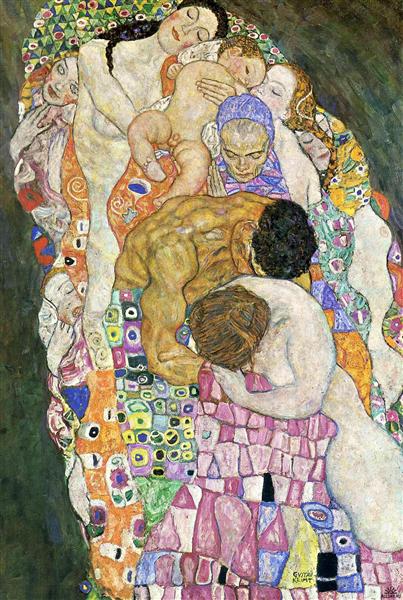
Afternoon Tea: Death and Life (1916)

From my favorite artist, the Austrian Gustav Klimt:

nol art klimt death and life 1916
Click here to zoom

My son was born a few hours ago. If all went according to plan (I scheduled this post last weekend), I am in a state of pure love and joy as a another Christensen is added to the troop.

RCH: Five facts about Emancipation Proclamation

That’s the subject of my weekend column over at RealClearHistory. An excerpt:

4. The Confederacy was, for all intents and purposes, an independent country. When Lincoln issued the Emancipation Proclamation, the Confederacy had long since declared independence from the United States and set up a federal government of its own. Montgomery, Ala. acted as its capital city until 1861, when the Confederacy’s government moved to Richmond, Va. Lincoln viewed Richmond’s diplomacy with the British and French as the most dangerous element of the Confederacy’s secession. If Richmond could somehow manage to get a world power on its side, the consequences for the future of the republic would be dire. For London and Paris, the calculations were a bit different. If either one joined the side of the Confederacy, the other would officially join the north and a global war could ensue. The Confederacy lobbied especially hard for the British to fight on their side, but there was one issue London’s hawks, the factions that wanted a war with Washington, couldn’t get past.

Please, read the rest.

My son is being born right about now (I scheduled this post). I hope everything goes well (it’s a c-section). Wish me luck!

Nightcap

  1. Mexico’s democracy is already in bad shape Noel Maurer, The Power and the Money
  2. Gorsuch and Sotomayor join forces in defense of Sixth Amendment rights Joe Setyon, Hit & Run
  3. How the Latin East contributed to a unique cultural world Jonathan Rubin, Aeon
  4. “…he amused himself by creating passports, certificates, permits, government memos, and identification papers.” Paul Grimstad, New Yorker