- Maggie Thatcher still owns the Left John Harris, New Statesman
- Stalinist Terror, Communist Prisons Patrick Kurp, Los Angeles Review of Books
- 1968 and the Irony of History Michael Mandelbaum, American Interest
- When Populism First Eclipsed the Liberal Elite Michael Massing, New York Review of Books
Year: 2018
Underrated & overrated libertarian thinkers
Here is my take on Tyler Cowen’s views on libertarian thinkers who are either overrated or underrated in shaping the libertarian tradition. Please be aware that I think libertarianism and classical liberalism are two different strands of liberal thought, as argued in more detail in an earlier post here at NOL and in my latest book. Please also note that my judgement will be particularly informed by their views on international relations.
Overrated:
- Hans-Hermann Hoppe – completely esoteric ideas about international relations, especially his erroneous and ill-thought idea about private defence through private insurance companies.
- Deepak Lal – no complaints about his general work, but his praise for empires was deeply disturbing, even though he meant well. Liberalism and globalization do not need empires, no matter how civilized – in the Oakeshottian meaning – they are meant to be.
- Ron Paul – I admire Ron Paul in many ways, but his ideas for ‘a foreign Policy of freedom’ are not much better than Hoppe’s. ‘peace, commerce, and honest friendship’: nice Jeffersonian goals, bad underlying analysis, not least about human nature.
Underrated:
- Friedrich Hayek – a far more sophisticated thinker on international relations than he is ever given credit for.
- Adam Smith – nowadays erroneously equated with ‘trade leads to peace’ fairly tales. Yet any reader of the complete two volumes of the Wealth of Nations recognizes that the book is also a lot about war and foreign policy, as are his Lectures on Jurisprudence and even a bit in The Theory of Moral Sentiments. Together these make for a full and sophisticated position on international affairs.
- David Hume – basically the same as Smith.
- Robert Jackson – ok, I am taking liberties here. I do not think Jackson would consider himself a classical liberal or libertarian. But his writings on international relations are important and often have a classical liberal leaning, especially The Global Covenant.
Nightcap
- Enlightenment and the Capitalist Crisis Chris Dillow, Stumbling & Mumbling
- The Wall is the Wall: Why Fortresses Fail Jack Anderson, War on the Rocks
- Topiary in the land of al-Qaeda Nicolas Pelham, 1843
- Why Ketchup in Mexico Tastes So Good Jeffrey Tucker, Daily Economy
SMP: Lessons From Inflation-targeting Regimes
Inflation targeting is probably the most widely-known policy adopted by central banks around the world. Under an inflation-targeting regime, the government (usually the central bank or treasury) announces an inflation target (usually with lower and upper limits). It is then up to the central bank to decide how to achieve the target. Seen in this light, inflation targeting is more of a constrained discretionary policy than a strict monetary rule.
Political Science survey (take it!)
I received the following email from a graduate student at SUNY-Stony Brook:
A team of researchers from Stony Brook University have asked us to help them study the role that emotion plays in politics. I have completed the survey myself, and it only took me a few minutes to finish. The survey is completely anonymous.
Click the link below to begin the survey:
https://stonybrookuniversity.co1.qualtrics.com/jfe/form/SV_bDvaFRlp0rmqYBf* * *
If you choose to post it, please let me know, and please discourage your readers from discussing the content of the survey by disabling the comment section on the post. It could bias my results if people go into it with specific expectations about the study.
Thanks so much for your consideration!Best Regards,
Brandon Marshall
Stony Brook University
Department of Political ScienceNote: This study has been approved by Stony Brook University’s Institutional Review Board protecting research involving human subjects.
The link is legit, though it took me about 10 minutes to complete it. On top of that, it wasn’t as cool as the ideology quizzes I link to, or the surveys Michelangelo occasionally conducts. The political scientists are trying to find out why Democrats and Republicans don’t like each other, so don’t expect any nuance or to learn anything new.
All the same, take the survey. Because science!
Nightcap
- It’s not gerrymandering if it benefits Democrats Aaron Bycoffe, FiveThirtyEight
- Just because you’re paranoid doesn’t mean they aren’t out to get you Rod Dreher, the American Conservative
- Planting trees beneath Turkish bombs in Syria Matt Broomfield, New Statesman
- In the long run we are all dead Charles Goodhart, Inference
Nightcap
- Victor Hugo’s surreal, forgotten art Andrew Hussey, 1843
- Was Roosevelt’s “Europe First” Policy A Mistake? Salvatore Babones, Asian Review of Books
- Your God is Our God Elliot Kaufman, Claremont Review of Books
- The Seduction of the Gun Matt Lewis, Los Angeles Review of Books
Nightcap
- Catholic Debate Over Kidnapping A Jewish Boy Korey Maas, the Federalist
- God’s Own Music Ian Bostridge, New York Review of Books
- Church property cases and “neutral principles” Samuel Bray, Volokh Conspiracy
- What to Do About the Money Frank McGough, Origins
On Antitrust, the Sherman Act and Accepted Wisdom
I am generally skeptical of “accepted wisdom” on many policy debates. People involved in policy-making are generally politicians who carefully craft justifications (i.e. cover stories) where self-interest and common good cannot be disentangled easily. These justifications can easily become “accepted wisdom” even if incorrect. I am not saying that “accepted wisdom” is without value or that it is always wrong, but more often than not it is accepted at face value without question.
My favorite example is “antitrust”. In the United States, the Sherman Act (the antitrust bill) was first introduced in 1889 (passed in 1890). The justification often given is that it was meant to promote competition as proposed by economists. However, as often pointed out, the bill was passed well before the topic of competition in economics had been unified into a theoretical body. It was also rooted in protectionist motives. Moreover, the bill was passed after the industries most affected saw prices fall faster than the overall price level and output increase faster than the overall output level (see here here here here and here). Combined, these elements should give pause to anyone willing to cite the “accepted wisdom”.
More recently, economist Patrick Newman provided further reason for caution in an article in Public Choice. Interweaving political history and the biographical details about senator John Sherman (he of the Sherman Act), Newman tells a fascinating story about the self-interested reasons behind the introduction of the act.
In 1888, John Sherman failed to obtain the Republican presidential nomination – a failure which he blamed on the governor of Michigan, Russell Alger. Out of malice and a desire of vengeance, Sherman defended his proposal by citing Alger as the ringmaster of one of the “trusts”. Alger, himself a presidential hopeful for the 1892 cycle, was politically crippled by the attack (even if it appears that it was untrue). Obviously, this was not the sole reason for the Act (Newman highlights the nature of the Republican coalition which would have demanded such an act). However, once Alger was fatally wounded, Sherman appears to have lost interest in the Act and left others to push it through.
As such, the passage of the bill was partly motivated by political self-interest (thus illustrating the key point of behavioral symmetry that underlies public choice theory). Entangled in the “accepted wisdom” is a wicked tale of revenge between politicians. At such sight, it is hard not to be cautions with regards to “accepted wisdom”.
The Gradual, Eventual Triumph of Liberty
Today I’d like to write a few words of hope and encouragement to those who already understand liberty’s value. I read a speech from 1853 that stood out to me. It’s easy to be caught up in the daily news cycle and feel that liberty is constantly under attack and threatened at every hand, that every gain is clawed back as liberties are eroded one at a time. At times like that, it is good to step back and took a better look at the broader history of the world.
The speech I read was by a gentleman named Parley P. Pratt, an apostle of the Church of Jesus Christ of Latter-day Saints in the Utah territory. This was just a few years after the Mormons, including Pratt and his family, had been driven from their homes by mobs and by indifferent and sometimes hostile state and federal governments in the United States proper to find freedom and refuge in the Rocky Mountains. There they still held 4th of July celebrations, honoring the sacrifices for liberty their fathers had made. Pratt, by this point in his life, had traveled through England and parts of Europe, much of the US, Canada, and along the Pacific into Mexico, and met with many people from Asia as well – a remarkably well-traveled man.
Despite the very real failures of the government to protect their individual rights or redress their grievances, he spoke in praise of the Constitution. The main thrust of his address was that the cause of liberty would expand and someday fill the world:
The longer I live, and the more acquainted I am with men and things, the more I realize that … the Constitution of American Liberty was certainly dictated by the spirit of wisdom, by a spirit of unparalleled liberality, and by a spirit of political utility. And if that Constitution be carried out by a just and wise administration, it is calculated to benefit not only all the people that are born under its particular jurisdiction, but all the people of the earth … . It seems broad enough, and large enough, to receive and protect all that may be in any way deprived of the common rights of man. …. [The principles of the Constitution] embrace eternal truths, principles of eternal liberty, not the principles of one peculiar country, or the sectional interest of any particular people, but the great, fundamental, eternal principles of liberty to rational beings – liberty of conscience, liberty to do business, liberty to increase in intelligence and in improvement […]
There is a day coming when all mankind upon this earth will be free. When they will no longer be shackled, either by ignorance, by religious or political bondage, by tyranny, [or] by oppression (Journal of Discourses, Vol. 1, p. 137-143)
Pratt claimed this would not happen predominantly by revolution and violence, but by America being a beacon light to the world. He spoke of throngs of people who would sit in his day enjoying to hear of our freedoms, our institutions, and our scientific and cultural progress. He spoke of the immigrants coming to this country from all parts of the world specifically to find that freedom, and that once enlightened by being allowed to think and reason and act for themselves without the bondage of kings, state religions, or other powers they would blossom and rise up in greatness. Whether they eventually returned to their native lands or not, this would act as an “indirect influence … on those despotic nations” of Europe and Asia.
Recognizing that our liberty is remarkably multi-faceted, I will focus on the same categories Pratt mentioned. At the time he spoke, there were exactly 3 nations that were in some measure democracies, where at least some large percentage of the populace had the liberty of choosing their leaders. You can see for yourself how this has grown in the intervening 160+ years:
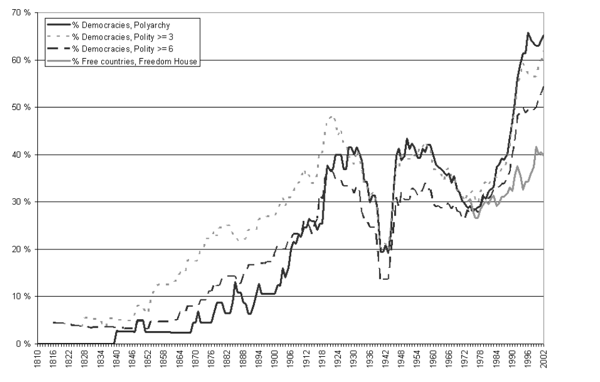
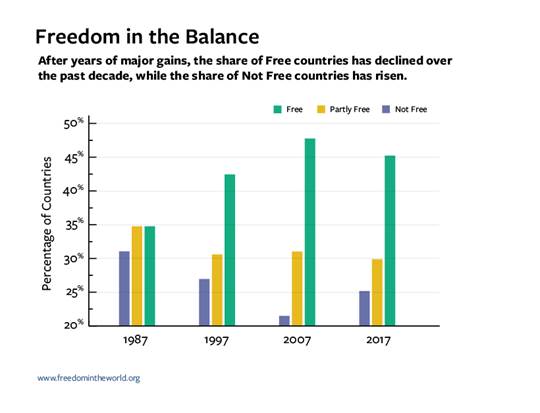
Billias’ 2009 work on how the principles of American constitutionalism were “heard round the world” shows that waves of influence gradually spread the principles of self-determination, liberty, separation of powers, and checks and balances into the freedom movements and constitutions of most of the world. Even while warning that the last ten years have seen declines in liberty overall worldwide, Heritage shows us that the last thirty years still show remarkable improvement:
From a time when the US was one of very few countries to legally protect religious liberty, today nearly three-fourths of all the countries in the world have a constitution that specifically protects freedom of belief, and two-thirds permit some religious proselytism – which preserves freedom of expression (Pew Global Restrictions on Religion). There is still much to do to improve and preserve religious liberty around the world, both in legally acknowledged protections and in fostering an actual peaceful society where religious groups are not subject to violence and persecution.
Despite the distance left to go, the cause of liberty has clearly moved forward in great ways in the last 160 years. Much as Pratt predicted, much of this was accomplished without great revolutions and civil wars, but through the power of example as free nations and free people proved themselves a beacon to the world. There is still good cause to believe in that fundamental converting power from setting the right example and allowing free people to govern themselves.
Secessions that didn’t work out
No, not that secession. It’s the ten most important unsuccessful secessions of the last few decades. That’s the topic of my latest column over at RealClearHistory, anyway. An excerpt:
You already know about Catalonia and its unsuccessful bid to secede from Spain late last year. (Check out our archives if you want to get up to speed.) A comparative approach is useful here. The unsuccessful secession movements in Africa have all been violent. The unsuccessful ones in Europe and North America started out violent but have evolved into democratic movements. The key to understanding this shift is the federative structures that exist, or don’t exist, in different parts of the world. The secessionist movements in Europe and North America are not looking to go it alone any longer. These movements don’t want full sovereignty. Separatists in Europe and North America want more decision-making power in federative structures. In the case of Quebecers, it’s Canada’s unique federation; for Catalonians (and the Scottish, for that matter), it’s the European Union. Once a federative body roots itself in a region of the world, separatist tendencies cease to be violent and they shift to more peaceful forms of resistance. Kurdistan provides a microcosmic example of this evolution, In Turkey, where the Kurds continue to be ignored and oppressed, violence reigns supreme. In Iraq, where the Kurdish region has been given autonomy and self-governance, grievances are aired out in the open, in the form of non-binding referenda and in arguments put forth in a free and open press.
I also spend a good deal of time explaining why the Confederacy is no longer relevant for understanding the world we live in. Please, check it out.
Nightcap
- Revisiting Bosnia Elliot Short, War is Boring
- Liberals and conservatives are wrong on guns Rick Weber, NOL
- Why doesn’t economics progress? Arnold Kling, askblog
- The Balance of the Federation: Canada 1870 to 2016 Livio di Matteo, Worthwhile Canadian Initiative
A quote
The most profound technologies are those that disappear. They weave themselves into the fabric of everyday life until they are indistinguishable from it.
Hayek would have liked this quote about computers. On his behalf, I’m going to co-opt it as a description of the miracle of markets.
Values quiz (worth taking!)
I’m a big fan of unscientific and undignified online political quizzes. (Remember this?) Michelangelo pointed out the newest one, and I just had to share it here. Take the quiz. My results:

Here’s Michelangelo’s results:

Me and Michelangelo match up pretty well, except for our diplomatic axis. Am I the odd man out here at NOL? In libertarian circles more generally? Take the quiz already, and don’t forget to post your results in the ‘comments’ section!
Nightcap
- Germany is struggling with its place in the world Ulrike Franke, War on the Rocks
- German parents are more laid back than American ones Lenore Skenazy, Hit & Run (Reason)
- How to walk through a Berlin park Elnathan John, 1843
- How is the world ruled? Branko Milanovic, globalinequality
 Notes On Liberty