- The road to nowhere: Manbij, Turkey, and America’s dilemma in Syria Aaron Stein, War on the Rocks
- The U.S. and Turkey Scott Sumner, EconLog
- The Kurdish issue in Turkey Barry Stocker, NOL
- Is nationalism obsolete? Rachel Lu, the Week
Year: 2018
Eye Candy: Each (American) state’s biggest export trading partner

Those tariffs will work wonders for the economy, I’m sure…
Nightcap
- Roosevelt, Taft, and the Nasty 1912 GOP Convention Rick Brownell, Historiat
- In praise of (occasional) bad manners Freya Johnston, Prospect
- What Should America Expect from a More Originalist Supreme Court? David French, National Review
- Why ultra-nationalists exceeded expectations in Turkey’s elections Pinar Tremblay, Al-Monitor
Pakistan’s dynastic politics and the PML-N’s Sharif family
As in other parts of South Asia, dynastic politics is an integral feature of Pakistan’s politics. Both the PPP (Pakistan People’s Party) and the PML-N (Pakistan Muslim League-Nawaz) are essentially family-run political parties. While the PPP has been dominated by the Bhutto family, the PML-N has been dominated by the Sharif family.
Resentment against family domination in PML-N
In the recent past, there has been resentment against the rise of both Maryam Nawaz Sharif (daughter of former Prime Minister Nawaz Sharif) and Hamza Shehbaz, son of Shehbaz Sharif (PML-N party chief and younger brother of Nawaz Sharif).
The latest resignation from PML-N was that of Zaeem Qadri, once a confidante of Shehbaz Sharif, who was denied a seat for the NA-133 (an electoral constituency in Pakistan). Qadri used some harsh words for Hamza Shahbaz, saying ‘Hear Hamza Shahbaz! Lahore is neither your, nor your father’s property.’ Qadri also stated, that one of the reasons he did not get the ticket was that he did not possess adequate resources.
In the run up to the elections, internal dynamics of the PML-N, as well as the role of the Pakistan military, will be crucial (it has been lending tacit support to the opposition, to weaken the PML-N, especially in the party’s citadel of Punjab).
Dynastic politics and differences within the Sharif family
If one were to look at the resentment against Maryam Nawaz, only last year, Chaudhry Nisar, former Interior Minister, who does not share particularly cordial relations with the Sharifs, said that it is too premature to compare Maryam Nawaz with Benazir Bhutto. Said Nisar in an interview with Geo TV:
Comparing Maryam Nawaz to Benazir Bhutto is wrong […] Maryam Nawaz should understand and partake in practical politics. Only then can she be considered a leader.
Another minister, Saad Rafique, too had stated that Maryam Nawaz should be ‘cautious while addressing public meetings.’
Rivalry between Hamza Shehbaz and Maryam Nawaz
It has been argued that one of the main reasons for the strained relationship between Shahbaz Sharif and Nawaz Sharif was the rivalry between their children. After Nawaz was removed from Prime Ministership in July 2017, one of the reasons why Shahbaz (now the PM candidate) was not immediately appointed interim Prime Minister, as well as President of the PML-N, was that there was a clamor for Hamza Shahbaz as Chief Minister of Punjab and Nawaz’s family was not comfortable with an arrangement where both father and son would be powerful. Later on, Nawaz appointed Pervez Malik, instead of Hamza Shehbaz, as campaigner in charge for NA-120, which was fought by his wife Kulsoom Nawaz.
Military’s behind the scenes manuevres and defections
In recent months, the Pakistan army has been trying to engineer a number of defections from the PML-N to PTI, and even though the military shares a comfortable relationship with Shehbaz, as compared to Nawaz, it is believed that now they would be most comfortable with Imran Khan as PM. There have also been reports of the military not just arm twisting political leaders of the PML-N, but censoring the media as well. Whether the latest resignation was prompted by the military is in the realm of speculation of course.
The Army and Nawaz’ reaction to the resignation of Qadri
Interestingly, Qadri’s resignation may be welcomed not just by the military, since it would have come across as a setback to the PML-N, which is considered the dominant force in Punjab. In his heart of hearts, Shahbaz’ brother Nawaz too may not mind this, since it will not only clip Hamza’s wings but also weaken Shahbaz’ position to some extent. During his press conference, Qadri made a mention of Nawaz Sharif, saying that the Former PM had told Qadri that many within the PML-N were not happy with his presence in the party.
While the two brothers share a very strong rapport, in spite of temperamental differences in the past year, there has been a degree of friction. After Nawaz’ remarks on the Mumbai attacks, where he blamed Pakistan for delaying the trial of the accused, Shahbaz had to intervene, and apparently told Nawaz not to talk to the press without consulting Shehbaz. In an interview to the Dawn newspaper, Nawaz had said:
Militant organisations are active. Call them non-state actors, should we allow them to cross the border and kill 150 people in Mumbai? Explain it to me […] Why can’t we complete the trial?
In spite of the differences within the PML-N, and some tensions between both brothers, there is a strong realization that the main crowd puller for the PML-N still remains Nawaz Sharif, and with the elder Sharif being in London due to his wife’s ill health (she has been on ventilator since June 14 2018) it is unlikely that he will be able to spearhead the campaign.
On the whole, defections like Qadri’s are not likely to have much of an impact on the prospects of the PML-N, given Nawaz’ charisma and goodwill, along with the fact that he is looked at as an individual who has taken on the army, and Shahbaz Sharif’s performance as Chief Minister. What will really be crucial is the success of the Pakistan military’s back door machinations, and to what extent will it go all out to back PTI Chief Imran Khan, who himself has been in the eye of a storm after a book written by his former wife and senior journalist, Reham Khan, has made some serious accusations against him, and could dent his prospects amongst certain sections.
Conclusion
It is in Pakistan’s interest that the 2019 election verdict results in the strengthening of the democratic set up. Apart from a dire need for change in the military’s mindset, political parties in Pakistan (like in other South Asian countries) too need to get their house in order and move beyond being family concerns. It is also important to have greater intraparty democracy.
Turkey after the Election
Grim Facts
Turkey held National Assembly and Presidential elections last Sunday (24th June). Recep Tayyıp Erdoğan won an overall majority of votes and retained the presidency without a second round of voting. The pro-Erdoğan electoral list of his AKP (Justice and Development Party/Adelet ve Kalkınma Partisi) and the older (the second oldest party in Turkey) but smaller MHP (Milliyetçi Hareket Partisi/Nationalist Action Party) took a majority of votes. The MHP took more votes than the breakaway Good Party (İYİ Parti/IP), though IP’s leader (Meral Akşener) is more popular than the MHP leader (Devlet Bahçeli) and the IP has more members.
The MHP broke through the 10% barrier to entry into the National Assembly in the votes cast for it, within the joint electoral list, though it was mostly expected to fall short by a distinct margin. Since the more moderate elements of the MHP joined IP, MHP forms part of a presidential majority in the National Assembly, with its authoritarian monolithic variety of nationalism unrestrained.
The main opposition party, the Republican People’s Party (Cumhuriyet Halk Partisi/CHP, a centre left and secularist-republican party), lost about one tenth of its National Assembly votes. The third party in the opposition electoral list, SP (Saadet Partisi/Felicity Party), a religious conservative party with the same roots as AKP, failed to get up to 1% in either the presidential or National Assembly elections, thus failing to increase its vote significantly and failing to take any notable fraction of the AKP vote.
CHP and then IP leaders failed to live up to promises to demonstrate outside the Supreme Election Council building in Turkey to protest against likely electoral rigging. Opposition data on voting gathered by election monitors ended up almost entirely coinciding with ‘official’ results (strictly speaking official results will not be available until 5th July) and earlier information is preliminary only.
Qualification of Grim Facts
The above gives the bare facts about the results with regard to the most disappointing aspects from the point of view of the opposition. This is a disappointing result for anyone opposed to the authoritarian regime of Recep Tayyıp Erdoğan, which began by appealing to supporters of reform in a country with rather limited liberalism in its democracy.
Erdoğan has since made it clear that he regards democracy as the unlimited power of one man who claims to represent the People against liberal, westernised, secularist, and leftist ‘elites’ and ‘marginals’, along with foreign and foreign manipulated conspiracies against the Nation.
One qualification to the bad news above is that the opposition during the election is fighting against bias, exclusion, threatening accusations, harassment, violence and legal persecution from the state apparatus, state media, private media effectively under state direction (which is most of the private media), and gangs of thugs, some armed. At the very least the opposition held its ground in terrible circumstances, which have been getting continuously worse for years.
Another ‘optimistic’ aspect is that while there was certainly some vote rigging of a kind it was difficult for opposition monitors to capture. This includes pre-marked voting ballots. As in last year’s referendum vote, videos of pre-marking of ballots have been circulating on social media.
In the referendum campaign the electoral authorities broke the law by accepting ballot papers which had not been stamped by a polling station official. This was legalised in time for the election and broadened to allow counting of ballot papers in unstamped envelopes.
Legal changes have also made it easier for state authorities to move polling stations and remove ballot boxes from polling stations to be counted elsewhere. On a less official level, reports indicate harassment of voters by armed gangs and some employers requiring evidence from a phone camera photograph of voting for the government.
There have been problems for decades with polling stations (especially in areas where the opposition does not send monitors because of a small local base) ignoring opposition votes and recording ‘100%’ for the party in control of the state at the time.
It is very difficult to know what the overall number of votes is changed by these malpractices. It is, however, clear that the southeast of the country (that is the Kurdish majority region) is much more vulnerable to such practices because of the atmosphere created by PKK (far left Kurdish autonomy terrorist/insurgent group) and the security-state counter operations.
The main Kurdish identity party, the leftist HDP (Halkların Demokratik Partisi/Peoples’ Democratic Party), competes with the AKP for first place in the southeast. It is regularly accused of supporting PKK terrorism and even of being an organic part of the PKK in government oriented media and legal cases opened by highly politicised state prosecutors.
There is certainly overlap between PKK sympathisers and HDP supporters, but ‘evidence’ that the HDP supports terrorism consists of statements calling for peace, criticising security operations against the PKK and it’s Syrian partner (PYD), and criticising state policy towards the PKK. Whatever one might think of the HDP’s policies and statements, these are not evidence that it is a terrorist organisation. The idea that it is legitimises official harassment (including imprisonment) and less officials forms of intimidation and vote rigging. It also legitimises less widespread but very real harassment of the CHP on the grounds that some supporters voted HDP to get is past the 10% thresh hold and, in a limited and very moderate way, the CHP has expressed some sympathy for persecuted HDP leaders and activists.
I can only make guesses but I think it is reasonable to estimate that 1% of votes have been historically manipulated and that this has increased along with the strengthening grip of the AKP on the state and parts of civil society, and also with its increasing demonisation of opposition.
I’ll estimate 3% for the votes manipulated.
Election evening results indicated just over 53% for Erdoğan as president and for the electoral list backing him. This has however been going down as later ‘preliminary’ results so it may now be about 52% for both votes. In this case, if 3% of votes are manipulated (a very sober estimate in my view) then we could be looking at 49% for Erdoğan and his supporters. This might still give a slight majority in the National Assembly, as distribution of seats is biased towards rural and small town conservative areas, and since 100% of votes are not represented by seats in the National Assembly in even the most pure form of proportional representation (because there are always some micro-parties which get some votes but do not enter the National Assembly).
A run-off for president after Erdoğan gets 49% seems very likely to still set up Erdoğan as the winner in the second round. It is of course wrong in principle to rig at this level but it doesn’t change anything important presuming rigging is at the level I’ve suggested. I will have a clearer idea about this when all results are officially released on 5th July.
On further relatively good news, the CHP vote in the presidential election was at 30%, about one fifth higher than before.
The presidential candidate Muharrem İnce turned out to be an inspiring campaigner and public speaker able to appeal to a variety of sections of Turkish society. He seems like a natural fit for the leadership of CHP, though so far the incumbent, Kemal Kılıçdaroğlu has been slow to step down and clear the way.,
The final results seem likely to show at least a slight decline for Erdoğan since the 2014 presidential election. IP is new and has no local government base. As there are local elections at the end of March next year, they should be able to establish local strongholds and build on that nationally.
The AKP does not have a majority in the National Assembly for the first time since 2002. MHP makes up the majority at present and as stated above seems likely to behave in a very nationalist-authoritarian way. However, its vote seems to have been increased by disaffected AKP voters (particularly in the southeast) who are not ready, so far, to vote against Erdoğan and a pro-Erdoğan electoral list. This makes their support rather unstable and the MHP is likely to see advantage in turning away from Erdoğan at some point, or at least cause him trouble by asserting its independence. Erdoğan is not someone to welcome, or live with, this kind of division in his support bloc and a conflict of some kind seems likely at some point.
Nightcap
- Centrists against freedom Chris Dillow, Stumbling and Mumbling
- Civility and Property vs. Politics Jeff Deist, Power & Market
- Justice Kennedy Retires, and the Legal and Political Ramifications Are Immense David French, the Corner
- Religious Bric-à-Brac and Tolerance of Violent Jihad Jacques Delacroix, Liberty Unbound
Busy, busy, busy
Hey folks, I’ve been busy. I just moved from Austin to Waco, and found out child #2 is on the way. Holy crap!
Here is my Tuesday column at RealClearHistory, on Rod Blagojevich, and here is my weekend column for the same site, on the World Cup. Be sure to check them out! I’ve got two columns per week at RealClearHistory, one comes out Tuesdays and the other on Fridays.
I hope you’ve been enjoying yourselves here at NOL. Awhile back, Michelangelo suggested I shift more of my writing focus here to be on libertarian parenting, but I thought that might be a bit too personal. (There’s a lot of weirdos out there.)
I’ve invited Joakim, Shree, Ethan, and Mary to join us at the consortium, and I do hope you’ve been enjoying their stuff so far (I know I have). You can find out what everyone has been up to lately by starting here (or here, if you’re on Twitter).
Have a good weekend!
Nightcap
- How did the West get religious freedom? Mark Koyama, Defining Ideas
- Are asylum rights misguided? Tyler Cowen, Marginal Revolution
- What Does China’s 5th Research Station Mean for Antarctic Governance? Nengye Liu, the Diplomat
- The forthcoming changes in capitalism? Branko Milanovic, globalinequality
Nightcap
- Privilege Versus Paranoia Steve Salerno, Quillette
- Russia, sport, absurdity, and reality Arkady Ostrovsky, Times Literary Supplement
- Christian Zionism in America Steven Grosby, Law & Liberty
- Welcome to North Macedonia Michael Goodyear, Le Monde Diplomatique
Nightcap
- Trump’s ‘Great Chemistry’ With Murderous Strongmen Conor Friedersdorf, the Atlantic
- A Little-Noticed Legal Ruling That Is Bad News for Trump Damon Root, Volokh Conspiracy
- Will the Pause in South Asian Conflicts Last? Arif Rafiq, the National Interest
- The changing shape of Britain’s mosques Burhan Wazir, New Statesman
Nightcap
- Gaza is bad. We are about to make it worse Michael Koplow, Ottomans and Zionists
- Jews, Human Rights, and the Last of the Tzaddiks David Shulman, NY Review of Books
- The Liberal Conception of Freedom Nick Nielsen, The View from Oregon
- The 19th-century painter with a warning for America Julian Beecroft, 1843
Nightcap
- Is fasting good for you? S. Abbas Raza, Aeon
- French Catholicism: A Eulogy Rod Dreher, American Conservative
- Iran’s (literary) sexual revolution Pardis Mahdavi, Times Literary Supplement
- How Trump is reshaping American foreign policy Paul Pillar, National Interest
Eye Candy: Countries whose capital is not their largest city
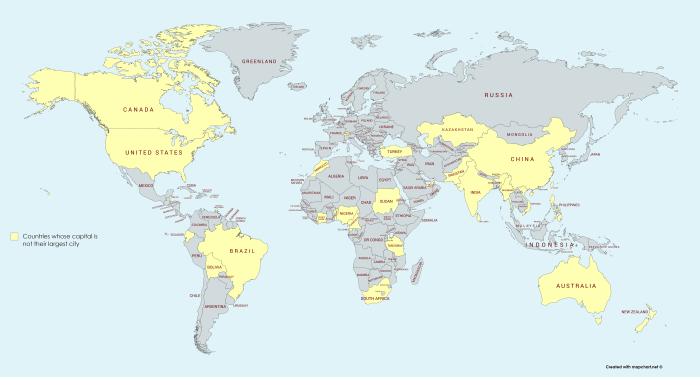
Not much to add here. There doesn’t seem to be any correlation of any kind (colonialism, economic development, etc.). Still, I thought it was cool…
Nightcap
- Siberia: a (concise) history Rhys Griffiths, History Today
- SPLC vs Maajid Nawaz: we should be concerned Ken White, Popehat
- Why women don’t code Stuart Reges, Quillette
- Benedict Arnold wanted a life of distinction Rick Brownell, Historiat
Nightcap
- The example of Charles Krauthammer Henry Farrell, Crooked Timber
- Turkey tries to legitimize incursion in northern Iraq Adnan Abu Zeed, Al-Monitor
- Why America won’t declare war Matthew Fay, Niskanen Center
- Stare Decisis and judge-made law Will Baude, Volokh Conspiracy
 Notes On Liberty