Ottomanism, Nationalism, Republicanism IX

After a break dealing with proofs and indexes of two forthcoming books, a process that overlapped with getting a new university semester started, I can return to this series, which I last added to here. I set the scene of the late 1960s in Turkey, so I will turn to the next big upheaval, the Coup by Memorandum on March 12th 1971.

The Coup by Memorandum followed an attempted coup by far left/third worldist revolutionaries amongst the officer corps. Any unity created by the Kemalist project (secularist national-republican tradition of Turkey’s founder, Kemal Atatürk) was effectively ended, though this decomposition could be said about the whole period from the 1940s to 1971, especially after the adoption of multi-partyism by Atatürk’s successor, İsmet İnönü.

The 1971 coup forced the resignation of the conservative Prime Minister Süyleman Demirel and the implementation of a program to crush the far left, while also implementing some of the more left-wing ideas associated with the 1960 coup (particularly land reform and trade union rights). National View, the first Islamist party in Turkey, founded by Necmettin Erbakan, was closed down along with leftist groups so that an appearance of balance could be maintained in opposing the extremes on both sides. The reality, though, is that the level of state repression, including violence, and further including illegal violence (torture of the arbitrarily detained) directed against the far left, including Kurdish autonomists, drastically exceeded that directed against the far right.

The level of oppression that affected the mainstream right (in that the Justice Party was temporarily removed from government) and religious right was enough to create the idea that the right in Turkey was in some way the liberal part of Turkish politics. This not only influenced liberals, but even some people with very left wing views. It is part of how the AKP could come to power and hollow out state institutions, while subordinating civil society from 2002 onwards. The right continued with a militant anti-communist discourse, in all parts, while in part posing as the liberal friends of leftist rights, along with the rights of the Kurdish autonomists. This was pioneered by Turgut Özal in the 80s and taken further by the AKP. Presumably, Turkish liberals and leftists of the most anti-Kemalist sort have now learned a lesson, but possibly too late to benefit from it for at least a generation.

The military establishment’s implicit tolerance of the religious right, along with the ultranationalist grey wolves, in comparison to the secularist leftists tells an important story about the reality of ‘Kemalist domination’ of Turkey. It had evolved into a Turkish-Islamic synthesis, a compromise with the more conservative parts of the Kemalist establishment, in which the Turkish-Islamic synthesis became more prominent and the ‘Kemalism’ became more and more gestural, including a pointless obsession with preventing young women with covered hair from entering the university, at the same time as the rights of non-Muslim minorities.

The picture is more complicated in that the anti-leftist post-memorandum government in 1971 closed the Greek Orthodox seminary in the Princes Islands off the Marmara Sea coast of Istanbul, as part of a general closure or nationalisation of private (largely foreign) institutions of higher education. This was a policy in accordance with the demands of the far left, including campus radicals. So a measure to deny rights to a Christian minority coincided with the demands of the far left and was undertaken by a notionally secularist government, in reality more concerned with crushing the far left and extending a conservative form of statism.

The above, in any case, did not resolve the real problems of political violence to which the 1971 coup responded. The period between the end of the very temporary government appointed in 1971 and the coup of 12th September 1983 was one of increasing political violence and extremism, with a lack of stable governments as the Justice Party lost majority support (though it remained in government most of the time). Neither it nor the Republican People’s Party were able to form stable coalitions or parliamentary agreements, while the economy suffered and political violence increased between far left and far right groups. Unexplained massacres of demonstrators and political assassinations accompanied barricades that violent groups put up to signify control of urban areas.

The National Assembly failed to elect a President of the Republic in 1980, despite 115 rounds of voting during increasing political and economic disruptions. When the army seized power again on the 12th September, there was widespread public support, but this was the most brutal of the military governments. Its attempt to create a more ‘stable’, i.e. authoritarian, democracy gave Turkey a constitution and system which enabled the AKP to come to power with 35% of the vote in 2002 and then erode the weak restraints on executive powers when held in conjunction with a one party majority in the National Assembly.

More on this in the next post.
Nightcap

  1. The dark side of German reunification Marcel Fürstenau, Deutsche Welle
  2. Kurdish rebels join anti-Iran lobbying fray Jack Detsch, Al-Monitor
  3. God, Man, and the Law according to Judge Kavanaugh Mark Movsesian, Law & Liberty
  4. The obligation to smile Irfan Khawaja, Policy of Truth

Nightcap

  1. Kingdoms of Faith: A New History of Islamic Spain Nicola Clarke, History Today
  2. After Rushdie’s The Satanic Verses Kenan Malik, Guardian
  3. The labor theory of value, explained Branko Milanovic, globalinequality
  4. The closest exoplanet to Earth could be “highly habitable” Adam Mann, Scientific American

Nightcap

  1. American Indian? Bruno Cortes, Claremont Review of Books
  2. Italy is the new Argentina Alberto Mingardi, Politico
  3. The case for Kavanaugh Randy Barnett, Volokh Conspiracy
  4. Israel’s Russia problem is dangerous Michael Koplow, Ottomans & Zionists

RCH: law schools and Thurgood Marshall

Yesterday’s RealClearHistory article was all about law schools, with a little bit of Thurgood Marshall thrown in for good measure (he took his seat on the US’ highest court Oct 2, 1967):

If the Supreme Court’s liberal and conservative justices all come from one of two law schools, the prevailing mode of thinking about the law is going to be not only out of touch with most of the legal profession (and general populace), but also with the idea of a judicial branch dedicated to overseeing the laws of a vast, continent-spanning republic. Marshall’s supreme courts were elitist and aristocratic, which is what they were supposed to be, but what do you call a court that is so insular and so self-selecting that only two law schools are represented?

This is not a plea to lower standards in order to broaden the field, but there are a lot of good law schools in America, which is, after all, a republic governed by laws, not men. If the Kavanaugh debacle proves too much of a problem for federal politicians (Kavanaugh went to Yale’s law school), perhaps President Trump should think of looking elsewhere for a nominee.

Please, read the rest. In it, I include 3 people who would be good SCOTUS Justices. Feel free to add your own…

Nightcap

  1. Police tailgating as entrapment Irfan Khawaja, Policy of Truth
  2. The mandatory canteens of communist China Hunter Lu, Atlas Obscura
  3. Will Shiite militias become Iraqi Basij? Hamdi Malik, Al-Monitor
  4. When details matter (Brexit) Chris Dillow, Stumbling & Mumbling

Nightcap

  1. The fantastic truth about China Alec Ash, ChinaFile
  2. Civilization in the wilderness (Argentina) JN Nielsen, The View from Oregon
  3. Giving psychiatry another look Pierre Joseph, Aeon
  4. Immigration and the Commerce Clause Ilya Somin, Cato Unbound

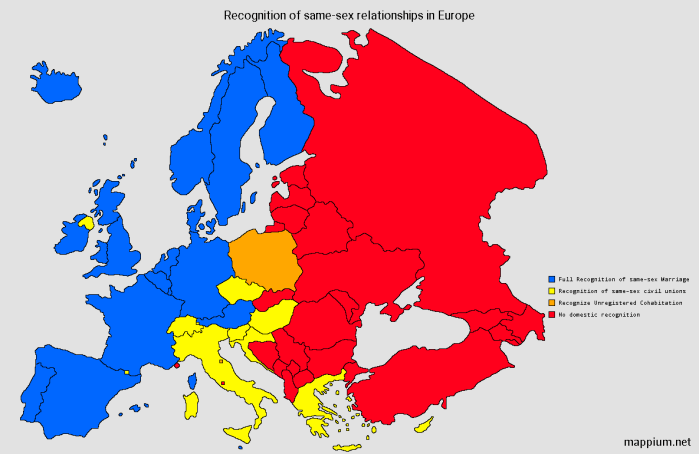
Eye Candy: Gay marriage in Europe (2018)

NOL gay marriage Europe
Click here to zoom

Opponents of gay marriage might have trouble explaining this one, at least in the free world.

Too many shadows whispering voices. Faces on posters too many choices. If when why what how much have you got…

The EU’s laudable Asia Connectivity Strategy

The European Union (EU) has put forward a plan for enhancing connectivity within Asia, and has been dubbed as the Asia Connectivity Strategy.

The EU does not want to give an impression that the Asia Connectivity Strategy (ACS) is a counter to the Belt and Road Initiative (BRI). Yet, senior officials of the EU, while commenting on the broad aims and objectives of the project, have categorically stated that the primary goal of the Asia Connectivity Strategy is enhancing connectivity (physical and digital) while also ensuring that local communities benefit from such a project, and that environmental and social norms are not flouted (this is a clear allusion to the shortcomings of the BRI). There are no clear details with regard to the budget, and other modalities of the project (EU member countries are likely to give a go ahead for this project, before the Asia-Europe Meeting in October 2018). The EU has categorically stated that it would like to ensure that the ACS is economically sustainable.

Other alternatives to BRI: the US

It is not just the EU, but also the US, along with Japan and Australia, which are trying to create an alternative vision to the BRI.

Continue reading

Nightcap

  1. A nationalism untethered to history Mark Koyama, Liberal Currents
  2. The virtue of nationalism? Alberto Mingardi, Cato Journal
  3. America desperately needs a healthy conservatism Andrew Sullivan, Daily Intelligencer
  4. After racism, the Left struggles to find a new menace Robert Merry, American Conservative

Nightcap

  1. The Tlatelolco massacre of 1968 Lorna Scott Fox, Times Literary Supplement
  2. Western Civilization “not welcome” in Australia Bella d’Abrera, Quillette
  3. Umber: The color of debauchery Kelly Grovier, BBC
  4. An interview with VS Naipaul Patrick Marnham, Literary Review

Opportunities for blockchain-based social media in developing countries

IMG_0488.JPG

On September 22nd, I presented my Serey project – a blockchain based social media platform in Cambodia – at BitFest 2018 in Amsterdam. It was organized by the BitShares Foundation and mainly attended by enthusiasts of BitShares and Graphene technology. Being part of the Bitshares/Graphene family, I was invited to speak at the conference.

We shared the stage with other graphene projects as BitSpark, DasCoin, PayGer, BitCrab, RuDEX and many others. I look forward to work together with anyone that seeks to decentralize our future, that has a vision in which every human being is free, and where blockchain technology provides the tools to secure our rights to life, liberty, and property.

Stan Larimer was there as well, and he had something interesting to say about how BitShares will import EOS technology through a middle-layer. This will greatly benefit the whole BitShares/Graphene community, including Serey.

Regarding my own presentation, I have made the case that Blockchain is not only a technological revolution, but essentially a social, political and economic revolution. I believe it’s a tool that will move us into a more decentralized world that was envisioned by the earliest internet adopters. As more internet applications were built, it became clear that it would not become as decentralized as these adopters hoped. These applications suffered from a centralized system in which data was stored and controlled on a single or a small number of servers. Those who controlled these servers, the men-in-the-middle, dictated the rules of the platform. They could look into your data, modify your data, prevent you from accessing your data etc.

Blockchain eliminates these so-called “men-in-the-middle”. Its censorship-resistant property provides many great opportunities for developing countries where the rule of law are often weak or underdeveloped. One opportunity that I have been trying to seize in Cambodia is the creation of a social media platform that could not be controlled or censored by a single party. As Cambodians are becoming more tech savvy, and more connected to the outside world through internet access, it’s a great time to roll out a Blockchain-based social media platform where people can express themselves freely. The advantage of a social media is that it’s easier to build the network effect that can reach critical mass in a relatively short period of time. Once we gain enough momentum, I would like to tokenize the national currency, the Riel, develop a Serey Wallet, and provide anyone who has access to the internet the opportunity to open a wallet (bank account) for free and use our tokenized Riel for e-commerce, remittances, savings, loans etc. Although Cambodia has experienced tremendous economic growth in the past two decades and the World Bank has moved Cambodia’s status from a lower-income bracket to a lower-middle-income bracket, 83% of Cambodians still remain unbanked.

Doing so, I hope we will promote freedom of expression and an intellectual society in Cambodia, as well as help banking the unbanked.

Below, you can find my slides for the presentation.

1.jpg


2.jpg


3.jpg


4.jpg


5.jpg


6.jpg


7.jpg


8.jpg


9.jpg


10.jpg


11.jpg


12.jpg


13.jpg


14.jpg


15.jpg


16.jpg


17.jpg


18.jpg

RCH: 10 most divisive Supreme Court justices in American history

It turns out that SCOTUS appointments have had a long history of dividing American society. An excerpt:

9. Roger Taney (1836-64). Taney rose up the political ranks as Andrew Jackson’s right-hand man. Jackson tried to get him on the Supreme Court in 1835 but his nomination was rejected by anti-Jacksonian Whigs in the Senate. After the Whigs were swept away in the 1836 election campaign, Jackson renominated Taney, but this time for the position of Chief Justice, and he was confirmed 21-15 after a bitter debate in the Senate. The Taney court is responsible for the Dred Scott case that tore the fledgling republic apart, and for helping Jackson abolish the national bank. Taney and Lincoln clashed often, too, as Taney ruled that Lincoln’s suspension of habeas corpus was unconstitutional, but Taney never did go home during the Civil War and served out his term as Chief Justice until his death in 1864. He holds the second-longest tenure of any Chief Justice.

Please, read the rest, and try to remember: this divisiveness is a feature of the system, not a bug.

Nightcap

  1. Legendary fart battles in the Samurai Era Richard Farrell, Vintage News
  2. The other side of Weimar (Germany) art David Bennun, 1843
  3. India’s ingenuous approach to life Christian Koch, BBC
  4. Revisiting the American Century Ronald Radosh, Claremont Review of Books

Nightcap

  1. Neoliberalism is making the world much more equal Scott Sumner, EconLog
  2. How effective are Islamic states at satisfying the religious needs of their citizens? Nile Green, Los Angeles Review of Books
  3. Socialism won’t get rid of bosses, either Christopher Freiman, Bleeding Heart Libertarians
  4. Hayekian communism Branko Milanovic, globalinequality