Hitching to Sweden at 17

Below is an excerpt from my book I Used to Be French: an Immature Autobiography. You can buy it on amazon here.


Anyway, on that first hitching trip to Sweden, I had some hard times because I looked ordinary. Hitchhiking long distance, it turns out, serves to steel you against a childish sense of injustice that lingers long after childhood among some people. On one occasion, somewhere in the northern Netherlands, I had been standing on the side of the road for two hours when two Highlanders in full kilt regalia including furry sporran passed me and politely started signaling from behind me. (That is, they took their proper place in the queue.) Soon, they were followed by a guy in complete white Saharan outfit, with turban, white flowing robes, and all. The Highlanders were gone in ten minutes. Before the Saharan got picked up, he had the time to confirm that he lived in Paris, that he did not dress that way to work or university, and that he had bought the outfit for the specific purpose of hitchhiking to Sweden to meet girls. I felt under-dressed in my plain cotton pants and my short-sleeved blue shirt. Later, I made myself understand that my travel slowness was not a result of bad luck but of inferior knowledge and skills.

BC’s weekend reads

  1. Path-dependence of measuring real GDP?
  2. Technological creativity and the Great Enrichment (h/t Federico)
  3. The deadly serious accusation of being a “so-called judge”
  4. Why Congress isn’t reigning in Trump
  5. How did Germany and Austria’s elite musical institutions navigate the vicissitudes of early 20th-century European history? (review)
  6. Western nationalism and Eastern nationalism

Dear Muslim Fellow Citizens:

President Trump’s executive order temporarily barring entry into the US to those coming from seven countries was a rude act.* To make things worse, it was badly implemented, causing inconvenience and even distress to a number of innocent travelers. What’s more, it’s unlikely to be very effective in its stated goal of keeping Americans safe. The reason the administration gave for the order was to give the appropriate agencies some time to improve their techniques for vetting ordinary travelers from those countries.

As I write, the bar is in circuit court where it will be decided whether a previous federal judge’s order suspending application of the bar holds or not. There is a mano-a-mano between a largely liberal circuit court and a fairly conservative and decisive new executive. Whether the executive prevails or not, the order was given and it will be remembered as one of the first acts of the Trump administration. It’s worth discussing.

Much of what has been said about the order is false, ridiculous, or dishonest. I urge you to preserve your collective credibility by not falling for the falsehoods, and worse, for partially true but misleading statements you have heard. Some, you have heard repeatedly.

Beyond this, I suspect you have not done enough collective self-examination. I suspect this because no one reasonable talks to you frankly about matters concerning you. There are plenty of ill-informed hysterical, obscene anti-Muslim shouts which you probably (rightly) shut out. The rest of America is too paralyzed by political correctness to say anything to you that may seem critical. I am reasonable and I am not paralyzed by political correctness. In addition, there is a good chance I am pretty well informed. (Go ahead, Google me.) Where I am not, I listen to advice and corrections with an open mind. I wish to talk to you about mistrust of Muslims and about what you may not have done to represent yourselves in a light inducing others to be fair. Lastly, I wish to address you about what you have done that has not been helpful.

The persecution of Muslims

Fact: The seven countries the executive temporary banning order targeted are all predominantly Muslim countries.

That does not make the order an anti-Muslim measure. If President Trump had wanted to persecute Muslims, Indonesia, Pakistan, Egypt and even India (yes, India) would be heading the list. There are something like forty predominantly Muslim countries in the world. How do you think the seven were chosen?

The seven were originally selected by the Obama administration as dangerous countries from which it was difficult to obtain enough information to vet travelers. This explains why most Muslim countries – by a long shot – did not make the list. In the case of five Arab Muslim countries on the list, they are there because they are failed states unable to provide credible information if they want to. Iran is a special case. President Trump, and some of us, think that the information should not be trusted that comes from a country where the political class has been smiling benevolently for the past thirty years on demonstrators whose main demand is “Death to America!” Taking people at their word is not a dirty trick, right? The sixth country on the list, Sudan, is there for both reasons. It’s an ineffective state and its leadership is openly hostile to America. It’s unable to cooperate in vetting and it will not.

Why should President Trump want to go to extraordinary lengths to vet travelers from those particular countries, you wonder suspiciously? It’s because – you are right – the Muslim world is widely thought to be a privileged source of terrorism. That’s in the 21st century. In the 20th century, it would have been (largely Catholic) Ireland, the (Catholic) Basque area of Spain and, especially, the (Hindu) Tamil area of Sri Lanka. The fact that no IRA terrorist, no ETA terrorist and no Tamil Tiger terrorist ever claimed to be acting in the name of God or of his religion may make a difference though. What do you think?

Personally I don’t see how anyone can disagree with the proposition that Muslim countries (not all, some, of course) generate large numbers of terrorists when those same terrorists massacre many more Muslims than they do anyone else? I can’t believe you are not aware of the many car bombs detonated near mosques during prayer from Pakistan and Afghanistan to Iraq. And have you ever thought of what the proportion of Muslims must have been at the massacres in the French night club or during the Bastille Day festivities, in Nice, France? Let me tell you: Many French Muslims are immigrants from rural areas in Africa. It’s been true for a long time. They have more children than people born in France. Whenever you find children and young people, in France, you are looking at many young Muslims. And, go back to the “Underwear Bomber” trying to blow up a plane over largely Muslim Detroit, during Christmas Eve, of all times. Who do you think would have died, primarily? How many Christians are on a plane on that night? (Reminder: He is a young man from a good Nigerian family. He is having a bad time in federal prison, right now.) It’s your duty to be informed about the people who are massacring both your people and your neighbors, I think.

Incidentally, the fact that Muslims die much more than other people under the knife of neo-jihadists does not give your passivity a pass.

This all is sufficient to explain well why there are only Muslim countries on the ban list. It would have been more polite of the Trump administration to add, say Iceland, Paraguay, and Laos, or Timor. Perhaps, they did not think of it. No one is perfect. Perhaps they did think of this trick and decided to not implement it to signal that political correctness has to go, at last.

Before I move on, note what the paragraphs above do not (NOT) say, lest your memory tricks you later: They do not say that “most Muslims are terrorists,” as stupid liberals allege such statements mean. I don’t think most Muslims are terrorists. I do not think that many Muslims are terrorists. I am not even sure the terrorists who claim to be Muslims are Muslims, or good Muslims. I don’t really know. However much I regret it, I can see how it is easy to find justification for religious acts of violence in the Islamic sacred Scriptures. (Ask me or tell me plainly that I am wrong, that there are no such justifications in the Scriptures.)

Trump’s order was intended to keep terrorists where they are for the time being, until we learn better to spot them. It was intended to protect me and my children, and you and your children. I have my doubts about its efficacy, as I have said elsewhere. You should feel free to criticize it on that ground without going to motives you have little way of knowing. “Stupid” is not the same as “prejudiced.”

The Muslim contribution to the mistrust of Muslims: Inaction

Next, I need to ask you if Muslims collectively have done anything to contribute to widespread mistrust of Muslims in America. First I need to ask what American Muslims did not do that they should have done – and can still do. This can be brief.

Large American Muslim organizations have put themselves repeatedly on the public record denouncing terrorism perpetrated by those who claim to be inspired by Islam. They are quick to assert that religious violence is incompatible with Islam, that the neo-jihadists are simply bad Muslims, or even, not Muslims at all. This is all for the good although – I am sorry – most of the protestations sound hollow. One of the things missing, incidentally – is condemnations by obvious religious authorities.

What bothers me personally, and probably others who don’t have the time to think about it, is the lack of individual faces to accompany condemnations of neo-jihadist barbarism. There are two exceptions I know of, two Arab-American men who sometimes come on TV to reject barbarism or any links to American Muslims vigorously. I don’t have either name in mind right now and I would not name them anyway because I don’t have a clear idea of the risks they are taking.

What I am missing is reactions from individual, private persons of Muslim faith, people with a face. I ask how many of you said anything – outside the family – when ISIS was beheading an American journalist and then, an American social worker, all on video. I wonder if you said anything, at work, even if only at the water fountain, when ISIS was burning people alive in cages. How many of you expressed horror aloud or when it was turning thousands of young women and girls into sex slaves. How many dismiss Boko Haram which is burning its way through North Western Nigeria as a (black) African monstrosity?

Some of you, most of you, or all of you, think these questions are superfluous and even, that my expectations are outrageous. I have a friend, a young Muslim woman who tells me straight up that terrorism is no more her problem than mine. It’s unrealistic and it’s false. The abstract category “American Muslims” (I am not using “community” deliberately) turns out enough terrorists and would-be terrorists to destroy this presumption of distance between you and the prevalent kind of barbarism. Note also that, irrespective of provocations, since the masterful, well-planned, very successful aggression of 9/11, there has not been a single act of private terrorism against Muslims or Muslim institutions in America. (Hectoring of women wearing the hijab in public places does not quite count as terrorism.) Mind what I am really saying: It’s not your job to stop terrorism committed in your names but you would be wise to reject it forcefully and loudly, and also in person when you have a chance.

The Muslim contribution to mistrust of Muslims: Actions

There are also the things American Muslims did that contributed to the process leading to the Trump administration temporary ban on travel from seven Muslim countries.

Let me help you remember. In 2008, you voted for Barack Obama in large numbers although he was a leftist of zero demonstrable achievement but one. (He did pass the bar exam.) I don’t know if you did it because the father he never knew was a Muslim (a drunken Muslim), or because his middle name is “Hussein,” or because you were caught up in the great Democratic emotional sweep. Later, in 2016, you largely supported the candidacy of an obvious liar and cheat who had already sold some of the country to foreign powers before even being elected. What’s more, she presented herself squarely as President Obama’s successor. Many of you just bet on the wrong horse without much of an excuse for doing so. (I think I have read somewhere that American Muslims are better educated than the average American. Correct me if I am wrong.)

Had more of you voted Republican, they just might have influenced the result of the primary, perhaps, Marco Rubio (my candidate) would have won it, or the honorable Mayor Giuliani. The presidential election could have played out differently. If it hadn’t, there is a chance you would have still earned a voice within Republican politics. You chose instead to trust in liberal cliches to go with the easy flow of falsely generous liberalism.

Even with Donald Trump as president, you would have avoided getting trapped in the Democratic identity mishmash. You would have saved yourselves the embarrassment of ending up squeezed in their book between illegal aliens from China and transgender activists. At this point, your main public, visible representation in American politics – by default, I realize – is the pathetic, corrupt loser’s personal assistant. She is very elegant but she is married to a gross pervert. The fact that her parents are members of the Muslim Brotherhood does not help. It’s not a terrorist organization exactly but it’s very unfriendly to America and to its main values. By the way, you appear to still not be paying enough attention. The fact is that, right now, thousands of Americans are talking (and screaming) in the streets in defense of, and often in the names of, Muslims in general. Yet, the voices of American Muslims themselves are hard to perceive in the din. It makes no difference; when the fog clears up, some Americans are going to blame you for the riots. You are innocent, of course but, to a large extent, you put yourselves there.

There is danger in letting others speak in your place on the public square. It’s the same others who recently used the armed power of government to force others to violate their conscience. (By forcing a Catholic nuns’ order, for example, to provide contraceptive services to their employees.) How is this going to play out tomorrow when your own religious practice needs protection, I wonder.

The executive order and our constitutional order

There is much misunderstanding everywhere about the legal nature of the order. It’s all over the media and elsewhere. One Iranian woman, a distinguished MD, I am told, is suing the federal government because she suffered some travel inconvenience as a result of the executive order. (I don’t know if she is a Muslim; it does not matter.) I hope the suit only shows confusion about the American Constitution rather than some sinister plot. Whatever some little liberal judge in the boondocks may say, the Constitution does not apply to those who are not under the power of the US government. This includes citizens, legal permanent residents, illegal permanent residents, prisoners of war, to some extent, and those who are already on US soil by whatever means, or otherwise under exclusive US control. It does not apply to Mr Yokama in Osaka, to Mrs Dupont in Marseille, or to Ms Reza in Iran, or on a layover in Dubai.

The media have also shown growing confusion about the nature of a visa. It’s not a contract between a government and a private foreign party. It’s not enforceable in any court. It’s a promise to admit and evidence that someone is considered acceptable at a particular time. Either of these assessments can change in minutes. Incidentally, American immigration officers at all levels have always had discretion to do what they think is best: You can arrive at LA International from Finland, with a perfect visa, and have a fat federal employee in short sleeves get suspicious of you and deny you admission on the spot. There is no legal recourse, never has been.

Nation-states avoid canceling visas in ways that would look arbitrary, for two reasons. First it makes the relevant government lose international credibility. That’s a subtle phenomenon. No one knows how much denials and cancellation push the relevant country over the brink. Thus, any government, including, the Trump administration assumes it has a good deal of discretion in this matter. The second possible consequence of many negative visa events is that other governments may take retaliatory measures: You do it to us, we do it to you or even, we deny your citizens any visa. It’s not surprising that some governments of small, poor countries just don’t care much about serving up reciprocation to a large, desirable country such as the US. If you are an alien and you have a visa for the US, it means that you have a good chance to get in. It’s not a guarantee.

The president and his conservative supporters are not responsible for the confusion about the Constitution whipped up and smartly supported by liberal opinion.

Islamophobia

By now, I suspect, you are thinking “Islamophobia.” I don’t quite know how to defend myself against accusations sitting in your mind about what’s going on in my own mind. It’s like suspecting me of watching porn inside my head. How can it convince you that I don’t? Nevertheless, for what it’s worth, nothing predisposes me to a blind, irrational hatred of Islam or of Muslims. I have known Muslims all my life. I have had nothing but harmonious personal relationships with them. I think there is much to love in Islamic culture. For example I am fond of calligraphy in Arabic, the language of the Koran, so fond that the Profession of Faith (the Sha’hada) hangs over my bed. (I wouldn’t be surprised if this usage by a non-believer is considered blasphemy, somewhere or other.) The few times I have lived among Muslims, I have liked it. There is even a Muslim country where I would like to live permanently now that I am old. (My wife won’t hear of it; what do you know!)

“Islamophobia” is not a real concept anyway. It was invented by liberal intellectuals to shut up debate up. If it were not so, there would be other similarly formed words such as “Protestanphobia” and “Bhuddistphobia.” The impression that Muslims in America take refuge behind that rotten old hyena hide is deplorable. It feeds many unfair stereotypes.

And, by the way, what would be wrong with being an Islamophobe? I mean in the American tradition of freedom of conscience and freedom of speech? Being a Muslim is not a race, an unalterable fact about a person. It’s a choice. If I understand a little about Islam, it’s even the supreme choice. There is widespread confusion there also.

Why should anyone not be morally, intellectually allowed to detest a choice you can reverse any time you wish? Take me, for example. I used to be a Catholic. I am not anymore. I am an ex-Catholic. Anyone could have blamed me for being a Catholic, a believer in fairy tales and a supporter of an organization massively complicit with child rape. “Catholicophobe” would not become an insult; it did not. Why would you deserve special treatment, in this regard?

No one at all blames me either for being an ex-Catholic, by the way. There is (well-founded) Catholicophobia in this country. There is no such thing as “ex-Catholicophobia.” I am also aware as I write that changing religion is called “apostasy.” I am further aware that apostasy is punishable by death in a number of countries. They are all Muslim countries, as far as I know. (Please, correct me if I am wrong on this.) One of the advantages of living in the US, as you and I do, is that there is no penalty here for transgressions of conscience. There is no punishment for walking away from a set of beliefs. This is never discussed in narratives that use the word “Islamophobia.” We don’t speak enough about such matters. Muslims, in particular, don’t speak enough. (And, I don’t believe the media suppress such conversations. The liberal media will print anything said by anyone identified as “Muslim,” especially if the speaker wears a hijab.) I realize that one can find many statements by American Muslims on the Internet. That’s not good enough; I shouldn’t have to do research.

There is also much confusion – often spread by the liberal media – about the First Amendment to the US Constitution. That main amendment to the Constitution is widely misunderstood, by native-born citizens and by many others as well. It states categorically that government cannot have a favorite religion; it says that government cannot interfere with religious practice or belief. Moreover, the Constitution forbids government to administer religious tests as a precondition to holding any government office. That’s it!

There is no part of the US Constitution that protects anyone from criticism by private parties. There are countries where such criticism is illegal; the US is not one of them. Personally, I hate Communism and Devil worship, and I also detest obsessive talk about baseball statistics, for example. Do I have a right to my dislikes? May I express them openly? Should I count on the protection of my government – whose first assignment is to protect me – when I express these dislikes? May I say safely, “Devil worship is an abomination”? How about, “Christianity is a false religion”? Should you, personally, have to forbid yourselves from detesting Devil worship aloud? How does the Constitution answer these questions?

Since I began talking calmly about things some Muslims don’t enjoy hearing, let me continue a little way. Let me affirm as a preamble that you have as much right to be here as anyone. If you are an immigrant like me, you might have even a little bit more right than most. (Immigrants contribute somewhat more than the native-born.) Irrespective of your rights, if you are a person who dislikes the separation of Church and State, if the gap between religion and government is anathema to you, I hope you will leave. I won’t do anything about you but you must know that I don’t want you as a fellow-citizen. And, if you take my suggestion, please, take with you as many Baptists, Lutherans and Catholics of the same belief you can find. I hope our government will do its best to limit or prevent the entry of people who hold such beliefs.

To end: It’s likely that most of you are people with whom I would like to have a cup of coffee or a meal. I suspect that we have more in common than not. You would yourselves be astonished at what a pleasant person of culture I am in real life. (Go ahead, Google me.) We would talk about our children and our grandchildren. We would share our experiences in the country I chose. This probable commonality creates no obligation for me to tolerate nonsense. The Trump temporary executive order of mention may well be regrettable. If it’s unlawful – I don’t see how – it will not be implemented. Our institutions are working. In the meantime, it’s not the end of the world. We, Americans, you and I, have bigger fish to fry.

About Syria: There are tens of thousands of Syrian refugees we could take in without endangering ourselves. We should do it, for two reasons. First, it the right thing to do and it’s good for our souls. Second, we are partly responsible for the unending disaster in Syria. I have not forgotten the red line in the sand the dictator Assad was not supposed to cross or else…. That was before the Russians were heavily involved. At the time, the US Air Force and the US Navy could have destroyed 95% of Assad’s planes and helicopters in one morning if there had been political will. It would have made it extremely more difficult for him to continue fighting and to massacre civilians. We did not intervene. Now, we have to give a hand, a big hand. I don’t see why this help should include a path to citizenship.


*The executive order has been suspended by a judge (a single judge) as I write. The Administration fast track appeal has been rejected. Afterwards, the administration appealed to the 9th Circuit Court. Our institutions are doing their work even if it’s at the cost of some judges believing it’s their job to make laws. To my mind, the fact that the order was issued at all is important whether it’s ultimately put to work or not.
Household size and growth since 1870 (albeit in Canada)

Two days ago, I posted something on how much we were estimating growth since the 1950s. While organizing another research paper that I am trying to finish, I realized that I could make a follow-up to this based on previous research of mine.

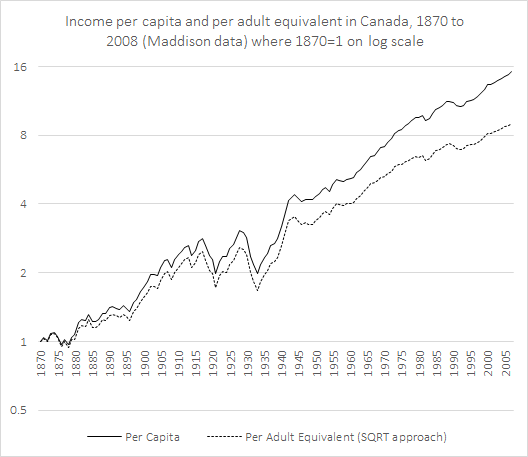
A few months ago, I published (alongside Vadim Kufenko and Klaus Prettner) a short note in Economics Bulletin where we showed that the large differences in household size in Canada that existed up to 1975 led many to overestimate the level of differences between provinces. Moreover, we pointed out that because household size were converging at the same time as incomes, we argued that the rate of convergence from 1945 onwards was slightly overestimated. That paper convinced us to do the same between all the OECD countries (we are assembling the data right now).  But this was an argument about variance, what if we simply plot the “per capita” income of Canada with the “per adult equivalent” income of Canada since 1870.

By using the Maddison dataset combined with the data from my article, it took me a few seconds to get the graph below. What is important to notice in this graph is that, incomes per adult equivalent (measured in 1990 Geary-Kheamis dollars) have increased 40% less than incomes per person. Since adult equivalents are a better measure of living standards (because you capture the economies of scale associated with household size), we can easily say that we have been underestimating the level of improvement in Canada (it is still substantial however).

growthfactors

On 7 million deaths from air pollution

ATTN published a video of An-huld (the really cool guy who made my childhood by being in all my favorite action movies like Predator* and who ended up being the governor of California). In that short clip, Schwarznegger starts by saying that 7 million individuals die from pollution-related illnesses.

That number is correct. But it is misleading.

People see pollution as “all and the same”. But some forms of pollution increase with development (sulfur emissions and some would argue that too much CO2 emissions is pollution as it causes climate change). However, others drop dramatically – especially heavy particules (Pm10) which are a great cause of smog. Julian Simon (the late cornucopian economist who is one my greatest intellectual influence) pointed out this issue and noted that the deadliest forms of pollution are those that relate to underdevelopment.

Back in 2003, Jack Hollander published the Real Environmental Crisis: Why Poverty, Not Affluence is the Environment’s Number One Enemy. Hollander pointed out that simply from the combustion of organic matter (read: firewood and animal manure – literally burning fecal matter) indoors for the purposes of heating, cooking and lighting was responsible for close to 2 millions deaths.

Since then, the WHO came out with a study pointing out that around 3 billion people cook and heat their homes with open fires and stoves that rely on biomass or anthracite-coal. They put the number of premature deaths directly resulting from this at over 4 million people. This is close to 60% of the figure cited by the former President of California (yes, I know he was governor – see here). In other words, 60% of the people who die prematurely as a result of strokes, ischaemic heart diseases, chronic obstructive pulmonary diseases and lung cancers can be attributed to indoor air pollution. That means pollution resulting from the fact that you are so poor that you have to burn anything at hand at the cost of your health.

True, richer countries pollute and there are policy solutions (I have often argued that governments are better at polluting than at reducing pollution, but that is another debate) that should be adopted. But, these forms of pollution do not harm human life as much as those that come with poverty.

* By the way, when you watch Predator, do you realize that there are two future American governors in that movie? I mean, imagine that when Predator came out, some dude from the future told you that two of the main actors would end governing American states. Pretty freaky!

How school choice can benefit teachers

Betsy DeVos was narrowly confirmed as US Education Secretary this week. Of all Trump’s nominees, she seems to have attracted the most rancor, which is a shame considering Trump’s pick for Attorney General, Jeff Sessions, is an outspoken supporter of the US’s brutally racist drug war. Concerns with DeVos’s background and experience are very well-founded. Concerns with her support for school choice, however, are not.

Others, including Nick Gillespie, have already covered the important student-centric case for school choice, pointing out in particular how greater choice benefits minority students and students from disadvantaged backgrounds. I will focus instead on the benefits to teachers as I see them based on my research in school choice systems in the United Kingdom and Sweden.

A great deal of opposition to school choice is based on the perception that it is necessarily an attack on the teaching profession (it is certainly the way teaching unions portray it). Indeed, it is too easy for generically anti-state advocates of school choice to fall into the assumption that there is a pitched conflict between the supposed special interests of publicly-funded teachers and the interests of students. On this narrow account, the purpose of school choice is to compel teachers to work harder, for longer, in order to produce better results for their students.

The reality is that teachers and students share a lot of common interests, namely having a safe, productive and enjoyable working environment. The broader case for school choice is that a competitive framework allows for these environments to emerge more readily than with a monopoly public provider. This does not necessarily mean importing a ‘competitive ethos’ inside the school gates. If anything, it is school administrators, or proprietors in the case of private schools, that need to be exposed to competition, not the teachers themselves.

How do teachers benefit from school choice in practice? First, schools exposed to competition are encouraged to devote more money to teachers’ salaries (for teachers both in public and private schools). Arguably, this is because retention of quality teachers is more important than more visible expenditure that are often more attractive to policymakers. These include new buildings and electronic classroom aids that officials think can give the public the impression of long-term ‘investment’ in a way that simply paying teachers more does not, even if that is, in fact, what works best.

Second, such schools can allocate training resources more effectively to teachers. I found in Sweden, which has an extensive school choice system, that one private network of schools had developed and provided their own continuing professional development curriculum rather than outsourcing it to consultants.

Third, multiple competing providers combined with the possibility of establishing new schools give more career options for teachers. Conversely, a public monopoly can easily succumb to group-think. This ends up excluding good teachers who happen to disagree with the prevailing orthodoxy. The career trajectory of British teacher, Katharine Birbalsingh, is a useful illustration. She was a successful state-school teacher who made the mistake of appearing at a Conservative Party conference in order to advocate for a more traditional pedagogy and to discuss problems of discipline in the school system. She was suspended from teaching as a result and essentially forced to resign her position.

Under a purely public school system, an outspoken teacher who disagrees with the way the majority of schools are run might be frozen out from further employment indefinitely. They would have to move to the fee-paying private sector instead in order to continue teaching at all. In the United Kingdom, however, we now have array of state-funded but independent schools called free schools. This allowed Birbalsingh to open a new school, the Michaela Community School, which so far appears to be enjoying some success. It is also an attractive employer for other teachers seeking an environment that supports greater discipline in the classroom. Thus she was able to continue contributing to public education. In this sense, a diverse range of schools, based on different pedagogical principles, does not only benefit students who can find a school that better matches their needs. It also gives teachers a wider range of environments in which to work.

What the Bible really says about how to treat refugees

Recently a text written by Jesse Carey, in Relevant Magazine, supposedly about what the Bible says about immigrants, refugees and displaced people, has come to me. The text is a bit old (from November 17, 2015), but is being reheated because of President Trump’s recent decisions in this area. Given these things, here are some comments on “What the Bible Says About How to Treat Refugees.”

Carey presents what he calls “12 verses about loving immigrants, refugees and displaced people”. The first thing to note is that none of the texts presented by Carey mentions the word refugees. The texts speak about foreigners, the poor and needy, travelers, strangers, and neighbors, but never about refugees. A refugee is a foreigner, but not every foreigner is a refugee. The same goes for stranger. Amazingly, refugee is also not synonymous with traveler. Every refugee is traveling (against his will, it is assumed), but not everyone who is traveling is a refugee. Finally, a refugee can be poor and needy, but poor and needy and refugee are also not synonymous. It seems that Carey has difficulty reading: when he sees words like foreigner or traveler or poor and needy or stranger his brain reads refugee. Either that or he’s being flagrantly dishonest.

The second observation is that, in the language used by Jesus, for the Christian every refugee is a neighbor. Not every refugee is poor and needy, not every foreigner is a refugee, nor does every stranger is a refugee and not every traveler is a refugee. But for the Christian, every human being is a neighbor, and so deserves his mercy. The problem is that Carey wants to apply this to immigration policies, and immigration policies are not made by Christian individuals, but by governments.

The history of the relationship between churches and governments is long, complex and tumultuous. To make a quick summary, suffice it to say that during the Middle Ages church leaders and political leaders fought and argued among themselves about who would dominate the people of Europe. The Bishop of Rome wanted to be above the Emperor of the Holy Roman Empire. At the local level, bishops and priests fought with nobles of all kinds. The result was a general confusion. One of the great victories of the Modern Era, beginning with the Protestant Reformation (which celebrates 500 years this year) was the separation of churches and state. Especially since the Peace of Westphalia in 1648, the tendency has been for states not to use their arms to impose a religion on the population. Carey wants to go the other way. He even cites 1 Corinthians 12:12-14 as if it applied to every human being, and not only to Christians.

The Bible teaches that individual Christians must care for needy people, and certainly refugees fall into this category. But the Bible does not teach that the state should do this. The role of the state, according to the Bible, is to carry the sword to punish wrongdoers and to benefit those who follow the law (the classic text regarding this is Romans 13). In other words, biblically the function of the state is restricted to security. Receiving immigrants is certainly a policy with which Christians can agree, but fully open borders, without any vigilance, are a delusion and nothing more. Wrongdoers can disguise themselves as immigrants to enter a country, and it is up to the state to do some kind of security check.

I am not discussing here the details of Trump’s current policy for immigrants and refugees. It is quite possible that there are aspects within it that Christians can or should disagree with. But by wanting to impose Christian behavior on the state, Carey goes against one of the greatest victories of the Modern Age, the separation of churches and state, something amazing for a liberal and progressive author. Does he approve of compulsory prayer in schools, the end of teaching Darwinism and punishment for those who do not attend Sunday worship? Hope not.

Roger Williams has already presented this discussion very clearly more than 300 years ago: Christians cannot impose their religion using the state for this. What can be expected Biblically from the state is in the second table of the law: you shall not murder, you shall not steal, you shall not give false testimony … Basically, do not hurt others, do not lie to them and do not take their stuff without permission, things that any kindergarten child knows are wrong. I do not think we need the Bible to teach us that.

I hope that the state is open to immigration as much as possible, being restricted only by security concerns. I hope Christians will welcome the refugees. I hope the wall of separation between church and state is never overthrown. And I hope that the rulers of the United States will leave the Islamic world for the Islamists to take care of. They already have enough work taking care of the safety of Americans in North America.

“Watch” the (industrial) revolution!

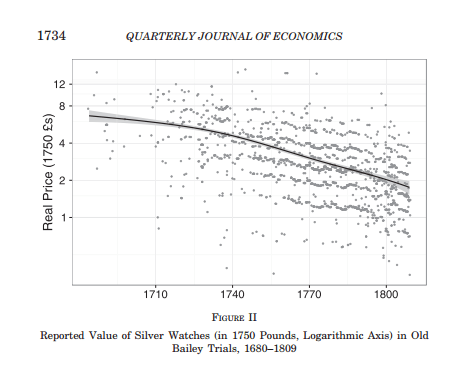
I don’t know how I missed such a valuable article, but O’Grada and Kelly have this fascinating piece on the price of watches in England from the early 18th century to the early 19th century in the Quarterly Journal of EconomicsStarting from Adam Smith’s quote that the price of watches had fallen 95% over roughly one hundred years, they collected prices of stolen watches reported in court records.  They find that Smith was wrong. The drop was only 75% (see the sarcasm here).

watch-prices

Why is this interesting? Because it shows something crucial about the industrial revolution. This was a complex good to build which required incredible technical advances – many of which could be considered general purpose technologies which could then be used by other industries for their own advances (on the assumption that other entrepreneurs noticed these technologies). But, more importantly, it provides further evidence against the pessimistic view of living standards in Britain at the beginning of the Industrial Revolution. These “new” goods became incredibly cheaper. Along with nails, glass, pottery and shipping , watches did not weigh heavily in the cost of living of the British. However, they did weigh heavily as industrial prices which meant that costs of production were falling progressively which augured well for the beginning of the industrial revolution*.

Literally, you can watch the industrial revolution in that paper! (sorry, bad pun)

* By the way, I use the term because it is conventional but a revolution is a clean break. The British industrial revolution was not saltation as much as it was a steady process of innovation from the early 18th century up to the mid 19th century. The real “revolution” in my eyes is that of the late 19th century. The technological changes from 1870 to 1890 are the most momentous in history and if there was any technological revolution in the past, this was it.

Did the Thirty Glorious Years Actually Exist?

Okay, I am going for a flashy title here. I should have asked whether the Thirty Glorious were as glorious as they are meant to be. This is a question that matters in debates about both inequality and the often-bemoaned growth slowdown.

In the past (say before 1950), labor force participation was quite low (relative to today) by virtue of large family sizes and most married women not working. However, when they were at-home, these married women produced something. That something was simply not included in our national accounts. When they entered the labor force, they produced less of that something. However, since it had never been measured, we never subtracted that something from the actual output generated from their increased participation.

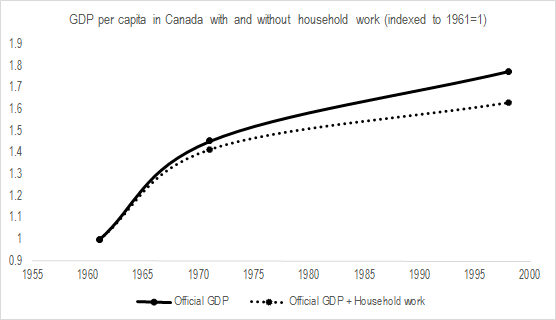
Even before the 1950s, this mattered considerably as growth tended to be heavily underestimated (by 0.3 percentage points from 1870 to 1890, overestimated by 0.38 points from 1890 to 1910 and by 0.06 percentage points from 1910 to 1930).This was at a time when variations between the household economy and the market economy were small. Imagine the importance of overestimates since the 1950s! In a short comment reply to Emily Skarbek last year, I pointed out that adjusting for the size of the household economy meant that 1/7th of Canada’s economic growth from 1960 to 1997 (see image below and this was before one additional surge of labor participation resulting from daycare and unemployment policy reforms).

SEcularStagnation2

Recently, I found an old book in my library. It is Kenneth Boulding’s Structure of a Modern EconomyIn it, he makes this exact same argument. Basically, actual output today is overestimated relative to output in the past. And there are many, many, many other articles on this. In all cases, the rate of growth is heavily reduced. In a way, that means that the Thirty Glorious are less glorious (which makes the growth stagnation argument seem more defensible).

And you know what? This is consistent with attempts to correct inequality measures. Most of the attempts made to correct inequality for age, number of workers per household, the size of household and prices, they generally increase very modestly the income growth of the bottom centiles and decrease appreciably the actual level of growth of incomes at the top. While these corrections reduce the level of inequality (and the growth thereof), they also reduce the growth rate of incomes.

Is it possible that the correction to make inequality measures more comparable over time are allow us to see the point about overestimating growth since the 1950s? It means that the Thirty Glorious aren’t that glorious (at the very least, they’re overestimated). It also means that someone who could follow some of the proposed corrections to national income accounts (generally, the best source for this is the Review of Income and Wealth) for every year since 1929 (starting date of the US national accounts which could be extended by using Kuznets’s national income measures from 1913 to 1929) could propose the “actual output” of the country and see how glorious the 1945-1975 period was. That is the work of economic historians to do!

Some thoughts on “Thinking About Libertarian Foreign Policy”

Brandon asked me to leave some thoughts on “Thinking About Libertarian Foreign Policy”, By Matthew Fay, here. Edwin van de Haar already did that in his “Foreign Policy in the Liberal Tradition: The Real Story”, but as I tend to follow a different path from van de Haar, I believe I may have something original to say here. So lets go.

First, unlike Edwin, I’m not going to go in the direction of discussing who is a libertarian, who is a conservative, who is a classical liberal, and so on. For one thing, I think that this kind of discussion is really boring (sorry Edwin, no offense intended, believe me). Other than that, it seems to me that discussing vocabulary is tremendously counterproductive. During the Cold War the US defined itself as a democracy. The USSR defined itself as a democracy as well. Both could meet and discuss who was really democratic, without any real gain. The same can be said about discussions within the socialist bloc: Chinese and Russians could discuss forever who was more Marxist, almost going to war because of that, without any real profit. Personally, I think I lost a lot of time some years ago discussing if Venezuela was democratic or not. And then they ran out of toilet paper. So I care not if communists want to call Venezuela a democratic state or not, the fact is that I don’t think any of them are willing to live without the simple but precious item of capitalist modern life.

With that said, if Matthew Fay wants to call his international relations perspective “libertarian,” so be it. But here are some commentaries from someone who usually calls himself libertarian:

“Libertarians have an uneasy relationship with foreign policy. The state, after all, is the primary actor in international relations.”

I wouldn’t say that. First, I’m a libertarian who studies foreign policy more than anything else. Second, I don’t think that we should say that “The state, after all, is the primary actor in international relations.” That’s simply not a good phrase to use when talking about International Relations. Better to say that the state is very often regarded as the primary actor in International Relations theory, especially by theorists who identify themselves as Realists. Other theorists would say that individuals, or international institutions, or international organizations are as or more important than the states.

“For libertarians, who want the state to do less, not more, this fact can be hard to stomach.”

I identify as a libertarian and I don’t exactly “want the state to do less.” I want the state to do some things and not others. I know that many libertarians (specially people at the Mises Institute, following Murray Rothbard) understand that anarcho-capitalism is the natural and logical conclusion for libertarians. I’m still not convinced. For example, I would like the state to do a lot about prosecuting murders and nothing about what I put in my own body.

“identifying an aggressor is difficult enough in interpersonal relations—let alone in international affairs.”

That’s something that goes at least to Robert Jervis’ 1978 article “Cooperation Under the Security Dilemma,” but I openly disagree. If they are not invading your territory, then they’re not aggressors. They may be potential aggressors, or they may be aggressive, but they’re not aggressors. As an individual, I choose to carry a gun, or even better, to avoid certain neighborhoods. The states should, if possible, avoid certain neighborhoods. If that’s not possible, carry a gun. And definitely keep a gun at home and learn how to use it.

“even when the action of the U.S. government may be superior to that of another government, many libertarians have a difficult time acknowledging that government action is justified. For those reasons, many strict non-interventionist libertarians find themselves openly embracing illiberal governments that they claim are resisting American imperialism and condemning any American criticism of autocrats as a prelude to ‘regime change.’”

First, I don’t think that one can prove that US intervention is superior to anything, ever. It’s basically a broken window fallacy. And I don’t embrace any illiberal government. I just don’t think that it’s the US government’s job to overthrown them. Also, I don’t think any autocratic governments are primarily resisting imperialism.

“Realism is attractive for libertarians because the United States faces no major threats, and therefore does not need to balance either externally or internally.”

Realism in International Relations theory is in general attractive for me because it seems to reflect the reality. Among International Relations theorists, my personal favorites are John Mearsheimer and Stephen Walt. I believe they are very liberal (in the classical sense) at heart but, like me, they are very suspicious of states. By the way, I’m Brazilian and I don’t live in the States, so the second part makes no sense either. There are many libertarians outside the US, by the way, and I think it would be very interesting to check what they think about all this.

“Libertarians, for example, believe that regime change and nation building through the use of military force is unjust and more often than not doomed to failure.”

I don’t think that. The American Revolution and the Puritan Revolution were great examples of regime change and nation building through the use of military force. They worked just fine. I just don’t believe that we can force this on other people.

“But libertarians have also rejected other aspects of America’s post-World War II grand strategy—namely, America’s military alliances and the web of international political and economic institutions they underpin—that have served the causes of peace, free trade, and a more interdependent world. The result of this web of institutions has been a liberal international order that encourages peaceful, commercial relations between states that had previously been rivals. It helps ameliorate security competition and establishes expected patterns of behavior that encourage cooperation instead. This order has not been without its flaws and, as Nexon highlights in another post, serious reforms should be explored. But it has also helped underpin previously unseen levels of peace and prosperity. As Nexon writes, ‘we should not confuse two different questions: ‘which liberal order?’ and ‘whether liberal order?’’”

I’m not sure if “America’s post-World War II grand strategy have served the causes of peace, free trade, and a more interdependent world.” Again, it’s a matter of opportunity cost, or another broken window fallacy. I’m also unsure if “the result of this web of institutions has been a liberal international order that encourages peaceful, commercial relations between states that had previously been rivals.” I have a really strong tendency to say it didn’t. The problem with theorizing in social sciences is that, unlike in natural sciences, you can’t take things to the laboratory and run consecutive tests. That is, by the way, one of the reasons why I reject positivism as a research methodology. I’m not sure if Matthew Fay embraces it, but the fact is that for me we are better with praxeology, or at least some version of methodological individualism. And with that in mind, we can’t be so bold to say that American foreign policy in the post-WWII Era was the main cause of peace and everything else. It just seems to me that without US intervention in WWI there would be no WWII (and no Russian Revolution, at least not a successful one, by the way). The Founding Fathers were right: Europe is a mess. The farthest you get from it, the best.

On immigration, trade, and inequality: why nobody should care (that much)

Recently, I read snippets from George Borjas’s book, We Wanted Workers (I got distracted and reverted to reading Leah Platt Boustan’s Competition in the Promised Land).On its heels came this article by Dani Rodrik in Foreign Policy. Both work make the same case, that free movement of goods and people may imply some negative effects on inequality. Borjas argues that immigration increases inequality while Rodrik argues that low-skilled workers are displaced.

Both arguments are not convincing.

First of all, immigration will always increase inequality in one area. This is by definition. Unless the migrants follow the same distributional pattern as the host population, inequality will increase. If somebody from Cuba enters the United States at the tenth percentile, he increases inequality by swelling the ranks of low earners. If somebody from China enters the United States at the 90th percentile, he increases inequality by swelling the ranks of the high earners. However, from a global perspective (world population), inequality has actually dropped since the migrant has a greater income than in the past. After all, bringing a Haitian to the US may increase US inequality measures but the ten-fold increase in his income (this number comes from my colleague Ben Powell) means that worldwide inequality drops.

To be honest, I know that Borjas is probably aware of this point, but many of those who spin his work don’t get it. Borjas’s argument is little more sophisticated. His claim is that low-skilled workers (high school dropouts) see their wages go down while everybody else (high school graduates and university graduates) gains from immigration. This increases inequality because they are left behind economically. But this is where his argument is alike that of Rodrik and where it misses the target dramatically.

While I could be lazy and simply say that many other scholars place Borjas at the extreme of the spectrum of academics with regards to the effects of immigration on labor markets. Indeed, there are more scholars who find that low-skilled workers also gain from immigration all things being equal. But, I won’t be lazy. Let me assume, for the sake of argument, that the empirical result is valid. If unskilled workers are displaced, why can’t they find new employment elsewhere. If the effects of immigration are so positive for everybody else, it means that everybody else is substantially richer and they can demand more goods. Are there barriers preventing the unskilled from acquiring jobs? The answer is emphatically yes.

The ability to find a new form of employment following changes in the labor market depends on the frictions that exist on the labor market. Some of them are natural. We have to assume search costs (time, energy, some money) to look for a job and get the training for that job. But there are also barriers that create unnecessary frictions. The rise of occupational licencing is one of those (growing) frictions (see here, here and here). We could also point out that product regulations tend to affect the prices of goods that weigh more heavily in the consumption baskets of lower-income workers (here and here) thus pulling the poorest down. We could also point to the fact that states with right to work laws seem to have enjoyed more limited increases in inequality than the states without such laws (here). We could also underline the fact that housing regulations are making it harder for unskilled workers to move to dynamic areas, thus locking them in low-productivity areas (here). And the list could go on for a few more pages, but I think the point is made: there are tons of factors that make displacement a problem. However, those who worry about it when it comes from changes resulting from trade or immigration are concerned with a minor (and positive in the long-run) variable. In a way, Borjas and Rodrik are (rightfully) concerned about the poorest but they fail to identify the problem like if a doctor was concerned with his patient’s loss of sight rather than concentrating on the brain tumor that caused the loss.

Free trade and open borders generate massive benefits. But there are short-term costs as production methods and resources are being reallocated. Many government policies amplify exponentially these costs and delay reallocation. This creates the inequality they bemoan.

Sex, again

Below is an excerpt from my book I Used to Be French: an Immature Autobiography. You can buy it on amazon here.


Note: This takes place in Brittany when I was sixteen.

The threshing work was divided by age and sex. Young men and boys would stand on the very tall wheat pile; it was thirty feet high or so at the beginning of the process. From there, they would throw sheaves of wheat down to a handler who placed them on a conveyor belt leading into the business end of the machine. That was a dangerous job left to a specialist because the threshing teeth, designed to strip the grain from the stalks, could mangle the man’s arm as he positioned the sheaves. Out of the other end of the machine, came sacks of grain and bales of compressed straw that someone had to tie immediately. Moving and stacking those outputs was the job of girls and young women.

The heat was infernal, the dust was infernal, and the cadence was infernal, so that each team worked only for one hour at a time. At the end of each hour, a supervisor would blow a whistle above the thresher’s din, signaling replacement, which was accomplished in one fell sweep, without breaking rhythm. Those being replaced would move to the area outside the kitchen where food was served continuously, or they would walk out to the hedges lining every road, to relieve themselves. They pretty well had to because they drank without cease, possibly several gallons a day. Since no one ever drank water, they took in huge quantities of cider.

Though low in alcohol, and although heat and exertion probably burned some of that alcohol, cumulatively, the cider must have had some positive effect on the prevailing mood. In addition, everyone dressed lightly because of the same heat and exertion, the girls, in not much more than a sleeveless blouse and a skirt, possibly nothing more at all. No wonder, then, that during breaks, some young people walked well past the point that public decency required for a simple leak. They would wander into meadows made deserted by the on-going work around la mécanique (the thresher). Unavoidably, some young men and some young women ran into each other there. It was summer and the grass was tall under the apple trees, easily concealing people lying down. Anyway, I think, perhaps that was the normal Breton betrothal ceremony. This was so well understood that every time I came back from my break that day, older boys would asked me loudly if I was engaged yet. I was not, not yet, but I came close, damn close! Several times. With several girls. Eventually, I moved away from Brittany, and even from France, and it took me another fifteen years to tie the knot. It would have been sooner if I had lived near a wheat-threshing machine, no doubt.

Foreign Policy in the Liberal Tradition: The Real Story

Over at the Niskanen Center, Matthew Fay wrote a blog entitled “Thinking about Libertarian Foreign Policy.” Brandon was so nice to point this out to me.

Fay’s main point is that, apparently contrary to what some libertarians think (Fay leaves them unnamed, no references either), there is big divide between the foreign policy pronouncements of Donald Trump and libertarian views on foreign policy. So far, so good. I have no dispute with that.

Yet Fay’s blog post is seriously lacking at other points. The main one, and the focus of this post, is that he mixes up different views on international relations within the liberal tradition at large, which is in some way not so surprising because he appears to be ignorant of those differences to begin with (at least in this piece). That is not very comforting for those concerned with this issue, as the Niskanen Center is about to start a larger project on foreign policy. Should it indeed be born in neglect and oversight, it won’t add much to our knowledge, I am afraid.

Conceptual mess

Fay’s essay gets off to a false start as he fails to properly introduce “libertarian.” He then continues to use this label for all kinds of theoretical ideas, originating from both liberal political thought, and international relations theory. To make things worse, Fay routinely claims that there is one unified libertarian position on foreign policy.

This is erroneous, as classical liberalism, libertarianism, and social liberalism all have partly different views on the matter. The various thinkers associated with those different liberalisms have different views on domestic and international politics. Any meaningful analysis on foreign policy from a libertarian or other liberal position should acknowledge that, and use it to the reader’s advantage. It is impossible and perhaps even deceiving to enter into a topical debate when your own position is a conceptual mess. This applies to all debates, academic and otherwise.

Proper conceptual approach

So what should Fay have done instead? Simply acknowledge there is more to liberal thought on international relations, and work from there.

To keep this blog to a readable length, I will just present these differences very briefly. My presentation is based on the writings of the British political theorist Michael Freeden. He argues that every political ideology (and liberalism is one of them) should be seen as a framework (which he calls morphology) composed of a number of political concepts. These concepts vary in importance while their meaning is contested within the ideology. It is possible to distinguish core, adjacent, and peripheral concepts, which together make a unique set of political ideas. While some of the individual concepts overlap, there is significant variation between the frameworks. This enables the distinction between different liberal variants, which are still part of the larger liberal family.

For example, the concept of liberty is key to all liberal variants, but liberty has different meanings. Isaiah Berlin’s famous divide between positive and negative liberty is relevant here. The latter can be defined as ‘the freedom from interference by others’, the first ‘the freedom to fully enjoy one’s rights and liberties’, which often demands some support of the state. Classical liberalism is associated with the negative conception and social liberalism with the positive meaning. Yet the meaning of negative liberty may be further contested. The protection from interference by others may be taken as absolute, which is far more stringent than the classical liberal interpretation, which does allow for compulsory taxation of individuals to pay for public services. Now we are entering the libertarian domain, which is in itself divided into those who hold an absolute idea of negative liberty (the anarcho-capitalists), and those who permit a minimal infringement of property rights to pay for police, external defense, and the judiciary (the minarchists). This is also why conservatism is not as closely related to the liberal family as is sometimes thought. For conservatives, individual liberty is not a core concept at all.

Applied to liberalism and conservatism is comes to this:

Table 1: The Morphology of Liberalism and Conservatism

Classical Liberalism Social Liberalism Libertarianism Conservatism
Core concepts Negative freedom, realistic view of human nature, spontaneous order, limited state Positive freedom, positive view of human nature, social justice as self-development, extended state Negative freedom, realistic view of human nature, spontaneous order, natural law including strict defense of property rights Realistic view of human nature, organic change, human order with ‘extra-human’ origins, counter movement
Adjacent concepts Natural law, rule of law/constitutionalism Modern human rights, rule of law and neutral state, social contract (Mill: utilitarianism) Minarchism: minimal state, rule of law Groups/family, hierarchy, active state, sometimes: spontaneous order
Peripheral concepts Social justice, strict defense of property rights, democracy, utilitarianism Property rights, spontaneous order Social justice Individual (property) rights, freedom

Source: Edwin van de Haar, Degrees of Freedom. Liberal Political Philosophy and Ideology (Transaction Publishers, 2015).

Liberalism and international relations

Interestingly, yet of course completely logical, these differences also translate to views on foreign policy and international relations:

Table 2: Liberalism, Conservatism, and International Relations

Classical liberalism Social liberalism Libertarianism Conservatism
Nation as limit of individual sympathy Yes No No Yes
State as prime actor in world politics Yes No No Yes
International governmental

institutions/regimes

No Yes No No
Can war be eliminated No Yes Yes No
Does trade foster peace? No Yes Yes No

Source: Edwin van de Haar, Degrees of Freedom. Liberal Political Philosophy and Ideology (Transaction Publishers, 2015).

So, in contrast to Fay’s approach, it is not so simple to claim all kinds of concepts and ideas for just one liberal label. There is far more to it. I shall leave it at this for the moment, but for those wanting to read more about this, see my longer essay at libertarianism.org, or my books Degrees of Freedom and Classical Liberalism and International Relations Theory.

Against Libertarian Populism

Over at The Liberty Conservative (which is, in my opinion, something of an oxymoronic name), Alex Witoslawski of the Leadership Institute recently wrote an article defending populism as a strategy for libertarian activists to embrace. I am going to disagree with Alex at almost every turn, but it should be known that I am friends with Alex and mean no ill-will towards him. In fact, he privately asked me for my input and asked that I publish my criticisms publicly.

Alex defines populism as “a political strategy that aims to mobilize a largely alienated base of the populace against out-of-control elites.” In order for a movement to be populist, Alex claims it must use four distinguishing factors:

Messaging: the central message obviously has to revolve around the theme of populism – “the people versus the privileged elites”

Strategy: put simply, the central strategy of populism is to bypass the ruling class – academia, mainstream media, and political establishment – in order to get the message out directly to the masses

Tactics: in order to achieve the strategic goal of bypassing the ruling class, populist candidates and organizations must make use of grassroots organizing, events, digital communication (social media and email), and the alt-media to communicate directly with the masses

Issues: the message of “the people vs. the elites” is closely adhered to on every single issue advocated; in addition to this, the policies advocated for must be sufficiently radical to inspire a core base of supporters who will passionately support the populist campaign/organization as donors and activists.

To cite reasons why libertarians should embrace this populist ethos, Alex cites the recent surprising election of Donald Trump and the relatively successful Ron Paul primary campaigns of 2008 and 2012, and gives the example of Lew Rockwell’s and Murray Rothbard’s infamous paleolibertarian phase in the late eighties and early nineties for inspiration. Let me give eight reasons why principled libertarians–and classical liberals–neither can be nor should be populists:

1. Is Populism even Necessary for Electoral Victory?
It’s not even apparent that populism is always and everywhere the best electoral strategy in the first place. The three best turnouts, for example, in LP history for president were the decidedly non-populist Gary Johnson campaigns and the non-populist, left-leaning Ed Clark/David Koch 1980 campaign, ranking much lower with less than half the votes of Clark/Koch was the much more populist Ron Paul 1988 campaign. For further evidence, there were many similarities between populists and progressive parties in the late nineteenth and early twentieth century, one of the few major differences were the degree of technocracy and even outright elitism that progressives embraced (populists were more Jacksonian, progressives Wilsonian). Which parties and candidates were more popular at polls? Progressives. All this is, of course, anecdotal and casual historical evidence from which no necessary causality can be established, but so are the examples of Trump vs. Cruz and Rand vs. Ron that Alex gives. There’s likely an empirical political science literature on the electoral effectiveness of populist messaging that might shed light on this question, one with which I am admittedly ignorant, but, at any rate, this is an antecedent point to my main argument.

2. The Narrow Focus on Electoral Politics
Even if populism does win elections, it’s not even clear that’s a good goal. As any good anarchist will tell you, electoral victories are not the only, or even a particularly good, measure of a political movement’s accomplishments. Who can cater to a rationally ignorant and irrational voting population has little to do with whether your ideology is actually improving anyone’s lives. In fact, for reasons I’ll get to in a later, if all you’re doing is winning elections, there’s a fair chance you’re making people’s lives worse. The goal should be to minimize the real world importance of elections, to get politics out of people’s lives, not to make electoral politics the end goal. Consistent libertarianism is (or at least should be), in fact, not really a political movement at all; it seeks the abolition of politics to begin with.

3. Populism’s Democratic Ethos Leads to Support for Bad Policies 
Even if you manage to get a majority of voters to vote for ostensibly libertarian politicians, the question of how to implement those principles in real-world policy is much more complex. Populists, because the goal is to “tear down the establishment,” are likely to call for haphazard, potentially dangerous policies which democratize institutions that shouldn’t be controlled by the people (eg., courts, central banks, etc.) and make currently controlled democratic institutions more democratic. It goes without saying that putting coercive institutions in control of rationally ignorant and irrational political actors is pretty rash–be they “elites” like politicians and bankers or “the little guy” like supposedly disenfranchised voters.

Examples of such bad ideas supported by populist libertarians include congressional term limits or auditing the fed. Those policies may have libertarian normative goals, but it requires working technical economics and institutional analysis to know if they’re the best way to work towards those goals. For reasons anyone who knows the first thing about public choice can tell you, the masses will never have such knowledge. In fact, the populist attacks on “the elites” are likely to lead people to detest those who do have such knowledge, exacerbating the Dunning-Kruger effect. (Call me an elitist, but I’d go far as to say that populism of any form is just the political manifestation of the Dunning-Kruger effect.)

4. Populism will Likely Turn into Something Nasty
Because the main thing driving populist movements are “the people vs. the elites” rather than the core principles the movement tries to espouse, there’s good reason to think the base of that movement will abandon many of those principles as it grows simply on the basis that they have something similar to what “the elites” believe. It’s not surprising that many of the younger psuedo-libertarians who supported Ron Paul have since jumped on either the Trump or Sanders bandwagon, or, even worse, have defected into the crypto-fascist, dark corners of the alt-right (Steffan Molyneux and Chris Cantwell’s occultists are examples of this). Even left-wing populist movements often have abandoned leftist principles throughout history (the Jacobins in the French Revolution, for example).

The irrationality of the masses makes it hard for them to have any principles–libertarian or not–for very long. Indeed, even the examples Alex gives are pretty bad examples of libertarians. Rothbard and Rockwell, of course, embraced outright racist and homophobic nonsense to appeal to their culturally conservative base (sometimes using Ron Paul’s name), which is antithetical to the classically liberal ethos of libertarianism which values reducing all forms of coercion–be it through casual institutional forms of oppression or statist coercion.

5. Populism’s Demand for Immediate Change is Likely to Cause Unforeseen Harm
Unlike other methods Alex mentions, populism is a form of immediatism. It really is just a post-enlightenment, first-world, institutionally democratic form of revolution. It’s no coincidence that most populist movements, from Bernie Sanders to Ron Paul rely on the language of revolution to further their appeal. However, there is good reason to be skeptical of any accelerated method of political change–be it “the masses” taking over and overhauling the errors of “the elites,” or violent revolutions like those in late eighteenth century France or early twentieth century Russia.

Institutions and policies often serve tacit functions in society of which we aren’t even focally aware. We are in a radical position of ignorance about what the effects of sudden change that populism demands, such as swapping out entirely who’s in power and changing all policies to the whims of “the masses,” whether those whims are libertarian principles or not. In sum, ironically given the name of the site Alex writes for, populism can never really even be conservative–not in the bastardized tea party or paleo sense, but in the principled Burkean sense. Even if I agree with the ends any political movement aims for, epistemic humility necessitates far more gradualism than populist rhetorical strategy can possibly accommodate.

6. Populism Leads to a Breakdown in Discourse and Awful Praxis
Whether you’re a conservative, libertarian, or liberal, if you are existing in a democracy the main thing you should strive for is to be understood by others. In fact, the alleged raison être for democracy–though famously fails at in its present institutional form–is aiming at better forms of government through arriving at some sort of consensus through open and honest public discourse. In order to have any sort of functional democracy in this sense–which, again, we are already woefully lacking in existing democracies–fulfill the primary function of speech, which is understanding. In order to do this, a necessary norm for discourse to function is the assumption of the good will of all participants in discourse.

The first assumption of populism, much like most crude forms of Marxism, is a violation of what is necessary for such discourse. It assumes, after all, that “the elites” are just an out-of-touch, greedy, mean group of people that “the masses” must depose and everything they’ve done is wrong and must be replaced with the vox populi. Anyone, then, who disagrees–even those within populist movements–is liable of being charged with being “one of the elites” (not unlike accusations of being “bourgeoisie” and “counter-revolutionary” after Lenin’s Vanguard Party took control), and ignored, leading to a communicative breakdown. Discussion is shut off, possible perspectives and principles that could improve the state of affairs are ignored if they bear any even superficial affinity to “the elites,” and one of the few sets of norms–those of communicative action taken from the lifeworld–that make existing democracy at least quasi-functional is replaced with simple partisan hackery. Try talking to your standard dogmatic Trump, Bernie, or even Ron Paul supporter (or really any overly partisan hack, including dogmatic Clinton supporters), and you’ll see exactly what I mean.

7. Populism is Inherently Illiberal and Opposed to Liberty

Populism tells us the problem is that “the elites are in power” and demands that the elites be deposed and replaced with “the masses.” But libertarians say the problem isn’t the fact that the wrong people are in power, the problem is that anyone is in power in the first place. As a consequence, classical liberals have always with good reason been very skeptical of the wisdom of the masses, and have had an ambivalent relationship towards any form of democracy. The radically Jacksonian democratic demeanor of populism, which asserts the masses are equipped to use coercive political institutions, is fundamentally at odds with classical liberalism’s value placed on individual liberty–which asserts that nobody is equipped to use coercive institutions. That’s a fine distinction populist rhetoric necessarily blurs, and you can’t expect “the masses” to understand.

Even if you say you’re just using populist rhetoric to depose those in power, the populist faction of our movement (once “the elites” are out of power) are going to ask, “What’s next?” and are liable to be upset when you say “nothing.” As Hayek tells us, one of the main reasons people get so heavily involved in the political process is that they want to be in charge, that’s true of “the masses” as it is “the elites.”

8. Populist Alliances Often lead to the Destruction of Libertarian Values
Alex mentions the rise of the religious right and other right-wing populist movements as possible fruitful avenues for libertarians to ally with and pursue. However, I’m of the opinion that any sort of fusionism is probably a really bad idea. Not just because many on the religious right want to be unfathomably cruel to me because I’m gay, but because libertarians have philosophical, fundamental disagreements with the people in those movements that cannot be bridged. It is simply not true that the religious right and nationalists are “anti-statist in their nature,” the fact that he cites “forced integration” from immigration supported by nationalists (derived from an infamously bad argument by Hoppe) as common ground is telling. Indeed, if you press most “fusionist” “conservatarians” (including paleos) or “liberaltarians” very far, you’ll find that outside of a few superficial single issues on which they agree with some libertarians, they do not even remotely understand or apply the principles very widely at all. If your movement is composed of walking Dunning-Krugers who do not really understand the extent to which coercive is possible and are not able to engage in constructive dialogue and you’re relying on rhetoric of “take power from the elites” to motivate them, you’re probably not going to have a very libertarian movement.

To illustrate, there’s no reason why “populism” needs to take on a right-wing flair for libertarians at all. In Rothbard’s young years, for example, he attempted to ally with left-wing populist progressives from the anti-war movement. Today, I could say, libertarians should ally with left-wing Sanders supporters. They, after all, share a skepticism towards foreign policy intervention, attacks on social freedom for religious freedom, and corporatist crony capitalism. In fact, there’s a case to be made that Sanders’ supporters are more libertarian than Trump’s, though I don’t necessarily agree with it. Regardless, it is worth noting libertarians have philosophically more in common with those on ‘the left’ in general, but that’s, again, an antecedent point.

Alex would probably reply “But Sanders supporters are socialists, and are fundamentally opposed to libertarians.”  Ignoring the fact that neither Sanders nor most of his supporters are really socialists, he’d mostly be right that they are fundamentally opposed libertarianism. Regardless, Trump supporters are nationalist–which Hayek famously called “the twin brother of socialism”–and are fundamentally opposed to libertarians. Alex might reply, correctly, that some right-wingers can become libertarians by engaging with the populist movement, but so can Sanders supporters. All that point establishes is libertarians should communicate with non-libertarians, and work with non-libertarians on single-issues with which we agree, that need not take on a populist flavor.

The Alternative
If we’re going to forego a focus on electoral politics, and not to populism, what should we replace it with? Alex mentions two possible alternatives:

Hayekian educationism, named after Friedrich Hayek’s theory of social change expounded in his essay “The Intellectuals and Socialism,” relies first on persuading a core group of intellectuals to adopt libertarian ideas. Then, according to Hayek’s model, those intellectuals persuade a growing number of what Hayek calls “second-hand dealers in ideas” like journalists, teachers, and politicians to propagate their ideas among the general populace.

Fabian incrementalism, named after the Fabian socialists of late 19th century Britain, relies on a similar group of individuals – intellectuals, journalists, and policy wonks – to persuade government bureaucrats and politicians to adopt gradual changes in policy. This, performed consistently over a long period of time will, theoretically, lead to the adoption of long-term social changes that the reformers set out to achieve.

First of all, Alex misunderstands Hayek’s theory of social change. The claim is n’t that you “persuade a core group of intellectuals to adopt libertarian ideas,” and completely ignore political actors and everyday people, the idea is that ideas coming from intellectuals filter down into the extended order of society and eventually become actualized. It’s not as if you just convince a bunch of professors and philosopher kings that you’re right and they’ll create a libertarian utopia, it’s that you put the ideas out there and they eventually filter down, a messy process which takes an extremely long time (possibly centuries), and one which libertarians have really only barely started.

A necessary thing that must occur before they actually become actualized is that the general population is at least subsidiarily aware of the ideas, which requires communicating with the general population in some form (which can and should include what Alex calls “grassroots organizing,” like engaging with them through the electronic forms and the alt-media). But that communication cannot take on the populist message for reasons given, it requires education and dialogue, it requires populizers–which can include educators, journalists, communicators, activists, and even to some extent politicians (though they are not acting qua politicians in the ideal typical capacity used in the model when doing this) to communicate with the masses. Contra Rothbard, it’s not about convincing the “ruling class,” it’s about overcoming them.

Regardless, I will agree that the method some beltway libertarians, unfortunately, take from Hayek’s theory of just writing academic journals and white papers is incomplete. You do need to communicate with the masses, but  I am heavily skeptical that this communication needs to be political in nature. Alex’s narrow focus on elections leads him to neglect other, possibly more fruitful, methods of social change. You can engage in direct action, agorism, or entrepreneurial action (eg., what Zak Slayback, et. al. talk about in “Freedom Without Permission“). In these forms, it requires actively defending the masses (in direct action), spreading ideas by improving the lives of real people by providing alternatives (agorism and entrepreneurial action), and making the effects of state intervention felt on people (eg., when entrepreneurial innovations, like Uber and Lyft, are taken away, the hypocrisy of regulation is made clear). They all accomplish the goal of making the ideas known, even if tacitly, among the masses, while adding bonuses of actually doing things that improve their lives without the riskiness inherent in using coercive institutions like elections to do so.

Though those aren’t necessarily at odds with populism (or Hayekian educationalism for that matter; in fact, I think it’s an inherent part of Hayek’s theory of social change), I put far more faith in these than in elections in which irrational, ignorant people only legitimize the state. Socio-political change happens at the micro-level, through everyday social interactions, through lived real-world experiences, through you reading this article, through good discourse and conversation. If you want to change, you need to alter the lifeworld in which individuals live, just focusing on getting “the masses” to turn out the polls is insufficient. Political activism can only get you so far.

Did 89% of American Millionaires Disappear During the Great Depression?

Over the years, I became increasingly skeptical of using tax data to measure inequality. I do not believe that there is no value in computing inequality with those sources (especially after the 1960s, the quality is much better in the case of the US). I simply believe that there is a great need for prudence in not overstretching the results. This is not the first time I make this point (see my paper with Phil Schlosser and John Moore here) and I think it is especially crucial for anything prior to 1943 (the introduction of tax withholding).

One of my main point is that the work of Gene Smiley which ended up published in the Journal of Economic History has generally been ignored. Smiley had highlighted many failings in the way the tax data was computed for measuring inequality. His most important point was that tax avoidance foiled the measurements of top incomes and how well they could transposed on the overall national accounts.

More precisely, Smiley argued that the tax shelters of the 1920s and 1930s would have affected reporting behavior. As long as corporations could issue stock dividends rather than cash dividends, delaying the payment of dividends until shareholders were in lower tax brackets, there would be avoidance. Furthermore, state and municipal securities were exempted from taxation which meant that taxpayers could shelter income and end up in lower brackets. All this combined to wide fluctuations in marginal tax rates conspires to reduce the quality of the tax data in computing inequality. Rather than substantial increases in inequality, Smiley found that his corrected estimates (which kept tax rates constant) suggested no increase in inequality during the 1920s and a minimal decrease when you exclude capital gains.

Alongside John Moore, Phil Schlosser and Phil Magness, I am in the process of attempting to extend the Smiley corrections to include everything up to 1941 (Smiley had ended in 1929). As a result, I had to assemble the tax data and the tax rates and I was surprised to see that, even without regressions, we can see the problem of relying on the tax data for the interwar period.

The number of millionaires in the tax reports is displayed below. As one can see, it is very low from 1917 to 1924 – a period of high tax rates. However, as tax rates fell in the 1920s, the number of millionaires quintupled. And then, when the Depression started in synchronicity with the increases in top marginal tax rates, it went back down. It went down by 89% from 1929 to 1941. Now, I am quite willing to entertain that many millionaires were wiped out during the Great Depression. I am not willing to entertain the idea that 9 out of every 10 millionaires disappeared. What I am willing to entertain is that the tax data is clearly and heavily problematic for the pre-withholding era.* This is evidence in favor of caution and prudence in interpreting inequality measures derived from tax data.


taxreports

I am of those who believe that inequality was lower than reported elsewhere in the 1920s, higher than reported in the 1930s and 1940s. Combined together, these would mean that inequality would tend to follow a L-curve or a J-curve from the 1920s up to the present rather than the U-curve often reported.  I will post more on this as my paper with Moore, Schlosser and Magness progresses.