The Case for the UK staying in the EU

Leaving the European Union would not be a gain for liberty in the United Kingdom. This is true as a matter of general principles and is reinforced by the nature of the Leave campaign which has targeted sections of the population hostile to immigration, open markets, and free trade. Much of the Leave campaigning which has not appealed to such base arguments has at the very least appealed to a version of populist democratic sovereignty at odds with the restraints on government and the state at the heart of classical liberal and libertarian thought.

Even if we try to separate some pure classical liberal version of the Leave campaign from the crudity of the campaign, as some natural supporters of leave wish had happened to the extent they ate voting for Remain rather than go along with such an obnoxious campaign, we are still left with the question of why it liberty advocates should support Leave.

I have sometimes seen references to national sovereignty as a classical liberal doctrine. If this means never sharing sovereignty at a transnational level, then it is simply a false claim. Immanuel Kant advocated a world federation to prevent war. Kant is not often put at the centre of the history of classical liberal thought. His ideas about political institutions, individual rights, and the limits of government certainly belong in the classical liberal sphere. We should distinguish between what Kant said and what later German Idealists said, a rather big issue, and appreciate how close he is to the way of thinking of Montesquieu and Smith and even advances upon them in showing a clearer understanding of the role of representative assemblies in modern politics.

More recently F.A. Hayek advocated federation between liberal democracies. The creation and evolution of the European Union has been and continues to be supported by European political parties of a classical liberal persuasion, those liberal parties which remained most true to the principles of their nineteenth century founders and precursors. Thinkers on the left, like Albert Camus and George Orwell, known for their particular commitment to liberty and their opposition to an authoritarian state were enthusiasts for European integration. Many conservatives of the more free market and limited government sort like Ludwig Erhard (founder of Germany’s post-war, post-Nazi market economy) and John Major (UK Prime Minister from 1990 to 1997, who went further than Margaret Thatcher in privatisation and deregulation) have been and are advocates of the European Union.

The unrestrained sovereignty of the nation-state is not only not an inherently liberal idea, it is dangerous to liberalism. There is nothing illiberal in transnational rules and institutions that restrain states from violence against their own citizens, attacks on individual rights, economic protectionism, and market rigging. The European Union is particularly successful with regard to the economic and market issues at the national level.  It adds huge institutional weight to the work of the Council of Europe which promotes human rights through its court in Strasbourg. The existence of the European Court of Justice is of profound importance in ensuring that national governments and peoples are accustomed to regarding the decisions of nation states as subordinate to and accountable to a judicial process enforcing transnational laws.

The EU is open to a great deal of criticism with regard to its tendencies towards over-regulation, but this represents the median attitude of the member governments, not an imposition on the nation-states of Europe. Since the UK economy is at the more free market deregulated end of the European Union, there is some plausibility in saying the UK might go further down that road if it left the EU. However, before it joined the EU it was looking less market oriented than the EU states of the time. The period during which the UK has moved from the more statist to the more limited state end of the European nations has been during the period of EU membership. The precedents do not favour the UK becoming more classically liberal because it leaves the EU and the Leave campaign has appealed to the most insular, nationalist, anti-immigrant, anti-foreigner, and anti-free trade sections of the UK population.

It is possible to imagine the UK as a more libertarian kind of place in the EU, but a much more plausible use of the liberal imagination is to think of ways in which the UK can work with allies in the EU for a a less regulatory and centralised EU. This has already worked as in the adoption of the European Single Market and the diminishing role of the European Commission, the ‘bureaucratic’ part of the EU. The Commission employs as many bureaucrats as the larger local government units in the UK and is tiny compared with any national bureaucracy. Its members are nominated by national governments subject to confirmation of the European Parliament. Power has shifted from the Commission to the bodies in which national government representatives meet, the European Council and the Council of the European Union.

The Leave campaign in the UK, including self-styled free marketers in the Conservative Party, is committed to leave the Single Market as well as the European Union itself, in large part to terminate free movement of EU citizens across its borders. The reasoning offered to prevent this movement of human capital is in terms of anti-foreigner sentiment. This is not something than can be recognised as a pro-liberty program. The pro-liberty choice is to keep free movement of goods, investment, and labour within the EU while working to reform the more interventionist tendencies of the European Union, to stymie the regulatory drift which started hitting industrial market economies decades before the EU was created and which cannot be solved by smashing up the EU.

Group Privileges No, Detriments Yes

The concept of “privilege” has become common in political discourse, while the term “detriment” is seldom used. One incurs a detriment, and is detrimented, when one is harmed, offended, displeased, or disadvantaged, unrelated to merit. One obtains a privilege, and is privileged, when a person or group is advantaged, benefitted, pleased, or favored relative to other groups, when the gain is unrelated to merit.

Some socialists emphasize “white privilege.” Suppose a white man is able to walk down a street without being harassed, while a black man will be stopped and questioned by the police. The socialist will say that the white man is privileged in being free of harassment. But actually, the ability of an innocent person to walk without being stopped and frisked is a natural right, not a special favor. The black man has suffered a violation of his natural rights, a detriment not suffered by the white man.

The socialist will also claim that there is “male privilege.” Suppose a man can walk down the street in peace, while a woman walking down the same street will be whistled at, aggressively approached, and may even be physically attacked. Does the man have a privilege? No, one has a natural right to be free of aggression. The woman suffers a violation of her rights, a detriment.

Women suffer many detriments because of social custom and culture, rather than governmental law. Wives tend to do more household work, even when they are working for wages as many hours as the husband. In some fields of work, men have more prestige and authority, unrelated to merit. The culture is not so much giving males privileges as it imposes on women various detriments.

Some detriments are mandated by law. In most places in the US, men are free to remove their shirts, while a bare-breasted woman would get arrested. The men do not have a privilege; the women have a legal detriment.

Female detriments can become tragic in cultures where male children are preferred. A boy is not privileged by not being aborted or killed. Rather, the girls suffer a lethal detriment. In my judgment, more progress can be made to stop this anti-female bias by calling it a detriment rather than saying the boys are privileged. Boys as well as girls have a right to not be murdered.

Female detriments have been lethal in India, where rape and violence has made headlines. But there is substantial rape in the US and throughout the world, which clearly makes being female a detriment in much of the world.

The trouble with saying there is a male privilege is that men do not feel privileged by not being attacked or disfavored. It should be normal to be left in peace, and to be respected. By identifying the problem as a detriment, we can then raise more awareness and support for remedies. We can also then better deal with the real privileges, favors to those who get subsidies from government because of political clout.

The language of privilege versus detriments influences policy. “Privilege” implies special favors that should be removed. “Detriment” implies harms and disadvantages that should be stopped. For the problem of infanticide, for example, it is not that privileged boys should be killed in an equal ratio, but that girls should not be murdered for being female.

Let’s speak less of racial and gender privilege, and more of detriments!

Muddy thinking on child care

Five Thirty Eight had a disappointing discussion of an interesting issue: the cost of child care for working parents. The basic issue is that kids are expensive in time and money. Unfortunately, the discussion mostly revolved around questions of how to engage in economic engineering by government in order to expand access to child care and parental leave.

The hosts see these policies as having costs and benefits, and they see the value in studying alternatives empirically, but they miss an important issue: providing these sorts of goods doesn’t require screwing up markets by adding an extra layer of complexity to the tax code. If these goods are worth providing (that’s another couple of cans of worms) then just give money to new parents. Better yet, move to a basic income guarantee.

Another important point they miss is that if some good is difficult to get, it’s worth figuring out what to do about the root problem rather than just throwing money at the issue and hoping someone will figure out the important stuff later.

NOL Foreign Policy Quiz, Part Two

This is a follow up to part one, where I discuss under what conditions a libertarian can engage in foreign policy beyond pursuing free trade and so whether the creation of a NOL Foreign Policy Quiz is even worthwhile.

In this post I outline how to design a foreign policy quiz.

For starters I imagine two major axis:

  • Soft vs. Hard Power and,
  • Nationalist vs. Internationalist

The first axis corresponds to whether an individual prefers using soft non-coercive actions to achieve their foreign policy goal or hard coercive actions. The second axis would correspond to whether someone prefers to act unilaterally, a “Nationalist”, or through multilateral institutions such as the United Nations, an “Internationalist”. Combined the two axis produce the below spectrum.


The questions themselves would be formatted something like the below:

Question: A foreign policy question on defense, trade, or resources/environment.

Answer 1: Nationalist, Hard Power action.
Answer 2: Nationalist, Soft Power action.
Answer 3: Internationalist, Hard Power action.
Answer 4: Internationalist, Soft Power action.
Answer 5: Do nothing.

On each question respondents would be given two points, one for the Soft/Hard axis and another for the Nationalist/Internationalist axis. A respondent’s coordinates would be the average score for the two respective axis.

For simplicity I think we ought to limit the NOL quiz to ten or so questions, but if a longer version were developed we could also assign scores on whether the question was about defense, trade or resources/environmental issues. That way we could further distinguish foreign policy views dependent on the type of issue at stake.

Note the inclusion of a fifth answer for all questions – to do nothing. This is an essential option as there are times, especially for the libertarians among us, where all available options are just awful. In those scenarios it may be better to simply not act at all.

I suspect that most of us who are based in the United States will tend to be most ‘nationalist’ than others all else held constant. Beyond that I am not sure where most libertarians would fall on spectrum. To be sure I think many would elect the fifth answer – “Do nothing” often and gravitate towards the center, but I’m doubtful many would be perfectly in the center.

Thoughts? Opinions?

In part 3 I will hopefully have an actual quiz developed so that we can have fun calling one another statists.

BC’s weekend reads

  1. Anthropology as critique of reality: A Japanese turn (pdf)
  2. Flat-footed Giants: Zaibatsu and Industrialization in Meiji Japan, 1868-1912 (pdf)
  3. A hypothetical federation between Japan and the United States

We don’t have to ruin markets to do charity

This post is for Democrats and Republicans, not libertarians. Let’s take it for granted that we want to help poor people and we’re willing to use the coercive power of government to do so.* The trouble with the interventions below is so troubling that we don’t even have to bother about having a deep philosophical debate. I’m not trying to change your destination, I’m just trying to get you to get out of that explosive Ford Pinto.


Minimum wage, water pricing, education, and just about all of American health care finance involves distorting markets to give charity and/or gifts. Essentially, they change rules so that group X pays Y instead of Z with the hope that X can afford it and Z can do more good with the money than Y. But this indirect giving has serious flaws.

Take the case of the minimum wage: it’s supposed to help the working poor by making their boss and consumers pay a bit more for their services. Of course it might simply be to help interest groups, and that further raises the burden of proof for those who would prefer a minimum wage to less invasive alternatives.

So what is this less invasive alternative? Cash transfers. We’ve already got some imperfect versions of this. School vouchers, food stamps, and a host of other welfare programs. What I want to see is a simpler version that takes the best features of these programs to eliminate the problems created by market interventions.

The economics of this proposal are simple and important. Prices are essential to help people use resources wisely. Interfering with the market process makes those prices less effective at communicating information about value and opportunity cost. And with an interconnected markets, a small price control can lead to worse decisions being made all across an economy.

Simple economics tells us that if we impose a minimum wage (or give special tax treatment to XYZ, or whatever) then something’s got to give. It might be higher unemployment, it might be worse working conditions, or it might simply be that rich people are a little less rich than before.

(It’s worth remembering that rich people are people too; even lawyers. They can do good and bad things, and those actions determine their moral quality, not their wealth per se… we don’t want to redistribute wealth for its own sake, we want to do so if/because we think it will do some good. The hope is that the harm of a few bucks out of your pocket does more good for the poor people who get that cash. And no, it’s not possible for “corporations” to suffer; corporations aren’t people, but they are owned by people.)

Consider the case of feeding the poor. It’s not hard (even for non-economists) to imagine how imposing price controls on food could lead to shortages. If there’s one thing we learned from socialism, it’s that bread lines are bad. Food stamps are a much simpler and targeted solution.

We should prefer straightforward transfers over market intervention because it will do more good at less cost. More importantly, it is humbler–distorting markets requires a lot of information, transfers don’t.

Transferring money rarely jives well with American intuition, and that brings up an important bundle of issues: responsibility and social engineering.

Republicans, for all their talk about the importance of individual responsibility, seem unwilling to let the poor exercise it themselves. They’re sure that enough poor people will abuse the system that some bureaucrat needs to exercise responsibility for them. Similarly, Democrats want to ensure the dignity of the poor, but how is anyone supposed to remain dignified while navigating labyrinthine bureaucracy?

The left should like cash transfers because they can help those we want to help, and take advantage of the information available to those with intimate knowledge of their context. The right should like it because it can replace a series of bloated bureaucracies while returning responsibility to the poor. Everyone should like that it will be cheaper and more effective than what we’ve currently got while creating better prospects for long-run economic growth.

We should absolutely debate whether specific transfers are a good idea (particularly middle-income to middle-income transfers like higher ed subsidies, mortgage interest subsidies, etc.), but for those programs we ultimately take on, we shouldn’t shoot ourselves in the foot by trying to do good by screwing up markets.


*As an economics professor I get to see what economic superstitions recent high school grads have. I’m struck with the confusion between the health of government and the health of the country a government is supposed to be helping. A related pair of confusions is that what a government can do, it should do; and if something isn’t already happening, and might be nice, government should make it so.

Missing from these superstitions is that the fundamental feature of government is force. What differentiates government from any other non-profit organization, is that charities and associations can’t put you in jail if you choose not to behave as they see fit. But for the sake of clarity, let’s put aside that issue and just focus on how the government can help the poor.

Rick solves the gun crisis

My best (uninformed) reading of the data is that gun ownership is slightly positively correlated with successful suicide attempts but little else, and that sounds about right to me. I’ve met (other) gun owners, and for the most part they aren’t likely to turn into Rambo in an emergency situation just because they’ve got a sweet gun.

But the 30 seconds of Facebook commentary on this last event before I had to close the tab led me to a revelation. I’ve said before that there’s no such thing as no gun control. Throw that together with the notion that government is a monopoly on coercion, and you’ve got my recent insight: a liberalized gun policy is equivalent to deputizing just about everyone.

Frankly, if I threw a Nerf ball into a crowd, I wouldn’t be likely to hit someone who should own a gun, but I also wouldn’t hit someone who should vote. (That hypothetical person’s vote would probably do more harm than their gun.) And that responsibility problem is similar in both cases. Everyone should have a right to vote and own a gun, but both rights should come with a heavy responsibility.

I can imagine a universe where the bouncers are armed and deputized as a routine matter. And I think that in such a world it would be relatively easy to have a liberalized 2nd amendment combined with a cultural understanding that a gun is a powerful tool to be wielded carefully rather than an entitlement.

The Right would do well to focus on their strong point here: responsibility is key. And the Left as well: barbaric intolerance is bad. Both sides confuse amoral tools with moral judgments.

The problems of ‘Exit’ and ‘Autonomy’ in (mostly American) libertarian thought

Over at EconLog, Italian political theorist Alberto Mingardi has a great post up on defining national socialism. Here is the money shot:

So, the nationalists are going to be more socialist, because they want to vindicate the power of the nation state in taking control of the national economy, and the socialists are going to be more nationalist, because strengthening regulation and advancing redistribution is all the more difficult in supranational arrangements, where a cooperative understanding is seldom reached.

My own mind was drawn to this insight, though:

I fear there is a symmetric problem for libertarians. If we take Applebaum’s points seriously, as we should, we are put in a very awkward position: which is defending the status quo, made of relatively free international trade plus relatively weak supranational institutions, as the least bad of all possible worlds. And yet libertarians are highly critical of the status quo and won’t feel well in the company of the current global elites.

This is largely correct. Libertarians are right, I think, to be critical of the status quo (even though it is the least bad of all possible worlds, and has been for the last three decades), but they veer off in the wrong direction when they start emphasizing exit and autonomy over entrance and interconnectedness.

This is not just a complaint about rhetoric, either. When libertarians constantly focus on exit and autonomy, a tendency begins to develop where these two concepts become harder and harder to critique and develop into more coherent ideas about liberty and freedom. Just look at all the support for Brexit by libertarians, or the support still given to the Confederate States of America (!). These libertarians have become so obsessed with exit and autonomy that they end up failing to even entertain the notion that you can’t have exit without entrance, or autonomy without interconnectedness.

Would a Universal Basic Income Increase Poverty?

Switzerland has recently overwhelming voted against a proposal that would establish a universal income guarantee (sometimes called a “basic income guarantee” or the similar Friedman-influenced “negative income tax”[1]). Though I myself am a supporter of BIG as a nth best policy alternative for pragmatic reasons,[2] I’m unsure if I myself would have voted for this specific policy proposal due to the lack of specifics. A basic income is only as good as the welfare regime surrounding it (which preferably would be very limited) and the tax system that funds it.[3] However, the surprising degree of unpopularity of the proposal—with 76.9% voting against—was quite surprising.

The Swiss vote has renewed debate in the more wonkish press and blogosphere, as well as in think tanks, about the merits and defects of a Basic Income Guarantee here in the States. For example, Robert Goldstein of the Center on Budget Policy and Priorities[4] has a piece arguing that a BIG would increase poverty if implemented as a replacement for the current welfare state. His argument covers three points:

  1. A BIG would be extremely costly to the point of being impossible to fund.
  2. A BIG would increase the poverty rate by replacing current welfare programs like Medicaid and SNAP.
  3. A universal welfare program like a BIG—as opposed to means-tested programs—is politically impossible right now due to its unpopularity.

For this post, I’ll analyze Goldstein’s arguments in detail. Overall, I do not find his arguments against a BIG convincing at all.

The Political Impossibility of a BIG

Goldstein writes:

Some UBI supporters stress that it would be universal.  One often hears that means-tested programs eventually get crushed politically while universal programs do well.  But the evidence doesn’t support that belief.  While cash aid for poor people who aren’t working has fared poorly politically, means-tested programs as a whole have done well.  Recent decades have witnessed large expansions of SNAP, Medicaid, the EITC, and other programs.

If anything, means-tested programs have fared somewhat better than universal programs in the last several decades.  Since 1980, policymakers in Washington and in a number of states have cut unemployment insurance, contributing to a substantial decline in the share of jobless Americans — now below 30 percent — who receive unemployment benefits.  In addition, the 1983 Social Security deal raised the program’s retirement age from 65 to 67, ultimately generating a 14 percent benefit cut for all beneficiaries, regardless of the age at which someone begins drawing benefits.  Meanwhile, means-tested benefits overall have substantially expanded despite periodic attacks from the right.  The most recent expansion occurred in December when policymakers made permanent significant expansions of the EITC and the low-income part of the Child Tax Credit that were due to expire after 2017.

In recent decades, conservatives generally have been more willing to accept expansions of means-tested programs than universal ones, largely due to the substantially lower costs they carry (which means they exert less pressure on total government spending and taxes).

I agree that Goldstein is right on this point: universal welfare programs are extremely unpopular right now, like the Swiss vote shows. I imagine that if a proposal were on the ballot in the States the outcome would be similar.[5] However, this is no argument against a Basic Income. Advocating politically unpopular though morally and economically superior policies is precisely the role academics and think tank wonks like Goldstein should take.

If something is outside the Overton Window of Political Possibilities, it won’t necessarily be so in the future if policymakers can make the case for it effectively to voters and the “second-hand dealer of ideas” in think tanks and academia get their ideas “in the air,” so to speak.[6] It wasn’t that long ago that immigration reform or healthcare reform seemed politically impossible due to its unpopularity, yet the ladder has popular support and the former was actually accomplished.[7]

If anything, the unpopularity of a BIG is precisely why people like Goldstein should advocate for the policy.

The Fiscal Costs of Funding a Basic Income Guarantee

Goldstein points out, rightly, that a Basic Income Guarantee would be extremely expensive:

There are over 300 million Americans today.  Suppose UBI provided everyone with $10,000 a year.  That would cost more than $3 trillion a year — and $30 trillion to $40 trillion over ten years.

This single-year figure equals more than three-fourths of the entire yearly federal budget — and double the entire budget outside Social Security, Medicare, defense, and interest payments.  It’s also equal to close to 100 percent of all tax revenue the federal government collects.

Or, consider UBI that gives everyone $5,000 a year.  That would provide income equal to about two-fifths of the poverty line for an individual (which is a projected $12,700 in 2016) and less than the poverty line for a family of four ($24,800).  But it would cost as much as the entire federal budget outside Social Security, Medicare, defense, and interest payments.

Where would the money to finance such a large expenditure come from?  That it would come mainly or entirely from new taxes isn’t plausible.  We’ll already need substantial new revenues in the coming decades to help keep Social Security and Medicare solvent and avoid large benefit cuts in them.  We’ll need further tax increases to help repair a crumbling infrastructure that will otherwise impede economic growth.  And if we want to create more opportunity and reduce racial and other barriers and inequities, we’ll also need to raise new revenues to invest more in areas like pre-school education, child care, college affordability, and revitalizing segregated inner-city communities.

Of course, Goldstein is right that a BIG would be fairly expensive and we are already having serious issues funding our existing welfare state. However, he grossly oversells the difficulty in funding it. In particular, it is not necessary to raise taxes to pay for it or for current welfare expenditures.

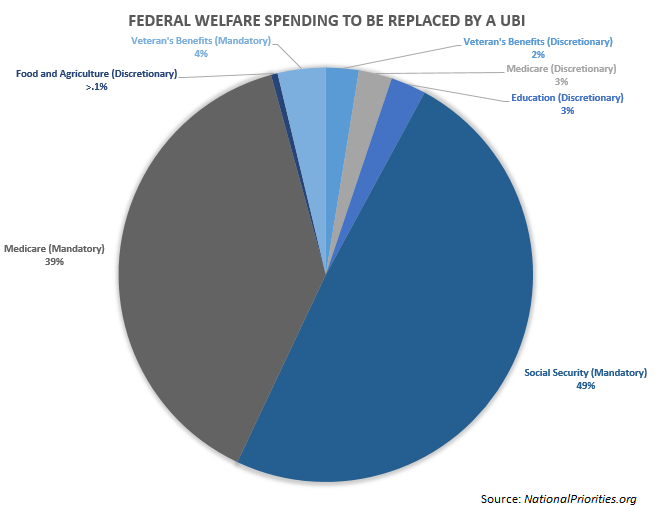
Goldstein likely gets the $10,000 figure from Charles Murray’s proposal for a BIG. Personally, I’m no fan of Murray’s proposal as it goes too far and he proposes financing it by increasing payroll taxes, which are economically inefficient. However, let’s assume that the relevant proposal is around $7,000 dollars.[8] Multiplying that by the US population of 320 million makes for a total cost $2.24 trillion per year.[9] This could be paid for by using the BIG to replace the following current welfare programs and cutting discretionary spending:[10]

  1. $65.32 billion annually in discretionary spending on Veteran’s benefits
  2. $66.03 billion in discretionary spending on Medicare and other healthcare benefits
  3. $69.98 billion in discretionary spending for education.[11]
  4. $13.13 billion in discretionary spending for food and agriculture (eg., SNAP).[12]
  5. $1.25 trillion in mandatory spending for Social Security.[13]
  6. $985.74 billion in mandatory spending for Medicare and Healthcare.
  7. $95.3 billion in mandatory spending for veteran’s benefits.[14]

Spending a UBI Could Replace

That’s a total of $2.542 trillion in savings annually, more than enough to fund the proposed BIG with another $300.3 billion to spare that could be used for tax credits for low-income households to use on healthcare,[15] education,[16] retirement,[17] and/or basic necessities like food.[18] Funding the program would be a huge challenge, but it is possible to do it without tax increases.

Additionally, Goldstein ignores the fact that similar proposals, such as Friedman’s negative income tax, would have a much lower cost while having a similar effect. The Niskanen Center’s Samuel Hammond has estimated that a NIT could cost only $182 billion annually.[19] From Hammond’s analysis:

Just how much of a cost difference is there between a UBI and NIT? To get a rough idea, I used the Census population survey’s Annual Social and Economic Supplement, which has the distribution of individuals over the age of 15 by income level in $2,500 intervals (I subtracted retirees). I then calculated the transfer each quantile would receive based on a hypothetical NIT which starts at $5,000 for individuals with zero income and is phased out at a rate of 30%. Multiplying the average transfer by the number of actual individuals in each grouping and summing, I arrived at total cost of $182 billion—roughly the combined budget for SSI, SNAP and EITC.

The Effect of Replacing Welfare with a BIG on Poverty

Goldstein would object to my line of reasoning by saying cutting all that spending would harm the poor and increase the poverty rate. He says as much in his piece:

UBI’s daunting financing challenges raise fundamental questions about its political feasibility, both now and in coming decades.  Proponents often speak of an emerging left-right coalition to support it.  But consider what UBI’s supporters on the right advocate.  They generally propose UBI as a replacement for the current “welfare state.”  That is, they would finance UBI by eliminating all or most programs for people with low or modest incomes.

….Yet that’s the platform on which the (limited) support for UBI on the right largely rests.  It entails abolishing programs from SNAP (food stamps), which largely eliminated the severe child malnutrition found in parts of the Southern “black belt” and Appalachia in the late 1960s, the Earned Income Tax Credit (EITC), Section 8 rental vouchers, Medicaid, Head Start, child care assistance, and many others.  These programs lift tens of millions of people, including millions of children, out of poverty each year and make tens of millions more less poor.

Some UBI proponents may argue that by ending current programs, we’d reap large administrative savings that we could convert into UBI payments.  But that’s mistaken.  For the major means-tested programs — SNAP, Medicaid, the EITC, housing vouchers, Supplemental Security Income (SSI), and school meals — administrative costs consume only 1 to 9 percent of program resources, as a CBPP analysis explains.  Their funding goes overwhelmingly to boost the incomes and purchasing power of low-income families.[20]

Moreover, as the Roosevelt Institute’s Mike Konczal has noted, eliminating Medicaid, SNAP, the EITC, housing vouchers, and the like would still leave you far short of what’s needed to finance a meaningful UBI.  Would we also end Pell Grants that help low-income students afford college?  Would we terminate support for children in foster care, for mental health, and for job training services?

This is by far and away the weakest part of Goldstein’s argument.

First of all, as my analysis above showed, Konczal’s and Goldstein’s idea that eliminating the current welfare state “would still leave you far short of what’s needed to finance a meaningful UBI” is just false. Even a relatively robust UBI of $7,000 a year is doable by significantly cutting current welfare programs.

But more importantly, Goldstein’s assertion that replacing the welfare state with a UBI would increase poverty is fully unwarranted. He seems to take a ridiculously unsophisticated idea that “more means-tested programs immediately reduce welfare.” His assertion that the programs in question “lift tens of millions of people, including millions of children, out of poverty each year and make tens of millions more less poor” is, at best, completely erroneous. For three reasons: first, individuals know better what they need to lift themselves out of the than the government, and these programs assume the opposite. Second, the structure of status quo means-tested programs often creates a “poverty trap” which incentivizes households to remain below the poverty line. Finally, thanks to these first two theoretical reasons, the empirical evidence on the success of the status-quo programs in terms of reducing the poverty rate is, at best, mixed.

The way our current welfare state is structured is it allocates how much money can go to what basic necessities for welfare recipients. So if a household gets $10,000 in welfare a year, the government mandates that, say, $3,000 goes to food, $3,000 goes to healthcare, $3,000 goes to education, and $1,000 goes to retirement.[21] This essentially assumes that all individuals and households have the same needs; but this is simply not the case, elderly people may need more money for healthcare and less for education, younger people may need the exact opposite, and poorer families with children may need more for food and education than other needs. It’s almost as if our current welfare system assumes interpersonal utility function comparisons are possible, or utility functions of poorer people are fairly homogenous but they’re not. It also ignores the opportunity cost of the funding for helping individuals and households out of funding; a dollar spent on healthcare may be more effectively spent on food for a particular individual or household.

In sum, there’s a knowledge problem involved in our current welfare policy to combat poverty: the government cannot know the needs of impoverished individuals, and such knowledge is largely dispersed, tacit, and possessed by the individuals themselves. The chief merit of a UBI is, rather than telling poor people what they can spend their welfare on, it just gives them the money and lets them spend it as they need.

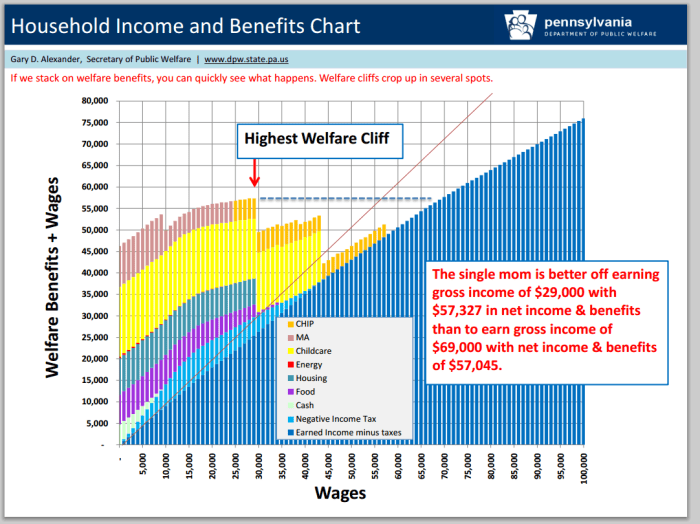
Second, universal programs are superior to means tested programs precisely because the amount of transfer payments received does not decrease as income increases. Our current welfare programs too often make the marginal cost of earning an additional dollar, above a certain threshold, higher than the benefits because transfer payments are cut-off at that threshold. This actually perversely incentivizes households to remain in poverty.[22] For example, the Illinois Policy Institute while analyzing welfare in Illinois found the following:

A single mom has the most resources available to her family when she works full time at a wage of $8.25 to $12 an hour. Disturbingly, taking a pay increase to $18 an hour can leave her with about one-third fewer total resources (net income and government benefits). In order to make work “pay” again, she would need an hourly wage of $38 to mitigate the impact of lost benefits and higher taxes.

SingleMomWelfareCliffChart

Or consider this chart (shown above) from the Pennsylvania Department of Public Welfare showing the same effect in Pennsylvania

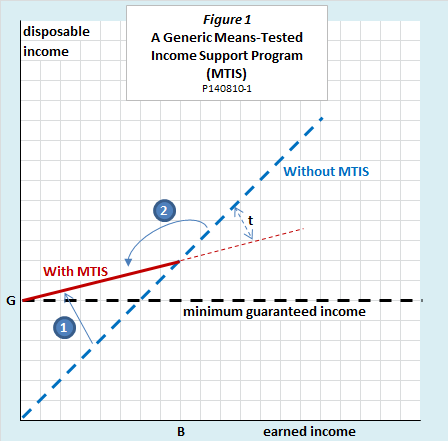
UBI does not suffer from this effect. If your income goes up, you do not lose benefits and so there are no perverse incentives at work here. Ed Dolan has analyzed how the current welfare state with its means-tested benefits is worse in terms of incentivizing work and alleviating poverty extensively. Here’s a slice of his analysis:

P140810-11

The horizontal axis in Figure 1 represents earned income while the vertical axis shows disposable income, that is, earned income plus benefits. To keep things simple, we will assume no income or payroll taxes on earned income—an assumption that I will briefly return to near the end of the post. The dashed 45o line shows that earned and disposable income are the same when there are no taxes or income support. The solid red line shows the relationship between disposable and earned income with the MTIS policy.

This generic MTIS policy has three features:

A minimum guaranteed income, G, that households receive if they have no earned income at all.

A benefit reduction rate (or effective marginal tax rate), t, indicted by the angle between the 45o line and the red MTIS schedule. The fact that t is greater than zero is what we mean when we say that the program is means tested. As the figure is drawn, t = .75, that is, benefits are reduced by 75 cents for each dollar earned.

A break-even income level, beyond which benefits stop. Past that point, earned income equals disposable income.

When these two factors are taken into account (that individuals know better than the government what they need to get out of poverty and there are significant poverty traps in our welfare state), it is no surprised that the empirical evidence on the effectiveness of these anti-poverty programs is far less rosy than Goldstein seem to think.

After reviewing the empirical literature on the relationship between income and welfare improvements for impoverished households, Columbia University’s Jane Waldfogel concluded “we cannot be certain whether and how much child outcomes could be improved by transferring income to low income families.” The Cato Institute’s Michael Tanner wrote in 2006:

Yet, last year, the federal government spent more than $477 billion on some 50 different programs to fight poverty. That amounts to $12,892 for every poor man, woman, and child in this country. And it does not even begin to count welfare spending by state and local governments. For all the talk about Republican budget cuts, spending on these social programs has increased an inflation-adjusted 22 percent since President Bush took office.

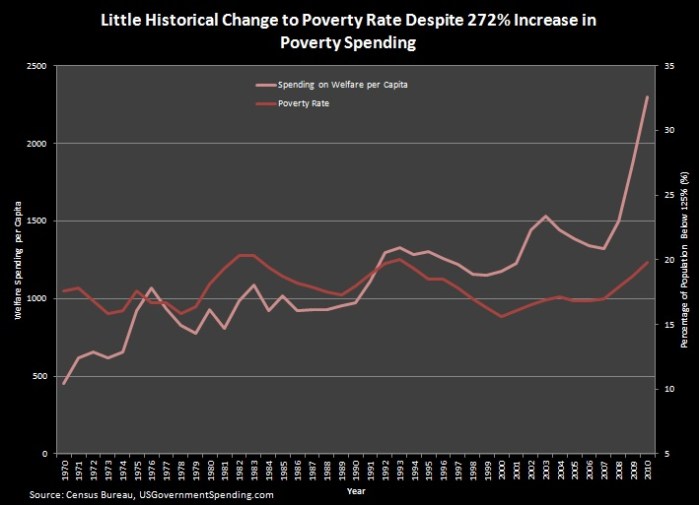
Despite this government largesse, 37 million Americans continue to live in poverty. In fact, despite nearly $9 trillion in total welfare spending since Lyndon Johnson declared War on Poverty in 1964, the poverty rate is perilously close to where it was when we began, more than 40 years ago.

Tanner’s point remains true today. The chart below shows that, despite a massive increase in anti-poverty spending since the war on poverty was declared under Johnson’s “Great Society,” Poverty rates have remained woefully stagnant. In fact, the reduction in poverty that was occurring prior to Johnson’s interventions stopped soon thereafter.

US Poverty Spending

Also, the point is that UBI is a replacement for current welfare benefits. Most households probably would not see a decrease in amount of benefits under a UBI, depending on the specifics of the proposal, and some might even see an increase, contrary to Goldstein’s analysis. Further, they’d be able to actually spend this on what they know they need rather than what government bureaucrats thin they need.

UBI lacks the flaws of the current welfare state, and would likely decrease poverty far more effectively than Goldstein thinks, especially when compared to his favored status-quo.

[1] Though there are some technical differences between Milton Friedman’s proposal for a “negative income tax” and most Basic Income Guarantee proposals, they essentially have the same effect on income. See the Adam Smith Institute’s Sam Bowmen on this point.

[2] See Matt Zwolinski for the “Pragmatic Libertarian Case for a Basic Income,” it should be noted that “pragmatic reasons” here does not refer to my pragmatist philosophical views. Zwolinski has also made a moral case for the basic income on Hayekian grounds that a BIG could reduce coercion in labor negations. I am unsure to what extent I am convinced by this line of reasoning, but it is a valid argument nonetheless.

[3] The Niskanen Center’s Samuel Hammond has made the case that universal transfer programs like a Basic Income cannot be analyzed outside of the tax system that pays for it.”

[4] Or, as my think tank buddies jokingly call it, the “Center for Bigger Budgets.”

[5] Having said that, polls have shown that it is popular across the pond in the Eurozone. The Swiss proposal would call into question this point but it could be argued that the vagueness of the Swiss proposal is why it was turned down not necessarily the spirit of it.

[6] My colleague Ty Hicks of Students for Liberty has made this point well. See also Hayek’s “Intellectuals and Socialism.”

[7] Granted, the Affordable Care Act was not really what most on the left or the right wanted in the first place and has been a disaster.

[8] This number is selected because, according to the CBO, $9,000 is the average amount in means-tested welfare benefits per household for 2006. But that’s for households and a BIG discussed here is for individuals, so it is understandable to make a BIG slightly less than the current average. Goldstein would object that this is far below the poverty line, but BIG is not meant to be a replacement for total income on the labor market at all, so it is unclear why this is an objection in the first place.

[9] This is admittedly a crude and naïve calculation but it is virtually identical to the method Goldstein himself uses to estimate the cost.

[10] All figures for this section are for the 2015 budget and are taken from here.

[11] Goldstein is sure not to be happy with cutting education, and I myself would like to replace this spending with few-strings-attached funding for local education or private school tax vouchers. I’ll address this point more later in this piece.

[12] Much of this is food stamps, which would be rendered obsolete by a BIG anyways. Goldstein would object, more on that in the next section.

[13] Not all of this could be cut, and there would be legal and detailed nuances on how to treat financial obligations for Social Security, veteran’s benefits, and Medicare. The specific legal complexities of mandatory welfare spending are not my areas of expertise, admittedly, and is outside the scope of this paper. I’m just illustrating that it is possible to cut at least some of this spending, perhaps even the majority of it, to fund it.

[14] Many people would object to cutting veterans benefits. First of all, BIG could act in place of these benefits

[15] I have in mind expanding tax-exempt Health Savings Accounts here. I also think funding this by eliminating the employer-based deduction would be a step in the right direction and reduce cost fragmentation in the healthcare market, as Milton Freidman argued.

[16] I have in mind a private school taxpayer voucher system like what is in Sweden.

[17] I have in mind something similar to this proposal to reform social security from the Cato Institute.

[18] I have in mind something like the pre-bates proposed in the Fair Tax.

[19] For this reason, I prefer an NIT to a BIG, but I prefer both to our current welfare state.

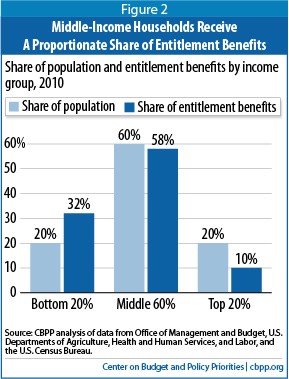
[20] This point is Ironic considering the fact that CBPP’s own research shows that government benefits in America overwhelmingly goes to households above the poverty line, in the middle and upper classes. See this chart (source):

1-SOlzSwsxa08Cno7PiQ9R7A

[21] The real-world numbers are probably different and vary a little bit from household to household, but this is just a hypothetical to illustrate a more general point.

[22] It should be noted, however, that the EITC, and some other programs, is largely free of this defect. This is because the EITC itself is modeled after Friedman’s NIT.

Note: The first chart has been edited since this was initially posted for readability.

The Moral Worth of Chloe Kardashian

Like many pack animals, I judge the hell out of the idiots surrounding me. It’s impossible not to have immediate gut reactions when we see our neighbors making stupid decisions; our brains are hard-wired to be nervous about how wisely our tribe used scarce survival resources. And let’s face it, it’s fun to make fun of doofuses in vinyl wrapped electric Hummers.

A couple semesters ago I asked my class for examples of useless things and landed on tabloid articles about Chloe Kardashian. Surely that’s one thing our economy can save some cash on without any real harm.

But it’s not so simple. Nobody is being forced to print those rags which means someone (bless their hearts) wants to read about Chloe Kardashian. And they want it enough that they’re willing to work for it.

If you set up an amateur print shop in your basement and made up a bunch of celebrities to gossip about as a hobby, nobody would have any reason to stop you. We may agree that your hobby is silly, but if you can’t have a silly hobby, then what’s the point of it all?!

When people buy those magazines at the check out counter, they’re putting their own effort into making up celebrities to gossip about, the difference is they don’t have to put in so much time and the production value is higher because of gains from trade.

Even silly things have moral worth when they exist because of people’s voluntary choices. We should all be more hesitant to ban behaviors we don’t understand.

Where did Homo Economicus come from?

Over on my Facebook page, I posted a short criticism of both neoclassical and behavioral economic scholarship on rational choice (drawing from a paper I’m working on exploring that topic). Stated a bit polemically,  though homo economicus has largely been dead in neoclassical theory, his spirit still haunts the work of most modern neoclassical scholars. Likewise, though behavioral economists are trying to dig the grave and put the final nails in the coffin of homo economicus, their nightmares are still plagued with the anxieties of his memory.

This led a former colleague from Hillsdale to ask me where I thought homo economicus came from historically. I wrote the following in response (lightly edited for this post):

It could be argued, in a sense, that the protestant Christian aim to complete moral purity and the Enlightenment aim to make man perfect in knowledge in morality (as embodied in Franklin’s virtue ethics) helped give rise to a culture that would be primed for such a model. Within economics, historically it comes from Bentham’s utilitarianism and Jevon’s mathematical extrapolations from Bentham’s psychology. However, I’d say this comes from a deeper “Cartesian anxiety” in Bernstein’s use of the term to make economic a big-T True, capital-C Certain, capital-S Science just like physics (which Jevon’s himself stated was an aim of his work,[1] and has preoccupied economists since the days of JS Mill). If economic science cannot be said to be completely positive and “scientific” like the natural sciences with absolutely falsifiable propositions and an algorithmic means of theory-choice, it is feared, it must be written off as a pseudo-scientific waste of time or else ideology to justify capitalism. If economics cannot make certain claims to knowledge, it must be solipsist and relativist and, again, be another form of pseudo-science or ideology. If economic models cannot reach definitive mathematical results, then they must be relativistic and a waste of time. This is just another example of the extreme Cartesian/Katian/Platonic (in Rorty’s use of the term) either/or: objectivity OR relativism, science OR nonscience, determinate mathematical solutions OR ideological emotional bickering. Homo economicus was erected as a means to be an epistemic foundation to solve all these anxieties and either/ors.

Of course, as any good Deweyan, I think all these either/ors are nonsense. Their understanding of science, as revealed through the so-called “growth of knowledge” literature in postempiricist philosophy of science (ie., the work of Thomas Kuhn, Lakotos, Karl Popper, Paul Feyerabend, Michael Polanyi, Richard Bernstein, Richard Rorty, etc.) has shown that this positivist conception of science, that is science consists of algorithmic theory choice selected based off correspondence with theory-free, brute “facts” of the “external world,” is woefully inaccurate. Dialogical Aristotelian practical reasoning in the community of scientists plays just as much of a role in formulating a scientific consensus as empirical verification. This does not undermine science’s claims to objectivity or rationality, in fact it puts such claims in more epistemically tenable terms.

Further, the desire to make the social sciences just another extension of the natural science, as Hayek shows in the Counterrevolution of Science, and as even positivists like Milton Freidman argue, is a completely misleading urge that has led to some of the worst follies in modern social theory. Obviously, I cheer the fact that “homo economicus is dead, and we have killed him,” but now that we’ve “out-rationalized the rationalizer of all rationalizers,” we must try to re-evaluate our economic theories and methods to, as Bernstein or Dewey would put it, “reconstruct” our economic science.

In short, immenatizing the eschaton in epistemology and philosophy of science created homo economicus.

For the record, you don’t have to be a radical scientific anti-realist like Feyerabend or Rorty to agree with my analysis here.[2] I myself wax more towards Quine than Rorty in scientific matters. However, the main point of philosophy of science since positivism is the exact type of foundationalist epistemology undergirding modern positivist methodology in the mainstream of the economics profession, and the concept of rationality that is used to buttress it, is a naive view of science, natural or social.

Notably, this critique is largely unrelated to much of the Austrian school. Mises’ own conception of rationality is mostly unrelated to homo economicus as he understands rationality to be purposive action, emphasizing that economists first understand the subjective meaning from the point of view of the economic actor him/herself before declaring any action “irrational.”[3] [4]

What are your thoughts on this? Are neoclassical and behavioral economics both still way too influenced by the spirit of homo economicus, or am I off the mark? Is my analysis of the historical conditions that led to the rise of homo economicus right? Please, discuss in the comments.

[1] Consider this quote from Jevon’s magnum opus Theory of Political Economy “Economics, if it is to be a science at all, must be a mathematical science.”

[2] In fact, I doubt anybody mentioned is really a scientific anti-realist, I agree with Bernstein that Feyerabend is best read as a satirist of the Cartesian anxiety and extreme either/or of relativism and objectivism in philosophy of science and think Rorty’s views are more complex than simple scientific anti-realism, but that’s an unrelated point.

[3] Of course, any critique of epistemic foundationalism would apply to Mises, especially his apriorism; after all, Mises did write a book called “Ultimate Foundations of the Social Sciences” and the Cartesian anxiety is strong with him, especially in his later works. Notably, none of this applies to most of Mises’ students, especially Schutz, Machlup, and Hayek.

[4] For a more detailed discussion of Mises and the Austrians on rationality, see my blog post here or this paper by Mario Rizzo. For a more general discussion of the insights of the type of philosophy of science I’m discussing, see Chapter 2 of Richard Bernstein’s excellent 1983 book Beyond Objectivism and Relativism: Science, Hermeneutics, and Praxis.

Migration from Bangladesh: Impulses, Risks and Exploitations

Migration and emigration from Bangladesh is a pervasive phenomenon. Historically, large-scale migration from the region constituting the present Bangladesh started after tea plantations were introduced to Assam by the British in the early 19th century. Gradually, the number of migrants from this region increased due to geographic location, climate change and poverty. Over the years, there has been a change in the gender pattern of migration, where the proportion of female migrants has increased significantly. These migrants play a significant role in the Bangladesh economy, as remittances constituted about 8.21% of gross domestic product in 2014. This article examines why, despite the many dangers that the migrants face, including violence in the host countries and exploitation by their ‘masters’, the number of migrants from Bangladesh continues to rise constantly.

That’s the abstract from my latest paper (pdf), published in The Round Table.

The Cruel, Conceited Follies of Trump’s Colonialist Foreign Policy

I typically prefer to abstain from writing too extensively on electoral politics. For one, it’s not my area of expertise and I simply don’t enjoy it that much, but also I think the type of issues that come up in electoral politics are a sensationalist distraction from the meaningful policy debates that actually go on in the back rooms of congress and think tanks, as well as the deeper and more important philosophical, economic, and cultural issues that plague our political situation. Thus, I prefer to write in more detail about public policy or more theoretical economic and philosophical issues rather than the day-to-day drudgery of superficial political news. However, the recent discussion on foreign policy on the campaign trail surprisingly has the potential to become at least mildly substantive, so it is in my mind worth analyzing in greater depth. It should be noted that I am far from an expert in foreign policy, so apologies in advance for any errors and if this article as a whole is a farce.

The purpose of this article is to lay out and critically assess Donald Trump’s foreign policy. It is my contention that Trump does have some fairly consistent underlying instincts, if not principles, on foreign policy that may be inferred from his public comments on the issue. This may be characterized by a concerning belief that the ultimate end of foreign policy should be to aggressively promote America’s interests abroad, akin to a radical, new type of Jacksonian colonialism. If I am right about Trump’s underlying views on foreign policy, a Trump presidency would result in disaster. It would mean massive violations of humanitarian rights and would fail to meet the goals even Trump himself is seeking to attain.

Clinton on Trump’s Foreign Policy

Yesterday, Hillary Clinton delivered a major speech ostensibly criticizing Trump’s foreign policy. Unfortunately, most of her speech was more of an attack on the narrative of Trump’s campaign and Trump himself than his actual foreign policy. This is largely because she thinks Trump doesn’t really actually have a foreign policy; his positions, Clinton thinks, are incoherent, ignorant, or just not even positions at all. This is probably the most quoted passage of the speech:

Donald Trump’s ideas aren’t just different — they are dangerously incoherent.
They’re not even really ideas: just a series of bizarre rants, personal feuds, and outright lies. He’s not just unprepared, he’s temperamentally unfit to hold an office that requires knowledge, stability and immense responsibility. This is not someone who should ever have the nuclear codes — because it’s not hard to imagine Donald Trump leading us into a war just because somebody got under his very thin skin.

Clinton’s strongest case against Trump was that he is “temperamentally unfit to hold office.” She makes this case even more persuasively elsewhere in the speech:

Imagine Donald Trump sitting in the Situation Room, making life-or-death decisions on behalf of the United States. Imagine him deciding whether to send your children into battle. Imagine if he had not just his Twitter account at his disposal when he’s angry, but America’s entire arsenal.

Do we want him making those calls – someone thin-skinned and quick to anger, who lashes out at the smallest criticism?

…I’ll leave it to the psychiatrists to explain his affection for tyrants. I just wonder how anyone could be so wrong about who America’s real friends are. But it matters. Because if you don’t know exactly who you’re dealing with, men like Putin will eat your lunch.

I typically don’t find these types of arguments convincing. After all, it doesn’t matter so much the character of public officials as the institutional incentives they face. But in matters of foreign policy problems of temperament and character do matter because the social situation between foreign leaders in diplomacy can often make a huge difference. Bad manners can and have caused wars (eg., there’s an argument to be made that Jefferson’s bad manners towards British diplomat Anthony Merry helped lead to the War of 1812). These points are confirmed by the fact that world leaders are terrified by Trump and how the intelligence community is afraid he could spill security-sensitive confidential information. (Of course, Clinton also has a less-than-optimal track record on the matter of intelligence security).

What is Trump’s Foreign Policy?

However, Clinton is only partially correct in claiming that Trump’s ideas on foreign policy are “incoherent” or that he doesn’t really have a foreign policy at all. It is true that, as with every other issue save immigration and free trade, Trump switches his positions a lot. But underneath the prime facie incoherence is an overarching vision for a foreign policy that is both somewhat coherent and terrifying.

First, a common misconception needs to be clarified about Trump’s foreign policy views. The press commonly treats Trump as if he’s more of a dove on war and foreign intervention than Clinton, citing his recent criticisms of the Iraq War and Libya. This myth is particularly peddled in pro-Trump “libertarian” circles (with an emphasis on the scare quotes). It is widely accepted that Trump’s foreign policy are less interventionist than Clinton’s fairly hawkish views. However, this is decidedly not the case.

Zach Beauchamp has persuasively made the case that Trump is, in fact, more hawkish in some sense than Clinton. The most consistent point that Trump has made for years now is that America should be waging, in Beauchamp’s words, “colonial wars of conquest” for the purpose of taking resources from other countries. Beauchamp notes:

He first debuted this plan in an April 2011 television appearance, amid speculation that he might run for the GOP nomination. In the interview, Trump seemed to suggest the US should seize Iraqi oil fields and just operate them on its own.

“In the old days when you won a war, you won a war. You kept the country,” Trump said. “We go fight a war for 10 years, 12 years, lose thousands of people, spend $1.5 trillion, and then we hand the keys over to people that hate us on some council.” He has repeated this idea for years, saying during one 2013 Fox News appearance, “I’ve said it a thousand times.”

Trump sees this as just compensation for invading Iraq in the first place. “I say we should take it [Iraq’s oil] and pay ourselves back,” he said in one 2013 speech.

As Beauchamp says, “To be clear: Trump’s plan is to use American ground troops to forcibly seize the most valuable resource in two different sovereign countries. The word for that is colonialism.”

This type of colonialism is even more extreme than the colonialism of American imperialism of the early twentieth century, where colonial wars of conquest were typically justified in terms of America’s “manifest destiny” to spread democracy throughout the world that would eventually benefit the conquered, often coaxed in racial terms (as typified by Kipling’s famous poem), rather than explicitly justified by looting natural resources.

Many people alleging Trump’s dovishness point to his recent criticisms of US intervention in Iraq, Syria, and Libya. The idea that Trump is a dove on these issues, however, is largely a myth. The actual record shows that what Trump’s comments over the past decade or so on foreign policy are largely in line with what Beauchamp sees as his colonialism.

As Beauchamp points out, Trump actually supported intervention in Libya at the time and called for even more aggressive intervention than the Obama administration engaged in (which, as a reminder, included Hillary Clinton at that point):

In a March 2011 vlog post uncovered by BuzzFeed’s Andrew Kaczynski and Christopher Massie, Trump full-throatedly endorsed intervening in the country’s civil war — albeit on humanitarian grounds, not for its oil.

“Qaddafi in Libya is killing thousands of people, nobody knows how bad it is, and we’re sitting around,” Trump said. “We should go in, we should stop this guy, which would be very easy and very quick. We could do it surgically, stop him from doing it, and save these lives.” In a later interview, he went further, endorsing outright regime change: “if you don’t get rid of Gaddafi, it’s a major, major black eye for this country.”

Shortly after the US intervention in Libya began in March 2011, Trump criticized the Obama administration’s approach — for not being aggressive enough. Trump warned that the US was too concerned with supporting the rebels and not trying hard enough to — you guessed it — take the oil.

“I would take the oil — and stop this baby stuff,” Trump declared. “I’m only interested in Libya if we take the oil. If we don’t take the oil, I’m not interested.”

What to make, then, of Trump’s more recent comments where he says he “would have stayed out of Libya”? He’s either incoherent, as Clinton claims, or he’s lying. The first possibility has largely been explored and, though plausible, is uninteresting for present purpose. Therefore, I’ll focus here on the latter (and, in my mind, more likely) possibility. I would argue that Trump is engaging in what could be called, in Arthur Melzer’s understanding of Straussian terms, a sort of dishonest perversion of political esotericism. But unlike the political esotericism of early modern political philosophers who sought to make the world more tolerant, Trump seeks the exact opposite ends. He’s recently been hiding his colonialist views in anti-war rhetoric to attract votes from Americans fatigued with perpetual nation-building through the Bush and Obama administrations. In reality, one of the only sincere substantive positions he’s retained throughout the years is a colonialist desire to wage war for oil. He could not be much further from an anti-war candidate.

As for Iraq, Trump has repeated the claim that he opposed the Iraq war from the beginning many times. Just yesterday, in reaction to Clinton’s speech, he repeated this yet again. “Crooked Hillary said, ‘Oh, Donald Trump, his finger on the button,’,” he said. “I’m the one that didn’t want to go into Iraq, folks, and she’s the one that stupidly raised her hand to go into Iraq and destabilize the entire Middle East.”

In reality, Trump himself wanted to stupidly go into Iraq at the time. In a 2002 interview with Howard Stern he said he supported invading Iraq, adding “I wish the first time it was done correctly.” How did he think it should have been done? Though he wasn’t specific in that interview, his later comments suggest he thinks a “correct” invasion of Iraq would be more aggressive and, of course, focus on taking their oil. Despite being sharply critical of the war later in the Bush administration (though note how he critiques the way it was “handled,” not getting involved in the first place), he supported McCain’s position in favor of the Troop Surge when endorsing him in 2008, claiming, though he wanted to pull out as soon as possible, he wanted to pull out with a victory. Even his most recent comments “critical” of the war, when viewed in the context of his overall foreign policy motivations, aren’t really dovish at all. As he said in 2013, “When I heard that we were first going into Iraq, some very smart people told me, ‘Well, we’re actually going for the oil,’ and I said, ‘All right, I get that.’ [But] we didn’t take the oil!”

Recent comments by Trump against the Iraq War, I think, are well explained by his aforementioned dishonest political esotericism. The record shows Trump disagreed with Bush’s Iraq policy because the motivations were too humanitarian and weren’t aggressive enough prior to the surge. Indeed, Trump’s dishonest claim to dovishness on Iraq has been widely proven false in the press (and yes, each different word links to a different source saying the same thing).

Beauchamp points out that Trump’s views on Syria can’t be described as doveish, as he is largely in agreement with Hillary Clinton:

But the two of them support more or less the same military escalation in Syria. Both Clinton and Trump have proposed carving out “safe zones” in the country, which means clearing out a chunk of its territory and protecting it from aggressors.

Trump sees this as the answer to the Syrian refugee crisis — if you can keep the Syrians there, they won’t have to come over here (or to Europe). “What I like is build a safe zone, it’s here, build a big, beautiful safe zone and you have whatever it is so people can live, and they’ll be happier,” he said in a campaign appearance. “I mean, they’re gonna learn German, they’re gonna learn all these different languages. It’s ridiculous.”

Similarly, both candidates have emphasized the need to bomb ISIS in Iraq and Syria — with Trump famously summarizing his policy as “bomb the shit out of” ISIS. But the way in which Trump plans to wage war on ISIS is far more aggressive — and illegal — than anything Clinton proposed.

He goes on to show that Trump endorses killing the families of suspected terrorists and supports torture for detainees, both of which are illegal war crimes. The killing of suspected terrorists’ families, in particular, is far more extreme than anything Clinton’s proposed and a violation of international law.

Trump essentially views other countries in one of two ways, the way he seems to view people: either as enemies to be defeated economically (eg. China and Mexico) and militarily (eg. Lybia and Syria) or assets to be exploited for American interests via colonial conquest (eg. Iraq). Indeed, he combines the worse elements of neoconservative interventionism with the worst elements of isolationism that my fellow Notewriter Brandon Christensen points out. Like isolationists, he opposes international organizations like NATO and the UN, is generally skeptical of alliances, and fiercely opposes trade agreements; but he also supports costly, unnecessary, and unjust foreign wars and efforts to intervene in other countries’ affairs like neoconservatives. He manages to be both an isolationist, thinking the American government should only protect its own interests at the expense of the citizens of other people, and an interventionist, thinking the government should wage unjust wars to that end, at the same time.

Beauchamp notes how Trump’s foreign policy positions can best be described as Jacksonian:

But historically, there are lots of other forms of American hawkishness. Trump fits well with one of those — one that Bard College scholar Walter Russell Mead calls the “Jacksonian tradition,” after President Andrew Jackson.

Jacksonians, according to Mead, are basically focused on the interests and reputation of the United States. They are skeptical of humanitarian interventions and wars to topple dictators, because those are idealistic quests removed from the interests of everyday Americans. But when American interests are in question, or failing to fight will make America look weak, Jacksonians are more aggressive than anyone.

… Unlike neoconservatives or liberal interventionists, who have well-fleshed-out foreign policy doctrines, many Jacksonians think about war and peace more instinctively. “With them it is an instinct rather than an ideology — a culturally shaped set of beliefs and emotions rather than a set of ideas,” Mead writes. Sound familiar?

Of course, Trump is Jacksonian in more ways than just his foreign policy. His general populism and affection for strong-man leadership are very Jacksonian through and through. Indeed, Thomas Jefferson’s criticisms of Andrew Jackson himself could just as easily be leveled against Trump today (and echo Clinton’s words):

I feel much alarmed at the prospect of seeing General Jackson President.  He is one of the most unfit men I know of for such a place.  He has had very little respect for laws and constitutions, and is, in fact, an able military chief.  His passions are terrible.  When I was President of the Senate, he was Senator; and he could never speak on account of the rashness of his feelings.  I have seen him attempt it repeatedly, and as often choke with rage.  His passions are, no doubt, cooler now; he has been much tried since I knew him, but he is a dangerous man.

A Critique of Trump’s Foreign Policy

Besides the obvious criticism made very persuasively by Clinton that Trump is temperamentally unfit to engage in diplomacy, what is wrong with foreign policy? In a word: everything. But for the purposes of this post, I’ll confine my criticism to three points.

First, Trump’s style of Jacksonian foreign policy is largely responsible for most of the humanitarian atrocities committed by the American government. Second, Trump’s economic foreign policy is antithetical to the entire spirit of the liberal tradition; it undermines the dignity and freedom of the individual and instead treats the highest good as for the all-powerful nation-state (meaning mostly the politicians and their special interests) as the end of foreign policy, rather than peace and liberty. Finally, Trump’s foreign policy fails for the same reasons that socialism fails. If the goals of foreign policy are to represent “national interest,” then the policymaker must know what that “national interest” even is and we have little reason to think that is the case, akin to the knowledge problem in economic coordination.

On the first note, Beauchamp quotes Dr. Mead on how the Jacksonian tradition in America has resulted in some of the most atrocious abuses of human rights in American history:

In the last five months of World War II, American bombing raids claimed the lives of more than 900,000 Japanese civilians—not counting the casualties from the atomic strikes against Hiroshima and Nagasaki. This is more than twice the total number of combat deaths that the United States has suffered in all its foreign wars combined…

Since the Second World War, the United States has continued to employ devastating force against both civilian and military targets. Out of a pre-war population of 9.49 million, an estimated 1 million North Korean civilians are believed to have died as a result of U.S. actions during the 1950-53 conflict. During the same war, 33,870 American soldiers died in combat, meaning that U.S. forces killed approximately thirty North Korean civilians for every American soldier who died in action. The United States dropped almost three times as much explosive tonnage in the Vietnam War as was used in the Second World War, and something on the order of 365,000 Vietnamese civilians are believed to have been killed during the period of American involvement.

This is because the Jacksonian view dictates that we should use full force in war to advance our interests and the reasons for waging war are for selfish rather than humanitarian purposes. We have good reason to think human rights under Trump will be abused to an alarming degree, as his comments that we should “bomb the hell out of” Syria, kill the noncombatant families of suspected terrorists, and torture detainees indicate. Trump is literally calling for the US to commit inhumane war crimes in the campaign, it is daunting to think just how dark his foreign policy could get in practice.

As mentioned earlier, many “libertarians” such as Walter Block seem to be under the delusion that Trump’s foreign policy is somehow compatible with the liberal tradition’s aspirations of individual liberty and peace. As he wrote when he endorsed Trump and created the oxymoronically named group “Libertarians for Trump:”

When put in this way, it is clear that The Donald is the most congruent with our perspective. This is true, mainly because of foreign policy.

…We readily concede Mr. Donald Trump is no Ron Paul on foreign policy or anything else for that matter. However, compared to his Republican alternatives, the Donald stands head and shoulders above them. He has said, time and time again, things like “Look at what we did in Iraq. It’s a mess. Look at what we did in Libya. It’s a mess there too. And we’re going to repeat our mistakes in Syria? Not on my watch.” …Yes, future President Trump wants a strong military, but with only a few exceptions, fewer than the other Republican candidates, only to defend our country.

Ignoring the glaring factual inaccuracy that Trump’s criticisms of Iraq and Libya were that we weren’t fierce enough and the main reason why he wants war is not to defend our country but to loot oil, nothing could be further from the truth that Trump’s foreign policy views are anywhere near to congruent with libertarianism.

To reiterate: Trump’s foreign policy views are just a particularly nasty version of imperialism and colonialism. Mises dedicated two entire sections of his chapter on foreign policy in Liberalism: The Classical Tradition to critiquing colonialism and revealing just how contrary these views are to liberalism’s commitment to peace and liberty. In direct opposition to Trump’s assertions that we should go to war to gain another country’s wealth and resources and that we should expand military spending greatly, Mises argues:

Wealth cannot be won by the annexation of new provinces since the “revenue” deprived from a territory must be used to defray the necessary costs of its administration. For a liberal state, which entertains no aggressive plans, a strengthening of its military power is unimportant.

Mises’ comments on the colonial policy in his time are extremely pertinent considering Trump’s calls to wage ruthlessly violent wars and commit humanitarian crises. “No chapter of history is steeped further in blood than the history of colonialism,” Mises argued. “Blood was shed uselessly and senselessly. Flourishing lands were laid waste; whole peoples destroyed and exterminated. All this can in no way be extenuated or justified.”

Trump says the ends of foreign policy are to aggressively promote “our” national interests, Mises says “[t]he goal of the domestic policy of liberalism is the same as that of its foreign policy: peace.” Trump views the world as nations competing in a zero-sum game and there must be one winner that can only be brought about through military conquest and economic protectionism, Mises says liberalism “aims at the peaceful cooperation between nations as within each nation” and specifically attacks “chauvinistic nationalists” who “maintain that irreconcilable conflicts of interest exist among the various nations[.]” Trump is rabidly opposed to free trade and is horrifically xenophobic on immigration, the cornerstone of Mises’ foreign policy is free movement of capital and labor over borders. There is no “congruence” between Trump and any classically liberal view on foreign policy matters in any sense; to argue otherwise is to argue from a position of ignorance, delusion, or to abandon the very spirit of classical liberalism in the first place.

Mises wasn’t the only classical liberal critical of Trump-style colonialist foreign policy. The classical liberal editor of The Nation Edward Lawrence Godkin was also sharply critical of the imperial foreign policy of the progressives and populists in his time. In a 1900 article entitled “The Eclipse of Liberalism,” in which he lamented the decline of the liberal emphasis on limited government, Godkin wrote:

Nationalism in the sense of national greed has supplanted Liberalism. It is an old foe under a new name. By making the aggrandizement of a particular nation a higher end than the welfare of mankind, it has sophisticated the moral sense of Christendom. Aristotle justified slavery, because Barbarians were “naturally” inferior to Greeks, and we have gone back to his philosophy. We hear no more of natural rights, but of inferior races, whose part it is to submit to the government of those whom God has made their superiors. The old fallacy of divine right has once more asserted its ruinous power, and before it is again repudiated there must be international struggles on a terrific scale. At home all criticism on the foreign policy of our rulers is denounced as unpatriotic. They must not be changed, for the national policy must be continuous. Abroad, the rulers of every country must hasten to every scene of international plunder, that they may secure their share. To succeed in these predatory expeditions the restraints on parliamentary, even of party, government must be cast aside. [Emphasis mine]

Though Godkin’s broader arguments against the “inferior races” argument for imperialism may not apply to Trump himself per se, it certainly does apply to some of Trump’s dangerously backward white nationalist supporters (at least one of whom Trump has publicly appointed) who are helping to drive his rise.

It wasn’t just Godkin in the United States, an entire organization was formed to oppose these policies: The American Anti-Imperialist League, which formed specifically in opposition to the Spanish-American War and the annexation of the Philippians and Cuba. Though it was certainly a diverse collection of anti-imperialists with a wide variety of motives, many of them were classical liberals. Their platform emphasized the incompatibility of small government and imperial conquest:

We hold that the policy known as imperialism is hostile to liberty and tends toward militarism, an evil from which it has been our glory to be free. We regret that it has become necessary in the land of Washington and Lincoln to reaffirm that all men, of whatever race or color, are entitled to life, liberty and the pursuit of happiness. We maintain that governments derive their just powers from the consent of the governed. We insist that the subjugation of any people is “criminal aggression” and open disloyalty to the distinctive principles of our Government.

Trump’s incompatibility with classically liberal goals is not of unique interest to libertarians. In many ways, both neoconservatives and liberal interventionists aim for a similar end of peace among nations in foreign policy for which classical liberals aim (or at least, I hope they share such an aim). The three viewpoints just disagree on the best policy means to reach those ends. Trump decidedly does not take peace as the end of foreign policy. He takes the ruthless promotion of America’s economic interests to be the goal, often at the expense of peace and at the expense of the lives of innocent people.

Additionally, even if we take Trump’s nationalist ends as given, the policy means Trump prefers of violent military intervention likely will not be successful for similar reasons to why socialism fails. Christopher Coyne has argued convincingly that many foreign interventions in general fail for very similar reasons to why attempts at economic intervention fail, complications pertaining to the Hayekian knowledge problem. How can a government ill-equipped to solve the economic problems of domestic policy design and control the political institutions and culture of nations abroad?  Coyne mainly has the interventionism of neoconservatives and liberals in mind, but many of his insights apply just as well to Trump’s Jacksonian vision for foreign policy.

The knowledge problem also applies on another level to Trump’s brand of interventionism. Trump assumes that he, in all his wisdom as president, can know what the “national interest” of the American people actually is, just like socialist central planners assume they know the underlying value scales or utility functions of consumers in society. We have little reason to assume this is the case.

Let’s take a more concrete example: Trump seems to think one example of intervention in the name of national interest is to take the resource of another country that our country needs, most commonly oil. However, how is he supposed to know which resources need to be pillaged for the national interest? There’s a fundamental calculation problem here. A government acting without a profit signal cannot know the answer to such a problem and lacks the incentive to properly answer it in the first place as the consequences failure falls upon the taxpayers, not the policy makers. Even if Trump and his advisors could figure out that the US needs a resource, like oil, and successfully loots it from another country, like Libya, there is always the possibility that this artificial influx of resources, this crony capitalist welfare for one resource at the expense of others, is crowding out potentially more efficient substitutes.

For an example, if the government through foreign policy expands the supply of oil, this may stifle entrepreneurial innovations for potentially more efficient resources in certain applications, such as natural gas, solar, wind, or nuclear in energy, for the same reasons artificially subsidizing these industries domestically stifle innovation. They artificially reduce the relative scarcity of the favored resource, reducing the incentive for entrepreneurs to find innovative means of using other resources or more efficient production methods. At the very least, Trump and his advisors would have little clue how to judge the opportunity cost of pillaging various resources and so would not know how much oil to steal from Libya. Even ignoring all those problems, it’s very probable that it would be cheaper and morally superior to simply peaceably trade with another country for oil (or any other resource) rather than waging a costly, violent, inhumane war in the first place.

Of course, I’m probably giving Trump way too much credit in that critique. Chances are, given Trump’s (nonexistent) economic literacy, he is just under the delusion that more resources always mean a better economy no matter what–opportunity costs, resource allocation, and entrepreneurial innovation be damned–and that government policy can be run just like a business.

Not only is it difficult for policy makers to know what the national interest is, as Christensen has argued it is unclear what “national interest” even means to begin with. He defines national interest as “an excuse for a policy or set of policies that should be taken in order to strengthen a state and its citizens (but not necessarily strengthen a state relative to other states…).” He further claims, “There’s no such thing as a national interest.” I’d take it even one step further: the rhetoric of “national interest,” it seems to me, is just an ideology (in the critical theory sense) for the foreign policy elite and their lobbyists to justify using coercive force to advance their arbitrary private interests rather than the (largely indeterminate) interests of the public or the country at large. Even if the “national interest” does have any meaning other than as a rhetorical ideology for the military industrial complex, the only way such a concept could become known is via the spontaneous process of the voluntary interchange of individuals, often time between citizens and non-citizens, and will likely never be known by a single individual mind. At the very least, there’s a public choice problem here: how is Trump realistically to differentiate his personal interests and those of his cronies from those of the general public? Given the fact that Trump likely has narcissistic personality disorder, I don’t have faith that he will.

The only positive potential to foreign policy under a Trump administration is the possibility that he will wisely not intervene in foreign affairs when no argument can be made that such an intervention would be in the national interest or give us oil. But given Trump’s record on the matter, and the arbitrary and elusive nature of the concept of “national interest,” I doubt that this will be a major factor in the way Trump actually implements foreign policy.

Trump vs. Clinton on Foreign Policy: Who is Preferable?

It is clear that underneath the prima facie inconsistencies in Trump’s comments on foreign policy, there is an underlying consistency that he thinks the goal of foreign policy is to quite aggressively promote US interests. This goal is impossible to reach as it represents a naïve understanding of the knowledge public leaders can possess, and generally represents a selfish, reckless, nationalist disregard for human dignity. The means he wants to undertake for this end are unnecessarily cruel and would likely constitute massive human rights violations. They contradict the high (and in my mind correct) aspirations of classical liberals of peace and individual liberty, and they’ll likely fail to accomplish their stated goals.

However, none of this necessarily means that Clinton’s foreign policy will be all that much better. Sure, Clinton’s motives are likely purer, but her record shows that the means she undertakes are uncannily similar to Trump and fail for similar reasons. She’s shown a similar lack of judiciousness in her handling of classified materials, just what the intelligence community fears of Trump. Her record shows her diplomatic skills yield mixed results at best, and she’s widely a progressive interventionist on foreign policy matters whose policies will subvert the liberal goals of peace and individual liberty. It is somewhat ironic that the Democrats have such great opportunity to go after Trump on foreign policy, but have chosen the absolute worst person in their party to make that case as their nominee (akin to Republicans and Romney on ObamaCare in 2012).

Comparing the two candidates point-by-point, therefore, is very difficult. Though there are many underlying consistencies to Trump’s comments on foreign policy and Clinton is still largely right that his stated positions have been somewhat incoherent. Unlike Trump, we have a record of Clinton actually implementing foreign policy and our only knowledge of the Donald’s policies only comes from occasionally off-the-cuff and contradictory remarks about others’ policies. Thus there is a degree of uncertainty as to what Trump’s foreign policies will actually look like and, though I think his comments reveal there is a high probability they will be atrocious, there is a small chance that they could be marginally better than Clinton’s (whose record shows she will implement almost certainly failed foreign policies). Trump’s very concerning comments on foreign policy alone do not make a slam-dunk case that Clinton is preferable on these matters.

Having said that, I’d still argue Clinton’s foreign policy is at least marginally preferable to Trump’s. With Trump we risk not only a fairly high probability of atrocious policies—quite possibly worse than Clinton’s—based off of his comments, we also risk the added problem of regime uncertainty in foreign policy. Also, some of the concrete policies Trump has called for—like torture and the murdering of families—are a cause for serious concern. Further, Clinton is likely to be far more diplomatic and will be less likely to offend other leaders and alienate the US from the world. Her point that Trump is “temperamentally unfit to lead” is very well taken, and was only confirmed by Trump’s response to her speech which in which he largely stuck to the non-substantive screaming of insults in his typical childish fashion. None of this at all means anybody should vote for either candidate as there is a lot more to voting than the issues of foreign policy. For what it’s worth (which is very little), I for one will most likely not be voting in the next election. If I were forced to, it would be for the Johnson/Weld ticket.


Dear Bernie Supporter: Keep an eye on foreign news

Widespread strikes in France, many turning violent. There are big-time shortages of gasoline so that many people can’t go to work if they want to. The strikes are not directed against “the corporations.” They are directed squarely at the government. What government? The government of the French Socialist Party. That’s an instance of “democratic socialism” if there was ever one.

What did the Hollande government do to attract such working class anger? It has tried to modify slightly the labor laws, to make it easier for example, for employers to offer more than 35 hours a week to their employees if the latter want them (IF they want them).

France is a country with around 10% unemployment for about twenty years. For the young it’s been around 25% . Also, there has not been real economic growth for about ten years (+1% GDP annual is a cause for celebration). Meanwhile, Germany and Switzerland next door are thriving. A great deal of French public opinion is simply in bad faith and refuses to see the obvious: If it’s too difficult to fire people, employers don’t hire and even suppress growth to avoid hiring.

The Minister of Labor in charge of making the French kiss and even swallow that frog is a woman with an Arab name, a Muslim name. Do I think the French Socialist Party is twisted? I am not sure.

Please, thing of sharing, especially with Sanderites.

“Voice, Exit, and Liberty: The Effect of Emigration on Origin Country Institutions”

That’s the title of this short piece (pdf) by Michelangelo, which was just published by the Cato Institute. Michelangelo, by the way, just got his MA in economics and is now in a doctoral program at UC Riverside’s political science department. Get reaquainted with his bio.

Hopefully he has a little bit of time now to work on NOL‘s soon-to-be-world-famous foreign policy quiz…