Possession

Part One: Drying up the tax fountain

I suspect many people have troubling getting a good grasp of the on-going conservative struggle to prevent large-scale takeover of the economy by the federal government. I think there are two main obstacles to their understanding.

First, the idea of the virtuousness of the market as a regulator and organizer of economic life is difficult to communicate. It’s an abstract idea and it does not correspond well to people’s own experience. In their personal life, people think that when good things happen it’s a because someone (some one) made good decisions. First, it’s Mom, and then, it’s the “leadership” of the many organizations within which they live, schools, churches and especially employing organizations. To an extent, the one is themselves.

In daily life, there are few occasions to reflect upon the fact that the myriad decisions made by anonymous decision-makers, including bad decisions, aggregate into good outcomes. The market processes involved are both too magical-seeming and too abstract.

At any rate, for some reason, schools and universities do a bad job of explaining these processes. Liberal Arts teachers don’t understand them themselves and they are hostile to them. Most of them are born socialists. If you eat the King’s bread long enough, you become a monarchist.  Continue reading

Boombustology: A Review

These days commentators near and far are announcing booms and bubbles in Treasury securities, gold, China – perhaps even a bubbles. Vikram Mansharamani is in the China camp, but his arguments stand out from the others. If you can get past the title of his book – Boombustology – you will be rewarded with a thorough, well-documented, yet mercifully brief and readable exposition of a theory of booms and busts applied to past events and China’s future.

Most macroeconomists see the boom-bust cycle as an unsolved problem. Like physicists in search of a Grand Unified Theory, they long for a model that accounts for all the major aspects of the business cycle. Perhaps they are hampered by looking through the wrong end of a telescope. Mansharamani uses not just one but five “lenses” to examine the subject. In addition to micro- and macroeconomics, they include psychology, politics, and biology. He is not the first economist to invade these fields. Rather his accomplishment lies in assembling ideas from each of those areas, applying them to past boom-bust cycles, and putting his ideas on the line by issuing a brave prediction of a forthcoming Chinese economic train wreck.

Austrian Business Cycle Theory

The author’s macro lens includes Austrian business cycle theory. That theory says inflation of the money supply causes a drop in interest rates, which is misinterpreted as an increased aggregate preference for saving over consumption, leading to investments in more roundabout means of production. When it becomes clear that there has been no such preference shift, these undertakings are seen to be at least partial mistakes, requiring write-offs and retrenchment – a bust. The boom is the problem, not the bust, which is the market’s attempt to realign itself to the realities of time preference. Austrian business cycle theory has great merit but leaves some things unexplained.

Mansharamani’s micro lens includes the concept of reflexivity. Market participants don’t just observe prices but also influence them. Reflexive dynamics occasionally give rise to instabilities in which rising prices lead to increased demand.  A simpler term would be a “bandwagon effect.” I recall an office party in 1980 where one of the secretaries asked about buying gold – precisely at the peak, as it turned out. All she knew about gold was that it was way up and therefore must be going higher. I should have realized that when you see financially unsophisticated people like her climbing on a bandwagon, you can be pretty sure there’s no one left to sell to and nowhere for prices to go but down, which is where gold and silver prices went in 1980, and in a big hurry.

From psychology Dr. M. borrows ideas and data about cognitive biases. For example, subjects asked to guess some bland statistic, like the number of African countries that belong to the UN, are influenced by the spin of a wheel of fortune: When the wheel lands on a high number, they guess higher. He translates this and a dozen other cognitive biases into irrational market behavior that can foster booms and busts.

He introduces his biology lens with an analogy to the spread of an infectious disease. When the prevalence of a disease reaches a high level, the infection rate necessarily slows and the disease begins to wane, just like the 1980 gold market.  But it is devilishly difficult to “inoculate” oneself against infectious ideas. Individual investors who can do so have a decent chance to beat the market averages over time, I believe. (Those who would pursue these ideas in greater depth would do well to find James Dines’s quirky and expensive but worthwhile book, Mass Psychology.) Continue reading

The Fiscal Cliff

The “fiscal cliff” is the economic plunge that will occur in the U.S.A. if Congress does not change the big tax hikes and spending reductions that will otherwise start on January 1, 2013. The income tax rate cuts enacted at the beginning of the ozo years (2000 to 2009), as well as the payroll tax cuts that followed the Crash of 2008, were temporary and are scheduled to expire at the close of 2012.

Congress enacted the Budget Control Act of 2011 to require “sequestration” – automatic sharp spending reductions in 2013 – unless it enacted the recommendations of a “supercommittee,” which then failed to achieve a consensus on raising revenues and cutting spending.

Now in mid November 2012 the economy is a train heading towards the cliff, and if Congress does not lay down a track to make the train veer off to the side, the economic train will plunge into another depression. Continue reading

The Disaster: A Teenage Victory

Last Tuesday (11/6/2012) there was a vote about the future and the teenagers won. They now have the keys to the family car.

I have never in my life so wanted to be wrong in my judgment. Here it is: President Obama’s re-election is an even worse disaster than his election was. Do I think that many of the people who voted for him gave serious thought to the giant national debt, to the impending entitlement implosion, to the tepid economic growth, or even to the unusually high rate of unemployment? No. Do I think a sizable percentage did? No. Do I think a few did consider all or any of this? I am not sure.

President Obama won re-election decisively. His margin in the popular vote was nearly three million votes. Apparently* there were none of the gangsterish electoral tactics that marred his 2008 election. This makes the results worse as far as I am concerned.

President Obama is still not a monster. It’s possible that he is manipulated by a brand of leftists we thought had disappeared long ago. It’s also possible that someone like me will nurture in his brain paranoid notions at a time of major anxiety, such as now. Continue reading

Warren Harding’s Fiscal Cliff

The economy is in rough shape right now but suppose it were even worse: unemployment at 12% rather than 8%; GDP falling at a 17% annual rate rather than rising slowly.  A close advisor to the President counsels an array of interventions to stimulate the economy but is ignored.  Instead, the President cuts Federal spending in half and engineers drastic reductions in income  tax rates for all groups.  Meanwhile the Federal Reserve, rather than cranking up the printing presses for a round of monetary stimulus, snoozes through the whole year.

Now there’s a fiscal cliff for you.  If today’s thinking about the fiscal cliff of Jan. 1, 2013 held true, surely such policies would tank the economy big-time.

The foregoing scenario actually happened.  The year was 1920, the President was Warren G. Harding and his close advisor was none other than Herbert Hoover, who as President from 1929 to 1933 would have his way – raising taxes, jawboning wages, and slapping a killer tariff on the economy, thereby doing a great deal to turn the rather mild downturn of 1929-30 into the Great Depression which, with lots of help from Franklin Roosevelt, would plague the nation for another decade.
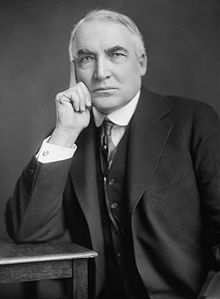
So what happened in Harding’s time?  Things were pretty rough for a while but by the summer of 1921, signs of recovery were already visible.  The following year, unemployment was back down to 6.7% and hit 2.4% by 1923 (source: Thomas Woods, “The Forgotten Depression of 1920″).  A budget surplus arose resulting in a noticeable decline in the national debt.  Business confidence soared and the 1920’s boom was off and running.

President Harding has gotten a bad rap from history because of the scandals that erupted during his administration as well as his chronic womanizing and his passion for the bottle.  But in the countdown of 20th century Presidents that I might do for this blog should I ever get ambitious, I will start with Harding as the least bad President of that sad century and work my way down from there.  I’ll let you  guess who I will honor as the Worst President of the Century.

How does the looming fiscal cliff compare with the policies of 1920?  In case you’ve been hiding under a rock lately (not a bad way to ride out the election campaign!), the fiscal cliff is the set of automatic tax increases and spending cuts that were agreed to when the debt ceiling was raised in 2011.  Congress decided to force its future self to act by lighting a time bomb that it would surely – surely! – defuse before it could go off.  The fuse has now burned to within 1/8 inch of the bomb.

The bomb’s tax increases and spending cuts would reduce the deficit by an estimated $600 billion in one year.  That may be the most accurate estimate but it’s only an estimate.  Congress can set tax rates but tax revenues depend on the size of the tax base.  If highly productive people, those who would take the biggest hit, decide to Go Galt, the tax base could shrink.  And as Jeff Hummel likes to point out, tax rates, particularly the top marginal rates, have varied drastically over the years and yet tax receipts have not varied much from 20% of GDP, excepting the World War II years.

Not only might tax receipts fall short, but expenditures could rise if additional welfare payments such as unemployment benefits or food stamps were to rise.

But let’s assume the fiscal cliff happens and the deficit is indeed reduced by $600 billion. Using figures for the fiscal year just ended, we would still have a $400 billion deficit which would have to be financed by borrowing.  As always, this would be new borrowing, on top of the borrowing needed to roll over the daily stream of maturing debt.  And we mustn’t forget the Social Security Trust Fund which until last year has mitigated the deficit by “investing” its surpluses (FICA tax revenues minus benefit payments) in Treasury securities.  Those FICA surpluses have now turned to deficits which for the present are offset by interest payments on Trust Fund holdings but will eventually require the Trust Fund to stop rolling over maturing securities and, should the trend continue, to deplete its holdings entirely.  All of these developments exacerbate the main federal deficit.  The same applies to the much smaller Medicare Trust Fund.

So I say, with a glance over my shoulder at 1920, bring on the fiscal cliff!  Let the cuts happen, thereby ending a lot of wasteful and harmful spending – particularly “defense” spending.  Let tax rates rise; people will work around them.

But it won’t happen because too many special interests will rise up to prevent it:

  • There are enough military personnel, military contractors, their suppliers, relatives and hangers-on to prevent significant cuts in defense spending.
  • The 27% cut in Medicare physician fees will lead doctors to brush away their Medicare patients like flies, sending those patients hobbling off to howl at their their Congressmen.
  • Millions of middle class people will gasp when their tax preparer tells them they’ve been caught in the dreaded Alternative Minimum Tax trap.  Others will escape the trap only to find that their ordinary income tax rates have risen substantially.
  • Still more millions will see their FICA (Social Security) tax rate revert to the 2010 rate of 6.2% from the current 4.2% “stimulus” figure.

The fiscal cliff won’t happen, at least not all of it, except perhaps for a brief period in January which will be fixed retroactively.  And so, though I hate to say it, I think the longer-term odds of pulling out of our fiscal death spiral are pretty slim.  Many think the government will resort to the time-honored remedy of the printing press, but Jeff Hummel has made a solid argument as to why this option won’t work and why there will be a default on Treasury securities instead.

Hummel also urges economists to do whatever they can to warn people not to count on government largess.  Most young people have written off Social Security for their future and that’s a good thing.  (Not so good for Social Security recipients like me who are increasingly unemployable yet hope to live another 25 years.)  We must take responsibility for our own health care, first by watching our health habits and second by cultivating a personal relationship with a physician, perhaps offering him or her cash payments.  We should be leery of Treasury Securities or of banks, mutual funds, etc. that rely heavily on these securities.  Sock away a few gold and silver coins.

We’re in for a rough ride, I fear, over the next few years.  But the sun will still rise and tangible assets will remain.  Provided enough of us have taken precautions, social unrest will be manageable and maybe, just maybe, the cancer that is called Social Democracy will be shaken off once and for all.
National Economic Systems: An Introduction for Intelligent Beginners – 2

Part Two: Taxing the Rich.

I argue in Part One of this essay that the stimulus package could not possibly stimulate the economy the way a stimulus package is supposed to do. That is, the present stimulus package cannot shorten or lessen the current recession by stemming the growth of unemployment and by jump-starting the national economy, the way Keynesian economics has it. I suggested there had to be another agenda for this massive spending of public money.

Recessions – two consecutive quarters when the national economy contracts instead of expanding – are common under capitalism, in market economies. They wane, whether or not anyone does anything about them. This fact makes if difficult to assign credit to government measures designed to lessen or shorten recessions when economic indicators do look good. Economic indicators don’t look good right now, although some of the press is announcing the beginning of the beginning of the end of the recession.

At any rate, the recession will end eventually. That is, economic growth will resume. I would bet on it but I don’t know when. When growth resumes, we will be left with the second economic crisis facing us. That second crisis is less routine, more extraordinary, and more worrisome than the first crisis, the recession itself. It’s massive public indebtedness. I have to go into the reasons why the Federal Government is even able to incur massive debt. Continue reading

The Good Old Days

Here is a story that’s more than a story.

All our food was organic and no one was overweight. We wore only natural fibers, from sheep and from the cotton fields of Africa.

Children did not get fat spending their days and nights in front of a stupid screen of one kind or another. We read instead.

No one was over-caffeinated or on pills. We rarely went to the doctor.

Kids with Attention Deficit Disorder did not disrupt any school.

We used water sparingly and washed our hair and bodies in simple, non-polluting soaps. We did not waste water or energy with long showers.

My own personal carbon footprint was close to zero, I am sure.

There were few car accidents, unlike now.  Continue reading

Why Blog?

Blogging is very time consuming. It’s cutting seriously into the life of leisure for which I am so obviously gifted. I am certainly not trying to achieve fame. I renounced that particular kind of folly many years ago: It’s not worth it because you are likely to fail. It’s not even worth it when you succeed according to many tabloid stories.

I can’t even say I am terribly successful in terms of effect achieved.

Only 26 people at most read my most recent ambitious posting, “Fascism Explained”. Writing it took me the better part of two or three half-days. Its sequel, “How about Communism?” captured only a little less of my free time and it was read by the same small number of people at best.

My two biggest hits ever, “The Inauguration; the Hamas Victory” and “Advice to Pres. Obama on Manhood” were each read by 56 people maximum.

Why am I alienating my free time that way? Why this fairly futile effort on my part? I could be on my pretty boat on Monterey Bay catching suicidal and cognitively challenged fish. Or, I could simply be reading one of the books I have been wanting to read for weeks. I might even rub my wife’s feet instead. (She is a talented artist and a conservative who thinks Attila the Hun was kind of a girlie man. The only thing that reaches her nowadays is hard foot massaging.)

There is an answer to this multiply-worded single question above:  Continue reading

France Does not Export Wines, nor Mexico Guacamole, nor Does the US Import Cars, etc. “National Competitiveness” for the Intelligent Ignorant

It’s national election season again. As always happens in this season, in every developed country, the old battle horse of national competitiveness gets a new coat of shiny paint and is led out by its sparkle-strewn tether to support politicians misconceptions and mis-talks. There is a very widespread misconception that nourishes unreasonable thoughts and false notions on the economy.

Sorry but at this time, in this season, I feel a compulsion to resort to teaching, so, pay attention. There might be a quiz.

The misconception: Countries, (or “nation-states”) such as the US, Canada, Mexico, Belgium, or France don’t compete with each other like soccer teams, for example, compete against each other. In soccer, when one team wins a point, the other team loses a point. When the economy of one country picks up speed however, it is not (NOT) the case that the economy of another country (or of several countries) must slow down. The reverse is true. When the Mexican economy grows, some Mexicans are better able to buy American corn, or American video games, making some Americans richer than would be the case if the Mexican economy stagnated.

The confusion has three sources. The first source is simply ignoring that the producers of one country are also potential customers for the producers of all other countries. Those who compete with American workers, are often also buyers of American-made products. If they are not at the moment, the richer they become, the more likely they are to become buyers. One of the international functions of those who compete with American producers is thus to enrich American producers, perhaps different ones. The relationship may be more indirect. Foreign worker A competes with American worker B and he uses the money he gets from beating B to buy from American worker C. If I am C, my interests are not well lined up with those of my fellow American B. That’s a fact, no matter what politicians say in the language of football. However, if I am American worker C, in the long run, I am better off if fellow American worker B becomes richer than if he does not. For one thing, he will be able to support better equipments, such as schools, from which I will profit. Continue reading

What Would You Do?

I picked up a five things to-do list from Grover Cleveland over at Pileus Blog if he were supreme ruler of the land. He in turn got his 5 from a prompt by Angus over at Kids Prefer Cheese. If readers have any more Top 5 lists they’ve come across let me know and I’ll link them accordingly.

Anyway, here are Angus’s Top 5: Continue reading

America’s War of 1812

I am anti-war, but if war there must be, then the people should be honest about its financing, and pay for the war while it goes on rather than pushing the finance to future generations.  The War in Iraq was fiscally dishonest in that the costs were not in the official federal budget, and it was paid for by borrowing.  The World Wars and Civil War were also paid for in large part by with war bonds and money creation.  As this year is its bicentennial, it is worth looking at how the War of 1812 was financed.

At first, Congress doubled the tariff to pay for the war, but since trade shrunk during the war, tariff revenue shrank rather than grew.  The US Constitution empowers Congress to levy a direct tax if it is apportioned by state population.  So Congress levied a direct tax on property, mostly on real estate.  The states could take a 15 percent discount if they collected the taxes themselves and transferred the revenues to the federal government.  Most states took advantage of this, which spared the federal government the expense of assessing the real estate and taxing the landowners.  Another federal tax was levied in 1815 to pay for the war of 1812, and then the federal property tax terminated.

Adam Smith wrote that wars should be paid for by taxes rather than borrowing, so that the people would not favor a war unless it was needed such as to defend against foreign aggression.  If the War in Iraq had been finance by taxes, it would most likely not have started!

The use of real estate taxes for the War of 1812 is a lesson for public finance.  If taxes there must be, then instead of a national sales tax or flat-rate income tax, the federal government could tax the states rather than the people.  Let the states pay, at their option, their share of the budget based on their share of population.  This works best if there is a federal tax on land value rather than on income or goods.  If all states did this, there would not have to be any federal tax bureaucracy.

Unfortunately, as Hegel observed, people and governments do not learn the right lessons from history.  At least libertarian candidates should learn from the War of 1812.  Two hundred years ago, the federal government was able to pay for national defense without an intrusive income tax.  We don’t need stinking taxes on wages and goods.  Let the states finance the federal government.  Let the states then have whatever public finance system they want. Political power would then flow back from the federal to the state level, and this decentralization would be good for liberty.  Remember the War of 1812!