In the Ruins of Public Reason, Part III: When the Barbarians Are at the Gates; Fascism, Bullshit, and the Paradox of Tolerance

Note: This is the third in a series of essays on public discourse. Here’s Part 1 and Part 2

Three years ago, I started this essay series on the collapse of public discourse. At the time, I was frustrated by how left-wing and progressive spaces had become cognitively rigid, hostile, and uncharitable to any and all challenges to their orthodoxy. I still stand by most everything I said in those essays. Once you have successfully identified that your interlocutors are genuinely engaging in good faith, you must drop the soldier mindset that you are combating a barbarian who is going to destroy society and adopt a scout mindset. For discourse to serve any useful epistemic or political function, interlocutors must accept and practice something like Habermas’ rules of discourse or Grice’s maxims of discourse, where everyone is allowed to question or introduce any idea to cooperatively arrive at an intersubjective truth. The project of that previous essay was to therapeutically remind myself and any readers to actually apply and practice those rules of discourse in good-faith communication.

However, at the time, I should have more richly emphasized something that has been quite obviously true for some time now: most interlocutors in the political realm have little to no interest in discourse. I wish more people had such an interest, and still stand by the project of trying to get more people, particularly in leftist and libertarian spaces, to realize that when they speak to each other, they are not dealing with barbarian threats. However, recent events have made it clear that the real problem is figuring out when an interlocutor is worthy of having the rules of discourse applied in exchanges with them. Here is an obviously non-exhaustive list of such events in recent times that make this clear: 

  1. The extent to which Trump himself, as well as his advisors and lawyers, engage in lazy, dishonest, and bad-faith rationalizations for naked, sadistic, unconstitutional executive power grabs.
  2. The takeover of the most politically influential social media by a fascist billionaire rent-seeker has resulted in a complete fragmentation and breakdown of the online public square
  3. The degree to which most on the right and many on the left indulge in insane conspiracy theories, which have eroded and destroyed the epistemic norms of society, for reasons of rational irrationality.
  4. Even the Supreme Court, the institution that ostensibly is most committed to publicly justifying and engaging in good-faith reasoning about laws, is now giving blatantly awful, authoritarian opinions so out of step with their ostensibly originalist and/or textualist legal hermeneutics and constitutionalist principles (not to mention the opinions of even conservative judges in lower courts). It certainly seems the justices are just as nakedly corrupt and intellectually bankrupt as rabble-rousing aspiring autocrats. Indeed, the court is in such a decrepit state of personalist capture by an aspiring fascist dictator that they aren’t even attempting to publicly justify ‘shadow docket’ rulings in his favor. One can only conclude conservative justices are engaging in bad-faith power-grabs for themselves, whether they intend to or not. Although this has always been true of statist monocentric courts to some extent, recent events have only further eroded the court’s pretenses to being a politically 

All these were obvious trends three years ago and have very predictably only gotten more severe.  You may quibble with the extent of my assessment of any individual example above. Regardless, all but the most committed of Trumpanzees can agree that there is a time and place to become a bit dialogically illiberal in times like these. Thus, it is time to address how one can be a dialogical liberal when the barbarians truly are at the gates. The tough question to address now is this: what should the dialogical liberal do when faced with a real barbarian, and how does she know she is dealing with a barbarian? 

This is an essay about how to remain a dialogical liberal when dialogical liberalism is being weaponized against you. This essay isn’t for the zealots or the trolls. It’s for those of us who believed, maybe still believe, that democracy depends on dialogue—but who are also haunted by the sense that this faith is being used against us.

Epistemically Exploitative Bullshit

I always intended to write an essay to correct the shortcomings of the original one. I regret that, for various personal reasons, I did not do so sooner. The sad truth is that a great many dialogical illiberals who are also substantively illiberal engage in esoteric communication (consciously or not). That is, their exoteric pretenses to civil, good-faith communication elide an esoteric will to domination. Sartre observed this phenomenon in the context of antisemitism, and he is worth quoting at length:

Never believe that anti‐Semites are completely unaware of the absurdity of their replies. They know that their remarks are frivolous, open to challenge. But they are amusing themselves, for it is their adversary who is obliged to use words responsibly, since he believes in words. The anti‐Semites have the right to play. They even like to play with discourse for, by giving ridiculous reasons, they discredit the seriousness of their interlocutors. They delight in acting in bad faith, since they seek not to persuade by sound argument but to intimidate and disconcert. If you press them too closely, they will abruptly fall silent, loftily indicating by some phrase that the time for argument is past. It is not that they are afraid of being convinced. They fear only to appear ridiculous or to prejudice by their embarrassment their hope of winning over some third person to their side.

If then, as we have been able to observe, the anti‐Semite is impervious to reason and to experience, it is not because his conviction is strong. Rather, his conviction is strong because he has chosen first of all to be impervious.

What Sartre says of antisemitism is true of illiberal authoritarians quite generally. Thomas Szanto has helpfully called this phenomenon “epistemically exploitative bullshit.” 

One feature of epistemically exploitative bullshit that Szanto highlights is that epistemically exploitative bullshit need not be intentional. Indeed, as Sartre implies in the quote above, the ‘bad faith’ of the epistemically exploitative bullshitter involves a sort of self-deception that he may not even be consciously aware of. Indeed, most authoritarians (especially in the Trump era) are not sufficiently self-aware or intelligent enough to consciously realize that they are deceiving others about their attitude towards truth by spouting bullshit. As Henry Frankfurt observed, bullshit is different from lying in that the liar is intentionally misrepresenting the truth, but the bullshitter has no real concern for truth in the first place. Thus, many bullshiters (especially those engaged in epistemically exploitative bullshit) believe their own bullshit, often to their detriment.

However, the fact that epistemically exploitative bullshit is often unintentional, or at least not consciously intentional, creates a serious ineliminable epistemic problem for the dialogical liberal who seeks to combat it. It is quite difficult to publicly and demonstrably falsify the hypothesis that one’s interlocutor is engaging in epistemically exploitative bullshit. This often causes people who, in their heart of hearts, aspire to be epistemically virtuous dialogical liberals to misidentify their interlocutors as engaging in epistemically exploitative bullshit and contemptuously dismiss them. I, for one, have been guilty of this quite a bit in recent years, and I imagine any self-reflective reader will realize they have made this mistake as well. We will return to this epistemic difficulty in the next essay in this series.

To avoid this mistake, we must continually remind ourselves that the ascription of intention is sometimes a red herring. Epistemically exploitative bullshit is not just a problem because bullshitters intentionally weaponize it to destroy liberal democracies. It is a problem because of the social and (un)dialectical function that it plays in discourse rather than its psychological status as intentional or unintentional. 

It is also worth remembering at this point that it is not just fire-breathing fascists who engage in epistemically exploitative bullshit. Many non-self-aware, not consciously political, perhaps even liberal, political actors spout epistemically exploitative bullshit as well. Consider the phenomenon of property owners—both wealthy landlords and middle-class suburbanites—who appeal to “neighborhood character” and environmental concerns to weaponize government policy for the end of protecting the economic rents they receive in the form of property values. Consider the similar phenomenon of many market incumbents, from tech CEOs in AI to healthcare executives and professionals, to sports team owners, to industrial unions, to large media companies, who all weaponize various seemingly plausible (and sometimes substantively true) economic arguments to capture the state’s regulatory apparatus. Consider how sugar, tobacco, and petrochemical companies all weaponized junk science on, respectively, obesity, cigarettes, and climate change to undermine efforts to curtail their economic activity. Almost none of these people are fire-breathing fascists, and many may believe their ideological bullshit is true and tell themselves they are helping the world by advancing their arguments. 

The pervasive economic phenomenon of “bootleggers and Baptists” should remind us that an unintentional form of epistemically exploitative bullshit plays a crucial role in rent seeking all across the political spectrum. This form of bullshit is particularly hard to combat precisely because it is unintentional, but its lack of intentionality in no way lessens the harmful social and (un)dialectical functions it severe.

Despite those considerations, it is still worth distinguishing between consciously intentional forms of aggressive esotericism and more unintentional versions because they must be approached very differently. Unintentional bullshitters do not see themselves as dialogically illiberal. Therefore, responding to them with aggressive rhetorical flourishes that treat them contemptuously is very unlikely to be helpful. For this reason, the general (though defeasible) presumption that any given person spouting epistemically exploitative bullshit is not an enemy that I was trying to cultivate in the second part of this essay series still stands. In the next essay, I will address how we know when this presumption has been defeated. However, for now, let us turn our attention to the forms of epistemically exploitative bullshit common today on the right. We have now seen how epistemically exploitative bullshit can appear even in technocratic, liberal settings. But that phenomenon takes on a more virulent form when fused with authoritarian intent. This is what I call aggressive esotericism.

Aggressive Esotericism

The corrosiveness of these more ‘liberal’ and technocratic forms of epistemically exploitative bullshit discussed above, while serious, pales in comparison to more bombastically authoritarian forms of it. The truly authoritarian epistemically exploitative bullshiter aims at more than amassing wealth by capturing some limited area of state policy. While he also does that, the fascist aims at the more ambitious goal of dismantling democracy and seizing the entire apparatus of the state itself.

 Let us name this more dangerous form of epistemically exploitative bullshit. Let us call this aggressive esotericism and loosely define it as the phenomenon of authoritarians weaponizing the superficial trappings of democratic conversation to elide their will to dominate others. This makes the fascistic, aggressive esotericist all the more cruel, destructive, and corrosive of society’s epistemic and political institutions.

It is worth briefly commenting on my choice of the words “aggressive esotericism” for this. The word “esoteric” in the way I am using it has its roots in Straussian scholars who argue that many philosophers in the Western tradition historically did not literally mean what their discursive prose appears to say. Esoteric here does not mean “strange,” but something closer to “hidden,” in contrast to the exoteric, surface-level meaning of the text. We need not concern ourselves with the fascinating and controversial question of whether Straussians are right to esoterically read the history of Western philosophy as they do. Instead, I am applying the general idea of a distinction between the surface level and deeper meaning of a text, the sociological problem of interpreting both the words and the deeds of certain very authoritarian political actors. 

I choose the word “aggressive” to contrast with what Arthur Melzer calls “protective,” “pedagogical,” or “defensive” esotericism. In Philosophy Between the Lines Melzer argues that historically, philosophers often hid a deeper layer of meaning in their great texts. In the ancient world, Melzer argues, this was in part because they feared theoretical philosophical ideas could disintegrate social order (hence the “protective esotericism”), wanted their young students to learn how to come to philosophical truths themselves (hence the “pedagogical esotericism”), or else wanted to protect themselves from authorities for ‘corrupting the youth’  (as Socrates was accused) with their heterodox ideas. 

As the modern world emerged during the Enlightenment, Melzer argues esotericism continued as philosophers such as John Locke wrote hidden messages not just for defensive reasons but to help foster liberating moral progress in society, as they had a far less pessimistic view about the role of theoretical philosophy in public life (hence their “political esotericism”). Whether Melzer is correct in his reading of the history of Western political thought need not concern us now. My claim is that many authoritarians (both right-wing Fascists and left-wing authoritarian Communists) invert this liberal Enlightenment political esotericism by engaging—both in words and in deeds, both consciously and subconsciously, and both intentionally and unintentionally—in aggressive esotericism. Hiding their esoteric will to domination behind a superficial façade of ‘rational’ argumentation.

Aggressive esotericism is a subset of the epistemically exploitative bullshit. While aggressive esotericism may be more often intentional than more technocratic forms of epistemically exploitative bullshit, it is not always so. You might realize this when you reflect on heated debates you may have had during Thanksgiving dinners with your committed Trumpist family members. Nonetheless, this lack of intention doesn’t cover up the fact that their wanton wallowing in motivated reasoning, rational ignorance, and rational irrationality has the selfish effect of empowering members of their ingroup over members of their outgroup. This directly parallels how the lack of self-awareness of the technocratic rentseeker ameliorates the dispersed economic costs on society.

Aggressive Esotericism and the Paradox of Tolerance

Even if one suspects one is encountering a true fascist, one should still have the defeasible presumption that they are a good-faith interlocutor. Nonetheless, fascists perniciously abuse this meta-discursive norm. This effect has been well-known since Popper labelled it the paradox of tolerance.  

The paradox of tolerance has long been abused by dialogical illiberals on both the left and the right to undermine the ideas of free speech and toleration in an open society, legal and social norms like academic freedom and free speech, and to generally weaken the presumption of good faith we have been discussing. This, however, was far from Popper’s intention. It is worth revisiting Popper’s discussion of the Paradox of Tolerance in The Open Society and Its Enemies:

Unlimited tolerance must lead to the disappearance of tolerance. If we extend unlimited tolerance even to those who are intolerant, if we are not prepared to defend a tolerant society against the onslaught of the intolerant, then the tolerant will be destroyed, and tolerance with them. In this formulation, I do not imply, for instance, that we should always suppress the utterance of intolerant philosophies; as long as we can counter them by rational argument and keep them in check by public opinion, suppression would certainly be most unwise. But we should claim the right even to suppress them, for it may easily turn out that they are not prepared to meet us on the level of rational argument, but begin by denouncing all argument; they may forbid their followers to listen to anything as deceptive as rational argument, and teach them to answer arguments by the use of their fists. We should therefore claim, in the name of tolerance, the right not to tolerate the intolerant. We should claim that any movement preaching intolerance places itself outside the law, and we should consider incitement to intolerance and persecution as criminal, exactly as we should consider incitement to murder, or to kidnapping, or as we should consider incitement to the revival of the slave trade.

His point here is not so much to sanction State censorship of fascist ideas. Instead, his point is that there are limits to what should be tolerated. To translate this to our language earlier in the essay, he is just making the banal point that our presumption of good-faith discourse is, in fact, defeasible. The “right to tolerate the intolerant” need not manifest as legal restrictions on speech or the abandonment of norms like academic freedom. This is often a bad idea, given that state and administrative censorship creates a sort of Streisand effect that fascists can exploit by whining, “Help, help, I’m being repressed.” If you gun down the fascist messenger, you guarantee that he will be made into a saint. Further, censorship will just create a backlash as those who are not yet fully-committed Machiavellian fascists become tribally polarized against the ideas of liberal democracy. Even if Popper himself might not have been as resistant to state power as I am, there are good reasons not to use state power.

Instead, our “right to tolerate the intolerant” could be realized by fostering a strong, stigmergically evolved social stigma against fascist views. Rather than censorship, this stigma should be exercised by legally tolerating the fascists who spout their aggressively esoteric bullshit even while we strongly rebuke them. Cultivating this stigma includes not just strongly rebuking the epistemically exploitative bullshit ‘arguments’ fascists make, but exercising one’s own right to free speech and free association, reporting/exposing/boycotting those, and sentimental education with those the fascists are trying to target. Sometimes, it must include defensive violence against fascists when their epistemically exploitative bullshit manifests not just in words, but acts of aggression against their enemies. 

The paradox of tolerance, as Popper saw, is not a rejection of good-faith dialogue but a recognition of its vulnerability. The fascists’ most devastating move is not to shout down discourse but to simulate it: to adopt its procedural trappings while emptying it of sincerity. What I call aggressive esotericism names this phenomenon. It is the strategic abuse of our meta-discursive presumption of good faith.

Therefore, one must be very careful to guard against mission creep in pursuing this stigmergic process of cultivating stigma in defense of toleration. As Nietzsche warned, we must be guarded against the danger that we become the monsters against whom we are fighting. I hope to discuss later in this essay series how many on the left have become such monsters. For now, let us just observe that this sort of non-state-based intolerant defense of toleration does not conceptually conflict with the defeasible presumption of good faith.

In the next part of this series, I turn to the harder question: when and how can a dialogical liberal justifiably conclude that an interlocutor is no longer operating in good faith?

Some Monday Links

Tale Spin (Real Life)

People, Not Science, Decide When a Pandemic Is Over (Scientific American)

Good Citizens (Orion)

I flee on sight.

Ivy League Justice (Law & Liberty)

Insularity issues have also been raised for the top EU Court: Political appointees and the dominance of French language.

The Political Economy of Classical Music (Jacobin)

Monday Links and unders – NOLite te bastardes

Also, armchair public policy analysis. Caveat emptor: may contain BS

Not posting here could be due to good reasons, or nasty reasons. Fortunately, it was a very good reason that kept me from posting for few weeks (hint: it was expected, and involves diapers). The (invisible to the naked eye) gap was covered via a spontaneous, à la WWE tag team display by Brandon (who, btw, restarted nightcapping, yay! And then got tarpitted again, nay).

Has the U.S. Supreme Court Effectively Overruled Roe v. Wade? (Verfassungsblog)

A take on the recent abortions slugfest. A decisive overturn of the post – 70s judicial status will probably spell similar changes elsewhere. The shadows have been stirring, the battlefront is wide, the divisions remain deep. Only recently, a proxy “skirmish” took place in Greece: A so-called “1st Panhellenic Conference on Fertility” or something got cancelled, after its anachronistic/ derogatory undertones provoked a digital uproar:

Ovaries and Outrage: How Social Media Took Down Greece’s Fertility Conference (MDI)

This metal feminist slogan came to mind:

Nolite te bastardes carborundorum

The Handmaid’s Tale

I have not read the book (nor watched the series), but this mock-Latin line rings timely and has an interesting history itself.

Lynn Parramore at INET argues that modern libertarians tend to overlook the subject, while the likes of Ayn Rand and Murray Rothbard were assertive in defending the right to abortion as part of the self-determination of one’s body/ life in general:

Why Aren’t Libertarians Protesting the Freedom-Busting Texas Abortion Law? (Institute for New Economic Thinking)

INET is not particularly fond of the liberty creed, but still, the picture is disheartening. What’s worse, it fits my own troubling perception (incomplete as it is, based on limited observations) that this kind of intrusion into individual freedom ranks lower than others. The whole issue seems mostly relegated to a “feminist” or “gender” only thing, bogged down by religion and politics, an underdog among individual rights (Scott Lemieux over at Lawyers, Guns & Money also notes something along this lines. LGM has been consistently slamming the Texas law and the SCOTUS response). And that’s why I did not exactly lament the conference cancellation, even if it borderline breached freedom of speech. It rhymed with an underway underhand undoing of that underdog.

A post in RCL (picked by Brandon here) makes an interesting case regarding the feasibility of free choice for both parts of the equation, doctor and patient. However, it also reminded me of this haunting story, and the possibility of a gap between elegant theory and brutal reality:

Italian doctors on trial for manslaughter after refusing abortion (Financial Times)

The FT article also showcases the heavy information asymmetries that plague healthcare services-at-large, which serve as a foundation for state intervention, be it regulation, public supply or whatnot. At least in the realm of textbook econ as I remember it.

Dismantling government policy – source

The other day, I used the same apparatus – old reliable econ – peppered with some basic public choice insights to smite a couple of state initiatives (in my head, that is).

(1) The Greek government recently ramped-up the vaccination push through mandates, prohibitions and fines. More heavy – handed intervention will beget more bottom-up webs that game the system, I decreed (right, late Mancur Olson documented this in his Power and Prosperity book, especially if the public’s trust is lacking, just pushing open an already unbarred door here). As it turns out:

Ten vaccination centers scrutinized over suspected fake Covid certificates (eKathimerini)

(2) A law enacted in early 2020 awards a one-off allowance of EUR 2,000 (that would be like four times the Greek minimum wage) for every childbirth (there are some conditions to be met, income level, residence etc, but they are quite lax). So, a generous gesture, meant to incentivize people to have children, and also to offer support with child-rearing costs, according to the relevant explanatory memorandum. The law is seated in the state’s duty to protect “family…motherhood and childhood”, somewhere in the underbelly of our Constitution’s list of individual and social rights.

At the face of all these, the free-market credo in my econ grasp whispered:

I will not fail in my strike, warrior. I will not fail in my strike.

The Last Mythal

I unfolded my offensive in two lines. First, the smell test: Nudging a life-changing decision with just a hand-out seems overstretched (a scheme of consistent financial aid is a different beast). And second, the econ-kick-in: This subsidy (you can actually feel my contempt here) will have the fate of other transfers that mess with the price mechanism. Will not the maternity services providers just jack-up prices to take a slice? Presto! (I left the actual cost – organizing/ funding – of implementing the policy plus the arbitrariness of the sum out, as too easy targets).

Well, the jury is still out about the first part, since it’s mostly an issue of empirical analysis. It surely made a nice PR exercise (that could also have a positive effect, and maybe this was the main point from the start). My price call went out of the window, though. The relevant costs have barely budged from the last time we needed maternity services, few years ago. First-hand observation is not statistics, but it did the trick. Nice, neat and clean inferences can still be BS, obviously.

Some Monday Links – Of bloody summer stains, busted hopes and laundries

Also lingo. And beards.

Why Cuba is having an economic crisis (Noahpinion)

The Language of Totalitarian Dehumanization (Quillette)

On the Cuba events. Governments and protests, now that’s a strained relationship. Talking about the so-called “Second World” countries, Nikita Khrushchev did not even know what booing is, until he encountered it in his visit to London in 1956.

Few years later, during a massive strike in the Russian city of Novocherkassk, a crowd stormed the central police station. Whether it was a genuine assault, or a naive display of defiance from a people inexperienced in protesting, the government’s fearful puzzlement turned to cold, brutal aggression. Unarmed protesters at the center of the city, mistakenly thinking that those days were over, remained steadfast at the face of warnings to disperse. That is, until security forces opened direct fire against them. The ensuing massacre was covered-up for three decades. Since this was an à la Orwell un-event, no high-ranking officials’ records were stained.

Khrushchev’s aloof ignorance strikes a nerve, contrasted with the people’s heartbreaking one. Both glimpses are captured in the brilliant (though somewhat uneven) Red Plenty, by Francis Spufford.

All things said, Karl Marx Loved Freedom (Jacobin). More beards.

The Greek government, like its French counterpart, is escalating the push for vaccinations. As constitutional scholars argue the limits of state power regarding personal freedom and the public good, historical precedents are brought forth (for the US, c. early 1900s), involving mandatory vaccinations, quarantines and discrimination. The discussion draws from equal protection of the laws jurisprudence and smoothly led me to Yick Wo v. Hopkins (1886):

Yick Wo v. Hopkins established fair implementation of statutes (History Net)

The decision set a milestone and has been cited some 150 times.

The backdrop of the case is rich. As it turns out,

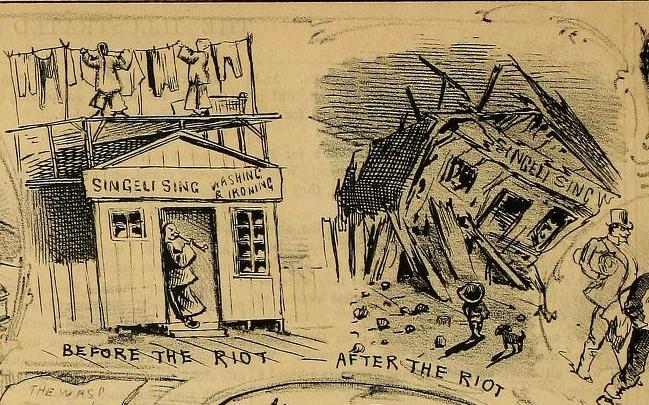
An 1880 ordinance of the city of San Francisco required all laundries in wooden buildings to hold a permit issued by the city’s Board of Supervisors. The board had total discretion over who would be issued a permit. Although workers of Chinese descent operated 89 percent of the city’s laundry businesses, not a single Chinese owner was granted a permit.

Oyez

The regulation was one in a series of many that reflected the anti-immigrant (especially anti-Chinese) sentiment, following the influx due to the Gold Rush (1849).

An illustration of the time, echoing the 3-day pogrom vs Chinese immigrants, San Francisco Jul. 1877 – Source

Yick Wo: How A Racist Laundry Law In Early San Francisco Helped Civil Rights (Hoodline)

A particularly badass line, from the unanimous opinion authored by Justice Stanley Matthews, shows that the Court did not hold back:

Though the law itself be fair on its face and impartial in appearance, yet, if it is applied and administered by public authority with an evil eye and an unequal hand, so as practically to make unjust and illegal discriminations between persons in similar circumstances, material to their rights, the denial of equal justice is still within the prohibition of the Constitution.

Nightcap

  1. Clarence Thomas and the Left Mark Pulliam, Law & Liberty
  2. Religious liberty and the Left Ian Millhiser, Vox
  3. Mughal hegemony Manjeet Pardesi, EJIR
  4. Was Shikha Dalmia purged? George Dance, Political Animal

Nightcap

  1. A conservatism that’s multiethnic, middle class, and populist Ross Douthat, NY Times
  2. Most legal commentary is dumbed down and misleading Ken White Popehat
  3. A social-democratic federation in a multiethnic state Branko Milanovic, globalinequality
  4. The radical leftist origins of the “self-help” movement Jennifer Wilson, the Nation

Amy Coney Barrett is the start of the rise of the Left

The Left has long been weak. It dominates elite circles, but not much else.

Amy Coney Barrett earned her law degree from Notre Dame. The other 8 justices earned their degrees from Harvard or Yale. President Trump’s ideological shake-up of the Supreme Court bodes well for diversity, which in turn bodes well for a resurgence of the American Left in the civic, intellectual, and moral life of the republic.

The stranglehold that the two schools had on Ivy legal thought has meant that the American Right would always be stronger ideologically as well as civically and morally.

It is perhaps ironic that Donald Trump, in trying to Make America Great Again, has done just that by opening up the avenues of power to diverse modes of thought. Donald Trump’s crusade for diversity has indeed opened up elite American circles to competition. This will only strengthen the Left, as it will now have to incorporate non-professional voices into its apparatuses of power, as the Right has long done with much success.

A strong Left that is not overly reliant on elite opinion bodes well for the republic.

Nightcap

  1. The socialist manifesto Robin Hanson, Overcoming Bias
  2. Why Amy Coney Barrett should step down Laura Field, Open Society
  3. There is no expressive duty to vote Chris Freiman, 200-Proof Liberals

Nightcap

  1. Pirates, liberty, and imperialism Regina Much, Commonweal
  2. Can hierarchies be rescued? Chang Che, Los Angeles Review of Books
  3. How to restrain judicial review Ryan Doerfler (interview), Vox
  4. Twilight of the union Colin Kidd, New Statesman

Nightcap

  1. The meaning of Amy Coney Barrett Ross Douthat, NY Times
  2. What does Ruth Bader Ginsburg mean for women? Amy Wax, CRB
  3. Talking about a constitutional restoration Titus Techera, L&L
  4. Give it away (Marcel Mauss) David Graeber, Free Words

Nightcap

  1. Schumpeterian enigmas David Glasner, Uneasy Money
  2. Is John Roberts the new Anthony Kennedy? Damon Root, Reason
  3. Economics of Federalism” (pdf) Inman & Rubenfield
  4. Gray mists & ancient stones Aleksandr Solzhenitsyn, New Criterion

Nightcap

  1. The Left is hardly enamored with John Roberts Lithwick & Stern, Slate
  2. Not all the facts fit the anti-colonialist narrative Remi Adekoya, UnHerd
  3. Facing up to Woodrow Wilson’s true legacy Adekeye Adebajo, TLS
  4. American racism and India’s caste system Sunil Khilnani, New Yorker

Legal silences

In law, there are different silences.

When lawmakers set out to establish legal standards, they inevitably don’t address every contingency. There are spaces for flexibility, for breadth of application, for unforeseen developments, for the careful discretion required for sound law enforcement. There are always gaps.

Yet the gaps raise serious questions. Foremost among these is the problem of delegated lawmaking power. The United States Constitution vests the legislative power in a bicameral congress. Exclusively. Yet gaps, though inevitable and sometimes desirable, can result in leaks of this exclusive authority to non-legislative actors–police, prosecutors, juries, regulators, etc.

Take a classic example, when the National Industrial Recovery Act of 1933 gave the President authority to make”codes of fair competition” for slaughterhouses and other industries. That was more than a gap–that was a gulf. It’s one of only two laws that the U.S. Supreme Court has ever invalidated as an unconstitutional delegation of lawmaking authority to a non-legislative actor.

But at what point does a crack become a crevasse? During Justice Neil Gorsuch’s confirmation hearing, Senator Al Franken mocked the notion that any line should be drawn at all: “When Congress passes laws that require agencies to implement them, … those agencies turn to experts to develop those policies …. And I think that is a good thing. We want experts doing the work. What we Senators do not want to be doing is deciding … what the distance in the slats are in a baby’s crib.”

As with most statements made by politicians in confirmation hearings (or most anywhere else), Franken tilts at a straw man. But his example helps to highlight different types of legislative silence. On one hand, Franken is of course correct–a legislature needn’t and probably shouldn’t become entangled in minutiae.

But Franken fails to see that there are different kinds of silence. On the one hand, permissible gaps to be filled in by agencies and law enforcers involve conditional lawmaking where a certain legal requirement hinges on delegated fact-finding responsibilities. I’m a bit skeptical that we want Congress legislating safety standards for baby cribs, but let’s run with Franken’s example anyway. Congress might pass a law that requires crib manufacturers to ensure that crib slats do not pose a serious safety risk to occupants. It can leave an agency to determine the exact distance between crib slats requisite for child safety because the agency is making a factual determination (again, I’m not sure we need or want regulators doing this but bear with me). We’ll call this crib-slat silence.

Crib-slat silence is not an unlawful delegation of lawmaking authority. It simply commits to federal agencies the fact-finding responsibilities already inherent in the executive branch’s duty to “take care that the laws be faithfully executed.”

Crib-slat silence is different in kind from an unlawful delegation of lawmaking power. An agency is doing something quite different when it sets a safety standard for crib slats than when it establishes “codes of fair competition.” It isn’t simply a difference in the size of the silence; it’s a silence of a different kind altogether. Take, for instance, how President Roosevelt put together “codes of fair competition” under the broad power given him by the National Industrial Recovery Act. He let New York poultry butchers do it for him. Anyone with a basic understanding of public choice theory can appreciate how a business allowed to write the law that governs its competitors might go about this task.

To no one’s surprise, the codes of fair competition made life harder for minority business owners, in particular kosher butchers. Specifically, the code prohibited butchers from letting customers select the specific chicken they wanted–a part of at least some kosher practices in New York at the that time. The Schechters brothers, who ran a kosher butcher shop, were criminally indicted for letting a customer select an “unfit” chicken, among other things. The Supreme Court held this to be an unlawful delegation of lawmaking authority because the National Industrial Recovery Act didn’t just make application of a particular law contingent on executive fact-finding–it delegated the policy choices inherent in the legislative power. This type of silence we’ll call Schechter silence.

Schechter silence and crib-slat silence aren’t just different in terms of the relative size of the gap. Take, for instance, an example of a smaller instance of Schechter silence, where the silence is not quite so huge as “codes of fair competition,” but still has the essential quality of letting the agency make policy choices rather than find facts. The Environmental Protection Agency and the Army Corps of Engineers share regulatory responsibility over the Clean Water Act. The Army Corps has statutory authority to issue permits for polluting protected water bodies, and the EPA has statutory authority to veto those permits, even after they’ve been issued, if the EPA decides that the permitted activity will have an “unacceptable adverse effect” on the environment. The statute hasn’t delegated the authority to create a regulatory code from whole cloth, but it has delegated authority to make normative judgment calls, not just executive fact-finding. Determining whether a certain adverse effect is “unacceptable” is unavoidably subjective and calls for much more than establishing the existence of certain objective facts. “Unacceptable” involves the weighing of various competing interests–economic, environmental, etc.–and making a judgment, not based on facts, but on agency policy preferences. Note also, that the EPA can decline to veto the permit even if it does find an adverse effect to be unacceptable. Hence, while the EPA’s veto authority isn’t especially sweeping in its effect, it still is an exercise of legislative power.

On the other hand, crib-slat silence can authorize executive acts of great national significance, like tariff rates. In 1928, an importer challenged the president’s statutory authority to set tariffs as a delegation of legislative power. But the statute at issue required the president to set such rates based on a variety of factual determinations–not on what the president considered appropriate in his own judgment.

There’s yet a third silence. Rather than interstitial gaps in statutory language, this thrid silence is the vacuum where Congress has chosen not to speak at all. Sometimes, courts and agencies have mistaken this silence for crib-slat silence. That mistake can be a serious problem for the structure of sound government.

One example is the Department of Labor’s regulation of “tip pooling.” The Fair Labor Standards Act establishes federal minimum wage law. The law allows businesses to set their wages below the default minimum if the businesses use a “tip credit”–the deficit between the wage and the legal minimum is filled in with the employee’s tip money.  If a business elects to use the tip credit, that business is prohibited from divvying up tip money among staff–you earn it, you keep it.

But the statute says nothing about prohibitions on tip-pooling for businesses that don’t take a tip credit. The Department of Labor didn’t like tip pooling, so it decided that the statute’s silence about tip pooling for non-tip-credit businesses was a delegation to the agency to do as it pleased. The Department of Labor promulgated a rule that extended the tip-pooling rule to all businesses, whether or not they took a tip credit. Incredibly, a federal court of appeals for the Ninth Circuit said this rule was just fine.

The silence extending outward from the edges of a statute are bookends, not blank pages.  Hence, I’ll call this third silence bookend silence. The idea that an agency can simply promulgate rules to fill up this endless silence destroys our system of separated powers. After all, the clear implication of allowing the Department of Labor to fill in that silence is that the executive branch of government has a boundless and inherent law-making authority that can only be circumscribed if Congress expressly tells the executive branch “no.” This is essentially a reversal of the first two articles of the Constitution, vesting the Executive with lawmaking authority and Congress with what amounts to no more than a glorified veto. Yet this is precisely what the largest appellate court in the country allows.

There’s no doubt, of course, that the Executive does have some inherent authority to act without legislative imprimatur, in areas like foreign affairs. But those are expressly granted powers, or they’re necessarily implied. For instance, the duty to take care that the laws are faithfully executed necessarily implies the ability to hire staff, promulgate regulations for managing staff , law enforcement practices, etc. This is all quite different than filling in bookend silence, a free-floating power to extend statutory prohibitions beyond the express scope laid out by Congress, simply on the basis that Congress hadn’t said “here and no farther.”

In law as in life, silence can be a virtue. But federal agencies can turn it into a vice. That depends on the kind of silence we’re talking about. Conflation of crib-slat silence and Schechter silence or bookend silence has resulted in a flaccid judicial response to delegations of lawmaking authority. It would help if courts acknowledged distinctions between the types of silence statutes exhibit.

Nightcap

  1. Texas sues California Josh Blackman, Volokh Conspiracy
  2. Explainable governance Robin Hanson, Overcoming Bias
  3. Possessed by the past Noah Millman, Modern Age
  4. The problem of consumerism Nick Nielsen, Grand Strategy Annex

Nightcap

  1. Slavery and Anglo-American capitalism Gavin Wright, The Long Run
  2. How the law creates both wealth and inequality Adam Tooze, NYRB
  3. On immigration, Democrats should listen to Gorsuch Ian Millhiser, Vox
  4. Separatists arrested for fraud in Indonesia Arya Dipa, Jakarta Post