Pornography, virtual reality and censorship [II]: puritanism and videogames

[Continuing from my last post, noting that feminists have not behaved monolithically toward pornography, and statistics have not provided any justifiable inference from violent pornography to violent crime.]

Most feminists would align, however, in a condemnation of violent pornography, even if they do not attempt to use legal coercion to restrict it. It has been particularly controversial when material becomes first-person, or even playable. And thus pornography, and violent pornography, often makes an intersection with the videogame industry. To name one infamous example, RapeLay, a role-playing game from a company in Yokohama, Japan, allows the player to assault a defenseless mother and her two children. Some critics argued that the videogame breached the Convention on the Elimination of All Forms of Discrimination Against Women, agreed to by the United Nations.

New York City Council speaker Christine Quinn called RapeLay a “rape simulator.” Commenting on the game and other controversies, an IGN journalist added: “For many, videogames are nothing but simulators. They are literal replications, and, as such, should be cause for the same kind of alarm the real life equivalents would inspire.” Is this the same motive for consumers though – that of, essentially, practice? On the piratebay download link for RapeLay, a top commenter “slask777” writes: “I highly approve of this for two reasons, [sic] the first is that it’s a slap in the face of every prude and alarmist idiot out there and second, it’s a healthy outlet for the rape fantasy, which is more common than most people believe.”

I suspect that much of the appreciation for videogames is due to their simplicity, to be eventually supplemented by mild and mostly innocent addiction. Then – not to put too much faith in slask777’s psychological credentials – I suspect as well that violent videogames serve a “channeling” function, allowing some instinctual energies to exert themselves in a harmless environment and release some psychological tension. Perhaps the “rape fantasy” is not shared by the majority of the populace, but judging by the comments on the torrent site, the audience for this game cannot be confined to stereotypical images of basement N.E.E.Ts. (Studies of the occupations of internet trolls confirm as well the difficulty of pinning down an image for anonymous internet users). There was even an informative, civil discussion of reproductive anatomy on page one of the torrent site. Following this theory of channeling, we might find similar uses for virtual realities: nonreal locations to perform socially unacceptable acts. Locations for people with genuine sexual or sadistic pathologies, to release their desires and blow off steam without harming other people. The entire premise is empathetic.

Of course, throughout history, any activity which has the possibly of harmlessly releasing what could be described as primordial man, the “reptilian” side, the repressed id, or whatnot, has faced violent opposition from culture, religion, criminal law and various romantic-familial-social apparatuses. Here, we can already expect that, fitting into the category of “recreational and individuational,” virtual reality technologies will face a cultural blowback. RapeLay is an extreme example of both violence and sexuality in videogames: the high-profile protest it received could be expected. (Pornography has even been to the Supreme Court a few times (1957, ’64, ’89). In a separate case, Justice Alito, commenting on RapeLay, wrote that it “appears that there is no antisocial theme too base for some in the videogame industry to exploit.”) This moral outrage, however, is not simply content-based, but medium-based, and flows directly from the extant condescension and distrust toward videogames and pornography.

The simple fact that disparate ideological camps agree on, and compatible groups disagree on, the effects and what to do about pornography and videogames could be seen as demonstrative of the issue’s complexity; in fact, this implies that the nature of opinion on this is fundamental and dogmatic. The opinion provides the starting point for selectively filtering research. There are two logical theories concerning these violent media: the desensitization argument, and the cathartic/channeling argument. Puritans and rebels enter the debate with their argumentative powers already assigned, and the evidence becomes less important.

Before evidence that might contradict either primitive position on pornography interferes, many people have already formed their condescension and distrust. The desensitization theory is particularly attractive due on the most publicly-understood thesis of cognitive-behavioral psychology: mental conditioning. Thus when violence or abusive language is used as a male advance in adult videos and games, and women are depicted as acquiescing rather than fighting back, boys must internalize this as reality. Of course, media itself has no interest in depicting legitimate representations of reality; it is inherently irreal, and it would be naïve to expect pornography directors to operate differently. This irreality I think is poorly understood, and thus the “replicator” argument as adopted by the IGN reporter becomes the most common sentiment for people that find pornography affronting to their morals and are also disinterested in research or empirical data. Glenn Beck, commenting on the release of Grand Theft Auto IV, said “there is no distinction between reality and a game anymore.”* He went on to say that promiscuity is at an all-time high, especially with high school students, when the number of sexual partners for young people is at a generational low. The seemingly a priori nature of a negative pornographic effect allows woefully out-of-touch rhetoric to dominate the conversation, appealing also to the emotional repulsion we may experience when considering violent porn. It encourages a simplifying effect to the debate as well. Again, were it simply true that nations with heavy pornography traffic face more frequent sexual violence (as a result of psychological conditioning, etc.), we would expect countries like Japan to be facing an epidemic – especially given the infamous content of Japanese porn (spread across online pornography, role-playing games and manga). Yet, among industrialized nations, Japan has a relatively low rape frequency. The rape ratio of a nation cannot be guessed simply from the size or content of its pornography industry.

Across the board, the verdict is simply still out, as most criminologists, sociologists and psychologists agree. There are innumerable religious and secular institutions committed to proving the evils of pornography, but contrasting them are studies that demonstrate that, alongside the arrival of internet porn, (1) sexual irresponsibility has declined, (2) teen sex has declined (with millennials having less sex than any other group), (3) divorce has declined, and – contrary to all the hysteria, contrary to all the hubbub – (4) violent crime and particularly rape has declined. Even with these statistics, and of course compelling arguments might be made against any and all research projects (one such counterargument is here), violent efforts are made to enforce legal restrictions – that is something that will probably persist indefinitely.

I first became interested in debating pornography with the explosion of “Porn Kills Love” merchandise that became popular half a decade ago. The evidence has never aligned itself with either side; if anything, to this day it points very positively toward a full acquittal. Yet, young and old alike champion the causticity of pornography toward “society,” the family, women, children, and love itself (even as marriage therapists unanimously recommend pornography for marriage problems). Religion has an intrinsic interest in prohibiting pleasurable Earthly activities, but the ostensible puritanism of these opposing opinions is not present in any religiously-identifiable way for a great number of the hooplaers. So an atheistic condemnation of pornography goes unexplained. One might suppose that, lacking the ability to get pleasure (out of disbelief) from a figure-headed faith (which sparks some of the indignation behind New Atheism), people move to destroy others’ opportunities for pleasure out of egalitarianism, and this amounts to similar levels of spiritual zeal. Traces of sexist paternalism are to be found as well, e.g. “it’s immoral to watch a woman sell her body for money,” and through these slogans Willis’ accusation of moral authoritarianism becomes evident. Thus the attitudes which have always striven to tighten the lid on freedom and individual spirituality – puritanism, paternalism, misogyny, envy, etc. – align magnificently with opposing pornography, soft-core or otherwise.

*I try to avoid discussion of GamerGate or anti-GG, but it is almost impossible when discussing videogames and lunatics. Recently, commenting on Deus Ex‘ options for gameplay, which allow the player to make decisions for themselves, Jonathan McIntosh described all games as expressing political statements, and that the option should not even be given to the player to make moral decisions about murder, etc. It’s immoral that there is a choice to kill, was his conclusion. He’s right about all games expressing political statements. But he’s a fucking idiot for his latter statement.

[In my next post I’ll conclude with an investigation into the importance of virtual reality technology and the effect it will have on society.]
BC’s weekend reads

  1. Anthropology as critique of reality: A Japanese turn (pdf)
  2. Flat-footed Giants: Zaibatsu and Industrialization in Meiji Japan, 1868-1912 (pdf)
  3. A hypothetical federation between Japan and the United States

BC’s weekend reads

  1. Saudi-Iran Conflict Is Not America’s Fault
  2. Gains from trade: China and the United States
  3. How Bad Is Trump’s Brand of Authoritarianism?
  4. How Hiroshima Became A War Crime
  5. Art and Porn in Edo Period Japan
  6. The [True?] Meaning of Marxism

From the Comments: What is a “National Interest”? (Why not federalism?)

Michelangelo writes:

I sympathize with your pro-federation views, but it is admittedly a difficult position to argue from a purist libertarian view. I would support offering statehood to Japan and South Korea, as I mentioned earlier this week.* I would not however offer the same deal to Ukraine or the Baltic states. If pressed why I would be okay with federation with one group of countries but not another is because I consider the Ukraine/Baltic region to have little value to American interests. I can see Japan/South Korea federation helping economic growth and military might to the US and therefore in our interests. Note my use of plural pronouns.

From a purely libertarian basis what regions would you offer federation with? Or, if you’d offer federation to all of them, which regions would you offer federation with first? Taiwan might entertain an offer to join the federation tomorrow, but I suspect the PRC or Russia wouldn’t.

*I imagine they’d join as multiple states in practice. I wouldn’t offer Japan 114 seats in the senate, but I would entertain giving them 10 senators.

Why only ten? Michelangelo’s quibble about the number senators can illustrate why federation is more libertarian than isolationism (I’ll get to his question in just a minute).

The Japanese would never accept any sort of union where they give up some sovereignty for other benefits and only have ten representatives in the senate. That wouldn’t be a bargain for the Japanese; it’d be highway robbery. The key conceptual point to keep in mind in this scenario is that there are two sides bargaining and cooperating with each other in order to arrive at a mutually beneficial deal. Japan and the US cease to exist as sovereign political units but become more secure militarily, economically, and politically through a federation with each other.

Contrast this view with what, say, isolationists such as Doug Bandow or Daniel McAdams argue; they want much less cooperation and, by implication, much less choice. Cooperation would be limited to negotiating trade details, arming factions, and coordinating responses to natural disasters. This is radically different from the status quo, but not in a beneficial way. Think of all the things isolationism and the status quo exclude from their policies. People in Japan and the US are overwhelmingly in favor of a continued US presence in Japan. The reasons for this are clear, but as it stands the Japanese are taking the US for a ride. Isolationist arguments are arguably worse, as they’d remove US troops (angering vast swathes of both societies in the process), which would put Japan in a position to fend for itself. Isolationism is “doing something,” and it’s doing something uncooperative.

I agree wholeheartedly with mainstream libertarians about the unfair nature of the status quo. I just think their proposals are equally unfair (if not worse). A libertarian position should emphasize cooperation, choice, and trade-offs above all else. The current stable of libertarian foreign policy experts don’t do this, despite their pertinent critiques of the status quo.

Now, before I get to Michelangelo’s question of who (I promise it’s coming), I want to spend a little time on his proposal for 10 senators, and tie it into the concept of “national interest,” which is a fuzzy concept and hence popular to wield in public discourse.

What is the national interest (or US interest)?

Think it through and write down your answer on a piece of scratch paper you have lying around.

Go ahead. I’ll wait patiently.

Is your answer really the national interest, though? Why is your definition of the national interest true and Walter Russell Mead’s not? Here is how I defined the concept of a national interest back in 2014:

…the national interest is an excuse [scholars and activists use] for a policy or set of policies that [they believe] should be taken in order to strengthen a state and its citizens (but not necessarily strengthen a state relative to other states…)

Now go back and look at what you wrote down as “the national interest.” Am I right or am I right? There’s no such thing as a national interest. Cooperation, choice, and trade-offs do exist, though, and I think they can walk us through a hypothetical federation between Japan and the US.

Michelangelo rightly decries the fact that Japan, a country with 126 million people in it (California has 40 million) should get 114 senators. Yet 10 senators seems far too few to give up sovereignty for federation. This appears to be a stubborn impasse, right? Wrong! One of the great benefits of cooperation is having to learn new things.

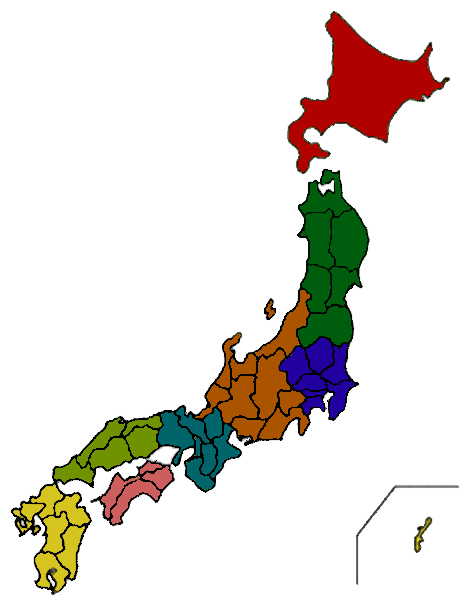
The 47+ prefectures of Japan, for example, have been in use since 1888. The prefectures had steadily been declining in number as the Meiji oligarchy began in earnest to nation-build in what is now Japan. Up until the surrender of Japan to the US, these prefectures were not representative and had little say in how each prefect was to be governed. MacArthur’s constitution gave these 47+ prefectures some autonomy in 1947, but recent attempts at reforming the administrative units of Japan have called for the abolition of these prefectures in favor of fewer administrative units that will also have much more independence from Tokyo. The policymakers who want to take this track are not creating these fewer administrative units out of thin air, either. Rather, reformists are calling for representative units to be based on the unofficial cultural areas of the country that have been around for centuries. Check out the map:

This map shows nine regions, but some people argue that there are actually 13-14 cultural regions within the country (a tough problem to have!). source: wikipedia
This map shows eight cultural areas, but some people argue that there are actually 12-14 cultural regions within the country. source: wikipedia

A cooperative approach to tackling free-riding and imperial expenses would be to reach out to the factions that want fewer administrative states with more autonomy. Adding anywhere from 8 to 14 administrative units into the Madisionian system is much more doable than, say, trying to incorporate 47 administrative units, especially since the latter units have little experience with the autonomous governance that federalism requires of its “states.” At most, there would be 28 additional members of the Senate. The costs associated with free-riding would be gone, and the Japanese people would get the benefits of being a part of the most powerful military the world has ever seen.

Would 28 Senate seats be enough to give up sovereignty? I don’t know, but I do know that the status quo is unsustainable and so, too, are current alternatives.

To finally answer Michelangelo’s question (“From a purely libertarian basis what regions would you offer federation with? Or, if you’d offer federation to all of them, which regions would you offer federation with first?”), I’d start with the Canadian provinces and Mexican states (though I would make it clear that any region is welcome to apply for membership). Then I’d approach the Caribbean islands, the administrative units in Western Europe (including the Baltic states but excluding Ukraine), and the administrative units in Japan and South Korea. Good neighbors and military allies.

My reasoning behind this approach is simply that 1) most of these regions are almost as rich as the United States, 2) they have a good history of actually being representative of their constituents, 3) they have a long history of either interacting with the Madisonian system or acknowledging its tremendous benefits, and 4) they have experience with being somewhat autonomous in a federal system (a federal system that is much less liberal than the one found in the US, but a federal system nonetheless).

Again, I’m not opposed to allowing poor regions to apply and join such a federation, but I think they would be less inclined to do so. Why? Because poorer states are more parochial, more protectionist, and more likely to be uncooperative than rich ones. If regions within these poorer states wanted to apply for membership, we should be open to it, but we’d have to recognize that these poorer regions have a long, hard slog ahead of them. They would, for example, have to market reasons for why they should no longer be a part of a poor state, and they’d have to do it under the harsh watch of the said poor state. Not an easy task, to be sure, but it can be done and the Madisonian federation should be open to the idea of picking apart post-colonial states if it means federating with an oppressed (or poorly governed) region.

Why “post-colonial”? Because of Realpolitik. Entertaining applications from the likes of Tibet or Chechnya is too risky. Entertaining applications from Baluchistan or Biafra? I’d have no problem risking the ire of Pakistan or Nigeria if it meant partnering up with people who want a better life and are willing to cooperate in order to get it.

PS: I think the dialogue in the ‘comments’ thread of this 2014 piece is also worth reading in tandem with my thoughts on Michelangelo’s comment here.

From the Comments: The Contribution of American Allies to Pax Americana

Dr Stocker answers my concerns about free-riding and rent seeking with this gem:

Good points Brandon. On the rent seeking, I think you are broadly correct, but I would offer two qualifications. European nations/the EU often foot a lot of the bill/take on associated civilian tasks where America has taken military action, so that the US is not subsidising the defence and security needs of Europe quite as much as it might seem. So for example, in the Yugoslav breakup led to US military operations and a comparatively passive role for Europe, but a lot of the afterwork was taken on by Europe and there is no point in military intervention without work on building civil society to create long term security and stability. Going back a bit further to the first Gulf War/expulsion of Saddam from Kuwait, Germany and Japan did pay a lot towards the cost in return for not participating. Despite [this] they got a lot of abuse in the US Congress from politicians who don’t appear to understand that their non-intervention in the Gulf owed a lot to constitutions and attitudes which the US encouraged/imposed during post-World War II occupation. Recently, though European govts have been cautious in what they say in public about the Ukraine crisis and containing Putin, there is a growth in military spending and co-operation done in fairly quiet ways largely with the aim of deterring Putin from adventurism in the Baltic states. Just one example, Germany has recently taken 100 Leopard II tanks out of retirement and work is underway for the Leopard III. Moving to the Pacific, Japan is enhancing its military and weakening constitutional restrictions on the deployment of the military (imposed by the US in the post-war Constitution) in reaction to Chinese assertiveness.

While I think it is broadly correct that the US has been paying for a military burden which should be born by Europe and Japan, the situation is not as extreme as it often assumed in the US and as far as I can see is moving in a more balanced direction. In general while it is true that the US has a very impressive military machine with some impressive technology and officers, I think some Americans are a bit over confident about this. A lot of Americans, at least amongst those who take an interest in military kit, appear very convinced that the Abrams 2 is the best tank anywhere, I would suggest that in military capacity, for cost, the Leopard II is probably better (it certainly does much better in export markets) and even in absolute terms ignoring cost, the French Leclerc (which is extremely expensive) has a good claim to be the best tank around, and the Korean K2 is another strong but very expensive candidate. The Abrams is expensive, heavy, difficult to transport and difficult to keep in sufficient fuel, though it can certainly do a very good job. A lot of Americans appear to be incapable of thinking of France as anything other than a surrender monkey joke in military terms, which is really very far from the reality, as can be seen by the very strong role that France is now taking in northwest Africa against violent Islamist fundamentalists. The US military may well be able to have the same military capacity for lower cost if it moves away from the Abrams II model of a tank that is expensive to run and transport as well as build.

So broadly a correct point Brandon, but I think the situation is a bit better than is often understood in America and is moving in the right direction as Japan and Europe are getting used to the idea of taking responsibility for dealing with new threats from China, Putinist Russia and the hydra of Islamist fundamentalists.

A very good point, and an even better angle with which to view the world.

My only quibble is that the right direction American allies are moving can easily be changed without a more fundamental shift in institutional arrangements between us. Some sort of federal or confederal arrangement would go a long way toward addressing this issue, and would further deepen the economic and cultural ties between constitutional democracies.

Or am I just looking for problems where there are none, in order for my arguments to gain ground?

From the Footnotes: Race, Nationality, and Empire

We have more to say than space allows about ‘race’ and ‘community’ as an imperial organizing category, especially in the British Empire, and about complex transformations and incongruities in decolonization as plural, hierarchical fields of multiply ‘races’ and ‘communities’ were constituted into new nation-states. A return to the dictionaries shows that while definitions of ‘nation’ before World War II sometimes connected nations to states, they invariably defined nations as ‘races’ and made the connection to race, not state, primary. Challenges to this linkage of nation and race were available at the time, notably Renan’s 1882 lecture rejecting race, language, and territory as bases for nationality. This argument eventually became famous. But the dictionaries changed only after that crescendo of failure of nations seeing themselves as races destined to dominate empires, the global catastrophes following the German effort to found an Aryan Third Reich and the Japanese effort to build a Co-Prosperity Sphere with the Yamato race as nucleus. Benedict Anderson deserves credit for insisting upon annihilation of the shared descent definitions of nation, for insistence that the nation is first of all imagined, ideal, and realized in co-dependence with a state. Yet in this, we think, he is the theorist observing at dusk, theorizing the world-order of quiescent nation-states built decades before by the architects of a United Nations in the rubble of the Second World War – and theorizing them not as 20th-century contingencies but as a modern necessity. To Anderson, the disconnection of nation from race or descent group and its connection to the state was, ironically, not an historical development but something intrinsic to the nation. The fact of the Nazis notwithstanding, he found scholarship seeing any connection between nationalism and racism simply ‘basically mistaken’.

This from “Nation and Decolonization: Toward A New Anthropology of Nationalism” by John D Kelly and Martha Kaplan in Anthropological Theory (gated, unfortunately).

What Would A Political Union of the EU, the NAFTA States and Japan-South Korea Look Like?

I’ve known about the relative poverty of Western Europe compared to the United States for quite some time now, but it’s always nice to see this little tidbit get some love in the national and international press. Fraser Nelson, a journalist at the Spectator (in the UK) gives us the run-down on the numbers. According to Nelson, the UK is poorer than any US state save for Mississippi. Over at Forbes, Tim Worstall points out that the UK is actually poorer than Mississippi, too. Poor Mississippi!

Both men are calculating wealth with GDP (PPP) per capita, which is what I use as well. GDP (PPP) per capita means Gross Domestic Product (Purchasing Power Parity) per capita. Worstall explains how and why social scientists like using GDP (PPP) per capita to gauge a society’s standard of living:

Just to explain PPP for you. Prices vary across places. In the US food is generally cheaper than it is in Europe, medical care generally more expensive. So what we try to do with PPP is work out what exchange rates would need to be in order to make prices of all of these different things the same in the different places. It’s not an exact science, more of an art. But if what you’re trying to measure is living standards then it’s somewhere between useful and essential as a part of your workings.

It isn’t just the UK that is poorer than the poorest US state, either. Economist Mark Perry did these same calculations using 2010 data back in 2011 and pointed out that only Luxembourg and Norway would be in the Top 30 states were Western Europe and the United States to meld into one federal republic. The rest of Western Europe is on par with the living standards of the American South (which is considered to be the poor, culturally backwards region of the US). Be sure to check out Perry’s 2010 data and compare it to Worstall’s and Nelson’s 2013 data, too.

Careful readers will notice extremely small differences in the calculated purchasing power parity of all three authors (the IMF’s is also a little different), but each data gives us a similar approximation for standards of living in each country and each US state. Suffice it to say here a political union between the United States and the wealthy countries of Western Europe would significantly diminish the GDP (PPP) per capita of the US overall. A political merger with Japan, South Korea, and Mexico would also diminish the overall purchasing power parity of the average US citizen. Canada might (might) make the Top 40 for US states (somewhere between Michigan and Ohio – states of the Rust Belt).

Now, if I had my way, the calculation standards for non-US countries would be the same as they are for US states. That is to say, I think a better way of measuring standards of living would be to break up the countries I’ve mentioned and measure the GDP (PPP) per capita of the administrative units that operate just below the national governments of these states. So, for example, instead of measuring the GDP (PPP) per capita of the Netherlands, I’d measure the GDP (PPP) per capita of the 12 provinces that make up the Netherlands.

Then, in my libertarian utopia, the 50 US states would join together politically with the various administrative units of Western Europe, Canada, Mexico, Japan, and South Korea. Instead of 50 administrative units (the US states) there would be hundreds, maybe even thousands, of them. Talk about decentralization!

Given that a political (and therefore economic and social) merger between Western Europe, the NAFTA states, and Japan-South Korea would diminish my PPP, why should I support such a proposal?

Update 8/30: Some commentators on Facebook have been clamoring for a map, and I found a great website that has devoted lots of time to creating maps based solely on administrative units. The name of the site is Kelso’s Corner and they have a great blog post on the “Natural Earth Vector,” which is the project that maps out administrative units.

It doesn’t have detailed maps of the Anglo-Saxon world or Mexico (presumably because these are so well known), but I found a couple of great maps of Western Europe and Southeast Asia.

This is what the European Union would look like, politically, if it were to be more libertarian in nature.

This is a map of South and East Asia’s administrative units.

Imagine if all of these units were to send representatives and senators to Washington (or a new geographic equivalent): Decentralized political power and integrated markets and cultures would be the new norm for much of the world in a political system based on Madison’s federal republic. I reckon that, in a libertarian utopia, the world would look like this map and be united under Madison’s minarchist federal government:

All thanks goes to kelsocartography.com

I understand that my utopia is not much of a utopia (people will still die and there will be plenty of conflict), but I think this is actually a strength rather than a weakness.

Radiations: Report is in!

The report of a serious scientific study aimed at detecting radiation from the Fukushima nuclear accident on the California coast is in. The study examined kelp (a kind of giant seaweed) because its tissues easily absorb and retain radiations.

The main finding is: _____________________________________

Eye Candy

Below the fold… Continue reading

The Power of Propaganda and the Japanese Empire

Economist Kurt Schuler has a fascinating post on the various currencies that were used in mainland East Asia during World War II over at the Free Banking group blog.

Unfortunately, there are three paragraphs in the post that attempt to take libertarians to task for daring to challenge both the narrative of the state and the narrative of the nation regarding that horrific reminder of humanity’s shortcomings. He is writing of the certainty of the US’s moral clarity when it came to fighting Japan (the post was published around Pearl Harbor remembrance day):

The 1940 U.S embargo of certain materials frequently used for military purposes was intended to pressure Japan to stop its campaign of invasion and murder in China. The embargo was a peaceful response to violent actions. Japan could have stopped; it would have been the libertarian thing to do. For libertarians to claim that the embargo was a provocation is like saying that it is a provocation to refuse to sell bullets to a killer.

Then, in December 1941, came not just the Japanese bombing of Pearl Harbor, but an attack on the whole of Southeast Asia: Hong Kong, Singapore, what is now Malaysia (British colonies), Indonesia (a Dutch colony), the Philippines (scheduled under American law to become independent in 1945), Thailand (independent). In 1942 there followed the invasion of Burma, a bit of India, and a few of the Aleutian Islands, plus the bombing of Darwin, Australia.

With that history in mind, how can anybody think that the United States could have made a durable peace with Japan? It would have lasted as long as would have been to Japan’s military advantage, no longer. Japan was hell-bent on conquest. Nothing since its emergence as a major international power suggested a limit to its ambitions. It only ceded in the face of superior force. Even as Allied forces retook territory, Japanese fanaticism was such that the government did not surrender until after the U.S. military dropped two atomic bombs. To ignore the long pattern of Japanese aggression as quite a few libertarians are wont to do is not just historically ignorant but dangerous, because it closes its eyes to the hard truth that some enemies are so implacable that the only choice is between fighting them and being subjugated by them. It took a prolonged U.S. military occupation to turn Japan from the aggressor it was to the peaceful country it has become. (source)

This is an unfortunate mischaracterization of what went on in World War 2, but it also does a fairly good job of demolishing some of the arguments that libertarians have come up with in regards to this debate. You see, the issue of World War 2 is one that is usually foisted upon libertarians as an example of the benevolence of the State: Washington crushed two powerful, evil war machines in one fell swoop and then stood up to a third evil empire for forty years.

Libertarians often get confronted with this interpretation of history and they get bothered by it. This argument gets under their skin. They often make up excuses for Japan’s actions, or they avoid dealing with what actually happened in the time period. This response is also unfortunate because the general principles of libertarianism – individual freedom, strong property rights, internationalism – explain the events of World War 2 well, but only once the facts are looked at clearly and thoroughly. The power of propaganda is immense. The fact that so many people believe that the United States was the good guy in the war against Japan is astounding, and I think the heavy weight that is placed upon the shoulders of those who dare to defy the standard account of the US’s war with Japan flusters the seeker of truth.

Even though libertarians get hot-headed on this issue and stumble, thus making Schuler right in a sense, his argument is absolutely wrong. What follows is an attempt to calm things down, and to explain why Schuler is wrong and what libertarians need to get right.

Tokyo did not want to expand beyond a certain point, due to the ideological consensus of the governing party at the time. The narrative of the governing party was that great civilizations had natural territories over which they naturally lorded. For the Japanese, this natural territory (which was, of course, entirely arbitrary and ahistorical) was called, amongst other things, the East Asia Co-Prosperity Sphere. It included the Korean peninsula, Manchuria, Southeast Asia, Indonesia, the Philippines, coastal China, Mongolia, Malaysia (including Singapore and Brunei), and a separatist region in India known as Azad Hind. Any territory beyond these lands were inhabited by – again according to the ideology of the dominant political party at the time – peoples who did not conform to the standards set by the Japanese people (and those ranked directly beneath them; the ones I just mentioned). These foreign peoples were treated accordingly, especially in Melanesia.

What this suggests is that, contra Schuler, the Japanese were not “hell-bent on conquest.” Rather they simply wanted to carve out a territorial space that has obvious parallels with the German conception of Lebensraum. This is not a coincidence, by the way, for the ideologies of the dominant parties in Germany and Japan were cut from the same racist cloth.

Hawaii might have been a target for the Japanese military eventually, due to the large number of people living there with Japanese ancestry, but even this is stretching the limits of generosity. Hawaiians of Japanese ancestry considered themselves to be Hawaiians, or Americans, before Japanese (this probably due to the fact that the Japanese government sent some of its citizens over to Hawaii by force, but that is another story for another day; hopefully you can see why loyalty to Hawaii and the US was a given to people of Japanese ancestry on the islands). A Japanese invasion of the US mainland is simply an incredibly silly notion, which is why I think Dr Schuler relies upon the irrefutable fact of Japanese lust for conquest. Can you not see where propaganda is at work here?

Now, obviously the Japanese were warmongering at the time. There is no doubt about this. However, it hardly follows that the Japanese were a threat to the American republic.

For instance, look at what the Japanese military ended up attacking:

  • European and American colonies (which were burdens rather than boons for both the colonized and the colonizing)
  • Thailand, a kingdom with a long history of playing foreign powers off on each other
  • and parts of China (which could hardly lay claim to much of its territory anyway)

If I’m not mistaken, Europe and the United States are thousands of miles away from Japan, and yet they had militaries occupying foreign lands in East Asia. Again, Japan was certainly an aggressive state in the early 20th century, but it seems extremely unfair to ignore the military occupation – by Western states – of Asian lands and the Jim Crow-esque political regimes that they enacted and enforced. Notice, too, that the military incursions of the Japanese Empire do not stray too far from the official ideology of the governing political party. This is also true of Nazi Germany and Fascist Italy. It was also true of Soviet Russia, but for different reasons. The Soviets engaged in worldwide imperial ambitions (“spreading the revolution”) after solidifying their rule at home, and this imperialism was part and parcel of the dominant ideology of Leninism. I am digressing.

Japan did declare war on the US, so I think Washington’s war was just, but it hardly follows that Japan was “hell-bent on conquest,” or that its military would have invaded the United States, or that Tokyo’s decision not to curl up in the fetus position and simply accept US economic warfare was “unlibertarian.” Suppose Japan had conquered the US. What would its armies have uncovered?

Think of it this way: What incentive would Japan have to conquer the United States? Where were the plans to do so? Doesn’t it make more sense to look at Japan’s war on the US as part of its broader effort at creating and maintaining its hold over the territory it deemed to be the natural lord over? Why waste so many resources invading and occupying a territory dominated by people who were part of another race (as per the prevailing ideology of Tokyo at the time)? Oh, that’s right: Because Japan was “hell-bent on conquest.”

Propaganda is very powerful, but it’s also important not to label everything you disagree with as propaganda. That makes you sound like a crackpot. For instance, I don’t think anything Dr Schuler argues is driven by pure propaganda. Such an insinuation on my part would simply be garbage, and (rightly) treated as such in the public sphere. However, the notion that the US military stopped a war machine “hell-bent on conquest” is a product of propaganda. This notion is strengthened by personal and cultural narratives, and in time it takes on a life form of its own.

One last thing: Dr Schuler argues that the embargo Washington placed on Tokyo “was a peaceful response to violent actions,” but surely you can see how that policy was actually a violent response to violent actions. Whether that violence to counter other violence was a good thing or not is a question that cannot be answered in this already-too-long post.

(One more last thing: Here is an excellent essay on ideology in developing states that might be worth checking out; it doesn’t deal directly with the Japanese Empire but does deal with some of the concepts [especially nationalisms] that confront us when thinking about the rise of the Japanese Empire.)

The Tyranny of Ambiguity: “Hate Speech” laws in Japan and subtle Western imperialism

Economist Tyler Cowen linked to the following report in the Washington Post about a supposed increase in enmity between Japanese citizens and Korean expats in Tokyo’s Koreatown. Setting aside all of the hyperbole on the part of the Post concerning rising tensions, and setting aside the interesting fact that there is a Koreatown in Tokyo, and setting aside the fact that there seems to be an increase in nationalism throughout the developed world, I’d like to focus on the Post‘s advocacy of “hate speech” laws. The Post reports:

“Japan is right now at a crisis point,” said Yoshifu Arita, a [Left-wing] lawmaker who is campaigning for new laws to regulate hate speech. “A situation like this — people getting so publicly hostile — never happened in the seven decades after the war until now.” […] In 1995, Japan did accede to the United Nations’ convention to eliminate racial discrimination, including hate speech, but its parliament has not passed legislation to enforce that treaty commitment. Its reluctance, experts and politicians say, stems from a separate war-era legacy — the wholesale suppression of anti-government dissent. Japan created free-speech laws to prevent a repetition of that censorship, and many still oppose the idea of regulating speech, said Kenta Yamada, a media law professor at Senshu University. The Japanese government’s hope, Yamada said, is to reduce hate speech with education and enlightenment, not with new laws.

Now I think we can all agree that ethno-nationalism is a bad thing, and there has been a rise in ethno-nationalism throughout the world since the 2007-2008 economic crisis began. However, I hope we can all equally agree that squelching free speech in the name of an imposed tolerance would be a much, much worse outcome.

“Hate speech,” of course, is ambiguous and invites arbitrary censorship. The fact that the Leftist politician pushing for the assault on free speech is employing the language of crisis does nothing to relieve my suspicions of her intentions.

This piece brought up three more quick thoughts in my mind:

  1. The report states, in the above quoted passage, that Japan created free speech laws after the war. This is all well and good for the most part, but I’ll never tire of reminding people that the right to free speech cannot be created by government. Free speech is a natural human right, and as such it is impossible for governments to create free speech. For example, what would happen if Japan had not created free speech laws after the war? Would free speech not exist? It’s possible, but this could only be true if governments had laws in place prohibiting free speech.
  2. Is it just me, or did the reporter – a Western Leftist – come off as sounding a bit imperialistic in his subtext?
  3. Imagine what a federal incorporation with the US would do for ethnic relations between Koreans and Japanese.

Around the Web

  1. When governments go after witches
  2. Borders, Ethnicity and Trade [pdf]
  3. A Lonely Passion. Libertarians in China
  4. Halloween in Germany: read this with globalization and its critics in mind
  5. Should Japan take the lead in mediating US-Iranian talks? Props to Obama, by the way
  6. Another excellent Free Speech blurb from Ken White
  7. Culture in a Cage

News you can abuse from the New York Times

Annoyed New York Times readers are asking why the Gray Lady recently deigned to publish an advice piece on avoiding interpersonal and legal troubles with one’s household staff. I can answer this:

1) A paper must cater to the demographic that actually buys the obscenely overpriced, and roundly obscene, items that it advertises, instead of just staring in amazement that such things exist. The Times’ gleaming new office building across from the Port Authority ain’t paying for itself, now.

You probably are not part of that demographic. When I’m cooking my own quesadillas and potato-onion stirfries in a housekeeping motel in Springfield, Oregon, I most certainly am not.

2) It is excellent click bait and a good business practice to regularly troll the poors.

My main topic tonight, however, is this week’s book review of a new Malthusian work, Countdown, arguing that the world population is overshooting its carrying capacity and nearing a crash.

I definitely find some of the alleged threats in question quite concerning, in particular the brittleness of modern crop monocultures (the Ug99 wheat stem rust is partially contained so far, but it’s no joke) and the depletion of the world’s fisheries. It’s worth noting that that’s why Somalia has so many pirates these days. Somalia has gone a generation without a coast guard. As a result, it has practically no fishery left, foreign trawlers having effectively strip-mined it in the absence of any functioning sovereign government, but as Captain Philips could tell you, it is a nation (if that) lately renowned for its fishers of men. Notice, too, that Iceland, settled by Vikings, does not have pirates or an extremist sectarian militia but does have a coast guard that opens live fire on poaching vessels within its territorial waters. These things are related.

The author, Alan Weisman, starts with a buzzkill for those who love them some Biblical living. According to the review, “Because of agricultural irrigation, the Jordan River is now a ‘fetid ditch’; pilgrims who attempt to bathe at the spot where Jesus is said to have been baptized will develop a rash and, if they swallow the water, will most likely vomit.”

Actually, Ecclesiastes was right: there’s nothing new under the sun, at least not in Holocene times. Check out this foreign army commander bitching to Elisha’s messenger in 2 Kings 5:12 about the skankiness of the Jordan, presumably not knowing its coming longue durée: “‘Are not Abana and Pharpar, the rivers of Damascus, better than all the waters of Israel? Couldn’t I wash in them and be cleansed?’ So he turned and went off in a rage.”

Dude eventually listened to the obscurantists, took his dip, and was cured. These days, the Jordan will more likely give a man leprosy, but it isn’t so much different as merely worse: thousands of years ago, rational people were scared to swim in that shit.

That said, things can get really unstable as they’re scaled up. A few tens of thousands of people watering their riverside farms from the same glorified creek may be sustainable. Several million people trying to water major cities and industrial monocultures from the same glorified creek is not sustainable at all.

The inevitable result is war. What, all sides swear that they’re holy peoples living in the Holy Land? Tough titty: they’ve still got war. In fact, they’ve got even more of it, since they’re not just desperate for resources but also inflamed by sectarian passions, the two aspects of their anger feeding one another.

As an institution, it’s good for a lot more than Edwin Starr ever wanted to contemplate. The Nazi expansion into Eastern Europe was about the glory of the Deutsche Volk, but it was also about the oil fields of Ploiesti. Hitler was a megalomaniac, but he wasn’t a total fool. Japan had an even starker motivation for its invasions of Korea (coal) and Indochina (oil, lumber, rubber): it was a heavily populated archipelago devoid of many important natural resources and, starting in 1941, under American embargo at a time when the US was the world’s top oil producer.

In a moral sense, though, Starr was right. War is a travesty. One has to be a bit dense or a lot immoral and atavistic not to recognize this. (These are great traits for government “service,” by the way.) A huge portion of the restiveness in the world can be straightforwardly explained by blatant resource shortages in times of growing population. It’s a total buzzkill for the nationalist and the End Times aficionado (similar personality types, and often the very same people, no?) but it’s true. Surely there must be an alternative to this madness.

There is. Brace yourselves.

Japan.

[T]he fertility rate is so low–1.4 children per female–that the population has been declining since 2006. This might make Japan something of a best-case situation, but an aging population means there are too many senior citizens, and not enough young people to take care of them. Already Japan has a shortage of geriatric nurses. Weisman visits Nagoya Science Park, where Japan’s oldest scientific firm has built RIBA II, a robotic white bear designed to carry elderly people around the house. It has large, widely-spaced black eyes, cute little ears and a painted smile.

“I will do my best,” says the bear, as it approaches a man who is lying on a hospital bed. “I will carry you as though you were a princess.”

RIBA II slides one paw under the patient’s knees, the other beneath his back. The robot cradles the man in its arms. It carries the man across the room, and lowers him tenderly into a wheelchair.

“I’m finished,” announces RIBA II, and it’s hard not to wonder whether the robot speaks for us all.

That bear won’t be finished with me until it can respond to my follow-up command: “Fuck you. Bring me a White Russian.”

Even if you’re familiar with Hello Kitty, you’ve probably been mercifully ignorant of Fukuppy. No more. He (she? it? ooh, goody: “indeterminate gender”) is like the Maytag Man, but actually a smiling Humpty-Dumpty with angel’s wings. Don’t blame me; I’m not the one using that imagery to market refrigeration equipment.

Why do I get the vague sense that there’s something off about modern Japan’s zeitgeist that isn’t all about raw demographics? Hello Kitty, Fukuppy, girls’ shopping getaways to Vegas, the hikikomori and the dame-ren, virtual girlfriends, a popular magazine imploring young people to start having sex again, a robotic bear that promises to carry old geezers like princesses: this isn’t just a skilled nursing shortage. If the papers aren’t reporting about how similar demographic changes play out in, say, Russia, it’s probably because the results aren’t weird enough. Babushka hoeing her cabbage patch again while her grandkids shoot smack behind a disused asbestos factory, or shut-ins who only leave the house to go on “honeymoons” with pixellated “girlfriends” while bedridden grandpa is romanced by ElderBear: which would you rather read?

There is, however, a bit of good news about Japan’s demographic profile. Rod Serling would approve.

Relative or Absolute Advantage: A Question of Conditional Cooperation

A while back I posted a summary of a question posed by economists to various groups of people in a book I am slowly but surely getting through:

The Harvard political economist Robert Reich […] asked a set of groups of students, investment bankers, professional economists, citizens of the Boston area, and senior State Department officials this question: for the United States which of the two following scenarios is preferable? (1) one in which the US economy grows by 25 per cent over the next ten years, while that of Japan grows by 75 per cent or (2) one in which the US economy grows at 10 per cent while the Japanese economy grows at 10.3 percent (132).

I then asked readers the same question, although only Dr Amburgey answered (thanks a lot jerks!). Professor Amburgey stated that he would prefer scenario #1. As an academic who specializes in strategic management at a prestigious business school I would have expected him to pick scenario #1 as well. Why? Here is how Agnew and Corbridge summarized the findings:

Most people in each group except one chose (2). The economists, thinking quantitatively, unanimously chose (1). The magnitude of difference in (1) may have pushed some people towards (2). What is clear, however, is that most of the respondents were willing to forego a larger absolute increase in ‘their’ economic well-being to prevent a larger relative advantage to Japan (132).

Okay let’s slow down for moment. Does everybody see why economists chose scenario #1?

Because economists (and normal people, too) would rather live in a society where the economy grows by 25% instead of 10%. This is what Agnew and Corbridge mean when they write that economists are thinking quantitatively. So why did everybody but the economists choose scenario #2, including high-ranking State Department officials?

The inclination to forego getting richer (‘absolute increase’) if it means the other guy doesn’t get as rich as he otherwise would (‘relative advantage’) is something anthropologists call ‘conditional cooperation,’ and it seems to be a human universal. Here is what academics are stating in plain English: people are willing to forego gains in wealth if it means that others will lose out, too. The question of “How much?” is relative to a given situation.

Why humans do this is the subject of vigorous academic research, but if humans do this is acknowledged by everybody.

Economists and other academics trained in quantitative analysis are not the only ones who prefer absolute gains over relative ones, though. Libertarians are, by and large, also more likely to choose scenario #1 (I wish it were the case that libertarians were unanimous on this, but as the movement grows, so too does the number of less than intelligent people in our quadrant). Some of this may have to do with IQ, but I think the cooperative nature of our worldview also plays an influential role in the way we make our choices.

One doesn’t have to be economically-adept to choose scenario #1 (though it helps). A question that libertarians may ask is, in response to the prompt, “Why should I care if the Japanese get richer, faster than I do?” This question would more than likely be followed with a statement along these lines: “As long as they are not gaining their riches through force or fraud I see absolutely nothing wrong with this scenario.”

And it would be this response that explains why I consider myself to be a libertarian.

By the way, here is the book I’ve been reading that sparked the post. It’s titled Mastering Space… and it was written by a couple of Marxist geographers in 1995. The book is an interesting attempt to reconcile the world that stood before them (a liberal, democratic world) with the one that they believed would occur through socialist revolution (with the Soviet Union leading the masses out of the dark depths of capitalist slavery). Some of the most fascinating research to come out of the Marxist paradigm has been produced since 1991. I think it would be wise to heed Orwell’s suggestion that the Left-Right paradigm be abandoned and replaced by an authoritarian-libertarian one.

Relative or Absolute Gains: A Question of Conditional Cooperation

From Mastering Space…:

The Harvard political economist Robert Reich […] asked a set of groups of students, investment bankers, professional economists, citizens of the Boston area, and senior State Department officials this question: for the United States which of the two following scenarios is preferable? (1) one in which the US economy grows by 25 per cent over the next ten years, while that of Japan grows by 75 per cent or (2) one in which the US economy grows at 10 per cent while the Japanese economy grows at 10.3 percent (132).

Before I continue, I guess it would be better to ask this question to readers as well. I’ll post the rest of my thoughts later (as well as the answer), but right now I am genuinely curious as to which option NOL’s humble readership would pick.