The Case for the UK staying in the EU

Leaving the European Union would not be a gain for liberty in the United Kingdom. This is true as a matter of general principles and is reinforced by the nature of the Leave campaign which has targeted sections of the population hostile to immigration, open markets, and free trade. Much of the Leave campaigning which has not appealed to such base arguments has at the very least appealed to a version of populist democratic sovereignty at odds with the restraints on government and the state at the heart of classical liberal and libertarian thought.

Even if we try to separate some pure classical liberal version of the Leave campaign from the crudity of the campaign, as some natural supporters of leave wish had happened to the extent they ate voting for Remain rather than go along with such an obnoxious campaign, we are still left with the question of why it liberty advocates should support Leave.

I have sometimes seen references to national sovereignty as a classical liberal doctrine. If this means never sharing sovereignty at a transnational level, then it is simply a false claim. Immanuel Kant advocated a world federation to prevent war. Kant is not often put at the centre of the history of classical liberal thought. His ideas about political institutions, individual rights, and the limits of government certainly belong in the classical liberal sphere. We should distinguish between what Kant said and what later German Idealists said, a rather big issue, and appreciate how close he is to the way of thinking of Montesquieu and Smith and even advances upon them in showing a clearer understanding of the role of representative assemblies in modern politics.

More recently F.A. Hayek advocated federation between liberal democracies. The creation and evolution of the European Union has been and continues to be supported by European political parties of a classical liberal persuasion, those liberal parties which remained most true to the principles of their nineteenth century founders and precursors. Thinkers on the left, like Albert Camus and George Orwell, known for their particular commitment to liberty and their opposition to an authoritarian state were enthusiasts for European integration. Many conservatives of the more free market and limited government sort like Ludwig Erhard (founder of Germany’s post-war, post-Nazi market economy) and John Major (UK Prime Minister from 1990 to 1997, who went further than Margaret Thatcher in privatisation and deregulation) have been and are advocates of the European Union.

The unrestrained sovereignty of the nation-state is not only not an inherently liberal idea, it is dangerous to liberalism. There is nothing illiberal in transnational rules and institutions that restrain states from violence against their own citizens, attacks on individual rights, economic protectionism, and market rigging. The European Union is particularly successful with regard to the economic and market issues at the national level.  It adds huge institutional weight to the work of the Council of Europe which promotes human rights through its court in Strasbourg. The existence of the European Court of Justice is of profound importance in ensuring that national governments and peoples are accustomed to regarding the decisions of nation states as subordinate to and accountable to a judicial process enforcing transnational laws.

The EU is open to a great deal of criticism with regard to its tendencies towards over-regulation, but this represents the median attitude of the member governments, not an imposition on the nation-states of Europe. Since the UK economy is at the more free market deregulated end of the European Union, there is some plausibility in saying the UK might go further down that road if it left the EU. However, before it joined the EU it was looking less market oriented than the EU states of the time. The period during which the UK has moved from the more statist to the more limited state end of the European nations has been during the period of EU membership. The precedents do not favour the UK becoming more classically liberal because it leaves the EU and the Leave campaign has appealed to the most insular, nationalist, anti-immigrant, anti-foreigner, and anti-free trade sections of the UK population.

It is possible to imagine the UK as a more libertarian kind of place in the EU, but a much more plausible use of the liberal imagination is to think of ways in which the UK can work with allies in the EU for a a less regulatory and centralised EU. This has already worked as in the adoption of the European Single Market and the diminishing role of the European Commission, the ‘bureaucratic’ part of the EU. The Commission employs as many bureaucrats as the larger local government units in the UK and is tiny compared with any national bureaucracy. Its members are nominated by national governments subject to confirmation of the European Parliament. Power has shifted from the Commission to the bodies in which national government representatives meet, the European Council and the Council of the European Union.

The Leave campaign in the UK, including self-styled free marketers in the Conservative Party, is committed to leave the Single Market as well as the European Union itself, in large part to terminate free movement of EU citizens across its borders. The reasoning offered to prevent this movement of human capital is in terms of anti-foreigner sentiment. This is not something than can be recognised as a pro-liberty program. The pro-liberty choice is to keep free movement of goods, investment, and labour within the EU while working to reform the more interventionist tendencies of the European Union, to stymie the regulatory drift which started hitting industrial market economies decades before the EU was created and which cannot be solved by smashing up the EU.
Should Somaliland be recognized as a state by the international “community”?

I’ve gone on record here at NOL as stating that one of the big problems facing advocates of individual liberty today is the failure of the international system to recognize calls for autonomy from sub-state actors, and that one of the best ways to do this is by counterintuitively incorporating that new autonomy into the international system in some way (you can do this by admitting such regions into the UN and other IGOs, or by admitting such regions into suprastate organizations like the United States or the European Union).

Mary Harper, a journalist writing for the BBC, has a new piece up that suggests I may be entirely wrong in my approach for a more individualistic and peaceful world:

The differences between Somalia and Somaliland raise interesting questions about recognition.

Somalia is a fully recognised country. Billions of dollars have been spent and many lives lost trying to restore a country devastated by more than a quarter of a century of conflict.

There has been some progress but there are no signs of full stability returning any time soon.

Somaliland is not recognised and does not receive much outside help. But it has built itself up from the devastation of civil war.

I first visited the territory in the early 1990s, when the capital Hargeisa had been reduced to rubble. When I returned in 2011, as I stood on a hill above the city, I was astonished is to see a whole new Hargeisa below me.

With the international gaze so firmly fixed on Mogadishu, it is unlikely Somaliland will be recognised in the near future – but that may be a blessing in disguise.

Maybe, but Somaliland’s plight could be a whole lot better, too. Imagine, for example, Somaliland joining the EU…

From the Comments: Why care about Syrians?

Dr Gibson notes:

I’d say the “big question” makes no sense. Surely some Syrians would be better off under ISIS and some under Assad.

And there’s a bigger question: who the hell cares? Few if any of us Americans have enough information to judge this issue nor should we. We have our own fish to fry. The Washington politicians have done incalculable damage with their ceaseless meddling in the affairs of the Middle East and elsewhere. Let the Syrians and their immediate neighbors sort this out.

I wanted to draw this excellent comment out for two reasons. Reason number one has to do with Dr Gibson’s first paragraph. Questions rarely make sense (which is why you ask people for help), but suppose you asked whether Syrians would be better off under capitalism or socialism. Some Syrians would be better off under socialism than capitalism, but that doesn’t mean it’s just as good as capitalism. Right? One of those systems is better for far more people than the other, and as an individual don’t you have a moral duty to support the more just system in some form or other? These are questions that libertarians, especially libertarians in the United States, should be asking themselves more often than not. There is a disturbing tendency among this faction of libertarians to lean in the direction of nationalist parochialism when it comes to matters outside of our borders. This brings me to reason number two for highlighting Dr Gibson’s (quite excellent) comment: Reminding libertarians and classical liberals that our creed is an international (and a humble) one.

War refugees represent the humblest of our species. The UN estimates that the war has affected nearly 12 million Syrians so far and, of course, that doesn’t include all of the people outside of Syria’s borders who have been affected. Russians, Europeans, North Americans, Syria’s immediate neighbors, and East Africans have all been affected by the ongoing war. How could you not be interested, especially from an individualist point of view?

I think the problem of the American libertarian’s parochialist nationalism stems from Murray Rothbard’s Cold War-era writings. Unlike F.A. Hayek and Ludwig von Mises, who were both big supporters of more international cooperation (but who both saw the glaring flaws in organizations like the UN and what is now the EU), Rothbard’s writings on foreign affairs were heavily influenced by the fact that the world was dominated by two superpowers and that the government he lived under used lies and deceit to counter Moscow’s power plays. Rothbard’s world of bi-polar geopolitics is long gone. It doesn’t exist. It will not exist again in my lifetime. Ours is a world of multipolarity. Yet somehow Rothbard’s writings on foreign affairs (which descended into outright incoherence near the end of his life) still have a profound impact on the American libertarian movement.

Much of my work here at NOL is dedicated to eviscerating this long-expired mindset from the American libertarian movement. Isolationism is nationalist, plain and simple (just pay attention to the rhetoric of libertarians like Justin Raimondo or Doug Bandow if you need more convincing), but Warren’s point about Washington’s meddling in the affairs of other states remains pertinent. So perhaps a different question to ask (even if it doesn’t make sense) is what a more internationalist-minded, in the vein of Hayek and Mises and Adam Smith, US foreign policy would look like. (I’ve been asking this question for a while now.)

An overview of India-China boundary disputes

I have a new paper that has just been published in Asian Affairs. Here is an excerpt:

Questions over the India-China border are not a new phenomenon. They are asked whenever there is a Sino-Indian state visit. Despite having close to $100 billion of trade between them, China and India have failed to bring their frontier disputes to an end. In the 1980s and 1990s it was thought that the increasing economic cooperation between the two countries would act as a prompt to resolve their political disputes, but it has not. Military stand-offs and confrontations between border guards from India and China occur at regular intervals. To address their boundary disputes, they have engaged in frequent dialogues (17 rounds of focused dialogues can be counted between 1988 and 2015), but nothing substantive has yet been yielded through such engagements.

The boundary disputes between India and China have their ultimate origin in the ‘Great Game’ played during the British Empire. At present, the two main areas of dispute along the Himalayan frontier are the western sector (Aksai Chin around 37,250 sq km/14,380 square miles) and the eastern sector (Arunachal Pradesh, around 83,740 sq km/32,330 sq mile). This article traces the roots of the boundary disputes between India and China and attempts to discuss sources of tensions and probable solutions.

The link to the whole paper can be found here [pdf].

From the Comments: Sovereignty, the Commons, and International Relations

There have been a number of excellent discussions in the ‘comments’ threads these days. Dr Khawaja adds more depth to the discussion on Iran and foreign policy. Me and Chhay Lin are in the midst of a debate on democracy and libertarianism. Michelangelo’s post on splitting up California generated a good discussion. You can see what’s hot in the threads by looking to your right, of course. I wanted to highlight this ‘comment’ by Rick in the threads of Edwin’s recent post on liberalism and sovereignty:

“[S]overeignty is a constitutional idea of the rights and duties of the governments and citizens or subjects of particular states.”

To me, a constitution is like a contract. It’s close to set in stone and it lays out these rights and duties. But the idea of sovereignty Jackson is pointing toward in that quote would be better understood as laying out a sort of meta-prize; it’s a delineation of the commons that potential groups within that area may compete over or cooperate in. To be fair, a constitution is a similar sort of commons (especially when that constitution includes the right to collect tax and lead armies). The question of how to govern the commons is *the* question on the domestic side.

On the international end of things, anarcho-capitalism calls for muddying the borders of these commons. This has obvious costs and benefits: it makes the emergence of a productive polycentric order easier, but it also opens access to what would have been relatively closed commons. I think the missing piece in the world governance question, whether from a classical liberal, minarchist, or anarchist perspective is the question of how a polycentric order would emerge and function (e.g. standards associations, norms of arbitration/dispute resolution, etc.).

More discussion is needed on this point…

NOL Foreign Policy Quiz, Part One

The goal of this post is to discuss the purpose of a NOL Foreign Policy Quiz. It is the first in a series of posts discussing the details of how to actually devise and distribute this quiz. Reader input is encouraged.


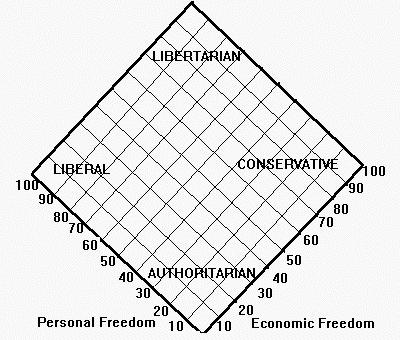
The Nolan Chart is a short political quiz developed by David Nolan, the Libertarian Party founder. The Nolan quiz plots individuals along two axes, asking them their preferences towards issues of personal and economic freedom (both Rick and Warren have blogged about the Nolan Chart here at NOL, too). Libertarians are those individuals who favor both personal and economic freedom.

nolanchart

The benefit of the Nolan Chart is that it moves us away from the left–right spectrum and towards a two-dimensional understanding of politics. The limitation of the Nolan Chart is that it only views politics through these two limitations. The Nolan Chart at best tells us what end policies we favor, but it fails to address how to achieve these goals.

This is problematic, as even political groups that agree on end goals differ substantially on how to best achieve them. Among libertarians, the largest debate is probably between those who believe a minimal state is needed (minarchists), and those who believe no state can be tolerated (market anarchists) to achieve maximum liberty. There is also, to a lesser extent, a debate on the form of government* and foreign policy.

It is possible to be a libertarian and believe that monarchy is superior to republicanism or democracy in upholding the law and maximizing liberty. Likewise, it is possible to be a libertarian and desire an active foreign policy beyond promoting free trade agreements. I know that I stir controversy with my latter comment, but give me a moment to defend it.

The standard libertarian foreign policy is one of non-intervention. It is a policy of wishing to sever military ties with foreign nations and instead promoting free trade with all. It is a policy consistent with the non-aggression principle.

However, this standard policy is not the only policy consistent with libertarianism. It is possible to believe that, although the loss of any human life is horrible and that the state is illegitimate, the best option to minimize human life and protect liberty is to attack, embargo, or annex another state.

I do believe that there are several tests that must be met before one adopts a foreign policy beyond the standard libertarian creed. Specifically:

  1. Loss of human life and liberty must be weighed for both sides.
    1. Discounting should not occur on national basis.
  2. All reasonable peaceful solutions must be acted on beforehand.
  3. The long-term consequences of the action must be considered and weighed for both sides.

Additionally, if actions are taken, then all precautions must be taken to minimize loss of human life and liberty on both sides.

Minarchist libertarians may see the state as a tool to maximize freedom, but I do not believe this grants them the authority to kill others. There may be a scenario where the murder of one man is outweighed by it leading to the protection of ten men, but the one man has still been murdered and his death must be felt as a regrettable action. The value of a man is not dependent on whether he was born in New York City or Tehran. A libertarian cannot be a jingoist.

At no point may a foreign policy action be taken if a reasonable peaceful action is still available. If a man enters your home with a gun and clearly intends to harm you, by all means it is justified to attack him, even if he has not yet shot or aimed at you.

And finally, the long-term consequence of a foreign policy action must be considered. Even if the first two rules are met, if there is not a long-term plan that is likely to succeed, no action should be taken.

For a long time, I wrestled with my stance on the Iraq war. I believed in the past that the first two requirements had been met and that the US invasion of Iraq was justified despite the loss of life and liberty on both sides. The Iraq war did not, however, meet the third hurdle. There was no viable long-term plan, and the latest consequence of this is the rise of ISIS and other militant groups in the MENA region.

Meeting these three conditions is difficult, but possible.

For example, I believe that expanding the US to include South Korea and Japan would be a proactive foreign policy stance consistent with my the rules I outlined above. Such an expansion would harm Okinawan residents, whose land is currently used for US bases. Such an expansion would also lead to retaliation from the PRC and North Korea. It would, however, lead to a net win for liberty. South Koreans and Japanese residents would have a stronger defense against a rising PRC seeking to dominate the region militarily. US residents would benefit from having defense costs, both in monetary and human life terms, more equitably shared. Although I am hopeful the PRC will liberalize in the future, its actions towards Hong Kong makes me doubtful that that will occur in the foreseeable future.

It is possible that I am wrong of course, and that adding South Korea and Japan would lead to a great loss of life and/or liberty. I am still a libertarian, however. I am not discounting the lives or liberty of non-US residents. I am not ignoring another peaceful solution – the current foreign policy scenario in East Asia is not sustainable for much longer, the PRC has clear intent to assert itself in the region, and it’s extremely doubtful that it will liberalize in the foreseeable future. I am considering the future: the PRC and North Korea are sure to retaliate, but I do not see either of them going to war over it. I do see the PRC being more likely to go to war over annexing Taiwan, even if not immediately, or otherwise I would promote Taiwanese annexation as well.

Hopefully I have successfully shown that it is possible to be a libertarian and favor a policy beyond the standard libertarian foreign policy. In which case, there is merit in discussing foreign policy beyond this standard.

There have been proposals to incorporate a foreign policy dimension to the extant Nolan Chart, but these proposals take it for granted that a non-interventionist policy is the only libertarian prescription. Over at FEE, Richard Fulmer proposes the following five questions:

  1. The United States should cease serving as the world’s policeman.
  2. The United States should not engage in nation building.
  3. The United States should not pledge to defend other countries.
  4. The United States should withdraw its troops currently stationed around the world.
  5. U.S. foreign policy should not be tied to that of the United Nations.

Unless one believes only a non-interventionist foreign policy is compatible with libertarianism, it is clear that these questions are insufficient. They also highlight that a NOL foreign policy quiz should seek to complement, but be independent of, the Nolan Chart. Otherwise, any attempt to add a foreign policy dimension will end with in fighting over who is a libertarian and who is a statist.

Again, the standard non-interventionist libertarian foreign policy view is a consistent and legitimate view point. It is however possible to favor foreign policy interventions under certain conditions and still be a consistent libertarian.

In the next post I will be proposing the foundation for a NOL foreign policy quiz.


Foot Notes:

*Even market anarchists who reject the need for a state debate on what type of organizations would exist and how the law would operate. For example, Murray Rothbard’s early vision for market anarchism presumed that a unitary law would exist, and that private defense associations (PDAs) would compete to best to carry out this unitary law. This unitary law would be based on ‘natural law.’ David Friedman’s vision for market anarchism does not presume a unitary law, and instead imagines competition for the law, as opposed to competition for the application of the law itself. My understanding is that there are also Rothbardians who have moved away from PDAs and towards dispute resolution organizations (DROs). It has been quite some time since I actively followed this debate among market anarchists, so I will defer to anyone who has more up-to-date information.

Further Reading:

Ian Bremmer’s American Foreign Policy Quiz [NOL Post] – The post that initiated the idea of a NOL Foreign Policy

A Three Dimensional Nolan Chart Extension Focusing on Form of Government (e.g. Anarchy v. Monarchy)

The Re-Privatization of Security (World Peace edition)

Sean McFate, a political scientist at National Defense University in Washington, DC, has a fascinating article in Aeon about the reemergence of mercenary and quasi-mercenary security firms throughout the world. The whole article is fulfilling throughout, especially if you’re a well-read anarchist or a history buff, but I wanted to highlight this tangent:

With the fall of the South African apartheid regime, unemployed soldiers from special forces units such as the 32nd Battalion and the Koevoet (‘crowbar’ in Afrikaans) special police formed the first modern private military company, appropriately named Executive Outcomes. Unlike WatchGuard, Executive Outcomes was not a military enterpriser but a true mercenary firm, waging war for the highest bidder. It operated in Angola, Mozambique, Uganda and Kenya. It offered to help stop the genocide in Rwanda in 1994, but Kofi Annan – then head of UN peacekeeping – refused, claiming ‘the world may not be ready to privatise peace’. Annan’s was an expensive ideology, given the fact that 800,000 people died. By 1998, the company closed its doors, but the mercenary market for force surged.

Two aspects are important here, one said and one unsaid. First, the unsaid. If this mercenary outfit was “waging war for the highest bidder,” why did it offer to go in to Rwanda to stop the bloodshed? I think scholars assume the worst when it comes to stateless actors and warfare. Why has Anheuser-Busch begun shipping free cans of water into Flint, MI? Why does Wal-Mart donate billions of dollars to charity? When it comes to reputation, costs may sometimes not make sense to outside observers who don’t have a sufficient understanding of benefits. Why on earth would a corporation built solely to wage war for the highest bidder be interested in offering its services to a country that would not be able to afford its services? To ask the question is to answer it, of course, but understanding incentives using a costs-benefits framework requires more effort than you might suspect.

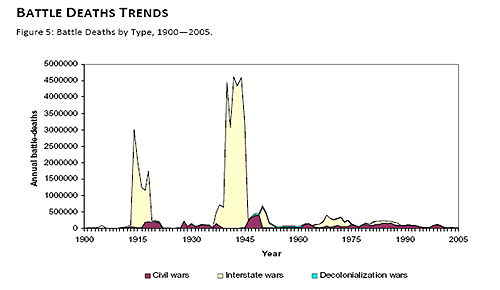
There is simply no logical coherence to the idea that, in a world where stateless mercenary firms are the prominent form of security, violence and lawlessness will reign supreme; nor is there any evidence whatsoever to suggest that “[m]ore mercenaries means more war, as they are incentivised to start and expand wars for profit, and turn to criminality between contracts.” Indeed, as McFate notes in his excellent article, the market for security is already becoming freer and while he ends his piece on a depressing note, lamenting this indisputable fact of the present-day world, I couldn’t help but remember the now-famous graph on battle death trends produced by political scientist Jay Ulfelder (using data from the Uppsala Conflict Data Program [UCDP]), which illustrates nicely the overall decline in deaths due to warfare violence around the world:

blog battle deaths
Notice that the most deadly conflicts are the ones involving states with armies that had been nationalized?

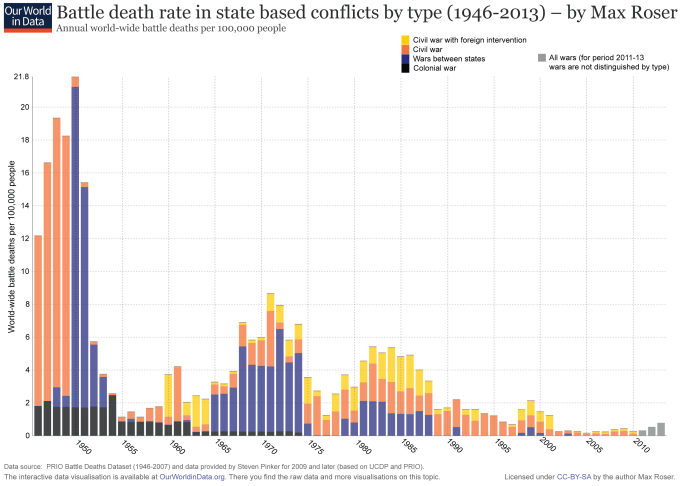
The always excellent Max Roser and his Our World in Data project has another graph worth highlighting, with this one using data from Steven Pinker’s The Better Angels of Our Nature… and the UCDP:

blog battle deaths pinker data

Now, two graphs showing that deaths from warfare have been in decline for half a century does not necessarily mean that a freer market in security services has led directly to this overwhelmingly good news. I am confident in claiming, though, that the freeing up of security services markets, combined with the steady presence of a few, still-powerful nationalized armies has led to a reduction in war-related deaths (and violent conflict in general). Both graphs illustrate well what happens when there are too many nationalized armies vying for power and prestige. (It is worth noting here that the main goal of diplomats and policymakers everywhere, no matter their ideological orientation or citizenship status, is still to avoid another world war.)

Second, the said. Annan’s refusal to decriminalize mercenary activities led directly to the 800,000 Rwandan deaths. How is this moral failing any better than when a mercenary firm breaks its contract and ends up killing a few dozen more people than it was supposed to? Again, the graphs are useful here: When conflict is nationalized, everybody suffers; when it is privatized, atrocities happen but not on the same scale we have seen with nationalized conflicts. It’s not even close. Annan’s short-sightedness reminds me of economist Scott Sumner’s 2012 summary of Hillary Clinton’s view of the War on Drugs:

[…] in response to a final question on drugs (from a Latin American reporter), she said drug legalization would do no good because drug dealers are really bad people, and they would simply do other crimes. No discussion of how America’s murder rate fell in half after alcohol was legalized in 1933.

Like drug use, the privatization of security services causes many people, well-educated or otherwise, to bristle at the notion without quite thinking through its logical implications. While ugly, mercenary firms are far more efficient and effective at quelling “bush wars” than are nationalized armies and, in turn, mercenary outfits are far less capable of sowing the type of destruction that nationalized armies routinely carry out.

I don’t think that a world with a few nationalized armies and an abundance of mercenary firms is necessarily the best option going forward, though. It is, however, a better option than most scholars and analysts give it credit for. In fact, it’s the best option at the moment, and while the status quo may sometimes be ugly, remember the graphs. Privatization of security services has contributed, at least in part, to a more peaceful and less violent world.

In order to move forward from this status quo it is best not lament the way things are going, but to acknowledge that things are the way they are for a reason, and then look for avenues to alter the status quo without falling back on a blanket policy like nationalizing security services again. The horrors of the World Wars should still be fresh in our minds, and the horrors of those wars were enabled and encouraged by nationalized security forces.

The best way to move forward is by looking at where these “bush wars” are taking place and begin thinking about ways to incorporate these regions into the global order (such as it is). This policy represents a departure from traditional post-war thinking about international relations, but it doesn’t make it radical or unfeasible. Indeed, there is a long tradition of republican thinking in Western thought pertaining to international relations. The West needs to start recognizing the legitimacy of secessionist sentiments in the post-colonial world, even if it means friction with Russia and China.

Washington and Brussels will have to endure charges of hypocrisy when it comes to ignoring the lobbying efforts of places like Tibet and Dagestan, but Biafra should have become a member state of the United Nations long ago. Baluchistan should have access independent of Pakistan and Iran to the IMF and World Bank. Two or three soccer teams from the region known as Kurdistan could easily be present in all major FIFA tournaments. Examples abound throughout the world. The West should also be open to recognizing arguments made by Russia and China for the independence of regions. There is no good reason why Western diplomats should ignore Moscow’s recognition of places like South Ossetia and Donetsk; doing so only hardens Russia’s stance on recognizing secession in parts of the world where its influence is limited or non-existent and forces the West into bed with unsavory post-socialist regimes.

The West needs to start being more inclusive when it comes to its own federal and republican institutions, too. Morocco, for example, should have had its 1987 application to join the European Union taken seriously (same goes for Turkey). The US federation needs to be actively courting polities like Puerto Rico, Coahuila, Alberta, and Micronesia to join the union. Both the EU and US are contracts designed to dampen violent conflict by fostering diplomatic, economic, and cultural intercourse between provincial polities. The reasoning behind exclusionary policies simply doesn’t answer why these republican, supranational organizations should not be actively recruiting neighboring or geopolitically useful administrative units into their representative systems.

Without this change in mindset the status quo will continue, which again if we remember the graphs is not all that bad, but something worse may happen: There could be a reversion to the blanket nationalization of security services that we saw during World Wars I and II.

Liberalism and Sovereignty

More than a year ago I promised Jacques a post on sovereignty and while I am not always able to follow up very quickly, I tend to do what I promise. So here it is! Jacques’ main cri de coeur was why (classical) liberals should care about sovereignty at all.

When it comes to the theoretical discussion about sovereignty (the literature is huge), I think there is no better start than the work of international relations theorist Robert Jackson. Or better and broader: any thinking about international relations benefits from this Canadian, former Boston University professor, especially his magnum opus The Global Covenant: Human Conduct in a World of States (Oxford University Press, 2000). But this is a side step.

In his 2008 book Sovereignty: Evolution of an Idea (Polity Press) he argues that:

sovereignty is an idea of authority embodied in those bordered territorial organizations we refer to as states, and is expressed in their various relations and activities, both domestic and foreign. It originates from the controversies and wars, religious and political of sixteenth and seventeenth century Europe. It has become the fundamental idea of authority of the modern era, arguably the most fundamental.

Also in regions where other kinds of arrangements existed before Western imperialism.

It is at the same time both an idea of supreme authority in the state, and an idea of political and legal independence of geographically separate states. Hence, sovereignty is a constitutional idea of the rights and duties of the governments and citizens or subjects of particular states. It is also an international idea of multiple states in relation to each other, each one occupying its own territories and having foreign relations and dealing with others, including peaceful and cooperative relations as well as discordant relations and periodical wars.

Of course a lot of popular and academic discussion follows from this, for example about the particular form of sovereignty (popular, or not), the relation between power and sovereignty, sovereignty and globalization, or if and when sovereignty may be breached to protect others through intervention. Yet here I solely  focus on the relation between sovereignty and liberal political theory.

Concerning the domestic supremacy side of sovereignty a lot has been written by liberals. Most liberals (classical, social, and even libertarian minarchists, such as Ayn Rand or Robert Nozick; see my Degrees of Freedom for the precise definitions) realize some form of state is needed to protect individual rights. A state embodied with sovereignty. At the same time most liberals (social liberals less so, because they favor a relatively large state) recognize the state is also the largest danger to individual freedom. How to balance the two is the perpetual question of liberal political thought, one also without a definitive answer or solution, so far.

Less attention has been given to the international side of sovereignty. There are a number of libertarians, such as the anarcho-capitalist Murray Rothbard, or his intellectual successor Hans-Hermann Hoppe, who think there should not be states, hence no issues of sovereignty exist once their stateless world has materialized (they remain largely silent about how to reach that situation). Yet it seems to me the thinking should not stop there. These same thinkers romanticize the idea of secession, yet seem to overlook that those seceded groups or communities also need to deal with other seceded groups and communities. They are a bit lazy when stating everybody should look after themselves, and only defend themselves in case of attack by others. If everything would be nice and neat among people this might be ok. Yet of course history shows (also in those areas where sovereignty never played a big role before Western imperialism) that people interfere all the time in each others affairs, some rulers may have malign intentions, others belief some parts of the seceded lands belong to their community, let alone issues about religion, et cetera. In short, chances on a peaceful world with the occasional conflict that can be solved by self defense are zero.

Funnily enough, social liberals share the idea of the possibility of a world peace and cosmopolitan harmony. They also favor the abolition of sovereign states, not through secession but through the pooling of sovereignty at the transnational level, with the European Union as an example and a world federation as the ultimate end goal. This seems just as unrealistic, as even the EU is still mainly governed from the member states, as the current refugee crisis and the possible dissolution of the Schengen agreement illustrates. More generally, the pooling of sovereignty proves rather difficult, also in other parts of the world. ASEAN in South East Asia is an example.

More realistic are classical liberals, such as Hume, Smith, and Hayek, who acknowledged an emotional tie between the individual and his country, as well as the constant need to defend individual property rights against invasion by others, through standing armies, diplomacy, some international treaties, the balance of power, et cetera.  Human nature does not allow for starry eyed fantasies about international harmony, let alone international peace. Hence, it is rather normal to care about external sovereignty, as it is foremost a means of protection.  Not the sole means, but an important and fundamental institution of international relations.

From the Comments: Military intervention, democracy, and stability

Longtime reader (and excellent blogger in his own right) Tam has an interesting response to Chhay Lin’s thoughts on the Paris terrorist attacks:

It is an interesting read indeed but there are two or even more sides to every story. What we are also noting is that many of these groups that hate Western interventionist policies also hate their own people for being different in one way or the other. However, I agree that the misplaced perception of democracy as the superior form of governance overlooks the essential internal historical and socio-political factors behind the politics of the different countries that have become victims of Western ‘sanctification’ processes fronted by bombs after daring to opt not to embrace democracy. Libya and Iraq were stable before Western intervention.

Tam’s point strikes at the heart of the difference between military interventionists and non-interventionists, I think. Libya and Iraq were indeed stable, but not everybody was free. In Iraq, Shias, Kurds, liberals, and religious Sunnis were all brutally suppressed, and this oppression stood in stark contrast to the freedoms that secularists, women, union members, some socialists, and the politically apathetic enjoyed. The sociopolitical dynamics in Libya were the same, though with different local actors.

This reality is something that both sides of the interventionist debate recognize, though the interventionist side seems to place much more faith in government when it comes to “doing something.” Jacques and Edwin, for example, have both argued that bombing ambiguous factions in Iraq, Syria, and Libya would contribute to the freedoms of the oppressed factions in those countries. Looking back on the debate makes it clear that they weren’t wrong, but look at what those freedoms have produced. Those freedoms have come at the expense of the freedoms of the factions that the dictators were protecting.

What this situation shows me is that the states of the post-colonial world are unviable. Stability comes at too steep a price (dictatorship), and democracy’s unpredictability only leads to predictably violent results in the post-colonial world.

This impasse, which I cannot be the only one in the world who recognizes, has led me to take a hard glance at two specific peace processes in the Western world: The diplomatic efforts of Europeans after the Napoleonic Wars (“Concert of Europe”) and the founding of the American republic, which is, in my mind, the most successful endeavor in the history of international relations. Neither of these efforts led to the complete abolition of war, but both have helped to maintain a relatively peaceful co-existence between large numbers of factions for long periods of time.

The Concert of Europe bought time for factions in the region to solidify their legitimacy at home, culminating in both the creation of Germany and Italy in the late nineteenth century and the infamous overseas imperial  domains of France, the UK, and the Netherlands (among a few others). While this peace process brought about prosperity for Western Europe, it was not inclusive and it still adhered to the Westphalian notion of state sovereignty. What state sovereignty means is that each state, in the context of international affairs, has a right to do whatever it pleases within the confines of its own borders (such as massacre hundreds of thousands of people in the name of stability). The Concert of Europe was also the precursor to the post-1945 peace process that created the state system that we all live with today, though I would argue that there are some elements that could be republican, such as the IMF and World Bank, provided some changes in mindset.

Aside from the problems produced by the notion of state sovereignty, the states of the post-colonial world today suffer from an issue of legitimacy, both from domestic populations and from foreign ones. Domestically, all of the factions that stability-inducing dictatorships oppress do not buy in to the argument that the states purporting to govern them are legitimate. In foreign affairs, many factions do not believe that these post-colonial states are legitimate either. Hence the calls for bombing campaigns, proxy wars, or outright invasions and occupations of states like Iraq and Libya by states like the US or France (even if these invasions come at the expense of domestic and international rule of law).

This situation, where post-colonial states claim to have sovereignty within an international state system but where domestic and international factions ignore such claims, is where we’re at today. It’s the status quo, and while it worked relatively well in a small part of the world for about hundred years or so, it’s obviously failing today.

Enter the founding of the American republic. Unlike the Concert of Europe, self-determination à la breaking away from the UK was a guiding principle of the federal system, rather than state sovereignty. Like the Concert of Europe, the statesmen who crafted the American republic were concerned about invasion, hegemony, and all of the other bad stuff that happens in the international arena. So they set up an inclusive, republican system of states rather than attempt to balance power off on each other, like they did in Europe. The republican, or federal, system tied each state up into the affairs of the other states, whereas the balance of power system contributed to the formation of rival blocs within the system. This is why Europe switched from trying to maintain yet another balancing act to building an actual confederation (though one that is far too complex than it has to be) after World War II.

From a strictly war and peace view, the republican state system has led to one war so far (dating from 1789). From the end of the Napoleonic Wars, in 1815, to today, the balance of power state system has led to numerous wars.

Now, I know what you’re thinking: Woodrow Wilson’s foreign policy was based on self-determination, and his foreign policy was a disaster. This is true, though I would argue that Wilson was simply confused about what self-determination actually implied. For Wilson, recognizing the self-determination of various groups within empires would lead to state sovereignty for these groups, and that this state sovereignty would then be protected by the institutions trying to maintain a balance of power. Wilson never entertained the notion of republicanism when it came to recognizing the self-determination of peoples living in empires, he simply thought empires were undemocratic. Thus, he was actually a proponent of state sovereignty rather than self-determination.

What I am not arguing for here is a Concert of Europe-type effort for Middle Eastern actors. I think it would be a disaster, largely because regional efforts at peace-building (rather than, say, trade agreements) are useless in today’s globalized world. The Middle East needs the West, and vice-versa. Peace will only be achieved if self-determination is embraced (by not only large swathes of Mideast factions, but Western ones as well) and the new polities can be incorporated into existing republican-esque institutions. This way, more factions have a voice, and bad actors can be more easily isolated. I am not necessarily arguing that the US or EU should welcome burgeoning Mideast states into their federations, but policymakers and statesmen from these countries should at least start thinking about how to encourage and embrace the notion of a Middle East that looks a lot like our own republican world and less like the one we gave them following the destruction of the Ottoman Empire.

Stability is overrated, especially if the notion of creative destruction is taken into account.

South Asia and the Glass Ceiling

That is the broad topic of my latest article (pdf), which was just published by Pakistan Journal of Women’s Studies: Alam-e-Niswan. Here is the abstract:

South Asia is one of the most violent societies in the world, and also the most patriarchal. Both characteristics have led to continuity of violence, in which women are the silent and non-recognised victims. The situation is such despite the fact that women have occupied the highest office in their respective countries. The post-1991 wave of globalisation has led to the emergence of two parallel societies, based on different values, in almost all South Asian countries. In both societies women are being exploited and violence has been unleashed on them. Revolution in information and communication technology has helped in the dissemination of patriarchal values through ‘objectification’ of women in the name of ‘liberation’ from the grip of tradition. These patriarchal trends are clearly reflected in the making of domestic policies as well as formulating foreign policies of South Asian states. In such a situation, an academic argument for feminist foreign policy is relevant, though not encouraged by social actors.

You can also find the article on my ‘About…‘ page here at NOL.

From the Comments: What is a “National Interest”? (Why not federalism?)

Michelangelo writes:

I sympathize with your pro-federation views, but it is admittedly a difficult position to argue from a purist libertarian view. I would support offering statehood to Japan and South Korea, as I mentioned earlier this week.* I would not however offer the same deal to Ukraine or the Baltic states. If pressed why I would be okay with federation with one group of countries but not another is because I consider the Ukraine/Baltic region to have little value to American interests. I can see Japan/South Korea federation helping economic growth and military might to the US and therefore in our interests. Note my use of plural pronouns.

From a purely libertarian basis what regions would you offer federation with? Or, if you’d offer federation to all of them, which regions would you offer federation with first? Taiwan might entertain an offer to join the federation tomorrow, but I suspect the PRC or Russia wouldn’t.

*I imagine they’d join as multiple states in practice. I wouldn’t offer Japan 114 seats in the senate, but I would entertain giving them 10 senators.

Why only ten? Michelangelo’s quibble about the number senators can illustrate why federation is more libertarian than isolationism (I’ll get to his question in just a minute).

The Japanese would never accept any sort of union where they give up some sovereignty for other benefits and only have ten representatives in the senate. That wouldn’t be a bargain for the Japanese; it’d be highway robbery. The key conceptual point to keep in mind in this scenario is that there are two sides bargaining and cooperating with each other in order to arrive at a mutually beneficial deal. Japan and the US cease to exist as sovereign political units but become more secure militarily, economically, and politically through a federation with each other.

Contrast this view with what, say, isolationists such as Doug Bandow or Daniel McAdams argue; they want much less cooperation and, by implication, much less choice. Cooperation would be limited to negotiating trade details, arming factions, and coordinating responses to natural disasters. This is radically different from the status quo, but not in a beneficial way. Think of all the things isolationism and the status quo exclude from their policies. People in Japan and the US are overwhelmingly in favor of a continued US presence in Japan. The reasons for this are clear, but as it stands the Japanese are taking the US for a ride. Isolationist arguments are arguably worse, as they’d remove US troops (angering vast swathes of both societies in the process), which would put Japan in a position to fend for itself. Isolationism is “doing something,” and it’s doing something uncooperative.

I agree wholeheartedly with mainstream libertarians about the unfair nature of the status quo. I just think their proposals are equally unfair (if not worse). A libertarian position should emphasize cooperation, choice, and trade-offs above all else. The current stable of libertarian foreign policy experts don’t do this, despite their pertinent critiques of the status quo.

Now, before I get to Michelangelo’s question of who (I promise it’s coming), I want to spend a little time on his proposal for 10 senators, and tie it into the concept of “national interest,” which is a fuzzy concept and hence popular to wield in public discourse.

What is the national interest (or US interest)?

Think it through and write down your answer on a piece of scratch paper you have lying around.

Go ahead. I’ll wait patiently.

Is your answer really the national interest, though? Why is your definition of the national interest true and Walter Russell Mead’s not? Here is how I defined the concept of a national interest back in 2014:

…the national interest is an excuse [scholars and activists use] for a policy or set of policies that [they believe] should be taken in order to strengthen a state and its citizens (but not necessarily strengthen a state relative to other states…)

Now go back and look at what you wrote down as “the national interest.” Am I right or am I right? There’s no such thing as a national interest. Cooperation, choice, and trade-offs do exist, though, and I think they can walk us through a hypothetical federation between Japan and the US.

Michelangelo rightly decries the fact that Japan, a country with 126 million people in it (California has 40 million) should get 114 senators. Yet 10 senators seems far too few to give up sovereignty for federation. This appears to be a stubborn impasse, right? Wrong! One of the great benefits of cooperation is having to learn new things.

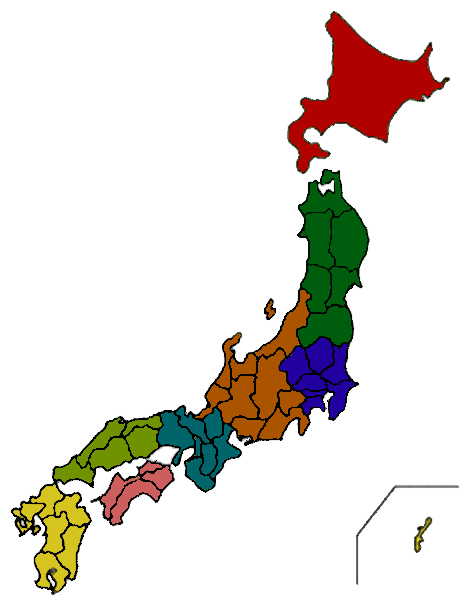
The 47+ prefectures of Japan, for example, have been in use since 1888. The prefectures had steadily been declining in number as the Meiji oligarchy began in earnest to nation-build in what is now Japan. Up until the surrender of Japan to the US, these prefectures were not representative and had little say in how each prefect was to be governed. MacArthur’s constitution gave these 47+ prefectures some autonomy in 1947, but recent attempts at reforming the administrative units of Japan have called for the abolition of these prefectures in favor of fewer administrative units that will also have much more independence from Tokyo. The policymakers who want to take this track are not creating these fewer administrative units out of thin air, either. Rather, reformists are calling for representative units to be based on the unofficial cultural areas of the country that have been around for centuries. Check out the map:

This map shows nine regions, but some people argue that there are actually 13-14 cultural regions within the country (a tough problem to have!). source: wikipedia
This map shows eight cultural areas, but some people argue that there are actually 12-14 cultural regions within the country. source: wikipedia

A cooperative approach to tackling free-riding and imperial expenses would be to reach out to the factions that want fewer administrative states with more autonomy. Adding anywhere from 8 to 14 administrative units into the Madisionian system is much more doable than, say, trying to incorporate 47 administrative units, especially since the latter units have little experience with the autonomous governance that federalism requires of its “states.” At most, there would be 28 additional members of the Senate. The costs associated with free-riding would be gone, and the Japanese people would get the benefits of being a part of the most powerful military the world has ever seen.

Would 28 Senate seats be enough to give up sovereignty? I don’t know, but I do know that the status quo is unsustainable and so, too, are current alternatives.

To finally answer Michelangelo’s question (“From a purely libertarian basis what regions would you offer federation with? Or, if you’d offer federation to all of them, which regions would you offer federation with first?”), I’d start with the Canadian provinces and Mexican states (though I would make it clear that any region is welcome to apply for membership). Then I’d approach the Caribbean islands, the administrative units in Western Europe (including the Baltic states but excluding Ukraine), and the administrative units in Japan and South Korea. Good neighbors and military allies.

My reasoning behind this approach is simply that 1) most of these regions are almost as rich as the United States, 2) they have a good history of actually being representative of their constituents, 3) they have a long history of either interacting with the Madisonian system or acknowledging its tremendous benefits, and 4) they have experience with being somewhat autonomous in a federal system (a federal system that is much less liberal than the one found in the US, but a federal system nonetheless).

Again, I’m not opposed to allowing poor regions to apply and join such a federation, but I think they would be less inclined to do so. Why? Because poorer states are more parochial, more protectionist, and more likely to be uncooperative than rich ones. If regions within these poorer states wanted to apply for membership, we should be open to it, but we’d have to recognize that these poorer regions have a long, hard slog ahead of them. They would, for example, have to market reasons for why they should no longer be a part of a poor state, and they’d have to do it under the harsh watch of the said poor state. Not an easy task, to be sure, but it can be done and the Madisonian federation should be open to the idea of picking apart post-colonial states if it means federating with an oppressed (or poorly governed) region.

Why “post-colonial”? Because of Realpolitik. Entertaining applications from the likes of Tibet or Chechnya is too risky. Entertaining applications from Baluchistan or Biafra? I’d have no problem risking the ire of Pakistan or Nigeria if it meant partnering up with people who want a better life and are willing to cooperate in order to get it.

PS: I think the dialogue in the ‘comments’ thread of this 2014 piece is also worth reading in tandem with my thoughts on Michelangelo’s comment here.

Which countries are of US interest?

I was reading my news stream when I noted a blog post from the Cato Institute discussing the silliness of adding Montenegro to NATO. I don’t disagree per se. I certainly don’t see the value of adding Montenegro to NATO, if the purpose of NATO is to protect the US. Nor do I disagree with the general US-libertarian belief that the US has over extended itself in terms of military alliances.

I do wonder though what countries US-libertarians should desire to maintain a military alliance with. A North American military alliance, ranging from Canada to Panama and including the Caribbean, makes sense to me. The Atlantic and Pacific Oceans are our greatest defenses, but I welcome military cooperation from our geographical neighbors.

Beyond there though it gets tricky. Western Europe is certainly rich enough to protect itself. The main reason I am hesitant to leave NATO altogether is the nuclear question. France and the UK are the only European powers with nuclear weapons, but several others are part of NATO’s nuclear sharing program. Should the US leave NATO would these countries seek nuclear weapons for themselves? Would the UK/France provide substitute weapons? Ending military ties with Europe would likely be the easiest option in terms of cutting down on allies.

Japan and South Korea are likewise rich countries, but here too the nuclear question arises. Japan has a cultural aversion to nuclear weapons that I do not see it overcoming in the foreseeable future. South Korea may be willing to use nuclear weapons, but its strained historical relationship with Japan leaves me concerned about the future possibility of a Korean-Japanese alliance to counterweight China PRC. I believe that Japan should be encouraged to modify its constitution to allow its military greater freedom in action and to consider acquiring nuclear weapons of its own. Other nations in the region, such as the Philippines, are outmatched in conventional weaponry or, in the case of Australia, too far away geographically to be of much use in restraining China PRC’s influence in east Asia.

I am hopeful that within my lifetime China PRC will transition to a liberal democracy, but till then I am skeptical about allowing it free reign in east Asia. For the foreseeable future it is hard for me to consider an east Asia without a significant role for the US. Nor would I be particularly against offering South Korea and/or Japan statehood in a United States of the Pacific.

Thoughts? I admit that international politics is not my area of expertise and I more than welcome other’s thoughts on the matter. I also admit that I am not viewing these issues from a pure libertarian perspective but with a splash of nationalism.

As readers may know our own Brandon is playing around with creating a NOL foreign policy quiz similar to the Nolan libertarian quiz.

Small Thought On The Terrorist Attack in Paris, France

What the attack in Paris has made clear to me is that there is a deep hatred amongst people against the west. I believe that much of this hatred stems from the same roots from which my discontents with the west had also grown – western interventionist policies with foreign nations. I also sense such discontents among the few people that I know from Pakistan, Nigeria, Afghanistan, Iraq, Morocco, and Serbia.

My displeasures with the west originate from the personal stories of my parents who, before they became victims of the Khmer Rouge, were also victims of American bombings of Cambodia – a fact that is not widely known. The bombardments that started in 1965 ended in 1973, and had killed hundreds of thousands of Cambodians. Indeed, before the Khmer Rouge took power over Cambodia in 1975 and before they sent all people to the rural areas to grow foodstuffs for ‘Angkar’ (the Organization/the State), there were already widespread famines and scores of displaced people due to the bombings. It had created a chaotic climate in which the anti-western, anti-capitalist, and anti-imperialist propaganda of the Khmer Rouge found their way into people’s minds – mostly into the minds of those poor rural Cambodian people that were suffering most from the secret bombings. Ben Kiernan writes in ‘Bombs over Cambodia’ (2004):

Years after the war ended, journalist Bruce Palling asked Chhit Do, a former Khmer Rouge officer, if his forces had used the bombing as antiAmerican propaganda. Chhit Do replied:

“Every time after there had been bombing, they would take the people to see the craters, to see how big and deep the craters were, to see how the earth had been gouged out and scorched . . . . The ordinary people sometimes literally shit in their pants when the big bombs and shells came. Their minds just froze up and they would wander around mute for three or four days. Terrified and half crazy, the people were ready to believe what they were told. It was because of their dissatisfaction with the bombing that they kept on co-operating with the Khmer Rouge, joining up with the Khmer Rouge, sending their children off to go with them. . . . Sometimes the bombs fell and hit little children, and their fathers would be all for the Khmer Rouge.”

Cambodia, together with Laos, still remains one of the heaviest bombed countries in the history of the world.[1] My parents were just 7-8 years old at the advent of the secret bombings. Imagine that a drone would bomb the school of your child or the hospital in which your loved ones are, would you not feel enraged? Would you not want to take revenge on those that are responsible?

A pre-moral person looks at the consequences of the actions. He sees the attacks, he acknowledges the dead, he becomes emotional and judges firmly. A moral person withholds his judgements and attempts to comprehend the causes of the attackers’ actions. I do not want to justify the killings of the French people, but I would like to emphasize that if we were really to honor the victims, we should reflect on the question why there are people that hate the west so fiercely. Maybe our society itself is part of a larger machine that is the origin of foreign hatred against the west. We must not only realize that religious fundamentalism is a danger to the world, but that there is a more contemptible false idol which is democratic fundamentalism – the uncritical acceptance that democracy is equal to liberty, that it is always superior and that, if necessary, it should be spread with violence.

As long as we, as a society, fail to reflect on ourselves and the political system we participate in, we will never find a fundamentally peaceful solution.

Footnote
[1] See Ben Kiernan’s ‘Bombs Over Cambodia: New Light On US Air War

What About Terrorism?

Thoughts on terrorism from “The Moral Arc: How Science and Reason Lead Humanity toward Truth, Justice, and Freedom” by Michael Shermer (Holt, 2015).

I may be doing more quoting here than is allowed under “fair use” but here goes.  I will paraphrase his seven myths about terrorism.

  1. Terrorists are pure evil. This was what Bush said after 9/11, but studies show they are typically motivated by outrage at U.S. foreign policy.
  2. Terrorists are organized. There is no top-down, central organization directing terrorism.
  3. Terrorists are diabolical geniuses. The shoe bomber and others following 9/11 were incompetent.
  4. Terrorists are poor and uneducated. They are typically higher-income, better-educated individuals.
  5. Terrorism is a deadly problem. Compare 13,700 homicides per year with 3,000 from 9/11 and an average of 70 terrorist deaths per year, or 7.8 per year excluding 9/11.
  6. Terrorists will acquire and use a nuclear weapon or a dirty bomb. A real danger, but nuclear weapons require a lot of scarce material and sophisticated engineering.
  7. Terrorism works. Terrorists usually wait until after their deed is done and then proclaim that whatever outcome happened was in fact their goal.

Please read the book yourself.  The section I have paraphrased (pp. 80-86) is a response to objections to his thesis that the over-arching trend of recent decades is toward a safer, more peaceful world.

I’ll add some thoughts of my own:

  1. Groups based on violence and hatred will eventually self-destruct as they splinter into factions and devour one another.  But “eventually” leaves time for a lot of damage.
  2. This seems like a great opportunity for Western governments to cooperate with Russia and perhaps China because Islamic terrorism is a threat to all those parties.

Leaders of all the Western nations have expressed outrage, as has Putin.  Radio silence thusfar from leaders of Islamic nations which, one presumes, have a lot to gain by distancing themselves from terrorism.

BC’s weekend reads

  1. Worldwide weeds
  2. The Mushroom That Explains the World
  3. …True Tales of Dharma, Demons, and Darwin
  4. From Spain to the New World via Florence and Vermont (be sure to scroll through the ‘comments’ thread)
  5. Time for Bolivians to Forget about the Sea (weak, but a good starting point for a discussion)
  6. Dissolution of the Templars