Quad: The way ahead and the key challenges

The Quadrilateral Security Dialogue (QSD) consisting of India, Australia, Japan, and the US has been pitching in favor of a ‘Free and Fair Indo-Pacific’ ever since the first meeting between representatives of member states in November 2017.

Shinzo Abe, the current Prime Minister of Japan, actually proposed this arrangement about a decade ago. Diplomatic engagement began, and joint military exercises were even held, but a change in guard in Australia, as well as Chinese complaints to member states, resulted in the end of the arrangement. Given the increasing focus on the ‘Indo-Pacific’ region and the strengthening of strategic ties between all four countries, reticence was finally shed and representatives of the four countries met in November 2017, on the eve of the East Asia Summit in Manila. The main aim of the alliance, thus in other ways, has been to check China’s assertiveness, especially in the South China Sea, and democracy has been one of the key binding factors between the Quad. The U.S. State Department, after the meeting in November 2017, issued a statement that the United States is “committed to deepening cooperation, which rests on a foundation of shared democratic values and principles.”

More recently, the joint statement issued after the meeting between Trump and Australian Prime Minister Malcolm Turnbull in February 2018, reiterated the point about a Free and Open Indo-Pacific. Said the joint statement between both countries: Continue reading

Nightcap

  1. Xi Jinping Looking More and More Like Mao Doug Bandow, National Interest
  2. Fear, Loathing, and Zulm in Iran Mehrad Vaezinejad, History Today
  3. India, Pakistan, and Balochistan: A History of Trouble Ahsan Butt, the Diplomat
  4. A History of Craft Beer in America Derek Thompson, the Atlantic

In foreign affairs, don’t ignore “soft power”

Israeli Prime Minister Benjamin Netanyahu, during his 6 day visit to India (January 14-19, 2018), made some interesting points. While arguing in favor of the advantages of hard power over soft power, Netanyahu stated:

I like soft power, but hard power is usually better. You need F-35s (fighter jets), cyber, a lot of intelligence… Where does the power for hard power come from? It comes from economic power.

Interestingly, India in recent years, under current Prime Minister Narendra Modi, has been focusing on promoting its Soft Power through a number of ways such as popularizing Yoga (The United Nations declared June 21st as International Yoga Day), Ayurveda, reaching out to its Diaspora, and rekindling Buddhist linkages with neighbours in South Asia as well as South East Asian and East Asian countries including China.

Modi has reiterated the relevance of “soft power” on more than one occasion. Even in the context of India-Israel relations, soft power has played a key role. There have been efforts toward renovating historical sites of Jews in India, and there has been an outreach towards Jews of Indian origin now settled in Israel. There have been efforts to strengthen educational linkages between both countries. During the visit of Israeli President Reuven Rivlin in November 2016, MOU’s were signed between the Hafia University of Israel and the Welingkar Institute of Management (WeSchool), and IDC Herzliya, Israel with the SP Jain School of High Technology. The joint statement issued during Netanyahu’s visit to India also made references to the importance of people-to-people linkages, the opening of an Indian cultural centre in Israel in 2018, and an MOU in film co-production.

The point made by Netanyahu has been made by a number of realists. Joseph Nye, who first put forward the concept of “soft power” as being the ability to influence outcomes without the use of force, later on argued in favour of the right blend of “hard power” and “soft power,” dubbing it as “smart power”. Along with Richard Armitage, Nye even set up a Commission on Smart Power. The concept was of course popularized by Former Secretary of State Hillary Clinton, who at the confirmation hearing before the Senate Foreign Relations Committee in 2009, stated:

We must use what has been called smart power, the full range of tools at our disposal—diplomatic, economic, military, political, legal, and cultural—picking the right tool, or combination of tools, for each situation. With smart power, diplomacy will be the vanguard of our foreign policy.

While there is absolutely no doubt that economic and hard power does give an impetus to soft power, it is also a bit of a stretch to totally dismiss “soft power.” Many would argue for instance that apart from geopolitical factors, soft power did give an edge to the US over the USSR, and later on over China, for a very long time. In recent years, China has been trying to focus on “soft power,” so much so that in the past decade, a large number of Confucius Institutes have come up in different parts of the world (over 500 in around 140 countries) including roughly 100 in the US. Apart from this, China has been trying to attract foreign students, and also tourists from across the world. Even its ambitious connectivity project, One Belt One Road, which has clear economic motives, is being packaged as part of its “soft power.”

In conclusion, “soft power” cannot be a determining factor, but it does play a significant role in strengthening bilateral relations, as well as building a positive image for countries. While we live in an age where being transactional is confused with being a pragmatist/realist. US President Trump too has been dismissive of “soft power,” and by his insular approach towards immigration, and indifference towards democratic values he has given up on two of the essential components of American Soft Power. Dismissing “soft power” because it does not help in achieving any tangible outcomes is one of the shortcomings of such transactionalism, and is an excessively simplistic view of a very complex debate.

Pakistan’s long struggle for democracy could get a boost from Trump, Rand Paul, and …the Saudis

In recent days, all eyes have been on President Trump’s January 1 tweet, which sent out an unequivocal message that it cannot be business as usual with Pakistan unless the latter takes concrete action against terror groups like the Haqqani Network.  Said Trump in his tweet:

The United States has foolishly given Pakistan more than 33 billion dollars in aid over the last 15 years, and they have given us nothing but lies & deceit, thinking of our leaders as fools. They give safe haven to the terrorists we hunt in Afghanistan, with little help. No more!

Trump’s tweet was followed by the US decision to withhold Foreign Military Fund (FMF) aid (worth 255 million USD) due to Pakistan’s inaction against terror groups. The Department of Defense has also suspended Coalition Support Fund (CSF) money to Pakistan (worth 900 million USD). In all, over 1.1 Billion USD has been suspended. Kentucky Republican Senator Rand Paul will be introducing a bill for ending all US aid to Pakistan. Said Paul:

I’ve been fighting to end Pakistani aid for years. But now we have a breakthrough. President Trump has publicly called to end their aid, and is currently holding up over $200 million of it. I want to end all of it.

The Kentucky senator has argued that the money provided to Pakistan can be used for building infrastructure in the US.

Reactions in Pakistan to Trump’s tweets were predictable. While some opposition parties said that US President’s assertive attitude vis-à-vis Pakistan is a failure of the present Pakistan Muslim League (PML-N)-led government to put forward Pakistan’s view point effectively, the PML-N government criticized the US President’s remarks and said that it was ready to provide audits, and that it has been on the front line in the war against terror. Pakistan Foreign Minister, Khawaja Asif, in response to Trump’s tweets stated:

Pakistan is ready to publicly provide every detail of the US aid that it has received over the last 15 years.

In the midst of all this, a number of noteworthy developments have taken place.

First, both Nawaz Sharif, President of Pakistan Muslim League and former PM, and Shahbaz Sharif, Chief Minister of Punjab province and PML-N’s PM candidate, met with the Saudi Crown Prince Mohammad Bin Salman on the night of January 1, 2018. There were speculations of various kinds with regard to the meeting. The first was that an agreement was being worked out where Nawaz Sharif would be exiled to Saudi Arabia in order to avoid the corruption cases filed against him in Pakistan. This, however, was flatly denied by his daughter Maryam Nawaz Sharif. A spokesman for the former PM also issued a strong denial in a press release. Said the spokesman:

He has always utilised these relations for national interest and never for his personal benefits.

The other major speculation was that the Sharifs met with the Saudi Crown Prince in light of the recent statements made by President Donald Trump, and had gone as a result of an understanding with the Pakistan army. Irrespective of whatever the reality was, it clearly shows that the Sharifs are still extremely relevant, not just because of their political influence in the province of Punjab, but also their strong networks in Saudi Arabia.

Second, Nawaz Sharif, who has – in spite of considerable domestic constraints – made concerted efforts at improving ties with India, had according to some news stories met with Pakistan National Security Advisor (NSA) Lt Gen Nasser Khan Janjua on December 28th, at the former’s Raiwind residence in Lahore. During this meeting, Sharif spoke about the need for mending fences with neighboring countries. The meeting was however dismissed as a false report.

Third, most interestingly the former PM, while reacting to Donald Trump’s attack on Pakistan as regrettable, launched an all out attack on the army and dictatorships in a speech on January 3, 2018. While he blamed Pervez Musharraf for capitulating to the US in 2002, the former PM also accused the army of propping up leaders through secret deals. He was alluding to the leader of the Pakistan Tehreek-E-insaaf (PTI) Imran Khan. Sharif also called for self introspection, and that it was time for Pakistanis to “ask ourselves why the world does not take us seriously.”

A few points need to be kept in mind:

First, Nawaz Sharif – who has been written off – remains the tallest and most mature political leader who realises the importance of strong ties with neighbors, and realizes the pitfalls of excessive dependence upon one country. During his speech on January 3, 2018 he categorically stated:

I would like to advise Prime Minister Abbasi to develop a policy that ensures we don’t need US aid so that our image is not attacked in this manner.

Second, Sharif’s aggressive approach towards the army may not be appreciated by many in, or outside of, Pakistan. The Saudi Prince is supposed to have put forward his discomfort with Nawaz’s approach towards the army, saying it will destabilise Pakistan. Nawaz is not likely to cave in easily, and is likely to use every opportunity to attack the army, and will make attempts to restore civilian supremacy. This is clearly evident from his speech on January 3, 2018.

Third, post the 2018 Parliamentary elections which PML-N is likely to win, efforts will be made to reach out to India, since a better economic relationship with India will fit in with the overall goal of Pakistan becoming more self-reliant. PML-N would also like to send a clear message to Pakistan’s army about who the real boss is. The Pakistani army will off course continue to sabotage such efforts, but Nawaz Sharif seems determined to make one last ditch effort. This will off course require PML-N to take decisive action against terror groups targeting India.

External forces should stop treating the Pakistani army with kid gloves. While the US has taken the lead in taking a strong stand against the Pakistani army, China too needs to do a rethink of its short term goal of using Pakistan to contain India. Terrorism and instability will have an impact on China in the near run as well as long run. The outside world, while being firm with the Pakistani army, should continue to make efforts aimed at strengthening democratic forces within Pakistan.

India needs to work harder, both in its own backyard and in its near-abroad

While there is absolutely no doubt that Donald Trump has on more than one occasion sent harsh warnings to Islamabad – calling upon Pakistan to give up its support for terrorist groups or face the consequences – Trump’s predecessors had begun to reduce aid to Pakistan. During the Obama years, for example, American aid to Pakistan dropped from over 2 Billion USD in 2014, to a little over 1.1 Billion USD in 2016.

In his latest tweet, Trump minced no words, saying that Pakistan had fooled the US all these years, and that US will not take this lying down:

The United States has foolishly given Pakistan more than 33 billion dollars in aid over the last 15 years, and they have given us nothing but lies & deceit, thinking of our leaders as fools. They give safe haven to the terrorists we hunt in Afghanistan, with little help. No more!

Trump tweeted early morning on New Year’s Day.

Earlier in the year, during his August speech pertaining to Afghanistan, Trump had categorically stated that it no longer could be business as usual, and that Pakistan needed to stop extending support to the Haqqani network and other groups. Said the US President:

We have been paying Pakistan billions and billions of dollars, at the same time they are housing the same terrorists that we are fighting. But that will have to change. And that will change immediately.

A number of senior officials in the Trump Administration, such as the Secretary of State Rex Tillerson, Defence Secretary Mattis, and Vice President Mike Pence have hinted that harsh steps for Islamabad are a real possibility, some of which include not just withdrawal of aid to Pakistan, but also the removal of Pakistan’s non-NATO ally status.

During his recent visit to Afghanistan, Pence stated that President had put Pakistan on notice. Said Pence: “President Trump has put Pakistan on notice. As the President said, so I say now: Pakistan has much to gain from partnering with the United States, and Pakistan has much to lose by continuing to harbor criminals and terrorists.”

In an oped written for the New York TimesTillerson stated:

Pakistan must contribute by combating terrorist groups on its own soil. We are prepared to partner with Pakistan to defeat terror organisations seeking safe havens, but Pakistan must demonstrate its desire to partner with us.

China – which has strategic and economic interests in Pakistan, with the primary one being the China-Pakistan Economic Corridor (CPEC) – has stood by Pakistan. While reacting to Trump’s August 2017 address, State Councillor Yang Jiechi said:

“We should attach importance to Pakistan’s important role in Afghanistan and respect Pakistan’s sovereignty and legitimate security concerns.”

India’s reactions

New Delhi has understandably been closely observing these events. Trump’s warnings to Pakistan are viewed as positive news for India, and the Trump Administration has also pleased New Delhi by speaking against violent groups that are targeting India. The US, for example, has lent support to India’s demand for declaring Jaish-E-Muhammed (JEM) Chief, Masood Azhar, a designated terrorist by the UN (this move has of course been stalled by China).

Realists in New Delhi will however be keeping an eye on the following issues.

First, sections of the political class in Pakistan, as well as old hands in the American administration will not allow things between Islamabad and Washington to go downhill. A number of Pakistani politicians, such as Sherry Rehman, have already stated that while Pakistan should have its own independent policy, and it should not be submissive, it need not be excessively aggressive. While such politicians may not publicly say so, the fact is that there is a large swath of the Pakistani population which may not be very comfortable with the US, but is even more uncomfortable with the increasing Chinese presence in Pakistan as a consequence of CPEC.

In the US too, there are sections in the State Department which follow the approach of engaging with moderate forces in Pakistan given the country’s strategic importance. There is a section of the US establishment which does not want Pakistan to totally drift away from Washington’s orbit, mostly because China is beginning to take a larger role in the whole of South Asia, including Afghanistan. One of the declarations of the first Foreign Minister-level trilateral dialogue between China, Pakistan, and Afghanistan was the extension of (CPEC) into Afghanistan.

Said the Chinese Foreign Minister:

So China and Pakistan are willing to look at with Afghanistan, on the basis of win-win, mutually beneficial principles, using an appropriate means to extend CPEC to Afghanistan.

Both New Delhi and Washington will closely watch this development.

Apart from Beijing, Pakistan will rely on Saudi Arabia to soften Washington’s approach vis-à-vis Pakistan. The Sharif brothers, both Nawaz and Shahbaz, have strong connections in Saudi Arabia and while there were speculations that the Saudis were trying to broker a deal between the Pakistani military and the Sharifs, there is also a view that there’s an understanding between the Pakistani army and the Sharifs, and that the latter would use their links in the Saudi establishment to soften the Trump Administration, which has strong ties with Riyadh.

In conclusion, there is an increasing awareness with regard to the nexus between the Pakistani army and terror groups targeting India. Yet New Delhi should be more realistic in its calculations, and it needs to not just bank on Washington. Instead, India should also leverage its economic ties with Riyadh and Beijing to put more pressure on Pakistan. While there is no doubt that strategic convergence with Washington has increased phenomenally, Trump’s harsh words against Pakistan are not just driven by any conviction, but also by simple transactionalism. This very transactionalism has also created space for China to become more pro-active in South East Asia and South Asia. New Delhi thus needs to be pragmatic, deft, and leverage its economic rise more effectively.

India-US relations and engaging with Trump

Ivanka Trump jointly inaugurated the GES Summit in Hyderabad (November 28-29) along with Prime Minister Narendra Modi, and she lauded the latter for his phenomenal rise. Modi had invited Ivanka during his US visit in June 2017. The US President’s daughter and Adviser was quick to accept the invite, and tweeted:

Thank you, Prime Minister Modi, for inviting me to lead the U.S. delegation to the Global Entrepreneurship Summit in India this fall.

During her address, Ivanka also highlighted India’s economic achievements in recent years, while also praising the country’s democratic credentials.

Said Trump:

‘You are celebrating it as the world’s largest democracy, and one of the fastest growing economies on earth…Through your own enterprise, entrepreneurship, and hard work, the people of India have lifted more than 130 million citizens out of poverty – a remarkable improvement, and one I know will continue to grow under the leadership of Prime Minister Modi.’

Why India reached out to Ivanka

By reaching out to Ivanka Trump, India has done the right thing, given the fact that all countries – including China, Saudi Arabia, Japan, and South Korea – have realized the importance of business interests, as well as personalized diplomacy with Trump.

Every country has to recognize its own interests, and the Trump Administration has been quite vocal on a number of issues including its tough stance on terrorism emanating from Pakistan, as well as a larger role for India in the Indo-Pacific. The US President, during his recent visit to Asia used the expression Indo-Pacific on more than one occasion (as opposed to the earlier expression Asia Pacific), while US Secretary of State Rex Tillerson has also spoken for a greater role for India in Asia Pacific. China took strong exception to the usage of ‘Indo-Pacific’ as opposed to Asia Pacific.

It is important however to bear a few points

First of all, while those who support Trump praise him for being a realist, at times what is dubbed as his transactionalism is a bit too simplistic. The US President is also not just unpredictable, but fickle. While some unpredictability is good, there are limits to this. Trump’s approach towards China, as well as other serious issues is a strong reiteration of his fickleness. While during his election campaign he used harsh language for Beijing, said Trump during an election rally in 2016:

‘We can’t continue to allow China to rape our country, and that’s what we’re doing.’

The warm reception he received in China was enough for Trump, to not only praise the Chinese, but even criticize previous US governments. While he lambasted Pakistan in a speech in August, a few weeks later he was all praise for the Pakistan army, after it helped in rescuing an American-Canadian couple who had been kidnapped by the Haqqani terrorist network. While rigidity is not good in diplomacy, and election campaigns do not translate into policy actions, it is important to understand the broad thrust of the US foreign policy.

It is not just policy issues, but even his relations with key members of his cabinet which are important to watch. The latest instance being of Rex Tillerson, the aforementioned Secretary of State who has tried to adopt a more realistic stance on issues like Iran. If Tillerson is changed as is being speculated, other countries who have built a strong rapport with him and sought to understand his orientation will need to now start from scratch.

Second, Trump is more inward looking than earlier Presidents, and that is advantageous for China in the strategic sphere, especially in the context of Asia.

While the Chinese will humor him through sweeteners such as FDI commitment, and this will help in influencing not just Trump, but even some of his key advisers like Jared Kushner, ultimately Beijing will have the last laugh in the strategic sphere, especially in the Indo-Pacific region. A number of countries in ASEAN have already subtly expressed their reservations with regard to Trump’s isolationist approach towards not only Asia but the rest of the world.

Third, unlike his predecessors, including Obama, Trump has no strong convictions with regard to democracy. While it is true that every country should see its own interests, a lot of countries have been more comfortable with the US because of the emphasis it places on democracy and civil liberties. During his recent visit to Myanmar for instance, Tillerson did refer to the Rohingya Issue, and the need for the NLD government to ensure the well being of the Rohingya committee.

Democracy and plural values drive the bilateral relationship between many countries , and in the context of India and the US, these should not be kept out. If Trump is totally indifferent to the nature of regimes, there is not much to distinguish the US from China, and American indifference towards issues such as democracy and civil liberties will only reduce an important component of its Soft Power.

What India needs to do

It is thus important for India to use innovative ways for reaching out to Trump, but also have a clear stand on key foreign policy issues. The Quad alliance (US, Japan, Australia and India), for instance, is important with Japan and Australia taking a clear stance against Chinese expansionist tendencies. While the US is part of this alliance, it is tough to predict whether the Trump Administration will really play a pro-active role, especially if Beijing objects to the alliance.

Similarly, India is doing the correct thing by maintaining an independent stance on Iran given its own strategic and economic interests. The Chabahar Port Project, which India is funding, is India’s gateway to Central Asia and Afghanistan, and by going ahead with the project even with the souring of ties between Washington and Tehran it has sent a clear message that it will not blindly tow Washington’s line.

In conclusion, while New Delhi has to see to its own interests, and explore synergies with the Trump Administration, there are likely to be some significant challenges given Trump’s simplistic approach towards complex issues, and the lack of any sort of consistency.

Lunchtime Links

  1. Interview with a secessionist
  2. Ducking questions about capitalism
  3. The perverse seductiveness of Fernando Pessoa
  4. Yet in this simple task, a doffer in the USA doffed 6 times as much per hour as an adult Indian doffer.”
  5. Conflicted thoughts on women in medicine
  6. The Devil You Know vs The Market For Lemons (car problems)

Emerging Political Realities in India

Whether one swallow it or not, Mahant Yogi Adityanath (Ajay Singh Bisht) -Chief Minister of Uttar Pradesh (UP)- is a new democratic reality of India, at least for present. He is well known for his questionable politics and political hold in and around Gorakhpur district in the eastern UP. Hindu Yuva Vahini (Hindu Youth Group) acts as his private brigade and has, allegedly, fomented and participated in communal activities. Even Yogi’s anti-minority diatribe during public meetings are well known. He is facing charges for rioting, related to intentional insult with intent to provoke breach of the peace, charges related to injuring or defiling place of worship with intent to insult the religion of any class, charges related to promoting enmity between different groups on grounds of religion, race, place of birth, residence, language, etc., and doing acts prejudicial to maintenance of harmony etc. All these were piled up during the non-Bhartiya Janta Party (BJP) governments at the Union and state levels. Instead of taking action against Yogi, his politics had been carefully nurtured during the rule of those governments. It is also alleged that they did so to keep the minorities with them. In past, this politics of fear has mechanically worked to serve the respective political interests of various political stakeholders.

With Yogi, as CM and the massive mandate BJP has got (won 312 seats out of 384 it contested), a question arises: is he a future or a temporary present? He may not be the future of India, but his politics is. He has an ability to divide the people in the name of religion, and at the same time can unite different castes of the Hindu community by arousing religious feelings. One of the reasons why most of the psephologists went wrong in their pre-poll analyses that they gave little attention to this uniting effect of the divisive politics. This pattern has taken years to develop. Analysts kept on writing and engage themselves into brain storming sessions on Mandal versus Kamandal while, on the ground, the two entered into a ‘comfortable’ symbiosis by making certain power related adjustments. In that adjustment, Kamandal has given political leadership to OBC, Dalits, and Schedule Tribes, and in return these leaders help in spread of Hindutva in their area and among their influence groups.

In contemporary India, one may analyse in a different way, but a larger reality is that the members, many of them, of the dominant Other Backward Castes or Dalits identify themselves as a Hindu first then a member of a non-upper caste group. They too believe that they are ‘different’ from the members of minority groups and, like majority members of the so called upper caste, many of them still practice social discriminations against the Muslims. This is evident during communal riots. This is essentially a result of Brahminization of a large section of OBCs, Dalits, and tribal groups carried out by the Hindu revivalist groups since the colonial era. This Brahminization dictates the cultural traits, behavioural pattern, and also dietary habits. Therefore, moral policing and forceful closure of chicken and mutton shops in UP find support from a substantive number of people. Moral policing is mean to regulate women’s sexuality and movement, and an attempt to check inter-caste mix up. Ad  banning of sale of meat is a form of  economic  attack  on  profession , largely, related with the members of  minority religious group and to those who do not adhere to Brahminical values.

As individuals wear multiple identities, they keep on changing them according to time and space. In the UP elections of 2017 majority of Hindu voters gave preference to their religious identity over the other identities. Almost all political parties are aware about this tenuous relationship between caste and religion, therefore no one shows enthusiasm or vocal about implementation of the recommendations of the Sachar Committee report to improve status of a large number of Indian Muslims.

One may ask that if this is the situation then why it did not work in Bihar in 2016. Well, in case of Bihar, BJP lost the election which was almost in its plate. Second, Nitish Kumar as a Chief Minister has always been considered to be a safety valve through whom others can ire their vent out while the upper castes can safeguard their political interests. In late 1990s he was a part of BJP’s such experiment in Bihar. In past he led coalition governments with BJP as an ally. Many such factors joined together to help him to develop similar political equation with the voters.

The results of a series of elections since 2014 general elections, with a few exceptions, prove that the BJP through its sister organizations has successfully captured the available political space in India, and is a dominant force with little or almost no opposition in coming years. Any challenge to its present position is possible only through a rise of an alternative politics from the below.

BC’s weekend reads

  1. From a nation of romantic philosophers, Russia is today a bastion of rationalism and pragmatism
  2. India’s merchant class aided the British instead of the Indian elite
  3. Why is Ethiopia building a space program?
  4. When Charlie Chaplin met Pablo Picasso

Immigration and Jobs

A couple of thoughts about immigration. It seems that there is a widespread belief in the US that immigrants take jobs from Americans. It makes superficial sense if you also assume that the number of jobs to be filled is fixed and that just about anyone can do any kind of work.

Both assumptions are mostly false. Here is an example that illustrates why.

I keep hearing native-born Americans trained in various high-tech fields who claim that they are unemployed because of competition from low-cost H1B visa holders. H1B visas go to foreigners with skills deemed to be needed by the American economy. A large number of H1B visa holders are from India and many are from China; they also come from a wide variety of other countries, including Russia, France, Bulgaria, etc. The implicit affirmation is that were such visas stopped completely, those who complain would step right into the vacant jobs.

Two things. First the claim that foreign H1B visa holders work for less is largely unsubstantiated although it should be easy to investigate such abuse. Second, I think it’s illegal to pay H1B holders less than Americans. Why would many employers risk a distracting lawsuit? Of course, a few might because there are irrational people everywhere.

Next and last: Hundreds of thousands of high-tech jobs are going begging as I write. Are employers so vicious that they would rather have the work not done at all than to give it to a credentialed American? Or is it more likely that the unemployed native-born high-tech workers have skills that do not match demand? If the second supposition is correct, ending the H1B visa program would cause even more high-tech positions to remain empty. Of course, this would have a negative effect on everyone, on every American’s prosperity.

Missing from this narrative: the possibility that high power, accelerated re-training programs would bring unemployed Americans the skills the high-tech sector requires.

I have to begin a confession that’s going to make me even more unpopular locally than I already am. I mean unpopular among my conservative friends. I taught in an MBA program in the middle of Silicon Valley for 24 years, two quarters each year. It was an evening program squarely directed at the ambitious hard-working. During that span of time, I must have had 150 students from India. I remember only one who was a bad student. I was intrigued, so I made inquiries. Sure enough, he had an Indian first name and last name, and the corresponding appearance but he was born in the US.* I cannot report so glowingly about other, non-Indian students that sat in my classroom through the years.

This little narrative proves nothing, of course. Consider it food for thought. Do it especially if you voted for Pres. Trump – as I did.

Reminder: H1B visas are awarded to individuals with an occupational qualification deemed to be in short supply in the US. Right now, it’s likely that most of those who get an H1B are trained in some IT area but that’s not all. For a long time, farriers from everywhere could easily get one. (If you don’t know what a farrier is, shame on you and look it up.)

There are other – presumably non-specialized – categories of immigrants who are widely suspected of taking jobs from Americans. The truth is not always easy to discern, not even conceptually. Five or six miles from where I live in Santa Cruz, there are growers who are tearing off their hair. Their problem is that they can’t figure out who is going to pick the crops they are now putting into the ground. As I have said repeatedly, the Mexicans they counted on in years past have largely stopped coming.

A quarter of a mile from where I live, and in the same direction, there are dozens of perfectly healthy US-born Americans who are working as “sales associates.” The apparent conceptual issue is this: sales associates earn $10/hr while a moderately experienced crop picker earns $15. The question arises of why we don’t see a full exodus from the sales positions to jobs that pay 50% more?

I think it’s lazy to call the US-born sales associates “lazy.” The reality is that the Mexicans who came, and are still coming, to pick vegetables and fruits in California overwhelmingly came from a rural population. They were reared under conditions where almost everyone around them labored in the fields. When they arrive in the US – legally through family reunion – or illegally, they are ready to take picking jobs. They then just do here more or less the same work they would do at home but for five times the pay or more.

In American society that kind of population disappeared several generations ago through mechanization and, of course, through the importation of foreign labor, precisely. Native-born Americans won’t do the work because it’s alien to their background. I think US-born people of Mexican ascendancy whose parents labored in the field won’t do the work either. Their parents do what they can to make their own work experience alien to their children. I am not surprised, that’s another expression of the American dream. It’s  what many would do back in Mexico but then, why emigrate?

I am pretty sure that any immigration reform should include a temporary agricultural program, a sort of H1A ( “A” for “Agriculture”) visa. It would allow foreigners to come to the US legally, just to work in the fields and for a set period only. It would not lead to permanent residency, nor, of course, to citizenship. Such a program existed between the forties and the early sixties, if memory serves. It was called the “Bracero program.” I don’t know why it was terminated. (Perhaps a reader can tell us.)

Mexicans would be the first to take advantage of such a program. As Mexico’s economy develops, they may be replaced by Central Americans and, eventually, by Africans. Such a program would sidestep the kind of assimilation problem France, for example, is facing right now with its North African population.

PS Personally, I think Mexicans make good immigrants to the US. I would bet than in ten years we will be begging them to come.


* Disclosure: I am married to an Indian woman. She is not in high-tech unfortunately.

Regional jealousies and transboundary rivers in South Asia

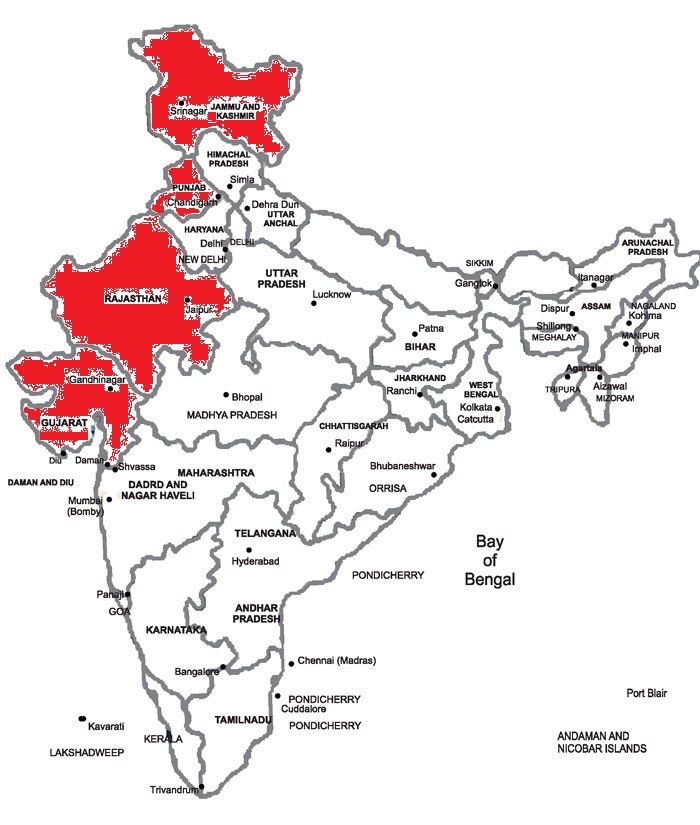
In the final reckoning, Pakistan got about 80 per cent of the Indus and India 20 per cent. India has limited rights on the western rivers and cannot undertake projects on those rivers without providing all the details to Pakistan and dealing with Pakistan’s objections. Why did India put itself in that position? The answer is that if Pakistan got the near-exclusive allocation of the three western rivers, India for its part got the eastern rivers. This was important from the point of view of the Indian negotiators because the water needs of Punjab and Rajasthan weighed heavily with them in seeking an adequate allocation of Indus water for India. Yet, Punjab had a serious grievance over the signing of the IWT [Indus Waters Treaty] by the union government. Citing provisions of the IWT which caused transfer of three river waters to Pakistan, Punjab had terminated all its water-sharing agreements with its neighbouring states in 2004.

The demand of Kutch (in Indian Gujarat), which used to fall into a catchment area of River Indus, decades back, was not taken into consideration despite many petitions, arguing about their historical claim on its water, sent by the prominent Kutchi leaders, in 1950s, to India’s Ministry of Irrigation and Power. Also people from the Indian side of Kashmir always show their ire against the IWT. On 3 April 2002, the Jammu & Kashmir Legislative Assembly, cutting across party affiliations, called for a review of the treaty. The state government has been contending that in spite of untapped hydroelectric potential, the state has been suffering from acute power deficiency due to restrictions put on the use of its rivers by the Indus Treaty. They claim that their interests were not taken into consideration and their views were not taken while signing the treaty. (6-7)

This is from my latest paper, “Disputed Waters: India, Pakistan and the Transboundary Rivers,” published by Studies in Indian Politics, and which you can find here.

Here is a map of all the Indian states mentioned in the excerpt above:

blog-india


Narratives, Impacts and the Actors: Bangladesh’s 1971 Liberation War

That’s the subject of my newest paper, which was just published by India Quarterly. Here is the abstract:

Both the Bangladesh state and society are yet to settle the questions over and narratives related to the Liberation War of 1971. Broadly, there are two groups with contradictory and conflicting interpretations of the events related to that war. This has also led to the mushrooming of militant groups in the country. The beginning of trial of perpetrators of Liberation War crimes since 2010 and the execution of a few of the leaders has further polarised the society and politics of Bangladesh. The existing debates over the Bangladesh Liberation War cannot be studied without looking into the roles of India and Pakistan. The two countries have their own interpretations and political fallout of the 1971 liberation war.

Here is the full paper (pdf).

Mohammad Iqbal’s writings on Islam and on the partition of India

That is the topic of a paper of mine that has just been published in the Journal of Punjab Studies. Here is the abstract:

Iqbal was a poet, religious philosopher, political activists, and supporter of autonomy to Muslim majority provinces in British India, but cannot be regarded as the ‘main’ architect of Pakistan. His basic concern was over the falling status of Muslims of India during British rule and ways to arrest the situation. His speech in 1930 at Allahabad session of the All India Muslim League is being always cited as his support to Pakistan, but later on he never made his position very clear over the issue of partition of British India. Yet his contribution to the formation of Pakistan cannot be entirely ruled out because he was speaking out the minds of the Muslim minorities who, by 1920s, not not only raised the demand, but started whispering about having a separate socio-political space. He was a towering figure of Islamic modernism, a great poet and also a religious philosopher, whose thinking still has considerable significance. His writings are still being read and researched in India and Pakistan.

The link to the whole paper can be found here [pdf].

An overview of India-China boundary disputes

I have a new paper that has just been published in Asian Affairs. Here is an excerpt:

Questions over the India-China border are not a new phenomenon. They are asked whenever there is a Sino-Indian state visit. Despite having close to $100 billion of trade between them, China and India have failed to bring their frontier disputes to an end. In the 1980s and 1990s it was thought that the increasing economic cooperation between the two countries would act as a prompt to resolve their political disputes, but it has not. Military stand-offs and confrontations between border guards from India and China occur at regular intervals. To address their boundary disputes, they have engaged in frequent dialogues (17 rounds of focused dialogues can be counted between 1988 and 2015), but nothing substantive has yet been yielded through such engagements.

The boundary disputes between India and China have their ultimate origin in the ‘Great Game’ played during the British Empire. At present, the two main areas of dispute along the Himalayan frontier are the western sector (Aksai Chin around 37,250 sq km/14,380 square miles) and the eastern sector (Arunachal Pradesh, around 83,740 sq km/32,330 sq mile). This article traces the roots of the boundary disputes between India and China and attempts to discuss sources of tensions and probable solutions.

The link to the whole paper can be found here [pdf].

“Conflicts in South Asia Will Go On and On”

That is the title of my recent article (pdf) on the long-term effects that the British partition of its Indian colony has had on South Asia. Here is the abstract:

This brief article, an extended review of two recent important publications, problematises the continuity of inter-state and intra-state conflicts since the partition of British India in 1947. Territory and identity are the main triggers of those conflicts, many of which will remain, while others will take on new forms relating to resource scarcity, mainly water. Conflicts are unlikely to be settled fully through various interventions, as sub-dimensions will linger on, develop new roots and new issues will constantly crop up. The article argues that past, present and future are visibly and invisibly connected through the fallout of patterns of myth and memory, dissatisfaction with the status quo and present conditions and often completely unrealistic expectations of a better future. Identifying elements of interconnectedness as central, the review assesses the contributions these two new studies make for a deeper understanding of the scenario of continuing conflict within the context of South Asian Studies.

It’s been published by South Asia Research, and is pessimistic throughout…