Stimuli For Your Moral Taste Buds [June 2022 Edition]

Today’s food-for-thought menu includes Eco-Feminism, Indics of Afghanistan, the Fetus Problem, a Mennonite Wedding, the Post-Roe Era, and the Native New World. I’m confident the dishes served today will stimulate your moral taste buds, and your gut instincts will motivate you to examine these themes in greater depth.

Note: I understand that most of us are unwilling to seek the opposing viewpoint on any topic. Our personal opinions are a fundamental principle that will not be altered. However, underlying this fundamental principle is our natural proclivity to prefer some moral taste buds over others. This series represents my approach to exploring our natural tendencies and uncovering different viewpoints on the same themes without doubting the validity of one’s own fundamental convictions. As a result, I invite you to reorder the articles I’ve shared today using moral taste buds that better reflect your convictions about understanding these issues. For instance, an article that appeals to my Care/Harm taste bud may appeal to your Liberty/Oppression taste bud. This moral divergence reveals different ways to look at the same thing.

The Care/Harm Taste Bud: Eco-feminism: Roots in Ancient Hindu Philosophy

The Nature-Culture Conflict Paradigm today reigns supreme and seeks to eradicate cultures, societies, and institutions that advocate for and spread the Nature-Culture Continuum Paradigm. Do you see this conflict happening? If so, can you better care for the environment by adopting a Nature-Culture Continuum paradigm? Is there anything one may learn from Hindu philosophy in this regard?

The Fairness/Cheating Taste Bud: 9/11 FAMILIES AND OTHERS CALL ON BIDEN TO CONFRONT AFGHAN HUMANITARIAN CRISIS

Due to a focus on other issues in Afghanistan, such as terrorism, food and water shortages, and poverty, the persecution of religious minorities in the nation is not as generally known, despite the fact that it has been a human rights crisis for decades. Ignorance of this topic poses a serious risk to persecuted groups seeking protection overseas. Western governments have yet to fully appreciate the risks that Afghan Sikhs and Hindus endure. I also recommend this quick overview of the topic: 5 things to know about Hindus and Sikhs in Afghanistan.

The Liberty/Oppression Taste Bud: Biological Individuality and the Foetus Problem

As I’ve discovered, abortion was one of the earliest medical specialties in American history when it became entirely commercialized in the 1840s. As a result, the United States has been wrestling with moral issues about abortion for 182 years! The abortion debate has gone through rights-based assertions and advanced to claims about the policy costs and benefits of abortion and now appears to have returned to rights-based arguments in the last 50 years. Regardless of where you stand on this debate, this much is clear: in the U.S., the circle of moral quandary surrounding abortion never closes. Nevertheless, what is the source of the moral ambiguity surrounding abortion? Can the philosophy of biology help us better comprehend this moral quandary?

Some philosophers would argue that the issue of biological individuality is central to this moral dispute. But why is biological individuality even a point of contention? Counting biologically individual organisms like humans and dogs appears straightforward at first glance, but the biological world is packed with challenges. For instance, Aspen trees appear to be different biological units from above the ground; nonetheless, they all share the same genome and are linked beneath the ground by a sophisticated root system. So, should we regard each tree as a distinct thing in its own right or as organs or portions of a larger organism?

How Aspens Grow?

Similarly, humans are hosts to a great variety of gut bacteria that play essential roles in many biological activities, including the immune system, metabolism, and digestion. Should we regard these microorganisms as part of us, despite their genetic differences, and treat a human being and its germs as a single biological unit?

NIH scientists find that salmonella use intestinal epithelial cells to colonize the gut

Answers to the ‘Problem of Biological Individuality’ have generally taken two main approaches: the Physiological Approach, which appeals to physiological processes such as immunological interactions, and the Evolutionary Approach, which appeals to the theory of evolution by natural selection. The Physiological Approach is concerned with biological individuals who are physiological wholes [Human + gut bacteria = one physiological whole], whereas the Evolutionary Approach is concerned with biological individuals who are selection units [Human and gut bacteria = two distinct natural selection units].

Is a fetus an Evolutionary individual or a Physiological individual? If we are Evolutionary individuals, we came into being before birth; if we are Physiological individuals, we come into being after birth. While the Physiological Approach makes it evident that a fetus is a part of its mother, the Evolutionary Approach makes it far less clear. But is there an overarching metaphysical approach to solving the problem of biological individuality? Can metaphysics (rather than organized monotheistic religion) lead us to a pluralistic zone where we can accept both perspectives with some measure of doubt?
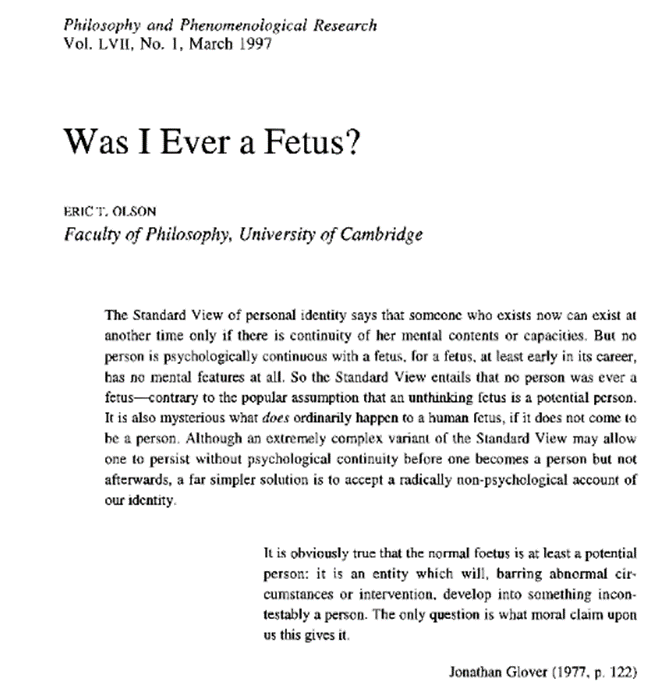
Philosophy and Phenomenological Research

The Loyalty/Betrayal Taste Bud: What I Found at a Mennonite Wedding

Do you consider the United States to be a high-power-distance or low-power-distance culture? Coming from India, I used to see the U.S. as the latter, but in the last 12 years of living here, it is increasingly becoming the former.

Does your proximity to an authority strengthen or lessen your loyalty?
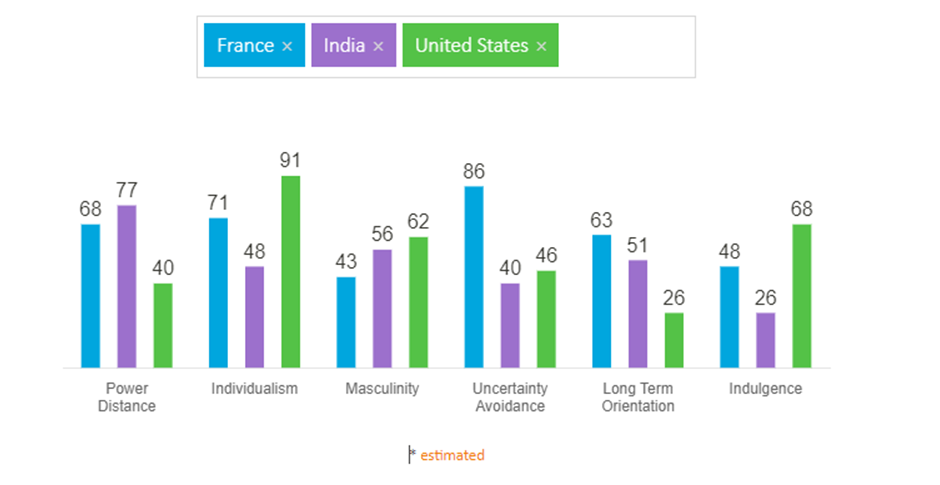
https://www.hofstede-insights.com/country-comparison/france,india,the-usa/

The Authority/Subversion Taste Bud: The Post-Roe Era Begins Political and practical questions in an America without a constitutional right to abortion.

[In the link above, make sure to listen to both Akhil Amar and Caitlin Flanagan]

I also recommend reading Why Other Fundamental Rights Are Safe (At Least for Now)

Is there a flaw in the mainstream discussion of the U.S. Constitution that the abortion debate has brought to light? In my opinion, although predating the U.S. federal constitution and being significantly more involved in federal politics and constitutional evolution, each American state’s constitution is widely ignored. Keep in mind that state constitutions in the United States are far more open to public pressure. They frequently serve as a pressure release valve and a ‘pressuring lever’ for fractious U.S. national politics, catalyzing policy change. Regrettably, in an era of more contentious national politics, mainstream U.S. discourse largely ignores changes to state constitutions and spends far too much time intensely debating the praise or ridicule the federal Constitution receives for specific clauses, by which time the individual states have already shaped how the nation’s legal framework should perceive them. Altogether, a federal system, where individual state constitutions are ignored, and conflicts are centralized, is the American political equivalent of Yudhishthira’s response to the world’s greatest wonder in the thirty-three Yaksha Prashna [33 questions posed by an Indic tutelary spirit to the perfect king in the Hindu epic of Mahabharata].

The Sanctity/Degradation Taste Bud: The Native New World and Western North America

The emergence of a distinctly Native New World is a founding story that has largely gone unrecorded in accounts of early America. Here’s an excerpt from the article:

To round off this edition, a Western movie question: Are there any examples of American Westerns developed with the opposing premise—valuing the First Nation’s People’s agency, which has gained historical support? Why not have a heroic Old World First Nation protagonist who safeguards indigenous practices and familial networks in a culturally diverse middle ground somewhere in the frontier country, shaping and influencing the emerging New World? Can this alternate perspective revitalize the jaded American Western movie genre?

[Here’s the previous edition of Stimuli For Your Moral Taste Buds]

Monday Links and unders – NOLite te bastardes

Also, armchair public policy analysis. Caveat emptor: may contain BS

Not posting here could be due to good reasons, or nasty reasons. Fortunately, it was a very good reason that kept me from posting for few weeks (hint: it was expected, and involves diapers). The (invisible to the naked eye) gap was covered via a spontaneous, à la WWE tag team display by Brandon (who, btw, restarted nightcapping, yay! And then got tarpitted again, nay).

Has the U.S. Supreme Court Effectively Overruled Roe v. Wade? (Verfassungsblog)

A take on the recent abortions slugfest. A decisive overturn of the post – 70s judicial status will probably spell similar changes elsewhere. The shadows have been stirring, the battlefront is wide, the divisions remain deep. Only recently, a proxy “skirmish” took place in Greece: A so-called “1st Panhellenic Conference on Fertility” or something got cancelled, after its anachronistic/ derogatory undertones provoked a digital uproar:

Ovaries and Outrage: How Social Media Took Down Greece’s Fertility Conference (MDI)

This metal feminist slogan came to mind:

Nolite te bastardes carborundorum

The Handmaid’s Tale

I have not read the book (nor watched the series), but this mock-Latin line rings timely and has an interesting history itself.

Lynn Parramore at INET argues that modern libertarians tend to overlook the subject, while the likes of Ayn Rand and Murray Rothbard were assertive in defending the right to abortion as part of the self-determination of one’s body/ life in general:

Why Aren’t Libertarians Protesting the Freedom-Busting Texas Abortion Law? (Institute for New Economic Thinking)

INET is not particularly fond of the liberty creed, but still, the picture is disheartening. What’s worse, it fits my own troubling perception (incomplete as it is, based on limited observations) that this kind of intrusion into individual freedom ranks lower than others. The whole issue seems mostly relegated to a “feminist” or “gender” only thing, bogged down by religion and politics, an underdog among individual rights (Scott Lemieux over at Lawyers, Guns & Money also notes something along this lines. LGM has been consistently slamming the Texas law and the SCOTUS response). And that’s why I did not exactly lament the conference cancellation, even if it borderline breached freedom of speech. It rhymed with an underway underhand undoing of that underdog.

A post in RCL (picked by Brandon here) makes an interesting case regarding the feasibility of free choice for both parts of the equation, doctor and patient. However, it also reminded me of this haunting story, and the possibility of a gap between elegant theory and brutal reality:

Italian doctors on trial for manslaughter after refusing abortion (Financial Times)

The FT article also showcases the heavy information asymmetries that plague healthcare services-at-large, which serve as a foundation for state intervention, be it regulation, public supply or whatnot. At least in the realm of textbook econ as I remember it.

Dismantling government policy – source

The other day, I used the same apparatus – old reliable econ – peppered with some basic public choice insights to smite a couple of state initiatives (in my head, that is).

(1) The Greek government recently ramped-up the vaccination push through mandates, prohibitions and fines. More heavy – handed intervention will beget more bottom-up webs that game the system, I decreed (right, late Mancur Olson documented this in his Power and Prosperity book, especially if the public’s trust is lacking, just pushing open an already unbarred door here). As it turns out:

Ten vaccination centers scrutinized over suspected fake Covid certificates (eKathimerini)

(2) A law enacted in early 2020 awards a one-off allowance of EUR 2,000 (that would be like four times the Greek minimum wage) for every childbirth (there are some conditions to be met, income level, residence etc, but they are quite lax). So, a generous gesture, meant to incentivize people to have children, and also to offer support with child-rearing costs, according to the relevant explanatory memorandum. The law is seated in the state’s duty to protect “family…motherhood and childhood”, somewhere in the underbelly of our Constitution’s list of individual and social rights.

At the face of all these, the free-market credo in my econ grasp whispered:

I will not fail in my strike, warrior. I will not fail in my strike.

The Last Mythal

I unfolded my offensive in two lines. First, the smell test: Nudging a life-changing decision with just a hand-out seems overstretched (a scheme of consistent financial aid is a different beast). And second, the econ-kick-in: This subsidy (you can actually feel my contempt here) will have the fate of other transfers that mess with the price mechanism. Will not the maternity services providers just jack-up prices to take a slice? Presto! (I left the actual cost – organizing/ funding – of implementing the policy plus the arbitrariness of the sum out, as too easy targets).

Well, the jury is still out about the first part, since it’s mostly an issue of empirical analysis. It surely made a nice PR exercise (that could also have a positive effect, and maybe this was the main point from the start). My price call went out of the window, though. The relevant costs have barely budged from the last time we needed maternity services, few years ago. First-hand observation is not statistics, but it did the trick. Nice, neat and clean inferences can still be BS, obviously.

Nightcap

  1. Will Afghanistan hurt US credibility? Don Casler, Duck of Minerva
  2. When did we all become women? Kathryn Robinson, Seattle Weekly (h/t Tyler Cowen)

Sunday Poetry: Gender Equality where it matters? The Scandinavian Unexceptionalism

Deja-Vu! Social Democrats once again bring up the topic of “Democratic Socialism” to cure all of the evils of the world. Once again, the Scandinavian countries (Sweden, Finnland, Denmark and Norway) are used as an example of how “a third way Socialism” can work. Although I still would consider myself young, I have already lost all of my stamina to engage in the same debates all over again until they pop up again a few months after.

So, instead of pointing out the fallacy in labelling the Scandinavian countries moderately socialist (Nima Sanandaji, for example, does an excellent job in doing so), I want to look at one aspect in particular: The myth of peak emancipation of woman in the labour market in these countries. So apologies for neglecting Poetry once again for the sake of interesting information. Have a look at the following graphic and the remarks by Sanandaji:

“Some boards in Nordic nations are actively engaged in how the companies they represent are run. Others have a more supervisory nature, meeting a few times a year to oversee the work of the management. The select few individuals who occupy board positions – many of whom reach this position after careers in politics, academia and other non-business sectors – have prestigious jobs. They are, however, not representative of those taking the main decisions in the business sector. The important decisions are instead taken by executives and directors. Typically individuals only reach a high managerial position in the private sector after having worked for a long time in that sector or successfully started or expanded a firm as an entrepreneur. The share of women to reach executive and director positions is the best proxy for women’s success in the business world. Eurostat has gathered data for the share of women among ‘directors and chief executives’ in various European countries between 2008 and 2010. The data show that Nordic nations all have low levels of women at the top of businesses. In Denmark and Sweden, only one out of ten directors and chief executives in the business world are women. Finland and the UK fare slightly better. Those Central and Eastern European countries for which data exist have much higher representation.

sanandaji.png

[…]

A key explanation lies in the nature of the welfare state. In Scandinavia, female-dominated sectors such as health care and education are mainly run by the public sector.
A study from the Nordic Innovation Centre (2007: 12–13) concludes: Nearly 50 per cent of all women employees in Denmark are employed in the public sector. Compared to the male counterpart where just above 15 per cent are employed in the public sector. This difference alone can explain some of the gender gap with respect to entrepreneurship. The same story is prevalent in Sweden. The lack of competition reduces long-term productivity growth and overall levels of pay in the female-dominated public sector. It also combines with union wage-setting to create a situation where individual hard work is not rewarded significantly: wages are flat and wage rises follow seniority, according to labour union contracts, rather than individual achievement. Women in Scandinavia can, of course, become managers within the public sector, but the opportunities for individual career paths, and certainly for entrepreneurship, are typically more limited compared within the private sector.

If you are interested in the whole book, it is completely available online for free.

I wish you all a pleasant Sunday.

Nightcap

  1. The Art of War re-translated and reconsidered Peter Gordon, Asian Review of Books
  2. Interview with Svetlana Alexievich (life behind the Iron Curtain) Julian Tompkin, Deutsche Welle
  3. Mutually nonconsensual sex (Title IX is a joke) Caitlin Flanagan, the Atlantic
  4. Reagan’s Right Turn George Nash, Modern Age

Halliday’s ‘The World’s Twelve Worst Ideas’

I came across a collection of essays and blogs by the late Fred Halliday, entitled Political Journeys (2007), published in the last few years of his life. Halliday, who died in 2010 at only 64 years of age, was one of my professors in the International Relations Department at the London School of Economics in the mid-nineties. By some standards he was the big departmental star, not only as a researcher, but also as a public intellectual.

Like most professors he was firmly left wing, a former communist who moved somewhat to the centre. To his credit, his teaching was immaculate: you could not tell his political ideas from his lecturing or the extensive international political theory reading list he gave. He was known for his expertise of the Middle East, revolutions, and his feminism. But he was also a good theorist, and his book Rethinking International Relations (1994) is especially a real treat.

While going through Political Journeys my eyes fell on a piece about ‘the world’s twelve worst ideas in 2007’. Most of them still stand, also from a classical liberal and libertarian viewpoint, and warrant a full discussion by themselves. Yet for now I just list them here, in descending order, with short explanations between parentheses when not self-explanatory:

12. human behaviour can be predicted (against the scientific fallacy in the social sciences)

11. the world is speeding up (large areas I human life still consume the same amount of time as ever before, despite acceleration in other areas)

10. we have no need for history

9. we live in a ‘post-feminist epoch’ (still a need for feminism, given the position of women in most parts of the world)

8. markets are a natural phenomenon, which allow for the efficient allocation of resources and preferences (clearly I strongly disagree with Halliday here, although he seems to mix up real free markets and those characterised by government interference)

7. religion should again be allowed, when not encouraged, to play a role in political and social life (points to the fight against the influence of religion on public life)

6. in the modern world we do not need utopias (aspiration to a better world as necessary part of the human condition)

5. we should welcome the spread of English as a world language (while practical it comes with cultural arrogance by the Anglo-Saxons)

4. the world is divided into comparable moral blocs or civilisations (there is indeed a set of common values shared across the world)

3. diasporas have a legitimate role to play in national and international politics (refutes the idea that diaspora have a special insight into their homeland, and Halliday then points to the negative and backward role in the resolution of the conflicts in their countries of origin)

2. the only thing ‘they’ understand is force (plain colonial and hegemonic thinking)

1. the world’s population problems and the spread of AIDS can be solved by ‘natural’ means (against those who oppose condoms use and other contraceptives)

Nightcap

  1. The cursed wonders of India Rishika Yadav, Spontaneous Order
  2. Robot of Jihad? A Guide to Tipu’s Tiger Blake Smith, the Appendix
  3. Black pictures (film) Darryl Pinckney, New York Review of Books
  4. A Male Feminist’s Crisis Michael Friedrich, New Republic

Nightcap

  1. Religion and human rights Bruce Clark, Erasmus
  2. Voltaire and the Buddha Donald Lopez, Public Domain Review
  3. The politics of the past in Europe and Russia Douglas Smith, LA Review of Books
  4. Lessons unlearned, empire falls Niall Ferguson, Vanity Fair

Identity Politics, the Alt-Right, and Empathy in Cultural Discourse

“Identity politics” have been an intensely large obsession of the American left or the past forty or so years. Academic leftists have devoted their entire careers and even the organizations of their departments to studying notions of identity and the specific history and interests of certain identity groups—such as women’s studies, African-American studies, and other similar programs. The Democratic Party has put special emphasis on mobilizing various minority groups based on identity, focusing on “Women’s issues” such as abortion or “the needs of the African-American community” such as police reform or “gay rights” to get a certain of segment of voters to turn out in elections.

Yet, with the election of Trump, many moderate leftists are questioning the utility of identity politics. Mark Lilla had a prominent recent piece in The New York Times declaring the “end of identity liberalism.” Lilla’s main criticisms of identity politics focus on it as a “strategic mistake” in electoral politics and how it has made liberals and progressives “narcissistically unaware of conditions outside of their self-identified groups,” particularly white, middle class, working men in the Midwest. Matt Yglesias, meanwhile, responded by sounding off that all politics is identity politics, people always organize themselves in interest groups, writing that “any plausible account of political behavior by actual human beings needs to concede that politics has always been practiced largely by mobilizing people around salient aspects of group identity rather than detailed policy proposals.” The left, he says, can’t abandon identity politics because “[t]here is no other way to do politics than to do identity politics.”

Those on what is traditionally considered the “right” end of the political spectrum (ignoring the specific phenomena of Trump voters and alt-righters, that is) tend to be dismissive of the whole project of identity politics. This approach is embodied by Robby Soave’s recent article in Reason claiming that identity politics is just a form of tribalism that seeks to subvert individual rights and overall social welfare to  the tribalist demands of some salient group people self-identify with. Soave also sees the rise of Trumpism as itself a form of identity politics for white men, a claim which I’ll address at length in a moment.

What is one to make, then, of identity politics in the Trump era? First, it seems there is considerable confusion about what identity politics even is in the first place. Lilla, for an example, seems to imply that the left’s obsession with appealing to minority political coalitions is merely a strategy for winning elections. Soave thinks it’s pure tribalist and collectivist ideology, and Yglesias defines it so broadly that any political mobilization at all is considered identity politics. How are we to understand what operative definition of what is commonly called “identity politics” is most useful, or at least is closest to how its commonly used in political discourse?

Lilla and Yglesias understanding, it seems, misses the point about why so many leftists are so passionate about identity politics. People who are interested in cultural dramas and issues related to group identity are not just Democratic strategists in campaign war-rooms, but, as I mentioned earlier, academics, and “true believer” bleeding-heart progressive activists. It seems to me that identity politics—at least at first (and still is in the minds of the true believers post-1960s progressivism)—is not about an election strategy. It’s certainly become that for Democratic strategists, but it originally was motivated by the old liberal concern with ending the misery for stigmatized groups. Identity politics is not merely a political strategy, but a strategy the left used for getting rid of racism, homophobia, and otherization of outgroups in society at large.

The idea is like this: try to get, for example, white people to sympathize with black people by getting whites to recognize that black people have their own meaningful web of cultural associations which is just as valid as those of the dominant culture. Its roots are in cultural studies academia, such as the writings of Judith Butler and Nancy Fraser. Essentially, identity politics is rooted in philosophical attempts to end prejudice through emphasizing “cultural recognition” of despised groups. As Richard Rorty wrote in describing this strategy:

It helps, when trying to recognise a common humanity in a person of another gender, class, or ethnicity, to think of them as having as rich an inner life as one does oneself. To picture such an inner life, it helps to know something about the web of memories and associations which make it up. So one way to help eliminate prejudice and erase stigma is to point out that, for example, women have a history, that homosexuals take pride in belonging to the same stigmatised group as Proust, and that African-Americans have detailed memories of the battles which make up what Russell Banks calls “the three hundred year War Between The Races in America” – the sort of memories whites are currently learning about from Toni Morrison’s novels. It helps to realise that all such groups wrap a comforting blanket of memories and traditions, customs and institutions, around themselves, just as do classical scholars, old Etonians, or members of the Benevolent and Protective Order of Elks.

Thus treating identity politics just as a way to get electoral coalitions out to vote, and also (as Soave does) as simply tribalism ideology when it was started as a strategy to mitigate tribalism, misses the point about why the left is so passionate about these cultural issues. It isn’t simple collectivism nor Machiavellian political strategy, but (hopefully) genuine concern for stigmatize groups that mobilizes this obsession.

Of course, as Rorty well-recognized, this way of ending prejudice is not the only way nor is it the most effective. First, it does make the left appear as this overly sensitive “politically correct” group of elitists who care little for the concerns of working class whites. As Rorty wrote that the left’s preoccupation with cultural identity politics would mean “the straight white male working class in America may find it tempting to think that the leftist academy is uninterested in its problems.” Indeed, most of why Lilla is concerned that identity politics has failed so spectacularly as an electoral strategy is that it has isolated progressives from middle America.

More importantly, however, is that emphasizing cultural difference has failed spectacularly at its initial aim of ending prejudice. The whole point of Soave’s Reason column is that leftist identity politics has become its own form of tribalism and have given rise to the right-wing identity politics of Trump. Not only have leftists often gotten so caught up in the identity politics language game that they call their own (such as Bernie Sanders) white supremacists for not playing along, it has created its own prejudice backlash. If your way of getting straight white males to recognize non-straight white males as worthy of equal treatment is to say “Those who are unlike you have different cultural values that are worth being celebrated and protected,” the response of straight white males is to say “Do not I also have a different culture worthy of being celebrated and protected?”

Indeed, this type of rhetoric is at the heart of the rise of the alt-right. It isn’t mere hatred of others that is animating this new populist, fascist movement (though that is certainly a concerningly large part of it), it is that they are making this hatred seem legitimate by couching it in terms of advancing “white interests” in a very similar rhetorical manner that the left has pushed the interests of minority groups. Richard Spencer’s “mantra” for the alt-right is “race is the foundation of identity” (emphasis mine) and calls himself an “identarian.” Even outside the small niche of the alt-right, average Trump voters often say they want a way to express and defend their identity—whether it is in the form of white nationalism or in forms of defending Christian “religious liberties” as its own identity coalition against gay rights.

Soave is correct that left-wing identity politics has given us this right-wing identity politics, and it is something Rorty himself saw as a potential consequence of this approach. In his 1998 book Achieving our Country, he explicitly predicted that the white working class would become disconnected from the academic left, and would “start looking around for a strongman to vote for—someone willing to assure them that, once he is elected, the smug bureaucrats, tricky lawyers, overpaid bond salesmen, and postmodernist professors will no longer be calling the shots[.]” He also predicted that when this strongman assumes office, “gains made over the past forty years by black and brown Americans, and by homosexuals, will be wiped out.” It is no coincidence that this sounds quite a bit like Trump.

It’s not surprising that emphasizing differences between the majority and a scapegoated group would mean that the majority group would start taking “pride” in its difference from the scapegoated. Of course, anyone who understands systemic power structures or how sociological hierarchy works understands why this response is not the same. There is a difference between cherishing the cultural differences of a scapegoated minority and using institutional power to coercively protect the cultural interests of the majority group at the expense of the minority. But you can’t expect a white adolescent basement-dwelling troll on 4-Chan or even a working class white voter from central Michigan to understand and fully internalize that difference, and they are likely to be very reluctant or overtly hostile to acknowledging it. All the alt-right has done is take identity politics and turn it against its original aim to advance the exact tribalism leftists have been trying to use identity politics to end.

A better strategy the left could have used was the strategy the old left used through classical feminism, abolitionism, the sixties Civil Rights movement, or some new progressives through the more pop-culture current of the gay rights movement. Rorty describes it beautifully:

Another way is to get the prejudiced to see the stigmatised as having the same tendency to bleed when pricked as they themselves: they too worry about their children and parents; they are possessed by the same self-doubts, and lose self-confidence when humiliated; their difficulties in moving from one stage of life to another are much like everyone else’s, despite the fact that their life-chances may be minimal. These ways of emphasising commonality rather than difference have little to do with “cultural recognition.” They have to do with experiences shared by members of all cultures and all historical epochs, and which remain pretty much the same despite cultural change.

There’s no real way for bigots to co-opt this approach to advance their bigotry. In fact, it explicitly avoids framing the discussion not as some necessary “culture war” between an oppressive majority and an oppressed minority as current identity politics rhetoric implies and alt-right identitarians have assumed as their rallying cry. Instead, it emphasizes the need to end culture wars in the first place by progressing people’s sentiments to stand in solidarity with an ever-growing chunk of humanity—it seeks to replace simple identity with empathy.

Is this approach still in the vein of “identity politics” as we currently understand it? If we take Yglesias’ understanding, sure it still “concede[s] that politics has always been practiced largely by mobilizing people around salient aspects of group identity,” but it seeks to make salient aspects of group identity as banal as possible, to make people stand in solidarity based off empathy for everyone’s common human shortcomings rather than based off who they happen to be culturally similar to, to make one’s ingroup as inclusive as impossible. It certainly isn’t tribalist or collectivist as Soave is concerned. Though it still recognizes diversity as important, Rorty still explicitly says that we should see this diversity “as a diversity of self-creating individuals, rather than a diversity of cultures[.]” This liberal (and classical liberal as I see it as drawing off of Hume, Smith, and Mill more than anything) vision is one that is both pluralistic and individualistic.

Is this, however, a winning electoral strategy, as Lilla is concerned? I’m not sure. Tribalist urges of racism are certainly very powerfully woven into how humans have psychologically evolved, and perhaps in our current broken discourse of race relations it isn’t the best electoral strategy. There is, however, some reason for optimism; popular support for gay rights is at an all-time high, after all, and this was probably more a function of the victory of emphasizing the similarity of love between gays to that of straights then getting straight allies to march in gay pride parades. Regardless of electoral outcomes, shouldn’t the goal of civil discourse not be to win elections, but to ensure the most just, peaceful, and prosperous civil society—the zero-sum game of coercive politics be damned? Leftists should try to change the current broken discourse, rather than try to work within it to gain political power.

To Women Voters:

I take the liberty to point out a small number of issues that I am told are important to women. I do it because I used to be a respectable social scientist and because I have been retired for ten years which gives me plenty of time to stay informed.

Women voters have been misled for years by propaganda explicitly pointed at them. It wasn’t necessarily a conspiracy though but a kind of uncritical cultural convergence. Many of those who spread misinformation believe it themselves. So, in a way, they are morally innocent. That’s no reason to follow them down the wrong path, and down the cliff. Below are five topics about which you may have received false information that has been repeated over and over until it sounded true.

The first female president

There is a widespread feeling among American women that it’s time finally to elect a female president. For some, it’s a sort of symbolic restitution. I can’t speak to this because I am only a man. Other voters, both females and males, seem to think that a female presidency would result in significant improvements in the lives of American women. A relevant reminder: Eight years ago, Americans elected the first African-American president. For many, it was a vote filled with hope for positive change in the area of race. After two Obama administrations, almost eight years later, it’s time to take stock. However you evaluate the Obama administrations in general, two facts stand out. First, race relations in American have not improved (to say the least). Second, African-Americans are not better off than they were eight years ago. In fact, they are slightly worse off economically. (My own position on having a woman President is straightforward: I would vote for Stanford Professor Condoleeza Rice, for President, in a heartbeat.)

Abortion

The 1973 Roe vs Wade decision made abortion on demand available throughout the territory of the United States. Candidate Trump has provided a list of potential nominees to the Supreme Court . Some of those nominees are pro-life. This raises the question of what would happen in the unlikely event that Roe vs Wade were overturned by a new Supreme Court. You may have been led to believe that abortion would become illegal. That’s simply not true. Legislation on abortion – if any – would revert to the individual states as the Constitution requires (same as murder, theft, sequestration, and spitting on the sidewalk). The likelihood that all fifty states would forbid abortion on demand is simply zero. The likelihood that half of them would is also zero, I believe. The worst case scenario is that abortion would become geographically inconvenient. (In case you wonder, I believe, just like former President Bill Clinton, that abortion should be legal, safe, and rare.) There is no chance that not electing Mrs Clinton will make abortion illegal.

Pay disparities

We have been told that women received interior pay for equal work for so long that it has almost become the truth. Even my local female Republican candidate for Congress uses this line. It’s not the truth. The reality is that women receive unequal pay for unequal work. There are various reasons why this is. (A broader treatment of this matter is on my blog and accessible through these two links.) In fact, paying women unequal pay for equal work has been against federal law for more than thirty years. Doing it is an invitation to costly class action suits. It’s probably important not to vote for someone on the basis of “facts” that are not facts at all. And then, there is the issue of why anyone would mislead you so badly. (Myself, I am going to vote for the Republican lady candidate for Congress although I think she should check her facts better.)

Immigration

Candidate Clinton has said clearly that she is is for open borders. This may come from a generous heart. Yet there are too many people from poor countries who want to come to the US to live. Even, if all of them are good people, the USA is like a lifeboat: If too many climb aboard, the boat capsizes and everybody drowns, the original passengers (Americans as well as existing immigrants) and the newcomers (would-be immigrants). To remain a decent society, a generous society, the US has to somehow restrict admission. Open borders is not a possible policy, it’s a dangerous fantasy. (In case you are wondering: I am an immigrant myself, so is my wife.)

Civility

Candidate Trump bragged – thirteen years ago – about making crude sexual gestures. There has not been a single formal complaint or any charge brought against him on this account. That’s although – unlike former Pres. Bill Clinton at the same stage – he has temptingly deep pockets, the kind of pockets that would give fighting courage to any moderately aggressive attorney. Candidate Trump often also has a filthy mouth, and he occasionally uses sexist language, that’s a fact. Candidate Clinton is good friends with and approves of, and patronizes artists who routinely sing of perpetrating gross sexual violence on women (including in the last days of her campaign). They too use obscene words. They do so routinely, every time they perform. (I don’t use such language myself but my wife of forty years does, another story, obviously.)

Please share this and ask your friends to share.

Pornography, virtual reality and censorship [II]: puritanism and videogames

[Continuing from my last post, noting that feminists have not behaved monolithically toward pornography, and statistics have not provided any justifiable inference from violent pornography to violent crime.]

Most feminists would align, however, in a condemnation of violent pornography, even if they do not attempt to use legal coercion to restrict it. It has been particularly controversial when material becomes first-person, or even playable. And thus pornography, and violent pornography, often makes an intersection with the videogame industry. To name one infamous example, RapeLay, a role-playing game from a company in Yokohama, Japan, allows the player to assault a defenseless mother and her two children. Some critics argued that the videogame breached the Convention on the Elimination of All Forms of Discrimination Against Women, agreed to by the United Nations.

New York City Council speaker Christine Quinn called RapeLay a “rape simulator.” Commenting on the game and other controversies, an IGN journalist added: “For many, videogames are nothing but simulators. They are literal replications, and, as such, should be cause for the same kind of alarm the real life equivalents would inspire.” Is this the same motive for consumers though – that of, essentially, practice? On the piratebay download link for RapeLay, a top commenter “slask777” writes: “I highly approve of this for two reasons, [sic] the first is that it’s a slap in the face of every prude and alarmist idiot out there and second, it’s a healthy outlet for the rape fantasy, which is more common than most people believe.”

I suspect that much of the appreciation for videogames is due to their simplicity, to be eventually supplemented by mild and mostly innocent addiction. Then – not to put too much faith in slask777’s psychological credentials – I suspect as well that violent videogames serve a “channeling” function, allowing some instinctual energies to exert themselves in a harmless environment and release some psychological tension. Perhaps the “rape fantasy” is not shared by the majority of the populace, but judging by the comments on the torrent site, the audience for this game cannot be confined to stereotypical images of basement N.E.E.Ts. (Studies of the occupations of internet trolls confirm as well the difficulty of pinning down an image for anonymous internet users). There was even an informative, civil discussion of reproductive anatomy on page one of the torrent site. Following this theory of channeling, we might find similar uses for virtual realities: nonreal locations to perform socially unacceptable acts. Locations for people with genuine sexual or sadistic pathologies, to release their desires and blow off steam without harming other people. The entire premise is empathetic.

Of course, throughout history, any activity which has the possibly of harmlessly releasing what could be described as primordial man, the “reptilian” side, the repressed id, or whatnot, has faced violent opposition from culture, religion, criminal law and various romantic-familial-social apparatuses. Here, we can already expect that, fitting into the category of “recreational and individuational,” virtual reality technologies will face a cultural blowback. RapeLay is an extreme example of both violence and sexuality in videogames: the high-profile protest it received could be expected. (Pornography has even been to the Supreme Court a few times (1957, ’64, ’89). In a separate case, Justice Alito, commenting on RapeLay, wrote that it “appears that there is no antisocial theme too base for some in the videogame industry to exploit.”) This moral outrage, however, is not simply content-based, but medium-based, and flows directly from the extant condescension and distrust toward videogames and pornography.

The simple fact that disparate ideological camps agree on, and compatible groups disagree on, the effects and what to do about pornography and videogames could be seen as demonstrative of the issue’s complexity; in fact, this implies that the nature of opinion on this is fundamental and dogmatic. The opinion provides the starting point for selectively filtering research. There are two logical theories concerning these violent media: the desensitization argument, and the cathartic/channeling argument. Puritans and rebels enter the debate with their argumentative powers already assigned, and the evidence becomes less important.

Before evidence that might contradict either primitive position on pornography interferes, many people have already formed their condescension and distrust. The desensitization theory is particularly attractive due on the most publicly-understood thesis of cognitive-behavioral psychology: mental conditioning. Thus when violence or abusive language is used as a male advance in adult videos and games, and women are depicted as acquiescing rather than fighting back, boys must internalize this as reality. Of course, media itself has no interest in depicting legitimate representations of reality; it is inherently irreal, and it would be naïve to expect pornography directors to operate differently. This irreality I think is poorly understood, and thus the “replicator” argument as adopted by the IGN reporter becomes the most common sentiment for people that find pornography affronting to their morals and are also disinterested in research or empirical data. Glenn Beck, commenting on the release of Grand Theft Auto IV, said “there is no distinction between reality and a game anymore.”* He went on to say that promiscuity is at an all-time high, especially with high school students, when the number of sexual partners for young people is at a generational low. The seemingly a priori nature of a negative pornographic effect allows woefully out-of-touch rhetoric to dominate the conversation, appealing also to the emotional repulsion we may experience when considering violent porn. It encourages a simplifying effect to the debate as well. Again, were it simply true that nations with heavy pornography traffic face more frequent sexual violence (as a result of psychological conditioning, etc.), we would expect countries like Japan to be facing an epidemic – especially given the infamous content of Japanese porn (spread across online pornography, role-playing games and manga). Yet, among industrialized nations, Japan has a relatively low rape frequency. The rape ratio of a nation cannot be guessed simply from the size or content of its pornography industry.

Across the board, the verdict is simply still out, as most criminologists, sociologists and psychologists agree. There are innumerable religious and secular institutions committed to proving the evils of pornography, but contrasting them are studies that demonstrate that, alongside the arrival of internet porn, (1) sexual irresponsibility has declined, (2) teen sex has declined (with millennials having less sex than any other group), (3) divorce has declined, and – contrary to all the hysteria, contrary to all the hubbub – (4) violent crime and particularly rape has declined. Even with these statistics, and of course compelling arguments might be made against any and all research projects (one such counterargument is here), violent efforts are made to enforce legal restrictions – that is something that will probably persist indefinitely.

I first became interested in debating pornography with the explosion of “Porn Kills Love” merchandise that became popular half a decade ago. The evidence has never aligned itself with either side; if anything, to this day it points very positively toward a full acquittal. Yet, young and old alike champion the causticity of pornography toward “society,” the family, women, children, and love itself (even as marriage therapists unanimously recommend pornography for marriage problems). Religion has an intrinsic interest in prohibiting pleasurable Earthly activities, but the ostensible puritanism of these opposing opinions is not present in any religiously-identifiable way for a great number of the hooplaers. So an atheistic condemnation of pornography goes unexplained. One might suppose that, lacking the ability to get pleasure (out of disbelief) from a figure-headed faith (which sparks some of the indignation behind New Atheism), people move to destroy others’ opportunities for pleasure out of egalitarianism, and this amounts to similar levels of spiritual zeal. Traces of sexist paternalism are to be found as well, e.g. “it’s immoral to watch a woman sell her body for money,” and through these slogans Willis’ accusation of moral authoritarianism becomes evident. Thus the attitudes which have always striven to tighten the lid on freedom and individual spirituality – puritanism, paternalism, misogyny, envy, etc. – align magnificently with opposing pornography, soft-core or otherwise.

*I try to avoid discussion of GamerGate or anti-GG, but it is almost impossible when discussing videogames and lunatics. Recently, commenting on Deus Ex‘ options for gameplay, which allow the player to make decisions for themselves, Jonathan McIntosh described all games as expressing political statements, and that the option should not even be given to the player to make moral decisions about murder, etc. It’s immoral that there is a choice to kill, was his conclusion. He’s right about all games expressing political statements. But he’s a fucking idiot for his latter statement.

[In my next post I’ll conclude with an investigation into the importance of virtual reality technology and the effect it will have on society.]

Pornography, virtual reality and censorship [I]: presidents and feminism

Oculus Rift, recently purchased by Facebook and partnered with Samsung, and HTC Vive, manufactured by HTC with Valve technology, have lead the 2010 wave in developing virtual reality headsets. These technologies, innovative by today’s standards but primitive by science fiction’s, mark the beginning of a differently structured society. They also mark a starting point for a new debate about privacy, the social affects of videogames, and especially censorship in media.

Virtual reality (in its not-too-distant actuality) offers an opportunity to behave outside of social norms in an environment that is phenomenologically the real world. The only comparable experience for humankind thus far is lucid dreaming, for which the rewards are less intense and the journey less traversible than the quick promises of virtual reality machines. One inevitable development for these machines is violent, sexually explicit experiences, available for cheap and accessible 24/7. To see how VR might be received, the closest industries to analyze are the videogame and pornography industries.

Interestingly, pornography has a very liberal history, in comparison to other “societal ills,” like drugs. Erotica dates back to ancient cultures — notably, the Kama Sutra, hardcore by today’s standards, is still a staple of contemporary sexual experimentation — and today’s perversions were common themes: bestiality, pedophilia, etc., although pornography with an emphasis on violence might be a more modern trend. This isn’t to ignore, however, the roles typically played by women in ancient Western folklore and mythology, which are degrading by today’s feminist standards.

The case could be made that today’s censorial views on pornography come from a far more malevolent or oppressive stance toward women than two millennia ago. The free expression that pornographic media once enjoyed was severely deflated over the 20th century. Only two years ago, a plethora of activities were banned from pornography in the United Kingdom. Reacting to the legislation, commentators were quick to criticize what was seen as policy that was specifically anti-female pleasure. Female ejaculation, fisting, face-sitting, and many forms of spanking or role-play were among the restrictions. There are puritanical, “moral outrage” elements to the restriction, but many noticed the absurdity of banning face-sitting: said one producer, “Why ban face-sitting? What’s so dangerous about it? … Its power is symbolic: woman on top, unattainable.” (There has been well-intended censorship as well. Los Angeles county passed Measure B in 2012 to require condom use during any pornographic scene with anal or vaginal contact, to combat the spread of venereal disease.)

Nowadays, there are plenty of porn directors that have learned to focus on both male and female pleasure, and reintroduced artistic merit to their directions. With the equalizing force gaining momentum in porn, it’s curious what the vehement, persistent condemnation springs from, when not focused exclusively on abusive sex scenes. In addition, the negative effects of pornography’s presence in society are still being debated. Just the other day, a study which led to headlines like “Porn doubles the risk of divorce” and “porn signifies a death knell for marriage” was criticized by Reason magazine for failing to address important underlying factors that more plausibly contribute to both pornography consumption and an unhappy marriage leading to divorce. There seems to be an obsession on behalf of the great majority of the public in assigning pornography to some sort of social harm.

Research on photographic pornography’s effect on society began early and aggressively. The Meese Report (1986), commissioned by Reagan and still frequently cited by anti-pornography advocates, determined pornography to be detrimental to society and family relations, and especially for women and children. Arguments built on similar reports attempt to connect sexually explicit material with rapes and domestic violence, alleging that the desensitization to rough sex carries over from the depictional world into the real one. Henry E. Hudson, the Chairman of the Meese Commission, alleged that pornography “appears to impact adversely on the family concept and its value to society.” The Meese Report, however, has been challenged extensively for bias, and is not taken seriously as a body of research any longer. One criticism by writer Pat Califia, concluding a traditionalist narrative embedded in the research, states that the report “holds out the hope that by using draconian measures against pornography we can turn America into a rerun of Leave It to Beaver.

The United States’ Commission on Obscenity and Pornography, preceding the Meese Report and commissioned by Lyndon B. Johnson and Nixon, was unable to find evidence of any direct harm caused by pornography. (Although Nixon, despite the evidence under his administration, believed porn corrupted civilization.) It is curious that a new federal study was requested only sixteen years after the first extensive one, but maybe not too unusual given the growth of porn with technology (from adult stores and newsstands to unlimited free online access; the internet just celebrated its quarter-centennial birthday); also not too unusual given the absurd and expensive studies already undertaken by the federal government. It is also worth pointing out that pornography, though often connected to feminism, is a divisive issue within 20th century and contemporary feminism: some thinkers, like Andrea Dworkin, condemned it as intrinsically anti-women; others feminists like Ellen Willis argued for pornography as liberating and its suppression as moral authoritarianism. The debate along lines of sexuality, online or otherwise, culminated in the feminist “sex wars,” with groups like Feminists Against Censorship and Women Against Pornography popping up. Thus, the debate is open across every ideological camp, and support of pornography is neither necessarily liberal nor necessarily feminist.

[In the next post, I discuss violent pornography’s cross-media transformation into videogames, more sociological research and the general point, and insecurity, of prohibitory measures.]

South Asia and the Glass Ceiling

That is the broad topic of my latest article (pdf), which was just published by Pakistan Journal of Women’s Studies: Alam-e-Niswan. Here is the abstract:

South Asia is one of the most violent societies in the world, and also the most patriarchal. Both characteristics have led to continuity of violence, in which women are the silent and non-recognised victims. The situation is such despite the fact that women have occupied the highest office in their respective countries. The post-1991 wave of globalisation has led to the emergence of two parallel societies, based on different values, in almost all South Asian countries. In both societies women are being exploited and violence has been unleashed on them. Revolution in information and communication technology has helped in the dissemination of patriarchal values through ‘objectification’ of women in the name of ‘liberation’ from the grip of tradition. These patriarchal trends are clearly reflected in the making of domestic policies as well as formulating foreign policies of South Asian states. In such a situation, an academic argument for feminist foreign policy is relevant, though not encouraged by social actors.

You can also find the article on my ‘About…‘ page here at NOL.

Goose Pimples and Hypocrisy

This is a micro alert. Be careful, reading this might make you uncomfortable.

It’s a November afternoon, a rather nice November but November all the same. There is a wedding on the little lawn on the cliff right above Steamer Lane. (Note for my overseas friends in Germany, Turkey, and Illinois: Steamer Lane is a famous cold water surf championship spot in Santa Cruz, California. The whole area, on the Monterey Bay, is exceptionally beautiful.)

The bride is late; surprise! The groom’s buddies are milling around in their comfortable enough tuxedos.* The bridesmaids are sitting and flocking together in their bareback, bare-arms, low-cut long dresses. A cool sea breeze is blowing, of course. Anyone could have predicted it. The ladies are obviously cold, as they should be. Anyone would be. Exemplary social scientist that I am, I make it a point to pass close enough to verify that goose pimples prevail. This goes on for at least an hour. It’s true nippling weather. Maybe that’s the point and I am just missing it.

I don’t know why no one in charge of the women of the bridal party planned for this weather. I don’t know why the bridesmaids’ uniform could not have included a tasteful shawl. Frankly, I don’t know if any of them would have used a shawl in preference to shivering though. (One young woman in my entourage says, “No way!”) At any rate, it’s difficult to take seriously the claim that women are tired of being considered sex objects. Those women, and the women of every American bridal party I have ever seen are bravely and determinedly on display. It’s not an intellectual display; it’s not a talent show; it’s not an IQ contest. I would swear they are disturbed, possibly enraged at the thought of not being considered sex objects on this occasion, after so much effort. The chasm between public discourse and reality has rarely been so wide since the Victorian Age. In the long run, political correctness is sure to induce some sort of collective schizophrenia, it seems to me.

Just to be painfully clear: I am not criticizing the bridesmaids’ behavior – bless their hearts! I hear that young men are ever more reluctant to commit. And you don’t catch flies with vinegar. And there must be a reason why Mother Nature placed women’s breasts on their chests rather than on their backs. (It’s so they can watch men watching them and take it from there.) I am not deriding the women in the bridal party at all. Female exhibitionism has been an attractive part of my worldview ever since I can remember (maybe since three or four years of age). I am just not becoming used to the grossly hypocritical denial that forms today the social context of such displays. It even bothers me worse than ever.

Someone has to shout, “Bullshit!” I wish older women would do it. In their regretted absence, here I am! You can count on me.

* “How gauche,” my snobbish Parisian side is thinking. Tuxedos are evening attire; they should never see the sun.

Friends of Liberty and Friends of Montaigne II: Marie de Gournay (Expanding the Liberty Canon series)

Marie Le Jars de Gournay (1565-1646) was a minor aristocrat from Sancerre in central France who became a leading scholar and writer of her time, and an important advocate of women’s liberty through her scholarly career against the dismissive attitude of powerful men of the time, and through her writing in favour of equality between men and women. She was a friend of Michel de Montaigne, one of the great historical advocates of liberty if in a rather enigmatic manner, and he even treated her as an adoptive daughter. After the death of Montaigne, she lived on the Montaigne estate as a guest of the family, while preparing the third edition of Montaigne’s Essays, a contribution to the history of thought and thinking about liberty in itself.

Gournay’s work in the transmission of Montaigne’s thought is though just one episode in a life of writing covering translations of the classics, literary compositions, and essays. Two essays in particular mark important moments in the case for liberty to apply equally between the two sexes: The Ladies’ Complaint and Equality of Men and Women. In these brief, but rich texts, Gournay argues that there can be no liberty, where goods are denied, so since women have been deprived of the goods of equal esteem, there is no liberty.

She points to the frequency and intensity of denial of equal esteem to women and contests it through the examples in which women have been esteemed, or we can see that women have performed great deeds on a level with great men. The argument is very much that of a Renaissance Humanist, that is someone educated in the languages, history, and literature of antiquity, as great expressions of human spirit and with the assumption that these are the greatest expressions of human spirit. Greatness of literary, intellectual, and statecraft in modern languages, modern thought, and modern states, is possible where  continuing from the classical tradition. Since the emphasis is on pagan classical antiquity, the Humanists to some degree placed humanity above Christian theological tradition, though some Christians were also Humanists and secular Humanist achievements to some degree interacted with scholarship of the Hebrew and Greek languages of the Bible, along with the Greek and Latin used by church thinkers.

Gourany’s concerns are largely secular but she does deal with the place of women in the Bible. For the Hebrew Bible (Old Testament) She points out that if the Queen of Sheba (often thought to refer to an ancient queen of Yemen, or possibly Sudan) visited King Solomon, because she knew of his great wisdom then she too must have had an interest in wisdom, and had some high level of scholarship, learning, and intellectual work herself.

With regard to the New Testament, she comments on St Paul’s injunction in his Epistles that women be silent in church and not take the role of priest. Gournay argues that Paul was not writing out of contempt for women, but fear that men would be distracted and tempted by women speaking out in church serves whereto as part of the congregation or as priests. The limitation on the role of women is not therefore based on beliefs about the supposed inferiority of women, but control of male desire.

On the role of women in the Bible, Gournay argues that in general we should not argue that it supports an inferior role for women, given that God created both men and women in the beginning, and given that men are commanded to leave their parents in order to find a wife. The connection between man and woman, and the idea that a man’s life is completed by association with a woman, is the main message of Christian scripture for Gournay.

Looking at the more secular aspects of Greek and Roman antiquity, Gournay deals with philosophical and with historical concerns. On the philosophical side she notes the importance that Plato gives to the priestess Diotima (unknown outside Plato’s writings) in his dialogue The Symposium, which appears to recount conversations about love in a dinner and drinking party in Athens attended by some of the leading people of the time.

Plato shows Socrates presenting the views of Diotima as the correct ones on love, and Socrates, the teacher of Plato, always appears in Plato’s dialogues as a representative of truth. So Gournay points out, it must be conceded that Plato claims that his ideas, and those of Socrates, are in some degree dependent on the thought of women of their time. In that case, Aristotle made himself absurd when  he claimed that women were defective and inferior, since he was the student of Plato and therefore was in some way formed by ideas that Plato said came from Diotima.

Plato’s student Aristotle may have claimed women were inferior by nature to men, but Antisthenes, a follower of Socrates regarded women and men as equal in virtue. Gournay also refers to the tradition according to which Aspasia, female companion of the Athenian democratic leader Pericles (admired by Plato and Aristotle though they did not share his democratic principles) was a scholar and thinker of the time. There is a lack of contemporary sources confirming this view, but this applies to much about the antique world, so Gournay’s suggestions about Aspasia are just as strongly founded as many claims about antiquity, and the investigation of tradition is itself an important part of any kind of intellectual history.

Moving onto Roman historiography, Gournay points out the role take by women in the tribes of Germany and Gaul, according to Tacitus. Women serve as judges of dispute and as battlefield participants inciting male warriors to fight fiercely. So she can point to a revered classic source, which suggests that women had roles in ancient France and Germany denied to them in those countries in early modern times. In general, as she points out, the antiques often referred to a tribe of female warriors, known  as Amazons, which may have some historical origin in Scythian tribes from north of the Black Sea.

Gournay uses her formidable Humanist learning to demonstrate the ways in which equality between men and women had been recognised in the ancient past, on some occasions in some places at least. Showing that women have been recognised as equal to men in some contexts is evidence that the lower status of women in many societies is a result of socially embedded prejudices rather than any difference in abilities. As Gournay notes, rectifying denial of rights to women is part of the basis for real enduring liberty.