Welfare Costs are not a Good Argument Against Immigration

Note: A version of this was initially posted on my old, now defunct blog. However, has become increasingly relevant in the age of Trump, and is worthy of reconsideration now.

It’s one of the most common arguments against looser immigration going back to Milton Friedman to Donald Trump. It is commonly claimed that even though loosening immigration restrictions may be economically beneficial and just, it should be opposed due to the existence of the welfare state. Proponents of this claim argue that immigrants can simply come to this country to obtain welfare benefits, doing no good for the economy and adding to budget deficits.

Though this claim is on its face plausible, welfare is not nearly as much of a compelling reason to oppose immigration as so many argue. It is ultimately an empirical question as to whether or not the fiscal costs of immigration significantly outweigh the fiscal benefits of having more immigrants pay taxes and more tax revenue economic growth caused by immigration.

Before delving into the empirical studies on the matter, there is one very important fact that is too often neglected in these discussions: there are already heavy laws restricting all illegal immigrants and even the vast majority of legal ones from receiving Welfare. As the federal government itself–specifically the HHS–notes:

With some exceptions, “Qualified Aliens” [ie., legal immigrants] entering the country after August 22, 1996, are denied “Federal means-tested public benefits” for their first five years in the U.S. as qualified aliens.

If we were to allow more immigrants, there are legal mechanisms stopping them from getting welfare. There are some exceptions and even unlawful immigrants occasionally slip through the cracks, but this is already a major hole in the case that welfare means we should hold off on immigration reform. The vast majority of immigrants cannot receive welfare until years after they are legalized.

However, for the sake of argument, let us ignore that initial hole in the case against increased immigration. Let’s generously assume the majority of immigrants–legal and illegal–can somehow get their hands on welfare. There is still little reason to expect that additional immigrants would be any more of a fiscal drag on welfare programs for the vast majority of our population simply because they are not the type of people who typically wind up on welfare. Our welfare programs are primarily designed to protect a select few types of people: the sick and elderly (Social Security and Medicare), and women and children (SCHIP, SNAP, TAMPF, etc.) If one looks at the demographics of immigrants coming into the country, however, one finds that they do not fit in the demographics of those who typically qualify for welfare programs. According to the Census Bureau, the vast majority (75.6%) of the total foreign-born population (both legal and illegal immigrants) are of working age (between 25 and 65).  Most immigrants, even if they were legal citizens, would not qualify for most welfare programs to begin with.

On the other hand, poverty rates are higher among immigrants and that means more would qualify for poverty-based programs. However, most immigrants are simply not the type to stay in those programs. Contrary to common belief, immigrants are mostly hard-working innovators rather than loafing welfare queens. According to Pew Research, 91% of all unauthorized immigrants are involved in the US labor force. Legal immigrants also start businesses at a higher rate than natural born citizens and file patents at almost double the rate of natives. As a result, immigrants have fairly high social mobility, especially intergenerationally, and so will not stay poor and on welfare all that long.

Put it together, and you find that immigrants generally use many major welfare programs at a lower rate than natives. Immigrants are 25% less likely to be enrolled in Medicare, for example, than citizens and actually contribute more to Medicare than they receive while citizens make Medicare run at a deficit. From the New York Times:

[A] study, led by researchers at Harvard Medical School, measured immigrants’ contributions to the part of Medicare that pays for hospital care, a trust fund that accounts for nearly half of the federal program’s revenue. It found that immigrants generated surpluses totaling $115 billion from 2002 to 2009. In comparison, the American-born population incurred a deficit of $28 billion over the same period

Of course, nobody would advocate restrictions on how many children are allowed to be born based on fiscal considerations. However, for some reason the concern becomes a big factor for immigration skeptics.

If you are still not convinced, let us go over the empirical literature on how much immigrants cost fiscally. Some fairly partisan studies, such as this one from the Heritage Foundation (written by an analyst who was forced to resign due to fairly racist claims), conclude that fiscal costs are very negative. The problem, however, is that most of these studies fail to take into account the dynamic macroeconomic impact of immigration. Opponents of immigration, especially those at the Heritage Foundation, generally understand the importance of taking dynamic economic impacts of policy changes into account on other issues, e.g. taxation; however, for some (partisan) reason fail to apply that logic to immigration policies. Like taxes, immigration laws change people’s behavior in ways that can increase revenue. First of all, more immigrants entering the economy immediately means more revenue as there are more people to tax. Additionally, economic growth from further division of labor provided by immigration increases tax revenue.  Any study that does not succeed in taking into account revenue gains from immigration is not worth taking seriously.

Among studies that are worth taking seriously, there is general consensus that immigrants are either a slight net gain fiscally speaking, a very slight net loss or have little to no impact. According to a study by the OECD of its 20 member countries, despite the fact that some of its countries have massive levels of immigration, the fiscal impact of immigration is “generally not exceeding 0.5 percent of G.D.P. in either positive or negative terms.” The study concluded, “The current impact of the cumulative waves of migration that arrived over the past 50 years is just not that large, whether on the positive or negative side.”

Specifically for the United States, another authoritative study in 1997 found the following as summarized by David Griswold of the Cato Institute:

The 1997 National Research Council study determined that the typical immigrant and descendants represent an $80,000 fiscal gain to the government in terms of net present value. But that gain divides into a positive $105,000 fiscal impact for the federal government and a negative $25,000 impact on the state and local level (NRC 1997: 337).

Despite the slight negative impact for states, as Griswold notes, there is no correlation between immigration and more welfare for immigrants:

Undocumented immigrants are even more likely to self-select states with below-average social spending. Between 2000 and 2009, the number of unauthorized immigrants in the low-spending states grew by a net 855,000, or 35 percent. In the high-spending states, the population grew by 385,000, or 11 percent (U.S. Census 2011; NASBO 2010: 33; Passel and Cohn 2011). One possible reason why unauthorized immigrants are even less drawn to high-welfare-spending states is that, unlike immigrants who have been naturalized, they are not eligible for any of the standard welfare programs.

The potential fiscal impact of immigration from the Welfare state is not a good reason to oppose it at all. There are major legal barriers to immigrants receiving welfare, immigrants are statistically less likely to receive welfare than natives for demographic reasons, and all the authoritative empirical evidence shows that immigrants are on net not a very significant fiscal drag and can, in fact, be a net fiscal gain.

Angry? Learn economics!

The election didn’t go your way (and if it did, just think about past elections… at least some of those didn’t go your way) and now you’re itching to do something about it. You’re angry and motivated, and at risk of making things worse

Economics isn’t just about money. In fact, it’s barely about money. It’s mostly about cooperation between strangers. But economists also study competition. Most importantly, we study decision making which is essential to understand if you want people to make different decisions!

More importantly, economics helps us understand how to navigate costs and benefits wisely. It turns out wise decision making isn’t as straight forward as we’d hope. So if you care enough to work hard to make the world better, economics is worth your time.

Still here? You really want to make the world a better place! Let me suggest that you study social science. Something I’ve learned during my first decade of studying economics (Jan. 2018 will by my 10 year mark) is that thinking clearly about something as complex as society requires mental tools that we aren’t born with. Our intuitions will lead us astray. The good news: economics mostly boils down to common sense rigorously applied.

Economics doesn’t have a monopoly on the truth (if we did, this post would be shorter but you’d have to pay to read it). But I think econ is the best place to start in an intellectual exploration of society. It will help you build a robust and modular framework for understanding the world. Economics is the ultimate modular social science; you can plug-and-play with insights from anywhere.

So why econ? Because at the end of the day, economics deals with the most important aspect of life: how to live life well. It boils down to this: every choice comes at the cost of a foregone alternative. Opportunity cost. All (good) economics comes down to this profound truth. Whether your goal is to reduce poverty, pollution, or parenting woes, learning to think of cost in these terms will serve you well.

Let’s take that concept for a test drive… would banning plastic bags reduce environmental harm? The benefit is that you’ll eliminate the problems associated with these bags (litter, use of oil, etc.). But we need to understand the costs before we know if we’re helping or hurting the environment. Notice that link starts with the question “paper or plastic” and goes on to say nothing about paper bags; it’s looking at the silver lining without acknowledging any possibility of a storm cloud. That lack of economic thinking opens us up to new problems: making heavy paper bags also creates pollution and could very well create more.

In other words, this simple concept showed us that it’s possible to do harm by doing something that sounds good (the road to hell is paved with good intentions!).

It’s easy to miss the forest for the trees: economists specialize in researching very specific areas–foreign exchange markets, agricultural futures, political change, pirates–and it’s easy to get bogged down in the details. Studying economics in school means studying under specialists. But once you’ve got the basics of the economic way of thinking down, you’ll see that those specializations are really just applications of the same general concepts and the same basic way of thinking. It’s easier to understand once you speak our language, but there are lots of great resources. Two places I would start:

Now get to it! Start making things better!

When Black Unemployment Rates Were Equal to White Unemployment Rates…

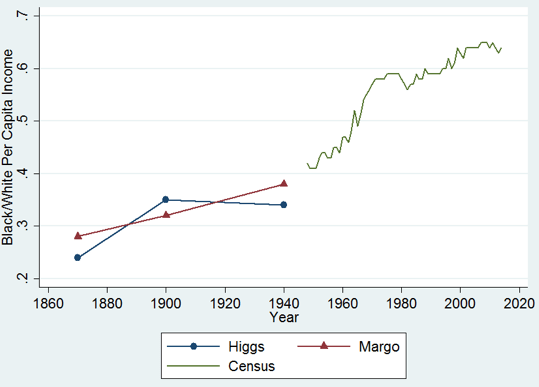
In a twitter-debate with Tariq Nasheed, I pointed out that the wages rates did converge between the 1940s and 1990s. Recently, Robert Margo of the University of Chicago extended this to per capita incomes since 1870. It is fascinating to see that there was convergence between 1870 and 1940 in spite of Jim Crow laws (it tells you how much more blacks could have achieved had the laws not existed – see notably the work of Bob Higgs on this).

income-convergece

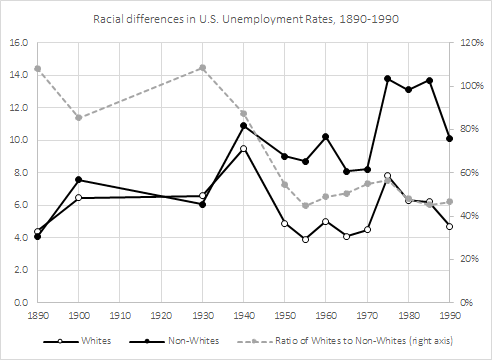
Each time I see this evidence, I am bemused. You see, I often debate colleagues on particular features of social policy in order to assess policy reforms or the effects of past reforms. But, its always good to take a step back and look at the long-view of history. It puts things in perspective. The Margo graph does just that. It tells me the story of what could have been. And just for the sake of remembering properly (infer whatever conclusions you like), it is worth showing racial differences in unemployment rates since 1890. What strikes me is how similar the rates are until the 1950s. What happened at that point? When you ask yourself this question, you’re forced to put everything in perspective. And it becomes harder to have “generic” answers in the lazy-form of “its racism”. Why would racism explain the difference after 1950, but not before?
whites

Maybe, just maybe, people like Tariq Nasheed should stop proving that H.L. Mencken was right in saying that “for every complex problem, there is an answer that is simple, clear and plainly wrong”.


What if fake news was merely an attempt at political entrepreneurship?

Fake news! The new plague that besets mankind! That is largely the new name given to what 19th century folks would have called “yellow journalism“.

Yellow journalism was sensationalist to the point of distorting the news in order to carry a very emotional message. Generally embedded in that message was a political narrative supporting progressive reforms (not all yellow journalists were progressive but it seems that most were).

The aim of many progressives was to design a new society, to reform the old society by getting rid of old institutions. In many cases, economic historians have documented that these reforms (like with prohibition, workers compensation, antitrust) ended up serving very narrow interest groups who either allied themselves with reforming zealots (as in bootleggers helping baptists pass Sunday sales bans), gained through the restriction of competition or gained at the expense of future workers and minorities. But it is not as if the “previous” order was paradise. The postbellum era prior to the progressive era was highly protectionist, used public funds to bailout poorly performing railways and solicited the federal army to deal with natives rather than peacefully deal with them.  Basically, both eras had their political entrepreneurs who found their way in the political process to obtain favors.

Progressives who indulged in yellow journalism merely wanted to replace one set of political entrepreneurs with another. Just like the Alt-Right, from which emanates most of the fake news. In a way, both are exactly the same. Many members of the Alt-Right are not interested in restraining government abuses, they’re in favor of redirecting government indulgences towards them (Trump did promise less immigration with paid maternity leaves and no reduction in social transfers). Some are well-meaning like the baptists of lore. But there are still bootleggers (example: Steven Mnuchin from Goldman Sachs) who co-opt the process in order to continue indulging in rent-seeking just as they did before.

Are we about to swap one bad set of institutions for another? Given that all I see is the same type of political entrepreneurs (after all, Bannon from the flagship of the fake news alt-right outlet Breitbart is now a member of the government) as those we saw during the progressive era, I am inclined to respond “yes”.

Would a Universal Basic Income Increase Poverty?

Switzerland has recently overwhelming voted against a proposal that would establish a universal income guarantee (sometimes called a “basic income guarantee” or the similar Friedman-influenced “negative income tax”[1]). Though I myself am a supporter of BIG as a nth best policy alternative for pragmatic reasons,[2] I’m unsure if I myself would have voted for this specific policy proposal due to the lack of specifics. A basic income is only as good as the welfare regime surrounding it (which preferably would be very limited) and the tax system that funds it.[3] However, the surprising degree of unpopularity of the proposal—with 76.9% voting against—was quite surprising.

The Swiss vote has renewed debate in the more wonkish press and blogosphere, as well as in think tanks, about the merits and defects of a Basic Income Guarantee here in the States. For example, Robert Goldstein of the Center on Budget Policy and Priorities[4] has a piece arguing that a BIG would increase poverty if implemented as a replacement for the current welfare state. His argument covers three points:

  1. A BIG would be extremely costly to the point of being impossible to fund.
  2. A BIG would increase the poverty rate by replacing current welfare programs like Medicaid and SNAP.
  3. A universal welfare program like a BIG—as opposed to means-tested programs—is politically impossible right now due to its unpopularity.

For this post, I’ll analyze Goldstein’s arguments in detail. Overall, I do not find his arguments against a BIG convincing at all.

The Political Impossibility of a BIG

Goldstein writes:

Some UBI supporters stress that it would be universal.  One often hears that means-tested programs eventually get crushed politically while universal programs do well.  But the evidence doesn’t support that belief.  While cash aid for poor people who aren’t working has fared poorly politically, means-tested programs as a whole have done well.  Recent decades have witnessed large expansions of SNAP, Medicaid, the EITC, and other programs.

If anything, means-tested programs have fared somewhat better than universal programs in the last several decades.  Since 1980, policymakers in Washington and in a number of states have cut unemployment insurance, contributing to a substantial decline in the share of jobless Americans — now below 30 percent — who receive unemployment benefits.  In addition, the 1983 Social Security deal raised the program’s retirement age from 65 to 67, ultimately generating a 14 percent benefit cut for all beneficiaries, regardless of the age at which someone begins drawing benefits.  Meanwhile, means-tested benefits overall have substantially expanded despite periodic attacks from the right.  The most recent expansion occurred in December when policymakers made permanent significant expansions of the EITC and the low-income part of the Child Tax Credit that were due to expire after 2017.

In recent decades, conservatives generally have been more willing to accept expansions of means-tested programs than universal ones, largely due to the substantially lower costs they carry (which means they exert less pressure on total government spending and taxes).

I agree that Goldstein is right on this point: universal welfare programs are extremely unpopular right now, like the Swiss vote shows. I imagine that if a proposal were on the ballot in the States the outcome would be similar.[5] However, this is no argument against a Basic Income. Advocating politically unpopular though morally and economically superior policies is precisely the role academics and think tank wonks like Goldstein should take.

If something is outside the Overton Window of Political Possibilities, it won’t necessarily be so in the future if policymakers can make the case for it effectively to voters and the “second-hand dealer of ideas” in think tanks and academia get their ideas “in the air,” so to speak.[6] It wasn’t that long ago that immigration reform or healthcare reform seemed politically impossible due to its unpopularity, yet the ladder has popular support and the former was actually accomplished.[7]

If anything, the unpopularity of a BIG is precisely why people like Goldstein should advocate for the policy.

The Fiscal Costs of Funding a Basic Income Guarantee

Goldstein points out, rightly, that a Basic Income Guarantee would be extremely expensive:

There are over 300 million Americans today.  Suppose UBI provided everyone with $10,000 a year.  That would cost more than $3 trillion a year — and $30 trillion to $40 trillion over ten years.

This single-year figure equals more than three-fourths of the entire yearly federal budget — and double the entire budget outside Social Security, Medicare, defense, and interest payments.  It’s also equal to close to 100 percent of all tax revenue the federal government collects.

Or, consider UBI that gives everyone $5,000 a year.  That would provide income equal to about two-fifths of the poverty line for an individual (which is a projected $12,700 in 2016) and less than the poverty line for a family of four ($24,800).  But it would cost as much as the entire federal budget outside Social Security, Medicare, defense, and interest payments.

Where would the money to finance such a large expenditure come from?  That it would come mainly or entirely from new taxes isn’t plausible.  We’ll already need substantial new revenues in the coming decades to help keep Social Security and Medicare solvent and avoid large benefit cuts in them.  We’ll need further tax increases to help repair a crumbling infrastructure that will otherwise impede economic growth.  And if we want to create more opportunity and reduce racial and other barriers and inequities, we’ll also need to raise new revenues to invest more in areas like pre-school education, child care, college affordability, and revitalizing segregated inner-city communities.

Of course, Goldstein is right that a BIG would be fairly expensive and we are already having serious issues funding our existing welfare state. However, he grossly oversells the difficulty in funding it. In particular, it is not necessary to raise taxes to pay for it or for current welfare expenditures.

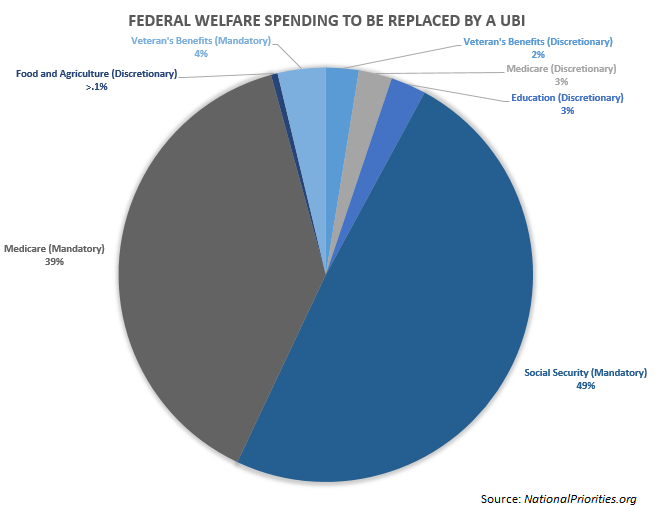
Goldstein likely gets the $10,000 figure from Charles Murray’s proposal for a BIG. Personally, I’m no fan of Murray’s proposal as it goes too far and he proposes financing it by increasing payroll taxes, which are economically inefficient. However, let’s assume that the relevant proposal is around $7,000 dollars.[8] Multiplying that by the US population of 320 million makes for a total cost $2.24 trillion per year.[9] This could be paid for by using the BIG to replace the following current welfare programs and cutting discretionary spending:[10]

  1. $65.32 billion annually in discretionary spending on Veteran’s benefits
  2. $66.03 billion in discretionary spending on Medicare and other healthcare benefits
  3. $69.98 billion in discretionary spending for education.[11]
  4. $13.13 billion in discretionary spending for food and agriculture (eg., SNAP).[12]
  5. $1.25 trillion in mandatory spending for Social Security.[13]
  6. $985.74 billion in mandatory spending for Medicare and Healthcare.
  7. $95.3 billion in mandatory spending for veteran’s benefits.[14]

Spending a UBI Could Replace

That’s a total of $2.542 trillion in savings annually, more than enough to fund the proposed BIG with another $300.3 billion to spare that could be used for tax credits for low-income households to use on healthcare,[15] education,[16] retirement,[17] and/or basic necessities like food.[18] Funding the program would be a huge challenge, but it is possible to do it without tax increases.

Additionally, Goldstein ignores the fact that similar proposals, such as Friedman’s negative income tax, would have a much lower cost while having a similar effect. The Niskanen Center’s Samuel Hammond has estimated that a NIT could cost only $182 billion annually.[19] From Hammond’s analysis:

Just how much of a cost difference is there between a UBI and NIT? To get a rough idea, I used the Census population survey’s Annual Social and Economic Supplement, which has the distribution of individuals over the age of 15 by income level in $2,500 intervals (I subtracted retirees). I then calculated the transfer each quantile would receive based on a hypothetical NIT which starts at $5,000 for individuals with zero income and is phased out at a rate of 30%. Multiplying the average transfer by the number of actual individuals in each grouping and summing, I arrived at total cost of $182 billion—roughly the combined budget for SSI, SNAP and EITC.

The Effect of Replacing Welfare with a BIG on Poverty

Goldstein would object to my line of reasoning by saying cutting all that spending would harm the poor and increase the poverty rate. He says as much in his piece:

UBI’s daunting financing challenges raise fundamental questions about its political feasibility, both now and in coming decades.  Proponents often speak of an emerging left-right coalition to support it.  But consider what UBI’s supporters on the right advocate.  They generally propose UBI as a replacement for the current “welfare state.”  That is, they would finance UBI by eliminating all or most programs for people with low or modest incomes.

….Yet that’s the platform on which the (limited) support for UBI on the right largely rests.  It entails abolishing programs from SNAP (food stamps), which largely eliminated the severe child malnutrition found in parts of the Southern “black belt” and Appalachia in the late 1960s, the Earned Income Tax Credit (EITC), Section 8 rental vouchers, Medicaid, Head Start, child care assistance, and many others.  These programs lift tens of millions of people, including millions of children, out of poverty each year and make tens of millions more less poor.

Some UBI proponents may argue that by ending current programs, we’d reap large administrative savings that we could convert into UBI payments.  But that’s mistaken.  For the major means-tested programs — SNAP, Medicaid, the EITC, housing vouchers, Supplemental Security Income (SSI), and school meals — administrative costs consume only 1 to 9 percent of program resources, as a CBPP analysis explains.  Their funding goes overwhelmingly to boost the incomes and purchasing power of low-income families.[20]

Moreover, as the Roosevelt Institute’s Mike Konczal has noted, eliminating Medicaid, SNAP, the EITC, housing vouchers, and the like would still leave you far short of what’s needed to finance a meaningful UBI.  Would we also end Pell Grants that help low-income students afford college?  Would we terminate support for children in foster care, for mental health, and for job training services?

This is by far and away the weakest part of Goldstein’s argument.

First of all, as my analysis above showed, Konczal’s and Goldstein’s idea that eliminating the current welfare state “would still leave you far short of what’s needed to finance a meaningful UBI” is just false. Even a relatively robust UBI of $7,000 a year is doable by significantly cutting current welfare programs.

But more importantly, Goldstein’s assertion that replacing the welfare state with a UBI would increase poverty is fully unwarranted. He seems to take a ridiculously unsophisticated idea that “more means-tested programs immediately reduce welfare.” His assertion that the programs in question “lift tens of millions of people, including millions of children, out of poverty each year and make tens of millions more less poor” is, at best, completely erroneous. For three reasons: first, individuals know better what they need to lift themselves out of the than the government, and these programs assume the opposite. Second, the structure of status quo means-tested programs often creates a “poverty trap” which incentivizes households to remain below the poverty line. Finally, thanks to these first two theoretical reasons, the empirical evidence on the success of the status-quo programs in terms of reducing the poverty rate is, at best, mixed.

The way our current welfare state is structured is it allocates how much money can go to what basic necessities for welfare recipients. So if a household gets $10,000 in welfare a year, the government mandates that, say, $3,000 goes to food, $3,000 goes to healthcare, $3,000 goes to education, and $1,000 goes to retirement.[21] This essentially assumes that all individuals and households have the same needs; but this is simply not the case, elderly people may need more money for healthcare and less for education, younger people may need the exact opposite, and poorer families with children may need more for food and education than other needs. It’s almost as if our current welfare system assumes interpersonal utility function comparisons are possible, or utility functions of poorer people are fairly homogenous but they’re not. It also ignores the opportunity cost of the funding for helping individuals and households out of funding; a dollar spent on healthcare may be more effectively spent on food for a particular individual or household.

In sum, there’s a knowledge problem involved in our current welfare policy to combat poverty: the government cannot know the needs of impoverished individuals, and such knowledge is largely dispersed, tacit, and possessed by the individuals themselves. The chief merit of a UBI is, rather than telling poor people what they can spend their welfare on, it just gives them the money and lets them spend it as they need.

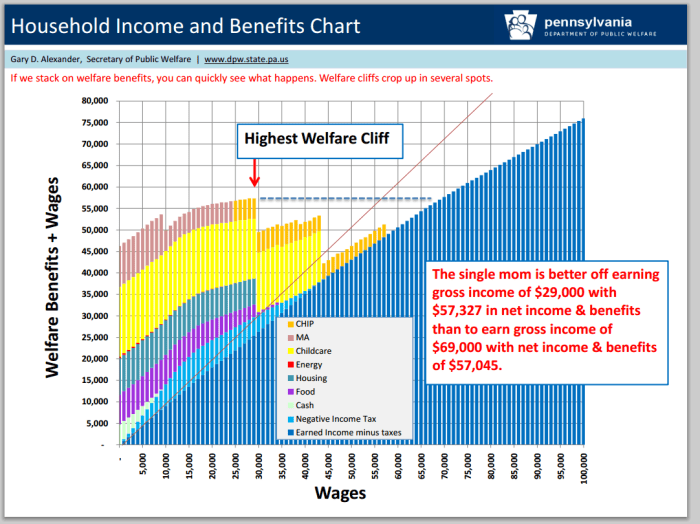
Second, universal programs are superior to means tested programs precisely because the amount of transfer payments received does not decrease as income increases. Our current welfare programs too often make the marginal cost of earning an additional dollar, above a certain threshold, higher than the benefits because transfer payments are cut-off at that threshold. This actually perversely incentivizes households to remain in poverty.[22] For example, the Illinois Policy Institute while analyzing welfare in Illinois found the following:

A single mom has the most resources available to her family when she works full time at a wage of $8.25 to $12 an hour. Disturbingly, taking a pay increase to $18 an hour can leave her with about one-third fewer total resources (net income and government benefits). In order to make work “pay” again, she would need an hourly wage of $38 to mitigate the impact of lost benefits and higher taxes.

SingleMomWelfareCliffChart

Or consider this chart (shown above) from the Pennsylvania Department of Public Welfare showing the same effect in Pennsylvania

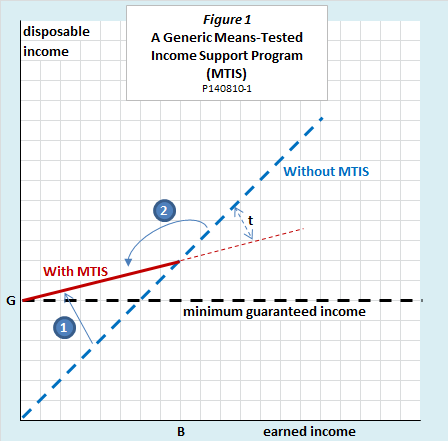
UBI does not suffer from this effect. If your income goes up, you do not lose benefits and so there are no perverse incentives at work here. Ed Dolan has analyzed how the current welfare state with its means-tested benefits is worse in terms of incentivizing work and alleviating poverty extensively. Here’s a slice of his analysis:

P140810-11

The horizontal axis in Figure 1 represents earned income while the vertical axis shows disposable income, that is, earned income plus benefits. To keep things simple, we will assume no income or payroll taxes on earned income—an assumption that I will briefly return to near the end of the post. The dashed 45o line shows that earned and disposable income are the same when there are no taxes or income support. The solid red line shows the relationship between disposable and earned income with the MTIS policy.

This generic MTIS policy has three features:

A minimum guaranteed income, G, that households receive if they have no earned income at all.

A benefit reduction rate (or effective marginal tax rate), t, indicted by the angle between the 45o line and the red MTIS schedule. The fact that t is greater than zero is what we mean when we say that the program is means tested. As the figure is drawn, t = .75, that is, benefits are reduced by 75 cents for each dollar earned.

A break-even income level, beyond which benefits stop. Past that point, earned income equals disposable income.

When these two factors are taken into account (that individuals know better than the government what they need to get out of poverty and there are significant poverty traps in our welfare state), it is no surprised that the empirical evidence on the effectiveness of these anti-poverty programs is far less rosy than Goldstein seem to think.

After reviewing the empirical literature on the relationship between income and welfare improvements for impoverished households, Columbia University’s Jane Waldfogel concluded “we cannot be certain whether and how much child outcomes could be improved by transferring income to low income families.” The Cato Institute’s Michael Tanner wrote in 2006:

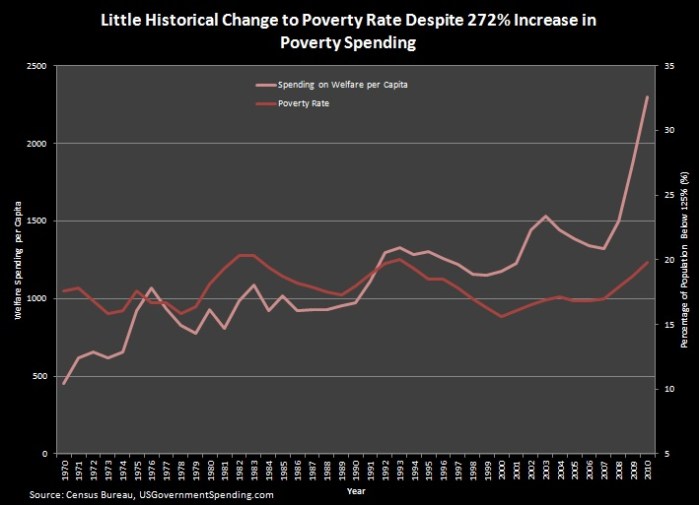
Yet, last year, the federal government spent more than $477 billion on some 50 different programs to fight poverty. That amounts to $12,892 for every poor man, woman, and child in this country. And it does not even begin to count welfare spending by state and local governments. For all the talk about Republican budget cuts, spending on these social programs has increased an inflation-adjusted 22 percent since President Bush took office.

Despite this government largesse, 37 million Americans continue to live in poverty. In fact, despite nearly $9 trillion in total welfare spending since Lyndon Johnson declared War on Poverty in 1964, the poverty rate is perilously close to where it was when we began, more than 40 years ago.

Tanner’s point remains true today. The chart below shows that, despite a massive increase in anti-poverty spending since the war on poverty was declared under Johnson’s “Great Society,” Poverty rates have remained woefully stagnant. In fact, the reduction in poverty that was occurring prior to Johnson’s interventions stopped soon thereafter.

US Poverty Spending

Also, the point is that UBI is a replacement for current welfare benefits. Most households probably would not see a decrease in amount of benefits under a UBI, depending on the specifics of the proposal, and some might even see an increase, contrary to Goldstein’s analysis. Further, they’d be able to actually spend this on what they know they need rather than what government bureaucrats thin they need.

UBI lacks the flaws of the current welfare state, and would likely decrease poverty far more effectively than Goldstein thinks, especially when compared to his favored status-quo.

[1] Though there are some technical differences between Milton Friedman’s proposal for a “negative income tax” and most Basic Income Guarantee proposals, they essentially have the same effect on income. See the Adam Smith Institute’s Sam Bowmen on this point.

[2] See Matt Zwolinski for the “Pragmatic Libertarian Case for a Basic Income,” it should be noted that “pragmatic reasons” here does not refer to my pragmatist philosophical views. Zwolinski has also made a moral case for the basic income on Hayekian grounds that a BIG could reduce coercion in labor negations. I am unsure to what extent I am convinced by this line of reasoning, but it is a valid argument nonetheless.

[3] The Niskanen Center’s Samuel Hammond has made the case that universal transfer programs like a Basic Income cannot be analyzed outside of the tax system that pays for it.”

[4] Or, as my think tank buddies jokingly call it, the “Center for Bigger Budgets.”

[5] Having said that, polls have shown that it is popular across the pond in the Eurozone. The Swiss proposal would call into question this point but it could be argued that the vagueness of the Swiss proposal is why it was turned down not necessarily the spirit of it.

[6] My colleague Ty Hicks of Students for Liberty has made this point well. See also Hayek’s “Intellectuals and Socialism.”

[7] Granted, the Affordable Care Act was not really what most on the left or the right wanted in the first place and has been a disaster.

[8] This number is selected because, according to the CBO, $9,000 is the average amount in means-tested welfare benefits per household for 2006. But that’s for households and a BIG discussed here is for individuals, so it is understandable to make a BIG slightly less than the current average. Goldstein would object that this is far below the poverty line, but BIG is not meant to be a replacement for total income on the labor market at all, so it is unclear why this is an objection in the first place.

[9] This is admittedly a crude and naïve calculation but it is virtually identical to the method Goldstein himself uses to estimate the cost.

[10] All figures for this section are for the 2015 budget and are taken from here.

[11] Goldstein is sure not to be happy with cutting education, and I myself would like to replace this spending with few-strings-attached funding for local education or private school tax vouchers. I’ll address this point more later in this piece.

[12] Much of this is food stamps, which would be rendered obsolete by a BIG anyways. Goldstein would object, more on that in the next section.

[13] Not all of this could be cut, and there would be legal and detailed nuances on how to treat financial obligations for Social Security, veteran’s benefits, and Medicare. The specific legal complexities of mandatory welfare spending are not my areas of expertise, admittedly, and is outside the scope of this paper. I’m just illustrating that it is possible to cut at least some of this spending, perhaps even the majority of it, to fund it.

[14] Many people would object to cutting veterans benefits. First of all, BIG could act in place of these benefits

[15] I have in mind expanding tax-exempt Health Savings Accounts here. I also think funding this by eliminating the employer-based deduction would be a step in the right direction and reduce cost fragmentation in the healthcare market, as Milton Freidman argued.

[16] I have in mind a private school taxpayer voucher system like what is in Sweden.

[17] I have in mind something similar to this proposal to reform social security from the Cato Institute.

[18] I have in mind something like the pre-bates proposed in the Fair Tax.

[19] For this reason, I prefer an NIT to a BIG, but I prefer both to our current welfare state.

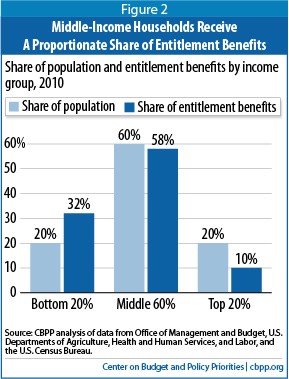
[20] This point is Ironic considering the fact that CBPP’s own research shows that government benefits in America overwhelmingly goes to households above the poverty line, in the middle and upper classes. See this chart (source):

1-SOlzSwsxa08Cno7PiQ9R7A

[21] The real-world numbers are probably different and vary a little bit from household to household, but this is just a hypothetical to illustrate a more general point.

[22] It should be noted, however, that the EITC, and some other programs, is largely free of this defect. This is because the EITC itself is modeled after Friedman’s NIT.

Note: The first chart has been edited since this was initially posted for readability.

The Cruel, Conceited Follies of Trump’s Colonialist Foreign Policy

I typically prefer to abstain from writing too extensively on electoral politics. For one, it’s not my area of expertise and I simply don’t enjoy it that much, but also I think the type of issues that come up in electoral politics are a sensationalist distraction from the meaningful policy debates that actually go on in the back rooms of congress and think tanks, as well as the deeper and more important philosophical, economic, and cultural issues that plague our political situation. Thus, I prefer to write in more detail about public policy or more theoretical economic and philosophical issues rather than the day-to-day drudgery of superficial political news. However, the recent discussion on foreign policy on the campaign trail surprisingly has the potential to become at least mildly substantive, so it is in my mind worth analyzing in greater depth. It should be noted that I am far from an expert in foreign policy, so apologies in advance for any errors and if this article as a whole is a farce.

The purpose of this article is to lay out and critically assess Donald Trump’s foreign policy. It is my contention that Trump does have some fairly consistent underlying instincts, if not principles, on foreign policy that may be inferred from his public comments on the issue. This may be characterized by a concerning belief that the ultimate end of foreign policy should be to aggressively promote America’s interests abroad, akin to a radical, new type of Jacksonian colonialism. If I am right about Trump’s underlying views on foreign policy, a Trump presidency would result in disaster. It would mean massive violations of humanitarian rights and would fail to meet the goals even Trump himself is seeking to attain.

Clinton on Trump’s Foreign Policy

Yesterday, Hillary Clinton delivered a major speech ostensibly criticizing Trump’s foreign policy. Unfortunately, most of her speech was more of an attack on the narrative of Trump’s campaign and Trump himself than his actual foreign policy. This is largely because she thinks Trump doesn’t really actually have a foreign policy; his positions, Clinton thinks, are incoherent, ignorant, or just not even positions at all. This is probably the most quoted passage of the speech:

Donald Trump’s ideas aren’t just different — they are dangerously incoherent.
They’re not even really ideas: just a series of bizarre rants, personal feuds, and outright lies. He’s not just unprepared, he’s temperamentally unfit to hold an office that requires knowledge, stability and immense responsibility. This is not someone who should ever have the nuclear codes — because it’s not hard to imagine Donald Trump leading us into a war just because somebody got under his very thin skin.

Clinton’s strongest case against Trump was that he is “temperamentally unfit to hold office.” She makes this case even more persuasively elsewhere in the speech:

Imagine Donald Trump sitting in the Situation Room, making life-or-death decisions on behalf of the United States. Imagine him deciding whether to send your children into battle. Imagine if he had not just his Twitter account at his disposal when he’s angry, but America’s entire arsenal.

Do we want him making those calls – someone thin-skinned and quick to anger, who lashes out at the smallest criticism?

…I’ll leave it to the psychiatrists to explain his affection for tyrants. I just wonder how anyone could be so wrong about who America’s real friends are. But it matters. Because if you don’t know exactly who you’re dealing with, men like Putin will eat your lunch.

I typically don’t find these types of arguments convincing. After all, it doesn’t matter so much the character of public officials as the institutional incentives they face. But in matters of foreign policy problems of temperament and character do matter because the social situation between foreign leaders in diplomacy can often make a huge difference. Bad manners can and have caused wars (eg., there’s an argument to be made that Jefferson’s bad manners towards British diplomat Anthony Merry helped lead to the War of 1812). These points are confirmed by the fact that world leaders are terrified by Trump and how the intelligence community is afraid he could spill security-sensitive confidential information. (Of course, Clinton also has a less-than-optimal track record on the matter of intelligence security).

What is Trump’s Foreign Policy?

However, Clinton is only partially correct in claiming that Trump’s ideas on foreign policy are “incoherent” or that he doesn’t really have a foreign policy at all. It is true that, as with every other issue save immigration and free trade, Trump switches his positions a lot. But underneath the prime facie incoherence is an overarching vision for a foreign policy that is both somewhat coherent and terrifying.

First, a common misconception needs to be clarified about Trump’s foreign policy views. The press commonly treats Trump as if he’s more of a dove on war and foreign intervention than Clinton, citing his recent criticisms of the Iraq War and Libya. This myth is particularly peddled in pro-Trump “libertarian” circles (with an emphasis on the scare quotes). It is widely accepted that Trump’s foreign policy are less interventionist than Clinton’s fairly hawkish views. However, this is decidedly not the case.

Zach Beauchamp has persuasively made the case that Trump is, in fact, more hawkish in some sense than Clinton. The most consistent point that Trump has made for years now is that America should be waging, in Beauchamp’s words, “colonial wars of conquest” for the purpose of taking resources from other countries. Beauchamp notes:

He first debuted this plan in an April 2011 television appearance, amid speculation that he might run for the GOP nomination. In the interview, Trump seemed to suggest the US should seize Iraqi oil fields and just operate them on its own.

“In the old days when you won a war, you won a war. You kept the country,” Trump said. “We go fight a war for 10 years, 12 years, lose thousands of people, spend $1.5 trillion, and then we hand the keys over to people that hate us on some council.” He has repeated this idea for years, saying during one 2013 Fox News appearance, “I’ve said it a thousand times.”

Trump sees this as just compensation for invading Iraq in the first place. “I say we should take it [Iraq’s oil] and pay ourselves back,” he said in one 2013 speech.

As Beauchamp says, “To be clear: Trump’s plan is to use American ground troops to forcibly seize the most valuable resource in two different sovereign countries. The word for that is colonialism.”

This type of colonialism is even more extreme than the colonialism of American imperialism of the early twentieth century, where colonial wars of conquest were typically justified in terms of America’s “manifest destiny” to spread democracy throughout the world that would eventually benefit the conquered, often coaxed in racial terms (as typified by Kipling’s famous poem), rather than explicitly justified by looting natural resources.

Many people alleging Trump’s dovishness point to his recent criticisms of US intervention in Iraq, Syria, and Libya. The idea that Trump is a dove on these issues, however, is largely a myth. The actual record shows that what Trump’s comments over the past decade or so on foreign policy are largely in line with what Beauchamp sees as his colonialism.

As Beauchamp points out, Trump actually supported intervention in Libya at the time and called for even more aggressive intervention than the Obama administration engaged in (which, as a reminder, included Hillary Clinton at that point):

In a March 2011 vlog post uncovered by BuzzFeed’s Andrew Kaczynski and Christopher Massie, Trump full-throatedly endorsed intervening in the country’s civil war — albeit on humanitarian grounds, not for its oil.

“Qaddafi in Libya is killing thousands of people, nobody knows how bad it is, and we’re sitting around,” Trump said. “We should go in, we should stop this guy, which would be very easy and very quick. We could do it surgically, stop him from doing it, and save these lives.” In a later interview, he went further, endorsing outright regime change: “if you don’t get rid of Gaddafi, it’s a major, major black eye for this country.”

Shortly after the US intervention in Libya began in March 2011, Trump criticized the Obama administration’s approach — for not being aggressive enough. Trump warned that the US was too concerned with supporting the rebels and not trying hard enough to — you guessed it — take the oil.

“I would take the oil — and stop this baby stuff,” Trump declared. “I’m only interested in Libya if we take the oil. If we don’t take the oil, I’m not interested.”

What to make, then, of Trump’s more recent comments where he says he “would have stayed out of Libya”? He’s either incoherent, as Clinton claims, or he’s lying. The first possibility has largely been explored and, though plausible, is uninteresting for present purpose. Therefore, I’ll focus here on the latter (and, in my mind, more likely) possibility. I would argue that Trump is engaging in what could be called, in Arthur Melzer’s understanding of Straussian terms, a sort of dishonest perversion of political esotericism. But unlike the political esotericism of early modern political philosophers who sought to make the world more tolerant, Trump seeks the exact opposite ends. He’s recently been hiding his colonialist views in anti-war rhetoric to attract votes from Americans fatigued with perpetual nation-building through the Bush and Obama administrations. In reality, one of the only sincere substantive positions he’s retained throughout the years is a colonialist desire to wage war for oil. He could not be much further from an anti-war candidate.

As for Iraq, Trump has repeated the claim that he opposed the Iraq war from the beginning many times. Just yesterday, in reaction to Clinton’s speech, he repeated this yet again. “Crooked Hillary said, ‘Oh, Donald Trump, his finger on the button,’,” he said. “I’m the one that didn’t want to go into Iraq, folks, and she’s the one that stupidly raised her hand to go into Iraq and destabilize the entire Middle East.”

In reality, Trump himself wanted to stupidly go into Iraq at the time. In a 2002 interview with Howard Stern he said he supported invading Iraq, adding “I wish the first time it was done correctly.” How did he think it should have been done? Though he wasn’t specific in that interview, his later comments suggest he thinks a “correct” invasion of Iraq would be more aggressive and, of course, focus on taking their oil. Despite being sharply critical of the war later in the Bush administration (though note how he critiques the way it was “handled,” not getting involved in the first place), he supported McCain’s position in favor of the Troop Surge when endorsing him in 2008, claiming, though he wanted to pull out as soon as possible, he wanted to pull out with a victory. Even his most recent comments “critical” of the war, when viewed in the context of his overall foreign policy motivations, aren’t really dovish at all. As he said in 2013, “When I heard that we were first going into Iraq, some very smart people told me, ‘Well, we’re actually going for the oil,’ and I said, ‘All right, I get that.’ [But] we didn’t take the oil!”

Recent comments by Trump against the Iraq War, I think, are well explained by his aforementioned dishonest political esotericism. The record shows Trump disagreed with Bush’s Iraq policy because the motivations were too humanitarian and weren’t aggressive enough prior to the surge. Indeed, Trump’s dishonest claim to dovishness on Iraq has been widely proven false in the press (and yes, each different word links to a different source saying the same thing).

Beauchamp points out that Trump’s views on Syria can’t be described as doveish, as he is largely in agreement with Hillary Clinton:

But the two of them support more or less the same military escalation in Syria. Both Clinton and Trump have proposed carving out “safe zones” in the country, which means clearing out a chunk of its territory and protecting it from aggressors.

Trump sees this as the answer to the Syrian refugee crisis — if you can keep the Syrians there, they won’t have to come over here (or to Europe). “What I like is build a safe zone, it’s here, build a big, beautiful safe zone and you have whatever it is so people can live, and they’ll be happier,” he said in a campaign appearance. “I mean, they’re gonna learn German, they’re gonna learn all these different languages. It’s ridiculous.”

Similarly, both candidates have emphasized the need to bomb ISIS in Iraq and Syria — with Trump famously summarizing his policy as “bomb the shit out of” ISIS. But the way in which Trump plans to wage war on ISIS is far more aggressive — and illegal — than anything Clinton proposed.

He goes on to show that Trump endorses killing the families of suspected terrorists and supports torture for detainees, both of which are illegal war crimes. The killing of suspected terrorists’ families, in particular, is far more extreme than anything Clinton’s proposed and a violation of international law.

Trump essentially views other countries in one of two ways, the way he seems to view people: either as enemies to be defeated economically (eg. China and Mexico) and militarily (eg. Lybia and Syria) or assets to be exploited for American interests via colonial conquest (eg. Iraq). Indeed, he combines the worse elements of neoconservative interventionism with the worst elements of isolationism that my fellow Notewriter Brandon Christensen points out. Like isolationists, he opposes international organizations like NATO and the UN, is generally skeptical of alliances, and fiercely opposes trade agreements; but he also supports costly, unnecessary, and unjust foreign wars and efforts to intervene in other countries’ affairs like neoconservatives. He manages to be both an isolationist, thinking the American government should only protect its own interests at the expense of the citizens of other people, and an interventionist, thinking the government should wage unjust wars to that end, at the same time.

Beauchamp notes how Trump’s foreign policy positions can best be described as Jacksonian:

But historically, there are lots of other forms of American hawkishness. Trump fits well with one of those — one that Bard College scholar Walter Russell Mead calls the “Jacksonian tradition,” after President Andrew Jackson.

Jacksonians, according to Mead, are basically focused on the interests and reputation of the United States. They are skeptical of humanitarian interventions and wars to topple dictators, because those are idealistic quests removed from the interests of everyday Americans. But when American interests are in question, or failing to fight will make America look weak, Jacksonians are more aggressive than anyone.

… Unlike neoconservatives or liberal interventionists, who have well-fleshed-out foreign policy doctrines, many Jacksonians think about war and peace more instinctively. “With them it is an instinct rather than an ideology — a culturally shaped set of beliefs and emotions rather than a set of ideas,” Mead writes. Sound familiar?

Of course, Trump is Jacksonian in more ways than just his foreign policy. His general populism and affection for strong-man leadership are very Jacksonian through and through. Indeed, Thomas Jefferson’s criticisms of Andrew Jackson himself could just as easily be leveled against Trump today (and echo Clinton’s words):

I feel much alarmed at the prospect of seeing General Jackson President.  He is one of the most unfit men I know of for such a place.  He has had very little respect for laws and constitutions, and is, in fact, an able military chief.  His passions are terrible.  When I was President of the Senate, he was Senator; and he could never speak on account of the rashness of his feelings.  I have seen him attempt it repeatedly, and as often choke with rage.  His passions are, no doubt, cooler now; he has been much tried since I knew him, but he is a dangerous man.

A Critique of Trump’s Foreign Policy

Besides the obvious criticism made very persuasively by Clinton that Trump is temperamentally unfit to engage in diplomacy, what is wrong with foreign policy? In a word: everything. But for the purposes of this post, I’ll confine my criticism to three points.

First, Trump’s style of Jacksonian foreign policy is largely responsible for most of the humanitarian atrocities committed by the American government. Second, Trump’s economic foreign policy is antithetical to the entire spirit of the liberal tradition; it undermines the dignity and freedom of the individual and instead treats the highest good as for the all-powerful nation-state (meaning mostly the politicians and their special interests) as the end of foreign policy, rather than peace and liberty. Finally, Trump’s foreign policy fails for the same reasons that socialism fails. If the goals of foreign policy are to represent “national interest,” then the policymaker must know what that “national interest” even is and we have little reason to think that is the case, akin to the knowledge problem in economic coordination.

On the first note, Beauchamp quotes Dr. Mead on how the Jacksonian tradition in America has resulted in some of the most atrocious abuses of human rights in American history:

In the last five months of World War II, American bombing raids claimed the lives of more than 900,000 Japanese civilians—not counting the casualties from the atomic strikes against Hiroshima and Nagasaki. This is more than twice the total number of combat deaths that the United States has suffered in all its foreign wars combined…

Since the Second World War, the United States has continued to employ devastating force against both civilian and military targets. Out of a pre-war population of 9.49 million, an estimated 1 million North Korean civilians are believed to have died as a result of U.S. actions during the 1950-53 conflict. During the same war, 33,870 American soldiers died in combat, meaning that U.S. forces killed approximately thirty North Korean civilians for every American soldier who died in action. The United States dropped almost three times as much explosive tonnage in the Vietnam War as was used in the Second World War, and something on the order of 365,000 Vietnamese civilians are believed to have been killed during the period of American involvement.

This is because the Jacksonian view dictates that we should use full force in war to advance our interests and the reasons for waging war are for selfish rather than humanitarian purposes. We have good reason to think human rights under Trump will be abused to an alarming degree, as his comments that we should “bomb the hell out of” Syria, kill the noncombatant families of suspected terrorists, and torture detainees indicate. Trump is literally calling for the US to commit inhumane war crimes in the campaign, it is daunting to think just how dark his foreign policy could get in practice.

As mentioned earlier, many “libertarians” such as Walter Block seem to be under the delusion that Trump’s foreign policy is somehow compatible with the liberal tradition’s aspirations of individual liberty and peace. As he wrote when he endorsed Trump and created the oxymoronically named group “Libertarians for Trump:”

When put in this way, it is clear that The Donald is the most congruent with our perspective. This is true, mainly because of foreign policy.

…We readily concede Mr. Donald Trump is no Ron Paul on foreign policy or anything else for that matter. However, compared to his Republican alternatives, the Donald stands head and shoulders above them. He has said, time and time again, things like “Look at what we did in Iraq. It’s a mess. Look at what we did in Libya. It’s a mess there too. And we’re going to repeat our mistakes in Syria? Not on my watch.” …Yes, future President Trump wants a strong military, but with only a few exceptions, fewer than the other Republican candidates, only to defend our country.

Ignoring the glaring factual inaccuracy that Trump’s criticisms of Iraq and Libya were that we weren’t fierce enough and the main reason why he wants war is not to defend our country but to loot oil, nothing could be further from the truth that Trump’s foreign policy views are anywhere near to congruent with libertarianism.

To reiterate: Trump’s foreign policy views are just a particularly nasty version of imperialism and colonialism. Mises dedicated two entire sections of his chapter on foreign policy in Liberalism: The Classical Tradition to critiquing colonialism and revealing just how contrary these views are to liberalism’s commitment to peace and liberty. In direct opposition to Trump’s assertions that we should go to war to gain another country’s wealth and resources and that we should expand military spending greatly, Mises argues:

Wealth cannot be won by the annexation of new provinces since the “revenue” deprived from a territory must be used to defray the necessary costs of its administration. For a liberal state, which entertains no aggressive plans, a strengthening of its military power is unimportant.

Mises’ comments on the colonial policy in his time are extremely pertinent considering Trump’s calls to wage ruthlessly violent wars and commit humanitarian crises. “No chapter of history is steeped further in blood than the history of colonialism,” Mises argued. “Blood was shed uselessly and senselessly. Flourishing lands were laid waste; whole peoples destroyed and exterminated. All this can in no way be extenuated or justified.”

Trump says the ends of foreign policy are to aggressively promote “our” national interests, Mises says “[t]he goal of the domestic policy of liberalism is the same as that of its foreign policy: peace.” Trump views the world as nations competing in a zero-sum game and there must be one winner that can only be brought about through military conquest and economic protectionism, Mises says liberalism “aims at the peaceful cooperation between nations as within each nation” and specifically attacks “chauvinistic nationalists” who “maintain that irreconcilable conflicts of interest exist among the various nations[.]” Trump is rabidly opposed to free trade and is horrifically xenophobic on immigration, the cornerstone of Mises’ foreign policy is free movement of capital and labor over borders. There is no “congruence” between Trump and any classically liberal view on foreign policy matters in any sense; to argue otherwise is to argue from a position of ignorance, delusion, or to abandon the very spirit of classical liberalism in the first place.

Mises wasn’t the only classical liberal critical of Trump-style colonialist foreign policy. The classical liberal editor of The Nation Edward Lawrence Godkin was also sharply critical of the imperial foreign policy of the progressives and populists in his time. In a 1900 article entitled “The Eclipse of Liberalism,” in which he lamented the decline of the liberal emphasis on limited government, Godkin wrote:

Nationalism in the sense of national greed has supplanted Liberalism. It is an old foe under a new name. By making the aggrandizement of a particular nation a higher end than the welfare of mankind, it has sophisticated the moral sense of Christendom. Aristotle justified slavery, because Barbarians were “naturally” inferior to Greeks, and we have gone back to his philosophy. We hear no more of natural rights, but of inferior races, whose part it is to submit to the government of those whom God has made their superiors. The old fallacy of divine right has once more asserted its ruinous power, and before it is again repudiated there must be international struggles on a terrific scale. At home all criticism on the foreign policy of our rulers is denounced as unpatriotic. They must not be changed, for the national policy must be continuous. Abroad, the rulers of every country must hasten to every scene of international plunder, that they may secure their share. To succeed in these predatory expeditions the restraints on parliamentary, even of party, government must be cast aside. [Emphasis mine]

Though Godkin’s broader arguments against the “inferior races” argument for imperialism may not apply to Trump himself per se, it certainly does apply to some of Trump’s dangerously backward white nationalist supporters (at least one of whom Trump has publicly appointed) who are helping to drive his rise.

It wasn’t just Godkin in the United States, an entire organization was formed to oppose these policies: The American Anti-Imperialist League, which formed specifically in opposition to the Spanish-American War and the annexation of the Philippians and Cuba. Though it was certainly a diverse collection of anti-imperialists with a wide variety of motives, many of them were classical liberals. Their platform emphasized the incompatibility of small government and imperial conquest:

We hold that the policy known as imperialism is hostile to liberty and tends toward militarism, an evil from which it has been our glory to be free. We regret that it has become necessary in the land of Washington and Lincoln to reaffirm that all men, of whatever race or color, are entitled to life, liberty and the pursuit of happiness. We maintain that governments derive their just powers from the consent of the governed. We insist that the subjugation of any people is “criminal aggression” and open disloyalty to the distinctive principles of our Government.

Trump’s incompatibility with classically liberal goals is not of unique interest to libertarians. In many ways, both neoconservatives and liberal interventionists aim for a similar end of peace among nations in foreign policy for which classical liberals aim (or at least, I hope they share such an aim). The three viewpoints just disagree on the best policy means to reach those ends. Trump decidedly does not take peace as the end of foreign policy. He takes the ruthless promotion of America’s economic interests to be the goal, often at the expense of peace and at the expense of the lives of innocent people.

Additionally, even if we take Trump’s nationalist ends as given, the policy means Trump prefers of violent military intervention likely will not be successful for similar reasons to why socialism fails. Christopher Coyne has argued convincingly that many foreign interventions in general fail for very similar reasons to why attempts at economic intervention fail, complications pertaining to the Hayekian knowledge problem. How can a government ill-equipped to solve the economic problems of domestic policy design and control the political institutions and culture of nations abroad?  Coyne mainly has the interventionism of neoconservatives and liberals in mind, but many of his insights apply just as well to Trump’s Jacksonian vision for foreign policy.

The knowledge problem also applies on another level to Trump’s brand of interventionism. Trump assumes that he, in all his wisdom as president, can know what the “national interest” of the American people actually is, just like socialist central planners assume they know the underlying value scales or utility functions of consumers in society. We have little reason to assume this is the case.

Let’s take a more concrete example: Trump seems to think one example of intervention in the name of national interest is to take the resource of another country that our country needs, most commonly oil. However, how is he supposed to know which resources need to be pillaged for the national interest? There’s a fundamental calculation problem here. A government acting without a profit signal cannot know the answer to such a problem and lacks the incentive to properly answer it in the first place as the consequences failure falls upon the taxpayers, not the policy makers. Even if Trump and his advisors could figure out that the US needs a resource, like oil, and successfully loots it from another country, like Libya, there is always the possibility that this artificial influx of resources, this crony capitalist welfare for one resource at the expense of others, is crowding out potentially more efficient substitutes.

For an example, if the government through foreign policy expands the supply of oil, this may stifle entrepreneurial innovations for potentially more efficient resources in certain applications, such as natural gas, solar, wind, or nuclear in energy, for the same reasons artificially subsidizing these industries domestically stifle innovation. They artificially reduce the relative scarcity of the favored resource, reducing the incentive for entrepreneurs to find innovative means of using other resources or more efficient production methods. At the very least, Trump and his advisors would have little clue how to judge the opportunity cost of pillaging various resources and so would not know how much oil to steal from Libya. Even ignoring all those problems, it’s very probable that it would be cheaper and morally superior to simply peaceably trade with another country for oil (or any other resource) rather than waging a costly, violent, inhumane war in the first place.

Of course, I’m probably giving Trump way too much credit in that critique. Chances are, given Trump’s (nonexistent) economic literacy, he is just under the delusion that more resources always mean a better economy no matter what–opportunity costs, resource allocation, and entrepreneurial innovation be damned–and that government policy can be run just like a business.

Not only is it difficult for policy makers to know what the national interest is, as Christensen has argued it is unclear what “national interest” even means to begin with. He defines national interest as “an excuse for a policy or set of policies that should be taken in order to strengthen a state and its citizens (but not necessarily strengthen a state relative to other states…).” He further claims, “There’s no such thing as a national interest.” I’d take it even one step further: the rhetoric of “national interest,” it seems to me, is just an ideology (in the critical theory sense) for the foreign policy elite and their lobbyists to justify using coercive force to advance their arbitrary private interests rather than the (largely indeterminate) interests of the public or the country at large. Even if the “national interest” does have any meaning other than as a rhetorical ideology for the military industrial complex, the only way such a concept could become known is via the spontaneous process of the voluntary interchange of individuals, often time between citizens and non-citizens, and will likely never be known by a single individual mind. At the very least, there’s a public choice problem here: how is Trump realistically to differentiate his personal interests and those of his cronies from those of the general public? Given the fact that Trump likely has narcissistic personality disorder, I don’t have faith that he will.

The only positive potential to foreign policy under a Trump administration is the possibility that he will wisely not intervene in foreign affairs when no argument can be made that such an intervention would be in the national interest or give us oil. But given Trump’s record on the matter, and the arbitrary and elusive nature of the concept of “national interest,” I doubt that this will be a major factor in the way Trump actually implements foreign policy.

Trump vs. Clinton on Foreign Policy: Who is Preferable?

It is clear that underneath the prima facie inconsistencies in Trump’s comments on foreign policy, there is an underlying consistency that he thinks the goal of foreign policy is to quite aggressively promote US interests. This goal is impossible to reach as it represents a naïve understanding of the knowledge public leaders can possess, and generally represents a selfish, reckless, nationalist disregard for human dignity. The means he wants to undertake for this end are unnecessarily cruel and would likely constitute massive human rights violations. They contradict the high (and in my mind correct) aspirations of classical liberals of peace and individual liberty, and they’ll likely fail to accomplish their stated goals.

However, none of this necessarily means that Clinton’s foreign policy will be all that much better. Sure, Clinton’s motives are likely purer, but her record shows that the means she undertakes are uncannily similar to Trump and fail for similar reasons. She’s shown a similar lack of judiciousness in her handling of classified materials, just what the intelligence community fears of Trump. Her record shows her diplomatic skills yield mixed results at best, and she’s widely a progressive interventionist on foreign policy matters whose policies will subvert the liberal goals of peace and individual liberty. It is somewhat ironic that the Democrats have such great opportunity to go after Trump on foreign policy, but have chosen the absolute worst person in their party to make that case as their nominee (akin to Republicans and Romney on ObamaCare in 2012).

Comparing the two candidates point-by-point, therefore, is very difficult. Though there are many underlying consistencies to Trump’s comments on foreign policy and Clinton is still largely right that his stated positions have been somewhat incoherent. Unlike Trump, we have a record of Clinton actually implementing foreign policy and our only knowledge of the Donald’s policies only comes from occasionally off-the-cuff and contradictory remarks about others’ policies. Thus there is a degree of uncertainty as to what Trump’s foreign policies will actually look like and, though I think his comments reveal there is a high probability they will be atrocious, there is a small chance that they could be marginally better than Clinton’s (whose record shows she will implement almost certainly failed foreign policies). Trump’s very concerning comments on foreign policy alone do not make a slam-dunk case that Clinton is preferable on these matters.

Having said that, I’d still argue Clinton’s foreign policy is at least marginally preferable to Trump’s. With Trump we risk not only a fairly high probability of atrocious policies—quite possibly worse than Clinton’s—based off of his comments, we also risk the added problem of regime uncertainty in foreign policy. Also, some of the concrete policies Trump has called for—like torture and the murdering of families—are a cause for serious concern. Further, Clinton is likely to be far more diplomatic and will be less likely to offend other leaders and alienate the US from the world. Her point that Trump is “temperamentally unfit to lead” is very well taken, and was only confirmed by Trump’s response to her speech which in which he largely stuck to the non-substantive screaming of insults in his typical childish fashion. None of this at all means anybody should vote for either candidate as there is a lot more to voting than the issues of foreign policy. For what it’s worth (which is very little), I for one will most likely not be voting in the next election. If I were forced to, it would be for the Johnson/Weld ticket.
Why Rising Prices May Indicate Abundance

I am currently writing a piece with Pierre Desrochers (University of Toronto at Mississauga) regarding environmental trends and economic theory for the conference of the Association for Private Economic Education (see here). In the process of writing up the first draft of the article, I had to revisit another article I wrote (with Desrochers) and I found a passage which now offers me a greater value than when I initially wrote it. In that piece, me and Desrochers basically argued that rising prices for certain environmental goods may not always indicate rising scarcity. In fact, we argued that prices could increase even if a resource grew in abundance.  Here is the passage from our article currently undergoing revise and resubmit:

Thirdly, technological innovations that increase productivity might drive up the price of a commodity without this truly reflecting the scarcity of the resource. Whale oil is a case in point. The decline of the whaling industry in the United States began around 1850 at which point real prices began to increase (Bardi 2007). However, economic historians agree that this was not because of resource depletion or overfishing (Davis, Gallman and Hutchins 1988). Brook Kaiser (2013) thus found that the increasing demand for illuminants created pressures on prices, which in turn motivated the development of substitutes like petroleum-derived kerosene. However, whale bone and oil prices did not fall as kerosene production expanded and, in spite of falling demand, prices stayed high and even increased. The answer to this conundrum is opportunity cost as the important surge in American labor productivity was greater than the observed increase in productivity in the whaling industry. This meant that the opportunity cost of using workers, capital and other resources in the whaling industry was great. These workers, capital goods and other resources were progressively reallocated to other industries. In the process, the whaling industry faced higher costs relative to productivity. While marginal players in the whaling industry exited, the supply of inputs to the whaling industry decreased and prices had to be increased [by the remaining firms in order for economy-wide equilibrium to be achieved]. Hence, prices in that situation are not reflective of depletion or expansion of resource stock.


Book Review: Hans-Hermann Hoppe – Economic Science and the Austrian Method

I decided to read Hans-Hermann Hoppe’s Economic Science And The Austrian Method (1995) in order to grasp a deeper philosophical understanding of the Austrian School’s methodology of economic inquiry. I was especially interested in Immanuel Kant’s influence on Ludwig von Mises and how Mises had used Kant’s epistemological insights to construct praxeology, the study of human action (economics included) that is purely deductive in nature.

Those who are acquainted with scientific methodologies in the field of economics may have heard of the controversies surrounding praxeology. Living in an empirical age, many people may be inclined to question the validity of a science that claims to arrive at economic laws from pure deduction whose validity can be established independently from observations. Praxeological propositions are indeed much more “like those of logic and mathematics, a priori” (Mises, 1966, p. 32). Such a science may strike the skeptics as being disquietly dogmatic.

In this book review, I will firstly give a brief discussion why it is important at all to discuss the epistemological foundations of economic science. Thereafter, I will discuss Hoppe’s thesis. I will describe the philosophical aspects of praxeology that can be traced back to Kantian epistemology. I will moreover summarize Hoppe’s critique of empiricism and historicism, and why Mises believed that economics is essentially praxeology. Lastly, I will give my personal thoughts on the book.

Why should we discuss the epistemological foundations of economic science?
The most immediate answer to this question is that different epistemological foundations lead to different methodologies and different theories, which can lead to different interpretations of real-life phenomena. Take for example the interpretation of an historical economic event, the Great Depression. Murray Rothbard, because he is working within the context of praxeology makes use of the praxeological Austrian Business Cycle Theory. This theory focuses on the expansion of the money supply as an explanation of the onset of the ‘boom’ in the 1920’s which eventually resulted in the ‘bust’ in 1929. Milton Friedman and Anna Schwartz in A Monetary History Of The United States (1963), while not applying the ABCT, have focused only on the contraction of the money supply and the resulting higher interest rates in 1928 as the main cause of the Great Depression. Their application of different economic methods has led them to look for different possible historical causes of the Great Depression which has effectively resulted in different accounts of the same historical event. It therefore matters what economic methods are employed in economic research.

Now that we have established the importance of inquiring epistemological foundations and methodologies of economic science, I will turn to Hoppe’s thesis.

Kant and synthetic a priori propositions
Working within the rationalist tradition of Leibniz and Kant, Mises attempts to present the proper way through which economic science – a science that according to Mises falls within the broader science of human action, praxeology – should be conducted. He resorts to the Kantian conception of the nature of knowledge and explains praxeology in terms of Kantian terminology. Hence, Hoppe firstly directs the reader to Kantian epistemology.

Kant had developed the idea that all propositions are either analytic or synthetic and either a priori or a posteriori. The difference between analytic and synthetic propositions is that the former is true by virtue of their meaning or as Kant would have phrased it himself, “the predicate B belongs to the subject A as something that is (covertly) contained in this concept A” (Kant, 1781, A:6-7). Take for instance the following proposition: “Bachelors are unmarried.” This proposition is analytic, because the predicate, ‘unmarried’, is part of the concept of a bachelor. Analytic propositions are regarded as tautological propositions; they simply restate the definition or a concept incorporated within a word and therefore they do not tell us anything meaningful about the world. A synthetic proposition on the other hand is a proposition whose predicate concept is not contained in the subject’s concept. It could therefore express something meaningful about the world. An example of a synthetic proposition is: “All bachelors are unhappy.” The concept ‘unhappy’ is not contained within the definition of ‘bachelor’, and expresses something meaningful about ‘bachelors’.

The distinction between a priori and a posteriori is as follows: a priori propositions are propositions whose justification does not rely upon experience, but solely on logical reasoning. The justifications of a posteriori propositions on the other hand, do rely upon experience. Examples of a posteriori propositions are “Some bachelors I have met are unhappy” or “Siddharta Gautama left the palace.”

The big question is: do synthetic a priori propositions exist? Kant certainly believed that they do exist, “and it is because Mises subscribes to this claim that he can be called a Kantian” (Hoppe, 1995, p. 18). In Critique of Pure Reason (1781), Kant contended that synthetic a priori propositions do exist and as an example he took mathematics (Kant, 1781, p. 55). The statement “7 + 5 = 12” is not dependent on experimentation and the concept 12 is not contained in either the definitions of 7 or 5. According to Kant, a priori propositions are derived from self-evident axioms. We can find such axioms by reflecting upon ourselves and understanding ourselves as knowing subjects. However, how can truth claims derived from reflection in our mind have any basis in reality? Is Kant here running into the problem of idealism – a notion that it is the mind that constructs reality and superimposes itself upon reality in such a way that it fits within the mind’s necessary laws?

According to Hoppe, Kant had not given a satisfactory response to this issue and future thinkers would have to take on the challenge of solving this problem. Hoppe believes that Mises had done so successfully when he had averred that action provides the link between mind – body and between mind – external world: “[W]e must recognize that such necessary truths are not simply categories of our mind, but that our mind is one of acting persons. Our mental categories have to be understood as ultimately grounded in categories of action” (Hoppe, 1995, p. 20). It is through action that the mind and reality are related: “[A]cting is a cognitively guided adjustment of a physical body in physical reality” (Hoppe, 1995, p. 70).

Another issue that arises with regards to the possibility of synthetic a priori propositions, and which I have found quite confusing myself is the following: does Hoppe suggest that we can arrive at knowledge without any experience of ourselves or the external world at all? No, according to Hoppe “the truth of a priori synthetic propositions derives ultimately from inner, reflectively produced experience” (Hoppe, 1995, p. 19). This experience is phrased by Stolyarov II as “the mind’s identification of facts about actually existing entities, including the identifier himself” (Stolyarov II, 2007, p. 53). In this sense, the action axiom is experientially-derived, but it is not subjected to the empiricists’ narrow view that all knowledge must be testable, verifiable, or falsifiable.

Empiricism, Historicism, and Praxeology
When Mises systematically constructed the foundations of praxeology, he faced a double-challenge; (A) empiricism which was quickly becoming the main influence in the economics discipline, and (B) historicism which was then a prevailing ideology at German-speaking universities.

(A) Empiricism
Empiricism is the “philosophy which thinks of economics and the social sciences in general as following the same logic of research of that, for instance, of physics” (Hoppe, 1995, p. 28). Hoppe writes that empiricism is governed by the following two related basic propositions:

(1) that empirical knowledge, knowledge about reality, must be subjected to falsifiability and verifiability by observational experience;
(2) and that empiricist research formulates their explanations in terms of causality, i.e. “if A, then B”. (Hoppe, 1995, pp. 28-29)

Hoppe continues to write that the validity of empirical statements

can never be established with certainty… The statement will always be and always remain hypothetical… Should experience confirm a hypothetical causal explanation, this would not prove that the hypothesis was true. Should one observe an instance where B indeed followed A as predicted, it verifies nothing… Later experiences could still possibly falsify it. (Hoppe, 1995, p. 29)

Empirical knowledge is hence contingent on historical facts. Neither confirmation nor falsification by observational experience can prove that a relationship between phenomena does not or does exist. By emphasizing that our knowledge of reality must stem from observational experience, they directly deny a science that avers that a priori knowledge can give us any meaningful explanation of real phenomena. However, as Hoppe and Mises point out, the statement that meaningful synthetic a priori propositions cannot exist is itself a synthetic a priori proposition. Mises has put this empiricist contradiction the following way in The Ultimate Foundation of Economic Science (1962):

The essence of logical positivism [logical empiricism] is to deny the cognitive value of a priori knowledge by pointing out that all a priori propositions are merely analytic. They do not provide new information, but are merely verbal or tautological, asserting what has already been implied in the definitions and premises. Only experience can lead to synthetic propositions. There is an obvious objection against this doctrine, viz., that this proposition that there are no synthetic a priori propositions is in itself a … synthetic a priori proposition, for it can manifestly not be established by experience. (Mises, 1962, p. 5)

Hoppe mentions a second contradiction of empiricism which regards historical events. Empiricists believe that particular events may cause any particular human action. They attempt to find such causal relationships in order to explain historical events. However, in order to do so, empiricists must assume that causality within historical sequences exists through all times. This assumption itself is not based on experiential observations, and must presuppose a priori knowledge that “time-invariantly operating causes with respect to actions exist” (Hoppe, 1995, p. 36). In addition, Hoppe identifies a third contradiction with respect to social phenomena. The empiricists believe that in order to confirm and falsify hypotheses, one must be able to learn from historical and social experience. If one would deny this, then why should one engage in empirical research at all? This however presupposes that “one admittedly cannot know at any given time what one will know at a later time and, accordingly, how one will act on the basis of this knowledge” (Hoppe, 1995, p. 37). Admitting that humans learn from historical and social experience, one cannot deny that empirical causal constants in human action do not exist. “The empiricist-minded social scientists who formulate prediction equations regarding social phenomena are simply doing nonsense” (Hoppe, 1995, p. 38). Predicting human action is not a science according to Hoppe.[1]

The empiricists are mistaken in applying the methodology of the natural sciences into the fields of social science in order to predict human actions. Unlike natural elements, human beings can and do act differently under equal conditions. Thus, social history cannot yield any knowledge that can be employed for predictive purposes. Relating this to the quantity theory of money; if the money supply for instance increases, one can still not predict whether the demand of money will change as this is entirely dependent on human action. Nonetheless, one could assert that if the demand for money stays constant and the money supply increases, then the purchasing power of money will fall (Hoppe, 1995, pp. 44-45).

(B) Historicism
Historicism, the second challenge that Mises had to face, does not take nature as its model but literary texts. Historicists believe that there are no objective laws in economics, and that “historical and economic events are whatever someone expresses or interprets them to be” (Hoppe, 1995, p. 54). Historicism is therefore extremely relativist. However, according to Hoppe also historicism is fundamentally self-contradictory. If there are only interpretations and hence no constant time-invariant relations, then there is also no historicist constant truth about history and economics. If historicism does not give us any reason to believe in its doctrine, why should we adhere to its epistemological philosophy if its proposition implies that they themselves may not be true?

Next to his refutations of empiricism and historicism, Mises had hoped that he could demonstrate the existence of true synthetic a priori propositions. Such propositions would (1) not be derived from experience, and (2) they must yield self-evident axioms so that when one tries to deny it one is involved in self-contradiction. Mises believes that these two requirements are met by the axiom of action – the proposition that human beings act and display intentional behaviour (Hoppe, 1995, pp. 60-61). According to Mises, purposeful human behaviour exhibits a person’s pursuit of an end which he attempts to reach through the employment of particular means (at least time and body). The fact that a person pursues a particular goal with his action reveals that he places a relatively higher value (preference) on the goal than any other goals of action that he could have thought of at the beginning of his action. Human action also happens sequentially, implying that the actor can only pursue one goal at a time in which he has to forego other valuable goals temporally. Action therefore also implies choices and costs. An action furthermore implies loss (and profit), because every action accompanies a certain degree of uncertainty, whether the goal achieved has resulted in the value one has expected can only be known in retrospect. All these categories of action – values, ends, means, choices, preferences, costs, profit, loss, and time – are at the heart of economics (Hoppe, 1995, pp. 61-63). This insight establishes economics as a science of human action. Or as Hoppe asserts more precisely,

all true economic theorems consist of (a) an understanding of the meaning of action, (b) a situation or situational change – assumed to be given or identified as being given – and described in terms of action-categories, and (c) a logical deduction of the consequences – again in terms of such categories – which are to result for an actor from this situation or situational change (Hoppe, 1995, pp. 63-64).

The existence of the categories of action is derived a priori from the axiom of action, and not through observation. Any attempt to disprove it is futile, since “a situation in which the categories of action would cease to have a real existence could itself never be observed or spoken of, since to make an observation and to speak are themselves actions” (Hoppe, 1995, p. 63).

My thoughts on Hoppe’s book
The book serves as an excellent summary of praxeological philosophy and is a must-read for anyone who wants to start learning more about the subject. Reading the book, one feels that it is extremely concise (around 80 pages), but also dense. Hoppe directly discusses the essential philosophical aspects that one must know in order to understand praxeology as developed by Mises, and fortunately he leaves many footnotes for further reading.

I believe that Hoppe has skillfully shown that economics is part of praxeology, and that it indisputably deals with such categories of human action as values, ends, means, choices, preferences, profit, loss, time, and causality. He has furthermore provided a well-reasoned critique of the empiricist and historicist-hermeneutical interpretations of economics by showing that they are necessarily self-contradictory.

Understanding that economics should not be conducted within the methodological framework of the natural sciences has severe implications to the ways we should deal with data of real world phenomena. If, like praxeologists claim, we cannot predict human action then there is also little reason to believe that effective social engineering is possible. The fundamentals of the praxeological methodology are therefore also immediately relevant within discussions on the roles of the state in planning the economy.

Footnotes
[1] Hoppe calls it entrepreneurship.

Bibliography
Friedman, M. & Schwartz, A.J. (1963). A Monetary History of the United States 1867-1960. Princeton: Princeton University Press.
Hoppe, H.H. (1995). Economic Science and the Austrian Method. Auburn: Ludwig von Mises Institute.
Kant, I. (1781). Critique of Pure Reason. (W.S. Pluhar, Trans.) Indianapolis: Hackett Publishing Company, Inc.
Mises von, L. (1942). Social Science and Natural Science. In R.M. Ebeling (Ed.) Money, Methods, and the Market Process (pp. 3-15). Retrieved from http://mises.org
Mises von, L. (1966). The Ultimate Foundation of Economic Science. Retrieved fromhttp://mises.org
Stolyarov II, G. (2007). The Compatibility of Hoppe’s and Rothbard’s Views of the Action Axiom. The Quarterly Journal of Austrian Economics, 10, 2, pp. 45-62.

Hayek’s Choice In Currency: A Way To Stop Inflation

I have just finished reading Friedrich Hayek’s short essay entitled ‘Choice in Currency’ (1976). I believe that this essay is highly relevant in our current time as we have become witnesses of the emergence of crypto-currencies. In the essay, Hayek argues for market competition in currencies as a way to stop inflation and its dire consequences. He does not contend that the governments’ right to issue money should be done away with. Instead, he argues that what should be abolished is their “exclusive right to do so and their power to force people to use it and to accept it at a particular price” (p. 16). Hayek concludes that

“the best the state can do with respect to money is to provide a framework of legal rules within which the people can develop the monetary institutions that best suit them… if we could prevent governments from meddling with money, we would do more good than any government has ever done in this regard. And private enterprise would probably have done better than the best they have ever done.” (p. 22)

Hayek starts the essay with a critique on John Maynard Keynes and his idea that governments or central banks should increase the aggregate of money expenditure in order to ensure prosperity and full employment. According to Hayek, an increase in money expenditure would stimulate the economy in the short run, but it would make unemployment worse on the long run. For a more detailed explanation of the Austrian Business Cycle Theory that Hayek has supported, you can read this article of mine – you have to be able to read Dutch though.

What I find most interesting about Hayek in the essay, next to his great arguments why we should allow currency competition on the market place, is that he seems to have become more embittered with politics and the common people at the point of writing in 1976. Just as my opinion of governments and the public have worsened over the years, so too has Hayek’s opinion over the course of his lifetime. He writes:

“I never had much illusion in this respect, but I must confess that in the course of a long life my opinion of governments has steadily worsened: the more intelligently they try to act (as distinguished from simply following an established rule), the more harm they seem to do – because once they are known to aim at particular goals (rather than merely maintaining a self-correcting spontaneous order) the less they can avoid serving sectional interests.” (p. 14)

“No worse traps could have been set for a democratic system in which the government is forced to act on the beliefs that the people think to be true. Our only hope for a stable money is indeed now to find a way to protect money from politics.” (p. 16)

What is Hayek’s proposal for the world in 1976? He writes:

“At this moment it seems that the best thing we could wish governments to do is for, say, all the members of the European Economic Community, or, better still, all the governments of the Atlantic Community, to bind themselves mutually not to place any restrictions on the free use within their territories of one another’s – or any other – currencies, including their purchase and sale at any price the parties decide upon, or on their use as accounting unites in which to keep books. This, and not a utopian European Monetary Unit, seems to me now both the practicable and the desirable arrangement to aim at. To make the scheme effective it would be important, for reasons I state later, also to provide that banks in one country be free to establish branches in any of the others.” (p. 17)

Fortunately, our technologies have rapidly changed since then. We are now able to create crypto-currencies that are in direct competition with governments’ or central banks’ issued currencies. I hope that such alternative currencies like Bitcoins will eventually weed out federal currencies and will stop the erosion of our money’s value. A currency that cannot be printed out of thin air would lead to a much safer world as governments cannot finance their wars through inflation anymore. Nor can they secretly usurp ‘taxes’ on seigniorage.

Reference
Hayek, F.A. (1976). Choice In Currency: A Way To Stop Inflation. Institute Of Economic Affairs

New issue of Econ Journal Watch is out

For those of you just tuning in to NOL, Fred is an editor for the journal, and Warren is its math reader.

Evolution, moral sentiments, and the welfare state: Many now maintain that multilevel selection created a sympathetic species with yearnings for social solidarity. Several evolutionary authors on the political left suggest that collectivist politics is an appropriate way to meet that yearning. Harrison Searles agrees on evolution and human nature, but faults them for neglecting Hayek’s charge of atavism: The modern polity and the ancestral band are worlds apart, rendering collectivist politics inappropriate and misguided. David Sloan Wilson, Robert Kadar, and Steve Roth respond, suggesting that new evolutionary paradigms promise to transcend old ideological categories.

Evidence of no problem, or a problem of no evidence? In 2009, Laura Langbein and Mark Yost published an empirical study of the relationship between same-sex marriage and social outcomes. Here Douglas Allen and Joseph Price replicate their investigation, insisting that conceptual problems and a lack of empirical power undermine any claim of evidence on outcomes. Langbein and Yost reply.

The progress of replication in economics: Maren Duvendack, Richard W. Palmer-Jones, and W. Robert Reed investigate all Web of Science-indexed economics journals with regard to matters concerning replication of research, including provision of the data and code necessary to make articles replicable and editorial openness to publishing replication studies. They explain the value of replication as well as the challenges, describe its history in economics, and report the results of their investigation, which included corresponding with journal editors.

A Beginner’s Guide to Esoteric Reading: Arthur Melzer describes techniques and devices used in esoteric writing.

Symposium:
Classical Liberalism in Econ, by Country (Part I): Authors from around the world tell us about their country’s culture of political economy, in particular the vitality of liberalism in the original political sense, historically and currently, with special attention to professional economics as practiced in academia, think tanks, and intellectual networks.

Chris Berg: Classical Liberalism in Australian Economics

Fernando Hernández Fradejas: Liberal Economics in Spain

Mateusz Machaj: Liberal Economics in Poland

Patrick Mardini: The Endangered Classical Liberal Tradition in Lebanon: A General Description and Survey Results

Miroslav Prokopijević and Slaviša Tasić: Classical Liberal Economics in the Ex-Yugoslav Nations

Josef Šíma and Tomáš Nikodým: Classical Liberalism in the Czech Republic

All the links are pdfs. The website is here.

Freeware

Similar to Brandon I’ve began playing around with new statistical packages. Like many libertarian scholars I have my skepticism about the limits of what we can learn from number crunching. I think there is a place for statistical analysis in the social sciences, but it is definitely meant to be a tool, not an ends to itself, and should be complemented with additional methods.

Recently I’ve begun trying to find a Geographical Information Systems (GIS). I had initially intended to buy a copy of ArcGIS, one of the dominant GIS packages, until I looked at their pricing plans. A single license for the basic version costs $1,500 USD. I’m sad to say this price tag is not abnormal. STATA, one of the larger statistical packages, sells an annual licence for its bare bones version at $125 USD. SAS has its pro version going for $9,000 USD.

What is abnormal is that several freeware packages exist that provide comparable services. Are you an undergraduate student taking a class on univariate regression analysis? Download Gretl. It has a menu based system that is relatively easy for even the newest of users to play around with. If you’re looking to challenge yourself opt instead for R.

Likewise, for those who like me are on a budget, there exists several freeware alternatives for GIS systems such as GRASS and QGIS. I’m still learning GIS so I can’t comment on either package, but I will be sure to provide reviews once I’m comfortable with them.

If several freeware alternatives exist, why do retail versions remain dominant in the industry?

Part of the answer is that corporations and universities value the customer help hotline if their software starts to malfunction. Poor graduate students don’t have much money, but tend to have a surplus of free time to use trying to figure out why their software isn’t working. Corporations have the opposite constraints, they have infinitely more money than graduate students but have much stricter time constraints.

Surely that can’t explain it all though, can it? If what you are purchasing with retail packages is the customer hotline, why haven’t a group of entrepreneurial (and hungry) grad students set up a business where they provide dedicated IT support for freeware? Several attempts have been made by Linux enthusiasts to provide such services for corporations looking to replace their Microsoft OS systems, so the idea has surely been thought of before.

Another possible answer is that what these retail packages are selling is their community. STATA may not be so technically superior to Gretl, but the former’s community is larger than the latter. If you have a problem with Gretl you can’t easily find another user to help out outside of a few niche forums. Meanwhile you are sure to find a STATA compatriot just by walking down a social science college’s halls. I am not really convinced by this idea though. There is a value to joining an existing community, but in the long run people do move across networks. Consider Myspace, which less than a decade ago was the social network, until it was defeated by another social network. How much longer will STATA and ArcGIS last before its user base migrate to R and GRASS?

What do you all think? What other reasons might explain why pricey retail statistical packages remain dominant over comparable freeware alternatives?

Around the Web: Notewriters Edition

Woah, it’s been a slow week here at NOL. I can’t speak for anybody else, but I’ve been busy. Michelangelo and Edwin have both recently had their work published by the Cato Institute, and that’s cool.

I wish, of course, that my fellow Notewriters would toot their own horns a little more often, especially on the blog, but rest assured loyal readers, we’re staying busy.

On the value of nature

I was listening to a really cool episode of RadioLab. The third act asks the question, “what is nature worth?” During part of it they discussed the fall and rise of bees in Mao county, China. Bees disappeared after farmers started using pesticides and had to be replaced with human labor. Against all expectations output actually increased 30% (they never did say how much these workers impacted bottom lines compared to when the bees were doing the job). But then economic growth happened and increased wages and put pressure on farmers.

This lead to a question about how to go about discussing the issue of conservation. On the one hand, this economic analysis means that we don’t take nature as being implicitly worthless and discussing it this way will help the cause of conservation. On the other hand, it doesn’t jive with our intuition (or perhaps our moral sense) that if some aspect of nature appears worth very little or seems irrelevant we still probably shouldn’t downsize nature.

All fair enough. So here’s where things go bad… the host then asks if there is an alternative to the conservationists moralizing and the economists’ cold calculating. Economics does in fact have an answer! Two if we can call Nassim Taleb an economist (surely one who does a lot of normative work).

Taleb would argue (with allusions to the argument I’ll present below) that prudential risk management (i.e. management of fluctuations in those economic values brought up above) calls for an appreciation of the potential for black swans. In the case of the bees there was a series of black swans; the bees disappeared (-), human workers were more productive (+), economic growth (+) made human labor too expensive (-, for farmers and pie-baking grandmothers). We want to be averse to the sorts of risks that might be wildly negative and so should diversify our approaches and bee (that was a typo but I’m keeping it) sure we’re not opening ourselves up to negative black swans–which would involve being very skeptical of cost benefit analyses that justify excessive environmental harm. This point was made (but not fully appreciated, I would argue) by an environmental economist on the program in pointing out that some changes are irreversible.

Taleb’s argument works because the complexity of ecological and economic systems means that such wild variation is possible. There can be cascades of cause and effect that create dire consequences to what may look like a small change. In other words it would be a fatal conceit to imagine that anyone can engineer an environment.

Not so obvious is that if we don’t want to deliberately prune too aggressively we also don’t want to sterilize nature by trying to stop all change. We are part of this environment after all; glorified beavers at the end of the day.

That said, what they closed with was good thought: biodiversity [like market diversity] serves as an extension of our brains. We can draw on the imagination evolution provides us to live better lives. I would add that you can view that as narrowly economical (imagining “imagination capital” being depleted along with rainforests) or more broadly as pursuing “the good life.”

Federalizing the Social Sciences

A few days ago I asked whether the social sciences could benefit from being unified. The post was not meant to make an argument in favor or against unification, although I myself favor a form of unification. The post was merely me thinking out loud and asking for feedback from others. In this follow up post I argue that the social sciences are already in the process of unification and a better question is what type of unification type this will be.


What is a social science?

First though allow me to define my terms as commentator Irfan Khawaja suggested. By social sciences I mean those fields whose subjects are acting individuals. For the time being the social sciences deal with human beings, but I see no particular reason why artificial intelligence (e.g. robots in the mold of Isaac Asimov’s fiction) or other sentient beings (e.g. extraterrestrials) could not be studied under the social sciences.

The chief social sciences are:

Economics: The study of acting individuals in the marketplace.

Sociology: The study of acting individuals and the wider society they make up.

Anthropology: The study of the human race in particular.

Political Science: The study of acting individuals in political organizations.

There are of course other social sciences (e.g. Demography, Geography, Criminology) but I believe the above four are those with the strongest traditions and distinctive methodologies. Commentators are more than encouraged to propose their own listings.

In review the social sciences study acting individuals.  A social science (in the singular) is an intellectual tradition that has a differentiating methodology. Arguably the different social sciences are not sciences as much as they are different intellectual schools.


Why do I believe the social sciences will be unified? 

On paper the social sciences have boundaries among themselves.

In practice though the boundaries between the social sciences blurs quickly. Economists in particular are infamous for crossing the line that the term ‘economics imperialism‘ has been coined to refer to the application of economic theory to non-market subjects. This imperialism has arguably been successful with Economists winning the Nobel prize for applying their theory to sociology (Gary Becker), history (Douglass North, Robert Fogel), law (Ronald_Coase) and political science (James M. Buchanan). The social sciences are in the process of being unified via economic imperialism.

Imperialism is a surprisingly proper term to describe the phenomenon taking place. Economists are applying their tools to subjects outside the marketplace, but little exchange is occurring on the other end. As the “Superiority of Economists” discusses, the other social sciences are reading and citing economics journals but the economics profession itself is very insular. The other social sciences are being treated as imperial subjects who must be taught by Economists how to conduct research in their own domains.

To an extent this reflects the fact that the economics profession managed to build a rigorous methodology that can be exported abroad and, with minimal changes, be used in new applications. I think the world is richer in so far that public choice theory has been exported to political science or price theory introduced to sociology. The problem lays in that this exchange has been so unequal that the other social sciences are not taken seriously by Economists.

Sociologists, Political Scientists, and Anthropologists might have good ideas that economics could benefit from, but it is only through great difficulty that these ideas are even heard. It is harder still for these ideas to be adopted.


Towards Federalizing the Social Sciences

My answer to economic imperialism is to propose ‘federalizing’ the social sciences, that is to say to give the social sciences a common set of methodologies so that they can better communicate with one another as equals but still specialize in their respective domains.

In practice this would mean reforming undergraduate education so that social science students take at minimum principle courses in each other’s fields before taking upper division courses in their specializations. These classes would serve the dual purpose of providing a common language for communication and encouraging social interaction between the students. Hopefully social interaction with one another will cause students to respect the work of their peers and discourage any one field from creating a barrier around itself. A common language (in the sense of methodology) meanwhile should better allow students to read each other’s work without the barriers that jargon terminology and other technical tools create. It is awful when a debate devolves into a semantics fight.

Supplementary methodologies will no doubt be introduced in upper division and graduate study, reflecting the different needs that occur from specialization, but the common methodology learned early on should still form the basis.

The unification of the social science need not mean the elimination of specialization. I do however fear that unless some attempt is made in ‘federalizing’ the social sciences we will see economics swallow up its sister sciences through imperialism.

As always I more than encourage thoughts from others and am all too happy to defer to better constructed opinions.

Could the social sciences benefit from being synthesized?

This past month a paper Marion Fourcade, Etienne Ollion, and Yann Algan by on the ‘Superiority of Economists‘ has made the rounds around the webs. Our own Brandon has made note of it before. I have given the paper some thought and cannot help but wonder if the social sciences could not benefit from being synthesized into a unified discipline.

Some background: I have been studying economics for a little under half a decade now. By all means I’m a new-born chicken, but I have been around long enough to have grown a distaste for certain elements of the dismal science. In particular I am disturbed by the insular nature of economists; relatively few seem interested in dropping by the History or Political Science departments next door to see what they’re working on. I cannot help but feel this insular nature will be economic’s undoing.

It should be no surprise that I hope to enter CalTech’s Social Science program for my PhD studies. The university is famed for its interdisciplinary nature and its social science program is no different. Its students are steeped in a core composed of microeconomics, statistics, and the other social sciences. For a while the New School in New York City offered a similar program.

I am sure there would be those who would object to synthesizing the social sciences into a unified discipline. Sociology and Economics might be more easily combined (as they were by folks such as Gary Becker) than Economics and Anthropology.

I am eager to hear other’s thoughts on this. Is the gap between the social sciences too large for them to be unified? Is unification even desirable? Should we content ourselves with an annual holiday dinner where we make fun of our common enemy?