The Genetics of Success

In this article, I will explore the latest science on how our genetic makeup is correlated to our ‘life success’. This post is not for egalitarians who believe that everyone is equally beautiful and talented or that everyone can become an Aristotle through immense self-effort. No, this post argues that our genetic differences result in different expected life outcomes.

genetics-of-success
Image source

We are living in extremely interesting times. We may have reached a tipping point in genomic research. It seems that we can now weakly predict life outcomes based on genetic tests. Daniel Belsky from Duke University and his team of researchers have recently released a paper asserting that genetic tests can predict adult life outcomes. The magnitude of correlation between genomic tests and adult life outcomes is still very modest, but I believe that the predictions will grow more accurate once we gain more knowledge about the genetic makeup of ‘success’. I believe that this is big news, since this is the first well-developed psychometric/genetic research I have read so far that asserts that life success is to some extent related to our genetic makeup.

When Belsky et al looked at the genetic profiles and the people they studied, they found that people with higher polygenic scores did not only have greater educational attainments, but also had more prestigious occupations, higher incomes, more assets, greater upward social mobility, and were more likable and friendly.

Main research findings

The main research findings can be summed up as follow:

  1. polygenic scores predicted adult economic outcomes even after accounting for educational attainments;
  2. genes and environments were correlated: Children with higher polygenic scores were born into better-off homes;
  3. children’s polygenic scores predicted their adult outcomes even when analyses accounted for their social-class origins; social-mobility analysis showed that children with higher polygenic scores were more upwardly mobile than children with lower scores;
  4. polygenic scores predicted behavior across the life course, from early acquisition of speech and reading skills through geographic mobility and mate choice and on to financial planning for retirement;
  5. polygenic-score associations were mediated by psychological characteristics, including intelligence, self-control, and interpersonal skill.

Belsky’s main research question

In 2013, Rietveld et al reported the first successful genome-wide association study (GWAS) of educational attainment. They analyzed millions of genetic variants in more than 100,000 individuals and found a genetic map that was related to people’s educational attainment. This genetic map could even explain differences in educational attainment between siblings in the same family.

The main research question that Belsky et al ask is: “do genetic discoveries for educational attainment predict outcomes beyond schooling?”

If so, what are the developmental and behavioral pathways that connect differences in DNA sequences with divergent life outcomes?


Image source

Belsky’s research methodology

1,037 people born between April 1972 and March 1973 in Dunedin, New Zealand, were tracked through a 38-year assessment of their socioeconomic development. This study became known as ‘the Dunedin study’. The cohort represented the full range of socioeconomic status (SES).

The researchers derived polygenic scores from the approximately 2.3 million genotypes that according to Rietveld et al would make up the genetic predisposition to educational attainment. In addition, adult-attainment scores were derived from extensive analyses of Dunedin members’ life developments. See table 1 for developments that were tracked and the methods through which these developments were measured.

The researchers have for example measured SES, determined from the higher of either parent’s occupational status throughout the Dunedin Study members’ childhoods. Educational attainment was measured, looking at the highest obtained degree. Attainment beyond education were measured by members’ reports of occupation, income, assets, credit problems when they were 38 years old and from social welfare and credit-score records. Reading abilities, taken when the Dunedin Study members were 7, 9, 11, 13, 15, and 18 years old, were measured as well. What I find extremely interesting is the fact that the researchers have measured not only cognitive ability through picture vocabulary tests and IQ tests, but also certain personal traits like self-control, impulsive aggression, hyperactivity, lack of persistence, inattention and interpersonal skills.

More substantive research results

I will list all research results here:

  1. people with higher polygenic scores tended to achieve higher degrees;
  2. people with higher polygenic scores tended to be more socioeconomically successful, holding more prestigious occupations, earning higher incomes, having more assets, relying less on social-welfare benefits, having higher credit scores and reporting fewer difficulties paying expenses;
  3. children with higher polygenic scores tended to come from families with higher SES;
  4. children with higher polygenic scores tended to attain more regardless of whether they began life in a family of low SES or high SES. Children from low SES with high polygenic scores tended to have greater upward social mobility than their low SES peers with low polygenic scores;
  5. children with higher polygenic scores were more likely to talk earlier and quicker to begin communicating using sentences;
  6. children with higher polygenic scores were able to read at younger ages;
  7. adolescents with higher polygenic scores had higher educational aspirations at the age of 15;
  8. adolescents with higher polygenic scores performed better academically and outperformed their peers on standardized tests;
  9. people with higher polygenic scores were more likely to pursue occupational opportunities outside of New Zealand;
  10. people with higher polygenic scores were more financially planful;
  11. people with higher polygenic scores tended to find partners with higher socioeconomic attainments;
  12. people with higher polygenic scores were not more satisfied with their lives;
  13. people with higher polygenic scores performed better on IQ tests and showed more rapid cognitive development during childhood;
  14. people with higher polygenic scores had stronger noncognitive skills, such as self-control, friendliness, confidence, being cooperative and communicative;
  15. children with higher polygenic scores were no healthier than their peers.

Tough questions

Knowing that our genetic makeup partly determine our success in life, would it be ethical to screen embryos for genetic signs of success in life? In some cases, embryologists already check embryos for major diseases, but should we allow parents to select embryos with the greatest genetic odds of future success?

These are interesting questions that, I believe, we will be facing in the near future.


Image source

Reference

Belsky et al – The genetics of success

Minorities and Economic Growth: Evidence from Jewish Communities in Premodern Europe

Urban theorist Richard Florida is celebrated for arguing that cities today succeed by attracting members of the “creative class.”  In a similar spirit I have a recent paper with Noel D. Johnson where we investigated whether or not cities in medieval and early modern Europe grew faster if they possessed a Jewish community.

Scholars have long noted the role of minority groups in economic development. This is particularly true for the the premodern period. The great scholar of long-run historical development in Europe, Fernand Braudel, observed that “successful merchants who controlled trade circuits and networks often belonged to foreign minorities.” These minorities could be other nationalities or religious minorities, for example, “the Jews, the Armenians, the Banyans, the Parsees, the Raskolniki (Old Believers) in Russia or the Christian Copts in Muslim Egypt” (Braudel, 1979, 1982, 165).

Hornung (2014) studies the impact of the Huguenot migration to Prussia. Since the nineteenth century, scholars like Friedrich List linked the presence of Huguenots with the transmission of human capital, skills, and innovation. Hornung (2014) is able to test this hypothesis using Prussian immigration lists from 1700 that document the location of Huguenot settlements and firm-level data on input and output for all 750 textile manufactories in Prussia in the year 1802. Approximately 16,000 to 20,000 Huguenots fled France to Prussia at the end of the seventeenth century.  Hornung finds that the presence of Huguenots significantly increased firm productivity. Specifically, a 1 percentage point increase in the share of Huguenots was associated with 1.5 percentage points higher productivity in 1802.

Jewish Communities and City Growth

In our paper we take a broad sweep of European history from 1400 to 1850.  We have a total of 1,792 cities in our panel data from the Bairoch (1988) dataset and 1,069 Jewish communities that appear in the Encyclopedia Judaica. The figure below shows both the cities in the Bairoch dataset and the Jewish communities mentioned in the Encyclopedia Judaica.


bairochandjewishcitiesgreyscale

To understand the relationship between the presence of a Jewish community and subsequent city growth we conduct a difference-in-differences style regression analysis.

The fact that we have data on city populations every century means we can hold constant the identity of a city using city fixed effects and see whether or not it grew faster in the centuries when it had a Jewish community in comparison to those centuries when it did not. We can also control for the possibility that overall city growth was faster in some centuries in comparison to others using century fixed effects.

We are also able to hold constant other factors that could plausibly have affected city growth. We control for local geography including cereal suitability, proximity to rivers, and proximity to coast, as these factors likely affected city growth in different ways over time. We also control for local infrastructure including presence of university and distance to a medieval trade route.

Our  analysis suggests that, indeed, cities with Jewish communities grew faster on average between 1400 and 1850. The effect we find suggests that cities with Jewish communities grew about one third faster than those that did not have Jewish communities. This analysis remains a correlation, however. We do not know if the presence of a Jewish community brought with it economic benefits or if Jews merely choose to settle in faster growing cities.

Instrumenting the Presence of a Jewish Community

We model the network of Jewish communities as one way to see whether the effect of Jews on city growth was indeed casual. By examining how Jewish communities expanded we hope to isolate a source of exogenous variation in the presence of a Jewish community.

We assume that a Jewish community is more likely to be established close to another Jewish community because of trade networks, financial relationships, or cultural linkages. We then calculate the closest travel path between Jewish communities using our information about the location of roads and river networks and estimates of premodern transport costs. The important assumption we make is that if cities with Jewish communities share certain “unobservable” characteristics that might make them more likely to grow rapidly, these characteristics become less correlated with distance.

We then divide Europe into 5km x 5km grids and assign the lowest travel cost to each grid. We apply Djikstra’s algorithm to determine the lowest cost of travel between all 3,211,264 city pairs (van Etten, 2012). This allows us to create a measure of ‘Jewish network access’ for each city.

Jewish network access itself is, of course, correlated with the unobservable characteristics of the city for which it is calculated. To overcome this we adopt two strategies to create valid instruments out of the network access measures. First, we calculate Jewish network access for cities that are only more than a certain distance away from each other. Second, we use information on expulsions to weight our measure of Jewish network access. The intuition behind this is that Jewish expulsions consist of an exogenous “push” factor leading to Jews settling in new cities close to the existing network of Jewish communities. Using these two strategies we obtain similar (though larger in magnitude) effects from the presence of a Jewish community on city growth. This provides further suggestive evidence that the correlation we found in our baseline analysis was indeed causal.

The Relationship Between Urban Growth and the Presence of a Jewish Community Over time

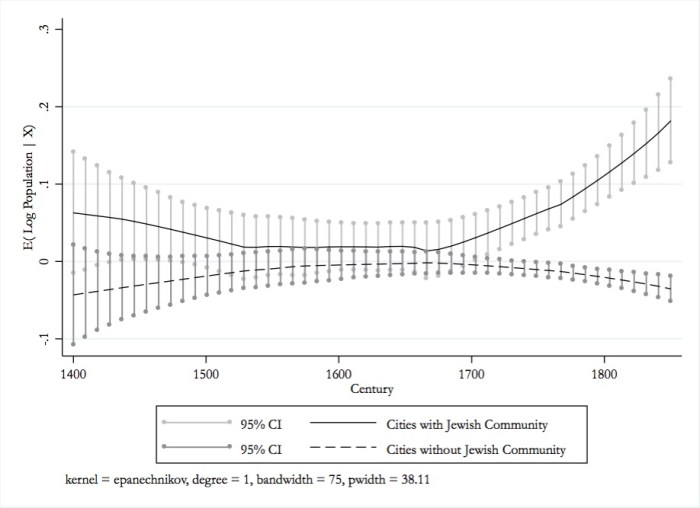
Across specifications, we find that cities with Jewish communities experienced no growth advantage in the 15th and 16th centuries. After 1600, however, they began to grow significantly faster.

motivationlpoly

The relationship we observe in the Figure does not appear to be inline with a pure human capital story. Jews had higher human capital than Christians throughout the medieval and early modern period. But the growth advantage of cities that had Jewish communities only became evident after 1600. This raises the possibility that something else changed around  17th century that made the human capital and skills of Jews more complementary to economic growth.

Two Mechanisms: Jewish Emancipation and Market Access

The two factors that stand out in explaining the emergence of a growth advantage for cities with Jewish communities after 1600 but not before are: (1) Jewish Emancipation after 1750; and (2) a complementarity between the presence of a Jewish community and market access.

The process of Jewish emancipation began in continental Europe after 1780. It was a major institutional break that signified a major change in the economic, social, and political status of the Jews in Europe. In work with Jean-Paul Carvalho, I’ve shown that Jewish emancipation lead to a religious schism and the emergence of both Reform and Ultra-Orthodox Judaism.

In the period before Jewish emancipation, legal barriers limited the ability of Jews to put their labor to its highest value use. Jewish businesses were prevented from hiring non-Jewish workers. Jews could not attend universities. Moreover, Jews and Christians were culturally isolated. This changed with emancipation, and we expect to see it reflected in the contribution of Jewish communities to city growth in the post-1750 period.

The second factor we study is the complementarity between the presence of a Jewish community and the development of markets. The historical literature points to the importance of Jewish trading and financial networks. But, while economic historians have conducted numerous studies of market integration during the early modern period, with a few exceptions these have focused on the grain trade with little systematic study of other markets due to data limitations. Jewish merchants in medieval and early modern Europe, however, did not play a prominent role in the grain trade but, rather, were involved in the transport of diamonds, sugar, silks, tobacco, and other luxury products in addition to playing a large role in banking and finance. Therefore, rather than looking at grain markets, we explore a more general measure of market integration based on market access.

Market access depends on the population size of nearby cities weighted by the cost associated with the least cost travel path. We show that market access was increasing for all cities after 1700. We find evidence that cities with Jewish communities were better able to take advantage of this increase in market access. As we detail in the paper, our findings are consistent with the argument made by numerous historians that Jewish trading and finance networks help to knit together the European economy, particularly in the period 1650 to 1800 (Israel, 1985).


Our analysis provides support for the accounts of historians who have emphasized the important role played by Jewish traders in 17th and 18th century Europe (such as Fortune, 1984; Israel, 1985; Trivellato, 2009). Furthermore, our story is in line with institutional arguments such as those developed by Douglass North, John Wallis and Barry Weingast, and Daron Acemoglu and James Robinson.  In the Middle Ages, the presence of Jewish communities was part of an institutional arrangement that extracted rents from society and distributed them among members of the ruling elite. The eradication of these rent-seeking arrangements and the liberalization of Jewish economic activity, first in the Netherlands and England and then in the rest of Europe following Jewish Emancipation, was of critical importance as it is in those cities that possessed emancipated Jewish communities that we observe the strongest relationship between the presence of Jews and economic growth.

BC’s weekend reads

  1. Doug Bandow on Australia’s geopolitical options
  2. The moral perils of Being Polish
  3. The moral perils of sect-coding (Shi’a forces, Iraqi armed forces)
  4. Can the militarization of the police in the US be a good thing?
  5. Warfare and economic growth in the preindustrial world

BC’s weekend reads

  1. Anthropology as critique of reality: A Japanese turn (pdf)
  2. Flat-footed Giants: Zaibatsu and Industrialization in Meiji Japan, 1868-1912 (pdf)
  3. A hypothetical federation between Japan and the United States

The High Wage Economy: the Stephenson critic

A recent trend has emerged in economics. The claim is that high wages can have a dynamic positive effect on market economies.  The intuition is that high wages increase productivity because they incite management to find new techniques of production. In essence, its an argument about efficiency wages: efficiency wages increase incentives to innovate on the part of managers, they can also incite workers to acquire more human capital and work harder and more diligently.

In economic history, this claim has been taken up by scholars like Robert Allen (see his work here for the general public) who argues that the Industrial Revolution took place in England because of high wages. The high-wages of England in the 17th and 18th centuries (relative to all other areas in Europe), together with cheap energy, created an incentive for capital-intensive methods of production (i.e. the industrial revolution). In fact, a great share of the literature on the desirability of high wages for economic development has emanated from the field of economic history.

I have always been skeptical of this argument for two reasons. The first is that efficiency wages is a strange theory that relies on debatable assumptions about labor (strangely, I have been convinced of this point by Austrian scholars like Don Bellante and Pavel Ryksa). The second is that numerous scholars have advanced large criticisms of the underlying data. Robert Allen – the figurehead proponent of the high wage argument – has been constantly criticized by historians like Jane Humphries (see here) for the quality of the data and assumptions used. Allen defends himself on numerous occasions and many of his replies (mainly those on the role of family size in living standards) show that his initial case might have been too conservative (i.e. he is more “correct” than he claims).

Until a year or two ago, I was agnostic on the issue even though I was skeptical. That was until I met Judy Stephenson – a colleague at the London School of Economics. Judy did what I really like to do – dig for data (yes, I am weird like that). She went to the original sources of data used by Allen and others and she looked at what any Law-and-Economics buffs like me like to look at – transaction costs and contracting models.

She recently published her work as a working paper at the LSE and what she found is crucial! Labor was not hired directly, it was hired through contractors who charged costs on the basis of days worked. But this did not translate into wages actually paid to workers. The costs included risks and overheads for contractors. Somewhere between 20% and 30% of the daily costs were not given to workers as wages. Thus, the wage series used to claim that England (Stephenson concentrates on London though) had high wages are actually 20% to 30% below the level often reported. They are also substantially close to those in western Europe.

Thus, the high wage story for England seems weaker. This little piece of historical evidence brought about by Judy is something to think about carefully when one makes the argument that high wages are conducive to growth. Since most of the argument brought to the public was informed largely by this argument in economic history, it makes sense to be cautious when thinking about it in the future.

Why farms die and should die


In Canada, I have the frustrating habit of criticizing government support to the agricultural sector especially entry-barriers in the form of production quotas. Most of those policies are regressive in the sense that they reallocate income from the poorest to the richest. In fact, their entire aim is to artificially increase the income of farmers (especially dairy and poultry farmers) at the expense of the rest of the population. However, when lobbyists for these subsidies come out in public, they do so under different disguises. Their favorite? Farms are dying.

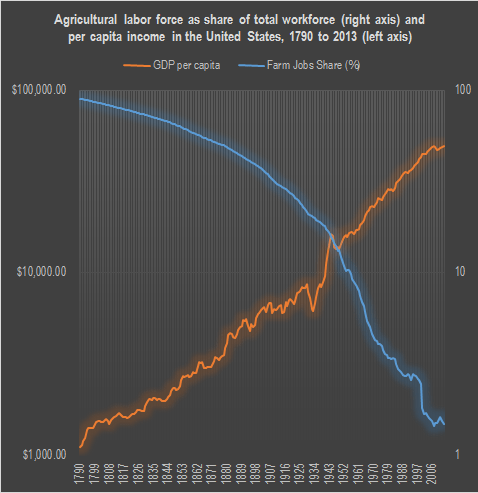
In each radio debate where that boogeyman is raised, I reply that “yes, they are dying and its a good thing”. If we can feed more and more people with less and less farmers using less and less land, that’s a good thing. In fact, it’s the greatest thing that happened in economic history. Less two centuries ago, 90% of the workers in some western economies were involved in agricultural activities. Today, that proportion has fallen to less than 1.5%. Thousands of farms disappeared, we liberated millions of acres of land to return to their natural state and in the process, we became rich and well-fed!

In testimony of this fact, which is my favorite economic history fact, I decided to recompute a graph by Mark Perry of the American Enterprise Institute but I added the GDP per capita figures for the same period (1790 to 2013).

GDPagriculture

Yes, let the farms die. Let the most productive stay in the fields and let them feed humanity while the others become engineers, doctors, teachers, businessmen, welders, carpenters or whatever trade they are best at!

Women and secular stagnation

As an economic historian, I’ve always had a hard time with the idea of secular stagnation. After all, one decade of slow growth is merely a blip on the twelve millenniums of economic history (I am not that interested with the pre-Neolithic history, but there is some great work to be found in archaeology journals). Hence, Robert Gordon’s arguments fall short on me.

That was until I was sparked to react to a comment by Emily Skarbek at Econlib. Overall, she is skeptical of Gordon’s claims of secular stagnation. But not for the same reasons. She claims that there are many improvements in welfare that we are not capturing through national income accounts. This is basically the same point as the one made by the great Joel Mokyr (the gold standard of economic historians).

It is true that national accounts have some large conceptual problems regarding measuring output when there are massive technological changes. Yet, all these problems don’t go in the same direction. More precisely, they don’t all lead to underestimation of growth.

My favorite example of one that leads us to overestimate growth is the one I keep giving my macroeconomics students at HEC Montreal. Assume an economy with a labor-force participation rate of 50%. Basically, only males work. All women stay at home for household chores and childcare. In that case, all measured output is male-produced output. Since national accounts don’t consider household production, all the output of women in the households of this scenario is non-existent.

Now assume a technological change causing a shift of 10% of women to the workforce at the same wage rate as men. That boosts labor participation rate to 55% and output by 5%. However, that would largely overestimate growth caused by this shift. After all, when my grandmothers were raising my parents, they were producing something. It was not worthless output. Obviously, if my grandmothers went to work, there was some net added value, but not as much as 5%. However, according to national account, the net increase in GDP is … 5%.

Obviously wrong right? Now, think of the economic history of the last 100 years. Progressively, female labor-force participation increased as marriages were delayed and family sizes were reduced. Unmarried women stayed on the market longer. Then, the introduction of new household technologies allowed some married women to join the labor force more actively. Progressively, women accumulated more human capital and became more active in the labor force. So much that in many western countries, both genders have equal labor-force participation rates.

As they shifted from household production to market production, we considered that everything they did was a net added value. We never subtracted the value of what was produced before. Don’t get me wrong, I am happy that women work instead of toiling inside a household to handwash dirty clothes. Yet, it would be both statistically incorrect and morally insulting to say that what women did in the household had no value whatsoever. 

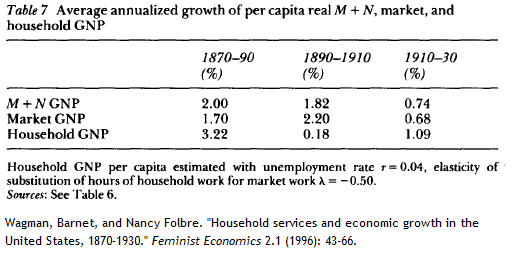
The role of household production in reducing the quality of growth estimates goes back to the 1870s! A 1996 article in Feminist Economics (which I use a lot in my own national account sections of macroeconomics classes) shows the following changes in growth rates when we account for the value of household production. Instead of increasing to 1910 and then falling to 1930, growth in the United States falls to 1930. While the growth rates remain appreciable, they nonetheless indicate a massively different interpretation of American economic history.

SecularStagnation


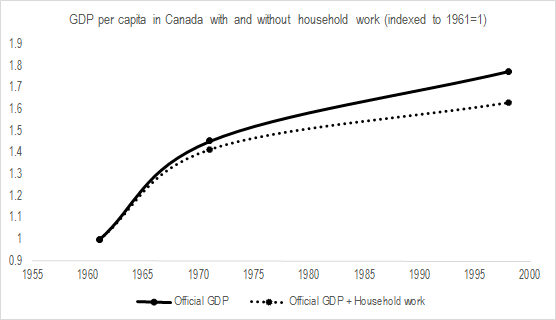
Sadly, I do not possess a continuation of such estimates to later points in time for the United States. I know there is an article by the brilliant Valerie Ramey in the Journal of Economic History, but I am not sure how to compute this to reflect changes in overall output. I intend to try to find them for a short piece I want to submit later in 2016. Yet, I do have estimates for my home country of Canada. Combining a 1979 paper in the Review of Income and Wealth with a working paper from Statistics Canada, it seems that the value of household production falls from 45% of GNP in 1961 to 33% in 1998. When we adjust GDP per capita to consider the changes in household work in Canada, the growth path remains positive, but it is less impressive.

SEcularStagnation2

I am not saying that Gordon is right to say that growth is over. I am saying that the accounting problems don’t all go in the direction of invalidating him. In fact, if my point is correct, proper corrections would reduce growth rates dramatically for the period of 1945 to 1975 and less so for the period that followed. This may indicate that “slow growth” was with us for most of the post-war era. That’s why I reacted to the blog post of Skarbek.

It also allows me to say the thing that is the best buzz-kill for economics students: national accounting matters!

Malthusian pressures (as outcome of rent-seeking)

Nearly a week ago, I intervened in a debate between Anton Howes of King’s College London whose work I have been secretly following  (I say “secretly” because as an alumnus of the London School of Economics, I am not allowed to show respect for someone of King’s College) and Pseudoerasmus (whose identity is unknown but whose posts are always very erudite and of high quality – let’s hope I did not just write that about an alumnus of King’s College). Both bloggers are heavily involved in my first field of interest – economic history.

The debate concerned the “Smithian” counter-effect to “Malthusian pressures”. The latter concept refers to the idea that, absent technological innovation,  population growth will lead to declining per capita as a result of marginally declining returns. The former refers to the advantages of larger populations: economies of scale, more scope for specialization and market integration thanks to density. Now, let me state outright that I think people misunderstand Malthusian pressures and the Smithian counter-effect.

My point of is that both the “Smithian counter-effect” and “Malthusian pressures” are merely symptoms of rent-seeking or coordination failures. In the presence of strong rent-seeking by actors seeking to reduce competition, the Smithian counter-effect wavers and Malthus has the upper hand. Either through de-specialization, thinner of markets, shifting to labor-intensive technologies, market disintegration and lower economies of scale, rent-seeking diminishes the A in a classical Cobb-Douglas function of Total Factor Productivity (Y=AKL). This insight is derived from my reading of the article by Lewis Davis in the Journal of Economic Behavior and Organization which contends that “scale effects” (another name for a slight variant of the “Smithian counter-effect) are determined by transaction costs which are in turn determined by institutions. If institutions tend to favor rent-seeking, they will increase the likelihood of coordination failure. It is only then that coordination failures will lead to “Malthusian pressures” with little “Smithian counter-effect”. Institutions whose rules discourage rent-seeking will allow markets to better coordinate resource use so as to maximize the strength of the “Smithian counter-effect” while minimizing the dismal Malthusian pressures.

In essence, I don’t see the issue as one of demography, but as one of institutions, public choice and governance. I am not alone in seeing it this way (Julian Simon, Jane Jacobs and Ester Boserup have documented this well before I did). Why the divergence?

This is because many individuals misunderstand what “Malthusian pressures” are. In an article I published in the Journal of Population Research, me and Vadim Kufenko summarize the Malthusian model as a “general equilibrium model”. In the long run, there is an equilibrium level of population with a given technological setting. In short-run, however, population responds to variation in real wages. Higher real wages from a “temporary” positive real shock will lead to more babies. However, once the shock fades, population will adapt through two checks: the preventive check and the positive check. The preventive check refers to households delaying family formation. This may be expressed through later marriage ages, planned sexual activities, contraception, longer stays in the parental household and greater spacing between births. The positive check refers to the impact of mortality increasing to force the population back to equilibrium level. These checks return to the long-term equilibrium. Hence, when people think of “Malthusian pressures”, they think of population growth continuing unchecked with scarce ressources. But the “Malthusian model” is basically a general equilibrium model of population under fixed technology. In that model, there are no pressures since the equilibrium rates of births and deaths are constant (at equilibrium).

However, with my viewpoint, the equilibrium levels move frequently as a result of institutional regimes. They determine the level of deaths and births. “Poor” institutions will lead to more frequent coordination failures which may cause, for a time, population to be above equilibrium – forcing an adjustment. “Poor” institutions would also lead to an inability to respond to a change in constraints (i.e. the immediate environment) by being rigid or stuck with path-depedency problems which would also imply the need for an adjustment.  “Good” institutions will allow “the Smithian counter-effect” to intervene through arbitrage across markets to smooth the effect of local shocks, a greater scope for specialization etc.

My best case for illustration is a working paper I have with Vadim Kufenko (University of Hohenheim) and Alex Arsenault Morin (HEC Montréal) where we argue that population pressures as exhibited by the very high levels of infant mortality rates in mid-19th century Quebec were the result of institutional regimes. The system of land tenure for the vast majority of the population of Quebec was “seigneurial” and implied numerous regressive transfers and monopoly rights for landlords. This system was also associated with numerous restrictions on mobility which limited the ability of peasants to defect and move. However, a minority of the population (but a growing one) lived under a different institution which did not impose such restrictions, duties and monopolies. In these areas, infant mortality was considerably lower. We find that, adjusting for land quality and other factors, infant mortality was lower in these areas for most age groups. Hence, we argued that what was long considered as “Malthusian pressures” were in fact “institutional pressures”.

Hence, when I hear people saying that there are problems linked to “growing population”, I hear “because institutions make this a problem” (i.e. rent seeking).

Philosophical Research on Seasteading

The Seasteading Institute has recently published my philosophical dissertation on ‘Seasteading’. You can find it in the key research section of their Law and Policy page: http://www.seasteading.org/law-and-policy/.

Wayne Gramlich and Patri Friedman[1] founded the Seasteading Institute in 2008 in order to promote the seasteading movement, which has intellectually attracted mostly libertarian-minded individuals. The institute has also attracted funding from Paypal cofounder and early facebook investor Peter Thiel.[2]

A seastead is a permanent habitable dwelling on the ocean that preferably lies outside governmental waters. The Seasteading Institute believes that the creation of permanent societies on the seas can provide an experimentation space for innovative forms of socio-political organizations. The ultimate aim of seasteading is that newly emerging societies will inspire social changes around the world and contribute to human flourishing. First seasteads will be small-scale projects and they may even be constructed within existing governmental territories. However, seasteads could expand organically as technologies improve and innovative ideas of the functions of seasteads would emerge. One of the core ideas of seasteading is that an open experimentation space for social organizations will lead to progress in social rules and legislations, just as an experimentation space for new technologies leads to technological progress.

It is undeniable that social rules and legislations heavily influence all aspects of life, including technological progress and social well-being. One could for example compare North and South Korea, two countries that separated from each other in 1945. Both countries have had more or less the same culture and similar natural resources. However, what differs is their form of social organization; the North came under communist rule, whereas the South embraced western-style capitalism and democracy. Almost 70 years later, the differences in wealth, technological advancement, and social well-being are striking. South-Korea’s GDP per capita is for example 18 times larger, its internet penetration is more than 815 times greater, its life expectancy rate is 10 years longer, and the heights of South Korean pre-school boys are on average 4 centimeters longer. (Taylor, 2013, April 8).

The Seasteading Institute believes that, given that social progress and well-being heavily depend on how society is structured, mankind could make a huge step forward by letting social entrepreneurs start up seasteads to compete with governments in the industry of law-making and by letting millions engage in the experimentation with new forms of social organization.

In the paper, I provide a philosophical investigation of the concept of seasteading from a libertarian anarchist perspective. My investigation revolves around the following research question: “given that governments are resistant to structural changes of governance, how can mankind discover better forms of social organization?”

I argue that seasteading can fulfill that important role of moving mankind forward by experimenting with and finding new forms of social organizations that are best for human flourishing.

In the first chapter, I maintain that one core focus of political philosophy is to deal with the realities of value pluralism and political disagreements. I also contend that the most common form of social organization, representative democracy, does not satisfactorily deal with these realities. Hence, we should look for political possibilities beyond representative democracies. In order to discover these possibilities, we should experiment with new forms of social organization.

Chapter two discusses why there is currently little experimentation with social orders. I approach the issue from a meta-system level perspective and contend that all land on earth is more or less already claimed by states, which leaves little opportunity for people to start new societies on land. By applying the theory of monopoly economics, I maintain that the state’s monopoly on jurisdiction and coercion does not encourage them to provide good rules of law. It rather makes states extremely resistant to large-scale social changes. The obvious solution for finding better forms of governance then would be the introduction of competition into the industry of governments.

Chapter three deals with the epistemological attitude required for the experimentation space. I maintain that this attitude consists of having a sociological imagination, being epistemologically modest, realizing that social order can emerge spontaneously, and that the utopian dream of a single perfect society is impossible.

Chapter four discusses seasteading as the means by which the experimentation space could be realized. By homesteading the seas, a community can build and test new forms of social organization outside the scope of current governments’ control. It could generate new knowledge on social orders, thereby contributing to political philosophy and the social sciences. It could moreover also ease political tensions between citizens with different comprehensive doctrines.

Finally, I raise two objections to seasteading and address them accordingly.

If you would like to see an awesome seastead design, you should watch this video here:

Footnotes
[1] It may be interesting to know that Patri Friedman is the grandson of Milton Friedman and the son of libertarian anarchist David Friedman.

[2] Peter Thiel, previously a student of Political Philosophy at Stanford University, is also founder of the libertarian-minded newspaper The Stanford Review. He is a venture capitalist who is very much influenced by the Austrian School of Economics. With this in mind, it may not be surprising that the early mission of PayPal was to give its users more control over their money by enabling them to switch currencies. The goal of PayPal was to make it, in Thiel’s words (1999), “nearly impossible for corrupt governments to steal wealth from their people through their old means [inflation and wholesale currency devaluations] because if they try the people will switch to dollars or Pounds or Yen, in effect dumping the worthless local currency for something more secure” (Jackson, 2004).

References
Jackson, E.M. (2004). The PayPal Wars: battles with eBay, the media, the mafia, and the rest of planet earth. Los Angeles: World Ahead Publishing, Inc.
Taylor, A. (2013, April 8). A Crazy Comparison of Life in North Korea and South Korea. Retrieved from http://businessinsider.com
Thiel, P. (2009). The Education of a Libertarian. Retrieved from http://cato-unbound.org

Migration from Bangladesh: Causes and Challenges

Migration and emigration from Bangladesh is a regular phenomenon. Historically, large scale migration from the region constituting present-day Bangladesh started after the tea plantation was introduced in Assam by the British rulers in the early nineteenth century. Large numbers of coolies (porters) were needed for the tea gardens. To fulfil that demand the Assam Company began to import labourers from Bengal (especially from its eastern part) in 1853. In contemporary times, the first batch of emigrants from Bangladesh were the ‘refugees’ seeking shelter in a foreign country, after atrocities started by the Pakistan Army in East Pakistan in 1971. This phenomenon did not stop even after the East Pakistan was liberated and Bangladesh was formed in 1971. Instead, since then many Bangladeshis have been migrating to Europe, West Asia, India, and East Asia. Migration has its impact on the demographic composition of the host countries. For example in some cities of Italy, like Lazio, Lombardy, and Veneto, the migrants from Bangladesh comprise a significant number of the population. In developed countries most of these migrants are engaged in service sector jobs like souvenir selling, or being a vendor, shop worker, restaurant waiter, or domestic maid.

Causes for large scale Migration from Bangladesh

Although its economy is stable, maintaining between 5-6 percent Gross Domestic Product (GDP) growth for the last two decades, it is not viable enough to occupy all skilled, semi-skilled, and non-skilled workers in the country. Statistically, only 26 percent of its population lives below the national poverty line of US$ 2 per day, but a substantive percentage remains unemployed or underemployed. To evade poverty, unemployment, and under employment, many Bangladeshi migrate to other countries. Often, they do so even at the cost of their lives. Many times, such a desperate act has lead them to be trapped in a situation like the one happened in May 2015, when about 8,000 people consisting of Rohingyas from Myanmar and Bangladeshis were stranded at sea close to Thailand. While moving illegally, many Bangladeshis have even lost their lives. The most recent high profile case of death of Bangladeshi migrants occurred on 28 August 2015 in North Africa, where at least twenty four Bangladeshis, including two minor children, died after two boats carrying up to 500 migrants sank off the coast of Libya. The first boat, which capsized early on 27 August 2015, had nearly 100 people on board. The second, which sank later, was carrying about 400 passengers.

As 80 percent of Bangladesh’s geographic area is situated in the flood plains of Ganges, Brahmaputra, Meghna, and many other small rivers, a contributing push factor to the migration is the character of these deltaic rivers. They often change their course, forcing many inhabitants to move to new settlements. The submergence of chors (silt areas) during the flood season forces many inhabitants, deliberately or out of sheer ignorance, to migrate into India. Out of these total number of environmental migrants, only a few return after the normalisation of the situation; others look out for ways to earn their livelihood in their ‘acquired ‘or ‘adopted’ land.

Changing Gender Pattern and Consequences of Migration

Gender-wise, like other countries from the developing world, the migration-related statistics of Bangladesh too is tilted in favour of males, of which there are around three million working in different parts of the world. But in last few years there has been a constant increase in the number of female migrants, who can migrate either alone or as a spouse. As reported in the Daily Star (a well-respected English language daily in Bangladesh), according to the June 2015 statistics of Bangladesh’s Bureau of Manpower, Employment and Training (BMET), a total of 37,304 female workers had gone to different countries in 2012; it has increased to 76,007 in 2014. One country which stands out in terms of employment of female workers from Bangladesh is the United Arab Emirates (UAE). According to the BMET statistics, the UAE is home to 27 percent of the total female migrant workers of Bangladesh. Two basic reasons can explain this rising trend. Firstly, the demand for female workers in the UAE is higher than that of other countries. Secondly, attractive salary in the UAE draws more female migrant workers there than other countries. After the UAE, Lebanon hires a large number of female migrant workers. While the country has only 1.3 percent of total Bangladeshi migrants, it nevertheless has the second highest percentage of female migrants (24.3 percent) compared to all other countries. About 97,000 female workers reside in Lebanon.

Host countries remain hostile to the migrants. Sometimes, under pressure from political and economic constituencies, the host country (ies) restricts its visa policy for the citizens of a particular country or even denies issuing it to them altogether. The migrants are accused of ‘cultural invasion’ through demographic transition. They are also blamed for taking away job opportunities from the locals. Quite often, the migrants face violence from the locals, which is a sign of an extreme form of hatred towards them. Bangladeshi migrants have faced both situations. In 2014 Saudi Arabia stopped issuing visas for Bangladeshis even for the Umrah (a pilgrimage to Mecca performed by Muslims; it can be undertaken at any time of the year, in contrast to the Hajj). The Saudi officials claimed that in 2014 many Bangladeshis for whom Umrah visas were issued did not return to their country after performing the ritual. The Umrah visa was restored on August 5, 2015, after Bangladeshi foreign minister Md Shahriar Alam’s visit to Saudi Arabia, where a request was made to the Saudi State Minister for Foreign Affairs (Nizar bin Obaid Madani) for Umrah visas to be resumed.

Termed as ‘illegal’, the Bangladeshi migrants have faced violence in the Indian states bordering Bangladesh. The radical groups in the area have centuries-old grievances against them. They are considered to be an economic and cultural threat to the region. Many contrasting figures are being presented by these groups to justify their position; in reality, according to the United Nations data of 2013, the number of Bangladeshi in India is around 3.2 million. Migrants from Bangladesh have faced violence not only in India, but in other parts of the world too. In Thailand there have been rampant cases of exploitation of Bangladeshi women working in various sectors, including the flesh trade. In West Asian countries, the women workers are forced to work in many houses as a maid and beaten when they demand salary from their ‘masters’. In Malaysia, too, the cases of abuse of maids is on the rise. Most of these maids are from Bangladesh. In February 2015 Bangladeshi workers faced targeted violence in Rome, Italy.

Conclusions

Remittances play a crucial role in pushing the Bangladeshi economy. According to the World Bank, total remittance received by Bangladesh in 2013 was $14.5 billion, which has increased to $ 15.0 billion in 2014-15. In 2014, the remittances constituted 8.21 % of the GDP of Bangladesh. In January-March 2015 quarter Bangladesh earned $ 3771.16 million of remittance, which is 8.49 percent higher than the previous year. These remittances have helped Bangladesh’s economy maintain its 5.5- 6 percent GDP growth.

Though the migrants are important to Bangladesh’s economy, many serious ill effects of migration too have emerged. Under the guise of migration, human trafficking is taking place from Bangladesh to many parts of the world. Women and children from Bangladesh are trafficked into India, East Asia, and West Asia for commercial sexual exploitation and to serve as bondage labour. To check this activity, especially human trafficking of females, the government of Bangladesh issues licences to the recruiting agencies, which are renewed at regular intervals of time and maintained by the concerned agency. Also, in 2013 the Government of Bangladesh revised the Overseas Employment and Migration Act which includes Emigration Rules, Rules for Conduct and Licensing Recruiting Agencies, and Rules for Wage Earner’s Welfare Fund. Despite all such steps migrants are being exploited by the domestic agencies and they face umpteen challenges in the host country they end up in.

Tricks of Unequal Poverty: A Repost (In Honor of Bernie Sanders)

Note: This is an old post, reproduced today in honor of American Senator and presidential candidate Bernie Sanders

In the previous installment:

I explained how the general standard of living in America, denoted by real income, grew a great deal between 1975 and a recent date, specifically, 2007. This, in spite of a widespread rumor to the contrary. The first installment touched only a little on the following problem: It’s possible for overall growth to be accompanied by some immobility and even by some regress. Here is a made-up example:

Between the first and the second semester, grades in my class have, on the average, moved up from C to B. Yet, little Mary Steady’s grade did not change at all. It remained stuck at C. And Johnny Bad’s grade slipped from C to D.

Flummoxed by the sturdiness, the blinding obviousness of the evidence regarding general progress in the standard of living, liberal advocates like to take refuge in more or less mysterious statements about how general progress does not cover everybody. Or not everybody equally, which is a completely different statement. They are right either way and it’s trivial that they are right. Let’s look at this issue of unequally distributed economic progress in a skeptical but fair manner.

It’s awfully hard to prevent the poor, women and minorities from benefiting

I begin by repeating myself. As I noted in Part One, it’s too easy to take the issue of distribution of income growth too seriously. Some forms of improvements in living standard simply cannot practically be withheld from a any subgroup, couldn’t be if you tried. Here is another example: Since 1950, mortality from myocardial infarctus fell from 30-40% to 5-8%. (from a book review by A. Verghese in Wall Street Journal 10/26 and 10/27 2013). When you begin looking at these sort of things, unexpected facts immediately jump at you.

Fishing expeditions

The US population of 260 millions to over 300 million during the period of interest 1975-2007 can be divided in an infinity of segment, like this: Mr 1 plus Mr 2; Mr 2 plus Mrs 3; Mr 2 and Mrs3 plus Mr 332; Mr 226 plus Mrs 1,000,0001; and so forth.

Similarly, the period of interest 1975 to 2007 can be divided in an infinity of subperiods, like this: Year 1 plus year 2; year 1 plus year 3; years 1, 2, 3 plus year 27; and so forth. You get the idea.

So, to the question: Is there a subset of the US population which did not share in the general progress in the American standard of living during some subperiod between 1975 and 2007?

The prudent response is “No.” It’s even difficult to imagine a version of reality where you would be right to affirm:

“There is no subset of the US population that was left behind by general economic progress at any time during the period 1975- 2007.”

Let me say the same thing in a different way: Given time and good access to info, what’s the chance that I will not find some Americans whose lot failed to improve during the period 1975 to 2007? The answer is zero or close to it.

This is one fishing expedition you can join and never come back empty-handed, if you have a little time.

Thus, liberal dyspeptics, people who hate improvement, are always on solid ground when they affirm, “Yes, but some people are not better off than they were in 1975 (or in ______ -Fill in the blank.)” The possibilities for cherry-picking are endless (literally).

Everyone therefore has to decide for himself what exception to the general fact of improvement is meaningful, which trivial. This simple task is made more difficult by the liberals’ tendency to play games with numbers and sometimes even to confuse themselves in this matter. I will develop both issues below.

To illustrate the idea that you have to decide for yourself, here is a fictitious but realistic example of a category of Americans who were absolutely poorer in 2007 that they were in 1975. You have to decide whether this is something worth worrying about. You might wonder why liberals never, but never lament my subjects’ fate.

Consider any number of stock exchange crises since 1975. There were people who, that year, possessed inherited wealth of $200 million each, generating a modest income of $600,000 annually. Among those people there were a number of stubborn, risk-seeking and plain bad investors who lost half of their wealth during the period of observation. By 2007, they were only receiving an annual income of $300,000. (Forget the fact that this income was in inflation shrunk dollars.) Any way you look at it, this is a category of the population that became poorer in spite of the general (average) rise in in American incomes. Right?

Or, I could refer to the thousands of women who were making a living in 1975 by typing. (My doctoral dissertation was handwritten, believe it or not. Finding money to pay to get it typed was the hardest part of the whole doctoral project.) One of the many improvements brought about by computers is that they induced ordinary people to learn to do their own typing. Nevertheless, there was one older lady who insisted all along on making her living typing and she even brought her daughter into the trade. Both ladies starved to death in 2005. OK, I made them up and no one starved to death but you get my point: The imaginary typists fell behind, did not share in the general (average) improvement and their story is trivial.

So, I repeat, given a some time resources, I could always come up with a category of the US population whose economic progress was below average. I could even find some segment of the population that is poorer, in an absolute sense, than it was at the beginning of the period of observation. Note that those are two different finds. Within both categories, I could even locate segments that would make the liberal heart twitch. I would be a little tougher to find people who both were poorer than before the period observation and that would be deserving of liberal sympathy. It would be a little tough but I am confident it could be done.

So, the implication here is that when it comes to the unequal distribution or real economic growth you have to do two things:

A You have to slow down and make sure you understand what’s being said; it’s not always easy. Examples below.

B You have to decide whether the inequality being described is a moral problem for you or, otherwise a political issue. (I, for one, would not lose sleep over the increased poverty of the stock exchange players in my fictitious example above. As for the lady typists, I am sorry but I can’t be held responsible for people who live under a rock on purpose.)

Naively blatant misrepresentations

A hostile liberal commenter on this blog once said the following:

“Extreme poverty in the United States, meaning households living on less than $2 per day before government benefits, doubled from 1996 to 1.5 million households in 2011, including 2.8 million children.”

That was a rebuttal of my assertion that there had been general (average) income growth.

Two problems: first, I doubt there are any American “households” of more than one person that lives on less than $2 /day. If there were then, they must all be dead now, from starvation. I think someone stretched the truth a little by choosing a misleading word. Of maybe here is an explanation. The commenter alleged fact will provide it, I hope.

Second, and more importantly, as far as real income is concerned, government benefits (“welfare”) matter a great deal. Including food stamps, they can easily triple the pitiful amount of $2 a day mentioned. That would mean that a person (not a multiple person- household ) would live on $1080 a month. I doubt free medical care, available through Medicaid, is included in the $2/day. I wonder what else is included in “government benefits.”

The author of the statement above is trying to mislead us in a crude way. I would be eager to discuss the drawbacks of income received as benefits in- instead of income earned. As a conservative, I also prefer the second to the first. Yet, income is income whatever its source, including government benefits.

The $2/day mention is intended for our guts, not for our brains. Again, this is crude deception.

Pay attention to what the other guy asserts sincerely about economic growth.

Often, it implies pretty much the reverse of what he intends. In an October 2013 discussion on this blog about alleged increasing poverty in the US, asked the following rhetorical question:

“Or have Americans’ standard of living only improved as the gap [between other countries and the US] closed?“

I meant to smite the other guy because the American standard of living has only increased, in general, as we have seen (in Part One of this essay posted). A habitual liberal commenter on my blog had flung this in my face:

“….Since 1975, practically all the gains in household income have gone to the top 20% of households…” (posted 10/23/13)

(He means in the US. And that’s from a source I am not sure the commenter identified but I believe it exists.)

Now, suppose the statement is totally true. (It’s not; it ignores several things described in Part One.) The statement says that something like roughly 60 million Americans are richer than they, or their high income equivalents were in 1975. It also says that other households may have had almost stationary incomes (“practically”). The statement does not say in any way that anyone has a lower income in 1975. At best, the statement taken literally, should cause me to restate my position as follows:

“American standards of living have remained stationary or they have improved….”

You may not like the description of income gains in my translation of the liberal real statement above. It’s your choice. But the statement fails to invalidate my overall assertion: Americans’ standard of living improved between 1975 and 2007.

What the liberal commenter did is typical. Liberals always do it. They change the subject from economic improvement to something else they don’t name. I, for one, think they should be outed and forced to speak clearly about what they want to talk about.

Big fallacies in plain sight

Pay attention to seemingly straightforward, common liberal, statist assertions. They often conceal big fallacies, sometimes several fallacies at once.

Here is such an assertion that is double-wrong.

“In the past fifteen years the 20% of the population who receive the lowest income have seen their share of national income decrease by ten percentage points.” (Posted as a comment on my blog on 10/21/13)

Again, two – not merely one – strongly misleading things about this assertion. (The liberal commenter who sent it will assure us that he had no intention to mislead; that it’s the readers’ fault because, if…. Freaking reader!)

A The lowest 20% of the population of today are not the same as those of fifteen years ago, nor should you assume that they are their children. They may be but there is a great deal of vertical mobility in this country, up and own. (Just look at me!)The statement does not logically imply that any single, one recognizable group of social category became poorer in the interval. The statement in no way says that there are people in America who are poor and that those same people became poorer either relatively or in an absolute sense. Here is a example to think about: The month that I was finishing my doctoral program, I was easily among the 20% poorest in America. Hell, I probably qualified for the 5% poorest! Two months later, I had decisively left both groups behind; I probably immediately qualified for the top half of income earners. Yet, my progress would not have falsified the above statement. It’s misleading if you don’t think about it slowly, the way I just did.

I once tried to make the left-liberal vice-president of a Jesuit university understand this simple logical matter and I failed. He had a doctorate from a good university in other than theology. Bad mental habits are sticky.

B Percentages are routinely abused

There is yet another mislead in the single sentence above. Bear with me and ignore the first fallacy described above. The statement is intended to imply that the poorer became poorer. In reality, it implies nothing of the sort. Suppose that there are only two people: JD and my neighbor. I earn $40, neighbor earns $60. In total, we earn. $100 Thus my share of our joint income is 40%, neighbor’s is 60%. Then neighbor goes into business for himself and his income shoots up to $140. Meanwhile, I get a raise and my income is now $60.

In the new situation, my share of our joint income has gone down to 30% (60/60+140), from 40%. (Is this correct? Yes, or No; decide now.) Yet, I have enjoyed a fifty percent raise in income. That’s a raise most unions would kill for. I am not poorer, I am much richer than I was before. Yet the statement we started with stands; it’s true. And it’s misleading unless you pay attention to percentages. Many people don’t. I think that perhaps few people do.

My liberal critic was perhaps under the impression that his statement could convince readers that some Americans had become poorer in spite of a general (average rise) in real American income. I just showed you that his statement logically implies no such thing at all. If he want to demonstrate that Americans, some Americans, have become poorer, he has to try something else. The question unavoidably arises: Why didn’t he do it?

Was he using his inadequate statement to change the subject without letting you know? If you find yourself fixating on the fact that my neighbor has become even richer than I did because he more than doubled his income, the critic succeeded in changing the subject. It means you are not concerned with income growth anymore but with something else, a separate issue. That other issue is income distribution. Keep in mind when you think of this new issue that, in my illustration of percentages above, I did become considerably richer.

Liberals love the topic of unequal progress for the following reason:

They fail to show that, contrary to their best wish, Americans have become poorer. They fail almost completely to show that some people have become absolutely poorer. They are left with their last-best. It’s not very risky because, as I have already stated, it’s almost always true: Some people have become not as richer as some other people who became richer!

Policy implications of mis-direction about income growth

The topic matters because, in the hands of modern liberals any level of income inequality can be used to call for government interventions in the economy that decrease individual liberty.

Here are a very few practical, policy consequences:

A Income re-distribution nearly always involves government action, that is, force. (That’s what government does: It forces one to do what one wouldn’t do out of own inclination.) That’s true for democratic constitutional governments as well as it is for pure tyrannies. In most countries, to enact a program to distribute the fruits of economic growth more equally it to organize intimidation and, in the end, violence against a part of the population. (For a few exceptions, see my old but still current journal article: “The Distributive State in the World System.“ Google it.) This is a mild description pertaining to a world familiar to Americans. In the 1920s, in Russia, many people (“kulaks”) were murdered because they had two cows instead of one.

Conservatives tend to take seriously even moderate-seeming violations of individual liberty, including slow-moving ones.

B Conservatives generally believe that redistribution of income undermines future economic growth. With this belief, you have to decide between more equality or more income for all, or nearly all (see above) tomorrow?

It’s possible to favor one thing at the cost of bearing the travails the other brings. It’s possible to favor the first over the second. This choice is actually at the heart of the liberal/conservative split. It deserves to be discussed in its own right; “Do your prefer more prosperity or more equality?” The topic should not be swept under the rug or be made to masquerade as something else.

If you are going to die for a hill, make sure it’s the right hill.

PS: There is no “income gap.”

Growing Poverty in the US: A Repost (In Honor of Bernie Sanders)

This is an old post, reproduced today in honor of American Senator and presidential candidate Bernie Sanders

It’s vital to the liberal narrative that pretty much everything has to go generally downhill (except global warming, of course, which is always going up even when it’s not, like right now). Life has to deteriorate, they think. That things are getting worse is an article of faith among liberals; it’s even a tenet of their faith. (If things are swimming along fine, what excuse is there for government intrusion?) You might even say that most liberals hate most good news. Prominent among the liberals’ permanent myths is the belief that Americans have become poorer except for a tiny minority of the very rich __________% (Fill in the blank.) In its most common version the idea is that Americans’ real standard of living has done nothing but decline since sometimes in the seventies. This, whatever the numbers say.

I, for one, know it’s not true. I was there, after all, from the beginning, even from before the beginning! I remember well how bad the good old days were in many respects. I am distressed that some people with apparently conservative or libertarian ideas have now also espoused this false belief. In this essay in two parts, I try to help readers find their way in the midst of often misleading or downright false statements that seem to support this erroneous belief. As usual, I do not address myself to specialists but rather to the intelligent but ignorant. Specialists are welcome to comment if they agree to do it in English or in some other official language.

Two forewords

1 I don’t contend that I understand what happened to American real incomes during the current crisis, say, between 2009 and 2013. I will say nothing about this recent period. (If I told you what I suspect happened, you might be astounded, though.) I refer in this essay only to the period 1975-2007.

2 I believe poverty and prosperity have to be measured in terms of real income, income as experienced by real human beings: It’s not how many dollar bills you have in your wallet, it’s what your paycheck actually buys that matters. This brings up several tough technical problems we will get into presently or in the next episode. If you think of poverty in different terms, I am not sure I have anything useful to say to you.

The superficial facts

General federal statistics, all OECD figures, all World Bank numbers show that on the average Americans have become considerably richer since 1975. Nevertheless, these statistics, contrary to a now common belief – significantly understate the economic progress of Americans. We, in general, have become vastly richer than were were then.

I will deal later explicitly with the issue of possible differences between what the average shows and the economic progress of sub-categories of the US population. In the meantime, I must point out that some common forms of enrichment cannot be confined to a particular group. Cleaner drinking water, for example, is usually cleaner for everyone. It would be impractical to reserve wells of dirty, polluted water for the poor or for racial minorities. (However, if you search a little you might actually find liberal allegations of such segregation or, at least, the intimations of such. National Public Radio is a good bet.)

Here is what I don’t intended to do, don’t do: I do not accuse government statistics of lying. I help others read them and complement them where they need to be complemented. There is not government conspiracy designed to mislead us about the living standards of Americans, I think.

Major (unintended) sources of bias.

There are three major sources of bias in expressing standard of living that understate, underestimate, understate economic betterment. I explain them below.

Ballooning health expenditures

Since the seventies, most employed Americans have taken most of their pay raises in the form of health benefits. This results from a historically accidental peculiarity of the American wage and benefit system going back to WWII. (It may be getting removed by the implementation of Obamacare as I write in 2013). The large increase in health expenditures provided by employers do not appear in wage statistics. Yet, they constitute consumption in a way similar to straight wages. In fact, wherever people are given a choice between more steak and more health care, they seem to chose more steak and more health care. Health care possesses an interesting characteristic all of its own: While there is a limit to how much steak an individual can ingest, there is no limit at all to how much health care -broadly defined – the same individual can absorb. It’s close to infinite. Why, I am considering right now some surgery to correct a nose I have not really liked for more than sixty years!

Whether it is a wise societal choice to spend apparently limitless resources on health care, much of it for the old and economically unproductive is an interesting issue in its own right. However, it’s not my issue here. Health services have been produced in vast quantities since 1975. They were eagerly consumed by Americans. Health expenditures constitute a part of the standard of living. If you don’t believe this, just ask yourself if the withdrawal of all health care would not be a lowering of the standard of living.

Better quality of common goods

Common objects on which comparisons of living standard across time are based have improved tremendously in quality. This is difficult, sometimes impossible to measure. Indices of comparison across time (1975 to 2007) don’t do a good job of it.

Nominal wages, the numbers printed on your paychecks, have to be corrected for inflation. We all know that a dollar does not buy as much as it did in 1975. (Around that time, my salary of $20,000/year was quite comfortable.) Federal international and private organizations in charge of these things do their very best to correct raw numbers in meaningful ways. However, they meet with several limitations because things of 1975 are often radically different from what bears the same name in 2007.

(Note: The agencies in charge do their best and mostly intelligently. Again, I am not faulting their efforts. Also, I think there is little intellectual fraud involved in this work because their results are among the most and best scrutinized in the history of the world.)

Here is an example: I suspect that the average television set of 1975 was like mine was then: It was small, offered only black and white images, often had scratchy sound, and gave access to little more than three national networks. Watching television then was like eating in a mediocre restaurant that offered only three dishes (and there was maybe a hot dog stand outside).

When economists correct for inflation, they have little choice but to compare that television set with a modern ultra-flat etc… Hence, when they report that the cost of a television set has increased in face dollars by, say, 100%, they are not able to take into account that the actual service (the enjoyment) attached to a contemporary set with precise colors, faithful sound that is a gateway to 300 sources is ten times, or one hundred times, greater than what I derived from my 1975 B&W set.

This example can pretty much be turned into a general rule: Everything is better, works better, tastes better, gives more service than its equivalent back then. When you find a seeming exception, you soon discover that it’s not real. Two examples of exceptions that don’t resist examination:

A     Cars are more expensive now than then by several measures. This means that it takes more days of mean (average) American wages to buy the cheapest car in American than it did then. But the cheapest car on American roads today are vastly better in every way than their supposed equivalent back then. They break down less often; they are safer (weight for weight); they require much less maintenance. (Older people will remember the days when every car required an oil change every 5,000 miles and when prudent car owners changed oil every 3,500 miles.)

In addition, much of the rise in real car prices is due to mandated safety and environmental buffers now built into them that did note exist in 1975. (It’s startling to see in not-so-old movies parents getting into the family car with their children and driving off with no one buckling safety belts because there aren’t any.) No matter how one feels about the current health and environmental restrictions pushing upward car prices, they are undeniably form of consumption. It’s useless to cry,” I don’t want it” when you imposed it on yourself through the political process you deem legitimate in every way.

B     Many older people, and I am often tempted to join them, believe that any number of produce just tasted better back then, produce such as tomatoes and strawberries, for example. This is pure delusion. Here is how I know: Several times, I have steeled my resolve, put cash in my pocket and directed my steps to the local farmers’ market. There, against all my instincts, I purchase a pound of organic tomatoes or a tiny basket of grossly priced strawberries. Now organic produce is not better for you (See “organic food” on this blog.) but it’s often fresher, and often handpicked. Each time, I recovered in my mouth the taste of produce of my youth. Each time, I did the calculations only to rediscover anew that the outrageous cost of the farmer’s market produce was actually less, as a percentage of any income, or in inflation-corrected dollars, than the equivalents did when I was young.

We have become used to paying little for mediocre produce, the better produce of yesteryear are still available. They are not even especially expensive. They appear expensive because we are spoiled by general low food prices.

An then, of course, there is the coffee. It was so vile then, coast-to-coast, in 1975 that if anyone but a drunks’ bar served it today he would probably be indicted. And then, there is bread that would have qualified as light construction material. The list is endless: In the good old days, most things were mediocre to very bad and they were, in fact expensive. Current measures are seldom able to take improvement in quality into account. For this reason, they understate average economic progress in America between 1975 and 2007.

I repeat that this average economic progress is also mostly widespread, available to all parts of the population. There are, in fact, few corner bakeries operating especially in the ghetto and specializing in nutritionally unsound, bad-tasting bread for African-Americans.

There may be an exception to the general rule that things have become cheaper in thirty years with constant quality I am not able to deal with here. It may be a major exception: Housing in all its forms may be more expensive in real terms now than it was in 1975. Much housing is the same now as it was then, so prices matters a great deal. Thus, better quality would not explain superior cost. I am eager to see sources on this issue and to publish them here.

New goods, new services

When comparing the prices of things and services then and now, economists are not able, of course, to take into account objects and services that simply did not exist then. This inescapable fact also understates the real progress in living standards. I repeat: Some good things are not counted at all in comparisons of the standard of living then and now because they did not exist at all then. This fact in itself constitutes an overstatement of the standard of living of then. The Internet and its many manifestations, its many subordinate services, such as Google, are a case in point.

I hasten to add that this judgment does not depend on how much you, personally value the Internet and its multiple offerings. To demonstrate that it’s a form of consumption, it’s enough to observe that few of those who can have access to the Internet actually turn it down. I, for example, like most residents of developed societies probably know more than one thousand people. Of the people I know, only three refuse to gain Internet access (and they periodically cheat by catching a ride on a relative’s network tool!)

I can hear some older readers grumble ( as one did recently on this blog) that newfangled technical innovations, such as the Internet and hugely better television, actually made life worse. I smile sarcastically inside for the following reason: Very few Americans seem to be following the primitivist dream implicit in such judgment and make for the wilderness. This, although it would be easy because there is probably more and more undeveloped, empty space in America as the population become more concentrated in a few mega cities. This is too has improved since 1975: There is more and wilder wilderness.

Summary

Large health expenditures, better products, more products have increased the general standard of living of Americans considerably beyond what wage and income statistics show. This statement is implicitly based on averages. The demonstration above does not exclude the logical possibility that some sectors of American society were worse off in 2007 than they, or their equivalents were in 1975. This issue is dear to liberal sensitivity. I deal with it in Part 2, soon forthcoming.

Cultural Adaptation to Climate Change? Requesting Feedback

I am currently working on adaptation to climate change and would appreciate a bit of feedback. I find feedback can be useful, if only to get me out of the ivory tower.

A brief background: When addressing climate change the popular idea is to reduce carbon emissions through a carbon tax, cap-and-trade or regulations. However focusing on emission reductions alone:

  1. Ignores the political difficulties of trying to reduce emissions. Regions that rely heavily on coal use are not going to be in favor of reducing its use or paying extra to use it, see the chart. Notice that states like California or Washington, which are trying to reduce their emissions independently, don’t use much coal anyway to meet their energy needs and would be minimally harmed by a carbon tax.
  2. Reductions today would not address the climate change that will occur even if we stopped all emissions today. Even if

We therefore need to adapt to climate change. We can adapt:

  • Individually by adopting technologies (e.g. air conditioning) or migrating to locations we expect to have better climates.
  • At the urban level by investing in the necessary infrastructure (e.g. seawalls to counter sea level rises), or by allowing cities to ‘move’ by letting old buildings deteriorate and focusing new development inland or building up near the coasts depending on local conditions.
  • At the (inter)national level by sharing technical information.

Economics, my home field, has plenty to say about the above three forms of adaptation. It is however lacking in discussing cultural adaptation.

For example, in Spain and other Mediterranean countries, it is customary to take a long mid-afternoon break to take a long lunch at home or take a nap. To compensate for this break work may end later than is customary elsewhere, and family-friendly social life is active well into the late evening. This custom was transplanted, to varying degrees, in Latin America; I am most familiar with the Mexican version due to family stories and personal experience. This custom helps to avoid working during the hottest time of the day and shifts activity towards the cooler part of the day. My understanding is that a similar custom exists in the warmer southeast Asian countries, but my personal knowledge is limited.

Are there any other examples of cultural adaptation to climate change that my fellow note writers can think of? Examples don’t need to be in regard to contemporary climate change and can be adaptations that took place during the Medieval Warm Period, the Little Ice Age, etc etc.


US States by % of Electricity Produced from Coal.
Source: The U.S. Energy Information Administration, 2013.
Note: Rhode Island, Vermont, and D.C. excluded due to minimal coal use for electricity production.

WV 95.28% KS 61.41% NC 37.38% HI 13.67%
KY 92.83% IA 58.76% TX 34.47% MA 12.04%
WY 88.48% MT 53.74% GA 33.26% AK 9.61%
IN 83.94% MI 53.40% AL 31.25% NH 7.40%
MO 83.06% AR 52.86% SD 28.19% OR 6.28%
UT 80.64% MN 45.85% VA 27.52% WA 5.90%
ND 78.46% MD 43.34% SC 25.62% NY 3.45%
NE 72.14% IL 43.31% FL 20.84% NJ 3.12%
OH 68.88% TN 40.78% LA 20.43% CT 1.91%
NM 67.31% OK 40.72% DE 19.90% ID 0.60%
CO 63.67% PA 39.00% MS 16.48% ME 0.45%
WI 61.62% AZ 38.38% NV 14.42% CA 0.41%
US 38.89%

Greece Needs a Radical Transformation

Having rejected austerity with the “no” vote on the referendum, Greece now sits on the edge of an even worse recession and economic collapse, unless the lenders write off or postpone the debt payments even further. The problem is that the Greek politicians have not provided a program of major policy reforms.

Only with radical changes could Greece rise like a phoenix from its economic mess. These are the measures which could quickly make Greece the most prosperous economy on earth.

1. Amend the constitution to eliminate all restrictions on peaceful and honest enterprise and human action. There would be free trade, without tariffs and quotas, with all countries.

2. Leave the European Union.

3. Crank up the printing presses and give each Greek citizen 10,000 new-drachma in paper currency. The new-drachma would be payable for taxes at a one-to-one ratio to the euro. One new-drachma would also pay for first-class postage to European countries. No new-drachmas would be created after this distribution except to pay previously-existing governmental pensions. Banks would be free to issue private currency redeemable in new-drachma.

4. Immediately replace the income tax, the value-added tax, and all other taxes with a tax on land value and a pollution tax. Replace judicial environmental restrictions with the levies on pollution based on the measured damage. Enable citizens to sue polluting firms that are not paying a pollution tax based on the damage. Allow real estate owners to self-assess their land value with the condition that the state could buy their land at their assessment plus 25 percent, and lease it back to the owner of the building at current market rentals.

5. Decentralize all government programs and bureaucracies other than the military to the 13 provincial “regions.” The Greek constitution already prescribes that the administration of the country be decentralized. The land value tax would be collected by the regional governments, which would then pass on a portion to the national government.

6. Pay the foreign lenders with futures contracts payable in new-drachmas maturing in 2025.

Greek democracy was restored in 1974. The politicians sought votes by legislating a welfare state funded by borrowing. With radical reforms, national welfare programs can be phased out as employment increases and programs are shifted to the regional governments.

A prosperity tax shift would bring in massive investment and quickly eliminate unemployment and tax evasion. Billions of euros held in foreign banks would come back to Greece to finance investment and production.

Without radical reforms, Greece will be stuck in debt, austerity, and poverty. Radical reforms are the only way out.

Some Quick Facts About Nepal

Dr J suggested I post some thoughts on the recent, devastating earthquake in Nepal, but I don’t know if I have much to add. Over at Policy of Truth, one of Dr Khawaja’s friends was in Nepal when the quake happened and there are some photos that his friend was able to take. And a development economist has some good advice on giving to Nepal.

Instead, I’ll just break down some interesting tidbits about the country. I can’t do any better than Wikipedia (minus most of the links):

Nepal […] is a landlocked country located in South Asia. With an area of 147,181 square kilometres (56,827 sq mi) and a population of approximately 27 million, Nepal is the world’s 93rd largest country by land mass and the 41st most populous country. It is located in the Himalayas and bordered to the north by the People’s Republic of China, and to the south, east, and west by the Republic of India. Nepal is separated from Bangladesh by the narrow Indian Siliguri Corridor and from Bhutan by the Indian state of Sikkim. Kathmandu is the nation’s capital and largest metropolis.

The mountainous north of Nepal has eight of the world’s ten tallest mountains, including the highest point on Earth, Mount Everest, called Sagarmāthā (सगरमाथा) in the Nepali language. More than 240 peaks over 20,000 ft (6,096 m) above sea level are located in Nepal. The southern Terai region is fertile and humid.

Hinduism is practiced by about 81.3% of Nepalis, the highest percentage of any country. Buddhism is linked historically with Nepal and is practiced by 9% of its people, followed by Islam at 4.4%, Kiratism 3.1%, Christianity 1.4%, and animism 0.4%. A large portion of the population, especially in the hill region, may identify themselves as both Hindu and Buddhist, which can be attributed to the syncretic nature of both faiths in Nepal.

A monarchy throughout most of its history, Nepal was ruled by the Shah dynasty of kings from 1768—when Prithvi Narayan Shah unified its many small kingdoms —until 2008. A decade-long Civil War involving the Communist Party of Nepal (Maoist), followed by weeks of mass protests by all major political parties, led to the 12-point agreement of 22 November 2005. The ensuing elections for the 1st Nepalese Constituent Assembly on 28 May 2008 overwhelmingly favored the abolition of the monarchy and the establishment of a federal multiparty representative democratic republic. Despite continuing political challenges, this framework remains in place, with the 2nd Nepalese Constituent Assembly elected in 2013 in an effort to create a new constitution.

Nepal is a developing country with a low income economy, ranking 145th of 187 countries on the Human Development Index (HDI) in 2014. It continues to struggle with high levels of hunger and poverty. Despite these challenges, the country has been making steady progress, with the government making a commitment to graduate the nation from least developed country status by 2022.

Nepal’s GDP (PPP) per capita stands at about Intl$ 2,300 according to the World Bank, which is lower than Bangladesh and on par with Senegal (in west Africa), and Tanzania and South Sudan (both in east Africa). GDP (PPP) per capita is, of course, my favorite unit of measurement for comparing the health and wealth of societies.

I couldn’t find much information on ethnic groups, but the number of religions practiced, plus the number of languages spoken by significant portions of the population and coupled with the decade-long civil war between Maoists and monarchists, is enough to suggest – to me – that the country has no tradition of liberalism whatsoever, and will thus likely remain in poverty for a long, long time – despite the fact that a federal state has recently been implemented from the bottom up.

Ideas matter, though at the same time, the question of federalism versus liberalism seems a lot like the question about the chicken or the egg. If a Maoist insurgency and a reactionary monarchy can give way to a liberal federation in the middle of the Indian-Chinese border I’ll disavow learning altogether and take up the cloth in liberalism’s name!

I am hoping Dr Ranjan – a South Asian specialist – can jump in and provide us with some insight as well, but spring is a busy time for scholars.