Is Socialism Really Revolutionary?

A central feature of Karl Marx’s thought is its teleological character: the world walks inexorably towards communism. It is not a question of choices. It is not a question of individual decisions. Communism is simply the direction in which the world walks. Capitalism will collapse not because of some external force, but because of its own internal contradictions (centrally the exploitation of the workers).

I don’t know exactly what History classes are like in other countries, but in basically all my academic trajectory I was bombarded with some version of Marxism. Particularly as far as my country was concerned, the question was not whether a socialist revolution would happen, but why it was taking so long! Looking at events in the past, the reading was as follows: the bourgeoisie overthrew the Old Regime in the French Revolution. At that time the bourgeoisie were revolutionaries (and therefore left-wing). However, overthrowing the monarchy and establishing a constitutional government, the bourgeois became advocates of the new order (and therefore, reactionary, or right-wing). Socialists have become the new revolutionaries, the new left, the new radicals.

This way of seeing history has a Hegelian background: there are no absolutes. History moves through a process of thesis, antithesis, and synthesis. History’s god is learning to be a god. I’ve written earlier here about how this kind of relativistic view does not stand on its own terms. Now I would like to say that this way of looking at history can be intellectually dishonest.

According to the historical view I have learned, there is no absolute of what is left or right. One political group is always to the left or to the right of another, depending on how much this group is revolutionary or reactionary. Thus, the bourgeois were revolutionaries at one time, but today they are no longer. But what happens when the Socialists come to power? Do not they themselves become reactionary, defenders of the status quo? According to everything they taught me, no. The revolution is permanent. My assessment is that at this point they are partly right: the revolution must be permanent.

Socialists can not take the risk of becoming exactly what they fought at the first place. In practice, however, this is not the case: the Socialists occupy the posts of the state and begin to defend their position and these positions more than anything else. That’s what I see in my country today. In practice, it is impossible to be revolutionary all the time, just as it is impossible to be relativistic in a consistent way. I have not yet met a person who, looking at the red light, said “but to me it’s green and all these other cars are just a narrative of patriarchal society.”

Politics is unfortunately, for the most part, simply a search for power. Even the most idealistic groups need the power to put their agendas into practice. And experience shows that once installed in power, many idealistic groups become pragmatic.

Socialism is not revolutionary. It is only a reaction against the real revolution that is capitalism defended by classical liberalism. Classical liberalism says: men are all equal, private property is inviolable, exchanges can only occur voluntarily and no one can be forced to work against their will. Marxism responds: men are not all the same (they are divided into classes), private property is relative (if it is in the interest of the collective I can take what was once yours) and you will work for our cause, whether or not you want to. In short, Marxism is a return to the Old Regime.

A beautiful bit of small world mojo

The first time I went to Boston was to look for an apartment. On my last day I was hanging around Downtown crossing. Gmail confirms it was June 12th, 2010. I was having a polish sausage, and this guy approached me. I don’t remember what we talked about, but we chatted for a few minutes. Good town. That sort of thing is exactly what I’d expect in SLO (Central Coast California) or Santa Cruz… but this was in a place with a skyline! Anyways, he wasn’t in a cult and I didn’t get robbed.

Flash forward to some time that fall. I was in Inman Square and saw a chair left on the curb for anyone who needed a chair. I needed a chair. I lived in Union Square, but that was just the next neighborhood north (if I lived on Prospect Hill, there’s no way that chair would have made it, but I might have realized that before picking it up). So I pick up this chair and walk. Google Maps puts my route at 0.5 miles. I got a couple blocks short of that before I crap out. Fortunately I’ve got a place to sit down. So I’m sitting in an easy chair on the sidewalk, hauling it forward a few yards, and plopping down again.

Across the street, someone’s trying to get my attention. He comes over, and he’s the guy I’d randomly met months earlier. He lives across the street from me! And he helps me carry home my chair. We have a beer and chat.

Flash forward to Thanksgiving of that fall. I’m hanging out by myself. This is my first Thanksgiving alone. Neighbor guy knocks on my door and invites me over. Inside are a bunch of his musician friends, and this fantastic music is coming from one of the bedrooms. An impromptu jam session is playing the sort of dusty sounding blues I’m enamored with at the time. After they finish I mention that it sounds like this African blues guitarist, Ali Farka Toure. It turns out I pronounced his name right, because I’m immediately informed that his son was playing guitar just now!

Just now I was listening to Spotify, and a song reminds me of another song which led me to the song above from that album I’d bought when I lived in SLO and was trying to be worldly. Absolutely fantastic music, a mish-mash of cultural influences bouncing back and forth around the world, and I got to experience something of it first hand because of the grace and generosity of a fellow human.

But more than that, a mix of technology, globalization, and absolutely random chance created that beautiful memory and triggered it again just now. We live in a beautiful world.

Alguns mitos, equívocos e objeções comuns ao capitalismo parte 2

Continuando um post antigo, seguem mais alguns mitos, equívocos e objeções comuns ao capitalismo.

Três mitos a respeito da Grande Depressão e do New Deal

Mito #1: Herbert Hoover praticava o laissez-faire, e foi sua falta de ação que levou ao colapso econômico.

Na verdade Herbert Hoover era tremendamente intervencionista na economia. Sua intervenção cooperou para o início da depressão e sua continuada intervenção evitou que a economia se recuperasse logo.

Mito #2: o New Deal trouxe fim à Grande Depressão.

Longe de ser uma série de medidas coerentes contra a depressão, o New Deal foi uma tentativa de Frank Delano Roosevelt de demonstrar que estava fazendo alguma coisa. As medidas do New Deal apenas agravaram e prolongaram a crise. Países que adotaram uma postura menos intervencionista se recuperaram da crise mais rápido do que os EUA.

Mito #3: A Segunda Guerra Mundial deu fim à Grande Depressão.

Talvez este seja o pior mito de todos: a produção industrial no contexto da Segunda Guerra gerou empregos, aumentou o PIB, e com isso acabou com a Depressão. Conforme Friedrich Hayek afirmou, “da última vez que chequei, guerras apenas destroem”. Este mito é uma aplicação da falácia da janela quebrada, observada por Frédéric Bastiat. Guerras não produzem riqueza. Na verdade elas a destroem. O exame cuidadoso dos dados históricos demonstra que a economia dos EUA só se recuperou realmente quando a Segunda Guerra Mundial já havia acabado.

Mais alguns mitos, equívocos e objeções comuns ao capitalismo:

1. Capitalismo é racista e sexista

Considerando o capitalismo economia de livre mercado, onde indivíduos são livres para escolher, nada poderia estar mais longe da verdade. O capitalismo assim definido é cego para raça ou gênero. O que importa é a troca de valores. Para ficar em apenas um exemplo, as lideranças políticas do sul dos EUA pressionavam os donos de empresas de ônibus a segregar os passageiros com base na cor da pele. Os próprios empresários de ônibus queriam ganhar dinheiro com transporte de pessoas, independente da cor da pele. Apenas uma observação: recusar serviço com base em cor de pele, gênero, orientação sexual ou qualquer outro motivo é uma prerrogativa do indivíduo dentro do capitalismo. Leve seu dinheiro para uma instituição que o receba. A instituição que recusa serviço está perdendo dinheiro, e neste sentido já recebeu a punição dentro do capitalismo.

2. Capitalismo tende a bolhas e pânico

Esta é uma observação presente tanto em Marx quanto em Keynes. Conforme observado nos mitos sobre a Grande Depressão e o New Deal, exatamente o oposto é verdade. Conforme a Escola Austríaca em geral e Friedrich Hayek de forma especial observaram, é a intervenção do governo, particularmente no setor bancário e financeiro, que produz bolhas e pânico. A tentativa do governo de estimular a economia através de juros baixos e outros artifícios apenas cria ciclos de crescimento e queda. Milton Friedman e a Escola de Chicago fizeram observações semelhantes. Deixada livre a economia é de certa forma imprevisível, mas através do sistema de preços podemos nos guiar sobre quando e no que é melhor gastar.

3. Capitalismo não investe em coisas importantes

É difícil saber o que seria um investimento importante. Somente indivíduos podem avaliar o que é importante para eles mesmos. O raciocínio aqui é que há investimentos de longo prazo, que custam muito dinheiro e não produzem resultado imediato. Capitalistas não investiriam em voos espaciais ou na cura de doenças, por exemplo. Mais uma vez observa-se a falácia da janela quebrada: investir em uma coisa significa não investir na próxima melhor opção. Exemplos recentes mostram que empresas atuando no livre mercado podem fazer mais, melhor e com menos desperdício do que governos, inclusive quando o assunto é exploração espacial.

4. Capitalismo leva a produção de coisas duvidosas

Mais uma vez este é um argumento de orientação subjetiva. Aquilo que é duvidoso para um individuo pode ser bom para outro. Há aqui a velha máxima de que “o capitalismo produz necessidades artificiais”. Conforme Voltaire respondeu a Rousseau mais de 200 anos atrás, este argumento não se sustenta. O que é uma “necessidade artificial”? Tesouras são necessidades artificiais? E sabão? E pasta de dente? Porque seres humanos viveram por séculos sem estas coisas. Conforme já foi observado por Joseph Schumpeter, a grande virtude do capitalismo é justamente trazer conforto a baixo preço não para reis e rainhas, mas para as pessoas mais simples em uma sociedade. Ainda que alguns possam considerar certos produtos de consumo duvidosos. Apenas não comprem.

Referências:

3 Myths of Capitalism (YouTube)

Top 3 Myths about the Great Depression and the New Deal (YouTube)

Common Objections to Capitalism (YouTube)

O capitalismo explora os trabalhadores?

Um dos argumentos contra o liberalismo econômico que tenho ouvido recentemente (ou contra a liberdade de mercado, com pouca ou nenhuma intervenção do estado) é que as relações entre patrões e trabalhadores são desiguais, e logo então desfavoráveis para os trabalhadores; cabe ao estado intervir a favor dos trabalhadores; o liberalismo econômico não é bom para os trabalhadores. Tenho dificuldade com este argumento, pois ele passa a ideia de que os patrões não trabalham. Seja como for, acredito que posso aceitar parte do que está sendo dito: é lógico que alguns patrões irão tentar pagar o pior salário possível aos trabalhadores para conseguir os maiores lucros possíveis. É lógico que muitos patrões irão ver qualquer investimento em segurança, bem estar, saúde e outros “direitos” como gastos incômodos, e irão tentar evitar estes gastos. É lógico que o trabalhador está pleiteando a vaga, e neste sentido está à mercê do patrão que a oferece. Tudo isto é não apenas lógico, mas empírico. Pessoalmente já vi estas coisas acontecendo “com estes olhos que a terra há de comer”. Há patrões que irão tentar fazer todas estas coisas e outras ainda, aproveitando-se da situação vulnerável dos trabalhadores. Irão tentar. Mas irão conseguir?

Segundo me parece, uma forma de evitar que patrões se aproveitem da situação vulnerável dos trabalhadores é apelar para a caridade dos patrões. Embora eu suspeite que esta abordagem possa soar romântica para muitos, o fato é que empiricamente ela funciona com alguma frequência. Historicamente, foi o cristianismo de muitos empresários que possibilitou a melhora das condições de trabalho na Europa e Estados Unidos durante o primeiro século de Revolução Industrial. Portanto, esta é uma abordagem que, acredito, não deve ser desconsiderada.

Uma segunda forma de evitar que patrões se aproveitem da situação vulnerável dos trabalhadores é criar leis trabalhistas. Ao invés de esperarmos que os patrões sejam voluntariamente bons, podemos usar a violência legítima do estado para força-los a serem bons. Esta abordagem possui efeitos positivos, mas também muitas consequências inesperadas. Basicamente o objetivo de qualquer lei é tornar os relacionamentos humanos mais padronizados. Uma maneira mais negativa de dizer a mesma coisa é falar que leis engessam a sociedade. Leis trabalhistas criam “direitos”, mas também impedem que trabalhadores e empregadores negociem voluntariamente outras possibilidades de relacionamento. Um exemplo bastante conhecido é o salário mínimo, que contra intuitivamente prejudica os trabalhadores mais do que os ajuda. Finalmente, leis só fazem sentido caso sejam amparadas por um estado. E com mais leis, mais estado. Nossa relação com o estado já é por definição desigual: o estado possui o monopólio do uso legitimo da violência; nós não. Aumentar o tamanho do estado é aumentar nossa vulnerabilidade dentro de uma relação desigual, o que vai contra exatamente o que está sendo discutido aqui.

Uma terceira forma de evitar que patrões se aproveitem da situação vulnerável dos trabalhadores é a liberdade econômica. Sim, como eu comecei dizendo, é lógico e empírico que alguns patrões irão tentar se aproveitar de situações de vulnerabilidade dos empregados. Mas irão conseguir? Numa sociedade orientada pela liberdade de mercado, é mais provável que não. Com liberdade de mercado, a tendência é o surgimento de concorrência, além de uma maior diversidade de atividades econômicas. Neste cenário, patrões que procurem abusar dos trabalhadores correm o rico de perder os trabalhadores para outros patrões. Mesmo no cenário improvável de todos os patrões serem abusivos, tratar bem os trabalhadores torna-se um imperativo para manter os lucros. A alternativa seria um acordo geral dos patrões abusivos, mas isto tornasse empiricamente infactível numa sociedade progressivamente marcada por liberdade de escolha. Uma última observação nesta lista muito longe de exaustiva de benefícios do livre mercado para o trabalhador é que no livre mercado a tendência é de aumento da produtividade. E nada está mais ligado a aumentos de salários do que aumento de produtividade. De fato, onde há liberdade de mercado os salários aumentam, assim como o poder de compra.

Em resumo, sim, há patrões que se aproveitam das relações desiguais com trabalhadores para exercer poder sobre estes mesmos trabalhadores. Isto é não apenas lógico, mas empírico. Mas qual é a melhor solução para este problema? Apelar para a boa vontade dos patrões? Criar leis que deem aos trabalhadores mais direitos? Favorecer uma maior liberdade de mercado? Minha resposta é: criar leis que favoreçam maior liberdade de mercado, e ao mesmo tempo apelar para a boa vontade dos patrões, até porque num cenário de maior liberdade econômica, patrões abusivos estão indo contra seus próprios interesses.


Referências:

O capitalismo explora os trabalhadores?

Alguns mitos, equívocos e objeções comuns ao capitalismo

No meu último post ofereci uma definição de capitalismo baseada nos conceitos de escolha pessoal, trocas voluntárias, liberdade de competição e direitos de propriedade privada. Em resumo, um capitalismo liberal ou uma sociedade de livre mercado. Neste post eu gostaria de começar a desfazer alguns mitos, equívocos e objeções comuns ao capitalismo (se entendido nos termos que defini anteriormente). A lista não é exaustiva, mas acredito que cobre bastante terreno da discussão. Aí vai:

  1. Ser pró-capitalismo é ser pró-grandes corporações.

Adam Smith observou que empresários dificilmente se encontram para eventos sociais, mas que quando se encontram não conseguem evitar combinar meios de evitar a mútua concorrência. Empresários (especialmente donos de grandes corporações) tendem a não gostar de concorrência. É compreensível. A maioria de nós também preferira não ter colegas de trabalho com quem competir, assim como vários corredores hoje gostariam que Usain Bolt não existisse. O capitalismo liberal, no entanto, é um sistema de perdas e ganhos. Numa economia verdadeiramente livre de intervenção do estado é improvável que corporações se tornem desproporcionalmente grandes. A tendência é ao nivelamento.

  1. O capitalismo gera uma distribuição de renda injusta

Uma das grandes objeções ao livre mercado é a desigualdade de renda. No entanto, nenhum sistema econômico na história foi tão eficiente em retirar pessoas da pobreza quanto o capitalismo. Numa economia verdadeiramente livre a desigualdade existe e é basicamente inevitável, mas não é nada quando comparada a sociedades que optam pelo controle estatal da economia. China, URSS e Cuba são os países mais desiguais da Terra.

  1. O capitalismo é responsável por crises econômicas, incluindo a mais recente

A crise de 2008 foi causada por intervenção do governo norte-americano nos setores bancário e imobiliário. Sem intervenção do governo, instituições financeiras teriam um comportamento mais cuidadoso e a crise seria evitada. A mesma observação vale para basicamente qualquer crise econômica dos últimos 200 anos.

  1. Capitalismo explora os pobres

A livre concorrência, por definição, não é um sistema de exploração. Quando eu pago cem reais por um par de sapatos, isso significa que eu valorizo mais o par de sapatos do que os cem reais. O sapateiro, por sua vez, valoriza mais os cem reais do que o par de sapatos. Isso não quer dizer que não existam vendedores inescrupulosos, ou que não existam compradores injustos. Mas numa sistema de livre concorrência as possibilidades de fraude são mitigadas justamente pela concorrência: se o produto ou serviço não agrada ao consumidor, há sempre a possibilidade de procurar a concorrência. Em resumo, no capitalismo o consumidor é rei. Para concluir este ponto, apenas uma observação: o salário é nada mais do que o preço que se paga pelo trabalho de uma pessoa. E as mesmas observações se aplicam.

  1. Capitalismo é injusto

Algumas pessoas nascem com deficiências. Algumas pessoas nascem em famílias pobres ou desestruturadas. Isso é injusto? Por quê? Uma definição clássica de justiça é “dar a cada um o que lhe é devido”. O que nós é devido? O que nós merecemos? Eu merecia ter nascido com boa saúde? O que eu fiz para merecer isso? Estas perguntas facilmente nos levam a grandes indagações filosóficas e teológicas, e logo demonstram o quanto a acusação de injustiça numa economia livre é superficial. Ainda assim, nenhum sistema político ou econômico permite a ajuda aos desfavorecidos como o capitalismo. Se você considera injusto que existam pessoas sem dinheiro, sem saúde ou sem famílias estruturadas, sugiro que seja coerente e use mais do seu tempo e dinheiro para ajudar estas pessoas. 

  1. Capitalismo não traz felicidade

Pensando num sentido aristotélico, felicidade possui significados diferentes para cada um. Para um cristão significa ter um relacionamento pessoal com Deus através de Jesus Cristo. Provavelmente um não cristão não irá concordar com este conceito de felicidade. Dito isto, a liberdade econômica não tem como objetivo trazer felicidade para qualquer pessoa, e assim é injusto culpá-la por algo que não propõe fazer. Porém, dentro de um sistema de liberdade econômica a tendência é que a liberdade para a busca da felicidade também esteja presente. Além disso, com liberdade econômica é mais provável que consigamos buscar nossa felicidade através da criação de uma família, do envolvimento com instituições religiosas, ou mesmo ficando ricos simplesmente.

  1. Capitalismo não é estético e é poluidor

Os países mais poluidores do século 20 foram URSS e China. Proporcionalmente ao tamanho da sua população, EUA está longe do topo desta lista. Quanto ao fator estético, sugiro pesquisar por imagens da Alemanha Ocidental e da Alemanha Oriental, ou da Coreia do Sul e da Coreia do Norte. Dizem que a beleza está nos olhos de quem vê, mas me parece bastante óbvio que esta acusação estética é simplesmente falsa.

  1. Corporações são cheias de escândalos e extorsão

Com certeza elas são. Mas possuem o mesmo nível de corrupção de governos? A matemática é bastante simples: quanto mais governo, mais corrupção. Além disso, com uma corporação é possível simplesmente levar o dinheiro embora dali. Governos não são tão permissivos com evasão de impostos. A proposta de criação de mais sistemas de vigilância governamental apenas aumenta o tamanho do governo e as possibilidades de corrupção. A ideia de transparência e de consulta popular também é simplesmente falsa: a não ser que possamos passar 24 horas de nossos dias vigiando os governantes, estes sistemas simplesmente não terão possibilidade de funcionar. A solução mais simples continua sendo menos governo.

Há mais alguns tópicos que podem ser acrescentados e que deixarei para um futuro post. Por enquanto basta dizer que capitalismo (definido como livre mercado) pode ser bastante diferente daquilo que popularmente se entende.

Para saber mais:

https://www.youtube.com/watch?v=KGPa5Ob-5Ps

https://www.youtube.com/watch?v=ZgiLF48w7uQ

O que é capitalismo?

O Brasil é capitalista? O capitalismo é culpado por vários problemas que observamos no Brasil? E outros países? A China é hoje um país de economia capitalista, ainda que com política socialista (ou comunista)? O capitalismo prejudica os mais pobres enquanto beneficia os mais ricos? Estas são algumas questões com as quais me esbarro regularmente. Algumas pessoas mais sofisticadas observam que não há apenas um capitalismo, mas vários: o capitalismo brasileiro é diferente do sueco, que é diferente do japonês, que é diferente do norte-americano, e assim por diante. Vejo alguma pertinência nesta observação, mas penso que ela ainda deixa de lado a questão mais básica e fundamental: o que é capitalismo?

Suponho que sem recorrer a qualquer fonte podemos concluir que capitalismo é algo relacionado a capital. Segundo o Palgrave Macmillan Dictionary of Political Thought, de Roger Scruton, “o capitalismo é um arranjo econômico, definido pela existência predominante de capital e trabalho assalariado”. De acordo com esta definição, no capitalismo alguns ganham salários e outros ganham lucros. Capital por sua vez é definido como “os meios de produção produzidos, ou seja, commodities que foram produzidas e que por sua vez podem ser empregadas na produção de outras commodities”. Em outras palavras: capital são recursos que são empregados na produção de mais recursos. Capitalismo é um sistema econômico (e não predominantemente político ou social ou cultural) que gira em torna da alocação destes recursos.

Partindo de uma forma de pensar semelhante, Milton Friedman observou que todos os países são capitalistas. Os EUA são capitalistas. A China é capitalista. A URSS é capitalista (Friedman estava fazendo esta observação ainda no período da Guerra Fria). Não há país (ou sociedade) onde não haja capital e onde não ocorram decisões sobre como alocar o capital. Há bastante tempo Max Weber fez uma observação semelhante, afirmando que alguma forma de capitalismo esteve presente em todas as civilizações, com a diferença que mais recentemente o Ocidente produziu um capitalismo moderno, com características peculiares. Mas voltando para Friedman: todos os países são capitalistas. A questão é: quem controla o capital?

A pergunta de Friedman lembra uma observação de Friedrich Hayek: durante o período da Guerra Fria era comum afirmar que a economia da URSS era planejada, enquanto que a economia dos EUA não era. Mas esta afirmação está errada: ambas economias eram planejadas. A da URSS por um pequeno grupo de pessoas em Moscou; a dos EUA por milhões de indivíduos espalhados pelo país. O ponto de Hayek é que uma economia necessariamente envolverá decisões sobre como alocar capital (ou recursos). A questão é: quem tomará estas decisões? Um grupo de governantes num comitê centralizado, em nome de toda a população? Ou a própria população, numa esfera mais modesta, dentro de suas próprias vidas?

Adam Smith é popularmente considerado o pai do capitalismo (e também da Economia como disciplina acadêmica, além do liberalismo econômico. Adam Smith teve muitos filhos). Curiosamente, Smith não usou o nome capitalismo em seus escritos (este nome seria cunhado mais tarde por marxistas – o próprio Marx também não usou este nome, ao menos não regularmente), mas falava sobre sociedade de mercado. A observação de Smith era que em tempos recentes mais pessoas estavam se tornando mercadores. Em tempos antigos (sobretudo na Antiguidade Clássica de Grécia e Roma) as relações econômicas eram dominadas por donos de terras e escravos. Havia mercadores (ou comerciantes), mas estes ocupavam um espaço menor na sociedade (e também eram vistos com desconfiança por não produzirem nada – apenas trocarem o que outros produziram). Na Inglaterra do final do século 18 mais pessoas eram comerciantes, isto é, trocavam alguma coisa, ainda que “alguma coisa” fosse sua força de trabalho em troca de salários. Neste sentido, Smith não inventou o capitalismo moderno: apenas observou e descreveu seu nascimento – além de suas vantagens diante de outros arranjos econômicos.

Partindo de Adam Smith e chegando a Friedman e Hayek, podemos observar quatro elementos fundamentais do capitalismo moderno (ou do liberalismo econômico, ou as sociedade de mercado, ou do livre mercado): escolha pessoal; trocas voluntárias; liberdade para competir em mercados; direito de propriedade privada. A escolha pessoal se refere às decisões individuais que se toma a respeito dos recursos individuais (devo sair para trabalhar hoje? Ou devo ficar em casa?). Trocas voluntárias se refere ao fato de que posso livremente trocar meus recursos com outra pessoa que queira fazer o mesmo (havendo uma coincidência de vontades). Liberdade para competir significa que posso oferecer meus serviços (ou produtos, ou talentos) e aguardar que haja interessados. Propriedade privada se opõe a propriedade coletiva ou comunal, geralmente sob controle do estado.

Uma forma mais direta de sistematizar a teoria de Smith (e neste ponto de Friedman e Hayek) é dizer que no livre mercado a propriedade é privada (e não coletiva ou comunal) e o trabalho e assalariado (e não escravo). Mais simples ainda, o livre mercado opera pela máxima de “não faça aos outros o que você não gostaria que fizessem com você”, ou “não mexa com quem está quieto”. No livre mercado os indivíduos são livres para fazer trocas voluntariamente com outros indivíduos – que queiram voluntariamente fazer estas trocas, havendo coincidência de vontades.

Há muitos economistas que consideram que a sociedade de mercado é mais um tipo ideal do que uma realidade. Alguns países estão mais próximos desta ideal do que outros, e neste sentido é válida a observação de que há variedades de capitalismo. O capitalismo praticado no Brasil (ou na China) não é (nunca foi e nunca chegou perto de ser) o capitalismo liberal descrito ou almejado por Smith, Friedman e Hayek. O capitalismo praticado nos EUA está mais próximo disso, embora esteja num franco afastamento deste ideal há várias décadas.

Saber o que é capitalismo é um primeiro passo para sabermos se este é um modelo que desejamos ou não. Pretendo nos próximos posts continuar este assunto. Por ora, digo apenas que quando falo a respeito de capitalismo estou pensando na sociedade de mercado descrita ou almejada pela tradição liberal. Caso o que temos no Brasil seja capitalismo, certamente não é este capitalismo que defendo.

Forget income, the greatest outcome of capitalism is healthier lives!

Yesterday, James Pethokoukis of the American Enterprise Institute posted, in response to Bernie Sanders’ skepticism towards free market, that capitalism has made human “fantastically better”.

I do not disagree – quite the contrary. However, Pethokoukis makes his case by citing the fact that material quality of life has increased for everyone on earth since the early 19th century. I believe that this is not the strongest case for capitalism.  The strongest case relies on health. This is because it addresses an element that skeptics are more concerned about.

Indeed, skeptics of capitalism tend to underline that “there is more to life than material consumption”. And they are right! They merely misunderstand that the “material standard of living” is strongly related to the “stuff of life”. For them, income is of little value as an indicator. Thus, we need to look at the “quality of human life”. And what could be better than our “health”?

The substantial improvement in the material living standard of mankind has been accompanied by substantial improvements in health-related outcomes! Life expectancy, infant mortality, pregnancy-related deaths, malnutrition, risks of dying from contagious diseases, occupational fatalities, heights, the types of diseases we die from, quality of life during old age, the physical requirements of work and the risks related to famines have all gone in directions indicating substantial improvements!

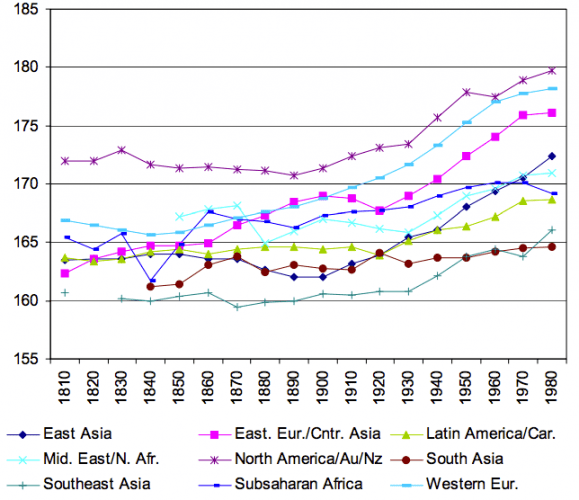
My favorite is the case of height. Human stature is strongly correlated with income and other health outcomes (net nutrition, risks of disease, life expectancy, pregnancy-related variables). Thus it is an incredible indicator of the improvement in the “stuff of life”. And throughout the globe since the industrial revolution, heights have increased (not equally though).  Over at OurWorldInData.org, Max Roser shows this increase since the 1800s (in centimeters)

height-development-by-world-regions-interpolation-baten-blum-2012-0-579x500

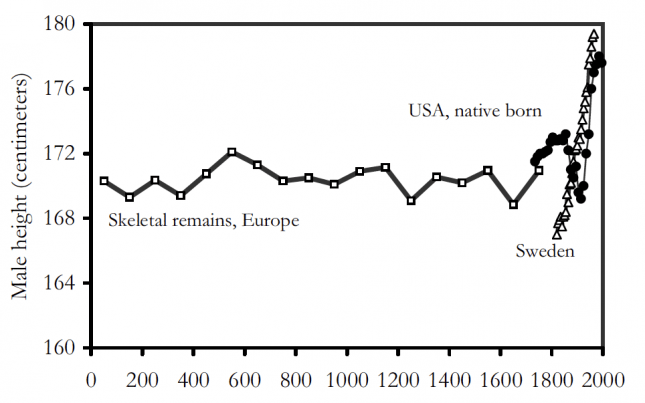
However, the true magnitude of the increase in human heights is best seen in the data from Gregory Clark who used skeletal remains found in archaeological sites for ancient societies. The magnitude of the improvement is even clearer through this graph.

male-heights-from-skeletons-in-europe-1-2000-clark-645x403.png

The ability of “capitalism” to generate improvement in material living standards did leak into broader measures of human well-being. By far, this is the greatest outcome from capitalism.

The Crypto Anarchist Manifesto (1988)

Crypto-anarchism is a subversive philosophy that extends anarchism into the world of cyberspace. Crypto-anarchists attempt to protect their privacy and political freedom through the use of information technologies. Timothy May, one of the co-founders of Cypherpunk and writer of the ‘Crypto Anarchist Manifesto’, describes Crypto-anarchism as

“the cyberspatial realization of anarcho-capitalism, transcending national boundaries and freeing individuals to make the economic arrangements they wish to make consensually.”

In this article I would like to post Timothy May’s ‘Crypto Anarchist Manifesto’, which was first spread among like-minded tech-anarchists in mid-1988 at the “Crypto ’88” conference. The Manifesto was also discussed at the first physical Cypherpunk meeting in 1992. Most people have never heard of Cypherpunk, but they might know their most notable member: Julian Assange, founder of Wikileaks.

See here the full Manifesto:

A specter is haunting the modern world, the specter of crypto anarchy.[1]

Computer technology is on the verge of providing the ability for individuals and groups to communicate and interact with each other in a totally anonymous manner. Two persons may exchange messages, conduct business, and negotiate electronic contracts without ever knowing the True Name, or legal identity, of the other. Interactions over networks will be untraceable, via extensive re- routing of encrypted packets and tamper-proof boxes which implement cryptographic protocols with nearly perfect assurance against any tampering. Reputations will be of central importance, far more important in dealings than even the credit ratings of today. These developments will alter completely the nature of government regulation, the ability to tax and control economic interactions, the ability to keep information secret, and will even alter the nature of trust and reputation.

The technology for this revolution–and it surely will be both a social and economic revolution–has existed in theory for the past decade. The methods are based upon public-key encryption, zero-knowledge interactive proof systems, and various software protocols for interaction, authentication, and verification. The focus has until now been on academic conferences in Europe and the U.S., conferences monitored closely by the National Security Agency. But only recently have computer networks and personal computers attained sufficient speed to make the ideas practically realizable. And the next ten years will bring enough additional speed to make the ideas economically feasible and essentially unstoppable. High-speed networks, ISDN, tamper-proof boxes, smart cards, satellites, Ku-band transmitters, multi-MIPS personal computers, and encryption chips now under development will be some of the enabling technologies.

The State will of course try to slow or halt the spread of this technology, citing national security concerns, use of the technology by drug dealers and tax evaders, and fears of societal disintegration. Many of these concerns will be valid; crypto anarchy will allow national secrets to be trade freely and will allow illicit and stolen materials to be traded. An anonymous computerized market will even make possible abhorrent markets for assassinations and extortion. Various criminal and foreign elements will be active users of CryptoNet. But this will not halt the spread of crypto anarchy.

Just as the technology of printing altered and reduced the power of medieval guilds and the social power structure, so too will cryptologic methods fundamentally alter the nature of corporations and of government interference in economic transactions. Combined with emerging information markets, crypto anarchy will create a liquid market for any and all material which can be put into words and pictures. And just as a seemingly minor invention like barbed wire made possible the fencing-off of vast ranches and farms, thus altering forever the concepts of land and property rights in the frontier West, so too will the seemingly minor discovery out of an arcane branch of mathematics come to be the wire clippers which dismantle the barbed wire around intellectual property.

Arise, you have nothing to lose but your barbed wire fences!

Footnote

[1] This is clearly a wordplay on the opening sentence of Karl Marx’ and Friedrich Engels’ The Communist Manifesto which reads: “A spectre is haunting Europe—the spectre of communism.”

Why You Should Avoid “Capitalism”

“Capitalism” means the sector of an economy in which markets determine prices and quantities. In a “capitalist” system, both the market for goods and the market for inputs are based on voluntary action within the constraints of governmental interventions, namely taxes, subsidies, restrictions, and mandates.

The term “capitalism” was first used in 1854 by William Thackeray in his novel The Newcomes. The term “capitalist” was used previously to refer to an owner of capital goods. The term was popularized by the German sociologist Max Weber as well as by socialists who use the term to condemn private enterprise as a system that exploits labor. In response, advocates of free markets use the term to mean private enterprise and to praise the concept of a free-market economy.

Confusion sets in as adjectives apply the term to markets with governmental interventions or to governmental enterprise, as in “state capitalism,” “crony capitalism,” “welfare capitalism,” “monopoly capitalism,” and “taxpayer-financed capitalism.” Thus “capitalism” is used to refer to current mixed economics (mixtures of markets and governmental intervention) and also to the concept of the pure free market. With the bad connotations as used by socialists, some advocates of reforms then present their approach as an alternative to “capitalism”.

Critics of markets use the term “capitalism” for propaganda by slyly shifting the meaning with this argument: 1) economies today are capitalist; 2) economies today have unemployment, poverty, and pollution; 3) therefore, capitalism causes these problems. The first statement uses “capitalism” as a label for current mixed economies, while the third one implicitly shifts the meaning to private enterprise or free markets.

The term “capitalism” is inherently confusing, since economies have three inputs: land, labor, and capital goods, and there is no logical reason to emphasize capital, unless one is going beyond the definition by claiming that capital dominates labor.

The term “capital” is itself ambiguous, as it can refer to any asset, including funds, capital goods, and reputation. It would be clearer to use the term “marketism,” but that word has already been adopted to mean the advocacy of free markets. “Marketocracy” is used by a mutual fund and portfolio web site. The term “market-priceism” is not yet in use, and would be a clearer term than “capitalism.”

An alternative to market prices is communism, in which goods are shared in a community such as a family. Another alternative is state socialism, in which government plans and controls production and resources, as well as the distribution of goods. Most economies today are mixed, consisting of a market sector and governmental impositions that alter the outcomes.

Economic discourse would be clearer if we used more precise terms. Instead of using “capitalism” to mean economic freedom, use “free markets,” “pure markets,” “private enterprise,” and “laissez faire.” Instead of using “capitalism” or “crony capitalism” for the actual economy, use “mixed economy” or “interventionism.” Instead of using “capitalism” for the exploitation of labor, use “capital domination.” For an economic system in which inputs and products trade in markets, use “market-priceism.”

Max Weber used terms such as “the development of capitalism” and “the evolution of capitalism.” This implies more than market-priceism. Weber analyzed economic development with private enterprise and market prices. He wrote of how such development could be strangled by the political structure. It would be clearer to call this “market-based development.”

Like the classical economists, Weber recognized the distinction between capital goods and land. He referred to “landlordism” and “prebends,” income from rent. In his essay “Structures of Power,” Weber wrote of land being an object of forceful acquisition, with ground rent frequently being “the produce of violent political subjection.”

In his essay “The Protestant Sects and the Spirit of Capitalism,” Weber wrote of some religions promoting a “rational way of life” which “paved the way for the ‘spirit’ of modern capitalism” and the ethos of the individualism of the middle classes with their small businesses. With due respect and admiration for Max Weber, this concept is better referred to with terms such as the spirit of private property, of competitive private enterprise, and of free markets.

The term “capitalism” is now so deeply dug into the global culture that it is here to stay. But those who wish to clearly understand and analyze economics would be wise to avoid the term and instead use words such as “mixed economy,” “pure free markets,” and, if it pleases you, “market-priceism.”

Let’s clear up the liberal mess

It appears there are as many liberalisms as there are liberals. To name just a few: libertarianism, classical liberalism, bleeding heart liberalism, economic liberalism, political liberalism, social liberalism, high liberalism, minarchism, objectivism, anarcho-capitalism, neoliberalism. And in international relations theory there is for example neoliberal institutionalism, liberal internationalism or embedded liberalism. Clearly this all amounts to a liberal mess. I attempt to sort it out in my forthcoming book Degrees of Freedom. Political Philosophy and Ideology (Transaction Publishers, April 2015).

Getting a decent grasp of liberal political thought does not have to be this complicated. You only need to keep in mind a perennial question in political philosophy: what is the just relation between the state and the individual? Roughly, there are three answers: the state should have (almost) no role in individual life, the state should have a limited role, or the state should have a fairly large role. The liberal variants that are associated with these answers are libertarianism, classical liberalism and social liberalism, respectively. To be sure, these three are not completely mutually exclusive, while the thinkers associated with these do not always neatly fit the categorization.

This is not the right place to discuss the methodological underpinnings in detail. Suffice it to note that the divide is based on the analysis and ranking of the main political concepts in classical liberalism, social liberalism and libertarianism. This method originates in the writings of British political theorist Michael Freeden. Put briefly, every political ideology should be seen as a framework made of a number political concepts, who vary in importance. Accordingly, all three liberal variants have core, adjacent and peripheral concepts. Sometimes the individual concepts overlap, but in total there is significant variation, leading to the three liberal variants.

Classical liberalism originates from the eighteenth century Scottish Enlightenment, not least in in the writings of David Hume and Adam Smith. It is also associated with thinkers such as Ludwig von Mises, Friedrich Hayek, Milton Friedman and James Buchanan. It has a realistic view of human nature, which means that man is seen a mix between rationality and emotion. Individual freedom is the main classical liberal goal, which is best preserved by protection of classical human rights (freedom from), the rule of law in public affairs and reliance on spontaneous ordering processes in society, such as the free market. The classical liberal state is limited, which means it does have to perform or arrange for a number of important public tasks. Besides defense, police and judiciary this mainly concerns a minimal amount of welfare arrangements, some environmental regulation, or other issues that cannot be dealt with through the markets.

Libertarianism and social liberalism both originate from the nineteenth century and they constitute the two contrasting poles of the liberal spectrum. Libertarians think the classical liberals allow the state to grow too big. They favor a stricter protection of individual rights to life, liberty and property which to them ensures a just and good functioning society, where free people will be able to use their talents and cooperate in strictly voluntary ways. Some, like Murray Rothbard or Hans-Hermann Hoppe, argue this society can totally rely on spontaneous order for the provision of all necessary services and therefore want to abolish the state completely. Others, such as Ayn Rand, think there is a need to publicly organize defense, police and judiciary.

The social liberals (liberals in the contemporary American sense), such as John Stuart Mill or John Rawls think the libertarian and classical liberal ideas lead to social injustice. They argue that individual flourishing demands a fuller, positive kind of liberty (rights to), which enables individuals to fully develop themselves. Individuals should be able, especially through education, to learn skills and get knowledge to use their natural talents, at the labor market and elsewhere. Otherwise the idea of liberty is just formal, lacking any practical meaning. Concern for social justice also entails the redistribution of income (through taxation), to ensure a welfare system (social security, public health) that takes care of the less fortunate. This leads to a much bigger role for the state than in the other two liberalisms.

Interestingly, these differences also show up in the liberal views on international relations. Libertarians favor the least active (state) interference in world politics, classical liberals recognize the implications of uneven power distributions and believe in the spontaneous ordering effects of the balance of power, while the social liberals are supporters of international organizations and international law.

Needless to say this is just a very short description of the three liberal variants. Much more can also be said about the reasons to discard the other forms of liberalism that figure in the public debate. Still, in my view, this division into three stands up to critical scrutiny, is methodologically sound and therefore by far the best way to sort the liberal mess.

The Dalai Lama on Inequality

There are many people who blame “capitalism” for the world’s economic problems, such as poverty, unemployment, inequality, and environmental destruction. This common belief is based on a confusion of meaning, and a lack of analysis. It is neither surprising nor noteworthy that many people fail to apply consecutive thought to economic issues, but it is sad that the Dalai Lama, as an influential religious leader, has not fully applied his compassionate thought to examine the causes and effective remedies of social problems.

The Dalai Lama, leader of Tibetan Buddhists, has identified himself as a Marxist socialist. He blames “capitalism” for economic inequality, and sees the Marxist alternative as the alternative that would increase equality. He advocates a more “human approach,” which implies less “capitalism” and more socialism. The Dalai Lama adds that he is not a Leninist, meaning that his Marxist views do not imply a desire for a totalitarian state.

The Dalai Lama believes that Marxism is founded on moral principles, such as economic equality, while “capitalism” is founded only on the pursuit of profit. His social and economic views were published in the 1996 book Beyond Dogma: Dialogues and Discourses. He said there that Marxism is concerned with the poor and with exploited minorities. Therefore, he said, “I think of myself as half-Marxist, half-Buddhist.” The Dalai Lama had studied Marxist ideology in China during the 1950s, and became attracted to it.

The essential problem with the word “capitalism” is that it is used both as a label for current economies, which are a mixture of markets and governmental interventions, and for the concept of private enterprise and free markets. Its use as a label for mixed economies makes it meaningless to blame “capitalism” for economic problems.

This confusion is similar to blaming diets for ill health. The diet of most people is a mixture of healthy foods such as vegetables and unhealthy stuff such as excessive sugar. The proposition that “diets” cause illness may be true, but it tells us nothing about which elements of our diets are causing the problem.

Likewise, to blame “capitalism,” meaning the mixed economy, for economic inequality, is meaningless, as this does not tell us which elements of the economy are causing the problem, whether it is markets or interventions. Blaming “capitalism” is worse than useless; it fogs the mind, because the label for mixed economies gets confused with the other meaning, private enterprise, so that, in a sly tacit shift of meanings, markets get blamed for economic woes.

It is meaningless to accuse “capitalism,” as a label, as only caring about profit and ignoring the poor, because the actual “mixed economy” cannot have any thoughts or feelings. Moreover, the concept of a pure market economy does have an ethical basis. The pure market is an economy in which all activity is voluntary. The concept of voluntary human action implies the existence of a universal ethic, or natural moral law, that designates acts as good, evil, or neutral, with voluntary action being good or neutral, and involuntary action consisting in coercive harm, which is evil.

One of the premises from which natural moral law is derived is the concept of human equality, that human beings have an equal moral worth, and should therefore be equal in the application of law. Human equality does not imply that all persons should have an equal income or wealth, because moral equality implies an equal self-ownership (or ownership of one’s body) of all persons. Therefore, each person properly owns his wage and the goods and investments bought from his wage. Income, however unequal, that comes from labor, including entrepreneurship, is not an evil outcome.

The mixed economy does create poverty, but not from private entrepreneurship. The poverty comes from government’s taxing the poor and subsidizing the rich. A study by the Institute on Taxation and Economic Policy and the Pew Research Center recently concluded that the poorest fifth of households pay more than twice the state and local tax rate (11 percent) as the richest one percent. Also, although the rich pay a much higher tax rate on their income, many of the rich get their money back implicitly in the form of the higher rent and land value generated by government spending, paid for by taxes on wages, goods, and enterprise profits. The taxes on the poor are even higher than that found in the study, as there are federal excise taxes included in goods, and also, federal taxes and restrictions on labor and self-employment add to the interventionist burden of the poor.

The economist Henry George wrote that “There is in nature no reason for poverty.” Poverty and excessive inequality are caused by human institutions. If Marxism implies income redistribution or government ownership of industry, this treats, and mistreats, the symptoms, not the causes. The main causes are the stifling of labor and enterprise from taxation and imposed barriers. The ultimate remedy is a completely free market, with voluntary, contractual, decentralized governance. Given today’s states and taxes, government interventions can be minimized with a constitutional prohibition of restrictions and imposed costs on peaceful and honest enterprise, thus with taxes only on bad effects – pollution – and on the ground rent generated by government’s public goods.

If he understood the ethics and economics of liberty, then the Dalai Lama would become a much greater global leader in promoting effective reforms that would not only promote liberty but also greater prosperity and social peace.

Does size matter?

No matter how one sees the ideal liberal world, there will always be differences in size between the sovereign entities on the globe. Even in an anarcho-capitalist world there will be different sizes of the communities that people voluntarily form, although they will of course lack sovereignty in any external legal meaning we now associate with the term. So the question is: does size matter in international relations?

There are many answers to this, and I will be unable to provide them all here (or elsewhere, for that matter). There are instances where size, measured in number of inhabitants of a particular state, does not matter at all. Trade is probably the most important one. After all, it is not countries that trade but people, and if the trade is free, the nationality or location of the traders is of no importance whatsoever. This more or less still applies to the completely distorted trade situation we now regard as normal, with states continually interfering through all kinds of tariffs and non-tariff trade barriers. The real exceptions are cases where political action forbids trade, such as with the several economic boycotts between Russia and the West at present.

Size does not matter in other important segments of international relations either. In cultural exchange, there is no general correlation between size of country and quality of cultural expressions. Of course in the mainstream Western arts (sculpture, paintings, opera, symphony orchestras, etc.), it helps if a country has reached a certain level of wealth, but this is independent of size. Also, talented artists will normally be recruited from all over the world, or be able to sell their (indigenous) works globally. The same applies to sports. If one corrects for population size, many medals at the Olympics, or other championships, are won by athletes from small or middle-size countries.

The size of an economy does matter. Richer countries (in terms of gross domestic product per head) are able to direct more resources to influence international relations. Not only through military expenditures, but also through resources deployed for diplomacy, international negotiations, ‘soft power’, or otherwise. Yet a rich country does not need to be big country, neither in land mass, or in number of inhabitants. And poor countries can still influence international affairs, take for example North Korea.

Still, there are greater and lesser powers in international politics. There is not one distinguishing feature, but most of them combine a large number of inhabitants, a fairly large land mass, either a developed economy which allows for significant military expenditure or the assignment of extraordinary share of GDP to the military. Even then there are real great powers (US, China, Russia at present), middle sized powers (UK, France, Brazil, Indonesia, South Africa) and countries punching under their international political weight (India, Germany, Japan, Egypt, the Philippines, perhaps Turkey). This division is never stable, as the past decades have shown, where only the US has been a consistent top dog. Even small countries can exert significant international political influence, as Singapore shows, although the sheer lack of size will always ensure they can rank higher than the middle category .

So the answer is clear: size hardly matters at all. All countries can become more, or less important, regardless of geography, inhabitants, or economic circumstances. Different policies may cause countries to rise or fall on the “international relations influence league.” Of course, liberals will aim at dynamics caused by liberty increasing policies. That is the perpetual opportunity for liberals across the globe.

Florentine Liberty I: Machiavelli, The Prince (Expanding the Liberty Canon series)

I have already addressed Machiavelli’s Discourses on the First Ten Books of Titus Livy here and I may well come back to them later. However, in the present post I will discuss the famous Machiavelli text, which is concerned with states headed by princes rather than republics, the subject matter of the Discourses. This will itself be the the first half of a two part discussion of liberty in Florence, with a second half on Guicciardini.

The city state of Florence had a history self-government, often republican rather than princely, going back to the eleventh century, when it broke away from the control of German emperors. Its role in republican political thought goes back to the thirteenth century as does its role as an early centre of capitalism, suggesting a connection between the economic development and the movement of political thought.

The first notable republican writer was Dante’s guardian Brunetto Latini (1210-1294). That is Dante Alighieri, the author of the great epic poem The Divine Comedy, one of the very great figures in the history of European literature. So not only was Florence the focus of late Medieval republicanism and capitalism, it was a focus of the development of literature in modern European languages, and of literary Italian in general. Dante created a modern language text on a level with Homer and Virgil, so putting Italian on a level with Latin and Ancient Greek, and confirming the development of modern languages, other than the Latin of church scholars, as instruments of thought and artistic creation. Indeed Latini even has a small role in the Divine Comedy, though rather ungratefully he is placed in Hell. This seems to be based purely on his same sex activities rather than any bad character beyond breaking church positions on sexual conduct. After the secular scholar Latini, the next Florentine given a place in the history of republican political thought is Remigio dei Girolami (1235-1319), a Dominican scholar whose philosophy was influenced by Thomas Aquinas. After that the scholar and city Chancellor Leonardo Bruni (1370-1444) keeps the republican tradition renewed. Detailed examination of these figures is perhaps a bit out of the scope of a historical survey series, but they certainly provide a rich tradition for Machiavelli and Guicciardini to examine and employ.

I have referred to this period in the history of Florence as late Medieval, but it can just as much be described as Renaissance. The great growth of classical learning and artistic creativity associated with the European fifteenth and sixteenth centuries had its beginnings in thirteenth century Florence and northern Italy, due to the commercial city states where there was patronage of the arts and there was contact with the Greek learning of the now highly weakened Byzantine Empire, which stemmed from Greek and Roman antiquity. Averroism, as in the legacy of the twelfth century Muslim philosopher from Cordoba, Ibn Rushd known in the Latinate world as Averroes. A period of Muslim influence, or sometimes dominance in Sicily from the ninth to the thirteenth century meant that Muslim thought was part of the general Italian heritage.

Niccolò Machiavelli (1469-1527) was a product of Florentine republican tradition and the general Italian Renaissance. He lived through periods of secular republican, religious republican, and secular princely rule in Florence. The religious period should be given some attention, as though Machiavelli himself was highly secular (possibly a non-believer, but a variety of views exist on that issue), the events of the religious republican period made a deep impression on him. From 1494 to 1498, the politics of Florence were dominated by the Dominican friar (like Girolami mentioned above), Girolamo Savonarola, who pushed Florence towards religious purification in anticipation of apocalyptic events. The apparent craziness was accompanied by some intellectual and literary sophistication, and was not just a pure descent into fanaticism. In the end the Pope found Savonarola too troubling too ignore so that he took action that ended with the execution of Savonarola as a heretic. Despite his lack of religious enthusiasm, Machiavelli shared a belief in the special role of Florence, though his vision of the city was as the descendent and repetition of the Roman republic rather than as the starting point of a Christian apocalypse. He wanted purification of a kind, if through the placing of laws above individuals, rather than religious observance, and an end to a corrupt aristocratic domination.

The Prince both pays tribute of a kind to Savonarola as a prophet without arms and sets Machiavelli on a path of hoped for cooperation with the dominant family, the Medici who had replaced republican with princely rule, arresting and torturing Machiavelli in the process, as he was a civil servant and diplomat in the former republic. The part admiration for Savonarola comes from an antique tradition of revering founders of republics and great law givers to states of any kind. This reaches a peak in Cicero who described founders of republic as god like. However secular Machiavelli was, he was aware of ancient Jewish history as recorded in the Hebrew Bible and the law giving role of Moses, which is one model of state foundation for Machiavelli and therefore of possible conditions for liberty, since liberty requires law rather than personalised rule.

The Prince is the product of a man who though very talented at the life of a private scholar which he pursued after his political fall, wanted to be working on public affairs even under a prince rather than a republic. It is a lengthy job application to Lorenzo Piero de ‘Medici (not to be confused with his grandfather Lorenzo the Magnificent) and despite composing the longest and best covering letter in all history, Machiavelli did not become a counsellor to a prince. So, we should not regard Machiavelli as a successful ‘Machiavellian’ and perhaps think again about any preconception that The Prince is some key to all knowledge in the dark arts of power and a place of voyeuristic pleasure in observing the inner workings of the state.

Machiavelli does offer his potential employer (who may never have read this extraordinary application material) some ruthless sounding advice on how a prince should gain and maintain power, including the execution of those who create the most obstacles to power. This is not exactly shocking advice for the time. The death penalty was widely used and extra-legal killings for political reasons were normal if not in line with the sort of moral standards rulers publicly proclaimed. The whole outrage of the church and others at the suppose shocking immorality of The Prince is one rather absurd and lengthy exercise in hypocrisy. There was certainly little Machiavelli could have taught Popes of the time in the darkest arts of power. Condemnation of Machiavelli was due to his making public unpleasant realities so that anyone who could read would now be aware of how kings used their power. The book was not published in Machiavelli’s time, so the torrent of vilification came after his death.

The more brutal aspects of The Prince do not even begin to match the horrors of dynastic wars and religious persecution at the time, particularly if we take into account the behaviour of colonists of the time. Machiavelli recommends none of these things which political and religious leaders of the time were willing to have on their conscience. Some passages recommend complete colonisation of newly acquired territories as one means of maintain control, in preference to partial colonisation which is as close as Machiavelli gets to advocating generalised suffering for civilians. In any case he does not recommend the kind of massacre and rapine normal at the time, and the main thrust of the argument is not towards conquest, but a state which has some community with its citizens.

Machiavelli was sceptical of the military value of walls and fortresses compared with a citizen army willing to defend its own land. Opposition to royal fortresses was opposition to one of the main forms of state control at the time. The prince is expected to dispose of individuals dangerous to assuming power, but this is advice to princes who newly have power and need to consolidate it, not advice on long term methods of government. The long term approach is to respect law, respect the property of citizens, and leave women free from forced advances. The prince is advised to hunt a lot as a means to improved military abilities, in knowing the terrain of his own land in detail so knowing how to defend it. The martial interests are presented as the prince’s main area of interest, so that the prince is more of a commander in chief of the military than a man of political power. The idea of a monarch who is mostly a chief of the military was a republican idea at the time and anticipates liberal ideas about the limited scope of any state apparatus.

The relationship between morality and political principles is where Machiavelli departs from antique republican thinkers like Aristotle and Cicero who present politics as the extension of virtue and moral principles. Machiavelli even overturns some of their ethical limits on power. He does so through a sophisticated dialogue with Aristotle, Cicero, and Seneca, which largely does not mention them by name but is very recognisable to those who have studied them, which was a high proportion of likely readers of Machiavelli in his own time. Both Aristotle and Cicero refer to the tyrannical ruler as a wild beast or worse. This itself refers to an antique way of thinking about ethics as self-control, which puts us above the supposed level of animals. Machiavelli challenges this by advising the prince to be a mixture of human and beast, and as beast to combine the cunning of a fox with the fierceness of a lion. None of this is Machiavelli advocating tyranny, it is an appreciation of power and desire which ancient thought was not good at accommodating. The good ruler rules from a desire to pursue the good life and be a friend of citizens in ancient thinking. They could not think of power and self-referring desire except as negatives, even if their own actions went against their words. Cicero’s political career included a willingness to go to the limits of law and beyond where he saw it as necessary to defend the republic, he simply had no language to explain this in the moral terms he used. His main political work, The Republic includes the positive contribution of Scipio Africanus the Younger, the Roman general who physically destroyed the city of Cartage and slaughtered every last inhabitant.

Cicero, like other ancients, had difficulty in discussing politics as power and civilised individual action as based on desire, rather than a morality of self control, so they had little way of accommodating theories of power and desire. This is why there are no ancient writers praising commerce except maybe within very limited and constrained circumstances and then only in a very minimal way, even Seneca who was a major money lender of the whole empire. Machiavelli did have  vocabulary and understanding of power in politics and desire in human action. He was convinced that general application of moral principles about always being truthful, merciful, generous, and so on, were not adequate to understanding the possibilities of human creation in politics and in commerce. Moral outcomes mattered to him, and he is clear in The Prince that some acts are too immoral to accept for any reason, but he thought moral outcomes come from skill in political arts and in trade offs between different moral demands. If one can sincerely claim to be always purely moral and never accept a lesser evil for a greater good, then one maybe has the right to be shocked by Machiavelli, but who can claim such a thing?

The Prince conforms to the wish of a prince to have power and glory and use violence to seize power where the chance arises. However, as far as possible, it always pushes the prince to do so through through respecting the rights of citizens, working to gain their consent, respect peace and stability, and the regular application of law. The prince is urged to avoid the virtue of generosity, because the ‘generosity’ of princes comes from taxations and is therefor a burden on citizens undermining their economic welfare. So that is the wickedness of Machiavelli! Avoid so called virtues which harm those they are supposed to benefit. It is advice to the prince to work so much through law, public good, and concentrating on his military duties, that a republic is bound to emerge under the nominal rule of a prince. That is the goal of all the wickedness in service of dark power.
Complex interdependence turned around

An interesting analysis in one of the Dutch quality papers today. The analysis was about Russia’s power politics, and especially how it used all kinds of formal and informal tactics in different areas, for example traditional diplomatic canals, covert military action, media, energy politics, espionage, et cetera. Special attention was drawn to the economic aspect. Not so much the economic sanctions, which are mainly making life more expensive for the Russian population, are a nuisance to the people in power, yet lack any pacifying effect.

More interesting was the point that the entanglement between the Russian en European economies actually allows the Russian leaders to be more belligerent, and to make use of the Ukraine crisis to prolong the life of their rule. This is due to the fear of Western governments to lose Russian investments, gas supplies and capital. President Putin and his followers know this too well, and are therefore prepared to take more risks in the Ukraine crisis. Sure there are other factors important as well, yet this economic factor is significant in their power game.

For liberal theory in international relations this is complex interdependence turned around. In 1978 Robert Keohane and Joseph Nye published their influential book Power and Interdependence, which focused on the importance of the multiple ways societies and countries are interconnected. Although a lot can, and has been, said about their analysis, as well as the broader discussion following the book, many liberals read the book as a confirmation of their belief in the pacifying effects of economic interdependence. However, this was not the actual position of Keohane and Nye, who emphasized that interdependence would not necessarily lead to international cooperation, nor did they assume any other automatic benign effects (see page 249 of the second edition, 1989).

If anything, the current situation in the crisis between Russia, Ukraine and the West shows the truth of these careful theoretical remarks. The political effect of economic ties is not automatically benign or peace enhancing.

Part Two of Capitalism for the Intelligent Ignorant: the Actors

Jacques Delacroix's avatarFACTS MATTER

This is a little complicated. Part One of this series listed the main constraints on pure capitalism. Then, I took a detour – which was NOT Part Two – on the subject of money which is a quite specialized topic. Below is Part Two of Capitalism for the Intelligent and Ignorant. It describes the main actors of capitalism, of real capitalism, of capitalism such as it exists. with an emphasis on the American instance.

As have stated forcefully in Part One the government is a the biggest economic actor in all developed countries. Although it’s nowhere constitutionally required, at any one time, the government has most or almost most of the money in its hands. This fact alone requires it to do some investing. It’s also the biggest buyer of many things because of the sheer size of government agencies, including the armed forces. It’s also a major seller of…

View original post 2,932 more words