How dairy farmers unions in Canada are distorting the facts about supply management

Under heat recently as President Trump has criticized supply management in Canada and retaliated against it, the different provincial associations representing dairy farmers have moved on the offensive. To promote the virtues of this system meant to reduce production in order to prop up prices through the use of trade tariffs, production quotas and price controls (how can we call those virtues), these unions have produced numerous infographics to make their case. It is even part of what they dub their These-infographics-show-that-diary-prices-are-lower-in-Canada-than-elsewhere, that milk is still a cheap drink relative to other type of drinks and those prices, supposedly, increase more slowly than elsewhere. All of these graphics are dishonest and must be dismantled.

The most egregious of these infographics – present in the “lobby day kit” – shows the price of milk in Australia (1.55 CAD), Canada (1.45 CAD) and New Zealand (1.65 CAD). They are seemingly using 2014 prices. First of all, they use data that conflicts massively with the reports of Statistics Canada that suggest that milk prices hover between 2.33$ to 2.48$ per liter.  Their data is provided by AC Nielsen but no justification is presented as to why they are better than Statistics Canada. The truth is that it is not better. Participants in Nielsen surveys come from a self-selected pool of storeowners who wish to participate and are then selected by Nielsen to be part of the data collection. Then, they can record prices. It should be mentioned that not all regions of Canada are covered in the data. Although the Nielsen data does have some uses (especially with regards to market studies), it hardly measures up Statistics Canada when comes the time to evaluate price levels. This is because the government agency collects information from all regions and tries a broader sweep of retailers in order to create the consumer price index.

But an even larger problem is that, in their comparison of prices, they don’t mention that New Zealand taxes milk. In New Zealand, all food items are subjected to sales tax, which is not the case in Canada and Australia. Hence, when they compare retail prices, they are comparing prices that exclude taxes and prices that include taxes. One would like to find if they acknowledge this fact in the methodological mentions, but there are none!

Using prices available at Numbeo.com and Expatisan.com and the exchange rates made available by the Bank of Canada, we can correct for this problem of theirs. Simply changing prices source leads to a massively different result with regards to Australia whose milk prices are lower than in Canada. Secondly, once we adjust for the sales tax in New Zealand, we find that prices in New Zealand are lower than in Canada. In fact they are lower than in one of Canada’s cheapest market, Montreal (let alone Toronto or Vancouver).  So the infographic they show in order to lobby governments is a fabrication.

Table 1: The real price of milk

Using Numbeo.com (regular milk)
Unadjusted Adjusted for taxes
 Australia  $           1.59  $                 1.59
 New Zealand  $           2.26  $                 1.97
 Canada  $           1.99  $                 1.99
 Using Expatisan.com (whole milk)
 Unadjusted  Adjusted for taxes
 Sydney  $           1.82  $                 1.47
 Wellington  $           2.42  $                 2.10
 Montreal  $           2.87  $                 2.87

Source: Numbeo.com and Expatisan.com, consulted May 16th 2014 and the Bank of Canada’s currency converter. Note: using the Statistics Canada price would make Canada’s situation even worse by comparison.

This is part of a pattern of deceit since they also massage data for numerous other graphs that are presented to Canadians in efforts to convince them of the virtues of supply management. One other example is an infographic that presents a figure of nominal milk prices in Australia before and after the abolition of supply management. Given that prices seem more volatile after 2000 and that they increase more steeply, they try to make us believe that liberalization was a failure. This is not the case. Any sensible policy analyst would deflate nominal prices by the general price index to control for inflation. When one does just that using the data from the Australian Bureau of Statistics, one sees that real prices stabilized in the first ten years of deregulation after increasing roughly 15% in the decade prior. And since 2010, real prices have been falling constantly.

Other examples abound. In one instance, the Quebec union of dairy farmers circulated an infographic meant to show that nominal prices for dairy products increased faster in the United States than in Canada. Again, they omit inflation. Since 1990 (their own starting date), prices of dairy products have risen more slowly than inflation – indicating a decline in real prices. In Canada, the opposite occurred – inflation increased more slowly than dairy prices indicating an increase of the real price.

The debate around supply management is complicated. The policy course to adopt in order to improve agricultural productivity and lower prices for Canadians is hard to pinpoint. But whatever position one may hold, no one is well-served by statistical manipulations offered by the unions representing dairy farmers.
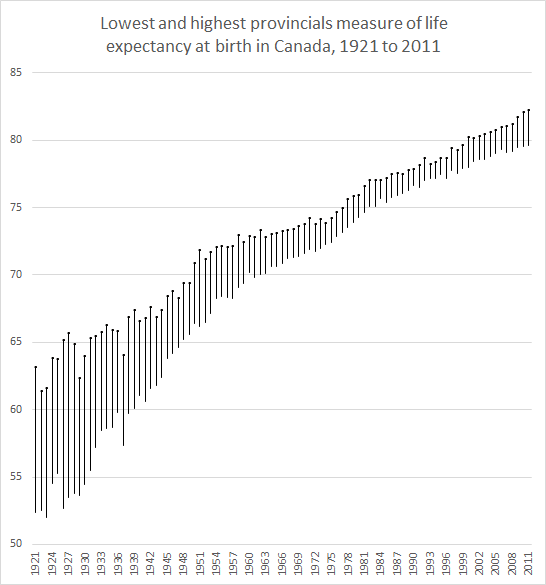
Differences in life expectancy within Canada, 1921 to 2011

I’ve been playing around with some data for a paper I have been trying to write about the economic history of Canada in the 20th century. In the process, I assembled the data from the Base de données sur la longévité canadienne regarding life expectancy at birth. Then, I thought that it would be interesting to see how large were the differences between the provinces and how fast did they close. They closed pretty dramatically during the 20th century – see for yourself.

LifeExpectancyCanada

On the reversal of fortune, urbanization and Canada

One of the more famous articles of economist Daron Acemoglu is his 2002 article on the reversal of fortunes where he points out that countries colonized by Europeans in 1500 that were relatively rich then are relatively poor now. In the paper, they use urban density as a proxy for economic development at that point in time.

I was not particularly convinced by this because of the issue of ruralization in colonial economies. I am still not convinced in fact. As many scholars interested in American colonial history point out, the country de-urbanized (ruralized) during the colonial era as cities grew at a slower pace than the general population. As such, the share of the US population in rural areas increased. But Jeffrey Williamson and Peter Lindert documented that in 1774, the United States were the richest place in the world (beating England on top of being more egalitarian). 

This is normal. Economies on the frontier had land to labor ratios that were the exact opposite of those in Europe. The opportunity cost of congregating in one area was high given the abundance of land that could be brought under cultivation. This is why the Americas (North America at least) was the Best Poor Man’s Country. As such, areas with low population density are not necessarily poor (even if urbanization is a pretty strong predictor of wealth).

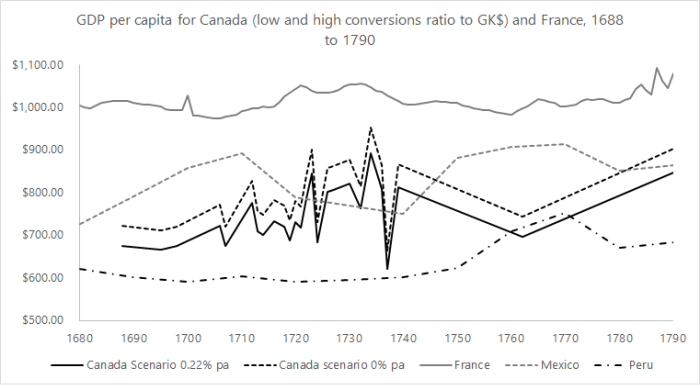
This is where Canada comes in. Today, the country easily fits in the “relatively rich” group. According to the figures 1 and 2 in the work of Acemoglu, Johnson and Robinson, it would have been in the “relatively poor” group well behind countries in Latin America. However, I recently finished compiling the Canadian GDP figures between 1688 and 1790 which I can now compare with those of Arroyo Abad and Van Zanden for Peru and Mexico. With my Canadian data (see the figure below), we can see that Canada was as poor as Latin America around 1680 (the start date of my data).

GelosoGDP.png

So, Canada was a relatively poor country back which was equally poor (or moderately richer) than Latin American countries. Why does that matter to the reversal of fortune story? Well, with the urbanization data, one shows that the non-urbanized of 1500 are the rich of the today. With the GDP data for the 1680s, we see that the more urbanized countries were also poorer than the less urbanized countries.

Now, my argument is limited by the fact that I am using 1680s GDP rather than 1500 GDP. But, one should simply extend the urbanization series to circa 1700 and the issue is resolved.  In any case, this should fuel the skepticism towards the strength of the reversal of fortune argument.

The Heights of French-Canadian Convicts, 1780 to 1830

A few days ago, it was confirmed that my article with Vadim Kufenko and Alex Arsenault Morin on the heights of French-Canadians between 1780 and 1830 was accepted for publication in Economics and Human Biology. In that paper, we try to introduce French-Canadians before 1850 to the anthropometric history literature by using the records of the prison of Quebec City. Stature is an important measure of living standards. As it is heavily related to other aspects of health outcomes, it is a strong measure of biological living standards. More importantly, there are moments in history when material living standards and biological living standards move in opposite directions (in the long-run, this is not the case).

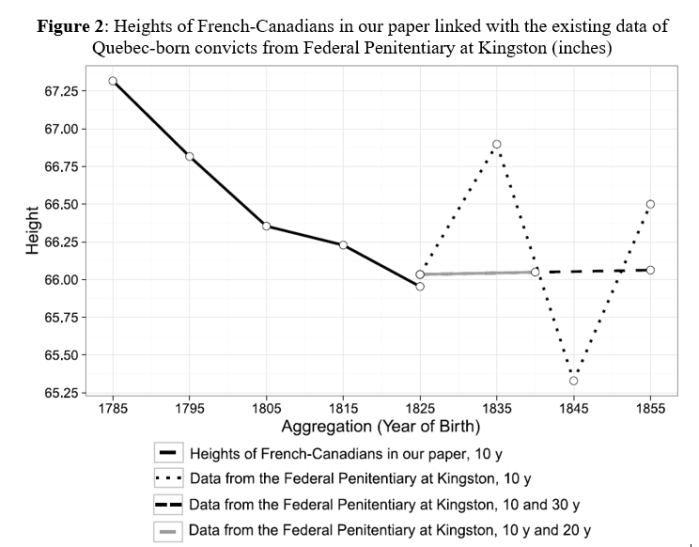
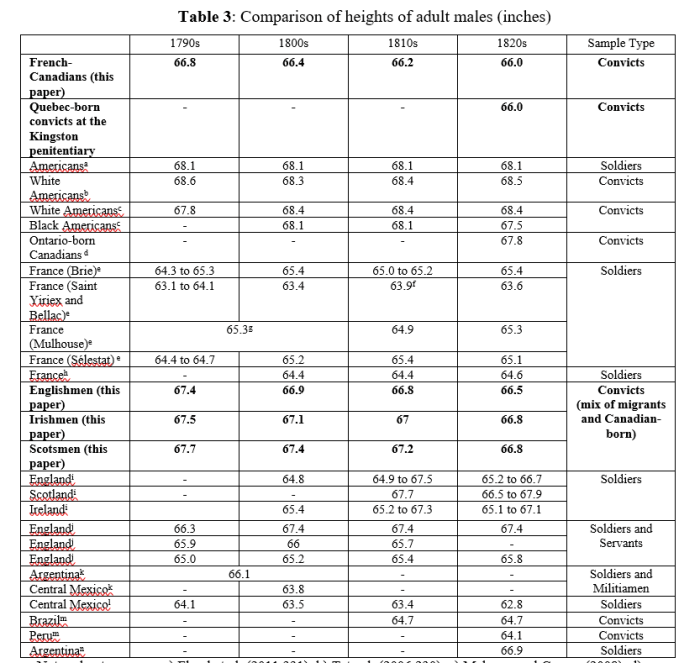
We find three key results. The first is that the French-Canadians grew shorter throughout the era when living standards did not increase importantly (and were very volatile). This puts them at odds from other places in North America where increases in stature were experienced up until the 1820s. Furthermore, stature stops falling around 1820 when economic growth picked up. This places the French-Canadians in a unique category in North America since it seems unlikely that they experienced a strong version of the antebellum puzzle (decline in stature with increases in material living standards which is what the US experienced). The second key result is that the French-Canadians are the shortest in North America, shorter even than Black Americans in slavery. However, they are considerably taller than most (save Argentinians) Latin Americans. More importantly, they are considerably taller than their counterparts in France. The third key result is related to the second key result. Today, French-Canadians are noticeably shorter than other Canadians. However, the gap was more important in the late 19th century and early 20th century. Pegged as a “striking exception” within Canada, we do not know when it actually started. Thanks to our work, we know that this was true as far back at the early 19th century.

The working paper (dramatically different than the accepted version) is here and I am posting key results in tables and figures below.  Moreover, I will be talking about anthropometric history and economic history with Garrett Petersen of Economics Detective Radio this Tuesday (I do not know when the podcast will be made available, but you should subscribe to that show anyways).

Heights.png

Table3.png

On power-display bias and the historians

This is an excerpt from my upcoming book at Palgrave McMillan which discusses Canadian economic history. This excerpt relates to a point that I have made numerous times on this blog regarding the bias for power held by historians and how it often leads them to inaccurate conclusions (here and here):

When the great historian Lord Acton warned that, “absolute power corrupts absolutely,” he was not only referring to imbuing certain fallible humans with excessive powers, but also as a caution to historians for their assessment of politicians. Too often, politicians become known for “greatness” because of their actions, regardless of how much they impoverished society or put in place measures that would ultimately erode their citizens’ quality of life. By the same token, some eminent figures remain unknown, relegated to a footnote in the history books, even though they have contributed in a more significant way to economic enrichment, cultural development, and social cohesion. Grand gestures and large-scale social projects inspired by good intentions do not always yield great results – or desirable ones.

If we truly want to assess the Quiet Revolution and the “Great Darkness” with any clarity, we must consider politicians’ actions in a more realistic scope, and sift through the quantitative and qualitative data that show how people thought and acted in the everyday. Through the use of rigorous tools, statistical methods and economic theories, we ought to consider how things might reasonably have developed otherwise without the Quiet Revolution. This is what I have tried to do in this book. (…)

The discourse on Quebec modernity that emerged along with the Quiet Revolution coincided with the emergence of a strong interventionist State. When we compare Quebec to other Western countries, however, our analysis reveals that the State did not play a major role in modernization here. After all, it was in a period when Quebec’s State apparatus was less active compared to the rest of Canada that it was able to progress in leaps and bounds. Of course, the State must have had some effect in certain areas, but the Quiet Revolution was not responsible for the bulk of positive outcomes that came to term during this period. Analyzing trends, causes, explanations and secondary forces at play in Quebec society’s metamorphosis definitely requires a degree of patience and effort. It would be much less onerous to take the easier path of only looking at the State’s activities as worthy of attention in this regard. If we fail to make these efforts, we risk succumbing to the “Nirvana Fallacy.” In order words, we tend to put the State on a pedestal: it becomes a kind of disembodied entity in a virtual reality where it plays the VIP or starring role. Comparing reality with a utopia necessary leads us to conclude that utopia is better, but this approach is utterly fruitless.


How Canada Tracked the US during the Great Depression

Over the last few years, while I continued my research on other fronts, I started spending small amounts of time on a daily basis to read about the Great Depression and more precisely, how Canada lived through the depression.

Since the old adage is that Canada gets pneumonia when the US gets the flu, I thought that it was a worthy endeavor (although Pedro Amaral and James McGee have been working on that front) to try to see what insights we can derive from looking at Canada’s experience during the Great Depression (especially since it had a very different banking system).

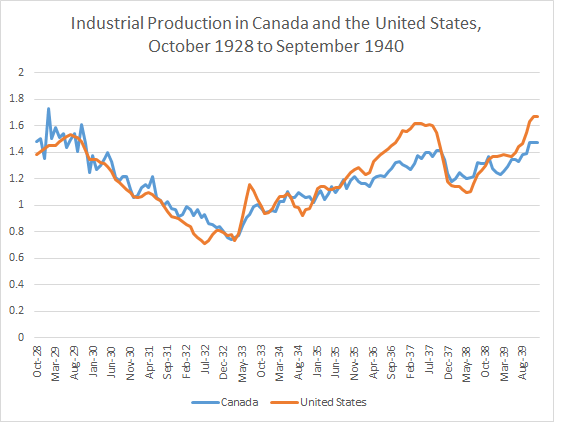
In the process, I managed to collect in a datasheet, the Industrial Production Index of Canada (consisting largely of heavy industry with some light industries and utilities, making it a relatively well-rounded index). This is what it looks like.

industrialproduction

Other than seeing Canada’s experienced mirrored in the US experience (except for the 1935-1937 window), I am not sure what to make of it. However, I thought it worthwhile to share that information publicly.

Household size and growth since 1870 (albeit in Canada)

Two days ago, I posted something on how much we were estimating growth since the 1950s. While organizing another research paper that I am trying to finish, I realized that I could make a follow-up to this based on previous research of mine.

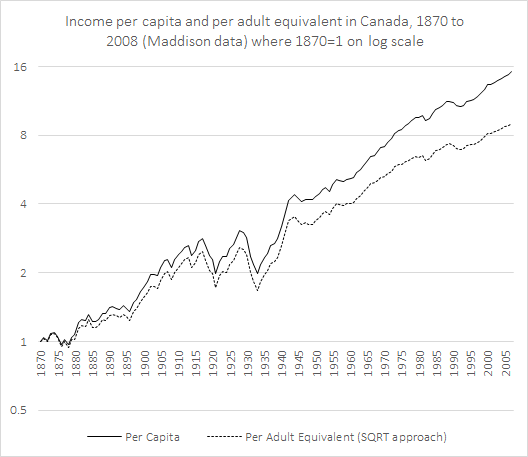
A few months ago, I published (alongside Vadim Kufenko and Klaus Prettner) a short note in Economics Bulletin where we showed that the large differences in household size in Canada that existed up to 1975 led many to overestimate the level of differences between provinces. Moreover, we pointed out that because household size were converging at the same time as incomes, we argued that the rate of convergence from 1945 onwards was slightly overestimated. That paper convinced us to do the same between all the OECD countries (we are assembling the data right now).  But this was an argument about variance, what if we simply plot the “per capita” income of Canada with the “per adult equivalent” income of Canada since 1870.

By using the Maddison dataset combined with the data from my article, it took me a few seconds to get the graph below. What is important to notice in this graph is that, incomes per adult equivalent (measured in 1990 Geary-Kheamis dollars) have increased 40% less than incomes per person. Since adult equivalents are a better measure of living standards (because you capture the economies of scale associated with household size), we can easily say that we have been underestimating the level of improvement in Canada (it is still substantial however).

growthfactors

On Tax Resistance, Censuses and the Cliometrician’s Craft

In the process of finalizing another research article (under revise and resubmit for Agricultural History), I found a small case of tax resistance in Canada East (modern day Quebec) in 1851  that is interesting.

The district of Grenville, northwest of Montreal, was an ethnically mixed district (25% French, the rest were English-Canadians) operating under the British freehold tenure system (as opposed to most of the rest of the province that operated under French seigneurial tenure). During the 1851 census, the enumerator complained that the population of roughly 2,000 inhabitants refused to report statistical information.

Basically, the enumerator pointed out that the majority supposed the information they were giving was “the precursor of a general tax for schools which they are strongly opposed to”.

tax-resistance-in-the-censuses

I find this to be interesting because it is a nice little case of how hard to master the craft of an economic historian. As a cliometrician, my task is to find the best data possible to answer historical questions with strong economic theory (while enriching theory with historical evidence). The data for that area would be biased downwards as peasants would understate their incomes to avoid being heavily taxed. Any statistical test to assert the applicability of a theory to historical questions of Canada (or Quebec) would be altered by this reaction on the part of peasants.

True, for some broad questions (like measuring GDP), this would not be too dramatic an issue. However, for more specific questions like “what was the role of tenure systems in explaining Quebec’s relative poverty”, the issue would be more problematic.

How much do the little things matter, right?

On 19th Century Tariffs & Growth

A few days ago, Pseudoerasmus published a blog piece on Bairoch’s argument that in the 19th century, the countries that had high tariffs also had fast growth.  It is a good piece that summarizes the litterature very well. However, there are some points that Pseudoerasmus eschews that are crucial to assessing the proper role of tariffs on growth. Most of these issues are related to data quality, but one may be the result of poor specification bias. For most of my comments, I will concentrate on Canada. This is because I know Canada best and that it features prominently in the literature for the 19th century as a case where protection did lead to growth. I am unconvinced for many reasons which will be seen below.

Data Quality

Here I will refrain my comments to the Canadian data which I know best. Of all the countries with available income data for the late 19th century, Canada is one of those with the richest data (alongside the UK, US and Australia). This is largely thanks to the work of M.C. Urquhart who recreated the Canadian GNP series fom 1870 to 1926 in collaborative effort with scholars like Marvin McInnis, Frank Lewis, Marion Steele and others.

However, even that data has flaws. For example, me and Michael Hinton have recomputed the GDP deflator to account for the fact that its consumption prices component did not include clothing. Since clothing prices behaved differently than the other prices from 1870 to 1885, this changes the level and trend of Canadian incomes per capita (this paper will be completed this winter, Michael is putting the finishing touch and its his baby).  However, like Morris Altman, our corrections indicate a faster rate of growth for Canada from 1870 to 1913, but in a different manner. For example, there is more growth than believed in the 1870-1879 period (before the introduction of the National Policy which increased protection) and more growth in the 1890-1913 period (the period of the wheat boom and of easing of trade restrictions).

Moreover, the work of Marrilyn Gerriets, Alex Chernoff, Kris Inwood and Jim Irwin (here, here, here, here) that we have a poor image of output in the Atlantic region – the region that would have been adversely affected by protectionism. Basically, the belief is a proper accounting of incomes in the Atlantic provinces would show lower levels and trends that would – at the national aggregated level – alter the pattern of growth.

I also believe that, for Quebec, there are metrological issues in the reporting of agricultural output. The French-Canadians tended to report volume units in manners poorly understood by enumerators but that these units were larger than the Non-French units. However, as time passed, census enumerators caught on and got the measures and corrections right. However, that means that agricultural output from French-Canadians was higher than reported in the earlier census but that it was more accurate in the later censuses. This error will lead to estimating more growth than what actually took place. (I have a paper on this issue that was given a revise and resubmit from Agricultural History). 

Take all of these measurements issue and you have enough doubt in the data underlying the methods that one should feel the need to be careful. In fact, if the sum of these (overall) minor flaws is sufficient to warrant caution, what does it say about Italian, Spanish, Portugese, French, Belgian, Irish or German GDP ( I am not saying they are bad, I am saying that I find Canada’s series to be better in relative terms).

How to measure protection?

The second issue is how to measure protection. Clemens and Williamson offered a measure of import duties revenue over imports volume. That is a shortcut that can be used when it is hard to measure effective protection. But, it may be a dangerous shortcut depending on the structure of protection.

Imagine that I set an import duty so high as to eliminate all entry of the good taxed (like Canada’s 300% import tax on butter today). At that level, there is zero revenue from butter import and zero imports of butter. Thus, the ratio of protection is … zero. But in reality, its a very restrictive regime that is not being measured.

More recent estimates for Canada produced by Ian Keay and Eugene Beaulieu (in separate papers, but Keay’s paper was a conference paper) attempted to measure more accurate indicators of protection and the burden imposed on Canadians. Beaulieu and his co-author found that using a better measure, Canada’s trade policy was 11% more restrictive than believed. Moreover, they found that the welfare loss kept increasing from 1870 to 1890 – reaching a figure equal to roughly 1.5% of GDP (a non-negligible social cost).

It ought to be noted though that alongside Lewis and Harris, Keay has found that the infant industry argument seems to apply to Canada (I am not convinced, notably for the reasons above regarding GDP measurements). However, that was in the case of Canada only and it could have been a simple outlier. Would the argument hold if better trade restriction measures were gathered for all other countries, thus making Canada into a weird exception?

James Buchanan to the rescue

My last argument is about political economy. Was the institutional arrangement of protection a way to curtail government growth? Protection is both a method for helping national industries and for raising revenues. However, the government cannot overprotect at the risk of loosing revenues. It must protect just enough to allow goods to continue entering to earn revenues from imports.  This tension is crucial especially since most 19th century countries did not have uniform general tariffs (like a flat 5% import duty) which would have very wide bases. The duties tended to concern a few goods very heavily relative to other goods. This means very narrow tax bases.

Standard public finance theory mandates wide tax bases with a focus on inelastic sources. However, someone with a public choice perspective (like James Buchanan) will argue that this offers the possibility for the government to grow. Basically, a public choice theorist will argue that the standard public finance viewpoint is that the sheep is tame. Self-interested politicians will exploit this tameness to be elected and this might imply growing government. However, with a narrow and elastic tax base, politicians are heavily constrained. In such a case, governments cannot grow as much.

The protection of the 19th century – identified by many as a source of growth – may thus simply be the symptom of an institutionnal arrangement that was meant to keep governments small. This may have stimulated growth by keeping other sectors of the economy more or less free of government meddling. So, maybe protection was the offspring of the least flawed institutional arrangement that could be adopted given the political economy of the time.

This last argument is the one that I find the most convincing in rebuttal to the Bairoch argument. It means that we are suffering from a poor specification bias: we have identified a symptom of something else as the cause of growth.

Canadian Megatrends: Top 1% income share and median age

Statistics Canada just came up with a study on the top income share of the top 1% in Canada. As I have explained elsewhere, my view of inequality is that: a) it has increased; b) not as much as we think; c) a lot of the increase is from desirable factors (personal utility maximization differing from income maximization or international immigration) or neutral factors (demography, marriage); d) that the inequality that is worrisome stems either from birth or government manipulations of the market and; e) that those stemming from government manipulations, direct (like subsidizing firms) or indirect (like the war on drugs which means that a large number of individuals are jailed and then released with a “prison earnings penalty” which stymies their income levels and growth), are the easiest to fight.

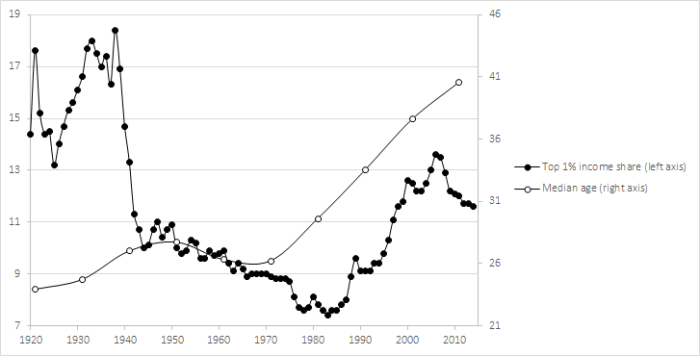
The recent Statistics Canada study allows me to make my point again with regards to element C of my answer. As I looked at their series, all I could think was “median age”. A lot of the variations seem to be related to the median age of the population. I went back to the census data I had collected for my book and plotted it against the data. This is what it looks like.

medianage

Why would there be a relation? Well, each year you measure the income distribution, the demographic structure of that population changes. As it grows older, you have more people at the top of their earnings curve relative to those at the bottom. Not only that, but earnings curve seem elongated in recent times – we live longer and so some people work older as witnessed by increased labor force participation rates above a certain age closer to retirement. And the heights of the earnings curve are now higher than ever before while we also enter later into the labor market.

Now, I am not sure how much aging would “explain away” rising inequality in Canada, but there is no point denying that it does explain some of it away. But, I would not be surprised that a large part is explained away. Why am I saying that? Because of this paper on Norway’s age structure. 

In Norway, the median age in 1950 was much higher than it was in Canada back then and today, it is roughly the same as Canada (although Canada has had a steeper increase in inequality). And according to the paper on Norway, adjusting for composition bias in inequality measures caused by aging, eliminates entirely the upward trend in that country. In fact, it may even reverse the trend whereby inequality adjusted for age has actually declined over time. This is a powerful observation. Given that Canada has had a steeper increase in median age, this suggests that the increase in inequality might be simply the cause of a statistical artifice.

Has Canada been Poorer than the US for so long?

A standard stylized fact in Canada is that we are poorer, on average, than the average American. This has been presented as a fact that is as steady as the northern star. But our evidence on Canadian incomes is pretty shoddy prior to 1870 (here I praise M.C. Urquhart for having designed a GNP series that covers from 1870 to 1926 and links up with the official national accounts even if I think there are some improvements that can be brought to measuring output from some key industries and get the deflator right). But what about anything before 1870? There are some estimates for Ontario from 1826 to 1851 by Lewis and Urquhart (great stuff), but Ontario was pretty much the high-income of Canada.

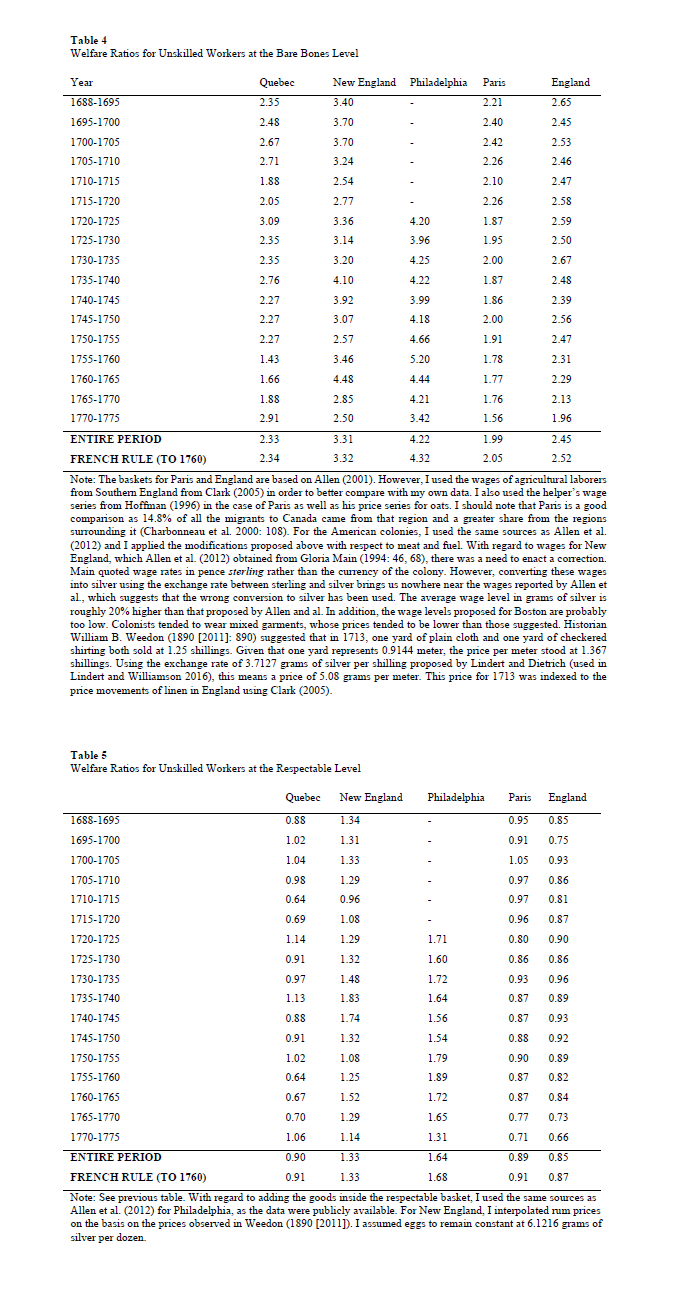
So, can we go further back? This is what my work is about (partially), and I just made available my results on Canadian living standards (proxied by Quebec where the vast majority of the population was) from 1688 to 1775 as captured by welfare ratios. So that’s pretty much the closest we can get to the “founding”. Below are my results derived from this paper. They show that the colonists in Canada were not very much richer than their counterparts in France with the basket meant to capture the meanest of subsistence and roughly equal to their counterparts in France with a basket that includes more manufactured goods like clothing and more alcohol. This explains why most migrants from France to Canada were “volunteered” (in the sense that they were pretty much reluctant migrants) for migration. But the key interesting result is that relative to New England – the poorest of the American colonies – it is poorer regardless of the basket used. Thus, there seems to be truth to the common logic about Canadians being always poorer than the Americans.

comparingcanadane

However, I am not fully convinced of my own results. This may surprise some. The reason is not that I do not trust my data (in fact, I think it is superior to most of what exists for the time given that I will be able to proceed to tons of other data). The reason is simple (and rarely discussed): natives.

Natives are always omitted from the stories of living standards. But they existed nonetheless. In terms of national accounts, if the British and French settlers dispossessed and killed natives, their welfare losses are just not computed. But the welfare losses of a musket shot to the head are real. I have always been convinced that if we could correct estimates of living standards to account for the living standards of natives, the picture would change terribly. The reason is two-fold. The first reason is that the historiography is pretty clear that while they were obviously not nice, the French were nicer than the British towards the Natives (at least until 1763 when the British shifted strategy). In fact, trade between French and Natives was very frequent and so it might be that for the whole population (natives + settlers), the French-area peoples enjoyed more growth and higher average levels. In the British colony, if the settlers killed and dispossessed natives, this is basically the British turning native capital stocks into their own capital stock or into consumption (which would enter settlers GDP but not change total GDP). In essence, this is basically a variation on the arguments of Robert Higgs with regards to measuring the American GDP in World War Two and Albrecht Ritschl on the German interwar growth. I am pretty sure that adjusting for the lives of natives would show a greater level for Canada leading to rough equality between the two colonies. However, I am not sure if the argument would cut that way (my guts say yes) since in their conjectural growth estimates, Mancall and Weiss show that with the natives included, their zero rate of income per capita growth turns into a positive rate.

Nonetheless, I still think that knowing that the settlers were better off in the US as an improvement over the current state of knowledge. Until ways to impute the value of native output and production are found, my current estimates are only a step forward, not the whole nine yards.

On Capitalism and Slavery : Pêle-Mêle Comments

Last week, a debate was initiated via an article in the Chronicle of Higher Education that relates to the clash between historians and economists over the topic of slavery. The debate seems acrimonious given the article and at the reading of a special issue of the Journal of Economic History regarding the Half has never been told by Edward Baptist, its hard to conclude otherwise. Pseudoerasmus published comments on the issue in a series of posts and a Trumpian twitterstorm (although the quality is far from being Trumpian). I find myself largely in agreement with him in response to the historians, but there are some pêle-mêle points that I felt I needed to add.

On Historians Versus Economists

To be honest, when I took my first classes in economic history, it seemed clear that there were important points that were agreed upon in the literature on slavery. The first was that the accounting profitability of slavery was not the same as the economic profitability (think opportunity cost here) of slavery. Thus, it was possible that (concentrating on the US here) the peculiar institution could more or less thrive regardless of the social costs it imposed (i.e. slavery is a tax on leisure which also increases the expropriation rate from slaves, and non-slaveowners often had to shoulder the cost of enforcing the institution). This argument is not at all new; in fact it is basically a public choice argument that Gordon Tullock and Anne Krueger could have signed on to without skipping a heartbeat (see Sheilagh Ogilvie – one of my favorite economist who does history in equality with Jane Humphries). The second point of agreement is that no one agreed on how to measure the productivity of slavery in the United States and the distribution of its costs and gains. The second point has been a very deep methodological debate which related to the method of measuring productivity (CES vs Translog TFP – stuff that would make your head blow and which also lead to the self-invitation of the Cambridge Capital Controversy to the debate). The quality of the data has been at the centre-stage as well, and datasets on slave prices, attributes, tasks and many other variables are still being collected (see notably the breathtaking work of Rhode and Olmsted here and here).

Thus, I will admit to being unimpressed by the use of oral histories to contest that literature. In addition, the absence of theory in Baptist’s work yields an underwhelming argument. Oral histories are super-duper important. The work of Jane Humphries on child labor is a case in point of the need to use oral histories. She very carefully used the tales told by children who worked during the industrial revolution to document how labor markets for children worked. The story she told was nuanced, carefully argued and supported by other primary evidence. This is economic history at its best – a merger of cliometrician and historian. In fact, while this is an evaluation that is subjective, the best economists are also historians and vice-versa. The reason for that is the mix of theory with multiple forms of evidence. But they key is to have a theory to guide the analysis.

Unexpectedly for some, the best exposition of this argument comes from Ludwig von Mises in his unknown book Theory and HistoryI was made aware of that book in a discussion with Chris Coyne of George Mason University and I proceeded to reading it. I was surprised how many similarities there were between the Mises who wrote that book and the Douglass Norths and the Robert Fogels of this world. The core argument of Theory and History is that axiomatic statements can be applied to historical events. The goal of historians and economic historians is to sort which theory applies. For example, the theory of signaling and the theory of asymmetric information are both axiomatically true. Without the need for evidence, we know that they must exist. The question of an economic historian becomes to ask “did it matter”? Both theories can compete to offset each other: if signaling is cheap, then asymmetric information can be solved; if it is not, asymmetric information is a problem. Or both may be irrelevant to a given historical development. To explain which two axiomatic statements apply to the event (and in what dosage), you need data (quantitative and qualitative). Thus, Theory and History actually proposes the use of econometrics and statistical methods because it does not try to predict as much as it tries to a) sort which axiomatic statements applied; b) the relative strengths of competing forces; c) the counterfactual scenario.

Without theory, all you have is Baptist’s descriptions which tell us very little and can, incidentally, be distorted by he who recounts the tales he read.

On the Culture of Peasants/Slaves/Slaveowners

When I started my PhD dissertation Canadian economic history, the most annoying thing I saw was the claim that the French-Canadians had “different mentalities” or “more conservative outlooks”. This was basically the way of calling them stupid. This has recently evolved to say that they “maximized goals other than wealth”. Regardless, this was basically: the French-Canadian was not culturally suited for economic development.

But culture is not a fixed variable, it is not an exogenous variable. Culture is basically the coherent framework built by individuals who share certain features to “cut out” the noise. Everyday, we are bombarded with tons of pieces of information and there is no way that the human brain can process them all. Thus, we have a framework – culture (ideology does the same thing) – which tells us what is relevant and what is irrelevant and what interpretation to give to relevant information.

People can cling to old beliefs for a long time, but only if there is no cost to them. I can persist in terrible farming practices if I am not made aware of the proper valuation of the opportunity I am foregoing. For example, British farmers who arrived in Quebec in the 19th century tended to use oxen as they did in England for tilling the soil. They had probably been taught to do that by their parents who learnt it from their grandparents because it was part of the farming culture of England. The behavior was culturally inherited. However, when they saw that the French-Canadians were using horses and that horses – in the Canadian hinterland – got the job done better, they shifted. The culture changed at the sight of how important was the foregone opportunity by continuing to use oxen. Where the British and the French co-existed, both were equally good farmers. Where they could not observe each other, they were all sub-optimal farmers. Seeing the other methods forced changes in culture.

The same applies to slaveowners and slaves! Slaveowners were a more or less tightly knit group that frequented similar circles and were constantly on the lookout to increase productivity. If some master had noticed that he could increase production by whipping more slaves, why would he not adopt this method? Why would he leave 100$ bill on the street? Why did the masters growing cotton in South Carolina not adopt the method of whipping adopted by growers in Louisiana? Without a theory of how culture changes (and what purposes it serves beyond the simplistic Marxist power structure argument), there is no answer to this question. With the work of Rhode and Olmstead, there is an answer: the type of cotton that had higher yields was not suited for growing everywhere! In this case, we are applying my comment from the section above on Historians versus Economists. There are competing theories of explaining increasing output: either some slave masters were unable to observe the other slave masters and adopt the torture methods they had (which would need to be the case for Baptist to be right) or there were biological limitations to growing the better crops in some areas (Rhode and Olmstead).

Two competing theories (they are not mutually exclusive though) that can be tested with data and they set a counterfactual. That is why you need theory to make good history.

One last thing: slave owners were not capitalists

This is probably the most childish thing to come out of works like those of Baptist: to assert that because slaves were capital assets, that the owners were capitalists. That is true if you want to adhere to the inconsistent (and self-contradicting) Marxist approach to capital. In fact, as Phil Magness pointed out to me, slave owners were not free market types. They were very much anti-capitalists. Slavery apologists like Fitzhugh and Carlyle were even more anti-capitalists than that. It’s not because you own capital that you are a capitalist unless you adhere to Marxist theory.

But, capital is just a production input. Its value depends on what it can produce. As Jeffrey Hummel pointed out, there is a deadweight loss from slavery: enforcement costs, the overproduction of cotton because slavery is basically a tax on leisure and the implicit taxation of the output produced by slaves. All three of these factors would have slowed down economic growth in the south. Thus, as capital assets, slaves were relatively inefficient.

Inflation in Canada and the US since 1774

It is often said that Canada and the United States are very much alike, except for the fact that Canada has tons of French people (myself included) and free (TANSTAFL) healthcare. It is also often said that when the US economy catches a cold, Canada gets pneumonia.

From an economic historian’s perspective, this is a hard claim to swallow without making tons of nuances. Yes, economic conditions in Canada are heavily affected by those in the US. But, the evidence for that generally concerns the twentieth century. There is very little before that. The first pieces of evidence we have for Canada start only in the 1870s. In fact, that evidence is also subject to many caveats (my work with Michael Hinton suggests that the GDP deflator for Canada from 1870 to 1900 causes a considerable underestimation of Canadian economic growth during the period and that Canada).

Thus, we do not know if that was always true. To some extent, I am tempted to believe that this is true, but that it is has grown “truer” over time. Canada used to be geared towards Britain and Europe for a long time, but, progressively, it became more connected with the United States. Now, the Maddison project data shows that Canada in terms of GDP per capita converged towards that of the United States from the 1870s to the present day. Morris Altman produced revised estimates of Canadian GDP growth (here) that show a moderately steeper convergence between 1870 and 1929. Given the amount of capital movements between both countries, this is not really surprising (in fact, excluding Quebec from Canada brings the two countries closer together).  But again, we don’t go back further than 1870.

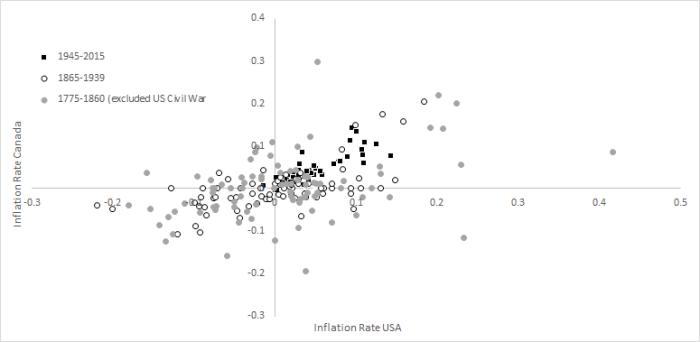
So, to see if this is the case, I decided to take my paper (online since yesterday) on creating a price index for Canada since 1688. Measuring Worth offers an American Price Index that starts in 1774. If the two economies began to become more interlinked, then a price index that goes back to the founding of the United States should do the trick. The result is below.

pricescorrelation

I organized the data by time period and it seems that the rates are generally correlated (which you would expect since global monetary conditions do suggest some long-terms similarities in terms of price trends – I have many reservations about the book I am citing here, but it gets the empirical point across). However, the dispersion seems to collapse over time. As we move from the colonial era to the modern era, inflation rates get more tightly grouped together. Free trade, lower transport costs, central bank policy, capital mobility and labor mobility would have factored in to mean that things become more tightly knit.

It does seem like Canada and the US became more interdependent over time.

I have more to come on this!

Prices in Canada, 1688 to 2015

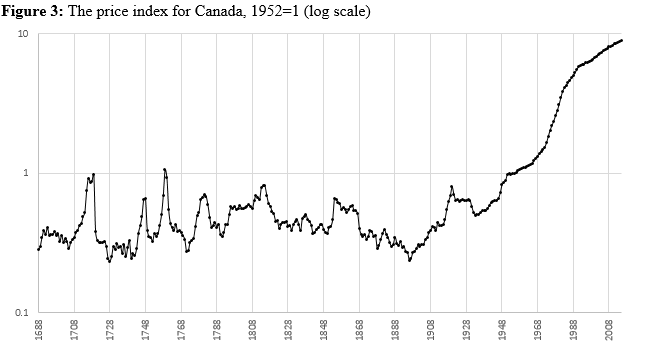
I have just finished my working paper creating a price index for Canada that covers the period from 1688 to 1850 in order to link with the existing datasets that cover up to 2015. Here is the result (and the paper is currently consideration for publication). The paper is here and it shows how much prices have changed in Canada since the late 17th century.

pricescanada

On the Canadian economy: the “real” problem

In Canada, the state of the economy has everyone worried. The fall in oil prices is causing the oil sector in the western provinces and in some of the Atlantic provinces to contract. As a result, everyone has the impression that Canada is sliding towards a recession and governments should act.

I disagree. My disagreement is fueled by two factors. The first is that we should never reason from a price change. The fall in the price of oil is mostly the result of increasing supply of oil. Such a price change is actually a good thing for the Canadian economy. The slowdown in economic activity is merely the result of frictions in the reallocation of resources. The second reason is that the slowdown is caused by “real factors” – policy decision affecting key regions of the Canadian economy. Any government action would worsen a situation caused by too much interference in the first place.

A fall in oil prices can indeed affect the Canadian economy. The oil produced in Canada is generally profitable when prices are relatively high (they require very capital-intensive methods of extraction and refining). An increase in the world oil supply (which is the case right now) would indeed affect the Canadian oil industry. However, Canadians win through lower oil prices – one important input has gotten cheaper. The problem is that once such a slowdown happens, resources are not reallocated without frictions. Business plans are positively affected by the lower oil prices and numerous firms are laying out new plans to expand production. Employment and output will fall in the oil industry before they will pick up in other industries. Eventually, there might even be greater output and employment because of the greater worldwide supply of oil. Right now, Canada is in-between those two situations.

My second reason for dissenting from the majority opinion is that certain regions of the Canadian economy are plagued by poor policy. To make my argument, consider a two-region (West and East) and two-industry economy (oil and manufacturing/services). In the West, the dominant industry is oil. In the East, the dominant industry is manufacturing/services.  The West economy has a more flexible market for inputs (limited regulation, freer labor market and low taxes on capital). The East economy suffers from greater rigidity in its market for inputs – high taxes, burdensome regulation and stringent labor laws.

In a way, this describes the Canadian economy. The provinces of Alberta, Saskatchewan, Manitoba and British-Columbia have been pulling the rest of the Canadian economy for the last twenty years. That’s the West. In the East, the historically poorer province of Quebec has been constantly pulling everyone behind, but less so in recent years as the province of Ontario (the most populous of Canadian provinces) began to slow down. Ontario dramatically expanded the size of its public sector, implemented important regulations and raised taxes – straight in the middle of the recession. In fact, if you exclude Ontario from the rest of Canada, you find (as Philip Cross did) that Canada’s performance is actually quite decent. So in the East, you have Quebec whose policies have not changed and you have Ontario who has adopted increasingly anti-growth policies. The East also has consistently higher taxes. The West has lower taxes. Etc.

Given the accuracy of this stylized description, imagine the effect of a shock on the western economy through a shock on its oil industry. Normally, firms in the East could adapt to lower oil prices by expanding their output in the manufacturing/services sector (thanks to cheaper inputs) while firms in the West contract their output and liberate inputs. However, in the presence of government-imposed frictions, this reallocation of resources is much harder and output has a harder time expanding in the East.

No demand-side policy can solve this problem! You could have easy money and a massive stimulus program, but if firms are discouraged from increasing output, little will happen. In Canada, the current slowdown is explained by “real factors”. Improving provincial policies would be the best channel for improving the state of the Canadian economy.