- The Chinese governance system: impressive strengths and appalling flaws Pradnab Bardhan, 3 Quarks Daily
- Time to make good on the US-Philippine alliance Poling & Sayers, War on the Rocks
- Secession and international alliances go together Edwin van de Haar, NOL
- Maps and legends John Holbo, Crooked Timber
alliances
Pres. Trump and Me After Two years
I voted for Donald Trump for two clear reasons. First, his name is not Clinton. Second, he promised to nominate Supreme Court Justices from a published list of conservative judges. I have been amply satisfied on both counts.
Accomplishments
Then, I watched pleasantly surprised as the Trump administration engineered a tax reform that could only improve economic growth. Then, it quickly dismantled hundreds of federal regulations, a strategy that could only benefit entrepreneurship and business activity. Sure enough, there was a sudden rise in Gross Domestic Product growth. I don’t have any proof of causality here but the temporal coincidence is gratifying! At the same time, the unemployment rate – which had been going down even in the waning days of the Obama presidency, it’s true – continued to nosedive. It reached an all-time low for African Americans and for Hispanics. That fact illustrated nicely the basic conservative idea that results count more than intentions. (Remember, that Adam Smith wrote the same in 1776 but who reads Adam Smith nowadays?)
Soon, there was the blessed withdrawal from the comedy of the Paris climate “accord.” Then, there was the abrogation of the weak-kneed, poisonous agreement (not a “treaty) with the totalitarian and aggressive Islamic Republic of Iran. I applauded both with both hands. I was pleasantly surprised later by the initiative toward North Korea although I reserve judgment because nothing much has actually been accomplished on that front, except, possibly (possibly) a better mood. I do think President Trump has gone farther on the road to disarming that kingdom of cruelty and madness than any previous president. Yet, Continue reading
Afternoon Tea: “The Johor-VOC Alliance and the Twelve Years Truce: Factionalism, Intrigue and International Diplomacy, C.1606-1613”
Using published and unpublished documents of Dutch, Portuguese and Malay provenance, the present study explores how news of the Twelve Years Truce in December 1609 negatively impacted politics and commerce at the court of the Kingdom of Johor. Since 1603, Johor had emerged as one of the principal allies of the Dutch East India Company (VOC) in the region of the Singapore and Melaka Straits, and after 1606 it had proven itself as a worthy ally in the company’s war on the Iberian powers across Southeast Asia. It will be argued that confusion resulting from the news of the truce on the ground in Asia exacerbated factionalism at the court. The Johor ruler, Ala’udin Ri’ayat Shah III, and especially his younger sibling Raja Bongsu, were incensed and evidently felt they had been left to carry on the struggle against Portuguese Melaka on their own. Unable to continue the war effort without Dutch funds, subsidies and ammunition, the pro-Portuguese faction at the Johor court brokered a peace with the Estado da Índia in October 1610. This deal led to the fall of Raja Bongsu and his pro-Dutch faction at the court. This essay provides the political and historical backdrop to the writing and revision of the Sejarah Melayu, or Malay Annals, in or around 1612.
This is from Peter Borschberg, a historian at the National University of Singapore. Here is a link.
NATO, Kendrick Lamar, and the answer to free riding
Edwin’s post giving one cheer to NATO brings up the old rift between European and American libertarians on foreign policy and military alliances. As usual, it’s excellent and thought-provoking. Here’s what he got out of me:
International relations splits the classical liberal/libertarian movement for a few reasons. First, consensus-building on both sides of the pond is different, and this contributes strongly to the divide over foreign policy. American libertarians lean isolationist because it aligns closer to the American left and libertarians are desperate to have some sort of common ground with American leftists. In Europe, leftists are much less liberal than American leftists (they’re socialists and communists, whereas in the States leftists are more like Millian liberals), and therefore European libertarians try to find different common ground with leftist factions. Exporting the Revolution just doesn’t do it for Europe’s libertarians.
Edwin (and Barry) have done a good job convincing me that trans-Atlantic military ties are worth the effort. But we’re still stuck at a point where the US pays too much and the Europeans do too little. Trans-Atlantic ties are deep militarily, culturally, and economically. Tariff rates between the United States and Western Europe are miniscule, and the massive military exercise put on by NATO’s heavyweights highlights well the intricate defense connections between both sides of the pond. Night clubs in Paris, London, Warsaw, and Los Angeles all play the same Kendrick Lamar songs, too.
Politically, though, the Western world is not connected enough. Sure, there are plenty of international organizations that bureaucrats on both sides of the pond are able to work in, but bureaucracy is only one aspect of getting more politically intertwined with each other (and it’s a damn poor method, too).
In 1966 economists Mancur Olson and Richard Zeckhauser wrote an article for the RAND Corporation showing that there were two ways to make NATO a more equitable military alliance: 1) greater unification or 2) sharing costs on a percentage basis. The article, titled “An Economic Theory of Alliances,” has been influential. Yet almost all of the focus since it was published over 50 years ago has been on door number 2, sharing costs on a percentage basis. Thus, you have Obama and Trump bemoaning the inability of Europe’s NATO members to meet their percentage threshold that had been agreed upon with a handshake at some sort of bureaucratic summit. You have Bush II and Clinton gently reminding Europe’s NATO members of the need to contribute more to defense spending. You have Nixon and Carter prodding Europe’s NATO members to meet an agreed-upon 3-4 percent threshold. For half a century policymakers on both sides of the Atlantic have tried to make NATO more equitable by sharing costs on a percentage basis, and it has never panned out. Ever. Sure, there have been some exceptions in some years, but that’s not okay.
What has largely been lost in the Olson & Zeckhauser article is the “greater unification” approach, probably because this is the much tougher path to take towards equitable relations. The two economists spell out what they mean by “greater unification”: replacing the alliance with a union, or federation. I’m all for this option. It would make things much more equitable and, if the Europeans simply joined the American federation, it would give hundreds of millions of people more individual freedom thanks to the compound republic the Americans have built. Edwin, along with most other European libertarians/classical liberals, acknowledges that Europe is free-riding, but are Europe’s liberals willing to cede some aspects of their country’s sovereignty in order to make the alliance more equitable? Are they ready to vote alongside Americans for an executive? Are they ready to send Senators and Representatives to Washington? Or are they just pandering to their American libertarian friends, and telling them what they want to hear so they’ll shut the hell up about being ripped off?
One Cheer for NATO
The largest military NATO exercise since the end of the Cold War will start shortly in Norway. About 50.000 troops and 10.000 vehicles from all 29 NATO countries plus Sweden and Finland will commence ‘Trident Juncture 2018’ on October 25.
Before the actual exercise starts, there are already logistical tests. As the news release of NATO explains:
Over the next few days, 70 Foxhound, Husky and Landover vehicles will make the 2,000km journey from the Hook of Holland harbour through northern Europe to Norway. The UK convoy’s move through the Netherlands, Germany, Denmark and Sweden will test how efficiently soldiers and equipment can move between European countries. It will also test customs, border regulations and infrastructure’s ability to cope with rapid and heavy troop movements.
“Military mobility is vital, especially to reinforce in a crisis. That’s exactly why we exercise it,” said NATO spokesperson Oana Lungescu. “Over the past few years, NATO has made real progress in improving our ability to deploy troops quickly across Europe. We are overcoming legal hurdles and cutting red tape, including by working closely with the European Union. Looking ahead, we aim to further reduce border-crossing times (clearances within five days by the end of 2019), identify alternative supply routes, and exercise even more to practice military mobility.”
The exercise itself has an article 5 or collective defense scenario, training NATO’s crisis response ability. It will last about two weeks. “NATO is a defensive Alliance. We’re not looking for a fight, but we are committed to defense and deterrence. That’s what this exercise is all about: training to defend, and providing a deterrent effect, ready to respond to any threat from any direction at any time,” commanding officer Admiral Foggo underlined.
I think this exercise, with all NATO members, on this scale, in these uncertain times, deserves one cheer. It shows that the Alliance is still able and willing to get together, to show it is the most powerful military alliance on earth, and that it realizes it needs a lot of training to remain so.
There are still two cheers lacking. The second cheer is lacking because the partnership is still unbalanced. Despite increases in the defense budgets in some of the European NATO members (The Netherlands included), the main burden (also in relative numbers) still falls on the Americans. That is simply wrong. And it is also dangerous, because in current times, for example also with cyber warfare becoming ever more important, any shortage of budget is putting (future) lives at risk. The third cheer is lacking because anti-NATO rhetoric (on both sides of the Atlantic) will sow the seeds of doubt about the use and future of NATO. That is also simply wrong and dangerous. Whether it is Russia, or other powers, the West cannot afford to leave any current or future authoritarian ruler in any doubt about the military ties across the Atlantic, all the way to the Russian border. It is in the best interest of all NATO members, the US included.
RCH: The battle that shaped Texas for one hundred years
That’s the topic of my latest at RealClearHistory. (Remember, I have a Tuesday column and a weekend column over there.) Here’s an excerpt:
In the mid 16th century, then, in what is now Texas and Oklahoma, world powers and regional polities bobbed and weaved with each other in an intricate, unpredictable game of geopolitics to settle who gain hegemony over a region destined to be important for transcontinental trade for centuries to come. The defeat forced Spain to give up its designs for the region entirely, and France was never interested in the region being anything other than a resource-rich frontier for its American port cities in New Orleans and Quebec.
The defeat also caused a minor rift between Tlaxcala and Spain, which was a big deal at the time because without Tlaxcala, Spain would have never been able to conquer the Aztec Empire as thoroughly as it did.
Please, read the rest. Texas ain’t no joke…
Nightcap
- A new history of Islamic Spain Peter Gordon, Asian Review of Books
- A Palestinian perspective on Labour’s anti-Semitism row Nimer Sultany, Disorder of Things
- The crumbling of French culture Guillaume de Thieulloy, Law & Liberty
- Can Asia and Europe make America’s alliances great again? Tongfi Kim, the Diplomat
Nightcap
- What is the ‘-dom’ in ‘freedom’? John Kelly, OxfordWords
- Does Trump Have a Point About Europe? Jeffrey Stacey, Duck of Minerva
- When Racism Is Fit to Print Andrew Sullivan, Daily Intelligencer
- How deep is the decline of the West? John Gray, New Statesman
Finally, the US is getting serious about the Indo-Pacific
China has not been particularly comfortable with the Trump Administration’s repeated use of the term ‘Indo-Pacific’ instead of ‘Asia-Pacific’ (of late, it has been quite scathing in it’s criticism). The term ‘Indo-Pacific’, which has been used for a few years, has now gained more attention after a few developments:
First, during Trump’s Asia visit in 2017, in which he visited Japan, Vietnam, and attended the ASEAN Summit, he used this term on more than one occasion.
Before his India visit in October 2017, former Secretary of State Rex Tillerson articulated a vision for a ‘Free and Fair Indo-Pacific’. Tillerson, while pitching for a greater role for India in the Indo-Pacific, also highlighted the need for preventing illiberal multilateralism. Said the former US Secretary of State:
We need to collaborate with India to ensure that the Indo-Pacific is increasingly a place of peace, stability, and growing prosperity — so that it does not become a region of disorder, conflict, and predatory economics.
The use of the term ‘Indo-Pacific’ was followed by the revival of the Quad Grouping (India, Australia, US, Japan). Senior officials of these four countries met on the eve of the East Asia Summit, held in Manila, and discussed ways to strengthen cooperation for promotion of a ‘Free and Fair Indo-Pacific’.
There have been a number of meetings between representatives of Japan, the US, and India to discuss a wide range of issues such as maritime cooperation, connectivity, and strengthening collaboration between these countries
China’s criticism of Indo-Pacific and Quad
China dismissed the Indo-Pacific as an ‘attention grabbing idea’, while the Quad too has been criticized by Beijing. Foreign Minister Wang Yi, while commenting on the Quad, likened the Quad to ‘foam on the sea’ that ‘will soon dissipate’ once the attention due to headlines turns elsewhere.
The Indo-Pacific narrative did lack a vision
One issue on which it is hard to disagree with Beijing, and those skeptical about the ‘Indo-Pacific’, is the fact that countries who have joined hands for promoting a Free and Fair Indo-Pacific (as a sort of counter narrative to China’s Belt and Road Initiative), did not have clarity in terms of enhancing connectivity and economic linkages. They have met on a number of occasions to discuss connectivity projects and a myriad of other issues but nothing substantial has emerged so far. This lack of effort, according to many, has been one of the main reasons for the Indo-Pacific narrative not being taken seriously (even by US allies). The other problem, of course, has been the Trump administration’s differences with allies like Japan and South Korea on economic and geopolitical issues.
US rolls out an economic vision for the Indo-Pacific
At the Indo-Pacific Business Forum, organized by the US Chamber of Commerce, Secretary of State Mike Pompeo articulated a broader economic vision for the Indo-Pacific, while also speaking about the likely role of the US in promoting cooperation.
First, Pompeo yet again reiterated the US desire for a Free and Open Indo Pacific, and how the US was fervently opposed to the hegemonic tendencies of certain countries (in a clear reference to China).
Second, at a time when a number of countries, such as Malaysia and Sri Lanka, are beginning to question the financial feasibility of China’s Belt and Road Initiative-related projects, Pompeo’s words are significant. It may also be pointed out that his address at the US Chamber of Commerce was made days before he began his Asia trip (which included visits to Malaysia, Indonesia, and Singapore).
Third, Pompeo spoke about the $113 million investment in areas such as digital economy, energy, and infrastructure. Pompeo dubbed this investment as a ‘…down payment on a new era in US economic commitment to peace and prosperity in the Indo-Pacific region’.
Fourth, the US Secretary of State also spoke about the potential role of the US private sector in promoting economic growth, prosperity, and cooperation in the Indo-Pacific. In an interview with CNBC, Pompeo stated:
We want private industry with the assistance of the United States government, understanding that we’re going to support this effort, we’re going to have private industry go in and develop relationships. When American businesses come to these countries, they’ll thrive
China’s reaction to Pompeo’s speech
China was dismissive of the US commitment towards Indo-Pacific, and Chinese foreign ministry spokesman Geng Shuang stated that even in the past, there has been talk of cooperation between Japan, the US, and Australia working jointly for developing infrastructure, but so far not much has been achieved.
While there is absolutely no doubt that an alternative narrative is needed to China, the US also needs to be more predictable in terms of economic and strategic relations with key players in the Indo-Pacific. One of Washington’s closest allies in the past, Japan, has been extremely uncomfortable with not just the tariffs, but also on Trump’s handling of strategic issues (such as the North Korea issue).
The example of Indian and Japanese Companies in South Asia
If differences can be ironed out, there is clear space for companies of different countries to work together in the Indo-Pacific. India and Japan have already taken the lead in Sri Lanka and Bangladesh (two countries likely to play an important role in the Indo-Pacific). In Bangladesh, Marubeni and Larsen and Toubro shall work jointly for supplying electrical and mechanical railway systems for Phase 6 of the Dhaka Mass Rapid Transport. In Sri Lanka, Petronet, along with Japanese companies, is setting up an LNG terminal near Colombo (L&T has already been working with Marubeni for setting up a 400 MW gas plant in Habibgant district, Bangladesh). Petronet will hold 47.5 per cent stake in the project while Japan’s Mitsubishi and Sojitz Corp will take 37.5 per cent stake, while the remaining 15 percent stake will be held by a Sri Lankan company.
Conclusion
Pompeo’s emphasis – on the need for greater transparency in investments, US support for areas such as technology in the Indo-Pacific, and a more pro-active role for the private sector in the Indo-Pacific – all make sense. A lot will depend upon Donald Trump’s approach on critical geopolitical and economic issues, and whether he is able to take along key allies such as Japan. A lot will also depend upon relations of countries, especially Japan and India, with China. In recent months, Japan and India have been trying to recalibrate economic ties with Beijing (a number of Japanese companies are in fact participating in the BRI). While this in no way implies that the narrative of the Indo-Pacific will lose its relevance, it does remain to be seen whether Japan and India would put it on high priority.
Pompeo’s speech is interesting, and it remains to be seen how companies from other countries react and whether they explore the possibility of investing in big ticket connectivity projects.
Nightcap
- An audacious proposal for a US–North Korean alliance Tim Shorrock, the Nation
- Le Corbusier’s Indian Dream “AG,” URBN Sense
- Lovers of Wisdom Jim Holt, New York Review of Books
- The curse of work Joe Moran, Times Literary Supplement
Eye Candy: Shanghai Cooperation Organization
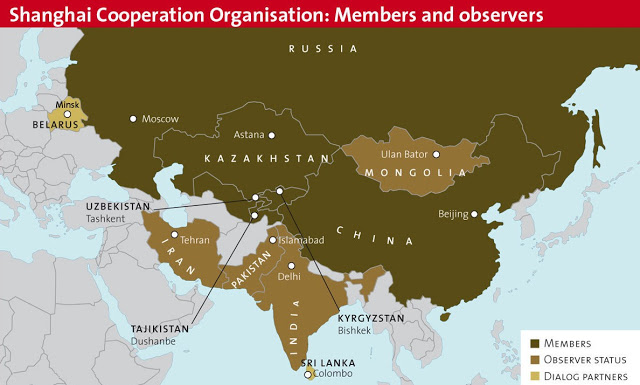
First off, Shanghai and Warsaw are two very different cities, and because of that I think the SCO is a different animal than the Warsaw Pact. For one thing (aside from the difference in the two cities, one being selected for its geographical prominence, the other for its commercial acumen), the Warsaw Pact was a military alliance led by the Soviet Union, while the SCO is dedicated to political and economic cooperation as well as military security. Notably, the security aspect of the SCO is dedicated to coordinating state-led efforts against terrorism and separatism rather than against a rival alliance.
I don’t see anything wrong with multilateral efforts undertaken by states other than the US. I don’t see any need to worry, fret, or otherwise suspect the SCO of undermining world peace and prosperity. The fact that the SCO is made up of cooperating autocratic regimes rather than democratic ones does not faze me. The SCO has been making overtures to the democracies of India, Iran, and Sri Lanka (be sure to check out Tridivesh’s excellent take on India and the SCO), and multilateral cooperation among states is in itself an exercise in political participation among equals, albeit not at an individual level.
There is also cause to be happy that China and Russia have bound themselves up in such a prominent cooperative venture, too, given the two powers’ history of fighting each other. The SCO is contributing to peace and prosperity, and while it appears on the surface that the venture is designed to be a rival of the Western-built world order, the Shanghai Cooperation Organization actually contributes to it.
(h/t Nick)
Ottomanism, Nationalism, Republicanism VI
The end of World War Two placed Turkey between the Soviet Communist world and the western democracies. It’s Middle Eastern neighbours consisted of one outright colony (thinly disguised as a League of Nations mandate), French Syria; one de facto colony of Britain, Iraq (formally independent after a mandate period); one country whose sovereignty was highly compromised by United States and British ‘interests’, that is Iran. After decades of rule by the secularist-nationalist Republican People’s Party (CHP is the Turkish acronym), the idea of a Middle Eastern orientation was not a major one at any kind of obvious level, and had limited practical applicability even for those oriented towards the kind of traditionalist Islam which inevitably looks for some kind of connection with the original Muslim heartland.
The Muslim Brotherhood was formed in (British dominated) Egypt in 1928 and that becomes more important in Turkey over time. A Turkish version, National View, was founded by Necmettin Erbakan in 1969, and forms the core of the AKP today, led by Recep Tayyıp Erdoğan. Turkish history from the 1940s to the AKP coming to power in 2002 can look like an inevitable process, and with some qualifications that is probably a reasonable one-sentence way of thinking. Qualifications include the dangers of seeing history as the inevitable unfolding of a single unified process, and the constant possibility that better decisions by secular leaders at various time could have prevented this outcome. The decisions of the small numbers of self-defined liberals in Turkey were not really any better, sad to say.
İnönü’s response to the post-war world was to adopt multi-partyism. The Democrat Party was allowed to form under Adnan Menderes, who had been a member of the short-lived Free Republican Party and then a CHP deputy, and former prime minister Celâl Bayar. The DP contested the 1946 election, which was not all fully free and fair, but came to power in a more properly conducted election in 1950. Bayâr became President and Menderes became Prime Minister. This worked more as the Turkish constitution suggested than when the CHP was the only party in the national assembly. The result was that Menderes was the decision making person.
This political opening up helped Turkey into the Council of Europe (the grouping of European democracies) in 1949 and made it eligible for Marshall Aid under İnönü. Under Menderes, Turkey joined NATO in 1952. Acceptance into NATO was helped by substantial Turkish participation in the Korean War. The participation of conscript peasant soliders from Anatolia is still remembered in folk songs.
All these ways in which Turkey was acknowledged as part of the community of European democracies took place simultaneously for Greece, so the countries were taken as a pair during this period. The peaceful transfer of power through election from İnönü and the CHP to Menderes and the DP was the first such occasion in Turkish and Ottoman history. Some have seen İnönü as ‘only’ responding to US pressure and therefore denied him credit. This has, in the past, been the default position of most Turkish liberals though I believe that the latest historical work shows that İnönü was much more of an active enthusiast for the transition to genuine elections. On this matter, and others, it looks like time for the default ‘liberal’ position to change.
In any case, the whole idea that İnönü only responded to pressure is unsatisfactory. Of course he made his decision in a context of international balances of power of the time. Others made different decisions. In Spain, for instance, Francisco Franco stuck to ultra-conservative, Fascist-influenced dictatorship, accepting US military bases and continuing previous valuable trading relations. In Portugal, the corporatist dictatorship of António de Oliveira Salazar joined NATO after the adoption of an absurd imitation of party pluralism, with a purely token licensed opposition. Spain and Portugal were not aid recipients, but were able to get considerable trade advantages from the differing deals they made to associate with North Atlantic democracies. İnönü could have found ways to stay in power for ever, but did not.
There were limits to İnönü’s moves towards political pluralism and it was certainly not the ideal process. To some degree, it was one part of the CHP agreeing to the demands of the other part (which left to form DP) to have its turn in power after the current, most favourable to state-led joint secularism and modernity had been in power for so long. More on the DP in the next post.
Returning to İnönü’s rule after the war, the left became victims after a period relative tolerance in the latter years of World War Two, when it looked like the western allies would win in alliance with the US, so the Turkish state showed more tolerance of leftists and less of pan-Turkish nationalists who had the most tolerance of Fascism and Nazism (there has never been a self-identified fascist or national socialist political movement in Turkey).
Not only did İnönü oppress leftist groups outside the CHP as he moved towards genuinely contested elections, he identified left-Kemalist loyalists to the regime as communists who needed to be purged. This was at least in part to gain favour in the US by presenting himself as the main enemy of a real communist threat. Left-Kemalist academics who lost their university jobs at the time included Neyazi Berkes, the most notable Kemalist intellectual of any kind, who went onto an academic career in the west. Measures against left groups outside the CHP included using a religious conservative gang to smash the printing presses of a left newspaper. The willingness of the state to tolerate, and even promote, illegal violence by far right groups supposed threats to the regime and has been a frequent occurrence ever since.
To be continued
Nightcap
- The lesser of two evils, Brazilian style Dom Phillips, Guardian
- Why We Need a New Transatlantic Alliance Bruno Maçães, National Review
- The Atlantic Charter, Atlanticism, and Western Civilization Nick Nielsen, The View from Oregon
- The Rich Tapestry of Jewish Life Colin Shindler, History Today
The Indo-Pacific narrative, US insularity, and China’s increasing influence
Over the past year, there has been a growing interest with regard to the vision of a Free and Fair ‘Indo-Pacific’. While this term has been used in recent years by policy makers from the US and Australia and has been pushed forward by a number of strategic analysts, a number of developments since last year have resulted in this narrative gaining some sort of traction.
US President Donald Trump, during his visit to South East Asia and East Asia in November 2017, used this term on more than one occasion, much to the discomfort of China (which prefers ‘Asia-Pacific’). On the eve of his visit to India last year, Former Secretary of State Richard Tillerson, while speaking at the Centre for Strategic and International Studies (CSIS, Washington DC), explicitly mentioned a larger role for India in the Indo-Pacific, and the need for India and US to work jointly. Said Tillerson:
The world’s center of gravity is shifting to the heart of the Indo-Pacific. The U.S. and India, with our shared goals of peace, security, freedom of navigation, and a free and open architecture, must serve as the Eastern and Western beacons of the Indo-Pacific, as the port and starboard lights between which the region can reach its greatest and best potential.
In November 2017, the Quad grouping (Australia, US, India, and Japan) met on the sidelines of the ASEAN Summit pitching not just for a rules based order, but also in favour of enhancing connectivity. Commenting on the meeting, an official statement from the US Department of State had said that the discussions were important and members of the Quad were “committed to deepening cooperation, which rests on a foundation of shared democratic values and principles.”
Earlier, too, the four countries had coalesced together, but as a consequence of Chinese pressure, the grouping could not last.
There have also been discussions of coming up with connectivity projects. This was discussed during Australian Prime Minister Malcolm Turnbull’s meeting with Donald Trump in February 2018, and between representatives of Japan, the US, and India in April 2018 when the three sides met in New Delhi, committing themselves to furthering connectivity between the countries.
China Factor
While members of the Quad have continuously denied that the Indo-Pacific concept is specifically targeted at China, it would be naïve to believe this assertion. In fact, during a visit to Australia, French President Emmanuel Macron, who is trying to position himself as one of the frontline protagonists of liberalism in the Western world, spoke about the need for India, Australia, and France to work together in order to ensure a rules-based order. Commenting on the need for India, France and Australia to jointly work for a rules based order, and checking hegemony (alluding to China), the French President stated:
What’s important is to preserve rules-based development in the region… and to preserve necessary balances in the region….It’s important with this new context not to have any hegemony.
Evolving relationship between China-India and China-Japan
While it is good to talk about a rules-based order, and a Free and Fair Indo-Pacific, it is important for members to do a rational appraisal of ensuring that the Indo-Pacific narrative remains relevant, especially in the context of two important events. First, the reset taking place between India-China, and second, the thaw between Japan-China.
This has already resulted in some very interesting developments.
First, Australia was kept out of the Malabar exercises last June (Japan, US, and India participated). Australia is a member of the Quad alliance and has been one of the vocal protagonists of the Free and Fair Indo-Pacific narrative. Canberra has also expressed vocally the need for a greater role for India in the Indo-Pacific. Australia has on more than one occasion expressed its desire to participate in the Malabar Exercises.
Many argue that the decision to exclude Australia from the exercises is a consequence of the significant shift taking place in India-China relations, though India has been dismissive of this argument.
Second, Japan has expressed its openness to participate in China’s Belt and Road Initiative (BRI) as long as international norms are met. During meetings between the Chinese and Japanese Foreign Ministers in April 2018, the Chinese Foreign Minister, Wang Yi, said such a possibility was discussed. Japanese Prime Minister Shinzo Abe, who is seeking to improve ties with China, recently reiterated the potential of the Belt and Road Initiative in giving a boost to the regional economy.
It would be pertinent to point out that a number of Japanese companies are already participating in countries which are part of the Belt and Road Initiative.
Interestingly, the Japanese-led Asian Development Bank (ADB), which has been funding many projects (spearheaded by Japan) projected to be components of the Indo-Pacific strategy, has even gone to the extent of stating that it does not perceive the Chinese-led Asian Infrastructure Investment Bank (AIIB) as a threat. Commenting on the possibility of cooperation between ADB and AIIB, the President of ADB, Takehiko Nakao, stated that “AIIB, it’s not the kind of threat to us. We can cooperate with AIIB because we need larger investment in Asia and we can collaborate.”
Where does the Indo-Pacific move from here?
In terms of strategic issues, especially ensuring that China is not an unfettered influence in the region, the narrative is relevant. The Chinese approach towards Indo-Pacific and Quad as being mere froth is an exaggeration. Addressing a press conference on the sidelines of the National People’s Congress, China’s Foreign Minister, Mr. Wang, had stated that there was “no shortage of headline grabbing ideas” but they were “like the foam on the sea” that “gets attention but will soon dissipate.”
Similarly, in terms of promoting democratic values it certainly makes sense. The real problem is in terms of connectivity projects (beyond India-Japan, none of the members of the Quad have elaborated a coherent vision for connectivity). The US has spoken about an Indo-Pacific Economic Corridor, but given the Trump Administration’s approach, it remains to be seen to what extent this can be taken further. While Australia has been steadfast in its opposition to China’s growing economic clout, it has its limitations, especially in terms of funding any concrete connectivity projects. Possible regions where Australia could play a key role should be identified.
Conclusion
It is fine to speak in terms of certain common values, but to assume that China can be the only glue is a bit of a stretch, especially given the fact that it has strong economic ties with key countries pushing ahead the Indo-Pacific vision. It is also important for the Indo-Pacific to come up with a cohesive connectivity plan. Currently, the narrative seems to be driven excessively by strong bilateral relationships, and the individual vision of leaders.
Lunchtime Links
- 25 years after Waco | Freedom of Conscience and the Rule of Law
- The US-Japan Alliance and Soviet competition | Some thoughts on “Thinking About Libertarian Foreign Policy”
- Japan’s rent-a-family industry | In Search of Firmer Cosmopolitan Solidarity
- The story of the skull of a victim of the Indian Uprising of 1857 | Myths of Sovereignty and British Isolation, III
- Reviving India’s classical liberal party | Classical Liberalism and the Nation State
- The decline of regional American art | A History of Regional Governments
- Michelle Pfeiffer keeps getting better and better | On the paradox of poverty and good health in Cuba
- “It was the most devastating loss in the history of the Library.” | No, natural disasters are not good for the economy
 Notes On Liberty