- A classical liberal view of the Iran crisis? Van de Haar & Kamall, IEA
- Great essay on state capacity libertarianism Geloso & Salter, AEIR
- The loneliness of the resistance protester Micah Sifry, New Republic
- The Woke primary is over and everybody lost Matt Welch, Reason
Be Our Guest: “Suing Juul Won’t Solve Anything”
NOL‘s “Be Our Guest” feature is as popular as ever this year. Here’s John Lancaster with the latest:
Peer driven rumors, videos of experimentation, forums, news, and entertainment sources provide nigh infinite opportunities for young ones to pick up on vices. The appeal of vaping would’ve caused widespread exposure through said channels anyway. The most marketing does at that point is convince the willing participants to choose a particular brand rather than take on the act itself.
Juul is a company that sells vapes, which are those cigarette replacements that have been so popular lately. Please, read the rest, and shoot us an email if you want your voice heard!
Nightcap
- Sir Roger Scruton (1944-2020) Johnathan Pearce, Samizdata
- Sir Roger Scruton and free market economics Chris Dillow, Stumbling & Mumbling
- Roger Scruton’s conservatism Bradley Birzer, American Conservative
- The problem of defining civilization Nick Nielsen, Grand Strategy Annex
Nightcap
- Outlaw universities (affirmative action) Michael Huemer, Fake Nous
- The case against judicial supremacy Marc DeGirolami, Law & Liberty
- Another case against executive supremacy David Cohen, Politico
- From outer space, the Earth is mostly blue Margarette Lincoln, Literary Review
Nomic-nomics?
Perhaps the coolest thing I’ve found on the Small Internet so far is the game Nomic. From where I found it:
Nomic was invented in 1982 by philosopher Peter Suber. It’s a game that starts with a given set of rules, but the players can change the rules over the course of the game, usually using some form of democratic voting. Some online variants exist, like Agora, which has been running since 1993.
It’s a game that’s about changing the game. Besides offering a tempting recreational opportunity, I think this could be formalized in such a way to make it rival the Prisoners’ Dilemma (PD) in shedding light on the big social scientific questions.
The PD is a simple game with simple assumptions and a variable-sum outcome that lets it work for understanding coordination, competition, and cooperation. One of my favorite bits of social science is Axelrod’s Evolution of Cooperation project. It’s basically a contest between different strategies to an iterated PD (you can play a variation of it here). That the “tit for tat” strategy is so successful sheds a lot of light on what makes civilization possible–initial friendliness, willingness to punish transgressions, and willingness to return to friendliness after punishing these transgressions.
A fantastic extension is to create a co-evolutionary simulation of a repeated PD game. Rather than building strategies and pitting them against each other, we can be totally agnostic about strategies (i.e. how people behave) and simply see what strategies can survive each others’ presence.
The evolutionary iterated PD is about as parsimonious a model of conflict/cooperation as we could make. But there is still a lot of structure baked in; what few assumptions remain do a lot of heavy lifting.
But if the structure of the game is up for grabs, then maybe we’ve found a way to generalize the prisoners’ dilemma without assuming on extra layers of complexity.
Of course, the parsimony of the model adds complexity to the implementation. Formalizing Nomic presents a formidable challenge, and getting it to work would surely create a new
But even if it doesn’t lend itself to simulation, it strikes me as the sort of exercise that ought to be happening in classrooms–at least in places where people care about building capacity for self governance (I’ve heard such places exist!).
Let’s play!
A bit of stage setting, then let’s start a game in the comments section. I get the impression that this game is nerdier than Risk, so you’ve been warned (or tempted, as the case may be).
The basic premise is that are mutable rules and immutable rules (like Buchanan’s view of constitutions). Players take turns to propose rule changes (including transmuting rules from a mutable to an immutable state). As part of the process, we will almost surely redefine how the game is won, so the initial rule set starts with a pretty boring definition of winning.
We’ll use Peter Suber’s initial rules with some variations to suit our needs. The rules below will be (initially) immutable.
117. Each round will happen in a new comment thread. A new round cannot start until the rule change proposed in the previous round has been voted on. If technical problems result in having to start a new comment thread, that thread should include the appropriate reference number and it will be understood to be part of the same comment thread.
I will take the first move to demonstrate the format in the comments section.
118. The final vote count will be determined after 24 hours of silence. Players may discuss and cast votes, and change their votes. But after 24 hours of no new comments, the yeas and nays will be tallied and the outcome determined accordingly. In cases requiring unanimity, a single nay vote is enough to allow a player to start a new round without waiting the full 24 hours. The final vote will still occur (for purpose of calculating points) after 24 hours of silence.
Despite being numbered 118, this rule will take priority over rule 105.
119. Anyone who is eligible to comment is eligible to play. If it is possible to start a new round, anyone may start that round. In the event that two people attempt to start a round at the same time (e.g. Brandon and I post a comment within a couple minutes of each other) priority will be given to whichever was posted first and the second comment will be voided.
120. The game will continue until someone wins, or everyone forgets the game, in which case the winner will be the last person to have had their comment replied to.
Be Our Guest: “The U.S. Economy: A Fading Illusion?”
This essay, by longtime NOL reader and CPA Jack Curtis, is the first essay of 2020’s “Be Our Guest” feature. Here is a snippet:
This widespread financial vulnerability seems a natural result of government policies that minimize interest rates and support monetary inflation as the Federal Reserve and other central banks have continued to do in recent decades. There is little incentive to save money when it offers no significant return and its value is inflated away. Governments that cling to such policies are imposing dependence upon their citizens, forcing them in essence to live hand to mouth, deprived of the ability to provide for their own futures.
Jack paints a pretty gloom picture of the U.S. economy. Does this square with what economists have been telling us about the state of the world? Please, read the whole essay, and if you have been thinking about writing for the public in 2020, give us a holler. We’d be happy to put your thoughts up for the whole world to read.
Protecting your privacy: symmetric cryptography (part 1)
In my previous post, I discussed the decline of internet freedoms around the world. While writing the post, I realized that I should follow-up on the topic and discuss how we can use cryptography to protect our communication from surveillance by governments and corporations.
This is the first of four posts in which I discuss cryptography. If you read all four posts, you will understand the differences between symmetric and asymmetric cryptography, why the US government were against the spread of modern cryptography, how it has resulted in the first crypto war between code rebels (techno-libertarians) and the US government, and how you can easily protect your privacy using Pretty Good Privacy (PGP).
The topics of the four posts are:
- What is symmetric cryptography;
- What is asymmetric (public key) cryptography;
- The first crypto war between code rebels and the government;
- How to easily use PGP to protect your e-mail communication.
What is symmetric cryptography
The use of cryptography is more than 4,000 years old. A classic example of symmetric cryptography is the Caesar cipher. It was used by Julius Caesar for his private correspondence with his generals.
The principle of the Caesar cipher is simple. The receiver of the message has to replace each letter with another letter, some number of fixed positions down the alphabet. If a Caesar cipher, for example, makes use of a rotation of three to the left,
- A in the encrypted text becomes X
- C becomes Z
- E becomes B
- etc…

A Caesar cipher, compared to modern encryption methods, can be easily deciphered. You can for example make a frequency analysis of letters and see whether the letters in the encrypted text resemble typically Dutch or English writing. Also, each letter in the encrypted text only has 26 possibilities in the decrypted text, including itself. You can also make a table in which you write down the text and let a computer replace each letter with all 26 possibilities.
Up until the 1970s, cryptographers made use of this type of cryptography – also known as symmetric cryptography.
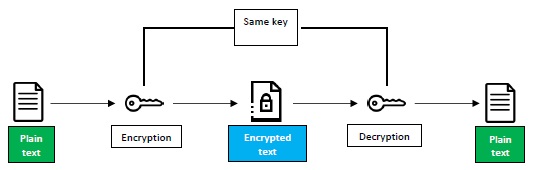
With symmetric cryptography, there is one key (the secret key) that is used for encrypting and decrypting the message. It’s therefore necessary for the sender of the message to share the secret key with the party he would like to correspond with.
The Caesar cipher is considered to be symmetric cryptography, because knowing the exact rotation (secret key) that is used to encrypt the message, you do also know how to decrypt the message.
Disadvantages of symmetric cryptography
There are several disadvantages to symmetric cryptography.
The first disadvantage is that the secret key has to be shared between the sender and receiver for messages to be exchanged privately. Sending the secret key over an unprotected communication channel is not recommended. In the next post, we will see how asymmetric (public key) cryptography allows us to send the encryption key safely over unprotected communication channels, while keeping the decryption key safely in our own possession.
The second disadvantage is that the secret key is now on two different locations. Thus, there are now two points of attack.
The third disadvantage is that the sender has to trust the receiver that he will not steal or copy the key or give it to someone else. It’s comparable to sharing the keys to your apartment: you also have to trust the other person not to steal your key, or copy your key, or give the key to another person.
The fourth disadvantage is limited scalability. Assuming that we’d like to communicate with a great number of parties, and that we’d like to provide each party with a different secret key for security reasons, we’d need to maintain a database of secret keys. For this setup to be user friendly in an environment like the internet, it would probably require an infrastructure of specialized distribution centers that generate secret keys each time two parties would like to initiate a private conversation. As these distribution centers would hold many secret keys, it would be a honey pot for hackers.
An example of symmetric cryptography is the Data Encryption Standard (DES), which was released on the market in 1975. It was developed by IBM, and was primarily meant to protect electronic communication between large financial organizations. Up until DES, cryptography was mainly a field for governments’ secret intelligence agencies to protect state communication. When the DES was released, it was received very well by cryptographers, until people found out that the National Security Agency (NSA) was involved with the development of the encryption key and purposefully influenced IBM to limit the key sizes from 64 bits to 56 bits. With 56 bits, there are 2^56 possible key combinations. This is considerably less than 64 bits keys. It is therefore much easier to break the encryption. Cryptographers believed that it would just be a matter of time before someone would find the right keys through a brute force search – meaning that you are trying all possible key combinations to find the right one.
Symmetric cryptography was the way cryptography was done until 1976 when two young researchers from Stanford University, Whitfield Diffie and Martin Hellman, invented asymmetric or public key cryptography.
Both researchers were discontent with DES, and Hellman even addressed a letter to the Secretary of Commerce, Elliot Richardson, saying:
I am writing to you because I am very worried that the National Security Agency has surreptitiously influenced the National Bureau of Standards [NBS] in a way which seriously limit the value of a proposed standard, and which may pose a threat to individual privacy. I refer to the proposed Data Encryption Standard. … I am convinced that NSA in its role of helping NBS design and evaluate possible standards has ensured that the proposed standard is breakable by NSA.
In my next post, I will discuss how public key cryptography works. Eventually, at the end of the post series, you will be able to encrypt your e-mails using public key cryptography.
Nightcap
- How the French Revolution reshaped the Catholic Church Glauco Schettini, Age of Empires
- The man who saved the Electoral College Christopher DeMuth, National Affairs
- Is the name of the country Myanmar or Burma? Mark Clifford, Asian Review of Books
- Suicide is not an act of cowardice Ken White, the Atlantic
Sunday Poetry: Gender Equality where it matters? The Scandinavian Unexceptionalism
Deja-Vu! Social Democrats once again bring up the topic of “Democratic Socialism” to cure all of the evils of the world. Once again, the Scandinavian countries (Sweden, Finnland, Denmark and Norway) are used as an example of how “a third way Socialism” can work. Although I still would consider myself young, I have already lost all of my stamina to engage in the same debates all over again until they pop up again a few months after.
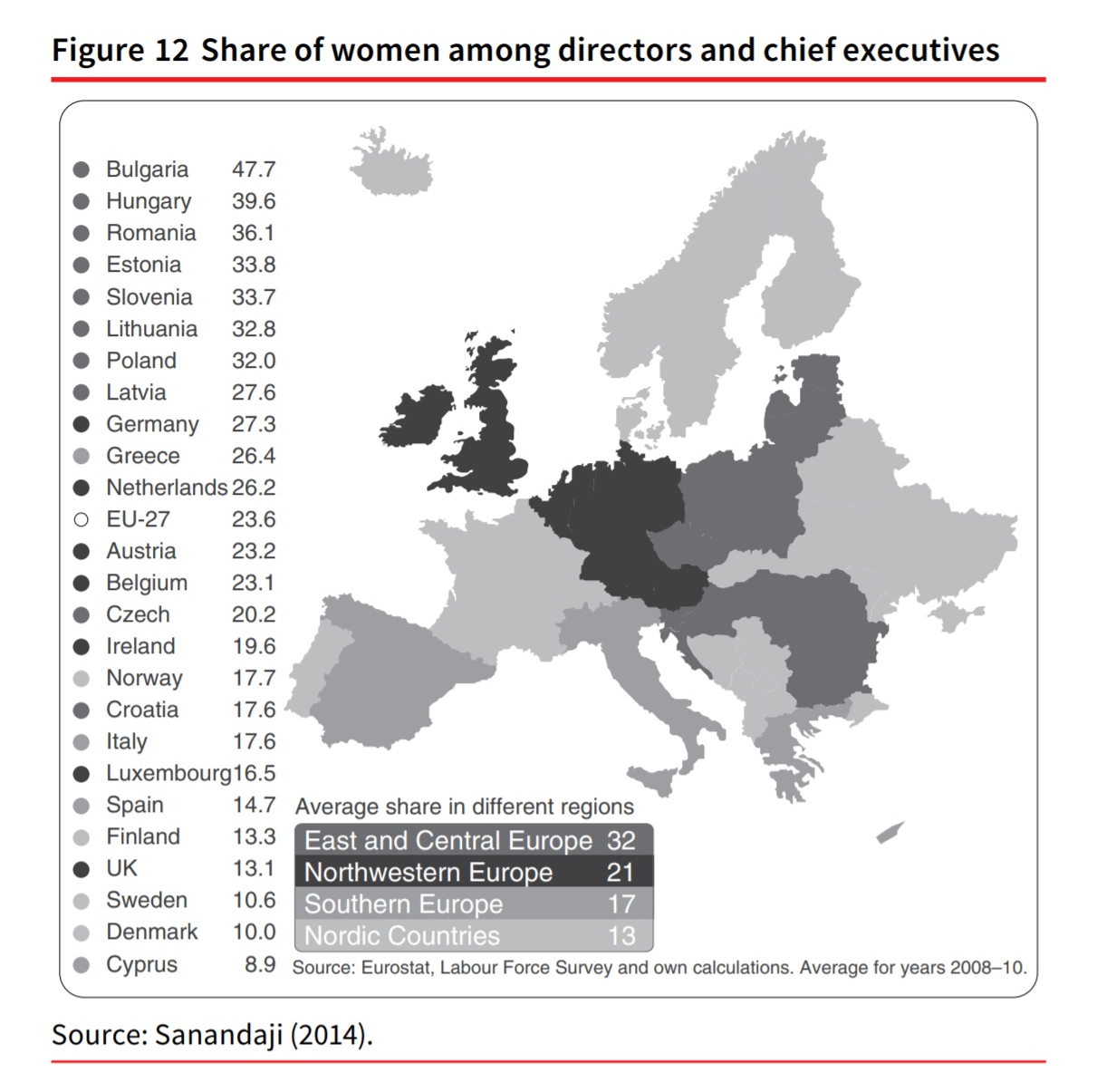
So, instead of pointing out the fallacy in labelling the Scandinavian countries moderately socialist (Nima Sanandaji, for example, does an excellent job in doing so), I want to look at one aspect in particular: The myth of peak emancipation of woman in the labour market in these countries. So apologies for neglecting Poetry once again for the sake of interesting information. Have a look at the following graphic and the remarks by Sanandaji:
“Some boards in Nordic nations are actively engaged in how the companies they represent are run. Others have a more supervisory nature, meeting a few times a year to oversee the work of the management. The select few individuals who occupy board positions – many of whom reach this position after careers in politics, academia and other non-business sectors – have prestigious jobs. They are, however, not representative of those taking the main decisions in the business sector. The important decisions are instead taken by executives and directors. Typically individuals only reach a high managerial position in the private sector after having worked for a long time in that sector or successfully started or expanded a firm as an entrepreneur. The share of women to reach executive and director positions is the best proxy for women’s success in the business world. Eurostat has gathered data for the share of women among ‘directors and chief executives’ in various European countries between 2008 and 2010. The data show that Nordic nations all have low levels of women at the top of businesses. In Denmark and Sweden, only one out of ten directors and chief executives in the business world are women. Finland and the UK fare slightly better. Those Central and Eastern European countries for which data exist have much higher representation.
[…]
A key explanation lies in the nature of the welfare state. In Scandinavia, female-dominated sectors such as health care and education are mainly run by the public sector.
A study from the Nordic Innovation Centre (2007: 12–13) concludes: Nearly 50 per cent of all women employees in Denmark are employed in the public sector. Compared to the male counterpart where just above 15 per cent are employed in the public sector. This difference alone can explain some of the gender gap with respect to entrepreneurship. The same story is prevalent in Sweden. The lack of competition reduces long-term productivity growth and overall levels of pay in the female-dominated public sector. It also combines with union wage-setting to create a situation where individual hard work is not rewarded significantly: wages are flat and wage rises follow seniority, according to labour union contracts, rather than individual achievement. Women in Scandinavia can, of course, become managers within the public sector, but the opportunities for individual career paths, and certainly for entrepreneurship, are typically more limited compared within the private sector.
If you are interested in the whole book, it is completely available online for free.
I wish you all a pleasant Sunday.
Nightcap
- The hunt for human nature Erika Milam, Aeon
- The negative capability of a good legislator Federico Sosa Valle, NOL
- Is feminism responsible for the persistence of monarchy? Arianne Chernock, Public Books
- Poor white boys in present-day England Kenan Malik, Guardian
The fight to preserve the internet as a tool of liberty
What’s the state of our internet freedoms around the world? Freedom House (2019) has recently released a report entitled ‘Freedom on the Net 2019‘.
According to the report, more than 3.8 billion people still have no access to the internet, but
- 71% of those who have access do live in countries where individuals have been arrested and thrown in jail for posting political, social or religious content;
- 65% live in countries where individuals have been attacked or killed for their online activities;
- 59% live in countries where authorities use online commentators to manipulate online discussions;
- 33 out of 65 countries that were assessed have seen their internet freedoms decline over past year.
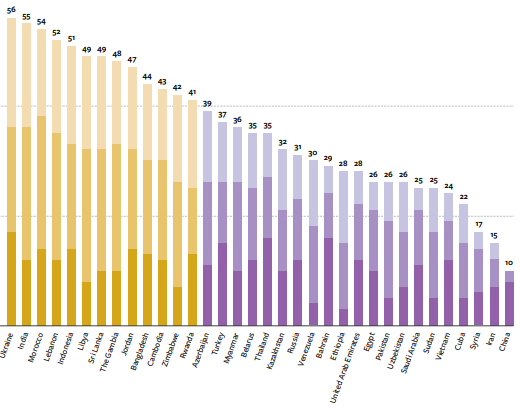
The greatest declines in internet freedoms happened in Sudan, Kazakhstan, Brazil, Bangladesh and Zimbabwe. For the fourth consecutive year, China has been the greatest abuser of internet freedoms, and although the United States is still scoring well, they have been on decline for three consecutive years.
The ranking from most to least free is as follows:

The report scores the countries, based on the internet controls that are in place:
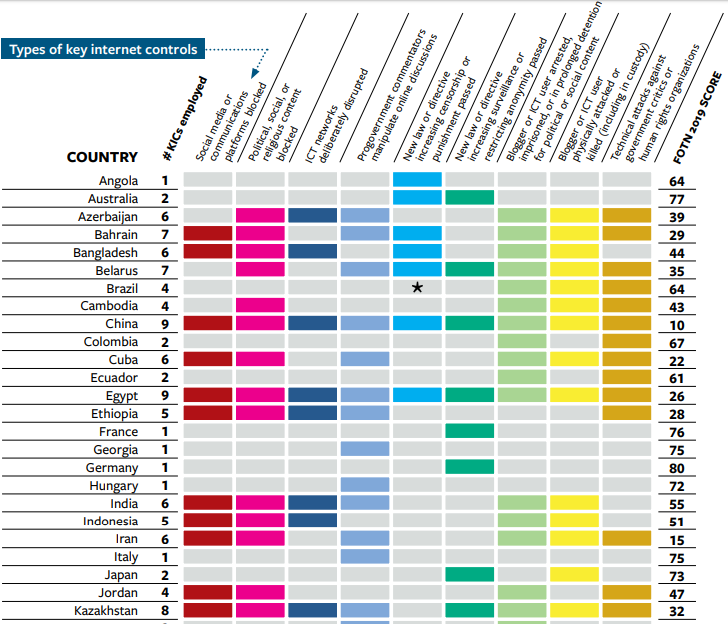

Governments hold more technological capabilities than ever before to surveil their citizens. They make use of bots to manipulate social media and big data analyses to surveil citizens. See for example this. In August 2018, Le Dinh Luong has been sentenced to jail for 20 years in Vietnam for addressing and posting about human rights abuses on social media in the country. In March 2019, an Uyghur Muslim was stopped and interrogated for three days, because not HE but someone ELSE on his WeChat contact list had checked in from Mecca.
What was once a liberating technology has now become a conduit for surveillance and electoral manipulation. What can we do to protect our internet liberties?
Nightcap
- How Japan invented Los Angeles — and reinvented American style Colin Marshall, LARB
- China’s new attempt at creating a civil religion Ian Johnson, NYT
- Liberty gained and (Protestant) power lost David French, Dispatch
- How Delhi’s Muslim rulers presided over a fusion of cultures and religions Ramachandra Guha, TLS
Nightcap
- Qassem Soleimani and deterrence Michael Koplow, Ottomans & Zionists
- A grim history of civilian planes shot down Ron DePasquale, NYT
- NATO expansion into the Middle East? Caitlin Oprysko, Politico
- Imperialism in medieval Java (sea power?) WJ Sastrawan, New Mandala
A happy ten-year anniversary to the case people love to hate
This month marks the ten-year anniversary of one of the most despised and misunderstood Supreme Court cases: Citizens United v. Federal Election Commission.
I love Citizens United. It stands as perhaps the most important First Amendment decision of the last decade. Yet it’s come to symbolize the illicit marriage between money and power, while what actually happened in the case is largely an afterthought. I remember encountering an enraged signature-gatherer outside a Trader Joe’s a few years ago who was engaged in one of the many campaigns to amend the Constitution to put an end to Citizens United. I thought he might have a coronary when I told him that it was one of my favorite Supreme Court decisions. I deeply regret not asking him if he could rehearse for me the facts of the case. Maybe he would’ve surprised me.
So what did Citizens United actually say? The law at issue banned corporations from using general treasury funds for electioneering, with civil and criminal penalties for corporations that spent money to speak on pressing political issues of the day. The Supreme Court said that a small-time political organization (that happened to be incorporated), Citizens United, could not be banned from publishing a film critical of a presidential candidate. It’s hard to find speech of a higher order of significance than that.
Citizens United held that government cannot ban political expenditures just because people choose to speak through the corporate form. This is a classic example of an old rule–government cannot censor speech based on the identity of the speaker.
Much of the fury over Citizens United is premised on a guttural abhorrence for the corporation. But corporations are just groups of people who have chosen to organize through a particular structure. And most don’t realize that the law at issue in Citizens United also banned unions from using general treasury funds for electioneering communications.
Much of the popular criticism of the case that I’ve seen seems to believe that Citizens United was the first case to establish that corporations had First Amendment rights. It wasn’t. In fact, not even the dissenters in the case would’ve held that corporations lack such rights. That was an uncontroversial and settled matter. And it should be obvious as to why. If corporations don’t have First Amendment rights, then the New York Times doesn’t have First Amendment rights, along with many other media organizations. (I’ve heard the excuse that freedom of the press would still protect media organizations independently, which is a misunderstanding of the freedom of the press, which doesn’t offer greater speech protections to media than non-media).
Citizens United gets a bad break, and I wish it a happy anniversary.
Nightcap
- Russia’s brief encounter with the sexual revolution Daniel Kalder, UnHerd
- The strange death of libertarian England Chris Dillow, Stumbling & Mumbling
- Did Iran’s missile attacks carry message for the Kurds? Dana Menmy, Al-Monitor
- A happy family beach in Puerto Vallarta Jacques Delacroix, Liberty Unbound
 Notes On Liberty