Automated law enforcement and rational basis

Does law enforcement need a human touch? The Supreme Court of Iowa says no. The Court recently decided that automated traffic enforcement (ATE) does not violate the Iowa Constitution. The Court, however, did take some time to address an important topic in constitutional jurisprudence: the nature of rational basis review.

Rational basis is a test applied to a variety of constitutional challenges. In the ATE case, the plaintiffs had brought due process and equal protection claims, both of which relied on the rational basis test. Rational basis is the weakest test in the hierarchy of judicial scrutiny. If a law is rationally related to a legitimate government interest, then a court won’t strike it down. As you might expect, plaintiffs very rarely succeed on this flimsy rational basis standard.

And so it was here. The Plaintiffs had argued that the ATE system in Cedar Rapids was not rationally related to an interest in public safety because, among many other things, the system punished a vehicle’s owner for speeding even if the owner was not the driver at the time. The Court had misgivings, but it ultimately deferred to the City and let the law slide.

The Court did, however, give a little boost to rational basis. The Court correctly noted that many state constitutions offer a stronger rational basis test than the federal test. That’s an important reminder to constitutional litigators–sometimes state constitutions may have analogous provisions to the federal constitution, but the protections they offer might be more robust.

The Court also made an important point about evidence in a rational basis claim. In many rational basis cases, plaintiffs don’t even get a chance to present evidence as to whether a law is rationally related to a legitimate government interest. If the government just asserts–without evidence–that a law furthers a legitimate interest like public safety, then the game is over. But the Iowa Supreme Court correctly noted that while a law is entitled to a presumption of constitutionality under rational basis, plaintiffs have a right to present evidence to rebut that presumption. Hence, “the mere incantation of the abracadabra of public safety does not end the analysis.” This evidentiary point is vital for strengthening the constitution’s protections against expansive government power.

Afternoon Tea: Christ on the Sea of Galilee (1854)

From Eugene Delacroix, as requested by Jacques Delacroix:

nol art delacroix christ on the sea of galilee 1854
Click here to zoom

I could stare at this for hours…

Obscenity law liberalised

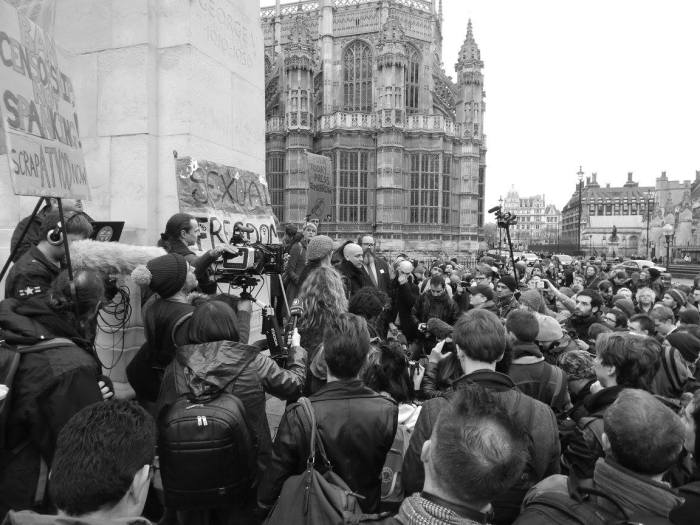
2014 Protest outside parliament for sexual expression. Photo by BeeMarsh BeePhoto
December 2014 Protest outside parliament against sex censorship. Photo by BeeMarsh BeePhoto

This is a cross-post from my contribution to the Adam Smith Institute blog.

Last week the Crown Prosecution Service published updated guidance for prosecutions under the Obscene Publications Act (1959). Legal campaigning has brought about a big change: the liberal tests of harm, consent and legality of real acts are now key parts of their working definition of obscenity. The CPS explain:

… conduct will not likely fall to be prosecuted under the Act provided that:

  • It is consensual (focusing on full and freely exercised consent, and also where the provision of consent is made clear where such consent may not be easily determined from the material itself); and
  • No serious harm is caused
  • It is not otherwise inextricably linked with other criminality (so as to encourage emulation or fuelling interest or normalisation of criminality); and
  • The likely audience is not under 18 (having particular regard to where measures have been taken to ensure that the audience is not under 18) or otherwise vulnerable (as a result of their physical or mental health, the circumstances in which they may come to view the material, the circumstances which may cause the subject matter to have a particular impact or resonance or any other relevant circumstance).

Continue reading →

Nightcap

  1. UCLA and its new ideological litmus tests Erik Gilbert, Quillette
  2. Sovereignty and the Latin American experience Greg Grandin, London Review of Books
  3. How good is television as a medium of history? Castor, et al, History Today
  4. SETI’s charismatic megafauna Nick Nielsen, Centauri Dreams

From the Comments: Mexican communist art at San Francisco’s public colleges

My college (City College of San Francisco) has a “Diego Rivera Theater” featuring a mural by the artist that spans the width of the building. It is the cultural asset of which the college is most proud. It is very nice to look at. Here’s a picture.

That’s from David Potts, who teaches philosophy at City College of San Francisco and blogs at Policy of Truth.

I’ve seen the real thing. It’s absolutely beautiful. If you’re doing the tourist thing in San Francisco, or if you live there and are looking for something to do, make sure you hit up CCSF.

Nightcap

  1. Pontius Pilate: the first Christian? Branko Milanovic, globalinequality
  2. Politics and forgiveness – a leftist proposal John Holbo, Crooked Timber
  3. Bumps on the road to pot legalization Irfan Khawaja, Policy of Truth
  4. America’s bewildering imperialism Damon Linker, the Week

Bad guys and bad thinking

AOC made waves with her recent “lightning round” during a hearing on a new campaign finance behemoth lumbering through the House, HR 1. Her basic point was that under our current campaign finance regime, it’s “super legal” to be a “pretty bad guy.”

I wrote recently that much campaign finance rhetoric resembles a religious canon. If so, then AOC is vying for the position of high priestess. I can’t review all the many flaws in her five-minute fable, but I’ll briefly canvas her commitment to orthodoxy.

First, she asks the hearing panel whether there is anything stopping a “bad guy” from being entirely funded by corporate PACs. The panel answered that no law prevents that. But surely common sense does. Running on a campaign solely funded by corporate PACs would be a titanically stupid campaign strategy. First off, thanks to disclosure laws and the realities of a media-rich society, all constituents would know that the candidate was running solely off corporate PACs. Why any candidate would intentionally sell themselves as a corporate lackey is beyond me.

Not only would this look bad, but it would also come at a huge financial cost. Congressional campaigns are mostly funded by individual contributions, not corporate PAC money, so basically a candidate would be refusing a huge amount of loot in order to broadcast themselves as the Peter Pettigrew of electoral candidates. I’m not convinced this is a looming threat to our democracy. Why should we regulate a non-existent problem?

Of course, she also trotted out important theological terms such as “dark money.” She seems to think campaigns are directly funded by dark money. Not so–any contribution over $200 faces extensive disclosure requirements. Dark money usually refers to independent political expenditures, which still face a variety of disclosure requirements and make up a surprisingly small amount of total political expenditures. Again, she is swiping at phantasms.

A larger issue is that even if her claims are true, HR 1 and most other campaign finance laws are hugely overbroad. The overwhelming majority of political spending occurs with no eye toward extracting favors from a candidate. Yet HR 1 would impose huge burdens on all groups speaking in the political arena. The better route to catch “bad guys” is to enforce criminal laws that prohibit bribery. Will you catch every instance of quid pro quo corruption? Almost certainly not. But since when was this a controversial price to pay for a free society? We’ve long ago decided that it’s best to have less than perfect enforcement in order to preserve individual liberty.

The collateral damage that HR 1 would impose on legitimate, non-corrupt speech is tremendous. I’m not confident AOC is fretting over the real “bad guy.”

Nightcap

  1. The battle for truth in Soviet science Michael Gordin, Aeon
  2. Governing least: a New England libertarianism Dan Moller, Bleeding Heart Libertarians
  3. A tale of two paths Michael Koplow, Ottomans and Zionists
  4. 10 walls that have actually been built – My latest at RealClearHistory

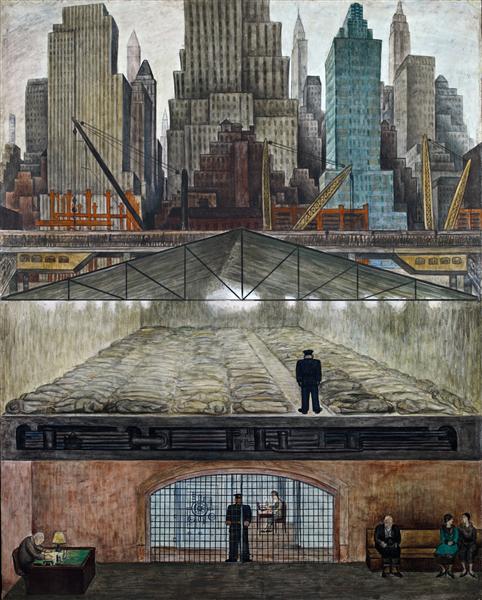
Afternoon Tea: Frozen Assets (1931)

This is from the communist Mexican artist Diego Rivera:

nol art rivera frozen assets 1931
Click here to zoom

Created during the Great Depression, this one is almost too predictable. It’s beauty alone, though, makes it worthy of an afternoon with tea.

Here is more from NOL on the Great Depression.

Nightcap

  1. In defence of prejudice Chris Dillow, Stumbling & Mumbling
  2. Escaping our Ship of Fools Mark Pulliam, Law & Liberty
  3. Against libertarian populism Zak Woodman, NOL
  4. How the Left continues to destroy itself Conor Friedersdorf, the Atlantic

Liberty and pro-choice arguments

Abortion never struck me as a liberty issue. Fundamental ideas that inform libertarian thinking don’t pick a “side” for or against abortion, late-term or otherwise. Abortion is a random issue. But my pro-choice credentials face greater and greater scrutiny as I pal around right-libertarians and conservatives, and I’ve had to re-investigate my own decision-making process here.

I find each political side — abortion jurisprudence — wholly unconvincing. When a sperm and egg becomes “life” is so outside thousands of colloquial years of the word, there’s nothing analytic in the definition to illuminate policy choices; I don’t think medical science is going to answer the philosophical question of the concept of “life” either (“clinical death” violates what should be commonsense notions of death); etcetera. And then, of course, the pro-choice camp (which emphasizes parental choice) rarely cares about parental choice afterward, like in education, and the pro-life camp is an absurdly broad name for their legitimate concerns. The philosophy of abortion is probably interesting — the politics is a waste of time.

Here is what, I think, enforces my libertarian advocacy of choice. I am probably more radically pro-choice than most people I know, but this provides a basic defense.

If the question of whether or not life is “worth it” is a sensible question in the first place, then it is not one that can be answered a priori. Life is an inherently qualitative experience. This is clear enough by the fact that some people would rather choose to have died at age 60 after having lived to age 80, if we take their judgment as the best authority on their own life’s worth (and I do, and I think we should). Therefore, in advance, its not knowable if a person’s life will be worth it. People generally do enjoy living (more than they would otherwise?); this might not be the case if, for instance, the Nazis won and we all were born in camps. This is an accidental property of the current world. We live in a generally worthwhile time period, suggesting life is generally going to be determined to be worth it by each individual.

Since the worth of life is not a priori, the best guess in advance is that from local knowledge. Parents have the most local knowledge about the future of their child’s immediate life, before it gets unpredictable and the knowledge gets divided by millions of individuals who will impact their life and also understand ongoing trends. Therefore, parents are the best option to make a judgment call about whether or not their child’s life will be worth it — if they can care for it, if they will have a genetic problem, etc. Not politicians. Not voters. Not interest groups concerned with in utero life in the abstract.

Thus, parental choice.

It’s been said this is an “anti-human” argument. Lots of us came from lower income or impoverished households, myself included. Our lives are still found worthwhile. Why strawman, as if we’re in countries with terrible childhood obesity, malnutrition, drug addiction, gang violence?

It’s true that in general life is found to be worthwhile. But there’s no Leibniz-like principle that it must be. Nor does the aggregate data that people do, often, qualify life as worth living, mean that random individuals overcome parental ownership of the best localized knowledge.

This, I think, is a libertarian argument for choice. It depends on the point that abortion is a unique sort of event — we’re not talking about an old man’s caretaker, who must have the best local knowledge about whether or not we should pull the plug. The question need not arise about who makes important choices once someone is cognizant and autonomous. The argument rides on the point that there’s a vacuum in decision-making autonomy for fetuses by their very intrinsic nature, and we have to make proxy choices in advance.

We give parents plenty of other choices by law. When we are debating potential- or possible-beings still in the womb, before our language game definitively identifies them as “alive,” choice should default to the parents, and I should have no right to the woman’s body to make choices for her about a possible-being I will never see, feed, care for or otherwise worry about except to force the woman to take care of it for nearly two decades.

What’s the biggest takeaway from my Blockchain classes?

We are nearing the end of my first semester as a Blockchain lecturer at a local university. We have discussed many topics, such as cryptography, consensus protocols, tokenization, smart contracts, how to build your own crypto-token…

During the final examination, I have asked what their biggest takeaways are from my classes. Do you know what the biggest takeaway is among most students?

It’s that they will never look at government and money the same way again. None of them had heard of the word Libertarian before, but now they leave the classes a little more sceptical of government and hopefully a little more libertarian.

Nightcap

  1. The world nationalism made Liah Greenfeld, American Affairs
  2. Remember the Kurds Shikha Dalmia, the Week
  3. The Kautilyan Prime Minister Kajari Sahai, Pragati
  4. Being Nigerian in Ghana Titilope Ajayi, Africa is a Country

Afternoon Tea: Le Coq (1938)

A Picasso:

nol art picasso le coq 1938
Click here to zoom

This one is in a private collection somewhere…

Nightcap

  1. How Mao took over the CCP Francis Sempa, Asian Review of Books
  2. Pentagon walks back Trump idea of using Iraq base to counter Iran Jack Detsch, Al-Monitor
  3. Hayek against the planners Anne Rathbone Bradley, Modern Age
  4. The internal contradictions of liberalism and illiberalism Scott Sumner, EconLog