Next

I have to report that I think my advancing age is not preventing me from gathering facts and exercising criticality. (Sorry, Joe; I don’t mean to put you down. – Joe Biden and I are the same age. But, I know what I am talking about.)

The year 2020 was rough, of course, not so much for me or for my wife Krishna, as for our children and others we love. For the two of us, sheltering in place did not really change our habits all that much except that our shopping for ourselves became progressively more limited. We didn’t party much before; we did not party in 2020. We had not partied that much in 2019. (That’s unless you count staying up until eleven pm with a small glass of Marsala as partying.) We might start partying in 2021 but it’s not all that likely!

The COVID affair did two things for me. First it reminded me of what a thin veneer rationality really is in Western society. We saw many lose their cool and accept the unacceptable. I was reminded also of something I knew in my bones, from thirty years of teaching: Even otherwise educated people don’t know how to deal with simple numbers. So, 320,000 excess deaths from the C-virus for a population of 320 million correspond to an excess death rate of 0.001. That’s one per thousand; it’s a very small figure. (I am deliberately leaving aside the idea that the number of deaths from COVID is almost certainly overestimated in this country. One problem at a time works best.) If people understood how small the number is, they would respond accordingly that is, with calm, perhaps. The evidence of innumeracy is all over our media, and all over Facebook, on all political sides. I don’t know why we keep doing such a piss-poor job teaching basic math. (It’s been like this as far back as I can remember.) Perhaps, it’s because people who can’t count don’t know that they can’t count.

Speaking of innumeracy, another topic rises to my mind irrepressibly. Above, I was referring to the task of interpreting simple fractions for example. There is something else missing among those, specifically, who are tasked with explaining what causes what, and who take the task seriously. People so engaged have always had to deal with two problems. First, there are multiple real causes to the thing they wish to understand, multiple causes of different strengths. So, weight gain is influenced both by calorie intake and by amount and intensity of exercise; fact. Calorie intake counts more than exercise. Second, there are possible causes that may not be causes at all. So, in addition to the two causes above, one may believe that weight gain is influenced by the ambient temperature. (It’s not.) Well it turns out that there is a series of tools that help understand better both kinds of problem. I mean much better.

There exists a toolbox called “econometrics” that does exactly that. It’s far from new. I learned econometrics in the seventies, and I was not a pioneer. Media explainers have evidently no acquaintance with it and probably don’t even know the tools exists. Now, I don’t want to give the wrong impression, learning econometrics is not light intellectual lifting but it’s within the reach of any smart person with a little time. I am baffled by the fact that something so obviously useful to figure out with real data whether X causes Y, in addition to Z, has failed to leach into ordinary educated society in fifty years and more. It’s discouraging about the pace of, or even the reality of progress.

The second important thing that happened in 2020 is that government at all levels gave us striking examples of its incompetence, and further, of its tendency immediately to turn tyrannical when frustrated. In the US and in France (whose case I am following pretty closely in the French media), government decisions have ruined a good part of the economy without real explanation being forthcoming. I mean closing by force thousands of small businesses that have little or no chance of recovering. I mean closing schools which prevents some, or many parents from going to work. The explanations for such actions are too light-weight to be taken seriously and they are frequently reversed like this: X causes Y; Ooops! X does not cause Y, Ooops! X does cause Y, sort of… Sometimes, often, good government consists in doing less rather than more: “We don’t know; do what you think is right,” at the most local level possible.

And, speaking of everyday government incompetence: The state of California wants to eliminate all internal combustion engines cars (and my own little pick-up truck) within fifteen years, to replace them with all-electric vehicles. That’s in a state where the local (PG&E, in central California) power monopoly has chronic trouble merely keeping the lights on. So, the question arises: Does the State of California really not know or does it know and not care (because it’s all about saving the planet)? I am not even sure which answer I prefer.

In the US, in addition to the COVID pandemic, we had a half a year of riots and burning of businesses, all in large cities held by Democrats for a long time. The inability, or the unwillingness, to stop the civil strife was striking. It expressed either a stunning degree of incompetence, or of complicity with the rioters. One explanation does not exclude the other, of course: Personal cowardice can easily hide under ideological fellowship. And ideology can generate cowardice.

In the minds of small government conservatives like me, the minimal task of government is to keep order so that individuals and companies can go about their constructive business. Local government largely failed in America in 2020. Extreme libertarians were more right than I thought. I wonder, of course, how much worse it would have been if a liberal had held the presidency instead of Donald Trump.

Government demonstrated to me in 2020 that it tends to be both incompetent and tyrannical. The thought crosses my mind that if it were more competent, it would be less inclined to tyranny.

The riots were adroitly attached to protests against the deaths of black suspects at the hands of police in questionable circumstances. They were staged as anti-racist protests, and especially as protests against “systemic racism.” I have already written why I think the police killings of black citizens in general are not racist acts. (Note: This is a long article. It can be read in nine segments, for convenience.)

I have also argued that in today’s America, systemic racism is too hard to find to lose sleep over it. Black Lives Matter, the organization, did almost all of the staging. It’s an organization of professional Marxist revolutionaries. I believe they are merely using alleged racism as a means to trigger a revolution in the US, or at least, to make their brand of statism gain ground, or at worst, to earn some credibility among the ill-read but well-intentioned.

In spite of the mendacity of the BLM campaign in every way, it may have done some good simply by drawing attention. I have always thought that American society has never really digested the fact of slavery. I mean the fact that it was 250 years of unrelenting atrocities. Some good may come from greater and deeper knowledge of that past. Same reason I am horrified by the brutal removal of statues and by the biased (“woke”) erasure of history going on in the streets and in universities as I write. Not facing the legitimate grievances about yesterday is like asking for insidious and endless blackmail today. That’s what we have now. There is a better way.

Do I think the Democrats, some Dems, stole the presidential election? I am not sure. I am sure of two things however: Many Democrats in several locations tried to steal it as much as they could. Some have argue in their defense that it was just “normal” cheating, that it happens the same every year. I want to know more about that. The second thing is that – to my knowledge (I am educable) there have been few or no complaints of cheating against Republican entities. Electoral cheating is a Democratic specialty.

Stealing a word from conservative commentator, Mark Stein, I fear we are entering a post-constitutional era. I don’t know what to do about it. I wish secession were more practical. It’s happening anyway on a small scale with tens of thousands voting with their feet by leaving California and New York State. It’s a first step. If the federal government would shrink some, I could imagine that this sort of peaceful partial secession would work for all: a Middle America centered on Texas, and an Extreme America based in California and New York State. The two parts linked in a loose confederacy. (Oops, wrong word!) Unfortunately, there is no miracle in sight by which the federal structure will become more skinny, with a shorter reach.

2020 saw the dramatic introduction of censorship and also of guided thought throughout the social media. If capitalism is allowed to function, the giant privately held businesses responsible for these poisons, and first and foremost Facebook, will have to withstand the emergence of rivals that will compete on that basis, precisely. I have tried one such and it did not work for me. There is no reason why there can’t be more, better ones. In the worst scenario with which I come up, the forces of darkness cannot eradicate capitalism fast enough to prevent this from happening. That’s my optimistic prediction for 2021 and beyond.

Other interesting things have happened to me that are kind of hard by their nature to recall. Here is the main one. As anthropogenic global warming became the state religion in many places, including to an extent, in the US, its narrative lost its remaining credibility in my mind. (Ask me why.)

Finally, we saw again that Communist China is too big and too powerful for a country that does not share our values. I refer to mass imprisonment without trial and outside the law, extra-judicial kidnapping by the government, guaranteed non-freedom of the press. This is true even if most rank-and-file Chinese citizens are satisfied with their government. (They may well be.) I am not Chinese myself. Chinese economic power has to be restricted (even if doing so is unfair). The influence of the Chinese Communists in America must be constrained. If Finland, for example were as big as Communist China, I wouldn’t mind so much, or at all.

I wish all of us a better year, more wisdom, more intellectual honesty, the ability peacefully and firmly to resist creeping tyranny.
UK-Turkey Free Trade Agreement: Beyond the Economics

Introduction

On December 29, 2020, the UK and Turkey signed a Free Trade Agreement (FTA) which will become effective January 1, 2021, after the UK leaves the EU. Turkey’s Trade Minister, Rushkar Pekcan, and the British Ambassador to Turkey, Dominick Chilcott, signed the agreement. 

The timing of the agreement was interesting, since the FTA was signed days after the UK and EU had managed to clinch a Brexit trade deal, with great difficulty, and after the US imposition of sanctions on Turkey for the purchase of S400 missiles from Russia (the decision to impose sanctions is likely to have its impact not just on Turkey-US ties, but also between Turkey and other NATO member states).

Commenting on the importance of the deal, Pekcan said:

The free trade agreement is a new and special milestone in the relationship between Turkey and United Kingdom.

President Recep Erdogan, while referring to the significance of the FTA a day before it was signed, had said that it would create a win-win situation for both Turkey and the UK. He also said that the deal is crucial, and dubbed it as Turkey’s most important economic agreement after the 1995 Customs Union.

Economic importance of the FTA 

If one were to look at the economic significance of the deal, it is dubbed to be the fifth largest trade deal for Britain. The UK-Turkey FTA is also likely to give a significant boost to the bilateral trade between both countries. The UK is Turkey’s second largest export market (for commodities including vehicles, textiles, and electrical equipment). The agreement is also important from Turkey’s point of view because without a deal well over 75% of Turkey’s exports to the UK would have been subject to tariffs. The FTA will also ensure existing preferential tariffs for 7,600 British businesses that exported goods to Turkey in 2019.

According to estimates, the potential for bilateral trade between Turkey and Britain is up to $20 billion. Britain is Turkey’s fifth largest investor (investment is estimated at $11.6 billion) and a total of 2,500 British companies are based in Turkey. 

UK Trade Secretary Elizabeth Truss, while commenting on the deal, said ‘[…it] provide[s] certainty for thousands of jobs across the UK in the manufacturing, automotive, and steel industries.’

While the key features of the deal are known (it seeks to prevent supply chains in automotive and manufacturing sectors, and also covers all agricultural and industrial goods), the FTA could also give a fillip to deeper defense cooperation between the UK and Turkey (in November 2020, Turkey and the UK held defence exercises for the first time).

Geopolitical context

The FTA also has geopolitical significance, because the UK is one of the few Western countries with which Turkey has a cordial relationship. While all eyes have been on the imposition of US sanctions, and its impact on the Washington-Istanbul relationship, Turkey’s ties with the EU have also witnessed a steady deterioration due to a multitude of factors in recent years. Turkey has also not been on the same page as the Western world on a number of geopolitical issues. This includes the Syria issue, as well as the dispute between Azerbaijan and Armenia over Nagorno-Karabakh.

Turkey’s military operation in Syria and reactions

Turkey’s military offensive against Kurdish forces in Northern Syria in 2019 received strong responses from EU member states and the US. While the EU was critical of the action, US policy makers had urged Donald Trump to freeze assets belonging to Turkish leaders and block the sale of arms to Istanbul. Trump had written to Erdogan to refrain from such an action, but the Turkish President paid no heed to the same. It would be pertinent to point out that after Turkey’s October 2019 invasion of Syria, Britain had stopped sales of arms, but said it would not be providing new export licences for weapons which may be used in military operations in Syria.

If one were to look at the Azerbaijan-Armenia issue, France has been vocal in supporting international supervision of the ceasefire and has also expressed apprehension that Turkey and Russia may exclude Western countries. 

The EU has also been uncomfortable with Turkey’s policy in the Mediteranean. Only recently, the EU imposed sanctions against Turkish companies and individuals for oil drilling. Greece had wanted sectoral sanctions but this was resisted by German Chancellor Angela Merkel and Bulgarian Prime Minister Boyko Borissov, who shares a close rapport with Erdogan.

Russia-Turkey relationship

While it is believed that the main reason for the rift between Turkey and the West is the former’s growing proximity to Russia, Istanbul and Moscow too have divergences over geopolitical issues (be it Syria, Libya, or Azerbaijan). Only recently, the presence of the Turkish President at Azerbaijan’s military parade on December 10, 2020, to mark Azerbaijan’s victory over Russian ally Armenia with Turkish assistance, would not have gone down well with Moscow. Yet in public, Russia has refrained from criticizing Turkey. In an interaction with the media in December 2018, Russian President Vladimir Putin stated that sometimes Russian and Turkish interests do not ‘coincide,’ yet he also praised Turkey for pursuing an ‘independent foreign policy’ in spite of being a member of NATO and honoring its commitments. 

He has also stated that Moscow needs to be ‘patient’ and adopt a more compromising stance vis-à-vis Turkey. 

Erdogan does realize that he cannot afford a sudden deterioration of ties with the US, and his reconciliatory statements vis-à-vis Israel, and the Turkish decision to appoint an envoy after more than two and a half years, is being viewed as a step towards mending ties with the incoming Biden Administration.

Conclusion 

The Britain-Turkey FTA is important not just for economics but also for geopolitical reasons. While Britain will deal with the realities of a post-Brexit world, and such FTA’s will be important in navigating the same, for Turkey the deal is important in the context of the geopolitics of the Middle East and beyond.

Prediction market update

The market for who wins the presidency closed this morning! But the Electoral College margin of victory market was still open and at 98 cents for the already certain outcome. Maxing out my position there would mean $17 for free! So I did, and the market dipped to 97 cents.

This truly is the dumbest jack in the box. We all know exactly what’s going to happen, and yet…

A couple of post-election thoughts

  1. The left has not learned the right lesson.
  2. What the hell is up with Predictit?

Trump was the perfect Madisonian teachable moment. A horrifying figure who I wouldn’t trust to watch my drink while I got up to hang my coat. The lesson should have been clear: scale back the power in the Oval Office. But now that the pendulum has swung the other way, they “are urging him to follow President Trump’s example”. This is why we can’t have nice things.

Meanwhile, in a world where people are putting their own money on the line, people are still holding out hope that Trump will win the election he just lost. The market for predicting the winner of the presidential election has 10’s of thousands of transactions and places the probability that Trump or Biden wins at 103%. As an economist I find it disconcerting that I can still buy contracts of “Biden to win” at 88 cents. The lesson I’m taking away is that (at least when Trump is involved) there’s a wide margin of error on how accurate the prediction market estimate is.

The politics of The Expanse

I am rewatching The Expanse, which is a deservedly popular science fiction show on Amazon Prime. It’s very good. As I said, I am rewatching it, mostly in anticipation of the new season, which comes out next month.

It’s good because I like my science fiction to be science-y. I prefer realistic scenarios. So Star Wars is not really my thing (even Star Trek is a stretch, to be honest, but DS9 is amazing).

One thing that strikes me as wrong in The Expanse is the politics. In the storyline, there are three political units: Earth, Mars, and the Belt. Earth and Mars are sovereign, and the Belt (based out of the asteroid belt) is semi-sovereign with a distinct and viable “nationalist” movement there. This is a sophisticated storyline for television. It’s better than DS9, which bore the standard for great science fiction television until The Expanse came along.

But I can’t stop thinking: why would the political alignment of the solar system be based on planets? If it were to be truly realistic, then Earth would not be a sovereign political unit. Instead, we’d have a dozen or so political units from Earth, some political units from Mars, and several from the Belt. Factions in the form of sovereign political units would dominate the political landscape, not planets.

Now, The Expanse does a good job confronting the issue of faction. Earth’s democratically-elected dictator has to deal with several factions, and Mars and the Belt both have factions, too. And several excellent subplots deal significantly with the issue of faction. But there’s not enough sovereignties in The Expanse. It doesn’t mean the series isn’t the best science fiction television series of all time (it is), but it does leave me wanting more.

You vote is your voice–but actions speak louder than words

On voting day, with everyone tweeting and yelling and spam-calling you to vote, I want to offer some perspective. Sure, ‘your vote is your voice,’ and those who skip the election will remain unheard by political leaders. Sure, these leaders probably determine much more of your life than we probably would like them to. And if you don’t vote, or ‘waste’ your vote on a third party or write in Kim Jong Un, you are excluded from the discussion of how these leaders control you.

But damn, if that is such a limited perspective. It’s like the voting booth has blinders that conceal what is truly meaningful. I’m not going to throw the traditional counter-arguments to ‘vote or die’ at you, though my favorites are Arrow’s Impossibility Theorem and South Park’s Douche and Turd episode. Instead, I just want to say, compared to how you conduct your life, shouting into the political winds is simply not that important.

The wisdom of the stoics resonates greatly with me on this. Seneca, a Roman philosopher, tutor, and businessman, had the following to say on actions, on knowledge, on trust, on fear, and on self-improvement:

  • Lay hold of today’s task, and you will not need to depend so much upon tomorrow’s. While we are postponing, life speeds by. Nothing is ours, except time. On Time
  • Each day acquire something that will fortify you against poverty, against death, indeed against other misfortunes as well; and after you have run over many thoughts, select one to be thoroughly digested that day. This is my own custom; from the many things which I have read, I claim some one part for myself. On Reading
  • If you consider any man a friend whom you do not trust as you trust yourself, you are mightily mistaken and you do not sufficiently understand what true friendship means. On Friendship
  • Reflect that any criminal or stranger may cut your throat; and, though he is not your master, every lowlife wields the power of life and death over you… What matter, therefore, how powerful he be whom you fear, when every one possesses the power which inspires your fear? On Death
  • I commend you and rejoice in the fact that you are persistent in your studies, and that, putting all else aside, you make it each day your endeavour to become a better man. I do not merely exhort you to keep at it; I actually beg you to do so. On the Philosopher’s Lifestyle

Seneca goes on, in this fifth letter, to repeat the stoic refrain of ‘change what you can, accept what you cannot.’ But he expands, reflecting that your mind is “disturbed by looking forward to the future. But the chief cause of [this disease] is that we do not adapt ourselves to the present, but send our thoughts a long way ahead. And so foresight, the noblest blessing of the human race, becomes perverted.”

Good leadership requires good foresight, but panic over futures out of our control pervert this foresight into madness. So, whether you think that Biden’s green promises will destroy the economy or Trump’s tweets will incite racial violence, your actions should be defined by what you can do to improve the world–and this is the only scale against which you should be judged.

So, set aside voting as a concern. Your voice will be drowned out, and then forgotten. But your actions could push humanity forward, in your own way, and if you fail in that endeavor, then no vote will save you from the self-knowledge of a wasted life. If you succeed, then you did the only thing that matters.

Election Day

You’ve seen me gripe about the inadequacy of the “Throw the Bums Out Theory of Governance” before. I could make the argument again, but Carlin’s more eloquent.

For the record, I did vote, but only for the sake of domestic harmony. I’m under no illusion that this is the year they’ll finally pick my preferred (least un-preferred) candidate. And I’m still going to complain, because a) causality is more complicated than works for the premise of a joke, b) I need a hobby and complaining doesn’t require special equipment, and c) I think complaining is a more valuable and useful form of civic duty than voting.

If you’re voting today, I hope it doesn’t suck to much. If you’re not, I hope you’ll use your saved time to actually make the world a better place.

Amy Coney Barrett is the start of the rise of the Left

The Left has long been weak. It dominates elite circles, but not much else.

Amy Coney Barrett earned her law degree from Notre Dame. The other 8 justices earned their degrees from Harvard or Yale. President Trump’s ideological shake-up of the Supreme Court bodes well for diversity, which in turn bodes well for a resurgence of the American Left in the civic, intellectual, and moral life of the republic.

The stranglehold that the two schools had on Ivy legal thought has meant that the American Right would always be stronger ideologically as well as civically and morally.

It is perhaps ironic that Donald Trump, in trying to Make America Great Again, has done just that by opening up the avenues of power to diverse modes of thought. Donald Trump’s crusade for diversity has indeed opened up elite American circles to competition. This will only strengthen the Left, as it will now have to incorporate non-professional voices into its apparatuses of power, as the Right has long done with much success.

A strong Left that is not overly reliant on elite opinion bodes well for the republic.

Triple-blinded trials in political economy

In medicine, randomized controlled trials are the most highly regarded type of primary study, as they separately track treatment and control groups to determine whether an observed effect is actually caused by the intervention.

Bias, the constant bane of statisticians, can be minimized further by completing a blinded trial. In a single-blinded trial, the patient population is not informed which group they are in, to prevent knowledge of therapy from impacting results. Placebos are powerful, so blinding has helped identify dozens of therapies that are no better than sugar pills!

However, knowledge can contaminate studies in another way–through the physicians administering the therapies. Bias can be further reduced by double blinding, in which the physicians are also kept in the dark about which therapy was administered, so that their knowledge does not contaminate their reporting of results. In a double-blind trial, only the study administrators know which therapy is applied to each patient, and sometimes an independent lab is tasked with analysis to further limit bias.

Overall, these blinding mechanisms are meant to make us more certain that the results of a study are reflective of an intervention’s actual efficacy. However, medicine is not the only field where the efficacy of many interventions is impactful, highly debated, and worthy of study. Why, then, do we not have blinded studies in political economy?

We all know that randomized controlled trials are pretty much impossible in political economy. North/South Korea and West/East Germany were amazing accidental trials, but we can still hope that politicians and economists make policies that can at least be tracked to determine their ‘change from baseline’ even if we have no control group. Because of how easy it is to harm socioeconomic systems and sweep the ruinous results under the rug, I personally consider it unethical to intervene in a complex system without careful prior consideration, and straight up evil to do so without plans to track the impact of that intervention. So, how can politicians take an ‘evidence-based approach’ to their interventions?

I think that, in recent years, politicians–especially in the US and especially liberals and COVID-reactionaries–have come up with an amazing new experimental method: the triple blinded study. Examples include the ACA, the ARRA, and the recent $3 trillion stimulus package. In a triple blinded study, politicians carefully draft bills so that they are (1) too long for anyone, especially the politicians themselves, to read; (2) filled with a mish-mash of dozens of strategies implemented simultaneously or that are delegated vaguely to administrative agencies; and (3) have no pre-specified metrics by which the policy will be judged, thus blinding everyone to any useful study of signal and response.

I am reminded of one of the most painful West Wing episodes ever made, in which “President Bartlett” is addressing an economic crisis, and is fielding dozens of suggestions from experts–without being able to choose among the candidate interventions. Donna, assistant to his Deputy Chief of Staff, tells a parable about how her grandmother would use ‘a little bit of this, a little bit of that’ to cure minor illnesses. Inspired, Bartlett adopts a policy of ALL suggested economic interventions, thus ensuring that we try everything–and learn nothing. I shudder to think that this strategy was ever broached publicly…and copied from fiction into reality.

In this way, politicians have cleverly enabled us to reduce the bias caused by any knowledge of the intervention or its impact. The patients (citizens), physicians (politicians), and study administrators (economists?) are all kept carefully in the dark so that none of them can know how a policy impacted the economy. Thus, anyone debating any of these topics is given the full freedom to invent whatever argument they want, cherry-pick any data they want, and continue peddling their politics without ever being called to task by the data.

Even more insanely, doctors are held not only to the standard of evidence-based medicine, but also to that of of the precautionary principle–where passivity is preferred to action and novel methods are treated with special scrutiny. “Evidence-based policy”, on the other hand, is a buzzword and not an actual practice to align with RCTs, and any politician who actually followed the precautionary principle would be considered ‘do-nothing’. Thus, we carefully keep both evidence and principles of ‘do no harm’ far from the realm of political action, and continue a general practice across politics of the blind making sure that they lead the blind.

In sum, political leaders, please ignore Donna. Stop intentionally blinding us to policy impacts. Stop doing triple-blinded studies with the future of our country. Sincerely, all data-hounds, ever.

AOC doesn’t understand Christianity

I believe I wasted a lot of time some years ago arguing if Venezuela was a democracy or not under Hugo Chávez. The difficulty with this kind of conversation is that people can have very different views on what constitutes a “democracy”. That is part of the reason why North Korea can call itself a “democratic republic”. However, when somebody claims something about Christianity, and specially about what the Bible says, I feel more comfortable to debate.

I understand that it is like flogging a decomposing horse, but some months ago representative Alexandria Ocasio-Cortez supposedly called out the hypocrisy of religious conservatives using their faith to justify bigotry and discrimination in the United States. Her speech can be watched here. I believe her point is this: conservative Christians only care about religion in order to support their so-called “bigotry”. AOC believes that Christians should support socialism, because after all, that’s what Jesus would do.

AOC says some truths: sadly, the Christian Scriptures have been distorted many times over American history to defend political agendas they were never meant to defend. AOC could go even further on that if she wanted: the Cristian Scriptures were completed almost 2 thousand years ago, and they simply don’t talk specifically to many of the political issues we have today. One can say they offer principles of conduct, but it’s really up to us to figure out how these apply to concrete situations we find today. In this case, using Scripture to support political agendas can be not only morally wrong, but also naive and misguided.

AOC is also right when she says that human life is special (although I would question if “holy” applies) and that we should “fight for the least of us”. All these statements and more are true!

What AOC really doesn’t seem to understand (and frankly, this is quite scary) is that Christianity can’t be forced upon people. Yes, biblically speaking, we are to care for the poor. However, the Bible is addressing we as individuals. There is absolutely nothing in the Bible that says that we are to provide medical care for those who cannot afford via government fiat. Actually, there is nothing in the Bible that says that I can force people to act as Christians when they are not.

One of the great gifts from modernity is separation between church and state. I would submit that this separation was present in Christianity from the start, but the concept was so radically different from everything people were used to that it took some centuries for it to be put into practice, and we are actually still working on it. One of the things we realized in modern times is that we can’t force people to be Christians via government. And in her speech, AOC is trying to undo that. She wants government to force people to do a charitable work that can only be done if it is their choice.

As a Christian, I would say this: I would like to diminish suffering in this world, and this is exactly why I’m against the socialism AOC supports. One doesn’t have to be a genius to realize that the poor are much better off in countries that go further away from what Ms. Ocasio supports. It’s not simply a matter of wanting to help the poor, but of doing it in efficacious way. And also: I want to invite people to look to the example of Jesus, who being rich made himself poor for the sake of many. I do hope that more and more people might have their lives changed by Jesus. But I don’t want to force anybody to do that. I want to invite people to consider what Scripture says, and to make their choice to change their lives. As for now, I believe that capitalism is the most efficient way to help the poor humanity has discovered so far.

Transaction costs, exit, and democracy

“What is important to note, however, is that transaction costs associated with relocation matter. The relative success of protectionist and subsidyseeking groups in post-war Britain, Australia, and New Zealand was facilitated by the high costs associated with exercising the exit option. Both Britain and New Zealand are unitary and centralized nation states. Although Australia is a federation, there are only six states, each of which has less fiscal and regulatory autonomy than American states or Canadian provinces.

Polycentric democracy works most effectively when exit-related transaction costs are low and when the number of viable options is large. The closest approximations of a genuine polycentric democracy are the 50 American states and the 26 Swiss cantons.”

Read the rest (pdf). (Yes, I know this was part of last night’s “nightcap,” too.)

Why the US is behind in FinTech, in two charts

The US is frankly terrible at innovation in banking. When Kenya (and its neighbors) has faster adoption of mobile banking–as they have since at least 2012–it is time to reconsider our approach.

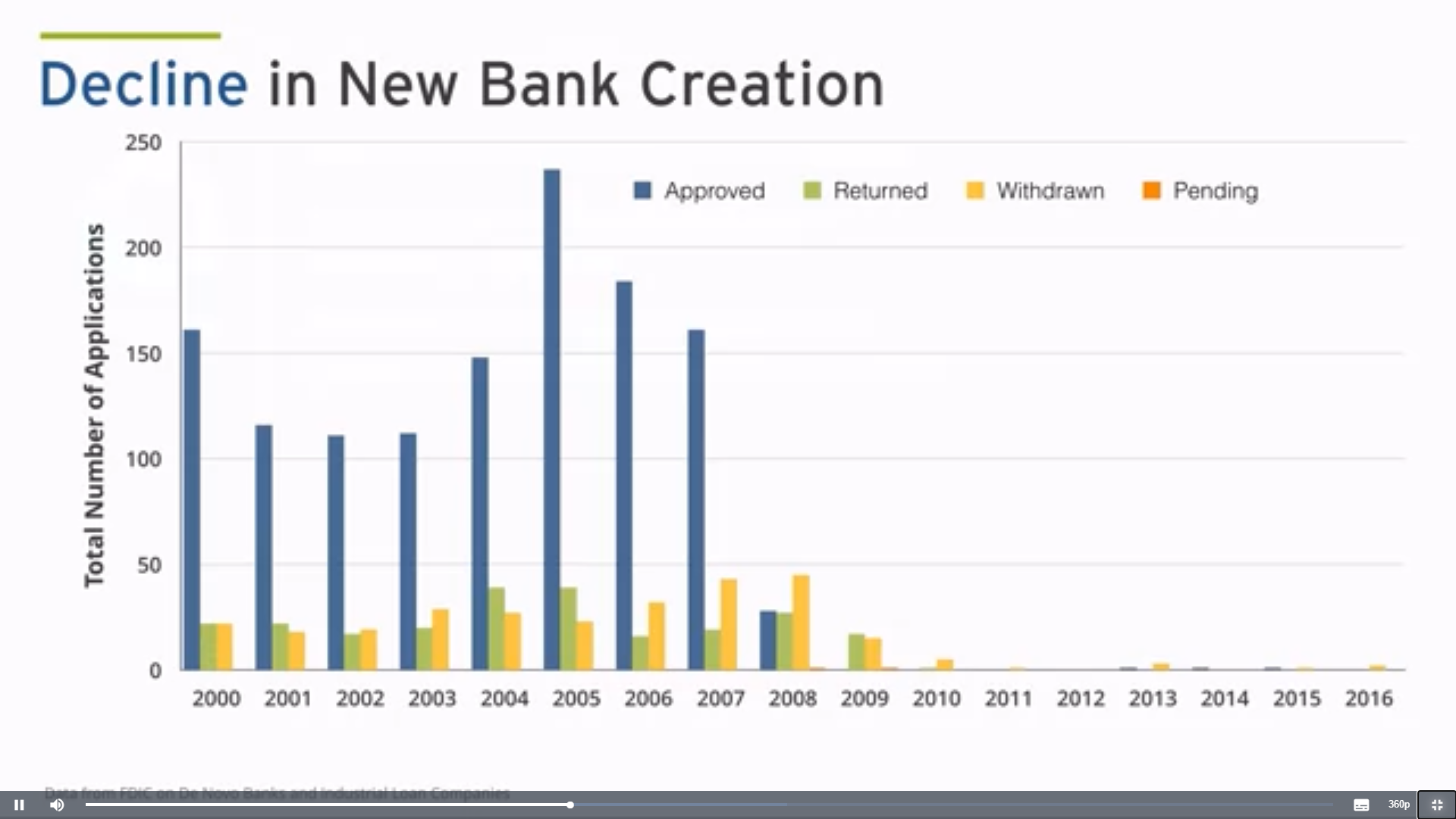
Here is the problem: we made new ideas in banking de facto illegal. Especially since the 2008 financial crisis, regulatory bodies (especially the CFPB) has piled on a huge amount of potential liability that scares away any new entrant. Don’t believe me? Let’s look at the data:

bank creation

Notice anything about new bank creation in the US after 2008?

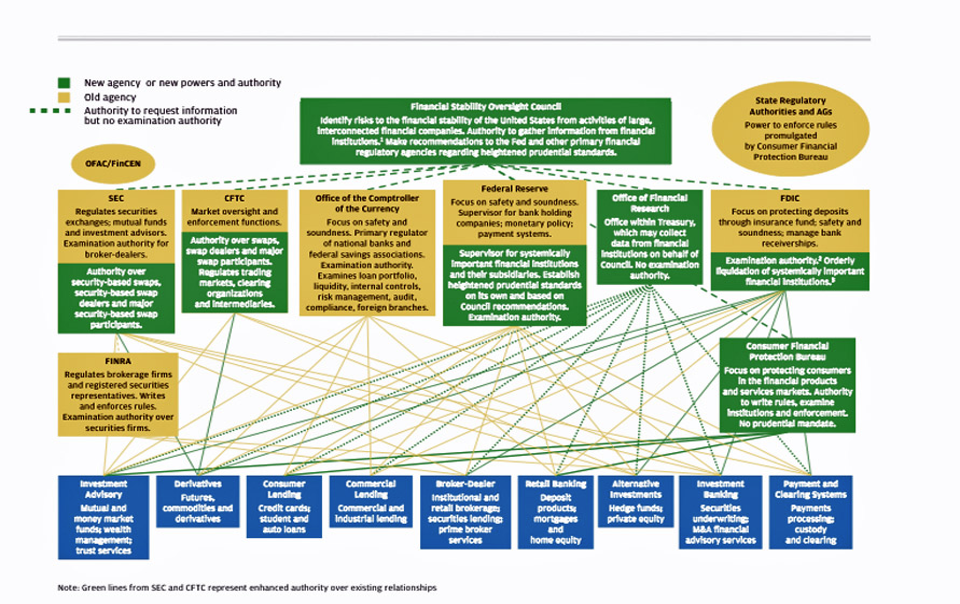
A possible explanation, in a “helpful resource” provided to banking regulators and lawyers for banks:

regulatory complexity

This shows: 8 federal agencies reporting to the FSOC, plus another independent regulatory body for fintech (OFAC/FinCEN). Also, the “helpful” chart notes state regulations just as an addendum in a circle…probably because it would take 50 more, possibly complex and contradictory charts.

So, my fellow citizens, don’t innovate in banking. No one else is, but they are probably right.

Pourquoi Kamala Harris?

La nomination de Kamal Harris comme candidate du Parti Democrate (“D” majuscule) à la vice-presidence avec Joe Biden a donne lieu à beaucoup de sornettes dans les media francais, et francophones, comme on pouvait s’y attendre. Bien sur tout ceci importe car il y a de bonnes chance que Kamala se retrouve présidente, peut-être même très vite.

Etant donnés l’âge de Biden et son état de sénilité, il n’est pas impossible qu’elle devienne tôt Président des EU par remplacement constitutionel. Ceci, à moins que ceux-la mêmes qui ont choisi Kamala comme V.P. à rideaux tirés changent de cheval et inventent aussi un stratagème constitutionel pour mettre en oeuvre le remplacement du vieux Biden. Il y a même certains (dont je ne suis pas) qui parient que Biden ne sera jamais le candidat Democrate venu le temps des élections, qu’il sera remplacé par Kamala avant les élections.

D’abord, des clarifications sur l’ascendance familiale de Kamlal Harris qui ne sont pas superflues vu que le Parti Democrate est enfoncé jusqu’au cou dans la politique communautariste. Elle est la fille de deux immigrants. Sa mère était une Indienne de haute caste du sud de l’Inde. Son père vient de la Jamaique. Selon lui-même, il descend à la fois d’esclaves et de propriétaires d’esclaves. (Il s’agit d’une situation commune, aux EU, comme dans les Antilles anglaises. On saurait qu’elle est commune aussi dans les Antille françaises si on se donnait la peine de chercher un peu.)

Les EU sont un des ces pays possèdant une bourgeoisie issue directement de l’immigration. (J’en fait moi-même partie, sur un plan assez mineur, à vrai dire.) On n’est pas obligé d’entrer dans la société américaine par le bas. Aujourd’hui même, des milliers de citoyens de l’Inde arrivent nantis de bons diplômes. Ils acquièrent un enseignement supplémentaire sur place. Ceux qui s’arrangent pour rester se retrouvent quelquefois millionaires en dix ans. Il se marient le plus souvent entre eux, ce qui accélère encore l’ascenceur économique de leur mobilité sociale. En tous cas, le père de Kamala était professeur d’économie a Stanford et sa mère, chercheuse à l’université de Californie/ Berkeley, possèdait aussi un doctorat. La petite Kamala n’a donc pas été élevéee dans le dénuement. Grandissant dans la très éclairée région immédiate de San Francisco , dans les années 70/80, elle n’a surement pas beaucoup d’expérience personelle du racisme non plus .

Le fait qu’elle se présente comme un candidate Noire pose problème à beaucoup de francophones. C’est que la classification raciale aux EU est avant tout une question sociologique plutot que génétique. Depuis longtemps, elle dépent en partie des choix identitaires que font les personnes elles-mêmes. Personne ne châtie ceux qui se presentent comme blancs même s’ils ont 50% de sang africain sub-saharien. De même, il faudrait un état de fraude charactérisée pour que des porte-paroles Noirs dénoncent la négritude de n’importe qui possèdant un grand-père ou un arrière-grand-père Noir, ou même un seul arrière-arrière-grand-père. Il vaut quand meme mieux, cependant, posséder des traits visibles d’origine africaine sub-saharienne, sur la tête ou les lèvres, si la teinte de peau fait défaut.

Le père de Kamala, né à la Jamaique, possède sans aucun doute des ancêtres Africains . Et il semble que très tôt, Kamala ait fait le choix de devenir membre de l’élite politique Noire de la région de San Francisco. Elle aura delibérément opté pour l’afroamericanité. Elle a donc fait ses premières études universitaires à Howard University à des milliers de kilomètres de chez elle. Howard est difficile a expliquer. C’est une université fondée et financée directement par le gouvernement fédéral apres la Guerre Civile pour donner un débouché universitaire spécifiquement aux Noirs, dont les esclaves affranchis de l’époque. Incidemment, cette origine ne signifie nullement que Howard pratique la ségrégation raciale. Les blancs y sont facilement admis; ils l’ont toujours été.

En faisant ce choix, Kamal a expressément endossé une identité publique d’Africaine-Americaine et elle s’est plongée dans une culture ethnique qu’elle connaissait peut-être mal, ou même, pas du tout. Plus tard, Kamala a fait son droit a l’Universite de Californie/Berkeley, une école bien estimée régionalement, et aussi connue sur le plan national, et surtout, surtout, la pépinière presque’obligatoire du personnel politique de la Californie-Nord (qui comporte entre autres, San Francisco, et Silicone Valley). Comme on le sait, la grande majorité des politiciens américains possède une formation juridique.

Apres avoir echoué une première fois a l’examen qui ouvre l’inscription au Barreau, elle a réussi et elle est immédiatement entrée en politique, de manière tout ce qu’il ya de plus conventionnelle. Elle s’est arrangée pour être recrutée comme assistant-procureur de base; puis elle a été élue procureur en chef dans la circonscription de San Francisco en 2004.

Les mauvaises langues prétendent que le fait qu’elle ait été la maîtresse de Willie Brown, de 37 ans son ainé, n’aura pas nuit à sa capacité d’obtenir le support des notables Démocrates de la région. Willie Brown est l’ancien président de l’assemblée legislative de l’Etat de Californie et aussi, ancien maire de San Francisco. C’est un politicien professionel habile, un Démocrate un peut filou (mais pas trop), bien aimé de tous dans ces deux rôles (y compris de moi-même qui l’ai rencontré une fois). Mr Brown est Noir. A propos, à mon avis, les mauvaises langues ont bien raison.

Kamala est devenue procureur général du grand état de Californie en 2014 dans une élection peu disputée puisque le Parti Républicain, (mon propre parti) y est moribond depuis plusieurs années. Ce nouveau poste lui a procuré instantanément et automatiquement une notoriété qui lui manquait au niveau de l’ensemble de l’état de Californie (pop. 39 millions). En 2016, elle était élue la seconde des deux Senateurs de Californie au parlement fédéral donc, l’une de cent Senateurs nationaux. Elle avait triomphé contre un fauteuil vide car, aussi incroyable que cela paraisse, aucun Républicain ne s’était présenté contre elle! Après trois ans et demi au Senat, Kamal ne s’est illustrée par…rien. Elle y a bien fait son petit boulot au jour-le-jour mais n’est à l’origine, meme partielle, d’aucune législation importante.

Dans ses plusieurs carrières de procureur, Kamela Harris avait plus brillé par ses discours, et par ses vannes, et par ses initiative politiques que par ses chiffres de rendement conventionnels. Dans ses divers postes de procureur, elle a produit un faible taux de condamnations, l’aune de performance normale de ce métier. Elle a pourtan la réputation de s’attaquer a des proies faciles. Ainsi, par exemple, elle a mis a l’ombre des centaines de personnes coupables d’avoir …fumé de la cannabis (pas traffiqué de la cannabis). Ceci, à une époque où tout le monde savait très bien que la Californie était sur le point de légaliser cette pratique fort commune. Et puis, en fin de compte, qui donc est assez vulnérable pour se faire prendre et se retrouver sans défense devant ce chef d’accusation mineur, légalement valide mais pratiquement et moralement bidon? Les jeunes Noirs de sexe masculin, bien sur. Kamal a été entendue plaisantant sur la possibilité de jetter en prison les parents d’enfants récidivistes d’école buissonière. (Je ne sais pas si elle l’a fait.) Kamala Harris a aussi plusieurs fois demontré en public sa mechanceté hors du commun. Elle l’a fait, en particulier, à l’égard de Joe Biden à l’occasion de la primaire présidentielle Démocrate auquelle elle avait brièvement participé (et dont elle s’était retirée rapidement faute d’avoir suscité assez d’enthousiasme).

Q’apporte donc Kamala à la campaigne de Biden? Le plus important est ce qu’elle n’apporte pas. Elle n’apporte surtout pas le vote Noir, acquis depuis longtemps à Biden. D’ailleurs, les électeurs Noirs qui apprécient Kamala sont relativement peu nombreux selon un sondage récent. Elle n’apporte pas non plus le grand état de Californie (ou je vis), perdu d’avance par Trump et par les Républicains en général. On peut donc se demander: pourquoi Kamala?

Kamala Harris est-elle une femme d’extrême-gauche?

Cela dépend.

Kamala Harris est-elle un femme de gauche?

Cela dépend.

Kamal Harris est-elle une centriste?

Cela dépend.

Possède t’elle du talent pour la collecte de fonds?

Oui, oui, absolument.

Kamal Harris est une femme vigoureuse, d’apparence agréeable, toujours bien attifée, coiffée et maquillée (important pour l’électorat féminin), une femme qui s’exprime bien sur tout, et aussi sur rien, un femme politiquement correcte (doublement correcte) sur le plan ethnique, enfin, a peu près, (comme Barak Obama, d’ailleurs). En même temps, c’est une femme capable de mordre férocement

Kamala est un vase à la fois très présentable et vide qu’on remplira du contenu idoine le moment venu, un bon choix sur le plan de la flexibilité, idéologique et autre. Elle sera bien utile a ses capi quoiqu’il arrive dans les mois qui viennent à un Parti Démocrate aujourd’hui en pleine dérive. En effet, personne ne sait trop comment se recomposera le coctèle de son électorat centriste traditionnel (y compris, le gros de l’électorat Noir), de sa forte minorité Sanderista, style- ancien PSU , et de sa frange d’émeutiers enragés dont personne ne connait vraiment ni le nombre ni l’influence, même approximativement.

The Non-Partisan Movement We Need: Anti-Authoritarianism

Political/ideological debates have a lot of moving parts, and there are a lot of timely issues to address. Given the marginal impact of anything we do in this sphere (e.g. voting, sharing a blog post on Twitter, or being a solitary voter in a vast sea of the entire 6200 people in this country), it’s only natural that we have to economize on information and argument and that results. We can’t help but deplete the intellectual commons.

What are some low cost ways to improve the quality?

  1. Value Intellectual humility.
  2. Devalue the sort of behavior that makes things worse.

It bears repeating: value intellectual humility. It’s not easy. I’m as drawn the confident claims as you are. I’ve got a lot of smart people in my bubble and when they boldly declare something, I tend to believe them. But the “I honestly don’t know” posts deserve more attention and are less likely to get it. Let’s adjust in that direction. I’ll try to write more about things I don’t know about in the future (although I don’t know what that’s going to look like).

It’s a statistical impossibility that, of all of the people burned at the stake for heresy or witchcraft or whatever, nobody deserved some punishment received in an unfair process. Don’t get me wrong, witch hunts are a bad thing in general, but we can’t discount them as entirely (maybe just 99.9%) unjustified. But cancel culture is, like good old fashioned witch hunts is doing a lot of harm to the intellectual commons. I’m they catch more bad guys than 17th century Puritans, but lets not leave cancellations up to Twitter mobs. Particularly when it comes to cancelling ideas.

Bad ideas don’t need to be cancelled. They need to be crushed under good ideas.

Far be it from me to peddle unreplicated psychological research (confirmation bias alert!), but I tend to believe that there’s something to the claim that the extreme poles of the ideological landscape exhibit some unsettling traits: narrow-mindedness, authoritarianism, and apparently Machiavellianism, narcissism, and psychopathy.

“Narcissistic psychopath” is not a label I’d like to see bandied about because it’s just too close to ad hominum. But “authoritarian” is a term I’d like to see more widely used as a pejorative, regardless of the position taken by would be authoritarians.

Let’s quit with the shouting, cancelling, flag waving, and blindly taking reactionary positions. Invite debate, and invite holding people accountable. But letting Twitter be the last word is as absurd as letting Helen Lovejoy-esque moral scolding decide how things should be.

But then again, maybe I’m wrong.

Real Decision Rights Theory and Political Coalitions

Libertarians understand these two big ideas:

  1. A system of individual rights can allow widespread cooperation and human flourishing.
  2. The world is full of emergent orders, like markets, with aggregate outcomes that are more than the sum of their parts.

But commitment to the first idea often blinds us to the full implications of the second.

Complex adaptive systems involve an infinity of illegible signals involving cooperation and competition in networks so complex that it would be impossible to replicate their success in any conceivable top-down system. The market is a discovery procedure. But the “it” that is the market is a collective thing. It’s a jointly produced phenomenon and it’s impossible to split it up without fundamentally changing it.

Likewise, a system of rights (including the rights underlying a functioning market) is a jointly produced common good.

Why does it mean anything to say that I own my laptop? Because when push comes to shove (if I’m willing to shove hard enough), other members of my community are willing to act in ways (formal and informal) that enforce my property right. (Interesting aside: If I reported my laptop stolen to the local police, they wouldn’t do anything about it. Perhaps this reflects the median voter’s level of regard for other people’s property rights…)

Ownership is not as simple as “I own this piece of property, period.” Instead, to own something is to have some bundle of rights to make particular decisions. I can decide what to plant in my garden, but I can’t decide to build a nuclear reactor in my front yard. I don’t need to go through some elaborate chain of natural rights reasoning to argue that your negative right to avoid externalities supersedes my positive right to do a thing. Doing so might be a useful exercise to see how (in)consistent our ruleset is. But the real system is much simpler (and much more ad hoc). Rights are as rights are enforced.

What am I driving at here? First, that we should be dealing with property decision rights as they are more than we deal with them as they ought to be. Second, individual rights require collective support. This puts constraints on how we move towards our Utopias.

Debating/convincing our intellectual opponents is necessary, but it’s really just a negotiation tactic. Discounting idiotic opponents is reasonable in the intellectual sphere, but we can’t just overlook the fact that those opponents are part of the environment we’re trying to shape. We don’t necessarily have to throw them a bone, but when we don’t make some group part of our coalition, we have to expect someone else will.

Our normative theories will convince us that group A can’t make group B’s lives worse for the sake of A’s ego. But if A perceives the subjective value of that ego boost to be high enough, and if A has the relevant rights, then B had better look out.

Improving the world isn’t simply a matter of making the right arguments well. We have to be entrepreneurial, and keep an eye out for how others might do the same. Political entrepreneurship means looking for the under-priced voters which is exactly what Trump did in 2016. He found a group A full of low-status voters who had been discounted by the political establishment. And because their rights to shape the collective outcome went unexercised so long, it was that much more disruptive when they were finally brought to the table. Likewise, BLM protests reveal that there is a group B that is ready to throw their weight around.

That leaves a big pile of questions. What is the cost of pride? How can we ensure people have enough dignity that they won’t want to destroy what a functioning (if imperfect) society? How do we account for potential political energy (particularly when we remember that voting is only a tiny part of political participation)?

I don’t know the answers, but I know this: we can’t escape getting our hands dirty and engaging in some political exchange. I don’t like it, but I’m not the only one deciding.