Last Time You Heard of “Flattening the Curve”?

We were told that many or most Americans workers had to be idled to “flatten the curve” of contaminations. This means simply that it was desirable to avoid having a sudden upsurge of people infected so that hospitals would not be overwhelmed. Officials – including the president and the Gov of California, Nancy’s nephew – never gave us any other reason for confinement.

Notably, limiting the total, final number of contaminations was not the reason. Instead, and since no vaccine is in our short sights – herd immunity will save us. But the slower the rate of contamination, the later we will enjoy herd immunity. Thus, a policy of confinement may cause more deaths that it avoids. I am not saying it’s the case; I don’t know. It’s just plausible based on the info I am given, including by my government(s).

Well, I am reasonably sure that to-date, C-virus patients have not overwhelmed American hospitals except in New York City. How do I know? The end-of-time loving, Trump-hating media would make sure I would know it if any American hospital were in a catastrophic situation caused by an unexpected influx of patients. That main danger seems past. It does not mean that individuals should not take common sense precautions, including social distancing. I know I do (but I am old).

In the meantime, the American economy is undergoing an unprecedented disaster; I mean, unprecedented in my lifetime. No mystery: When people don’t work, wealth is not being generated. The solution to this problem is as obvious as it seems: More people have to go back to work. In this connection, I think it’s time to discuss something that should also be obvious: Working at close quarters leads to contamination, and thus, for some categories of the population, to death. Economic contraction leads to sectorial poverty which also kills people. Panic also kills people: surgeries and other medical interventions are being re-scheduled all over the country. No doubt, patients are dying as a result, indirect victims of the pandemics. (And many doctors are complaining of loss of income.)

Who should go back to work? A is always the case, this issue must be resolved as close as possible to those most directly concerned. In this case, it’s the employees themselves and their employers. This principle does not necessarily lead to the wisest decisions; it makes bad decisions less consequential than would be the case for decisions taken by government at the federal level. It makes rolling back bad decisions more likely.

During all this confinement period, my fellow-citizens’ general submissiveness horrified me. (I had two postings on this.) It seems that submission is over. There is a mass automobile protest going on in Lansing, Michigan as I write. It’s directed at the governor of that state, an extreme example of schoolmarmism gone mad. (“Why do I have to do it?” “Because I say so!”)

By the way, if you fear the rise of America fascism, don’t look for guns, look for ballpoints.

Authoritarianism in Tiny Steps

All the power in both the County and the City of Santa Cruz (where I live) now resides in the hands of a County health official. Yesterday, she just closed all parks and all beaches in the county for at least a week. She had the courtesy to post a long letter explaining her reasons.

The letter contains this gem: “…too many of us were visiting the beach for leisure rather than recreation.”

I just can’t figure out the distinction. I am sure I don’t know when I am enjoying leisure from when I am recreating.

Now, I have been using the English language daily for about fifty-five years; it’s my working language; I write in it; I read at least a book a week in that language. Nevertheless, I don’t get the distinction. I even tried the old trick of translating the relevant phrase into my native language, French, like this:

Trop nombreux etaient ceux, entre nous qui se rendaient a la plage pour y jouir de leurs loisirs plutot que dans un but de recreation.

Still don’t know what the difference is!

The problem with George Orwell, the poor man’s libertarian theoretician, is that he keeps cropping up not matter how hard I try to shut him out of my mind. Way to go George! You were on to something.

Addendum the next day: I almost forgot. The county of Santa Cruz also explicitly forbade surfing (SURFING). Now, surfers hate even gliding past one another. They don’t congregate. They are sometimes suspected of attempting murder to get more space on the waves.

Two explanations come to mind for this strange interdiction. First, this is a devious way to stop many young people from nearby, very populated Silicon Valley to come over to Santa Cruz and enjoy their forced vacation on the waves. Or, second, this is an unconscious expression of the puritanism that always accompanies petty tyranny: Times are hard; you may not enjoy yourself, period!

A Reflection on Information and Complex Social Orders

In the year 2020, occidental democracies face a time of lock-downs, social distancing, and a sort of central planning based on epidemiological models fueled by testing methodologies. An almost uniform consensus on the policy of “flattening the curve and raising the line” spread worldwide, both in the realms of politics and science. Since the said public policy is not for free, but nevertheless it is out of discussion, the majority of the efforts are focused on gathering data concerning the rate of infection and fatalities and on achieving accurate and fast methods of early detection of the disease (COVID-19). The more the data is collected, the more efficient the policy of “flattening the curve” will be, i.e.: minimizing the economical costs. Technology -in a broad sense- seems to be the key ingredient of every successful policy.

Nevertheless, since the countries that undertook the said task are democracies -and they were urged to do so because they are democracies-, there is a lot more than data provided by technology to take into account. Science and technology could reach a conclusive study about infection and fatality rates, but the outcomes of the societal discussions about the value of life and the right of every individual to decide upon the way of conducting their own plans of life will always remain inconclusive. Those discussions are not only philosophical and, fundamentally, are not only to be conducted in the terms of an academic research, since the values at stake entitle every human being to have their own say and, at the same time, are so deeply rooted in the upbringing of the individuals that seldom they might be successfully articulated -and surely that is why such questions are of philosophical interest.

In the race to determine the political agenda, technology plays with a significant advantage over philosophy: in times of emergency, conclusive assertions -despite proving right or wrong afterwards- enable political leaders with a sense of determination that any philosophy can hardly achieve. It is true that philosophical considerations mark the legitimate limits of science and its uses, but the predictable models and plausible scenarios depicted by the technology might lift the barriers of what had been considered at the time as politically illegitimate, i.e.: to describe a given situation as a state of exception.

However, there is still a dominion in which philosophical considerations might have high expectations of winning the competition against technology: the making of the abstract criteria to judge the fulfillment of the due procedures to be followed by the authorities given the account of the data gathered by the technology. Such philosophical considerations on which base authorities should personally account for their decisions, despite having been discussed by academics and writers, have being treated for centuries in particular legal procedures that crystallized the standards of conduct of the Civil Law (the diligence of a good father of a family, or of a good businessman, etc) or Common Law concepts (the reasonable person, the ordinary prudent man of business) or more recent -in terms of the evolution of the law- formulae, such as the Hand’s rule.

Such legal standards, concepts or formulae do not oblige the political authorities in their public sphere, but they perform as an incentive to be taken into account by the agent who is invested with the public authority; since he, eventually, will be personally accountable for his decisions. Moreover, those legal parameters to judge the personal responsibility of the agent in charge of the political authority are a true guarantee for the public servants, more reliable than the changing public opinion measurements to be provided by the technology.

Notwithstanding the Realist assertion about the division between law and politics might earn certain relevance in times of turmoil, individual rights and legal procedures should endure in the long run, in order to work as a benchmark to judge the personal performance of the political agents.

Such times of political and social upheaval are useful to test political theories and doctrines as well. Certain strains of Political Liberalism -particularly Classical Liberalism- have been largely criticized for -supposedly- trying to replace the political with the law. However, the law is there to remind the political agents that the state is an abstraction run by individuals who are expected to be personally accountable for their decisions. In this case, the true function of the law, although conceding that it should remain outside of the political sphere, is to provide the correct incentives for the political agents, who are not mere abstractions -and so, maximize their own plans- to take their own decisions. If technological devices might be the key instruments for public policy, the rule of law is its inescapable framework -or at least so it is, of course, for every democracy.

Coddle the Old, Spoil Them; Everybody Else, Back to Work!

I am more worried by the day about the economic consequences of the current isolation policy intended to change the shape (not the numbers) of the corona-virus epidemic in America. This, in spite of the a large infusion of (national debt) money, that I would approve regretfully if it were my sole decision. (Note: I am not an economist but I have been reading the Wall Street Journal daily for thirty years. I am also a scholar of organizations including businesses.) What inspires most of my fear is that the issue of small-scale entrepreneurship is seldom discussed, as if it did not exist.

I believe that the larger businesses, those that survive the current crisis, may well come back with a roar (as the president seems to predict for the whole US economy.) The problem is that small businesses, restaurants, but also dry cleaning establishments, hair dressers, bookstores, and the like, have short financial lifelines. Many must be dying like flies, right now. It will be difficult or impossible for them to make a comeback once the health emergency is gone. Also we can’t count on fast replacement of those failed business by new entrepreneurs. The collection of small business that accrued over many years at a particular location is not going to be replaced in the course of a few months, I think. (Yes, I know something about this topic. Ask me.)

All the above, in spite of large infusion of my granddaughter’s money by the federal department. (She is 11.) And, repeating myself, I would do it too if it were my decision, but regretfully.

The ruinous strategy of idling much of the workforce could have been avoided and could still be modified quickly, it seems to me. The alternative solution would be to confine all the sick and most of the aged, and to keep children out of school (because they are veritable cesspools, as everyone knows).

Everyone else would be invited to go back to work by agreement with his employer. Some financial dispositions should be offered at state’s expense to help parents who lose income because they must stay home to care for their children. Under such conditions, the economy would grow again and many irreplaceable small businesses would survive. Sweden is currently trying something like this policy. That country never ordered most people to stay home. I hope this experiment stays in the news. It may not because the liberal media are afraid of rational responses and of responses that don’t proceed from panic.

I only know two people who have consistently advocated for an American policy and a California policy of confining only the old and the sick. The two are myself and Jimmy Joe Lee, a singer composer musician from Boulder Creek, near Santa Cruz. Both of us are old dudes. We are both close to the center of virus’ target. I am 78 and Jimmy Joe may be even slightly older. (OK, let the whole truth come out: He is taller, straighter than I am and a much, much sharper dresser.) I am just pointing to the obvious: neither of us is speaking out of selfishness.

Now, let’s imagine the old are confined from, say, the age of 65, even 60. First, some of them wouldn’t even know anything has changed because they don’t go out much anyway. For the rest of us, all you would have to do is serve us promptly two hot meals a day. They would have to be of gourmet quality. That would be easy to achieve because so many expensive restaurants are idle and hurting. It would be a nice touch if the meals were brought and served by a youngish woman wearing a short skirt. We may not remember why we like it but we do. Yes, and speaking for myself and I am sure, for Jimmy Joe, don’t forget to send along each meal a couple of glasses of really, really good old wine. I assure you that however extravagant you went with that last component of our confinement regimen, it would be a lot cheaper than what you are currently doing. At least, promise to think about it.

The state as the illusionary Deus Ex Machina

The 20th century was a century in which societies consolidated the belief that governments should provide certainty and protection from collective risks and developed the expectation that governments are well equipped to do so through large-scale interventions in the social environment.

The image of the state was transformed from that of an alien and often hostile apparatus in the service of the king and nobility to that of a collective organization entrusted with society’s safety and prosperity. This view grew stronger in the years of war-like economy and post-war reconstruction during the 21st century. Nationalism gave it the face of a father taking care of his extended family. Socialism gave it the image of a collective machine serving the interests of the working class. Democracy promised to tame its power, make it accountable to its subjects and harness it for the provision of public goods, whose definition was open to public deliberation.

The image of the state was also shaped by a growing belief in the use of science to give meaning to the ‘common good’ and offer prescriptions as to how a powerful central planner should work to achieve it. The state and science together provided a replacement for the loss of divinity. They offered a rationalization of power as enlightened parenthood. They created a secular Deus Ex Machina. Governments cultivated this paradigm as they were strengthening their role and clout over society through increasing levels of taxation, regulation and distribution, which in turn fostered public expectations for state effectiveness and political accountability. Recurrent failures led to policy re-adjustments some of which were historical political transitions. Yet all these transitions were responses that complied with this paradigm and sought to re-establish confidence in it.

Consider one of the most discussed economic and political transitions, the neoliberal turn. In light of recurrent economic crises, most prominently long-standing stagflation in the 1970s, neoliberalism best describes a re-adjustment of the role of government in the economy through privatizations, a drift away from Keynesianism to monetarism, and the re-regulation of economic structure. In the field of ideology, there was an effort to reshape public perceptions of what the state should not do with the promotion of economic freedom. Governments – most of them very reluctantly, such as both the Conservative and Labour governments in the late 1970s and the Ford and Carter administrations, while others very enthusiastically such as the Reagan and Thatcher governments – adopted versions of a ‘take some economic decisions back to you’ approach.

In the so-called neoliberal era, the state did not become less interventionist overall. Instead, governments redefined the nature of interventions in some areas to forms of surveillance of the responsibilities and individual risks that were given back to businesses and workers. Neoliberalism was a large-scale intervention in itself. It was an effort to revamp the economy and protect the capacity of states to extract resources from the market for political allocation. Governments preserved interventions that privileged the few and maintained those that continued to offer a safety net for the many (such as health insurance, progressive taxation and welfare state spending).

A remarkable juncture occurred when the 2009 crisis posed a systemic threat. Governments intervened to patch the financial system from a sequence of cascading events – partly the result of imbalances attributed to its own macroeconomic policies. The management of collective risk came center stage.

Terrorism is another case of the interventionist state. Spectacular terrorist attacks triggered a war-like response that combined the use of the criminal justice system with extra-judicial actions, including the mobilization of security and military forces and the introduction of new intrusive norms of intelligence collection and surveillance.

It is easy to discern that, over time, demand for drastic state action is more pronounced in the presence of dramatic single-source events or cascading events that are traceable as a single sequence. While millions are killed by car accidents and diseases, large-scale massacres such as the 9/11 or unravelling developments from the collapse of a major bank trigger a collective alarm. The public expects the state to intervene and give a heroic fight against the visible threat on behalf of society.

The most extreme version of the protective state is the current general lockdown. Not knowing any way out, governments can only deliver a form of collective protection that requires a general population quarantine. They offer society the kind of shield that a medieval wall and a locked gate offers in times of siege. Society both expects and accepts this.

Yet in the current pandemic governments still cannot deliver a cure. If a safe vaccine is not found, if the epidemic does not recede with growing immunity, if seasonal change doesn’t make any difference with contagion and if an effective anti-viral treatment is not found, governments will oversee their economies in rapid collapse and will soon have to make tough choices about how to turn the epidemic into a chronic manageable condition. For the time being, citizens remain disciplined in their lock-down and are the ones demanding strict measures. Governments know that, like in terrorism, citizens can be overwhelmed by fear as well as managed through fear.

In our efforts to understand what has happened and to make informed guesses about what could happen, metaphors can help or distort our perception. Societies have subscribed to an ideal image of political power that metaphorically resembles the biblical God: omnipotent, omniscient and benevolent. They call for a divine intervention, they express their dissatisfaction when they see no signs of it but they never question its raison d’ être. But there is an ontologically different metaphor. In Greek mythology gods are superhuman creatures struggling for domination and survival with their own moral regards, vices and ignorance as they mess around with the world of humans. They struggle to rule based more on terror than wisdom, imposing justice that serves their order. Humans have to worship them in order to appease them. I find this imagery closer to a realist depiction of government.

Religious speech gets shorted again

Today, the U.S. Supreme Court denied a petition asking whether a transit authority can reject a Christmas ad for display on its buses just because the ad is religious. This is an easy question, and it’s a shame the Court denied the petition. Justices Gorsuch and Thomas, though, did write a short consolation prize, saying what they would have said if they granted the case: namely, the government can’t discriminate against a religious viewpoint on a topic while allowing other non-religious viewpoints.

The sides of buses are a frequent and heated battleground for free speech. Transit authorities often draw revenue by selling blank space on their buses. In this case, Archdiocese of Washington v. Washington Metropolitan Area Transit Authority, the Catholic Church tried to place a Christmas ad on D.C. buses with the silhouettes of a few shepherds and the phrase “Find the Perfect Gift.” The transit authority rejected the ad.

    The key fact here was that the transit authority allowed other ads about Christmas. All the parties, and the various courts, agreed that Christmas has a “secular” component and a “religious” component. Hence, Wal-Mart and Macy’s and every other retailer could slap their ads on buses across the metropolitan area clamoring about how to celebrate the holiday (by buying their stuff). But a religious advertiser could not express their views on how to celebrate the holiday in that same space, the only difference being the religious nature of the content.

    The Supreme Court has repeatedly stated in other settings that similar restrictions constitute viewpoint discrimination. If the government allows speech on a particular subject matter, it cannot then restrict speech on that topic simply because the viewpoint is religious. That’s true even if the proposed speech drips with religious sentiment–such sentiment deserves equal footing under the First Amendment.

    This isn’t to say that D.C. buses can now be overrun with religious zealotry. D.C. could lawfully limit advertisements to only commercial ads (they don’t). And of course they could always just forego the revenue and say no ads at all. But if the government opens up a space for expression, it must do so even-handedly.

    Ron Paul’s Revolution: A libertarian education

    The Mises Institute, lewrockwell.com, and FFF all had cool articles mixed in with some not so cool stuff, and I stuck with these sites for a while after opening the floodgates. The fact that these sites are more combative, more dogmatic than other libertarian organizations probably played a role in my reluctance to branch out too far into other spheres of influence. I was a product of the public school system and a relatively strict religious upbringing and, as a result, my mind was mush. The combativeness spoke to me. It seized me in its grasp and led me forcefully down a path I knew I needed to take. This personal intellectual journey was complemented by my foray into formal education. My professors, too, were combative but not in the same way as the paleo-libertarian websites I would frequent. They pushed me, hard. The cool thing about Cabrillo College was a combination of the weather, the girls (me and the Banana Slug broke up shortly after our arrival in Santa Cruz), the PhDs teaching there, and the fact that most of the classes shrunk in size to about 12 people (more or less) in a matter of weeks. I was getting a first-rate education from great teachers who happened to be married to the California Teachers’ Union. After one semester at Cabrillo College, I was reluctantly ushered into its fairly challenging Honors program, where a transfer to Cal or maybe even Stanford was all but guaranteed.

    My go-to websites began to change. The Independent Institute, where Anthony Gregory was officially employed, and Liberty, which published occasional essays by a French-American scholar who happened to live in Santa Cruz, became more influential. FEE’s smorgasbord of scholars overwhelmed me with libertarianism. Cato’s devout, firebrand non-interventionism emboldened my heart. EconLog and Cafe Hayek were too wishy-washy for me at the time. They had no oopmf. Reason was cool but it was too bubbly, too pop-culture for me. Tyler Cowen’s name began to pop up in places. I also came across Peter Boettke and Steve Horwitz via a brutal intralibertarian squabble at the Mises Institute’s website. These were scholars I earmarked as possible sources of knowledge, but their blogs were too informal for me. They reminded me of my college classes, and I already had enough of those on my plate as it was. I wanted – needed – my libertarianism to be sure of itself, formal, and able to reinforce my thoughts about the world at large. Just like Ron Paul.

    I decided to spend the summer of 2009 traveling not around Europe or Ghana, but around the United States in order to attend seminars that various libertarian foundations put on for undergraduate students.

    I attended four seminars that summer. The first one was up the road from Santa Cruz in Oakland at the Independent Institute. It was a strange way to be introduced into the world of formal libertarianism. First, they had no idea I was coming. I had signed up for the seminar, and I remember paying for it because I had found out that the Independent Institute offered seminars during the summer long after I had already bought my plane tickets for the other three, so I bummed the money from my dad in order to squeeze in a week at my favorite libertarian think tank. Mary and David Theroux were nonetheless ecstatic to have me there and offered to waive the fee. I politely declined their offer and paid up on the spot. (I was a libertarian now and not some freeloading socialist.) My situation was probably helped by the fact that there were only 4 or 5 other students attending the seminar, and most of them were high school students forced to attend for an assortment of reasons.

    I was especially excited about the lineup of scholars the institute had cobbled together. Robert Higgs could not be there (I would see him later, at different seminar), but Anthony Gregory and Fred Foldvary would both be there, as would three guys I had never heard of before: Brian Gothberg, James Ahiakpor, and José Maria J. Yulo.

    The two things that brought me into libertarianism was its non-interventionist foreign policy and its internationalist worldview. I have always been attracted to other ways of life, and Ron Paul’s 2008-2009 campaign perfectly encapsulated these two attractive -isms. That James Ahiakpor, an economist from Ghana, and José Maria J. Yulo, a philosopher from the Philippines, were to be teaching me about libertarianism, in person, was perfect. Ahiakpor lectured on Adam Smith, and Yulo on Plato, two dead white guys whose thoughts I had never been introduced to before (though I knew both of their names). Ahiakpor’s lectures were actually a bit of a dud. He was not able to fathom, or entertain, the notion of an economy without a central bank. He appealed to Adam Smith on the matter, and that was that. Dr Yulo’s lectures were quite different. They were rich and socratic. They were peppered with personal anecdotes, both funny and serious. They were conservative, too. Dr. Yulo’s lectures eviscerated my aversion to conservatism. He made conservatives human and worthy of my time and attention. Anthony was Anthony and Fred was Fred. The star of the seminar was undoubtedly Brian Gothberg.

    Gothberg’s passion for liberty oozed out into the makeshift classroom (this makeshift classroom was one of the many charms connected with attending the institute’s seminar). Gothberg had been a California liberal, a technocrat rather than a socialist like me, and his intellectual journey sounded, to me at the time, a lot like my own. He used basic economic reasoning to show how prices could help save the environment, and how the Robber Barons captured their rents. Most of all Gothberg used every opportunity he could to engage me personally. I am an introvert and I just showed up on the institute’s doorstep with apparently no heads up. Brian went out of his way to make me feel welcome, to help me voice my thoughts aloud, and to get to know me.

    I spent my nights in San Francisco that week, sleeping on my best friend’s couch. I brought him all of the books I would receive from the seminar. My friend and I marched together in San Francisco. He was attending San Francisco State at the time. We had heated but mostly civil discussions about liberty and American politics. He and I went to the same schools in the same town. We both had the same worldview of civics up until Ron Paul crashed the party. Looking back, those discussions represented the flowering of our intellectual capacity to think for ourselves. We were teasing out ideas and confronting stark intellectual challenges to our conceptions of the world. The books I gave him ended up in his garbage can. When I was again sleeping on his couch, in Austin, in 2016, he had voted for Gary Johnson. (During those hot summer nights in Austin, we both revealed what turned out to be a shared disgust in our fellow anti-war protestors. Those people were not marching in San Francisco to protest the invasion and subsequent occupation of Iraq; they were marching against the Republican Party and, by extension, democratic politics.)

    Next up were two of FEE’s venerated seminars, one in Midland, Michigan and the other in Irvington-on-Hudson, New York. The Midland seminar, located at Northwood University, was a breath of fresh air. The topic of the seminar was “History & Liberty,” and lecturers included Lawrence Reed, Robert Higgs, Brad Birzer, Burton Folsom Jr., and Stephen Davies. Unlike the seminar in Oakland, this one was well-organized and well-funded. I was put up in a dorm and all of my meals were comped. These were also well-attended seminars. I met people from all over the world, though Midwestern Americans formed a slight majority. My roommate was none other than Vincent Geloso, 2017’s hottest libertarian blogger. In 2009, though, Vincent was already something of a star. A Quebecer, Geloso spent his free time either trying to get into the pants of an outgoing Guatemalan student whose name escapes me or watching Star Trek reruns on his laptop. He organized a boycott of Robert Higgs’ remaining lectures for the week after Dr. Higgs haughtily suggested that World War II was not worth the effort. Vincent also praised Paul Krugman’s academic work while bemoaning his blog at the New York Times, something I was not yet accustomed to libertarians doing. At Mises and FFF (and at the lectures of these summer seminars), Krugman was nothing more than a punching bag, not somebody you could learn from.

    Burton Folsom made everybody laugh, and Larry Reed made everybody feel good. Stephen Davies lectured on Paraguay, and its lessons have stuck with me over the years, but Brad Birzer’s intelligence and loquaciousness impressed me the most. Brad Birzer loves history. There are two events I remember most clearly about that first FEE seminar in humid Midland, Michigan. First: I remember seeing Sheldon Richman at a table by himself eating breakfast and reading at the same time. The man lived and breathed liberty. I remember thinking to myself (I dared not interrupt his breakfast) that he was probably reading some obscure work of Böhm-Bawerk or something. Second, I was dropped off at the airport a full day before my flight was scheduled. I tried to find a field to sleep in, but was instead picked up on the side of some god forsaken road by an airport employee on her way home, and she let me meet her family, dine with them, and crash on her couch for the night.

    The Irvington-on-Hudson seminar was an introductory course on “Austrian economics.” I don’t remember much about the lectures. Lawrence Reed was there again. He told different stories than the ones he told in Midland, and they were equally good. Sheldon Richman lectured, too. An economist named Paul Cwik lectured. He was funny, but unremarkable. I don’t think I learned anything new at this seminar.

    There was an Asian girl from Stanford, an economics major, who attended the seminar. She stood out because she was a she, she was Asian, and she attended an elite school. I remember her asking Sheldon Richman, after one of his forgettable lectures, a question about economics and him becoming flustered by the questions. The Asian girl actually put up her hands at one point and said “woah.” She backed away slowly and I never heard from her again. This seminar had less Midwestern Americans in it. There were more Europeans. I don’t remember who my roommate was at Irvington-on-Hudson but I do remember going to the city not once but twice. The first time I went with a Dane and a Swede, both of whom were business students. The Empire State Building blew them away. I went a second time to the city with two Italians, brothers Claudio and Adriano Gulisano. The brothers stayed out late and pretended to enjoy the nightlife. I could see in their eyes, though, that NY’s nightlife was a perfunctory for them; a duty to be performed as a European in the United States. The Brothers Gulisano were, and are, brooding individualists concerned only with the next move of their enemy (the state), and NY’s shallow nightlife rudely illuminated the chains of their social obligations.

    The highlight of the Austrian Economics seminar was not the old FEE building or New York, but Lode Cossaer, a Belgian libertarian whose passion for liberty was unlike anything I had ever seen before. He freely gave the Americans history lessons about their own country. He told the Eastern Europeans to beware of clever authoritarian traps nestled in their Hoppeanism. He explained to the Guatemalans why their university, Francisco Marroquin, was such an important institution for global liberty. Cossaer did all of these things with the worst haircut in the world, too. (He had one of those little boy bowlcuts that just makes you want to puke when you see a grown man sporting it.)

    The final seminar of that eventful summer brought me, full circle, back to northern California. The Institute for Humane Studies was an institute I hadn’t heard much about. There wasn’t a lot of writing on its website, but it was obviously libertarian and the seminar had some great topics (I think it was “liberty & economic development” or something along those lines). I had to write an essay and wait around to be rejected or accepted. The seminar was at Cal, a school I still didn’t think I could ever get in to. IHS set itself apart from FEE and the Independent Institute before the summer even started.

    The students were different, too. Elite research universities and expensive liberal arts colleges adorned most of the nametags. The majority of the students were from the eastern seaboard or the upper South. There were more Californians; two attended Cal, one attended UCSD (and whose boyfriend was from my hometown), and Rick Weber, my favorite economist-blogger. The lecturers had no public presence that I was aware of, except for one of them, who was officially was part of the Coordination Problem group blog but hardly ever wrote anything there. The IHS seminar had more of a university feel to it, overall, while the other three had more of a Fellowship of the Rings vibe to them. There were more leftists and fewer foreigners. My roommate was an older undergraduate who was attending Georgetown. He had just gotten out of the Navy. The lecturers included an anthropologist, two economists – one from France and one from the United States – and a philosopher.

    The economists were forgettable, except for the French one’s contempt for his home country, but the anthropologist and the philosopher were excellent. Susan Love Brown lectured on planned societies and their many failures, and Andrew I. Cohen actually brought leftists to tears with his rigorous logic. So defeated were these leftists that they had no recourse other than to do what their mommies and daddies had taught them to do: cry about it. This was a phenomenon that I had never witnessed before.

    The lecturers and the students would party together after dinner. At one point the organizers, the 24 year-olds responsible for overseeing the day-to-day affairs of the seminar, asked us as a group to be aware of the fact that a big-time donor would be at one of the lectures for half of the day. Many of the non-Californian students, as well as the lecturing American economist, ignored me once they learned that Cabrillo College was a community college rather than an obscure liberal arts college in the redwoods. Dr. Cohen reached out to me, as did Dr. Brown, but the overall atmosphere kept the vibe bittersweet. IHS at Cal was nothing like FEE or the Independent Institute in Oakland.

    Altogether, the IHS experience was more rewarding precisely because it was more alarming. Berkeley taught me that libertarian people as well as libertarian organizations are fallible, something that I think FEE and the Independent Institute tried to ignore or gloss over. There are careerists in the libertarian movement. There’s an entire cottage industry dedicated to professionalizing libertarian thought, strategy, and outreach. I tried to hitch a ride with one of the Cal students up to Sacramento, where I could take a bus to Placerville, but he didn’t have any room in his car. I took a train instead, from Berkeley to Sacramento, and a bus from Sacramento to Placerville. I spent the next two weeks on my mom’s couch, and then it was back to Santa Cruz for the fall.

    Next: from Santa Cruz to Los Angeles

    Eco’s ‘How to eat ice cream’

    A friend recently gifted me a vintage copy of some of Umberto Eco’s essays translated to English. One of the essays, titled “How to eat ice cream,” opened with an anecdote Eco said was based on his childhood. In the story, there was an ice cream vendor who sold regular cones for two cents and ice cream pie cones for four cents. Eco said his parents and grandmother would buy him which ever type he requested, but there was a limit. Young Eco envied the neighbor children who would parade down the street carrying a regular cone in each hand. But whenever he asked for four cents to buy two cones, the adults would flatly refuse and tell him that he could have a pie cone instead. As an adult, he mused:

    […] I realize that those dear and now departed elders were right. Two two-cent cones instead of one at four cents did not signify squandering, economically speaking, but symbolically they surely did. It was for this precise reason that I yearned for them: because two ice creams suggested excess. And this was precisely why they were denied me: because they looked indecent, an insult to poverty, a display of fictitious privilege, a boast of wealth. […] And parents who encouraged this weakness, appropriate to little parvenus, were bringing up their children in the foolish theatre of “I’d like to but I can’t.” They were preparing them to turn up at tourist-class check-in with a fake Gucci bag bought from a street peddler on the beach at Rimini.

    The parenting method must have worked because he became Umberto Eco. What Eco recognized was that his parents had inoculated him against false consumerist behavior. The preventative measures were not against the so-called consumerist society but ostentatious display, the process of “keeping up with the Joneses.”

    Around January 2018, there was a meme floating around social media. It said something along the lines of “Entrepreneur: someone who lives a few years the way most people won’t so that they can spend the rest of their lives living the way most people can’t.” I very belatedly discovered Carl Schramm’s 2004 book The Entrepreneurial Imperative. Schramm identified the 1950s as the time when American society ceased valorizing business ownership and virtuous risk in favor of material security. As part of the “security first” mentality, children and young people were openly discouraged from seeking independence or from being different in a positive way. The world was one of ossification and stagnation, even as the federal government and media pushed a strong Keynesian message of “consume to grow.” On a side note, now that I think about it, Keynesian economics resemble the children’s video game Snake: one guides the snake to food so that it will grow but eventually it becomes so big that it bites itself – Game over.

    Even given the massive propaganda effort put into promoting Keynesian theories, scapegoating “consumerism” or “consumerist society” is a form of escapist thought, a dodging of responsibility. Eco spotted the cause and effect nature of being a parvenu. The desire for “fictitious privilege” creates a set of priorities that cause one to spend his wherewithal thoughtlessly. In turn a “boast of wealth” strategy leads to “’I’d like to but I can’t’” through ensuring that there is no money when real opportunity arrives. The world becomes one of abundant middle as the effort to possess everything spirals.

    Again: Never reason from a fatality change

    The future isn’t written yet

    Last week Richard Epstein predicted around 500 fatalities in the United States (I originally misread his estimate to be 50,000 for the US, not the whole world). His estimate was tragically falsified within days and he has now revised his estimate to 5,000. I still think that’s optimistic but I am hopeful for less than 50,000 deaths in the United States given the social distancing measures currently in place.

    Today, several US peers have become excited about a Daily Wire article on comments by a British epidemiologist, Neil Ferguson. He has lowered his UK projections from 500,000 to 20,000 Coronavirus fatalities. The article omits the context of the change. The original New Scientist article (from which the Daily Wire is derivative with little original reporting) explains that the new fatality rate is partly due to a shift in our understanding of existing infections, but also a result of the social distancing measures introduced.

    The simple point is:

    Policy interventions will change infection rates, alter future stresses on the health system, and (when they work) lower future projections of fatalities. When projections are lower, it is not necessarily because the Coranavirus is intrinsically less deadly than believed but because appropriate responses have made it less deadly.

    Life

    Screenshot 2020-03-26 at 12.15.15

    No matter how old, frail or vulnerable it may be, a life isn’t something to take or risk at another’s discretion. Nor does it undermine culpability when someone dies as a result of negligence. The common law ‘eggshell skull’ rule reflects this moral principle.

    During the Coronavirus pandemic, some erstwhile defenders of the famous Non-Aggression Principle (NAP) appear to have forgotten that natural rights are conceived to protect life as well as liberty and property. They seem to think that the liberties we ordinarily enjoy have priority over the right to life of others. The environment has changed and, for the time being, many activities that we previously knew to be safe for others are not. They are not part of our set of liberties until a reformed set of rules, norms and habits establishes a sufficiently hygienic public environment. To say that bans on public gatherings violate natural rights a priori is as untenable as G.A. Cohen’s claim that a prohibition on walking onto a train without a valid ticket is a violation of one’s freedom.

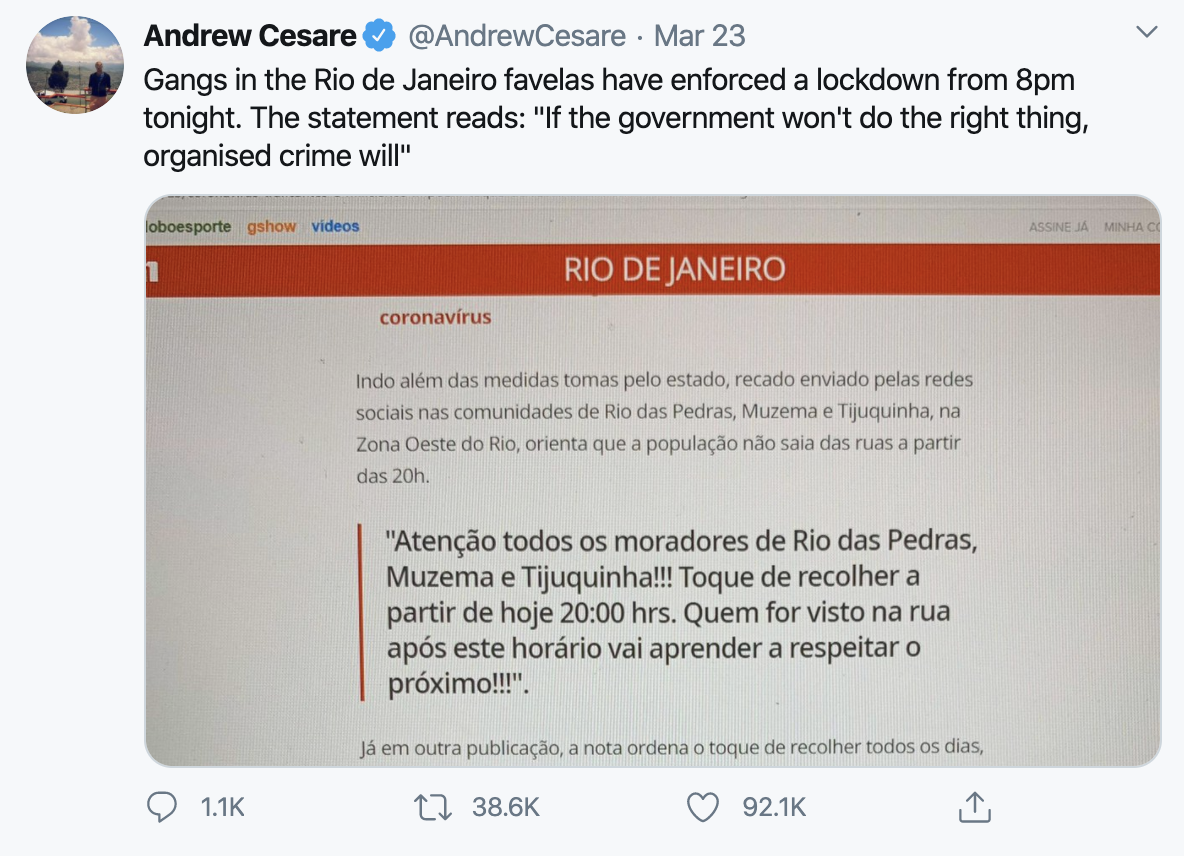
    The clue for anarcho-capitalist state-sceptics that this is a genuine shift in social priorities is that even organized criminal gangs are willing to enforce social distancing. You do not have to believe that the state itself is legitimate to see that the need for social distancing is sufficiently morally compelling that it can be enforced absent free agreement, just as one does not need free agreement to exercise a right to self-defense.

    Not every restriction is going to be justified, although erring on the restrictive side makes sense while uncertainty about the spread of infection persists. Ultimately, restrictions have to balance genuine costs with plausible benefits. But rejecting restrictions on a priori grounds does not cohere with libertarian principles. Right now, our absolute liberties extend to the right to be alone. Everything else must be negotiated under uncertainty. Someone else’s life, even two-weeks or so in the future, is a valid side-constraint on liberty. People can rightfully be made to stay at home if they are fortunate enough to have one. When people have to travel out of necessity, they can be temporarily exempted, compensated or offered an alternative reasonable means of satisfying their immediate needs.

    A PPE pandemic reading list

    I haven’t written for a while – other duties get in the way – but I’d like to suggest this reading list in Philosophy, Politics, and Economics for the present time of crisis and perplexity. The main reason is that everyone seems to be an expert in Economics, Epidemiology, and Political Philosophy these days, assuming that from “facts” we can easily derive “values” and answer the question, “what is to be done?” I think this is at best a naïve attitude and at worst the same rationalistic hubris we experience everytime a political issue is simplified and reduced to a matter of “science”. Yes, there are facts and they shouldn’t be ignored, but it’s not easy to decide what is to be done, morally and politically, in light of those facts.

    The first item on the list is Leviathan by Thomas Hobbes. A classic, and a reminder that people choose all the time to sacrifice some degree of liberty in the altar of survival (or a chance to survive), but also a reminder that Leviathan may turn from friend to foe, from protector to persecutor – and there is very little we can do about it. The second item is John Locke’s Second Treatise of Government, which then explores this topic in light of the fact that civil government shouldn’t have absolute power. It makes an attempt to show us how that power can, or should, be limited within a certain sphere of responsibility. Though it’s still there to protect us.

    In this time of pandemic, people feel tempted to panic. People and politicians are calling for dramatic measures, and one reason is that the use of government coercion – which, according to Locke, ought to be limited – might be necessary to force people to cooperate, for example, by staying home. This is a proposed solution to the dilemmas of collective action posed by the problem that some may “free-ride” on the rest, and, as a result, the disease will keep spreading, frustrating any attempt to slow it down. Against dramatic, desperate and, perhaps, arrogant, use of political power, and in favor of prudence and wisdom, Edmund Burke’s collection of writings from the period of the French Revolution can be a beacon of light. On the other hand, explaining the dilemmas of collective action and suggesting ways of solving them, Mancur Olson offers an insightful look at incentives and group behavior in The Logic of Collective Action.

    However, the idea that government coercion is the only solution to dilemmas of collective action (such as imposing a quarantine, for example) doesn’t hold water. In fact, other economists follow Olson in saying the problem is real and challenges a strict individualist way of thinking, but, adding to Olson’s point, they also acknowledge the role of private action and sanctions in fostering cooperation. Elinor Ostrom’s Governing the Commons is a wonderful study that opens up a number of possibilities for private enforcing of collective action to preserve and promote the frugal allocation of common goods. This can be complemented by The Quest for Community, an overlooked work by sociologist Robert Nisbet, where it becomes clear that, between individuals, the state, and the market, there’s room for other associations and communities that strengthen civil society – particularly in this challenging time. Nisbet’s lesson invites liberty-loving people to reflect on whether a hyper-individualistic view of the world ends up pitting helpess individuals against Leviathan instead of offering the buffer zone of community in between. This is something Alexis de Tocqueville discussed in the 19th century.

    And just for the sake of dealing with the issue that “is” doesn’t easily lead to “ought”, and that science might have facts and an explanation for them, but does not easily conduce to a proper discussion on values policy, I must finish this PPE pandemic reading list with F. A. Hayek’s The Constitution of Liberty. On Chapter 4, for example, Hayek introduces a constrast between “rationalist liberalism” and “anti-rationalist liberalism”. Rationalist liberals assume too easily that knowledge of the facts on the ground will give them what they need to re-design a society governed by reason. Hayek warns us against this technocratic assumption and offers a defence of “anti-rationalist liberalism”. Anti-rationalist liberals understand the importance of spontaneous order and of constraining power (even at a time of crisis) while prudently balancing the values of liberty and safety in light of past experience and tradition.


    Three Additional readings:

    Buzan, Waever and De Wilde, Security: A New Framework for Analysis (1997). In a liberal democracy, the state steps in suspending some civil liberties only if it can persuade citizens that there’s a threat that justifies it. This book offers a framework to interpret how such threats are constructed in official and non-official discourse, and to what extent this construction of a threat can be effective.

    Robert Higgs, Crisis and Leviathan (2013). 25th anniversary edition. Looks at US history and how government employed crises to its advantage and the advantage of the ruling elites. In particular, security and economy related issues are dealt with.

    Sanford Ikeda, Dynamics of the Mixed Economy (2002). Shows that a time of crisis might be a time for further interventionism in the economy, as Higgs (see above) suggests, but might also be a time for disintervention, as seems to be the case with part of the agenda today (FDA deregulation, etc.) This is based on Ludwig von Mises’ view that interventionist economies are not very stable and are always swinging as a pendulum between socialism and capitalism.


    A History of Plagues

    As COVID-19 continues to spread, fears and extraordinary predictions have also gone viral. While facing a new infectious threat, the unknowns of how new traits of our societies worldwide or of this novel coronavirus impact its spread. Though no two pandemics are equivalent, I thought it best to face this new threat armed with knowledge from past infectious episodes. The best inoculation against a plague of panic is to use evidence gained through billions of deaths, thousands of years, and a few vital breakthroughs to prepare our knowledge of today’s biological crises, social prognosis, and choices.

    Below, I address three key questions: First, what precedents do we have for infections with catastrophic potential across societies? Second, what are the greatest killers and how do pandemics compare? Lastly, what are our greatest accomplishments in fighting infectious diseases?

    As foundation for understanding how threats like COVID-19 come about and how their hosts fight back, I recommend reading The Red Queen concerning the evolutionary impact and mechanisms of host-disease competition and listening to Sam Harris’ “The Plague Years” podcast with Matt McCarthy from August 2019, which predated COVID-19 but had a strangely prophetic discussion of in-hospital strategies to mitigate drug resistance and their direct relation to evolutionary competition.

    • The Biggest Killers:

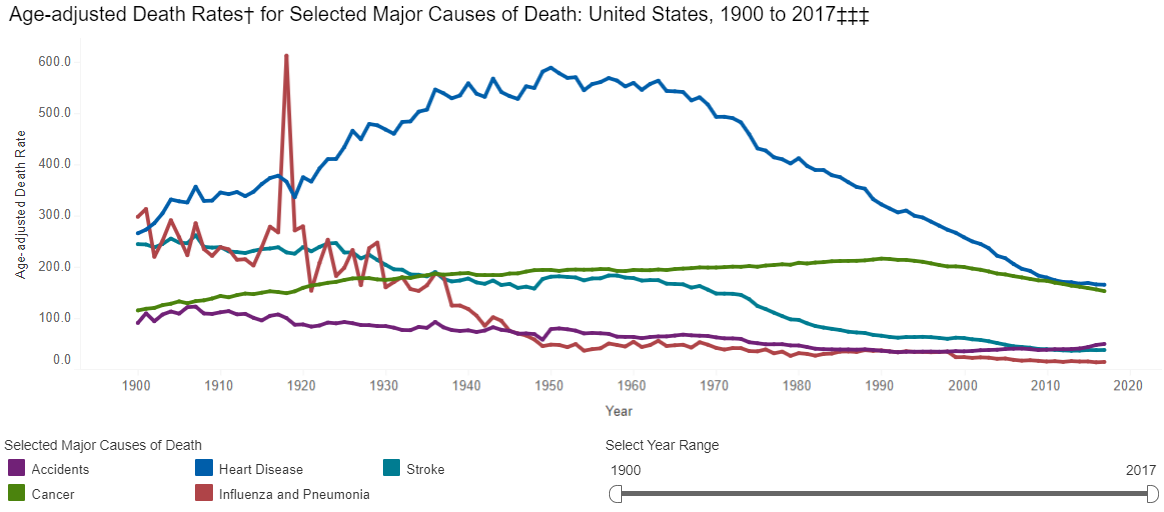
    Infectious diseases plagued humanity throughout prehistory and history, with a dramatic decrease in the number of infectious disease deaths coming in the past 200 years. In 1900, the leading killers of people were (1) Influenza, (2) Tuberculosis, and (3) Intestinal diseases, whereas now we die from (1) Heart disease, (2) Cancer, and (3) Stroke, all chronic conditions. This graph shows not that humans have vanquished infectious disease as a threat, but that in the never-ending war of evolutionary one-upmanship, we have won battles consistently since 1920 forward. When paired with Jonathan Haidt’s Most Important Graph in the World, this vindicates humanity’s methods of scientific and economic progress toward human flourishing.Death rates

    However, if the CDC had earlier data, it would show a huge range of diseases that dwarf wars and famines and dictators as causes of death in the premodern world. If we look to the history of plagues, we are really looking at the history of humanity’s greatest killers.

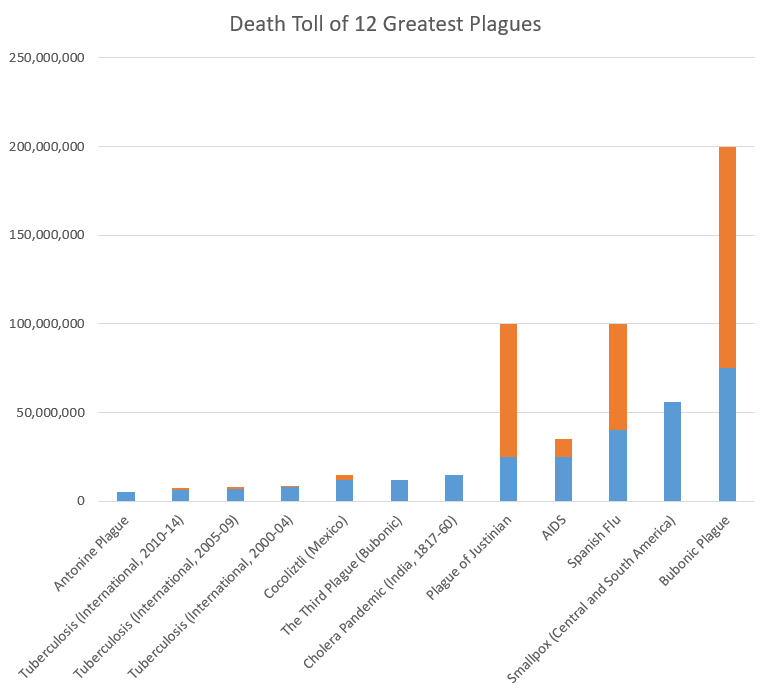
    The sources on the history of pandemics are astonishingly sparse/non-comprehensive. I created the following graphs only by combining evidence and estimates from the WHO, CDC, Wikipedia, Our World in Data, VisualCapitalist, and others (lowest estimates shown where ranges were presented) for both major historic pandemics and for ongoing communicable disease threats. This is not a complete dataset, and I will continue to add to it, but it shows representative death counts from across major infectious disease episodes, as well as the death rate per year based on world population estimates. See the end of this post for the full underlying data. First, the top 12 “plagues” in history:

    Capture disease top 12


    Note: blue=min, orange=max across the sources I examined. For ongoing diseases with year-by-year WHO evidence, like tuberculosis, measles, and cholera, I grouped mortality in 5-year spans (except AIDS, which does not have good estimates from the 1980s-90s, so I reported based on total estimated deaths).

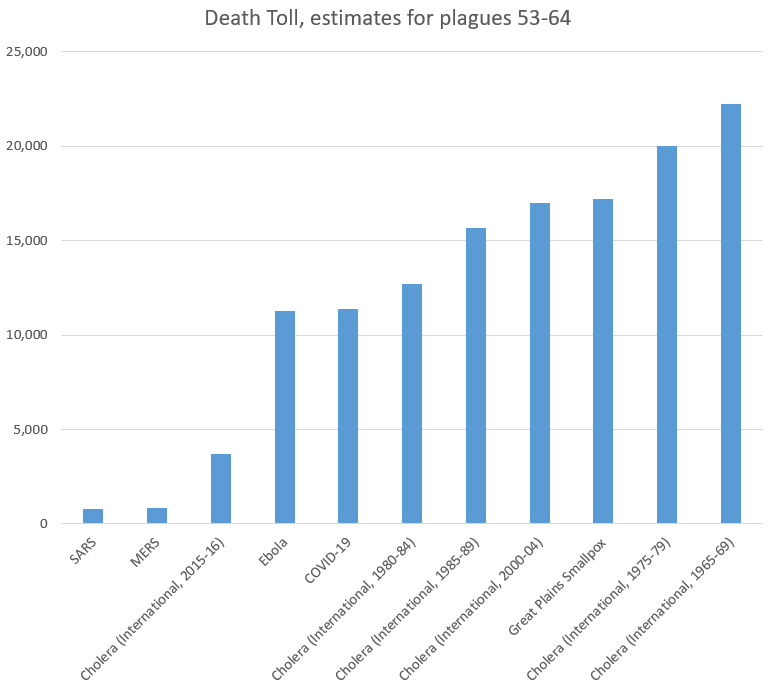
    Now, let’s look at the plagues that were lowest on my list (number 55-66). Again, my list was not comprehensive, but this should provide context for COVID-19:

    Capture covid

    As we can see, the 11,400 people who have died from COVID-19 recently passed Ebola to take the 61st (out of 66) place on our list of plagues. Note again that several ongoing diseases were recorded in 5-year increments, and COVID-19 still comes in under the death rates for cholera. Even more notably, it has 0.015% as many victims as the plague in the 14th Century,

    • In Context of Current Infectious Diseases:

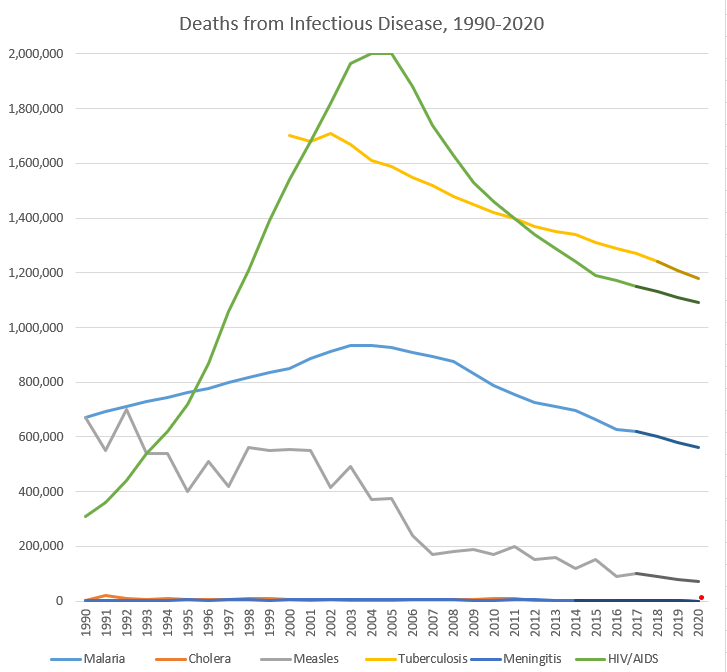
    For recent/ongoing diseases, it is easier to compare year-by-year data. Adding UNAIDS to our sources, we found the following rates of death across some of the leading infectious causes of death. Again, this is not comprehensive, but helps put COVID-19 (the small red dot, so far in the first 3 months of 2020) in context:

    Capture diseases by year

    Note: darker segments of lines are my own estimates; full data at bottom of the post. I did not include influenza due to the lack of good sources on a year-by-year basis, but a Lancet article found that 291,000-645,000 deaths from influenza in a year is predictable based on data from 1999-2015.

    None of this is to say that COVID-19 is not a major threat to human health globally–it is, and precautions could save lives. However, it should show us that there are major threats to human health globally all the time, that we must continue to fight. These trendlines tend to be going the right direction, but our war for survival has many foes, and will have more emerge in the future, and we should expend our resources in fighting them rationally based on the benefits to human health, not panic or headlines.

    • The Eradication List:

    As we think about the way to address COVID-19, we should keep in mind that this fight against infectious disease builds upon work so amazing that most internet junkies approach new infectious diseases with fear of the unknown, rather than tired acceptance that most humans succumb to them. That is a recent innovation in the human experience, and the strategies used to fight other diseases can inform our work now to reduce human suffering.

    While influenzas may be impossible to eradicate (in part due to an evolved strategy of constantly changing antigens), I wanted to direct everyone to an ever-growing monument to human achievement, the Eradication List. While humans have eradicated only a few infectious diseases, the amazing thing is that we can discuss which diseases may in fact disappear as threats through the work of scientists.

    On that happy note, I leave you here. More History of Plagues to come, in Volume 2: Vectors, Vaccines, and Virulence!

    Disease Start Year End Year Death Toll (low) Death Toll (high) Deaths per 100,000 people per year (global)
    Antonine Plague 165 180 5,000,000 5,000,000 164.5
    Plague of Justinian 541 542 25,000,000 100,000,000 6,250.0
    Japanese Smallpox Epidemic 735 737 1,000,000 1,000,000 158.7
    Bubonic Plague 1347 1351 75,000,000 200,000,000 4,166.7
    Smallpox (Central and South America) 1520 1591 56,000,000 56,000,000 172.8
    Cocoliztli (Mexico) 1545 1545 12,000,000 15,000,000 2,666.7
    Cocoliztli resurgence (Mexico) 1576 1576 2,000,000 2,000,000 444.4
    17th Century Plagues 1600 1699 3,000,000 3,000,000 6.0
    18th Century Plagues 1700 1799 600,000 600,000 1.0
    New World Measles 1700 1799 2,000,000 2,000,000 3.3
    Smallpox (North America) 1763 1782 400,000 500,000 2.6
    Cholera Pandemic (India, 1817-60) 1817 1860 15,000,000 15,000,000 34.1
    Cholera Pandemic (International, 1824-37) 1824 1837 305,000 305,000 2.2
    Great Plains Smallpox 1837 1837 17,200 17,200 1.7
    Cholera Pandemic (International, 1846-60) 1846 1860 1,488,000 1,488,000 8.3
    Hawaiian Plagues 1848 1849 40,000 40,000 1.7
    Yellow Fever 1850 1899 100,000 150,000 0.2
    The Third Plague (Bubonic) 1855 1855 12,000,000 12,000,000 1,000.0
    Cholera Pandemic (International, 1863-75) 1863 1875 170,000 170,000 1.1
    Indian Smallpox 1868 1907 4,700,000 4,700,000 9.8
    Franco-Prussian Smallpox 1870 1875 500,000 500,000 6.9
    Cholera Pandemic (International, 1881-96) 1881 1896 846,000 846,000 4.4
    Russian Flu 1889 1890 1,000,000 1,000,000 41.7
    Cholera Pandemic (India and Russia) 1899 1923 1,300,000 1,300,000 3.3
    Cholera Pandemic (Philippenes) 1902 1904 200,000 200,000 4.2
    Spanish Flu 1918 1919 40,000,000 100,000,000 1,250.0
    Cholera (International, 1950-54) 1950 1954 316,201 316,201 2.4
    Cholera (International, 1955-59) 1955 1959 186,055 186,055 1.3
    Asian Flu 1957 1958 1,100,000 1,100,000 19.1
    Cholera (International, 1960-64) 1960 1964 110,449 110,449 0.7
    Cholera (International, 1965-69) 1965 1969 22,244 22,244 0.1
    Hong Kong Flu 1968 1970 1,000,000 1,000,000 9.4
    Cholera (International, 1970-75) 1970 1974 62,053 62,053 0.3
    Cholera (International, 1975-79) 1975 1979 20,038 20,038 0.1
    Cholera (International, 1980-84) 1980 1984 12,714 12,714 0.1
    AIDS 1981 2020 25,000,000 35,000,000 13.8
    Measles (International, 1985) 1985 1989 4,800,000 4,800,000 19.7
    Cholera (International, 1985-89) 1985 1989 15,655 15,655 0.1
    Measles (International, 1990-94) 1990 1994 2,900,000 2,900,000 10.9
    Cholera (International, 1990-94) 1990 1994 47,829 47,829 0.2
    Malaria (International, 1990-94) 1990 1994 3,549,921 3,549,921 13.3
    Measles (International, 1995-99) 1995 1999 2,400,000 2,400,000 8.4
    Cholera (International, 1995-99) 1995 1999 37,887 37,887 0.1
    Malaria (International, 1995-99) 1995 1999 3,987,145 3,987,145 13.9
    Measles (International, 2000-04) 2000 2004 2,300,000 2,300,000 7.5
    Malaria (International, 2000-04) 2000 2004 4,516,664 4,516,664 14.7
    Tuberculosis (International, 2000-04) 2000 2004 7,890,000 8,890,000 25.7
    Cholera (International, 2000-04) 2000 2004 16,969 16,969 0.1
    SARS 2002 2003 770 770 0.0
    Measles (International, 2005-09) 2005 2009 1,300,000 1,300,000 4.0
    Malaria (International, 2005-09) 2005 2009 4,438,106 4,438,106 13.6
    Tuberculosis (International, 2005-09) 2005 2009 7,210,000 8,010,000 22.0
    Cholera (International, 2005-09) 2005 2009 22,694 22,694 0.1
    Swine Flu 2009 2010 200,000 500,000 1.5
    Measles (International, 2010-14) 2010 2014 700,000 700,000 2.0
    Malaria (International, 2010-14) 2010 2014 3,674,781 3,674,781 10.6
    Tuberculosis (International, 2010-14) 2010 2014 6,480,000 7,250,000 18.6
    Cholera (International, 2010-14) 2010 2014 22,691 22,691 0.1
    MERS 2012 2020 850 850 0.0
    Ebola 2014 2016 11,300 11,300 0.1
    Malaria (International, 2015-17) 2015 2017 1,907,872 1,907,872 8.6
    Tuberculosis (International, 2015-18) 2015 2018 4,800,000 5,440,000 16.3
    Cholera (International, 2015-16) 2015 2016 3,724 3,724 0.0
    Measles (International, 2019) 2019 2019 140,000 140,000 1.8
    COVID-19 2019 2020 11,400 11,400 0.1


    Year Malaria Cholera Measles Tuberculosis Meningitis HIV/AIDS COVID-19
    1990 672,518 2,487 670,000 1,903 310,000
    1991 692,990 19,302 550,000 1,777 360,000
    1992 711,535 8,214 700,000 2,482 440,000
    1993 729,735 6,761 540,000 1,986 540,000
    1994 743,143 10,750 540,000 3,335 620,000
    1995 761,617 5,045 400,000 4,787 720,000
    1996 777,012 6,418 510,000 3,325 870,000
    1997 797,091 6,371 420,000 5,254 1,060,000
    1998 816,733 10,832 560,000 4,929 1,210,000
    1999 834,692 9,221 550,000 2,705 1,390,000
    2000 851,785 5,269 555,000 1,700,000 4,298 1,540,000
    2001 885,057 2,897 550,000 1,680,000 6,398 1,680,000
    2002 911,230 4,564 415,000 1,710,000 6,122 1,820,000
    2003 934,048 1,894 490,000 1,670,000 7,441 1,965,000
    2004 934,544 2,345 370,000 1,610,000 6,428 2,003,000
    2005 927,109 2,272 375,000 1,590,000 6,671 2,000,000
    2006 909,899 6,300 240,000 1,550,000 4,720 1,880,000
    2007 895,528 4,033 170,000 1,520,000 7,028 1,740,000
    2008 874,087 5,143 180,000 1,480,000 4,363 1,630,000
    2009 831,483 4,946 190,000 1,450,000 3,187 1,530,000
    2010 788,442 7,543 170,000 1,420,000 2,198 1,460,000
    2011 755,544 7,781 200,000 1,400,000 3,726 1,400,000
    2012 725,676 3,034 150,000 1,370,000 3,926 1,340,000
    2013 710,114 2,102 160,000 1,350,000 3,453 1,290,000
    2014 695,005 2,231 120,000 1,340,000 2,992 1,240,000
    2015 662,164 1,304 150,000 1,310,000 1,190,000
    2016 625,883 2,420 90,000 1,290,000 1,170,000
    2017 619,825 100,000 1,270,000 1,150,000
    2018 1,240,000
    2019
    2020 16,514

    Pandemic responses are beyond Evidence-based Medicine

    critical-appraisal-of-randomized-clinical-trials-14-638

    John Ioannidis, a professor of medicine at Stanford University, fears that the draconian measures to enforce social distancing across Europe and United States could end up causing more harm than the pandemic itself. He believes that governments are acting on exaggerated claims and incomplete data and that a priority must be getting a more representative sample of populations currently suffering corona infections. I agree additional data would be enormously valuable but, following Saloni Dattani, I think we have more warrant for strong measures than Ioannidis implies.

    Like Ioannidis’ Stanford colleague Richard Epstein, I agree that estimates of a relatively small overall fatality rate are plausible projections for most of the developed world and especially the United States. Unlike Epstein, I think those estimates are conditional on the radical social distancing (and self-isolation) measures that are currently being pushed rather than something that can be assumed. I am not in a position to challenge Ioannidis’ understanding of epidemiology. Others have used his piece as an opportunity to test and defend the assumptions of the worst-case scenarios.

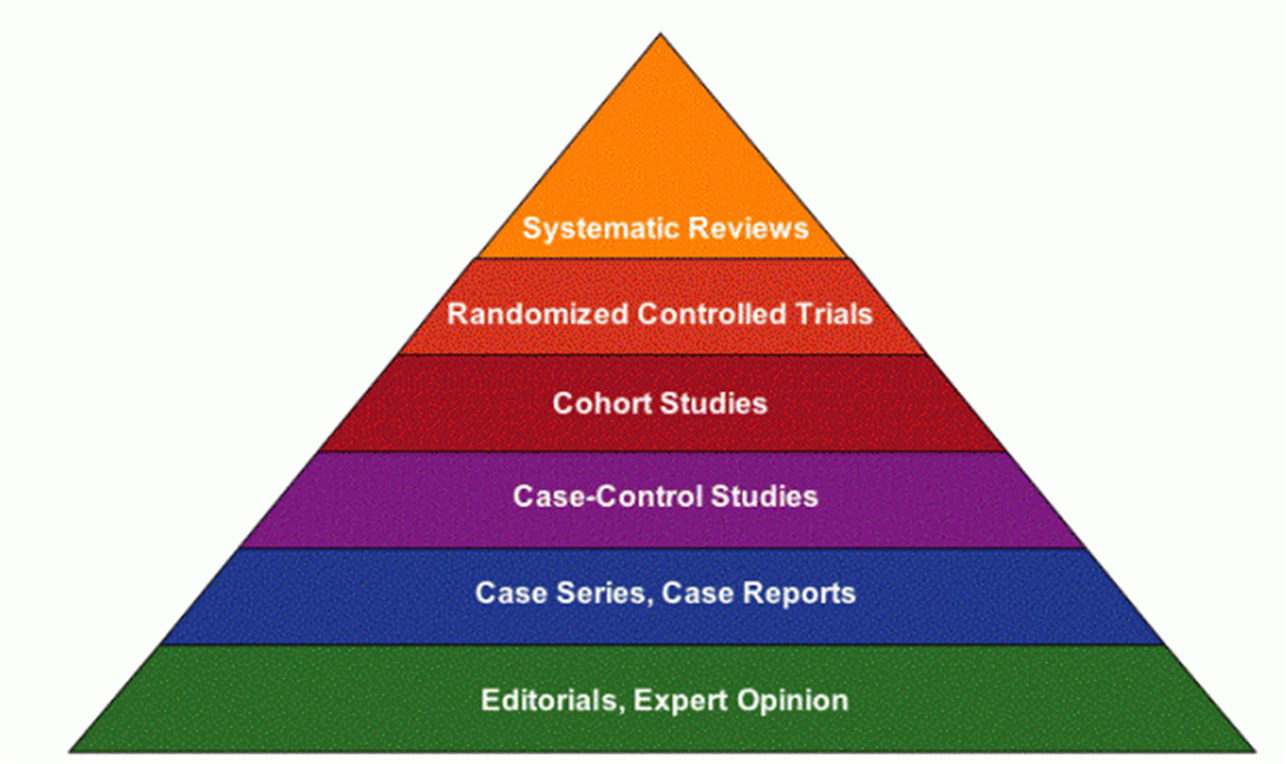
    Nevertheless, I can highlight the epistemic assumptions underlying Ioannidis’ pessimism about social distancing interventions. Ioannidis is a famous proponent (occasionally critic) of Evidence-based Medicine (EBM). Although open to refinement, at its core EBM argues that strict experimental methods (especially randomized controlled trials) and systematic reviews of published experimental studies with sound protocols are required to provide firm evidence for the success of a medical intervention.

    The EBM movement was born out of a deep concern of its founder, Archie Cochrane, that clinicians wasted scarce resources on treatments that were often actively harmful for patients. Cochrane was particularly concerned that doctors could be dazzled or manipulated into using a treatment based on some theorized mechanism that had not been subject to rigorous testing. Only randomized controlled trials supposedly prove that an intervention works because only they minimize the possibility of a biased result (where characteristics of a patient or treatment path other than the intervention itself have influenced the result).

    Picture4

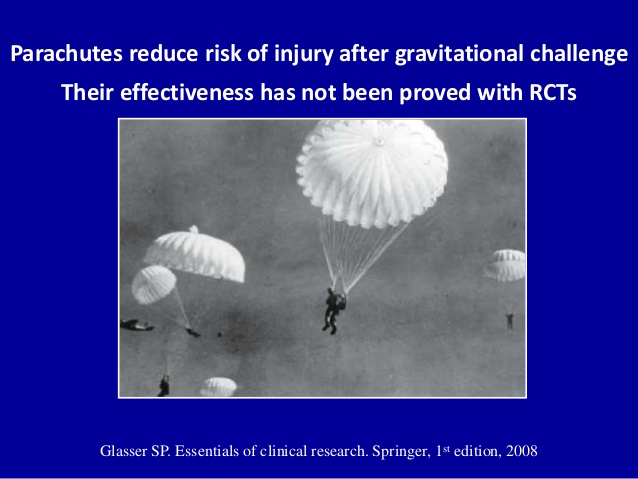
    So when Ioannidis looks for evidence that social distancing interventions work, he reaches for a Cochrane Review that emphasizes experimental studies over other research designs. As is often the case for a Cochrane review, many of the results point to uncertainty or relatively small effects from the existing literature. But is this because social distancing doesn’t work, or because RCTs are bad at measuring their effectiveness under pandemic circumstances (the circumstances where they might actually count)? The classic rejoinder to EBM proponents is that we know that parachutes can save lives but we can never subject them to RCT. Effective pandemic interventions could suffer similar problems.

    Nancy Cartwright and I have argued that there are flaws in the methodology underlying EBM. A positive result for treatment against control in a randomized controlled trial shows you that an intervention worked in one place, at one time for one set of patients but not why and whether to expect it to work again in a different context. EBM proponents try to solve this problem by synthesizing the results of RCTs from many different contexts, often to derive some average effect size that makes a treatment expected to work overall or typically. The problem is that, without background knowledge of what determined the effect of an intervention, there is little warrant to be confident that this average effect will apply in new circumstances. Without understanding the mechanism of action, or what we call a theory of change, such inferences rely purely on induction.

    The opposite problem is also present. An intervention that works for some specific people or in some specific circumstances might look unpromising when it is tested in a variety of cases where it does not work. It might not work ‘on average’. But that does not mean it is ineffective when the mechanism is fit to solve a particular problem such as a pandemic situation. Insistence on a narrow notion of evidence will mean missing these interventions in favor of ones that work marginally in a broad range of cases where the answer is not as important or relevant.

    Thus even high-quality experimental evidence needs to be combined with strong background scientific and social scientific knowledge established using a variety of research approaches. Sometimes an RCT is useful to clinch the case for a particular intervention. But sometimes, other sources of information (especially when time is of the essence), can make the case more strongly than a putative RCT can.

    In the case of pandemics, there are several reasons to hold back from making RCTs (and study designs that try to imitate them) decisive or required for testing social policy:

    1. There is no clear boundary between treatment and control groups since, by definition, an infectious disease can spread between and influence groups unless they are artificially segregated (rendering the experiment less useful for making broader inferences).
    2. The outcome of interest is not for an individual patient but the communal spread of a disease that is fatal to some. The worst-case outcome is not one death, but potentially very many deaths caused by the chain of infection. A marginal intervention at the individual level might be dramatically effective in terms of community outcomes.
    3. At least some people will behave differently, and be more willing to alter their conduct, during a widely publicized pandemic compared to hygienic interventions during ordinary times. Although this principle might be testable in different circumstances, the actual intervention won’t be known until it is tried in the reality of pandemic.

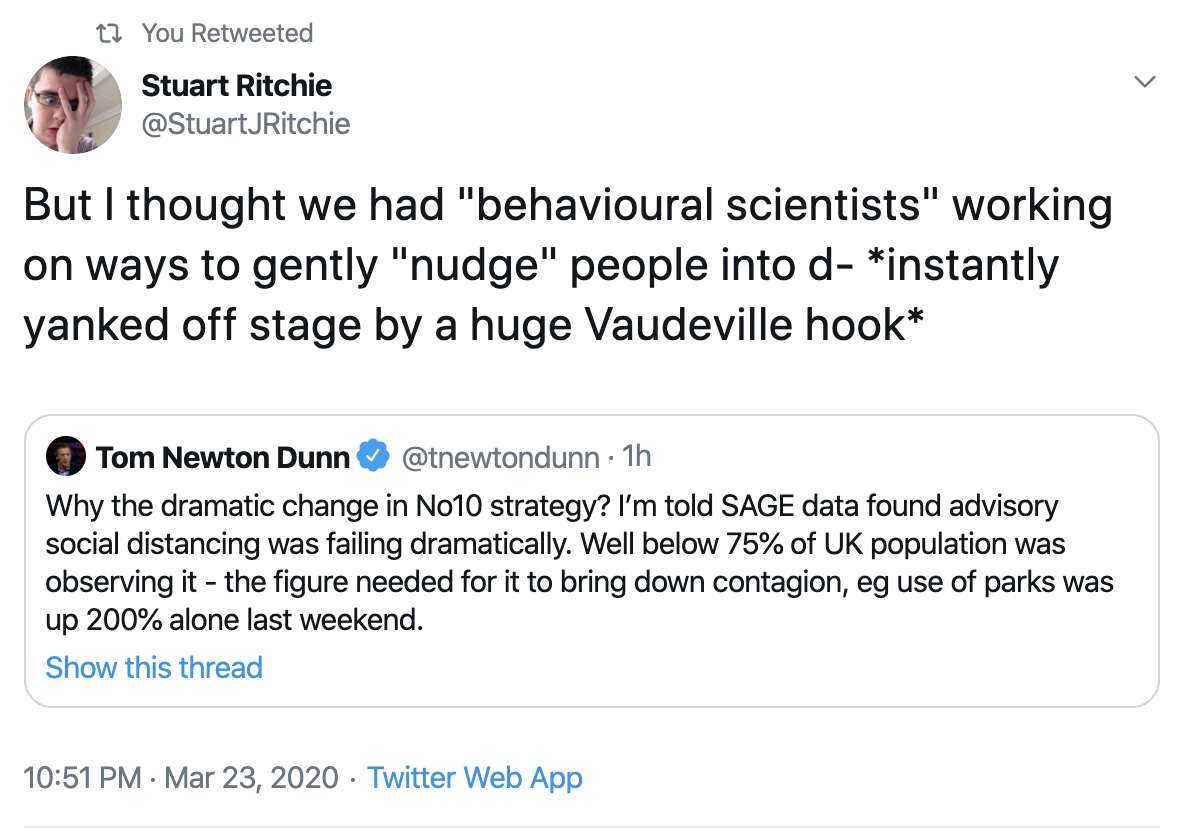
    This means that rather than narrowly focusing on evidence from EBM and behavioral psychologists (or ‘nudge’), policymakers responding to pandemics must look to insights from political economy and social psychology, especially how to shift norms towards greater hygiene and social distancing. Without any bright ideas, traditional public health methods of clear guidance and occasionally enforced sanctions are having some effect.

    Screenshot 2020-03-23 at 23.57.13

    What evidence do we have at the moment? Right now, there is an increasing body of defeasible knowledge of the mechanisms with which the Coronavirus spreads. Our knowledge of existing viruses with comparable characteristics indicates that effectively implemented social distancing is expected to slow its spread and that things like face masks might slow the spread when physical distancing isn’t possible.

    We also have some country and city-level policy studies. We saw an exponential growth of cases in China before extreme measures brought the virus under control. We saw immediate quarantine and contact tracing of cases in Singapore and South Korea that was effective without further draconian measures but required excellent public health infrastructure.

    We have now also seen what looks like exponential growth in Italy, followed by a lockdown that appears to have slowed the growth of cases though not yet deaths. Some commentators do not believe that Italy is a relevant case for forecasting other countries. Was exponential growth a normal feature of the virus, or something specific to Italy and its aging population that might not be repeated in other parts of Europe? This seems like an odd claim at this stage given China’s similar experience. The nature of case studies is that we do not know with certainty what all the factors are while they are in progress. We are about to learn more as some countries have chosen a more relaxed policy.

    Is there an ‘evidence-based’ approach to fighting the Coronavirus? As it is so new: no. This means policymakers must rely on epistemic practices that are more defeasible than the scientific evidence that we are used to hearing. But that does not mean a default to light-touch intervention is prudent during a pandemic response. Instead, the approaches that use models with reasonable assumptions based on evidence from unfolding case-studies are the best we can do. Right now, I think, given my moral commitments, this suggests policymakers should err on the side of caution, physical distancing, and isolation while medical treatments are tested.

    [slightly edited to distinguish my personal position from my epistemic standpoint]

    Seattle’s landlord regs at the Supreme Court

    Landlords in Seattle must rent to the first person to walk in the door, so long as they check out on paper. This “first-in-time” rule has slogged through several years of litigation over whether the rule violates landlords’ constitutional rights (full disclosure–I represent the plaintiffs). That case, called Yim v. City of Seattle, has now crescendoed with a petition to the United States Supreme Court. The Court should seize the chance to decide two pressing questions about the Constitution’s role in protecting property rights: (1) if regulation destroys a fundamental attribute of property ownership–like the right to exclude, or the right to sell–does the regulation result in a taking that requires compensation? and (2) if a regulation is “unduly oppressive” of individual rights, does it violate due process?

    The first-in-time rule is something of a novelty. The rationale behind the rule is to prevent implicit bias; a landlord can’t unconsciously discriminate if she doesn’t have any discretion to decide whom to rent to. Hence, the rule allows landlords to set pre-established criteria, though all criteria must have minimum thresholds (i.e., minimum credit score). The landlord cannot thereafter deviate from that criteria and must simply rent to the first person who qualifies, even if ten or fifteen applicants check all the boxes. After the landlord rents to the first comer, the lucky winner has 48 hours to sit on the offer, after which time the offer moves on to the next person in line.

    The bottom line is that landlords can no longer make common-sense judgment calls about who will live on their property. The practical challenges that result are daunting, for small landlords in particular. A landlord cannot, for instance, deny an applicant because they feel threatened or unsafe when an applicant tours a unit. That’s a big deal for plaintiff Kelly Lyles, a single woman and sexual assault survivor. Or for MariLyn Yim, who owns a triplex and lives in one of the units with her husband and kids. They share a yard and common spaces with their tenants–compatibility and safety are key. And some of the Yims’ units have roommates, where the ability to select people that will get along and feel comfortable with each other is essential. But basic discretion is out the window with first-in-time. If Lois Lane advertises the fortress of solitude for rent and Lex Luthor shows up with his spotless credit score and seven-digit income, she’s out of luck.

    And renting property often involves a give-and-take negotiation that’s no longer possible under the rule. Tom Riddle’s credit score is shabby, but he offers a two-year lease instead of one to make his application more appealing. Not under first-in-time. Pam Isley offers to do landscaping if the landlord drops rent by $50 a month. Nope. Nor can landlords offer leniency by deviating from their criteria because they want to give a second chance to someone down-and-out.

    MariLyn Yim and Kelly Lyles sued on the theory that removing everyday discretion in this manner constitutes an unconstitutional taking and a violation of due process. They won at trial and lost before the Washington Supreme Court. Now, the questions they bring to the Supreme Court’s attention raise some fundamental questions about the Fifth Amendment’s takings clause and the Fourteenth Amendment due process guarantee.

    The plaintiffs argue that a taking occurs when regulation destroys a fundamental attribute of property ownership. They invoke a well-known metaphor in property law: the “bundle of sticks.” Property is not really a single right–it’s a bundle of various rights that a person has with respect to a physical thing, such as the right to exclude others, the right to use the property, to occupy it, to sell it, and so on. Plaintiff’s theory is that each of these “sticks” in the bundle is entitled to independent constitutional protection; when one of those sticks is destroyed by regulation, that constitutes a taking of property as surely as a seizure of land. In this case, plaintiffs argue that denying them the right to decide who will occupy their property destroys their right to sell property to the person of their choosing and their right to exclude people not of their choosing.

    This is an important and uncertain question under the Fifth Amendment. The Supreme Court has held in the past that a taking occurred where various attributes of property ownership were destroyed. For instance, when the United States required a marina to open a private lagoon to the public, the Supreme Court held a taking occurred because the government had destroyed the right to exclude, “one of the most essential sticks in the bundle of rights that are commonly characterized as property.” Likewise, the Supreme Court held that a taking occurred when Congress prohibited owners of tribal lands to pass on the property to their heirs, which was a “total abrogation” of a right that “has been part of the Anglo-American legal system since feudal times.”

    The trouble is, though, that some other decisions of the Supreme Court can be read to refute this approach to takings. Hence, the city of Seattle argues that these takings precedents don’t represent the current state of takings law. This question thus presents an important opportunity for the Court to clarify the scope and meaning of the Fifth Amendment.

    The second issue is no less compelling: does the oppressive impact of a law bear on whether it satisfies due process? The federal courts tend to answer yes, while a large number of state courts answer no. The Fourteenth Amendment’s due process clause imposes, at minimum, a floor of rationality–a law must be rationally related to a legitimate government interest. The question raised in the Yim petition asks the Court to address whether an unduly oppressive means (obliterating discretion) of achieving a legitimate government purpose (preventing discrimination) satisfies this threshold of rationality. The Supreme Court has repeatedly held that a law’s oppressive nature bears on whether the law is arbitrary or irrational. That is, a government has no legitimate interest in imposing oppressive laws on its people, and the use of oppression to achieve an otherwise legitimate government interest is arbitrary and irrational, in violation of due process.

    The Washington Supreme Court, however, held that the U.S. Supreme Court had implicitly overruled this “unduly oppressive” analysis. It also overruled a whopping 61 of its own cases recognizing and applying this “unduly oppressive” test–so many that it provided a separate index of cases fed through the shredder. By joining a growing number of states that refuse to recognize that an unduly oppressive law violates the rational basis test required by due process, the Washington Supreme Court has teed up an important issue that warrants the U.S. Supreme Court’s attention.

    These questions will grow in significance as government control of the rental market expands. Since enacting first-in-time, for instance, Seattle has imposed a ban on criminal background checks, a ban on winter evictions, a requirement that landlords rent to a tenant’s choice of roommate, and more. Other cities are enacting similar restrictions on landlord control over their own property. The U.S. Supreme Court should address the pressing constitutional questions that such regulations raise.

    Coronavirus and takings

    City governments are flirting with a ban on evictions during the coronavirus pandemic. I doubt, however, that doing so comports with the Constitution’s takings clause or, perhaps, the contracts clause.

    San Jose has introduced legislation that will ban evictions due to un/underemployment resulting from coronavirus. Seattle’s socialist firebrand, Kshama Sawant, calls for similar action. Her letter, though, betrays the truth behind many proposed emergency measures–she’s leveraging the crisis to further her political agenda, particularly her hatred of capitalism. In the letter, she froths: “The status quo under capitalism is deeply hostile to the majority of working people, and it would be unconscionable to place the further burden of the Coronavirus crisis on those who are already the most economically stressed.” Never mind that the status quo in the absence of capitalism would be grinding poverty.

    But, in any case, the proposal to ban evictions and force landlords to renew leases as the pandemic sweeps across the states raises serious constitutional concerns. Even in times of crisis, observance of constitutional norms remains essential. In part, this is because laws passed as emergency measures tend to hang about long after the emergency subsides. New York rent control began as a wartime measure, for instance, and that curse still plagues the New York rental market. The other reason, of course, is that the Constitution is built for just these moments. The pressure to invade rights, after all, comes when things are not going well. As Justice Sutherland once put it, “If the provisions of the Constitution be not upheld when they pinch, as well as when they comfort, they may as well be abandoned.”

    Forcing landlords to either renew leases or forego eviction for lease violations likely raises at least two constitutional problems: takings and impairment of contractual obligations. While such laws don’t literally seize property, they effectively impose a servitude on landlords’ property, stripping them of control over the disposition and occupation of their land. When an essential attribute of property ownership is destroyed by regulation in this manner, the government must offer compensation. We already know this compensation requirement applies during national emergencies. During World War II, for instance, the Supreme Court held that the United States had to compensate property owners and leaseholders when it temporarily seized factories for wartime production.

    The contract clause problem is also straightforward: barring landlords from enforcing lease terms impairs obligations under pre-existing contracts. The contracts clause, though, has been severely undermined in recent decades, such that a showing of a compelling interest like mitigating the impact of the pandemic may well satisfy the flaccid demands of the modern contracts clause.

    It may seem profoundly harsh to impose constitutional constraints on governments trying to resolve a crisis. But three things ought to be kept in mind.

    First, an emergency certainly means that some will face a heavy burden, but that fact tells us nothing about how that burden should be allocated. Why should landlords bear the costs? Indeed, As the Supreme Court said in Armstrong v. United States, the takings clause exists to avoid imposing societal burdens on specific individuals: “The Fifth Amendment’s guarantee that private property shall not be taken for a public use without just compensation was designed to bar Government from forcing some people alone to bear public burdens which, in all fairness and justice, should be borne by the public as a whole.”

    Second, we should keep in mind that lease agreements already account for risk. That’s baked into the price and terms that give rise to a mutually agreeable arrangement between parties. To simply allow one party to slip out of the terms of the lease distorts that arrangement.

    Third, the takings clause does not bar emergency measures, including the seizure of property, but only upon just compensation. No exigency should excuse cities like San Jose or Seattle from compensating for the costs they’re hoisting upon landlords. And in the case of the contracts clause, the government could still honor existing leases by acting as a guarantor for tenants who can’t pay the rent.

    All of these points apply to a world in which landlords do not voluntarily exercise leniency. But I think we’ll find that most landlords are forgiving during a temporary crisis. Most landlords have an extreme aversion to evicting tenants–it’s the nightmare, last-ditch option that they try hard to avoid. That, plus the simple dose of compassion that many landlords will feel inspired to offer, may do more toward helping see us through than any emergency measures.