Pope Francis on Economics

by Fred E. Foldvary

Any statements which deplore “trickle down” economics reveal that the author has not quite yet grasped the heart of economics.

On November 26, 2013, The Vatican press published the apostolic exhortation, “The Joy of the Gospel.” The text was written in Spanish, and its full title in the English translation (converted here from upper case to initial capitals) is “Evangelii Gaudium of the Holy Father Francis to the Bishops, Clergy, Consecrated Persons and the Lay Faithful on the Proclamation of the Gospel in Today’s World.” Besides its religious calls, Pope Francis makes statements about today’s economic problems, and calls for greater economic justice.

One of the aims of this proclamation is to point out “new paths for the Church’s journey in years to come.” One of the questions the Pope seeks to discuss is “the inclusion of the poor in society.” Chapter Two is entitled, “Amid the Crisis of Communal Commitment.” In paragraph 52, Francis writes that “today we also have to say ‘thou shalt not’ to an economy of exclusion and inequality. Such an economy kills… Today everything comes under the laws of competition and the survival of the fittest, where the powerful feed upon the powerless.”

The Pope is wise and correct in seeing the harm done by inequality, but I urge him to see past the appearances to study the underlying reality. What provides the powerful with their might? The state has the ultimate power of force, and by its power to tax, to restrict, to mandate, and to subsidize, the state endows the powerful with the means to feed on the powerless. Market competition as such cannot impose force, and it does not create poverty. In a free society, each person has the power to be employed and pursue happiness. In a truly free market, all are fit to survive, because workers have access to natural opportunities. It is government intervention that stops this access.

Paragraph 54 is the key, widely cited, economic passage. We need to be sure that the English version is true to the original Spanish. In Spanish, Francis wrote, “algunos todavía defienden las teorías del « derrame », que suponen que todo crecimiento económico, favorecido por la libertad de mercado, logra provocar por sí mismo mayor equidad e inclusión social en el mundo.”

The Vatican’s English translation says, “some people continue to defend trickle-down theories which assume that economic growth, encouraged by a free market, will inevitably succeed in bringing about greater justice and inclusiveness in the world.”

The English-edition term “trickle-down theories” is translated from the Spanish, “teoria del derrame.” “Derrame” means a slow leak, hence a trickle, and so the English translation is accurate. The translated term “free market” is more literally “the liberty of the market” in the original Spanish, but the meaning is the same.

As noted by Harvard professor Greg Mankiw in his blog, critics of markets often use the term “trickle down” as a pejorative for the effects of a market economy. There is indeed a trickle down effect, for example, when a tourist resort is built in a location with many poor people, where a few get hired to work to clean rooms and wash dishes. A bit of the wealth of the resort trickles to the local population. But this situation does not confront the issue of why the poverty exists in the first place.

The theory of the free market is not one of “trickle down.” A truly free market is a fountain that gushes up wealth for all. Moreover, economic growth in market economies has indeed raised millions of persons up from poverty. However, the theory of market-driven growth does not claim that growth brings justice. The causation is the opposite: economic justice promotes growth. Moreover, justice and liberty are two faces of the same coin, so if a market has liberty, it must also provide justice.

The Pope continues: “This opinion, which has never been confirmed by the facts, expresses a crude and naïve trust in the goodness of those wielding economic power and in the sacralized workings of the prevailing economic system.”

But the proposition that free markets provide growth that benefits all is not a mere opinion. The proposition is a theory of growth that was first analyzed by the French economists of the 1700s, who concluded that the unhampered market, with free trade, would provide the greatest prosperity for all.

The prescription of the French economists was to abolish taxes on labor and trade, and instead use the surplus of the economy, which is land rent, for public revenue. Adam Smith in his Wealth of Nations brought this theory into classical economics. The American economist Henry George a century later explained in detail how land rent captures the gains from economic progress, and how growth generates inequality and poverty if that rent is not equally shared.

Markets have had various degrees of freedom, but there is no truly free market in the world today. Those who advocate a pure free market do not defend the “prevailing economic system,” but rather, they seek to stop the state’s subsidy of economic powers. The greatest subsidy and economic power is the land rent generated by the public goods provided by government.

The Pope is correct in decrying “the denial of the primacy of the human person” (paragraph 55) and that “Behind this attitude lurks a rejection of ethics” (57). Ethics and the primacy of the human person requires the equal right of each person to pursue happiness without harming others and to keep the earnings of his labor, as recognized by the commandment, “Thou shalt not steal.” Ethics must also respect the equal sharing of the benefits of nature and community, as stated in Ecclesiastes 5:9, “the profit of the earth is for all.”

The heart of economics is the understanding of the root cause of poverty: the forced redistribution of wealth from the working poor to the landed rich. This is caused not by markets but from state policy. It is good that Pope Francis seeks to remedy poverty. His “new path” should be to go more deeply into the economics and politics of maldistribution.
Cell Phones on Airliners?

The FAA recently decided, tentatively, that cell phone use would be OK on commercial airplanes. But forthwith, moans went up from near and far and the FAA backed off. Lots of travelers understandably dread the prospect of captivity to loud conversations by boors seated inches away from them. It’s unclear at this time what the final decision will be.

Why does it never occur to anyone to let the owners of the airplanes decide this issue? They could experiment with various policies ranging from outright bans to unlimited use with all sorts of possibilities in between. Following Amtrak and some commuter railroads that have quiet cars, they could establish a no-talk section of the airplane like the non-smoking sections of yore. Or they could try pleading with talkers. Soon enough they will discover what their customers want and competitive pressures would force all airlines to fall into line.

That sort competitive experimentation works quite well in many market segments, as a moment’s reflection will confirm. So why do we hear nothing about this simple solution for the cell phone problem? Part of the answer, I fear, is that so many people are resigned to letting bureaucrats set the rules for practically all of life. An extreme example of this attitude is the kind of message that appears in my spam folder with a subject like “Obama lowers re-fi rates.” Of course this is nonsense but it suggests that a good many people think Obama has the power to set re-fi rates and worse: that it’s perfectly OK for him to wield such dictatorial powers.

Back to cell phones on airplanes: the whole issue came about as a result of determinations by the FAA technical staff that cell phone signals don’t really interfere with airplane communications as had been feared. That suggests a more difficult question: suppose there were credible evidence that cell phone use really was a threat to airplane communications. Should the FAA be empowered to ban cell phone use? I suggest that it does not. The airlines have an enormous incentive to avoid interference problems. If they were free to make their own decisions about this (again, assuming there was credible evidence of a real problem), their lawyers would be all over them about instituting their own prohibitions. The owners of the control towers (I’m envisioning a privatized FAA) would have strong incentives as well. Many passengers would be aware of the issue and would press for bans.

We have here another example of what a tough job we face, those of us who advocate free markets. The general public, Mencken’s “booboisie” if you will, hasn’t the mental horsepower to envision even modest deviations from the command and control paradigm that is smothering our society.

The Canons of Economics

by Fred E. Foldvary

A “canon” is a set of items which are regarded by the chiefs of a field to be the accepted elements of the domain. Every religion, for example, has a canon of accepted ideas and documents such as the established books of the Bible. Every scientific field has a canon of propositions and facts accepted as genuine by the experts and by those in authority such as editors of the major journals and most members of the departments of the prominent universities.

The canon of economics consists of the propositions, methods, and historical facts accepted as true and applicable by most scholarly economists. This canon appears in textbooks and in the articles of the prominent journals. The ideas and methods outside the canon are referred to as heterodox economics, in contrast to the mainstream or orthodox canon. There have been articles and organizations about the mainstream and alternative canons, but they have not laid out what the canons consist of. Here is my attempt.

The canon of orthodox neoclassical economics consists of 1) supply and demand; 2) graphical curves of equal utility, inputs, and output; 3) marginal analysis (additional amounts of utility, inputs, outputs); 4) the factors or input variables of capital goods and labor; 5) the price level; 6) equations of production and utility; 7) the government-influenced money supply and the market-based velocity of the circulation of money; 8) economic and accounting profit; 9) market failure and government corrections; 10) equilibrium; 11) maximizing and minimizing within constraints; 12) the premises of subjective values, self-interest, scarcity, unlimited desires, and the uncertainty of the future; 13) the “time preference” for present day good relative to future goods; 14) the trade-off between goods and leisure; 15) the trade-off between equity and efficiency; 16) diminishing marginal utility; 17) diminishing marginal products; 18) theory from mathematical models; 19) econometric testing of hypotheses; 20) the producer and consumer surplus.

Neoclassical economics is divided into several sub-schools for macroeconomic theory. The major schools and their canons are:
1) Keynesian or demand-side economics, with the canons of the consumption function, spending multiplier, and the determination of output from autonomous spending and the multiplier.
2) The Monetarist school, its canon being the equation of exchange: Money times velocity equals the price level times real output, hence monetary inflation generally causes price inflation.
3) The New Classical school with its canon of rational expectations, which makes inflationary policy ineffective.
4) The New Keynesian school with its canon of wages, prices, and interest rates stuck above equilibrium; it accepts New-Classical rational expectations but claims that contracts and other rigid conditions make expansionary policy effective in increasing output.

The heterodox Austrian economic school of thought accepts these elements of neoclassical economics:1, 3, 4, 7, 8, 12, 13, 14, 15, 16, 17, 20. Austrians reject the excessive emphasis on 6, 9, 10, 11, 18, 19. The canons of the Austrian school that have not been absorbed into the mainstream are: 1) the time and interest-based structure of capital goods; 2) market dynamics rather than equilibrium; 3) dispersed knowledge; 4) discrete marginal utility based on diminishing importance; 4) axiomatic-deductive theory (praxeology); 5) entrepreneurship as both discovery and creative reconstruction; 6) free-market money and banking; 7) roundabout production; 8) the market as spontaneous order; 9) the failure of government intervention; 10) the evenly rotating economy that illustrates the role of entrepreneurship in the real world of uncertainty and change.

The Marxist school canon includes 1) class struggle, 2) the labor theory of value; 3) the surplus from labor taken by the capitalists who dominate labor; 4) benefits from socializing wealth.

The Georgist or geo-classical school has these canons: 1) land and its rent as major elements of the economy; 2) the margin of production as the least productive land in use; 3) land speculation and the movement of the margin raising rent and reducing wages; 4) the creation of land rentals from public goods; 5) depressions resulting from land-value bubbles; 6) economic effects of replacing market-hampering market-hampering taxes and subsidies with land-value taxation; 7) the surplus as land rent; 8) the ethics of labor and land; 9) harmony between equity and efficiency, and 10) the social behavioral effects of economic justice.

There is also a school of thought called “public choice,” which has been accepted by neoclassical economics as well as by other schools, as a side branch. Its canon includes: 1) self-interest in politics; 2) the rational ignorance of voters; 3) transfer-seeking and getting due to concentrated interests and spread-out costs; 4) vote trading by representatives; 5) bureaucrats maximizing their power and comfort; 6) the primacy of the median voter; 7) constitutional versus operational choice; 8) clubs that provide collective goods to their members.

The classical economics canon, before it turned neoclassical, included these elements: 1) Say’s law, that production pays factors that enable effective demand; 2) the division of labor; 3) economic growth from unhampered production and free trade; 4) the margin of production as the least productive land in use; 5) population growth pushing the margin to less productive land; 6) the three factors of production as land, labor, and capital goods.

A problem in economics today is that each canon excludes the useful elements of other schools. Economics needs a universalist canon that integrates the best elements from all schools of thought. However, economists disagree on what the canon should be. In my judgment, the most glaring omission in the mainstream canon is the neglect of the Austrian-school time-structure of capital goods, its neglect of the creation of land rent by public goods, and its neglect of the benefits of a prosperity tax shift, the replacement of market-hampering taxes with market-enhancing payments of land rent and pollution charges.

Note: This article first appeared in the Progress Report.

Lost Innocence.

One of the defining features of a “free society” is that the citizens in such a society are innocent of crimes unless proven otherwise by a body that can be trusted to be impartial in its deliberations. In other words, the right to a fair trial and the belief in innocence until guilt is proven. This natural right was guaranteed to United States citizens in the U.S. BIll of Rights under the 4th, 5th and 6th amendments of the Constitution.

Time and again in modern America that right is ignored by those whose job it is to protect it. Recently a particularly vile example took place near Houston, Texas. The article speaks for itself but to make a long story short police invaded the personal lives and property of two individuals under no legal pretense. The message is clear, we are not secure in our persons or our properties if the police decide we are of particular interest to them. These officers will likely go unpunished and even if disciplinary measures are taken they will not be the same measures as if, lets say, I removed two people from a car at gun point, bound them, and held them hostage for eleven hours. There are two sets of laws, one for the people and the other for the state.

Distribution of Wealth — A Distortion of Focus

A ‘sociology’ paper by LA Repucci

Wealth vs Wages

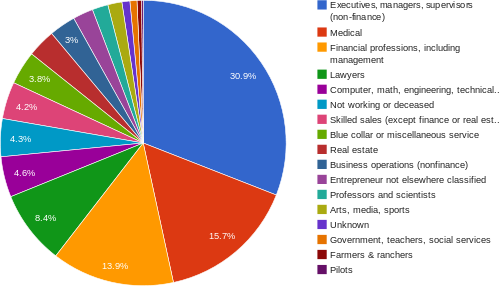
Much hay is made of the distribution of wealth in the modern United States.  Recently, the Occupy movement has protested the accruing affluence of a shrinking number of individuals that constitute the top ‘1%’ of wealthy within the country.  Data suggests that the top 1% of income earners in the country represent a myriad of professions, investments, and financial instruments as revenue streams, with the largest portion (30.9%) represented as the executive/corporate professionals, as shown by graphic 1.1 below:

1.1: Top 1% of Wage Earners by Profession, US.  Source, Wikicommons

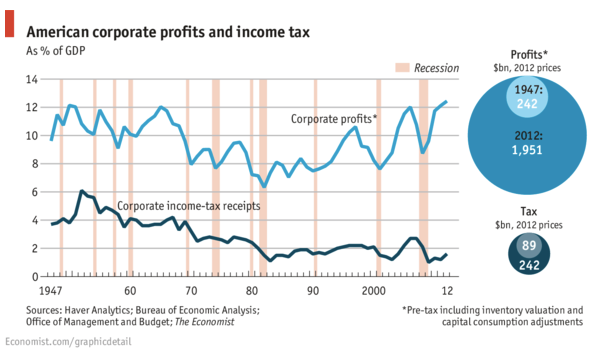
Analyzing the data from this table paints a picture of broad distribution of wage incomes across a myriad of industries, but fails to account for the disproportionately massive amounts of wealth that aren’t generated by salaries at all, nor are they representative of the fact that the wealthiest legal entities within the US aren’t people — they are tax-sheltered corporate entities:

1.2: Corporate Profits vs Tax Liability

The Corporate Model

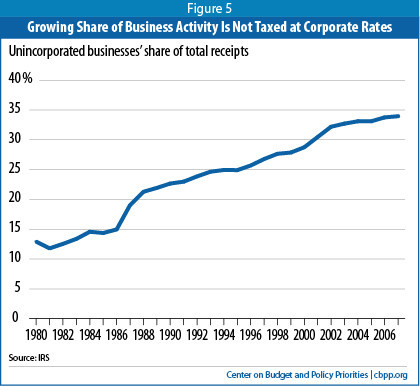
Corporations are paper entities recognized by the state as legal persons.  They exist in order to generate and accrue revenue, and pay stakeholders.  Unlike natural persons, corporate entities are immortal.  Instead of competing on the open marketplace for revenue, the most successful and largest corporations have discovered a way to cut the market out of their revenue streams altogether.  It is simply easier and more cost effective to lobby the state to enact laws that protect their revenue stream and squash market forces than it is to operate within a competitive market.  Progressive, draconian tax structures enacted as a hedge against corporate domination of wealth may be adopted by government in an effort to increase tax revenue from the corporations, but in reality, simply provide further incentive for corporations to allocate resources in an effort to mitigate or outright eliminate their tax liability within the US.  For example, Google, the fastest growing and wealthiest of the new tech giants, pays a majority of it’s taxes in Ireland and Bermuda — nations with a far friendlier income tax policy than the US — and bypass their US tax liability almost entirely due to the so-called ‘loophole’ in the income tax law, resulting in the federal government’s lost tax revenue from one of the largest US corporations in history. This leads increasingly to a larger percentage of individuals, sole proprietors and small-to-mid cap businesses shouldering an increasing burden within the tax structure as shown in 1.3 below.

1.3

The State’s Culpability

The new corporate model of tax evasion coupled with astronomical growth in profits-to-cost relies heavily on the government’s complicit action with regard to tax policy and recognition of corporate person-hood.  It is in a company’s interest to make money — but to ‘saw the ladder off’ below them, they require government cooperation to enact laws that make tax sheltering and corporate personhood possible.  This culture of lobbying and outright appropriation of the legislative process has progressed to the point that there is little differentiation between the state and the corporation.  Insurance companies write health care laws, and banking institutions write tax laws and set monetary policy.  The roots of this collaboration run deep through US history, crystallized notably by the creation of the Federal Reserve Bank in 1913 on Jekyll Island by J.P. Morgan, Paul Warburg and other global-level financiers with the collusion of Senator Nelson Aldrich, who had close ties to both Morgan and Nelson Rockefeller. (Further reading: ‘The Creature from Jekyll Island’ by E.B. White)  The Federal Reserve Act of 1913 was signed into law by then US President Woodrow Wilson, and effectively turned over control of the nation’s monetary policy, issuance of currency, and anti-market fixing of interest rates to a private bank set up as a for-profit corporation called the Federal Reserve Bank, effectively undoing the American Revolution and the work of his predecessor, President Andrew ‘Old Hickory’ Jackson.  The ‘Fed’ as it is known today, continues to be the sole issuer of paper money accepted for the payment of taxes in the US.  While the people remain ‘free’ to trade in whatever currency or barter they choose, all state and federal taxes in the US must be paid in Federal Reserve Notes, giving the Fed a monopoly on currency.

The Corporate-State Combine

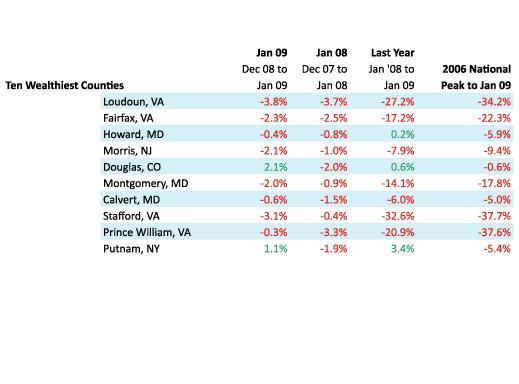
A century of the above-outlined activities of corporate entities have led to an overlap between the banking community and government that often goes understated.  JP Morgan/Chase market their banking services directly to government, as clearly outlined in their marketing materials: https://www.jpmorgan.com/pages/jpmorgan/cb/government. It is no surprise that most of the nominees for president, cabinet members, the Fed and legislators exist in a professional ‘revolving door’ environment that moves them from banking to high office and back over the course of their careers.  For example, both major party candidates for president in the last 20 years have had direct professional ties to JP Morgan and Goldman Sachs.  This ‘partnership’ has led to a century of collusion between government and banking, taking an ever-increasing cut of the total wealth out of the real market, and enriching our legislators to the point that many of the wealthiest counties in the nation now surround Washington DC as evidenced in the data provided.  This corporate-government combine acts as a siphon, sucking wealth out of the population through inflation, currency devaluation and increased tax burden, and enriches the corporate interest through outright gifting (TARP, Stimulus, Bailouts, etc) to the wealthiest of the wealthiest of the 1%.  Warren Buffett, one of the wealthiest men in the world and owner of Berkshire Hathaway Ltd. championed bailouts while his firm received the largest portion of us taxpayer money from the TARP program. Buffett himself pounds the table for higher tax rates, while he and his company manage to ‘limit’ their tax liability and avoid paying taxes owed back to 2002.  Mr. Buffett is a major campaign contributor to our current President, Barack Obama.

Solutions

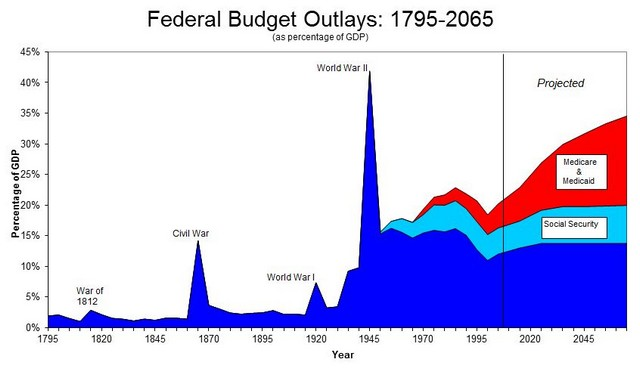
With the compound factors of massive increases in government spending (roughly $20,000 annually per citizen), and the steady evaporation of corporate tax liability (less than 40% of the total tax base of businesses in the US is covered by large-cap corporations) the problem of the distribution of wealth in the US is starkly apparent.  To identify what is going wrong in the economy is one thing — providing real solutions is another entirely.  Both major political parties offer their version of the fix — the right would suggest cutting government spending on services and lowering the tax base to broaden it and encourage large cap corporate interests to pay their income taxes in-country.  The left advises steeply progressive tax laws on private citizens (one would assume the left would suggest tax reform for large corporations, but the democrat party has been in charge of the tax law for decades with no such legislation to speak of), and consumption and indulgence taxes on goods and services, combined with further devaluation of the dollar through Quantitative Easing (QE) and raising (or outright elimination of) the debt ceiling.

While it would seem that these two paths are the only potential ‘fixes’ to our nation’s distribution of wealth problem, neither of these plans would provide real, permanent relief to the average citizen who is continually squeezed out of the middle of the economy, with an ever-increasing portion of their revenue taken by the state through tax, and devalued by the state through inflation.  Indeed, it would seem that our problem is not ‘distribution of wealth’, but rather, the redistribution of wealth through taxation and devaluation of the dollar.  Looking at the problem from this perspective, the solutions become simpler and multi-fold.

Monetary Policy/END THE FED

Should the Federal government enact law that checks the monopoly power of the Fed to issue currency by accepting in payment of taxes any and all used currencies in the market, the nation would be free to adopt currencies other than the dollar.

Bitcoin, a decentralized crypto-currency, is a notable example of a market solution to the problem of distribution of wealth.  Though Bitcoin has it’s detractors and a relatively small market cap, it’s value has continued to skyrocket on the open market, and is in the early stages of large-scale adoption and public use.  Bitcoin requires no bank or government to ‘mint’ it as a currency, and is freely traded electronically between users with no bank needed.

Similarly, gold and silver have been used for thousands of years the world over as viable hard currencies.  Hard currencies cannot be devalued through running of a printing press like paper currencies, nor through the click of a button like crypto-currencies.  As there is a finite amount of gold and silver in the market, it’s value has a ‘hard floor’ — it is always worth at least it’s value as a raw material.

The fact that the Federal government will only accept Federal Reserve Notes (which, in itself violates the constitutional directive for the US Treasury to mint coin, not a private bank) in payment of taxes effectively gives the FED a monopoly on currency.  The last US President to order the Treasury mint silver certificates was John F. Kennedy.

Commercial Policy/END CORPORATE PERSON-HOOD

Corporations are legal ‘persons’ with the ability to lobby the legislature directly, resulting in tax laws and policies that favor them over natural citizens of the US.  This has resulted in laws being written directly by corporations, including insurance companies’ authorship of the Affordable Healthcare Act.   The insurance companies’ stock has risen by a factor of 2-5 due to the implementation of the law, while the cost of health insurance for the average citizen has skyrocketed.  Ending corporate person-hood would go a long way to ending the power of lobbyists to purchase legislators, and result in elected officials representing the people who elect them.

Tax Policy/END THE TAX

‘Taxes’, ‘tariffs’, or any other name the state wishes to apply, are simply pseudonyms for extortion — that is, the violation of individual property rights through threats of aggressive reprisal.  When private entities such as a thief or mob perform the same action, we rightly call it theft.  It is completely inconsequent what a thief does with your money once he has violated your rights to acquire it, even if he assures you that it is to your personal, direct benefit that he take your property from you by force.  To fix the distribution of wealth, and as well to return to a moral society where one does not live on the property of his neighbor through state-sponsored theft, all taxes should be eliminated.  If a portion of the population would like to provide a service or product to their neighbors, let them do so legitimately through voluntary free association and exchange.  The state spends more than it takes in in taxes, and floats the rest on credit.  This activity has crippled the purchasing power of the dollar, which has lost 99% of its total purchasing power on the market in the 100 years the Fed has controlled the nation’s currency.

Bibliography:

Wikimedia Commons. N.p., n.d. Web. 04 Dec. 2013.

JP Morgan.com “State and Local Government.” N.p., n.d. Web. 06 Dec. 2013.

Cogan, John F. Federal Budget Deficits: What’s Wrong with the Congressional Budget Process. Stanford, CA: Hoover Institution, Stanford University, 1992. Print.

The Unwritten Rules of Integrity in the Free Market

Benjamin Franklin is quoted as saying, “Only a virtuous people are capable of freedom.” The Founding Fathers alleged many times that liberty would not work unless they had a morally righteous citizens, and well-informed intelligent citizens. Part of economic liberty and the free market, and the way to ensure it works, runs by unwritten rules. It assumes that people will take responsibility for their own negative actions.

According to studies done by the Huffington Post and other sources, it can be estimated that almost one half of Wal-Mart employees live off of public assistance because their wages are too low to function in today’s society (food costs, rent costs, etc.). As a result, the petite bourgeoisie, middle-middle class, and blue-collar working-class fund the public assistance through tax dollars for employees of a one-percenter, the Walton family. The Waltons are number six on Forbes list of American billionaires, and yet the middle classes have to fund the survival of their proletariat abyss.

The behavior of the Walton family is inherently no different than a man who impregnates a woman, and abandons her and the child, causing the child and its mother (in many situations) to require a subsidized income from the taxpayers. The father’s behavior is now at the expense of everyone else. The child’s father cannot just walk away and say “oh, don’t infringe on my liberty,” and neither should the Waltons (and other shareholders) be able to.

In the United States, the Founding Fathers intended for a particular code of ethics to be followed. Keep in mind that ethics is not synonymous with morality. It should be assumed that a free market capitalist will practice ethics by taking responsibility for his actions, cleaning up after himself, and taking care of his workers as needed. This has nothing to do with either social justice or human rights, but is simply a civic responsibility to prevent a burden on society. Here is the economic libertarian argument in favor of self-regulation, and eventually raising of the minimum wage.

No matter how many times an Ayn Rand libertarian simply screams, “economic liberty, economic liberty,” or “the Walton family owes nobody higher wages in a free market,” we are still living in the cynical real world that exists as of now. And in this world, the reality is that the middle classes are paying for the public assistance of Wal-Mart employees because the shareholders and executives do not want to raise their wage. Forbes list billionaires are embezzling money from the working US taxpayer. That means that the Waltons are objectively a parasite on the economy.

Of course there are many other things that must be taken into account for the bigger picture. Raising wages always inevitably means raising prices, no matter what. Wage-raising means nothing, because the product purchased will take the same percent from the wage as it did when the wage was low. It causes inflation. Many Ayn Rand fanboys and Austrian economists would also make the argument that, “the Waltons pay so much in taxes for people’s food stamps that they can’t afford to pay workers any more. If food stamps were cut, they would pay more.” This is an issue involving serious mathematical analysis of markets and economics and cannot be fixed with a simple world view, whether it is blind faith in Atlas Shrugged or the bleeding heart of a social justice activist.

Well Atlas has not shrugged as of yet, and public assistance is not going away anytime soon. Until it does go away, then all capitalist bosses who underpay their workers causing them to get on public assistance, must be viewed as economic parasites, and the enemy of economic liberty and the middle classes. This is not small mom-and-pop business, but big, heavily regulated corporations, especially Wal-Mart and McDonald’s.

Just because a capitalist SHOULD do something does not mean that the Federal government should MAKE him do something. Here is an example of the civic responsibility of a successful capitalist. If a worker breaks his leg on the job, that capitalist employer should pay to fix his leg, so the worker he can get back to work, and provide for himself. A.S.A.P. If the capitalist just says “oh sorry… it’s economic liberty,” then the worker will get let go, will get on public assistance, and will objectively become a burden on the taxpayer. But that capitalist who caused that situation is the far greater parasite.

Costco is known to pay their workers a fairly high wage. They also sell more expensive, high quality products wholesale. That is simply called a high standard of living. A well-paid worker buying a well-made product. This is also known as a first world economy. You can be an economic capitalist and still a social collectivist. McDonalds and Wal-Mart produce a third world product. As a result, they pay a third world wage, they sell to third world markets, and create a third world society. They deteriorate American society and make it rot. In order to make a little extra profit, Wal-Mart and McDonalds are literally willing to let the US devolve into a cesspool.

There are many different ideologies on the left and the right who support this idea. Just because a market is free does not mean the market is free to take a dump everywhere and turn society into a cesspool for the sake of “economic liberty”. For example, Dr. Ron Paul, as would be expected of someone his age, believes in American-made, and an end to outsourcing. That does not mean he believes in federal regulations enforcing that scenario, but it is still the world he WANTS to see. Pat Buchanan, who identifies as paleoconservative instead of libertarian, believes in US non-intervention, closed borders, and economic nationalism. He ran for president unsuccessfully on the Reform Party ticket in 2000, like Ross Perot did in 1996, who also cannot be called a libertarian. On what is known as the “far right fringe,” or ultra-nationalism, there is great hatred towards free markets, libertarianism, Ayn Rand, and borderless capitalism, mostly due to illegal immigration, outsourcing, and backroom corporate deals with China.

One such capitalist from the 20th century was Mr. Henry Ford, a right-wing extremist with voluntarily progressive economic practices. Henry Ford is well-known for his paranoid rants about “the Jews” infiltrating labor unions to bring the communist revolution to the US, as was a typical canard from the era. The way he dealt with his Red Scare paranoia, however, was peculiar, yet constructive. He began paying his workers at the motor plants higher wages, so he could build a product that his workers could afford. He wanted to give the communist-infiltrated unions no excuse to organize and agitate on his plant grounds. As a result, he could not be the evil, greedy capitalist they wanted to paint him as. With happy, well-paid workers, professional labor leaders from communist or socialist organizations had no audience at Ford’s motor plant.

The libertarian in me knows all too well that Wal-Mart and McDonalds are ALREADY meeting the tax bracket and red tape that federal regulations are throwing up, which kill mom-and-pop businesses in record numbers. Progressives must understand that just “raising the minimum wage”, because their hearts bleed for human rights will not be a long-term solution. The populist in me however, realizes that corporate shareholders evading a living wage is not a long-term solution either. Any Atlas Shrugged disciple who puts the “economic liberty” of the Waltons above the well-being of the working-middle classes who have to pay taxes for Wal-Mart employees’ public assistance is just as delusional and ignorant as liberal activists who support policy based on emotion.

Is there such thing as Conservative Liberalism?

A friend sent me an email expressing confusion at the idea of Conservative Liberalism, which is apt because it combines two frequently misused words in a confusing way. Let me offer my views/definitions of important political terms to shed some light on this. This post will almost certainly raise more questions than it answers so disagree with me in the comments!

Hayek contrasted conservatism with liberalism and socialism, though a restatement would replace socialism with interventionism. My views are roughly in line with Hayek’s on what these terms mean, with an important caveat (below).

Conservatism is a support for the status quo, and is inherently anti-radical. But that status quo is a historical phenomenon and so conservatism isn’t per se pro- or anti-liberalism. So Conservative Liberalism is possible, just not in America today.

Liberalism is almost synonymous with goodness. It’s a big concept and trying to describe it adequately requires a whole library. All forms of liberalism are essentially concerned with freedom (from the latin Liber, i.e. liberty).

Interventionism is a belief that the government can usefully intervene in society and/or the market. Be that outlawing homosexuality or regulating hotels, this view has a distinctly illiberal flavor, though it’s essentially an orthogonal concept.

Hayek describes these categories as though distinct ideal types and with good reason. There are recurrent divisions along these lines that support thinking of politics in three dimensions, and lead to the formation of three groups (libertarians, conservative Republicans, and liberal [though not classically so] Democrats in the U.S., and similar factions elsewhere). However, I think it makes more sense to think of these as dimensions than ideal types. This adds some vagueness and makes it more difficult to put people in boxes. There can be Conservative Liberals (just not following the last few increasingly illiberal decades), and modern liberals can be understood as being descendant from classical liberal. Ideally everyone would be happy with this vagueness and instead of using labels as short-hand we’d discuss these sorts of things in depth.

But alas, it’s not so easy and even three dimensions is too many for most people, so we’ve got Left and Right wings. Us versus them! Good and evil! Which puts libertarians in the awkward position of not quite fitting in with Democrats on the left or Republicans on the right. I think the Nolan Chart is a step in the right direction. It makes Libertarians (top of the chart!) equidistant from left and right, but not really centrist either. It strips out political labels and gets to the principles at hand. And it’s ahistorical so it leaves room for radicalism and conservatism.

But then we’re left with a tricky situation because we’ve just eliminated an important dimension! And that leads to confusion when we discuss left and right because the ideas aren’t quite as simple as just particular bundles of policies, and that’s especially obvious in a two dimensional graph. If someone asks a libertarian if they’re left or right they should respond “freedom top!” and a neo-con should respond “power bottom!” I view Leftism as being an approach that is radical (i.e. anti-status quo) and Rightism as being pro-established interests. But it isn’t as simple as that either because the historical origins of the terms, and every day practice involves self-identification. The Tea Party is definitely in the Right but their views are typically radical (either radically small-government-liberal, or radically socially-conservative). There are right-wingers who are pro-market (a liberal position) and those who are pro-business (a pro-established interest position)

So what’s the solution? Libertarians would probably like to see an accurate taxonomy that accounts for a wide variety of political and moral dimensions, but left/right has adequate for many for so long. I think the Nolan Chart is a good first step to breaking this false dichotomy, but I also think that using terms like classical liberal is a good choice when it invites conversation with people who aren’t familiar with these ideas. And Conservative Liberalism? It’s a paradoxical term that would also invite discussion, but it’s irrelevant since in the current historical context, the status quo is illiberal.

Anti-Tesla bill rejected by Ohio Senate.

On December 3rd, an amendment to Ohio Senate Bill 137 failed to pass. The amendment would have required Tesla Motors to sell its electric cars through a third party rather than directly to consumers. Ohio is number two in auto manufacturing in the midwest and Tesla’s new line of ultra-efficient electric vehicles are a threat to the entire automotive industry. Contrary to what those in Detroit and Ohio would have you think, this is a good thing.

For far too long the automotive unions and automotive industry lobbyists have suckered the individuals in this country into believing they were the backbone of American manufacturing when in fact they were a leech sucking money from more productive uses. For example through the years 2008 to 2011 Ohio granted $80.8 million in subsidies to General Motors, $54.4 million to Ford, and $28.7 million to Chrysler. This is ignoring the billions of dollars spent on the auto bailout last decade which, much like Chrysler bailout in 1980, simply saved failing corporations from their own shoddy business practices. While Tesla gets its own fair share of subsidies any threat to the auto industry is a positive thing for consumers.

From the Comments: Secession and Nationalism in the Middle East

My dear, brave friend Siamak took the time to craft a very insightful rebuttal to my argument on supporting decentralization in the Middle East. He writes:

Brandon,

First of all thanks a lot for your attention to my comment…

You know that I have problems in English and maybe that’s the cause of some mis-understandings…

Look my friend. I did understand what you mean but the problem is sth else… As a libertarian I’m not completely against decentralization in the method you mentioned (I mean dealing with new nations)… USSR was a great example for this… My problem is that you can’t compare today’s med-east with USSR. Soviet Union was a country formed by some “nations”. Nation has a unique meaning. I think the best meaning for that is a set of people with close culture and common history which “want” to stay together as a nation. A country like Iran is formed of many ethnics including: Fars, Azeri (I’m Azeri), Kurd, Mazani, Gilani, Turkemen, Balooch, Sistani, Arab, etc. If you come and visit the whole part of this country you can see that all of them believe that they are Iranian. I don’t know that much about Arabian countries but I think that’s the same. Even all of them are Arabs and speak the same language but there are big cultural differences between for example Egypt and Saudi Arabia!

My reaction to your post has got a reason. 8 years of Ahmadinejad presidency, not only killed the economy, culture and any kind of freedom, But made us a weak country in mid-east. What I see today is that some little groups created and supported by Azerbaijan, Turkey, Qatar and Emirates are working so hard to make Arabian and Azeri groups to separate from Iran. They even do terrors for their aims. What I see is decentralization in mid-east not only doesn’t solve any problem but makes new problems! Makes new never-ending ethical wars.

You mentioned about US Imperialism. (I hate this word, Because when the leader speaks from three words he speaks two is “Enemy” and one is “Imperialism”! :D ) One of the biggest problems in mid-east is Al-Qaida, which everybody knows that without the support of the united states they couldn’t be this big. You in your post didn’t say that you think US should start the decentralization of mid-east, But you believe decentralization and Schism is good for the peace of mid-east. My objection is to this belief. Arabs are very nationalist. Iranians and Afghans are nationalists too. Changing the current map of mid-east will bring new problems. A big problem of mid-eastern countries is their governments. But Governments are not the only problem… The problem is not “just democracy”, It’s not even “Just modernism”! In some parts the problem is “Savagery”! The people are a big problem. If anybody wants peace for mid-east they should economic relationships more and more… We libertarians know the power of free business. Don’t be afraid of central powerful governments. Even sometimes their power is useful. We are in a Transient status between “Savagery & Civilization”, “Tradition & Modernism” and “Dictatorship (Even Totalitarianism) & Democracy”.
If the western countries want to help Democracy, Modernism, Civilization and peace they should make economical relations. Sanctions just gives the right to Islamic Radical groups and makes them stronger… As you mentioned Imperialism just gives them credit. Any decentralization makes new problems. The Communist Soviet Union was a block of different nations that their only common point was Communism. New Nations that are formed on the basis of ethnics just makes new dictator governments and new enemies. Mid-east is different from Soviet Union. I hope that this time I have less grammar mistakes! :)

Siamak, by the way, is a citizen of Iran and ethnically an Azeri. I always prize the views and arguments of foreigners in matters of philosophy, culture and policy. All individuals bring diversity to my world, but when the voice speaks with an accent and carries experience that I know nothing about, it – well – it makes my world and my life that much richer.

With that being said, I don’t buy Siamak’s argument. largely because I don’t see much of a difference between the Soviet Union and Iran ethnically-speaking. That is to say, I think Siamak’s argument falls flat because both the Soviet Union and Iran have numerous nations within their borders, so the distinction between the two states doesn’t quite add up.

I think the rest of Siamak’s argument stands up pretty well.

Blind Faith

By Adam Magoon

On November, 26th Eric Liu, founder of “Citizen University”, a pro-government think-tank, wrote a telling article about having faith in government on the CNN opinion page. He begins the piece with a story about leaving his suitcase in a New York City cab saying:

“I had an experience recently that reinvigorated my faith in humanity — and bureaucracy.”

Keep that equivalency in your mind for a few minutes. Humanity and bureaucracy.

He goes on to explain that he did not even realize he left the suitcase in the cab for twenty minutes and only then began calling people for help. He explains this process in detail, emphasis mine:

“For almost three hours, various people tried to help me — two folks at my bank, whose credit card held the only record of the cab ride; three people at two yellow cab companies based in Long Island City; a service rep at the New York City Taxicab & Limousine Commission; people in my office back in Seattle.”

So Eric was helped by no less than eight individuals (counting the cab driver) in his successful search for his luggage. Eight people helped improve Eric’s business trip. He then claims this experience taught him three lessons.

First:

“Always, always get a receipt.”

This, as he says, is obvious.

Second:

“Another is that New Yorkers, contrary to popular belief and their own callous pose, are essentially nice.”

As someone born in New York I would like to think this is true, but I adhere to the maxim that terms such as “New Yorker” can only describe places where someone lives or is born. Saying “all New Yorkers are nice” is equivalent to saying “all Scots are drunks” or “all Scandinavians are attractive”. Essentially it is a non-statement that is easily refuted. There are just as many people who would have taken anything of value from his case and threw it into the nearest dumpster.

That is just the appetizer though, here is the main course.

His final lesson, and where the train totally leaves the rails, is this:

“But the third, even more deeply contrary to popular belief, is that government is not the enemy.”

Wait, what?! What kind of logic is Mr. Liu using? Of the eight people who helped him only one (the service representative at the New York City Taxicab & Limousine Commission named Valerie) even worked for a governmental organization and “she insisted she was just doing her job”. How did Mr. Liu get to “government is not the enemy” from that series of events? He goes on to claim that:

“Government is not inherently inept. It’s simply us — and as defective or capable of goodness as we are”.

Mr. Liu tries to rationalize his faith in government with a single good experience with a few select people. What he ignores though, is that many people are not “essentially nice”. If that were the case crime, corruption, and violence simply wouldn’t exist. There are people in the world who only seek to exploit and profit from the work of others and to quote the great classical liberal theorist Frédéric Bastiat:

As long as it is admitted that the law may be diverted from its true purpose — that it may violate property instead of protecting it — then everyone will want to participate in making the law, either to protect himself against plunder or to use it for plunder”

Even if we were to assume that most people in the world are “essentially nice” the very nature of government attracts precisely the opposite type; the corrupt, the malevolent and the lazy. His agenda finally becomes clear nearly two-thirds of the way through the article when Mr. Liu unabashedly asks us to not wonder what our country can do for us, but rather what we can do for our country in response to the failed Obamacare launch.

Individuals are expected to bail the government out when it fails at intruding into our lives? How can we expect the government to run healthcare without kickbacks and corruption when they cannot even get someone to build the website without it being a disaster?

Mr. Liu fails to offer any helpful advice on how to improve things but he does offer one revealing suggestion. He says that citizens should not expect the “state…to serve us perfectly” and that individuals should not “forget how to serve”.

The argument often goes that taxes pay for services provided by the government but Mr. Liu suggests we shouldn’t expect too much from those services. That we shouldn’t get upset when we pay a third of our labor to the government and it spends that money on things we do not want; in fact he implies we should fix for free the broken things they have already spent our money on.

If Mr. Liu goes out to dinner and his silverware is dirty when he sits at the table does he go back to the sink and wash them? Or does he expect more from the things he spends his money on? At least in that situation Mr. Liu could choose to spend his money elsewhere. With the government spending our money for us we aren’t even afforded that meager victory.

Debunking the Wage Slavery Myth

By Adam Magoon

It is often stated by those who are ignorant of economics that work is not a voluntary endeavor even when a wage is agreed upon voluntarily by both parties.  The rationale behind this claim is that a human being must eat, drink, and have shelter and therefore the employer has this leverage to use in order to strangle wealth from the poor worker.  In order to examine this erroneous belief we must start as we do with all economic examination with the Robinson Crusoe scenario.

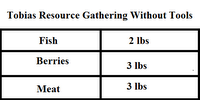
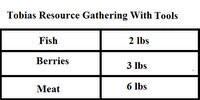
Assume a shipwrecked sailor (Tobias) on an island with no resources but his own two hands and his ingenuity.  To survive he has a number of options:  He can gather fruit/berries for a return of 3 pounds of berries per day, he can fish in the shallows(without tools) for a return of 2 pounds of fish per day, or he can hunt wildlife(without tools) for a return of 3 pounds of meat per day.

wageslavery1

Tobias requires 2 pounds of consumer goods per day to survive.  On this island consumer goods are either Berries, Meat, or Fish and given Tobias’ productive capacity of either 2 pounds of berries or 3 pounds of the other two consumer goods any intake of resources allows him to maintain his existence (subsistence).  It is at this point we must examine whether Tobias’ work is slave labor.

The definition [1] of a slave is:

1.

a person legally owned by another and having no freedom of action or right to property

2.

a person who is forced to work for another against his will

In our scenario is Tobias the property of anyone other than himself?  The answer is clearly “no” since Tobias is quite literally the only person on this island.  While he is “forced” to work due to his innate need for sustenance it would be counter-factual to claim he is somehow a slave to himself since the definitions of slave-master and slave are incompatible with another [2].  It is also absurd to say that because they provide his method of survival that Tobias is somehow slave to the ocean or the land [3].  So as we can see; when Tobias is alone on the island working to survive he is a slave to no one.

To this point we have been dealing with Tobias merely using his nature given resources to obtain and consume consumer goods.  However by collecting berries or hunting for two days (6pounds collected – 4 pounds consumed) he obtains 2 pounds of excess goods he can save.  Through this method of saving and then consuming the saved goods on the third day he can then use that time to create capital goods.  This means that on the third day, instead of hunting he can fashion himself a spear from collected wood.  The spear allows him to take on larger game and thus increases his collection of meat to 6 pounds per day.

 wageslavery2

At this point we need to examine two things.  First, at this point it would be foolish for Tobias to do anything other than hunt.  He has a decisive gain in resources due to his construction of the Spear and can use the vast amount of saved food to create even more goods (extra spears, traps, shelter, etc…).  As foolish as it may be objectively that diagnosis ignores his subjective valuations; perhaps he finds it distasteful to kill animals even in his situation, or simply prefers to pick berries due to the relative safety.  The reasons are irrelevant, just keep in mind that despite the obvious advantage of hunting in this scenario he can always choose not to.

The second thing we need to examine is whether Tobias is now a slave.  All of the evidence from the previous examination applies; he is still not a slave to himself.  The only thing that has changed is the creation of a spear from the saving of consumer goods.  It is clear that Tobias cannot be a slave to either the spear or his own saved consumer goods, again due to their nature as objects.  So we have seen that a worker working, both with and without capital goods, is a slave to no one.

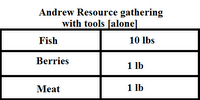
Now here is where the hypothesis comes into question.  Let us assume a second person becomes stranded on the island; except this person (let’s call him Andrew) has been able to scavenge from his wrecked ship a small life boat and netting that is suitable for fishing.  Using his tools while alone Andrew can Hunt for 1 pound of meat, gather 1 pound of berries, or gain 10 pounds of fish.

 wageslavery3

In this economy Tobias will gain the most by hunting and Andrew will gain the most by fishing and they both are likely to pursue those activities [4].  Now we must again identify if this change in circumstance has resulted in slavery.  Tobias’ situation has not changed at all, so he is not a slave to anyone.  Andrew is not interacting with Tobias in any way, he cannot be a slave to his boat, his net, the ocean, or himself so he is also obviously a slave to no one either.

However Andrew soon comes to believe that if he had someone to operate the net while he piloted the boat he could obtain 20 pounds of fish per day, this may be an erroneous prediction but that is the entrepreneurial risk Andrew must take to earn a profit.  For the sake of this examination we will assume that Andrew is an amazing entrepreneur and his prediction is exactly right; but to obtain the 20 pounds of fish Andrew needs an employee.

Here we reach the concept of wages.  In the economy where both Andrew and Tobias work alone they obtain 10 pounds and  6 pounds of consumer goods respectively for a total of 16 pounds.  Andrew, as an entrepreneur, sees that if he employed Tobias they would obtain 20 pounds of total consumer goods which is an increase in the size of their economy by 4 pounds of consumer goods.    At this point Andrew needs to hire Tobias.

If you remember; the subsistence level for Tobias is 2 pounds of consumer goods per day; so any attempt to hire Tobias for less than that will be ignored since he could not survive at that wage.  Currently though Tobias is producing 6 pounds of meat using just his own intelligence and skill so any attempt to hire Tobias below that rate will also be denied.

Andrew would obtain 10 pounds of goods without Tobias’ help so he would be amiss in paying Tobias more than that since then Andrew would then be taking a loss.  Using our final profit of 20 pounds if Tobias agrees to work for Andrew the wage rate must be between 6 and 10 pounds of goods per day.

In this scenario let’s assume Andrew offers to pay Tobias 7 pounds of goods in exchange for his work operating the net [5].   Tobias would then be gaining 1 pound of goods over his efforts if he worked alone.  Andrew would be gaining 3 pounds of goods compared to his work alone.  Tobias agrees to this arrangement and both parties are better off.  Here is where the proponent of wage slavery points to the fact that Tobias is seemingly generating 10 pounds of goods but only obtaining 7 pounds and thus he is being exploited by the capitalist-pig Andrew but let’s examine whether there is a master-slave arrangement here.

Andrew has freely chosen to hire Tobias at the cost of 7 pounds of consumer goods with the expectation of gaining 13 pounds for his own use.  He is free to terminate this agreement at any time.   Tobias is in a voluntary agreement to help Andrew obtain a total of 20 pounds of consumer goods in exchange for a payment of 7 pounds of goods.  He is free to leave at any time if the agreement becomes unsatisfactory and hunt for himself, though he would suffer a net loss of 1 pound of consumer goods to do so.

There is nothing here that fits the definition of slavery, Tobias is not forced to work against his will and Andrew is not forced to hire him.  Both parties own their own property and neither owns the other in part or in whole.  Even though Tobias would be taking a loss by leaving Andrew’s employment the loss to Andrew would be even greater!  Andrew would be losing 3 pounds of profit and Tobias would only be losing 1 pound.  Therefore despite Tobias’ innate need to work this does not cause a master-slave arrangement or “exploitation”.  It is true Tobias has to work to survive but he does not need to work for Andrew; but he voluntarily will continue to do so as long as it benefits him.

Finally, what of the “missing” 3 pounds of goods that Tobias is somehow losing?  The answer is obvious; it is the price put on Tobias’ use of Andrew’s capital goods which in this scenario are his boat and net.  Without these capital goods Tobias would not be able to generate 10 pounds of consumer goods and therefore there is a premium placed upon them by Andrew; after all they are his property and he must maintain them.  If Andrew’s boat was to spring a leak or his net tear Tobias would not have any responsibility to fix them and could happily take his 1 pound loss and go back to hunting while Andrew (if he had not achieved some profit) would suffer the far greater loss of both his 3 pounds of goods and the destruction of his capital goods.

It is worthwhile to note how this scenario compares to the classic opinion that people born into wealth have somehow acquired it illegitimately.  In our scenario Andrew did not need to save consumer goods like Tobias did in order to obtain capital goods, he simply has them due to luck, or fate, or what-have-you.  This does not change the fact that he does indeed own them and can utilize them how he wishes and that utilization is totally legitimate.  Would anyone scoff if Tobias handed down the hunting spear to a future son for his protection and livelihood?  To remain consistent we cannot then harry Andrew for passing down his fishing equipment for the sole reason that it would give his own heirs an “unfair competitive advantage”.

It is evident by now that the entire concept of wage slavery is simply a misunderstanding of economic principles.  Even the myth that somehow the wage earner does not get “his fair share” has been debunked.  The simple reason why so many find these concepts hard to extrapolate in the real world is due to the hundreds of years of savings, production of capital goods, and the highly specialized division of labor that has made worker productivity increase to such an extent that the fall to subsistence seems unfathomable.

The productivity of the workers in the industrialized world has become so great that any work outside of this world, such as gathering berries or fishing to feed an entire family, would require a massive drop in quality of life.  This is somehow turned around to be a slight on employers when they are the ones who have made this increase in the quality of life possible.

If we had replaced Andrew’s life boat in our scenario with a commercial fishing trawler that allowed Tobias to obtain 500 pounds of fish per day would we then say he is Andrew’s slave because he would be “forced” to return to hunting only 6 pounds of meat per day should he choose to leave?  Would Andrew be a villain for hiring Tobias and paying him such a vast increase over the wage he could obtain by working alone?  No! Of course not! It doesn’t logically follow!  Yet that is the accusation from the proponents of wage-slavery and it is clearly absurd.

[1] http://dictionary.reference.com/browse/slave?s=t

[2]  It is true that a slave could himself be the master of a third slave, but a slave master logically cannot be a slave to his own slave since either one slave or the other would end his own involuntary servitude.

[3] By their nature as objects they cannot own other objects.

[4] Whether they actually trade goods at this point is irrelevant because both parties are satisfying their base needs through their own effort.

[5] We are also assuming that the number of hours worked are the same and subjective preferences of hunting over fishing or vice versa are non-existent.

New Mexico’s Police Breaking Badly

by Fred Foldvary

The AMC television channel recently concluded the drama “Breaking Bad.” The series was about a high-school chemistry teacher who has terminal cancer and “breaks bad” by making methamphetamine to get money for his treatments and for his family. The episodes take place in New Mexico, and some of the scenes occur in the desert.

Now the state government of New Mexico is breaking into real-life evil. Its police are stopping drivers and forcing them to submit to intrusive body searches and medical tests for drugs, including X-rays and colonoscopies. The hospitals then bill the victims for the involuntary procedures.

The State of New Mexico is establishing the principle that the state may force people to undergo medical procedures that they then must pay for. The worst aspect of governmental medical provision is that the health of individuals becomes a governmental matter, and therefore the state takes control over medical decisions. The federal and state governments may, in the future, force people to adopt preventive measures and periodic tests. The government will not only force citizens to have medical insurance, but also force people to submit to procedures such as anti-smoking treatments and colonoscopies.

One of the victims of medical coercion is suing the City of Deming in a U.S. District Court for being forced to submit to X-rays, enemas, and a colonoscopy. The police and doctors did not find any drugs in his body. As justification, the police claim that the driver was clenching his buttocks after being stopped for a traffic violation and ordered out of his car.

After that lawsuit was registered, it was reported that another man was probed for drugs in a New Mexico hospital after his car was stopped by police for failure to signal. The news media are now reporting that other drivers in New Mexico are being searched after getting stopped for alleged traffic violations. The police suspect the drivers of drug violations due to their appearance or due to dog sniffing, often with untrained dogs, and obtain warrants for the intrusive drug tests and body searches. In the case of the driver suing the state, the warrant was not even valid for the county and the time in which the colonoscopy took place.

The police in other states have been doing similar things. In Tennessee, the police took a man cited for an expired car licence to a hospital for drug tests, after a sniffing by a drug dog. A woman in Texas was strip-searched and double-probed by the police and by doctors.

The Fourth Amendment to the United States Constitution states, “The right of the people to be secure in their persons, houses, papers, and effects, against unreasonable searches and seizures, shall not be violated, and no Warrants shall issue, but upon probable cause, supported by Oath or affirmation, and particularly describing the place to be searched, and the persons or things to be seized.”

Unfortunately it is easy for the police to evade the Fourth Amendment because they can claim that their searches and seizures are reasonable. and some judges will routinely issue warrants if a dog, even if untrained, growls or points at the victim, or perhaps if the victim seems nervous.

Long ago, and still in some countries, highways were dangerous because robbers would halt a carriage or train and steal from the riders. Now, in the USA, the highwaymen are the police who are not content to merely issue citations, but use traffic violations as an excuse to enforce the drug laws. Driving in New Mexico is now dangerous because of the police predators.

Ecology is the relationship of living beings to one another and the environment. Evolution seems to generate predator-prey ecologies. Now that large predators such as lions and wolves have been eradicated from human habitat, ecology has generated human predators such as hijackers. Government is supposed to protect the public from such predators, but the drug laws have turned the police into yet another set of predators.

The German philosopher Nietzsche wrote that the “will to power” is the strongest human motivator. Individuals who seek the thrill of exerting power now become traffic officers, because they can stop any driver and have power over and into his body. This police predation is legalized rape.

What I learned in Community College

A salvo:  As a returning student in my thirties, I must admit I am thoroughly enjoying the community college experience — it blows my mind that I have the freedom to return to the academic environment and pursue my education in a convenient and cost-effective manner.  Surely this is a testament to the community college system, and for that, I am grateful.

Now that I’ve established my gratitude, I’d like to outline briefly what I’ve learned in my first semester back in school, and solicit the well-educated community that is notesonliberty.com for a bit of guidance.  Hopefully, you fine lot will provide me with some direction and perspective.  I intend to apply to a California school upon completion of my transfer program at the end of the 2014 academic year.

Here is what I’ve learned in a semester at Cabrillo college in Aptos, CA:

GEOG 3, Physical Geography:  Anthropogenic climate change is a fact.  Humanity is a juggernaut exhausting the planet’s resources, polluting, heating and overpopulating the environment.  The planet’s ability to support us is quickly and undoubtedly reaching the breaking point, and the solution is radical and immediate de-industrialization and depopulation.  The fact that industrialized nations and economic development provide innovations that result in efficiency and sustainability, as well as a negative replacement population rate matter not.  Humans must cease to eat anything but primary energy producers (plants), and ‘enact policy’ to curtail fertility by all and any means necessary to save the planet.

CG 65, Leadership:  Democracy is fair and effective.  It is just and fair to allow the tyranny of the majority to compel by force the theft of property from individuals in the form of taxation for the ‘common good’.  The importance of understanding the electorate’s will is secondary at best to mastering the process by which I as an individual can gain power and privilege through the exploitation of the democratic process.  Open manipulation of the will of the masses is the only just means to gain dominance over my neighbors and co-opt their liberty and resources.  Individual ability is meaningless, and it is unethical to use superior individual ability, labor and intellect to succeed, because that would be unfair to the dull-witted and lazy.  Those who have no power or ability have been exploited by individuals with power and ability, which is unethical.  The ethical way to exploit the public is as a group.  Everyone has equal value and ability, and it is wrong to favor individual performance based upon merit.  An individual’s worth is based on their ability to consent to the democratic process, and there are no natural leaders — leadership is a learned skill.

ACCT 151a, Financial Accounting:  All systems of accounting exist solely for the expressed purpose of paying the state.  I am compelled to violate my own right against self-incrimination by ‘voluntarily’ providing the state with a detailed log of all of my economic activity, so that I can ‘voluntarily’ send them a portion of that which I have earned by way of participation in commerce.  I must use Generally Accepted Accounting Principles and keep meticulous records, based on a system codified by a medieval Jesuit named Fra. Lucca Paccioli, which he derived from ancient Sumerian systems of accounting and transcribed in the margins of a bible.  Should I participate in commerce in any other manner, or fail to disclose exactly what I’ve done with every dime that passes through my hands, I will be fined or imprisoned.  Corporations (that is, ideas drawn on paper) are people who never die and have rights that supersede the rights of natural people.  This system exists for my benefit…somehow.

SOC 2, Introduction to Sociology:  The ‘sociological imagination’ is a process by which unique individuals are grouped and classified as either privileged or victimized.  Race does not exist biologically, and gender has nothing to do with sex — paradoxically, people of western European ancestry with testicles are inherently evil, unless they are homosexual and socialist.  The laws of the natural, biological world are immoral when applied to society, even though Sociology as a field proposed the theory of Social Darwinism.  Central planning is needed to control the actions of individuals, and a free society is inherently unjust.  Though the ‘sociological imagination’ has given birth to the greatest evils of human society — Totalitarianism, Eugenics, and Human Bondage, sociology is somehow the salvation of human civilization.  The ‘great sociologists’ include Marx, Sanger and Mao — three people responsible for the death of millions.  Enlightenment thinkers and individual liberty is wrong, and Thomas Jefferson’s ownership of slaves somehow invalidates the merit of any concepts he wrote on human liberty.

With all of that being stated — I pose a question to you, the great minds of notesonliberty.com:  To which schools within California shall I apply?  To which programs?  Is there any merit to a college education that has a legitimate basis in Art and Science, or is education within the college system simply a continued exercise in political indoctrination?  I write this in earnest — my thoughts aren’t in the least tongue-in-cheek.  Please, please, please, guide me to quality schools and baccalaureate programs for a libertarian thinker, so that I may not abandon my quest for a degree.

Help me, Obi-wan Kenobi.  You are my only hope.

Obama’s Utilitarian Foibles

The utilitarian insists that the morally right way to act is to promote the greatest good for the greatest number (of people but perhaps of all sentient beings). This goes for public policy as well! The goal overrides any individual rights, so if to secure it some people’s rights to life, liberty and/or property need to be violated, so be it!

For example, if to provide health insurance for elderly folks it is necessary to coerce young people to purchase health insurance, then coerce them! Never mind their right to liberty and property. Those are irrelevant, even though they are supposed to be unalienable rights no one may violate, not in the American political tradition.

Here, then, is a clear example of how the Obama regime departs significantly, in its political philosophy and program, from the uniquely American framework. This framework supports securing the protection of individual rights as the primary job of government. Read the Declaration of Independence and see for yourself. That is indeed the central feature of the American Revolution, with its Bill of Rights and its Constitution.

Not only does that render the country one that’s free – under which all citizens may live as they choose provided they do not violate anyone’s rights – but is responsible for the great prosperity of the country, its freedom from arbitrary government intervention in people’s lives. Even the public good or interest does not permit it. While this may appear to be a restriction that stops the country from achieving utilitarian objectives, the very opposite is the result! That’s because free men and women make the most productive use of their liberty.

The idea is that human beings are by their very nature proactive. They think of ideas that they will implement and these are usually good ideas, ideas their fellows can make good use of. This is the essence of entrepreneurship. They don’t just daydream but think purposefully, which is to say their ideas can be marketed to others. Out of this process arises the bustling economy of a country and, indeed, of the world.

So long as men and women are free to think creatively and productively, they will make sure their work will have payoffs, either economic or personal or even charitable. This is how a free society works, creates products and services, and leads to high employment to boot.

But the likes of Obama & Co. want to step in and regiment how free men and women act and they believe or pretend to know what others should do to be productive. And that means, usually, that they misguide the economy. (The most notorious recent example of this was all those five-year plans Stalin and his gang unleashed upon Russia and its satellite states, which brought the Soviet Socialist system to its knees!)

But Mr. Obama & Co. fail or refuse to grasp any of this. Shame on them!

Corrupção e Julgamento

Na última sexta-feira, em meio a um feriado prolongado, a população tomou conhecimento de um fato inédito: homens próximos a um ex-presidente, ainda ativos no jogo do poder, iriam para a prisão. De maneira surpreendente, os sempre ativos auto-denominados defensores das minorias não celebraram a decisão do juiz – figura polêmica e central no caso – Joaquim Barbosa. Além disso, os – também auto-denominados – “progressistas”, que sempre buscaram se identificar com algum tipo de padrão moralmente superior, calaram-se.

O silêncio, desde a sexta-feira, no país, por parte destes grupos é ensurdecedor.

O fato é surpreendente em si dada a raridade de casos em que corruptos – nas palavras da Lei – são efetivamente punidos. O Brasil que caminhava para um modelo liberal nos anos 90 (uma espécie de social-democracia centro-liberal, se permitem), nos últimos 12 anos, mudou sua direção para o modelo “Nova Classe”, para citar o clássico de Milovan Djilas.

As instituições formais e informais, como sempre centrais em qualquer tentativa de se falar em desenvolvimento econômico, redução de desigualdades, etc, não deixam de se fazer sentir aqui. É difícil dizer em que grau a decisão do STF altera alguma delas. Observamos uma certa acomodação do brasileiro com práticas “rent-seeking”, como dito no texto anterior. A ideologia da vez anestesia a revolta popular contra os abusos do governo e há, mesmo neste episódio, quem tente dizer que a prisão tem conotação política (numa espécie de alucinação criada por se acreditar nas próprias mentiras…).

Do lado das instituições formais, Joaquim Barbosa pode ter feito algo importante mas a pergunta é: o senso de impunidade dos políticos diminuiu com a decisão? A impunidade sobreviverá a Joaquim Barbosa? Vemos demonstrações gritantes de racismo sem o menor protesto das organizações anti-racistas financiados com dinheiro público (embora se digam não-governamentais) e não se observa, ainda, uma mudança de mentalidade do lado Law de Law & Economics quanto à importância de se diminuir a impunidade em prol  de uma sociedade de mercado (é bom lembrar que a revolta contra a impunidade pode ter fundamentos totalitários ou não).

A corrupção foi julgada e condenada pelo sistema legal e parte da sociedade parece acreditar (ou melhor, vende esta idéia, porque acreditar nisto é muita ingenuidade…) que isto tudo não passa de “perseguição política”. O discurso político nunca mudou e nunca mudará. Já a prática política, bem, esta é outra história.

Caso Hayek estivesse vivo e morasse no Brasil, o que ele diria? Difícil dizer. Mas pelos seus escritos, provavelmente apoiaria o juiz Joaquim Barbosa (libertários, por definição, não são racistas e nem apóiam a manutenção de privilégios arbitrários, gerados por decisões políticas), diria que ele está certo e, claro, lamentaria a falta de experimentação de nosso Judiciário.

De qualque forma, esta semana se iniciou menos suja no Brasil. Um pouco de alívio para se respirar não faz mal.