What sort of “Meritocracy” would a libertarian endorse, if he had to?

The first attempt to answer this question should say: “none.” Notwithstanding that this is the correct approach, we can’t help but feel uneasy about it. Libertarians have had to deal with this uncomfortable truth for so long. In respect to my own personal experience, I remember where I was when I read, for the first time, “Equality, Value, and Merit,” the title of Chapter 6 in Friedrich A Hayek’s The Constitution of Liberty. I was attending a weekly reading group about that book, and we were gathered in a cafê in Buenos Aires. The number of attendees was enough to find every kind of reader you could expect (and not expect) to meet in such a group:

  • There was the one who had already studied and condensed each chapter and then was re-reading and re-assessing the whole book; the one who did his “homework” without any effort;
  • the one who the embarrassment of failing to accomplish the reading requirements for the meeting overcame the pleasure of any type of procrastination (i.e. me, mostly because I was one of the promoters);
  • and the one who gave to the group the enthusiasm to last for six months in a row and finish the whole book. The latter, in this case, was a truly “natural Libertarian,” the one who had the pure Libertarian position for each subject by not showing an excessive regard for what Hayek was actually saying.

I remember that I arrived to the “Equality, Value, and Merit” meeting with a feeling of uncertainty. Hayek argued that there is no merit to acknowledging in a market process, none of any sort, a just compensation for the value of one’s apportation – a value whose magnitude depends on the relative scarcity of the marginal product. The reader who always accomplished his reading duties without any effort shared my sentiment of awe. Almost the whole meeting was conducted by our companion who was reading the book for a second – or perhaps third – time. In effect, Hayek left no place to meritocracy, since it is impossible to decide democratically among any scale of merit (remember Kenneth Arrow’s theorem on the impossibility of democracy, cited later on the third volume of Law, Legislation and Liberty), so retributions based on value enable the system to adapt spontaneously to the changes in the environment with more efficiency. The explanation was a bit of an unpopular one, but accurate. Not without reluctance, almost all of us accepted it. All of us but one: our true spontaneous Libertarian. She would under no condition surrender her convictions on the merit of the retributions that the market process assesses spontaneously to each one in accordance to the marginal value of their activity. While we acknowledged no merit to the results of the market process, she was prone to endorsing a moral value to the blinded results of the allocation of goods adjusted to the changes in their relative scarcities.

Many years after our debate took place, I am now starting to acknowledge that there might be a particle of truth in the statements of our natural Libertarian and, what is most outstanding, that these statements could be deducted from other chapters of the same book (The Constitution of Liberty), particularly the one which concerns on the definition of liberty (“Liberty and Liberties”). I said a particle of truth, not the whole truth, but at least that particle which is needed to start an intellectual quest.

In The Constitution of Liberty, written in 1960, Hayek made a quick outline of the different notions of liberty that were popular at that moment in time. Positive liberty, negative liberty, inner liberty, individual liberty, freedom from, freedom to, and freedom of were some of the categories mentioned. He made it clear that an in-depth discussion of each notion was not his main aim, but instead that was trying to make a quick account of them in order to give a conceptual frame to the one of his choice: a variant of the individual negative liberty defined as “the absence of arbitrary coercion.”

Slavery is the subjection to the will of another person, without boundaries of any kind. A slave could be subject to a good master who allows him to keep a normal life, but he could lose all of his freedom on a whim of his master at any time. On the other hand, the boundaries to the freedom of a free man are imposed by abstract and general laws and by contracts and the judicial decisions based on those contracts. The ordinary experience of a man enables him to discover principles and patterns of what would be regarded by others as just conduct, and to form in such way expectatives on how a given conflict could be solved. This concept of individual liberty as an absence of arbitrary coercion stated by Hayek in 1960 finds a strong resemblance today in the notion of liberty as an “absence of domination” by contemporary republican authors such as Quentin Skinner, Philip Pettit and, here in Argentina, Andrés Rosler.

The outcome of such a system is that every individual is enabled with a set of possible actions to be taken at his sole will, which we call an “individual sphere of autonomy.” In principle, these spheres are delimited by general and abstract laws and any controversy on the limits between two of them will be solved by an impartial court whose decision will be based on principles expressed by these norms. These judicial decisions would be in accordance to the patterns of just conduct that everyone had previously formed by ordinary experience, so they will prove correct the expectatives of most people and then will be regarded as non-arbitrary.

Of course, we could find that some judicial decisions would be taken by equity or that some administrative decisions would be based on expediency. But such a system could stand some exceptions, most of them aimed to solve an unexpected situation. Some of these new “precedents” are compatible with the principles which inform the existing laws and then their formulation will be a sort of “discovery” of new norms that until that moment were “implicit” in such a normative system. A criterion to distinguish the discovery of new norms from a decision based on expediency might be that the universalisation of the former brings about stability to the system; it makes the law work as a negative feedback system while the universalisation of the latter would only cause an increasing process of disorder.

Friedrich Hayek developed his theory of law – savagely summarised in the previous paragraphs – in Law, Legislation and Liberty and it provides us with an accurate modelization of how it would work a legal system that could not be experienced as “arbitrary” by the individual. In Hayek’s legal model, the fulfillment of the law would imply the respect of individual freedom as the absence of arbitrary coercion, since all boundaries to one’s will are previously known or reasonably expected and, then, our individual plans are conceived and accomplished regarding such limits.

After such a long digression we may come back to our initial enquiry: if a Libertarian had to “do meritocracy,” what sort of meritocracy would it be? The usual answer is, as we noted above, “none.” But I suspect that the wrong statements of some intuitive Libertarians carry within them a kernel of truth: the assignment of functions and subsequent retributions are expected not to be arbitrary, because even the changing value of the marginal products implies (1) some sort of predictability, (2) an impersonal process, and (3) a learning feedback system that fosters increasingly correct pattern predictions.

If we state that liberty is one, be it political, economic or social, we cannot use a definition of liberty in the political realm and another notion of it in the economic one. The “none answer” implies just plain individual negative liberty (absence of coercion) in political economy issues, while our definition of individual liberty is “absence of arbitrary coercion,” and this should be applied to the definition of economic liberty as well.

Therefore, I dare to state that a non-arbitrary distribution of functions and its subsequent remunerations should be a central problem to economic liberty, if we define it as “absence of arbitrary coercion.” Since our spheres of individual autonomy are delimited by a system of norms of just conduct, general and abstract, which distinguish arbitrary from just coercion, the economic liberty is expected to be found in such a framework.

Usually, the legal framework of a free market is regarded to be a neutral one: general and abstract rules, whose source could be the legislation sanctioned by an assembly of deputies of the people and notable citizens or the customs acknowledged as mandatory by the judiciary courts. In any case, general and abstract rules that are not conceived by a single will but have the impartiality of a plurality of legislators or juries. In this sense, “absence of arbitrary coercion” is identified with “absence of coercion by discretionary powers of the state.” Nevertheless, we consider that this is not enough: we should be conceptually endowed to do an evaluative judgement about the outcome of such economic system. We need to determine if the result of a neutral legal framework produces a non-arbitrary distribution of functions and retributions.

A neutral legal framework works like a peaceful, predictable, and secure Lockean Civil Society – i.e. the opposite of a Lockean Civil Society. Since we accept that legal norms express rules of just conduct whose obedience brings about a rightful delimitation of each individual sphere of autonomy, the remaining normative conflicts will be related to moral and social norms. But these normative conflicts will not occur among competitive orders, such as legal order against moral order or against social order, since we acknowledge the preeminence of the rule of law over any other source of obligations. Modernity relegates moral and social norms to the inner of each individual sphere of autonomy or, at most, to conflicts among different individuals which will never escalate and balloon into physical violence. That means that morals and social customs will not bring about an alternative order to society, but that they will enable the individual with an order to rule the inner aspects of his personality and a limited scope of his interactions with other individuals. These sets of moral and social rules will not integrate the formal institutions – to use the categories coined by Douglass North – but will be embodied in “packs of precepts of life” that we usually name “virtues” (a term cherished by the republicans mentioned above and by libertarian authors such as Deirdre McCloskey.)

These “virtues” are expected to contribute to the fulfilment of most individual plans in a system of inner stability. What we regard as good and wrong are a set of received values accrued after generations of trial and error processes. “Being honest,” for example, might be considered as a pack of precepts of life which successfully spread all over the members of the society structured by a neutral legal framework. The unit of evolution is neither the society nor even the individuals, but the “virtues” that are spread among the individuals that compounds that society.

At this stage, we must admit that what we regard as “neutral” is just an analytical category that means a set of fixed elements that work as a framework for other elements which change their respective relative positions. This framework is what Hayek named “order” (we can find in his Sensory Order the most accurate definitions of this concept: more than one). These notions allow us to do a clear distinction between the concepts of “evolution” and “change.” Change occurs among the relative positions of different elements given a stable framework – a Hayekian “order” – while “evolution” – in our terms – is related to a modification in the framework where the ordinary events occur. In the words of Douglass North, “evolution” is an incremental change in opposition to a disruptive change – or revolution. Notwithstanding this use of the terminology at hand, only Hayekian orders “evolve,” while their elements (or events) simply “change” their relative positions.

Nevertheless, to use an Arthur Schopenhauer image, events are the eyes of the blind machine which is the spontaneous order. Given a certain abstract order, the population with some types of virtues extended among the individuals will prevail over other ones. For example, Max Weber, in his Protestant Ethic, showed how the habits of frugality, self-confidence, hard work, and so on, were once considered by most people as eccentric but eventually took over whole communities and changed the meaning of good and evil in a process that ended up in an “iron cage of liberty”: the dissolution of the transcendent values that had previously given a religious sense to those habits into a neutral framework of standard moral duties immanent to the social system.

Another classical book that illustrate a process of “natural selection” of virtues might be The Prince by Nicoló Machiavelli: from the very beginning, the author warns us that a different set of virtues would be needed to be develop in a Republic and that he treated that matter in another book, The Discourses on the First Decades of Titus Livius. The Prince, instead, is focused on determining which virtues is a Prince to be enabled with in order to survive in a realm where no one has the sense to be bound by any moral or legal obligation, i.e.: in a set of non-cooperative games. The whole book can be read as a succession of mental experiments about which virtue could make the Prince survive over his competitors. In Richard Dawkins terms, the ones which are competing are the virtues, and the politicians who struggle with each other are the “vehicles” of those virtues. A very well-known example shows how the population of the ones who seek to be feared at the risk of being hated will displace the population of the ones who seek to be loved at the risk of being scorned. To put this another way: in the “ethical pool” the trait “seek to be feared” will outshine the trait “seek to be loved.” Finally, at the last paragraph of the book, the very virtue of the Prince rules supreme among the other ones: the initiative.

Besides the fact that The Prince – as Quentin Skinner pointed out – should be regarded as a satire (but see Barry here and here for a contrary account) , the emergence of the virtue of the initiative as the inner quality of a political leader of a non-republican system scraps any moral sense of the term “virtue.” Virtues are a compound of personality traits that conditions the agent’s decisions from the inner. But certain virtues depend on the legal framework to spread over the “ethical pool.” As we have said, the virtues that will prevail in an authoritarian regime will be different from those which flourish in a republic. The “republican virtues” described by Machiavelli in his Discourse on the Decades can only proliferate among people within a given set of procedural rules. A similar distinction was made later by David Hume: “natural virtues,” such as empathy, can emerge at any given circumstances, as they are embodied in human nature, but artificial virtues such as “justice” will depend upon a determinate legal framework.

Virtues will erode or shore up a formal institutional framework by incremental change (D. North), yet this will occur only as a response to the change in the environment (virtues as the eyes of the blind machine of the spontaneous order). For example, Gutenberg’s press discovery allowed the evangelical movement to gain force since anyone could then start to count with a Bible. Within the Evangelical movement took place a Puritan one, which at its turn changed the sense of morality in the people for whom it took place. This resulted, for example, in the anti-slavery political movement in certain states of the US or cities of the UK such as Bristol, even at a price of high economic cost.

Nevertheless, while spontaneous changes in virtues lead to incremental political and legal change, a disruptive change of the latter could bring about a dramatic shift in uses and customs of the people involved. This need not to be a violent revolution, since democratic institutions are enabled to issue the required laws to make a significant change for the good – or for the bad – in the said virtues to spread among the society. Sound money is a condition for the virtue of frugality to appear, for example. On the other hand, the Adam Ferguson’s book When Money Dies shows how the people change their main traits due to the phenomenon of hyperinflation.

Since virtues are – in the definition stated here – a mere pack of ethical traits that condition the individuals who are their vehicles from the inner, allowing them to survive and pass their virtues to the next generation of individuals, on what basis should we endorse some virtues over other ones? Our theory cannot provide us with a normative answer by itself, since it leads us to the conclusion that what we regard as good and evil comes from a process of blind evolution. As we have said, a learned libertarian would not endorse a meritocracy of any kind.

However, the complex order compounded by the legal framework and the moral and social virtues extended in society might be “neutral” for each individual involved in such society, but the legal framework will not be neutral to the moral and social virtues that are spread in that society. Different types of frameworks will deliver different sets of virtues to be spread. An authoritarian regime will deliver the set or virtues described by Machiavelli in The Prince, while a republic will spread the virtues of The Discourse on the Decades of Titus Livius. Moreover, the difference between the former and the latter is found in the proportion of decisions taken on the basis of expediency and the ones taken on the basis of principles. The whole message of Hayek’s Road to Serfdom might be exemplified in the transition from a system of public decisions based on principles (i.e.: a republic), to a system of public decisions based on expediency. Each system will deliver a different set of “virtues.”

Thus, we are now in a better position to answer the question “what sort of meritocracy would a libertarian would endorse, if he had to?” A natural libertarian will expect that the distribution of functions and retributions will correlate with the virtues most expected to be found in a legal and political system in which most decisions are taken on the basis of general and abstract principles. Such a system of norms and values will be experienced by the individual as “non arbitrary” and then the ideal of negative individual liberty as “absence of arbitrary coercion” will be achieved, not only in the political realm, but also in the economic and social ones.

In a “Keynesian turn,” we could point out that a system whose decisions are taken purely on the basis of principles is an “especial case” and that we usually find mostly the opposite. In most constitutional systems the “macroeconomic policy” is not a matter subject to the courts and we have to acknowledge that the spreading of some virtues over other ones are more conditioned by monetary or tariff policies than by a neutral legal framework. Nevertheless, this reality is not a reason to disregard the value of the virtues that would arise should those policies be neutral (i.e. not being policies at all, but legal norms). Moreover, these objections just pointed out are good reasons to claim for a republican system of liberties as a fairer system.

To summarize: natural libertarians are not so wrong when they aim to achieve a special kind of meritocracy – the one in which the functions and retributions would correlate with the virtues spread in a society where liberty as absence of arbitrary coercion is respected. In such a system, most political decisions will be taken on the basis of general and abstract principles. After all, the dissatisfaction manifested by a natural libertarian when most of the wealth of a society goes to the rent seekers is rooted in a well founded claim for a “free and virtuous society.”
Why Brexit is bad for Liberty

I have been debating classical liberalism and the European Union with Edwin van de Haar. For the moment at least, I think the debate should end or we will risk repetition of previously made points. I would like to thank Edwin for a constructive debate and to invited readers to read through it themselves. Now is the time to move onto a more concrete discussions of the UK referendum vote to leave the European Union.

The UK referendum vote to leave the European Union is not producing the consequences its most eloquent supporters and ideologues had predicted. It is of course very early to have a complete view of the consequences of Brexit, but a large part of Brexit journalistic, campaigning and intellectual elite have argued for leaving the EU on the grounds it would enable a mıore free market UK, one less burdened by regulations ‘imposed’ from Brussels.

A disproportionate part of this elite claims to be libertarian or conservative libertarian, operating in party politics via the Conservative Party and the UK Independence Party and operating in libertarian to conservative campaigning groups. Employees of the most important classical liberal and libertarian policy institutions, the Institute of Economic Affairs and the Adam Smith Institute were divided on this issue. However, some part of the Brexit elites were High Tory, that is traditionalist conservative.

The insistence on sovereignty and national institutions outweighs a commitment to free markets and individual rights. Immigration in particular comes off badly here. The High Tory narrative dominates the Brexit narrative in practice. Some Brexit enthusiasts welcome the supposed opportunity to boost defence spending (though this has nothing do with the European Union which places no limits whatsoever on national defence spending) and believe Brexit will allow restoring the UK’s Great Power status. This is already very high by general European standards and given the inherent limits of the UK’s resources compared with the USA, Russia and China, it’s hard to see how great power status could be attained and why the UK should try. It is clearly not compatible with retrenchment of the state.

David Cameron announced his resignation as Conservative Party leader and Prime Minister straight after the referendum result. His replacement Theresa May began her term of office with a speech suggesting greater state involvement in the economy and society. As Home Secretary she has a particularly illiberal record in civil liberties, immigration and drugs. She has announced support for changes in company law to force firms to accept employee representatives onto boards and restriction on takeover laws.

These measures have led the ‘Red Tory’, Philip Blond, to announce compatibility with his views and enthusiasm for her leadership. Blond runs the policy institute, ResPublica (http://www.respublica.org.uk). He was a colleague of mine in graduate programs at the University of Warwick in the late eighties, though I have not been in touch with him since. He moved from a period of research and university teaching in theology (he was studying European philosophy since the early nineteenth century when I knew him) into the policy world.

The contemporary theologian who influenced him most is John Milbank, an adherent of a version of the Christian tradition which tends to advocate community above individual, or at least would seem to do so if its social philosophy is turned into state enforced actions. There is a strong element of Medieval nostalgia for an organic society in Blond’s social and political thought. He is arguing for less not more free markets and individualism. Now there is no reason to think that Blond’s ideas will have a major influence on May, but if he feels so comfortable with her then that is reason to think there will be strong streak of communalist conservatism in the post-referendum government and even a hint of Christian socialism.

May’s approach has also been compared to that of Joseph Chamberlain, a nineteenth century advocate of interventionist local government and then of a protectionist, state-welfare orientated British Empire; he was as well considered by some to be the strongest advocate of Empire ideology in his time.

Even the Brexit supporters who have the strongest free market small government history have come out in favour of interventionist and corporatist polices. Allister Heath, a senior member of the Daily Telegraph staff, who has a reputation as a free market advocate published advice to Theresa May which is anything but free market, full of corporatism and buying off people who might be relative losers in the post-Brexit UK.

Previous free market advocates, who found it easy to be advocates when the EU served as a scapegoat for any and every overextension of state activity in the UK (whether or not in reality it originated with the EU), have become less clear in their commitment given that some EU support for open markets, such as bans on subsidies to keep bankrupt companies afloat, are no longer available. With some institutional supports for free markets removed, the Brexit liberty advocates find themselves in a world of paying off voters who voted for ‘leave’ because they don’t like ‘neoliberalism’ and blame any difficult consequences of technological invention and market innovation on Brussels Bureaucrats along with immigration from EU countries.

One key theme of the more ostensibly libertarian parts of the ‘leave’ campaign was to argue that they did not want to reduce immigration, but globalise it by replacing automatic rights of EU citizens to live in the UK with an Australian points system, which allows people to enter from anywhere in the world who has sufficient points with regard to educational level, scarce skills, money to invest and so on. However, it is clear that many ‘leave’ voters just want a reduction in immigration and May has distanced herself from a ‘points’ system in favour of absolute reduction.

The ‘leave’ vote won based on the anti-immigration, anti-globalist and anti-‘neoliberal’ instincts of a significant section of the ‘leave’ vote. It is not the whole of the ‘leave’ vote, but  ‘leave’ could not have won without it. The evidence so far is that whatever the intentions of the libertarian to conservative element of ‘leave’ thinking that the government is now driven by the wish to follow that aspect of public opinion. The UK is headed towards communalist corporatism, or even protectionist/mercantilist, security-state Great Power nationalist versions of conservatism. Clearly there is much work for liberty advocates to do in the UK counteracting this disaster.

Art, Photography, and Homophobia

Sometimes the theater of the absurd, current events that is, just gets to be too much and I have to comment. This time the issue is whether photography is an art form, a case arising from a professional photographer’s refusal to cover a lesbian wedding. If photography is art, goes the argument, it’s a form of speech protected by the Constitution and that protection overrides any laws prohibiting discrimination on account of sexual orientation.

This nonsense arises from the notion that some forms of voluntary transactions should enjoy legal protection and others shouldn’t. Transactions that are deemed to be exercises of religion or freedom of speech are protected while it’s OK to suppress others even when they are mutually voluntary. The courts view artistic works forms of speech, and are protected. This protection covers not just engaging in protected activities but also refraining from engaging in them. Thus if photography is art, then refraining from photographing a lesbian wedding is an exercise of free speech, protected by the first amendment.

That’s all well and good as far as it goes, but it leaves courts with the job of drawing lines delimiting religious activity or free speech activity. Example: during Prohibition, Catholics were allowed to use wine as part of their Communion sacrament. But Native Americans who want to use peyote as part of their religious ceremonies have consistently run afoul of the law. What’s the difference? Obviously, Catholics are more numerous and politically powerful than Native Americans. Since there is no objective way of delimiting either religion or art (as presently understood), court decisions about these matters are necessarily political.

Delimiting artistic expression may be even more problematic than with religion. Given that any and all kinds of garbage can be found in “Modern Art” museums, it would seem that almost any activity, spraying graffiti for example, could be construed as artistic expression.

The solution is to recognize the right of free association and its concomitant freedom of dissociation, whether in personal or business affairs. (Though not a part of the First Amendment, these rights might be found in the Ninth Amendment.) There are two qualifications. First, any transaction that infringes on the rights of third parties is illegitimate. As Ayn Rand put it, “any alleged ‘right’ of one man, which necessitates the violation of the rights of another, is not and cannot be a right.” Second, politicians and bureaucrats must not be allowed to discriminate since they are supposed to represent the entire population. Those qualifications aside, any business person must be free to turn away gays, blacks, Jews, or anybody else, with or without explanation. But woe unto anyone who tries such exclusions in today’s world. They would pay a stiff price in lost business and boycotts. Unless they found a niche market among KKK bigots, such business people would very likely lose most of their customers, including, I hasten to add, this writer.

Some time ago I posted a piece on these pages defending the right of Lester Maddox, a truly obnoxious character, to exclude blacks from his chicken restaurant, which he did in the 1960s in defiance of the Civil Rights Act. Those were different times, and he garnered enough support to get elected Governor of Georgia. That would not happen these days.

Though I got a lot of pushback, I stand by the argument that obnoxious characters like Lester Maddox constitute a vanguard that helps defend the rights of us “normal” folks. If their outrageous but non-aggressive actions are protected, our moderate actions are safe. Nobody has made this case better than Walter Block in his book “Defending the Undefendable.” He trots out and defends one seedy character after another—pimps, prostitutes, you name it—whose actions, while distasteful to almost everyone, violate no one’s rights.

Returning to the photographer in question, it should make no difference whether her refusal is informed by religion or by hatred of gays.  She should be free to turn away customers for good reasons, bad reasons, or no reason.

Incidentally, my friend Michelle Kamhi recently convinced me that photography is not art. I highly recommend her book Who Says That’s Art?, devoted primarily to demolishing modern and post-modern “art” which she calls “anti-art.” I think she’s spot on, but whether you agree or not, you will have to admire the courage and tight reasoning in her book.

The Nice Massacre

Following the massacre in Nice yesterday, I am hearing comments on radio that, together, would have one believe that it could not happen here, that it’s somehow the fault of the French themselves. I think that’s a dangerous dream.

Americans have to get past the Irma la Douce fantasy about France that many still shelter in their hearts. The French do not wile away their days at sidewalk cafes terraces brimming with insouciance. (That means a “devil-may care” attitude.) France is an industrial society pretty much like the US though without most of the inventiveness. Its economic policies for the past twenty years have been stinky. The causes of the French stagnation would sound familiar to any Bernie Sanders supporter. The current government of the Socialist Party differs from the Obama administration in matters of degree only. The same la-la-la Land dream occupies the minds of most of the French Left as of most American liberals. If anything, the French tend to be more realistic because they have had more experience of its failures.

It’s not the case that France has had an open borders policy as I have heard say on conservative radio today. Nevertheless, for historical reasons, France probably has many more Muslims proportionately than the US has. “Probably” because no one knows who is really a Muslim; no one really knows who is really a Catholic. The only thing that’s more or less known is the number of Muslims names. There are many. Most are French citizens by birth.

The current French Minister of Labor has a Muslim name. People with Muslim names are present throughout all levels of French society. They are in banking, in entertainment. The most popular French citizens probably have Muslims names; they are in sports. By and large, such people are well integrated within a mostly religiously indifferent French society. That is, as well as can be done within an economically stagnant society with a permanent unemployment rate of 10%, 20% for the young. How much discrimination there is against people with Muslim names is anyone’s guess. The fact is that immigrants with Muslim names keep trying hard to move to France. Not many try to move to Egypt or even to Saudi Arabia, for example, where the fate of immigrants may be even worse.

This large population with Muslim names is seen from the US as providing a bottomless pool of jihadist recruits. That’s true but it should also be an asset in combating violent jihadism. Thousands of French police personnel have Muslim names. (The police officer murdered outside Charlie Hebdo was one such.) Hundreds if not thousands of police and other security personnel are fluent in diverse dialects of Arabic. This is more, of course, than can be said of their American counterparts.

The French intelligence services have earned the respect of their allies. The country was not caught sleeping after the Bataclan slaughter. It had been under a state of emergency lightly suspending some personal rights. The state of emergency was slated to be removed in the coming days. Perhaps, someone did not want it to stop although it’s hard to believe given how light it was.

As I write on July 15th, there has been no claim by any Islamist organization. The only thing known is that the driver of the truck, the murder weapon, was a person of Tunisian origin who was probably a French citizen. That’s not enough to prove a link to Islamist terrorist organizations. The man was known to the police as a petty criminal (a familiar story). Note that a petty criminal is one who is not very successful, one at the bottom of the criminal pecking order. He was also undergoing a difficult divorce. I speculate that jihadist organizations provide people of Muslim origin undergoing personal difficulties a high-sounding excuse for venting their anger on the innocent many.

If there was indeed an involvement of ISIS or Al Qaida, no reason for the attack on civilians need to be found. They hate Westerners, irrespective of what Westerners actually do. The fact that France has been publicly involved in fighting Islamist terrorism in two theaters – in Iraq next to the US and in Mali may have made it a priority target for jihadists.

With this group assassination the lack of scruples of violent jihadists is confirmed again. Given the number of victims, the circumstance and the location of the crime, there is a 100% certainty that some of the victims have Muslim names. (By the way, the best video of the event was supplied by an Egyptian tourist.) I wonder if this is going to prompt Muslim organizations everywhere, including in the US, to do more than passively deplore the crime. I wonder if this is going to lead to request for energetic surveillance measures involving the breeding marshes of violent jhadists, which are not Lutheran seminaries or Buddhist monasteries. I ask because, under Obama, in this country, we are paralyzed by political correctness as if avoiding bruising the feelings of some was well worth a few hundred blown up civilians here and there.

Classical Liberalism and the Nation State

Barry’s response to my earlier post is another interesting read, yet it is also rather broad brush historical. I think he is erroneous if he claims that ‘it did not occur to classical liberals, on the whole, to question the state system as they knew it’. In fact the founding fathers of classical liberalism, David Hume and Adam Smith, were very much aware of other, often cosmopolitan ideals of world order. Yet they argued that the nation was attached to individual emotion, which could not be the case for entities beyond the nation state. This was also the position of later classical liberals such as Von Mises and Hayek, as I show in Classical Liberalism and International Relations Theory (Palgrave, 2009).  Let me elaborate a little, also in the wider context of international political theory.

Liberalism is the political expression of individualism, yet cooperation of individuals in groups is valued positively. For classical liberals the nation, or the country, is the largest group in society which is the object of human passion, both positive in the sense of national pride and negative in the sense of shame and humiliation. Hume noted that there are few men entirely indifferent to their country, and both he and Adam Smith underlined that humans sympathise more with people to whom they are close than with strangers or foreigners. Feelings for the nation are strong, natural motivational forces for individuals.[i]

This also applies in the age of modern states and nationalism. Despite the atrocities committed in the name of national glory throughout the twentieth century, Mises and Hayek never predicted nor called for the end of the nation state. Mises thought that language was the essence of nationality, and with the fragmentation of the polyglot Austro-Hungarian Empire in mind he argued that multi-language countries were doomed to failure. His solution was an increase in possibilities for individual self-determination and group secession, but not in the expectation that this would lead to a world without sovereign states.[ii] Hayek saw the nation as a prime source of human bonding and individual loyalty, but recognised the negative aspects of nationalism. He valued the nation, but nationalism was a poison,[iii] not least because he saw a strong relation between nationalism and imperialism. After all, it is a small step from thinking good about one’s country to trying to rule and civilise allegedly inferior others. Often, although certainly not in all cases, the nation as a group is politically organised as a sovereign state. In the classical liberal view, states are the most important actors in international relations.

To maximise individual freedom the state should only have a limited number of tasks. The state is an important protector of natural rights, but history has shown that it is also the biggest abuser of these rights. The principle of the rule of law intends to protect the negative liberty of individuals. Classical liberals think the state can best be bound by a combination of constitutions; separation of the legislative, executive and judicial powers; and the limitation of positive law.

In international affairs this means that states should be cautious about concluding and ratifying treaties and other forms of positive law. These are often binding commitments that are very hard to change or to get rid of, with a large possible negative impact on individual freedom. Some international agreements may be useful to smooth the working of the international society of states, or to settle practical matters. But the dangers of overregulation are just as real in world politics as they are in national politics. Besides some specific cross-border issues, the classical liberal rule of thumb is that there is no need for international state action if there is no domestic state task.

Consequently, attempts to build a better world by establishing international organisations and regimes are rejected. Mises and Hayek were strong critics of the League of Nations and its successor the United Nations, and Hayek was a fierce critic of the International Labour Organization. Their main concern was that these and other organisations were taking up tasks they should not perform, just like overactive states in national circumstances. Social constructivism is bad, no matter at what level it is performed.[iv]

In Degrees of Freedom (Transaction, 2015)  I have tried to illuiminate the differences between the different forms of liberalism (and conservatism, also see my earlier post on the differences between them entitled “Let’s clear up the liberal mess”), including their views in international relations. In summary it looks like this:

Liberalism, Conservatism and International Relations

Classical liberalism Social liberalism Libertarianism Conserva

tism.

Nation as limit of individual sympathy Yes No No Yes
State as prime actor in world politics Yes No No Yes
International governmental

institutions/regimes

No Yes No No
Can war be eliminated No Yes Yes No
Does trade foster peace? No Yes Yes No

Source: Edwin van de Haar, Degrees of Freedom. Liberal Political Philosophy and Ideology (Transaction Publishers, 2015).

That also explain partly why Barrry can rightly argue that the ideas of Kant, Mill and to a lesser extent Montesquieu differ from those of Hume, Smith, Mises and Hayek: they are not classical liberals but social liberals.

Notes:

[i] Hume, Treatise,79, 317; Adam Smith, The Theory of Moral Sentiments (Indianapolis: Liberty Fund, 1982), 299; also Edwin van de Haar, ‘David Hume and International Political Theory: A Reappraisal,’ Review of International Studies, 34:2 (April 2008), 225–242.

[ii] Ludwig von Mises, Nation, State, and Economy. Contributions to the Politics and History of Our Time (New York and London: Institute for Humane Studies & New York University Press, 1983), 39–40, 82.

[iii] Friedrich Hayek, Studies in Philosophy, Politics and Economics (New York: Simon and Schuster, 1967), 143.

[iv] Mises, Nation, State and Economy, 90–91; Ludwig von Mises, Omnipotent Government. The Rise of the Total State and Total War (Grove City: Libertarian Pres, 1985), 292–294; Friedrich Hayek, The Road to Serfdom (London: Routledge, 1997), 176.

Classical Liberalism, Cosmopolitanism and Nationalism

In another thought-provoking post on Facebook (does the guy ever write mediocre stuff, I wonder?) Barry raised the question of the relation between classical liberalism, nationalism and cosmopolitanism. He wrote the following:

“On the capture of classical liberal/libertarianism by anti-cosmopolitans. This is very influential at the heart of the ‘leave’ ‘elite’ in the UK, and can only be destructive of classical liberalism/libertarianism. The immediate political consequence of Leave is the elevation of Theresa May to Tory leadership/Prime Minister’s office on a much more ‘Red Tory’, communitarian, corporatist foundation than existed under Cameron. ’To the extent to which the current wave of populism maps into a conflict over national versus transnational identity (Dan Drezner is unconvinced), the problem is not an excess of cosmopolitanism but rather its absence, especially on the conservative, free-market right.”

He seems to take a positive relation between classical liberalism and cosmopolitanism as the default position. Of course Barry did not provide definitions in a FB post, but here I take cosmopolitanism to mean “the idea that all human beings, regardless of their political affiliations, belong to a common moral community. Cosmopolitans often believe that all individuals have the same basic moral status, and tend to downplay the importance or desirability of national political institutions. [They are] opposed to nationalism” (source: Matt Zwolinski (editor), Arguing About Political Philosophy, Routledge, 2009).

I argue that Barry overlooks that classical liberalism combines a cosmopolitan side, with a strong defense of national political institutions (e.g. the state). The cosmopolitan side is perhaps easiest to see, if one takes the idea of free trade as the guiding principle. Free trade is by nature morally neutral for the individuals involved, and has numerous positive economic effects; it fosters cultural exchange as well as innovation and knowledge sharing. In that sense classical liberalism is indeed related to cosmopolitanism.

Yet this stops where the national state comes into play. Classical liberals never predicted any positive political effects of trade (see my earlier notes on this topic) and, just as importantly, they actually favor a strong state, with a limited number of tasks. At the same time, from Hume and Smith onwards to Mises and Hayek, they strongly dislike the idea of transnational political institutions, because these lack any substantial emotional basis which nations do posses. Also, these large political institutions easily become a threat to individual liberty, even more so than national states with too many tasks. So, there is no really no relations between political cosmopolitanism and classical liberalism at all.

There is also no relation between nationalism and classical liberalism. A preference for the national state does not lead to nationalism, which is the vicious and poisonous belief in the superiority of one’s country, often accompanied with a dislike of allegedly inferior neighboring countries or peoples or groups. This is collectivism turned even worse, which is a double ‘no’ from a classical liberal perspective. This said, if patriotism is defined as national pride, then classical liberalism and patriotism can and will go together. There is a fine line between the two sometimes, but patriotism is not violent and dividing, but a binding force between individuals sharing a national state.

The last point is on the European Union. Hayek and Mises have been on record with strong support for a European Federation, primarily as a remedy to war-torn and nationalism-infected Europe. In these circumstances the default position of an international order as a society of states no longer functioned, so there was a need to seek an alternative. Needless to say their federation had little resemblance with the current super state we know as the European Union, which has become a classical liberal nightmare in terms of liberty and property rights violations it commits on a daily basis.

The current EU has some classical liberal traits (the imperfect common market is the single most important one), which is of tremendous use to all European individuals. It is, however, way too cosmopolitan in the bad political way. A likely consequence of Brexit is that this will become even worse, now that the French and their allies will get more room for their collectivist fallacies.

Why a Nexit would be good for the Netherlands

Past Friday, 51.9% of the British have voted to leave the European Union against 48.1% of those who have voted to remain. The details of the EU referendum can be found on BBC’s EU referendum page. Although it is still unclear what shape the relationship between Britain and the EU will take, I expect that the Brexit will offer good economic opportunities for Britain provided that they can reach free trade agreements with all nations within the EU and provided that they will continue to open up their markets for free trade with other countries outside of the EU.

An Exit of the Netherlands, or a Nexit, will have more consequences than a Brexit as the Netherlands are also participants in the European Monetary Union. A Nexit could therefore lead to an end of the Euro. An analysis of the EU is a political analysis and as politics is always complemented by power, this analysis should hence incorporate insights on power struggles and competing visions. Each country has its own interests within the EU, just like any politician within the EU has his own special interests that he is serving. Participation in the EU is often represented as an exercise of solidarity and political appeasement, however it is still politics with politicians’ usual desire for self-enrichment.

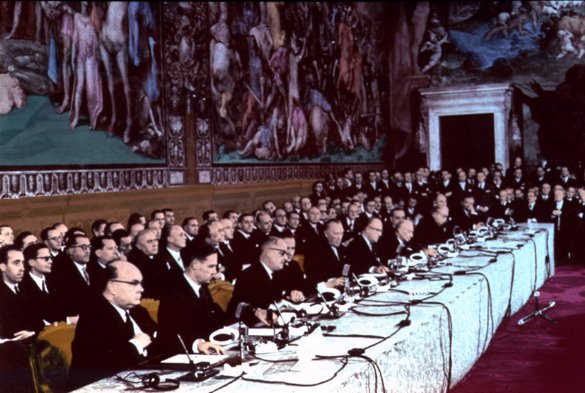
There have always been two competing visions of the EU. The first one is a classical liberal vision, led by German speaking Christian democrats Schuman (France), Adenauer (Germany) and Alcide de Gasperi (Italy) with the Treaty of Rome (1957) as the greatest achievement of this classical liberal vision for Europe. The Treaty sought to deliver the following four freedoms: free movement of goods, freedom of movement for workers, the right of establishment and freedom to provide services, and free movement of capital. The other vision was a socialist vision led by mainly French politicians, such as Jacques Delors and François Mitterrand whose goal was to create a supranational state.

Treaty of Rome signed
Treaty of Rome.

Classical liberal vision
The first vision promotes political competition between the EU’s member states by opening up borders. When a person is discontent with the excessive taxes in his country, he could leave his country for another. Competition between member states would lead to smaller governments, lower taxes, and political respect for people who would want to pursue their individual freedoms in another member state. It would represent a return to the political model that was prevalent in Europe from the Middle Ages to the 19th century when different political systems coexisted independently. There were independent cities or city states in Flanders, Germany and Northern Italy. There was the kingdom of Bavaria, the republic of Venice, and small city states like Ghent and Bruges embraced their autonomy. The German writer and poet Johann Wolfgang von Goethe (1749-1832) had expressed the beauty of such a political system as follows when he discussed a Germany that was still splintered in 39 independent states:

“I do not fear that Germany will not be united; … she is united, because the German Taler and Groschen have the same value throughout the entire Empire, and because my suitcase can pass through all thirty-six states without being opened. … Germany is united in the areas of weights and measures, trade and migration, and a hundred similar things. … One is mistaken, however, if one thinks that Germany’s unity should be expressed in the form of one large capital city, and that this great city might benefit the masses in the same way that it might benefit the development of a few outstanding individuals. … What makes Germany great is her admirable popular culture, which has penetrated all parts of the Empire evenly. And is it not the many different princely residences from whence this culture springs and which are its bearers and curators? … Germany has twenty universities strewn out across the entire Empire, more than one hundred public libraries, and a similar number of art collections and natural museums; for every prince wanted to attract such beauty and good. Gymnasia, and technical and industrial schools exist in abundance; indeed, there is hardly a German village without its own school. … Furthermore, look at the number of German theaters, which exceeds seventy. … The appreciation of music and song and their performance is nowhere as prevalent as in Germany, … Then think about cities such as Dresden, Munich, Stuttgart, Kassel, Braunschweig, Hannover, and similar ones; think about the energy that these cities represent; think about the effects they have on neighboring provinces, and ask yourself, if all of this would exist, if such cities had not been the residences of princes for a long time. … Frankfurt, Bremen, Hamburg, Lübeck are large and brilliant, and their impact on the prosperity of Germany is incalculable. Yet, would they remain what they are if they were to lose their independence and be incorporated as provincial cities into one great German Empire? I have reason to doubt this.”[1]

In addition to the advancement of political competition, the vision also promotes economic competition. A German employee would not be obstructed from working in France anymore, a Dutchman would not be taxed by the government if he transfers money from a Dutch to a Spanish bank or when he decides to buy stocks on the Italian equity market. Nobody would withhold a Belgian brewery from selling beer in other countries within the European free trade area.

Socialist vision
The second vision promotes a European central state that holds the power to enact more regulations, redistribution of wealth, and harmonization of legal systems within the whole Union. A strong central political body is to coordinate such efforts. The consequence is that its member states would increasingly have to give up their sovereignty. This is clearly visible from the political events in Greece and Ireland during the financial crisis of 2008 when Brussels demanded from Greece and Ireland how they should deal with their deficits and what austerity measures they should take. The socialist vision of Europe is an ideal for the political class, bureaucrats, interest groups and the subsidized sectors that want a powerful central state for their self-enrichment. Political competition among its member states, something that the classical liberals supported, should be eliminated. Doing so, Europe becomes less democratic and political power is increasingly shifted into the hands of bureaucrats and technocrats in Brussels. Historically, such plans for concentrated political power had been realized by such figures as Charlemagne, Napoleon and Hitler. The difference with our times is that the creation of a modern European superstate does not directly require military means. The introduction of new institutes like the European Central Bank, a common currency like the Euro, and extended power of the European Commission would suffice. Similar socialist intentions were already visible from the start of the European integration in the European vision of Jean Monnet, the intellectual father of the European community. Fearing an independent and emerging Germany after the second World War, an integration of Germany into Europe was considered to be a good thing. Next to that, the French wanted to have control over the Rühr area and they wanted to keep other vital German resources out of solely German hands. After losing her colonial powers in Indochina and Africa, the French ruling elite were also looking for new influence and pride which they eventually found in the European community.[2] The French premier in 1950 had for example proposed a plan to install a European army under the leadership of the French.

Why it is good for the Netherlands to leave the European Union
I believe that the EU should never have had more ambitions than the free trade zone that requires no supranational institutes, except for a European Court of Justice that is restricted to supervising conflicts between the member states and guaranteeing the four freedoms. The EU has become so far removed from the classical liberal vision of political and economic competition that it is not worthwhile anymore for the Netherlands to participate. It has declined into a malignant cartel of states that can tell its members with whom and how they should conduct their trade. A good example were the quotas and import levies on Chinese solar panels in 2013 under the disguise of ‘anti-dumping’ measures. Several countries like the Netherlands and Germany had first opposed to these measures as they would like to maintain good relationships with China. Nonetheless, the European Committee, apparently under influence of solar panel lobbyists like those of the German producer Solarworld AG, introduced ‘anti-dumping’ measures. The eventual winners of such measures are European solar panel producers and its victims are the European people that simply want to buy cheap solar panels. Another example are the sanctions that the EU had imposed on Russia since the Ukrainian conflict – a conflict that was provoked by American imperialists and NATO.[3] The deteriorating trade relationships between the EU and Russia is also detrimental to the wealth of ordinary European citizens. Another recent example is the prohibition of high-powered vacuum cleaners and possible future bans on other energy appliances such as kettles and hairdryers in order to reach environmental targets.[4] Those who profit from such measures are mainly large legacy organizations such as Bosch and Siemens that have enough capital to meet the strict EU regulations.

Another reason why a Nexit would be good for the Netherlands is that it offers an opportunity to extricate oneself from the Euro and the implicitly pledged financial aid when a future financial crisis will tear through Europe.

The tragedy of the Euro
The introduction of the Euro has proven to be a huge mistake, because it has enabled fiscally irresponsible governments of such countries like Portugal, Italy, Greece, Spain etc. to conduct unsustainable economic policies. In the past, when these states had their own currency, their governments had to finance their budget deficits through the sales of government bonds which resulted in higher government debts. The higher government debts manifested itself in higher interest rates on their government bonds, and a greater money supply would lead to devaluations of their currencies.

To illustrate how the process of government bonds financing works in the European Monetary Union, we could look at the development of 10-year government bonds. The graph below shows the interest rates that governments have to pay to the financiers of their 10-year government bonds from 1995 to 2011:

Development in Interest Rates on 10-year Government Bonds
Interest rates on 10-year government bonds from 1995-2011.

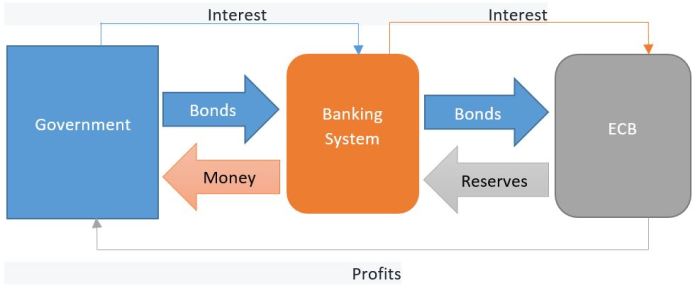
The y-axis represents the rates of interest that an investor receives from 10-year government bonds. Countries that are economically stronger and fiscally more conservative are rewarded with lower interest rates due to the smaller risk that these governments will not pay back their loans. In the case of Germany, a country with traditionally a stronger economy, a more conservative Bundesbank, and a fiscally more responsible government than many other European nations, investors received 7.5% interest on their 10-year government bonds in 1995. Greek government bonds had a yield of 18% in 1995. 1995 was the year in which the European Committee had announced that the Euro would arrive in 2002. Interest rates on government bonds consequently converged in the following years. At the end of 1997 all rates of interest on Portuguese, Irish, Spanish, Italian, French and German 10-year government bonds were more or less equal despite the fact that many of the governments of these countries still spent more than they received in tax incomes. The consequence of sharing a common currency with fiscally more responsible countries like Germany and the Netherlands is that fewer price signals in the form of higher interest rates on government bonds of fiscally irresponsible governments emerge. Irresponsible governments can issue government bonds to the banking sector that transfer these bonds as collateral to the ECB in return for loans. The interest rate that banks pay for the loans of the ECB are issued as profits to their governments. This is in short how ‘seigniorage’, the profits derived from money creation when the costs of money production and the distribution of money are lower than the value of money itself, is created.

Sovereign debt financing in EMU
Sovereign debt financing in the European Monetary Union.

This process leads to inflation, but the costs of inflation in the EMU are not solely borne by the respective country that issues the government bonds, but by all countries that participate in the EMU. A country like Spain can for example issue government bonds that traditionally would correspond with 10% inflation. However, when other countries like the Netherlands and Germany issue an amount of bonds that corresponds with 5% inflation, Spain benefits from seigniorage as the inflation created by Spain is higher and borne partly by the Netherlands and Germany. A Euro in this regard is beneficial for fiscally irresponsible governments. It is actually a “Tragedy of the commons”. Abusing the Euro in this way is exactly what countries like Portugal, Italy, Ireland, Greece, Spain and France have done. This works until a financial crisis shows how insolvent the governments of these countries actually are. That has happened in 2008, the moment when interest rates on European government bonds started diverging. The ECB had even decided to buy up Greek government debts in May 2010 in order to lower the interest rates on Greek government bonds. In June 2010, a temporary European Financial Stability Facility (EFSF) was founded with guarantees of up to €440 billion to combat the European sovereign debt crisis. It has provided financial assistance to Ireland, Portugal and Greece. The EFSF was later replaced by the European Stability Mechanism (ESM) in October 2012 with a total described capital of around €700 billion of which the Netherlands has pledged €40 billion in capital participation. The Dutch prime minister, Mark Rutte, had promised the Dutch in 2011 that the Netherlands would receive back the money it has loaned out to Greece in May 2010.[5] The total sum that was loaned to Greece by the Dutch was €3.2 billion. However, in 2012 when the Netherlands loaned out €14.5 billion of the second financial aid package of €130 billion that was pledged by Europe and the IMF to Greece, the Dutch minister of Finance, Jeroen Dijsselbloem, admitted that the Netherlands were losing money. Rutte also admitted that he could not guarantee that the Dutch loans to the Greeks would not be forgiven.[6] Three years later, on July 13 2015, the Netherlands loaned out another €22.6 billion to Greece.[7] It has become clear that such financial pledges of the Netherlands to fiscally irresponsible governments like that of Greece are not beneficial for the Dutch. Even in the long run it is not beneficial for the EU as it supports and prolongs a socialist European system that is deeply rotten to its core and destined to fail. What the EU needs is a radical return to decentralization and political competition.

The EU has become a sinking ship. It appears to me that the Netherlands should leave the Union as soon as possible. I do not see how Europe can maneuver itself safely through the next financial crisis that is at the point of breaking out as more banks are on the brink of collapse.[8] I also expect greater centralization of political power within the EU and a greater loss of individual member countries’ sovereignty. On June 27, 2016, the Polish media had reported that France and Germany were taking matters into their own hands and are using the Brexit to unveil their plan to morph the continent’s countries into one giant superstate. Under their radical proposals,

“EU countries will lose the right to have their own army, criminal law, taxation system or central bank, with all those powers being transferred to Brussels.”[9]

Conclusion
A sensible Netherlands would leave the European Union and the European Monetary Union in order to preserve political and economic sovereignty. They would have free trade agreements with all countries within and outside of the EU. EenVandaag, a popular Dutch TV programme, had published the results of their 27,000 large online poll on Sunday June 26, 2016 in which 54% of the Dutch would like to hold a referendum about the Netherlands’ participation in the EU. 48% of the poll wanted the Netherlands to leave the EU against 45% who would like to remain in the EU.[10] In the meantime, the Remain camp will continue their nauseating snobbery accusing the Leave camp of being racist, nationalistic, isolationist or simply ignorant.

References
Bagus, P. (2010). The Tragedy of the Euro.

BBC. (2016). EU referendum: The result in maps and charts.

China Courant. (2014). Mogelijk nieuwe straffen voor producenten Chinese zonnepanelen.

Dijkstra, M. (2015). Griekse crisis: wat heeft het allemaal gekost?

DutchNews.nl. (2016). Dutch PM rejects referendum calls: not in the Netherlands’ interest.

Fullfact.org. (2016). First they came for the vacuum cleaners: will it be kettles next?

Gutteridge, N. (2016). European SUPERSTATE to be unveiled: EU nations ‘to be morphed into one’ post-Brexit.

Hoppe, H.H. (2001). Democracy the god that failed.

Judt, T. (2006). Postwar: A History of Europe Since 1945.

McMurtry, J. (2016). Ukraine, America’s “Lebensraum”. Is Washington prepared to wage war on Russia?

NOS. (2011). Rutte verwacht Grieks geld terug.

NU.nl. (2012). Rutte geeft verbreken verkiezingsbelofte toe.

Zerohedge.com. (2016). Deutsche Bank tumbles near record lows as yield curve crashes.

Footnotes
[1] From Johann Peter Eckermann’s Conversations with Goethe (1836-1848).

[2] Tony Judt writes in Postwar: A History of Europe Since 1945 (2006) that “[U]nhappy and frustrated at being reduced to the least of the great powers, France had embarked upon a novel vocation as the initiator of a new Europe” (p. 153). He also writes that “[F]or Charles de Gaulle, the lesson of the twentieth century was that France could only hope to recover its lost glories by investing in the European project and shaping it into the service of French goals (p. 292).”

[3] See for example Prof. John McMurtry’s “Ukraine, America’s ‘Lebensraum’. Is Washington prepared to wage war on Russia?” for an analysis how Washington had provoked the Ukrainian conflict with Russia.

[4] See “First they came for the vacuum cleaners: will it be kettles next?”

[5] See “Rutte verwacht Grieks geld terug” (2011). http://nos.nl/artikel/275035-rutte-verwacht-grieks-geld-terug.html

[6] See “Rutte geeft verbreken verkiezingsbelofte toe” (2012). http://www.nu.nl/algemeen/2968363/rutte-geeft-verbreken-verkiezingsbelofte-toe.html

[7] See “Griekse crisis: wat heeft het ons allemaal gekost?” http://www.elsevier.nl/economie/article/2015/07/griekse-crisis-wat-heeft-het-ons-allemaal-gekost-2657386W/

[8] See for example “Deutsche Bank tumbles near record lows as yield curve crashes.” http://www.zerohedge.com/news/2016-06-13/deutsche-bank-tumbles-near-record-lows-yield-curve-crashes

[9] See “European SUPERSTAT to be unveiled: EU nations ‘to be morphed into one’ post-Brexit.” http://www.express.co.uk/news/politics/683739/EU-referendum-German-French-European-superstate-Brexit

[10] See “Dutch PM rejects referendum calls: not in the Netherlands’ interest.” http://www.dutchnews.nl/news/archives/2016/06/92520-2/

Black Women are not the most educated group in the United States

Several news media have published in the past weeks that Black Women are the most educated group in the United States or that they are the most educated according to race and gender. I decided to look into the statistics, ran some numbers, and found out that this is not the case. Black Women don’t perform as well as Caucasian and Asian Men and Women.

Here are examples of articles that wrongly claim that Black Women are the most educated group:

These media outlets have misrepresented the statistics from the National Center for Education Statistics and have misunderstood the report’s finding that

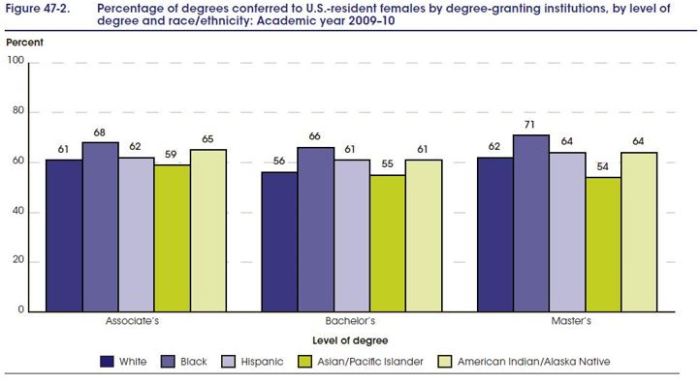
“From 1999–2000 to 2009–10, the percentage of degrees earned by females remained between approximately 60 and 62 percent for associate’s degrees and between 57 and 58 percent for bachelor’s degrees. In contrast, the percentages of both master’s and doctor’s degrees earned by females increased from 1999–2000 to 2009–10. Within each racial/ethnic group, women earned the majority of degrees at all levels in 2009–10. For example, among U.S. residents, Black females earned 68 percent of associate’s degrees, 66 percent of bachelor’s degrees, 71 percent of master’s degrees, and 65 percent of all doctor’s degrees awarded to Black students.”

From this, they conclude that Black Women are therefore necessarily the most educated group. What it shows however, is not that Black Women are the most educated, but that they have the highest proportion of graduates in comparison to their male counterparts by race. See here the data from the NCES:

Degrees conferred to Black Women
Table 1: Number of degrees conferred to females.

The data shows the following:

  • of the total Black population with an Associate Degree, 68% are female and 32% are male;
  • of the total Black population with a Bachelor’s Degree, 66% are female and 34% are male;
  • of the total Black population with a Master’s Degree, 71% are female and 29% are male;
  • of the total Black population with a Doctor’s Degree, 65% are female and 35% are male.

These findings indicate that Black Women have been much more successful in their educational endeavors in comparison to Black Men, but tell us nothing about the educational performances of Black Women compared to those of other or similar sexes of other races.

What is striking about the statistics of the NCES is that women far outperform men for all races. This graph is a clear depiction of that finding:

Degrees conferred to females
Table 2: Degrees conferred to females.

We can therefore conclude that women are more successful in obtaining degrees in Higher Education than men, but the gender gap is nowhere as wide for other races than for Blacks.

In order to have more insights in how well educated Black Women are compared to other groups, I have looked at statistics from the NCES on the educational level of people that are 25-29 years old:

Bachelor's degrees or higher for people ages 25-29 by race
Table 3: Bachelor’s degree or higher conferred by race.

According to the NCES, 60.1% of Asians aged 25-29 have at least a Bachelor’s Degree. Hispanics are the lowest performing group with 15.7%. Blacks have 20.5% and Whites 40.4%. Since the obtainment of Bachelor’s Degrees decreases the obtainment of Associate Degrees, it is more meaningful to look at the percentages of Bachelor’s Degrees or higher than to the percentages of conferred Associate Degrees. This graph however, has not specified the proportion of degree holders by gender. To approximate the degree holding male-female proportion, I have looked at table 1.

I have not found statistics that indicate the proportion of exclusively Asian degree holders by sex in Higher Education so I will make the assumption that the percentage of conferrals to Asian Women among the Asian population is approximately the same as that for Asian/Pacific Islander Women at around 55%. Hence, among the Asian group of which 60.1% aged 25-29 hold a Bachelor’s degree or higher, 55% are female: 33% of the total Asian population is female and holds a Bachelor’s degree or higher. 20.5% of Blacks aged 25-29 hold a Bachelor’s degree or higher of which around 68% is female. This means that around 14% of the total Black population is female and holds a Bachelor’s degree or higher. We can thus conclude that Asian Women perform much better educationally than Black Women with a ratio of almost 2:5.

How do Black Women perform in comparison to White Women? If we say that around 58% – this may not be entirely accurate, but from the NCES statistics it is reasonable to assume this number – of Bachelor’s Degrees and higher conferred to Whites are conferred to Women, we can assert that approximately 23% aged 25-29 of the total white population that have obtained these degrees are Women. According to my calculation, White Women thus perform far better than Black Women as well.

What if you would compare Black Women with Asian Men? According to my calculation, around 27% of all Bachelor’s Degrees and higher that have been conferred to the Asian population were conferred to Asian Men. Asian Men hence outperform Black Women with an approximate ratio of 1:2.

If you would compare Black Women with White Men, we can find that around 17.4% of the white population aged 25-29 that have obtained a Bachelor’s Degrees or higher are Men. This again is higher than the 14% of Black Women.

You can find a clear overview of my findings in the following table:

Group by gender and race Percentage holding Bachelor’s or higher degree w.r.t. their race
Black Men 7%
Black Women 14%
White Men 17%
White Women 23%
Asian Men 27%
Asian Women 33%

Conclusion
Black Women are by far not the most educated group within the United States. According to my calculations Black Women proportionally hold fewer Bachelor’s Degrees or higher compared to White Men, White Women, Asian Men, and Asian Women. An Asian Woman aged 25-29 is almost 2.5 times more likely to hold a Bachelor’s Degree or higher than a Black Woman aged 25-29. An Asian Man is almost 2 times more likely to hold a Bachelor’s Degree or higher. White Women more than 1.5 times more likely. I have not included Hispanics into my calculations, but I can see in one glance that Black Women do perform better than female and male Hispanics. Comparing Black Men with Asian Women, I find it shocking that an Asian Woman is almost 5 times more likely to hold a Bachelor’s Degree or higher than a Black Man.

I find it a shame that many news media have misinterpreted the data from the NCES and have spread the untruth that Black Women are the most educated group in the United States. Lastly, I would like to add that in order to gain more insights in how much better educated a group is we should also look into the type and quality of the courses and universities where these degrees were conferred. This is something I have not looked into.

References
Black Women Are Now The Most Educated Group In The U.S.
National Center for Education Statistics
Report: Black Women Have Become The Most Educated Group In The U.S.
Study: Black Women Most Educated in U.S.

The Case for the UK staying in the EU

Leaving the European Union would not be a gain for liberty in the United Kingdom. This is true as a matter of general principles and is reinforced by the nature of the Leave campaign which has targeted sections of the population hostile to immigration, open markets, and free trade. Much of the Leave campaigning which has not appealed to such base arguments has at the very least appealed to a version of populist democratic sovereignty at odds with the restraints on government and the state at the heart of classical liberal and libertarian thought.

Even if we try to separate some pure classical liberal version of the Leave campaign from the crudity of the campaign, as some natural supporters of leave wish had happened to the extent they ate voting for Remain rather than go along with such an obnoxious campaign, we are still left with the question of why it liberty advocates should support Leave.

I have sometimes seen references to national sovereignty as a classical liberal doctrine. If this means never sharing sovereignty at a transnational level, then it is simply a false claim. Immanuel Kant advocated a world federation to prevent war. Kant is not often put at the centre of the history of classical liberal thought. His ideas about political institutions, individual rights, and the limits of government certainly belong in the classical liberal sphere. We should distinguish between what Kant said and what later German Idealists said, a rather big issue, and appreciate how close he is to the way of thinking of Montesquieu and Smith and even advances upon them in showing a clearer understanding of the role of representative assemblies in modern politics.

More recently F.A. Hayek advocated federation between liberal democracies. The creation and evolution of the European Union has been and continues to be supported by European political parties of a classical liberal persuasion, those liberal parties which remained most true to the principles of their nineteenth century founders and precursors. Thinkers on the left, like Albert Camus and George Orwell, known for their particular commitment to liberty and their opposition to an authoritarian state were enthusiasts for European integration. Many conservatives of the more free market and limited government sort like Ludwig Erhard (founder of Germany’s post-war, post-Nazi market economy) and John Major (UK Prime Minister from 1990 to 1997, who went further than Margaret Thatcher in privatisation and deregulation) have been and are advocates of the European Union.

The unrestrained sovereignty of the nation-state is not only not an inherently liberal idea, it is dangerous to liberalism. There is nothing illiberal in transnational rules and institutions that restrain states from violence against their own citizens, attacks on individual rights, economic protectionism, and market rigging. The European Union is particularly successful with regard to the economic and market issues at the national level.  It adds huge institutional weight to the work of the Council of Europe which promotes human rights through its court in Strasbourg. The existence of the European Court of Justice is of profound importance in ensuring that national governments and peoples are accustomed to regarding the decisions of nation states as subordinate to and accountable to a judicial process enforcing transnational laws.

The EU is open to a great deal of criticism with regard to its tendencies towards over-regulation, but this represents the median attitude of the member governments, not an imposition on the nation-states of Europe. Since the UK economy is at the more free market deregulated end of the European Union, there is some plausibility in saying the UK might go further down that road if it left the EU. However, before it joined the EU it was looking less market oriented than the EU states of the time. The period during which the UK has moved from the more statist to the more limited state end of the European nations has been during the period of EU membership. The precedents do not favour the UK becoming more classically liberal because it leaves the EU and the Leave campaign has appealed to the most insular, nationalist, anti-immigrant, anti-foreigner, and anti-free trade sections of the UK population.

It is possible to imagine the UK as a more libertarian kind of place in the EU, but a much more plausible use of the liberal imagination is to think of ways in which the UK can work with allies in the EU for a a less regulatory and centralised EU. This has already worked as in the adoption of the European Single Market and the diminishing role of the European Commission, the ‘bureaucratic’ part of the EU. The Commission employs as many bureaucrats as the larger local government units in the UK and is tiny compared with any national bureaucracy. Its members are nominated by national governments subject to confirmation of the European Parliament. Power has shifted from the Commission to the bodies in which national government representatives meet, the European Council and the Council of the European Union.

The Leave campaign in the UK, including self-styled free marketers in the Conservative Party, is committed to leave the Single Market as well as the European Union itself, in large part to terminate free movement of EU citizens across its borders. The reasoning offered to prevent this movement of human capital is in terms of anti-foreigner sentiment. This is not something than can be recognised as a pro-liberty program. The pro-liberty choice is to keep free movement of goods, investment, and labour within the EU while working to reform the more interventionist tendencies of the European Union, to stymie the regulatory drift which started hitting industrial market economies decades before the EU was created and which cannot be solved by smashing up the EU.

Group Privileges No, Detriments Yes

The concept of “privilege” has become common in political discourse, while the term “detriment” is seldom used. One incurs a detriment, and is detrimented, when one is harmed, offended, displeased, or disadvantaged, unrelated to merit. One obtains a privilege, and is privileged, when a person or group is advantaged, benefitted, pleased, or favored relative to other groups, when the gain is unrelated to merit.

Some socialists emphasize “white privilege.” Suppose a white man is able to walk down a street without being harassed, while a black man will be stopped and questioned by the police. The socialist will say that the white man is privileged in being free of harassment. But actually, the ability of an innocent person to walk without being stopped and frisked is a natural right, not a special favor. The black man has suffered a violation of his natural rights, a detriment not suffered by the white man.

The socialist will also claim that there is “male privilege.” Suppose a man can walk down the street in peace, while a woman walking down the same street will be whistled at, aggressively approached, and may even be physically attacked. Does the man have a privilege? No, one has a natural right to be free of aggression. The woman suffers a violation of her rights, a detriment.

Women suffer many detriments because of social custom and culture, rather than governmental law. Wives tend to do more household work, even when they are working for wages as many hours as the husband. In some fields of work, men have more prestige and authority, unrelated to merit. The culture is not so much giving males privileges as it imposes on women various detriments.

Some detriments are mandated by law. In most places in the US, men are free to remove their shirts, while a bare-breasted woman would get arrested. The men do not have a privilege; the women have a legal detriment.

Female detriments can become tragic in cultures where male children are preferred. A boy is not privileged by not being aborted or killed. Rather, the girls suffer a lethal detriment. In my judgment, more progress can be made to stop this anti-female bias by calling it a detriment rather than saying the boys are privileged. Boys as well as girls have a right to not be murdered.

Female detriments have been lethal in India, where rape and violence has made headlines. But there is substantial rape in the US and throughout the world, which clearly makes being female a detriment in much of the world.

The trouble with saying there is a male privilege is that men do not feel privileged by not being attacked or disfavored. It should be normal to be left in peace, and to be respected. By identifying the problem as a detriment, we can then raise more awareness and support for remedies. We can also then better deal with the real privileges, favors to those who get subsidies from government because of political clout.

The language of privilege versus detriments influences policy. “Privilege” implies special favors that should be removed. “Detriment” implies harms and disadvantages that should be stopped. For the problem of infanticide, for example, it is not that privileged boys should be killed in an equal ratio, but that girls should not be murdered for being female.

Let’s speak less of racial and gender privilege, and more of detriments!

Muddy thinking on child care

Five Thirty Eight had a disappointing discussion of an interesting issue: the cost of child care for working parents. The basic issue is that kids are expensive in time and money. Unfortunately, the discussion mostly revolved around questions of how to engage in economic engineering by government in order to expand access to child care and parental leave.

The hosts see these policies as having costs and benefits, and they see the value in studying alternatives empirically, but they miss an important issue: providing these sorts of goods doesn’t require screwing up markets by adding an extra layer of complexity to the tax code. If these goods are worth providing (that’s another couple of cans of worms) then just give money to new parents. Better yet, move to a basic income guarantee.

Another important point they miss is that if some good is difficult to get, it’s worth figuring out what to do about the root problem rather than just throwing money at the issue and hoping someone will figure out the important stuff later.

Rick solves the gun crisis

My best (uninformed) reading of the data is that gun ownership is slightly positively correlated with successful suicide attempts but little else, and that sounds about right to me. I’ve met (other) gun owners, and for the most part they aren’t likely to turn into Rambo in an emergency situation just because they’ve got a sweet gun.

But the 30 seconds of Facebook commentary on this last event before I had to close the tab led me to a revelation. I’ve said before that there’s no such thing as no gun control. Throw that together with the notion that government is a monopoly on coercion, and you’ve got my recent insight: a liberalized gun policy is equivalent to deputizing just about everyone.

Frankly, if I threw a Nerf ball into a crowd, I wouldn’t be likely to hit someone who should own a gun, but I also wouldn’t hit someone who should vote. (That hypothetical person’s vote would probably do more harm than their gun.) And that responsibility problem is similar in both cases. Everyone should have a right to vote and own a gun, but both rights should come with a heavy responsibility.

I can imagine a universe where the bouncers are armed and deputized as a routine matter. And I think that in such a world it would be relatively easy to have a liberalized 2nd amendment combined with a cultural understanding that a gun is a powerful tool to be wielded carefully rather than an entitlement.

The Right would do well to focus on their strong point here: responsibility is key. And the Left as well: barbaric intolerance is bad. Both sides confuse amoral tools with moral judgments.

Would a Universal Basic Income Increase Poverty?

Switzerland has recently overwhelming voted against a proposal that would establish a universal income guarantee (sometimes called a “basic income guarantee” or the similar Friedman-influenced “negative income tax”[1]). Though I myself am a supporter of BIG as a nth best policy alternative for pragmatic reasons,[2] I’m unsure if I myself would have voted for this specific policy proposal due to the lack of specifics. A basic income is only as good as the welfare regime surrounding it (which preferably would be very limited) and the tax system that funds it.[3] However, the surprising degree of unpopularity of the proposal—with 76.9% voting against—was quite surprising.

The Swiss vote has renewed debate in the more wonkish press and blogosphere, as well as in think tanks, about the merits and defects of a Basic Income Guarantee here in the States. For example, Robert Goldstein of the Center on Budget Policy and Priorities[4] has a piece arguing that a BIG would increase poverty if implemented as a replacement for the current welfare state. His argument covers three points:

  1. A BIG would be extremely costly to the point of being impossible to fund.
  2. A BIG would increase the poverty rate by replacing current welfare programs like Medicaid and SNAP.
  3. A universal welfare program like a BIG—as opposed to means-tested programs—is politically impossible right now due to its unpopularity.

For this post, I’ll analyze Goldstein’s arguments in detail. Overall, I do not find his arguments against a BIG convincing at all.

The Political Impossibility of a BIG

Goldstein writes:

Some UBI supporters stress that it would be universal.  One often hears that means-tested programs eventually get crushed politically while universal programs do well.  But the evidence doesn’t support that belief.  While cash aid for poor people who aren’t working has fared poorly politically, means-tested programs as a whole have done well.  Recent decades have witnessed large expansions of SNAP, Medicaid, the EITC, and other programs.

If anything, means-tested programs have fared somewhat better than universal programs in the last several decades.  Since 1980, policymakers in Washington and in a number of states have cut unemployment insurance, contributing to a substantial decline in the share of jobless Americans — now below 30 percent — who receive unemployment benefits.  In addition, the 1983 Social Security deal raised the program’s retirement age from 65 to 67, ultimately generating a 14 percent benefit cut for all beneficiaries, regardless of the age at which someone begins drawing benefits.  Meanwhile, means-tested benefits overall have substantially expanded despite periodic attacks from the right.  The most recent expansion occurred in December when policymakers made permanent significant expansions of the EITC and the low-income part of the Child Tax Credit that were due to expire after 2017.

In recent decades, conservatives generally have been more willing to accept expansions of means-tested programs than universal ones, largely due to the substantially lower costs they carry (which means they exert less pressure on total government spending and taxes).

I agree that Goldstein is right on this point: universal welfare programs are extremely unpopular right now, like the Swiss vote shows. I imagine that if a proposal were on the ballot in the States the outcome would be similar.[5] However, this is no argument against a Basic Income. Advocating politically unpopular though morally and economically superior policies is precisely the role academics and think tank wonks like Goldstein should take.

If something is outside the Overton Window of Political Possibilities, it won’t necessarily be so in the future if policymakers can make the case for it effectively to voters and the “second-hand dealer of ideas” in think tanks and academia get their ideas “in the air,” so to speak.[6] It wasn’t that long ago that immigration reform or healthcare reform seemed politically impossible due to its unpopularity, yet the ladder has popular support and the former was actually accomplished.[7]

If anything, the unpopularity of a BIG is precisely why people like Goldstein should advocate for the policy.

The Fiscal Costs of Funding a Basic Income Guarantee

Goldstein points out, rightly, that a Basic Income Guarantee would be extremely expensive:

There are over 300 million Americans today.  Suppose UBI provided everyone with $10,000 a year.  That would cost more than $3 trillion a year — and $30 trillion to $40 trillion over ten years.

This single-year figure equals more than three-fourths of the entire yearly federal budget — and double the entire budget outside Social Security, Medicare, defense, and interest payments.  It’s also equal to close to 100 percent of all tax revenue the federal government collects.

Or, consider UBI that gives everyone $5,000 a year.  That would provide income equal to about two-fifths of the poverty line for an individual (which is a projected $12,700 in 2016) and less than the poverty line for a family of four ($24,800).  But it would cost as much as the entire federal budget outside Social Security, Medicare, defense, and interest payments.

Where would the money to finance such a large expenditure come from?  That it would come mainly or entirely from new taxes isn’t plausible.  We’ll already need substantial new revenues in the coming decades to help keep Social Security and Medicare solvent and avoid large benefit cuts in them.  We’ll need further tax increases to help repair a crumbling infrastructure that will otherwise impede economic growth.  And if we want to create more opportunity and reduce racial and other barriers and inequities, we’ll also need to raise new revenues to invest more in areas like pre-school education, child care, college affordability, and revitalizing segregated inner-city communities.

Of course, Goldstein is right that a BIG would be fairly expensive and we are already having serious issues funding our existing welfare state. However, he grossly oversells the difficulty in funding it. In particular, it is not necessary to raise taxes to pay for it or for current welfare expenditures.

Goldstein likely gets the $10,000 figure from Charles Murray’s proposal for a BIG. Personally, I’m no fan of Murray’s proposal as it goes too far and he proposes financing it by increasing payroll taxes, which are economically inefficient. However, let’s assume that the relevant proposal is around $7,000 dollars.[8] Multiplying that by the US population of 320 million makes for a total cost $2.24 trillion per year.[9] This could be paid for by using the BIG to replace the following current welfare programs and cutting discretionary spending:[10]

  1. $65.32 billion annually in discretionary spending on Veteran’s benefits
  2. $66.03 billion in discretionary spending on Medicare and other healthcare benefits
  3. $69.98 billion in discretionary spending for education.[11]
  4. $13.13 billion in discretionary spending for food and agriculture (eg., SNAP).[12]
  5. $1.25 trillion in mandatory spending for Social Security.[13]
  6. $985.74 billion in mandatory spending for Medicare and Healthcare.
  7. $95.3 billion in mandatory spending for veteran’s benefits.[14]

Spending a UBI Could Replace

That’s a total of $2.542 trillion in savings annually, more than enough to fund the proposed BIG with another $300.3 billion to spare that could be used for tax credits for low-income households to use on healthcare,[15] education,[16] retirement,[17] and/or basic necessities like food.[18] Funding the program would be a huge challenge, but it is possible to do it without tax increases.

Additionally, Goldstein ignores the fact that similar proposals, such as Friedman’s negative income tax, would have a much lower cost while having a similar effect. The Niskanen Center’s Samuel Hammond has estimated that a NIT could cost only $182 billion annually.[19] From Hammond’s analysis:

Just how much of a cost difference is there between a UBI and NIT? To get a rough idea, I used the Census population survey’s Annual Social and Economic Supplement, which has the distribution of individuals over the age of 15 by income level in $2,500 intervals (I subtracted retirees). I then calculated the transfer each quantile would receive based on a hypothetical NIT which starts at $5,000 for individuals with zero income and is phased out at a rate of 30%. Multiplying the average transfer by the number of actual individuals in each grouping and summing, I arrived at total cost of $182 billion—roughly the combined budget for SSI, SNAP and EITC.

The Effect of Replacing Welfare with a BIG on Poverty

Goldstein would object to my line of reasoning by saying cutting all that spending would harm the poor and increase the poverty rate. He says as much in his piece:

UBI’s daunting financing challenges raise fundamental questions about its political feasibility, both now and in coming decades.  Proponents often speak of an emerging left-right coalition to support it.  But consider what UBI’s supporters on the right advocate.  They generally propose UBI as a replacement for the current “welfare state.”  That is, they would finance UBI by eliminating all or most programs for people with low or modest incomes.

….Yet that’s the platform on which the (limited) support for UBI on the right largely rests.  It entails abolishing programs from SNAP (food stamps), which largely eliminated the severe child malnutrition found in parts of the Southern “black belt” and Appalachia in the late 1960s, the Earned Income Tax Credit (EITC), Section 8 rental vouchers, Medicaid, Head Start, child care assistance, and many others.  These programs lift tens of millions of people, including millions of children, out of poverty each year and make tens of millions more less poor.

Some UBI proponents may argue that by ending current programs, we’d reap large administrative savings that we could convert into UBI payments.  But that’s mistaken.  For the major means-tested programs — SNAP, Medicaid, the EITC, housing vouchers, Supplemental Security Income (SSI), and school meals — administrative costs consume only 1 to 9 percent of program resources, as a CBPP analysis explains.  Their funding goes overwhelmingly to boost the incomes and purchasing power of low-income families.[20]

Moreover, as the Roosevelt Institute’s Mike Konczal has noted, eliminating Medicaid, SNAP, the EITC, housing vouchers, and the like would still leave you far short of what’s needed to finance a meaningful UBI.  Would we also end Pell Grants that help low-income students afford college?  Would we terminate support for children in foster care, for mental health, and for job training services?

This is by far and away the weakest part of Goldstein’s argument.

First of all, as my analysis above showed, Konczal’s and Goldstein’s idea that eliminating the current welfare state “would still leave you far short of what’s needed to finance a meaningful UBI” is just false. Even a relatively robust UBI of $7,000 a year is doable by significantly cutting current welfare programs.

But more importantly, Goldstein’s assertion that replacing the welfare state with a UBI would increase poverty is fully unwarranted. He seems to take a ridiculously unsophisticated idea that “more means-tested programs immediately reduce welfare.” His assertion that the programs in question “lift tens of millions of people, including millions of children, out of poverty each year and make tens of millions more less poor” is, at best, completely erroneous. For three reasons: first, individuals know better what they need to lift themselves out of the than the government, and these programs assume the opposite. Second, the structure of status quo means-tested programs often creates a “poverty trap” which incentivizes households to remain below the poverty line. Finally, thanks to these first two theoretical reasons, the empirical evidence on the success of the status-quo programs in terms of reducing the poverty rate is, at best, mixed.

The way our current welfare state is structured is it allocates how much money can go to what basic necessities for welfare recipients. So if a household gets $10,000 in welfare a year, the government mandates that, say, $3,000 goes to food, $3,000 goes to healthcare, $3,000 goes to education, and $1,000 goes to retirement.[21] This essentially assumes that all individuals and households have the same needs; but this is simply not the case, elderly people may need more money for healthcare and less for education, younger people may need the exact opposite, and poorer families with children may need more for food and education than other needs. It’s almost as if our current welfare system assumes interpersonal utility function comparisons are possible, or utility functions of poorer people are fairly homogenous but they’re not. It also ignores the opportunity cost of the funding for helping individuals and households out of funding; a dollar spent on healthcare may be more effectively spent on food for a particular individual or household.

In sum, there’s a knowledge problem involved in our current welfare policy to combat poverty: the government cannot know the needs of impoverished individuals, and such knowledge is largely dispersed, tacit, and possessed by the individuals themselves. The chief merit of a UBI is, rather than telling poor people what they can spend their welfare on, it just gives them the money and lets them spend it as they need.

Second, universal programs are superior to means tested programs precisely because the amount of transfer payments received does not decrease as income increases. Our current welfare programs too often make the marginal cost of earning an additional dollar, above a certain threshold, higher than the benefits because transfer payments are cut-off at that threshold. This actually perversely incentivizes households to remain in poverty.[22] For example, the Illinois Policy Institute while analyzing welfare in Illinois found the following:

A single mom has the most resources available to her family when she works full time at a wage of $8.25 to $12 an hour. Disturbingly, taking a pay increase to $18 an hour can leave her with about one-third fewer total resources (net income and government benefits). In order to make work “pay” again, she would need an hourly wage of $38 to mitigate the impact of lost benefits and higher taxes.

SingleMomWelfareCliffChart

Or consider this chart (shown above) from the Pennsylvania Department of Public Welfare showing the same effect in Pennsylvania

UBI does not suffer from this effect. If your income goes up, you do not lose benefits and so there are no perverse incentives at work here. Ed Dolan has analyzed how the current welfare state with its means-tested benefits is worse in terms of incentivizing work and alleviating poverty extensively. Here’s a slice of his analysis:

P140810-11

The horizontal axis in Figure 1 represents earned income while the vertical axis shows disposable income, that is, earned income plus benefits. To keep things simple, we will assume no income or payroll taxes on earned income—an assumption that I will briefly return to near the end of the post. The dashed 45o line shows that earned and disposable income are the same when there are no taxes or income support. The solid red line shows the relationship between disposable and earned income with the MTIS policy.

This generic MTIS policy has three features:

A minimum guaranteed income, G, that households receive if they have no earned income at all.

A benefit reduction rate (or effective marginal tax rate), t, indicted by the angle between the 45o line and the red MTIS schedule. The fact that t is greater than zero is what we mean when we say that the program is means tested. As the figure is drawn, t = .75, that is, benefits are reduced by 75 cents for each dollar earned.

A break-even income level, beyond which benefits stop. Past that point, earned income equals disposable income.

When these two factors are taken into account (that individuals know better than the government what they need to get out of poverty and there are significant poverty traps in our welfare state), it is no surprised that the empirical evidence on the effectiveness of these anti-poverty programs is far less rosy than Goldstein seem to think.

After reviewing the empirical literature on the relationship between income and welfare improvements for impoverished households, Columbia University’s Jane Waldfogel concluded “we cannot be certain whether and how much child outcomes could be improved by transferring income to low income families.” The Cato Institute’s Michael Tanner wrote in 2006:

Yet, last year, the federal government spent more than $477 billion on some 50 different programs to fight poverty. That amounts to $12,892 for every poor man, woman, and child in this country. And it does not even begin to count welfare spending by state and local governments. For all the talk about Republican budget cuts, spending on these social programs has increased an inflation-adjusted 22 percent since President Bush took office.

Despite this government largesse, 37 million Americans continue to live in poverty. In fact, despite nearly $9 trillion in total welfare spending since Lyndon Johnson declared War on Poverty in 1964, the poverty rate is perilously close to where it was when we began, more than 40 years ago.

Tanner’s point remains true today. The chart below shows that, despite a massive increase in anti-poverty spending since the war on poverty was declared under Johnson’s “Great Society,” Poverty rates have remained woefully stagnant. In fact, the reduction in poverty that was occurring prior to Johnson’s interventions stopped soon thereafter.

US Poverty Spending

Also, the point is that UBI is a replacement for current welfare benefits. Most households probably would not see a decrease in amount of benefits under a UBI, depending on the specifics of the proposal, and some might even see an increase, contrary to Goldstein’s analysis. Further, they’d be able to actually spend this on what they know they need rather than what government bureaucrats thin they need.

UBI lacks the flaws of the current welfare state, and would likely decrease poverty far more effectively than Goldstein thinks, especially when compared to his favored status-quo.

[1] Though there are some technical differences between Milton Friedman’s proposal for a “negative income tax” and most Basic Income Guarantee proposals, they essentially have the same effect on income. See the Adam Smith Institute’s Sam Bowmen on this point.

[2] See Matt Zwolinski for the “Pragmatic Libertarian Case for a Basic Income,” it should be noted that “pragmatic reasons” here does not refer to my pragmatist philosophical views. Zwolinski has also made a moral case for the basic income on Hayekian grounds that a BIG could reduce coercion in labor negations. I am unsure to what extent I am convinced by this line of reasoning, but it is a valid argument nonetheless.

[3] The Niskanen Center’s Samuel Hammond has made the case that universal transfer programs like a Basic Income cannot be analyzed outside of the tax system that pays for it.”

[4] Or, as my think tank buddies jokingly call it, the “Center for Bigger Budgets.”

[5] Having said that, polls have shown that it is popular across the pond in the Eurozone. The Swiss proposal would call into question this point but it could be argued that the vagueness of the Swiss proposal is why it was turned down not necessarily the spirit of it.

[6] My colleague Ty Hicks of Students for Liberty has made this point well. See also Hayek’s “Intellectuals and Socialism.”

[7] Granted, the Affordable Care Act was not really what most on the left or the right wanted in the first place and has been a disaster.

[8] This number is selected because, according to the CBO, $9,000 is the average amount in means-tested welfare benefits per household for 2006. But that’s for households and a BIG discussed here is for individuals, so it is understandable to make a BIG slightly less than the current average. Goldstein would object that this is far below the poverty line, but BIG is not meant to be a replacement for total income on the labor market at all, so it is unclear why this is an objection in the first place.

[9] This is admittedly a crude and naïve calculation but it is virtually identical to the method Goldstein himself uses to estimate the cost.

[10] All figures for this section are for the 2015 budget and are taken from here.

[11] Goldstein is sure not to be happy with cutting education, and I myself would like to replace this spending with few-strings-attached funding for local education or private school tax vouchers. I’ll address this point more later in this piece.

[12] Much of this is food stamps, which would be rendered obsolete by a BIG anyways. Goldstein would object, more on that in the next section.

[13] Not all of this could be cut, and there would be legal and detailed nuances on how to treat financial obligations for Social Security, veteran’s benefits, and Medicare. The specific legal complexities of mandatory welfare spending are not my areas of expertise, admittedly, and is outside the scope of this paper. I’m just illustrating that it is possible to cut at least some of this spending, perhaps even the majority of it, to fund it.

[14] Many people would object to cutting veterans benefits. First of all, BIG could act in place of these benefits

[15] I have in mind expanding tax-exempt Health Savings Accounts here. I also think funding this by eliminating the employer-based deduction would be a step in the right direction and reduce cost fragmentation in the healthcare market, as Milton Freidman argued.

[16] I have in mind a private school taxpayer voucher system like what is in Sweden.

[17] I have in mind something similar to this proposal to reform social security from the Cato Institute.

[18] I have in mind something like the pre-bates proposed in the Fair Tax.

[19] For this reason, I prefer an NIT to a BIG, but I prefer both to our current welfare state.

[20] This point is Ironic considering the fact that CBPP’s own research shows that government benefits in America overwhelmingly goes to households above the poverty line, in the middle and upper classes. See this chart (source):

1-SOlzSwsxa08Cno7PiQ9R7A

[21] The real-world numbers are probably different and vary a little bit from household to household, but this is just a hypothetical to illustrate a more general point.

[22] It should be noted, however, that the EITC, and some other programs, is largely free of this defect. This is because the EITC itself is modeled after Friedman’s NIT.

Note: The first chart has been edited since this was initially posted for readability.

The Moral Worth of Chloe Kardashian

Like many pack animals, I judge the hell out of the idiots surrounding me. It’s impossible not to have immediate gut reactions when we see our neighbors making stupid decisions; our brains are hard-wired to be nervous about how wisely our tribe used scarce survival resources. And let’s face it, it’s fun to make fun of doofuses in vinyl wrapped electric Hummers.

A couple semesters ago I asked my class for examples of useless things and landed on tabloid articles about Chloe Kardashian. Surely that’s one thing our economy can save some cash on without any real harm.

But it’s not so simple. Nobody is being forced to print those rags which means someone (bless their hearts) wants to read about Chloe Kardashian. And they want it enough that they’re willing to work for it.

If you set up an amateur print shop in your basement and made up a bunch of celebrities to gossip about as a hobby, nobody would have any reason to stop you. We may agree that your hobby is silly, but if you can’t have a silly hobby, then what’s the point of it all?!

When people buy those magazines at the check out counter, they’re putting their own effort into making up celebrities to gossip about, the difference is they don’t have to put in so much time and the production value is higher because of gains from trade.

Even silly things have moral worth when they exist because of people’s voluntary choices. We should all be more hesitant to ban behaviors we don’t understand.

Where did Homo Economicus come from?

Over on my Facebook page, I posted a short criticism of both neoclassical and behavioral economic scholarship on rational choice (drawing from a paper I’m working on exploring that topic). Stated a bit polemically,  though homo economicus has largely been dead in neoclassical theory, his spirit still haunts the work of most modern neoclassical scholars. Likewise, though behavioral economists are trying to dig the grave and put the final nails in the coffin of homo economicus, their nightmares are still plagued with the anxieties of his memory.

This led a former colleague from Hillsdale to ask me where I thought homo economicus came from historically. I wrote the following in response (lightly edited for this post):

It could be argued, in a sense, that the protestant Christian aim to complete moral purity and the Enlightenment aim to make man perfect in knowledge in morality (as embodied in Franklin’s virtue ethics) helped give rise to a culture that would be primed for such a model. Within economics, historically it comes from Bentham’s utilitarianism and Jevon’s mathematical extrapolations from Bentham’s psychology. However, I’d say this comes from a deeper “Cartesian anxiety” in Bernstein’s use of the term to make economic a big-T True, capital-C Certain, capital-S Science just like physics (which Jevon’s himself stated was an aim of his work,[1] and has preoccupied economists since the days of JS Mill). If economic science cannot be said to be completely positive and “scientific” like the natural sciences with absolutely falsifiable propositions and an algorithmic means of theory-choice, it is feared, it must be written off as a pseudo-scientific waste of time or else ideology to justify capitalism. If economics cannot make certain claims to knowledge, it must be solipsist and relativist and, again, be another form of pseudo-science or ideology. If economic models cannot reach definitive mathematical results, then they must be relativistic and a waste of time. This is just another example of the extreme Cartesian/Katian/Platonic (in Rorty’s use of the term) either/or: objectivity OR relativism, science OR nonscience, determinate mathematical solutions OR ideological emotional bickering. Homo economicus was erected as a means to be an epistemic foundation to solve all these anxieties and either/ors.

Of course, as any good Deweyan, I think all these either/ors are nonsense. Their understanding of science, as revealed through the so-called “growth of knowledge” literature in postempiricist philosophy of science (ie., the work of Thomas Kuhn, Lakotos, Karl Popper, Paul Feyerabend, Michael Polanyi, Richard Bernstein, Richard Rorty, etc.) has shown that this positivist conception of science, that is science consists of algorithmic theory choice selected based off correspondence with theory-free, brute “facts” of the “external world,” is woefully inaccurate. Dialogical Aristotelian practical reasoning in the community of scientists plays just as much of a role in formulating a scientific consensus as empirical verification. This does not undermine science’s claims to objectivity or rationality, in fact it puts such claims in more epistemically tenable terms.

Further, the desire to make the social sciences just another extension of the natural science, as Hayek shows in the Counterrevolution of Science, and as even positivists like Milton Freidman argue, is a completely misleading urge that has led to some of the worst follies in modern social theory. Obviously, I cheer the fact that “homo economicus is dead, and we have killed him,” but now that we’ve “out-rationalized the rationalizer of all rationalizers,” we must try to re-evaluate our economic theories and methods to, as Bernstein or Dewey would put it, “reconstruct” our economic science.

In short, immenatizing the eschaton in epistemology and philosophy of science created homo economicus.

For the record, you don’t have to be a radical scientific anti-realist like Feyerabend or Rorty to agree with my analysis here.[2] I myself wax more towards Quine than Rorty in scientific matters. However, the main point of philosophy of science since positivism is the exact type of foundationalist epistemology undergirding modern positivist methodology in the mainstream of the economics profession, and the concept of rationality that is used to buttress it, is a naive view of science, natural or social.

Notably, this critique is largely unrelated to much of the Austrian school. Mises’ own conception of rationality is mostly unrelated to homo economicus as he understands rationality to be purposive action, emphasizing that economists first understand the subjective meaning from the point of view of the economic actor him/herself before declaring any action “irrational.”[3] [4]

What are your thoughts on this? Are neoclassical and behavioral economics both still way too influenced by the spirit of homo economicus, or am I off the mark? Is my analysis of the historical conditions that led to the rise of homo economicus right? Please, discuss in the comments.

[1] Consider this quote from Jevon’s magnum opus Theory of Political Economy “Economics, if it is to be a science at all, must be a mathematical science.”

[2] In fact, I doubt anybody mentioned is really a scientific anti-realist, I agree with Bernstein that Feyerabend is best read as a satirist of the Cartesian anxiety and extreme either/or of relativism and objectivism in philosophy of science and think Rorty’s views are more complex than simple scientific anti-realism, but that’s an unrelated point.

[3] Of course, any critique of epistemic foundationalism would apply to Mises, especially his apriorism; after all, Mises did write a book called “Ultimate Foundations of the Social Sciences” and the Cartesian anxiety is strong with him, especially in his later works. Notably, none of this applies to most of Mises’ students, especially Schutz, Machlup, and Hayek.

[4] For a more detailed discussion of Mises and the Austrians on rationality, see my blog post here or this paper by Mario Rizzo. For a more general discussion of the insights of the type of philosophy of science I’m discussing, see Chapter 2 of Richard Bernstein’s excellent 1983 book Beyond Objectivism and Relativism: Science, Hermeneutics, and Praxis.