Rick Weber has a good note lashing out against net neutrality regulation. The crux of his argument is that there are serious costs to consumers in terms of getting content slower to enforced net neutrality. But even if we ignore his argument, what if regulation isn’t even necessary to preserve the benefits of net neutrality (even though there really never was net neutrality as proponents imagine it to begin with, and it has nothing to do with fast lanes but with how content providers need to go through a few ISPS)? In fact, there is evidence that the “fast lane” model that net neutrality advocates imagine would
In fact, there is evidence that the “fast lane” model that net neutrality advocates imagine would happen in the absence of regulatory intervention is not actually profitable for ISPs to pursue, and has failed in the past. As Timothy Lee wrote for the Cato Institute back in 2008:
The fundamental difficulty with the “fast lane” strategy is that a network owner pursuing such a strategy would be effectively foregoing the enormous value of the unfiltered content and applications that comes “for free” with unfiltered Internet access. The unfiltered internet already offers breathtaking variety of innovative content and application, and there is every reason to expect things to get even better as the availabe bandwidth continues to increase. Those ISPs that continue to provide their users with faster, unfiltered access to the Internet will be able to offer all of this content to their customers, enhancing the value of their pipe at no additional cost to themselves.
In contrast, ISPs that chose not to upgrade their customers’ Internet access but instead devote more bandwidth to a proprietary “walled garden” of affiliated content and applications will have to actively recruit each application or content provider that participates in the “fast lane” program. In fact, this is precisely the strategy that AOL undertook in the 1990s. AOL was initially a propriety online service, charged by the hour, that allowed its users to access AOL-affiliated online content. Over time, AOL gradually made it easier for customers to access content on the Internet so that, by the end of the 1990s, it was viewed as an Internet Service Provider that happened to offer some propriety applications and content as well. The fundamental problem requiring AOL to change was that content available on the Internet grew so rapidly that AOL (and other proprietary services like Compuserve) couldn’t keep up. AOL finally threw in the towel in 2006, announcing that the proprietary services that had once formed the core of its online offerings would become just another ad-supported web-site. A “walled garden/slow lane” strategy has already proven unprofitable in the market place. Regulations prohibiting such a business model would be suprlusage.
It looks like it might be the case that Title II-style regulation is a solution in search of a problem. Add to it the potential for ISPs and large companies to lobby regulators to erect other barriers to entry to stop new competitors, like what happened with telecommunications companies under Title II and railroad companies under the Interstate Commerce Commission, and the drawbacks of pure net neutrality Rick pointed out, and it looks like a really bad policy indeed.
Regular readers of NOL know that fellow notewriter Vincent Geloso has done a lot of great work on the war on drugs. Dr. Geloso was recently on Student for Liberty’s Podcast to discuss a paper he recently co-authored compiling data on the effects of the war on drugs on increased security costs, which he previewed a few months ago on NOL. He had a wide-ranging discussion on his findings, secondary effects of the war on drugs in terms of economic costs, the psychology of policing with the war on drugs, and comparing the drug war to prohibition. Check out the discussion.
P.S. If you’re not already listening to SFL On Air, you should and not just because I’m in charge of marketing for it.
As I plan out my summer plans I am debating how to allocate my time in skill investment. The general advice I have gotten is to increase my quantitative skills and pick up as much about coding as possible. However I am skeptical that I really should invest too much in quantitative skills. There are diminishing returns for starters.
More importantly though artificial intelligence/computing is increasing every day. When my older professors were trained they had to use IBM punch cards to run simple regressions. Today my phone has several times more the computing power, not to mention my PC. I would not be surprised if performing quantitative analysis is taken over entirely by AI within a decade or two. Even if it isn’t, it will surely be easier and require minimal knowledge of what is happening. In which case I should invest more heavily in skills that cannot be done by AI.
I am thinking, for example, of research design or substantive knowledge of research areas. AI can beat humans in chess, but I can’t think of any who have written a half decent history text.
Mind you I cannot abandon learning a base level of quantitative knowledge. AI may take over in the nex decade, but I will be on the job market and seeking tenure before then (hopefully!).
First off, Comcast sucks. Seriously, screw those guys.
But let’s assume a can opener and see if that doesn’t help us find a deeper root problem. The can opener is competition in the ISP network. Let’s consider how the issue of Net Neutrality (NN) would play out in a world where your choice of ISP looked more like your choice of grocery store. Maybe a local district is set up to manage a basic grid and ISPs bid for usage of infrastructure (i.e. cities take a page out of the FCC’s playbook on spectrum rights). Maybe some technological advance makes it easy to set up decentralized wireless infrastructure. But let’s imagine that world.
Let me also assume a bit of regulation. The goal is to create some simple rules that make the market work a bit better. Two regulations that I’d like to see are 1) a requirement that ISPs have a public list of any websites they restrict access to*, and 2) a limitation on how complicated end user agreements can be. I’m not sure these things would be possible in my anarchist utopia, but in a second best world of governments I’m pretty comfortable with them.
Let’s also create a default contracts for content providers with ISPs. “Unless otherwise agreed to, content providers (e.g. YouTube, my crazy uncle Larry, the cafe around the corner, etc.) relationship with ISPs is assumed to take the following form:…” An important clause would be “access/speed/etc. to your content will meet ______ specifications and cannot be negatively altered at the request of any third party.”
A similar default contract could be written for ISPs and end users. “Universal access under ____________ conditions will be provided and cannot be negatively altered at the request of any third party.”
Explicitly and publicly setting neutral defaults means we can get NN by default, but allow people the freedom to exchange their way out of it.
Do we need, or even want, mandated NN in that world? There are some clear potential gains to a non-neutral Internet. Bandwidth is a scarce resource, and some websites use an awful lot of it. YouTube and Netflix are great, but they’re like a fleet of delivery trucks creating traffic on the Information Super Highway. Letting them pay ISPs for preferred access is like creating a toll lane that can help finance increased capacity.
Replacing NN with genuine competition means that consumers who value Netflix can pay for faster streaming on that while (essentially) agreeing to use less of the net’s bandwidth for other stuff. We should encourage faster content, even if it means that some content gets that extra speed before the rest.
Competing ISPs would cater to the preferences and values of various niches. Some would seem benign: educational ISPs that provide streamlined access to content from the Smithsonian while mirroring Wikipedia content on their volunteer servers. Bandwidth for sites outside the network might come at some price per gigabyte, or it might be unlimited.
Other ISPs might be tailored for information junkies with absolutely every website made available at whatever speed you’re willing to pay for. Family friendly ISPs would refuse to allow porn on their part of the network (unsuccessfully, I suspect), but couldn’t stop other ISPs from anything. Obnoxious hate group ISPs would probably exist too.
There would be plenty of bad to go along with the good, just like there is in a neutral network.
I’m okay with allowing ISPs to restrict access to some content as long as they’re honest about it. The Internet might not provide a universal forum for all voices, but that’s already the case. If you can’t pay for server space and bandwidth, then your voice can only be heard on other people’s parts of the Internet. Some of those people will let you say whatever you want (like the YouTube comments section), but others are free to ban you.
Similarly, big companies will be in a better position to provide their content, but that’s already the case too. Currently they can spend more on advertising, or spend more on servers that are physically closer to their audience. A non-neutral net opens up one more margin of competition: paying for preferred treatment. This means less need to inefficiently invest physical resources for the same preferred treatment. (Hey, a non-neutral net is Green!)
There might be reason to still be somewhat worried about the free speech implications of a non-neutral net. As consumers, we might prefer networks that suppress dissident voices. And those dissident voices might (in the aggregate) be providing a public good that we’d be getting less of. (I think that’s a bit of a stretch, but I think plenty of smart people would take the point seriously.) If that’s the case, then let’s have the Postal Service branch out to provide modestly priced, moderate speed Internet access to whoever wants it. Not great if you want to do anything ambitious like play Counter Strike or create a major news network, but plenty fine for reading the news and checking controversial websites.
tl;dr: I can imagine a world without Net Neutrality that provides better Internet service and better economizes on the resources necessary to keep the Information Super Highway moving. But it’s not the world we currently live in. What’s missing is genuine market competition. To get there would require gutting much of the existing regulatory frameworks and replacing it with a much lighter touch.
What I’m talking about seems like a bit of a pipe dream from where we’re sitting. But if we could take the political moment of the Net Neutrality movement and redirect it, we could plausibly have a free and competitive Internet within a generation.
*Or maybe some description about how they filter out websites… something like a non-proprietary description of their parental filters for ISPs that (attempt to) refuse adult content access.
I am finishing up my first year of doctoral level political science studies. During that time I have read a lot of articles – approximately 550. 11 courses. 5 articles a week on average. 10 weeks. 11×5×10=550. Two things have bothered me immensely when reading these pieces: (1) it’s unclear authors know their data well, regardless of it being original or secondary data and (2) the reader is rarely showed much about the data.
I take the stance that when you use a dataset you should know it well in and out. I do not just mean that you should just have an idea if its normally distributed or has outliers. I expect you to know who collected it. I expect you to know its limitations.
For example I have read public opinion data that sampled minority populations. Given that said populations are minorities they had to oversample in areas where said groups are over represented. The problem with this is that those who live near co-ethnics are different from those who live elsewhere. This restricts the external validity of results derived from the data, but I rarely see an acknowledgement of this.
Sometimes data is flawed but it’s the best we have. That’s fine. I’m not against using flawed data. I’m willing to buy most arguments if the underlying theory is well grounded. To be honest I view statistical work to be fluff most times. If I don’t really care about the statistics, why do I care if the authors know their data well? I do because it serves as a way for authors to signal that they thought about their work. It’s similar to why artists sometimes place a “bowl of only green m&ms” requirement on their performance contracts. Artists don’t know if their contracts were read, but if their candy bowl is filled with red twizzlers they know something is wrong. I can’t monitor whether the authors took care in their manuscripts, but NOT seeing the bowl of green only m&ms gives me a heads up that something is off.
Of those 500+ articles I have read only a handful had a devoted descriptive statistics section. The logic seems to be that editors are encouraging that stuff be placed in appendices to make articles more readable. I don’t buy that argument for descriptive statistics. Moving robustness checks or replications to the appendices is fine, but descriptive stats give me a chance to actually look at the data and feel less concerned that the results are driven by outliers. In my 2nd best world all dependent variables and major independent variables would be graphed. If the data was collected in differing geographies I would want the data mapped. In my 1st best world replication files with the full dataset and dofiles would be mandatory for all papers.
I don’t think I am asking too much here. Hell, I am not even fond of empirical work. My favorite academic is Peter Leeson (GMU Econ & Law) and he rarely (ever?) does empirical work. As long as empirical work is being done in the social sciences though I expect a certain standard. Otherwise all we’re doing is engaging in math masturbation.
Tldr; I don’t trust most empirical work out there. I’ll rant about excessive literature reviews next time.
At the beginning of the 19th century there was almost no vestige of Protestantism in Brazil. From the 16th century the country was colonized basically only by Portuguese, who resisted the advance of Protestantism during the same period. Huguenots and Dutch Reformers tried to colonize parts of Brazil in the 16th and 17th centuries, but with little or no lasting effects. Only after the arrival of the Portuguese royal family in 1808 did this picture begin to change.
First came the English Anglicans. England rendered a great help to Portugal in the context of the Napoleonic Wars, and thus the subjects of the English crown gained religious freedom on Brazilian soil. This freedom soon extended to German Lutheran immigrants who settled mainly in the south of the country from the 1820s. However, it was only with the American missionary work, from the 1840s and 1850s, that Protestantism really began to settle in Brazil.
James Cooley Fletcher was one of the people who contributed most to the establishment of Protestantism in Brazil. Quoted frequently by historians, he is, however, little understood by most of them and little known by the general public. Born April 15, 1823 in Indianapolis, Indiana, he studied at the Princeton, Paris, and Geneva Seminary between 1847 and 1850 and first came to Brazil in 1852. In 1857 he published the first edition of The Brazil and the Brazilians, a book which for many decades would be the main reference regarding Brazil in the English language.
Fletcher first came to Brazil as chaplain of the American Seamen’s Friend Society and a missionary of the American and Foreign Christian Union. However, shortly after his arrival in the country, he made it his mission to bring Protestantism to the Brazilians. His performance, however, would be indirect: instead of preaching himself to the Brazilians, Fletcher chose to prepare the ground for other missionaries. For this he became friends with several members of the Brazilian elite, including Emperor Dom Pedro II. Through these friendships, he managed to influence legislation favorable to the acceptance of Protestantism in Brazil.
Although Fletcher anticipated and aided missionaries who would work directly with the conversion of Brazilians to Protestantism, his relationship with these same missionaries was not always peaceful. Some of the missionaries who succeeded Fletcher were suspicious of him because of his contacts with Brazilian politicians. It is true, Fletcher had an agenda not always identical with that of other missionaries: while others wished to focus only on the conversion of Brazilians, he understood that Protestantism and liberalism were closely linked, and that the implementation of the first in Brazil would lead to the progress propelled by the second. For this very reason, Fletcher had no problem engaging in activities that at first glance would seem oblivious to purely evangelistic work. He promoted, for example, the immigration of Americans to Brazil, the establishment of ship lines linking the two countries, the end of slavery in Brazil and commercial freedom.
James Cooley Fletcher is generally little remembered by Brazilian Protestants, although he has contributed decisively to the end of the Roman Catholic monopoly in the country. He is also little remembered by historians, but this should not be so. Fletcher was one of the people who contributed most to the strengthening of religious freedom in Brazil, and also to a combination of religious, political, and economic beliefs. It was precisely because of his religious beliefs that he believed in the political and economic strength of liberalism to transform any country, including Brazil.
This Wednesday, O Globo, one of the newspapers of greater audience in Brazil, leaked information obtained by the Federal Policy implicating president Michel Temer and Senator Aécio Neves in a corruption scandal. Temer was recorded supporting a bribe for former congressman Eduardo Cunha, now under arrest, so that Cunha would not give further information for the police. Aécio, president of PSDB (one of the main political parties in Brazil), was recorded asking for a bribe from a businessman from JBS, a company in the food industry. The recordings were authorized by the judiciary and are part of the Operation Lava Jato.
In the last few years Oparation Lava Jato, commanded by Judge Sérgio Moro and inspired by the Italian Oparation Clean Hands, brought to justice some of the most important politicians in Brazil, including formed president Luis Inácio Lula da Silva. However, supporters of president Lula, president Dilma and their political party (PT) complained that Moro and his team were politically biased, going after politicians from the left, especially PT, and never form the right – especially PSDB. PSDB is not actually a right-wing party, if we consider right wing only conservatives and libertarians. PSDB, as it name implies, is a social democratic party, i.e., a left wing one. However, since the late 1980s and especially mid-1990s, PSDB is the main political adversary for PT, creating a complicated scenario that PT usually explores politically in its own benefit. In any way, it is clear now (although hardcore Lula supporters will not see this) that Operation Lava Jato is simply going after corrupt politicians, regardless if their political parties or ideologies.
With president Michel Temer directly implicated in trying to stop Operation Lava Jato, his government, that already lacked general public support, is held by a string. Maybe Temer will resign. Other possibility is that the Congress will start an impeachment process, such as happened with Dilma Rousseff just a year ago. In one way or another, the Congress will have to call for a new presidential election, albeit an indirect one: the Congress itself will elect a new president and virtually anyone with political rights in Brazil can be candidate. This new president would govern only until next year, completing the term started by Dilma Rousseff in 2014. There is also another possibility in the horizon: the presidential ticket that brought both Dilma Rousseff and Michel Temer to Brasília is under investigation and it is possible that next June Temer will be declared out of office by the electoral justice.
Politicians from the left, especially REDE and PSOL, want a new presidential election with popular vote. In case Temer simply resigns or is impeached, this would require an amendment to the already tremendously amended Brazilian constitution. This new election might benefit Marina Silva, virtual candidate for REDE and forerunner in the 2010 and 2014 presidential elections. Without a solid candidate, it is possible that PSOL will support Marina, or at least try a ticket with her. A new presidential election with popular vote could also benefit Lula, still free, but under investigation by Moro and his team. Few people doubt that Lula will be in jail very soon, unless he escapes to the presidential palace where he would have special forum.
Temer already came to public saying that he will not resign. Although a corrupt, as it is clear now, Temer was supporting somewhat pro-market reforms in Brazil. In his current political predicament it is unlikely that he will be able to conduct any reform. The best for Brazil is that Temer resigns as soon as possible and that the Congress elects equally fast a new president, someone with little political connections but able to run the government smoothly until next year. Unfortunately, any free market reform would have to wait, but it would also give time for libertarian, classical liberal and conservative groups to grow support for free market ideas among the voters until the election. A new presidential election with popular vote would harm everyone: it would be the burial of democratic institutions in Brazil. Brazil needs to show the World that it has institutions that are respected, and to which people can hold in times of trouble, when the politicians behave as politicians do.
A recent article in the Economist describes the results from a study of an interesting Japanese custom. Traditionally (and according to the civil code until 1945), company ownership and leadership were passed on through primogeniture. This custom has continued to be practiced, and the study found solid evidence that family-managed companies outperform professionally managed companies. It could be argued that family unofficial training, continuity, and trust are at the root of this, but the authors find a different reason: adoption.
Japan and the US lead the world in adoption rate, but Japanese adoption is not necessarily what you would think. Over 90% of Japanese adoptions are of adults, who are usually men adopted into childless (or more specifically son-less) families for business purposes. This is also quite traditional, and since Japanese birth rates are extremely low, Japanese businessmen are likely to continue adopting talented, ambitious single men. This is often also accompanied by marriage to the daughter of the businessman (while women participate in business in Japan, they are more rarely the executives), which is referred to as mukoyoshi and combines familial with business ties.
This practice has the advantage of allowing for the trust, mutual investment, and long-term planning and teaching based on family relationship while avoiding the risk of having an unfit successor. In fact, in reading this, I am reminded of another culture’s custom of adoption: ancient Rome.
Ancient Rome also had a custom of adoption among its upper classes because of the prestige associated with old patrician family names and the incentives of inheritance laws (for a time it also served as a political means of a patrician gaining the tribuneship, as the Gracchi did). Similarly to the Japanese businessmen, adopted sons tended to excel (the earliest and best example is the Republican general Scipio Aemilianus), and it served as a method of political alliance and developing shared interest. It also became a typical method of succession for Roman emperors in the case that no son was available, a deal needed to be made between factions, or an emperor had a favored successor to whom he was not related. Adopted emperors included Trajan (adopted by Nerva as deal with the army, successful and beloved military leader), Hadrian (great builder and patron of the arts), and Marcus Aurelius (famed general and philosopher), and were generally well-reputed and effective leaders. In contrast, the sons of emperors (such as Domitian and Commodus, who were both infamously insane and harmful, or Maxentius, whose usurpation followed a blood-based claim) or blood-based successors (such as Caligula, who was blood-thirsty and childish, Nero, who was brutal and wasteful, and Elegabalus, who had was more interested in orgies than leadership).
It seems that the same potential reasons underlying Japanese business success through adoption were also at work in antiquity: emperors who were chosen and bred based on their abilities provided the continuity associated with heredity but with the advantage of meritocratic selection. This raises the question of whether this advantage has somehow been passed over by the Western world in those cases where we have avoided family-based succession in business (based on worries about nepotism and/or to gain the advantages of meritocratic selection). Even more interesting, does the adoption practice maintain the freedom of choice and opportunity found in Western careers while also conferring the ability to maintain trust and continuity that family-based succession offers?
Before I go any further let me be clear that I am not arguing against the use of Spanish generally. Nor am I arguing against providing Spanish translations in public spaces. My concern is about the conflation of Hispanics and migrants.
I had the pleasure of being educated in bilingual classrooms during my early childhood. My entire life I have alternated between English and Spanish. When I have kids (I can dream!) I plan to educate them in both languages plus either Chinese or Japanese. I absolutely love Spanish. However I often worry that it has become too prevalent among migrant circles.
When I visit migrant groups I notice many of them have Spanish names or sprinkle Spanish slogans among their material. The worst instances of this is when ‘la raza’, the race, is used as reference to the pan Hispanic community. I can understand why they do so, Hispanic migrants probably find such gestures to be in good will and are more willing to seek help when they need it. What however of non-Hispanic migrants?
We, Hispanic migrants, often make fun of white Americans for thinking that all Hispanics (plus Brazilians!) must be Mexicans.”Guatemala? Where is that in Mexico?” Yet we fall into the same trap of thinking that all migrants are Hispanics. How must Asian or African migrants feel when they search for help but are surrounded by Spanish? It is hard enough to learn one new language, let alone two.
As I’ve mentioned before, I grew up in Los Angeles’ Koreatown. As the name suggests the area has a sizeable Korean population. I interacted with them all the time, except when it came to migrant related events. Their absence was particularly notable in services for undocumented/illegal aliens. Koreans, unknown to most, make up a significant share of undocumented migrants. You’ll rarely see them at events though. Part of it is a taboo about discussing the issue in the Asian migrant community. I can’t help but feel that it is also that we, Hispanic migrants, have made them feel unwelcome in our groups.
If migrant groups care about inclusion they should avoid the use of Spanish where possible. By the same account, can we please stop linking Cinco de Mayo and other Hispanic-linked things with all migrants. By all means have Spanish translations of your material, but also have translations in Korean, Chinese, etc etc.
Since 1994, Brazilian presidential elections follow a pattern: PSDB and PT candidates are the main competitors, with a third candidate falling between the main leaders and countless dwarf candidates. Although this third candidate does not reach the presidency and does not even dispute the second round of the elections, its political influence tends to increase and its support happens to be disputed by the candidates of the PSDB and the PT. So it was mainly with Marina Silva in 2010 and 2014, and possibly will be so with Jair Bolsonaro in 2018.
After being defeated in 1989, 1994 and 1998, Luis Inacio Lula da Silva finally won the presidential election in 2002 and was re-elected in 2006. In 2002 Lula was benefited by the low popularity of President Fernando Henrique Cardoso (FHC), hurt by the circumstantial economic difficulties that the country was going through. FHC was practically absent from the campaign of his successor candidate, José Serra, apparently by common agreement of the incumbent and the possible successor. In addition, Lula and the PT had a radical change of stance that year, expressed mainly by the “Letter to the Brazilian People”. In this document Lula promised to abandon his historic struggle against free markets and to maintain the basic guidelines of FHC’s economic policy, which in the middle of the previous decade had taken the country from one of the worst economic crises in its history. The Brazilian economy left the circumstantial difficulty of 2002 and with this Lula secured his reelection in 2006. However, looking back, the arrival of Lula to the power was not accidental. Created in the late 1970s, the PT always faithfully (and not secretly) followed Antonio Gramsci’s guidelines of cultural Marxism: to come to power not by violence and also not by elections per se, but by cultural influence. This guideline guaranteed to Lula, even in the elections he lost, about 30% of the valid votes. The other 21% were electors dissatisfied (in the case of 2002) or excited (in the case of 2006) with the economic conditions of the moment. However, it is this same strategy of cultural Marxism that is now opening room for Jair Bolsonaro.
Bolsonaro is already an old congressman in Brazil, but has only really become famous in recent years. Elected for the first time in 1990, he fiercely criticized FHC’s free-market economic policy during the 1990s. In his view the then-president was a entreguista (something like a surrenderer) and the Brazilian economy needed to be protected against foreigners. Bolsonaro has also many times attenuated or even denied the fact that Brazil underwent a military dictatorship between 1964 and 1985. But what his followers (who call him Mito) really admire him for is the way he stands against political correctness, in a way reminiscent of Donald Trump. Bolsonaro became famous mainly for opposing the introduction of gender ideology as content in the country’s public schools. For this reason he is often accused of machismo and homophobia by his opponents. In recent statements Bolsonaro expresses greater support for the free market, but maintains his admiration for the military that governed Brazil in the past and a hard line against the politically correct.
Not only in Brazil, but in other parts of the world, the spell of cultural Marxism is turning against the sorcerer. When the facts refuted Marx’s economic theory (already brilliantly refuted by Mises) some Marxists, such as Oskar Lange, and more recently Thomas Piketty, sought a soft version of economic Marxism. Many others, however, took refuge in the cultural Marxism of Gramsci, Foucault, Herbert Marcuse, and others. The option was simple: instead of admitting that Marxism is not true, many Marxists decided that truth is relative. The main result of this is the identity politics that spread throughout the world. Everyone wants to identify themselves as members of minorities who are not represented by traditional politicians. It was only a matter of time before white middle-aged men began to complain that they were not represented. And so white middle-aged men have taken Britain out of the European Union, elected Trump US president and will shortly elect leaders in other countries or at least greatly annoy the globalist establishment.
Throughout the world there is a weakening of the semi-Marxist welfare state, and the same can be observed in Brazil. Important right-wing leaders have emerged in recent years, ranging from conservatism to libertarianism. In the case of Brazil, however, where the population is still largely socially conservative, there is a strong tendency towards a conservatism with which libertarians do not identify, and this trend is stopping the advance of communism in the country. Brazilians can accept Marxism in politics and economics, but they do not accept it in their bedrooms as easily. It is possible that Bolsonaro is accepting the basic premises of a free-market economy, but his main appeal is to be the most anti-Lula, anti-PT, anti-establishment and politically incorrect presidential candidate. Even if he is not elected president in 2018, or even reaches the second round of elections, Bolsonaro is already a political leader impossible to ignore.
This post is meant to help my non-economist friends think more clearly about how we pay for health care. I’ll talk about markets, but the truth is that the American system is built of deeply bastardized markets. If our car markets worked like our health markets, most of us would walk to work. I’m trying to focus on the essential logic of the situation which is going to sound Utopian because Congress isn’t going to give us any sort of logical policy any time soon. But we aren’t going to get a logical solution until we as voters understand the logic of health care finance.
I’ve got a few big points to make:
Trying to health insurance also work like charity is bound to end poorly for everyone.
A single-payer system has a lot of nice features for individuals, but a lot of systemic problems.
It’s fundamentally impossible to insure pre-existing conditions. Insurance is about sharing risk, not unavoidable expenses.
(This post is longer than I’d like, so thanks for your patience!)
The essence of markets is that they aggregate knowledge about the relative costs and benefits of different goods based on the preferences of the real people involved in producing and consuming those goods.
The demand side of markets provide information by giving you (as a consumer) a choice between more of something you like and more money to spend on other stuff. On the supply side they give you (as a supplier–probably of your own labor) the choice between providing more of what people are willing to pay for or having less money to buy the stuff you want. Markets crowdsource cost-benefit analysis.
Prices also give suppliers an incentive to produce things that consumers want while trying to save resources (i.e. cut costs). In other words, a price is a signal wrapped up in an incentive.
So what about fairness? The bad news is that markets are a system of “from each according to their ability, to each according to how much other people are willing to pay for the product of their ability.” (Not very catchy!) It’s mostly fair for most of us, but doesn’t do much good for people who are just unlucky (e.g. kids born with genetic defects). Here’s the good news: we can use charity alongside markets.
We can debate how much role government should play in charity some other time. For now, let’s whole-ass one thing instead of half-assing two things. We have to appreciate that interfering with markets interferes with the ability of those markets to function as sources of reliable information. It doesn’t matter how good our intentions are, we face a trade off here… unless we do something to establish a functioning charity system parallel to the health care finance system.
Single Payer
Anecdotes about the merits of a single-payer health care system are powerful because they shed light on the biggest benefit to such a system: individual convenience.
Part of the appeal has to do with the general screwiness of the American system. It’s a cathedral built of band-aids. But even in an idealized market system, a single-payer system has the advantage of not making me go through the work of evaluating which plan best suits my needs.
A single-payer system is, from an individual perspective, about as ideal as having your parents pay for it. But we don’t really want our parents buying our stuff for us.
Single payer system sacrifice the informational value of markets (probably even more so than America’s current system of quasi-price controls). Innovation would be harder as long as new treatments had to be approved by risk-averse bureaucrats (and again, we already face a version of this with Medicare billing codes and insurance companies).
Essentially, a single payer system creates a common pool problem: each of us gets the individual benefit of being able to be lazy. But then we’re left trusting bureaucrats, special interest groups, and think tanks to keep an eye on things. It could be an improvement over the current American system, but that’s like saying amputation is better than gangrene.
Insurance
Premium = expected cost + overhead
Consider two alternatives. In scenario A you start with $150, flip a coin, and if it comes up tails you lose $100. In scenario B you get $90. The expected value of A is $100, but most of us would still prefer the sure thing.
Here’s how insurance works: You start with $150, give $60 to the insurance company, then flip the coin. If it comes up tails, you lose $100, but the insurance company gives you back $40. You’ve just gotten the sure thing. And by taking on thousands of these bets the insurance company is able to make enough money to pay their employees.
But here’s the thing: the premium they charge is fundamentally tied to that expected value. Change the odds, or the costs (i.e. the claims they have to pay for) and you’ll change the premium.
(BTW, Tim Harford did a nice ~8 minute podcast episode on insurance that’s worth checking out.)
Pre-existing conditions are the equivalent of changing our thought experiment to a 100% chance of flipping tails. No amount of risk sharing that will get you to the $90 outcome you want. You can’t insure your car after you’ve been in an accident and you can’t insure a person against a loss they’ve already realized. If you’re Bill Gates, that’s no big deal, but for many people, this might mean depending on charity. That’s a bummer, but wishful thinking can’t undo that.
If we insist that insurance companies cover pre-existing conditions* the result can only be higher premiums. This is nice for people with these pre-existing conditions, but not so great for (currently) healthy poor people. Again, charity matters needs to be part of the debate, but it needs to be parallel to insurance markets.
Covering more contingencies also affects premiums. The more things a policy covers, the higher the expected cost, and therefore the higher the premium. We each have to decide what things are worth insuring and what risks we’re willing to face ourselves. Politics might not be the best way to navigate those choices.
High deductibles and catastrophic care
Actuaries think about the cost of insuring as a marginal cost. In other words, they know that the odds that you spend $100 in a year are much higher than the odds that you spend $1000. So the cost of insuring the first dollar of coverage is much higher than the cost of insuring the 5000th dollar. This is why high deductible plans are so much cheaper… they only pay out in the unlikely situation where something catastrophically bad happens to you. This is exactly why most of us want insurance. We aren’t afraid of the cost of band-aids and aspirin, we’re afraid of the cost of cancer treatment.
For those of us firmly in the middle class, what we really need is a high-deductible plan plus some money in the bank to cover routine care and smaller emergencies. (Personally, my version of this is a credit card.) Such a plan has the added benefit of encouraging us to be more cost conscious.
A big problem with our current system is that it’s set up like an all-you-can-eat buffet. You pay to get in (your premiums) but once you’re in the hospital, any expenses are the insurance company’s problem (read: everyone else on your health plan). The logic here is the same as with pollution. When I drive my car I get the benefits of a quick and comfortable commute but I also suffer a little bit more pollution. But I don’t have incentive to think about how that pollution affects you so I pollute more than would be ideal. Multiply that by millions of people and we can end up with smog.
tl;dr
If I were trying to put together a politically palatable alternative to our current system, I’d have an individual mandate with insurance vouchers for the poor (it’s not very libertarian, and it’s far from my Utopian ideal, but I think it would be a huge improvement over what we’ve got now). I would also expand the role of market competition by encouraging high deductibles plus flexible health savings accounts.
Reality is complicated, but I’m trying to get at the fundamental logic here. We don’t have a properly functioning market system. To get there we need competition, transparency, and a populace with the mental tools and mathematical literacy necessary to understand what their insurance can and can’t do. That’s a tall order, but it doesn’t mean we shouldn’t keep trying to move in that direction.
To have a fruitful debate we need to understand what we want from our healthcare system: help for the poor (charity), convenience, and efficiency from an individual and social perspective. By trying to lump all these things together we muddy the waters and make it harder to understand one another.
*I don’t know what the deal is with the idea that the AHCA will treat rape as a pre-existing condition. Some webpages give a bunch of random tweets as evidence of this, and others call bullshit. Let’s just leave it at this: in a competitive market this would be considered terrible marketing and savvy companies wouldn’t do it. The lesson then is to keep calling companies on bad marketing, and avoid protecting politically powerful companies from market competition.
The Latin American edition of the Liberty Forum took place in Buenos Aires, Argentina, last week. From almost all of the addresses delivered by the speakers, the attendees could single out two main patterns. The first one: a shift from mere utilitarianism to the acknowledgement of the importance of emotions and moral values in the defense of individual liberties. In this sense, the legacy of David Hume was present and I celebrate it. Moreover, we could expect that in a few years’ time we would get rid of an argumentation exclusively articulated in terms of instrumental reason and recover a sense of a substantive raison d’être of the case for liberty.
The second pattern the audience could guess from the speeches concerns the role of education in the formation of public opinion on liberty. Almost everyone agreed on the strong influence of education over the political ideas held by the citizenship. If you look up the state of the opinion, both in academia and the general public, the rest of the conclusions will follow…
Nevertheless, I consider the importance of academia and education in the articulation of public discourse to be overestimated. After all, what educational institutions of every sorts and levels provide to their pupils are adaptive devices to get -or remain- inserted into society. All that the educational system could do to change public opinion is make marginal contributions to be achieved only in the long term.
Since the public opinion is in the short run almost autonomous, the main matter refers to where it dwells. The television? The blogosphere? The radio? The public parks? (In Ancient Rome, by the way, people were very fond of the graffitis). Perhaps it could be a combination of all of them.
They -including education- are stages of the process of production of public opinion –superior stages, to express it in Austrian Economics terms. And if one takes Austrian Economics seriously, one will have to admit that the value of the superior goods is determined by the value of the final good -and not otherwise.
Last week, Rebecca Tuvel, an Assistant Professor of Philosophy, had her recent article in Hypatia, ‘In Defence of Transracialism’, denounced in an open letter signed by several professional scholars (among others). They accused her of harming the transgender community by comparing them with the currently more marginalized identity of transracialism. William Rein, on this blog, and Jason Brennan at Bleeding Heart Libertarians, have written valuable defences of Tuvel’s right to conduct academic research in this area even if some find it offensive.
Events have moved fast. The associate editors initially seemed to cave in to pressure and denounced the article they had only just published. The main editor, Sally Scholz, has since disagreed with the associate editors. Critically, Tuvel’s colleagues at Rhodes College have given her their support so it looks like the line for academic freedom might be holding in this case. Without wishing to engage too much in the hermeneutics of suspicion, I think there are grounds to doubt the depth of the critics’ attitudes. I base this on my reading of Judith Butler, who is one of the signatories to the open letter arguing for Tuvel’s article to be retracted.
Seven years ago, I managed to read Judith Butler’s Gender Trouble. Although there are many variations in the movement, Butler is a central figure in the post-structuralist , non-gender-essentialist, feminism that inspires much of the contemporary ‘social justice’ movement. When I got past Butler’s famously difficult prose, I found a great deal of ideas I agreed with. I wrote up a brief piece comparing Butler’s concerns with violently enforced gender conformity to classical liberal approaches to personal autonomy. I also identified some problems.
First, Butler’s critique of the natural sciences seems to completely miss the mark. Butler associates gender essentialism with the study of genetics, when, in fact, genetics has done more than almost anything else to explore the contingency and variation of biological sexual expression in nature. The same applies to race and ethnicity.
Second, more importantly, Butler insists that there is no underlying authentic gender or sexual identity. All identities are ultimately constituted by power relations and juridical discourses. You find this argument repeated among social justice proponents who insist all forms of identity are products of ‘social construction’ rather than ever being based on natural facts. As a result, all personal identity claims are only ever historical and strategic. They are attempts to disrupt power relations in order to liberate and empower the subaltern and oppressed albeit temporarily
I don’t think this is perfectly factually true but lets accept it for now as roughly true. This means that transracialism itself might become, or could already be, another example of the strategic disruption of contemporary juridical discourses, this time about race and ethnicity. The same people currently denouncing Tuvel could very easily insist on the acknowledgement of transracial identity in five or ten years time, and denounce those who hold their current views. From their own position, which explicitly rejects any ultimate restrictions on identity formation, we have no warrant to know otherwise.
In this sense, Tuvel might not be ‘wrong’ at all, just slightly ahead of the social justice curve. And her critics wouldn’t actually be changing their minds, just changing their strategies. Meanwhile, people who actually take their identities seriously should be wary of their academic ‘allies’. They can quickly re-orientate their attitude such that a previously oppressed identity comes to be re-configured as an oppressive and exclusionary construct.
If all claims in this area are strategic, rather than factual, as Butler claims, then why try to damage a philosopher’s career over it? Why provoke an academic journal almost to self-destruct? Rather than working out which ideas to denounce, we should critique the strategy of denouncement (or calling out) itself. In that vein, much as I disagree wholly with the stance of its editorial board, I think calling into question Hypatia’s status as an academic journal, is premature.
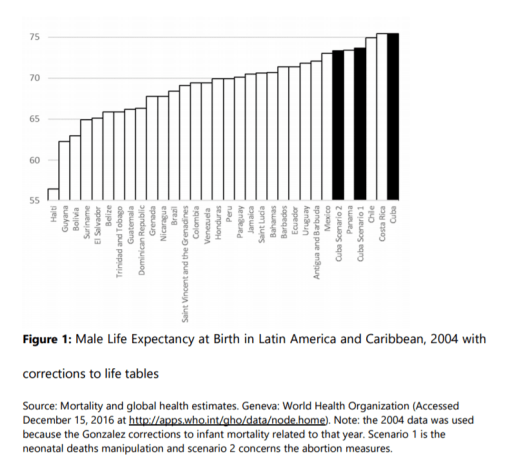
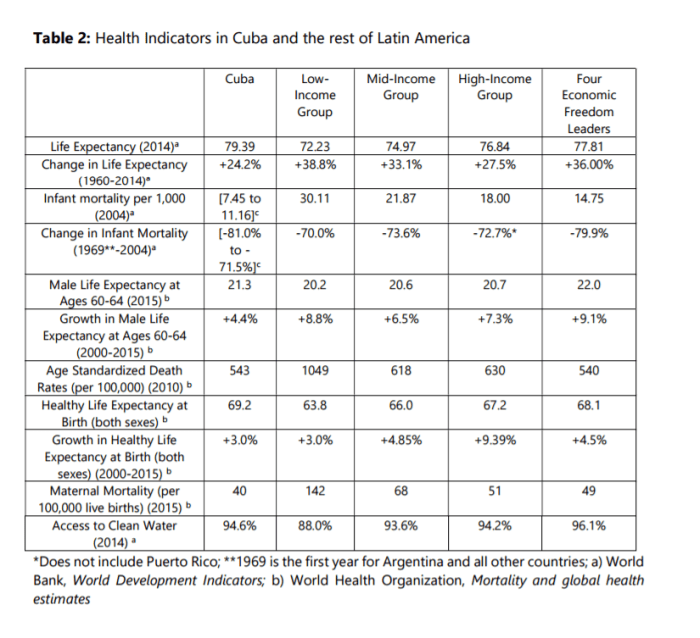
One of the most interesting (in my opinion) paradox in modern policy debates relates to how Cuba, a very poor country, has been able to generate health outcomes close to the levels observed in rich countries. To be fair, academics have long known that there is only an imperfect relation between material living standards and biological living standards (full disclosure: I am inclined to agree, but with important caveats better discussed in a future post or article, but there is an example). The problem is that Cuba is really an outlier. I mean, according to the WHO statistics, its pretty close to the United States in spite of being far poorer.
In the wake of Castro’s death, I believed it necessary to assess why Cuba is an outlier and creates this apparent paradox. As such, I decided to move some other projects aside for the purposes of understanding Cuban economic history and I have recently finalized the working paper (which I am about to submit) on this paradox (paper here at SSRN).
The working paper, written with physician Gilbert Berdine (a pneumologist from Texas Tech University), makes four key arguments to explain why Cuba is an outlier (that we ought not try to replicate).
The level of health outcomes is overestimated, but the improvements are real
Incentives matter, even in the construction of statistics and this is why we should be skeptical. Indeed, doctors are working under centrally designed targets of infant mortality that they must achieve and there are penalties if the targets are not reached. As such, physicians respond rationally and they use complex stratagems to reduce their reported levels. This includes the re-categorization of early neonatal deaths as late fetal deaths which deflates the infant mortality rate and the pressuring (sometimes coercing) of mothers with risky pregnancies to abort in order to avoid missing their targets. This overstates the level of health outcomes in Cuba since accounting for reclassification of deaths and a hypothetically low proportions of pressured/coerced abortions reduces Cuban life expectancy by close to two years (see figure below). Nonetheless, the improvements in Cuba since 1959 are real and impressive – this cannot be negated.
Health Outcomes Result from Coercive Policy
Many experts believe that we ought to try to achieve the levels of health outcomes generated by Cuba and resist the violations of human rights that are associated with the ruling regime. The problem is that they cannot be separated. It this through the use of coercive policy that the regime is able to allocate more than 10% of its tiny GDP to health care and close to 1% of its population to the task of being a physician. It ought also be mentioned that physicians in Cuba are also mandated to violate patient privacy and report information to the regime. Consequently, Cuban physicians (who are also members of the military) are the first line of internal defense of the regime. The use of extreme coercive measures has the effect of improving health outcomes, but it comes at the price of economic growth. As documented by Werner Troesken, there are always institutional trade-offs in term of health care. Either you adopt policies that promote growth but may hinder the adoption of certain public health measures or you adopt these measures at the price of growth. The difference between the two choices is that economic growth bears fruit in the distant future (i.e. there are palliative health effects of economic growth that take more time to materialize).
Health Outcomes are Accidents of Non-Health Related Policies
As part of the institutional trade-off that make Cubans poorer, there might be some unintended positive health-effects. Indeed, the rationing of some items does limit the ability of the population to consume items deleterious to their health. The restrictions on car ownership and imports (which have Cuba one of the Latin American countries with the lowest rate of car ownership) also reduces mortality from road accidents which, in countries like Brazil, knock off 0.8 years of life expectancy at birth for men and 0.2 years for women. The policies that generate these outcomes are macroeconomic policies (which impose strict controls on the economy) unrelated to the Cuban health care system. As such, the poverty caused by Cuban institutions may also be helping Cuban live longer.
Human Development is not a Basic Needs Measure
The last point in the paper is that human development requires agency. Since life expectancy at birth is one of the components of the Human Development Indexes (HDI), Cuba fares very well on that front. The problem is that the philosophy between HDIs is that individual must have the ability to exercise agency. It is not a measure of poverty nor a measure of basic needs, it is a measure meant to capture how well can individual can exercise free will: higher incomes buy you some abilities, health provides you the ability to achieve them and education empowers you.
You cannot judge a country with “unfree” institutions with such a measure. You need to compare it with other countries, especially countries where there are fewer legal barriers to human agency. The problem is that within Latin America, it is hard to find such countries, but what happens when we compare with the four leading countries in terms of economic freedom. What happens to them? Well, not only do they often beat Cuba, but they have actually come from further back and as such they have seen much larger improvements that Cuba did.
This is not to say that these countries are to be imitated, but they are marginal improvements relative to Cuba and because they have freer institutions than Cuba, they have been able to generate more “human development” than Cuba did.
Our Conclusion
Our interpretation of Cuban health care provision and health outcomes can be illustrated by an analogy with an orchard. The fruit of positive health outcomes from the “coercive institutional tree” that Cuba has planted can only be picked once, and the tree depletes the soil significantly in terms of human agency and personal freedom. The “human development tree” nurtured in other countries yields more fruit, and it promises to keep yielding fruit in the future. Any praise of Cuba’s health policy should be examined within this broader institutional perspective.
As previously indicated I will be posting an appendix to mypostsonCoup and Counter-Coup in Turkey, referring to Ottomanism, Kemalist republicanism and related issues. The sixteenth of April referendum does require a response of a more immediate kind. The referendum was on amendments to the Constitution largely concerned with transforming Turkey from a parliamentary republic, which it has been at least in principle since the formation of the Republic of Turkey in 1923. Recep Tayıp Erdoğan had already been breaking the Constitution since 2014 when he was elected President of Turkey after more than a decade as Prime Minister. On becoming President he transferred the chief executive power to the presidential palace (which has more than 1000 rooms and was built on Erdoğan’s orders using executive privilege to override court bans on building on the land concerned). This in itself tells you everything you need to know about the decay of Turkish democracy, from a starting point which was itself not a shining beacon to the world of purist constitutional democracy.
Erdoğan’s ambitions for an executive presidency in Turkey precede his elevation to that role. The shift from a President elected by the National Assembly to a President elected by popular vote came from a referendum of 2007, though Erdoğan is the first President of Turkey to take the office in this way. Kemal Atatürk (1923-1938) and then İsmet İnönü (1938-1950) were powerful presidents in a parliamentary system. This paradox arose because Turkey was a de facto one-party state in which only the Republican People’s Party had seats in the National Assembly from 1923 to 1943, though the Free Republican Party won seats in local elections. The elections of 1946 resulted in an opposition party and some independent deputies entering the National Assembly. In 1950 İnönü became the first Turkish (or Ottoman) leader to give up power peacefully as the result of elections and the Republican People’s Party became the first political party to give up power in this manner. During the one party period, the President was the dominant figure in the Republican People’s Party and therefore acted as the head of government, though with a Prime Minister and some genuine divisions of responsibilities.
Not only did Erdoğan start using powers he had not been given in the constitution in 2014, the whole evolution towards a presidential system has been done in a way to benefit him personally. He was Prime Minister over three terms from 2002 to 2014, an office to be abolished in 2019 as a result of the recent referendum, and was the head of government. He has acted as effective head of government since 2014, regardless of the Prime Minister having this role. The office of Prime Minister will still exist until 2019 and most of the constitutional changes as a result of the referendum will not come into force until then. Erdoğan can then have the two terms of executive presidency in addition to the term he is currently serving which will still constitutionally limit his powers in ways that mean the Prime Minister should be head of government. In this sense, the system is working as in the days of the one party system. So Erdoğan can serve as head of government in Turkey from 2003 until 2029. Furthermore he may be able to add another term if the National Assembly goes to an early election during his second term.
The President will have the power to dissolve the National Assembly, and this could easily happen simply because the President wishes to have a third term. The amended constitution at least restricts the President to two five-year terms plus most of a third term in special conditions. So the possibility exists of Erdoğan running the Turkish government from 2003 to 2034, a highly unusual situation in any democracy and one likely to undermine the democracy in question, particularly as the powers of the President now include control of appointment of senior judges, senior civil servants, senior bureaucrats, the right to issue decrees as laws, the right to appoint all cabinet ministers without National Assembly approval, and the right to appoint two vice-presidents without National Assembly approval. Theses figures will not be required to answer questions in the National Assembly and, like the President, will benefit from lifetime immunity with regard to alleged crimes committed in office. That is to say, the President and his associates will have immunity for life unless the National Assembly votes to suspend the immunity, with a high enough majority required to make this unlikely unless there is a massive collapse in the number of AKP deputies, or of Erdoğan’s control of the AKP.
We cannot even say that these changes designed to produce a President above normal democratic constitutional checks and balances, dominating the whole governmental process and state machinery in a way unprecedented in Turkey’s multi-party history, have been agreed to by a genuine majority vote. The referendum was held in state of emergency conditions, which still prevails. A state of emergency in which opposition journalists have been detained in large numbers on flimsy charges as ‘terrorists’, opposition deputies (from Kurdish rights-leftist HDP) have been detained on a similar basis. State media and most private media groups operate as media organs of the AKP. The state of emergency has been applied in a particularly harsh way in the southeast (Kurdish majority) part of the country where elected local government has been replaced by central government appointees. There are 500,000 displaced persons in the southeast resulting from PKK terror and the state security reaction which led to military bombardment of whole towns and urban districts until they were reduced to rubble. It was clearly not easy for them to vote and it looks like a large number did not vote. Extreme intimidation of No campaigners was the norm in the southeast where large numbers of HDP election observers were denied access to polling booths. Intimidation of the No campaign took place elsewhere if in a less extreme way and public spaces were dominated by Yes publicity.
The count was itself full of flagrant irregularities. The number of polling stations recording a 100% vote for Yes was far greater than the number recording 100% AKP votes in recent elections. There was another party campaigning for the Yes, the hardline nationalistic MHP, but the party split over the leader’s support for Yes and all the evidence is that overwhelmingly most MHP voters did not vote Yes. Given that some AKP voters defected from Yes, not many but no less than 5%, there was no reason to expect an increased number of polling stations with a 100% vote and of course suspicion is in order about polling stations which recorded such results in the past.
An AKP politician who is a member of the national electoral board (itself packed with AKP appointees) requested that all ballot papers used to vote, but not carrying a stamp to show they have been authorised for that polling station by an official, should be counted. This is illegal but the request was granted. AKP apologists were quick to say that opposition requests in the past for counting such ballots (because maybe they were stuck together when the official was stamping papers) were granted in the past. Small illegality does not excuse large illegality and the scale of counting of such ballot papers was much larger than previously.
During the count the state news agency was announcing results before they were released by the electoral board. A strange and suspicious situation. The international media, following the state news agency, failed to see the discrepancy also confusing the percentage of ballot boxes opened with votes cast, giving a very misleading impression of a big lead amongst most votes cast early in the evening. The election board results then went off line and were not shared with the opposition. When results came back online they showed a very different pattern than before the break in service, more in line with the state news agency announcements.
Given the close (51.4% for Yes) nature of the official result, there are a number of reasons to think that No won in votes cast, and even if we ignore the voting irregularities, there is reason to think that in a less intimidating atmosphere, particularly in the southeast, more Yes voters would have cast a vote. In these circumstances I suggest that even on a very cautious reckoning, the number of votes cast for No was at least 51% and that with a less intimidating and disruptive atmosphere, another 2% would have gone to No. To say on this basis that 53% voted No is I believe a very cautious estimate. There is very probably a clear majority of Turkish voters against the new presidential system, at least 55%.
The narrow result clearly caused embarrassment to Erdoğan and the AKP who had predicted a very big victory for Yes. They have gone quieter since then, but with no let up in authoritarian measures. Just two days ago Wikipedia was blocked in Turkey, several thousand state employees were dismissed using emergency powers and a number of NGOs were closed in a similar way. The context of the supposed Yes victory gives hope that there is opposition to the Erdoğan/AKP destruction of liberal democracy, but recent measures suggest they are as determined as ever to use the tools of state to obliterate opposition, or just any sense of independence from the party-state machine.