Party politics and foreign policy in Brazil’s early history

Early Brazilian foreign policy was criticized for being too Europe-centered. Brazil declared its independence from Portugal in 1822 in a process unique in the Americas: Dom Pedro I, the country’s first head of state and government, was the son of Dom João VI, king of Portugal. This gave Brazil a sense of continuity with the former metropolis – unique in the Americas. Although Dom Pedro I renounced his rights in the Portuguese succession line to become Brazil’s first Emperor, early Brazilian foreign policy was very much a continuation of late Portuguese policy.

Early in the 19th century Portugal became involved in the Napoleonic Wars on the English side. Portugal and England enjoyed then an already long friendship. When Napoleon invaded the Iberian Peninsula, Dom João, then Prince Regent, decided to move the Portuguese imperial capital to Rio de Janeiro, instead of fighting a war he believed he could not win. This move consolidated the Anglo-Portuguese alliance of that time, as Dom João’s policy was backed up by England.

In South America, Dom João first decision was to finish the colonial exclusivism Portugal enjoyed with its colony, opening Brazil’s ports to friendly nations. With most of Europe at war and occupied by French armies, England was basically the only friend Brazil and Portugal had at the time. But his policies meant that Brazil had a move towards liberalism unknown until that moment. The country’s trade with the outside world rose as English products entered the Brazilian market.

When Dom João returned to Europe, Brazilian elites were unwilling to give up the freedom conquered in the previous years; in that case, something not that different from what happened in Spanish America. With Dom Pedro I as Prince Regent in Brazil, the independence movement grew strong until complete secession in 1822.

With that in mind, it’s possible to understand how early Brazilian foreign policy was mostly a continuation of Dom João’s policy: Dom Pedro I’s first task was to get recognition of Brazil’s independence from Portugal. That happened with English support. The United States was the first country to recognize Brazil’s independence, but this was welcomed coldly in Rio de Janeiro.

In response to English help, Dom Pedro I kept and improved the trade benefits England already enjoyed with Brazil. He also occupied Uruguay, a region disputed between Spain and Portugal, leading to a war with Argentina and, despite renouncing his rights to the Portuguese throne, kept close relations with his family in Portugal.

Dom Pedro I’s foreign policy was a reason for growing opposition. He could not win a war against Argentina and his connection to Portugal was a constant reason for accusations of recolonization plans. Topping that was the perception of Brazilian elites that the trade agreements with England were bad for Brazil. For these and other reasons, Dom Pedro I resigned in 1831 and returned to Portugal, leaving the Brazilian throne to his son, Dom Pedro II.

Dom Pedro II was only five years old when he ascended to the throne, and so despite being the head of state, he could not govern the country. The 1830’s were a period of regencies when few important decisions were made in Brazil’s foreign policy. But in another topic, that was a crucial decade in Brazilian history: the political tendencies present in Dom Pedro I’s reign became more formal political parties in the late 1830’s: the Conservative Party, that defended progress inside of order, and the Liberal Party, that defended more radical changes.

Dom Pedro II’s adulthood was anticipated in 1840, and besides a short period of Liberal rule, the conservatives dominated Brazilian politics for most of the 1840’s to the 1870’s. In domestic politics, conservatives wanted to centralize politics and bureaucracy in Rio de Janeiro and leave little autonomy to the provinces. They claimed to be afraid of the extremes of mob rule, despotism, and oligarchy, and therefore defended progress inside of order. This meant conserving much of the Portuguese heritage. It was up to the state to build the nation and to lead a modernization process. Ironically, many important conservative leaders were former adversaries to Dom Pedro I and accused him of despotism. However, once in power, they said the country needed to be saved from excesses of liberty.

The conservatives talked about the 1830’s as a period of dangerous upheaval in Brazil. Indeed, the country faced several regional revolts that could have fragmented the Empire. Anyway, the conservative answer was to secure the integrity through a stronger government. In their understanding, Brazil was simply not ready for a certain level of liberty.

A Radical Take on Science and Religion

An obscure yet still controversial engineer–physicist named Bill Gaede put out a video last year, inspired by Martin Luther, spelling out 95 theses against the current scientific consensus in physics. I’m in no position to evaluate his views on physics, but I find his take on the difference between science and religion fascinating. In this post I’ll try to condense some of his views on that narrow topic. You can watch the whole video here. Fair warning: his presentation style is rather eccentric. I find it quirky and fun, you may feel differently.

***

A description is a list of characteristics and traits. It answers the questions what, where, when, and how many.

An explanation is a discussion of causes, reasons, and mechanisms. It answers the question why.

An opinion is a subjective belief. What counts as “evidence”, “proof”, or “truth” is an opinion.

Science is the systematic attempt at providing explanations. Why do planets orbit stars? Why are some people rich and others poor? Why is there something instead of nothing? All questions that can be answered (to varying degrees) with science.

Note well that the experiments and observations per se are not science. The scientist takes those results for granted: they form his hypothesis—literally, that which is without a thesis or explanation. Technicians and assistants may carry out the observations and experiments. But the actual science is the explanation.

Religion is the systematic attempt at shaping opinions. Religion is not mere faith—the belief in things without evidence. Religion works through persuasion—the use of science and faith to appeal to your subjective beliefs about evidence and proof and truth.

Science is not be about persuading the audience. Good science is about providing consistent, logically sound explanations. An individual may have many religious reasons for their incredulity. But religious skepticism is not the concern of the scientist. The scientist is only concerned about logically valid explanations.

How to fix the journal model? 

Disclaimer: I am not (yet!) published in any peer reviewed journals.

A companion recently posed an interesting proposal to improve the academic journal model: have referees publish their reviews after X period of time. I am sympathetic to the idea as I have always found secrecy to be a strange thing in decision making. What’s the point of ‘blind’ reviews anyway? From conversing with those with more experience in the field, it is rarely a ‘double blind’ process but a de facto one way ‘blind’ process. This seems to be the case more so outside the major journals.

My counter is: why not just get rid of journals altogether? Why not just publish via SSRN and similar websites? Journals seem to have maintained their existence in the digital age as a means of quality insurance, but there’s still lots of junk in the top journals. Surely we can come up with better ways than relying on a few referees? Even relying on citation count would be a better measure of a paper’s value I think.

#microblogging

Libertarianism, Classical Liberalism, Right Wing Populism, and Democracy

An interesting exchange has occurred between Will Wilkinson of the Niskanen Center and Ilya Somin writing for the Washington Post on the issue of the influence of libertarianism over the modern Republican Party’s erosion of liberal democratic norms. In his initial piece, Wilkinson seemed to argue that the Libertarian view of absolutism in regards to property rights which was a way to offer an emotionally gratifying alternative to socialist redistribution was responsible for the Right’s adoption of a populist outlook which eroded democratic norms, for example, policies like Voter ID and Gerrymandering. Ilya Somin responded by pointing out that the libertarian “absolutist” conception of property rights had next to nothing to do with why many libertarians Wilkinson cites are skeptical of democracy. Wilkinson responded by saying his initial argument was confusingly stated, not that absolutist property rights is driving democratic erosion on the part of the right, by trying to clarify his distinction between “libertarian” and “classical liberal.” Somin pointed out that this response undermines the force of Wilkinson’s initial argument and took issue with some of his other points.

I wish to contribute to this debate because, even though Somin is largely right that Wilkinson’s argument is weakened by his clarification, I think both have missed that Wilkinson has fundamentally misunderstood what right-wing populism is and why it is a threat to democracy. Modern right-wing populism does not try to erode majoritarian democracy, even if it erodes some of the institutional norms which make it possible for modern liberal democracy to function. Rather, populism, in its many forms, weaponizes democratic rhetoric which is premised on the very notions which libertarians and classical liberals critical of democracy seek to challenge. Attempts to tie such criticisms to the modern right is absurd and distracts us from confronting those aspects which are actually threatening about the right’s pathologies. Afterwards, I will comment on some of the other minor confusions into which I believe Wilkinson falls.

Populism and Folk Democratic Intuitions

In Wilkinson’s genealogy, the root of modern libertarianism is an attempt to weaponize classical liberalism’s defense of property against the desire for socialist redistribution. As he tells it, classical liberals like Hayek and Buchanan sought to put trigger locks on democracy in the form of constitutional constraints on majority rule whereas radical libertarians like Rand, Nozick, and Rothbard sought to disarm democracy altogether from violating property rights. This conception leaves no room for any analysis of or support for democratic decision-making. Since the end of the Cold War, the right has continued to believe this absolutist property rights argument was extremely important even after the Red Menace had been slain and so is willing to do anything, including throwing democracy under the bus, to defend property rights. As Wilkinson puts it:

And that’s why ideological free-market conservatives tend to be so accommodating to, if not exactly comfortable with, populist white identity politics. In their minds, mundane left-right differences about tax rates and the generosity of the welfare state are recast as a Manichean clash between the light of free enterprise and the darkness of socialist expropriation. This, in turn, has made it seem morally okay, maybe even urgently necessary, to do whatever it takes—bunking down with racists, aggressively redistricting, inventing paper-thin pretexts for voting rules that disproportionately hurt Democrats, whatever—to prevent majorities from voting themselves a bigger slice of the pie.

In his follow up, after Somin pointed out that irrational factors like partisanship are more likely to influence a voter’s decision than complicated moral theories such as property rights, Wilkinson attempted to make this argument more plausible by giving the hypothetical example of a white working-class republican voter who, while not fully libertarian, uses his thin knowledge of libertarian property rights absolutism as a form of motivated reasoning justifying his erosion of democratic norms:

Burt is a moderately politically engaged mechanical engineer with ordinary civics-class ideas about democracy, as well as a strong distaste for paying his taxes. (He wants to buy a boat.) One day Burt picks up Atlas Shrugged on the recommendation of a friend, likes it a lot, and spends a few weeks poking around libertarian precincts of the Internet, where he encounters a number of libertarian arguments, like Rand’s, that say that taxation violates a basic, morally inviolable right. Burt happens to find these arguments extremely convincing, especially if he’s been idly shopping for boats online. Moreover, these arguments strongly suggest to Burt that democracy is a dangerous institution by which parasitic slackers steal things from hyper-competent hard workers, like Burt.

Now, none of this leads Burt to think of himself as a “libertarian.” He thinks of himself as a Lutheran, a moderate Republican, and a very serious Whovian. He’s suspicious of “free trade.” He’s “tough on crime.” Burt would never disrespect “our troops” by opposing a war, and he thinks legalizing drugs is bananas. Make no mistake: Burt is not a libertarian. But selective, motivated exposure to a small handful of libertarian arguments has left Burt even more indignant about taxes, and a bit sour on democracy—an altogether new attitude that makes him feel naughtily iconoclastic and a wee bit brave. Over time, the details of these arguments have faded for Burt, but the sentiments around taxation, redistribution, and democracy have stuck.

Ayn Rand and the other libertarian thinkers Burt encountered in his brief flush of post-Atlas Shrugged enthusiasm wanted him to be indignant about redistribution and wanted him to be sour on democracy. He drew the inferences their arguments were designed to elicit. The fact that he’s positively hostile to other elements of the libertarian package can’t mean he hasn’t been influenced by libertarian ideas.

Let’s suppose that, a few years later, a voter-ID ballot initiative comes up in Burt’s state. The local news tells Burt that this will likely make it harder for Democrats to win by keeping poorer people without IDs away from the polls. Burt rightly surmises that these folks are likely to vote, if they can, to take even more of his money in taxes. A policy that would make it less likely for those people to cast a ballot sounds great to Burt. Then it occurs to him, with a mild pang of Christian guilt, that this is a pretty selfish attitude. But then Burt remembers those very convincing arguments about the wickedness of democratic redistribution, and it makes him feel better about supporting the voter-ID requirement. Besides, he gives at church. So he votes for the initiative come election day.

That’s influence. And it’s not trifling, if there are a lot of Burts. I think there are a lot of Burts. Even if the partisan desire to stick it to Democrats is doing most of the work in driving Burt’s policy preference, the bit of lightly-held libertarian property rights absolutism that got into Burt’s system can still be decisive. If it gives him moral permission to act on partisan or racial or pecuniary motives that he might otherwise suppress, the influence might not be so small.

The problem here is not just, as Somin says, that this dances around the issue that people like Burt have become less libertarian over time and so it seems silly to blame libertarianism for his actions. It sounds as if Wilkinson has never actually talked to a populist-leaning voter like Burt. If you do, you will not find that Burt is skeptical of democracy or sees himself as defending some important ideal of laissez-faire capitalism against irrational socialist voters who are using democracy to destroy it. It is more likely that you will find that Burt sees himself as defending the “silent majority” who democracy should rightly represent from evil liberal, socialist and “cultural Marxist” elites who are undermining democracy, and how Trump will stop all the elitist liberals in the courts and media from alienating the common man with common sense by “draining the swamp.”

Read, for example, Rothbard’s original call for libertarians to ally with nationalist right-wing populists. In it, you’ll find no mention of how small “d” democracy attacks property rights because voters are rationally ignorant, and you won’t find, to quote Wilkinson, skepticism towards “a perspective that bestows dignity upon democracy and the common citizen’s democratic role.” Instead, you’ll find that the “grassroots” of the right-wing common man like the secessionists and neo-confederates who are defending property rights against the “socialist tyranny” of the “beltway elites,” Clintons, and the Federal Reserve. Modern adherents to this Rothbardian populist strategy define populism as “a political strategy that aims to mobilize a largely alienated base of the populace against out-of-control elites.” It sounds more like a radically majoritarian, Jacksonian screed about how the voice of the people needs to be truly represented.

Importantly, what the libertarian populists are trying to do is take the folk democratic intuitions which populist right-wingers have, intuitions upon which most peoples’ beliefs in the legitimacy of democracy rely, and channel those intuitions in a more thinly “libertarian” direction. Unfortunately, this is why many modern right-libertarians in the style of Ron Paul are impotent against white supremacists and often try to cozy up to them: because an important part of their strategy is to regurgitate the vulgar democratic rhetoric in which populists believe.

By contrast, modern skeptics of democracy in libertarian circles (or “classical liberal” or “cultural libertarian,” whichever semantic game Wilkinson wants to play to make his argument coherent), such as Ilya Somin, Bryan Caplan, and Jason Brennan, fundamentally undermine those folk democratic intuitions. While right-wing populists believe that the “common man” with his “common sense” knows better how the world works than the evil conniving academic elite does, the libertarian skeptic of democracy points out that the majority of voters know next to nothing and fail to be competent voters due to their rational ignorance. While populist voters believe that the voice of the majority should rule our governing structure, public choice tells us that “majority will” is mostly an illusionary concept. While populist voters believe that the “trigger locks” like courts are evil impediments to the people’s will and regularly attack them, libertarian skeptics of democracy view such institutions as the last line of defense against the irrational and ignorant mob of hooligan voters.

In fact, if people listened to folks like Somin and Brennan, populism of the sort that we’ve seen on the right would be an impossible position to maintain. This is partially why Rothbard largely rejected the public-choice analysis on which scholarship like Somin’s depends.

To try to link modern public choice-inspired skepticism of democracy with populism of any form, even in its most pseudo-libertarian form of the late Rothbard, is to grossly misunderstand populism, classical liberalism, and libertarianism. It seems rather odd to blame Somin and company for the rise of a political ideology which their arguments render incoherent. A Nancy MacLean-like conspiracy to undermine majority rule doesn’t have much of anything to do with the modern right when they think they are the majority who’s being oppressed by elites.

Neither is this some trivial matter of simply assigning blame incorrectly. The problem with populism on the right which has eroded American democracy is not that it thinks democracy is wrong, most populists naively have a lot of folk intuitions which imply some sort of vague proceduralist justification of strongly majority rule. Rather, they’ve taken the majoritarian, quasi-Jacksonian rhetoric (rhetoric to which libertarians other than Rothbard and classical liberals alike have mostly been opposed) which democrats often use and weaponized it in a manner that undermines the non-majoritarian norms on which liberal democracy is dependent for functioning. For someone like Wilkinson, who defends liberal democracy vigorously, misunderstanding the very nature of the threat seems like a particularly grave error as it renders his arguments impotent against it.

Democratic Majoritarianism versus Democratic Norms

In part, I think Wilkinson falls for this trap because he makes a conceptual confusion between the non-majoritarian liberal ideals on which democracy depends—towards which most libertarians are sympathetic—and democracy’s institutional form as majority rule. I’ve described this as a distinction between “institutional democracy” and “philosophical democracy” in the past, and have argued that one can uphold philosophical democratic norms while being skeptical of the current institutions in which they are embedded. Wilkinson argues, citing an article by Samuel Freeman, that libertarian absolutist conception of property is inherently illiberal as it implies a sort of propertarian, feudalist order. Of course, Wilkinson neglects to mention a response to Freeman by Peter Boettke and Rosolino Candela claiming that Freeman misunderstands the role property rights play in libertarian theory.

I am not an absolutist natural property rights-oriented libertarian at all, however in their defense, it is wrong for Wilkinson to think that belief in absolutist property rights—even to the point that one becomes an anarchist like Rothbard—means one is necessarily willing to do anything to undermine democracy to defend property rights. As Somin mentions, not all libertarian absolutists in property completely disbelieved in government like Nozick, but more importantly one can be an anarchist who is strongly skeptical of democracy for largely propertarian reasons but still believes, given that we have democracy, certain norms need to be upheld.

Norms such as equality before the law, equal footing in public elections (which Gerrymandering violates), and equal access to political power (which Voter ID laws violate). Just because one believes neo-Lockean arguments about property rights are valid does not mean one cannot coherently also endorse broadly Hayekian accounts of non-majoritarian liberal norms which make it possible for democracies to function (what Wilkinson calls “trigger locks”), even if in particular instances it might result in some property rights violations.

In other words, one can be skeptical that institutional democracy is moral for libertarian reasons while still embracing a broadly philosophically democratic outlook, or simply believe it is preferable to keep some democratic norms intact given that we have a democracy as an nth best possible solution.

What Wilkinson takes issue with is how the modern right attacks the sort of norms which make democracy work, norms with which no libertarian ought to take issue with given that we have a democracy as they are precisely the “trigger locks” which Hayek called for (even if libertarians want much stronger trigger locks to the point of effectively disarming governments). To think these norms are identical with how many libertarians think the specific voting mechanisms which democracy features are flawed is a conceptual confusion.

An Alternative Account of the Relationship between Libertarianism and the Right’s Pathologies

To me, it seems that Wilkinson’s attempt to shoehorn the somewhat nuanced (by the standards of electoral politics, if not by the standards of academic philosophical argumentation) philosophical arguments of Nozick and Rothbard into an account of the rise of Trumpian politics seems fundamentally inconsistent with the way we know voters act. Even if voters sometimes use indirect intellectual influences as a way to reason about their voting preferences in a motivated manner likes Wilkinson imagines, it’s not really explaining why they need to use such motivated reasoning in the first place. Here’s an alternative account:

During the Cold War, as Wilkinson notes, libertarians and conservatives had a common enemy in communism and socialism. As a result, fusionism happened and libertarians and conservatives started cheering for the same political team. After the end of the cold war, fusionism continued and libertarians found it hard to stop cheering for the “red” team for the same tribalist reasons we know non-libertarian irrational voters remain fiercely loyal to their political parties. Today, even though the GOP is becoming extremely less libertarian, some libertarians find it hard to stop cheering for the GOP for the same reasons New England Patriots fans still cheer for Tom Brady after the deflation scandal: old tribalist affiliations are hard to break.

The only real link between libertarians and modern right-wing pathologies are that some voters who have vaguely libertarian ideas still cheer for populist right-wingers in the GOP because they’re irrational hooligans who hate the left for tribalist reasons. This accords better with the fact voters aren’t all that ideological, that they (unlike Burt who’s interested in just lowering his own taxes selfishly) vote based off of perceived national interest more than self-interest, and how we know generally voters behave in partisan tribalist patterns. But this doesn’t make libertarianism any more culpable for the rise of the modern right’s erosion of democratic norms any more than (and probably less than given its limited influence) any other ideological current which has swayed the right to any degree.

How does this make sense of Wilkinson’s only real, non-hypothetical evidence of libertarian influence on the modern GOP, that some right wing politicians like Paul Ryan and Rand Paul sometimes cite Ayn Rand and Rothbard? Politicians sometimes use intellectual influences haphazardly to engage in certain sorts of motivated-reasoning to cater to subsets of voters, even though they overwhelmingly disagree with those thinkers. This why Paul Ryan first praised Ayn Rand, to get some voters who like Rand, and then later emphasized how much he rejected Rand. This is why Rand Paul cites libertarians simply to virtue-signal to some subset of libertarianish voters while constantly supporting extremely un-libertarian policies. Ted Cruz has said that conservatives “should talk about policy with a Rawlsian lens,” but nobody thinks that Rawls has been particularly influential over Cruz’s policy decisions. All politicians do when they cite an intellectual influence is try to play to cater to the tribalist, pseudo-intellectual inklings of some nerdy voters (“I read the same guys as you do, therefore I’m on your team”), it usually doesn’t mean they really were deeply influenced by or even understand the thinker they cite.

Libertarians and Classical Liberals

Let me conclude this article by addressing a side-issue of how to parse out the distinction between classical liberals and libertarians. One of Wilkinson’s ways of clarifying his disagreement with Somin was by claiming that there is something fundamentally different between “libertarianism” and “classical liberalism.” As Wilkinson puts it:

Absolutist rights-based libertarianism isn’t really part of this conversation at all. It’s effectively an argument against liberalism and the legitimacy of liberal political institutions, which is why it’s so confusing that the folk taxonomy lumps libertarianism and classical liberalism together, and sets them against standard left-liberalism. The dispute between liberalism and hardcore libertarianism concerns whether it’s possible to justify democratic political authority at all. The dispute within liberalism, about the status of economic rights and the legitimate scope of democratic decision-making, is much smaller than that.

Thus, Wilkinson seems to think that libertarians think political authority can’t be justified given that property rights are absolute and that classical liberals just think economic liberties should be included as liberal liberties. However, in my view this taxonomy of ideologies is still confused. Many who typically count as “libertarians” do not fit neatly into such a schema and need to be ignored.

You need to ignore significant portions of libertarians who still endorse property rights but think they are insufficient to a full conception of liberty and endorse other liberal freedoms, like the aforementioned Peter Boettke paper. You need to ignore intuitionist libertarians who do not endorse an absolutist conception of property rights but still dispute that political authority is justified at all, like Mike Huemer. You need to ignore consequentialists who do not embrace absolutist property rights as a philosophical position but think some sort of absolutist property-based anarchist society is desirable against liberal democracy, like David Friedman and Don Lavoie’s students. You need to ignore “thick” left libertarians like Charles Johnson and Gary Chartier who endorse libertarian views of rights yet think they imply far more egalitarian leftist positions. Further, you’d need to claim that most people the public readily identifies as some of the most influential libertarians of all time, like Hayek and Milton Friedman, are not actually libertarian which obscures rather than clarifies communication. Basically, the distinction is only useful if you’re trying to narrowly clarify disagreements between someone like JS Mill and someone like Rothbard.

I agree that there are distinctions between “libertarians” and “classical liberals” that can be drawn and the folk taxonomy that treats them creates a lot of confusion. However, it seems obvious if one talks to most libertarians, there is more going on in their ideology than just “property rights are absolute” and that there is a strong intermingled influence between even the most radical of anarchist libertarians and classical liberals. It is also true that there are a small minority of libertarians who are thoroughly illiberal (like Hoppe), but it seems better to just call such odd illiberal aberrations “propertarian” and still treat most libertarians as a particularly radical subset of classical liberals.

Ultimately, however, I think this taxonomical dispute, while interesting, isn’t particularly closely related to the problem at hand: the relationship between right-wing populism and libertarianism.
In Praise of Academia

This week I got the happy news that my article on Ayn Rand’s views on international relations was accepted for publication. Once it is posted ‘online first’, I shall write a bit about its content. For now I would like to make a two other points, though.

One of the reason for my happiness is that this article took an exceptional time to get accepted. I started working on it in 2010, doing the initial reading (in this case all published works of Ayn Rand). The actual drafting started in 2011, I solicited commentary, and came to an acceptable first version in 2013. To be sure: I did not work on the paper on a full time basis, and there were many other distractions, not least my day time job, other academic projects, and family affairs. Still, the article kept nagging in the back of my head, perhaps not daily, but certainly on a weekly basis. I got the first few rejections by journals in 2013, then again a few in 2015, and another one this summer. So reason enough to be happy to get accepted and all the more exciting to see it through the production phase in the coming months, with actual printed publication still in the somewhat distant future.

I am not writing this to congratulate myself in public. My reason for this blog is to show young (aspiring) scholars, that it is completely normal to work on a project for ages, and to get rejected a few times. Yet the reward is sweet. As long as you persevere, are ready to change and edit your text, overcome your anger when you get unjust blind reviews (and believe me: writing on Rand regularly solicits angry, malicious and/or erroneous responses, also from editors and reviewers of high ranked reputed journals), and keep the faith in the possible value of your modest contribution to the world’s knowledge base.

This is a lesson I learned from experience in the past decade or so. But early on, I also greatly benefitted from one of the best and useful guides to PhD research and academic life I have ever come across: LSE professor Patrick Dunleavy’s Authoring a PhD. It realistically describes what to expect of academic life, it’s ups and also it’s downs. So get it, if you are still unsure what to expect of academic life.

The other remark I would like to make is about the unique and open character of academic publishing. It is really great, as a part-time academic, to be able to get published in reputable journals. I am sure the editors of journals and presses are more keen to see academics from highly reputed universities submitting papers and book manuscripts. Yet they first and foremost value content. If you have something interesting to say, and live up to the academic standards, you will get the same chance and treatment as everybody else. That is pretty unique, compared to many other professions.

So: academia be praised!

A feast of classical liberal thought: Mont Pelerin Society in Stockholm

Last week, Stockholm hosted a special meeting of the Mont Pelerin Society (MPS) on the populist threats to the free society. MPS meetings are held under Chatham House rules, which means I cannot report in any detail about the proceedings. Yet a few impressions can be shared.

I have been a MPS member since 2010, when my nomination was accepted at the end of the general meeting in Sydney. In those days the old rules still applied, which meant you had to attend three meetings before you could be nominated for membership. However, this strict rule led to the erosion of the membership base (the MPS was literally starving out), so the rules to join as a member have been made easier.

My first MPS meeting was in Guatemala City, in 2006. I had participated in the essay contest for young scholars which is always organized in the run-up to the bi-annual General Meetings. As a runner-up I won free entry to the meeting. I happened to be in the south of the USA in the weeks before, doing PhD research at the Mises Institute in Alabama, so could easily make the trip to Central America. Because I lived in Manila during those years, I could also easily attend the 2008 meeting in Tokyo.

I had are number of reasons for wanting to join the MPS. First of all, the quality of the meetings offer a great chance to listen to and speak with the leading scholars within current classical liberalism. Increasingly multidisciplinary (back in the old days the economists dominated), the programme committees of the MPS Meetings always succeed in attracting an impressive crowd of high quality speakers and commentators from across the globe. I always find this a great intellectual treat. Second, the meetings are characterized by extremely pleasant and open atmospheres. Everybody mingles with everybody, you can talk with everybody, no matter your age, or academic background. Thirdly, the meetings take place across the globe, so they offer a great opportunity to travel and see places. Although it must be added that even when you do not stay at the conference hotel, the meetings are never very cheap, so it remains an investment. Fourth, for a Hayekian like myself, it feels very good to be a member of the society founded by the master himself, which had and has such an illustrious membership, ever since its beginnings 70 years ago.

Besides the big one week General Meetings held every two years, there are shorter regional or special meetings in the other years. Last week’s MPS meeting in Stockholm was a special meeting, very well-organized by the Ratio Institute. The theme was discussed from numerous angles, through sessions on Russia’s foreign policy, the economic issue of secular stagnation, or the danger of political Islamism. Two sessions were focused on new classical liberal ideas to counter the threats. At the opening day there was a session for young scholars to present papers. This was of course also a way to attract new talent and interest in the MPS. And at the end of the second day there was something different: beer tasting while listening to Johan Norberg. A rather splendid combination!

The speakers and commentators were high level, including MPS chair Peter Boettke (George Mason), David Schmidtz (Arizona), Deirdre McCloskey (Illinois), John Tomasi (Brown), Leszek Balcerowic (former president of Poland’s Central Bank), Russia specialist Anders Aslund, German thinker Karen Horn, Jacob Levy (McGill), Mark Pennington (Kings College London), Paul Cliteur (Leiden), Amigai Magen (Hoover Institution), and the energetic Ralf Bader (Oxford). A lineup like this guarantees a number of new insights, solid arguments, and general intellectual stimulus. Many answers were provided, yet in true academic fashion, many questions remain.

While well represented in this program, International Relations are normally a minor topic at MPS meetings, and there are not many IR scholars around (nor are sociologists or legal scholars, by the way). Personally I am convinced that the future appeal of classical liberal thought also relies on taking into account world affairs. So there is a need to keep on writing and publishing about it, to expand the basis for thought, also in the MPS. To hear about the concerns and insights of other classical liberals in other disciplines helps my thought process, besides remaining up to speed with current classical liberal issues in general.

So it was a great meeting again, And for all you young scholars out there: if you are interested make sure to regularly check the MPS website (www.montpelerin.org) to see if there are opportunities to participate in one of the upcoming meetings.

Rules for Rulers

Watch to the end for details about the book (by Bruce Bueno de Mesquita and Alastair Smith) this video is based on.

  1. I think readers of NoL will enjoy this nicely condensed public-choice-y analysis of the constraints involved in operating (and thus changing) a government.
  2. The audiobook is available on Overdrive, so you can borrow it from your library. I’m just started listening to it and I’m enjoying it immensely.
  3. I suddenly found myself as the benevolent dictator of some country. My long-term objective is to shape my society into a libertarian utopia. Here’s my plan to deal with the constraints discussed in the video: all of my advisors are required to play devil’s advocate when I propose some change. Yes-men will be summarily executed. Assuming I stay benevolent but also ruthless, does my devil’s advocate scheme work out? Please discuss in the comments. Anyone who doesn’t earnestly try to poke holes in my idea will be sent to the work camps.

Catalonia: a philosophical case for Secession

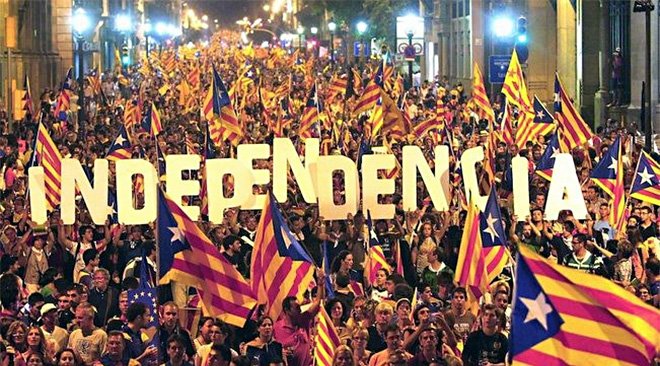
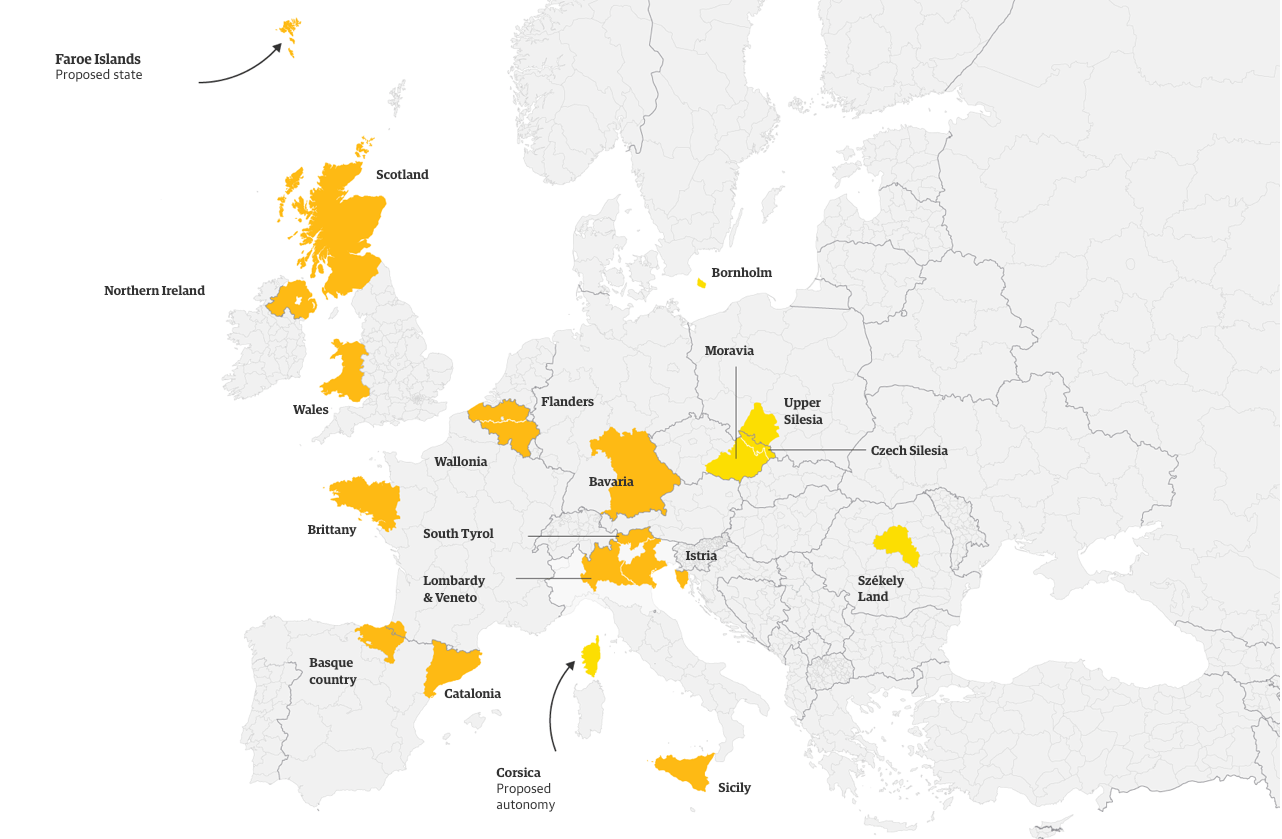
Yesterday, the Catalan government has overwelmingly voted for independence from Spain and to establish an independent republic. 70 were in favour, 10 were against, and 2 votes were blank. Unfortunately, it was rejected by the central governments of Spain and many other countries. Nonetheless, the Catalan case may inspire the other independence movements in Europe.

In this post I’d like to provide a philosophical case for the ethical right of secession based on a libertarian perspective of self-ownership. My argument is exclusively theoretical, although a discussion on how secession could be achieved practically would be interesting as well. I may save that for a post in the future.

Below, you can find a map of other places in Europe with strong secessionist movements:

Structure of my argument

My argument is deductive and runs as follows:

  1. People have the right of self-ownership in accordance with the non-aggression principle, and based on the natural rights philosophy put forward by the political philosopher Murray Rothbard;
  2. If people have the right of self-ownership, they also have the right of voluntary association, voluntary formation of communities, and the right to choose their own leaders;
  3. Sometimes the state that the individual belongs to, violates the rights of the individual to the extent that the individual does not feel associated with it anymore;
  4. Under such circumstances the individual may perceive the state as an unacceptable aggressor, and he is justified to revolt by separating himself from the state. He can form communal associations to secede as a new political unit;
  5. There is no limit to secession. Provinces have the right to secede from a state, a district from the province, a town from the district, a neighbourhood from the town, a household from the neighbourhood, and an individual from the household.

The right of self-ownership and property rights

In For a New Liberty (1973), Murray Rothbard deduces natural law from the essential nature of human beings. He writes that it is in man’s nature to use his mind in order to select values, ends and the means to attain these ends so that he can “act purposively to maintain himself and advance his life”. He furthermore contends that it is absolutely “antihuman” to interfere violently with a man’s “learning and choices” as “it violates the natural law of man’s needs”. Therefore, man’s nature should be protected through his right of self-ownership. This right asserts that man has the absolute right to “own” his body and “to control that body free of coercive interferences”. This right includes the practice of such essential activities as thinking, learning, valuing, and choosing ends and means without any coercion, since such activities are necessary for the enhancement of man’s life.

From this natural right follows the right to do anything with one’s body, including the right to form free associations and communities, and the right not to be violated in one’s self-ownership. Thus, one has the right to associate oneself with the leader of one’s choice, but not the right to impose a leader unto someone else. Likewise, people should be free to join and to leave communities voluntarily.

In addition to the right of free association, people also have property rights. Rothbardian property rights are directly derived from self-ownership rights, and are based on the Lockean homesteading theory. It states that since man owns his person, he owns his labour, and therefore he also owns the fruits thereof. John Locke (1689) has put homesteading theory in the following way:

… every man has a property in his own person. … The labour of his body and the work of his hands, we may say, are properly his. Whatsoever, then, he removes out of the state of nature hath provided and left it in, he hath mixed his labour with it, and joined it to something that is his own, and thereby makes it his property.

Given that man has the right of self-ownership, and that he must employ natural objects for his survival, then the sculptor has the right to own the product he has made through the mixing of his labour. In other words, by producing something with one’s energy through the utilization of unowned nature, one has, as Rothbard calls it, “placed the stamp of his person upon the raw material”. One therefore rightfully owns the product. Any violation of self-ownership and property rights should hence be regarded as an act of aggression.

The state

The state is nonetheless a social institution that has historically interfered most often with people’s self-ownership and property rights. Max Weber has recognized it as an institution with a territorial monopoly of compulsion in his essay ‘Politics as a Vocation’ (1919). Hoppe, in Democracy – the God that failed (2001), asserts that every government will use this monopoly to exploit its citizens in order to increase its wealth and income.

“Hence every government should be expected to have an inherent tendency toward growth”. (Hoppe)

State exploitation happens in the form of expropriation, taxation, and regulation of private property owners. A state at best respects the rights of individual sovereignty and private property, but because its functioning is dependent on the expropriation of its citizens’ wealth there is a natural conflict between the state and its citizens. According to Franz Oppenheimer (1908), the state can impossibly finance itself without its productive citizens. It can only take that what has already been produced, and therefore it can only exist as a result of the “economic means”. However, this confiscation often involves state violence and aggression as nearly no one is willing to give up on his property voluntarily.

Under such circumstances, it is understandable that conflicts may arise between citizens and the state; sometimes resulting in citizens’ feelings of dissociation from their governments.

Secession

Frédérik Bastiat maintains in The Law (1850) that if everyone has the right to “his person, his liberty, and his property”, then

“a number of men have the right to combine together to extend, to organize a common force to provide regularly for this defense.”

Following Bastiat’s reasoning, I believe that citizens who feel dissociated can then revolt and opt for secession as a form of self-defense against state aggression on their self-ownership and property. Any state that does not recognize its citizens’ rights of secession does not sufficiently recognize the sovereignty of its people. Secession is a powerful means of political action to show the people’s discontent with their leaders. If secession would be impermissible, then the people who want to disassociate themselves from the state have the following three options:
(1) continue living under the oppressive state rule;
or (2) revolt against the state;
or (3) emigrate to another state.

By doing (1), the people continue living under perpetual state aggression, and their sovereignty is continually violated.

If the people choose option (2), then there will be severe and costly consequences which can involve war and destruction of private property. In addition, there are also no guarantees that the revolt against the state will be successful. For these two reasons, this option seems to most secessionists to be the least preferable of the three.

The people can alternatively choose (3) and emigrate to another state. This alternative is often used as an argument against secession under the presumption that those who are unhappy within one particular state, should simply emigrate. However, the cost of emigration can be so significantly high that it is unfeasible. One has for example the costs of finding information on the procedure of emigration, becoming accepted by the other state, finding a new workplace etc… The state can also exert barriers of emigration through tedious bureaucratic processes and passport controls, which makes emigration even more unattractive.

Who are morally justified to secede?

Following man’s right of free association, the answer should be: anyone, as long as it happens on a voluntary basis. Even though most secessionist movements are built on a common ethnicity or common cultural heritage, such precepts are not necessary to justify secession. Moreover, secessionists should not be prescribed any form of social organization as they should be free to choose their own form of government. This means that a multitude of social organizations are possible, including those that are currently non-existent. By being epistemologically modest of what governmental form is best, communities are allowed to experiment and find their own form of government. This will eventually add to our understanding of human social organizations.

Lastly, it is important to note that if secession is ethical, ultimately based on the principle of self-ownership, then it follows that the individual has the right to secede as well.

This right cannot be exclusively granted to groups, because only individuals can have ownership of their own bodies. Self-ownership cannot be shared, just like the mind cannot be shared. The mind is an attribute, inherent only to individuals, and collectives only derive their rights from the rights of their individual members. Therefore the right of self-ownership must necessarily imply the right to practice unlimited secession.

As Rothbard would assert, provinces should have the right to secede from a state, a district from the province, a town from the district, a neighbourhood from the town, a household from the neighbourhood, and an individual from the household. This logical consequence is anarchism.

Conclusion

In setting forward a natural rights defense of self-ownership, I have concluded that individuals have the right to free association and property rights. Unfortunately, states sometimes violate these rights to the extent that its people do not want to be associated with their state anymore. Under such circumstances they retain the right to secede. Secession should however not only be limited to communities. Single individuals also bear the right to secede, since only individuals can possess self-ownership, and since groups can only derive their rights from its individual members.

A quick rant on NY’s Excelsior Scholarship

Long Island Business News had a cover story last week: “Free for all?

And the answer is no.

NoL readers don’t need to be reminded that there ain’t no such thing as a free lunch. But I want to focus on the “for all” aspect. And the answer there is also no. This is a program that benefits the middle class and simply won’t be available for the poorest kids in the state.

There are a lot of different programs for paying for schooling costs, and I don’t want to get bogged down in specifics. So here’s (roughly) how this new program works: full time students whose family income is below (approximately) the 75th percentile get more money for school. That money goes away if they stop meeting those criteria.

This is not going to be helpful to poor students who don’t have to resources necessary to go to school full time. It sounds inclusive, but they might as well make the income requirement family income between the 60th and 75th percentile.

In the best case scenario, we might end up getting a positive return on this program (generating more tax revenues from more productive workers). But we still have to ask about what alternatives were possible.

Here are three problems with that outcome:

  1. If those kids were going to go to school anyways, then we’re just creating a common pool problem where costs and benefits aren’t compared by the relevant decision makers.
  2. If some of those kids weren’t going to go to school otherwise, then we’ve increased the pressure on poor kids to get a college degree without helping them out. And if we’re thinking of this like an investment, the returns would be higher on getting more poor kids to go through school.
  3. If this program doesn’t have a return on investment high enough to offset the costs, then that budget line has to compete with some other program (tax returns would be nice, or investment in infrastructure, or something else).

I don’t expect any legislation to solve the problem once and for all. But this program is more likely to make the underlying problems worse, at the expense of poor people, and with little net gain. Not only is this bad economics, it’s not even in line with the more honorable goals of progressives. It’s simply a way for politicians to buy votes with other people’s money.

Markets for Secrets?

In a world without intellectual property, would it be possible to buy and sell secrets? I suggest the answer is yes. In this post, I provide both a theoretical framework for such markets, as well as pointing to real life examples of such markets already existing.

Introduction

In a previous post, we talked about why information is the only public good. But of course, it’s possible to keep information private. Such private information is called a secret. Currently, entrepreneurs and inventors have two choices when they have what they believe is a profitable secret: they can either keep recipe, industrial process, or so on, a secret, and be protected by “trade secret” laws; or they can “publicize” their secret in exchange for a patent (which they can use to either issue injunctions against competitors or to extract royalties).

But there has been a lot of economics literature in recent years that challenges the status of intellectual property (IP). Most famously, there is Michele Boldrin and David K. Levine’s book Against Intellectual Monopoly, where they detail both an empirical and theoretical case against the economics of intellectual property. Furthermore, patent lawyer Stephan Kinsella’s book Against Intellectual Property gives a principled legal and ethical case against IP.

Continue reading

How fast does populism destroy economic freedom in Latin America?

The turn of the twentieth century has seen an increase in populist government in Latin America. That populism is no friend of free markets is well known. And even if their movement against free markets if fairly quick, it is common for individuals to loose track of how fast they are loosing their economic freedoms.

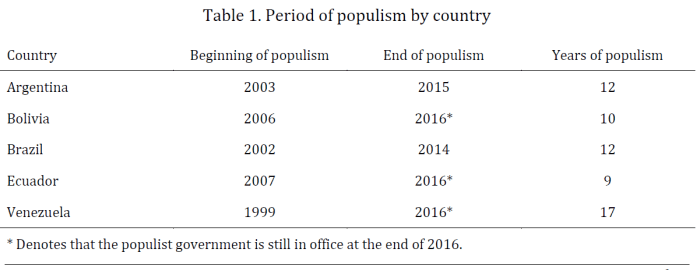
There are five cases of populist governments in Latin America that can work as benchmarks for the region. In particular, we can look at the behavior of governments in Argentina, Bolivia, Brazil, Ecuador, and Venezuela for the time frames depicted in the following table.

Table 1

During this time period, populist governments failed to increase GDP per capita consistently faster than the region. The only exception is Argentina. But its fast increase in GDP is largely explained as recovery after the 2001 crisis and by consuming capital stock, not as an expansion of potential output. It is no accident that Argentina met stagflation in 2007. In the last three issues of the Economic Freedom of the World (Fraser Institute) Argentina ranks among the bottom 10 free economies in the world.

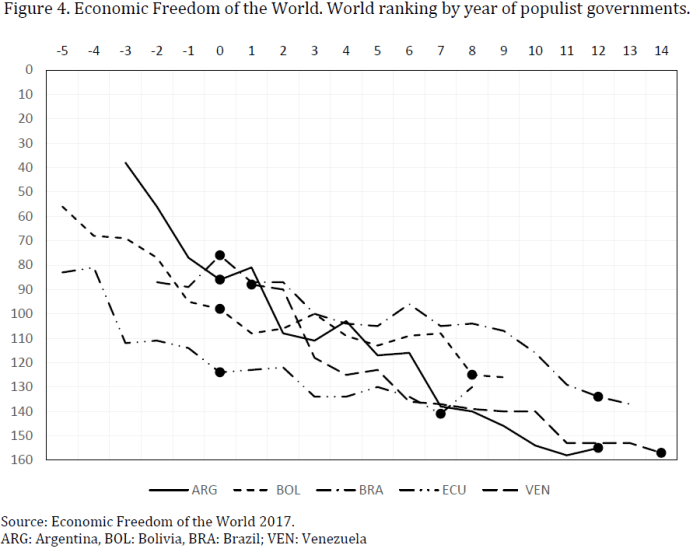
The following figure shows the fall in ranking of each country in the Economic Freedom of the World.

Figure 1

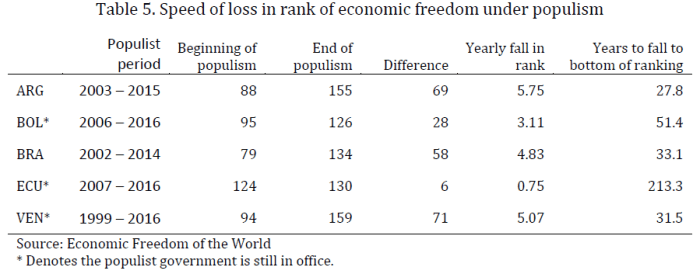
We can translate the information shown in the above into loss of ranking position per year of populist government. This is what is shown in the next table.

Table 2

This table offers a few readings:

  1. Argentina is the country that fall in the ranking of economic faster than its peers.
  2. Ecuador shows a very slow fall. This is due to two reasons: (1) Ecuador already starts from a low ranking position. (2) The last year of the index (2015) shows an improvement (without this improvement the fall is quite sharp as well.) Ecuador does not represent a case of “good populism.”

What this table is showing is that if an individual is born in any of these countries ranking 1st in economic freedom the same year a populist government takes office, then the same country will rank at the bottom of the world before he retires. In the case of Argentina, in 27.8 years the country will be at the bottom of the list, this means that by the time this individual starts to work, Argentina will already have a very repressed economy. By retiring time, this individual will have no experience of living and working in a free economy.

This numbers are not just descriptive of populism in Latin American countries. They also serve as a sort of warning for Europe and the United States, regions that have already seen some signs of populist behavior in their governments and political groups in the last few years. Populism can be emotionally attractive, but is very dangerous for our economic freedoms.

What is a “left libertarian”?

I often hear a contrast drawn between “left-” and “right-libertarians.” In fact, I hear it so often, that I have no idea what it could possibly refer to. The history of the word makes it particularly confusing.

The word “libertarian,” prior to, perhaps, the later 20th century, referred to (definitely) left-wing, anarchist philosophies. The point is well-known and harmless. The modern day, American usage of the term refers to a different branch of philosophies, with a common root in classical liberalism. Comparing the left-wing anarchists of old to the Libertarian Party, for instance, would draw an obvious line between left-wing and right-wing politics. There’s nothing wrong or appropriative about this name change. The word “liberal” has also suffered a large definitional change in the United States that it hasn’t in most other countries. It could be argued that most political groups have shifted around under various names, at times co-opting even their ideological opponent’s.

So, “libertarian” to the average joe nowadays means something different than the libertarian socialism espoused by Proudhon or Bakunin. However, it could still be applied; it might just be an anachronism: two very different referents.

Then, for the modern libertarian movement, there again appears a “left” and “right” division. For instance, I hear Cato or the Institute for Humane Studies regarded as left-libertarian, and the Mises Institute as right-libertarian. Bleeding Heart Libertarians is called left-libertarian. These “left” groups are, however, all clearly in favor of mostly free market capitalism. Then there’s Center for a Stateless Society, which labels itself “pro-market anarchist,” and then, when people confuse it for just, I don’t know, anarcho-capitalism, Kevin Carson says he wants to use the word market instead. Maybe capitalism is too long to spell. In any case C4SS is considered left-libertarian. Michelangelo seems to use the term to refer to, again, capitalism-inclined folks. (I also hear Students for Liberty referred to as left- and Young Americans for Liberty more right-libertarian.)

“Left-libertarians” are not all anarchists intent on abolishing the state, but some are; meanwhile, libertarian socialists would hardly call market anarchism an “anarchism” at all, since they oppose private property rights. If you ask them, they generally seem pretty pissed off about the whole name co-opting. Noam Chomsky is, anyway.

So, it looks like there’s the left libertarians, who may be using an American anachronism, but maintain their philosophical etymology just as classical liberals try to. And then there’s the left-libertarians, who would still fall in the bottom-right of the modern political compass, directly to the left of the right-libertarians. Does that sound right? What is the sense in which a libertarian qua libertarian would use the term “left-libertarian”?

It doesn’t usually seem like libertarians use the term left-libertarian to refer to anarchic socialists, but it sometimes does. Hanging out with Marxists only makes it worse. I’m looking for someone who has been around the liberty movement longer than I have to make sense of it.

North Korea at the North Sea?

Yesterday, both Houses of Dutch Parliament jointly opened the parliamentary year, which is always held on the third Tuesday in September, and is known as “Budget Day.” Normally, there is not much pomp and glory in the Low Lands, but on “Little Princes Day” (as the day is literally called), we go all-out: the King and Queen are driven in a horse-pulled carriage to the Hall of Knights, the oldest part of the parliamentary buildings (built around 1250), surrounded by military troops in full ceremonial dress. The King reads his speech (actually written by and under full political responsibility of the Prime Minister and cabinet) from a huge throne, announcing the government’s plans for the next year. Male ministers in morning coats, ladies in dresses and hats, with the powerful elites also assembled.

king and queen
King Willem-Alexander and Queen Maxima entering the Hall of Knights (source)

After the reading, the Royal couple make their way back to one of their palaces in the centre of The Hague, returning once to greet the masses from the balcony.

Meanwhile, the Minister of Finance officially presents the 2018 budget to the Lower House. The separate budgets of all departments are laws, which will have to pass both Houses before 31 December. This process is normally preceded by a two day debate on “the general state of the country,” but this year it is skipped because there is only a caretaker government in office. It awaits the finalization of negotiations for a new government, which started right after the elections on 15 March. Still no government is formed, although it is widely expected that a four-party coalition will be presented within a few weeks, consisting of small Christian left wingers, centre Christian Democrats, and two social liberal parties, D66, and Prime Minister Mark Rutte’s VVD.

Although much improved since the low point of the Great Recession, around 2011-2012, the public finances are still shocking from a classical liberal perspective. The income of the national government is 285 billion Euro (around 338.5 billion USD), which is 43% of GDP.

It consists mainly of several mandatory insurance premiums for collective arrangements (112.2 billion Euro), income tax (55.4 billion; the highest bracket of 51.5% tax applies to all personal income over 68.507 Euro), and VAT (52.8 billion). The rest are mainly specific taxes, related to companies, the environment, excises, dividends, et cetera. In 2011, the public share of GDP was still 47%, while in the 1980s it reached peaks of around 60%. Not exactly anywhere near an ideal liberal situation, no matter what liberal persuasion you are. Personally, I would argue that 25% should be the max for a decent set of state tasks, but I am sure that makes me some weird Northern European commie in some American libertarian eyes!

The situation is even more dire if we see where that money is spent. Health care (80.4 billion euro) and social security (79 billion) are always in competition as the largest spending departments. So that is 56% of the budget already and both increase annually, no matter the economic circumstances. The third post is public education (35.4 billion), followed by funds for provinces and municipalities (24.4 billion), foreign affairs and foreign aid (12), police and judiciary (10.3), defense (8.4), and infrastructure and environment (also 8.4), with the other departments taking parts of the rest. Despite a very rare expected budgetary surplus of 7.8 billion in 2018, the national debt is still 53.7% of GDP. Perhaps not bad in international comparison, still not good for any liberal.

These numbers are only part of the story, because there are also numerous local taxes, and the number of liberty-inhibiting regulations, from European, national, provincial and local origin are staggering. There is not one really free market, and there are hardly parts of individual life not regulated or influenced by the state. A comparison with North Korea is of course still far-fetched, yet socialism is alive and kicking on the North Sea shores.

In my view it is evidence of the remarkable power of capitalism that The Netherlands is still one of the richest countries on earth, a global top 15 economy (GDP per capita), with only 17 million inhabitants. No matter how hard you curb it, the capitalist system still delivers amazing results. Of course, the opportunity costs of the Dutch regulatory state are very high. In terms of personal liberty there are not many better places on the planet. Yet in other fields it is a different story. Economic freedom is a mess, which means that the material aspects of personal freedom are seriously restricted. Yet the worst is the mentality. Sadly, most Dutch have traveled the whole Hayekian Road to Serfdom, making a shift to classical liberalism highly unlikely.

A photo of Vincent and Michelangelo

Proof that NoL bloggers are living beings. Anyone else have photos of NoL meet ups?

Deontology and consequentialism, again

Christopher Freiman, associate professor in philosophy at William and Mary and writer at Bleeding Heart Libertarians, identifies as both a libertarian and utilitarian. Since my first real introduction to libertarianism was Harvard theorist Robert Nozick, I originally envisioned the philosophy as a rights-based, and thereby in some sense deontological, political theory, with like-minded economists and political scientists arguing for its merits in terms of material conditions (its consequences). In university philosophy courses, “libertarianism” means self-ownership and property rights, often through Nozick’s analytic approach. Consequentialism looked more like a top-down approach on how to live, one that doesn’t necessarily suggest any political theory, or does so only ambiguously.

In living by a deontological ethics, considerations about the consequences of an action will almost inevitably come into play, especially when pressed with more extraordinary cases. (Brandon has pointed out their ostensible — I think it only that — compatibility.) The right of an individual to not be violently attacked, for example, seems trumped in the face of the alternative immediate destruction of every other human being. I don’t think this is a great method for deducing practical principles, however. Although considering extreme cases might be entertaining and enlightening as to the durability of a thesis, their pragmatic import is typically negligible.

However, in considering their philosophical compatibility, libertarianism and utilitarianism feel at odds, and not over extreme counterexamples. Let’s look at a few low-hanging fruits. Suppose the National Security Agency had advanced knowledge that someone was planning to attack a nightclub in Orlando a few weeks prior to June 12, 2016. Private security would have increased, several clubs would have shut down. Were the threat classified as serious enough, state government might debate the Constitutionality of entering peoples’ homes and forcefully taking firearms; they might do this and succeed. Any further firearm sales would also be prohibited. This is an awful lot of state power and intrusion. However, fifty lives are plausibly saved, including Omar Mateen, and the lives of their family and friends are not devastated. Using a hedonistic calculus, these efforts look justified. Now, ignoring the NSA’s incompetency, suppose that our security agencies predicted the hijackings several months before September 11, about sixteen years ago to this day. In a utilitarian model, would the choice to prevent any civilian boarding for so many days, in order to prevent tragedy, be the correct one? In essence, is the partial nuisance to a substantial number of people overridden by the imperative to save 2,996 lives? Certainly — through utilitarianism — yes: the government ought to intervene and shut down air travel. In fact, the state determined it had a compelling interest immediately after the attacks and did this very thing, balancing national security over civil liberties.

Utilitarianism and liberal positions also challenge each other aggressively on issues like gun rights. In theory, were it possible to completely remove firearms from the states, there would be a gain in utility for the lives saved that would otherwise be lost to gun violence accidental or otherwise. Many people suffering nuisance (e.g. loss of pleasure from visiting the shooting range and insecurity about home invasion) is less consequential than the saving of lives.

And what of abortion? I align with reproductive rights, like plenty but not nearly all libertarians. Is choice, here, compatible with utilitarianism? All the additional children, bringing their own default happiness (cf. David Benatar for a counterargument), might be a utility bomb large enough to warrant invasive pro-life measures under utilitarianism, regardless of first, second or third trimester.

There are surely historical arguments that protest awarding the consequentialist victory so easily to the side of authoritarianism. For example, a nation equipped with the administrative power to invade private citizens’ homes and families, or cancel intranational travel or immigration, is probably not the nation which, in the long run, leads to the most utility or happiness. Nationhood aside, if all firearms were removed from society, this too might not be that which leads to the greatest net utility: maybe home invasion becomes epidemic; maybe rural areas that capitalize on hunting fall into unforeseen economic concerns; maybe the sheer quantity of the nuisance outweighs the beneficial effect of confiscation. The consequences of most of these issues are empirical and fall to historical argument. However, at least to me, utilitarianism seems incompatible with a variety of rights-based libertarian commitments, and thus deontological considerations become essential.

Here is another challenge to utilitarianism in general, and particularly Bentham’s project of a utilitarian legal system: discovering utils, or quantifying how much utility is connected to any action, is difficult. (And, since it has been, in all instantations, attached to government policy — not cooperation among peoples — it suffers from planning concerns on an even more detrimental scale.) The calculation is even more challenging when considering “short” versus “long term” effects. In the cases of Patriot Act-style defense, gun control (were it possible), and abortion, large-scale government intervention is, prima facie, justified by utilitarianism; yet over time, it may become evident that these choices result in overall poorer consequences. How much time do we wait to decide if it was the utilitarian decision? — And in the episodes of history, did any of those scenarios play out long enough to give a definitive “long term” case study? Swapping classical for “rule ulitarianism” doesn’t remove this epistemic barrier. There isn’t a non-arbitrary rule that determines how many moments into the future one must wait before judging the utility-consequence of any action, for those actions where we cannot pinpoint the closed-system end of the casual chain. Another related concern is that utilitarian judgments take on society as a whole, with little room for specific circumstances and idiosyncracies. This is why it strikes me as viciously top-down.

Thus the two philosophies, one etho-political and one entirely ethical, appear to conflict on several important considerations. (Most of the principles of the Libertarian Party, to name one platform, are not utilitarian.) Lengthy historical arguments become necessary to challenge the compelling nature of particular hypotheticals. J. S. Mill, whose utilitarian work inspired much of the classical liberal tradition, was, at the end of the day, a consequentialist; however, his harm principle from On Liberty is definitively rights-based, and this principle is at the core of his libertarian import, along with his anti-paternalism as espoused by people like Freiman. Freiman acknowledges some of the criticisms of utilitarianism, being (I think) a Millian and a libertarian, including one of its most prominent objections from those concerned with individual liberty: the separateness of persons, as offered from critics like Rawls. His response to this problem is essentially the one that falls to historical argument: “While it is possible for utilitarianism to recommend organ harvesting, hospitals that expropriate organs would not contribute to a happy and peaceful society in the real world.” This empirical conjecture leaves the realm of philosophy for us.

The inconsistencies promulgated by Mill — from his political philosophy, namely in On Liberty (1859), and his ethical philosophy, namely in Utilitarianism (1863) — may be why both consequentialist and deontologist libertarians can find support in his writings. Combinations like these are no doubt why Brandon finds the two compatible.

I don’t find them compatible, though utilitarianism as it was understood before Rawls may be the worse of the two (although rhetorically more effective). The modern father of deontology, Immanuel Kant, rejected the consequentialist ethos in his call to “treat people as ends, not means.” Utilitarianism, as broadly understood, has every reason to produce an omnipotent authority figure that will approve any gamut of regulatory and coercive policies if it seems to benefit the greatest interest of the majority. The “seems to” part is the only part that matters, since plans have to be acted on the basis of best knowledge; and I would maintain that estimating utils is never certain, being an empirical question made especially blurry by historical confusion. Brandon gave the example of the Great Leap Forward as an instance where we see utmost disregard for human sanctity in the sake of majoritarian or nationalist or “best interest” considerations.

Yet Kant can be interpretated as no less controlling. Deontology, from deos “duty,” is the study of what is morally permissible or obligatory, and to this natural rights is just one possible derivative. He is taken to be a natural rights theorist, and there is a separateness of persons explicit in his ethics absent from Bentham and Mills’ greatest happiness principle. But although Kant’s metaphysics of morals has persons, and not majorities, his Protestant upbringing shines through in his conservative views on sexuality and otherwise non-political behavior.

In a comment on Freiman’s post, Matt Zwolinksi objects to his assertion that utilitarianism is opposed to the interference of government in private, consenting interactions between adults (for some of the reasons mentioned above, and I agree). Zwolinski says, on the other hand, that Kant was strongly anti-paternalist. I doubt this. Immanuel Kant wrote criticisms of casual sex — each party is self-interested, and not concerned about the innate dignity of the other — and, like other Enlightenment philosophers, advanced that true freedom is something other than acting how one wishes within the bounds of others’ rights (true freedom is, in fact, acting according to how Kant wants you to act). It’s not exactly clear if his traditionalist positions on personal morality follow from his categorical imperative, but his duty ethics in isolation prohibits many activities we would take to be personal freedoms regardless. Kant might have opposed forms of government paternalism, but his entire ethical philosophy is paternalistic by itself.

For example, what would a Kantian say about a proposal to legalize prostitution? When someone pays another for sexual favors, the former is definitely not considering the latter’s innate dignity. The person who sells their body is treated as means to an end and not an end in themselves. Presumably, since Kant thought the state has a role in regulating other behavior, he would be against this policy change. This is confusing, though, because in most trades people use each other as means and not ends. The sexual transaction is analogous enough to any sort of trade between persons, in which we consider each other in terms of our own immediate benefit and not inherent humanity. When I purchase a Gatorade from a gas station, I am using the cashier as the means to acquire a beverage. Kantian deontologists could, the same as the utilitarians, call to organize all the minutiae of personal life to coordinate with the ideals of one man from Königsberg.

Meanwhile, what does the classical utilitarian say about legalizing prostitution? We only have to weigh the utility gained and lost. First of all, it helps the customers, who no longer have to enter the seedy black market to buy a one-night stand. Next, it helps the workers, who in a regulated marketplace are treated better and are less likely to receive abuse from off-the-radar pimps. There would likely be a dip in human trafficking, which would raise the utility of would-be kidnapees. In addition, it creates new jobs for the poor. If you are in poverty, it automatically benefits you if a new way to create income is opened up and legally protected. Further, with legalization there would be less stigmatization, and so all involved parties benefit from the mitigated social ostracization too. The disutility is minor, and comes from the pimps (who lose much of their workforce), abusive tricks who get away with physical violence as long as prostitution is underground, and the slight increase in moral disgust from involved sexual prudes around the globe. So, it seems safe to award the legalization case to Bentham and Mill, and indeed decriminalizing prostitution is the right thing to do. (Although we see another fault. Since all humans are equal, their utility too is considered equally: the utility of “bad men” is worth as must as the utility of “good men,” there being no meta-util standard of good.)

In this situation, utilitarianism helps the libertarian cause of individual freedom and self-determination; in others, duty based ethics are a closer bet. Natural rights perspectives, from Cicero and Aquinas to Nozick and Rothbard, on average satisfy more of the conditions which we find essential to libertarian concerns, especially when the emphasis is on the individual. That said, Kant is a deontologist and not necessarily a freedom-lover. Neither utilitarianism nor Kantian deontology point obviously to libertarianism. The moral psychology research of Jonathan Haidt gives us reason to surmise that it’s mostly “left-libertarians” that think in terms of consequences, and “right-libertarians” that stick to natural rights or deontologic premises. I think, regardless of which theory is more correct, they both capture our ethical intuitions in different ways at different times — and this without even considering other popular theories, like Aristotle’s virtue ethics, Rawlsian justice as fairness, loyalty ethics or Gilligan’s ethics of care.*

I like a lot of Christopher Freiman’s writing on Rawls and basic income. However, I find utilitarianism has to submit to empirical inquiry a little too often to answer fundamental questions, and in its ambiguity often points to policy that disrespects the atomic individual in favor of a bloated government. I don’t think utilitarianism or deontology à la Kant are the bedrock of libertarian principles, but ultimately natural rights is the most non-incorrect position and groups together most cohesively the wide range of positions within libertarianism.

* Gilligan’s ethics of care is terrible.