Where is the line between sympathy and paternalism?

In higher-ed news two types of terrifying stories come up pretty frequently: free speech stories, and Title IX stories. You’d think these stories would only be relevant to academics and students, but they’re not. These issues are certainly very important for those of us who hang out in ivory towers. But those towers shape the debate–and unquestioned assumptions–that determine real world policy in board rooms and capitols. This is especially true in a world where a bachelor’s degree is the new GED.

The free speech stories have gotten boring because they all take the following form: group A doesn’t want to let group B talk about opinion b so they act like a bunch of jackasses. Usually this takes place at a school for rich kids. Usually those kids are majoring in something that will give them no marketable skills.

The Title IX stories are Kafkaesque tales where a well-intentioned policy (create a system to protect people in colleges from sexism and sexual aggression) turns into a kangaroo court that allows terrible people to ruin other people’s lives. (I hasten to add, I’m sure Title IX offices do plenty of legitimately great work.)

A great article in the Chronicle gives an inside look at one of these tribunals. For the most part it’s chilling. Peter Ludlow had been accused of sexual assault, but the claims weren’t terribly credible. As far as I can tell (based only on this article) he did some things that should raise some eyebrows, but nothing genuinely against any rules. Nonetheless, the accusations were a potential PR and liability problem for the school so he had to go, regardless of justice.

The glimmer of hope comes with the testimony of Jessica Wilson. She managed to shake them out of their foregone conclusion and got them to consider that women above the age of consent can be active participants in their own lives instead of victims waiting to happen. Yes, bad things happen to women, but that’s not enough to jump to the conclusion that all women are victims and all men are aggressors.

The big question at the root of these types of stories is how much responsibility we ought to take for our lives.

Free speech: Should I be held responsible for saying insensitive (or unpatriotic) things? Who would enforce that obligations? Should I be held responsible for dealing with the insensitive things other people might say? Or should I even be allowed to hear what other people might say because I can’t take responsibility for evaluating it “critically” and coming to the right conclusion.

Title IX: Should women be responsible for their own protection, or is that akin to blaming the victim? We’ve gone from trying to create an environment where everyone can contribute to taking away agency. In doing so we’ve also created a powerful mechanism that can be abused. This is bad because of the harm it does to the falsely accused, but it also has the potential to delegitimize the claims of genuine victims and fractures society. But our forebears weren’t exactly saints when it came to treating each other justly.

Where is the line between helping a group and infantilizing them?

At either end of a spectrum I imagine caricature versions of a teenage libertarian (“your problems are your own, suck it up while I shout dumb things at you”) and a social justice warrior (“it’s everyone else’s fault! Let’s occupy!”). Let’s call those end points Atomistic Responsibility and Social Responsibility. More sarcastically, we could call them Robot and Common Pool Responsibility. Nobody is actually at these extreme ends (I hope), but some people get close.

Either one seems ridiculous to anyone who doesn’t already subscribe to that view, but both have a kernel of truth. Fair or not, you have to take responsibility for your life. But we’re all indelibly shaped by our environment.

Schools have historically adopted a policy towards the atomistic end, but have been trending in the other direction. I don’t think this is universally bad, but I think those values cannot properly coexist within a single organization.

We can imagine some hypothetical proper point on the Responsibility Spectrum, but without a way to objectively measure virtue, the position of that point–the line between sympathy and paternalism–its location is an open question. We need debate to better position and re-position that line. I would argue that Western societies have been doing a pretty good job of moving that line in the right direction over the last 100 years (although I disagree with many of the ways our predecessors have chosen to enforce that line).

But here’s the thing: we can’t move in the right direction without getting real-time feedback from our environments. Without variation in the data, we can’t draw any conclusions. What we need more than a proper split of responsibility, is a range of possibilities being constantly tinkered with and explored.

We need a diversity of approaches. This is why freedom of speech and freedom of association are so essential. In order to get this diversity, we need federalism and polycentricity–stop trying to impose order from the top down on a grand scale (“think globally, act locally“), and let order be created from the bottom up. Let our organizations–businesses, churches, civic associations, local governments and special districts–adapt to their circumstances and the wishes of their stakeholders.

Benefiting from this diversity requires open minds and epistemic humility. We stand on the shore of a vast mysterious ocean. We’ve waded a short distance into the water and learned a lot, but there’s infinitely more to learn!

https://youtu.be/bzS39oghcnY?t=2m29s

(Sidenote: Looking for that Carl Sagan quote I came across this gem:

People are not stupid. They believe things for reasons. The last way for skeptics to get the attention of bright, curious, intelligent people is to belittle or condescend or to show arrogance toward their beliefs.

That about sums up my approach to discussing these sorts of issues. We’d all do better to occasionally give our opponents the benefit of the doubt and see what we can learn from them. Being a purist is a great way to structure your thought, but empathy for our opponents is how we make our theories strong.

Does business success make a good statesman?

Gary Becker made the distinction between two types of on-the-job training: general and specific. The former consist of the skills of wide applicability, which enable the worker to perform satisfactorily different kinds of jobs: to keep one’s commitments, to arrive on time to work, to avoid disturbing behavior, etc.. All of them are moral traits that raise the productivity of the worker whichever his occupation would be. On the other hand, specific on-the-job training only concerns the peculiarities of a given job: to know how many spoons of sugar your boss likes for his coffee or which of your employees is better qualified to deal with the public. The knowledge provided by the on-the-job training is incorporated to the worker, it travels with him when he moves from one company to another. Therefore, while the general on-the-job training increases the worker productivity in every other job he gets, he makes a poor profit from the specific one.

Of course, it is relative to each profession and industry whether the on-the-job training is general or specific. For example, a psychiatrist who works for a general hospital gets specific training about the concrete dynamics of its internal organization. If he later moves to a position in another hospital, his experience dealing with the internal politics of such institutions will count as general on-the-job training. If he then goes freelance instead, that experience will be of little use for his career. Nevertheless, even though the said psychiatrist switches from working for a big general hospital to working on his own, he will carry with him a valuable general on-the-job training: how to look after his patients, how to deal with their relatives, etc.

So, to what extent will on-the-job training gained by a successful businessman enable him to be a good statesman? In the same degree that a successful lawyer, a successful sportsman, a successful writer is enabled to be one. Every successful person carries with him a set of personal traits that are very useful in almost every field of human experience: self confidence, work ethics, constancy, and so on. If you lack any of them, you could hardly be a good politician, so as you rarely could achieve anything in any other field. But these qualities are the typical examples of general on-the-job training and what we are inquiring here is whether the specific on-the-job training of a successful businessman could enable him with a relative advantage to be a better politician -or at least have a better chance of being a good one.

The problem is that there is no such a thing as an a priori successful businessman. We can state that a doctor, an engineer, or a biologist need to have certain qualifications to be a competent professional. But the performance of a businessman depends on a multiplicity of variables that prevents us from elucidating which traits would lead him to success.

Medicine, physics, and biology deal with “simple phenomena”. The limits to the knowledge of such disciplines are relative to the development of the investigations in such fields (see F. A. Hayek, “The Theory of Complex Phenomena”). The more those professionals study, the more they work, the better trained they will be.

On the other hand, the law and the market economy are cases of “complex phenomena” (see F. A. Hayek, Law, Legislation and Liberty). Since the limits to the knowledge of such phenomena are absolute, a discovery process of trial and error applied to concrete cases is the only way to weather such uncertainty. The judge states the solution the law provides to a concrete controversy, but the lawmaker is enabled to state what the law says only in general and abstract terms. In the same sense, the personal strategy of a businessman is successful only under certain circumstances.

So, how does the market economy survive to its own complexity? The market does not need wise businessmen, but lots of purposeful ones, eager to thrive following their stubborn vision of the business. Most of them will be wrong about their perception of the market and subsequently will fail. A few others will prosper, since their plans meet -perhaps by chance- the changing demands of the market. Thus, the personal traits that led a successful businessman to prosperity were not universal, but the right ones for the specific time he carried out his plans.

Having said that, would a purposeful and stubborn politician a good choice for government? After all, Niccolo Macchiavelli had pointed out that initiative was the main virtue of the prince. Then, a good statesman would be the one who handles successfully the changing opportunities of life and politics. Notwithstanding, The Prince was -as Quentin Skinner showed- a parody: opportunistic behaviour is no good to the accomplishment of public duties and the protection of civil liberties.

Nevertheless, there is still a convincing argument for the businessman as a prospect of statesman. If he has to deal with the system of checks and balances -the Congress and the Courts-, the law will act as the selection process of the market. Every time a decision based on expediency collides with fundamental liberties, the latter must withstand the former. A sort of natural selection of political decisions.

Quite obvious, but not so trite. For a stubborn and purposeful politician not to become a menace to individual and public liberties, his initiative must not venture into constitutional design. No bypasses, no exceptions, not even reforms to the legal restraints to the public authority must be allowed, even in the name of emergency. Especially for most of the emergencies often brought about by measures based on expediency.

Coup and Counter Coup VI: Presidential Authoritarianism in Turkey

(Previous posts here, here, here, here and here). The state of emergency proclaimed by President Erdoğan in Turkey on 20th July last year, in response to the coup attempt of five days before, is not a situation that will come to an end in a return to normality. It is the model for the presidential system that Erdoğan has been pushing for since 2007, when he was still admired by many liberal minded people inside Turkey (though not me) and abroad. One of the key provisions of the state of emergency is that the President can issue decrees with the force of law. There are doubts about the constitutionality of this form of ‘law making’ but two members of the Constitutional Court were arrested after the coup attempt and the chances of the court starting up to executive power are now extremely remote. Judges and prosecutors have been demoted and even arrested after making the ‘wrong’ decision during the state of emergency and I do not think Erdoğan and his associates would have any scruples at all about further arrests of judges in the Constitutional Court.

The Presidential system, or one person rule system, which Turks will vote on, will retain the decrees as law powers of the Presidency. There are some limits on the decrees issued, but as the President will control the appointment of most of the senior judiciary there are serious questions about whether the Constitutional Court will put any effective break on these powers to legislate through decree. There is no sign of the state of emergency ending, though at least now everyone can see the deception in the original decision to declare a state of emergency for three months only instead of the six months maximum allowed in the Constitution. The state of emergency is renewed every three months with no debate and no indication of when it will come to an end. Does Erdoğan have any intention of ending the state of emergency before he becomes a President elected with the new powers? In principle these powers should only be implemented after the next presidential election in 2019, coinciding with elections to the National Assembly. Erdoğan may wish to bring these elections forward, particularly for the National Assembly if he loses the referendum. While it may seem outrageous for the Council of Ministers to keep prolonging the state of emergency until 2019, the AKP government has been doing more and more previously outrageous and even unimaginable things now for some years, particularly since the Gezi protests of 2013.

What the state of emergency also means is that suspects can be held without charge and access to lawyers if charged with ‘terrorism’, which is defined in absurdly broad ways to cover any kind of contact with the Gülenists or sympathy for the Kurdish autonomy movement. Torture has been making a return in Turkey after becoming relatively unusual since the PKK terror campaign began again in 2015. The state of emergency conditions have now normalised it completely and though the government denies torture charges, in the normal manner of authoritarian regimes, claiming the charges are terrorist propaganda, you have to wonder how seriously they expect anyone to take the denials. Photographs of the alleged coup plotters immediately after the coup attempt showed they had been badly beaten, though of course this is explained away as the result of ‘resisting arrest’, another time-honoured evasion. Consistent reports suggest prisoners are denied food, placed in stress positions for long periods of time, beaten and sexually assaulted. In the more moderate cases, the prison officials merely restrict prisoners to a diet of bread and bad quality tap water in conditions of psychological abuse. There is amongst everything else in Turkey a growing problem of mental and emotion health problems amongst the survivors of these ordeals, which are of course excluded from the mainstream media.

The rhetoric and abuse used by police ‘special teams’ invading the media and political offices of ‘terrorist’, that is Kurdish autonomy and other leftist groups, involve extreme nationalism and Ottomanism. Kurds are insulted as covert Armenians. Actual Armenians are told that the Ottomans destroyed the Armenians and that Turks are the masters of Armenian. A particularly disgusting reference to the massacre of 1 500 000 Armenians during World War One. These are not aberrations, this behaviour reflects the deep ideology of the AKP, mixing extreme nationalism and Ottomanism, of course ignoring the tensions between these positions. The torture and abuse is legitimated in the minds of perpetrators by a political rhetoric and government measures which present opponents as terrorist and part of international conspiracies against the ‘innocent’ Turks who are so good they are naive. This I am afraid is no exaggeration of the political discourse of the moment.

There is no reason to think the abuse and political extremism will end, though of course we should hope it does. If all Gülenists – real and imagined – and all sympathisers with Kurdish autonomy or the far left are targeted, then there are essentially endless opportunities for authoritarianism, polarising dehumanising rhetoric and abuse. I can only presume the current atmosphere will last indefinitely, as Erdoğan has found it a successful strategy for staying in power and increasing his power.

It is of course not just a question of his own political power. There is the question of how his family occupy places of privilege in large Muslims NGOs (at the same time as non-AKP oriented NGOs come under increasing pressure) with huge budgets and sit on the boards of major companies in Turkey. Erdoğan does not envisage any situation in which these activities are placed under mainstream media examination, and even less legal investigation. The issue of legal immunity is a huge one in Turkish politics. The amended constitution would allow the President to appoint anyone to two vice presidential positions and to the cabinet. Like the President all these people would have lifetime immunity from prosecution for activities undertaken while in office. Though the National Assembly would have the power to send the President to the Constitutional Court, this requires a very high threshold, clearly designed to protect Erdoğan even if the AKP loses a large part of its support.

As mentioned above, there is an expectation that Erdoğan will call an early National Assembly election if he loses the referendum. It seems likely on current polling that two out of the three opposition parties currently in the National Assembly would fail to meet the electoral thresh hold of 10%. This means the National Action Party, which has split over the referendum, and the Kurdish radicals who have lost some of their more moderate support since the revival of PKK violence. In such a National Assembly, the AKP could certainly put any constitutional proposal to referendum and very possibly could have enough votes to amend the constitution without referendum. So even if Erdoğan loses the election, he could get the same measures, or close enough, through other means.

(Last post in the current series, though I will post an appendix on Ottomanist and Atatürkist legacies in Turkey, along with comments on related political thought.)

Coup and Counter Coup IV The Kurdish issue in Turkey

Previous parts here, here and here. As mentioned in the last post, in the immediate post coup atmosphere President Erdoğan appeared to have the support of some significant part of Kemalist (as in Kemal Atatürk who shaped the Turkish republic with reference to secularism, modernisation, national sovereignty and statism) opinion, the more hard core part, seeing shared enemies in both violent Kurdish separatists and Gülenist (members of a religious community, see previous posts) infiltrators into the state apparatus. The return of PKK (the Kurdish acronym for Workers’ Party of Kurdistan) violence against state forces and civilians (the latter largely undertaken by the Freedom Falcons of Kurdistan, TAK in the Kurdish acronym, a product of the PKK) in the summer of 2015 already placed the AKP, hardcore Kemalists, and the Nationalist Action Party (MHP, rooted in a ‘Grey Wolf’ or ‘Idealist’ ideology of absolutist state nationalism and Pan-Turkism) on the same side advocating a militant response including support for the army-led destruction of whole urban areas in PKK strongholds in the southeast. Previously the latter two groups had regarded the AKP as treasonous for holding talks with Abdullah Öcalan, the imprisoned founder-leader of the PKK, fearing a federalised Turkey with a southeast federal region under strong PKK influence. The talks were not at all public, no attempt was made to prepare public opinion for possible evolution in the Turkish state tradition, or to hold any kind of open discussion on the issues at stake.

The talks collapsed with Öcalan returned to strict prison conditions. Despite the MHP and hardcore Kemalist fears about federalisation on PKK terms, it seems likely that Erdoğan never intended more than token concessions to Kurdish identity and autonomy for the southeast, in exchange for operating for the PKK and a party with a common origin as an external support of the AKP. The party which has a common origin with the PKK is DBP (Turkish acronym for Democratic Regions Party) and the umbrella party it formed to accommodate small leftist groups (which don’t have specific Kurdish origins). It appears that the DBP hardcore does not like accommodating non-Kurds so the survival of HDP is not guaranteed. It poses a very happy image to leftist educated Turks, of interest in social liberalism, minority rights and left socialist policies. This reflects a historical feeling of marginalisation, because the CHP (Republican People’s Party: Kemalist/social democratic something like the French Socialist Party in merging Jacobin, social democratic and socialist traditions) is seen as too nationalist and not ‘really’ leftwing.

It tells you something about Turkish politics that there are people who insist that HDP is not leftwing despite its obvious leftwing policies and roots in the Maoist orientation of the PKK. This insistence is rooted in the belief that all left polices must be non-ethnic, that raising ethnic issues is inherently divisive and chauvinistic, reflecting of course a blindness to how some people experience the Turkish state as unaccommodating of, and even hostile to, expressions of identity by those people in Turkey who have a first language, and associated culture, other than Turkish. The Maoist and terrorist origins of the main expressions of Kurdish autonomy politics supports that majoritarian blindness and even chauvinism. Clearly they feed off each other.

The HDP has been turned into an effectively semi-legal party since the summer of 2015, which is not the right state reaction from the point of view of constitutional democracy and individual liberty. However, the HDP has to some degree brought this on itself, because while condemning the acts of terror directed from mountains in Iraq by the current PKK leader Cemil Bayık, it has never rejected the PKK as such, treating Öcalan as the symbolic leader of Kurds in Turkey, and adhering to a political rhetoric of ‘autonomy’ shared with the PKK.

The government has now used the state of emergency to take over the administration of all HDP led local government, that is local government throughout the southeast, appointing ‘trustees’ to run these municipalities. All media with an HDP orientation has been closed down and blocked online if based abroad.

Accusations have been made of the HDP using local government as infrastructure and a source of money for the PKK. This has yet to be proven in court. If it was, we would certainly have to consider the HDP to have taken a very bad path. As things stand, this has not been proven and the persecution of HDP politicians along with the takeover of HDP municipalities is highly premature, serving political power goals and grossly overriding any idea that guilt only exists if and when proven in court, preferably with judges under less political pressure than is the case at present in Turkey.

Immigration and Jobs

A couple of thoughts about immigration. It seems that there is a widespread belief in the US that immigrants take jobs from Americans. It makes superficial sense if you also assume that the number of jobs to be filled is fixed and that just about anyone can do any kind of work.

Both assumptions are mostly false. Here is an example that illustrates why.

I keep hearing native-born Americans trained in various high-tech fields who claim that they are unemployed because of competition from low-cost H1B visa holders. H1B visas go to foreigners with skills deemed to be needed by the American economy. A large number of H1B visa holders are from India and many are from China; they also come from a wide variety of other countries, including Russia, France, Bulgaria, etc. The implicit affirmation is that were such visas stopped completely, those who complain would step right into the vacant jobs.

Two things. First the claim that foreign H1B visa holders work for less is largely unsubstantiated although it should be easy to investigate such abuse. Second, I think it’s illegal to pay H1B holders less than Americans. Why would many employers risk a distracting lawsuit? Of course, a few might because there are irrational people everywhere.

Next and last: Hundreds of thousands of high-tech jobs are going begging as I write. Are employers so vicious that they would rather have the work not done at all than to give it to a credentialed American? Or is it more likely that the unemployed native-born high-tech workers have skills that do not match demand? If the second supposition is correct, ending the H1B visa program would cause even more high-tech positions to remain empty. Of course, this would have a negative effect on everyone, on every American’s prosperity.

Missing from this narrative: the possibility that high power, accelerated re-training programs would bring unemployed Americans the skills the high-tech sector requires.

I have to begin a confession that’s going to make me even more unpopular locally than I already am. I mean unpopular among my conservative friends. I taught in an MBA program in the middle of Silicon Valley for 24 years, two quarters each year. It was an evening program squarely directed at the ambitious hard-working. During that span of time, I must have had 150 students from India. I remember only one who was a bad student. I was intrigued, so I made inquiries. Sure enough, he had an Indian first name and last name, and the corresponding appearance but he was born in the US.* I cannot report so glowingly about other, non-Indian students that sat in my classroom through the years.

This little narrative proves nothing, of course. Consider it food for thought. Do it especially if you voted for Pres. Trump – as I did.

Reminder: H1B visas are awarded to individuals with an occupational qualification deemed to be in short supply in the US. Right now, it’s likely that most of those who get an H1B are trained in some IT area but that’s not all. For a long time, farriers from everywhere could easily get one. (If you don’t know what a farrier is, shame on you and look it up.)

There are other – presumably non-specialized – categories of immigrants who are widely suspected of taking jobs from Americans. The truth is not always easy to discern, not even conceptually. Five or six miles from where I live in Santa Cruz, there are growers who are tearing off their hair. Their problem is that they can’t figure out who is going to pick the crops they are now putting into the ground. As I have said repeatedly, the Mexicans they counted on in years past have largely stopped coming.

A quarter of a mile from where I live, and in the same direction, there are dozens of perfectly healthy US-born Americans who are working as “sales associates.” The apparent conceptual issue is this: sales associates earn $10/hr while a moderately experienced crop picker earns $15. The question arises of why we don’t see a full exodus from the sales positions to jobs that pay 50% more?

I think it’s lazy to call the US-born sales associates “lazy.” The reality is that the Mexicans who came, and are still coming, to pick vegetables and fruits in California overwhelmingly came from a rural population. They were reared under conditions where almost everyone around them labored in the fields. When they arrive in the US – legally through family reunion – or illegally, they are ready to take picking jobs. They then just do here more or less the same work they would do at home but for five times the pay or more.

In American society that kind of population disappeared several generations ago through mechanization and, of course, through the importation of foreign labor, precisely. Native-born Americans won’t do the work because it’s alien to their background. I think US-born people of Mexican ascendancy whose parents labored in the field won’t do the work either. Their parents do what they can to make their own work experience alien to their children. I am not surprised, that’s another expression of the American dream. It’s  what many would do back in Mexico but then, why emigrate?

I am pretty sure that any immigration reform should include a temporary agricultural program, a sort of H1A ( “A” for “Agriculture”) visa. It would allow foreigners to come to the US legally, just to work in the fields and for a set period only. It would not lead to permanent residency, nor, of course, to citizenship. Such a program existed between the forties and the early sixties, if memory serves. It was called the “Bracero program.” I don’t know why it was terminated. (Perhaps a reader can tell us.)

Mexicans would be the first to take advantage of such a program. As Mexico’s economy develops, they may be replaced by Central Americans and, eventually, by Africans. Such a program would sidestep the kind of assimilation problem France, for example, is facing right now with its North African population.

PS Personally, I think Mexicans make good immigrants to the US. I would bet than in ten years we will be begging them to come.


* Disclosure: I am married to an Indian woman. She is not in high-tech unfortunately.

Illegal Immigration: Pres. Trump’s New Measures

I can’t wait for the raging assaults by the pseudo-cultural elite and by the media against Pres. Trump to stop to begin criticizing some of his decisions, as I would with any other president.

I have heard and read reports that the president intends to launch a policy of accelerated repatriation of illegal aliens. It will single out criminals for priority deportation (as was the case under Mr Obama). At this point, almost everybody agrees about getting rid of illegal aliens who are real criminals, especially the violent ones. Again, the new policy sounds a lot like Mr Obama’s, with a few details different. The details often matter when it comes to human lives, also when it comes to traditions of government. Here are two such details.

First, I have heard that even traffic tickets qualify an illegal alien for quick deportation. Make a wrong u-turn and your life gets broken up.

Second, I have heard and read that even being merely charged with a crime places you at the head of the line for deportation. Someone who looks like you steals a car. You get charged by mistake. You are gone.

The first detail seems awfully rough to me. I would feel better if the word “recidivist” were included. A person who breaks driving rules repeatedly is a trouble-maker we can do without. A guy who is too distracted to interpret the U-turn sign (could be me – once) is not exactly a criminal in the real sense of the word.

It’s true that such extreme severity would improve the driving of all illegal aliens. The claim is probably also correct however that it would interfere with aliens’ (legal and not) willingness to cooperate with the local police. Aside from this, I would bet it would involve significant law enforcement costs just to process traffic tickets through to the Immigration Service. I am a conservative, I am against big government, even against big government at the local level. I don’t want tax money, federal, state, or local, to be wasted processing a U-turn violator. It seems irrational to me.

The second, detail concerns the treatment of people only charged with a crime. It’s simple. I just don’t want any of them to be included in the priority list. Having any branch of government treating the accused as guilty simply goes too strongly against everything I believe. It’s un-American.

Yes, I have not forgotten that the subjects have no right to be in the country in the first place. I don’t care. It’s not about illegal aliens’ rights. Immigrants, legal or not, have no rights as a category as far as I am concerned. They only possess the ordinary human rights of anyone under American jurisdiction.

It’s about a slippery slope for all. If we begin officially thinning out the traditional wall between “charged” and “guilty,” where are we going to stop?

I understand that a lawyer would argue that the person is technically not being deported for the imaginary crime of being charged but because he has no right to be in the country, period. Do you know the one about the lawyer….

Welfare Costs are not a Good Argument Against Immigration

Note: A version of this was initially posted on my old, now defunct blog. However, has become increasingly relevant in the age of Trump, and is worthy of reconsideration now.

It’s one of the most common arguments against looser immigration going back to Milton Friedman to Donald Trump. It is commonly claimed that even though loosening immigration restrictions may be economically beneficial and just, it should be opposed due to the existence of the welfare state. Proponents of this claim argue that immigrants can simply come to this country to obtain welfare benefits, doing no good for the economy and adding to budget deficits.

Though this claim is on its face plausible, welfare is not nearly as much of a compelling reason to oppose immigration as so many argue. It is ultimately an empirical question as to whether or not the fiscal costs of immigration significantly outweigh the fiscal benefits of having more immigrants pay taxes and more tax revenue economic growth caused by immigration.

Before delving into the empirical studies on the matter, there is one very important fact that is too often neglected in these discussions: there are already heavy laws restricting all illegal immigrants and even the vast majority of legal ones from receiving Welfare. As the federal government itself–specifically the HHS–notes:

With some exceptions, “Qualified Aliens” [ie., legal immigrants] entering the country after August 22, 1996, are denied “Federal means-tested public benefits” for their first five years in the U.S. as qualified aliens.

If we were to allow more immigrants, there are legal mechanisms stopping them from getting welfare. There are some exceptions and even unlawful immigrants occasionally slip through the cracks, but this is already a major hole in the case that welfare means we should hold off on immigration reform. The vast majority of immigrants cannot receive welfare until years after they are legalized.

However, for the sake of argument, let us ignore that initial hole in the case against increased immigration. Let’s generously assume the majority of immigrants–legal and illegal–can somehow get their hands on welfare. There is still little reason to expect that additional immigrants would be any more of a fiscal drag on welfare programs for the vast majority of our population simply because they are not the type of people who typically wind up on welfare. Our welfare programs are primarily designed to protect a select few types of people: the sick and elderly (Social Security and Medicare), and women and children (SCHIP, SNAP, TAMPF, etc.) If one looks at the demographics of immigrants coming into the country, however, one finds that they do not fit in the demographics of those who typically qualify for welfare programs. According to the Census Bureau, the vast majority (75.6%) of the total foreign-born population (both legal and illegal immigrants) are of working age (between 25 and 65).  Most immigrants, even if they were legal citizens, would not qualify for most welfare programs to begin with.

On the other hand, poverty rates are higher among immigrants and that means more would qualify for poverty-based programs. However, most immigrants are simply not the type to stay in those programs. Contrary to common belief, immigrants are mostly hard-working innovators rather than loafing welfare queens. According to Pew Research, 91% of all unauthorized immigrants are involved in the US labor force. Legal immigrants also start businesses at a higher rate than natural born citizens and file patents at almost double the rate of natives. As a result, immigrants have fairly high social mobility, especially intergenerationally, and so will not stay poor and on welfare all that long.

Put it together, and you find that immigrants generally use many major welfare programs at a lower rate than natives. Immigrants are 25% less likely to be enrolled in Medicare, for example, than citizens and actually contribute more to Medicare than they receive while citizens make Medicare run at a deficit. From the New York Times:

[A] study, led by researchers at Harvard Medical School, measured immigrants’ contributions to the part of Medicare that pays for hospital care, a trust fund that accounts for nearly half of the federal program’s revenue. It found that immigrants generated surpluses totaling $115 billion from 2002 to 2009. In comparison, the American-born population incurred a deficit of $28 billion over the same period

Of course, nobody would advocate restrictions on how many children are allowed to be born based on fiscal considerations. However, for some reason the concern becomes a big factor for immigration skeptics.

If you are still not convinced, let us go over the empirical literature on how much immigrants cost fiscally. Some fairly partisan studies, such as this one from the Heritage Foundation (written by an analyst who was forced to resign due to fairly racist claims), conclude that fiscal costs are very negative. The problem, however, is that most of these studies fail to take into account the dynamic macroeconomic impact of immigration. Opponents of immigration, especially those at the Heritage Foundation, generally understand the importance of taking dynamic economic impacts of policy changes into account on other issues, e.g. taxation; however, for some (partisan) reason fail to apply that logic to immigration policies. Like taxes, immigration laws change people’s behavior in ways that can increase revenue. First of all, more immigrants entering the economy immediately means more revenue as there are more people to tax. Additionally, economic growth from further division of labor provided by immigration increases tax revenue.  Any study that does not succeed in taking into account revenue gains from immigration is not worth taking seriously.

Among studies that are worth taking seriously, there is general consensus that immigrants are either a slight net gain fiscally speaking, a very slight net loss or have little to no impact. According to a study by the OECD of its 20 member countries, despite the fact that some of its countries have massive levels of immigration, the fiscal impact of immigration is “generally not exceeding 0.5 percent of G.D.P. in either positive or negative terms.” The study concluded, “The current impact of the cumulative waves of migration that arrived over the past 50 years is just not that large, whether on the positive or negative side.”

Specifically for the United States, another authoritative study in 1997 found the following as summarized by David Griswold of the Cato Institute:

The 1997 National Research Council study determined that the typical immigrant and descendants represent an $80,000 fiscal gain to the government in terms of net present value. But that gain divides into a positive $105,000 fiscal impact for the federal government and a negative $25,000 impact on the state and local level (NRC 1997: 337).

Despite the slight negative impact for states, as Griswold notes, there is no correlation between immigration and more welfare for immigrants:

Undocumented immigrants are even more likely to self-select states with below-average social spending. Between 2000 and 2009, the number of unauthorized immigrants in the low-spending states grew by a net 855,000, or 35 percent. In the high-spending states, the population grew by 385,000, or 11 percent (U.S. Census 2011; NASBO 2010: 33; Passel and Cohn 2011). One possible reason why unauthorized immigrants are even less drawn to high-welfare-spending states is that, unlike immigrants who have been naturalized, they are not eligible for any of the standard welfare programs.

The potential fiscal impact of immigration from the Welfare state is not a good reason to oppose it at all. There are major legal barriers to immigrants receiving welfare, immigrants are statistically less likely to receive welfare than natives for demographic reasons, and all the authoritative empirical evidence shows that immigrants are on net not a very significant fiscal drag and can, in fact, be a net fiscal gain.

On Gentrification, Inequality and Zoning

On the CityLab blog, Richard Florida posted a piece pointing out that gentrification has virtually no effects on homeowners. I can buy that result, especially since I wrote a policy piece for a think tank back in the summer of 2016 on the issue. The important point that Florida underlines (by citing a paper by Martin and Beck in Urban Affairs Review) is that homeowners are not being displaced, but renters are more likely to be. This will probably fuel some people who are concerned about inequality. I disagree.

I want to point out that my interest in the issue is entirely related to the issue of inequality which some individuals have tried to tie to gentrification (sometimes without understanding that causality can run both ways). If you want to tie the two issues together, then you must realize that there are four “types” of gentrification. First of all, gentrification always appear in an area that is poor and it is always a result of a shift in demand for land in that area. However, that area can be largely unoccupied or heavily inhabited. It can also be in a district where zoning is lax or burdensome. In each of these situations, you will different effects with different interpretations for inequality.

  • Scenario 1 (largely vacant, lax zoning laws): in this situation, demand shifts right but there is slack in the local housing market and in any case, supply can adjust easily. In that case, the effects on rents will be minimal and will probably be smaller than the economic gains in terms of local economic activity. In this situation, there is little displacement and there is in fact a reduction in inequality.
  • Scenario 2 (largely vacant, heavy zoning laws): same happens, except that the restrictions on construction and building conversions put a ceiling on the capacity of a local area to adapt. The effect on rents is ambiguous and depends largely on the relative quantity changes (how many people relative to empty units). There are probably small to moderate gains in the area. There are ambiguous effects on inequality.
  • Scenario 3 (heavily occupied, lax zoning laws): in this situation, the influx of individuals creates a temporary surge in rents. This is because, in the short-term, housing supply is inelastic. In the long-run, the supply is more elastic and new units can be added to counterbalance the price effects. So, there is a long-term benefit that comes after a small bump. More individuals will be displaced than in scenario 1. Overall, a reduction in inequality might occur.
  • Scenario 4 (heavily occupied, heavy zoning laws): in this situation, the influx happens in a market where the supply is highly inelastic (short and long-run). In that case, the shift in demand creates a substantial increase in rents. This is where gentrification can hurt and be tied to inequality.

These four scenarios are important because they show something important that some people have to understand. Gentrification can increase inequality. However, that depends on the context and the institutions (zoning) surrounding the area in which it happens. In all cases, gentrification is a normal process that can’t really be stopped but turns sour because of zoning laws. Thus, if you really want to tie gentrification to inequality, it should twice removed since the first parents are zoning laws and construction limits.

Castro: Coercing Cubans into Health

On Black Friday, one of the few remaining tyrants in the world passed away (see the great spread of democracy in the world since 1988). Fidel Castro is a man that I will not mourn nor will I celebrate his passing. What I mourn are the lives he destroyed, the men and women he impoverished, the dreams he crushed and the suffering he inflicted on the innocents. When I state this feeling to others, I am told that he improved life expectancy in Cuba and reduced infant mortality.

To which I reply: why are you proving my point?

The reality that few people understand is that even poor countries can easily reduce mortality with the use of coercive measures available to a centralized dictatorship. There are many diseases (like smallpox) that spread because individuals have a hard time coordinating their actions and cannot prevent free riders (if 90% of people get vaccinated, the 10% remaining gets the protection without having to endure the cost). This type of disease is very easy to fight for a state: force people to get vaccinated.

However, there is a tradeoff to this. The type of institutions that can use violence so cheaply and so efficiently is also the type of institutions that has a hard time creating economic growth and development. Countries with “unfree” institutions are generally poor and grow slowly. Thus, these countries can fight some diseases efficiently (like smallpox and yellow fever), but not other diseases that are related to individual well-being (i.e. poverty diseases). This implies that you get unfree institutions and low rates of epidemics but high levels of poverty and high rates of mortality from tuberculosis, diarrhea, typhoid fever, heart diseases, nephritis.

This argument is basically the argument of Werner Troesken in his great book, The Pox of LibertyHow does it apply to Cuba?

First of all, by 1959, Cuba was already in the top of development indexes for the Americas – a very rich and healthy place by Latin American standards. A large part of the high levels of health indicators were actually the result of coercion. Cuba actually got its very low levels of mortality as a result of the Spanish-American war when the island was occupied by American invaders. They fought yellow fever and other diseases with impressive levels of violence. As Troesken mentions, the rate of mortality fell dramatically in Cuba as a result of this coercion.

Upon taking power in 1959, Castro did exactly the same thing as the Americans. From a public choice perspective, he needed something to shore up support.  His policies were not geared towards wealth creation, but they were geared towards the efficient use of violence. As Linda Whiteford and Laurence Branch point out, personal choices are heavily controlled in Cuba in order to achieve these outcomes. Heavy restrictions exist on what Cubans can eat, drink and do. When pregnancies are deemed risky, doctors have to coerce women to undergo abortion in spite of their wishes. Some women are incarcerated in the Casas de Maternidad in spite of their wishes. On top of this, forced sterilization in some cases are an actually documented policy tool.   These restrictions do reduce mortality, but they feel like a heavy price for the people. On the other hand, the Castrist regime did get something to brag about and it got international support.

However, when you look at the other side of the tradeoff, you see that death rates from “poverty diseases” don’t seem to have dropped (while they did elsewhere in Latin America).  In fact, there are signs that the aggregate infant mortality rates of many other Latin Americans countries collapsed toward the low-levels seen in Cuba when Castro took over in 1959  (here too). Moreover, the crude mortality rate is increasing while infant mortality is decreasing (which is a strong indictment about how much shorter adult lives are in Cuba).

So, yes, Cuba has been very good at reducing mortality from communicable diseases and choice-based outcomes (like how to give birth) that can be reduced by the extreme use of violence. The cost of that use of violence is a low level of development that allows preventable diseases and poverty diseases to remain rampant. Hardly something to celebrate!

Finally, it is also worth pointing two other facts. First of all, economic growth in Cuba has taken place since the 1990s (after decades of stagnation in absolute terms and decline in relative terms). This is the result of the very modest forms of liberalization that were adopted by the Cuban dictatorship as a result of the end of Soviet subsidies. Thus, what little improvements we can see can be largely attributed to those. Secondly, the level of living standards prior to 1990 was largely boosted by the Soviet subsidies but we can doubt how much of it actually went into the hands of the population given that Fidel Castro is worth 900$ million according to Forbes. Thus, yes, Cubans did remain dirt poor during Castro’s reign up to 1990. Thirdly, doctors are penalized for “not meeting quotas” and thus they do lie about the statistics. One thing that is done by the regime is to categorize “infant deaths” as “late fetal deaths” – its basically extending the definition in order to conceal a poorer performance.

Overall, there is nothing to celebrate about Castro’s dictatorship. What some do celebrate is something that was a deliberate political action on the part of Castro to gain support and it came at the cost of personal freedom and higher deaths from preventable diseases and poverty diseases.

H/T : The great (and French-speaking – which is a plus in my eyes because there is so much unexploited content in French) Pseudoerasmus gave me many ideas – see his great discussion here.

The legacy of autocratic rule in China

What is the long-term legacy of political persecutions? Here I want to present the main findings of my recent research with Melanie Meng Xue (UCLA Anderson). Our research is an attempt to undercover how a legacy of political persecution can shape social capital and civil society by studying imperial China. The full version of the paper is available here.

We know from other research that particular institutions, policies, and events can have a detrimental and long-lasting impact on economic and political outcomes (e.g. Nunn 2011, Voigtländer and Voth, 2012). But it is hard to find a setting where we can study the long-run impact of autocratic institutions. A key feature of autocracy is the use of persecutions to intimidate potential opponents. In our paper, Melanie and I argue that the intensification of imperial autocracy that took place in the High Qing period (1680-1794) provides an ideal setting to study the impact of such persecutions.

Qing China

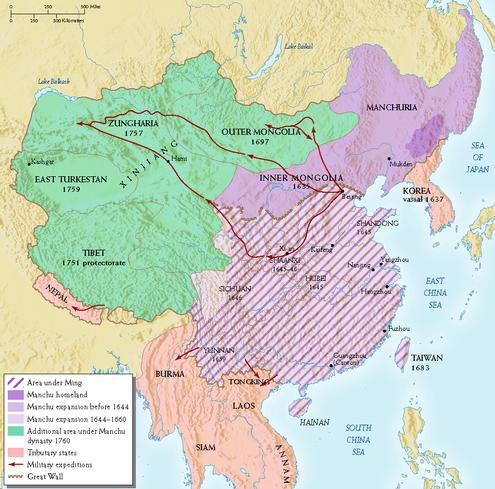
The High Qing period was one of great political stability, imperial expansion, and internal peace. Economic historians like Bin Wong and Ken Pomeranz have shown that China possessed a flourishing market economy during this period; it experienced Smithian economic growth and a massive demographic expansion. Rulers such as the Kangxi (1661-1722) and Qianlong Emperors (1735-1794) are seen as among the most successful in Chinese history. Nevertheless, as ethnic Manchus, these rulers were extremely sensitive to possible opposition from the Han Chinese. And during this period Qing tightened control over the gentry and implemented a policy of the systematic persecution of dissent. (Figure 1 depicts the Manchu conquest of China.)

chinamingqing
The Qing conquest of China

The Literary Inquisitions

The focus of our paper is on the impact of persecutions conducted by Qing China against individuals suspected of expressing disloyalty. We study the impact of these state-orchestrated persecutions on the social fabric of society. This allows us to speak to the kinds of concerns that authors like Hannah Arendt and George Orwell expressed about the long-run impact of totalitarianism in the 20th century.

These persecutions are referred to by historians as ‘literary inquisitions’. Existing scholarship suggests that the resulting fear of persecution elevated the risks facing writers and scholars, and created an atmosphere of oppression and a culture of distrust which deterred intellectuals from playing an active role in society. But these claims have never been systematically investigated. Putting together several unique datasets for historical and modern China, we explore the impact of literary inquisitions on social capital in Qing China and trace its long-run impact on modern China through its effect on cultural values.

spence
Jonathan Spence provides an excellent account of one of the most famous and unusual inquisition cases in his book Treason by the Book

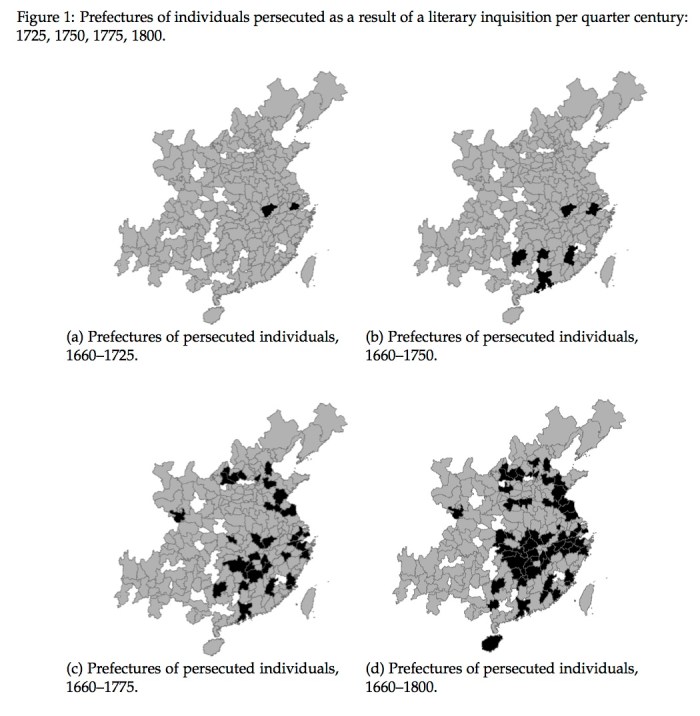
To conduct our analysis, we use data on 88 inquisition cases. We match the victims of each case (there are often multiple victims per case) to their home prefecture. This data is depicted in Figure 1. Since prefectures varied greatly in their economic, social, and political characteristics we conduct our analysis on a matched sample. This ensures that the prefectures “treated” by a literary inquisition are similar in terms of their observables to those we code as “untreated”. As our data is a panel, we are able to exploit variation across time as well as variation in space.

While individuals could be persecuted for a host of reasons, these were all but impossible to anticipate ex ante. Cases were referred to the emperor himself. Frederic Wakeman called this “the institutionalization of Imperial subjectivity.” The standard punishment in such cases was death by Lingchi or (slow slicing) and the enslavement of all one’s immediate relatives. In some cases, however, the guilty party would be executed by beheading. These persecutions aimed to deter opposition to Qing rule by signaling the ability of the Emperor to hunt down all potential critics or opponents of the regime.

Map.jpg

The Impact of Literary Inquisitions on Social Capital

We initially focus on the impact of persecution on the short and medium-run using our historical panel. We first examine the effects on the number of notable scholars.  In our preferred specification we find that a literary inquisition reduced the number of notable scholars in a prefecture by 33 percent relative to the sample mean.

We go on to show the effect of persecutions on collective participation among the gentry in China. Our measure of collective participation in civil society is the number of charitable organizations. Charitable organizations played an important role in premodern China providing disaster relief and local public goods such as repairing local roads. They were non-governmental organizations and played an important role alongside the government provision of disaster relief. In our preferred empirical specification, we find that a persecution number of charitable organizations by 38 percent relative to the sample mean.

These results are in keeping with the argument that literary inquisition had a major psychological impact on Chinese society. They are consistent with the rise of “inoffensive” literary subjects during the Qing period that have documented by historians. To reduce the risk of persecution, intellectuals scrupulously avoided activities that could be interpreted as constituting an undermining of Qing rule. Instead they “immersed themselves in the non-subversive “sound learning” and engaged in textual criticism, bibliography, epigraphy, and other innocuous, purely scholarly pursuits” (Wiens, 1969, 16).

The Impact of Literary Inquisitions on 20th Century Outcomes

We go on to examine how the effects of these persecutions can be traced into the 20th century. In particular, we focus on the provision of basic education at the end of Qing dynasty. In late 19th and early 20th century China, there was no centralized governmental provision of primary schools.  Basic education remained the responsibility of the local gentry who ran local schools.

Thus the provision of education at a local level was dependent on the ability of educated individuals to coordinate in the mobilization of resources; this required both cooperation and trust. We therefore hypothesize that if the persecution of intellectuals had a detrimental impact on social capital, it should also have negatively affected the provision of basic education.

We find that among individuals aged over 70 in the 1982 census – hence individuals who were born in the late Qing period – a legacy of a literary inquisition is associated with lower levels of literacy. This reflects the impact of literary inquisition on the voluntary schools provided by the gentry and is not associated with lower enrollment at middle school or high school. We show that result is robust to controlling for selective migration and for the number of death caused by the Cultural Revolution.

Finally, we show that literary inquisitions generated a cultural of political non-participation. Drawing on two datasets of political attitudes – the Chinese General Social Survey (CGSS) and the Chinese Political Compass (CPoC) – we show that individuals in areas in which individuals were targeted during literary inquisitions are both less trusting of government and less interested in political participation.

Finally, we find that individuals in prefectures with a legacy of literary inquisitions are less likely to agree that: “Western-style multi-party systems are not suitable for China” (Q 43.). This suggests that in areas affected by literary inquisitions individuals are also more skeptical of the claims of the Chinese government and more open to considering alternative political systems. Similarly, individuals in affected prefectures are more likely to disagree with the statement that: “Modern China needs to be guided by wisdom of Confucius/Confucian thinking.”

In summary, our analysis suggests that autocratic rule reduced social capital and helped to produce a culture of political quietism in pre-modern China. This has left a legacy that persisted into the 20th century. These findings have implications for China’s current political trajectory. Some scholars anticipate China undergoing a democratic transition as it’s economy develops (Acemoglu and Robinson, 2012). Others point to China as an example of “authoritarian resilience.” By showing that a long-history of autocratic rule and political persecutions can produce a culture of political apathy, our results shed light on a further and previously under-explored source of authoritarian resilience.

Words and Actions of Trump the Horrible

I spent yesterday listening in horrified fascination to the mass media creating a crude amalgam of Trump’s sins in the so-called video, yes, that old video.

Nearly all the media, including, I am afraid, the Wall Street Journal, put together or often mix in the same sentence two elements of Trump’s objectionable aspects: words and possible actions. The two deserve completely different treatments. There is no excuse for confusing them except a desire to win at all costs.

Words first: Trump referred to women in obscene terms. This is not in dispute. Calling women “pussies” may tell you something about his present character. (Although that happened fifteen years ago, when he was a registered Democrat.) I don’t see what it tells you that’s new. The man is crude. He is crude in precisely the same way that millions of American men are. I am completely innocent of that particular sin myself (because I was raised overseas) but I have several friends who qualify. It’s interesting that they are, by and large, the same male friends I would describe as “pussy-whipped.” (This is another topic, an interesting one I can’t deal with here: Married American men are exceptionally submissive.) I think the brouhaha about Trump’s obscene words is completely hypocritical and massively promoted by media that lost their intellectual self-respect some time ago. Public discourse also stopped being sensitive a long time ago irrespective of what the current neo-Victorians would have you believe: A young woman I have never met except on-line a couple of days ago, a Clinton supporter, recently invited me on Facebook to “suck my dick!” (She meant her own non-existent appendage.)

Then, there are Trump actions as revealed on the video. Fact is, the video reveals no, zero, objectionable acts. Instead, it reveals Mr Trump bragging about engaging in sexually assaultive behavior. The report is not a fact. Fake confessions are legion, especially within a bragging context. Donald Trump may have never, not once, done the things he says in the video he does, not even the slightest crotch grab. Now, if he is guilty of this kind of boasting, characteristic of teenage boys everywhere, you may decide he is too immature for the job but he is not (NOT) an unpunished criminal.

A stupid braggart and a rapist are different creatures. If you think they are more or less the same, you are full of shit and we need someone like Trump to clean house, because of you, precisely. You are poison while he, Trump, is only moronic.

Let’s focus on various forms of sexual assault. Trump committed some, at least one, or (OR) he did not. There is nothing in between. The function of the amalgam I heard all day yesterday is to spread the credibility of the reports of obscene talk onto the supposition of sexual assault: It’s true that he referred to women in a sexually crude manner, therefore, (THEREFORE), he must have assaulted women sexually. This kind of verbal ploy sometimes actually works. It works with fools and with fanatics.

Now I imagine I might be on a jury regarding Mr Trump’s sexual assault(s) (one or several). I would not have the option to find him a “little bit guilty,” or “sort of guilty,” or “mostly guilty,” or “not actually guilty but he might have done it; look how he refers to women.” The only options available are guilty/not guilty. That’s it. For once, judicial conventions correspond well with logic: He did it (any “it”), or (OR) he did not. There are almost an infinity of offenses a person can be charged with so, there is no reason to come up with unclear verdicts. The prosecutor can charge with attempted sexual battery, sexual battery, aggravated sexual battery, different kinds of rape, etc., exactly so a clean verdict is possible without violating factual evidence. Those who do not know this to be true don’t understand either the US Constitution nor basic fairness. They are temperamentally fascists. (There are other forms of fascism on the Clinton side, following Mr Obama.)

What we see right now is a massive and concerted display of hypocrisy on the part of the bulk of the kind-of-educated class, beginning with the media. It’s so obvious that I think that if Jesus were around today, He would be for Trump. Fact is, there is no record of his speaking up against obscenity while he repeatedly and vehemently attacked hypocrisy.

PS I am wavering in my support of Trump. It’s not because Clinton has become less than a total horror but because he falls too easily into her traps. It bothers me.

Pornography, virtual reality and censorship [I]: presidents and feminism

Oculus Rift, recently purchased by Facebook and partnered with Samsung, and HTC Vive, manufactured by HTC with Valve technology, have lead the 2010 wave in developing virtual reality headsets. These technologies, innovative by today’s standards but primitive by science fiction’s, mark the beginning of a differently structured society. They also mark a starting point for a new debate about privacy, the social affects of videogames, and especially censorship in media.

Virtual reality (in its not-too-distant actuality) offers an opportunity to behave outside of social norms in an environment that is phenomenologically the real world. The only comparable experience for humankind thus far is lucid dreaming, for which the rewards are less intense and the journey less traversible than the quick promises of virtual reality machines. One inevitable development for these machines is violent, sexually explicit experiences, available for cheap and accessible 24/7. To see how VR might be received, the closest industries to analyze are the videogame and pornography industries.

Interestingly, pornography has a very liberal history, in comparison to other “societal ills,” like drugs. Erotica dates back to ancient cultures — notably, the Kama Sutra, hardcore by today’s standards, is still a staple of contemporary sexual experimentation — and today’s perversions were common themes: bestiality, pedophilia, etc., although pornography with an emphasis on violence might be a more modern trend. This isn’t to ignore, however, the roles typically played by women in ancient Western folklore and mythology, which are degrading by today’s feminist standards.

The case could be made that today’s censorial views on pornography come from a far more malevolent or oppressive stance toward women than two millennia ago. The free expression that pornographic media once enjoyed was severely deflated over the 20th century. Only two years ago, a plethora of activities were banned from pornography in the United Kingdom. Reacting to the legislation, commentators were quick to criticize what was seen as policy that was specifically anti-female pleasure. Female ejaculation, fisting, face-sitting, and many forms of spanking or role-play were among the restrictions. There are puritanical, “moral outrage” elements to the restriction, but many noticed the absurdity of banning face-sitting: said one producer, “Why ban face-sitting? What’s so dangerous about it? … Its power is symbolic: woman on top, unattainable.” (There has been well-intended censorship as well. Los Angeles county passed Measure B in 2012 to require condom use during any pornographic scene with anal or vaginal contact, to combat the spread of venereal disease.)

Nowadays, there are plenty of porn directors that have learned to focus on both male and female pleasure, and reintroduced artistic merit to their directions. With the equalizing force gaining momentum in porn, it’s curious what the vehement, persistent condemnation springs from, when not focused exclusively on abusive sex scenes. In addition, the negative effects of pornography’s presence in society are still being debated. Just the other day, a study which led to headlines like “Porn doubles the risk of divorce” and “porn signifies a death knell for marriage” was criticized by Reason magazine for failing to address important underlying factors that more plausibly contribute to both pornography consumption and an unhappy marriage leading to divorce. There seems to be an obsession on behalf of the great majority of the public in assigning pornography to some sort of social harm.

Research on photographic pornography’s effect on society began early and aggressively. The Meese Report (1986), commissioned by Reagan and still frequently cited by anti-pornography advocates, determined pornography to be detrimental to society and family relations, and especially for women and children. Arguments built on similar reports attempt to connect sexually explicit material with rapes and domestic violence, alleging that the desensitization to rough sex carries over from the depictional world into the real one. Henry E. Hudson, the Chairman of the Meese Commission, alleged that pornography “appears to impact adversely on the family concept and its value to society.” The Meese Report, however, has been challenged extensively for bias, and is not taken seriously as a body of research any longer. One criticism by writer Pat Califia, concluding a traditionalist narrative embedded in the research, states that the report “holds out the hope that by using draconian measures against pornography we can turn America into a rerun of Leave It to Beaver.

The United States’ Commission on Obscenity and Pornography, preceding the Meese Report and commissioned by Lyndon B. Johnson and Nixon, was unable to find evidence of any direct harm caused by pornography. (Although Nixon, despite the evidence under his administration, believed porn corrupted civilization.) It is curious that a new federal study was requested only sixteen years after the first extensive one, but maybe not too unusual given the growth of porn with technology (from adult stores and newsstands to unlimited free online access; the internet just celebrated its quarter-centennial birthday); also not too unusual given the absurd and expensive studies already undertaken by the federal government. It is also worth pointing out that pornography, though often connected to feminism, is a divisive issue within 20th century and contemporary feminism: some thinkers, like Andrea Dworkin, condemned it as intrinsically anti-women; others feminists like Ellen Willis argued for pornography as liberating and its suppression as moral authoritarianism. The debate along lines of sexuality, online or otherwise, culminated in the feminist “sex wars,” with groups like Feminists Against Censorship and Women Against Pornography popping up. Thus, the debate is open across every ideological camp, and support of pornography is neither necessarily liberal nor necessarily feminist.

[In the next post, I discuss violent pornography’s cross-media transformation into videogames, more sociological research and the general point, and insecurity, of prohibitory measures.]

Rick solves the gun crisis

My best (uninformed) reading of the data is that gun ownership is slightly positively correlated with successful suicide attempts but little else, and that sounds about right to me. I’ve met (other) gun owners, and for the most part they aren’t likely to turn into Rambo in an emergency situation just because they’ve got a sweet gun.

But the 30 seconds of Facebook commentary on this last event before I had to close the tab led me to a revelation. I’ve said before that there’s no such thing as no gun control. Throw that together with the notion that government is a monopoly on coercion, and you’ve got my recent insight: a liberalized gun policy is equivalent to deputizing just about everyone.

Frankly, if I threw a Nerf ball into a crowd, I wouldn’t be likely to hit someone who should own a gun, but I also wouldn’t hit someone who should vote. (That hypothetical person’s vote would probably do more harm than their gun.) And that responsibility problem is similar in both cases. Everyone should have a right to vote and own a gun, but both rights should come with a heavy responsibility.

I can imagine a universe where the bouncers are armed and deputized as a routine matter. And I think that in such a world it would be relatively easy to have a liberalized 2nd amendment combined with a cultural understanding that a gun is a powerful tool to be wielded carefully rather than an entitlement.

The Right would do well to focus on their strong point here: responsibility is key. And the Left as well: barbaric intolerance is bad. Both sides confuse amoral tools with moral judgments.

Libertarians and Pragmatists on Democracy Part 4: Why Market Anarchism is more Democratic than Democracy

Note: This is the final part of a series on democracy. It is assumed the reader is familiar with part one, defining democracy, part two, summarizing classical liberal perspectives on democracy, and part three, which analyzes how pragmatists conceive of democracy as a broader philosophy. Here, I will argue that a synthesis of libertarian and pragmatist perspectives on democracy will yield an argument in favor of market anarchy.

The insights of classical liberalism, and particularly modern libertarianism, have shown that democracy is likely to lead to a tyranny of an irrational and ignorant majority and public choice theory has shown how it results in awful policies thanks to a number of collective action issues. However, as pragmatists have argued, democracy’s philosophical aspirations to scientific public deliberation, seeking the consent of the governed, valuing the dignity of every individual, and decentralizing political authority to take advantage of dispersed intelligence are still admirable. However admirable these philosophical aspirations are, real-world democracies completely fail to fulfill them.

The natural question is, if not democracy, what political arrangements can live up to the philosophical goals of Dewey and Hook? I think the answer lies in market anarchism. In what follows, I will show how market anarchism could succeed in realizing the aspirations of philosophical democracy where political democracy has failed.

Before we get started, let’s take into account a few minor housekeeping notes. It is assumed that the reader has at least a cursory knowledge of how market anarchism and polycentric law works. If you are not familiar with these concepts I highly recommend watching this video by David Friedman before continuing. Also, I am in no way arguing that any of the thinkers discussed in this series are “really” anarchists unless they’re obviously so such as Huemer. I will not even claim that any of them “should have been” anarchists (with the exception of Hayek). I am simply arguing that if we take into account the insights of their various perspectives, one could plausibly defend market anarchism.

Market Anarchism, Unlike Democracy, Does Rest on the Voluntary Consent of the Governed

As Michael Huemer convincingly has shown, democracy does not actually “rest upon the freely given consent of the governed” as Sidney Hook claims. The bar tab example illustrates that we would not consider majority rule “consent” in any everyday interaction and there is little reason to think it should be any different in the context of political institutions. By contrast, market anarchism is almost by definition based off of consent. This is the primary reason why many deontological market anarchists, such as Murray Rothbard, are market anarchists in the first place and why they oppose the coercive, non-consensual nature of the state. While democracy’s claim to legitimacy is that the governed vote but they are still forced to follow the (unjustified) authority of a state that has the monopoly on force whether they agree or not to, market anarchism is based off of voluntarily consented to contracts between individuals and defense agencies and contracts between those defense agencies and private, voluntary court systems and arbitrators. Further, the content of the laws is agreed to and law becomes a product one buys in voluntarily agreeing to sign up with a defense company, just as one buys a car, a piece of furniture, or any other good.

It is curious that many pragmatist defenses of democracy sound very similar to what many market anarchists and libertarians write. Not just in Sidney Hook’s definition of a democracy as a government that “rests upon the freely given consent of the governed,” but perhaps most strikingly in John Dewey’s 1939 essay “I Believe.” In this essay, Dewey walked back some of his early Hegelian collectivist lines of his early years:

My contribution to the first series of essays in Living Philosophies put forward the idea of faith in the possibilities of experience at the heart of my own philosophy. In the course of that contribution, I said, “Individuals will always be the center and the consummation of experience, but what the individual actually is in his life-experience depends upon the nature and movement of associated life.” I have not changed my faith in experience nor my belief that individuality is its center and consummation. But there has been a change in emphasis. I should now wish to emphasize more than I formerly did that individuals are the final decisive factors of the nature and movement of associated life.

Indeed, throughout the whole essay he emphasizes “the idea that only the voluntary initiative and voluntary cooperation of individuals can produce social institutions that will protect the liberties necessary for achieving development of genuine individuality.” Throughout the essay, he decries (like many left-anarchists do) “state socialism” just as much as he does “state capitalism.” Dewey’s opposition to capitalism is well-known, but what is less known is his opposition to so-called “public collectivism.” His criticisms here could just as easily have been written by someone like Hayek:

Recent events have shown that state socialism or public collectivism leads to suppression of everything that individuality stands for. It is not too late for us in this country to learn the lesson taught by these two great historic movements [ie., the rise of state capitalism and state socialism]. The way is open for a movement which will provide the fullest opportunity for cooperative voluntary endeavor. In this movement, political activity will have a part, but a subordinate one. It will be confined to providing the conditions, both negative and positive, that favor the voluntary activity of individuals.

It is interesting that, like anarchists who favor direct action, he emphasizes that political activity is subordinate to the political movement he sees as necessary.

Of course, there are still notable differences between Dewey and libertarians, he still defends what he calls “functional socialism” in the socialization of medicine and still berates more than many libertarians would be comfortable with (except, of course, for left-anarchists) inequality caused by state capitalism. His vision of a truly individualist society, even in his later years, was one with localized, experimental democratic institutions and economics controlled by those localized governments in a “functional socialist” fashion (as I mentioned earlier, that economic vision is at odds with Dewey’s epistemological commitments).

However, I would argue that it is more than a mere superficial coincidence that Dewey’s criticisms of state capitalism are almost identical to those of market anarchists who decry “crony capitalism,” that his criticisms of state socialism are very similar to some individualist libertarian criticisms, and his overall rhetoric defending democracy on the grounds of “voluntary cooperation of individuals” sounds remarkably similar to many libertarians. This is because, largely, the philosophical ends Dewey seeks in politics are the same as those sought by libertarians, market anarchists, and classical liberals. However, the institutional means he advocates are very different and fail to meet those ends.

There is, conversely, one potential criticism that Sidney Hook would raise at this point: that market anarchism does not really rest upon the freely-given consent of the governed due to its allowance for economic inequality. Hook argued that income inequality undermines consent in democracy and, as a result, economic organization should be controlled by a democratically elected government. There are two points to be made. First of all, when economic organization is controlled by government in democracies it exacerbates the problem of income inequality. Rent-seeking culture arises in which concentrated interests use, through lobbying power, government force to accumulate and protect their wealth. Indeed, as I mentioned earlier,  there have been empirical studies showing how over-regulation lobbied for by those concentrated benefits have regressive effects. Even fairly anti-free market economists such as Joseph Stiglitz have argued that income inequality is not an inevitable result of market institutions, but a result of bad government policies such as corporate welfare.

Second, it is questionable to what degree income inequality would exist in pure market anarchy. Of course, much of the bad inequality experienced under state capitalism is the result of bad policies, but some if it is also just a result of market’s tendencies to disrupt economic distributions (which, as Mises argued in Liberalism: The Classical Tradition is not a bad thing because it allows for luxury markets which can serve as an experimental market for expensive, new goods that one day become popular consumer goods). Some market anarchists, such as Anna Morgenstern, have argued that the type of mass accumulation of capital under capitalism would be impossible under market anarchism. I am unsure to what extent I agree, and a systemic analysis of the economic roots of inequality is outside of the scope of this post. However, suffice it to say that it is an open, empirical question whether purely free markets would result in problematic levels of inequality, as Hook seems to think, and we have some good reasons to think it would not. At the very least, it is clear that the democratic institutions favored by Hook are not a serious solution to the problem.

Market Anarchism, Unlike Democracy, Relies on a Decentralized Process of Political Decision Making

Dewey argued in “Democracy and Educational Administration” that “it is the democratic faith that [the distribution of knowledge and intelligence] is sufficiently general so that each individual has something to contribute and value of each contribution can be assessed only as it enters into the final pooled intelligence constituted by the contributions of all.” He seems to echo Hayek’s knowledge problem critique of socialism when he argues that the democratic faith is based on the wisdom that “no man or limited set of men is [sic] wise enough or good enough to rule others without their consent[.]” As we have seen, democracies tend towards heavily centralized governments that undermine this faith and fail to take advantage of the dispersed knowledge (in Hayekian terms) among individuals in society.

Market anarchy, on the other hand, by definition takes advantage of this feature of dispersed intelligence. Rather than having law be designed by a centralized legislature, law arises out of voluntary market exchanges between individuals and, like common law, the precedent of judges in private courts. Of course, both Dewey and Hayek embraced democratic institutions (in Hayek’s case, as well as free market economic coordination) to take advantage of decentralized knowledge. However, both Dewey and Hayek, particularly the ladder (Dewey never wrote about market anarchism as it did not exist as a unique perspective until almost a decade after his death), failed to appreciate the extent to which a polycentric legal system does this much better. Peter Stringham and Todd Zywicki have noted this tension in Hayek’s thought in particular, as they put it in an abstract for their excellent paper on the issue:

Should law be provided centrally by the state or by some other means? Even relatively staunch advocates of competition such as Friedrich Hayek believe that the state must provide law centrally. This article asks whether Hayek’s theories about competition and the use of knowledge in society should lead one to support centrally provided law enforcement or competition in law. In writing about economics, Hayek famously described the competitive process of the market as a “discovery process.” In writing about law, Hayek coincidentally referred to the role of the judge under the common law as “discovering” the law in the expectations and conventions of people in a given society. We argue that this consistent usage was more than a mere semantic coincidence — that the two concepts of discovery are remarkably similar in Hayek’s thought and that his idea of economic discovery influenced his later ideas about legal discovery. Moreover, once this conceptual similarity is recognized, certain conclusions logically follow: namely, that just as economic discovery requires the competitive process of the market to provide information and feedback to correct errors, competition in the provision of legal services is essential to the judicial discovery in law. In fact, the English common law, from which Hayek drew his model of legal discovery, was itself a model of polycentric and competing sources of law throughout much of its history. We conclude that for the same reasons that made Hayek a champion of market competition over central planning of the economy, he should have also supported competition in legal services over monopolistic provision by the state — in short, Hayek should have been an anarchist.

There is one possibly fatal objection to this line of reasoning, that is also the most substantial objection to market anarchism as a whole: the possibility that market anarchy, like democracy, will eventually lead to a centralized state that undermines its attempt to take advantage of dispersed knowledge. This argument was initially hinted at by Robert Nozick in Anarchy, State, and Utopia in his argument about the “immaculate conception of the state” but was expanded on most convincingly by Tyler Cowen. Ultimately it is an empirical question whether market anarchy would eventually lead to more centralization, and it is outside the scope of this post to analyze that fascinating question in any satisfactory amount of detail. I will say, however, that Bryan Caplan has given more or less convincing reasons why this may not be the case.

Market Anarchism, Unlike Democracy, Values the Dignity of the Individual

One of the features central to the pragmatist “democratic faith” is the belief that “belief that every individual should be regarded as possessing intrinsic worth or dignity[.]” As I argued, the conflation of democratic governments with the “collective will” of the people undermines this faith as political dissenters and individual thinkers become viewed as opponents to “the people.” Indeed, it seems that the type of “public” and “private” collectivisms that Dewey ridiculed in “I Believe” are a result of democratic institutions run amuck.

Market anarchism, meanwhile, suffers from no such issues. Instead, the intrinsic worth of the individual is respected as their free choices and associations is the main driving mechanism for political organization. There is no violation of free speech and free thought by a deliberative government as such a government does not exist in the first place under anarchy, and thus the intrinsic worth and dignity are not found in the “will of the people” as in democracies, but in the sovereign individual’s choice of which defense provider to contract with.

Market Anarchism, Unlike Anarchy, is Scientific and Deliberative

Contrary to Dewey and Hook’s characterization of democracy as a deliberative, intelligent application of the scientific method to social issues, democracy is instead characterized by polarizing populist pandering and rationally ignorant and irrational voters casting meaningless ballots based cultural associations rather than reasoned consideration of policy issues. Market anarchism, meanwhile, does have the deliberative, scientific nature the pragmatists vainly hope democratic institutions could aspire to. While under democracy the cost of casting an informed vote is very high and the benefits very low resulting in massive amounts of rational ignorance, under market anarchism individuals have every incentive to ensure they are informed about the legal rules they are purchasing, so to speak, by contracting with rights defense agencies. Unlike in democracy where the benefits of casting an informed vote are extremely low because your vote has an infinitely small probability of making a difference, under market anarchy the rights defense agency you chose to contract with has immediate and certain impacts upon your life, thus creating a much larger incentive to cast an informed (metaphorical) vote by choosing to purchase the services of a preferred rights defense agency.

Deliberation about legal policy is far more likely to be more reasoned in market anarchy than in democracy. First, because market anarchism is more radically experimental than political democracy. Freedom of speech and of thought in democracy is often likened to a metaphorical “marketplace of ideas,” but in market anarchy it is a literal marketplace in which the ideas are not chosen just by speculation and public deliberation, but actually experimented with and acted upon in practice. Democracy is only “experimental” in a priori public deliberation about policies, but market anarchy is “experimental” in actually applying those policies and assessing their results a posteriori. Under democracy, once a policy is chosen it becomes difficult to assess counterfactually if another potential policy could have yielded better results, thus it is difficult to ascertain which was the superior policy. It is as if scientists in a lab simply talked about the hypothetical results of various hypothetical experiments and chose theories based on their discussions rather than actually testing the theories by actually running the experiments. Because of the polycentric nature of law under market anarchy, multiple policies are taken on at the same time, making it easier to tell which is more desirable in practice rather than simple theoretical deliberation.

Another reason why political deliberation is more likely to be reasoned in market anarchy than democracy is because of the institutional mechanisms for choosing policy. The main way law is “made” in democracy is through legislation voted on by representatives, who are ultimately accountable to the public through general elections. Often, debate on the floor of legislative bodies is anything but reasoned and deliberative, and clearly discussion about elections quickly devolves into mindless partisan bickering, sensationalist “scandals,” and populist rhetorical flair rather than reasoned discussion about policies. In market anarchy, however, law is “discovered” by private arbitrators and judges who are ultimately accountable to the defense firm’s consumers in the marketplace. It is pretty clear that real-world courtrooms tend to have a more elevated level of dialogue than legislative bodies, to say less of public elections, and I fail to see why this would not be the case under market anarchism.

Further, there wouldn’t be a need for partisan bickering and debates that bring down the level of public discourse in market anarchy, for similar reasons why there isn’t nearly as nasty debates about preferences for consumer goods as there are about politics. To use an analogy, in democracy, if we’re voting on what soda to consume, whoever wins the vote gets a monopoly on their preferred soda; so my preference for Coke could possibly eliminate your ability to enjoy Pepsi; but in a market, if I prefer Coke you still can drink Pepsi, meaning we don’t need to bicker about our consumer preferences. It is similar (though clearly not identical because when we’re talking about law it’s quite a bit more consequential) with legal policies: in democracy, if I prefer one set of legal rules to another which you prefer, we must fight over how to vote because the two are mutually exclusive; but in market anarchy, because law is polycentric and not monolithic, they are not mutually exclusive so we don’t need to fight nearly as hard for it. There’s a good reason why debates among consumers for products they prefer (Coke v. Pepsi, Apple v. Windows, Android v. iPhone) rarely get as nasty as debates in democratic politics, because there is room for disagreement at the end of the day in a market that there is not in politics.

Conclusion

Clearly, democracy is far from the ideal method of political organization. As classical liberals throughout history have shown, despite the fact that it may be possible to other political forms such as oligarchy and monarchy, it has a tendency towards the tyranny of the majority and massive collective action problems. However, the philosophical aspirations of the most ardent defenders of democracy are still extremely valuable, even if their preferred institutions fail to deliver. Market anarchism is a reasonable synthesis of these two insights; it has the potential to live up to the aspirations of pragmatist democrats without the major, systemic problems of real working democracies that undermine those aspirations.

John Dewey once said “democratic institutions are no guarantee for the existence no guarantee for the existence of democratic individuals,” what is needed is a better set of institutions that have a higher probability to cultivate Dewey’s idea of “democratic individuals.” Market anarchism appears to be a viable candidate for such a set of institutions.

Malthusian pressures (as outcome of rent-seeking)

Nearly a week ago, I intervened in a debate between Anton Howes of King’s College London whose work I have been secretly following  (I say “secretly” because as an alumnus of the London School of Economics, I am not allowed to show respect for someone of King’s College) and Pseudoerasmus (whose identity is unknown but whose posts are always very erudite and of high quality – let’s hope I did not just write that about an alumnus of King’s College). Both bloggers are heavily involved in my first field of interest – economic history.

The debate concerned the “Smithian” counter-effect to “Malthusian pressures”. The latter concept refers to the idea that, absent technological innovation,  population growth will lead to declining per capita as a result of marginally declining returns. The former refers to the advantages of larger populations: economies of scale, more scope for specialization and market integration thanks to density. Now, let me state outright that I think people misunderstand Malthusian pressures and the Smithian counter-effect.

My point of is that both the “Smithian counter-effect” and “Malthusian pressures” are merely symptoms of rent-seeking or coordination failures. In the presence of strong rent-seeking by actors seeking to reduce competition, the Smithian counter-effect wavers and Malthus has the upper hand. Either through de-specialization, thinner of markets, shifting to labor-intensive technologies, market disintegration and lower economies of scale, rent-seeking diminishes the A in a classical Cobb-Douglas function of Total Factor Productivity (Y=AKL). This insight is derived from my reading of the article by Lewis Davis in the Journal of Economic Behavior and Organization which contends that “scale effects” (another name for a slight variant of the “Smithian counter-effect) are determined by transaction costs which are in turn determined by institutions. If institutions tend to favor rent-seeking, they will increase the likelihood of coordination failure. It is only then that coordination failures will lead to “Malthusian pressures” with little “Smithian counter-effect”. Institutions whose rules discourage rent-seeking will allow markets to better coordinate resource use so as to maximize the strength of the “Smithian counter-effect” while minimizing the dismal Malthusian pressures.

In essence, I don’t see the issue as one of demography, but as one of institutions, public choice and governance. I am not alone in seeing it this way (Julian Simon, Jane Jacobs and Ester Boserup have documented this well before I did). Why the divergence?

This is because many individuals misunderstand what “Malthusian pressures” are. In an article I published in the Journal of Population Research, me and Vadim Kufenko summarize the Malthusian model as a “general equilibrium model”. In the long run, there is an equilibrium level of population with a given technological setting. In short-run, however, population responds to variation in real wages. Higher real wages from a “temporary” positive real shock will lead to more babies. However, once the shock fades, population will adapt through two checks: the preventive check and the positive check. The preventive check refers to households delaying family formation. This may be expressed through later marriage ages, planned sexual activities, contraception, longer stays in the parental household and greater spacing between births. The positive check refers to the impact of mortality increasing to force the population back to equilibrium level. These checks return to the long-term equilibrium. Hence, when people think of “Malthusian pressures”, they think of population growth continuing unchecked with scarce ressources. But the “Malthusian model” is basically a general equilibrium model of population under fixed technology. In that model, there are no pressures since the equilibrium rates of births and deaths are constant (at equilibrium).

However, with my viewpoint, the equilibrium levels move frequently as a result of institutional regimes. They determine the level of deaths and births. “Poor” institutions will lead to more frequent coordination failures which may cause, for a time, population to be above equilibrium – forcing an adjustment. “Poor” institutions would also lead to an inability to respond to a change in constraints (i.e. the immediate environment) by being rigid or stuck with path-depedency problems which would also imply the need for an adjustment.  “Good” institutions will allow “the Smithian counter-effect” to intervene through arbitrage across markets to smooth the effect of local shocks, a greater scope for specialization etc.

My best case for illustration is a working paper I have with Vadim Kufenko (University of Hohenheim) and Alex Arsenault Morin (HEC Montréal) where we argue that population pressures as exhibited by the very high levels of infant mortality rates in mid-19th century Quebec were the result of institutional regimes. The system of land tenure for the vast majority of the population of Quebec was “seigneurial” and implied numerous regressive transfers and monopoly rights for landlords. This system was also associated with numerous restrictions on mobility which limited the ability of peasants to defect and move. However, a minority of the population (but a growing one) lived under a different institution which did not impose such restrictions, duties and monopolies. In these areas, infant mortality was considerably lower. We find that, adjusting for land quality and other factors, infant mortality was lower in these areas for most age groups. Hence, we argued that what was long considered as “Malthusian pressures” were in fact “institutional pressures”.

Hence, when I hear people saying that there are problems linked to “growing population”, I hear “because institutions make this a problem” (i.e. rent seeking).