RCH: 10 most brutal massacres in history

That’s the subject of my latest at RealClearHistory (I submitted it before the vicious, anti-Muslim shooting in New Zealand occurred). An excerpt:

7. Chios massacre (March – July 1822). The Ottomans were bad people for a few centuries during the Middle Ages (RealClearHistory has more on the Ottomans here). In 1822, Istanbul massacred 52,000 Greeks on the island of Chios during the Greek War of Independence. The massacre was used deftly by imperial proponents in London, Paris, and Moscow, and further isolated the Ottomans from European diplomacy. As for the inhabitants of Chios, most were apathetic toward the rebellion until the massacre.

Here’s another one:

5. Massacre of the Latins (1182). In the 12th century, Roman Catholics in Constantinople, the capital city of the Roman Empire, were known as Latins and in 1182 they were slaughtered, driven out of the city, or sold into slavery. Tens of thousands of people are estimated to have died. The massacre occurred because the vast majority of non-Roman Catholic inhabitants were much poorer than the Latins of the city, due to the latter’s connections to the wealthy city-states on the Italian peninsula (Venice, Genoa, Pisa, etc.). The massacre also made it harder for the Pope to unify the Christian world, as the split between Catholic and Orthodox sects only became more hardened.

Lots of bad things have happened in Turkey and Greece and over the years. Please, read the rest. There’s more massacres, but also thoughts on the genocide-versus-massacre debate, and the sheer lack of knowledge that humanity possesses in regards to its own history.

Why Persecute?

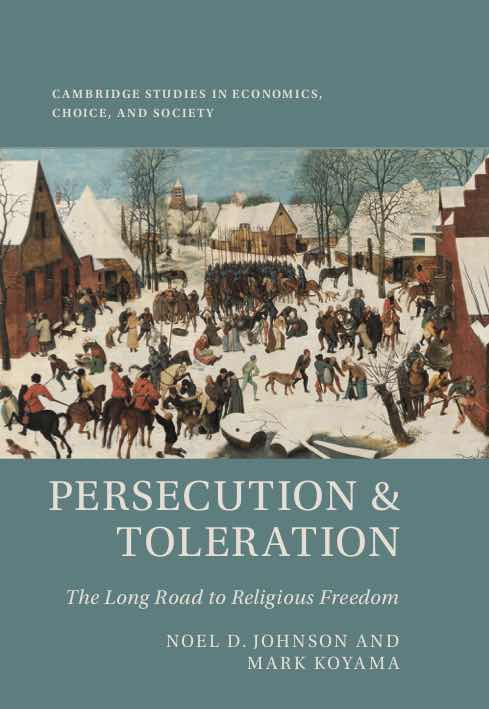
Why was religious persecution common in the premodern world? This is the question Noel Johnson and I address in Persecution and Toleration.

Answers that rely on the alleged barbarism of the times or the brutality or narrowed-mindedness of individual churchmen or rulers are unsatisfying. We need to understand why religious dissent was so alarming that political and religious authorities resorted to violent repression.

In Persecution and Toleration, we outline why states often had an incentive to enforce religious conformity.

Suppose the ruler wants to pass a law. The religious authority can choose to legitimate this law or to oppose it. If the religious authority opposes it, the law will be seen as illegitimate, and the ruler will face unrest or opposition in attempting to enforce it. If the religious authority legitimates the law, then compliance with the law will be greater and the law will be enforced at a much lower cost for the ruler. Rulers therefore have a good reason to want legitimacy. Because religious authorities were the most powerful source of legitimacy in the premodern period, it was natural for rulers to rely on religious legitimacy.

Rulers can bargain with religious authorities to obtain legitimacy. One way to do this is to enforce religious conformity. This provides a natural framework for studying religious persecutions.

One insight is that persecutions are necessarily political. The justification for persecution can vary. Secular authorities will persecution in terms of secular arguments. Religious authorities may persecute on religious or doctrinal grounds. But structurally these persecutions will resemble one another.

A second key argument is that some form of religious repression was the default in the premodern world but outright persecution was, in fact, quite rare. The default level of religious repression we characterize as a state of conditional toleration. Religious differences were usually tolerated, but only conditionally. Outright persecution was quite rare. But the threat of persecution played an important role in enforcing religious conformity, restricting dissent and providing states with legitimacy.

How general is our account? Is this story only applicable to Western Europe? Or to monotheistic societies? Can it explain the persecution of Christians in pagan Rome or the persecution of Christians in 17th century Japan? And what distinguishes religious persecutions from other persecutions?


To address these concerns, consider the persecution of Christians in the Roman Empire. Historians such as Candida Moss downplay these persecutions (here). Catherine Nixey’s The Darkening Age — reviewed positively in the New York Times —for example, writes:

“The idea, therefore, of a line of satanically inspired emperors, panting for the blood of the faithful is another Christian myth. As the modern historian Keith Hopkins wrote, ‘the traditional question: “Why were the Christians persecuted?” with all its implications of unjust repression and eventual triumph, should be re-phrased: “Why were the Christians persecuted so little and so late?”

Nixey correctly cautions the reader not to view Christian accounts of the death of martyrs as historical accounts. But her argument is a larger one. To her mind, the persecution of Christians was not a religious persecution. Commenting on the Roman governor Pliny’s decision to persecute some Christians, she writes:

“Pliny’s problem with all of this is not religious. He is not upset because Jupiter has been neglected, or Hera has been slighted: he is upset because the citizens of his province are becoming disgruntled by the Christians’ behaviour . . .”

“. . . Even the locals who were forcing Pliny’s hand might not have been complaining about Christians for religious reasons either: it has been speculated that what was really upsetting them was not theology but butchery. Local tradesmen were angry because this surge of Christian sentiment had led to a drop in the sales of sacrificial meat and their profits were suffering: anti-Christian sentiment caused less by Satan than by a slow trade in sausage-meat.”

Because Christians were punished as pests and social deviants, rather than for reasons conventionally identified as religious, Dixey suggests this was a simple matter of“law and order”. If anything her sympathies appear to be with the Roman governor responsible for prosecuting Christians:

“What should Pliny do with these odd people? Trajan’s reply is brief and to the point. He doesn’t get into theological or legal debates about the legal status of Christianity (to the disappointment of later scholars); nor does he (thus confounding the martyrdom tropes) fulminate against the Christians. He does agree with Pliny that those who are proved to be Christian ‘must be punished’ — though for precisely what charge is unclear. He also adds that ‘in the case of anyone who denies that he is a Christian, and makes it clear that he is not by offering prayers to our gods, he is to be pardoned as a result of his repentance however suspect his past conduct may be’. Roman emperors wanted obedience, not martyrs. They had absolutely no wish to open windows into men’s souls or to control what went on there. That would be a Christian innovation.”

This hardly not exculpates the Romans or implies the persecution of Christians was a myth. Nixey is correct that the Roman authorities were unconcerned with what Christians believed. But she is wrong to suppose that this is the defining characteristic of religious persecution. And the urge to downplay the persecution of Christians suggests other anachronistic instincts are at work. After all, no-one denies that Christians were killed, often horrifically, in the Roman persecutions (for a critical review of Moss’s book, on which Nixey relies, see here).

Theologians were, of course, concerned with wrong beliefs. But the reason why religious dissent became a major concern to both secular and religious authorities in medieval Europe was precisely due to the threat heresy posed to the established social and political order.


Consider another example from medieval Europe. Norman Cohn’s Pursuit of the Millennium explains the threat heretical movements posed to political order. Focusing on the most revolutionary millennium sects — movements that envisioned the last days as at hand, and took action to herald their coming — Cohn’s text vividly captures both the appeal as well as the radicalism and violence of these movements. Describing the manifesto of the “Revolutionary of the Upper Rhine”, Cohn writes:

“the route to the Millennium leads through massacre and terror. God’s aim is a world free from sin. If sin continues to flourish, divine punishment will surely be visited upon the world; whereas if sin is once abolished, then the world will be ready for the Kingdom of the Saints. The most urgent task of the Brethren of the Yellow Cross is therefore to eliminate sin, which in effect means to eliminate sinners . . . To achieve that end assassination is wholly legitimate: ‘Whoever strikes a wicked man for his evildoing, for instance for blasphemy — if he beats him to death he shall be called a servant of God; for everyone is in duty bound to punish wickedness.’ In particular the Revolutionary calls for the assassination of the reigning Emperor, Maximilian, for whom he had an overwhelming hatred.”

Such beliefs were a threat to all established authority. Church authorities were naturally concerned with monitoring belief and practice. But heresy also posed a potent threat to secular authority.

Of course, many people in medieval society had incorrect and unorthodox religious beliefs. What principally concerned the Church was not ignorance but heresy: obstinately holding beliefs that directly contradicted Church teachings.

Heresy was feared because it was a source of disorder. Religious dissent had the potential to unleash revolutionary violence and social chaos. This was one reason why Martin Luther recanted his earlier support for religious liberty during the Peasant Revolt.

Arguments for enforcing religious conformity went deeper than the fear of revolutionary violence. Such was the importance of the Church to the social and political order that all challenges to Church authority were perceived as threats to society.


Consider the doctrine of apostolic poverty — which emerged in the 11th and 12th centuries as the Commercial Revolution was transforming the European economy increasing urbanization, trade, wealth, inequality and also poverty. Shocked by the growing gap between the rich and the poor, adherents to this doctrine aspired to the simple poverty of Christ’s followers. They lived without property or money and they were critical of the wealth accumulated by the Church.

The fact that the Church was wealthy did not, of course, imply that Churchmen were not devout or dedicated. The problem was, however, that the Church was also a political institution. Many bishoprics were the preserve of the nobility who would jostle to ensure that their younger sons became influential churchmen. These prelates were expected to be the equal of the secular nobles, to entertain lavishly, and to dress splendidly. Taken too far, therefore, apostolic poverty threatened the legitimacy of the Church and its relationship with secular authority.

Through mendicant orders such as the Franciscans, the Church could accommodate these demands and concerns. But groups who directly attacked the legitimacy of the Papacy itself, such as the Waldensians and the Spiritual Franciscans could not be tolerated. The leader of the Spiritual Franciscans, Angelo da Clareno denied that Pope John XXII was pope, a direct challenge to the legitimacy of the Church. Precisely because of the threat they posed to the church and state alliance — and not because of their theological beliefs, which were unremarkable — the Spiritual Franciscans had to be repressed.

Were the concerns of the Roman Emperors so different from those of medieval rulers and churchmen? Religion was not a private affair in antiquity. It had political consequences; it mattered for the fate of the Empire. The first Empire-wide persecution of Christians occurred under Decius (r. 249–251). Decius’s response to the political crisis facing the Empire — invasions from both Persia and the Goths — was a revival of the state religion and the imperial cult.

Claiming that Roman persecutions of Christianity were not religious but political, as Moss and Nixey do, is misleading; all persecutions are political. Because it began as a persecuted cult, Christianity as a religion contained many potent arguments against religious persecution. For these reasons, it was probably less predisposed to persecution than many other religions. Nevertheless, the fact that the medieval Church eventually came to persecute dissent points to deep, structural, political economy factors that made religious freedom impossible. It this these factors that are the subject matter of Persecution & Toleration.

Interwar US inequality data are deeply flawed

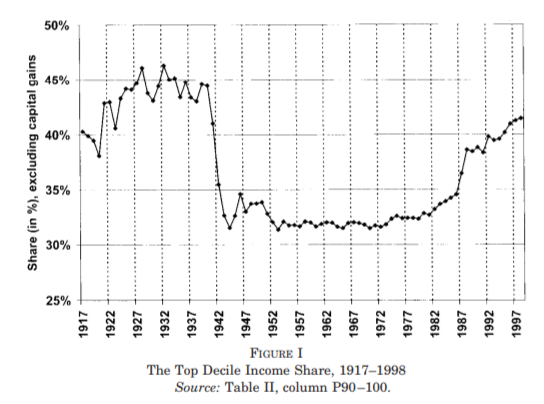
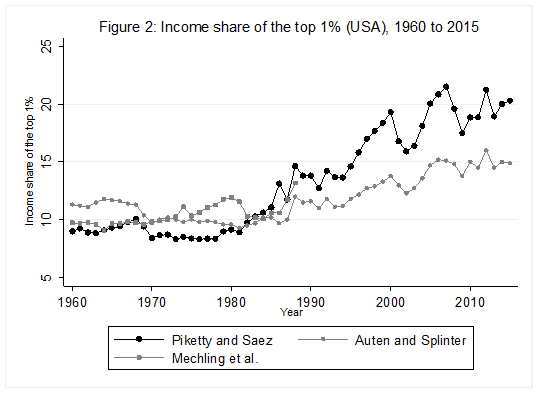
For some years now, Phil Magness and myself have been working on improving the existing income inequality for the United States prior to World War II. One of the most important point we make concerns why we, as economists, ought to take data assumptions seriously. One of the most tenacious stylized facts (that we do not exactly dispute) is that income inequality in the United States has followed a U-curve trajectory over the 20th century. Income inequality was high in the early 1920s and descended gradually until the 1960s and then started to pick up again. That stylized fact comes from the work of Thomas Piketty and Emmanuel Saez with their data work (first image illustrated below). However, from the work of Auten and Splinter and Mechling et al. , we know that the increase post-1960 as measured by Piketty is somewhat overstated (see second image illustrated below).  While the criticism suggest a milder post-1960 increase, me and Phil Magness believe that the real action is on the left side of the U-curve (pre-1960).

Inequality

NOL1

Why? Here is our case made simple: the IRS data used to measure inequality up to at least 1943 are deeply flawed. In another paper recently submitted, I made the argument that some of the assumptions made by Piketty and Saez had flaws. This did not question the validity of the data itself. We decided to use state-level income tax data from the IRS to compute the state-level inequality and compare them with state-income tax data (e.g. the IRS in Wisconsin versus Wisconsin’s own personal income tax data). What we found is that the IRS data overstates the level of inequality by appreciable proportions.

Why is that? There are two reasons. The first is that the federal tax system had wide fluctuations in tax rates between 1917 and 1943 which means wide fluctuations in tax compliance. Previous scholars such as Gene Smiley pointed out that when tax rates fell, compliance went up so that measured inequality went up. But measured inequality is not true inequality because “off-the-books” income (which was unmeasured) divorced true inequality from measured inequality.  This is bound to generate false fluctuations in measurement as long as tax compliance was voluntary (which is true until 1943). State income taxes do not face that problem as their tax systems tended to be more stable throughout the period. The same is true with personal exemptions.

The second reason speaks to the manner the federal data is presented. The IRS created wide categories with the numbers of taxpayers according to net taxable income (rather than gross income) in each categories. For example, the categories go from 0$ to 1,000$ per filler and then increase by slice of 1,000$ until 10,000$ and then by slices of 5,000$ etc. This makes it hard to pinpoint where to start each the calculations for each of the fractiles of top earners. This is not true of all state income tax systems. For example, Delaware sliced the data by categories of 100$ and 500$ instead. Thus, we can more easily pinpoint the two. More importantly, most state-income tax systems reported the breakdown both for net taxable and gross income. This is crucial because Piketty and Saez need to adjust the pre-1943 IRS data – which are in net income – to that they can tie properly with the post-1943 IRS data – which are in adjusted gross income. Absent this correction, they would get an artificial increase in inequality in 1943. The problem is that the data for this adjustment is scant and their proposed solution has not been subjected to validation.

What do our data say? We compared them to the work of Mark Frank et al. who used the same methodology and Piketty Saez but at the state-level using the same sources. The image below pretty much sums it up! If the points are above the red line, the IRS data overestimates inequality. If below, the IRS underestimates. Overall, the bias tends towards overestimation. In fact, when we investigated all of the points separately, we found that those below the red line result merely from the way that Delaware’s (DE) was adjusted to convert net income into gross income. When we compared only net income-based measures of inequality, none are below the red line except Delaware from 1929 to 1931 (and by much smaller margins than shown in the figure below).

IRS.png

In our paper, we highlight how the state-level data is conceptually superior to the federal-level data. The problem that we face is that we cannot convert those measures into adjustments for the national level of inequality. All that our data do is suggest which way the bias cuts. While we find this unfortunate, we highlight that this would unavoidably alter the left side of the curve in the first graph of this blog post. The initial level of inequality would be less than it is now. Thus, combining this with the criticisms made for the post-1960 era, we may be in presence of a U-curve that looks more like a shallow tea saucer than the pronounced U-curve generally highlighted.  The U-curve form is not invalidated (i.e. is it a quadratic-looking function of time or not), but the shape of the curve’s tails is dramatically changed.

RCH: “10 Worst Space Disasters in History”

My latest at RealClearHistory:

When I think about space disasters, I am reminded of the space battle between Earth and Trisolaris in Liu Cixin’s fantastic sci-fi novel. Stay with me here. Liu Cixin’s Dark Forest novel needs to be read. In the novel, humans make contact with a nearby alien civilization, who proceed to make plans to invade earth, wipe out its human population, and re-populate it with themselves. The first battle between Earth’s space forces and the would-be invaders ends badly for Earth, as thousands of space warships are destroyed in a matter minutes by a Trisolaran probe. The novel brings up an uncomfortable theory that humans have been all-too-willing to neglect: what if the universe is a hostile, deadly place instead of a curious one?

Please, read the rest.

RCH: The secession of Texas from Mexico

My latest at RealClearHistory deals with Texas and its secession from Mexico. An excerpt:

There are other similarities, too, starting with the fact that Texas was not the only state in Mexico to try and secede from Mexico City. The self-declared republics of Rio Grande, Zacatecas, and Yucután also asserted their independence from Mexico, though Texas was the only state to actually succeed in its rebellion. Unlike the 13 North American states attempting to secede from the British Empire, the Mexican provinces did not band together to form a united front against a common enemy.

Texas itself was the northern part of a larger state called Coahuila y Tejas. When Mexico originally seceded from Spain, Coahuila y Tejas joined the new republic as its poorest, most sparsely populated member state. In addition to economic and demographic problems, Coahuila y Tejas shared a border with the Comanche and Apache Indians, who in the 1820s were still powerful players in regional geopolitics. Life in Coahuila y Tejas was nasty, brutal, and short.

Please, read the rest.

RCH: Iraq, then and now

Folks, I’m still plugging away at RealClearHistory. This week’s focus was on Iraq. Here’s the link to my Tuesday column. And here’s the link to my weekend column. I’m not going to spoil anything. Just read ’em already!

RCH: Calvin Coolidge

I took on Calvin Coolidge this week. My Tuesday column dealt with Coolidge and his use of the radio, while this weekend’s column argues why you should love him:

2. Immigration. At odds with the rest of his anti-racist administration, Coolidge’s immigration policy was his weakest link. Although he was not opposed to immigration personally, and although he used the bully pulpit to speak out in favor of treating immigrants with respect and dignity, Coolidge was a party man, and the GOP was the party of immigration quotas in the 1920s. Reluctantly, and with public reservations, Coolidge signed the Immigration Act of 1924, which significantly limited immigration into the United States up until the mid-1960s, when new legislation overturned the law.

Please, read the rest.

Monetary Progression and the Bitcoiner’s History of Money

In the world of cryptocurrencies there’s a hype for a certain kind of monetary history that inevitably leads to bitcoin, thereby informing its users and zealots about the immense value of their endeavor. Don’t get me wrong – I laud most of what they do, and I’m much looking forward to see where it’s all going. But their (mis)use of monetary history is quite appalling for somebody who studies these things, especially since this particular story is so crucial and fundamental to what bitcoiners see themselves advancing.

Let me sketch out some problems. Their history of money (see also Nick Szabo’s lengthy piece for a more eloquent example) goes something like this:

  • In the beginning, there was self-sufficiency and the little trade that occurred place took place through barter.
  • In a Mengerian process of increased saleability (Menger’s word is generally translated as ‘saleableness’, rather than ‘saleability’), some objects became better and more convenient for trade than others, and those objects emerged as early primative money. Normally cherry-pick some of the most salient examples here, like hide, cowrie shells, wampum or Rai stones.
  • Throughout time, precious metals won out as the best objects to use as money, initially silver and gradually, as economies grew richer, large-scale payments using gold overtook silver.
  • In the early twentieth century, evil governments monopolized the production of money and through increasingly global schemes eventually cut the ties to hard money and put the world on a paper money fiat standard, ensuring steady (and sometimes not-so-steady) inflation.
  • Rising up against this modern Goliath are the technologically savvy bitcoiners, thwarting the evil money producing empires and launching their own revolutionary and unstoppable money; the only thing that stands in its way to worldwide success are crooked bankers backed by their evil governments and propaganda as to how useless and inapt bitcoin is.

This progressively upward story is pretty compelling: better money overtake worse money until one major player unfairly took over gold – the then-best money – replacing it with something inferior that the Davids of the crypto world now intents to reverse. I’m sure it’ll make a good movie one day. Too bad that it’s not true.

Virtually every step of this monetary account is mistaken.

First, governments have almost always defined – or at least seriously impacted – decisions over what money individuals have chosen to use. From the early Mesopotamian civilizations to the late-19th century Gold Standard that bitcoin is often compared to, various rulers were pretty much always involved. Angela Redish writes in her 1993 article ‘Anchors Aweigh’ that

under commodity standards – in practice – the [monetary] anchor was put in place not by fundamental natural forces but by decisions of human monetary authorities. (p. 778)

Governments ensured the push to gold in the 18th and 19th centuries, not a spontaneous order-decentralized Mengerian process: Newton’s infamous underpricing of silver in 1717, initiating what’s known as the silver shortage; Gold standard laws passed by states; large-scale network effects in play in trading with merchants in those countries.

Secondly, Bills of Exchange – ie privately issued debt – rather than precious metals were the dominant international money, say 1500-1900. Aha! says the bitcoiner, but they were denominated in gold or at least backed by gold and so the precious metal were in fact the real outside money. Nope. Most bills of exchange were denominated in the major unit of account of the dominant financial centre at the time (from the 15th to the 20th century progressively Bruges, Antwerp, Amsterdam and London), quite often using a ghost money, in reference to the purchasing power of a centuries-old coins or social convention.

Thirdly, monetary history is, contrary to what bitcoiners might believe, not a steady upward race towards harder and harder money. Monetary functions such as the medium of exchange and the unit of account were seldomly even united into one asset such as we tend to think about money today (one asset, serving 2, 3 or 4 functions). Rather, many different currencies and units of accounts co-emerged, evolved, overtook one another in response to shifting market prices or government interventions, declined, disappeared or re-appeared as ghost money. My favorite – albeit biased – example is early modern Sweden with its copper-based trimetallism (copper, silver, gold), varying units of account, seven strictly separated coins and notes (for instance, both Stockholms Banco and what would later develop into Sveriges Riksbank, had to keep accounts in all seven currencies, repaying deposits in the same currency as deposited), as well as governmental price controls for exports of copper, partly counteracting effects of Gresham’s Law.

The two major mistakes I believe bitcoiners make in their selective reading of monetary theory and history are:

1) they don’t seem to understand that money supply is not the only dimension that money users value. The hardness of money – ie, the difficulty to increase supply – as an anchoring of price levels or stability in purchasing power is one dimension of money’s quality – far from the only. Reliability, user experience (not you tech nerds, but normal people), storage and transaction costs, default-risk as well as network effects might be valued higher from the consumers’ point of view.

2) Network effects: paradoxically, bitcoiners in quibbling with proponents of other coins (Ethereum, ripple, dash etc) seem very well aware of the network effects operating in money (see ‘winner-takes-it-all’ arguments). Unfortunately, they seem to opportunistically ignore the switching costs involved for both individuals and the monetary system as a whole. Even if bitcoin were a better money that could service one or more of the function of money better than our current monetary system, that would not be enough in the presence of pretty large switching costs. Bitcoin as money has to be sufficiently superior to warrant a switch.

Bitcoiners love to invoke history of money and its progression from inferior to superior money – a story in which bitcoin seems like the natural next progression. Unfortunately, most of their accounts are lacking in theory, and definitely in history. The monetary economist and early Nobel Laureate John Hicks used to say that monetary theory “belongs to monetary history, in a way that economic theory does not always belong to economic history.”

Current disputes over bitcoin and central banking epitomize that completely.

RCH: MacArthur’s battles

That’s the subject of my weekend column over at RealClearHistory. There’s not a whole lot of information out there about Douglas MacArthur’s battle history, so it’s gotten a lot of attention. I think most people avoid writing about MacArthur because he’s such a polarizing figure. At any rate, here’s an excerpt:

8. Battle of Chosin Reservoir (Nov.-Dec. 1950). Fought on the Korean Peninsula, take a quick moment to reflect on the rapid, violent change that catapulted the United States from regional hegemon in 1914 to world power less than half a century later. And MacArthur served in the military throughout the whole change. The Battle of Chosin Reservoir decisively ended MacArthur’s plans for reuniting Korea under one banner and established the two-country situation of the Korean Peninsula found today. One hundred and twenty thousand Chinese troops pushed 30,000 American, Korean, and British troops out of what is now North Korea and changed the trajectory of the Korean War once and for all. It also led to MacArthur’s political downfall, as his increasingly public calls to attack China’s coastline (with atomic bombs) angered Washington and eventually led Truman to dismiss MacArthur.

Please, read the rest…

RCH: MacArthur’s rule over Japan

That’s the subject of my latest over at RealClearHistory. An excerpt:

The relative graciousness of the American occupation of Japan led to the most peaceful and prosperous era in Japanese history. MacArthur’s governing strategy for a conquered people was so successful that it was aped by Washington in 2001 and 2003 when the United States invaded and occupied Afghanistan and Iraq. What went wrong? You could write a dissertation trying to answer that question, but the most straightforward answer is that Iraq and Afghanistan were not conquered. The governments of Kabul and Baghdad never officially surrendered to Washington, and they never really had the capacity to wage war the way that Japan was able to wage war on the United States.

As always, I appreciate the clicks…

RCH: Annexation of the Hawaiian islands

That’s the topic of my latest over at RealClearHistory. An excerpt:

That is to say, there are theoretical lessons we can draw from the American annexation of Hawaii and apply them to today’s world. The old Anglo-Dutch playbook turned out to serve American imperial interests well, especially when contrasted with the disastrous Spanish-American War of 1898, when the United States seized the Philippines, Cuba, Guam, and Puerto Rico from Spain in an unwarranted act of aggression. Hawaii, now an American state, has one of the highest standards of living in the world (including for its indigenous and Japanese citizens), while the territories seized by the U.S. from Spain continue to wallow in relative poverty and autocratic governance.

Please, read the rest.

Semiotics in national dialogue: an observation

One thing the Notes on Liberty community may not know about me is that I worked for a while as a research (and writing) extern for the Victims of Communism Memorial Foundation. Because of my academic background in history and the arts, most of my work focused on historical communism, especially as related to propagandist representations from inside communist countries. The experience provided me with an opportunity to immerse myself in the documentation and wording of communism.

Most people know how the Soviet and Maoist propagandists portrayed their own people: the moral, brave underdogs who are hated and despised by rich, corrupt weaklings. Any of the sufferings connected to communism – famines, shortages, economic instability – these were all the fault of external forces. Except in the case of the Chinese, to whom Mao refused to offer explanation and simply told the people that their sufferings were glorious and were sacrifices to the revolution. Hua Yu in his memoir China in Ten Words conveys quite poetically exactly how “glorious” everyone’s sufferings were. Even today, we are still treated to a modern iteration in the form of Nicolás Maduro and his wild accusations regarding the cause of Venezuela’s collapse. Most of the time, the perpetrators are the White House and CIA, though in August 2018 he blamed Colombia and some unidentified Floridians and in December 2018 he threw in Brazil, along with the traditional “White House did it” trope.

What is less commonly known – outside of film and literature aficionados – about Cold War era portrayals is their representation of those who live on the other side of the divide, i.e. in capitalism. Across the board, the portrayals were fairly simplistic – the rich were evil, the poor were good. The premise was always that the former were useless and the latter were meritorious, belonging in a socialist workers’ paradise, instead of in a system that metaphorically chewed them up and spat them out. The propagandists were masters of imposing this interpretive paradigm universally, from traditional Western literature (or even their own traditional literature in the case of China) to news items. For example, the failed yachtsman and minor-league conman Donald Crowhurst became a proletariat hero in the Soviet film Race of the Century in which he is driven to his death by a greedy, capitalist sponsor (in real life, Crowhurst’s angel investor). The propaganda point being that in capitalism human life is expendable. One has only to read Alexander Solzhenitsyn’s Gulag Archipelago to see under which system an indifference to human life was, and still is, ingrained.

There is a reason that Marxist and post-structuralist theory and criticism focus on the concept of “the other.” It is because communism can only arise from chaos and conflict. In order to justify its existence and explain its ills and failures, there must be an “other” which opposes it. The other can be the White House, foreign intelligence services, or foreign bankers. “Othering” can be imposed on practically any person or group of people, and the dynamic can be read into any relationship. If one wants to find an “other” in Solzhenitsyn, a very good candidate is Fetyukov from One Day in the Life of Ivan Denisovich. For a literary criticism standpoint, Ivan Denisovich Shukov’s contempt for Fetyukov is a case of the former “othering” the latter. “Othering,” while a development of Marxist thought, is not a domain exclusive to communist writing. Ian Fleming used the paradigm, consciously or unconsciously, in his James Bond series, with their black-and-white portrayals of who was the good and who was the bad party.

Study of the language and structures of Marxist thought and propaganda is both lacking and overwhelming today. Yes, on the one hand, our universities have been overtaken with grievance studies and criticism classes. But on the other, the tropes and thought processes of Marxism have subtly appeared in contemporary American dialogue. More insidiously, they are not coming necessarily from the overt socialists, such as Alexandria Ocasio-Cortez, but from figures that identify as center and right. Ocasio-Cortez and her idol Bernie Sanders might be pardoned for regurgitating Marxist tropes, given that at least these politicians have had the decency to acknowledge their ideological leanings, but for “Conservative” [note the big “C”] intellectuals to do so is indicative of either ignorance or manipulation, both of which are unforgivable.

Consider what Michael Lind, a prominent neo-conservative, wrote in an article titled “Classless utopia versus class compromise,”published in American Affairs in summer 2018,

Democracy, then, requires strategically strengthening institutions that working-class people can control or at least influence. That means, among other things, defending the institutional independence of diverse religious communities, while sometimes favoring pragmatic municipal socialism. Whatever form an authentic grassroots working-class movement might take in the twenty-first-century United States, it is likely to look like historic precedents, including old-fashioned Milwaukee-style “sewer socialism” (municipal ownership of public utilities) and the Salvation Army. It will not look like the campus-based social justice and climate-change NGOs of progressive upper-middle-class professionals or, for that matter, free-market agitprop groups funded by the libertarian rich.

Lind has had a decades-old, well-publicized bugbear with libertarian thought, and to some extent his language reflects this. What is concerning about his words is the justification of localized socialism (history shows that this would not remain local for long) using the language of agency. The entire argument is built upon the fundamental Marxist assumption that the proletariat has no agency, wants it, and must collectivize to have it. In Marxist speak, Lind’s acceptance of the laborer-has-only-his-labor paradigm effectively “others” everyone on the other side of an indeterminate class line – upper-middle-class professionals (progressive or not), college students, free-marketeers, oh, and rich libertarians (one wonders where poor student classical liberals and middle-class libertarians fall in this equation).

In old fairy tales, a common theme is a beloved plant, usually a tree, that begins to wither away. The tree is externally healthy, and no one can discern a logical reason for it to be dying. After a long search, consulting of necromancers, and other typical fairy tale activities, the hero digs around the tree’s roots and discovers that there is a repulsive, venomous animal, usually a snake or a toad, living there, and it is the cause of the plant’s slow decline. Marxist thought and paradigms, not Marxism as an ideology, have become that snake for American Conservatism and center-right politics. Its poison is exacerbated by the fact that its acolytes and proselytizers appear to be unconscious of its presence as they argue that their only desire is to preserve the American Republic through preventing class conflict. But if they are doing is to hurl us faster and faster, more inexorably toward this very breakdown, as their ideas begin to overlap with those of the acknowledged far-left.

RCH: Cassius Clay as the “greatest American” of the 20th century

My latest at RealClearHistory:

It was also the heyday of the Cold War, a nearly 50-year struggle for power between the liberal-capitalist United States and the socialist Soviet Union. The struggle was real (as the kids say today). The United States and its allies were losing, too, at least in the realm of ideas. The Soviet Union was funding groups that would today be considered progressive — anti-racist and anti-capitalist — around the world. One of the sticks that Moscow used to beat the West with was racism in the United States, especially in the officially segregated South.

It is doubtful that most of the African-American groups who took part in the struggle for liberty were funded, or even indirectly influenced by Soviet propaganda. The clear, powerful contrast between black and white in the United States was enough for most African-Americans to take part in the Civil Rights revolution. Yet Soviet propaganda still pestered Washington, and Moscow wasn’t wrong.

Please, read the rest.

RCH: Five facts about Emancipation Proclamation

That’s the subject of my weekend column over at RealClearHistory. An excerpt:

4. The Confederacy was, for all intents and purposes, an independent country. When Lincoln issued the Emancipation Proclamation, the Confederacy had long since declared independence from the United States and set up a federal government of its own. Montgomery, Ala. acted as its capital city until 1861, when the Confederacy’s government moved to Richmond, Va. Lincoln viewed Richmond’s diplomacy with the British and French as the most dangerous element of the Confederacy’s secession. If Richmond could somehow manage to get a world power on its side, the consequences for the future of the republic would be dire. For London and Paris, the calculations were a bit different. If either one joined the side of the Confederacy, the other would officially join the north and a global war could ensue. The Confederacy lobbied especially hard for the British to fight on their side, but there was one issue London’s hawks, the factions that wanted a war with Washington, couldn’t get past.

Please, read the rest.

My son is being born right about now (I scheduled this post). I hope everything goes well (it’s a c-section). Wish me luck!

In the Spirit of Socialist Realism: Sampling American Multikulti Cinema

On the new year day, searching on Youtube for something to watch, by chance, I stumbled upon a low budget and poorly made Western Yellow Rock (2012). By now, I watched enough of Hollywood products that were tailored to current “diversity” ideology and PC tastes. At least, some of them (e.g. Django Unchained, Black Panther, Dances with Wolves) were well crafted . But this Yellow Rock really “rocks.” It totally “overwhelmed” me. 

An official plot description is rather innocent:

“A man searching for his missing son hires a group of rugged cowboys to take him into territory controlled by the Black Paw Indians. When they come upon an ancient burial ground, their own greed tears them apart, as the posse turns on itself.”

Yet, in reality, from the first scenes, you are literally plunged into the “diversity pulp fiction”: caricature whisky-drinking and swearing white male rednecks (the posse) approach a camp of no less caricature noble American Indians who are taken care of by an all-female team of noble physicians and nurses. The head of the posse claims that he is looking for his missing son. Yet, in reality, they need to secure a permission from the tribe to cross Indian lands to reach an abandoned gold mine to get hold of some sacks with gold dust. Through their wooden characters, from the very beginning, producers defined clearly ideological sides: noble victims (Native Americans), allies (white women), and oppressors (white males). Not a single shade of grey. The only exception is a white male alcoholic scout who takes the posse into the wild. As a victim of his addiction, he is also somewhat qualified to be noble, and, in fact, he acts as an ally too.

nol_4The cliche plot is painfully predictable: the posse of the “whitey” wants to cross straight across Indian burial grounds, although the “Injuns” warn them not to do it. Of course, by violating the sacred land, the “whitey” offend local spirits, who send against the rednecks a pack of wolves who appear as grotesque caricature shiny silver wolves resembling their brethren from New Age postcards and posters. Finally, the evil posse, which en route harasses an accompanying female physician and a male Indian, finds the gold. Yet, driven by an expected greed, the members of the posse take on each other. The rest of them are finished by the physician who is able to snatch a gun and by Black Paw Indians who arrive just in time to commit the act of justice. The movie ends with a scene of a slow motion collective execution of the last greedy redneck by a group of the Black Paws who repeatedly shoot the guy holding tightly a sack of gold. When the justice warriors lean over the dead corpse, they find out that gold dust somehow miraculously turned into regular dust; elements of paranormal and New Age mystique are rather common in latter day Westerns.

nol_2

I would not have ventured into the description of this “movie” unless it had not provoked me to jump to an obvious conclusion: at times a trashy cultural product might serve as a good learning tool. Trashy stuff highlights dominant ideological cliches and sentiments more than any other more or less well crafted movie. Like an imbecile who mimics the behavior of surrounding people, such “masterpieces” clone the mainstream ideology that is superimposed on people in public schools and colleges. To me, Yellow Rocks demonstrated how deeply the educational system (film studies along with the rest of humanities) and print media has ingrained in the minds of movie makes the pillars of what people on the right label Cultural Marxism and that people on the left call Critical Theory. In its turn, this elusive theoretical “beast” served as a major fountainhead of the Multiculturalism ideology.

nol_34

Watching that particular movie, I suddenly felt catapulted to the “good old” Soviet Union. Replace noble Indians+female do-gooders with noble workers (proletarians) and greedy white evil males with greedy capitalists and you will get a solid Soviet movie tailored according to the cliches of Socialist Realism. For those who do not know what Socialist Realism is, I want to note that it was a Stalinist doctrine that required from movie makers, poets, writers, and the rest of the intellectual gang to depict the surrounding life not as it was but as should be in the ideal future. I have also realized that comparing old Soviet and communist Chinese movies with current multikulti products in European and American realms might have a pedagogical value. It will allow us to trace the genetic links between the Marxism of old that had been obsessed with political economy and class warfare and the current Cultural Marxism that is obsessed with racial and gender identity wars. In the 1920s and the 1930s, both in the Soviet Union and Western progressive subculture the ultimate noble savage was a metaphysical muscular male proletarian.

Since the 1960s, “noble savages” of old Marxism became replaced by the new cultural left with new “noble savages”: third world, people of “color,” females, gays….The list of victims who are simultaneously to act as redeemers from the evil Western civilization is not yet complete.

In a typical Soviet heroic movie a people-friendly misfit character without a stable class-based moral compass chaotically fought against oppression. He or she needed a solid back up form a wise muscular industrial proletarian who, with his working class salt of the earth wisdom, was to take this character to the highest level of consciousness. In Yellow Rock, the alcoholic scout similarly was upgraded by female and Indian wisdom. Incidentally, the same trope one can observe in the third part of the famous (and well made) Hunger Games trilogy that I watched again last night. The major character, Katniss Everdeen, a noble female warrior, was not complete without receiving an endorsement (in the final scene of that trilogy) from the victim/redeemer of a “higher caliber.” After Everdeen defeats dictator Snow, an aged cunning white male, a black female elder approaches Everdeen and gently leads her to the center of the new power, where masters of the multikulti paradise gathered to usher the new world.

nol_9