The Americanism of Aureliano Cândido Tavares Bastos

Life has been very busy, and so I am not blogging nearly as much as I would like to. Nevertheless, I would like to share my last published paper with you guys. Here is the abstract:

Aureliano Cândido Tavares Bastos was one of the main ideologists of the Brazilian Liberal Party in the 1860s and 1870s. Through several books, pamphlets and articles, Tavares Bastos defended that Brazil should follow a greater political and administrative decentralization, granting greater autonomy to the provinces. Another way to summarize Tavares Bastos’s political thinking is to say that he had great admiration for the United States, and understood that Brazil should, within the possibilities, copy more the political model of this country. Thus, this text interprets the political thinking of Tavares Bastos emphasizing as central factor of this the proposal that Brazil should not only more closely copy US federalism, but also get closer to the US in its foreign policy.

I do believe that Tavares Bastos is a great political thinker in Brazilian history and even beyond. Someone very worth knowing. Today Brazil is turning right, and the debate between Conservatives, Classical Liberals, and Libertarians is getting hotter. That is one reason why I believe Tavares Bastos is important today. A classical liberal, he opposed the nationalists/conservatives of his day. Here is the link for the complete article.

Afternoon Tea: “Confucian Constitutionalism in Imperial Vietnam”

The phantasm of “Oriental despotism” dominating our conventional views of East Asian imperial government has been recently challenged by the scholarship of “Confucian constitutionalism.” To contribute to our full discovery of the manifestations of Confucian constitutionalism in diverse Confucian areas, this paper considers the case of imperial Vietnam with a focus on the early Nguyễn dynasty. The investigation reveals numerous constitutional norms as the embodiment of the Confucian li used to restrain the royal authority, namely the models of ancient kings, the political norms in the Confucian classics, the ancestral precedents, and the institutions of the precedent dynasties. In addition, the paper discovers structuralized forums enabling the scholar-officials to use the norms to limit the royal power, including the royal examination system, the deliberative institutions, the educative institution, the remonstrative institution, and the historical institution. In practical dimension, the paper demonstrates the limitations of these norms and institutions in controlling the ruler due to the lack of necessary institutional independence. At the same time, it also suggests that the relative effectiveness of these norms and institutions could be achieved thanks to the power of tradition. The study finally points out several implications. First, the availability of the constitutional norms and institutions in the tradition is the cultural foundation for the promotion of modern constitutionalism in the present-day Vietnam. Second, the factual material concerning the Vietnamese experiences can hopefully be used for further study of the practice of Confucian constitutionalism in East Asia and further revision of the “Oriental despotism” - based understanding of imperial polity in the region. Third, the findings may also be useful for a more general reflection on pre-modern constitutionalism.

That is from Son Ngoc Bui, a legal scholar at the Chinese University of Hong Kong’s law school. Here is a link.

Afternoon Tea: “Highland Chiefs and Regional Networks in Mainland Southeast Asia: Mien Perspectives”

This article is centered on the life story of a Mien upland leader in Laos and later in the kingdom of Nan that subsequently was made a province of Thailand. The story was recorded in 1972 but primarily describes events during 1870–1930. The aim of this article is to call attention to long-standing networks of highland-lowland relations where social life was unstable but always and persistently inclusive and multiethnic. The centrality of interethnic hill-valley networks in this Mien case has numerous parallels in studies of Rmeet, Phunoy, Karen, Khmu, Ta’ang, and others in mainland Southeast Asia and adjacent southern China. The implications of the Mien case support an analytical shift from ethnography to ethnology—from the study of singular ethnic groups that are viewed as somehow separate from one another and from lowland polities, and toward a study of patterns and variations in social networks that transcend ethnic labels and are of considerable historical and analytical importance. The shift toward ethnology brings questions regarding the state/non-state binary that was largely taken for granted in studies of tribal peoples as inherently stateless.

This is from Hjorleifur Jonsson, an anthropologist at Arizona State University’s School of Human Evolution and Social Change. Here is a link.

Afternoon Tea: “Dividing Power in the First and Second British Empires: Revisiting Durham’s Imperial Constitution”

In his Report on the Affairs of British North America, Lord Durham proposed that “internal” government be placed in the hands of the colonists themselves and that a short list of subjects be reserved for Imperial control. Janet Ajzenstat maintains that Durham did not intend to formally restrict the authority of the new colonial legislature by dividing power. This paper argues otherwise: that Durham’s recommendation fell squarely within a tradition of distinguishing between the internal and external affairs of the colony. This was the imprecise but pragmatic distinction that American colonists invoked during the Stamp Act crisis as a means of curtailing imperial authority over internal taxation while maintaining their allegiance to the British Crown. It also was a division that Charles Buller relied upon in a constitution for New South Wales that he proposed prior to sailing to Canada as Durham’s principal secretary. Durham likely was drawing upon this tradition when he made his recommendation, a distinction that began to crumble away almost immediately. In the result, Canadians inherited a robust semblance of self-government, just as colonists during the Stamp Act crisis had desired, but without the need for revolution.

This is from David Schneiderman, a law professor at the University of Toronto. Here is the link.

Afternoon Tea: “Magna Carta for the World? The Merchants’ Chapter and Foreign Capital in the Early American Republic”

This Article examines the early modern revival and subtle transformation in what is here called the merchants’ chapter of Magna Carta and then analyzes how lawyers, judges, and government officeholders invoked it in the new American federal courts and in debates over congressional power. In the U.S. Supreme Court in the early 1790s, a British creditor and an American State debated the meaning and applicability of the merchants’ chapter, which guaranteed two rights to foreign merchants: free entry and exit during peacetime, without being subjected to arbitrary taxes; and, in wartime, the promise that their persons and goods would not be harmed or confiscated, unless their own king attacked and confiscated English merchants. In other words, no harm to enemy aliens, except as retaliation. Tit for tat.

The idea that reciprocity was a fundamental mechanism of international (and interpersonal) relations became something like a social science axiom in the early modern Enlightenment. Edward Coke claimed to find that mechanism in the merchants’ chapter and publicized it to lawyers throughout the emerging British Empire and beyond. Montesquieu lauded the English for protecting foreign commerce in their fundamental law, and Blackstone basked in that praise. American lawyers derived their understanding of the merchants’ chapter from these sources and then, in the early Republic, stretched the principle behind it to protect foreign capital, not just resident merchants. The vindication of old imperial debt contracts would signal to all international creditors that, in the United States, credit was safe. Federalists then invoked the chapter outside of the courts to resist Republican attempts to embargo commerce and sequester foreign credit. For Republicans, doux commerce had become the Achilles heel of the great Atlantic empires: their reliance on American trade could be used to gain diplomatic leverage without risking war. For Federalists, economic sanctions threatened not just their fiscal policy but their entire vision of an Atlantic world that increasingly insulated international capital from national politics. They all agreed, however, that the role of foreign capital in the American constitutional system was a central issue for the new and developing nation.

This is from Daniel J. Hulsebosch, a historian at NYU’s law school. Here is the link.

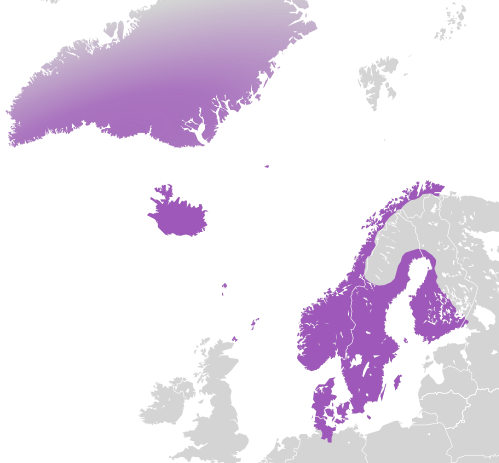
Eye Candy: Kalmar Union, circa 1400

NOL map Kalmar Union 1400

The Kalmar Union lasted from 1397 to 1523. Here is a wiki on it. Imagine Denmark, Norway, and Sweden united as a single country when it came to foreign affairs, but each of them having plenty of room to govern themselves domestically. The main rivalry here was the “monarchy” of Kalmar and the aristocracies of both Sweden and Denmark. This domestic rivalry, coupled with fact that its neighborhood included the Holy Roman Empire and the Hanseatic League, means that the Kalmar Union is probably one of the more interesting polities in European history. Yet I know next to nothing about it…

Afternoon Tea: “Shareholder Activism at the Dutch East India Company 1622-1625”

This paper explores the reason for the absence of control rights of shareholders in the Dutch East India Company (VOC) and the background of the conflict between shareholders and directors that arose in 1622/1623 when the VOC Charter of 1602 was extended.

The VOC was the result of a merger between several companies that had been trading in the East Indies between 1594 and 1602. The legal structure of most of these “pre-companies” which were incorporated for a single voyage to the East Indies, prevented shareholders from having actual influence. In most of these companies, the shareholders invested their money, not in the company itself, but via one of the individual directors. The relationship between a shareholder and most of the precompanies was therefore indirect, which impeded the exercise of control rights. Furthermore, shareholders may not really have been interested in their control rights given the high returns and the expectations of the newly opened trade route.

When these pre-companies were merged into the VOC in 1602, nothing changed with respect to the absence of shareholder control rights. The VOC, however, was established for a longer period and had to meet other more long-term challenges than those faced by the pre- companies. The failure to adapt the control structure to suit the different circumstances may have been a source of the conflicts that arose between the directors and shareholders between 1602 and 1623.

In 1622, upon extension of the 1602 Charter, a significant conflict erupted between the shareholders and directors. The so called dissenting participants complained about the numerous conflicts of interests that had been arising between the various directors and the VOC. They accused the directors of abuse of power, short-selling and self-enrichment. They argued that shareholder approval was required for the VOC to turn to the capital market to borrow funds. They also demanded that large investors be entitled to vote on the appointment of new directors. As the dissenting participants supported their arguments by referring to the English East India Company, the corporate governance of the EIC is briefly described.

Publishing their complaints in pamphlets, the shareholders mobilized public opinion and attempted to convince merchants not to invest in the Dutch West India Company, which was being incorporated at the same time. They exerted pressure on the government to ensure that more rights were granted to the shareholders when the VOC Charter was extended. To a limited extent, the activism of the “dissenting participants” was successful. The 1623 Charter granted certain rights to large investors, including the right to nominate new candidates for appointment as director. The 1623 Charter further regulated insider trading by the directors and encouraged the directors to pay a yearly dividend to the shareholders. In addition, a committee of nine shareholders was entrusted with the supervision of the VOC directors. This corporate body was known as the “Lords Nine” (Heren IX).

This is from Matthijs de Jongh, a judge in the Netherlands. Here is the link.

Afternoon Tea: “Albert Venn Dicey and the Constitutional Theory of Empire”

In the post-1945 world, constitutionalism has transcended the nation-state, with an array of transnational arrangements now manifesting constitutional characteristics — so says a growing number of scholars. This paper reveals an earlier but largely forgotten discourse of transnational constitutionalism: the constitutional theory of the British Empire in the late-nineteenth and early twentieth centuries. Focusing on the work of Albert Venn Dicey, the paper shows that, when the Empire was at the height of its power and prestige, British constitutional scholars came to see the Empire as a constitutional order and project. For Dicey, a committed constitutionalist and imperialist, the central dynamic of the imperial constitutional order was balancing British constitutional principles with imperial unity. This paper focuses in particular on parliamentary sovereignty, a constitutional principle that for Dicey was both necessary for and dangerous to the Empire’s integrity. An exercise in intellectual history, the paper rethinks Dicey’s work and the constitutional tradition in which Dicey has played such an integral part, seeking to bring empire back into the picture.

This is from Dylan Lino, a legal theorist at the University of Western Australia’s Law School. Here is the link.

RCH: Vietnam War armistice, Southeast Asian kingdoms, and abolitionism in America

I’ve been behind on links to my RealClearHistory columns. So, without further adieu:

and

Afternoon Tea: “The Johor-VOC Alliance and the Twelve Years Truce: Factionalism, Intrigue and International Diplomacy, C.1606-1613”

Using published and unpublished documents of Dutch, Portuguese and Malay provenance, the present study explores how news of the Twelve Years Truce in December 1609 negatively impacted politics and commerce at the court of the Kingdom of Johor. Since 1603, Johor had emerged as one of the principal allies of the Dutch East India Company (VOC) in the region of the Singapore and Melaka Straits, and after 1606 it had proven itself as a worthy ally in the company’s war on the Iberian powers across Southeast Asia. It will be argued that confusion resulting from the news of the truce on the ground in Asia exacerbated factionalism at the court. The Johor ruler, Ala’udin Ri’ayat Shah III, and especially his younger sibling Raja Bongsu, were incensed and evidently felt they had been left to carry on the struggle against Portuguese Melaka on their own. Unable to continue the war effort without Dutch funds, subsidies and ammunition, the pro-Portuguese faction at the Johor court brokered a peace with the Estado da Índia in October 1610. This deal led to the fall of Raja Bongsu and his pro-Dutch faction at the court. This essay provides the political and historical backdrop to the writing and revision of the Sejarah Melayu, or Malay Annals, in or around 1612.

This is from Peter Borschberg, a historian at the National University of Singapore. Here is a link.

Afternoon Tea: “English Liberties Outside England: Floors, Doors, Windows, and Ceilings in the Legal Architecture of Empire”

We tend to think of global migration and the problem of which legal rights people enjoy as they cross borders as modern phenomena. They are not. The question of emigrant rights was one of the foundational issues in what can be called the constitution of the English empire at the beginning of transatlantic colonization in the seventeenth century. This essay analyzes one strand of this constitutionalism, a strand captured by the resonant term, ‘the liberties and privileges of Englishmen’. Almost every colonial grant – whether corporate charter, royal charter, or proprietary grant – for roughly two dozen imagined, projected, failed, and realized overseas ventures contained a clause stating that the emigrants would enjoy the liberties, privileges and immunities of English subjects. The clause was not invented for transatlantic colonization. Instead, it had medieval roots. Accordingly, royal drafters, colonial grantees, and settlers penned and read these guarantees against the background of traditional interpretations about what they meant.

Soon, however, the language of English liberties and privileges escaped the founding documents, and contests over these keywords permeated legal debates on the meaning and effects of colonization. Just as the formula of English liberties and privileges became a cornerstone of England’s constitutional monarchy, it also became a foundation of the imperial constitution. As English people brought the formula west, they gave it new meanings, and then they returned with it to England and created entirely new problems.

This is from Daniel J. Hulsebosch, a historian at NYU’s Law School. Here is a link.

Afternoon Tea: “Independent Indians and the U.S.-Mexican War”

This cross-border conversation had a broad and tragic context. In the early 1830s, following what for most had been nearly two generations of imperfect peace, Comanches, Kiowas, Navajos, and several different tribes of Apaches dramatically increased their attacks upon northern Mexican settlements. While contexts and motivations varied widely, most of the escalating violence reflected Mexico’s declining military and diplomatic capabilities, as well as burgeoning markets for stolen livestock and captives. Indian men raided Mexican ranches, haciendas, and towns, killing or capturing the people they found there, and stealing or destroying animals and other property. When able, Mexicans responded by attacking their enemies with comparable cruelty and avarice. Raids expanded, breeding reprisals and deepening enmities, until the searing violence touched all or parts of nine states.

This is from Brian DeLay, a historian at Cal-Berkeley. Here is a link.

100 years after World War 1

In the five weeks since the Germans first requested peace negotiations, half a million casualties had been added to the war’s toll. As the delegates talked, Germany continued to collapse from within: inspired by the Russian Revolution, workers and soldiers were forming soviets, or councils. Bavaria proclaimed itself a socialist republic; a soviet took over in Cologne.

And:

But can we really say that the war was won? If ever there was a conflict that both sides lost, this was it. For one thing, it didn’t have to happen. There were rivalries among Europe’s major powers, but in June, 1914, they were getting along amicably. None openly claimed part of another’s territory. Germany was Britain’s largest trading partner. The royal families of Britain, Germany, and Russia were closely related, and King George V and his cousins Kaiser Wilhelm II and Tsar Nicholas II had all recently been together for the wedding of Wilhelm’s daughter in Berlin.

There is more here. Isolationism, or non-interventionism, often sounds good to American libertarians when World War I is brought up and discussed. And who can blame us? I think, though, that non-interventionism is one of the least libertarian positions you could take on matters of foreign policy.

I got an email the other day from an (American) economist who said that he wasn’t an isolationist because he favored free trade and open migration. Instead, he resolutely trotted out the same old dogma that he was a non-interventionist. I’ve got to bury this cognitive failure on the part of American libertarians.

RCH: Antarctic history

Longtime readers of NOL know I have a strange obsession with Antarctica, and the murder that happened on the continent earlier this week gave me the perfect opportunity to write about the southernmost continent for this weekend’s column at RealClearHistory. Behold, an excerpt:

6. The Gauss Expedition (1901-03). The Germans got in on the Antarctic act, too, even though Germany only formed as a country in 1871. The Gauss Expedition got trapped by ice for 14 months, but the gas balloon that the Germans brought along was put to good use while they were trapped. The photo above was taken in a balloon the Germans floated above their trapped ship. Johann Carl Friedrich Gauss, by the way, is one of history’s most important mathematicians, and many rank Gauss second only to Newton in mathematical importance.

You’ll have to read the whole thing if you want to see the photo (it really is a thing of beauty).

The Capitalist Peace: What Happened to the Golden Arches Theory?

Many are familiar with the Democratic Peace Theory, the idea that two democracies have never waged war against one another. The point is widely recognized as one of the major benefits of democracy, and the hand-in-hand development of more democracies and fewer/less-devastating wars than virtually any other period of human history, is a tempting and enticing explanation.

Now, it is not overly difficult to come up with counter-examples to the Democratic Peace Theory, and indeed there’s an entire Wikipedia page dedicated to it. Here are some notable and obvious counters:

  • Yugoslavian wars of the 1990s
  • First Kashmir War between India and Pakistan War (1947-49)
  • Various wars between Israel and its neighbors (1967, 1973, 2006 etc)
  • The Football war (1969)
  • Paquisha and Cenepa wars (1981, 1995)

Some people even include the First World War and various 18th and 19th century armed conflicts between major powers (American War of Independence comes to mind), but the question of when a country becomes a democracy naturally arises.

There’s another, equally enticing explanation, the main rationale underlying European Integration: The Capitalist Peace, or in a more entertaining and relatable version: The Golden Arches Theory – as advanced by New York Times columnist Thomas Friedman in the mid-1990s:

No two countries that both have a McDonald’s have ever fought a war against one another.

Countries, frankly, “have too much to lose to ever go to war with one another.” As a proposition it seems reasonable, an extension of the phrase apocryphally attributed to Bastiat: “When goods don’t cross borders, soldiers will”. And not because your Big Mac meal comes with a side of peace-and-love or enhanced conflict-resolution skills, but because the introduction of McDonald’s stores represents close economic interdependence and global supply chains. After all, if your suppliers, your customers or your collegues consists of people on the other side of a potential military conflict, a war seems even less useful. Besides – paraphrasing Terry Anderson and Peter Hill in their superb The Not So Wild Wild Westtrading is cheaper than raiding. Even as adamant a critic as George Monbiot admits that a fair number of McDonald’s outlets “symbolised the transition” from poor and potentially trouble-making countries, to richer and peace-loving ones.

Not unlike poor Thomas Malthus, whose convicing theory had been correct up until that  point, reality rapidly decided to invalidate Friedman’s tongue-in-cheek explanation. Not long after it was published, the McDonald’s-ised nations of Pakistan and India decided to up their antics in the Kargil war, quickly undermining its near-flawless explanatory power of Friedman’s. Not one to leave all the fun to others, Russia engaged in no more than two wars in the 2000s to undermine the Golden Arches theory: the 2008 war with Georgia, and more recently the Crimean crisis. Adherring to their namesake creation, McDonald’s pull-out from Crimea was just a tad too late to vindicate Friedman.

The Capitalist Peace, the academic extension of the general truism that trading is cheaper than raiding, came undone pretty quickly thanks in part to our Russian friends. The updated version, the Dell Theory of Conflict Prevention, may unfortunately fall into the same trap as the Democratic Peace Theory: invoking ambiguous definitions that may ultimately collapse to mere than tautologies.