A Short Note on Fraudulent Banking

In my piece over at American Institute for Economic Research the other week, I discussed the phenomenon of selling property that one does not (yet) own. I mentioned a left-wing and a right-wing version, but focused my efforts mostly on the right-wing “Fractional-Reserve-Banking-is-Fraud” idea.

My main point was to, by analogy, point to other fiduciary relationship – specifically insurance and airline overbooking – that fulfil the same criteria of double-ownership that is so crucial for the right-wing view. Insofar as this analogy holds, rejecting fractional reserve banking as fraudulent and illegal requires one to similarly reject insurance policies and airlines’ practice of overbooking. Regardless of where one comes down on the legal relationship between a depositor and a bank, I thought the theme interesting to explore.

Unknown to me, in one of Hoppe-Hülsmann-Block’s (HHB) early articles they devoted about two pages to addressing my main points. To HHB, there’s a “fundamental distinction” between property and property titles that render these and other analogies “mistaken”: future vs present goods. Money titles such as fractionally issued bank notes are designated present goods whereas insurance policies, parking permits or flight tickets are considered future goods. Money is the “present good par excellence to use Rothbard’s words.

HHB claims that one can legally oversell future goods, but when overselling present goods, one is committing fraud. A narrow distinction, admittedly, and we’ll see that it doesn’t fare so well. Discussing the example of airline overbooking, this distinction does momentarily save HHB from condemning airlines; yes, the airline is selling a flight at a future date, which seems meaningfully different from the instantly-available present goods bank notes ought to be. But the thing about the future is that it inevitably and predictably becomes the present. Once that future arrives, HHB explicitly admits that having more passengers at the gate than they have seats on the plane does amount to fraud. Strangely, however, HHB exonerate airlines since they are “prepared to pay every excess ticket holder off”.

Oh, and fractional reserve banks aren’t?

At this point their already weak defense falls apart. Every instance of historical bank runs include management, shareholders and governments doing precisely that: slowing down the run by paying employees, friends or relatives to deposit funds; acquiring new funding (either debt or equity) to pay off skittish depositors who want their present goods right away; or my own personal favorite, as a good student of Scottish financial history: the Option Clause!

HHB say that airlines are not committing fraud since once at the gate – on the verge of having their oversold future goods transform into present goods – they stand ready to

“repurchase [the passenger’s] ticket at a price (by exchange of another good) that the holder considers more valuable than his present airline seat.”(HHB 1998: 47)

Let’s see what the financially innovative Scots did. Their notes were subject to a legal clause, allowing management to ‘mark’ particular notes when offered up for redemption. That meant deferring the redemption claim for six months, effectively transforming the present good (the money title) into a future good (money title in six months), at the maximum legal rate of interest of 5%. That sounds like a good “the holder considers more valuable”, especially considering that these notes were effortlessly accepted in trade – i.e., the holder could instantly turn around and buy things with this note, its value gradually appreciating as the six-month date arrived.  In practice, this deterrent was only used infrequently, and then almost exclusively against English currency speculators.

Indeed, extrapolating this point, as I do in a forthcoming piece on maturity-mismatch (and have flaunted in Austrian conferences), illustrate how little practical and economic difference there would be between the opposing and deeply-entrenched Fractional-Reserve-Banking camps.

Regardless, it seems the airline-insurance-parking permit analogy still stands.

Two Financial Instruments that made the Modern World

Following my Mr. Darcy piece that outlined the use and convenience of British government debt instruments in the eighteenth (and predominantly the nineteenth) century, I thought to extend the discussion to two particular financial instruments. In addition to the Consols (homogenous, tradeable perpetual government debt) that formed the center of public finance – and whose active secondary market that made them so popular as savings devices – the Bill of Exchange was the prime instrument used by merchants for financing trade and settling debts.

The complementarity of the Consol and the Bill in international finance, roughly from the South Sea Bubble (1720) to the end of Napoleon (1815), was the “secret of success for international finance” (Neal 2015: 101) and arose without an overarching plan, i.e. rather spontaneously. As the Consol is more easily understood for a modern reader, and the Bill is both more ancient and less well understood, I’ll focus the bulk of my attention on the latter.

According to Anderson (1970: 90), the Bill constituted “a decisive turning-point in the development of the English credit system,” but is much older than that. In practice, it was a paper indicating debt and a time for repayment, allowing financing of current trade. Cameron (1967:19) writes that the Bill

was far more ancient than either the banknote or the demand deposit; it had been developed in the Middle Ages. At first the bill was used as a device for avoiding the cost and risks of shipping coin or bullion over great distances, then as a credit instrument which circumvented the Church’s prohibition of usury. When it first came to be used as a means of current payment is a moot question that may never be answered, but that it was so used in eighteenth-century England is beyond doubt.

The Bill was predominantly used in coastal cities in the Mediterranean and around the North-Sea, becoming frequent perhaps in the 1700s. One observer even dates an early instance of its use to 1161, and it was of standard use among traveling traders, merchants and brokers throughout the Middle Ages (Cassis & Cottrell 2015: 12). Occasionally – warranting a discussion of its own – Bills in England became “so widespread that they drove out even banknotes” (Cameron 1967: 19).

There is an unfitting competition among financial historians as to who can produce the most persuasive, informative or complicated schedule for how Bills worked (I know of at least four similar, yet uncredited, renditions). Here’s Anthony Hotson’s (2017: 92) attempt from last year:

1aDeI0Nu0W4AIXASg.jpg

  1. We start, counter-intuitively, in the top-right corner. Andrew, an English exporter of Apples, draws up a Bill on Bas, a Amsterdam maker of Bankets – a Dutch pastry. Bas, having no coin/gold available to pay Andrew – either because he won’t have the funds until after he has sold his apple-flavored(!) Bankets, or because the risk of loss or cost of transportation is too great – accepts the Bill and returns it to Andrew.
  2. Having returned it to Andrew, we now have a debt and a financial instrument; Bas has promised to pay Andrew £x for the apples in 90 days, a common duration for a Bill of exchange.
  3. But like most merchants, Andrew cannot wait 90 days for payment; he has sold and shipped his Apples, but needs funds for himself (feeding his family, or investing in new Apple-harvesting equipment etc). In the heyday of British financial markets, Andrew could simply visit a bank, Bill-broker or the London financial markets himself, and offer to sell the Bill there. Of course, Andrew won’t be able to sell the Bill for £x, since his buyer is effectively providing him with a loan for 90 days. The bank, bill-broker or financial market trader will discount the Bill with the going interest rate (say 6%, for one-quarter of a year, so ~1.5%), paying at most £0.985x for the Bill. Besides, there is a risk-of-default element involved, so the buyer applies a risk premium as well, perhaps buying the Bill at £0.95x.
  4. In the schedule above Hotson uses the Bill trade to show how merchants trading Bills could net out their respective debts and minimize the need to send payment across the British channel. For (3) and (4), then, we replace the banker with an English importer – Dave – of Dutch goods (perhaps tin-glazed pottery) looking for a way to pay his Amsterdam pottery supplier, Cremer. Instead of shipping gold to Amsterdam, Dave may purchase Andrew’s Bill, and settle his account with Cremer by sending along the Bill drawn on Bas. Once the 90 days are up, Cremer can simply wander over to Bas’ pastry shop and present him with the Bill to receive payment for the goods Cremer already shipped to England.

This venture can – and usually was – made infinitely more complicated; we can add brokers and discounting banks in every transaction between Andrew, Bas, Dave and Cremer, as well as a number of endorsers and re-discounters. In his popular book Exorbitant Privilege, Barry Eichengreen recounts a 12-step, several-pages long account for how a U.S. importer of coffee and his Brazilian supplier both get credit and signed papers from their local (New York + Brazil) banks, how both banks send their endorsed bills to their London correspondent banks, and some investor in the London money markets purchase (and perhaps re-sell) the Bill that eventually settles the transaction between the American coffee importer and the Brazilian farmer.

Although it might sound excessive, complicated and impossible to overlook, the entire process simplified business for everyone involved – and allowed business that otherwise couldn’t have been done. In econo-speak, the Bill of Exchange set within a globalizing financial system, extended the market for merchants and farmers and customers alike, lowered transaction costs and solved information asymmetries so that trade could take place.

Turning to the opposite end of the maturity spectrum, the Consol as a perpetual debt by the government was never intended to be repaid. Having a large secondary market of identical instruments, allowed investors or financial traders everywhere to pass Gorton’s No-Questions-Asked criteria for trade. A larger market for government debt, such as after Britain’s wars in the late-1700s and early 1800s, allowed dealers in financial markets to a) be reasonably certain that they could instantly re-sell the instrument when in need of cash, and b) quickly and effortlessly identify it. These aspects contributed to traders applying a smaller risk premium to the instrument and to be much more willing to hold it.

While the Bills were the opposite of Consols in terms of homogeniety (they all consisted of different originators, traders, and commodities), there developed specialized dealers known as Discount Houses whose task it was to assess, buy, and sell Bills available (Battilosso 2016: 223). Essentially, they became the credit rating institutions of the early modern age.

Together these two instruments, the Bills of Exchange and the Consols, laid the foundations for the modern financial capitalism that develops out of the Amsterdam-London nexus of international finance.

Mr. Darcy’s Ten Thousand a Year

On popular demand, I’m reviving a reoccurring theme of mine: teaching economic history through the lens of popular culture. Today: bonds, yields and 18th century English financial planning.

In what is probably my favourite piece ever written, I tried to estimate exactly how rich Mr. Darcy was – Mr. Darcy, of course, of Jane Austen’s classic novel Pride & Prejudice. I showed that whatever method you use to translate incomes to the present, all characters in Austen’s captivating story are astonishingly rich. But, as we well know today, there are large differences even among the superrich; compare Bernie Sanders (small-time millionaire) with George Lucas and Steven Spielberg (single-digit billionaires) or Jeff Bezos (wealthiest man alive).

Using Pride & Prejudice to illustrate some economic point is hardly unconventional (Piketty did this in his Capital in the Twenty-First Century), so let me similarly discuss 18th and 19th century British financial markets using the characters in this well-known tale.

The starting point is the following musing, courtesy of former Oxford Economist Martin Slater’s (2018: 52) The National Debt; how come “female characters in nineteenth-century novels always seem to have a suspiciously exact income of ‘so many pounds per year'”? Where does this money come from? Why is it so exact? And what’s the reason Piketty uses this particular literary example to illustrate the permanence and steady stream of income that capital somehow just throws off?

Consols and Financial Markets

Financial markets are truly awesome – not just in their impressive scope or potential devastation, but in the many different needs they simultaneously fulfil for many different people. Slater ably guides us through the confusing mishmash that is the 17th and 18th century English public finance, but what emerges by 1757, after Henry Pelham’s consolidation of government debt, is two main – and for our purposes, equivalent – securities: the Consolidated 3% Annuities (and the ‘Reduced annuities’), affectionately named ‘Consols’. These were permanent government bonds with annual interest payments of 3%. This means that they had no maturity date, i.e. the holder of the security could expect the government to keep paying 3% of the face value for all future (a Churchill-issued subsequent Consol was actually repaid and retired just a few years ago, after almost a century in service).

Two cool things happen. First, the “initial value” – the face value – of debt running in perpetuity becomes almost irrelevant, since all that matters for the issuer is the ability to maintain interest rate payments; there is no presumption of future repayment. Second, creditors – that is, holders of the Consols who receive the regular interest payments – may trade that asset on financial markets. Since the plethora of different debt assets were now condensed into a single, credible, identical and easily-identified asset, the market for 3% Consols in London developed into a very large and liquid market. With such ease of access and predictable and stable payoffs, the Consols became the instrument of saving for well-off families in Austen’s time.

A note on yields

The Consols, essentially a piece of paper with a face value of £100, entitled the owner to a perpetual stream of payments by the government, in this case 3% – or £3. Now, the actual price at which this paper could be sold in London fluctuated extensively depending on the conditions of the financial market and, most prominently in Austen’s lifetime, the Napoleonic wars. As the £3 annual pay was serviced by the British government, and financial strain during the war increased the risk for defaults (through a foreign invasion or British government itself), the price of Consols was chiefly reflecting the military success.

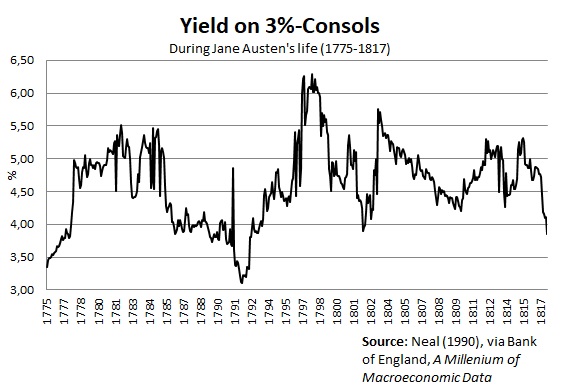
When the market price of a debt falls below its face value, the effective interest rate (the “yield”) that a prospective investor receives increases; paying £50 for a Consol with face value of £100 and a £3 perpetual interest payment, effectively earns the investor 6% interest instead of 3% (3/50 = 0.06). Since the Consols were the most dominant asset on the largest financial market in the world, their price became “the single most important asset price in the world economy” as Klovland (1994: 165) called it. Here’s the yield on Consols during Austen’s life:

JA, yield on 3%

It reached a low of 3.11% in 1792 (almost at par), and a high of 6.22% in 1798 (below £50) after the suspension of the gold standard.

The Bennets and the fortunes of handsome young men

The families of Pride & Prejudice made good use of this thriving financial market – not specifically for trading but for financial planning (others, such as British economist David Ricardo, and the banking families of Rothschild and Barings, made some of their fortune trading Consols).

In the novel, Mr. Bennet – the protagonist Lizzy’s father – has an income of £2,000 a year (again, see my 2016 piece for three different attempts at “translating” these sums into today’s money). It is not clear what his income comes from, but it’s a fair guess that it stems, like many other landed gentry of the time, from renting out farm lands belonging to the family home Longbourne. In addition, we know that Mrs. Bennet’s portion to the family home is a £5,000 contribution which is the sole inheritance the (five) Bennet daughters are entitled to.

Now, the way well-off families like the Bennets would make use of Consols was to ensure that non-inheriting children had at least some source of income after the passing of their father. The underlying concern in Pride & Prejudice, causing Mrs. Bennet to worry so about fortunate marriages for her daughters, is that the Bennet estate is entailed away to Mr. Collins – and with it the presumed rental income of £2,000 a year. That would leave the girls homeless, reduced to living off Mrs. Bennet’s inheritance of £5,000.

Austen began writing First Impressions (the initial title for Pride & Prejudice) in October 1796. During the decade leading up to this, the yield on Consols had been firmly within the interval 3.5-4.5%, hovering around 4% for years. It should thus not surprise us that Mrs. Bennet’s fortune of £5,000 presumably consisting of Consols, would have been purchased at around £75, predictably yielding the family an annual return of 4%. Indeed, the characters of Pride & Prejudice seem to be squarely set on 4% being the general norm. For instance, in a desperate attempt to enhance his already-inane proposal to Lizzy, Mr. Collins explicitly says:

“To fortune I am perfectly indifferent, and shall make no demand of that nature on your father, since I am well aware that it could not be complied with; and that one thousand pounds in the 4 per cents, which will not be yours till after your mother’s decease, is all that you may ever be entitled to.”

(Chapter 19, p. 133 in the 2009 HarperCollins edition)

Here we see the great use that Consols offered families like the Bennets. Once the Bennet parents pass away, the £5,000 of Consols could be divided equally among her children; Lizzy’s share would be a thousand pounds, which earns her an annual 4% interest return, or £40 (although maybe several year’s earnings for a regular worker, this was a rather small sum for such rich families – in contemplating Lizzy’s sister Lydia’s imprudent marriage, we learn that Mr. Bennet spent almost £100/year on Lydia’s purchases and pocket money alone). Being liquid financial assets, dividing up the Consols among children was very easy, and their steady income stream ensured that they would have at least some income. Bar Napoleonic conquest, the interest payment on the Consols would reliably show up year after year.

As for the handsome young men, Mr. Bingley’s case is easier than Mr. Darcy’s. We know that Bingley’s income is not agricultural, but investments from a fortune of almost  £100,000 inherited from his father, who had not yet acquired an estate. The fortune was “acquired by trade”, where (being from the North) cotton or shipping are prime candidates, but the slave trade is also a possibility. We also know that the ambiguity of his annual income (£4,000 or £5,000) lies well within the return from a fortune of that size invested in Consols. Indeed, for Bingley to hold that kind of fortune, earn that income and still not have an estate of his own, suggests that his financial wealth consists predominantly of Consols – perhaps complemented with some other stock (Bank of England or East India Company stock are plausible candidates). Clearly, new money.

Mr. Darcy, on the other hand, is plainly old money. And a lot of it. There are subtle hints in the novel that Pemberley has been in the Darcy family for generations. What we don’t know is precisely how his £10,000 a year is earned. When visiting Pemberley in Derbyshire with her aunt and uncle, Lizzy is told by the housekeeper that Mr. Darcy is such a generous and fair man: “ask any of his tenants”, she says, which indicates that Mr. Darcy, has a fair number of them – as one would expect from a sizeable estate like Pemberley. Now, what we don’t know is if the entirety of his £10,000 a year is reaped from rental income; it could be that some of his income is financial – or that either his financial or rental income is excluded from this rumoured number. Beyond a mention of his sister, Georgiana’s, fortune of £30,000 – which for convenience would likely be held in Consols – we know very little about the personal finances of Mr. Darcy.

The use and abuse of Consols

The financial market for government debt in the late-18th and early 19th century was not created with financial planning in mind, but by incremental improvements to previous government funding problems. The outcome, however, was a striking success for Britain, whose thriving financial market in no small part accounted for Britannia’s Century until WWI.

Moreover, as contemporary economists from Ricardo and John Stuart Mill to Malthus and Lauderdale observed, the recurring interest payments, funded by taxes, may have had quite large macroeconomic consequences. Taxing ‘productive’ investments and trade in order to fund ‘unproductive’ holders of government debt was, it was argued, harmful to the country – and in a time where government expenditures largely consisted of the military and debt maintenance, the impacts of funding the debt was of prime political interest.

Piketty’s use of Austen’s England (and Balzac’s France) was used for precisely the same distinction. Wealth, in Piketty’s view, perpetuates itself, and effortlessly earns its return (never mind the work, risk and selection issues involved). By continually paying the interest on its debt, the governments of Austen’s Britain financed the leisurly lifestyles of the rich, just as the “natural” return of the modern-day rich contribute and maintain today’s inequality.

The Consol was a revolutionary invention, but it is possible that it was not part of Mr. Darcy’s Ten Thousand a Year.

Watson my mind today: labor markets

And how ‘bout them Dodgers, hunh? Actually, how about each division’s top team? That’s a lot of winning!

— A partial response to Marx’ claim that managers are expropriating the value produced by the workers while providing nothing themselves: “The study showed that managers didn’t just influence the results their teams achieved, they explained a full 70% of the variance. In other words, if it’s a superior team you’re after, hiring the right manager is nearly three-fourths of the battle.”

— Boudreaux wonders what supposedly-enormous transaction cost prevents firms from offering workers a choice of pay packages – buying more parental time for a lower wage, for instance. One commenter notes their firm does just that, letting workers buy back vacation time. This is also, of course, standard practice in much of academia, where faculty are allowed to reduce their teaching load in exchange for a salary cut – usually funded by a research grant.

— Sumner on how labor market reforms (including cutting unemployment benefits) helped Germany and Israel to lower average unemployment rates and increase economic growth.

— But there appears to be a great deal that only deregulation will not be able to change. A new paper by Berger and Engzell finds correlation between the European-country-of-origin of people in modern US and the level of inequality and intergenerational mobility. Institutions persist for a very, very long time … again. (Homework: How does this apply to the reparations debate?)

— Another new paper by Fone, Sabia, and Cesur finds that higher minimum wages increase property crime arrests – contra expectations – so that “a $15 Federal minimum wage could generate criminal externality costs of nearly $2.4 billion.”

— A history of civil asset forfeiture tells how the British Crown’s attempt to encourage the Royal Navy to enforce trade restrictions and tariffs became so widely used in modern America.

— Summers and Sarin show that wealth taxes will take in much less than their proponents hope.

Proposal: Let’s stop calling them “Property Rights”

I think an alternative that is both clearer and more general is “Decision Rights”. When I teach Coase Theorem I use both terms, and (I think) students have an easier time grasping it when they realize that property rights are really just rights to make certain decisions. I can’t see a good reason to keep using the term property rights except that by historical accident it’s become entrenched jargon.

Property sounds like “stuff” to most people. And property rights sounds like “owning stuff”. This raises two points that need clarifying:

1. There is more to the world than just the physical, and there is more to property than just stuff.

I would argue that economic rights are human rights. (I would also argue that corporations are owned and staffed by humans but are not humans themselves.) And I would say that right to self-ownership is a particular type of economic/human right.

When we talk about environmental issues, the root problem is usually over some shared resource (e.g. we can’t neatly privatize the atmosphere and let now-private conflicts be resolved in court). It’s much easier to focus in on the relevant particulars when our language directs us to what’s really at stake (e.g. whether I can decide to put more than X amount of pollution into the atmosphere without legal consequences).

2. I own a bit of land and I can make many decisions about how to use it. But I can’t set up a nuclear reactor or burn a massive pile of debris. My ownership is not carte blanche, but a bundle of different rights. I have the right to use (for normal domestic purposes), to exclude, to sell, etc. By “I own” what I really mean is “I can make a particular set of decisions.

I hope my hard core libertarian friends will agree with me that the decisions I can make are not limited by what is explicitly legislated. I suspect my interventionist friends will disagree. But I also think interventionists can agree that it’s more reasonable for me to have a set of decision rights (how ever nebulous the extent of that set is) than some more magical sounding dominion/ownership over a particular fifth of an acre.

The notion of decision rights makes it clearer what political debates are over. If we want to pass a law saying you can’t put a pool in your yard because of spotted owls, “property rights” muddies the discussion. The law would take away a particular property right–which is to say, the right to make a particular decision. But the debate is going to devolve into “you’re taking our land” vs. “no we aren’t.” It’s close to the real issue, but not close enough.

tl;dr: When we talk about “property rights” or ownership what we really mean is a set of various decisions that one has a right to make. Those decisions might be over the use of what we traditionally call property (e.g. my yard), but it might also be over shared resources (e.g. the atmosphere), decisions with collective impacts (e.g. ecosystem management–or lack thereof), or socially constructed issues (e.g. intellectual property). The term “property rights” is not clear or obvious (particularly for people who aren’t already likely to read this blog). A better term would be “decision rights.”

The French Have It Better?

As I keep saying, facts matter. Facts matter more than ideological consistency if you want to know. That’s why I keep comparing us with the other society I know well, France. I am up-to-date on it, a task facilitated by the fact that I read a major French newspaper online every day, by the fact that I watch the French-language Francophone television chain, TV5, nearly every day, and by occasional recourse to my brother who lives in France. My brother is especially useful as a source because he is well-informed by French standards, articulate, and an unreconstructed left-of-center statist. I suspect he has never in his life heard a clear exposition of how markets are supposed to work. He is a typical Frenchman in that respect.

I almost forgot: I must admit that I watch a French soap opera five days a week at lunchtime. And finally, I spy on my twenty-something French nieces and nephews through Facebook. I never say anything to them so they have forgotten I am their so-called “friend.” I almost forgot again: Until recently, I went to France often. Every time I was there, I made it my duty to read local newspapers and newsweeklies and to listen to the radio and to watch the news on television. I said “duty” because it was not always fun.

So, those are my credentials. I hope you find them as impressive as I do.

And, incidentally, for those who know me personally, mostly around Santa Cruz, the rumor that I am a guy from New Jersey who fakes a French accent to make himself interesting to the ladies, that rumor has no foundation. In fact, the accent is real. French is my first language; the accent never went away and it’s getting worse as my hearing deteriorate. I like to write in part because I don’t have much of an accent in writing. Got it?

I found out recently that the French national debt to GDP ratio is about 85. That is, French citizens, as citizens, owe 85 cents for every dollar they earn in a year. The debt is a cumulative total, of course, And “national debt” refers to what’s owed by the national government of a country. The private debt of the citizens of the same country is an unrelated matter. Another way to say the same thing is that, should you reduce the national debt of your country down to zero, it wouldn’t help you directly with your personal credit card balance. (It might help you indirectly to some extent because you wouldn’t be in a position anymore to compete with the federal government for credit. This competition raises interest rates.)

The national debt also does not include the debts of states and local governments. In this country, the aggregate of these non-federal government debts is also high because of our decentralized structure. Let me say it another way: The national debt, associated entirely with the federal government, is a relatively small fraction of the total debt US citizens owe by virtue of the cost of their overall system of government. It’s relatively small as compared to the same quantity for France, for example. The French national debt includes most sub-debts that would be counted as state debt and local debt in this country. Accordingly, the French national debt is overestimated as compared to ours. If French accounting were like ours the French national debt would be considerably less than 85% of GDP.

Well, you ask: What’s ours, our national debt as a percentage of GDP? Fair enough:

It’s about 100% of GDP, 15 points higher than the French percentage. We are closer to Greece than France is in that respect.

This pisses me off to no end. The divergence between the directions taken by French society and American society occurred during my adulthood. I witnessed that divergence in concrete terms through my French relatives and directly, through my visits to France, and the occasional longish sojourn there, and so forth. So, let me summarize what I saw in France during the past thirty years.

The French eat better than Americans. They always did but their food could have become worse under “socialism.” Even the children who stay at school over lunch eat good meals for a nominal sum. School lunches in the average French town taste better than the fare of a better-than-average American restaurant, in my book.

The French have longer vacations than Americans. That’s all of them, all Americans, including civil servants and bricklayers’ union members. Five weeks is the norm in France. You read that right: 5!

In many French municipalities – I am tempted to say “most” but I have not done the research – children go skiing at public expense one week each year or more. There are also many subsidized “initiation to the sea” summer camps.

It’s also true that Americans have bigger houses and bigger cars than do French people. Personally (and I am a kind of small expert on the topic) I think French universities are not nearly as good as their American counterparts. I mean that the best French universities don’t come close to the best American universities and that the worst American universities maintain standards absent in the worst French universities. Elementary and secondary French schools seem to me to be about equivalent to American schools. They also turn out large numbers of functional illiterates. But, there is more.

The French have universal health care that is mostly free. It hurts me a lot to say this but I saw it at work several times, including under trying circumstances, and the French national health care system performed fine every time. (There is an essay on this topic on this blog, I think.) I know this is only anecdotal evidence but the raw numbers don’t contradict my impression. In point of fact, French males live two years longer than American men. I realize this superior longevity could be due to any number of factors (except genetic factors, both populations are very mixed). However, it is not compatible with a truly horrendous “socialized medicine” system. And, yes, I too would like to credit Frenchmen’s longevity to regular drinking of red wine but it’s not reasonable. If it were, a health cult of red wine would have been launched by the wine industry in this country a long time ago.

The French collectively spend about half as much as we do on health care.

I can hear my virginal libertarian friends howling: The French can afford all those tax-based luxuries because they are less likely than Americans to become involved in military ventures. (And I would add, they cut out earlier, as they are now doing in Afghanistan.) But the numbers have to jibe: In the past thirty years, the US never spent more than 5% of GDP on the military. In most years, it was under 4% . Both figures include incompressibles such as veterans’ benefits that aren’t really spent to wage war, now or in the future. Those costs, about ¼ of the military budget in the average year, would be more or less made up elsewhere if they did not exist. So, it seems to me that higher military budgets cannot begin to account for the fifteen percentage points the French have over us in their national debt relative to GDP.

I am a small government conservative who would call himself a libertarian if I did not see the word as associated with pacifism. Yet, I cannot look away from these simple facts. I wish I had an answer to the quandary they pose but I don’t. Any ideas?

Not all GDP measurement errors are greater than zero!

Bryan Caplan is an optimist. He thinks that economists do many errors in estimating GDP (overall well-being). He is right in the sense that we are missing many dimensions of welfare improvements in the last half-century (see here, here and here). These errors in measurements lead us to hold incorrectly pessimistic views (such as those of Robert Gordon). However, Prof. Caplan seems to argue (I may be wrong) that all measurements problems and errors are greater than zero. In other words, they all cut in favor of omitting things. There are no reasons to believe this. Many measurement problems with GDP  data cut the other way – in favor of adding too much (so that the true figures are lower than the reported ones).

Here are two errors of importance (which are in no way exhaustive): household output and adjustments for household size.

Household Output

From the 1910s to the 1940s, married women began to enter moderately the workforce. This trickle became a deluge thereafter. National GDP statistics are really good at capturing the extra output they were hired to produce. However, national GDP statistics cannot net out the production that was foregone: household output.

A married woman in 1940 did produce something: child-rearing, house chores, cooking, allowing the husband to specialize in his work. That output had a value. Once offered the chance to work, married women thought the utility generated from producing “home outputs” was inferior to the utility generated from “market work”. However, the output that is measured is only related to market work. Women entered the labor force and everything they produced was considered a net addition to GDP. In reality, any economist worth his salt is aware that the true improvement in well-being is equal to the increased market output minus the forsaken house output. Thus, in a transition from a “male-labor force” to a “mixed labor force”, you are bound to overestimate output increases.

How big of an issue is this? Well, consider this paper from 1996 in Feminist Economics. In that paper, Barnet Wagman and Nancy Folbre calculate output in both the “household” and “market” sectors. They find that even very small changes in the relative size of these sectors alter growth rates by substantial margins. Another example, which I discussed in this blog post based on articles in the Review of Income and Wealth, is that when you make the adjustment over four decades of available Canadian data, you can find that one quarter of the increase in living standards is eliminated by the proper netting out of the value of non-market output. These are sizable measurement errors that cut in the opposite direction as the one hypothesized by prof. Caplan (and in favor of people like prof. Gordon).

Household Size

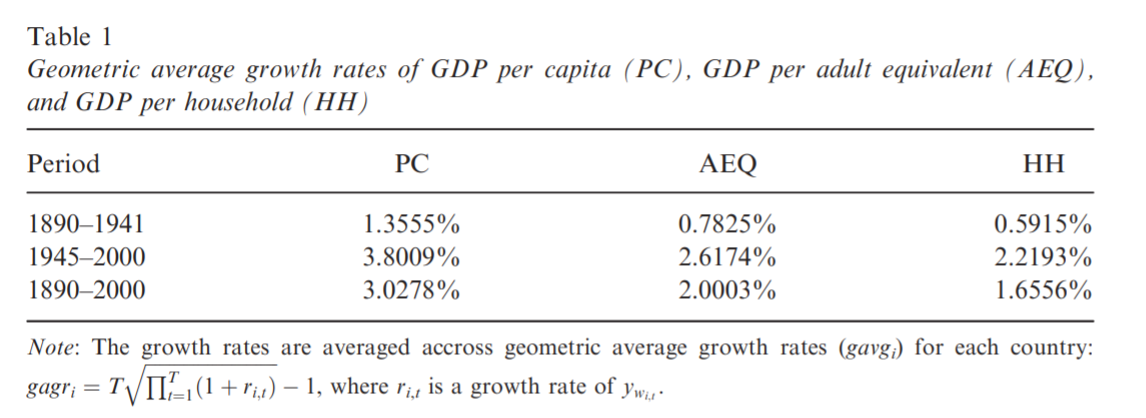
Changes in household sizes also create overestimation problems. Larger households have more economies of scale to exploit than smaller households so that an income of $10,000 per capita in a household of six members is superior in purchasing power than an income of $10,000 per capita in a single-person household. If, over time, you move from large households to small households, you will overestimate economic growth. In an article in the Scottish Journal of Political Economy, I showed that making adjustments for household sizes over time yields important changes in growth rates between 1890 and 2000. Notice, in the table below, that GDP per adult equivalent (i.e. GDP per capita adjusted for household size) is massively different than GDP per capita. Indeed, the adjusted growth rates are reduced by close to two-fifths of their original values over the 1945-2000 period and by a third over the 1890 to 2000 period. This is a massive overestimation of actual improvements in well-being.

HouseholdAdjust

A large overestimation

If you assemble these two factors together, I hazard a guess that growth rates would be roughly halved (there is some overlap between the two so that we cannot simply sum them up as errors to correct for – hence my “guess”). This is not negligible. True, there are things that we are not counting as Prof. Caplan notes. We ought to find a way to account for them. However, if they simply wash out the overestimation, the sum of errors may equal zero. If so, those who are pessimistic about the future (and recent past) of economic growth have a pretty sound case. Thus, I find myself unable to share Prof. Caplan’s optimism.

Three Lessons on Institutions and Incentives (Part 8): Conclusion

Far from the custom of assigning to cultural factors, or educational, or geographic or relative to the particular constitution of the ruling elites, the three works reviewed – Institutions, Institutional Change and Economic Performance, by Douglass C. North; The Elusive Quest for Growth, by William Easterly and Why Nations Fail, by Daron Acemoglu & James A. Robinson, state an explanation of the progress and decline of nations articulated on abstract incentives, which serve as a structure in which frame the rational agent makes his choices. The four authors have a common reference to methodological individualism, but such an individual agent does not make decisions in a vacuum, but inserted within a framework of incentives.

That such incentives, to act as points of reference for individual action, should materialize historically, does not mean that such conditions for action come from a particular circumstance of time and place, but that they depend on an abstract structure that relates to different terms and that is present in every phenomenon of human interaction.

To finish, it is worth referring to the conclusions reached by North in his referenced work: the case of the two successive Spanish Americas, the Habsburg and the Bourbons. The first extended from the discovery and colonization of America to the early eighteenth century. The viceroyalties of America enjoyed great political autonomy – Spanish immigration had been little and a “Creole” elite had developed – and they were closed to trade, which was limited to the “export” of gold to Spain. With the arrival of the Bourbons at the beginning of the 18th century and the implementation of their Reforms – which from the economic point of view were a resounding success both in Spain and in America – the relationship was reversed: political power passed into the hands of the “Peninsular Spaniards” and an opening of a more fluid trade between the metropolis and its colonies was launched. North explains that the independence movements could be successful due to a transitory alliance between the sectors that wanted to return to the Habsburg system and those who wanted to deepen the modernizing and free-market impulse of the Bourbons. Once achieved independence, these two currents came into conflict, which, according to the author, would extend until today.

According to North’s thesis on Spanish America, there would be two political patterns in tension: on the one hand, an elitist politician who is open to the economy and on the other a “popular” current that is traditionally protectionist. In the second half of the 19th century, success belonged to the “Bourbon pattern” and, in the 20th Century, the “Habsburg pattern” prevailed. In terms of Acemoglu & Robinson, it would be the dispute between a combination of extractive political institutions with inclusive economic institutions and another combination of inclusive political institutions with extractive economic institutions. Of course, in practice, moments of extractive political and economic institutions were also known, as well as short-lived experiences of inclusive institutions, both politically and economically.

The notion of polarized societies used by Easterly can serve as a way to deepen this analysis. It is much clearer to find problems of countries with societies divided into distant and dissimilar regions, in which the policy is expressly articulated as a function of tribes or ethnic groups and which the dispute over public policies expressly favors or harms a another ethnic group. However, as it has been stated, it is not ethnicity or nationality that determines the low economic and institutional performance of a country, but the polarization structure itself, whatever the functions in which such polarization is expressed (language, religion, ethnicity, ideology, etc.). Understanding these latter is fundamental to be able to provide a common thread for a principle of solution.

Just as on the political level an express agreement can be reached on the way to choose who exercises public power and under what conditions, Easterly states a series of conditions related to economic institutions whose agreement would allow for economic growth, regardless of the region, culture, or education of the ruling class of each country. Throughout The Elusive Quest for Growth you can find mentioned to free trade as a main factor of progress, monetary stability and exchange freedom as examples of clear and equitable rules, a state that participates in large infrastructure works but that refrain from arbitrating in the distribution of economic rents among various groups, a low level of public indebtedness, stability in property rights and an independent justice that allows individuals to innovate and save, as well as support programs and incentives to members of society who are immersed in poverty traps.

As mentioned, many times the policy -especially when, in the terms of Acemoglu & Robinson, it is inclusive- consists of the composition of interests of various kinds for the purpose of articulating a government program. From the work of the authors commented here, it can be inferred that, just as there is an agreement on the political plane regarding the rules of the democratic game, which include periodic elections, limited re-elections and division of powers, among others, there should also be a consensus in a body of economic institutions that should be left out of political negotiation, so that economic policy is as neutral as possible against the conflicting interests of which a country with a polarized society is composed.

[Editor’s note: Here is Part 7, and here is the entire, Longform Essay.]

Three Lessons on Institutions and Incentives (Part 7): Breaking the mold

This role of entrepreneurs also depends on an abstract characteristic of technological knowledge: it works in a manner contrary to that of most goods, since it is more productive to the extent that it is more widespread in the population. This characteristic of the abstract nature of technological knowledge is related to the phenomenon of the combination of skills (matching of skills): the negative side of creative destruction lies in substitution phenomena (a computer program of inventory management increases the productivity of work saving the salaries of the army of employees who used to carry them with pencil and paper), but the positive side comes from the phenomena of complementarity.

As William Easterly exemplifies, the cardiac surgeon will be more productive in a first world hospital, where he will have specialized nurses, other qualified doctors like him, a sophisticated system of hospital administration, and so on, being the only cardiac surgeon in a hospital. city ​​of the third world, where it does not have professionalized nurses, nor the help of other medical colleagues, working in a hospital in which he himself has to deal with administrative issues. If there were only substitution relations, it would be convenient for a doctor to practice his profession in the most remote place possible. However, as relations of complementarity of knowledge exponentially increase the productivity of the professionals involved, the doctor will find it more convenient to practice in a health center that has the largest number of doctors and paramedics possible.

The latter does lead to the phenomenon of “traps”: any rational agent, who maximizes the utility of their choices will be discouraged to deepen their studies if they perceive that they can not give any use to their education. There are the cases in which a person discovers that in his country there is no technology or the necessary number of professionals to develop a specific activity, or that, existing, you will find prohibited the exercise of their profession based on restrictions regarding their race, caste, social class, sex, etc. Since, rationally, a person who is included in a particular group under which he will be found forbidden or will be hindered the exercise of his profession, he will find as the most rational of their alternatives to abandon their studies, so that their chances of progress will no longer be limited only by legal or social barriers, but because of their lack of suitability for high-paying functions. Such are the so-called “poverty traps.”

There are also wealth traps. There are those cases in which the individual knows that he is within a favored group or in which he knows a large number of professionals and, therefore, invests time and money in his education because he knows that he has high chances of success, which will then be confirmed. Obviously, such phenomena of divergence generates another problem, addressed both by Easterly and by Daron Acemoglu & James Robinson, which is that of polarized societies.

Easterly affirms that it is the exchange of goods and services, through the mutual benefits that they report to the parties that participate in it, the main source of wealth generation. Where individuals are allowed to exchange, in a stable institutional framework with a stable currency, is where prosperity flourishes. However, Easterly recognizes that bad luck can devastate nations, as are the cases of geological and climatic phenomena such as earthquakes, tsunamis or mudslides, as well as recognizing that the situations of individuals involved in a poverty trap can only be resolved through an active public policy that not only provides education, but also establishes the conditions so that the recipients of that educational system can count on certain expectations that they will be able to apply that knowledge acquired through education and that, consequently, it is reasonable to study.

Just as the bad star can affect the economic performance of the countries, so can a favorable conjuncture, such as the case of a transitory improvement in terms of exchange of a given country. But this favorable circumstance can become a counter-march. Easterly explains that, for a simple statistical matter, it is very difficult for both a nation and an individual to always remain on the crest of the wave, over the years everything tends to return to the average. The problem occurs when a country -or a person, too- got used to a certain level of spending in the boom years and intends to maintain it through debt or emisionism. We come to the cases in which, according to Easterly, the government can “kill the growth.” Public debt and inflation generate capital consumption and, consequently, poverty.

Another way that governments have to discourage growth is through corruption. Not only because it means a transfer of resources from productive activities to unproductive activities, but because it also means a bad signal for citizens. However, in cases of corruption, as noted above, wealth at least changes hands. There is another case, even more pernicious, in which the government’s actions, whether motivated by corruption or inspired by good intentions, destroy wealth, without even redistributing it: this is the case of inconsistent public policies derived from highly polarized societies.

Public policies that aim to favor a given industry, but at the same time need to agree on measures with other sectors of the economy, whose purpose is to compensate for the losses generated by those policies, can lead to a tangle of inconsistent regulations that, instead of transfer riches from one sector to another, directly destroy them. For example: exchange controls harm the export sector, since they generate black markets. The exporters will have costs that will be partly quoted according to the black market prices (which are higher) and they will have to liquidate the value of their exports at the official exchange rate, which will be lower. Regulations of this kind may not involve acts of corruption, but they do destroy wealth, which there is no way to recover.

Easterly lists numerous examples of everything that needs to be done to destroy growth. However, there is something that deserves to be especially highlighted: the progress or stagnation of nations does not depend on educational, cultural or geographic factors, but rather on the incentive framework that predominates. This incentive framework will always be abstract, that is, it can be applied at any time and place.

[Editor’s note: Here is Part 6, and here is the entire, Longform Essay.]

Three Lessons on Institutions and Incentives (Part 6): Breaking the mold

Daron Acemoglu & James Robinson acknowledge that the weakest point of their theory consists of recommendations to “break the mold.” How to change the historical matrix that leaves the nations stagnant in extractive political and economic institutions, or that move them back from having inclusive economic institutions with extractive political institutions to being trapped in exclusively extractive institutions with the risk of falling into a failed state. This brings us to Douglass C. North and his theory of institutional change.

Although he published works before and after Institutions, Institutional Change and Economic Performance, this book can be taken as the archetypal expression of neo-institutionalism. In the United States, institutionalism, whose main speaker was the Swedish immigrant Thorstein Veblen, was the local expression of what in Europe was known as “historicism”: a romantic current, inspired by Hegelian idealism, which denied the universal validity of institutional rules and claimed the particularism of the historical experience of each nation. American historicism was called institutionalism, because it concentrated the sciences of the spirit in the empirical study of the institutions given in the United States.

On the contrary, North’s school is called “neo-institutionalist” because it does exactly the opposite: it studies the phenomenon of institutions from a behavioral point of view and, therefore, universal. As already noted here, for North institutions are limiting the choice of the rational agent in his context of political, economic and social interaction. These limitations are abstract; that is, they are not physical, like the law of gravity, nor do they depend on a specific and specific order of authority. Examples of these abstract limitations can be found in social customs and uses, in moral rules, in legal norms insofar as they are enunciated in general and abstract terms.

Attentive to such diversity, Douglass C. North groups institutions in formal and informal. Within the formal institutions we find, unquestionably, the positive law, in which its rules of formation and transformation of the statements that articulate them can be identified very clearly. In a modern democracy, laws are sanctioned by the legislative body of the State. Meanwhile, the rules of formation and transformation of statements concerning morality are more diffuse – previously, Carlos Alchourrón and Eugenio Buligyn, in Normative Systems, had used this distinction to support the application of deontic logic to law, since deontic statements of law are much more easily identifiable than those of morality.

On the other hand, North distinguishes two types of institutional change: the disruptive and the incremental. An example of disruptive institutional change can be a revolution, but it can also be a legislative reform. The sanction of a new Civil Code, entirely new, can mean a disruptive change, while partial reforms, which incorporate judicial interpretative criteria or praetorian creations, can be examples of incremental changes.

Institutional changes do not necessarily have to come from their source of creation or validity. Scientific discoveries, advances in transport and telecommunications, information technologies, are some of the innovations that can make certain institutions obsolete or generate a new role or interpretation for it, depending on the open texture of the language.

Therefore, following the tradition of Bernard Mandeville and Adam Ferguson, neo-institutionalism admits that there are unintended consequences in the field of institutional change. Not only the incremental change of institutions, be they formal or informal, depends largely on changes in the cultural and physical environment in which institutions are deployed. Also the disruptive and deliberate change of a formal institution can generate unforeseen consequences, since it is articulated on a background of more abstract informal institutions.

Both Acemoglu & Robinson and North acknowledge that there is no universal law of history that determines institutional change -i.e., they deny historicism, as Karl R. Popper had defined it at the time-; what we have, on the other hand, is an “evolutionary drift,” a blind transformation of institutions. In this transformation, political will and environmental conditions interact. The latter not only limit the range of options for the exercise of “institutional engineering,” but also introduce an element of uncertainty in the outcome of such institutional policies, the aforementioned unintended consequences.

Much more complex is to identify which components are included in that black box that is called “environment” (environment). In principle, there could reappear the creatures that both William Easterly and Acemoglu & Robinson had banished from their explanations: the geography, culture and education of the ruling elites; more sophisticated elements such as the one referred to in the previous paragraph could also be incorporated: technological change. However, the discoveries of science would have no impact if the institutional framework pursued “creative destruction”, seeking to protect already installed activities from competition, or a lifestyle threatened by technological innovation.

We arrive here at a seemingly paradoxical situation: the institutions’ environment is the institutions. Using the Douglass North classifications system, one could try as a solution to this paradox the assertion that formal institutions operate on the background of informal institutions, which escape political will, and that disruptive institutional changes occur in a context of other institutions that are transformed in an incremental way. From this solution to reintroduce culture as a factor of ultimate explanation of institutional change, only one step remains.

At the other extreme, following the typologies used by Acemoglu & Robinson, the institutions can be political or economic and these in turn can be extractive or inclusive, jointly or alternatively. Inclusive economic institutions within a framework of extractive political institutions can result in a limitation of creative destruction and, consequently, produce a regression to extractive economic institutions. In the institutional dynamics of Acemoglu & Robinson, history can both progress and regress: from economic institutions and extractive policies it can be involuted even to situations of failed state and civil war. To reach the end of history, with inclusive institutions, seems to depend on the conjugation of a series of favorable variables, among which is the political will; while to fall back into chaos and civil war it is enough to let go. Without looking for it, the conceptual background of Why Nations Fail rehabilitates the thesis of Carl Schmitt insofar as it presupposes that in the background of human interaction there is no cooperation but conflict.

For his part, William Easterly in The Elusive Quest for Growth does not ask these questions, but simply works under a hypothesis that already has it answered: whenever there is human interaction, there will be a framework of incentives and such a framework of incentives will have certain universal characteristics. Douglass C. North’s central concern in Institutions, Institutional Change, and Economic Performance, as well as that of Acemoglu & Robinson in Why Nations Fail, was to establish patterns of events and conditions that made some nations be prosperous while others could not emerge from stagnation. That is, they are works that must necessarily be about the differences between one country and another and, therefore, emphasize the different conditions. Notwithstanding that both North and Acemoglu & Robinson expressly shun culturalist explanations, but instead postulate abstract models and typologies of institutions and institutional change to be applied universally, when the moment of exemplification arrives, they must necessarily resort to the differences between countries and regions. While it is true that both books resort to the description of the problems of the southern United States when illustrating how certain institutions generate results similar to those of third world countries, the culturalist explanation is always available.

In contrast, William Easterly in his The Elusive Quest for Growth: Economists’ Adventures and Misadventures in the Tropics focuses almost exclusively on countries with low economic performance and only tangentially refers to cases of high performance. Therefore, in his work, the empirical analytical tools used to dissect it are well separated. To do this, Easterly will not only use a utility-maximizing rational agent model, but will also enunciate abstract models of universally valid human interaction.

In the first part of the work, Easterly describes the failed panaceas of growth: direct aid, investment, education, population control, loans to make adjustments and subsequent debt forgiveness. Affirms that such policies invariably failed because they did not take into account the basic principle of the economy that indicates that people respond to incentives (people respond to incentives, a statement that is repeated as a mantra throughout the book). While acknowledging that in some cases of extreme poverty and bad luck it is necessary for governments to take direct action to help people escape from poverty traps, the author proposes as the main means for people to take a path of prosperity: work to establish the right incentives. It clarifies, however, that this should not be a new panacea but a principle to be implemented little by little, displacing the layers of vested interests impregnated with the wrong incentives and allowing the entrance of the right incentives.

These incentives, right or wrong, do not depend on the culture, nor on the education of the elites, nor on geography. On the contrary, they consist of abstract models of human interaction, which can materialize at any time or latitude. Since the main interest of The Elusive Quest for Growth is, precisely, growth, such models concern this matter, but nothing prevents future research from identifying other abstract patterns of behavior that allow us to infer incentives to address other issues, such as crime, equity, violence, etc.

Some incentive structures that Easterly describes in relation to the problem of growth are the following: conditions for increasing returns – instead of decreasing ones – that come from technological innovation, which in turn depend on phenomena identified as “leakage of technological knowledge” (leaks of technological knowledge), “combination of skills” (matches of skills) and traps (traps) of poverty -although there are also wealth traps.

Technological knowledge has the capacity to filter into a population because it is mainly abstract. It can be exemplified in an accounting system, the practice of carrying inventories, literacy, techniques and procedures for the production, distribution and sale of products, etc. If the technological knowledge consisted exclusively of physical machinery, then yes it would be to a point where yields would become decreasing. On the contrary, understanding technological knowledge as consisting of “abstract machines”, it acquires the characteristics of a public good: it is not consumed with its use nor can it be exclusive. This is how technological knowledge can be extended in a society, multiplying the productivity of its members without entering into diminishing returns.

Also, following the ideas of the recent Nobel Prize in Economics Paul Romer, Easterly highlights that technological change can generate increasing returns thanks to the work of an endogenous agent of the economy, the entrepreneur. Being the labor force a fixed factor of production with respect to machinery, it is expected that, at a certain point, capital will generate diminishing returns, thus conditioning the growth rate of an economy (the main concern of The Elusive Quest for Growth). For its part, the entrepreneur is not only that agent of the economy who discovers new business, he also discovers new uses for existing capital goods. Easterly does not mention it, but this is also the main conclusion reached by Ludwig Lachmann in his work Capital and Its Structure. This work of the entrepreneurs, to find a new utility for a set of capital goods that had come to generate diminishing returns, making them continue to generate increasing returns is what frees the rate of growth of the economy from the limits of technological change and, in turn, makes it depend on the endogenous factor of the economy: the incentives for entrepreneurs to develop their activity -which some call creative destruction.

[Editor’s note: Here is Part 5 and here is the entire, Longform Essay.]

Three Lessons on Institutions and Incentives (Part 5): “Spontaneous” institutions

When Friedrich A. Hayek referred to the coordination problems among rational agents as a consequence of the dispersion of information in the economic system -and that made him worthy of the Nobel Prize in Economics- he did not refer to an information problem that could be solved with better statistical tools. This is also a problem of the economics of information and what Hayek himself called “limit relative to knowledge,” since the frontiers of science could be continuously extended, generating more and more information. The limit that Hayek qualified as absolute for knowledge came from the increasing degrees of abstraction and complexity characteristic of any “extended society.” This to the point of calling such phenomena spontaneous orders, or abstract or extended. Such orders allowed the prediction of the general configuration of the system, but they made impossible the concrete prediction regarding the relative position of each particular element of the system. If one looks for an example of such an institutional arrangement, Hayek himself would point as such to the legal systems that structured the mercantile communities, not because they lacked legislation or a state that monopolized its enactment, but because it provided the members of such a mercantile community of a dispute resolution system whose complexity acted as a guarantee of impartiality.

There is much talk of the virtues of institutions as guarantors of predictability, or legal security, or political stability and clear rules of the game. All of them are positive qualities that express the favorable consequences of a negative quality -negative not in the sense of pernicious, but of absence of a particular characteristic- that can be defined as “absence of arbitrariness.” In general, the concept of freedom is related to that of “free will,” which is very desirable for those who exercise it, but it could become a hell for those who suffer the free will of a third party. The institutions are, as it was pointed out, abstract limitations to the social human action that are structuring of the political, economic, and social interaction; in other words, they limit the arbitrariness of the decisions of own and third parties.

In a certain sense, institutions limit individual freedom, whether we define it in a positive way -as the faculty to exercise its own free will in a legitimate way- or negative -like the absence of coercion to exercise one’s free will. However, for the definition of freedom as absence of domination or absence of arbitrary coercion (similar to that coined by Quentin Skinner), institutions cease to be limiting of individual freedom to be functioning as the abstract devices that make it possible.

An institution is made up of a set of rules that not only limits the action of the rational agent and the action of a third party, but also limits, fundamentally, the actions of the political authority. The said procedural due process, for example, belong to the category of institutions that limit governmental action: no one can be punished except by a judgment based on a law prior to the fact of the process and dictated by its natural judges. The due process is not exhausted in this formulation, but this already constitutes in itself a strong restriction to the power of the government over the citizens. These limits make foreseeable the actions of the government that can interfere in the free will of the individuals and, therefore, define their spheres of autonomy.

Of course, although an institution by itself provides stability and predictability to the system and this generates dividends in terms of the coordination of expectations and individual plans, not all institutions are equally efficient if the mentioned predictability is taken as an evaluation parameter. A system of multiple castes, for example, depends on numerous but ambiguous indicators for the identification of each individual, necessary for the purpose of determining what rights and obligations that person owns. In contrast, a modern system, at the other end of the arch, which equates, with the exception of certain political rights, citizens with inhabitants, and agrees equal rights and obligations for anyone who proves distinctive features of humanity, drastically reduces the “transaction costs” of a system of social control structured around abstract institutions.

The summum of arbitrariness can be identified in despotic systems, in which the free will of the ruler or the group of rulers finds no abstract limit in the law -only concrete limits of other more powerful ones. In these systems, the rules are mere orders to the subjects that have a changing and unpredictable content. In any case, if there are positive laws, we are not facing the rule of law, but government through law. When a case of such extreme arbitrariness is exercised from one man to another, we call it slavery or, in the best of cases, servitude.

At the other pole of the arch we have, as has been pointed out, the modern system, which recognizes in each individual the inalienable right to exercise his free will within a sphere of autonomy that is equal for all. Thus, in a system of isonomy, knowing the limits of the sphere of autonomy itself, the limits of the spheres of autonomy of the third parties are known and, consequently, each individual can form expectations regarding a range of expected behavior of his fellows. They will have a high degree of certainty, as will their respective plans.

In the middle of the two poles of these two ideal types of legal-political systems we have the range of possible and specifically given societies, in which freedom as absence of arbitrary coercion (in the meanings given by both Skinner and Hayek) verify to a greater or lesser extent. What Daron Acemoglu & James Robinson do in this regard, is to open two axes of institutional analysis: the political and the economic, and in turn introduce the distinction between extractive and inclusive institutions. Extractive institutions would be halfway between despotism and isonomy: there are limiting rules of free will, but they are not equal for all, fundamentally restricting the right to access certain prerogatives: limitations on access to food, of political decisions or legal monopolies, to cite examples.

It is worth remembering that the birth of individual rights took place, primitively, as prerogatives that the powerful took from the despot. Such is the case of the Magna Carta of 1215. That is why it is said that rights do not pre-exist the individual but that they are conquered. These prerogatives that were pulling the sovereigns one by one and that is why there is no talk of “liberty” in the singular, but of “liberties”: of trade, of industry, of speech, of transit, etc. These prerogatives or liberties were initially torn from the ruler by militarily or financially powerful men and then extended to the rest of the inhabitants, to the point of recognizing their ownership every human being. Correlatively, by virtue of this process of institutionalization, in which each new prerogative was taken from the ruler, this implied a new limit to governmental power, so that the political system was evolving from tyranny to a constitutional system.

Following the course of this evolution, Acemoglu & Robinson work with the ideal substitute types of “failed state” and “modern state,” the complementary ideal types of “political institutions” and “economic institutions” and again with ideal substitute types of “extractive institutions” and “inclusive institutions.” Political democracy, with a plurality of voices and the extension of political rights, as to elect and be elected to public office, means the realization of inclusive political institutions. An economy that enjoys of sound money, a balanced public budget, openness to international trade, free access to markets, absence of legal monopolies and regulation of natural monopolies is the example of what inclusive economic institutions mean. For all this, we need a degree of political centralization crystallized in the modern state, which enforces the law, whose prescriptions must establish a public sphere whose administration the rulers must be accountable of.

Obviously, the analytical instruments of Acemoglu & Robinson are useful both in political and economic liberalism and, although they do not make a total use of almost three centuries of doctrinal and philosophical elaborations, their classification system is susceptible of being deepened by the incorporation of such concepts. For example, on the end of Why Nations Fail, the authors are at the crossroads of answering the question that serves as the title for the work. For this, they allude to the fact that certain critical situations cause a country to take one or another path: the development of inclusive political and economic institutions or the fate of stagnation, but that there is no such thing as a general law of history that determines that one or the other path will be taken forcibly at some specific historical moment.

This is how the authors invoke, timidly and tangentially, the current of cultural evolutionism, according to which the social customs and habits are evolving following the changes in environmental conditions, but without having a predetermined course, following an evolutionary drift. In the same way, they could have explained the institutionalization that the emerging state implies a modern state through the names and procedural principles that are previously in the uses and customs that make up private law. This is how Max Weber explained it and such studies can be used to delve into the historical analyzes formulated by Acemoglu & Robinson when answering why countries fail.

Notwithstanding this, these economists do establish certain patterns of institutional evolution that are apt to be applied when designing public policies or, plain and simple, a government program. In this sense, they allude to cases such as those of Argentina in the late nineteenth and early twentieth centuries, which had a resounding success at the moment of formal institutionalization through the enactment of a written constitution and the establishment of a central government of a federal nature. As explained by Acemoglu & Robinson, Argentina incorporated inclusive economic institutions, while it was slower to leave behind extractive political institutions. Initially, Argentina was strongly benefited by the “catch up” regarding the degree of progress of its economic partners, mainly England.

However, following these evolutionary patterns, sooner or later a crucial point is reached in which, in order for the economy to continue to progress, higher levels of competition must be developed that make it necessary to tolerate the impact of the so-called “creative destruction.” When the political system is extractive, it is much easier to resist innovation in the economic sphere when it threatens their economic rents. Arriving at that stage, there are the conditions given for the economic and political progress of a country to be reverted to extractive economic institutions.

That is to say, with inclusive institutions, both politically and economically, it becomes more difficult to find shortcuts to the sectors threatened by the creative destruction of all innovation that progress brings, in order to neutralize it. Once the regulatory, interventionist and protectionist apparatus that characterizes the extractive economic institutions is assembled, the contest moves to the political level: whoever has the springs of political power will distribute the benefits of the economic system. If we add to this a polarized society, it is not difficult to explain why the alternation of popular governments emerged from popular democracies and military civic coups. Specifically, in the case of Argentina, Acemoglu & Robinson add the factor of justice: for a country to be involved in such a spiral of institutional involution, it was necessary for justice to lose its independence from political power.

[Editor’s note: Here is Part 4; here is the entire, Longform Essay.]
Three Lessons on Institutions and Incentives (Part 4): Institutions and the Rule of Law

Daron Acemoglu & James Robinson call the set of regulations that obstruct innovation “extractive institutions.” Of course, here again, extractive institutions are less harmful than the total absence of institutions. Not every change in the status quo can be interpreted as “creative destruction” or “entrepreneurship.” As Friedrich Hayek pointed out in Law, Legislation and Freedom, so that the most mutually compatible plans can be carried out, it is necessary that a well-defined set of expectations be systematically frustrated: the usurpations, the frauds, collusions, the paramilitary bands, etc., etc. The main thing is to have institutions that guarantee a minimum of order. Now, many times the institutions manage to be put into effect as a result of having the consensus of a certain number of interests that see in the law an opportunity to extract benefits. It is the distinction between Acemoglu & Robinson between the already mentioned “extractive institutions” and “inclusive institutions.” The latter are constituted by that set of rules that formally are equal for all and that materially protect private property, the value of money, competition understood as freedom of entry to markets, among other values ​​of modern capitalism.

The distinction between extractive and inclusive institutions can find its parallelism in the expressions of “Rule by Law” and “Rule of Law.” The first consists on the accommodation of general and abstract normative statements with a second intention: to benefit a group at the expense of society as a whole. It is common to hear the criticism that the law has a false neutrality and that therefore any defense of the “Rule of Law” must be ideological (in the Marxist sense of the term). However, what distinguishes the concept of “Rule of Law” from “Rule by Law” is that, for the first of the terms, the consequences are unlikely to be predicted in terms of their particular and even more individual, while the second has an intentionality, declared or hidden.

To give an example, the procedural due process has such a degree of abstraction that it can hardly be predicted who will benefit from those proceedings. However, a law that prohibits the importation of a product of domestic manufacture clearly aims to redistribute resources from consumers to the local producers (although this type of regulation usually also generates consequences that are very difficult to foresee and often contrary to its original intentional).

Critics of the Rule of Law state that it is not neutral, because it protects exclusively the interests of the proprietors. However, such criticism loses sight of the fact that in the Modernity, any inhabitant, even those who are not citizens, can have access to the right to property, regardless of whether or not they belong to a certain caste, class, or social class. This, unlike the legal and political systems of the so-called Ancien Régime, which limited access to private property in perpetuity and irrevocably to a certain group of people, or even more, to a certain clan or group of families. It does not matter if, in Modernity, a person does not own any particular good, as long as he can count on the expectation of being able to become one at some time. In this sense, private property understood in the modern sense as that right that any inhabitant can enjoy from having stability in their possessions to the point of only being stripped of it by their own consent or by following the procedural due process.

This unlike laws protecting infant industries, professions or trades, or promotion of certain activities that are deemed as socially necessary or valuable, which establish a regime of transfers of resources from one sector of society to another. As the School of Public Choice indicates, such laws encourage “lobbying” and reduce the efficiency in the allocation of resources. In such institutional arrangements, individuals and businesses do not prosper through the discipline of serving the consumer, but through political agreements. Economic agents continue to maximize, but at the expense of regulations that deliberately establish certain winners (the owners of protected activities) and certain losers (consumers and potential producers who are denied access to protected activities). Under these circumstances, the citizenry begins to perceive an arbitrary sense in the norms and have no moral issues with challenging them (any contraband, without commercial purposes, is a clear example of this). Obviously, when non-compliance with standards becomes so extensive, regulations become ineffective. Moreover, as James M. Buchanan put it in his brief essay “A policy in the interests of producers,” the stagnation generated by protectionism means that the winners of such a system – the protected producers – turn out to be less rich than they would be in an open and competitive institutional framework.

Sometimes protectionism seeks its foundation in a mistaken theory of “original accumulation.” (Joseph Schumpeter ruled out the validity of such proposals by pointing out that, although those could have had some basis until the 19th century, the development of capital markets made this theory completely obsolete.)

However, neither Douglass North, nor William Easterly, nor Acemoglu & Robinson, deal with the problem of original accumulation. They prefer to encompass such phenomena within the set of erroneous theories that serve to justify policies arising from political agreements in polarized societies. This means that a certain institutional arrangement, an economic growth policy, a stabilization program, a constitutional reform, foreign policy and so on, in a polarized society is not inspired by abstract and formal principles but in concrete goals that benefit certain sectors of society above others.

The examples of polarized societies, to which Easterly and Acemoglu & Robinson turn, come mostly from African countries since these are mostly created in the process of decolonization and comprise different ethnic groups and languages ​​within themselves, so polarization is much more evident: certain policies benefit a certain ethnic group over another. Easterly specifically cites the case of an African nation in which an ethnic group that represents 10% of the population lives in the region where a certain commodity is produced and whose export generates large revenues and, in the meantime, the government is elected, with some exceptions, by 90% of the remaining population, which imposes export rights on the said commodity, whose collection is destined to industrialization plans that systematically fail.

It is often tempting to explain the failure of such industrialization plans for the corruption evidenced in their execution. In fact, corruption cases are verified, but public policy would also fail even if those involved were incorruptible. Many times bad policies destroy much more wealth than political corruption. Corruption implies a transfer of resources and, therefore, an inefficient allocation of resources, while bad public policies result in the destruction of wealth.

However, examples of polarized societies in African countries can generate confusion around the main message of The Elusive Quest for Growth and Why Nations Fail. The economic performance of nations has nothing to do with geography, culture, or lack of preparation of the ruling elites to draw the plans of government. Easterly holds the main responsibility for the rise and fall of nations in incentives, while Acemoglu & Robinson point to the institutions that establish such incentive schemes. Regarding the opinion of Douglass C. North, although his line of research can lend itself to a “culturalist” interpretation, he himself recognizes the disruptive change of formal institutions as a determining factor of economic performance.

In summary, the three works discussed here have as a common denominator the role of incentives as a determinant of the economic performance of countries, above culture (which North would call “informal institutions”), geography, or the level of education of its elites. However, the case of polarized societies is presented as a critical point of such approaches.

José Luis de Imaz in Los que mandan (The ones who command) had defined politics as the activity consisting of articulating diverse interests according to a coherent plan of government. The definition of Imaz deserves to be put back into use, since it addresses the problem of polarization and also because its double edge allows to tie the loose ends left by the visions that we can group, with greater or lesser precision, under the “neo- institutionalist” (clearly the case of North, although it would be pending to discuss the label for Easterly and Acemoglu & Robinson).

Notwithstanding, that polarization is manifest in tribal or caste societies does not mean that it is not present in other societal forms. In the United States, the north and south; in Europe, the separatist movements; in Argentina, the interior and Buenos Aires. With greater or lesser intensity, manifestly or latently, politics is always structured on a space of tension of interests in competition for resources. Those who frequent the work of Carl Schmitt often claim that trade and law are “civilized” means for the exchange and dispute of such resources, politics and war are on the other side of the same question in terms of intensity of the conflict.

However, the term institutions – which define incentives – does not refer only to deliberate political agreements in pursuit of a specific purpose, such as a given public policy. The concept of institution also concerns a series of abstract and general principles whose final result at a particular level no one can foresee, because their level of abstraction imposes an insurmountable limit for the knowledge of its concrete consequences.

[Editor’s note: Here is Part 3; Here is the entire, Longform Essay]

Three Lessons on Institutions and Incentives (Part 3): Innovation means creative destruction

The concept of creative destruction was popularised by Joseph Schumpeter and assumes that the economy is in a equilibrium. The “entrepreneur,” therefore, is an unbalancing factor that, through innovation, displaces the winners of the prevailing situation until then, generating a new equilibrium. This notion was criticized by other economists such as Friedrich Hayek and Israel Kirzner, who saw that the entrepreneur, far from being a disequilibrating factor, obtained its benefits by identifying the points of disequilibrium of a system and arbitrating between them.

The concept of “creative destruction,” on the other hand, focuses on businesses that go to waste from the irruption of the entrepreneur. This emphasis allows us to understand why there will be those who see with fear or disgust the very idea of ​​innovation. In contrast, Hayek and Kirzner emphasize the benefits of the new equilibrium: greater efficiency in the allocation of resources and, consequently, a greater generation of wealth. The notion of Schumpeter allows us to explain why many oppose innovation, that of Hayek and Kirzner gives us reasons to move forward with it. Strictly speaking, in order for innovation not to cause damage at the aggregate level, it must satisfy the Kaldor-Hicks criterion, that is, the gains from innovation must be so high as to allow a hypothetical compensation to the ones who lost the new distribution of resources.

In short, the notion of creative destruction that both William Easterly and Acemoglu & Robinson use, although it might differs from Schumpeter’s, meets the said Kaldor-Hicks criterion. In these cases, innovation does not represent a social disvalue, but on the contrary it generates a benefit for the whole. Therefore, it goes without saying that any brake on an innovation of this nature generates social loss. At this point, if innovation -also called “creative destruction”- is systematically curtailed, in order to seek to protect activities that would otherwise be displaced, society may encounter the following scenarios: a relative delay (regarding its potential) of its development, or a stagnation, or setback. In all three scenarios, inequality in wealth and income increases, or society sees its standard of living delayed or diminished in a homogenous way. In this last case, the protected sectors are also harmed by the brakes imposed on innovation.

[Editor’s note: Here is Part 2; Here is the entire Longform Essay.]

Three Lessons on Institutions and Incentives (Part 2); Institutions: definition and subtypes

Implicitly, Douglass C. North, William Easterly, and Daron Acemoglu & James A. Robinson share the same notion of “institution.” In this respect, what must be taken into account is not a real definition of the former but its operative concept, that is, what characteristic features relate it to the rest of the concepts of each theoretical body. In this sense, we can affirm that for these authors an institution is a limiting factor for human interaction. More precisely, in terms of D.C. North, institutions can be defined as abstract constraints imposed on human social decisions that structure political, economic, and social interaction. The rational agent finds limited its action and its spectrum of choices by institutions, which can be derived as much from the law as from custom, his habits, or his moral constraints.

However, the particular limitations that a particular person experiences are not relevant, but those that are incorporated into the behavior of a large number of human beings that interact with each other, which allows them to recognize a structural pattern of human social action. In this way, although an institution limits human action, because it is widespread throughout the social fabric, building it, it allows each individual inserted in such a set of interactions to represent expectations about the behavior of their fellow human beings that have a high probability of being true (something similar to what Friedrich A. Hayek had previously enunciated in his concept of “spontaneous order”). These expectations allow each individual to make plans with a high degree of probability of accomplishment, or at least to identify those actions that could be ruinous. In this sense, an institution is not only a limitation of human action, but, correlatively, a motivator for it, i. e. an incentive. The structure of human interactions that institutions project in the political, economic, and social fields helps the rational agent to make more efficient decisions, since they have a lower margin of risk. Of course, not all the incentives generate the same economic performance.

It is true that any pattern of human interactions that constrains the scope of choices of the agent (i.e., institutions), however inefficient they might be, represent an advantage over the total absence of it, since it works as a hedge against the arbitrary power and violence from third parties. Thus, the main distinction to be drawn is between anomie and institutionalization.

This latter opinion is expressly stated in Why Nations Fail: the extractive institutions -the ones that establish rules that favor a group at the expense of the whole-, both politically and economically, although they are harmful, are less so than civil war, polarization, factions, or anarchy. Acemoglu & Robinson argue that a country that does not have “inclusive” institutions, but at least have extractive institutions, might experience a rapid development obtained from the importation of discoveries from better organized countries – the phenomenon of “catch up.” However, after reaching a certain maturity, if the country in question does not advance towards political and economic opening, stagnation and subsequent implosion will be difficult to avoid.

Here is where the book of Acemoglu & Robinson finds its point of greatest affinity with the work of William Easterly: to continue on a path of growth and development, countries and their ruling classes must be willing to admit that progress only comes through innovation and that all innovation is accompanied by a process of “creative destruction.”

[Editor’s note: You can find Part 1 here. You can find the entire Longform Essay here.]

The Nonsensical Meaning of Sustainability

Along with ‘Inequality’ and ‘Democratic socialism’, ‘Sustainability‘ is one of the words that captures the essence of my generation. A sustainable project, event or business is met with “wow”s and “oooh!”s, an indicator of its owner’s moral righteousness and altogether praiseworthy character.

But its meaning is far from clear from all but its most fervent supporters. Dealing with the extraction of resources, the use of ecological reserves or harvesting of crops, a process is allegedly ‘sustainable’ if the naturally occurring regeneration exceeds the current levels of extraction. Simply put, don’t use more than what is (annually?) renewed. Moreover, a process branded as sustainable usually involve a mix of some other virtue signalling activities of our time: carbon emission neutrality or offsetting; at least a superficial concern for one’s environmental impact; energy produced in ‘renewable’ ways (read: nothing but solar, wind or hydro); or the use of recycled materials.

If this sounds unobjectionable and self-evident to you, this piece is for you. Despite the fancy branding, the SDGs, the fervor of self-proclaimed do-gooders, is the ‘sustainability’ of an activity really what we care about?

There are at least two major confusions with the assessment of activities as sustainable or its despised opposite: unsustainable. First, and most frequently occurring, is the belief that we aim to pursue our current endeavor in the same way for all eternity. If you think about it, the indignant objection of unsustainability is often quite meaningless, worthy of nothing but a ‘so what?’ response; everything we do at any given moment is in a sense “unsustainable”:

  • if I keep typing on my computer I will eventually starve;
  • if I keep lifting weights or endlessly running on that treadmill, I will collapse;
  • if I keep eating this chocolate cake of mine, I will be sick.

So? Everyone who has ever engaged in those activities understand that there are ends to them, that we’re only doing them for a particular purpose for a certain period of time, and that extrapolating snapshots of reality is quite silly; I do not intend to continue this activity until the brink of whatever physical boundary there might – or might not – be. Until I approach some “safe” distance to that brink, I’ll happily indulge in my chocolate cake, lift my weights or type away at my keyboard. In economic speak we are trading off one resource for another, until saturation or the fulfillment of some other aim becomes more important (prime example is Environmental Kuznets Curves).

The other confusion is to believe that economic systems cannot change and that humans cannot adapt. It is emphatically irrelevant that there is a physically limited amount of oil in the ground, since price systems and their incentives effectively ration oil use according to urgently-induced needs and encourage substitutes when those are needed. More importantly, the price system for raw materials incorporate and incentivize technological improvements that 1) through discovering new deposits literally expands “the” amount of resources,  2) shape cost-effective processes to hard-to-access deposits we couldn’t profitably exploit before, 3) improve the bang for our buck, i.e. how much output we can squeeze out of a given quantity of material. Thus, there might ultimately be a physical limit, but not an economic limit.

Let me give an iconic example: chopping down trees quicker than the forest grows. Such an activity seem pretty ‘unsustainable’ since the declining size of the forest implies that one day there will no longer be a forest. So what? There might be urgent present reasons for doing that (say, for instance, no other source of heat/fuel for cooking or no other source of income) that are very likely to change in a fairly short time frame (ie, before complete deforestation has occurred); the current prices of pulp or firewood may be meaningfully higher than their anticipated future prices (‘selling’ off some capital assets would therefore be fairly prudent); there might be future technological innovations that a) (re-)grows forests quicker, b) offers a better substitute to the current use of wood, c) allows us to cheaply make use of more from what we chop down.

Almost any practice taken as a snap-shot in time is literally ‘unsustainable’. Naively believing that they will mindlessly continue linearly into the future is quite silly; hailing processes that don’t as righteous and ‘sustainable’ is similarly silly. Human societies and their economic process are dynamic systems capable of (read: constantly) change.

By saying that something is unsustainable, my generation wants to convey the idea that these activities are immoral and that they shouldn’t continue. It’s a naive and erroneously nonsensical conviction.